HAL Id: hal-00296891
https://hal.archives-ouvertes.fr/hal-00296891
Submitted on 11 Jul 2005
HAL is a multi-disciplinary open access
archive for the deposit and dissemination of
sci-entific research documents, whether they are
pub-lished or not. The documents may come from
teaching and research institutions in France or
abroad, or from public or private research centers.
L’archive ouverte pluridisciplinaire HAL, est
destinée au dépôt et à la diffusion de documents
scientifiques de niveau recherche, publiés ou non,
émanant des établissements d’enseignement et de
recherche français ou étrangers, des laboratoires
publics ou privés.
Desertification risk assessment in southern
Mediterranean areas
M. Greco, D. Mirauda, G. Squicciarino, V. Telesca
To cite this version:
M. Greco, D. Mirauda, G. Squicciarino, V. Telesca. Desertification risk assessment in southern
Mediterranean areas. Advances in Geosciences, European Geosciences Union, 2005, 2, pp.243-247.
�hal-00296891�
SRef-ID: 1680-7359/adgeo/2005-2-243 European Geosciences Union
© 2005 Author(s). This work is licensed under a Creative Commons License.
Advances in
Geosciences
Desertification risk assessment in southern Mediterranean areas
M. Greco, D. Mirauda, G. Squicciarino, and V. Telesca
CIMA, Department of Environmental Engineering and Physics, Basilicata University, Potenza, Italy
Received: 14 November 2004 – Revised: 18 April 2005 – Accepted: 18 April 2005 – Published: 11 July 2005
Abstract. The paper deals some important aspects
concern-ing the study of desertification phenomenon that has signifi-cantly interested all European countries of the Mediterranean basin in the last decades. The territorial sensibility, qualita-tively and/or quantitaqualita-tively, of the risk related to the deser-tification processes has been valued as grade of susceptibil-ity to the phenomenon in the study area, with respect to the hydraulic and hydrologic conditioning factors. The method-ological approach followed is based on the classification of desertification indicators by means of a suitable conceptual model applied to the study area in Basilicata region. The classical desertification indexes have been evaluate referring to the study area generating temporal informative map. To achieve such objective, the historical series of temperatures and rainfall of several gauge-stations have been analysed, and the first results show an increasing trend for the temperature in last years, according to the global scale. An increase of aridity and erosion index values is, also, outlined by the col-lected data with slight reductions at higher altitudes.
1 Introduction
The phenomenon of desertification has assumed now the fea-ture of a global problem, although with different characteris-tics in distinct economic, social and environmental contexts. The need of contrasting desertification is largely recognized not only in the areas with large desert zones, but also in the northern countries of the world, in particular the Mediter-ranean ones, involved in this phenomenon both directly, for degradation processes of the territory, and indirectly, for the repercussions of socio-economic imbalances in the emergent countries. The lack of water and the irrational management of natural resources, at productive and settling ends, such as the increased tendency to leave rural areas, are the main causes of desertification processes, or better of progressive
Correspondence to: M. Greco
reduction of the soil surface layer and its producing capacity loss. The concept that the soil degradation occurs both for climatic and, more and more, for anthropic factors has been consolidated.
The most recent researches disclose as climatic variation can make the existing desertification processes worsen or cause trigger conditions. Let’s think to an increasing of arid-ity conditions and/or to a larger frequency of droughty phe-nomena and/or to an increase of intense rain that, above all on poor as vegetated soil, can cause a high and rapid ground degradation, for the mechanical removal of its fertile por-tion. “Human” activities followed this one, together with the exploitation of upland and wooden areas for pasturage in a careless and irrational way without an adequate planning constituting another disequilibrium element. Population con-centration in the coastal zones and the intensive agrarian uti-lization in the same territories determine water requirements that, often for a long period of the year, exceed the real avail-abilities. Consequently the excessive extraction from coastal aquifers often determines intrusion phenomena of sea wa-ter, that lead to increase even more the desertification risk, linked, in that case, to salting effects.
Even though continuous studies for the diffusion control of areas at desertification risk are going on, around the 70% of the barren grounds used in agriculture is interested by de-sertification process. Also in the areas with sufficient water for the irrigation, the phenomenon is improving in a signifi-cant way: the 30% of the irrigation water at worldwide level shows a marked soil degradation, while in Europe the per-centage is around to 16%. In this way, the present contribu-tion is addressed to the pressure state assessment of Luca-nian territory through the reconstruction of the vulnerability thematic maps of different periods. The critical state is cal-culated by the value assumed by hydraulic and hydrologic indexes representing the process. In particular, with the data analysis of the Lucanian Agency of Development and In-novation in Agriculture (ALSIA) and in the period between 1999 and 2003, the indicators have been valued and the mod-els have been developed, both on aggregate index base and on
244 M. Greco et al.: Desertification risk assessment in southern Mediterranean areas
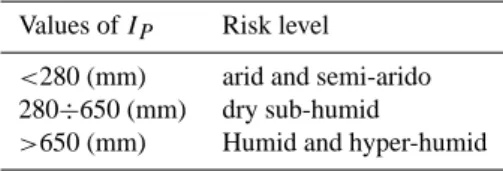
Table 1. Classification of the climatic zones according to the
rain-fall index.
Values of IP Risk level
<280 (mm) arid and semi-arido
280÷650 (mm) dry sub-humid
>650 (mm) Humid and hyper-humid
disaggregate parameter base, suitable to give a support to the medium term provisional analysis of the studying process. It is important to underline that analysis has been effected us-ing historical series reported to a brief period of observation because of the not complete availability of all data, reported to every climatic parameter, necessary for the elaboration of aggregated indexes that will be considerer later in the pa-per. Also, being evident that the climatic variables are not correlated to bashful with the recorded courses in the long period, it is necessary to notice that the principal intent of this job has been to make a test of a methodology, follow-ing described, respect to the deducible information from the available historical series, apart from the analysis of the evo-lutionary trends of the selected components, in this phase.
2 Study methodology
The performed analysis is based on the use of the state, pres-sure, impact indicators methodology and, in particular, the hydraulic-hydrologic indexes and the soil ones have been valued (Greco et al., 2003).
It was reached, therefore, the draft valuation of the vulner-ability to the desertification risk of the territory examined, giving a first cognitive level to use as work basis propaedeu-tic to the integration of other indices representing the phe-nomenon, or better suggesting provisional quantities models that allow the definition of the indicators themselves.
Three different indices have been used, reflecting the terri-torial system state with regard to the acting climatic stresses. In particular:
– rainfall index; – aridity index; – ratio SAU/ST.
The rainfall index is a typically hydrologic index with the double function of considering the rain as one of the main erosive soil agent and, consequently, giving the contribution to the degradation of it, and, on the other hand, of contribut-ing to the vegetation growth.
Three rainfall groups have been identified for this index, considering the rain values accumulated in the space of one year, to which a higher risk is associated when the rainfall decreases.
Unlike the previous one, the aridity index considers the soil because it is calculated as the ratio between the annual
Table 2. Classification of the climatic zones according to the aridity
index.
Values of Ia Definition of the climatic zones
<0.5 arid and semi-arid
0.5÷0.65 dry sub-humid
>0.65 Humid and hyper-humid
average precipitations, P , and the potential annual average evapo-transpiration, ETP, and so it considers the average wa-ter availability in the soil essential for the preservation of the vegetal species.
Three groups corresponding to definite climatic zones have been identified for both indices to which a different value has been assigned (Tables 1 and 2).
The ratio Farm Surface Used (SAU)/Total Territorial Sur-face (ST), finally, gives an indication of the part of the ter-ritory really assigned to productive farm activities compared with the total territorial surface and so of the real pressure state both on the territory and on the soil in regard to an-thropic activities against the cultivation tendency of the area. In fact, according to the definition of the ISTAT, the agrar-ian surface used is considered as the totality of the sow able land surfaces, permanent mead owed surfaces, pasture-land surfaces and agrarian wooden cultivation, kitchen-gardens and fruit chestnut grove. Although the index is mostly socio-economic, its evolution in time can give indications about the impact exercised by the farms on the environment, above all in terms of soil removed to agrarian use, agriculture exten-sive or abandonment of marginal areas.
A decrease of the ratio in upland areas is generally inter-preted in the negative because it is correlated to a progressive abandonment of “marginal” areas, main cause of soil erosion phenomena and hydro geological risk.
3 Study area and environmental conditions
The region of Basilicata is considered as one of the most threatened areas of Italy as far as the phenomenon of de-sertification is concerned. This is mainly due to climactic changes and to the widespread degradation of the territory resulting from hydro geological instability, woodland fires, and more generally to an ever growing misuse of the land by man.
In particular the most affected areas of this phenomenon are the Ionian alluvial plain and the south-eastern territories characterised by their plio-pleistocene clays.
The former, deriving from the expansion of the region’s rivers over coastal deposits left by the sea’s regression and now representing the main agricultural area, is subject to im-portant and periodical salting process which in recent years have become more frequent. Although it is not possible to quantify, with great precision, the areas affected by this pro-cess or even describe the intensity, the limited fertility of the
M. Greco et al.: Desertification risk assessment in southern Mediterranean areas 245
7
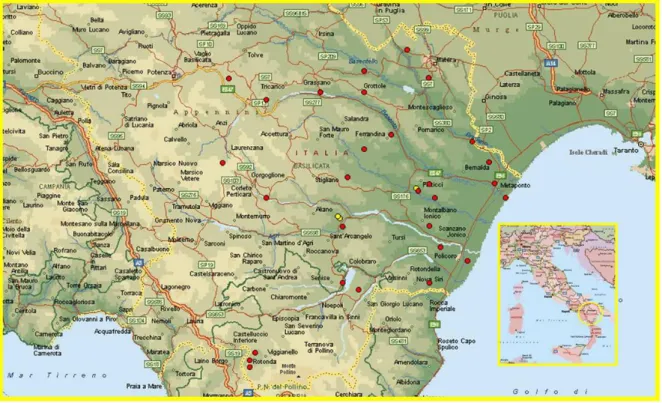
Figure 1. The study area.
4 Data analysis and first results
The processing on the select indicators has been performed with reference to the data obtained
by the meteorological gauge-stations of ALSIA, distributed on the whole Lucanian territory.
In particular, among the thirty nine telemetry control units, the twenty nine of the
south-eastern part of the region, corresponding to the whole study area, have been selected.
Data about rain, temperature and relative humidity measurements available in time format, for
this work, have been aggregate on a daily basis and, successively, on an annually one. The
space distribution and the rainfall index variation, relative to the period of observation
1999-2003, are showed in the Fig. 2 and underline, excluding the year 2002, low annual rainfalls on
the whole studying territory. In fact, altogether, rainfall index values around 400-450 mm
have been observed and, for this reason, they place the study areas in the middle-high range of
risk.
Fig. 1. The study area.
land for agricultural purposes is particularly evident in some areas which were studied. This is due to several contributory factors: the production of erosive materials deriving from marine terraces above the plains which, due to the pedoge-netic substrate (plio-pleistocene bluish-grey clays), are rich in soluble salts, and particularly in sodium, sea water infil-tration and finally the soil pattern which, if very fine, may result in a deposit of salt along the profile.
These areas are locally defined as “burned land” and can be readily found along the entire coastline from Policoro to Scanzano and up as far as Metaponto and also spread inland for about 1km covering an area of 4000 ha. The irrigation waters, deriving from the local Consorzio di Bonifica (lo-cal water supply) are of a high quality, while the quantity of such water obtained from local wells is very low, as well as being dangerous due to its high salt content (Ministero dell’Ambiente, 1999).
Plio-pleistocene clay areas also tend to be very hard as is the case in about 200 000 ha of territory to the south-east of the region. However, these problems are in fact of an-other nature: the widespread formation of gullies represent a significant index of the high level of land degradation and, consequently, a continuous and progressive increasing of ter-ritorial vulnerability. The hot, dry summers cause the sur-face crust of the south-facing lands and ridges generate a land creeping with the depth of the creeps depending on geo-graphical orientation. It therefore follows that with the ag-gressive summer and autumn rainstorms an increased sur-face area is subject to land erosion: from 2 mm to 20 mm
per year. However, on the other hand, we can also find flat or mildly sloping areas where the intensity of notable de-segregation processes is inferior. All this, coupled with the management difficulties arising from the particular morpho-logical features of the area, generate a productive deficiency of these lands: it is for this very reason that these areas are greatly influenced by recent EU directives aimed at extend-ing them and transformextend-ing them into productive woodlands (Agenzia Nazionale per la Protezione dell’Ambiente, 2000). The clayey nature of the territory described, is too prepon-derant to generate a state of aridity constant in time.
It is evident, therefore, that the risk of desertification in Basilicata, due to the intrinsic nature, as well as to the an-thropic use of the land is considerably high and that the draw-ing up of a map, highlightdraw-ing the area’s vulnerable points, represents an essential tool in order to set forth a strategic plan for productive assets and for the establishment of in-frastructures within the region.
The study area has interested the zone between the Ionian coast and the hills of Matera area of Basilicata in the territory of Tursi, Montalbano Ionico, Pisticci, Craco, Aliano, Ferran-dina (low and middle hills of Matera area), San Mauro Forte, Stigliano, Cirigliano, Gorgoglione (high hills of Matera area) and Guardia Perticara in the province of Potenza as showed in the Fig. 1 covering almost the whole of Lucanian basins.
246 M. Greco et al.: Desertification risk assessment in southern Mediterranean areas 8 0 200 400 600 800 1000 1999 2000 2001 2002 2003
Figure 2. Spatial distribution of the rainfall index by 1999 to 2003.
Fig. 3 refer to the aridity index for the same years showing values markedly lower than 0,5 and putting the areas in the zone corresponding to the arid and semi-arid zones. The reading of temporal vulnerability maps of the two indices allows to draw useful information about the pressure state to which the Lucanian territory is subjected and, in particular, the south-eastern part of the region. The observed rainfall shortage, in fact, versus an evident stability of the aridity index on middle-high values, states, in a more accurate way, what emerges from the analyses conduced on a national scale underlining a tendential increase of desertification risks of the territory in answer to the imposed aridity conditions to which the area has been subjected.
Fig. 2. Spatial distribution of the rainfall index by 1999 to 2003.
4 Data analysis and first results
The processing on the select indicators has been performed with reference to the data obtained by the meteorological gauge-stations of ALSIA, distributed on the whole Lucanian territory. In particular, among the thirty nine telemetry con-trol units, the twenty nine of the south-eastern part of the region, corresponding to the whole study area, have been se-lected.
Data about rain, temperature and relative humidity mea-surements available in time format, for this work, have been aggregate on a daily basis and, successively, on an annually one. The space distribution and the rainfall index variation, relative to the period of observation 1999–2003, are showed in the Fig. 2 and underline, excluding the year 2002, low annual rainfalls on the whole studying territory. In fact, alto-gether, rainfall index values around 400–450 mm have been observed and, for this reason, they place the study areas in the middle-high range of risk.
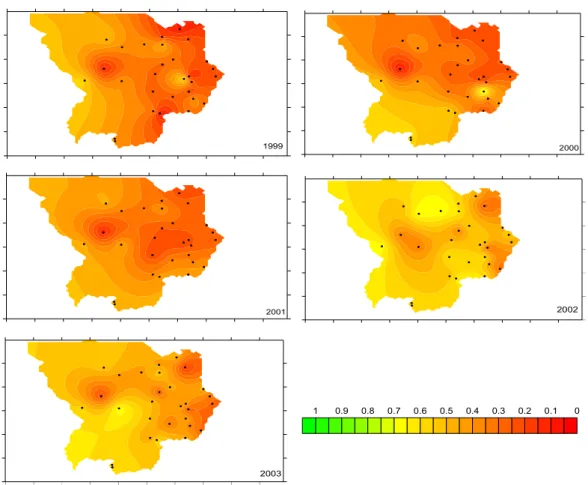
Figure 3 refers to the aridity index for the same years showing values markedly lower than 0,5 and putting the ar-eas in the zone corresponding to the arid and semi-arid zones. The reading of temporal vulnerability maps of the two in-dices allows to draw useful information about the pressure state to which the Lucanian territory is subjected and, in
par-ticular, the south-eastern part of the region. The observed rainfall shortage, in fact, versus an evident stability of the aridity index on middle-high values, states, in a more ac-curate way, what emerges from the analyses conduced on a national scale underlining a tendential increase of desertifi-cation risks of the territory in answer to the imposed aridity conditions to which the area has been subjected.
Finally, the information derivable from the spatial distribu-tion of the ratio SAU/ST, even if averaged on the long term, shows a high degree of utilization of the soil for agrarian use with percentages between the 70%–85%, strengthening the positions derived from hydrologic indices analysis, showing the presence and the possible increase of a high vulnerabil-ity state of territory, concause of the climatic and anthrophic components.
5 Conclusions
The study of some physical-climatic and hydrologic indica-tors, and their following comparison in different times, allow a valuation of the vulnerability degree of Basilicata Region. The analysis of the rainfall index maps that registers the rain-fall shortage in the last years, the aridity index value that puts the territory in an arid or semi-arid area and the high
9 1999 2000 2001 2002 2003 0 0.1 0.2 0.3 0.4 0.5 0.6 0.7 0.8 0.9 1
Figure 3. Spatial distribution of the aridity index by 1999 to 2003.
Finally, the information derivable from the spatial distribution of the ratio SAU/ST, even if averaged on the long term, shows a high degree of utilization of the soil for agrarian use with percentages between the 70%-85%, strengthening the positions derived from hydrologic indices analysis, showing the presence and the possible increase of a high vulnerability state of territory, concause of the climatic and anthrophic components.
Fig. 3. Spatial distribution of the aridity index by 1999 to 2003.
10 0.3 0.35 0.4 0.45 0.5 0.55 0.6 0.65 0.7 0.75 0.8 0.85 0.9 0.95 1
Figure 4. Ratio SAU/ST.
5 Conclusions
The study of some physical-climatic and hydrologic indicators, and their following comparison in different times, allow a valuation of the vulnerability degree of Basilicata Region. The analysis of the rainfall index maps that registers the rainfall shortage in the last years, the aridity index value that puts the territory in an arid or semi-arid area and the high ratio SAU/ST have showed an increase of the sensitive areas toward aridity and desertification phenomena. The results obtained have allowed to make a draft valuation of the vulnerability state to the desertification of the studying territory, reaching a first cognitive level to expand in future introducing other indices representative of the phenomenon.
References
Agenzia Nazionale per la Protezione dell’Ambiente, ANPA: Sviluppo di indicatori per il suolo e siti contaminati, Roma, 2000.
Greco, M., Telesca, V., and Squicciarino, G. :Applicazione di un modello concettuale DTPSIR per lo studio della desertificazione del territorio lucano, Documenti del territorio, 52, 2003.
Ministero dell’Ambiente: Comunicazione nazionale per la lotta alla siccità ed alla desertificazione, Roma, 1999.
Fig. 4. Ratio SAU/ST.
ratio SAU/ST have showed an increase of the sensitive areas toward aridity and desertification phenomena. The results obtained have allowed to make a draft valuation of the vul-nerability state to the desertification of the studying territory, reaching a first cognitive level to expand in future introduc-ing other indices representative of the phenomenon.
Edited by: L. Ferraris
Reviewed by: anonymous referees
References
Agenzia Nazionale per la Protezione dell’Ambiente, ANPA: Sviluppo di indicatori per il suolo e siti contaminati, Roma, 2000. Greco, M., Telesca, V., and Squicciarino, G. :Applicazione di un modello concettuale DTPSIR per lo studio della desertificazione del territorio lucano, Documenti del territorio, 52, 2003. Ministero dell’Ambiente: Comunicazione nazionale per la lotta alla