HAL Id: hal-01966703
https://hal.archives-ouvertes.fr/hal-01966703
Submitted on 29 Dec 2018
HAL is a multi-disciplinary open access
archive for the deposit and dissemination of
sci-entific research documents, whether they are
pub-lished or not. The documents may come from
teaching and research institutions in France or
abroad, or from public or private research centers.
L’archive ouverte pluridisciplinaire HAL, est
destinée au dépôt et à la diffusion de documents
scientifiques de niveau recherche, publiés ou non,
émanant des établissements d’enseignement et de
recherche français ou étrangers, des laboratoires
publics ou privés.
Basal slip of a screw dislocations in hexagonal titanium
Piotr Kwasniak, Emmanuel Clouet
To cite this version:
Piotr Kwasniak, Emmanuel Clouet. Basal slip of a screw dislocations in hexagonal titanium. Scripta
Materialia, Elsevier, 2019, 162, pp.296-299. �hal-01966703�
Basal slip of hai screw dislocations in hexagonal titanium
Piotr Kwasniaka,∗, Emmanuel Clouetb
aFaculty of Materials Science and Engineering, Warsaw University of Technology, Woloska 141, 02-507 Warsaw, Poland bDEN-Service de Recherches de M´etallurgie Physique, CEA, Universit´e Paris-Saclay, F-91191 Gif-sur-Yvette, France
Abstract
Basal slip of hai screw dislocations in hexagonal closed-packed titanium is investigated with ab initio calcu-lations. We show that a basal dissociation is highly unstable and reconfigures to other structures dissociated in a first order pyramidal plane. The obtained mechanism for basal slip corresponds to the migration of the partial dislocations and of the associated stacking fault ribbon in a direction perpendicular to the dissocia-tion plane. Presented results indicate that both basal and pyramidal slip will operate through the Peierls mechanism of double-kink nucleation and will be equally active at high enough temperature.
Keywords: Titanium; Plasticity; Dislocations; Ab initio; Basal slip
Plastic deformation of hexagonal titanium de-pends on complex interplay of temperature, pu-rity and activity of the different slip modes [1– 4]. Experiments recognized that prismatic slip of hai = 1/3 h1210i dislocations is the easiest slip mode with a lattice friction opposing the motion of the screw orientation for temperatures below 550 K while hai dislocation with an edge character remain highly mobile [5, 6]. In situ TEM straining exper-iments [7] confirmed that deformation is governed at low temperatures by long rectilinear screw dislo-cations which glide in the {1010} prismatic planes through a jerky motion associated with some cross-slip in the {1011} pyramidal planes. This thermally activated mobility of the screw dislocation in pure Ti could be explained by a locking-unlocking mech-anism [7, 8]: the screw dislocation, which is sessile in its ground state, needs to reconfigure to a higher energy configuration corresponding to a dissocia-tion in a prismatic plane where the dislocadissocia-tion can easily glide. Various cores have been proposed for this ground state [5, 9, 10] and recent ab initio cal-culations [11] have shown that it corresponds to a planar dissociation in the pyramidal plane.
Besides prismatic and pyramidal glide, hai dis-locations in hcp Ti are also known to glide in the
∗Corresponding author
Email address: [email protected] (Piotr Kwasniak)
(0001) basal planes [12–14]. Recent TEM obser-vations [15, 16] at and above room temperature show straight screw dislocations moving viscously in the basal planes. This deformation mode is, how-ever, part of profuse cross slip and is always linked with prismatic glide, leading to wavy slip traces. Caillard et al. [15] have proposed that basal glide of the screw dislocations proceeds through a kink-pair mechanism, where the screw dislocation re-mains dissociated either in a pyramidal or prismatic plane and a kink-pair nucleates in the neighbor-ing Peierls valley, with the kinks lyneighbor-ing in the basal plane. A basal dissociation of the gliding disloca-tion will therefore not be required to allow for basal slip. Ab initio calculations have actually not man-aged to stabilize such a basal configuration of the screw dislocation until now [17], probably because the basal I2 stacking fault associated with such a
dissociation has a too high energy in titanium [18– 21]. Here, we use ab initio calculations to examine more closely the stability of such a basal dissocia-tion of the hai screw dislocadissocia-tion in pure Ti, before determining the transition pathway corresponding to basal slip, taking into account all configurations which have been found stable for the hai screw dis-location.
The computational supercell used in this study contains 288 atoms and exhibits m = 9, n = 8 and l = 1 unit cell periodicity along ~ex = [0001],
~
respec-Figure 1: Core structures corresponding to a basal dissociation of a 1/3 [1210] screw dislocation for two different positions B1 and B2 of the dislocation center. The initial configurations are shown in a), the fully relaxed configurations in b) and
the configurations obtained with constrained minimization in c). Different dissociation distances λ are studied. The arrows between two atomic columns are proportional to the differential displacement created by the dislocation in the [1¯210] direction. Displacement smaller than 0.1 b are not shown. The contour map shows the dislocation density according to the Nye tensor. Ti atoms belonging to particular types of stacking faults or different (1¯210) atomic planes are plotted with open or full-colored symbols as presented in top-right corner. Positions of the dislocation centers are marked by green crosses and constrained atoms with a fixed position along the dislocation line are marked by light-blue squares. The energy variation ∆E as a function of the basal dissociation distance λ obtained from ab initio calculations (B1and B2) and linear elasticity (LE) are shown in
d) with filled and opened symbols respectively for unconstrained and constrained relaxations.
tively. As a result, the periodicity vectors of the simulation box are ~u1 = mc ~ex, ~u2 = na ~ey and ~u3
= la ~ez, where a and c are the Ti lattice
param-eters. The calculations of the screw dislocations were performed in accordance to full periodic con-ditions approach [21, 22] and the initial structures of two line defects with opposite Burgers vectors were generated using anisotropic linear elasticity thanks to the Babel code [23]. The two disloca-tions composing the dipole are separated by a vec-tor ~d = 1/2 (~u1+ ~u2), thus leading to a
quadrupo-lar arrangement which minimizes the elastic inter-action between the dislocations and their periodic images. The plastic strain created by the dipole is compensated by adding the tilt vectors ~δ1 = ~b/2
= a ~ez/2 and ~δ2 = - ~δ1 to ~u1 and ~u2, respectively.
It should be highlighted that the selected supercell geometry has an odd number of α-Ti unit cell repe-tition along ~ex(m = 9) which is different from those
used in previous studies of〈a〉 type screw disloca-tions in hcp systems [11, 22, 24, 25]. This ensures that the plastic strain arising from the edge
com-ponents of a basal dissociation exactly compensates for the two dislocations composing the dipole, thus preventing the existence of a back-stress caused by the fixed periodicity vectors and which would acts against such a dissociation.
Ab initio calculations were performed with VASP code [26, 27], with projector augmented wave (PAW) method for core-valence electron inter-action [28] and Perdew-Burke-Ernzerhof (PBE) [29] generalized gradient functional. The Bril-louin zone was sampled in accordance with the Monkhorst-Pack scheme [30] using 1 × 1 × 9 gamma centered k-points grid and a 0.3 eV Methfessel-Paxton electronic occupancy smearing. The Ti pv pseudopotential with 10 valence electrons (3p63d24s2) was employed, with a 500 eV cutoff
en-ergy for plane waves. The atomic structures of the screw dislocations were determined by perform-ing ionic relaxations with a fixed-shape simulation box using a criterion of 3 meV/˚A for Hellmann-Feynman forces convergence. The relative line de-fects energies are equal to:
∆E = Etot− Eπl
2h (1)
where, Etot is the total energy of α-Ti supercells
with different positions or configurations of dislo-cation cores, Eπlis the total energy of the
simula-tion box with dislocasimula-tions in their ground state (low energy pyramidal configuration [11]), and h is the height of the atomic model along dislocation line.
The dislocation initial configuration is dissoci-ated in the basal plane. It is introduced in the sim-ulation cell by applying to all atoms the elastic dis-placement predicted by anisotropic elasticity for a pair of 1/3 h1100i and 1/3 h0110i Shockley partials in the same prismatic plane (Fig. 1a), thus cre-ating a stacking fault ribbon between them. Two core positions, which correspond to the center of symmetry of the ground state or of the high energy pyramidal metastable configuration, marked as B1
and B2, respectively, are considered. Width of the
core is characterized by the distance λ between the two Shockley partials which is measured in units of the distance k = a√3/2 between two Peierls valleys in the [1010] direction. Such prepared basal screw dislocations subjected to ab initio ionic relaxation spontaneously reconfigure to the ground state πlor
high energy pyramidal πh geometry depending on
their initial position (Fig. 1b), with an energy dif-ference ∆E = 11.9 meV/˚A between these two states in good agreement with previous ab initio studies [11, 25, 31]. Our investigation therefore conclude to the instability of basal dissociation in pure Ti, which is in line with the ab initio calculations of Tarrat et al. [17] relying on different boundary con-ditions.
To unveil the energy variation during decay of the basal dissociation, i.e. to estimate the core energy as function of the basal dissociation width, con-strained relaxations have also been performed. In these calculations, atoms in the dissociation plane located between the two partial dislocations were not allowed to relax along the [1210] screw di-rection. These atoms are indicated by light-blue squares in Fig. 1c. Such a constraint allows main-taining the basal stacking fault. Because of hcp lattice symmetry, the dissociation distance λ where this constraint is applied needs to be equal to an odd (respectively even) number of distances k be-tween Peierls valleys for the B1 (respectively B2)
position. Independently from the selected core po-sition and width, the leading and trailing partials are never purely basal but spread onto the
pris-matic or first-order pyramidal planes (Fig. 1c). Moreover, the energy of the considered line defects strongly depends on the basal dissociation distance as shown in Fig. 1d. The excess energy ∆E contin-uously increases with the dissociation distance λ, without showing any minimum at small distances, thus indicating the absence of a metastable con-figuration dissociated in the basal plane. The en-ergy variation corresponding to a basal dissociation was also calculated according to elasticity theory (Eq. 3 in Ref. [22]) using a core radius equal to 1 k, a stacking fault energy γb = 306 mJ/m2 and
the elastic constants given by our ab initio calcu-lations. As shown in Fig. 1d, linear elasticity, al-though not fully quantitative, provides a reasonable estimate of ∆E(λ): this energy variation therefore mainly results from the increase of the dissociation width. Elasticity theory predicts a dissociation dis-tance deqb = 2.6 ˚A = 1.03 k, a distance which is too small to lead to any real basal dissociation, in agreement with ab initio results.
As basal slip in pure Ti does not stem from a basal dissociation, we consider now the ground state of the screw dislocation, where the core is dissoci-ated in a pyramidal plane (configuration πl in Fig.
1b), and examine how such a core can glide in a basal plane. The studied scenario involves basal motion of the screw dislocation from its πlground
state to the next equivalent πlposition in the [1010]
direction. The minimum energy path determined with the nudged elastic band (NEB) method [32] using 5 intermediate images corresponds to the re-action coordinate 0 ≤ ζ ≤ 2 in Fig. 2. According to the preliminary results obtained with a force con-vergence criterion of 30 meV/˚A, direct πl→ πlglide
goes through an intermediate metastable configura-tion which corresponds to the high energy πh core
(Fig. 2e). The NEB calculation was thus further refined by considering the two half-paths πl → πh
and πh → πl with 5 intermediate images and a
20 meV/˚A convergence criterion. The obtained en-ergy barrier is only about +2 meV/˚A higher than the metastable πh core and corresponds to a
con-figuration where the dislocation is spread in both prismatic and pyramidal planes (Fig. 2c).
We then consider the prismatic configuration of the screw dislocation. As previously shown [11], hai screw dislocations in Ti can adopt a config-uration where the core is fully dissociated in a prismatic plane and where the dislocation center is at the same position as for the ground state (Fig. 2b). This metastable P core has an energy
Figure 2: Basal slip of the hai screw dislocation starting from its ground-state pyramidal πland its prismatic P configurations.
The energy variation ∆E is shown as a function of a reaction coordinate ζ, with fully colored points and opened circles corre-sponding to (meta-)stable cores and transition configurations obtained by the NEB method, respectively. The correcorre-sponding path is sketched on top with the basal slip plane marked by a vertical red line. Some core structures along this path are shown in subfigures (a-e) (see Fig. 1 for a detailed caption of these subfigures).
∆E = 5.6 mev/˚A, still in good agreement with pre-vious ab initio calculations [11, 25, 31], and the en-ergy barrier leading to this stationary core recon-struction is only slightly higher than the energy of P state (energy path shown for 2 ≤ ζ ≤ 3 in Fig. 2). The minimum energy path for basal glide of this prismatic core geometry (3 ≤ ζ ≤ 5 in Fig. 2) goes through the same configurations as for the πl→ πl
transition, thus leading to the same energy barrier. Similarly to πl→ πl slip, after an initial NEB
cal-culation with 5 intermediate images,where the in-termediate πh configuration appeared, the P → P
transition has been refined by considering half the path, corresponding thus to the P → πhtransition.
Besides the intermediate πh configuration, a well
defined additional metastable state (Fig. 2d)
ap-pears both during P → P basal slip (ζ ∼ 3.7 and 4.3), and during πl → πl basal slip (ζ ∼ 0.7 and
1.3), where the dislocation is partly dissociated in the pyramidal and prismatic plane.
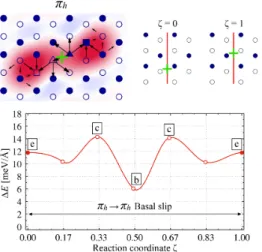
We finally consider basal slip of the metastable πh core (Fig. 3), using 5 intermediate images in
the NEB calculation, as this configuration appears in both πl → πl and P → P transition paths. No
new path was actually obtained as this πh → πh
transition goes through the prismatic configuration and is equivalent to the P → P basal slip.
Summarizing the present study, it was found that basal glide of the 1/3〈11¯20〉 screw dislocations in pure Ti is realized without any basal dissociation. Instead, the dislocation remains dissociated in pyra-midal and prismatic planes during the transition, 4
Figure 3: Minimum energy path for basal slip of hai screw dislocation, corresponding to the transition between two neighboring πhmetastable core (shown in the top-left
cor-ner). The labels (b), (c), and (e) refer to the configurations shown in Fig. 2.
with a motion of the partial dislocations and of the stacking fault ribbon in a direction perpendicular to the dissociation plane. This basal slip mecha-nism is similar to the one already identified in Zr [24]. Because of the high energy barrier associated with such a path, basal slip will proceed through the nucleation of double kinks thanks to thermal acti-vation, in agreement with the Peierls mechanism inferred from TEM observations [15]. The same configurations being involved for basal as for pris-matic and pyramidal motion, this explains the wavy slip traces experimentally observed when basal slip is active [15, 16]. Finally, as the Peierls barrier of basal and pyramidal [11] glide are close, both basal and pyramidal slip are activated at high enough temperature [15, 16].
Acknowledgments - This work supported by the National Science Center under SONATINA 1 project No. 2017/24/C/ST8/00123. Computing resources were provided by the HPC facilities of the PL-GRID and CI-TASK infrastructure.
References
[1] A. T. Churchman, The slip modes of titanium and the effect of purity on their occurrence during tensile de-formation of single crystals, Proc. R. Soc. Lond. A 226 (1954) 216–226. doi:10.1098/rspa.1954.0250. [2] H. Conrad, Effect of interstitial solutes on the strength
and ductility of titanium, Prog. Mater. Sci. 26 (1981) 123–403. doi:10.1016/0079-6425(81)90001-3.
[3] S. Naka, A. Lasalmonie, Prismatic slip in the plastic deformation of α-Ti single crystals below 700 K, Mater. Sci. Eng. 56 (1982) 19–24. doi:10.1016/0025-5416(82) 90178-1.
[4] D. Caillard, J. L. Martin, Thermally activated mech-anisms in crystal plasticity, Pergamon, Amsterdam, 2003.
[5] S. Naka, A. Lasalmonie, P. Costa, L. P. Kubin, The low-temperature plastic deformation of α titanium and the core structure of a-type screw dislocations, Philos. Mag. A 57 (1988) 717–740. doi:10.1080/ 01418618808209916.
[6] M. P. Biget, G. Saada, Low-temperature plasticity of high-purity α-titanium single crystals, Philos. Mag. A 59 (1989) 747–757. doi:10.1080/01418618908209818. [7] S. Farenc, D. Caillard, A. Couret, An in situ study of
prismatic glide in α titanium at low temperatures, Acta Metall. Mater. 41 (1993) 2701 – 2709. doi:10.1016/ 0956-7151(93)90139-J.
[8] S. Farenc, D. Caillard, A. Couret, A new model for the peak of activation area of α titanium, Acta Met-all. Mater. 43 (1995) 3669 – 3678. doi:10.1016/ 0956-7151(95)90150-7.
[9] M. ˇSob, Sessile splittings of screw dislocations in h.c.p. metals, Phys. Stat. Sol. (a) 24 (1974) K133–K136. doi: 10.1002/pssa.2210240252.
[10] M. ˇSob, J. Kratochv´ıl, F. Kroupa, Theory of strength-ening of alpha titanium by interstitial solutes, Czech. J. Phys. B 25 (1975) 872–890. doi:10.1007/BF01589305. [11] E. Clouet, D. Caillard, N. Chaari, F. Onimus, D.
Rod-ney, Dislocation locking versus easy glide in titanium and zirconium, Nat. Mater. 14 (2015) 931–936. doi: 10.1038/nmat4340.
[12] E. D. Levine, Deformation mechanisms in titanium at low temperatures, Trans. AIME 236 (1966) 1558. [13] D. Shechtman, D. G. Brandon, Orientation dependent
slip in polycrystalline titanium, J. Mater. Sci. 8 (1973) 1233–1237. doi:10.1007/BF00549337.
[14] A. Akhtar, Prismatic slip in zirconium single crystals at elevated temperatures, Metall. Mater. Trans. A 6 (1975) 1217–1222. doi:10.1007/BF02658531.
[15] D. Caillard, M. Gaum´e, F. Onimus, Glide and cross-slip of a -dislocations in Zr and Ti, Acta Mater. 155 (2018) 23–34. doi:10.1016/j.actamat.2018.05.038.
[16] B. Barkia, J. Couzini´e, S. Lartigue-Korinek, I. Guil-lot, V. Doquet, In situ TEM observations of dislo-cation dynamics in α titanium: Effect of the oxy-gen content, Mater. Sci. Eng., A 703 (2017) 331–339. doi:10.1016/j.msea.2017.07.040.
[17] N. Tarrat, M. Benoit, D. Caillard, L. Ventelon, N. Combe, J. Morillo, Screw dislocation in hcp Ti: DFT dislocation excess energies and metastable core structures, Modelling Simul. Mater. Sci. Eng. 22 (2014) 055016. doi:10.1088/0965-0393/22/5/055016. [18] P. Kwa´sniak, P. Spiewak,´ H. Garbacz, K. J.
Kurzyd lowski, Plasticity of hexagonal systems: Split slip modes and inverse Peierls relation in α-Ti, Phys. Rev. B 89 (2014) 144105. doi:10.1103/physrevb.89. 144105.
[19] P. Kwa´sniak, H. Garbacz, K. Kurzydlowski, Solid solution strengthening of hexagonal titanium alloys: Restoring forces and stacking faults calculated from first principles, Acta Mater. 102 (2016) 304–314. doi: 10.1016/j.actamat.2015.09.041.
first-principles study of stable stacking faults in hcp met-als, Acta Mater. 123 (2017) 223–234. doi:10.1016/j. actamat.2016.10.042.
[21] D. Rodney, L. Ventelon, E. Clouet, L. Pizzagalli, F. Willaime, Ab initio modeling of dislocation core properties in metals and semiconductors, Acta Mater. 124 (2017) 633–659. doi:10.1016/j.actamat.2016.09. 049.
[22] E. Clouet, Screw dislocation in zirconium: An ab initio study, Phys. Rev. B 86 (2012) 144104. doi:10.1103/ PhysRevB.86.144104.
[23] E. Clouet, Babel software (n.d.).
URL http://emmanuel.clouet.free.fr/Programs/ Babel/index.html
[24] N. Chaari, E. Clouet, D. Rodney, First-principles study of secondary slip in zirconium, Phys. Rev. Lett. 112 (2014) 075504. doi:10.1103/PhysRevLett.112.075504. [25] P. Kwa´sniak, H. Garbacz, Screw dislocation mediated solution strengthening of substitutional αTi alloys -first principles investigation, Acta Mater. 141 (2017) 405–418. doi:10.1016/j.actamat.2017.09.028. [26] G. Kresse, J. Hafner, Phys. Rev. B 47 (1993) 558–561. [27] G. Kresse, J. Furthm¨uller, Phys. Rev. B 54 (1996)
11169–11186.
[28] P. E. Bl¨ochl, Phys. Rev. B 50 (1994) 17953–17979. [29] J. P. Perdew, K. Burke, M. Ernzerhof, Phys. Rev. Lett.
77 (1996) 3865–3868.
[30] H. J. Monkhorst, J. D. Pack, Phys. Rev. B 13 (1976) 5188–5192.
[31] M. Poschmann, M. Asta, D. C. Chrzan, Convergence of calculated dislocation core structures in hexagonal close packed titanium, Modelling Simul. Mater. Sci. Eng. 26 (2018) 014003. doi:10.1088/1361-651X/aa9ba9. [32] D. Sheppard, R. Terrell, G. Henkelman, Optimization
methods for finding minimum energy paths, J. Chem. Phys. 128 (2008) 134106. doi:10.1063/1.2841941.
![Figure 1: Core structures corresponding to a basal dissociation of a 1/3 [1210] screw dislocation for two different positions B 1 and B 2 of the dislocation center](https://thumb-eu.123doks.com/thumbv2/123doknet/12879505.369888/3.892.105.791.169.508/figure-structures-corresponding-dissociation-dislocation-different-positions-dislocation.webp)