The architect’s perspective on the tour and map perspective
The MIT Faculty has made this article openly available. Please share
how this access benefits you. Your story matters.
Citation Papadopoulou, Athina. The Architect’s Perspective on the Tour and Map Perspective. Cognitive Processing, Volume 16, Issue 1 Supplement, (2015), pp 331-336.
As Published http://dx.doi.org/10.1007/s10339-015-0671-3
Publisher Springer Berlin Heidelberg
Version Author's final manuscript
Citable link http://hdl.handle.net/1721.1/103098
Terms of Use Article is made available in accordance with the publisher's policy and may be subject to US copyright law. Please refer to the publisher's site for terms of use.
The Architect’s Perspective on the Tour and Map Perspective
Athina Papadopoulou
Research Specialist, Massachusetts Institute of Technology
265 Massachusetts Avenue, MIT Bld. N52-373, Cambridge MA 02139, USA email: [email protected], phone: +16178066415
Abstract
Literature in linguistics suggests that when people are asked to provide an oral spatial description they usually provide a body-centered narrative; they adopt a Tour Perspective, that is, an imaginary tour of the space rather than a Map Perspective, that is, a description focused on spatial relations as “seen from above” (Linde and Labov, 1975; Howald, 2009).
I conducted a pilot experiment to address the following questions: Does the formal knowledge of architects –their familiarity with plan drawings and maps- override the tendency to adopt the tour perspective? Does the tour perspective depend on the actual experience of space?
Twenty-two graduate students in architecture were asked to respond to the following questions:
1. “Can you describe the layout of your apartment?” 2. “Can you describe the layout of an ideal apartment?”
In the responses to the first question most participants used the tour perspective. In the responses to the second question most participants used the map perspective.
The results provide evidence that architects’ formal knowledge does not override the preference of the tour perspective in descriptions of experienced space. Moreover, that the tour perspective is associated with the actual experience of space.
Keywords: Narratives, Embodied Cognition, Architecture, Tour Perspective, Map Perspective, Linguistics
1. Introduction
Plans and sections offer a formal, ‘artificial’ description of space that does not reflect the way we naturally perceive space when we experience it. Experience only gives a partial image of a space, one that one conceives while walking through it, or looking into it from a certain point of view. Previous studies on oral descriptions of space (Linde and Labov, 1975; Howald, 2009) suggest that people tend to describe a space as a sequence of movements, views and actions (Tour Perspective) rather than abstract geometric relations (Map Perspective). If this is the case, an analysis of verbal descriptions that focus on experiential approach of space can inform architectural discourse from a body-centered perspective.
By conducting a pilot experiment on oral descriptions of space focused on architects’ perspectives my aim was to explore whether architects’ formal knowledge and experience would override the preference of the tour perspective over the map perspective as suggested by Linde and Labov and Howald. Moreover to confirm or disproof the observation made by Howald that the use of the Tour Perspective is the prevalent perspective only if the space described has been experienced by the narrator.
2. Background
Linde and Labov (1975) in their paper "Spatial Networks as a Site for the Study of Language and Thought" studied the perspectives taken in oral descriptions of space. They conducted an experiment asking people to describe the layout of their apartment. Documenting and analyzing the results their aim was to demonstrate the underlying rules of these narratives. Observing the oral descriptions they distinguished between the Map Perspective of Space and a Tour Perspective of Space. They characterized the tour perspective as the default perspective taken since only the three percent of the participants provided a map perspective.
The tour description of space takes the form of an imaginary tour into the space in in the form of second-person narrative. As defined by Linde and Labov the tour perspective is a “speech act which provides a minimal set of paths by which each room could be entered.”
Contrary to the tour perspective, which focuses on the movement of the body into the space, the map perspective -referred to by Linde and Labov as only a rare case of spatial description- focuses on the overall spatial organization and the relationships of shapes as “seen from above.”
The distinction between “map” and “tour” perspectives can be also found in Howald (2009). Howard studied “guilty plea narratives” confirming Linde and Labov’s observations on the prevalence of the tour over the map perspective. He also added to this main claim the following observations: First, that the tour and map perspectives are not mutually exclusive; in many cases a short map description complements the tour narrative. Second, without however providing further evidence, that Linde and Labov’s analysis of the tour and map perspectives is only applicable to descriptions of spaces that have been personally experienced by the narrator.
3. Pilot Experiment: Method and Results 3.1 Revisiting Linde and Labov’s experiment
Twenty-two graduate students in the Architecture Department at Massachusetts Institute of Technology were asked to provide an oral description in response to the question “Can you describe the layout of your apartment?” This is the same question used by Linde and Labov in their study. The students were asked individually and the oral descriptions were documented. After providing the oral narrative the students were asked to also provide a sketch-plan of their apartment. Out of the twenty-two students, sixteen provided a tour perspective, five a map perspective and one a mixed one.
By repeating this question, but having only architects as narrators, my aim was to test whether architect’s formal knowledge would influence the results of the experiment. My first impression was that architects would favor the map perspective over the tour perspective but the results proved the opposite. This suggests that formal knowledge does not override the preference of the tour over the map perspective.
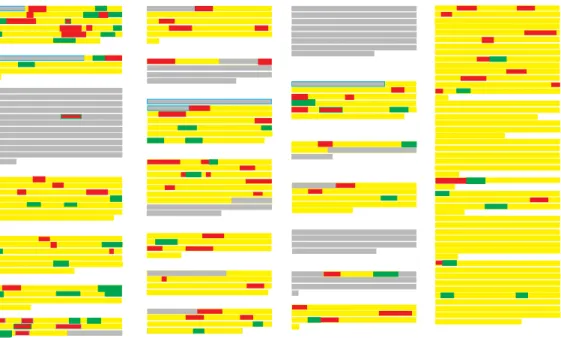
The results of the experiments are diagrammatically represented in the above diagram (fig. 1). Each of the narratives provided is shown as a distinct paragraph. Each line represents a series of approximately twenty-five spoken words. In yellow color the tour perspective is indicated and in grey color the map perspective. As shown in the diagram in many cases the tour perspective is complemented with a short map description, usually in the beginning or the end of the narrative. This fact confirms Howald’s (2009) observation. In some cases the complementary map description provides information about the overall organization of space in a few words, or it adds information about secondary spaces in the end of the description. If the map description acts only as a complementary statement the narrative is not considered here as mixed description. More specifically, a description is defined as mixed when more than twenty-five percent of the prevalent description is of the other type.
To make further observations regarding the perspectives used, the oral narratives were mapped onto the sketch-plans provided and analyzed according to the descriptions given. As it will be demonstrated though specific examples, the tour perspective is body-centered and dynamic but the map perspective non-temporal and externally defined in terms of reference.
In oral descriptions we either adopt an objective reference when referring to spatial relations or to a subjective reference. For example, we could say that “the kitchen is next to the living room” or that “the kitchen is at the south side.” This description can be regarded as objective because it does not depend on the location of the observer. On the contrary, if we say, “at the right of the living room is the kitchen”, the description is subjective because it depends on the position of the observer who distinguishes between “left” and “right.” The subjectivity of reference becomes more explicit when the
Figure 1. Diagrammatic representation of the narratives provided to the question “Can you describe
the layout of your apartment?” Each of the narratives provided is shown as a distinct paragraph. Each full line represents a series of approximately twenty-five spoken words. In yellow color the tour perspective is indicated and in grey color the map perspective. In red color are marked the expressions of transition and in green color the expressions of internal reference. The red and green colors are overlaid as a second layer on top of the specified types of narratives.
expression includes a direct reference to the body. For example, “At the right hand side, there is the kitchen”, or “As you enter, in front of you is the living room.” The distinction between a subjective and objective type of reference, defined in literature as the distinction between an “internal” and an “external” reference frame respectively, is discussed in depth by Tversky (1996).
The difference in frame of reference is one of the main characteristics that distinguish a tour from a map perspective. The first is associated with the internal reference frame and the second with the external. Another major difference concerns the notion of time. The tour perspective, as an imaginary tour includes expressions that express motion or transition such as “As you enter…” “If you keep going…” On the other had, the map
perspective, which focuses on geometric relations and connectivity from an external point of view, can be regarded as “static.” In the diagrammatic representation of the provided narratives (fig. 1) in green color the expressions of internal reference are indicated and in red color the expressions of transition. A typical example of a tour perspective, as provided by one of the students is the following:
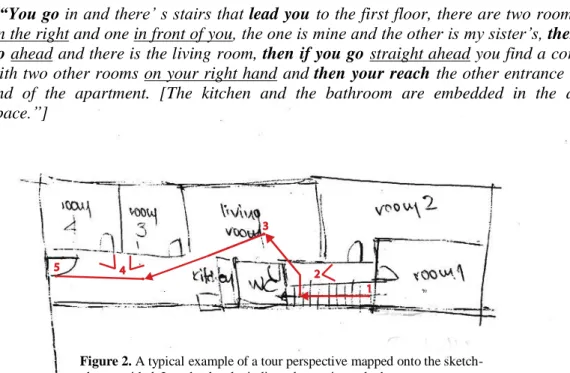
“You go in and there’ s stairs that lead you to the first floor, there are two rooms one on the right and one in front of you, the one is mine and the other is my sister’s, then you go ahead and there is the living room, then if you go straight ahead you find a corridor with two other rooms on your right hand and then your reach the other entrance of the end of the apartment. [The kitchen and the bathroom are embedded in the dining space.”]
In the language used in the tour narrative we observe the frequent use of expressions of transition (marked in bold) as well as the use of internal frame of reference (underlined). The tour perspective always takes the form of a second-person narrative. This probably happens because the subject provides the description directly to the interviewer (see Tversky, 1996). If we map the oral description onto the provided sketch (fig. 2), we observe that the tour begins from the entrance, then traverses the common areas and corridors and whenever there is a room the subject makes a reference to the room. The tour description is complemented in this example with a short map description in the end (defined between brackets). On the other hand, a typical example of a map perspective, as provided by one the architecture students is the following:
“So, my apartment I live now is at Tang Hall (…) on the east and west sides has the rooms for four people …so it has four bedrooms and living room which is big and has one bathroom and one small kitchen. And the other two types of rooms (...) Mine is the four-people one so I have three roommates, and the layout of my apartment is like a
Figure 2. A typical example of a tour perspective mapped onto the
trapezoid shape so the living room occupies the space that has the slope edges and the other three rooms are rectangular but the forth one has some small slope shape.”
As it is evident in the above example, no expressions of transition are used in the narrative. The description follows a static description focused on geometrical characterizations (marked in bold) and the overall spatial organization. Moreover the reference to the body is absent. Instead, the points of reference are external and objective (underlined phrases). Mapping the narrative onto the sketch-plan provided we identify the basic geometric configurations mentioned in the narrative (fig. 3).
3.2 Description of an ideal Apartment
To test this hypothesis that the tour perspective is associated with the actual experience of space I formulated a new question to be answered by the same architecture students. This time instead of describing their own apartment they were asked to provide a spatial description to the question “Can you describe the layout of an ideal apartment?” To test whether there is a default perspective preferred by each participant and to demonstrate others differences between the narratives provided for the first and second question the narratives were compared and analyzed.
Figure 3. A typical example of a map perspective mapped onto the
To the question “Can you describe the layout of an ideal apartment” fifteen out of the twenty-two students provided a map description, two out of the twenty-two a tour description, four out of twenty-two a mixed one, and one of them provided a more “poetic” approach that couldn’t be classified in the tour/map categories. The map perspective is marked in light grey color, the map perspective in yellow color and the unclassified in dark grey color (fig. 4). These results confirm the hypothesis that the tour description is associated with the memory of experienced space since in the hypothetical spatial narratives most of students chose the map description.
The expressions of transition are shown in the diagrams in red color and the reference to the body would be marked in green color but as it is evident in the graphical representation the internal reference is totally absent (fig. 4). The lack of specificity in terms of connectivity of spaces is also evident in the map perspective. To a certain degree this probably happens because it is a hypothetical scenario of space and the person does not have a very specific spatial organization in mind. We can also assume, given the association between tour narratives and memory of experienced space, that when imagining an ideal space the reference to the body is absent because the space has not been yet “inhabited.” It should be noted here that most students showed great surprise when were asked this question since they were forced to come up with an architectural solution almost instantly and only by mentally representing it.
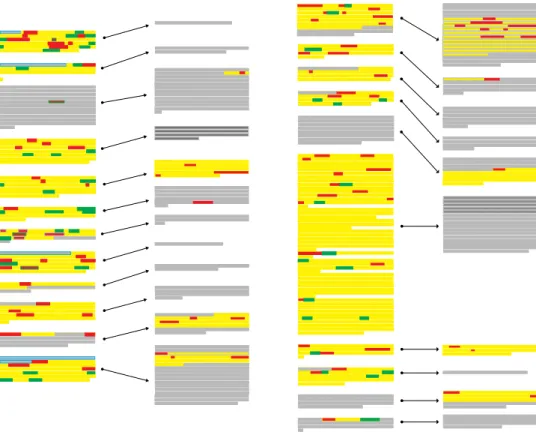
Comparing the results of the first and second questions (“Describe the layout of your apartment” and “Describe the layout of an ideal apartment”) we observe that the descriptions in the second question are in many cases much shorter in length making evident the lack of detail and specificity (fig. 5). Another fact observed is that two of the
Figure 4. Diagrammatic representation of the narratives provided to the question “Can you describe the
layout of an ideal apartment?” Each of the narratives provided is shown as a distinct paragraph. Each full line represents a series of approximately twenty-five spoken words. In yellow color the tour perspective is indicated and light grey color the map perspective. In dark grey color the unclassified perspective is indicated. In red color are marked the expressions of transition. The absence of green color indicates the absence of the expressions of internal reference.
five people that gave a map perspective in the first question switched to a tour perspective in the second and one of these five to a mixed perspective. This suggests that there is no default perspective for each person.
4. Conclusions
The results of pilot experiment I conducted suggest that the tour perspective is mainly associated with experienced space. To the question “Can describe the layout of your apartment?” most of the students took a tour perspective rather than a map perspective. The opposite is the case for the responses to question “Can you describe the layout of an ideal apartment?” In the responses to the second question the reference to the body was totally absent making further evident the association between the body-centered view and experienced space.
The results of the conducted experiment also suggest that architects’ formal knowledge does not override the tendency to use the tour perspective for experienced space. Experiments conducted in previous literature proved the prevalence of the tour perspective over the map perspective in oral spatial descriptions. By asking the same question only to architects (“Can describe the layout of your apartment?”) and receiving analogous results we come to the conclusion that formal knowledge is not a factor when choosing perspectives in narratives.
Figure 5. Diagrammatic comparison of the narratives given to the first question (“Can you
describe the layout of you apartment?”) and second question (“Can you describe the layout of an ideal apartment?”). In yellow color the tour perspective is indicated and in light grey color the map perspective. The arrows match the narratives given by the same person.
5. Acknowledgements
I would like to thank Professor Patrick H. Winston for his advice on this experiment.
6. References
HOWALD, B. S. (2009) Discursive Constraints on Space in Narrative: Evidence From Guilty Plea Discourse, eVox 3
LINDE, C and LABOV, W. (1975) Spatial Networks as a Site for the Study of Language and Thought, Language 51, 1, 924-939
TVERSKY, B. (1996) Spatial Perspective in Descriptions. In Paul Bloom et al, Ed., Language and Space. 2009. Cambridge MA: The MIT Press, 463-491