HAL Id: hal-01672571
https://hal.archives-ouvertes.fr/hal-01672571
Submitted on 26 Dec 2017
HAL is a multi-disciplinary open access
archive for the deposit and dissemination of
sci-entific research documents, whether they are
pub-lished or not. The documents may come from
teaching and research institutions in France or
abroad, or from public or private research centers.
L’archive ouverte pluridisciplinaire HAL, est
destinée au dépôt et à la diffusion de documents
scientifiques de niveau recherche, publiés ou non,
émanant des établissements d’enseignement et de
recherche français ou étrangers, des laboratoires
publics ou privés.
Discovering Injective Mapping Between Relations in
Astrophysics Databases
Nicu Stancioiu, Lhouari Nourine, Jean-Marc Petit, Vasile-Marian Scuturici,
Dominique Fouchez, Emmanuel Gangler, Philippe Gris
To cite this version:
Nicu Stancioiu, Lhouari Nourine, Jean-Marc Petit, Vasile-Marian Scuturici, Dominique Fouchez, et
al.. Discovering Injective Mapping Between Relations in Astrophysics Databases. Information Search,
Integration, and Personalization 11th International Workshop, Nov 2016, Lyon, France. �hal-01672571�
Discovering Injective Mapping between Relations
in Astrophysics Databases
Nicu-Razvan Stancioiu1, Lhouari Nourine2,
Jean-Marc Petit1, Vasile-Marian Scuturici1,
Dominique Fouchez4, Emmanuel Gangler3, and Philippe Gris3 1Université de Lyon, CNRS
INSA-Lyon, LIRIS, UMR5205, F-69621 Villeurbanne, France
E-mail: {nicu.stancioiu,marian.scuturici,jean-marc.petit}@insa-lyon.fr
2
Clermont-Université, Université Blaise Pascal, LIMOS, CNRS, France E-mail: [email protected]
3
Clermont-Université, LPC, CNRS, France E-mail: [email protected]
4IN2P3, CNRS, Marseile, France
E-mail: [email protected]
Abstract. Data in Astrophysics are very often structured with the rela-tional data model. One particularity is that every value is a real number and comes with an associated error measure, leading to a numerical in-terval [value − error, value + error]. Such Astrophysics databases can be seen as interval-based numerical databases.
Classical data mining approach, specifically those related to integrity constraints, are likely to produce useless results on such databases, as the strict equality is very unlikely to give meaningful results.
In this paper, we revisit a well-known problem, based on unary inclu-sion dependency discovery, to match the particularities of Astrophysics Databases. We propose to discover injective mapping between attributes of a source relation and a target relation. At first, we define two notions of inclusion between intervals. Then, we adapt a condensed representa-tion proposed in [15] allowing to find a mapping funcrepresenta-tion between the source and the target. The proposition has been implemented and sev-eral experiments have been conducted on both real-life and synthetic databases.
1
Introduction
Astrophysics is known to generate huge amount of data in large experiments, as for example with the Large Synoptic Survey Telescope (LSST1), a wide-field
survey reflecting telescope in Chile. The camera is expected to take over 500,000 pictures per year, leading to more than 60 petabytes of data at the end of
1
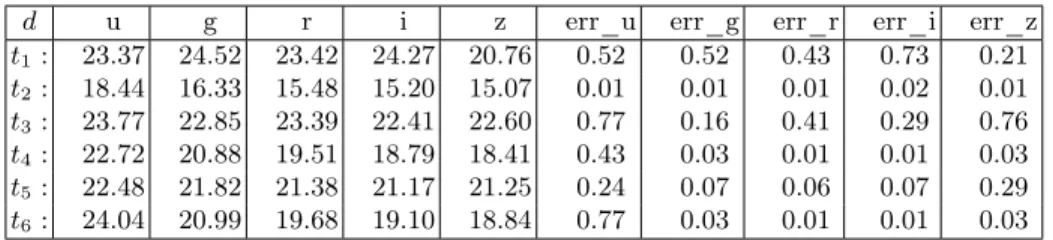
d u g r i z err_u err_g err_r err_i err_z t1: 23.37 24.52 23.42 24.27 20.76 0.52 0.52 0.43 0.73 0.21 t2: 18.44 16.33 15.48 15.20 15.07 0.01 0.01 0.01 0.02 0.01 t3: 23.77 22.85 23.39 22.41 22.60 0.77 0.16 0.41 0.29 0.76 t4: 22.72 20.88 19.51 18.79 18.41 0.43 0.03 0.01 0.01 0.03 t5: 22.48 21.82 21.38 21.17 21.25 0.24 0.07 0.06 0.07 0.29 t6: 24.04 20.99 19.68 19.10 18.84 0.77 0.03 0.01 0.01 0.03
Fig. 1: Example of astrophysics database
the project. After a long image processing process, relevant data are stored in specialized Relational Database Management Systems (RDBMS). Since every value comes with its associated error measure, it can be seen as a numerical interval [value − error, value + error]. Then, such Astrophysics databases are interval-based numerical databases and look like the data given in Figure 1. u and erru(resp. g, r, i, z) are the magnitude (flux in log scale) and corresponding
error of an astrophysical object measured through a passband color filter named u (resp. g, r, i, z). The u, g, r, i, z color filters slice the visible spectrum in five similar size bins. For each attribute that contains a magnitude parameter, there is an associated error measure attribute (e.g. u and err_u).
Classical data mining approach, specifically those related to integrity con-straints like functional dependencies (FD), conditional FD or inclusion depen-dencies (IND), are likely to produce useless results on such databases. The particularities of interval-based databases impose peculiar problems to the asso-ciated discovery problems.
In this paper, we revisit a well-known problem, the discovery of unary inclu-sion dependency discovery, to match the particularities of Astrophysics Databases. Due to the nature of the data in use, the proposed solution has to be changed with respect to existing approaches [15,16].
More precisely, we propose to discover injective mapping between attributes of a source relation and a target relation. In order to solve the problem of dis-covering such mappings, we adapt the problem of disdis-covering unary inclusion dependencies for interval-based databases. With respect to the application do-main in Astrophysics, we do not claim that such mappings solve real problems for astrophysicists, even if some applications could benefit from it. The problem studied in this paper should be thought as a first step, opening many opportu-nities to address others related problems, more challenging and interesting for astrophysicists.
Let us consider two interval-based relations s and t over relation schema S and T respectively. As usual, attributes of a relation r over R are denoted by sch(R).
Problem statement
Given a source s and a target t such that |sch(S)| ≤ |sch(T )|, find a mapping f from sch(S) to sch(T ) such that (1) f is injective (f (A) =
f (B) ⇒ A = B) and (2) for every attribute A ∈ sch(R), the values of A in s and the values of f (A) in t should be as similar as possible, i.e. some forms of inclusion dependencies should exist between them.
To deal with this problem, we propose a contribution based on the following three-step process:
– First, we define two types of membership of an interval into a collection of intervals. The first one is based on the classical inclusion between intervals while the second one is defined on the so-called canonical representation of a collection of intervals.
– Second, we extend the work of [15] and build a condensed representation of an interval-based numerical database as a binary relation (or transactional database where transactions are values and items are attributes). At the end, we discover a set of approximate unary inclusion dependencies from the source to the target.
– Finally, we propose a method to find an injective mapping, which is equiv-alent to the minimum weight matching in an weighted bipartite graph, re-solved with the Hungarian algorithm [12] in this paper.
The proposition has been implemented and several experiments have been conducted on both real-life and synthetic databases. Even if the overall com-plexity of the studied problem remains polynomial, the overhead with respect to classical databases turns out to be rather low. The main lesson we have learned from this work is that many contributions in pattern mining could be revisited in order to deal with interval-based numerical databases.
To the best of our knowledge, this is the first contribution dealing with the discovery of integrity constraints in interval-based numerical databases.
Paper Organization . The remaining part of the paper is organized as follows: Section 2 gives preliminaries of the paper. Section 3 adapts the condensed repre-sentation of [15] to interval-based databases. Section 4 introduces details about the discovery of approximate unary inclusion dependencies. Section 5 describes the main algorithm SR2TR providing an injective mapping between a source and a target relations, and the results of experiments. Section 7 concludes the paper and gives some perspectives to this work.
2
Preliminaries
Basic database notions are given here, more details can be found for example in [14]. We restrict our attention to interval-based numerical databases only.
Let U be a set of attributes and D the possible intervals over real numbers. A relation symbol is generally denoted by R and its schema by sch(R), sch(R) ⊆ U . When clear from context, we shall use R instead of sch(R). Each attribute has a domain, included in D. A tuple over R is an element of the cartesian product D|R|. An interval-based numerical relation (or simply relation) r over R is a set
of tuples over R. An interval-based numerical database d (or simply database) over a set of relation symbol {R1, . . . , Rn} is a set of n interval-based relations
{r1, . . . , rn}, ri defined over Ri for i = 1..n.
Given a relation r over R and A ∈ R, the active domain of A in r is de-noted by ADOM (A, r). The active domain of r is dede-noted by ADOM (r) = S
A∈RADOM (A, r). The projection of a tuple t on an attribute set X ⊆ R
is denoted by t[X]. The projection of a relation r onto a set of attributes X, denoted by πX(r), is defined by πX(r) = {t[X]|t ∈ r}.
Let I, J be two intervals of D. We note min(I) (resp. max(I)) the minimum (resp. maximum) value of I. I is contained in J , denoted by I ⊆ J , if min(J ) ≤ min(I) ≤ max(I) ≤ max(J ).
Let I be a collection of intervals of D. The union of I is the minimal number of intervals covering I. Since its union is unique, it represents a canonical form of I, and will be denoted by cano(I). More formally, cano(I) can be defined by induction as follows:
cano(I) = I if for all J1, J2∈ I, J1∩ J2= ∅
= cano(I \ {J1, J2}) ∪ {J3}) otherwise with J1, J2∈ I, J1∩ J26= ∅ and
J3= [min(min(J1), min(J2)), max(max(J1), max(J2))]
I is said to be connected if |cano(I)| = 1.
We now introduce the classical syntax and semantics of unary inclusion depen-dencies between relation symbols R and S.
Definition 1. An unary inclusion dependency (UIND) from R to S is a state-ment of the form R[A] ⊆ S[B], where A ∈ R, B ∈ S.
Definition 2. Let d = {r, s} be a database over {R, S}. An unary inclusion dependency R[A] ⊆ S[B] is satisfied in d, denoted by d |= R[A] ⊆ S[B], iff for all u ∈ r, there is v ∈ s such that u[A] = v[B] or equivalently πA(r) ⊆ πB(s).
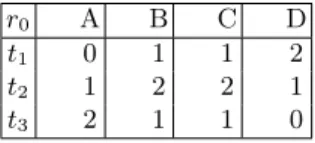
Example 1. Let r0 be a classical relation over R (see Figure 2).
r0 A B C D
t1 0 1 1 2
t2 1 2 2 1
t3 2 1 1 0
Fig. 2: A toy relation r0
Several classical UINDs are satisfied in {r0}, for instance R[A] ⊆ R[D] and
When working with intervals, the strict equality "=" used in the definition of the satisfaction of an UIND is likely to produce unsatisfying results. For instance, in Figure 3, the relation r1has no satisfied UINDs.
r1 A B C
t1: [0,0.5] [0,1] [0,1.5]
t2: [1,1.5] [1,2] [3,3.5]
t3: [2,3] [1.5,4] [2,3]
Fig. 3: A toy interval-based relation r1
This leads to introducing different UIND satisfaction on intervals.
We define two kinds of satisfied UINDs over interval-based numerical database: classical satisfaction based on interval inclusion over collection of intervals and canonical satisfaction based on interval inclusion over the canonical representa-tion of collecrepresenta-tion of intervals.
Let d = {r, s} be an interval-based numerical database over {R, S}.
Definition 3. An UIND R[A] ⊆ S[B] is classically satisfied in d, denoted by d |=1R[A] ⊆ S[B], iff for all u ∈ r, there is v ∈ s such that u[A] ⊆ v[B].
An UIND R[A] ⊆ S[B] is canonically satisfied in d, denoted by d |=2 R[A] ⊆
S[B], iff for all u ∈ r, there is v ∈ cano(ADOM (B, s)) such that u[A] ⊆ v. We will note d |=λR[A] ⊆ S[B] to refer to both of them.
Example 2. In the relation r1of figure 3, for the satisfaction, we have an UIND
r0 |= A ⊆1 B as [0, 0.5] ⊆ [0, 1], [1, 1.5] ⊆ [1, 2] and [2, 3] ⊆ [1.5, 4]. For the
second one, r0|= A ⊆2B as [0, 0.5] ⊆ [0, 4], [1, 1.5] ⊆ [0, 4] and [2, 3] ⊆ [0, 4].
We also need to define when a given interval belongs to a collection of intervals. Let I be an interval and I a collection of intervals.
I is classically included in I, denoted by I ⊆1I, if there exists I0∈ I such that
I ⊆ I0. I is canonically included in I, denoted by I ⊆
2I if I ⊆1cano(I).
3
Condensed representation for interval-based relations
We now extend the contribution for discovering UINDs in databases [15] to interval-based numerical databases. This is, up to our knowledge, the best ap-proach for discovering UINDs. It relies on a preprocessing to get a condensed representation from the initial database.
Now, we define a condensed representation for UIND discovery.
Definition 4. The condensed representation of an interval-based numerical relation r, denoted by CR⊆λ(r), is defined by:
Condensed representations from the two defined satisfactions can be different. We denote CR⊆1(r) and CR⊆2(r) the condensed representations for ⊆1and ⊆2
respectively.
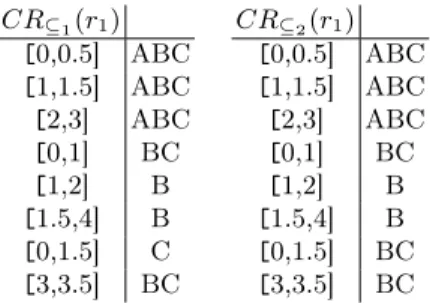
Example 3. The condensed representations CR⊆1(r1) and CR⊆2(r1) of the
re-lation r1 (see Figure 3).
CR⊆1(r1) [0,0.5] ABC [1,1.5] ABC [2,3] ABC [0,1] BC [1,2] B [1.5,4] B [0,1.5] C [3,3.5] BC CR⊆2(r1) [0,0.5] ABC [1,1.5] ABC [2,3] ABC [0,1] BC [1,2] B [1.5,4] B [0,1.5] BC [3,3.5] BC
Fig. 4: Condensed representations of r1 for both semantics
Given a set of relations r1, r2, ..., rn, its condensed representation is defined by
as:
CR⊆λ(r1, r2, ..., rn) =
[
i=1..n
CR⊆λ(ri).
Definition 5. The support of an attribute set X ⊆ R in CR⊆λ(r), denoted by
sup(X, CR⊆λ(r)), is defined by:
sup(X, CR⊆λ(r)) = |{(i, Y ) ∈ CR⊆λ(r)|X ⊆ Y }|
Definition 6. The closure of an attribute A ∈ sch(R) with respect to CR⊆λ(r),
denoted by A+CR ⊆λ(r), is defined as: A+CR ⊆λ(r)= \ (i,X)∈CR⊆λ(r) {X|A ∈ X}
Example 4. In Figure 4, for CR⊆1(r1) we have that sup({A}, CR⊆1(r1)) = 3,
sup({A, B}, CR⊆1(r1)) = 3 and A
+
CR⊆1(r1) = {A, B, C}, C
+
CR⊆1(r1) = {C}.
As for CR⊆2(r1), sup({B, C}, CR⊆2(r1)) = 6, sup({C}, CR⊆2(r1)) = 6 and
CCR+
4
Unary Inclusion Dependencies Discovery in a single
interval-based relation
To alleviate the notations, we consider a single relation only, i.e. UIND of the form r |=λR[A] ⊆ R[B]. Let r be a relation over R and A, B ∈ R.
We first give a technical lemma which relates the definition of r |=2 A ⊆ B to
the canonical representation of the intervals of A in r.
Lemma 1. r |=2A ⊆ B ⇐⇒ ∀I ∈ cano(ADOM (A, r)), ∃J ∈ cano(ADOM (B, r)),
I ⊆ J
Proof. (=⇒) Suppose not. Assume, to the contrary that there exists I0 ∈ cano(ADOM (A, r)), such that for all J ∈ cano(ADOM (B, r)), I0 6⊆ J .
Let I ⊆ ADOM (A, r) be the maximal collection of intervals such that cano(I) = {I0}.
By definition, r |=2 A ⊆ B implies that for all I ∈ ADOM (A, r), there exists
J ∈ cano(ADOM (B, r)) such that I ⊆ J .
If |I| = 1, then we have a contradiction and the result follows.
Assume |I| > 1. The collection I can be divided into n > 1 disjoint non-empty collections of intervals {I1, I2,..,In} such that there exist n different associated
intervals {J1, J2, .., Jn} ∈ cano(ADOM (B, r)) such that for all I ∈ Iλ, I ⊆ Jλ,
λ ∈ {1, 2, .., n}.
Since |cano(I)| = 1, for every Iλ ∈ {I1, I2,..,In}, there exists Iλ0 ∈ {I1,
I2,..,In}, λ 6= λ0 such that there exists I0∈ Iλ, K0∈ Iλ0 such that I0∩ K06= ∅.
But I0⊆ Jλ, K0⊆ Jλ0, then Jλ∩ Jλ0 6= ∅. Contradiction as Jλ, Jλ0 are supposed
to be non-intersecting. (⇐=)
Let I0∈ ADOM (A, r). Then there exists I ∈ cano(ADOM (A, r)) such that I0⊆
I. Since for all I ∈ cano(ADOM (A, r)), there exists J ∈ cano(ADOM (B, r)) such that I ⊆ J , it follows that I0⊆ J . Thus r |=2A ⊆ B.
Intuitively, the main result of the paper states that every inclusion of the form A ⊆ B that holds in r turns out to be equivalent to a closure computation on the associated condensed representation.
We can now give the main result of the paper. Theorem 1.
r |=λA ⊆ B ⇐⇒ B ∈ A+CR⊆λ(r)
Proof. We consider the two UIND satisfactions presented before: 1. r |=1A ⊆ B ⇐⇒ B ∈ A+CR
⊆1(r)
(=⇒)
Let (I0, X) ∈ CR⊆1(r) such that A ∈ X. Then, there exists I ∈ ADOM (A, r)
such that I0⊆ I. Or r |=1A ⊆ B implies that there exists J ∈ ADOM (B, r)
such that I ⊆ J . It follows that I0 ⊆ J , and thus B ∈ X. Then B ∈ A+CR
(⇐=) B ∈ A+CR
⊆1(r) ⇐⇒ for all (I, X) ∈ CR⊆1(r), if A ∈ X then B ∈ X. For all
I ∈ ADOM (A, r), there exists a pair (I, X) ∈ CR⊆1(r) such that A ∈ X.
Thus, B ∈ X also holds, i.e. there exists J ∈ ADOM (B, r) such that I ⊆ J . Thus r |=1A ⊆ B.
2. r |=2A ⊆ B ⇐⇒ B ∈ A+CR
⊆2(r)
(=⇒)
Let (I0, X) ∈ CR⊆2(r) such that A ∈ X. Then, there exists I ∈ cano(ADOM (A, r))
such that I0 ⊆ I. Based on lemma 1, r |=2A ⊆ B implies that there exists
J ∈ cano(ADOM (B, r)) such that I ⊆ J . It follows that I0 ⊆ J , and thus B ∈ X. Then B ∈ A+CR
⊆1(r).
(⇐=)
For all I0 ∈ ADOM (A, r), there exists a pair (I, X) ∈ CR⊆2(r) such
that A ∈ X and I0 ⊆ I. Thus, B ∈ X also holds, i.e. there exists J ∈ ADOM (B, r) such that I ⊆ J . It follows that I0⊆ J .
Thus r |=2A ⊆ B.
From previous theorem, the discovery of UIND is based on the following property, based on support counting in the condensed representation.
Property 1. B ∈ A+CR
⊆λ(r)⇐⇒ sup({A, B}, CR⊆λ(r)) = sup({A}, CR⊆λ(r)).
Proof. B ∈ A+CR
⊆λ(r) ⇐⇒ for all (I, X) ∈ CR⊆λ(r), if A ∈ X then B ∈ X.
Equivalently, the support of {A} and {A, B} are the same in CR⊆λ(r), i.e.
sup({A, B}, CR⊆λ(r)) = sup({A}, CR⊆λ(r)).
5
Approximate unary IND between two interval-based
relations
Within this setting, an unary IND A⊆λB may be still unsatisfied in a relation
due to a few counter-examples. As a result, we introduce an approximation measure to extract approximate unary inclusion dependencies from a relation. This approximation will be calculated based on the support of attributes’ sets. The error measure related to the correspondence between two attributes, denoted error can be defined using the support of attribute sets as follows:
Definition 7. Let r be a relation over R and A, B ∈ R. error(r |=λA ⊆ B) = 1 −
sup({A, B}, CR⊆λ(r))
sup({A}, CR⊆λ(r))
Given two relations r over R and s over S, we are interested in finding the approximative unary inclusion dependencies from single attributes of R with
respect to singles attributes of S. From now on, we consider the relation r as a source relation and s as a target relation.
Based on the previous definition we can build a matrix of error measures, such that each element of the matrix is represented as the value of the error measure between a single attribute from R and a single attribute of S.
Example 5. Let r2, s2be two toy relations:
r2 A B C t1: [0,0.5] [0,1] [0,1] t2: [1,1.5] [1,2] [3,3.5] t3: [2,3] [1.5,4] [2,3] s2 D E F G t1: [0,1.5] [1,2] [1.6,1.8] [2,3] t2: [0,1.5] [1,2] [3.1,4] [2,3] t3: [0,1.5] [0,1] [0,0.5] [1,2] t4: [2,3.5] [2,3] [0,0.5] [1,2] t5: [2,3.5] [1,2] [0,0.5] [1,2]
Fig. 5: Toy relations r2and s2
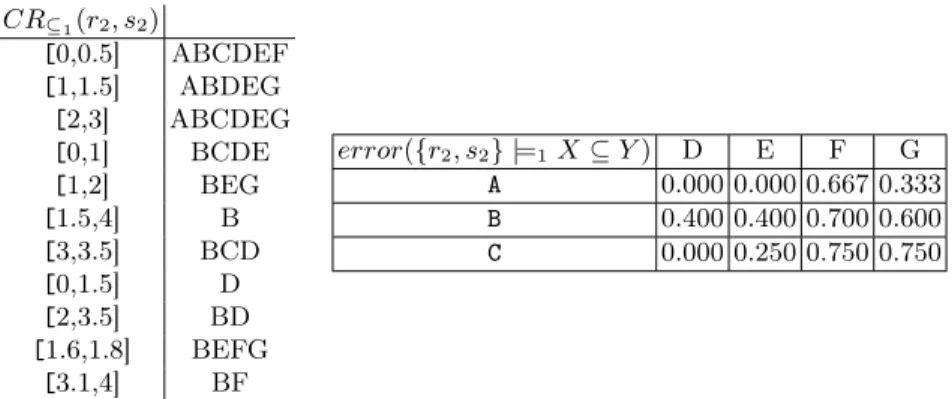
Based on the condensed representation CR⊆1(r2, s2), we build a matrix of error
measures error({r2, s2} |=1 X ⊆ Y ) with X as attribute over r2 and Y as
attribute over s2: CR⊆1(r2, s2) [0,0.5] ABCDEF [1,1.5] ABDEG [2,3] ABCDEG [0,1] BCDE [1,2] BEG [1.5,4] B [3,3.5] BCD [0,1.5] D [2,3.5] BD [1.6,1.8] BEFG [3.1,4] BF error({r2, s2} |=1X ⊆ Y ) D E F G A 0.000 0.000 0.667 0.333 B 0.400 0.400 0.700 0.600 C 0.000 0.250 0.750 0.750
Fig. 6: The condensed representation of r2 and s2 and the associated matrix of error
measures
As we search to find the most appropriate injective matching function between two schema relations, given the matrix of error measures, we can reformulate this problem as follows:
Given an error matrix between two schema relations R and S, find the best matching with the minimum error between R and S.
This problem is in fact an assignment problem [12] which consists of find-ing a maximum weight matchfind-ing in a weighted bipartite graph. Hungarian Algorithm [11] is one of the algorithms that can solve the assignment problem. There are other algorithms that include adaptations as the Simplex Algorithm and the Auction Algorithm [2]. The assignment problem is a special case of the transportation problem [10], which is a variation of minimum cost maximum flow problem [1].
6
Scalable algorithms
We propose a polynomial algorithm called SR2T R, which provides an injective mapping based on the discovery of a set of approximate unary INDs from a source relation r over R to a target relation s over S.
Algorithm 1 (SR2TR) Mapping from Source Relation to Target Relation
Input: two relations: r over R and s over S Output: A mapping function f from R to S
1: CR = Preprocessing(r, s) 2: M = MEM(CR)
3: f = FindMatching(M ) 4: return f .
Algorithm 1 can be summarized as follows:
1. Process the condensed representation CR(r, s) - Preprocessing(r,s); 2. Build the matrix of error measures M based on CR(r, s) - MEM(CR); 3. Find the minimum weight matching in the weighted bipartite graph
con-structed from M - FindMatching(M).
Two other algorithms are provided: Algorithm 2 for the P reprocessing function (line 1 of Algorithm 1) and Algorithm 3 for the M EM function (line 2 of Al-gorithm 1). The F indM atching function (line 3, AlAl-gorithm 3) corresponds to the minimum weight matching in a weighted bipartite graph. From the matrix of error measures M , we have implemented the Hungarian Algorithm, not detailed here.
Algorithm 2 (Preprocessing) Computing the condensed representation of r ∪ s
Input: Two relations r over R and s over S Output: Condensed representation CR(r, s)
1: CR=∅
2: for all I ∈ ADOM (r) ∪ ADOM (s) do 3: BR = ∅
4: for all A ∈ R ∪ S do
5: if check_inclusion(I, ADOM (A, r ∪ s)) = true then 6: BR[A] = true 7: else 8: BR[A] = f alse 9: end if 10: end for 11: CR.add(BR) 12: end for 13: return CR
For each interval I ∈ ADOM (r) ∪ ADOM (s), we search all single attributes A ∈ R ∪ S for which I is included in ADOM (A, r ∪ s) (line 5). Then we update the binary relation BR accordingly, which is afterwards added to CR. As the set ADOM (A, r ∪s) is a set of intervals, from which we can construct an interval tree for each single attribute in R ∪ S, so that check_inclusion is logarithmic in the size of the r and s.
Algorithm 3 (MEM) Compute the matrix of error measures
Input: Condensed representation CR(r, s)
Output: The matrix of error measures between R and S 1: init(M )
2: for all A ∈ R do
3: for all (I, X) ∈ CR(r, s) where A ∈ X do 4: sup1[A] = sup1[A] + 1
5: for all B ∈ S where B ∈ X do 6: sup2[A][B] = sup2[A][B] + 1 7: end for
8: end for 9: end for
10: for all A ∈ R and B ∈ S do
11: M [A][B] = 1.0 − sup2[A][B]/sup1[A] 12: end for
13: return M
Based on the condensed representation CR(r, s), we form the matrix of error measures M of size |R| ∗ |S|. Line 1, M is initialized and filled with zeros in the init(M ) function. At this point we create two arrays, sup1 and sup2, referring
to the support of size 1 and 2 of R ∪ S. Then, we search through all the elements of CR and we update step by step the support accordingly (lines 4, 6). Lines 10-11, we fill the matrix M, such that the value of an element M [A][B] of the matrix is equal to 1 −sup({A,B})sup({A}) , where A ∈ R and B ∈ S.
Complexity analysis of SR2TR Let n = |R|, m = |S|, a = |r|, b = |s|. The theoretical complexity is in O((n ∗ a + m ∗ b) ∗ (n ∗ log(a) + m ∗ log(b)) + P ) where P is the complexity of the matching algorithm. In case of the Hungarian Algorithm, its complexity would be (n + m)4, which can be reduced to (n + m)3 [4,8,9,13].
7
Experimental Results
We implemented the previous algorithms in C++ and conducted experiments to determine its effectiveness. We used datasets provided by astrophysicists of IN2P3 and synthetic databases to check the scalability of the algorithm. Our experiments were run using a machine with an Intel Core i7-4712MQ (2.3 GHz) CPU and 12GB of memory. We focused on the classical UIND definition, referred to as ⊆1. The results with canonical UIND, referred to as ⊆2, being quite similar
are not discussed.
The IN2P3 dataset is composed of two databases with 11 single attributes each.
2,000 4,000 6,000 8,000 100 150 200 250 300 Number of tuples in r ∪ s Execution Time (ms)
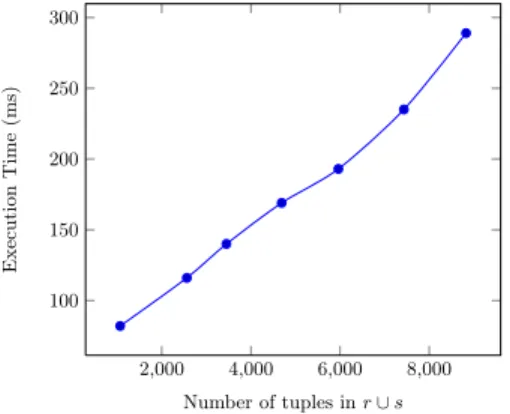
Fig. 7: Real-life astrophysics database
With respect to the number of tuples of the two databases, we obtained accept-able execution times (see Figure 7), linear in the size of the data.
To test the scalability of our technique with regard to the response time and the memory usage, we created 4 tests realized on synthetic datasets. The datasets are composed of floating numbers in the interval [0,5000] and with an error measure in the interval [0,1].
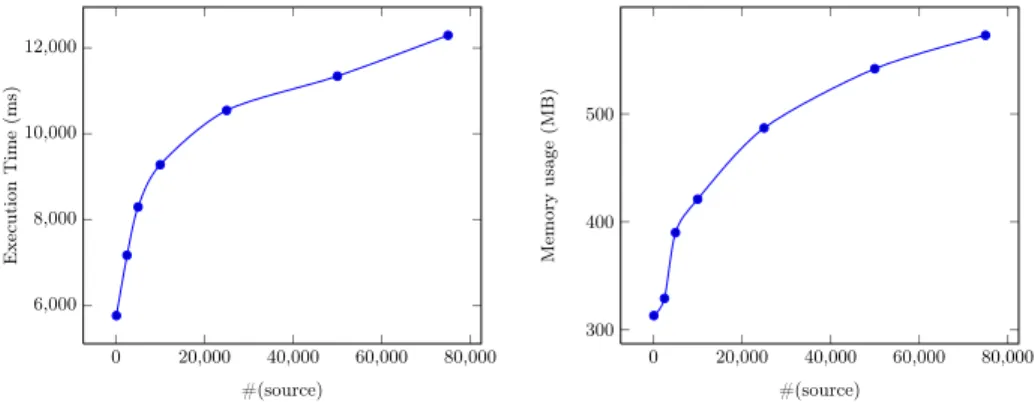
The first test considers a target relation of 100000 tuples, 20 attributes in each relation schema and a varying number of tuples in the source relation (see Figure 8). We can observe a polynomial behavior on experimental results both in response time and memory usage.
The second test considers a source relation of 1000 tuples, 20 attributes in each relation schema and a varying number of tuples in the target relation (see Figure 9). In both the response time and memory usage we recognize a linear behavior.
The following test considers a target schema relation with 100 single attributes, 100 tuples in each relation and a varying number of single attributes in the source schema relation (see Figure 10). We observe a linear behavior on experimental results both in response time and memory usage.
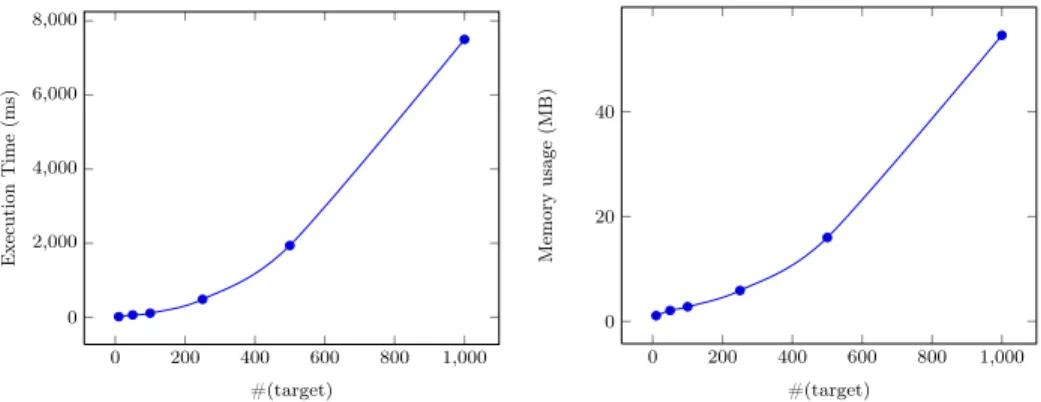
The last test considers a source relation with 10 single attributes, and 100 tuples in each relation and a varying number of single attributes in the target schema relation (see Figure 11). A polynomial behavior can be observed both in response time and memory usage.
0 20,000 40,000 60,000 80,000 6,000 8,000 10,000 12,000 #(source) Execution Ti m e (ms) 0 20,000 40,000 60,000 80,000 300 400 500 #(source) Memory u sa ge (MB)
0 20,000 40,000 60,000 80,000 100,000 0 2,000 4,000 6,000 #(target) Execution Ti m e (ms) 0 20,000 40,000 60,000 80,000 100,000 0 100 200 300 #(target) Memory u sa ge (MB)
Fig. 9: Varying of the number of tuples in the target relation
0 200 400 600 800 10,000 15,000 20,000 25,000 30,000 #(source) Execution Ti m e (ms) 0 200 400 600 800 50 60 70 80 (#(source) Memory u sa ge (MB)
Fig. 10: Varying the number of single attributes in the source schema relation
0 200 400 600 800 1,000 0 2,000 4,000 6,000 8,000 #(target) Execution Ti m e (ms) 0 200 400 600 800 1,000 0 20 40 #(target) Memory u sa ge (MB)
8
Conclusion
We have addressed the problem of finding an injective mapping between at-tributes from a source relation to a target relation in an interval-based numerical databases. The proposition is mainly based on the work of [15] on the discovery of approximate unary inclusion dependencies. We implemented the contribu-tions and tested on both real life and synthetic databases. Dealing with intervals instead of classical values turns out to feasible in practice for this polynomial problem, and requires mainly to think about notions such as the membership of an interval into a collection of intervals.
Many perspectives do exist for this work: First, the Astrophysics setting of this paper offers opportunities to extend the contributions made in this paper to real Astrophysics problems. More joint works are needed to better understand the needs of each other. Second, many pattern mining problems can be revisited for interval-based numerical databases. For example, the discovery of conditional functional dependencies could be revisited [6] as well as the discovery of editing rules [7,5] for data cleaning, a main concern in Astrophysics.
Acknowledgments: This work has been partially funded by the CNRS Mastodons projects (QualiSky 2016 and 2017).
References
1. R. K. Ahuja, T. L. Magnanti, and J. B. Orlin. Network Flows: Theory, Algorithms, and Applications. Prentice-Hall, Inc., Upper Saddle River, NJ, USA, 1993. 2. D. P. Bertsekas. A distributed algorithm for the assignment problem. 1979. 3. G. B. Dantzig. A history of scientific computing. chapter Origins of the Simplex
Method, pages 141–151. ACM, New York, NY, USA, 1990. 4. M. Dawes. The optimal assignment problem.
5. T. Diallo, J.-M. Petit, and S. Servigne. Discovering Editing Rules for Data Clean-ing. In 10th International Workshop on Quality in Databases In conjunction with VLDB (Very Large Databases) 2012, pages 1–8, Aug. 2012.
6. W. Fan, F. Geerts, J. Li, and M. Xiong. Discovering conditional functional depen-dencies. IEEE Trans. Knowl. Data Eng., 23(5):683–698, 2011.
7. W. Fan, J. Li, S. Ma, N. Tang, and W. Yu. Towards certain fixes with editing rules and master data. VLDB J., 21(2):213–238, 2012.
8. M. J. Golin. Bipartite matching and the hungarian method. 9. S. Khuller. Design and analysis of algorithms: Course notes.
10. M. Klein. A primal method for minimal cost flows with applications to the assign-ment and transportation problems. Manageassign-ment Science, 14(3):205–220, 1967. 11. H. W. Kuhn. The hungarian method for the assignment problem. Naval Research
Logistics Quarterly, 2:83–97, 1955.
12. H. W. Kuhn. Variants of the hungarian method for assignment problems. Naval Research Logistics Quarterly, 3:253–258, 1956.
13. E. Lawler. Combinatorial Optimization: Networks and Matroids. Dover Books on Mathematics Series. Dover Publications, 2001.
14. M. Levene and G. Loizou. A guided tour of relational databases and beyond. Springer, 1999.
15. F. D. Marchi, S. Lopes, and J. Petit. Efficient algorithms for mining inclusion dependencies. In Advances in Database Technology - EDBT 2002, 8th International Conference on Extending Database Technology, Prague, Czech Republic, March 25-27, Proceedings, pages 464–476, 2002.
16. T. Papenbrock, T. Bergmann, M. Finke, J. Zwiener, and F. Naumann. Data profiling with metanome. PVLDB, 8(12):1860–1863, 2015.
17. R. T. Snodgrass. The temporal query language tquel. ACM Trans. Database Syst., 12(2):247–298, 1987.