HAL Id: insu-02080310
https://hal-insu.archives-ouvertes.fr/insu-02080310
Submitted on 27 Mar 2019
HAL is a multi-disciplinary open access archive for the deposit and dissemination of sci-entific research documents, whether they are pub-lished or not. The documents may come from teaching and research institutions in France or abroad, or from public or private research centers.
L’archive ouverte pluridisciplinaire HAL, est destinée au dépôt et à la diffusion de documents scientifiques de niveau recherche, publiés ou non, émanant des établissements d’enseignement et de recherche français ou étrangers, des laboratoires publics ou privés.
Detecting exoplanets with FAST?
Philippe Zarka, Di Li, Jean-Mathias Grießmeier, Laurent Lamy, Julien N.
Girard, Sébastien Hess, Joseph Lazio, Gregg Hallinan
To cite this version:
Philippe Zarka, Di Li, Jean-Mathias Grießmeier, Laurent Lamy, Julien N. Girard, et al.. Detecting exoplanets with FAST?. Research in Astronomy and Astrophysics, IOP Publishing, 2019, 19 (2), pp.023. �10.1088/1674-4527/19/2/23�. �insu-02080310�
Detecting exoplanets with FAST ?
Philippe Zarka1, Di Li2, Jean-Mathias Grießmeier3, Laurent Lamy1, Julien Girard4, S. Hess5, T. Joseph W. Lazio6, Gregg Hallinan7
1 LESIA, CNRS – Observatoire de Paris, Meudon, France
2 National Astronomical Observatories, Chinese Academy of Science, Beijing, China 3 LPC2E, CNRS – Université d’Orléans, Orléans, France
4 Univ. Paris VII, AIM/Irfu/SAp/CEA-Saclay, Orme des Merisiers, Gif-Sur-Yvette, France 5 ONERA – DESP, Toulouse, France
6 JPL – California Institute of Technology, Pasadena, CA, USA 7 California Institute of Technology, Pasadena, CA, USA
In press in : Research in Astronomy and Astrophysics
Abstract : We briefly review the various proposed scenarios that may lead to nonthermal radio
emissions from exoplanetary systems (planetary magnetospheres, magnetosphere-ionosphere and magnetosphere-satellite coupling, and star-planet interactions), and the physical information that can be drawn from their detection. The latter scenario is especially favourable to the production of radio emission above 70 MHz. We summarize the results of past and recent radio searches, and then discuss FAST characteristics and observation strategy, including synergies. We emphasize the importance of polarization measurements and a high duty-cycle for the very weak targets that radio-exoplanets prove to be.
1. Introduction : Exoplanets
Planets are the most favourable cradle of life. As of today, nearly 4000 exoplanets are known (exoplanet.eu – mainly by radial velocity or transits measurements, from which masses, orbital parameters, sizes, density, and atmospheric composition can be inferred). In our solar system, magnetized planets are strong radio sources (Jupiter is as bright as the Sun at decameter wavelengths). Radio detection of exoplanets aims at the physical characterization of exoplanets and comparative studies with solar system planets.
2. Experience from solar system planets and theory
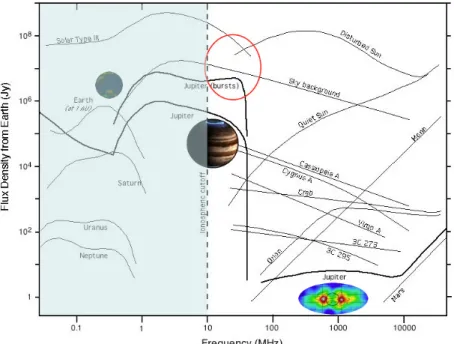
There are 6 magnetized planets in the solar system with planetary-scale magnetic field: Mercury, the Earth, Jupiter, Saturn, Uranus, and Neptune. In their magnetospheres, various processes accelerate electrons to keV-MeV energies, leading to high-latitude (auroral) radio emissions (Zarka 1998), whose spectra are displayed in Fig. 1. The corresponding radio sources have been studied remotely and in situ (cf. e.g. Huff et al. 1988; Treumann & Pottelette 2002; Lamy et al., 2010). The emissions were found to be coherent cyclotron (Maser) radiation from keV electrons. The emission frequency depends on the local cyclotron frequency, proportional to the magnetic field amplitude, and is thus generally below a few 10’s of MHz, reaching 40 MHz for Jupiter. Emissions are very intense (brightness temperature up to 1015−20 K), sporadic (bursts lasting
from msec to hours), anisotropic (beamed at large angle from the magnetic field), and circularly polarized (Right-Handed in northern magnetic hemispheres and Left-Handed in southern ones) (Wu 1985; Zarka 1998; Treumann 2006; Hess et al. 2008). Weaker incoherent synchrotron emission is
generated by MeV electrons in Jupiter’s radiation belts (de Pater 1990), recently imaged with LOFAR (Girard et al. 2016).
The energy drivers for electron acceleration up to keV energies include (Zarka et al. 2001; Zarka 2007, 2017; Nichols 2011):
– Stellar Wind-Magnetosphere interaction (super-Alfvénic, via compressions and reconnections),
– Magnetosphere-Ionosphere coupling,
– Magnetosphere-Satellite coupling (sub-Alfvénic, via reconnection or unipolar inductor interaction),
– Star-Planet Interaction (SPI – sub-Alfvénic, via reconnection or unipolar inductor interaction).
Figure 1 : Spectra of astronomical radiosources detected from the Earth’s vicinity. Auroral planetary spectra lie below the Earth’s ionospheric cut-off, except Jupiter’s decametric-to-decimetric emissions. Normalized to the same observer distance of 1 AU, Jupiter’s spectrum must be upscaled by ×20, Saturn’s by ×100, Uranus’ by ×400, and Neptune’s by ×900, so that all are grouped within 2–3 orders of magnitude.
3. Predictions for exoplanets
Jupiter’s decametric emission is detectable at no more than 0.2 pc over the Galactic background. Thus search for exoplanetary radio emissions had to rely on scaling laws and extrapolations, as well as more direct theoretical predictions.
Study of solar wind-magnetosphere interactions led Zarka et al. (2001) and Zarka (2007, 2010) propose that a planet’s low-frequency radio output is proportional to kinetic (including CME = coronal mass ejections) and magnetic (Poynting flux) power inputs on the obstacle’s cross-section. Extrapolation to hot jupiters led to prediction of radio fluxes up to 103−5 times that of Jupiter (Fig. 2). Io-Jupiter electrodynamic interaction transposed to plasma SPI led the same authors to predict radio outputs proportional to the Poynting flux input, up to 106 times Jupiter’s (Fig. 2).
Nichols (2011, 2012), based on the physics of magnetosphere-ionosphere interaction, predicted a large low-frequency radio output, up to 104 times Jupiter’s, for fast rotating planets orbiting stars with a bright X-UV luminosity. Willes & Wu (2004, 2005) extended the theoretical frame of Io-Jupiter unipolar interaction to terrestrial planets around White Dwarfs, predicting a large radio output at frequencies >> 1 GHz.
In all cases, detection is the difficult step. Even if star-planet systems will be unresolved in radio, subsequent discrimination between stellar and planetary emission will rely (easily) on the
polarization (circular for planets) and periodicities (rotation, orbital) of the detected radio emission.
Figure 2 : Scaling law relating magnetospheric (Earth, Jupiter, Saturn, Uranus and Neptune) and satellite-induced (Io, Ganymede, Callisto) radio power to incident Poynting flux of the plasma flow on the obstacle. Dashed line has slope 1, emphasizing the proportionality between ordinates and abscissae, with a coefficient 2×10⁻³. The thick bar
extrapolates to hot jupiters the magnetospheric interaction (solid) and satellite-planet electrodynamic interactions (dashed). The orange dot illustrates the case of the RS CVn magnetic binary V711 τ discussed in (Zarka 2010, Zarka et al. 2015a). Inset sketches the types of interaction.
4. Motivations for studying exoplanets’ radio emissions
Magnetospheric radio emissions provide unique information on planetary magnetic field amplitude and tilt (Jupiter’s magnetic field was first measured that way (Burke & Franklin 1955)), and thus on the planetary dynamo, giving constraints on the planetary interior structure. It is also a signature of planetary rotation, due to the emission anisotropy (the rotation periods of Jupiter (Higgins et al. 1997), Saturn (Desch & Kaiser 1981), Uranus, and Neptune were measured via their radio emission ), that will permit to test directly exoplanetary spin-orbit locking. It may reveal the presence of satellites (e.g. Io (Bigg 1964)) interacting with the planetary magnetic field. Hess & Zarka (2011) showed that radio emissions also allow to probe planetary orbit inclination, and SPI and magnetospheric dynamics at large.
A magnetosphere also shields a planet’s atmosphere and surface versus cosmic rays, stellar wind and CME bombardment, preventing O3 destruction and atmospheric erosion or escape. It is
thus a favourable condition for life (Grießmeier et al. 2004; Lammer et al. 2006). Finally radio emission detection may evolve as an independent discovery tool for planets around active, magnetic or variable stars.
5. Past and ongoing observations and results
Targeted searches have been guided by theory and scaling laws applied to the exoplanet census (with e.g. τ Boo, υ And, or 55 Cnc as good candidates (Lazio et al. 2004; Grießmeier et al. 2007)), to strongly magnetized stars (such as HD 189733 (Donati et al. 2006)), to planets with very elliptical orbits and close-in periastron (such as HD 80606 (Lazio & Farrell 2007; Lazio et al. 2010)), and to systems with possible optical SPI signatures (such as HD 179949 (Shkolnik et al. 2008) and references therein). Observations were conducted with the VLA at ≥74 MHz (Farrell et
al. 2003, 2004; Lazio & Farrell 2007), UTR-2/Kharkov in the range 10-32 MHz (Ryabov et al. 2004), and the GMRT at ≥150 MHz (Hallinan et al. 2013; Lecavelier des Etangs et al. 2013). No confirmed detection was reached. A hint of a radio occultation of Hat-P-11 b by its star was found at the GMRT, but in only one of two observations with similar geometry, thus it remains to be confirmed (Lecavelier des Etangs et al. 2013). Ongoing targeted observations include campaigns at UTR-2 (10-32 MHz, ≥100 hours), programs with LOFAR in cycles 0 to 8 (20-80 MHz, for a total of ∼170 hours), and with the LWA (Long Wavelength Array – program of ∼5000 hours).
In parallel, correlations of the exoplanet catalog at exoplanet.eu with low-frequency surveys open new perspectives. Four candidates were found in the GMRT TGSS 150 MHz survey, at the 10-100 mJy level, out of 175 exoplanetary systems in the surveyed field (Sirothia et al. 2014), but remained unconfirmed. Analysis of LOFAR surveys is ongoing (Multi-Snapshot Source Survey in the 120-160 MHz band at ∼5 mJy sensitivity, and later in the 30-75 MHz band at ∼15 mJy sensitivity from the LOFAR deep surveys program (Shimwell et al. 2017, Loh et al. in preparation)). Permanent all-sky observations at ∼1 sec resolution have started at OLWA (Owens Valley LWA).
As a preliminary conclusion, radio emissions much stronger than Jupiter’s at frequencies ≥150 MHz appear to be rare, which could be due to a too low planetary magnetic field, emission beaming out of the observer’s line of sight at the time of the observations, or too weak flux density.
6. Science outcome enabled by FAST
Following the previous conclusion, it is necessary to explore a large sample of targets with the highest possible continuum sensitivity, preferably at low frequencies, with circular polarization or full Stokes observations, down to the thermal noise level. Multi-epoch observations with integration times of a few hours at each epoch are required for reaching a good sensitivity and addressing time variations of intrinsically (or beaming-induced) sporadic emissions.
The FAST radiotelescope (Nan et al., 2011) can observe down to 70 MHz, within a broad frequency range, with full polarization measurements. Table 1 summarizes its relevant characteristics for SPI studies. Comparing the sensitivities with the typical flux densities of Jupiter’s bursts at 30-40 MHz, about 40 µJy at 10 pc range, it appears that FAST has the sensitivity to detect moderate intensity exoplanetary emissions, provided that the frequency of emission exceeds 70 MHz. A frequency >70 MHz corresponds to cyclotron emission from a source with a magnetic field amplitude >25 G. Figure 3 shows the FAST sensitivity (as well as that of other low-frequency instruments) compared to the predicted maximum emission low-frequency and expected radio flux for known exoplanets in 2011, extrapolated following Grießmeier et al. (2007). Only a few candidate exoplanets have a predicted magnetic field reaching or exceeding 25 G. FAST will thus likely be best adapted to search for SPI emissions (exoplanet-induced as proposed by Zarka (2007, 2017), including for terrestrial planets around white dwarfs as proposed by Willes & Wu (2004, 2005)), down to moderate intensities, whereas magnetospheric exoplanetary emissions will be rather the target of lower frequency radio arrays such as LOFAR (van Haarlem et al. 2013) and NenuFAR (Zarka et al. 2012, 2015b).
Due to the relatively low angular resolution of FAST at low frequencies, exoplanet detection via direct imaging will be severely limited by confusion, i.e. spatial noise across the sky background. The possible ways to lower this limit are (i) observing in circular polarization – for which confusion noise is expected to be much smaller than for unpolarized emission – of full Stokes, and (ii) looking for time variable emission in well-defined fields. The latter method is favoured by FAST’ constant beam size in all pointing directions (Nan et al. 2011) and a frequency range well above the ionospheric cut-off (~10 MHz).
A key element of the success of FAST in exoplanet radio search and study will be the possibility to conduct a large number of multi-epoch targeted observations as well as extensive
polarized surveys (e.g. of all observable stellar systems up to 10 pc distance : ~200 known stars and ~35 currently known exoplanets). One drawback is the availability of a single beam at low frequencies, that will require a strong programmatic decision in favour of exoplanet studies in order to perform a significant program (such as the LWA – HJUDE program). Follow-on observations of targets identified by other instruments (LOFAR, GMRT) also offer good prospects (FAST covers a large declination range in common with these 2 instruments).
Frequency (MHz) 70 140 280 560 1150 T sky (K) 2500 420 72 13 5 T sys (K) 100 80 40 10 10 SEFD (Jy) 110 22 5 1 0.7 Sensitivity (mJy) [4 MHz x 1 hr, polarized] 0.5 0.1 0.020 0.004 0.003 Confusiona (mJy) [unpolarized] 3100 480 73 11 1.6
Angular resolution (’) 50 25 13 7 3
Table 1 : FAST characteristics at frequencies below L-band. aTheoretical estimate from (Condon 2005).
Figure 3 : Predicted maximum emission frequency and expected radio flux for known exoplanets (in 2011, indicated by triangle symbols) for a rotation-independent planetary magnetic field and the scaling law of Fig. 2. The approximate sensitivity of several instruments is shown (for 1 h of integration time and a bandwidth of 4 MHz). Frequencies below 10 MHz are not observable from the ground (ionospheric cut-off). Adapted from (Grießmeier et al. 2011). More recent observations have populated this diagram, but only ~doubling the number of FAST candidates.
7. Synergies
Advantage will be taken of synergies between radio observations of exoplanets and of stellar solar-like bursts. Stellar flares could be planet induced, or intrinsic: GHz periodic bright pulses with periods ∼2 hours, and 100% circularly polarized have been found by Hallinan et al. (2007, 2008, 2015), and attributed to cyclotron masers in brown dwarf with magnetic field ∼2 kG. Further, there is a realm to explore from brown dwarfs to exoplanets (faster rotation, cooler & more neutral atmosphere, larger-scale stable magnetic field topologies, with weaker field amplitude). Tracing
magnetic fields and radio flux densities from brown dwarfs to planets will bring unique constraints for dynamo theories and radio emission scaling laws. Lower mass planets seem to be more frequent around M dwarfs, with close-in planets lying in the habitable zone (Dressing & Charbonneau 2013). Commensal SETI searches would be possible with adequate instrumentation (very high spectral resolution of waveform measurements).
Synergies will also exist with observations at other wavelengths:
– with radio observations at frequencies below 70 MHz (LOFAR, NenuFAR, UTR-2),
– with Zeeman Doppler Imaging (CFHT/Espadons, TBL/Narval, CFHT/Spirou) permitting stellar magnetic field measurements and planet searches around M dwarfs (Fares et al. 2010),
– with UV-X observations (HST, JWST, XMM, Chandra, Athena) of stellar flares and exoplanet atmospheres,
– with PLATO and TESS revealing more nearby exoplanets, ESO-VLT/NGTS, ESPRESSO, or GAIA surveys that will provide tens of exoplanets per FoV or a few degrees.
8. Conclusions
Study of radio emissions from exoplanets and the star-planet connection is a broad new field to explore. Its theoretical frame is ready. There are currently optimistic prospects with LOFAR, and soon (in 2018) with its giant compact extension NenuFAR. The advent of SKA will bring a sensitivity improvement of ∼ 30× compared to LOFAR, down to the 10 µJy level, at frequencies ≥50 MHz. This make it highly likely that SKA-Low will detect exoplanetary radio signals (Zarka et al. 2015a). But this will happen in 2020+, and FAST, being operational now, benefits from a favourable window for exoplanet and SPI radio search. It will also cover a declination range complementary to that of LOFAR & NenuFAR (mostly the northern hemisphere), SKA (mostly the southern hemisphere) and compatible with that of the GMRT.
Acknowledgement
Part of this research (TJWL) was carried out at the JPL/CalTech under a contract with NASA.
References
Bigg, E. K. 1964, Nature, 203, 1008
Burke, B. F. & Franklin, K. L. 1955, J. Geophys. Res., 60, 213
Condon, J. J. 2005, ASP Conf. Ser. 345 “From Clark Lake to the Long Wavelength Array”, N. E. Kassim et al. eds., 237
de Pater, I. 1990, Annual review of astronomy and astrophysics, 28 (A91-28201 10-90), 347 Desch, M. D. & Kaiser, M. L. 1981, Geophys. Res. Lett., 8, 253
Donati, J.-F., Howarth, I. D., Jardine, M. M., et al. 2006, MNRAS, 370, 629 Dressing, C. D. & Charbonneau, D. 2013, ApJ, 767, 95
Fares, R., Donati, J.-F., Moutou, C., et al. 2010, MNRAS, 406, 409
Farrell, W. M., Desch, M. D., Lazio, T. J., Bastian, T., & Zarka, P. 2003, in Astronomical Society of the Pacific Conference Series, Vol. 294, Scientific Frontiers in Research on Extrasolar Planets, ed. D. Deming & S. Seager, 151–156
Farrell, W. M., Lazio, T. J. W., Desch, M. D., Bastian, T. S., & Zarka, P. 2004, in IAU Symposium, Vol. 213, Bioastronomy 2002: Life Among the Stars, ed. R. Norris & F. Stootman, 73
Girard, J. N., Zarka, P., Tasse, C., et al. 2016, A&A, 587, A3
Grießmeier, J.-M., Stadelmann, A., Penz, T., et al. 2004, A&A, 425, 753 Grießmeier, J.-M., Zarka, P., & Spreeuw, H. 2007, A&A, 475, 359
Grießmeier, J.-M., Zarka, P., Girard, J. N. 2011, Radio Science, 46, RS0F09 Hallinan, G., Antonova, A., Doyle, J. G., et al. 2008, ApJ, 684, 644
Hallinan, G., Bourke, S., Lane, C., et al. 2007, ApJ, 663, L25
Hallinan, G., Sirothia, S. K., Antonova, A., et al. 2013, ApJ, 762, 34 Hallinan, G., Littlefair, S. P., Cotter, G., et al. 2015, Nature, 523, 568
Hess, S., Mottez, F., Zarka, P., & Chust, T. 2008, Journal of Geophysical Research (Space Physics), 113, 3209
Hess, S. L. G. & Zarka, P. 2011, A&A, 531, A29
Higgins, C. A., Carr, T. D., Reyes, F., Greenman, W. B., & Lebo, G. R. 1997, J. Geophys. Res., 102, 22033
Huff, R. L., Calvert, W., Craven, J. D., Frank, L. A., & Gurnett, D. A. 1988, J. Geophys. Res., 93, 11445
Lammer, H., Khodachenko, M. L., Lichtenegger, H. I. M., et al. 2006, in European Planetary Science Congress 2006, 388
Lamy, L., Schippers, P., Zarka, P., et al. 2010, Geophys. Res. Lett., 37, L12104 Lazio, W., T. J., Farrell, W. M., Dietrick, J., et al. 2004, ApJ, 612, 511
Lazio, T. J. W. & Farrell, W. M. 2007, ApJ, 668, 1182
Lazio, T. J. W., Shankland, P. D., Farrell, W. M., & Blank, D. L. 2010, AJ, 140, 1929
Lecavelier des Etangs, A., Sirothia, S. K., Gopal-Krishna, & Zarka, P. 2013, A&A, 552, A65 Nan, R., et al. 2011, Int. J. Modern Phys. D, 20 (6), 989
Nichols, J. D. 2011, MNRAS, 414, 2125 Nichols, J. D. 2012, MNRAS, 427, L75
Ryabov, V. B., Zarka, P., & Ryabov, B. P. 2004, Planet. Space Sci., 52, 1479 Shimwell, T. W., Röttgering, H. J. A., Best, P. N., et al. 2017. A&A 598, A104
Shkolnik, E., Bohlender, D. A., Walker, G. A. H., & Collier Cameron, A. 2008, ApJ, 676, 628 Sirothia, S. K., Lecavelier des Etangs, A., Gopal-Krishna, Kantharia, N. G., & Ishwar-Chandra, C.
H. 2014, A&A, 562, A108
Treumann, R. A. 2006, A&A Rev., 13, 229
Treumann, R. A. & Pottelette, R. 2002, Advances in Space Research, 30, 1623 van Haarlem M. P., et al. 2013, Astron. Astrophys., 556, A2
Willes, A. J. & Wu, K. 2004, MNRAS, 348, 285 Willes, A. J. & Wu, K. 2005, A&A, 432, 1091 Wu, C. S. 1985, Space Sci. Rev., 41, 215 Zarka, P. 1998, J. Geophys. Res., 103, 20159 Zarka, P. 2007, Planet. Space Sci., 55, 598
Zarka, P. 2017, in Handbook of Exoplanets (Planets and their Stars: Interactions), ed. H. J. Deeg & J. A. Belmonte, Springer International Publishing AG, doi:10.1007/978-3-319-30648-3_22-1 Zarka, P. 2010, in Astronomical Society of the Pacific Conference Series, Vol. 430, Pathways
Towards Habitable Planets, ed. V. Coudé du Foresto, D. M. Gelino, & I. Ribas, 175
Zarka, P., Girard, J. N., Tagger, M., & Denis, L. 2012, in SF2A-2012: Proceedings of the Annual meeting of the French Society of Astronomy and Astrophysics, ed. S. Boissier, P. de Laverny, N. Nardetto, R. Samadi, D. Valls-Gabaud, & H. Wozniak, 687–694
Zarka, P., Lazio, T. J. W., Hallinan, G., & the “Cradle of Life” Science working group. 2015a, in Advancing Astrophysics with the Square Kilometre Array (AASKA14), id.120, http://pos.sissa.it/cgi-bin/reader/conf.cgi?confid=215
Zarka, P., Tagger, M., Denis, L., et al. 2015b, in International Conference on Antenna Theory and Techniques (ICATT), Kharkiv, Ukraine, pp. 13-18