Detecting stable distributed patterns
of brain activation using Gini contrast
The MIT Faculty has made this article openly available.
Please share
how this access benefits you. Your story matters.
Citation
Langs, Georg, Bjoern H. Menze, Danial Lashkari, and Polina
Golland. “Detecting Stable Distributed Patterns of Brain Activation
Using Gini Contrast.” NeuroImage 56, no. 2 (May 2011): 497–507.
As Published
http://dx.doi.org/10.1016/j.neuroimage.2010.07.074
Publisher
Elsevier
Version
Author's final manuscript
Citable link
http://hdl.handle.net/1721.1/98859
Terms of Use
Creative Commons Attribution-Noncommercial-NoDerivatives
Detecting Stable Distributed Patterns of Brain Activation Using Gini Contrast
to appear in NeuroImage
-Georg Langs, Bjoern H. Menze, Danial Lashkari, Polina Golland Computer Science and Artificial Intelligence Laboratory
Massachusetts Institute of Technology {langs,menze,danial,polina} @csail.mit.edu
Abstract
The relationship between spatially distributed fMRI patterns and experimental stimuli or tasks offers insights into cognitive pro-cesses beyond those traceable from individual local activations. The multivariate properties of the fMRI signals allow us to infer interactions among individual regions and to detect distributed activations of multiple areas. Detection of task-specific multivariate activity in fMRI data is an important open problem that has drawn much interest recently. In this paper, we study and demonstrate the benefits of Random Forest classifiers and the associated Gini importance measure for selecting voxel subsets that form a mul-tivariate neural response. The Gini importance measure quantifies the predictive power of a particular feature when considered as part of the entire pattern. The measure is based on a random sampling of fMRI time points and voxels. As a consequence the resulting voxel score, or Gini contrast, is highly reproducible and reliably includes all informative features. The method does not rely on a priori assumptions about the signal distribution, a specific statistical or functional model or regularization. Instead it uses the predictive power of features to characterize their relevance for encoding task information. The Gini contrast offers an additional advantage of directly quantifying the task-relevant information in a multi-class setting, rather than reducing the problem to several binary classification sub-problems. In a multi-category visual fMRI study, the proposed method identified informative regions not detected by the univariate criteria, such as the t-test or the F-test. Including these additional regions in the feature set improves the accuracy of multi-category classification. Moreover, we demonstrate higher classification accuracy and stability of the detected spatial patterns across runs than the traditional methods such as the recursive feature elimination used in conjunction with Support Vector Machines.
1. Introduction
Functional Magnetic Resonance Imaging (fMRI) allows us to study the relationship between experimental conditions and the brain response at different locations. The traditional analy-sis methods analyze the data in a univariate fashion, that is, they examine the contributions of different experimental conditions to the fMRI response of each voxel separately (Friston et al., 1994). Recently, a new approach, often referred to as multivari-ate pattern analysis (MVPA), has emerged that considers pat-terns of responses across voxels that carry information about different experimental conditions (Haxby et al., 2001). In the multivariate pattern analysis framework, the response of each voxel is considered relevant to the experimental variables not only on its own, but also in conjunction with the responses of other spatial locations in the brain. Most multivariate pattern analysis methods train a classifier on a subset of fMRI images in an experiment and use the classifier to predict the experimen-tal conditions in the unseen subset. This approach has proved successful in a variety of applications (Norman et al., 2006; O’Toole et al., 2007).
One of the major challenges of multivariate pattern analysis is that fMRI images contain a large number of uninformative, noisy voxels that carry no useful information about the category
label. At the same time, voxels that do contain information are often strongly correlated. When trained with a relatively small number of examples, the resulting classifier is likely to capture irrelevant patterns and suffer from poor generalization perfor-mance. To mitigate the first problem, feature selection must be performed prior to, or in conjunction with, training (De Martino et al., 2008; Pereira et al., 2009).
Furthermore, the ultimate goal of most fMRI experiments is not to achieve high classification performance, but to charac-terize the functional organization of the brain. Identifying the complete set of task-dependent meaningful features promises to not only improve the generalization performance of the learning algorithms, but also to provide insights into the structure of the functional areas in the brain. Specifically, a feature selection method can identify regions that process information related to specific stimuli. In light of this exploratory goal, feature selec-tion becomes more than a mere tool in optimally regularizing the learning algorithm, but the main aim of the analysis.
In this paper, we focus on the problem of reproducible feature selection and examine a fully multi-feature, multi-class method in application to fMRI analysis that improves upon the previous approaches in terms of the generalization ability of the result-ing classifiers, the robustness and completeness of the selected voxel sets, and the stability of the voxel score patterns. We
em-ploy the Gini importance measure derived from a Random For-est (RF) classifier (Breiman, 2001) or Gini contrast to quan-tify the predictive power of voxels in the selection procedure. This measure captures multivariate and non-linear relationships among fMRI activations and conditions. The measure is robust to noise, exhibits stability across datasets without a need for ex-plicit regularization, and captures the most informative voxels more accurately than previously demonstrated approaches.
We demonstrate the method on a visual multi-category fMRI study of object perception and recognition. Our experimental results indicate that the proposed method outperforms the com-monly used univariate and multivariate feature selection algo-rithms in terms of reproducibility and ranking of voxels.
This paper is organized as follows. In the next section, we review existing pattern analysis methods used for multivariate pattern analysis in fMRI studies. In Section 3, we present the training procedure for the Random Forest classifiers and define the Gini contrast we use for selecting voxels. The same sec-tion also reviews our methodology for the empirical compari-son across methods. Section 4 contains detailed information on the imaging study we used for empirical evaluation of the meth-ods. Section 5 reports the experimental results, followed by a discussion in Section 6. We conclude in Section 7.
2. Background and Related Work
Conventional localization approaches for fMRI analysis fo-cus on explaining the variation in the response of individual voxels. Univariate statistical tests detect voxels whose fMRI response is highly correlated with the experimental variable of interest in a linear model (Friston et al., 1994). Most methods select a subset of the detected voxels that form contiguous blobs in relevant anatomical locations. For example, in the studies of visual object recognition, the localization approach was used to identify category-selective functional regions, such as the fusiform face area (FFA) and the parahippocampal place area (PPA) in the ventral visual pathway (Epstein and Kanwisher, 1998; Kanwisher et al., 1997; Kanwisher, 2003).
In contrast, multivariate pattern analysis aims to associate a robust pattern of response across a large set of brain voxels with each experimental condition. For example, to study the struc-ture of object representation in the visual cortex, this approach yields a distributed pattern in the visual cortex as an alternative to the localized representations implied by category-selective areas such as FFA and PPA (Carlson et al., 2003; Cox and Savoy, 2003; Haxby et al., 2001). Classification-based multi-variate pattern analysis methods have been employed in a wide variety of neuroscientific problems, including decoding cogni-tive and mental states (Haynes and Rees, 2006; Mitchell et al., 2004), lie detection (Davatzikos et al., 2005), and low level vi-sion (Haynes and Rees, 2005; Kamitani and Tong, 2005). 2.1. Multi-Variate fMRI Analysis Methods
Unlike the unified framework of the Generalized Linear Models (GLM) used by the univariate fMRI analysis (Friston et al., 1994), there is considerable variety in the preprocessing
stages and the classification algorithms used for multivariate pattern analysis (Pereira et al., 2009). Earlier studies employed simple correlation-based methods, Linear Discriminant Anal-ysis (LDA), or multiple regression (Haxby et al., 2001; Carl-son et al., 2003; Ishai et al., 2000). A comprehensive overview of the basic concepts, and the relationship between univariate and multivariate approaches can be found in (Haynes and Rees, 2006; Norman et al., 2006). Later work compared the more sophisticated Support Vector Machines (SVM) with simple al-gorithms such as LDA, Gaussian Naive Bayes (GNB), and the k-Nearest Neighbors (k-NN), commonly demonstrating advan-tages of the linear SVM, which naturally imposes regularization on the learning problem (Cox and Savoy, 2003; Mitchell et al., 2004; Mour˜ao-Miranda et al., 2005). These findings resulted in considerable interest in SVM classifiers for fMRI analysis (La-Conte et al., 2005; Mour˜ao-Miranda et al., 2005, 2007; Wang et al., 2007; Wang, 2009).
However, the application of linear SVMs to fMRI data presents several challenges. First, the regularization used by the SVM training procedure results in weights that are not directly informative as spatial maps but require further processing. Ex-amples of representations extracted from the classifier include sensitivity maps (Kjems et al., 2002) and weighting of the fea-ture space based on the distance to the margin (LaConte et al., 2005). Second, the SVM classification framework is intrinsi-cally defined for two-category classification problems. Addi-tional constructs are needed to form multi-class prediction from binary SVM classifiers. Finally, proper regularization of non-linear SVMs is challenging; non-linear SVMs might be insufficient for modeling non-linear relationships between the experimental conditions and the fMRI responses, in particular when working with more than two categories.
2.2. Feature selection in fMRI studies
Most multivariate pattern analysis methods use voxels as fea-tures. The problem of feature selection thus reduces to choosing a subset of voxels to be used in the analysis (Cox and Savoy, 2003; Mour˜ao-Miranda et al., 2006; De Martino et al., 2008; Hardoon et al., 2007). Numerous feature selection methods have been developed in machine learning (Guyon and Elisseeff, 2003), many of which also have been employed on the fMRI data (Pereira et al., 2009). Most commonly, statistical signif-icance tests or other univariate criteria are used for selecting relevant voxels. However, this approach departs from the core idea of multivariate pattern analysis and fails to fully utilize the predictive power of the underlying signals.
Alternatively, multivariate feature selection methods, such as Recursive Feature Elimination (RFE), search for a set of voxels that jointly provide the most information about the experimen-tal conditions (Hanson and Halchenko, 2008; De Martino et al., 2008). Given a classifier of choice, typically a linear SVM, RFE starts with the set of all voxels and incrementally removes voxels with lowest weights (Guyon et al., 2002). Since it is computationally infeasible to estimate the classifier after re-moving each voxel, usually a subset of voxels is removed in each step. However, since the SVM results degrade with the increasing number of features, it is unclear whether the ranking
provided by the initially trained classifier is a reliable measure for the elimination of voxels.
Sparse logistic regression with automatic relevance determi-nation (Yamashita et al., 2008) is also based on a regularized linear model. Rather than successively remove features, it di-rectly maximizes the number of zero regression coefficients in the model. A more local “search light” strategy was proposed in (Kriegeskorte et al., 2006). Rather than test individual voxels for correlation with the experimental protocol, the search light selection procedure considers small neighborhoods for inclu-sion in the analysis. Unfortunately, this approach still fails to capture the joint patterns of response across distant locations in the brain.
An alternative approach to feature selection is to compare the performance of a classifier trained on the full data set with the performance of the classifier on a data set with a particular feature removed, or the values of that feature permuted across training samples (Hanson and Halchenko, 2008; Strobl et al., 2008; Archer and Kimes, 2008). The difference in classifica-tion performance is then used as a measure of the feature impor-tance. This perturbation method comes at a high computational cost. Furthermore, it may fail to select relevant variables if sev-eral features carry the same information and the removal of one of them does not affect the classification performance signifi-cantly, ultimately leading to low reproducibility of the detected patterns. A related approach is discussed in Kjems et al. (2002) where sensitivity maps represent the sensitivity of class labels to the modification of individual voxel values.
Nonlinear feature selection methods promise to improve the performance of the approaches based on linear classification models (Davatzikos et al., 2005). For example, the algorithm developed in (Lao et al., 2004) approximates the nonlinear mar-gin at each support vector by a local linear function, and vi-sualizes the features that contribute the most to the separa-tion between the classes. However, relying on support vec-tors might overly emphasize the most extreme representatives of each class (De Martino et al., 2008).
For completeness, we note that dimensionality reduction techniques, such as PCA, can be used to reduce the number of features used by the classifier and therefore improve its gen-eralization performance (Mour˜ao-Miranda et al., 2005, 2007). But since these exploratory methods do not reflect the structure of the experimental design, their results are not necessarily pre-dictive of the experimental conditions (O’Toole et al., 2007). 2.3. Random Forests and Gini contrast
In this paper, we propose to use the Gini contrast of the fMRI voxels derived from a Random Forest (RF) classifier (Breiman, 2001) for feature selection in multivariate pattern analysis in fMRI studies. The inherently non-linear multivariate Gini con-trast promises to robustly capture complex relationships be-tween the experimental conditions and the observed fMRI sig-nals.
The method does not rely on neighborhood constraints, lin-earity, specific kernels, or regularization. The core algorithm is simple and requires only minimal parameter tuning. Moreover,
the results appear quite robust to the changes in the values of the parameters.
A Random Forest is an ensemble classifier that uses decision trees as base learners (Breiman, 2001). Each decision tree is trained on a random subset of the training set. The nodes of the decision tree perform thresholding on individual features. To construct the next node of a decision tree, the method searches over a random subset of features (voxels in the fMRI context) to maximize separation among the different classes. The features are tested effectively for their ability to separate the classes, conditioned on the decisions at the higher levels of the tree. The Gini importance of a particular feature quantifies the gain in class separation due to that feature, integrated over all the trees in the random forest.
In contrast to many other training methods, the independent random draws enable highly correlated but predictive features to be included in the classifier, a characteristic referred to as grouping effect. This is particularly relevant when we are in-terested in detecting all informative voxels in fMRI data as op-posed to detecting a sub-set sufficiently informative to perform accurate decoding. A direct consequence is high reproducibil-ity of the informative regions detected by Gini contrast across trials.
Unlike the classification methods based on SVMs (Pereira et al., 2009), the Random Forest classifiers naturally enable a multi-class setup. As a result, the Gini contrast derived from such a classifier simplifies the interpretation of the result-ing feature rankresult-ings and highlights the importance of features which are of mutual relevance to differentiating several exter-nal stimuli. In addition, the Gini importance measure has been shown to correlate well with measures based on feature pertur-bations (Breiman, 2001; Archer and Kimes, 2008), providing a surrogate for computationally more expensive statistical per-mutation tests.
Random forests often perform remarkably well, with very lit-tle tuning required (Hastie et al., 2009). The Gini importance and related importance measures derived from the Random For-est classifiers have shown to be useful for feature selection in a variety of high dimensional learning tasks (Breiman, 2004). Examples include micro-array experiments (Diaz-Uriarte and Alvarez de Andres, 2006), chemometrical applications (Svet-nik et al., 2003; Menze et al., 2009), classification of spectra (Menze et al., 2007; Granitto et al., 2006), classification of time series and EEG signals (Shen et al., 2007).
3. Methods
In this section, we formally define the Gini contrast and dis-cuss the empirical evaluation procedure we used to compare different feature selection methods. Our review of the Random Forest classifiers follows (Breiman, 2001)1. (Hastie et al., 2009)
offers an excellent introduction to RF.
1Implementations of Random Forest classifiers are available for R (L
Breimann, http://www.stat.berkeley.edu/∼breiman/RandomForests/), and
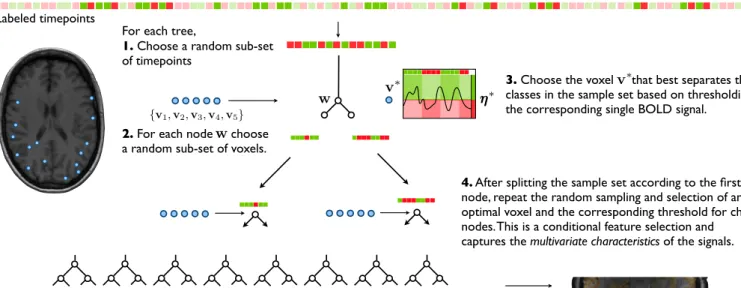
For each tree,
1. Choose a random sub-set
of timepoints
4. After splitting the sample set according to the first
node, repeat the random sampling and selection of an optimal voxel and the corresponding threshold for child nodes. This is a conditional feature selection and captures the multivariate characteristics of the signals. Labeled timepoints
5. Build multiple trees. The decrease in Gini impurity resulting from each fMRI signal is
accumulated over all trees in the forest that contain this voxel. This results in a Gini contrast value for every voxel in the analyzed region (e.g., the entire cortex).
{v1, v2, v3, v4, v5}
2. For each node choose
a random sub-set of voxels.
v∗ 3. Choose the voxel that best separates the
classes in the sample set based on thresholding the corresponding single BOLD signal.
v∗
w ηηη∗
w
Figure 1: Random forest construction and Gini importance calculation.
3.1. Random Forests and Gini Importance for Feature Selec-tion
We let X = [x1, . . . , xT] ∈ RV×T be the BOLD signal
ob-served in an fMRI experiment in V voxels over T time points. xv
t represents the response of voxel v at time t. In addition,
we have access to the labels [l1, . . . , lT] that specify the
ex-perimental condition (stimulus or task) for each time point, lt ∈ {1, . . . , L}. We treat the fMRI pattern at each time point
as a separate data point for classification purposes. Feature se-lection then becomes selecting voxels [v1, . . . , vK] whose fMRI
responses exhibit robust generalization.
A Random Forest classifier consists of decision trees (Fig. 1) for predicting the category label l from the fMRI pattern x. Ma-jority voting rule yields the final category by integrating deci-sions over all the trees in the forest. Each tree is trained on a random subset of examples (xt, lt).
Let nwbe the total number of examples assigned to node w in
the tree and nlwbe the number of examples at node w that belong to category l. Let plwbe the empirical frequency of category l at node w, i.e., plw = nlw
nw. The Gini impurity measures the degree
of separation among the classes achieved at a particular node:
i(w)=
L
X
l=1
plw(1 − plw). (1)
Intuitively Gini impurity measures the probability that two in-dependent draws from the multinomial distribution defined by
pl
ware from two different classes. Each node is associated with
a feature (voxel) v and a threshold value η. All the examples at node w are assigned to one of its two children, w1 and w2,
based on the outcome of the thresholding. We can evaluate the decrease in Gini impurity between node w and its children
(w1, w2): ∆i(w; v, ηv)= i(w) − nw1 nw i(w1) − nw2 nw i(w2). (2)
During training of the tree, given node w, we choose a random subset of features [v1, . . . , vK]. We then select a single feature
v∗(w) and a threshold value η∗(w, v∗) that maximize the
reduc-tion in Gini impurity for the node w. This selecreduc-tion defines the two children of the node w. We repeat this procedure recur-sively, until all leaves of the tree define unique categories.
Given the forest, the Gini importance or contrast of feature v is defined as the reduction in the Gini impurity induced by the feature, integrated over all the trees in the forest:
IG(v)= X all trees X {w:v∗(w)=v} ∆i(w; v, η∗(w, v)). (3)
In this work, we use the Gini importance to rank voxels for feature selection. We refer to the value as the Gini contrast of a voxel with regard to the classes in the training set of the random forest (e.g., different image categories). The underlying Gini impurity is related to the entropy of the conditional distribution of the labels at node w, ie(w)= − PLi=1p
l
wlog piby replacing the
logarithm log piby −(1 − pi) (Raileanu and Stoffel, 2004). The
decrease in Gini impurity quantifies the decrease of labeling uncertainty caused by choosing the feature and the threshold. The Gini contrast approximates the expected information gain in the decision tree. It enables selection of voxels that improve the separation among the classes at some point of any of the hierarchical decisions imposed by decision trees in the forest.
3.2. Gini contrast vs. Univariate Criteria
We compare Gini contrast to three univariate criteria for fea-ture selection: (i) the univariate t-test that compares the average response to stimuli in a particular category to that of fixation, (ii) the omnibus F-test that includes one regressor for each cate-gory in the linear model of the signal, and (iii) random selection of features that provides an uninformed baseline. We use iden-tical classification setup, described above, with all four feature selection methods.
We train a random forest of 40,000 trees to rank voxels based on Gini contrast. The Matlab implementation on a standard workstation (Intel Xeon, 8 cores, 2.8GHz each) takes about 2.5 hours to train the classifier.
To illustrate the regions selected by Gini contrast and univari-ate scores we use the Mutual Information between the labels and the average fMRI signals in individual selected regions, or pairs of regions.
3.3. Gini contrast vs. Recursive Feature Elimination
We compare the Gini contrast to Recursive Feature Elim-ination based on linear SVMs as described in (Hanson and Halchenko, 2008; Guyon et al., 2002).
During recursive feature elimination, we train a SVM with linear kernel in every step, enforcing strong regularization by setting the error penalty to 1010and assigning equal weight to all features by scaling each variable to unit variance. After training, we rank variables according to the absolute value of the coefficient in the prediction function. We remove the fea-tures with the lowest rank, retrain the SVM using the remaining features and repeat the elimination process. In each step, about half of the voxels are removed. The process yields data sets with 40, 80, 160, 320, 640, 1280, 2560, 5120, and 10240 vox-els.
When using recursive feature elimination, we select features for each category separately, as choosing a unique feature set by merging the feature rankings obtained for all binary sub-problems (“one-vs-all”) resulted in poor predictions. We used the same classification setup with both feature selection proce-dures.
3.4. Classification Setup
Once the ranking of all voxels is established, we proceed to train a classifier based on the top K voxels while varying K. We decouple the choice of the feature selection method from the classifier that uses the features to assign novel examples to one of the categories. In this work, we use three types of classifiers: the Random Forest (Breiman, 2001), the linear SVM and the Gaussian RBF SVM (Schoelkopf and Smola, 2002).
For each subject in the study, we train the classifier on the voxels identified by the feature selection procedure using the first half of the time courses and test it on the remaining time points. While the Random Forest classifiers are inherently multi-class, the SVM classifiers are two-way classifiers for each image category vs. all other categories. We quantify the classi-fication performance of the classifiers by the average area under the ROC curve (AUC), averaged over all categories.
In the absence of ground truth for the regions related to stim-uli categories, we evaluate the information encoded in the se-lected voxels by the classification performance. A fast classifi-cation performance increase when starting with the top-ranked features indicates that the top-ranked voxels contain highly rel-evant information.
3.5. Cross validation scheme
We perform feature selection, classifier training, and testing in a two-fold cross validation fashion. For each subject, we divide the fMRI sequence into two consecutive parts of equal length (300 time points). We then use one of the halves for fea-tures selection and training and apply the resulting classifier to the other half. While the signals of adjacent time points in fMRI time courses are highly correlated, this subdivision reduces the effects of correlations to a small region at the split point.
In addition to the classifier performance, we evaluate the sta-bility of the selection by comparing the overlap of the selected voxel subsets between the two halves of the time courses. For each feature selection method (Gini contrast and RFE), we use the Dice measure of overlap (Dice, 1945)
Dice(A, B)= 2|A ∩ B|/(|A| + |B|)
to quantify the volume overlap between the two voxel sets iden-tified by the method on the two training sets. We calculate the Dice measure for different numbers of top ranked voxels.
4. Image Data
We evaluated the methods in a high-level vision fMRI study that included five subjects (Kanwisher, 2003). The subjects viewed images from eight different categories (Animals, Bod-ies, Cars, Faces, Scenes, Shoes, Trees, Vases) in a block-design protocol. During the experiment, subjects viewed sets of eight blocks separated by a fixation period. Each block lasted 16 seconds, during which 20 images of one category were shown. Each block set contained one block for each category, arranged in a random order. Subjects were shown between 8 and 9 blocks for each category. The fMRI data was acquired using a Siemens 3T scanner and a custom 32-channel coil (EPI, flip angle= 90◦
, TR= 2s, TE = 30ms, 28 axial 128x128 slices, voxel size = 1.5 × 1.5 × 2mm). The image volume was restricted to the occipital cortex and the temporal lobe.
For each subject, structural T1 MRI data was acquired and co-registered to the functional data. We segmented the cortex in the T1 image using the segmentation procedures in FreeSurfer2 and transfered this segmentation to the functional images. All calculations were restricted to the voxels on the cortex. We per-formed motion correction, spike detection, intensity normaliza-tion, and Gaussian smoothing with a 3 mm kernel using our standard pipeline employed in localization studies. We dis-carded all runs that contained signal spikes. In addition, we
50 100 200 500 2000 5000 0.5 0.6 0.7 0.8 0.9 1.0 SVM−LIN
Number of features used
AUC ROC Gini F test T test random 50 100 200 500 2000 5000 0.5 0.6 0.7 0.8 0.9 1.0 SVM−RBF
Number of features used
AUC ROC 50 100 200 500 2000 5000 0.5 0.6 0.7 0.8 0.9 1.0 RF
Number of features used
AUC ROC
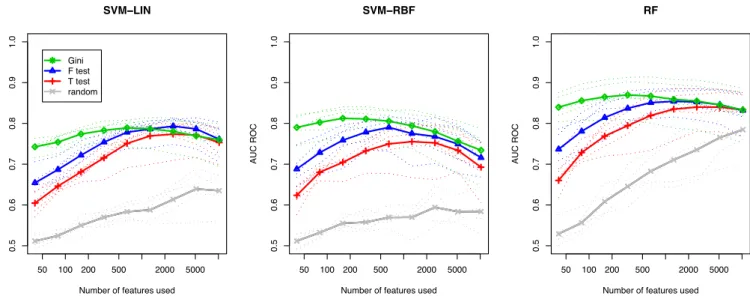
Figure 2: Comparison of Gini contrast ranking and univariate rankings for all 5 subjects averaged over all classes: classification accuracy using the top ranked voxels. Three classifiers (SVM-LIN, SVM-RBF, and RF) exhibit consistent differences when trained on the selected voxels. The curves show the AUC for all classes, and all subjects. Dotted lines show subject-specific accuracy; solid lines show the average accuracy across subjects.
applied de-trending to voxel time courses, regressing out a con-stant baseline, a linear trend, and three linear motion correction regressors, using FsFast3.
We calculated the classification labels by convoluting the block labels with the hemodynamic response kernel and thresh-olding the resulting values at 10% of the maximum value, to exclude ambiguous sections close to the beginning and the end of each block. We excluded the fixation periods from feature selection and classification.
5. Results
We first compare ranking by Gini contrast and univariate cri-teria, and examine the information contained in the regions se-lected only by the multivariate criterium. Then, we compare Gini contrast to RFE in terms of classification performance and reproducibility.
5.1. Gini contrast vs. univariate criteria
Fig. 2 reports the classification performance for random rank-ing, t-test, F-test and Gini contrast ranking. The mean perfor-mance over all categories is shown for each subject, as well as the average performance over all subjects. Starting with the highest ranked voxels, the voxel sets used for classification have a size of 40, 80, 160, 320, 640, 1,280, 2,560, 5,120, and 10,240 (approximately a quarter of all voxels). Random ranking pro-vides a baseline for the information contained in arbitrary sub-sets of voxels. As expected, all three feature selection methods perform better than the random ranking. Since RF performs an inherent feature selection during training the accuracy of RF on random ranking increases as more voxels are included. This is
3http://surfer.nmr.mgh.harvard.edu/fswiki/FsFast
not the case for SVM. When using SVM-RBF and RF classi-fiers the Gini contrast consistently outperforms t-test, and F-test for all voxel subsets. The accuracy of the classifiers based on Gini contrast peaks between 200 and 400 voxels, while t-test, and F-test reach their peak performance only after 1,000 voxels are included.
RF achieves the best classification results for all selection methods. However, the differences between the feature selec-tion methods (random, t-test, F-test, Gini contrast) are consis-tent across the three classification methods.
The differences between the feature selection methods are most pronounced for the small voxel sets. An RF classifier trained and tested on the 40 top ranked voxels yields an aver-age 0.84 AUC for Gini contrast ranking, 0.73 for the F-test, and 0.66 for the t-test. It takes 640 voxels for the F-test to reach classification accuracy comparable to that of Gini con-trast for 40 voxels, and the t-test ranking never reaches this per-formance.
5.2. What is gained by multivariate regions?
When increasing size of the selected voxel set, starting from the top-ranked voxels, the classification performance of Gini contrast increases more rapidly, and reaches its peak earlier, than that for t-test and F-test. The latter two capture large blobs in the data, while Gini contrast selects parts of the same blobs, but ranks only a small portion of each blob very high. At the same time, Gini contrast selects other regions that are not iden-tified by the t-test or the F-test.
Fig. 3 illustrates the regions selected by t-test and those se-lected by Gini contrast but not by t-test. It also shows the detrended BOLD signals for the regions selected by Gini con-trast only. For one pair of those regions, I(y; x1), I(y; x2), and
Univariate Gini contrast Gini contrast only
Face Face Face Face
Gini contrast only Regions
Univariate
Figure 3: Face category: Top row: top ranked voxels by univeriate t-test, Gini contrast, and exclusively Gini contrast. Second row: comparison be-tween connected regions with more than 9 voxels detected by a univariate criterion (t-test, blue) and regions selected exclusively by Gini contrast (red). The additional regions detected by Gini contrast primarily contribute multi-variate relationships to the category. For one pair of regions the de-trended BOLD values are illustrated. Together they hold significantly more informa-tion about the category than random regions. Two example regions carrying joint information are indicated by red and green curves. They exhibit charac-teristic joint behavior for faces: single mutual information vs. face images:
I(face;red)=0.11, I(face;green)=0.054, pair-wise mutual information vs. face
images: I(face;red,green)= 0.213. U selected by univariate ttest; Gini only
-selected only by Gini contrast.
the signals explain the presense of faces jointly, while each of them alone does not exhibit high selectivity to the stimulus.
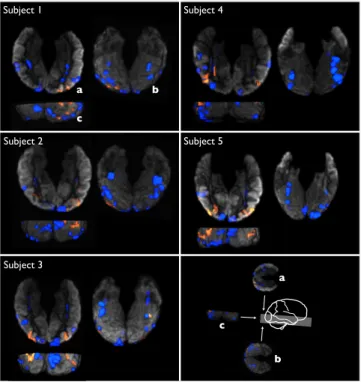
In Fig. 4, the Gini contrast ranking is shown for subject 1 for all 8 image categories. The multi-class Gini contrast takes the interaction between the classes into account and reflects the dif-ferentiating features accordingly. In Fig. 5, t-test, and Gini only regions are shown for all 5 subjects in the study. The regions selected only by Gini contrast exhibit a considerable level of consistency across subjects.
5.3. Gini contrast vs. Recursive Feature Elimination
Fig. 6 reports cross-validation results for the two multivariate ranking methods. We first perform recursive feature elimina-tion based on a linear SVM. We stop removing features when the overall predictive performance starts decreasing. We ob-serve such a peak, for most subjects, after removing 35,000 to 39,000 features. The remaining 2,000 - 5,000 voxels form the feature set used for training of the classifier. When testing the nonlinear classifiers on the same subset of top RFE features the SVM-RBF holds a slight advantage over the linear SVM and shows consistent improvement with the increasing voxel
set size. The RF is well within the performance range defined by the two SVMs – with slightly worse results on the larger sets of features and better results on the smaller sets when compared to the SVM-RBF classifier. The RF performs well as long as in-formative features are part of the feature set it is applied to, with a slight decrease in performance upon the injection of too many irrelevant “noisy” predictors. Many of the 200-400 features re-quired for an optimal RF classifier were removed early in the RFE ranking. Overall, we find that the predictive performance of the two nonlinear classifiers is very close to the performance of the linear classifier which had been used to define the feature ranking and the selected voxel sets. This also implies that fea-tures which may be non-linearly related to the categories have been removed early in the recursive feature elimination.
The random forest classifier achieves the best classification performance for both ranking schemes (Gini and RFE) (Fig. 6). More importantly, the Gini contrast ranking has an advantage over the RFE ranking for small voxel sets regardless of which of the two non-linear classifiers (RF, and SVM-RBF) is used for classification. That is, both non-linear classifiers can take advantage of the information in the voxels ranked high by Gini contrast. Gini contrast ranking together with random forests achieves the best classification performance in the entire exper-iment.
We find the peak performance of the nonlinear classifiers to be at about 200-400 features, i.e., when using at most 1% of the features. The observed advantage of the RF classifier may be attributed to the match between the feature importance measure and the classifier. The two SVMs exhibit comparable perfor-mance on larger feature sets, but we observe a significant ad-vantage of the nonlinear classifier on small feature sets. Specif-ically SVM-RBF with the top 400 features performs equally or better than the linear SVM with any of the voxel subsets se-lected by Gini contrast or RFE. Overall, the Gini contrast seems to identify features relevant to nonlinear relations between ob-servations and stimuli, better than the recursive feature elimina-tion.
In summary, for all classifiers in the experiment the max-imum classification performance is reached by Gini ranking with smaller numbers of voxels than what is required by other rankings. The observations regarding linear SVM and SVM-RBF accuracy are consistent with the expectation that Gini con-trast selects voxels with both linear and non-linear relationship to the class label, while RFE with linear SVMs selects those features with a linear relationship to the class label.
5.4. Consistency of the selected regions across data
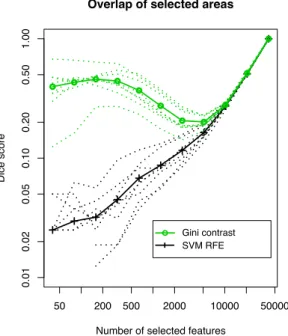
Fig. 7 shows the top 1% of voxels for two folds of the cross-validation for the Gini contrast (top row), and RFE (bottom row). Here we examine face-selective areas of the brain. For each number of chosen voxels, we compute the Dice measure of volume overlap (Dice, 1945) between the sets of top-ranked voxels in the two training sets. The average Dice coefficient between the two sets is 0.35 (ranging from 0.21 to 0.54) for Gini contrast, and 0.06 (ranging from 0.05 to 0.08) for RFE. Fig. 8 reports the Dice measure of overlap between voxel sub-sets selected by RFE and Gini contrast on two different parts
of the fMRI data. For RFE, the amount of overlap scales lin-early with the number of selected voxels, indicating that ran-domness – or lack of appropriate regularization – is present in the recursive feature selection process. In contrast, for Gini contrast, we find a set of several hundred top ranking features (less than 0.5 % of the total number of voxels) that are shared during cross-validation. The Dice scores behave distinctly dif-ferent from the random scaling found for RFE, until more than approximately 10% of total features are added, which presum-ably contain more noise than the initial top features.
6. Discussion
The premise of employing multivariate pattern analysis in fMRI studies is that the relationship between BOLD signals and stimuli can be captured by multi-voxel classifiers. Furthermore this approach assumes that the patterns detected reveal informa-tion about the role of brain regions during cognitive processes.
The search for selective, or diagnostic regions in the neuro-scientific context, is equated with the selection of informative features - a preprocessing step for classification. There are dif-ferent approaches for selecting features, or voxels, driven by the objective to improve the classifier performance. The individual time courses of the selected voxels do not necessarily corre-late with the experimental protocol, but are a part of potentially complex patterns that predict the stimulus.
The approaches used in the neuroscientific community tran-sitioned from including anatomical regions known a priori to employing univariate criteria to select regions (Friston et al., 1994), and then to recursive feature elimination schemes that take the properties of a specific classifier explicitely into con-sideration (Hanson and Halchenko, 2008). This has made the relationship between feature selection and the detection of ac-tive regions more complex, and subject to potential bias intro-duced by the feature selection method (Norman et al., 2006).
In this paper, we use the Gini contrast to rank voxels ac-cording to their potentially non-linear and multivariate relation-ship to the set of the stimuli in the experiment. The scoring is inherently multi-class and captures both the relationship of a voxel’s timecourse to individual categories of stimuli (in our case, different visual object categories), and its contribution for the differentiation among categories. We do not perform any preselection of the regions other than confining the analy-sis to an anatomical segmentation of the cortex in the recorded fMRI data. No parameter optimization or regularization was performed as part of the Gini contrast computation. The classi-fication of the visual categories is not the focus of this paper but only a means to quantify the information encoded in the vox-els in a comparative way. To obtain a balanced view and avoid bias towards a specific classifier and feature selection pair, we performed validation with three different classifiers.
6.1. Experimental Findings
The experiments revealed several interesting findings. 1. Multivariate non-linear scoring of voxels identified regions related to the stimuli that are consistent across cross validation
trials and across subjects. Some of these regions are missed by univariate criteria.
This suggests that the Gini contrast score yields a more accu-rate indication of the relation between voxels and stimuli than the t-test and the F-test. Specifically, Gini contrast captures multivariate relationships that cannot be detected by univariate criteria. The results substantiate this hypothesis. The perfor-mance of the classifiers trained on the voxel sets selected based on the Gini contrast tends to peak at high accuracy for rela-tively small feature set sizes (Fig. 2), implying that the infor-mation about the stimulus in the highest ranked voxels is higher than for univariate criteria. The t-test and F-test do not capture multivariate relations, and thus comparable sizes of top ranked voxel sets include possibly noisy voxels with weak univariate relationships to the stimuli.
Comparing voxel selection by Gini contrast and univariate criteria (t-test, F-test) based on the classification performance of the classifier on a separate test set reveals two important dif-ferences in the ranking. The Gini contrast selects regions if they exhibit strong univariate or multivariate relation to the stimulus differentiation. Most of the regions selected by a t-test are also selected by Gini contrast. However with equal number of top-ranked voxels, Gini contrast selects additionally regions that ex-hibit primarily a multivariate relation to the stimulus, and are completely ignored by the univariate criteria. In a related phe-nomenon, the voxels selected by the Gini contrast form tighter spatial clusters.
An example of this behavior is illustrated in Fig. 3. The two individual highlighted regions do not differentiate between face and non-face with sufficient specificity to be selected by the t-test. However as a joint feature set, they do relate to faces. The corresponding mean BOLD signals reveal this form of relation-ship. Fig. 5 depicts the regions selected by Gini contrast but not by the t-test for all subjects in the study. There is a quali-tative level of consistency across subjects that indicates that the multivariateregions are characteristic to the face stimuli across subjects.
2. The ranking of the voxels by a multivariate non-linear crite-rion like Gini contrast more accurately captures the informa-tion contained in individual voxels. We quantitatively com-pared the feature selection methods based on the score assigned to the voxels by random ranking, t-test, F-test, and Gini con-trast. We used the classification performance in a two-fold cross validation as an indicator for the information captured in the selected voxels. Fig. 2 shows that the methods outperform ran-dom ranking, as expected. The important difference between the univariate rankings and Gini contrast is in the highest ranked voxels. We note that Gini contrast yields higher classification accuracy. The advantage is particularly pronounced in the top 2% of the voxels. While the classifiers based on the univariate criteria gradually improve the performance, as more voxels are included, the Gini contrast selection leads to a fairly early peak in classification accuracy.
It is interesting to compare the classifiers’ performance for the random ranking. In contrast to the SVMs, random forests utilize the information in the randomly selected 10,000 voxels (approximately a quarter of all voxels) to achieve competitive
Faces - Gini contrast rank top 1%
Subject 1 Subject 2 Subject 3 Subject 4 Subject 5
First half of fMRI sequence Second half of fMRI sequence
Top 1% features only fold 1 Top 1% features only fold 2 Overlap of fold 1 and 2 Faces - SVM-RFE rank top 1%
Figure 7: Consistency across trials: Gini contrast ranking vs. SVM RFE ranking of voxels. Top 1% of the voxels is shown for the first half of the time course in red, and the second half of the time course in blue. The overlap between the two sets is shown in green. In the bottom row the voxel sets for Subject 1 are shown on the 3D view of the cortex.
classification performance, even though a majority of the in-cluded voxels are not informative. This phenomenon is related to the observations made in (De Martino et al., 2008): high clas-sification performance indicates presence of informative voxels, not the absence of noise.
3. Gini contrast outperforms RFE with linear SVMs in terms of ranking and selection of informative voxels, and in terms of stability of the selection. The effect is similar to but less pro-nounced than what we observed in comparisons to univariate criteria. RFE reaches the peak performance for larger sizes of the selected voxel sets than Gini contrast. Furthermore, the re-gions selected by Gini contrast exhibit better stability than those selected by RFE (Fig. 7). While the RFE regions have only small overlap between training sets, Gini contrast regions show significantly higher overlap. Since both methods yield similar classification performance, this calls for caution using classifi-cation performance as a singular criterion, if voxel identifica-tion is the primary aim. Despite of comparable classificaidentifica-tion performance, the repeatability of the voxel sets is substantially different for the two ranking methods. Similar observations have been made in prior literature (Kjems et al., 2002; LaConte et al., 2003; Strother et al., 2002; Pereira et al., 2009). The non-linear classifiers like SVM-RBF, and random forests reveal a quantitative classification difference favoring the Gini contrast regions. This is in agreement with the high overlap of the se-lected regions in different training sets of the cross-validation, and gives reason for confidence in the identified brain regions. It is consistent with the hypothesized robustness of the Gini contrast measure for ranking of the voxels in fMRI.
6.2. Pitfalls of multivariate pattern analysis
There is a conceptual difference between the activations de-tected by a general linear model (GLM) that takes the increase of oxygenation as an indicator for the relationship to the stim-ulus, and the classifier based identification of multivariate pat-terns (Haynes and Rees, 2006; Norman et al., 2006). While the former associates the correlation of BOLD signal increase with a specific stimulus, the latter uses multiple voxels to dif-ferentiate between stimuli. One criticism of GLM is noted in (Hanson and Halchenko, 2008) where the authors conclude that for example, the efficiency of a brain region in terms of en-ergy consumption can confound the significance of the GLM paradigm. In contrast multivariate patterns aim to di fferenti-ate between stimuli, or conditions, by using BOLD signals in multiple voxels together with statistical classifiers. While this approach makes the observation of complex and interconnected characteristics possible (i.e., beyond the correlation between a single BOLD signal and the stimulus) it can lead to ambigu-ous results if used for the identification of informative voxels. The patterns might include voxels that are not informative but do not deteriorate the classification results. It can also exclude parts of informative but highly correlated voxels. Both cases result in only partial overlap between regions identified by the algorithm, and those actually related to the stimulus.
For example, a method that treats the reduction in classifi-cation performance when a certain voxel is excluded as an in-dicator of the voxel’s diagnostic value, can detect informative
voxels. But such a method would exclude voxels that are infor-mative but highly correlated to other inforinfor-mative voxels. SVM-based rankings tend to score informative but highly correlated voxels lower than single voxels with the same contribution to classification performance that are not strongly correlated with other voxels in the volume. One way of constraining the voxel selection and minimizing this ambiguity is a tolerant univariate activation detection by a standard GLM and only a subsequent restriction of the analysis to the selected regions. In (De Mar-tino et al., 2008; Haynes et al., 2007) a GLM-based detection of voxels that exhibit an activation effect precedes the multivariate pattern analysis. However, the disadvantage of this strategy is that it can exclude regions with low univariate characteristics but high multivariate predictive power. In our experiments, we did not perform a prior exclusion of regions based on GLM.
In contrast to the methods above, Gini contrast exhibits a grouping effect. It ranks informative voxels equally high, even if their time courses are strongly correlated. Furthermore, bag-ging and random feature selection during the Random For-est training and Gini contrast calculation provides robustness against noise and ensures stability even though the size of the training set is small (300 time points) compared to the dimen-sionality of the data (40,000 voxels).
7. Conclusion
Identification of diagnostic brain regions by means of clas-sifiers and multivariate patterns requires careful choice of the classifier, the voxel selection criterion, and the inference made from the selected regions. In our experiments, we observed that Gini contrast as a voxel selection score identifies regions de-tected by univariate criteria and additional informative regions consistently missed by univariate criteria. Regions selected by the Gini contrast measure exhibit substantial overlap for di ffer-ent fMRI data trials for the same subject and across subjects. Gini contrast is a multi-class multivariate criterion, that elim-inates the need for regularization or pre-selection of regions. The results indicate that it is a promising choice for the detec-tion of multivariate patterns in fMRI data.
8. Acknolwedgements
We thank Nancy Kanwisher for providing the fMRI data for the experiments in this work. This work was funded in part by the NSF IIS/CRCNS 0904625 grant, the NSF CAREER 0642971 grant, the NIH NCRR NAC P41-RR13218 and the NIH NIBIB NAMIC U54-EB005149 grant. B.M. acknowl-edges support by the German Academy of Sciences Leopoldina (Fellowship Programme LPDS 2009-10).
References
Archer, K., Kimes, R., 2008. Empirical characterization of random forest variable importance measures. Computational Statistics and Data Analysis 52 (4), 2249–2260.
Breiman, L., 2004. Consistency for a simple model of random forests. Techni-cal report 670, Department of Statistics, University of California, Berkeley, USA.
Carlson, T., Schrater, P., He, S., 2003. Patterns of activity in the categorical representations of objects. Journal of Cognitive Neuroscience 15 (5), 704– 717.
Cox, D., Savoy, R., 2003. Functional magnetic resonance imaging
(fMRI)“brain reading”: detecting and classifying distributed patterns of fMRI activity in human visual cortex. Neuroimage 19 (2), 261–270. Davatzikos, C., Ruparel, K., Fan, Y., Shen, D., Acharyya, M., Loughead, J.,
Gur, R., Langleben, D., 2005. Classifying spatial patterns of brain activity with machine learning methods: application to lie detection. Neuroimage 28 (3), 663–668.
De Martino, F., Valente, G., Staeren, N., Ashburner, J., Goebel, R., Formisano, E., 2008. Combining multivariate voxel selection and support vector ma-chines for mapping and classification of fMRI spatial patterns. Neuroimage 43 (1), 44–58.
Diaz-Uriarte, R., Alvarez de Andres, S., 2006. Gene selection and classification of microarray data using random forest. BMC Bioinformatics 7, 1–25. Dice, L. R., 1945. Measures of the amount of ecologic association between
species. Ecology 26 (3), 297–302.
Epstein, R., Kanwisher, N., 1998. A cortical representation of the local visual environment. Nature 392 (6676), 598–601.
Friston, K., Holmes, A., Worsley, K., Poline, J., Frith, C., Frackowiak, R., et al., 1994. Statistical parametric maps in functional imaging: a general linear approach. Human Brain Mapping 2 (4), 189–210.
Granitto, P., Furlanello, C., Biasioli, F., F., G., 2006. Empirical characterization of random forest variable importance measures. Chemometrics and Intelli-gent Laboratory Systems 83, 83–90.
Guyon, I., Elisseeff, A., 2003. An introduction to variable and feature selection.
The Journal of Machine Learning Research 3, 1157–1182.
Guyon, I., Weston, J., Barnhill, S., Vapnik, V., 2002. Gene selection for cancer classification using support vector machines. Machine learning 46 (1), 389– 422.
Hanson, S., Halchenko, Y., 2008. Brain Reading Using Full Brain Support Vector Machines for Object Recognition: There Is No ’Face’ Identification Area. Neural Computation 20 (2), 486–503.
Hardoon, D., Mourao-Miranda, J., Brammer, M., Shawe-Taylor, J., 2007. Un-supervised analysis of fmri data using kernel canonical correlation. Neu-roImage 37 (4), 1250–1259.
Hastie, T., Tibshirani, R., Friedman, J., 2009. The Elements of Statistical Learn-ing, 2nd Edition. Springer.
Haxby, J., Gobbini, M., Furey, M., Ishai, A., Schouten, J., Pietrini, P., 2001. Distributed and overlapping representations of faces and objects in ventral temporal cortex. Science 293 (5539), 2425.
Haynes, J., Rees, G., 2005. Predicting the orientation of invisible stimuli from activity in human primary visfual cortex. Nature Neuroscience 8 (5), 686– 691.
Haynes, J., Rees, G., 2006. Decoding mental states from brain activity in hu-mans. Nature Reviews Neuroscience 7 (7), 523–534.
Haynes, J., Sakai, K., Rees, G., Gilbert, S., Frith, C., Passingham, R., 2007. Reading hidden intentions in the human brain. Current Biology 17 (4), 323– 328.
Ishai, A., Ungerleider, L. G., Haxby, J. V., Dec 2000. Distributed neural systems for the generation of visual images. Neuron 28 (3), 979–90.
Kamitani, Y., Tong, F., 2005. Decoding the visual and subjective contents of the human brain. Nature Neuroscience 8 (5), 679.
Kanwisher, N., 2003. The ventral visual object pathway in humans: evidence from fMRI. In: Chalupa, L., Wener, J. (Eds.), The Visual Neurosciences. MIT Press, pp. 1179–1189.
Kanwisher, N., McDermott, J., Chun, M., 1997. The fusiform face area: a module in human extrastriate cortex specialized for face perception. Journal of Neuroscience 17 (11), 4302–4311.
Kjems, U., Hansen, L. K., Anderson, J., Frutiger, S., Muley, S., Sidtis, J., Rottenberg, D., Strother, S. C., Apr 2002. The quantitative evaluation of functional neuroimaging experiments: mutual information learning curves. Neuroimage 15 (4), 772–86.
Kriegeskorte, N., Goebel, R., Bandettini, P., 2006. Information-based func-tional brain mapping. Proceedings of the Nafunc-tional Academy of Sciences 103 (10), 3863.
LaConte, S., Anderson, J., Muley, S., Ashe, J., Frutiger, S., Rehm, K., Hansen,
L. K., Yacoub, E., Hu, X., Rottenberg, D., Strother, S., Jan 2003. The evalu-ation of preprocessing choices in single-subject bold fmri using npairs per-formance metrics. Neuroimage 18 (1), 10–27.
LaConte, S., Strother, S., Cherkassky, V., Anderson, J., Hu, X., 2005. Sup-port vector machines for temporal classification of block design fMRI data. NeuroImage 26 (2), 317–329.
Lao, Z., Shen, D., Xue, Z., Karacali, B., Resnick, S., Davatzikos, C., 2004. Morphological classification of brains via high-dimensional shape transfor-mations and machine learning methods. Neuroimage 21 (1), 46–57. Menze, B., Kelm, M., Masuch, R., Himmelreich, U., Bachert, P., Petrich, W.,
Hamprecht, F., 2009. A comparison of random forest and its gini importance with standard chemometric methods for the feature selection and classifica-tion of spectral data. BMC bioinformatics 10 (1), 213.
Menze, B., Petrich, W., Hamprecht, F., 2007. Multivariate feature selection and hierarchical classification for infrared spectroscopy: serum-based detection of bovine spongiform encephalopathy. Analytical and Bioanalytical Chem-istry 387 (5), 1801–1807.
Mitchell, T., Hutchinson, R., Niculescu, R., Pereira, F., Wang, X., Just, M., Newman, S., 2004. Learning to decode cognitive states from brain images. Machine Learning 57 (1), 145–175.
Mour˜ao-Miranda, J., Bokde, A., Born, C., Hampel, H., Stetter, M., 2005. Clas-sifying brain states and determining the discriminating activation patterns: support vector machine on functional MRI data. NeuroImage 28 (4), 980– 995.
Mour˜ao-Miranda, J., Friston, K., Brammer, M., 2007. Dynamic discrimination analysis: A spatial–temporal SVM. NeuroImage 36 (1), 88–99.
Mour˜ao-Miranda, J., Reynaud, E., McGlone, F., Calvert, G., Brammer, M., 2006. The impact of temporal compression and space selection on SVM analysis of single-subject and multi-subject fMRI data. NeuroImage 33 (4), 1055–1065.
Norman, K., Polyn, S., Detre, G., Haxby, J., 2006. Beyond mind-reading: multi-voxel pattern analysis of fMRI data. Trends in Cognitive Sciences 10 (9), 424–430.
O’Toole, A., Jiang, F., Abdi, H., P´enard, N., Dunlop, J., Parent, M., 2007. The-oretical, statistical, and practical perspectives on pattern-based classification approaches to the analysis of functional neuroimaging data. Journal of Cog-nitive Neuroscience 19 (11), 1735–1752.
Pereira, F., Mitchell, T., Botvinick, M., 2009. Machine learning classifiers and fMRI: a tutorial overview. Neuroimage 45 (1S1), 199–209.
Raileanu, L., Stoffel, K., 2004. Theoretical comparison between the Gini index
and information gain criteria. Annals of Mathematics and Artificial Intelli-gence 41 (1), 77–93.
Schoelkopf, B., Smola, A., 2002. Learning with Kernels, 644. MIT Press, Cam-bridge, MA.
Shen, K. Q., Ong, C. J., Li, X. P., Zheng, H., Wilder-Smith, E. P. V., 2007. A Feature Selection Method for Multi-Level Mental Fatigue EEG Classifica-tion. IEEE Transactions on Biomedical Engineering 54, 1231–1237. Strobl, C., A.-L., B., Kneib, T., Augustin, T., A., Z., 2008. Conditional variable
importance for random forests. BMC Bioinformatics 9, 307.
Strother, S. C., Anderson, J., Hansen, L. K., Kjems, U., Kustra, R., Sidtis, J., Frutiger, S., Muley, S., LaConte, S., Rottenberg, D., Apr 2002. The quan-titative evaluation of functional neuroimaging experiments: the npairs data analysis framework. Neuroimage 15 (4), 747–71.
Svetnik, V., Liaw, A., Tong, C., Culberson, J. C., Sheridan, R. P., Feuston, B. P., 2003. Random Forest: A Classification and Regression Tool for Compound Classification and QSAR Modeling. Journal of Chemical Information and Computer Sciences 43, 1947–58.
Wang, Z., 2009. A hybrid SVM–GLM approach for fMRI data analysis. Neu-roimage 46 (3), 608–615.
Wang, Z., Childress, A., Wang, J., Detre, J., 2007. Support vector machine learning-based fMRI data group analysis. Neuroimage 36 (4), 1139–1151. Yamashita, O., Sato, M., Yoshioka, T., Tong, F., Kamitani, Y., 2008. Sparse
estimation automatically selects voxels relevant for the decoding of fMRI activity patterns. Neuroimage 42 (4), 1414–1429.
1: Animals 3: Cars 5: Scenes 7: Trees 2: Bodies 3: Faces 6: Shoes 8: Vases
Figure 4: Gini contrasts for all 8 classes, shown in 3D at their positions on the cortex. Subject 2 Subject 3 Subject 4 Subject 5 a b c c Subject 1 a b
Figure 5: All subjects: regions selected by t-test (blue) and regions selected by Gini contrast but not by t-test (red) analogous to Fig. 3. The regions are shown on top of a 3D rendering of the cortex: view from top, view from behind, view from bottom. !" #"" $""" !""" "%! "%& "%' "%( "%) $%" SVM RFE ranking !" #"" $""" !""" "%! "%& "%' "%( "%) $%" Gini ranking *+,-./0012134 567!*8+,-./0012134 567!9,-./0012134 !" #"" $""" !""" "%! "%& "%' "%( "%) $%" SVM RFE ranking !" #"" $""" !""" "%! "%& "%' "%( "%) $%" Gini ranking *+,-./0012134 567!*8+,-./0012134 567!9,-./0012134
SVM RFE Gini contrast
Figure 6: Comparison of classification performance in a two-fold cross-validation, using (a) random forests, (b) RBF SVM, and (c) Linear SVM. For each classifier voxel ranking was done by RFE, and Gini contrast. Three
classifiers (SVM-LIN, SVM-RBF, and RF) exhibit consistent differences when
trained on the selected voxels. The curves show the AUC for all classes, and all subjects. Dotted lines show subject-specific accuracy; solid lines show the average accuracy across subjects.
50 200 500 2000 10000 50000 0.01 0.02 0.05 0.10 0.20 0.50 1.00
Overlap of selected areas
Number of selected features
Dice score ! ! ! ! ! ! ! ! ! ! ! ! Gini ranking SVM RFE ranking Gini contrast SVM RFE
Figure 8: Dice measure of overlap between identified voxels in the two-fold cross-validation. Voxel sets selected by Gini contrast (green) exhibit far higher overlap compared to those selected by RFE (black). The thick lines show the mean over all subjects and all categories. The thin lines show average overlap for each category separately. Both axes use log scale.