HAL Id: hal-00302965
https://hal.archives-ouvertes.fr/hal-00302965
Submitted on 12 Jul 2007HAL is a multi-disciplinary open access
archive for the deposit and dissemination of sci-entific research documents, whether they are pub-lished or not. The documents may come from teaching and research institutions in France or abroad, or from public or private research centers.
L’archive ouverte pluridisciplinaire HAL, est destinée au dépôt et à la diffusion de documents scientifiques de niveau recherche, publiés ou non, émanant des établissements d’enseignement et de recherche français ou étrangers, des laboratoires publics ou privés.
Effect of NOx level on secondary organic aerosol (SOA)
formation from the photooxidation of terpenes
N. L. Ng, P. S. Chhabra, A. W. H. Chan, J. D. Surratt, J. H. Kroll, A. J.
Kwan, D. C. Mccabe, P. O. Wennberg, A. Sorooshian, S. M. Murphy, et al.
To cite this version:
N. L. Ng, P. S. Chhabra, A. W. H. Chan, J. D. Surratt, J. H. Kroll, et al.. Effect of NOx level on secondary organic aerosol (SOA) formation from the photooxidation of terpenes. Atmospheric Chemistry and Physics Discussions, European Geosciences Union, 2007, 7 (4), pp.10131-10177. �hal-00302965�
ACPD
7, 10131–10177, 2007NOxdependence of SOA formation from
terpenes N. L. Ng et al. Title Page Abstract Introduction Conclusions References Tables Figures ◭ ◮ ◭ ◮ Back Close
Full Screen / Esc
Printer-friendly Version Interactive Discussion
EGU Atmos. Chem. Phys. Discuss., 7, 10131–10177, 2007
www.atmos-chem-phys-discuss.net/7/10131/2007/ © Author(s) 2007. This work is licensed
under a Creative Commons License.
Atmospheric Chemistry and Physics Discussions
Effect of NO
x
level on secondary organic
aerosol (SOA) formation from the
photooxidation of terpenes
N. L. Ng1, P. S. Chhabra1, A. W. H. Chan1, J. D. Surratt2, J. H. Kroll3, A. J. Kwan4, D. C. McCabe4, P. O. Wennberg4, A. Sorooshian1, S. M. Murphy1, N. F. Dalleska4, R. C. Flagan1,4, and J. H. Seinfeld1,4
1
Department of Chemical Engineering, California Institute of Technology, Pasadena, CA 91125, USA
2
Department of Chemistry, California Institute of Technology, Pasadena, CA 91125, USA 3
Aerodyne Research, Inc., Billerica, MA 01821, USA 4
Department of Environmental Science and Engineering, California Institute of Technology, Pasadena, CA 91125, USA
Received: 7 June 2007 – Accepted: 3 July 2007 – Published: 12 July 2007 Correspondence to: J. H. Seinfeld ([email protected])
ACPD
7, 10131–10177, 2007NOxdependence of SOA formation from
terpenes N. L. Ng et al. Title Page Abstract Introduction Conclusions References Tables Figures ◭ ◮ ◭ ◮ Back Close
Full Screen / Esc
Printer-friendly Version Interactive Discussion
EGU
Abstract
Secondary organic aerosol (SOA) formation from the photooxidation of one monoter-pene (α-pinene) and two sesquitermonoter-penes (longifolene and aromadendrene) is investi-gated in the Caltech environmental chambers. The effect of NOxon SOA formation for
these biogenic hydrocarbons is evaluated by performing photooxidation experiments
5
under varying NOx conditions. The NOx dependence of α-pinene SOA formation
fol-lows the same trend as that observed previously for a number of SOA precursors, including isoprene, in which SOA yield (defined as the ratio of the mass of organic aerosol formed to the mass of parent hydrocarbon reacted) decreases as NOx level
increases. The NOx dependence of SOA yield for the sesquiterpenes, longifolene and
10
aromadendrene, however, differs from that determined for isoprene and α-pinene; the aerosol yield under high-NOxconditions substantially exceeds that under low-NOx
con-ditions. The reversal of the NOx dependence of SOA formation for the sesquiterpenes
is consistent with formation of relatively low-volatility organic nitrates, and/or the iso-merization of large alkoxy radicals leading to less volatile products. Analysis of the
15
aerosol chemical composition for longifolene confirms the presence of organic nitrates under high-NOx conditions. Consequently the formation of SOA from certain biogenic hydrocarbons such as sesquiterpenes (and possibly large anthropogenic hydrocarbons as well) may be more efficient in polluted air.
1 Introduction
20
Atmospheric oxidation of certain volatile organic compounds (VOCs) leads to the formation of low volatility species that partition into the condensed phase and form secondary organic aerosol (SOA). Biogenic hydrocarbons, such as isoprene (C5H8), monoterpenes (C10H16), and sesquiterpenes (C15H24), are important contributors to
the total atmospheric burden of SOA owing to their large global emissions and high
25
ACPD
7, 10131–10177, 2007NOxdependence of SOA formation from
terpenes N. L. Ng et al. Title Page Abstract Introduction Conclusions References Tables Figures ◭ ◮ ◭ ◮ Back Close
Full Screen / Esc
Printer-friendly Version Interactive Discussion
EGU et al., 1995; Griffin et al., 1999a; Geron et al., 2000; Owen et al., 2001; Atkinson and
Arey, 2003; Seinfeld and Pankow, 2003; Kanakidou et al., 2005).
Over the last two decades, numerous laboratory chamber experiments have been conducted to study aerosol formation from biogenic hydrocarbons. Level of odd ni-trogen (NOx) has been found to be highly influential in SOA production for a variety
5
of compounds. Recent studies on isoprene photooxidation,α-pinene ozonolysis, and benzene, toluene, andm-xylene photooxidation have demonstrated that aerosol yields are generally highest at low levels of NOx(Hatakeyama et al., 1991; Kroll et al., 2006;
Presto et al., 2005; Song et al., 2005; Ng et al., 2007). These observations are con-sistent with competitive chemistry of peroxy radicals between NO and HO2, with the
10
RO2+HO2 reaction producing products of lower volatility than the RO2+NO reaction (Hatakeyama et al., 1991; Johnson et al., 2004, 2005; Kroll et al., 2005, 2006; Presto et al., 2005; Ng et al., 2007). For example, inα-pinene ozonolysis, Presto et al. (2005) ob-served relatively volatile organic nitrates under high-NOxconditions, while less volatile products, such as 10-hydroxypinonic acid, were more abundant under low-NOx
condi-15
tions. Although a decreasing SOA yield with increasing NOxlevel has been established
for relatively small hydrocarbons (10 carbons of fewer), it is unknown whether larger molecules, such as sesquiterpenes, exhibit a similar NOxdependence of SOA yield.
In the present study, we focus on two sesquiterpenes, longifolene and aromaden-drene, and compare the NOx-dependence of their SOA formation with that ofα-pinene.
20
Longifolene reacts very slowly with ozone (Atkinson and Arey, 2003), making it ideal for the study of OH photooxidation. Moreover, both longifolene and aromadendrene have only one double bond, thus one can infer more easily the general mechanisms of SOA formation than when multiple double bonds are present (Ng et al., 2006). Experiments are conducted under limiting NOx conditions (high-NOx conditions in which HONO is
25
used as the OH precursor, and low-NOx conditions in which H2O2 is used as the OH precursor), as well as with intermediate levels of NOx.
ACPD
7, 10131–10177, 2007NOxdependence of SOA formation from
terpenes N. L. Ng et al. Title Page Abstract Introduction Conclusions References Tables Figures ◭ ◮ ◭ ◮ Back Close
Full Screen / Esc
Printer-friendly Version Interactive Discussion
EGU
2 Experimental section
Experiments are performed in Caltech’s dual 28 m3 Teflon environmental chambers. Details of the facilities are given elsewhere (Cocker et al., 2001; Keywood et al., 2004). Before each experiment, the chambers are flushed continuously with dry purified air for ∼24 h. Each chamber has a dedicated Differential Mobility Analyzer (DMA, TSI
5
model 3081) coupled with a condensation nucleus counter (TSI model 3760) for mea-suring aerosol size distribution, number concentration, and volume concentration. All aerosol growth data are corrected for wall loss, in which size-dependent coefficients determined from inert particle wall loss experiments are applied to the aerosol volume data (Keywood et al., 2004). Temperature, relative humidity (RH), O3, NO, and NOxare
10
continuously monitored. The initial temperature of the chamber is ∼20◦C. Heating from the lights leads to a temperature increase of approximately 5◦C inside the chamber over the course of the experiment. The analytical instruments are located outside the chamber enclosure and are at the temperature of the surrounding room (∼20–22◦C). The air may cool slightly as it is sampled from the chamber into the instruments, and the
15
measured aerosol likely corresponds to the gas-particle partitioning at the temperature of the surrounding room rather than the chamber enclosure. Such small temperature differences are unlikely to affect results significantly.
Seed particles are introduced into the chamber to act as substrates onto which the gas-phase semivolatile products may condense. Seed aerosols are generated from a
20
0.015 M aqueous ammonium sulfate solution with a constant-rate atomizer, producing initial particle number concentrations of ∼25 000 particles cm−3, with a geometric mean diameter of ∼50 nm, and an initial aerosol seed volume of ∼10–15µm3cm−3. After in-troduction of the seed aerosol, a known volume of the parent hydrocarbon is injected into a glass bulb, and then introduced into the chambers by an air stream. For
ex-25
periments withα-pinene and longifolene, the concentration (mixing ratio) of the parent hydrocarbon is monitored with a Hewlett Packard gas chromatograph (model 5890) with flame ionization detection (GC-FID). The concentration of longifolene in several
ACPD
7, 10131–10177, 2007NOxdependence of SOA formation from
terpenes N. L. Ng et al. Title Page Abstract Introduction Conclusions References Tables Figures ◭ ◮ ◭ ◮ Back Close
Full Screen / Esc
Printer-friendly Version Interactive Discussion
EGU experiments is also measured with a Proton Transfer Reaction Mass Spectrometer
(PTR-MS), a custom-modified Varian 1200 system (see Appendix A). Owing to the difficulties in measuring aromadendrene with GC-FID, its concentration is measured solely with the PTR-MS. The PTR-MS is calibrated only for aromadendrene.
In the high-NOx experiments nitrous acid (HONO) serves as the OH precursor.
5
HONO is prepared by dropwise addition of 15 mL of 1% NaNO2 into 30 mL of 10%
H2SO4 in a glass bulb. After injection of the seed aerosol and parent hydrocarbon, the bulb is then attached to the chamber and a stream of dry air is passed through the bulb, sending HONO into the chamber. NO and NO2, formed as side products in
the preparation of HONO, are also introduced into the chamber, and are measured
10
by a commercial NOx monitor (Horiba APNA-360, Irvine, CA). Additional NO from a 500 ppm gas cylinder (Scott Marrin, Inc.) is introduced into the chamber after the addi-tion of HONO to achieve a target NOxlevel in the chamber of about 1 ppm (upper limit
of the NOxmonitor).
For low-NOx experiments, H2O2serves as the OH precursor. The background NOx
15
level in the chamber during such experiments is ≤2 ppb. About 3 ppm H2O2 is
intro-duced into the chamber (prior to introduction of seed particles and parent hydrocarbon) by bubbling air through a 50% H2O2 solution for 2.5 h at 5 L/min. The air stream then
passes through a particle filter to remove any droplets. Variable NO experiments are also carried out, in which a known concentration of NO is introduced into the chamber
20
after the addition of H2O2. This allows for the study of SOA formation under
intermedi-ate NOxconditions. It is noted that for these intermediate NOx experiments, NO goes
to zero during the experiment and so there is a switch from high- to low-NOxconditions over the course of the experiment.
Once the seed, parent hydrocarbon, and NOx concentrations stabilize, reaction is
25
initiated by irradiating the chamber with blacklights. Output from the lights is between 300 and 400 nm, with a maximum at 354 nm. Half of the available black lights are used in the experiments. At these wavelengths HONO efficiently photolyzes to OH and NO. By contrast, H2O2 absorbs only weakly in this wavelength range, requiring the use of
ACPD
7, 10131–10177, 2007NOxdependence of SOA formation from
terpenes N. L. Ng et al. Title Page Abstract Introduction Conclusions References Tables Figures ◭ ◮ ◭ ◮ Back Close
Full Screen / Esc
Printer-friendly Version Interactive Discussion
EGU ppm mixing ratios of H2O2to achieve target levels of OH.
A comprehensive range of measurements are employed to study the chemical com-position of the SOA formed. Real-time particle mass spectra are obtained with an Aerodyne quadrupole Aerosol Mass Spectrometer (Q-AMS) (Jayne et al., 2000). A particle-into-liquid sampler (PILS, Brechtel Manufacturing, Inc.) coupled with ion
chro-5
matography is employed for quantitative measurements of water-soluble ions in the aerosol phase (Sorooshian et al., 2006). For offline chemical analysis, aerosol sam-ples are collected on Teflon filters (PALL Life Sciences, 47-mm diameter, 1.0-µm pore size, Teflo membrane) starting at the point when aerosol volume reaches its maximum value. Depending on the total chamber volume concentration of aerosol, the filter
sam-10
pling time is 2–4 h, which results in ∼1.5–6 m3 of total chamber air sampled. Teflon filter extraction protocols in HPLC-grade methanol have been described previously (Surratt et al., 2006). The resultant filter extracts are then analyzed by high perfor-mance liquid chromatography/electrospray ionization-quadrupole mass spectrometry (HPLC/ESI-MS) and electrospray ionization-ion trap mass spectrometry (ESI-ITMS);
15
details of the protocols are described elsewhere (Surratt et al., 2006). Filter extracts are also analyzed by a Waters ACQUITY ultra performance liquid chromatography (UPLC) system, coupled with a Waters LCT Premier time-of-flight (TOF) mass spectrometer (MS) equipped with an electrospray ionization (ESI) source (see Appendix B), allowing for exact mass and tandem MS measurements.
20
The parent hydrocarbons studied and their stated purities are as follows: α-pinene (Aldrich, 99+%), longifolene (Aldrich, >99%), and aromadendrene (Aldrich, >97%). Table 1 lists the structures of the parent hydrocarbons and the rate constants of the compounds for reaction with OH radicals (kOH). Experimental conditions and results
for each of the parent hydrocarbons studied are given in Tables 2, 3, and 4. In
cal-25
culating SOA yield, knowledge of the SOA density is required. By comparing volume distributions from the DMA and mass distributions from the Q-AMS, effective densities for the SOA formed can be estimated (Bahreini et al., 2005; Alfarra et al., 2006). The estimated densities of the SOA formed from different parent hydrocarbons are given in
ACPD
7, 10131–10177, 2007NOxdependence of SOA formation from
terpenes N. L. Ng et al. Title Page Abstract Introduction Conclusions References Tables Figures ◭ ◮ ◭ ◮ Back Close
Full Screen / Esc
Printer-friendly Version Interactive Discussion EGU Table 5. 3 Aerosol yields 3.1 α-pinene photooxidation
Under high-NOxconditions, the efficient photolysis of HONO generates relatively high concentrations of OH (∼2×10⁷molecules cm−3initially), leading to rapidα-pinene
de-5
cay. Aerosol growth occurs essentially immediately, even when [NO] is high (100’s of ppb). With the high NO concentration throughout the entire experiment, formation of ozone and NO3is suppressed.
Under low-NOx conditions, aerosol growth is also observed immediately after
ini-tiation of irradiation. The α-pinene decays at a slower rate than under high-NOx
10
conditions, owing to the relatively slow production of OH radicals by H2O2
pho-tolysis. Ozone formation is observed at an increasing concentration over time (∼30 ppb at the peak of aerosol growth), possibly from residual material released from the chamber walls. Based on the reaction rate constants of α-pinene+O3
(kozone=8.4×10
−17
cm3molecule−1s−1, Atkinson et al., 2003) and α-pinene+OH
15
(kOH=5.3×10 −11
cm3molecule−1s−1, Atkinson et al., 2003), and an inferred OH con-centration of 3×10⁶molecules cm−3(estimated from longifolene low-NOxexperiments,
see Sect. 3.2), it is estimated that an ozone source of ∼0.1 ppb/min would be required to produce the observedpinene decay. It is estimated that only about 35% of the α-pinene reacts by ozonolysis at the point of maximum growth. Therefore, whileα-pinene
20
ozonolysis accounts for some of the SOA yield under low-NOxconditions, it is unlikely
that the observed yield differences between high- and low-NOx conditions (described
below) arise solely from the presence of ozone.
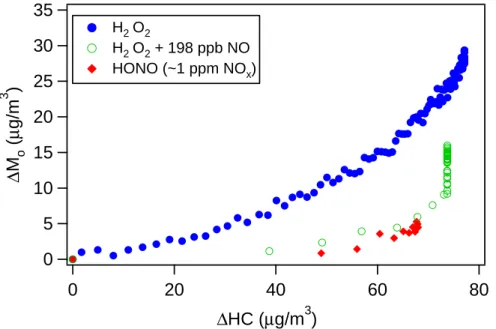
Figure 1 shows the time-dependent growth curves (organic aerosol generated, de-noted as ∆Mo, as a function of hydrocarbon reacted, ∆HC) for α-pinene under different
25
ACPD
7, 10131–10177, 2007NOxdependence of SOA formation from
terpenes N. L. Ng et al. Title Page Abstract Introduction Conclusions References Tables Figures ◭ ◮ ◭ ◮ Back Close
Full Screen / Esc
Printer-friendly Version Interactive Discussion
EGU those of particle volume, theα-pinene concentrations shown are obtained by fitting the
GC measurements to an exponential decay. In all cases, the initial mixing ratio of α-pinene is about 15 ppb, all of which is consumed by the end of the experiment. It is clear that the aerosol growth under low-NOx (H2O2) conditions substantially exceeds that
under high-NOx (HONO) conditions, while the intermediate NOx(“H2O2+NO”)
experi-5
ment exhibits an aerosol yield between those of the two extremes. The time-dependent growth curve of the intermediate NOxexperiment exhibits a vertical section at the end,
indicating that further reactions are contributing to aerosol growth after α-pinene is consumed. We return to this observation in Sect. 5.2.2.
3.2 Longifolene photooxidation
10
For longifolene, a series of high-NOx (HONO) experiments and low-NOx (H2O2)
ex-periments with varying initial hydrocarbon concentrations are carried out. The time-dependent growth curves for 3 high-NOxand 3 low-NOxexperiments, with initial
longi-folene mixing ratios ranging from ∼10 to 30 ppb, are shown in Fig. 2. In contrast to α-pinene photooxidation, longifolene aerosol yields under high-NOxconditions exceed
15
those under low-NOxconditions. Under high-NOxconditions, the maximum SOA yield is about ∼100–130% and is reached in ∼10 min after initiation of the experiments, with the yield decreasing after that point. It is noted that SOA yield is defined on a mass basis so oxidation (addition of O or N atoms) can lead to yields larger than 100%. Under low-NOx conditions, SOA yield continues to increase over the course of the
ex-20
periment, reaching a maximum when all the longifolene is consumed. The final SOA yields of each longifolene low-NOxexperiment lie on a straight line that passes through the origin, indicating that under low-NOxconditions SOA yield is constant (∼75%)
un-der the range of ∆Mostudied. It is possible that under lower SOA loadings the yields
may decrease as some of the products partition back into the gas phase. Based on
25
the observed longifolene decay andkOHfor longifolene, the chamber OH concentration
under low-NOxconditions is estimated to be ∼3×10 6
molecules cm−3.
time-ACPD
7, 10131–10177, 2007NOxdependence of SOA formation from
terpenes N. L. Ng et al. Title Page Abstract Introduction Conclusions References Tables Figures ◭ ◮ ◭ ◮ Back Close
Full Screen / Esc
Printer-friendly Version Interactive Discussion
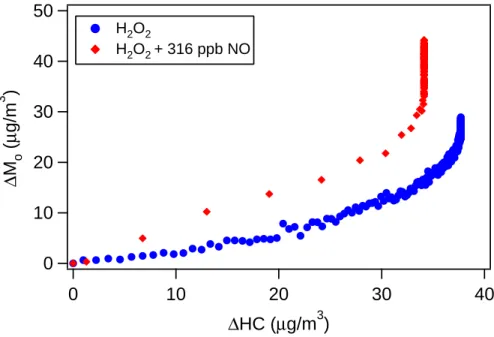
EGU dependent growth curves in Fig. 3. In both experiments H2O2 is used as the OH
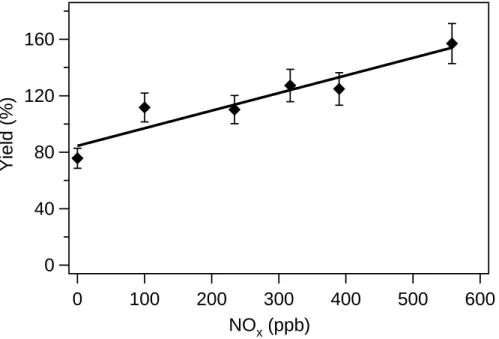
precursor and the initial longifolene mixing ratio is 4–5 ppb; in one experiment no extra NO is added, while in the other experiment about 300 ppb of NO is introduced into the chamber after the addition of H2O2. Aerosol growth in the presence of ∼300 ppb NO is substantially higher. A series of experiments with the same initial longifolene
5
concentration but different initial NO concentrations (∼100–600 ppb) are also carried out. Figure 4 shows the final aerosol yield as a function of the initial NOxconcentration. The amount of aerosol formed is highly dependent on the level of NOxpresent initially;
with ∼600 ppb NO, the ultimate aerosol yield is twice that at low-NOxconditions.
3.3 Aromadendrene photooxidation
10
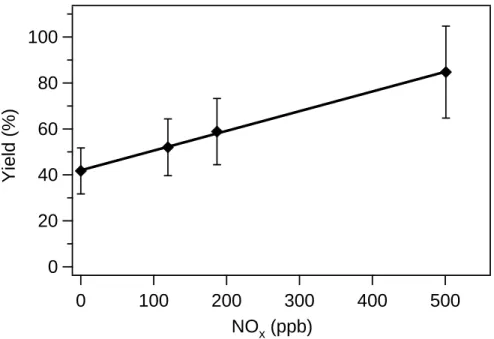
Figure 5 shows the final aerosol yield as a function of initial NOx concentration for aromadendrene photooxidation. The OH precursor used in these experiments is H2O2
and the initial aromadendrene mixing ratio is ∼5 ppb. It is clear that aromadendrene aerosol yield also increases with NOxconcentration; as with longifolene, with ∼500 ppb NO, the aerosol yield is approximately double that at low-NOxconditions.
15
4 Chemical composition of SOA
In this section, the measurements of the chemical composition ofα-pinene and longi-folene SOA are presented. The aromadendrene experiments are performed mainly to verify the observed NOx dependence for longifolene, in which SOA yield is higher
under high-NOx conditions, and so detailed analysis of the chemical composition of
20
aromadendrene SOA is not pursued.
4.1 Aerosol Mass Spectrometer (Q-AMS) measurements
Figures 6 and 7 show the AMS high-NOxversus low-NOxspectrum signal forα-pinene
ACPD
7, 10131–10177, 2007NOxdependence of SOA formation from
terpenes N. L. Ng et al. Title Page Abstract Introduction Conclusions References Tables Figures ◭ ◮ ◭ ◮ Back Close
Full Screen / Esc
Printer-friendly Version Interactive Discussion
EGU the total signal. For both hydrocarbons, SOA at high NOx conditions exhibit relatively
strong signals atm/z 30 and 46, and to a much smaller extent m/z 14. The signals at these mass to charge ratios likely correspond to NO+2(46), NO+(30), and N+(14) fragments from nitrates in the aerosol. The significance of these fragments will be further discussed in Sect. 5.1.
5
Changes in AMS spectra over the course of the experiment for longifolene under high- and low-NOxconditions are shown in Figs. 8 and 9, respectively. The correspond-ing growth curves for these experiments are shown in Fig. 2 (the pair of experiments with ∼30 ppb of longifolene injected). The top panel shows the fractional contribu-tion of each mass fragment to the total organic and nitrate signal during the growth
10
phase of the experiment (the first ∼100µgm−3α-pinene reacted); the middle panel shows the fractional contributions at the point when all of the hydrocarbon is con-sumed (∆HC∼200 µgm−3); the bottom panel shows the percentage change of each mass fragment between these two phases. Under high-NOx conditions, changes in mass fractions of different fragments during aerosol growth are minimal, indicating that
15
the aerosol composition is not changing significantly over time. Under low-NOx
condi-tions, however, the mass fraction ofm/z 44 (corresponding to the CO+2 ion, indicative of highly oxidized organics) increases by 93% during the reaction, while those for higher mass to charge ratios are observed to decrease. The mass fractions ofm/z 44 and higher mass to charge ratios continue to change even after the aerosol growth levels
20
off, suggesting the presence of further chemistry (either gas-phase or particle-phase) even after all the initial hydrocarbon is consumed.
4.2 Offline chemical analysis
All ions detected by the UPLC/ESI-TOFMS instrument fromα-pinene and longifolene photooxidation are listed in Tables 6 and 7, respectively. The tables list the exact
25
masses and their likely molecular formulas corresponding to each of the [M–H]− ions detected (in which M is the molecular weight of the compound). The error between the measured mass and theoretical mass is reported in two different ways, ppm and mDa.
ACPD
7, 10131–10177, 2007NOxdependence of SOA formation from
terpenes N. L. Ng et al. Title Page Abstract Introduction Conclusions References Tables Figures ◭ ◮ ◭ ◮ Back Close
Full Screen / Esc
Printer-friendly Version Interactive Discussion
EGU For most of the ions observed, the error between the measured and theoretical masses
is less than ±2 mDa and ±5 ppm, allowing for generally unambiguous identification of molecular formulae. Solvent blanks and control filters are also run on the UPLC/ESI-TOFMS instrument; none of the listed ions is observed in these control samples. The ions listed in Tables 6 and 7 are also detected by HPLC/ESI-MS and ESI-ITMS,
con-5
firming that these compounds are not the result of artifact formation in a specific mass spectrometer.
Acidic compounds, such as carboxylic acids and sulfate esters, readily ionize under (–)ESI-MS techniques (Gao et al., 2004; Surratt et al., 2006; Surratt et al., 2007). Hy-droxylated compounds, as well as ketones and aldehydes, however, are generally not
10
ionizable unless carboxylic acid and/or sulfate ester moieties are also present within the same molecule. Therefore, it is expected that all ions listed in Tables 6 and 7 are acidic compounds. For the SOA formed in the presence of NOx (HONO and “H2O2+NO”
experiments), even-mass [M–H]− ions are observed in ESI mass spectra, indicating the compound has an odd number of nitrogen atoms, likely within organic nitrate
func-15
tional groups. Nitrated organics were previously observed in isoprene SOA formed under high-NOx conditions (both HONO and H2O2/NO) (Surratt et al., 2006), and are further confirmed by the tandem MS data, which reveals a loss of 63 Da (HNO3). For
α-pinene, only one acidic organic nitrate (m/z 322) is detected in the HONO experi-ment and none are detected in H2O2 and intermediate NOx experiments. Masses of
20
many ions detected in theα-pinene experiments have been observed in previous lab-oratory work (Glasius et al., 1999, 2000; Larsen et al., 2001) and field studies (Gao et al., 2006). For longifolene, a much wider array of acidic organic nitrates is detected by the UPLC/ESI-TOFMS instrument in both HONO and intermediate NOxexperiments.
Figure 10 shows the extracted ion chromatograms (EICs) ofm/z 346, 374, and 390
25
from longifolene oxidation under different NOx conditions. These m/z values
corre-spond to acidic organic nitrates, as confirmed by the exact mass data (Table 7) as well as the loss of 63 Da in the tandem MS data. The chromatographic peaks are much larger in the highest NOx experiment than those in the intermediate NOx experiment
ACPD
7, 10131–10177, 2007NOxdependence of SOA formation from
terpenes N. L. Ng et al. Title Page Abstract Introduction Conclusions References Tables Figures ◭ ◮ ◭ ◮ Back Close
Full Screen / Esc
Printer-friendly Version Interactive Discussion
EGU (except m/z 372, not shown); no chromatographic peaks are observed under
low-NOx (H2O2) conditions. In addition, for several [M–H] −
ions (e.g. m/z 374 and 390) there are several structural isomers present. Additionally, the intensity of non-nitrogen-containing ions (e.g.m/z 223, 239, 253, 255, 267, 269, and 283), are generally larger under low-NOxconditions.
5
5 Discussion
5.1 Effect of hydrocarbon size on NOxdependence
It has been established that NOx levels exert a major influence on SOA formation (Hatakeyama et al., 1991; Pandis et al., 1991; Zhang et al., 1992, 2006; Hurley et al., 2001; Johnson et al., 2004, 2005; Song et al., 2005; Presto et al., 2005; Kroll et
10
al., 2005, 2006; Ng et al., 2007). For photooxidation of isoprene, SOA yields increase as the NOx level decreases (Kroll et al., 2006). The proposed mechanism for this
observed NOxdependence is the competitive chemistry of organic peroxy radicals
be-tween NO and HO2, in which the semivolatile products formed via the RO2+HO2path
are less volatile than those formed via the RO2+NO route (Hatakeyama et al., 1991;
15
Johnson et al., 2004, 2005; Presto et al., 2005; Kroll et al., 2006; Zhang et al., 2006; Ng et al., 2007). A similar yield dependence on NOx is observed here for photooxi-dation ofα-pinene (Fig. 1). For an initial α-pinene concentration of ∼15 ppb, the SOA yield under low-NOxconditions is about a factor of 3 higher than that under high-NOx
conditions. The observed NOxdependence is consistent with that of previous studies
20
onα-pinene photooxidation (Hatakeyama et al, 1991) and α-pinene ozonolysis (Presto et al., 2005).
The observed NOx dependence of SOA yield for the sesquiterpenes, however, is
different from that of isoprene and α-pinene (as well as other hydrocarbons with 10 or fewer carbons, such as aromatic species). For longifolene and aromadendrene,
25
ACPD
7, 10131–10177, 2007NOxdependence of SOA formation from
terpenes N. L. Ng et al. Title Page Abstract Introduction Conclusions References Tables Figures ◭ ◮ ◭ ◮ Back Close
Full Screen / Esc
Printer-friendly Version Interactive Discussion
EGU the NOxdependence of SOA formation could be the result of a number of factors.
Fig-ure 11 shows a simplified reaction mechanism involving peroxy radical chemistry. At the two limiting NOx conditions of this study, the peroxy radical chemistry is relatively
well-defined; under high-NOx conditions, peroxy radicals react virtually entirely with NO, while under low-NOx conditions, RO2reacts predominantly with HO2. One of the
5
possible explanations for the higher SOA yield under high-NOxconditions is the
forma-tion of large alkoxy radicals that isomerize rather than fragment. Isomerizaforma-tion is plau-sible if the alkoxy radical has four or more carbon atoms and can form a 6-membered transition state (Baldwin et al., 1977; Carter and Atkinson, 1985). The isomerization pathway leads to the formation of large hydroxycarbonyls, multifunctional products that
10
are likely low in volatility. The relative importance of isomerization increases with the size of alkoxy radicals (Atkinson, 1994, 1997a, b; Atkinson et al., 1995, 1999), and larger compounds could exhibit increasing SOA yields under high-NOx conditions as
a consequence of this mechanism. For example, Lim and Ziemann (2005) measured SOA yields up to ∼50% for C15 alkanes in the presence of ppm levels of NOx. They
15
proposed multiple isomerization steps leading to the formation of multifunctional com-pounds including nitrooxy, hydroxyl, and carbonyl groups, and it is suggested that the hydroxycarbonyls formed may isomerize to form furan species that can undergo fur-ther reactions (Lim and Ziemann, 2005). Gas-phase products that are consistent with the isomerization mechanism have been observed inα-pinene photooxidation but this
20
pathway does not appear to dominate SOA formation under high-NOx conditions
(As-chmann et al., 1998, 2002), possibly due to the higher volatility of these species. Higher SOA yields observed under high-NOxconditions for sesquiterpenes may, sec-ondly, be a result of the formation of relatively nonvolatile organic nitrates, evidence for which appears in both Q-AMS data and filter sample data. In AMS data, m/z 30
25
(NO+) andm/z 46 (NO+2) signals are commonly associated with nitrate species (or-ganic and inor(or-ganic nitrates). For bothα-pinene and longifolene, the ratio of the sum of the intensities of ions atm/z 30 and m/z 46 to the total ion intensity is higher un-der high-NOx conditions: under low-NOxconditions, the ratio is very small (2%), under
ACPD
7, 10131–10177, 2007NOxdependence of SOA formation from
terpenes N. L. Ng et al. Title Page Abstract Introduction Conclusions References Tables Figures ◭ ◮ ◭ ◮ Back Close
Full Screen / Esc
Printer-friendly Version Interactive Discussion
EGU high-NOx conditions, the ratio is about 15–25%. The ratio of m/z 30 to total mass
and the ratio of m/z 46 to total mass show the same trend, indicating m/z 30 and m/z 46 are correlated. It is possible that the signal at m/z 30 could be the result of a non-nitrogen containing organic fragment ion; however, given the observed correla-tion betweenm/z 30 and m/z 46 and their small signals under low-NOxconditions, it
5
appears that there is little interference from organics at these signals. Under high-NOx
conditions, ∼10µgm−3of inorganic nitrates, as measured by the PILS/IC, are present in the aerosol. Such nitrates may arise from the partitioning or reactive uptake of gas-phase HNO3into the aerosol phase. Assuming no non-nitrate contribution to m/z 30
andm/z 46, the total nitrate content of the SOA is estimated as the sum of the signals
10
at each fragment. It is found that the calculated nitrate content (∼20µgm−3) exceeds that measured by PILS/IC, suggesting the presence of organic nitrates.
The filter sample data provide a more direct comparison on the amount of organic nitrates formed inα-pinene and longifolene photooxidation under different NOx
condi-tions. For bothα-pinene and longifolene, no acidic nitrates are observed under
low-15
NOx conditions, consistent with the lack of NOx and the prevailing RO2+HO2reaction
in this case. Organic nitrate yield from the RO2+NO reaction increases with increasing
carbon number (Atkinson et al., 1987; Carter and Atkinson, 1989; O’Brien et al., 1998; Arey et al., 2001; Aschmann et al., 2001; Zhang et al., 2004), and with the larger car-bon skeleton the organic nitrates formed will be less volatile, this is consistent with the
20
much wider array and larger quantities of acidic nitrates detected in longifolene pho-tooxidation under high-NOx conditions compared to theα-pinene experiments. Hence for photooxidation of larger compounds such as sesquiterpenes, the nitrate formation channel may play an important role in SOA formation under high-NOxconditions. With
the formation of large molecular weight compounds with nitrate groups, mass-based
25
SOA yields from longifolene photooxidation under high-NOxconditions actually exceed 100%.
Lacking appropriate analytical techniques for the detection of non-acidic nitrates, the contribution of these species under high-NOx conditions cannot be assessed. In
α-ACPD
7, 10131–10177, 2007NOxdependence of SOA formation from
terpenes N. L. Ng et al. Title Page Abstract Introduction Conclusions References Tables Figures ◭ ◮ ◭ ◮ Back Close
Full Screen / Esc
Printer-friendly Version Interactive Discussion
EGU pinene photooxidation, hydroxynitrates have been identified in the gas phase using
mass spectrometry (Aschmann et al., 1998, 2002). In SOA formation from alkanes un-der high-NOxconditions, Lim and Ziemann (2005) found that, while SOA from oxidation
of C10alkane contains noδ-hydroxynitrates, nitrates contribute ∼40% of the SOA mass
for reactions of the C15 alkane. It seems likely that higher levels of hydroxynitrates are
5
present in longifolene SOA than inα-pinene SOA. 5.2 General mechanisms of aerosol growth 5.2.1 Loss of semivolatiles
Substantial insight into the general mechanism of SOA formation and growth kinet-ics can be gained by examining “growth curves”, showing the amount of SOA formed
10
per hydrocarbon reacted (Ng et al., 2006, 2007). Figure 2 shows the time-dependent growth curves from longifolene photooxidation under high- and low-NOx conditions.
The high-NOx growth curves have a “convex” shape, indicating that aerosol growth
slows down as longifolene approaches complete reaction. Similar behavior for longi-folene growth was observed previously in our laboratory (Ng et al., 2006); the authors
15
suggested that this atypical growth behavior may have been spurious, as a result of inaccuracies in PTR-MS measurements, owing to interference from product ions, or changes in the aerosol density over the course of the experiment. In this study, in those experiments in which the longifolene concentration is monitored by both GC-FID and PTR-MS, the shape of PTR-MS hydrocarbon decay agrees with that measured by
20
GC-FID. The density of the aerosol is estimated during oxidation by comparing Q-AMS and DMA data. It is found that the SOA density decreases slightly (<5%) over the course of the experiment, however, such a small decrease in density is within experi-mental uncertainty and cannot account for the observed atypical growth behavior.
Deceleration in SOA growth can arise from the loss of semivolatiles by photolysis,
25
further reaction with OH to form volatile products, or irreversible loss to chamber walls. Such processes reduce the amount of gas-phase semivolatiles species that partition
ACPD
7, 10131–10177, 2007NOxdependence of SOA formation from
terpenes N. L. Ng et al. Title Page Abstract Introduction Conclusions References Tables Figures ◭ ◮ ◭ ◮ Back Close
Full Screen / Esc
Printer-friendly Version Interactive Discussion
EGU into the aerosol phase. The effect on SOA growth of gas-phase reaction forming more
volatile species has been examined in a recent modeling study (Chan et al., 2007). Figure 12 shows a kinetic scheme depicting the competition between gas-particle par-titioning and irreversible loss of the gas-phase semivolatiles. X represents the product of generic loss of semivolatile species Ag;k
′
OH is the pseudo-first-order rate constant
5
(k′
OH=kOH[OH]) for reaction of the parent hydrocarbon; and kg is the first-order rate
constant of loss of semivolatiles. When fitting the observed aerosol growth with this simple kinetic model, it is estimated thatkg is about 5 times larger thank
′
OH. At the
es-timated OH concentration of ∼2×10⁷molecules cm−3under high-NOxconditions,k′ OH
for longifolene is ∼9.6×10⁻⁴s−1. A major difference in SOA composition under
high-10
and low-NOxconditions is the presence of organic nitrates under high-NOxconditions.
Thus the loss of organic nitrates (among other gas-phase species) may play a role in the observed deceleration in aerosol growth. The reaction rate constants of small alkyl nitrates with OH are generally of the order of 10−13cm3molecule−1s−1(hence pseudo-first-order reaction rate of ∼10−6s−1) and their photolysis rates have been measured
15
to be ∼1×10⁻⁶s−1 (Talukdar et al., 1997; Finlayson-Pitts and Pitts, 2000). Although the OH reaction rate and photolysis rate of organic nitrates are much slower than the oxidation rate of longifolene, both rates are expected to increase with carbon num-ber (Talukdar et al., 1997; Finlayson-Pitts and Pitts, 2000; Treves and Rudich, 2003). Hence, it is possible that gas-phase reaction of C15 organic nitrates may be occurring
20
at an appreciable rate. Further study on the OH reaction rate constant and photolysis rate of larger nitrates would be useful in evaluating the importance of gas-phase nitrate chemistry in aerosol formation.
Such a deceleration in SOA growth is not observed in longifolene low-NOx experi-ments. This is in contrast to the rapid decrease in aerosol volume observed in isoprene
25
photooxidation under low-NOx conditions, in which photolysis and/or further reactions
of organic hydroperoxides may be occurring (Kroll et al., 2006). There is evidence for further reactions with longifolene low-NOx SOA as well: the AMSm/z 44 (CO+2) mass fraction increases over the course of the experiment (Fig. 9), indicating the SOA is
ACPD
7, 10131–10177, 2007NOxdependence of SOA formation from
terpenes N. L. Ng et al. Title Page Abstract Introduction Conclusions References Tables Figures ◭ ◮ ◭ ◮ Back Close
Full Screen / Esc
Printer-friendly Version Interactive Discussion
EGU being further oxidized. Unlike with isoprene photooxidation, however, the compounds
formed from the further oxidation of longifolene products are likely sufficiently non-volatile to remain in the particle phase. The photochemistry of larger and more complex hydroperoxides merits further investigation.
5.2.2 SOA formation from higher generation products
5
In Figs. 1 and 3, the growth curves ofα-pinene and longifolene photooxidation exhibit a “hook” at the end of the intermediate NOx experiments, indicting that aerosol growth
continues after the complete consumption of the parent hydrocarbon. Organic mass measured by the Q-AMS increases even after all the hydrocarbon is consumed, indi-cating that this additional aerosol growth is not a result of condensation of inorganic
ni-10
trate. Continued aerosol growth can arise from further gas-phase reactions of reactive oxidation products, such as aldehydes and furans, etc, or from further particle-phase reactions. In the intermediate NOx experiments, the NO concentration goes to zero
about 30 min after the commencement of photooxidation, owing to the rapid reaction of NO and peroxy radicals (HO2and other peroxy radicals). As a result, a transition from
15
high-NOxto low-NOxconditions occurs over the course of the experiment, and the final
aerosol formed is potentially a mixture of the products formed under both conditions. It is possible that particle-phase reactions, such as the formation of peroxyhemiacetals from hydroperoxides and aldehyde species, may be contributing to the further aerosol growth observed in the intermediate NOxexperiments (Johnson et al., 2004, 2005).
20
6 Implications
A series of chamber experiments investigating the NOxdependence of SOA formation
from the photooxidation of one monoterpene and two sesquiterpenes is reported here. SOA formation from monoterpenes such asα-pinene is found to have a similar NOx
dependence as isoprene (as well as other hydrocarbons with 10 or fewer carbons, such
ACPD
7, 10131–10177, 2007NOxdependence of SOA formation from
terpenes N. L. Ng et al. Title Page Abstract Introduction Conclusions References Tables Figures ◭ ◮ ◭ ◮ Back Close
Full Screen / Esc
Printer-friendly Version Interactive Discussion
EGU as aromatic species), in which the aerosol yields are substantially higher under
low-NOx conditions. The NOx dependence of SOA formation from the two sesquiterpenes is, however, markedly different; for longifolene and aromadendrene, aerosol yields are at their maximum under high-NOx conditions. The reason for this reversal of the NOx
dependence, while not unequivocally established here, may be the result of production
5
of highly nonvolatile organic nitrates, the existence of which is suggested by both Q-AMS and filter sample data, and/or isomerization of alkoxy radicals to form low-volatility multifunctional organics.
The increase in SOA yield from photooxidation of the larger biogenic hydrocarbons under high-NOx conditions could have implications in terms of the effect of
anthro-10
pogenically influenced air masses on biogenic SOA formation. In the recent study of de Gouw et al. (2005), it is suggested that over the western Atlantic the majority of the measured organic aerosol is from secondary anthropogenic sources, a conclusion that is somewhat at odds with the radiocarbon measurements that indicate high fractions of “modern” (presumably biogenic) carbon (e.g. Klinedinst and Currie, 1999; Weber
15
et al., 2007). If the production of SOA from biogenic hydrocarbons is enhanced in the presence of NOx, observations of enhanced SOA correlated with anthropogenic sources can occur, even for organic carbon of biogenic origin. Large anthropogenic hydrocarbons may exhibit a similar NOx behavior as that of the sesquiterpenes
stud-ied, as suggested by the substantial SOA yields from the OH-initiated reaction of large
20
alkanes in the presence of ppm levels of NOx(Lim and Ziemann, 2005). If the NOx
be-havior observed for longifolene and aromadendrene extends to other sesquiterpenes as well as larger alkanes, the contribution to the total SOA from these compounds in polluted air may actually be higher than previously estimated (Griffin et al., 1999a, b; Carreras-Sospedra et al., 2005; de Gouw et al., 2005).
25
In this study, we have investigated the NOxdependence of SOA formation from pho-tooxidation of only the monoterpeneα-pinene and two sesquiterpenes, each containing one double bond. SOA formation from compounds with two or more double bonds can exhibit characteristics that suggest significant contributions from multiple generation
ACPD
7, 10131–10177, 2007NOxdependence of SOA formation from
terpenes N. L. Ng et al. Title Page Abstract Introduction Conclusions References Tables Figures ◭ ◮ ◭ ◮ Back Close
Full Screen / Esc
Printer-friendly Version Interactive Discussion
EGU products (Ng et al., 2006) and this may have impacts on the NOx dependence. It is
clear that the effect of NOx on SOA yields from the complete suite of atmospherically
relevant aerosol-forming hydrocarbons should be evaluated thoroughly.
Appendix A
5
Description of PTR-MS technique
For PTR-MS sampling, a constant flow of ∼2.5 standard liters per minute (slm) is drawn from the chamber through PFA tubing. The residence time in the inlet tubing is roughly 1 s. A small portion of the flow, 93 standard cubic centimeters per minute (sccm), is pulled through a glass critical orifice into a 2.54-cm diameter glass flow tube, in which
10
this sample flow is diluted with dry N2 (1.6 slm) to maintain the flow tube pressure
at 35 mbar. This dilution minimizes confounding effects owing to large concentrations of hydrogen peroxide and other compounds typically used or produced in chamber experiments.
In the flow tube, analyte ionization occurs in a manner similar to that described by
15
Crounse et al. (2006) for negative ionization. N2(400 sccm) flows through an ion source cup composed of a cylindrical silver foil lined with210Po and sealed with gold. α bom-bardment from the 210Po, coupled with trace water present in the N2, leads to the
formation of positively charged clusters, e.g. (H2O)nH+. The electric potentials of the
ion source components are set such that these positively charged clusters then pass
20
through a 6.35 mm aperture into the 35 mbar flow tube, flowing perpendicular to the sample flow. The clusters then react via proton transfer with the analyte (e.g. aro-madendrene) in the sample flow to form aromadendrene-H+ and higher order water clusters.
Across the flow tube from the ion source, a pinhole aperture (diameter 0.34 mm)
25
allows a portion of the ions and neutral gas (∼30 sccm) to flow into the mass spectrom-eter, a Varian 1200 tandem mass spectrometer. The spectrometer was modified by
ACPD
7, 10131–10177, 2007NOxdependence of SOA formation from
terpenes N. L. Ng et al. Title Page Abstract Introduction Conclusions References Tables Figures ◭ ◮ ◭ ◮ Back Close
Full Screen / Esc
Printer-friendly Version Interactive Discussion
EGU removing the electron impact source and extending the hexapole ion guide that leads
to the quadrupole mass analyzer to the pinhole aperture. For these measurements, the mass spectrometer was operated exclusively in one-dimensional mass spectrome-try mode.
In order to simplify the mass spectra, a DC potential of –10 V (relative to the pinhole
5
aperture) is applied to the hexapole. This offset pulls ions into the hexapole, where the pressure is relatively high owing to the neutral gas flow (chiefly N2) through the pinhole.
The ions therefore undergo high energy collisions with the neutral gas molecules which dissociate water clusters of analyte A:
A · (H2O)n·H++N2→A · H++nH2O+N2 (A1)
10
Thus, species are predominantly observed at m/z=M+1, where M is the molecular mass of the species. Hydrates, A·(H2O)m·H+, particularlym=1, are also observed for some species, though not for aromadendrene or longifolene.
Each day, the PTR-MS sensitivity towards aromadendrene was determined by sam-pling standard mixtures of aromandendrene in teflon bags filled with 50 L zero air. The
15
sensitivity was determined to be linear from 0 ppb to at least 5 ppb. Also, because of the large amounts of H2O2utilized in the experiments, the sensitivity as a function of
H2O2was determined, with [H2O2] measured by operating the Varian 1200 in negative ionization mode, exploiting the reaction of CF3O
−
with H2O2 (Crounse et al., 2006).
Thus, the sensitivity determined from H2O2-free standards was corrected for sampling
20
from the chamber when H2O2was present.
The uncertainty of aromadendrene measurements using PTR-MS is estimated to be ∼±22%, based on the scatter of replicate data and background measurements and uncertainties in the H2O2correction.
ACPD
7, 10131–10177, 2007NOxdependence of SOA formation from
terpenes N. L. Ng et al. Title Page Abstract Introduction Conclusions References Tables Figures ◭ ◮ ◭ ◮ Back Close
Full Screen / Esc
Printer-friendly Version Interactive Discussion
EGU
Appendix B
Description of UPLC/ESI-TOFMS technique
Filter extracts (in 1:1 (v/v) solvent mixture of methanol and 0.1% aqueous acetic acid solution) are analyzed by a Waters ACQUITY ultra performance liquid chromatography
5
(UPLC) system, coupled with a Waters LCT Premier time-of-flight (TOF) mass spec-trometer (MS) equipped with an electrospray ionization (ESI) source. The ESI source on this instrument contains two individual sprays; one spray is for the eluent and the other is for the lock-mass correction. Optimum ESI conditions are found using a 2.5 kV capillary voltage, 40 V sample cone voltage, 350◦C desolvation temperature, 130◦C
10
source temperature, 20 L h−1cone gas flow rate, and a 650 L h−1desolvation gas flow rate. Data are collected fromm/z 50–1000 in the negative (–) ionization mode using the TOFMS operated in the W geometry reflectron mode. The W reflectron mode offers the highest mass resolution, which is approximately 12 000, and allows for exact mass measurements to be conducted on detected SOA components. The chromatographic
15
separations are carried out on a Waters ACQUITY HPLC HSS (high strength silica) column (2.1×100 mm, 1.8µm particle size) at 45◦C using a gradient elution scheme. The eluent composition is (A) 0.1% acetic acid in water and (B) 0.1% acetic acid in methanol; both eluents are high purity solvents (LC-MS ChromaSolv Grade, Sigma-Aldrich). In the 12-min gradient elution program used, the concentration of eluent B
20
is 0% for the first 2 min, increased to 90% from 2 to 10 min, held at 90% from 10 to 10.2 min; and then decreased back to 0% from 10.2 to 12 min. The flow rate of the eluent is 0.3 mL min−1 and the sample injection volume is 2µL. At the beginning of each analysis period, the TOFMS is calibrated using a 1:1 (v/v) solvent mixture of ace-tonitrile and 0.1% phosphoric acid aqueous solution. During each chromatographic
25
run, 2 ng/µL of leucine enkphalin (MW=555) is used for the mass spray for lock-mass correction to obtain accurate lock-masses for each SOA component eluting from the column. The lock-mass syringe pump is operated at 20 uL min−1. In addition to the
ACPD
7, 10131–10177, 2007NOxdependence of SOA formation from
terpenes N. L. Ng et al. Title Page Abstract Introduction Conclusions References Tables Figures ◭ ◮ ◭ ◮ Back Close
Full Screen / Esc
Printer-friendly Version Interactive Discussion
EGU lock-mass spray, the dynamic range enhancement feature of this mass spectrometer
is applied to prevent dead time, which affects mass accuracy, from occurring. As con-firmation of the UPLC/ESI-TOFMS technique, a standard sample containing known isoprene andα-pinene sulfate esters previously characterized by Surratt et al. (2007) are analyzed. The known elemental compositions (i.e. molecular formulas) of the
pre-5
viously characterized sulfate esters (Surratt et al., 2007) are in excellent agreement with their measured exact masses (i.e. within ±2 mDa or ±2 ppm). In addition to exact mass measurements, further insights into the structures of the SOA components are obtained by generating tandem MS data, which are generated by increasing the first aperature voltage on the TOFMS from 10 V to 25 V.
10
Acknowledgements. This research was funded by U.S. Department of Energy Biological and
Environmental Research Program grant DE-FG02-05ER63983. This material is based in part on work supported by the National Science Foundation (NSF) under grant ATM-0432377. The Waters LCT Premier XT time-of-flight mass spectrometer interfaced to a Waters UPLC system was purchased in 2006 with a grant from the National Science Foundation, Chemistry Research
15
Instrumentation and Facilities Program (CHE-0541745). The LCQ Ion Trap mass spectrometer was purchased in 1997 with funds from the National Science Foundation through the CRIF program (CHE-9709233). J. D. Surratt is supported in part by the U.S. EPA under the STAR Graduate Fellowship Program. A. J. Kwan acknowledges the support of a NSF graduate re-search fellowship. The authors would like to thank M. Shahgohli of the Chemistry Department
20
at Caltech for her useful communications regarding high-resolution mass spectrometry.
References
Alfarra, M. R., Paulsen, D., Gysel, M., Garforth, A. A., Dommen, J., Prevot, A. S. H., Worsnop, D. R., Baltensperger, U., and Coe, H.: A mass spectrometric study of secondary organic aerosols formed from the photooxidation of anthropogenic and biogenic precursors in a
re-25
action chamber, Atmos. Chem. Phys., 6, 5279–5293, 2006,
http://www.atmos-chem-phys.net/6/5279/2006/.
ACPD
7, 10131–10177, 2007NOxdependence of SOA formation from
terpenes N. L. Ng et al. Title Page Abstract Introduction Conclusions References Tables Figures ◭ ◮ ◭ ◮ Back Close
Full Screen / Esc
Printer-friendly Version Interactive Discussion
EGU
and hydroxycarbonyl formation from the NOx – air photooxidation of C5-C8 n-alkanes, J. Phys. Chem. A, 105, 1020–1027, 2001.
Aschmann, S. M., Arey, J., and Atkinson, R.: Atmospheric chemistry of three C10alkanes, J. Phys. Chem. A, 105, 7598–7606, 2001.
Aschmann, S. M., Atkinson, R., and Arey, J.: Products of reaction of OH radicals withα-pinene,
5
J. Geophys. Res., 107(D14), 4191, doi:10.1029/2001JD001098, 2002.
Aschmann, S. M., Reissell, A., Atkinson, R., and Arey, J.: Products of the gas phase reactions of the OH radical withα- and β-pinene in the presence of NO, J. Geophys. Res., 103(D19),
4191, 25 553–25 561, 1998.
Aschmann, S. M., Reissell, A., Atkinson, R., and Arey, J.: Products of the gas phase reactions
10
of the OH radical with a- and b-pinene in the presence of NO, J. Geophys. Res., 103(D19), 25 553–25 561, 1998.
Atkinson, R., Kwok, E. S. C., Arey, J., and Aschmann, S. M.: Reactions of alkoxy radicals in the atmosphere, Faraday Discuss., 100, 23–37, 1995.
Atkinson, R. and Arey, J.: Gas-phase tropospheric chemistry of biogenic volatile organic
com-15
pounds: a review, Atmos. Environ., 37, S197-S219, 2003.
Atkinson, R., Aschmann, S. M., and Winer, A. M.: Alkyl nitrate formation from the reaction of a series of branched RO2radicals with NO as a function of temperature and pressure, J. Phys. Chem., 5, 91–102, 1987.
Atkinson, R., Baulch, D. L., Cox, R. A., Hampson, R. F., Kerr, J. A., Rossi, M. J., and Troe,
20
J.: Evaluated kinetic and photochemical data for atmospheric chemistry, organic species, supplement VII, J. Phys. Chem. Ref. Data., 28, 2, 1999.
Atkinson, R.: Atmospheric reactions of alkoxy and β-hydroxyalkoxy radicals, Int. J. Chem.
Kinet., 29, 99–111, 1997a.
Atkinson, R.: Gas phase tropospheric chemistry of organic compounds, J. Phys. Chem. Ref.
25
Data, Monogr., 2, 11–216, 1994.
Atkinson, R.: Gas phase tropospheric chemistry of volatile organic compounds: 1. Alkanes and Alkenes, J. Phys. Chem. Ref. Data., 215–290, 1997b.
Baldwin, A. C., Barker, J. R., Golden, D. M., and Hendry, D. G.: Photochemical smog – rate parameter estimates and computer simulations, J. Phys. Chem., 81, 2483–2492, 1977.
30
Bahreini, R., Keywood, M. D., Ng, N. L., Varutbangkul, V., Gao, S., Flagan, R. C., and Seinfeld, J. H.: Measurements of secondary organic aerosol (SOA) from oxidation of cycloalkenes, terpenes, and m-xylene using an Aerodyne aerosol mass spectrometer, Environ. Sci.
Tech-ACPD
7, 10131–10177, 2007NOxdependence of SOA formation from
terpenes N. L. Ng et al. Title Page Abstract Introduction Conclusions References Tables Figures ◭ ◮ ◭ ◮ Back Close
Full Screen / Esc
Printer-friendly Version Interactive Discussion
EGU
nol., 39, 5674–5688, 2005.
Carreras-Sospedra, M., Griffin, R. J., and Dabdub, D.: Calculations of incremental secondary organic aerosol reactivity, Environ. Sci. Technol., 39, 1724–1730, 2005.
Carter, W. P. L. and Atkinson, R.: Alkyl nitrate formation from the atmospheric photooxidation of alkanes; a revised estimation, J. Phys. Chem., 8, 165–173, 1989.
5
Carter, W. P. L. and Atkinson, R.: Atmospheric chemistry of alkanes, J. Atmos. Chem. 3, 377– 405, 1985.
Chan, A. W. H., Kroll, J. H., Ng, N. L., and Seinfeld, J. H.: Kinetic modeling of secondary or-ganic aerosol formation: effect of particle- and gas-phase reactions of semivolatile products, Atmos. Chem. Phys. Discuss., 7, 7051–7085, 2007,
10
http://www.atmos-chem-phys-discuss.net/7/7051/2007/.
Cocker III, D. R., Flagan, R. C., and Seinfeld, J. H.: State-of-the-art chamber facility for studying atmospheric aerosol chemistry, Environ. Sci. Technol., 35, 2594–2601. 2001.
Crounse, J. D., McKinney, K. A., Kwan, A. J., and Wennberg, P. O.: Measurements of gas-phase hydroperoxides by chemical ionization mass spectrometry, Anal. Chem., 78, 6726–
15
6732, 2006.
de Gouw, J. A., Middlebrook, A. M., Warneke, C., Goldan, P. D., Kuster, W. C., Roberts, J. M., Fehsenfeld, F. C., Worsnop, D. R., Canagaratna, M. R., Pszenny, A. A. P., Keene, W. C., Marchewka, M., Bertman, S. B., and Bates, T. S.: Budget of organic carbon in a polluted atmosphere: Results from the New England Air Quality Study in 2002, J. Geophys. Res.,
20
110, D16305, doi:10.1029/2004JD005623, 2005.
Finlayson-Pitts, B. J. and Pitts, J. N.: Chemistry of the upper and lower atmosphere: theory, experiments and applications, Academic Press, San Diego, 220–221, 2000.
Gao, S., Keywood, M. D., Ng, N. L., Surratt, J. D., Varutbangkul, V., Bahreini, R., Flagan, R. C., and Seinfeld, J. H.: Low-molecular weight and oligomeric components in secondary
25
organic aerosol from the ozonolysis of cycloalkenes andα-pinene, J. Phys. Chem. A, 108,
10 147–10 164, 2004.
Gao, S., Surratt, J. D., Knipping, E. M., Edgerton, E. S., Shahgholi, M., and Sein-feld, J. H.: Characterization of polar organic components in fine aerosols in the south-eastern United States: Identity, origin, and evolution, J. Geophys. Res., 111, D14314,
30
doi:10.1029/2005JD006601, 2006.
Geron, C., Rasmussen, R., Arnts, R. R., and Guenther, A.: A review and synthesis of monoter-pene speciation from forests in the United States, Atmos. Environ., 34, 1761–1781, 2000.
ACPD
7, 10131–10177, 2007NOxdependence of SOA formation from
terpenes N. L. Ng et al. Title Page Abstract Introduction Conclusions References Tables Figures ◭ ◮ ◭ ◮ Back Close
Full Screen / Esc
Printer-friendly Version Interactive Discussion
EGU
Glasius, M., Duane, M., and Larsen, B. R.: Determination of polar terpene oxidation products in aerosols by liquid chromatography-ion trap mass spectrometry, J. Chrom. A., 833, 121–135, 1999.
Glasius, M., Lahaniati, M., Calogirou, A., Di Bella, D., Jensen, N. R., Hjorth, J., Kotzias, D., and Larsen, B. R.: Carboxylic acids in secondary aerosols from oxidation of cyclic monoterpenes
5
by ozone, Environ. Sci. Technol., 34, 1001–1010, 2000.
Griffin, R. J., Cocker, D. R., Flagan, R. C., Seinfeld, J. H., and Dabdub, D.: Estimate of global at-mospheric organic aerosol formation from the oxidation of biogenic hydrocarbobs, Geophys. Res. Lett., 26, 17, 2721–2724, 1999a.
Griffin, R. J., Cocker, D. R., Flagan, R. C., and Seinfeld, J. H.: Organic aerosol formation from
10
the oxidation of biogenic hydrocarbons, J. Geophys. Res., 104(D3), 3555–3567, 1999b. Guenther, A., Hewitt, C. N., Erickson, D., Fall, R., Geron, C., Graedel, T., Harley, P., Klinger, L.,
Lerdau, M., McKay, W. A., Pierce, T., Scholes, B., Steinbrecher, R., Tallamraju, R., Taylor, T., and Zimmerman, P.: A global model of natural volatile organic compound emission, J. Geophys. Res., 100,(D5), 8873–8892, 1995.
15
Hatakeyama, S., Izumi, K., Fukuyama, T., Akimoto, H., and Washida, N.: Reactions of OH withα-pinene and β-pinene in air: Estimates of global CO production from the atmospheric
oxidation of terpenes, J. Geophys. Res., 96(D1), 947–958, 1991.
Hurley, M. D., Sokolov, O., Wallington, T. J., Takekawa, H., Karasawa, M., Klotz, B., Barnes, I., and Becker, K. H.: Organic aerosol formation during the atmospheric degradation of toluene,
20
Environ. Sci. Technol., 35, 1358–1366, 2001.
Jayne, J. T., Leard, D. C., Zhang, X., Davidovits, P., Smith, K. A., Kolb, C. E., and Worsnop, D. W.: Development of an Aerosol Mass Spectrometer for size and composition analysis of submicron particles, Aerosol Sci. Technol., 33, 49—70, 2000.
Johnson, D., Jenkin, M. E., Wirtz, K., and Mart´ın-Reviejo, M. Simulating the formation of
sec-25
ondary organic aerosol from the photooxidation of aromatic hydrocarbons, Environ. Chem., 2, 35-48, 2005.
Johnson, D., Jenkin, M. E., Wirtz, K., and Mart´ın-Reviejo, M.: Simulating the formation of secondary organic aerosol from the photooxidation of toluene, Environ. Chem., 1, 150–165, 2004.
30
Kanakidou, M., Seinfeld, J. H., Pandis, S. N., Barnes, I., Dentener, F. J., Facchini, M. C., Van Dingenen, R., Everns, B., Nenes, A., Swietlicki, E., Pautaud, J. P., Balkanski, Y., Fuzzi, S., Horth, J., Moortgat, G. K., Winterhalter, R., Myhre, C. E. L., Tsigaridis, K., Vignati, E.,
ACPD
7, 10131–10177, 2007NOxdependence of SOA formation from
terpenes N. L. Ng et al. Title Page Abstract Introduction Conclusions References Tables Figures ◭ ◮ ◭ ◮ Back Close
Full Screen / Esc
Printer-friendly Version Interactive Discussion
EGU
Stephanou, E. G., and Wilson, J.: Organic aerosol and global climate modeling: a review, Atmos. Chem. Phys., 5, 1053–1123, 2005,
http://www.atmos-chem-phys.net/5/1053/2005/.
Keywood, M. D., Varutbangkul, V., Bahreini, R., Flagan, R. C., and Seinfeld, J. H.: Secondary organic aerosol formation from the ozonolysis of cycloalkenes and related compounds,
Env-5
iron. Sci. Technol., 38, 4157–4164, 2004.
Klinedinst, D. B. and Currie, L. A.: Direct quantification of PM2.5 fossil and biomass carbon within the northern front range air quality study’s domain, Environ. Sci. Technol., 33. 4146— 4154, 1999.
Kroll, J. H., Ng, N. L., Murphy, S. M., Flagan, R. C., and Seinfeld, J. H.: Secondary organic
10
aerosol formation from isoprene photooxidation under high-NOx conditions, J. Geophys. Res., 32, L18808, doi:10.1029/2005GL023637, 2005.
Kroll, J. H., Ng, N. L., Murphy, S. M., Flagan, R. C., and Seinfeld, J. H.: Secondary organic aerosol formation from isoprene photooxidation, Environ. Sci. Technol., 40, 1869–1877, 2006.
15
Larsen, B. R., Di Bellla, D., Glasius, M., Winterhalter, R., Jensen, N. R., and Hjorth, J.: Gas-phase OH oxidation of monoterpenes: Gaseous and particulate products, J. Atmos. Chem., 38, 231–276, 2001.
Lim, Y. B. and Ziemann, P. J.: Products and mechanism of secondary organic aerosol formation form reactions ofn-alkanes with OH radicals in the presence of NOx, Environ. Sci. Technol.,
20
39, 9229–9236, 2005.
Ng, N. L., Kroll, J. H., Keywood, M. D., Bahreini, R., Varutbangkul, V., Flagan, R. C., Seinfeld, J. H., Lee, A., and Goldstein, A. H.: Contribution of first- versus second-generation products to secondary organic aerosols formed in the oxidation of biogenic hydrocarbons, Environ. Sci. Technol., 40, 2283–2297, 2006.
25
Ng, N. L., Kroll, J. H., Chan, A. W. H., Chhabra, P. S., Flagan, R. C., and Seinfeld, J. H.: Secondary organic aerosol formation fromm-xylene, toluene, and benzene, Atmos. Chem.
Phys. Discuss., 7, 4085–4126, 2007,
http://www.atmos-chem-phys-discuss.net/7/4085/2007/.
O’Brien, J. M., Czuba, E., Hastie, D. R., Francisco, J. S., and Shepson, P. B.: Determination of
30
the hydroxy nitrate yields from the reaction of C2-C6alkenes with OH in the presence of NO, J. Phys. Chem., 102, 8903–8908, 1998.
ACPD
7, 10131–10177, 2007NOxdependence of SOA formation from
terpenes N. L. Ng et al. Title Page Abstract Introduction Conclusions References Tables Figures ◭ ◮ ◭ ◮ Back Close
Full Screen / Esc
Printer-friendly Version Interactive Discussion
EGU
Gas/particle partitioning and secondary organic aerosol yields, Environ. Sci. Technol., 30, 2580–2585, 1996.
Odum, J. R., Jungkamp, T. P. W., Griffin, R. J., Forstner, H. J. L., Flagan, R. C., and Seinfeld, J. H.: Aromatics, reformulated gasoline and atmospheric organic aerosol formation, Environ. Sci. Technol., 31, 1890–1897, 1997.
5
Owen, S. M., Boissard, C., and Hewitt, C. N.: Volatile organic compounds (VOCs) emitted from 40 Mediterranean plan species: VOC speciation and extrapolation to habitat scale, Atmos. Environ., 35, 5393–5409, 2001.
Pandis, S. N., Paulson, S. E., Seinfeld, J. H., and Flagan, R. C.: Aerosol formation in the photooxidation of isoprene andβ-pinene, Atmos. Environ., 25A, 997–1008, 1991.
10
Presto, A. A., Huff Hartz, K. E., and Donahue, N. M.: Secondary organic aerosol production from ozonolysis: 2. Effect of NOx concentration, Environ. Sci. Technol., 39, 7046–7054, 2005.
Seinfeld, J. and Pankow, J. F.: Organic atmospheric particulate material, Annu. Rev. Phys. Chem., 54, 121–140, 2003.
15
Song, C., Na, K., and Cocker III, D. R.: Impact of the hydrocarbon to NOx ratio on secondary organic aerosol formation, Environ. Sci. Technol, 39, 3143–3149, 2005.
Sorooshian, A., Brechtel F. J., Ma, Y. L., Weber R. J., Corless, A., Flagan, R. C., and Seinfeld, J. H.: Modeling and characterization of a particle-into-liquid sampler (PILS), Aerosol Sci. Technol., 40, 396–409, 2006.
20
Surratt, J. D., Kroll, J. H., Kleindienst, T. E., Edney, E. O., Claeys, M., Sorooshian, A., Ng, N. L., Offenberg, J. H., Lewandowski, M., Jaoui, M., Flagan, R. C., and Seinfeld, J. H.: Evidence for organosulfates in secondary organic aerosol, Environ. Sci. Technol., 41, 517–527, 2007. Surratt, J. D., Murphy, S. M., Kroll, J. H., Ng, N. L., Hildebrandt, L., Sorooshian, A., Szmigielski,
R., Vermeylen, R., Maenhaut, W., Claeys, M., Flagan, R. C., and Seinfeld, J. H.: Chemical
25
composition of secondary organic aerosol formed from the photooxidation of isoprene, J. Atmos. Chem., 31, 9665–9690, 2006.
Szmigielski, R., Surratt, J. D., Vermeylen, R., Szmigielska, K., Kroll, J. H., Ng, N. L., Murphy, S. M., Sorooshian, A., Seinfeld, J. H., and Claeys, M.: Characterization of 2-methylglyceric acid oligomers in secondary organic aerosol formed from the photooxidation of isoprene using
30
trimethylsilylation and gas chromatography/ion trap mass spectrometry, J. Mass Spectrom., 42, 101–116, 2007.