Computers, Music, and Math: Using Technology in a Learning Environment by
Becky Wagenberg
Submitted to the Department of Electrical Engineering and Computer Science in Partial Fulfillment of the Requirements for the Degrees of
Bachelor of Science in Computer Science and Engineering
and Master of Engineering in Electrical Engineering and Computer Science at the Massachusetts Institute of Technology
May 23, 1997
© 1997 Becky Wagenberg. All rights reserved.
The author hereby grants to M.I.T. permission to reproduce distribute publicly paper and electronic copies of this thesis
and to grant others the right to do so.
Author
Departmen of ElectAcal Engineeing and Computer Science May 23, 1997
Certified by Certified by ,.
Jeanne Bamberger --- ofessorPf--Mysic and Education Thes1?Suoer~or Accepted by_
Arthur C. bnim .. Chairman, Department Committee on Graduate Theses
Computers, Music, and Math: Using Technology in a Learning Environment
byBecky Wagenberg
Submitted to the
Department of Electrical Engineering and Computer Science May 23, 1997
In Partial Fulfillment of the Requirements for the Degrees of Bachelor of Science in Computer Science and Engineering and Master of Engineering in Electrical Engineering and Computer Science
ABSTRACT
On the surface, computers, music, and math do not seem to have much in common. This thesis project proves otherwise. Specifically, it uses MusicLogo, which allows a person to program a computer synthesizer to play music, as one of several methods through which students can explore the mathematical concepts of ratio and proportion. Activities using MusicLogo and other media are performed with both MIT students and elementary schools students in Cambridge, Massachusetts. The goal of such activities is to help students achieve an understanding of proportionality rather than a rote memorization of how to solve ratio and proportion problems. In the process, the role played by technology in a learning environment is examined.
Thesis Supervisor: Jeanne Bamberger Title: Professor of Music and Education
Table of Contents
D edication ... ... 1. Introduction ... 2. Project Overview ... 3. Background Work ...
3.1 Problem-Solving and Learning in Children ... 3.1.1 Wertheimer's Parallelograms ... 3.1.2 Piaget's Position and Measurement ... 3.2 Ratio and Proportion ... ...
3.2.1 Proportional Thinking ... 3.2.2 Traditional Teaching Methods ... 3.2.3 Informal Strategies ... ... 3.2.4 Difficulties with Ratio and Proportion ... 3.2.5 New Teaching Approaches ... 3.2.6 Lessons Learned ... ... 3.3 Learning with Computers ... ...
3.3.1 Papert's Logo ... ... 3.3.2 Bamberger's Activities ... 4. Designing the Activities ...
4.1 Paper and Pencil Drawings ... ... 4.2 Cuisenaire Rods ... ... 4.3 MusicLogo ... 4.4 The Students ... 4.5 The Sessions ... 5. Observations and Emerging Issues ... ...
5.1 MIT Students ... 5.1.1 Drawings ... ... 5.1.2 Rod Representations ... 5.1.3 MusicLogo ... ... 5.2 Graham and Parks Students ... ...
5.2.1 Drawings ... ... 5.2.2 Rod Representations ... 5.2.3 MusicLogo ... ... 6. Evaluation and Comments ... ... 7. Conclusion ... Acknowledgments ... List of Figures and Tables ... R eferences ... . ... Appendix: Informal Script for Thesis Sessions ...
4 5 7 10 10 10 13 15 16 17 18 19 20 22 23 24 25 28 29 30 31 33 35 36 37 37 39 44 48 48 50 54 59 63 65 66 67 68
Dedication
To Mami and Papi for all their love and support, for always being right about everything,
for teaching me to believe in myself, and for being my biggest fans.
1. Introduction
In 1985, a group of professors and teachers came together to create a project and a place called the Laboratory for Making Things (LMT) at the Graham and Parks
Alternative Public School in Cambridge, Massachusetts. The purpose of the Laboratory for Making Things was to establish a learning environment where children who were having trouble in school could bring together the act of "making things" and the use of computer technology to examine their understanding of difficult material. One of the creators of the LMT, MIT Professor Jeanne Bamberger, explained the reason for its creation:
The project was initially motivated by my interest in a well recognized but poorly understood phenomenon: children who are virtuosos at building and fixing complicated things in the everyday world around them ... are often the same children who are having trouble learning in school. These are children who have the ability to design and build complex systems, who are experts at devising experiments to analyze and test problems confronted on the way, and who can learn by extracting principles from the successful workings of the objects they make. But they are also children who are frequently described as having trouble working with common symbolic expressions -numbers, graphs, simple calculations, written language. With "knowledge" in schools mostly equated with the ability to deal with conventional symbolic expressions, it is not surprising that attention focuses on what these children cannot do. Thus, instead of seeing them as virtuosos, they are seen as "failing to perform." [3, 2]
In the LMT, the real time/space activities ranged from constructing Lego objects and using large cardboard gears to playing rhythms on drums and building pulley systems. Yet, there was one unique element that made the work in the LMT special -the computer. As
seen by the children, the computer was simply another way to build and analyze real world phenomena. Beneath the surface, though, stood an underlying notion: in a virtual
environment the child must begin by describing, in some symbolic form, what he/she wants to happen. Once this has been accomplished, the symbolic description turns into
the thing or action described. [3, 3] Thus, the computer, placed in a hands-on learning environment, can be used to help students become more comfortable with the relationship between symbolic expressions, conventional notations, and real world actions and objects.
2. Project Overview
Based on the increasing appearance of computers in the classroom, there seems to be no doubt about the computer's ability to facilitate and enhance the student's learning process. The interactive property of computers makes them a natural tool for creating learning environments where the students themselves are actively involved in acquiring new ideas. In the recent past, computer scientists and educators have come together to develop a wide variety of educational programs and products to aid in the education of children. The LMT, in its attempt to fully integrate the computer into the classroom environment, took these ideas one step further.
Following the positive results of the LMT, Bamberger went on to use computers to help students learn about a new area -music. She first helped create MusicLogo, a Logo programming language with added music primitives that allows students to experiment with making music on a computer and synthesizer. She then developed Impromptu, a more "intuitive, icon driven" version of MusicLogo that makes it possible for students to study musical structures at several different levels of detail. [2, 10-15] In addition, Bamberger used both programs to help children who were having trouble in school (even in areas other than music.) The main issue evident in both the LMT and in Bamberger's music work is how to effectively take advantage of the unique properties of the computer in order to help students who are having trouble in a particular subject area. It is precisely this issue that is at the heart of this thesis project.
Specifically, this project explores the possibilities for using the techniques developed by Professor Bamberger to help students who are having trouble in
who are seen as "failing to perform" in school. As Bamberger explains, "The issues of counting, including the different uses and meanings given to numbers, illustrate the kinds of confusion that children may be facing, but they are issues that often remain
unrecognized in school settings." [1, 274] Mathematics, being an exact science, has a clear distinction between right and wrong answers, but the strategies for getting to any answer may be quite varied. Seldom does one find a mathematics teacher who takes the time to examine students' wrong answers to try and understand where the students are going wrong in their thinking. This makes mathematics an ideal candidate for a computer learning environment. The computer allows the students themselves to explore their own intuitive mathematical notions, whether they be correct or incorrect. It also gives them the chance to use these notions to solve interesting problems and accomplish set tasks.
This project focuses on one particular area of mathematics -ratio and proportion. It uses music (rhythm in particular) as the main context in which ratio and proportion are explored. Rhythms are strongly tied to the ideas of proportionality, yet the ability to create and imitate rhythms is one that almost everyone has acquired in life. This makes rhythm easy to use on students of all ages and all levels of scholastic ability. The goal of the project is to use the computer (specifically the MusicLogo environment) in combination with other media to let the students discover and "play around with" the ideas of ratio and proportion in music and other contexts. This, it is hoped, will lead to their understanding of the underlying mathematical concepts and will result in their increased ability to deal with typical classroom ratio and proportion problems.
While incorporating the computer as a key element of the learning environment, two basic principles are followed -the same two principles used in the design of
Bamberger's MusicLogo and Impromptu. First of all, "computers should be used only to do things that we can't do better in some other way." [2, 10] That is, the inclusion of the computer must have some meaningful point other than simply to use it or to make the experience more "fun" for the student (although that in itself may motivate a poor student to face difficult subject matter.) Second (borrowed from Hal Abelson), "an educational computer environment is valuable to the degree it causes its developers to rethink the structure of the domain." [2, 10] Thus, in designing an activity that uses the computer, this project closely examines the subject of ratio and proportion to determine where the students' problems lie and how a computer can be used to deal head-on with these problems.
3. Background Work
The background research for this project involves the examination of three different but relevantly related topics. The first such area is research into a general understanding of learning and problem-solving in children. The second topic, which is more specific to this project, is a survey of previous research in the teaching and learning of ratio and proportion. The final topic is a glance at the use of computers to enhance the learning process, with a marked emphasis on the work of Seymour Papert and Jeanne Bamberger. The following sections summarize these three topics and bring out many ideas which are relevant to this project.
3.1 Problem-Solving and Learning in Children
The general study of learning for this project consists of surveying the work of two people -Max Wertheimer and Jean Piaget. The findings of these two researchers are seemingly unrelated; on the surface they share only the examination of problem-solving and learning in children and involve specific tasks that are entirely different. Yet, in taking a closer look, it is evident that there are a multitude of common questions, ideas, and concepts about learning that they share. Out of these two areas of study emerge several important points about the way in which children learn and how that should affect the way in which we, the educators, teach them.
3.1.1 Wertheimer's Parallelograms
Wertheimer, as a professor of Psychology and Philosophy, deals directly with the question of "What does it mean for people to think?" In his book, Productive Thinking, he
focuses on thought processes in children as they solve certain (mathematical and other) problems. In particular, in Chapter 1, he discusses the problem of finding the area of a parallelogram. [14, Ch.1] In the course of studying this problem two very important points emerge. Wertheimer begins by describing a teacher who shows his students the method for finding the area with the use of a figure as follows:
d c
a e b f
Figure 1: Method for finding the area of a parallelogram
The teacher explains that the area of the parallelogram is equal to the product of the base and the altitude. He also gives the proof that establishes the congruence of the two triangles (aed and bfc.) The students are then given several problems to do where the length of the sides of the parallelogram vary; in all cases they succeed in finding the area.
In order to test the students' understanding, Wertheimer, who is observing the class, presents another variation of the problem where the parallelogram is flipped:
I
LA i1
Figure 2: Variation of the parallelogram problem and attempted solutions Only a minority of the students manage to use the correct method to obtain the correct result (a). The other students either attempt to follow the original instructions of the teacher (b) and are confused or cannot do the problem at all. [14, 13-16] This example
|-.All-I
I
leads Wertheimer to the first crucial idea, that "If a subject applies the method he has learned to a variation of the original problem, not realizing that it is out of place in the given instance, this is an indication that he has not understood it in the first place, or that he has failed to realize what it is that matters in the changed problem." [14, 23] In other words, in order to show understanding, the child should be required to apply the learned principle in several situations. This notion is extremely applicable to the project at hand in an obvious way: in order to best help the troubled students with a particular subject, they must be given a variety of contexts in which to approach it.
The second point which arises in Wertheimer's study of the area of the
parallelogram is the question of "What is a thing?" That is, when is it useful to break an object into its parts? How do we choose the parts? Does it matter? Wertheimer illustrates this concept when he shows how the parallelogram problem can be solved by breaking it up into two parts: [14, 70]
a b b a
Figure 3: Breaking a parallelogram into its parts
In this case, breaking the parallelogram up into its "parts" gives the solution to the problem we were trying to solve (because the area has now been reduced to that of a a rectangle, which can easily be calculated.) If the parallelogram had been split in a different way, it is possible that the solution would not have been as clear (or maybe not clear at all.) In addition, this example brings forth the idea of "sameness." For instance, is the triangle labelled a in the above figure "the same" as the one labelled a'? If so, in what way are they the same? It is clear that the triangles a and a' have the same area, so in this
sense they are the same. Yet, it is also true that a and a' are different. For example, the hypotenuse of triangle a is an outside edge in the parallelogram formed by a and b, while the hypotenuse of triangle a' is an inside edge which becomes invisible if b' and a' are joined to form a rectangle. Wertheimer's questions of how we choose and label different
"things" and which of these things we consider to be the "same" are extremely important in solving ratio and proportion problems.
3.1.2 Piaget's Position and Measurement
Piaget, in The Child's Conception of Geometry, studies an entirely different area of problem-solving -change of position and measurement. [11, Ch. 1-2] He thoroughly
describes the transitions that children make along the way to understanding that "to measure is to take out of a whole one element, taken as a unit, and to transpose this unit on the remainder of the whole." [11, 3] He shows how children move from an "egocentric" point of view, where they are the center of all measurement, to an objective point of view, where motion and measurement can be described in reference to an outside fixed
coordinate system. His perceptions on the evolution of these principles in children can easily be applied to many other areas of problem-solving, and thus is important in the design of the activities in this project.
Piaget carries out two separate sets of activities with children in his examination of motion and measurement. In the first activity, he asks school children, given a sand tray and some small wooden blocks, to make a model of their neighborhood in reference to the main school building. He then proceeds to turn the school building around by 180 degrees and asks the children to modify their model accordingly. [11, 16] In the second activity,
Piaget shows children a tower built out of blocks on top of a table. The task given to the children is to build another tower (on a separate, lower table) that is "the same as" the given one (with no mention of measurement.) [11, 30] Piaget observes, records, and analyzes the actions of the children in order to show the progression of thought that occurs as the children grow and learn the principles needed to solve the given problems. In doing so, many questions and concepts arise that are similar to those of Wertheimer. For
example, the question of "What is a thing?" surfaces when Piaget explains how some children understand the use of certain types of units (those that are the same size or bigger than the tower being measured) but not other types of units (those that are smaller than the tower.) By treating the tower as one thing, these children are unable to break it down to smaller units than can be counted to measure its size.
In addition, Piaget develops another important idea about the acquisition of knowledge in children:
In short, the growth of knowledge is not a matter of mere accumulation..Bit by bit [children] de-centre relations which they have learnt in the course of their own actions, and transform them in such a way that they can be combined with other relations without the intermediary of the self. [11, 24] It is not enough for a child to amass disjoint pieces of knowledge. In order to achieve real understanding and usefulness of a particular principle, a child must be able to see the principle as part of a larger system of ideas with which it can be combined. The
implications of this are simple: it is useless to teach a child a new concept in isolation from the things he/she already knows. Rather, the concept must be shown in relation to the ideas and experiences that a child is already familiar with.
3.2 Ratio and Proportion
Seymour Papert, in his book Mindstorms, states an interesting opinion on the study of learning: "I think that the best way to understand learning is first to understand specific, well-chosen cases and then to worry afterward about how to generalize from this
understanding. You can't think seriously about thinking without thinking about thinking about something." [10, 10] In this project, the "something" is ratio and proportion. Ratio and proportion have been part of the general mathematical curriculum for a long time. The National Council for Teaching Mathematics (NCTM), in its 1989 standards, writes:
The ability to reason proportionally develops in students throughout grades 5-8. It is of such great importance that it merits whatever time and effort must be expended to assure its careful development. Students need to see many problem situations that can be modeled and the solved through proportional reasoning. [5, 455]
The topic of ratio and proportion is often taught in Pre-Algebra classes, since it can be used to demonstrate many powerful algebraic ideas in a simple fashion. [12, 81] A proportional relationship, in fact, exemplifies the simplest kind of mathematical function as it can be represented by the familiar linear equation y=mx. In addition, ratios and proportions are applicable to a large variety of problem-solving situations and can easily be used to introduce and examine multiple representations (such as tables, graphs, equations, and diagrams) in the mathematics classroom. [12, 81]
Because of its importance and applicability and the difficulties students face when dealing with this subject, proportional reasoning has been a popular topic of study in the educational research community. The readings examined for this project consist of a few selected studies that offer a broad view into the research in the area of ratio and
answer many of the same questions and, in doing so, develop some common ideologies and methodologies that are important to the project at hand.
3.2.1 Proportional Thinking
What exactly is proportional thinking? That is the obvious first question examined and answered by these educational researchers. To begin with, as stated by Post et al., it is commonly agreed that proportional reasoning "involves a sense of covariation, multiple comparisons, and the ability to mentally store and process several pieces of information. [It] is very much concerned with inference and prediction and involves both qualitative and quantitative methods of thought." [12, 79] That is, the ability to reason proportionally involves more than just being able to solve given standard mathematical problems. It includes the application of proportions to a wide variety of situations (whether inside or outside the classroom) and the ability to reason about these situations in a logical way. For example, consider a version of a popular question found in the readings: "If I run fewer laps in more time than I did yesterday, am I running faster, slower, the same, or can't tell?" In order to answer this question a student must be able to do more than just plug numbers into an equation and get an answer. A second commonly mentioned aspect of proportional reasoning involves the ability to discriminate between proportional and non-proportional situations. [7, 255] This task that causes students a great deal of problems as they confuse the purely multiplicative relationship found in proportional situations with
others that seem similar. A final facet of proportional reasoning makes the distinction between general rates that are always true (e.g. 4 quarters per dollar) and particular instances of rates (e.g. a sale of 10 apples for 5 dollars). [8, 3]
3.2.2 Traditional Teaching Methods
Once the researchers have defined proportional reasoning, they can analyze the traditional methods of teaching this subject matter and discover where and why they fail to convey the important ideas about proportions. In the past, only a few types of standard problems have been used to assess students' proportional reasoning abilities. [7, 247] These are summarized in the table below:
Type of Problem Sample Question
Numerical comparison Which is bigger, 2/3 or 3/4?
Missing Value Fill in the missing value: 3/9 = ?/24
Qualitative prediction and If I drive more miles than you in the same amount comparison of time, who is going faster?
Table 1: Standard types of proportion problems
Furthermore, the standard algorithms taught to solve these problems are mechanical procedures that do not require much thought. For example, the popular "cross-multiply and divide" procedure for solving missing value problems (a/b=c/?) involves doing the steps a*? = c*b and then ? = (c*b) / a. This method can be memorized by any student and applied to a given problem with minimal reasoning. Kaput and West illustrate this clearly with a word problem in which a restaurant puts 7 pieces of silverware and 4 pieces of china on every placemat. The student is asked to find out how many pieces of china were used on a given night if the total number of pieces of silverware was 392. Many students are able to construct the correct equation (7/392 = 4/?) but, as Kaput and West claim,
One can create the equation without understanding -by using a gross distinction based on the relative size of the numbers involved. In our example, one could simply note that the small-to-large comparison of the silverware needs to be maintained by a small-to-large comparison of china. In this case, one can substitute this heuristic for a genuine qualitative understanding of a situation and successfully create an equation. [8, 12]
Furthermore, once this equation is constructed it can be solved systematically. Thus, the ability to correctly answer problems using such traditional approaches does not seem to demonstrate true proportional thinking at all. In fact, a conclusion reached by many of the researchers is that these meaningless algorithms should not be introduced to students until they have had sufficient exposure to proportional problems in which they must use logic and reason.
3.2.3 Informal Strategies
Of course, if the traditional method of constructing and solving proportions fails in achieving true understanding, other, more useful methods need to be discovered. For the researchers, the path to finding these newer methods starts with the examination of varying strategies used by children in solving ratio and proportion problems. In general, three main forms of "competent but informal reasoning" are found in children's thinking in this area that do not rely on the manipulation of formal algebraic expressions. [8, 6] The first is an additive method whereby children simply reach the desired answer by repeated addition. For example, take the case where they are given the ratio of 7 pieces of
silverware to 4 pieces of china and are asked to find the number of china that are needed to
go along with 35 pieces of silverware. Using this additive method they will make something like the following table:
Silver 7 14 21 28 35
China 4 8 12 16 20
The second technique, often called the factor-of-change method, involves consolidating the repeated addition into multiplication. The idea is to find out the "times as many" relationship between the two known quantities and then multiplying the third quantity by it. In the above example, 35 is 5 times as many as 7 so 4 needs to be multiplied by 5 to give 20. Note that this procedure becomes more difficult when the resulting relationship is not an integer. In the third method, the unit-rate approach, the student computes "how many for one?" and then multiples or divides this as needed. Applying this method to the example above gives: 7 silver/4 china = 1.75 silver/1 china ==> 35 silver / 1.75 = 20 china. Again, notice the increased difficulty because of the non-integer relationship; the meaning of 1.75 pieces of silver to 1 piece of china is hard to visualize.
3.2.4 Difficulties with Ratio and Proportion
In addition to discovering informal methods of proportional reasoning in children, the researchers also expose several basic difficulties that these children face when dealing with ratio and proportion. One such difficulty is the fact that fractions, on which ratios and proportions are based, can take on many different meanings. Sheila Tobias, in Overcoming Math Anxiety, points out four such meanings that the fraction 1/4 can take on: [13, 161-2]
* One-quarter of one (e.g. a slice of a whole pie).
* One item out of four (e.g. 1 candy bar from 4 candy bars). * One item compared to four others (e.g. 1 girl for every 4 boys). * Division of one by four (i.e. 1/4 = .25).
These multiple meanings can greatly confuse children in their problem-solving. A second difficulty is the fact that there are two rates for any given pair, forcing a decision as to
which one to use. An example of this by Post et al. gives the rate $4.50for 5 disks which reduces to 90 cents per disk as compared to 5 disks for $4.50 which reduces to .0111...
disks per cent, an equally correct but much less intuitive notion. [12, 83] This latter
example illustrates a third difficulty that arises, as previously mentioned, when children are given non-integer rates. Even more complicated, as Piaget stated, is the idea that proportion is an "operation on operations"; each rate pair is an operation and the comparison of the two (whether it be equality or greater/less than) is another level of operation. [12, 79] A final difficulty is the problem of recognizing if a given situation is proportional or not. Take, for instance, a problem given to thirty-three preservice
elementary school teachers: "Sue and Julie were running equally fast around a track. Sue started first. When she had run 9 laps, Julie had run 3 laps. When Julie had completed 15 laps, how many laps had Sue run?" Thirty-two of these teachers incorrectly set this up as a missing-value proportion problem (9/3 = ?/15) and answered 45, without realizing that this was an additive situation and the correct answer was 21 (because Sue was always 6 laps ahead of Julie). [6, 159] Word problems like this one have been shown to cause students a lot of trouble if they are not taught to distinguish between proportional and non-proportional situations.
3.2.5 New Teaching Approaches
After uncovering these difficulties and examining informal proportional thinking patterns, the researchers create new teaching approaches for ratio and proportion. In doing so, three basic ideas seem to permeate the theories that they use in designing their
own prior intuitive understanding of proportionality. With respect to this idea, Kurtz and Karplus explain their rationale of "[giving] students more autonomy in their studies -more opportunities to look at relations from their own points of view, to raise questions that disturb them, and to seek answers to those questions in their own ways." [9, 397] If students can build on their own intuitive notions then they will be more likely to get to a point where they can relate to proportions in their own way. The second idea is to give students hands-on opportunities for experimenting with the key concepts of
proportionality. To this end, the researchers propose endless different types of specific activities and lesson plans that allow students to discover the meaning of proportionality on their own. In doing so, the researchers bring up the third concept, multiple
representations, that focuses on giving students a variety of different media and tools with which to experiment. The idea is that "equipping students with a variety of perspectives and solution strategies fosters not only better understanding but also a more confident and flexible approach to problem solving." [12, 89]
Following their individual rationale, the researchers develop and explain a variety of different teaching programs for mathematics teachers. One group, Cramer et al., aims to teach students to recognize proportional situations with the use of a set of worksheets. For each one, the students must construct a table based on given data, generalize a rule to describe that same data, and then plot the data on coordinate axes. For example, they ask students to fill in a table with the surface area and lateral surface area of the ten different Cuisenaire rods. The goal of this is for students to realize that proportional relationships are always multiplicative and are represented by a straight-line graph going through the origin. [5, 445] In a similar fashion, Kurtz and Karplus's "Numerical Relationship
Program" asks students to identify invariant relationships in tables of data. These
relationships are then categorized (as constant ratio, constant sum, or constant difference), and hands-on exercises are used to further explain these categorizations. For instance, both springs and scaling diagrams are used to show constant ratio. [9, 388] A third pair, Kaput and West, experiment with a computer program that allows students to directly examine ratio. This program takes a ratio (e.g. 3 triangles for every 2 squares) and creates a box holding one instance of the ratio:
Figure 4: One instance of the ratio 3:2
The student can then repeat this unit box to arrive at the desired number of individual quantities (e.g. 10 boxes give 30 triangles which produce 20 squares). [8, 16] The results produced by these teaching experiments vary, but a main point of agreement arises: students are able to learn and internalize several different proportional problem-solving procedures. [9, 396]
3.2.6 Lessons Learned
So what has been learned about attempts to teach ratio and proportion to children? This is the final question that the educational researchers deal with in their studies and the most relevant question for this project. The varying answers to this question highlight the main lessons learned. The first such lesson is that of the inadequacy of the traditional teaching techniques, as explained by Kaput and West:
AAA
FDD
The rush to put formal computational tools in students' hands before they understand their quantitative foundations is one major factor in the widespread incompetence and alienation from mathematics among students across the land. Although the tradition of teaching ration
reasoning in the formal style is very long-lived, we should not assume that it should be venerated, or continued. The preponderance of data indicates that it does not work, and may in fact do actual harm. [8, 26]
The meaningless algorithms that are taught to students do nothing in the way of allowing them to reach a true understanding of ratios and proportions. Similarly, a second lesson learned is that these methods do not aid in getting students to differentiate between proportional and non-proportional situations. In fact, most textbooks have a separate chapter on proportions and do not encourage students to compare or contrast this to previously learned material (such as additive situations). [8, 25] A final lesson is the benefit of qualitative types of proportion questions that "demand an understanding of the meaning of proportions and hence should receive considerable attention in the
curriculum." [7, 304]
In general, the work of the educational research community has paved the way fro improvements in the teaching of ratio and proportion. This project takes these idea one step further by introducing the computer as an experimental tool. Furthermore, it does this in such a way to allow students to explore the concepts of proportionality in a free and unrestrained environment that uses rhythm as its main context.
3.3 Learning with Computers
While Wertheimer's and Piaget's studies give rise to certain important notions about learning and the studies on ratio and proportion give insight into the teaching of these specific matters, the biggest influence on this project comes from the computer work
of Seymour Papert and Jeanne Bamberger. Papert, in creating the Logo programming language, completely changes the way in which the computer could be used as part of a classroom experience. Bamberger, following Papert's example, allows students to explore with the computer and other media to pull out the common ideas that bind them together.
3.3.1 Papert's Logo
In Mindstorms, Papert explains his rationale in the invention of the Logo programming language for children. Logo enables children to program a computer to perform seemingly complicated tasks in a simple manner. In particular, the graphics part of Logo allows children to draw multiple shapes and patterns on the screen and then use those to create more extravagant shapes and patterns. Papert uses this as a tool to get students to think about and learn geometry, in specific, and problem-solving, in general. The difference between his view of computers in the classroom and those of others is that he allows the child to explore by being in control of the situation:
In many schools today, the phrase computer-aided instruction means making the computer teach the child. One might say the computer is being used to program the child. In my vision, the child programs the computer, and, in doing so, acquires a sense of mastery over a piece of the most modern technology and establishes an intimate contact with some of the deepest ideas from science, from mathematics, and from the art of intellectual model building. [10, 5]
This is an extremely important idea; the child, in experimenting with programming the computer, not only learns about the topic at hand (e.g. geometry) but also learns powerful ideas about thinking and problem-solving. Papert calls this "learning mathematics in Mathland" and compares it to learning French in France. [10, 6] That is, the child learns the important mathematical notions in a natural way that by far supersedes the formal
lecture methods of the traditional classroom. Mathematics becomes just another one of the languages in which they can speak at ease.
As a separate but equally important idea, Papert proclaims the benefit of computers in teaching children the methods of "debugging" or seeking for and removing errors in a program. In most classrooms today, the child is taught that errors are "bad" or "wrong." This attitude permeates most of the activities that go on in schools. Papert insists that by learning that "debugging" computer programs is a normal and useful part of
programming, students also learn that "errors benefit us because they lead us to study what happened, to understand what went wrong, and through understanding, to fix it." [10, 114] In other words, students learn to decide not whether something is right or wrong, but what the problem is and whether it can be fixed.
3.3.2 Bamberger's Activities
Bamberger carries the ideas of Papert directly into the LMT and her work with MusicLogo and Impromptu. In both cases, Bamberger focuses directly on the use of the computer, in combination with other media, to explore and make improvements in the way in which students learn to deal with conventional notations (including both music and mathematics.) The problem with notations, she says, lies in the fact that once we, the educators, internalize conventional notations, they become our tools for viewing the world. We are no longer aware that they are there: "Our conventional units of description function like the lenses that shape, select, sort out, and segment the world. And like eye-glasses, as long as they are left alone, as long as they are not perturbed, we are happy just to look through them." [2, 4] For example, once we have internalized the meaning of
symbols "+" and "=" we have a very hard time understanding a child who claims that "7 and 7 is 77" because we automatically hear it as the statement "7+7=77" [1, 270]
Bamberger uses the computer as a way of letting children explore their own meanings for given symbols and allowing them to modify these until they discover their conventional meanings. She makes this clear when she explains the idea of the LMT:
We imagined a learning environment where an individual child could use computer technology as a resource for inquiry and invention in a world that fit his/her size of space/time. It would be an environment where children were easily moving back and forth between actions and symbolic
description, between sensory experiences and representations of it, between the virtual world inside "the box," and the familiar world of their own powerful know-how in real time/space/motion. It would be a world in which children could catch up with their own understandings -slowing down events and actions so as literally to grasp the "goings on" of things and how they were related to ideas. [3, 2]
The results of such an environment would be an increased understanding of how people turn actions into discrete, symbolic representations. For example, using MusicLogo the
students could represent rhythms and melodies, which are continuous in time, with discrete symbols like numbers and procedures. In the LMT environment, real-world actions are stressed through activities with media like Legos, blocks, gears, and pulleys. At the same time, the symbolic representations are brought out through the computer (e.g. letting a MusicLogo number represent a pitch.)
In particular, three ideas permeate Bamberger's work with the LMT and the music programs: the notion of a "procedure," the strategy of finding "patterns," and the concept of "chunking", i.e. separating a thing into its parts. [3, 3] The different activities allow the children to explore these three ideas in both real and virtual systems. In comparing and contrasting these activities, the children make explicit both the differences and surprising
the hidden shared principles that lay beneath the surface of the seemingly different problems with which they are presented.
All in all, the studies and experiments examined in these sections give a good basis for proceeding with the work of this project. The ideas presented about problem-solving and learning are useful in designing activities to help students explore the topics of ratio and proportion. Bamberger's work with computers in a learning environment is especially important, and it serves as a model for the implementation of this thesis project.
4. Designing the Activities
The work of this thesis project, as mentioned before, consisted of elaborating on the methods of Bamberger and applying them to aid students in learning ratio and proportion. The first part involved designing activities for the children that, it was hypothesized, would help them explore their intuitive view of ratio and proportion and lead them towards the understanding of the conventional meaning of these principles (i.e. that found in mathematics textbooks.) This part of the project relied heavily on the idea that the use of multiple representations is advantageous and necessary to the process of learning and internalizing new concepts. The benefits of using different media are clearly explained by Bamberger when she writes (about the LMT):
We designed projects that were overtly different on the surface, but embodied similar underlying principles: projects that differed in the kinds of objects/materials used, that utilized differing sensory modalities, that held potential for differing modes of description, but that shared conceptual underpinnings. [3, 3]
The choice of specific media and activities for this project reflected this idea directly; the goal was for students to be able to make analogies between the different activities they were asked to engage in, and thus extract the underlying principles that the activities share.
To this end, three different media were chosen, and the tasks to be performed with each of those media were designed. A particular ratio, 3:1, was chosen as the common basis for the tasks using all three media. The result was a set of activities that are described in an informal script (given in the Appendix) of a typical session between me and a student. A session began with my clapping steady beats whose rates have a 3:1 relationship (i.e. I tapped three beats with my left hand for every beat of my right hand) and asking the subject to do the same (Appendix, Part A). The session continued by
asking the students to use the chosen media to represent this 3:1 rate of beats (which will be referred to in the remainder of this paper as the 3:1 rhythm) in different ways.
The main point of these sessions was to see whether the students could get to an understanding of ratio and proportion. It was expected that by using the multiple media given (especially the computer) the students would be able to find and pull out the shared principle, i.e. the constancy of the 3:1 relationship between the claps of one hand and those of the other. We hoped that the different sensory experiences would make them aware of the fact that this rhythm, whether it be drawn or played on the computer and whether it be clapped fast or slow, contained an invariant property that could be described using a mathematical object -the ratio 3:1. We also expected that this ratio could become part of the repertoire of useful tools that these students could use to model and solve problems in both the classroom and the real world. The following sections describe in detail the media and tasks of the activities, the students with which the activities were performed, and the nature of the sessions conducted with these students.
4.1 Paper and Pencil Drawings
The first task chosen was paper and pencil rhythm drawing. Drawing, as a medium, was an ideal candidate for a first task because of its familiarity. It was used to introduce subjects to the 3:1 rhythm and allow them to invent a notation by which to describe it. Specifically, the students were asked to draw something on paper so that "if someone else walked into the room they could clap what we were just clapping" by looking at the drawing (Appendix, Part B). Although such rhythm drawings can be simple, the interpretation of these drawings is much more complex. In fact, the way in
which a person chooses to represent and describe a real-world action (such as clapping a rhythm) can reveal a lot about the way in which the person is viewing and understanding the action. In this way, the students' drawing of the 3:1 rhythm gave insight into intuitive notions about both rhythms and ratios that these students held inside.
4.2 Cuisenaire Rods
The second task chosen was representing the 3:1 rhythm with Cuisenaire rods (Appendix, Part C). These are small wooden blocks that are often used to teach
mathematics at the elementary school level. A set of Cuisenaire rods contains several of 10 different size and color rods. Each rod has the same cross section (a square of size 1 cm2) but represents a different number from 1 to 10 by its differing length. The rods are
correctly scaled so that, for example, the 2 (cm) rod and the 3 (cm) rod placed together are the same length as the 5 (cm) rod. All the rods, along with their associated numbers and colors, are shown in Figure 5. The shadings chosen for this figure are used in the rest of the paper to show which rods were selected by each of the students.
Figure 5: A complete set of Cuisenaire rods
1
E
White
2 Red 3 Light Green 4 Magenta5l
Yellow
6~ Dark Green 7 •Black 8 Brown 9 Blue 10 OrangeThe Cuisenaire rods were chosen as a transition between the simple paper and pencil drawings and the more complicated MusicLogo environment. The rods provided an additional way in which the students could understand and describe the 3:1 ratio before moving on to the computer. Furthermore, if used in a certain way, the numbers
represented by the rods could be directly translated to numbers in MusicLogo. For example, if we use the size of the rods to represent durations (i.e. time from the onset of one clap to the onset of the following clap) then the following figure shows a possible representation of the 3:1 rhythm:
Figure 6: A possible rod representation of the 3:1 rhythm Since MusicLogo also uses numbers as durations then these 3's and l's can be used directly to make MusicLogo play the same rhythm. Thus, the Cuisenaire rods allowed the student to explore the use of numbers (and not just pictures) in representing a rhythm.
4.3 MusicLogo
The final task chosen was programming the computer synthesizer to play the 3:1 rhythm (Appendix, Parts D, E, and F). MusicLogo allows the student to tell the computer what durations to play. Furthermore, the computer synthesizer can make two different sounds using the commands BOOM and PING. Each of these commands takes a list of numbers telling it the durations of the sounds it should play. For example, the command
3 3 3
111 111 111
BOOM [2 2 2 2 ] tells the computer to play a regular beat made up of four BOOM sounds each with a duration of 2. The numbers representing the durations are scaled so that a 4 is twice as long as a 2, and a 6 is half as long as a 12. In addition, the computer can be made to play two different sounds simultaneously by using two voices (abbreviated V1 and V2) as follows:
Vl BOOM [2 2 2 2 2 2 2 2] V2 PING [4 4 4 4 4 4 4 4]
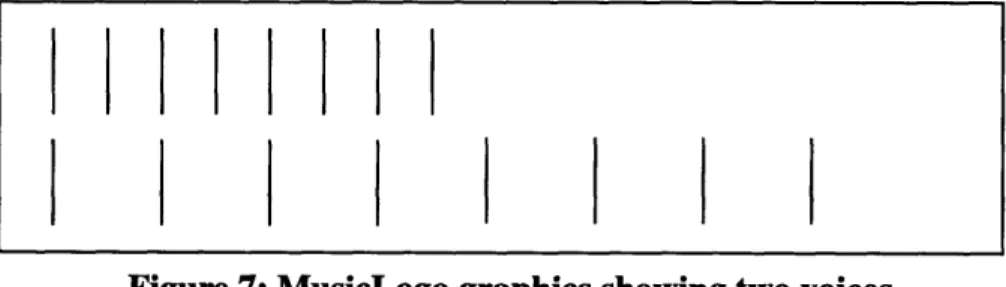
Finally, the MusicLogo program includes a graphics window where the user can see a representation of the rhythm being played. These graphics, called rhythm bars, show rows of lines where each line represents a beat and space represents the time between these beats. For instance, the rhythm bars produced by the two voices above are shown in Figure 7 below; the 2's in the top row take up half as much space as the 4's in the bottom row. This is a spatial analog of the music where less space represents less time.
Figure 7: MusicLogo graphics showing two voices
Thus, the playing of the 3:1 rhythm can be accomplished by making the computer simultaneously play beats of duration 3 in one voice and beats of duration 1 in the other voice; it can equivalently be accomplished by assigning durations of 6 and 2 to each of the voices, respectively. In fact, using 6 and 2 instead of 3 and 1 keeps the relationship between the rate of events the same but makes the whole thing go twice as slow (because each beat is now twice as long.) This is a perfect example of a real-world proportional situation. By experimenting with different durations and their combinations in such a
way, the students can thus experience (because they can hear) the principles of ratio and proportion in action. It was expected that this would help the students realize and internalize these principles in a way which was meaningful to them.
To this end, there was actually a real benefit to programming the computer to play the rhythm instead of just using a drum or other instrument. The computer is never wrong; it plays back exactly what the student has asked it to play. If the rhythm played by the computer is different from the rhythm intended by the student, then the student has either misrepresented his/her own clapping or misunderstood the language of the computer. It is not possible that the computer has misunderstood the student. Therefore, the student is forced to understand and adapt to the notation used by the computer in order to
accomplish the task at hand. This is extremely similar to the case where a student misunderstands formal notations used in the mathematics classroom (such as the most common notation for ratio -3:1) and cannot use these notations in a way that make sense to him/her. The difference here is that the instant response of the computer lets the student
explore the notation until its meaning becomes clear.
4.4 The Students
Three MIT students were asked to participate as a base group for testing out the designed activities before conducting them with any elementary school students. MIT is a research university that is known all over the world for its excellence in the sciences, engineering, and mathematics. Therefore, these MIT students were not at all the type of students that did poorly in school or specifically in mathematics. Thus, it was expected that they would be able to complete the given tasks with little or no problem. What was
important, though, was the way in which they completed the tasks. In this sense, the MIT students provided a lot of insight into the issues that arise when dealing with ratio and proportion, with multiple representations, and with computers in a learning environment.
Once the sessions with the MIT students were completed, the activities were performed with three 6th grade students from the Graham and Parks Alternative School in Cambridge, Massachusetts. This school has close to four hundred students in grades kindergarten through eighth grade. It includes a diverse student body and emphasizes alternative teaching methods in its curriculum, as described on the World-Wide Web:
We have a wide mixture of students from various social classes, ethnic and racial backgrounds, and a balance of males and females... The educational program is highly individualized with an emphasis on teaching basic skills in creative ways, with a non-standardized curriculum that is developed by the teachers, a curriculum that is project- and activity-oriented and
multicultural, occurring primarily in multi-graded, self-contained, open classrooms. [http://www.ci.cambridge.ma.us/-Schools/elementary/graham.html]
Due to this reliance on an activity-oriented curriculum, Graham and Parks has several computer labs that the students use in their classes. Thus, all three of the students that participated in this project were extremely comfortable with the computer lab environment
and were proficient at using several different programs. In fact, the same day that this project's activities were performed, they had been programming the computer to draw geometrical shapes with Papert's Logo.
In addition, the three students, although not necessarily considered excellent students, were bright and enthusiastic. They fully involved themselves in the tasks
presented to them and were eager to share their thought processes with me. As expected, their work provided further insight into the area of proportional reasoning. It also showed how the classroom is positively affected by hands-on activities and the use of multiple
media (especially the computer).
4.5 The Sessions
The sessions themselves were conducted one-on-one with the individual students. In the case of the MIT students, these took place in an isolated computer laboratory on campus. For the Graham and Parks students, the sessions were performed at the school in the shared computer lab while other students were working on different assignments. In both cases, the sessions lasted anywhere between thirty and forty-five minutes each. During the sessions, a tape recorder was used and notes were taken in order to keep careful track of the progression and reaction of each of the students. The following section describes the observations made and the issues that emerged from them.
5.
Observations and Emerging Issues
The second part of this thesis project required actually performing the designed activities with some students and carefully observing and analyzing their actions and reactions to the presented materials and tasks. In doing so, the main question was not
whether the students could complete the tasks but how they went about doing so. Because
of this question, when observing the subjects the most important assumption made was that they were doing things that "made sense" to them. In other words, all of the actions and responses of the students, no matter how obscure or unusual, were considered to be valid, interesting, and worth analyzing. Thus, the work of this part of the project involved more than just writing down and recording students' actions. The experimental
methodology closely followed that used by Bamberger in her work with children. It included open-ended tasks that were "rich in possibilities for the active participation of subjects and sensitive interventions by the researcher." [1, 2] This means that each time an activity was conducted, the specific responses of the subject could be used to probe the subject further and alter the exact way in which the activity was run.
The observations in this section refer to the script in the Appendix of this project and show how the students chose to represent the given 3:1 rhythm and play it on the computer. They are separated into those made while working with the MIT students and those made while working with the Graham and Parks students. It was surprising to find that although the two groups of students were completely different, similar issues arose in both cases. In fact, most of the sixth graders turned out to be just as good as the MIT students at making representations of the 3:1 rhythm and getting the computer to play it. For clarity, the observations and issues in this section are also divided by task.
5.1 MIT Students
The MIT students were extremely proficient at mathematics and also at general problem-solving. Thus, as expected, they had little or no problem completing the tasks at hand. In addition, they learned to use the different media given to them very quickly. This was especially true of the computer; in a matter of one or two attempts they were able to discover the meaning of the MusicLogo numbers and get the computer to play the 3:1 rhythm. Nevertheless, out of their work with this rhythm and the different media emerged many relevant issues.
5.1.1 Drawings
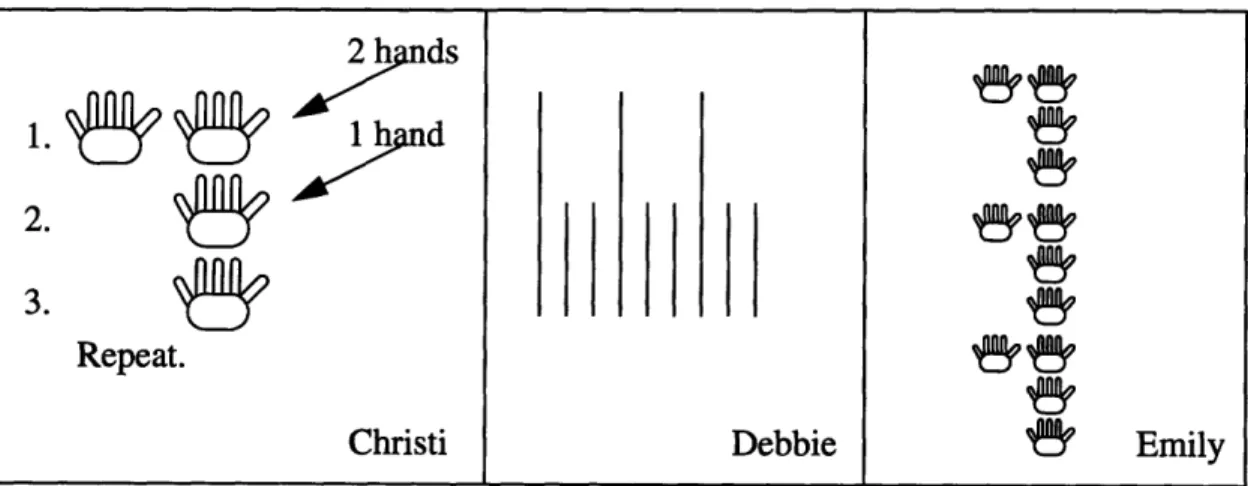
Clapping the 3:1 rhythm was no problem for the MIT students and the task of drawing this rhythm (Appendix, Part B) seemed to come just as naturally to them. However, they produced three quite different drawings:
Figure 8: MIT students' drawings of the 3:1 rhythm
These drawings contain differences and similarities that point out two important issues. The first issue is that of selective attention. That is, when people experience and then describe a real-world action they choose to highlight and pay attention to only certain salient aspects of that action; it is almost impossible for anyone to include all of the
pnds
2.
3.
Repeat.
subtleties of the situation since every representation captures only certain features of a given object or action. This raises the question of what exactly each person chose to represent in their description. In these rhythm drawings, we can see just this question. Christi and Emily, paying attention to the physical actions they made while playing the rhythm, chose to use pictures of hands, and showed the two hands independently. On the other hand, Debbie took the "one-liner" approach; she represented what she heard -a loud sound followed by two softer sounds -regardless of how those different sounds were produced by the hands themselves. That is, the two simultaneous rates going on (that have a 3:1 relationship between them) are collapsed into one in Debbie's drawing. Thus, she does not illustrate the embedded 3:1 ratio at all. Another difference in the drawings that shows selective attention is the fact that Debbie and Emily showed three whole repetitions of the rhythm, while Christi only used the word Repeat to produce the same result.
The second issue illustrated by these drawings is that of invented notation and conventional notation. Christi and Emily both drew hands to show the claps and both drew the rhythm down the page. Debbie used lines and drew from left to right. These notations were all invented on-the-spot by the students, but they rely on certain regular conventions that are used all the time. For example, making time go from left to right comes from our convention of writing (in English) in that same direction. Actually, making time go from top to bottom may also come from our English writing conventions. It would certainly be rare to find a person who would draw the rhythm from right to left, upwards, or even diagonally. This points out how the conventions and assumptions that students bring with them into a new learning environment play a big role in how they perform tasks and solve problems.
5.1.2 Rod Representations
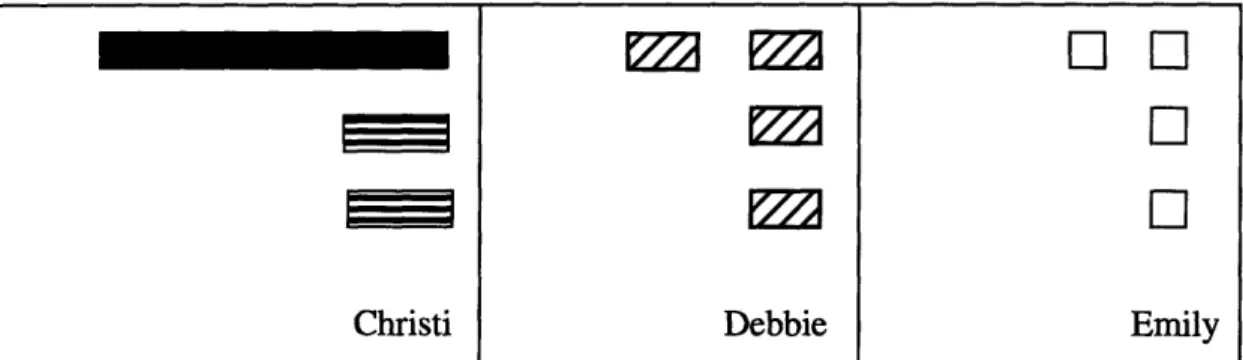
Representing the 3:1 rhythm with the Cuisenaire rods (Appendix, Part C) was a little more confusing for the MIT students; none of them had ever used these rods in their mathematics classes. Thus, on their first attempt, they were not aware of the idea that each different rod in the set could be used to represent a number from one to ten. Instead, they produced the following representations:
Figure 9: First attempt at rod representation of the 3:1 rhythm by the MIT students Like the rhythm drawings, these rod representations illustrate two more important points about the way in which students experience and internalize real-world actions. First of all, these representations show the difficulty in making a static representation of an action which does not stand still. In clapping, the 3:1 rhythm the MIT students dynamically moved from one event to the next to produce the desired sound. Yet, when they proceeded to represent this action with the rods (and in their drawings) the actual movement from one clap to the next inevitably disappeared. The rods were not capable of capturing this movement so it simply became implied in their representations. This led to differences in the students attempts to hold still what was once moving. In particular, Christi let each row represent a moment in time and thus combined the two simultaneous hand claps into one event that occurred at the beginning. It is evident that she did not capture the 3:1 relationship between the rate of events in her representation. In contrast, Debbie and
Emily both made the individual hand motions stand still and thus kept the two hands (and the rates of events) separate.
Consequently, these rod representations also bring up the key question of "what represents what?" That is, if we were to create a legend or key to each student's picture, what could we say each rod represents (other than just a hand clap)? All three students used single rods to show the second and third claps clearly (i. e. those that were produced by only one hand), but only Debbie and Emily used a relative number of blocks to show the 3:1 relation between the two rates of events. On the other hand, Christi used the informal size of the rods (one big and two small) to contrast the loudness of the sounds
(one loud and two soft) that she heard.
Still, none of these students used the size of the blocks themselves to represent durations. For this reason, I showed them how each of the rods, by its length, embodied a number between one and ten and asked them to use this new information to represent the 3:1 rhythm a second time. The following figure shows this attempt:
0 0
Christi Debbie Emily
Figure 10: Second attempt with the rods by the MIT students
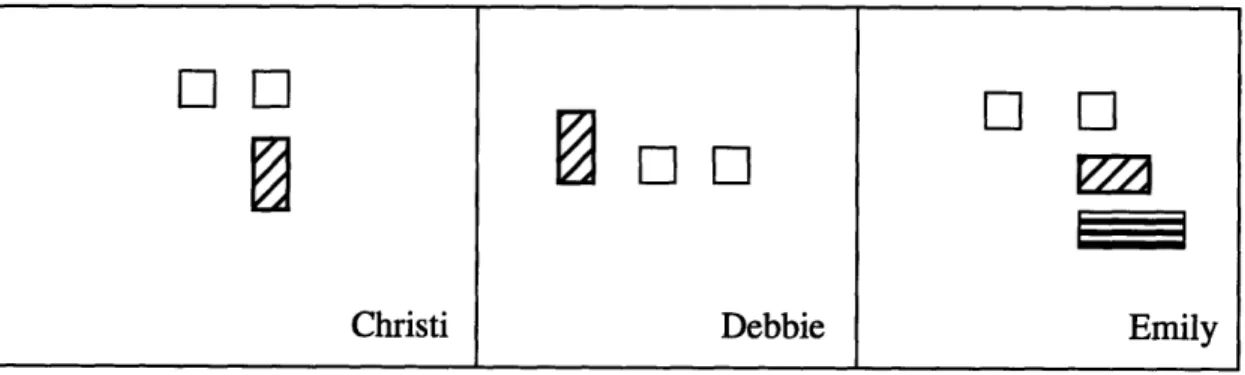
Once they had done this I clapped back my own interpretation of what they had put down and, if it was different than the intended rhythm, asked them to make a third attempt at the rod representation. For instance, following Debbie's second attempt I used only one hand
to clap back to her one long beat followed by two shorter beats. That is, the time between the first clap and the second was longer than the time between the second and third claps. I did something similar with Christi and Emily where I used the size of their rods to stand for a duration. The following figure shows each of their subsequent changes:
0
Christi Debbie Emily
Figure 11: Third attempt with the rods by the MIT students
Aside from the previously mentioned points, these new rod representations introduce a new issue -the use of numbers. People tend to use numbers in several different ways; even the same person uses the same numbers in different ways. In this case, the numbers embodied by the rods were used in at least three different ways by the MIT students:
1. Christi and Debbie (second attempt) use the numbers to show the number of hands being clapped simultaneously.
2. Emily (second attempt) used the numbers to count along with the rhythm - 1,2,3 ... as if she was giving a name to each of the claps.
3. Emily (third attempt) used the numbers to show the relative duration of each clap and the differing rate of events.
In addition, Christi and Debbie, in their third attempts, failed to use the numbers in any consistent way. Debbie used a rod to stand for each individual clap. In doing so, she clearly showed the difference between the rate of events. Yet, she could have used any rods as long as they were all the same size. Christi tried to show durations but again collapsed the two simultaneous claps into a single event.
that the use of numbers to model real-world phenomena is not at all straightforward and trivial. Numbers can stand for many different aspects of the action being described. Thus, it is not surprising that elementary school students do not always grasp the notations handed to them by their teachers. Indeed, this is one of the most significant issues brought out by the work of Papert, Bamberger, and this project. Students must be given a chance to explore and internalize any given conventional notations. Often the best way to get them to do exactly this is to let them invent, examine, analyze, and share their own
notations. In doing so, they can begin to realize what their notation and the given notation are trying to model. Only then can they appreciate the usefulness of standard notations that can be understood by all people, such as musical notes and mathematical equations.
A final issue is illustrated by comparing the students' paper and pencil drawings and all three of their attempts at the rod representations -the issue of change of focus. That is, at each step of the way, the MIT students changed their minds (although maybe not consciously) about what the important aspects of the target rhythm were, consequently forcing them to alter what to represent. The progression made by each of these students is summarized in Figure 12. A couple of examples of change of focus from this figure are enough to illustrate the point at hand. To begin with, in the first rod attempt, Christi and Debbie did exactly the opposite of what each of them had done in their drawing. That is, Christi combined the two hand claps into one "big" sound, while Debbie separated them into two separate claps. It is clear that the change of medium caused them to rethink the target rhythm. A second example is shown by Emily's first two rod representations; being asked to use the rods "as the numbers they represent" caused her to change her view of the rods and use them as a kind of name for each of the claps (1,2,3...).
Christi Debbie Emily 2 hnds 2. 3. Repeat.
I
EQa
E l
F0E----4
.-e Fu 1 0Finally, the transition to each student's third rod representation occurred when I clapped back my own interpretation of their second rod representation. Hearing the wrong rhythm caused them to try to clarify the idea of two separate hands clapping steady beats with a relation of 3:1 between them. For example, Debbie replaced the single 2 (cm) rod with two 1 (cm) rods to show the hands individually. Christi simply replaced the 2 (cm) rod with a 3 (cm) rod in an attempt to illustrate the 3:1 relationship. These examples shows how both a particular choice of medium and interference by an onlooker can affect the way in which an action is processed. They also substantiate the idea that the use of multiple media is relevant to the learning process because it can cause an important change of focus in the student.
5.1.3 MusicLogo
The last part of the session, which involved learning MusicLogo and using it to play the 3:1 rhythm was the most interesting. Although the MIT students had little trouble
in accomplishing this task some unexpected and insightful reactions and comments arose from their work. The first such surprising remarks came when I was showing the students how to use MusicLogo (Appendix, Part D). I played BOOM using two different sets of durations -first 2's and then 4's -and asked the students if they could hear the difference between them. Emily simply pointed out that "the 2's are quicker," but Debbie and Christi had some trouble discovering this same fact. Debbie thought that "the 4's were either louder or the 2's were higher," and Christi said "They're a different tone. [They're] a different noise -a different frequency." After I played both beats for them again they realized their mistakes and changes their minds; Debbie decided that "the 4's are slower," and Christi said, "Ok, It's the same noise, it's just slower."