Compression and Query Execution within Column Oriented
Databases
by
Miguel C. Ferreira
Submitted to the Department of Electrical Engineering and Computer Science
in partial fulfillment of the requirements for the degree of
Master of Engineering in Computer Science and Electrical Engineering
at the
MASSACHUSETTS INSTITUTE OF TECHNOLOGY
June 2005
@
Massachusetts Institute of Technology 2005. All rights reserved.
Author ....
Department of Electrial Engineering and Computer Science
May 19, 2005
Certified by ... ... . ...
Samuel Madden
Assistant Professor, Theses Supervisor
Thesis Supervisor
Accepted by...
...
...Professor Arthur C. Smith
Chairman, Department Committee on Graduate Theses
MASSACHUSETTS INSTTLtrE
OF TECHNOLOGY
ARKER
ZIURKER
JUL
18
2005
Compression and Query Execution within Column Oriented Databases
by
Miguel C. Ferreira
Submitted to the Department of Electrical Engineering and Computer Science on May 19, 2005, in partial fulfillment of the
requirements for the degree of
Master of Engineering in Computer Science and Electrical Engineering
Abstract
Compression is a known technique used by many database management systems("DBMS") to increase performance[4, 5, 14]. However, not much research has been done in how compression can be used within column oriented architectures. Storing data in column increases the similarity between adjacent records, thus increase the compressibility of the data. In addition, compression schemes not traditionally used in row-oriented DBMSs can be applied to column-oriented systems.
This thesis presents a column-oriented query executor designed to operate directly on compressed data. We show that operating directly on compressed data can improve query performance. Additionally, the choice of compression scheme depends on the expected query workload, suggesting that for ad-hoc queries we may wish to store a column redundantly under different coding schemes. Furthermore, the executor is designed to be extensible so that the addition of new compression schemes does not impact operator implementation. The executor is part of a larger database system, known as CStore [10].
Thesis Supervisor: Samuel Madden
Acknowledgments
The implementation of the executor was a large team project. Daniel Abadi and I worked together in defining the details of the CStore executor and its subsequent implementation. To Daniel a big thanks for the many long nights spend coding, writing and thinking1 about CStore. Part of the same team was Edmond Lau, who designed the aggregation operators and was involved in many of our discussions. Involved in an earlier implementation of the executor was Amerson Lin.
I would also like to thank Professor Michael Stonebraker for the conception of CStore, and my advisor
Professor Samuel Madden for his prompt reviews of our ideas and our discussions. Thanks Sam for all your help over the last couple of terms and all the last minute reviewing. It was a pleasure to work for you this last year.
CStore is a large, inter-university project, and I would like to thank the rest of the CStore team for their ideas and input. In particular, I would like to thank Alexander Rasin and Xuedong Chen for their help with implementation, as well as Betty O'Neil for her code reviews.
I wish the CStore team and the CStore project the very best.
Contents
1
Introduction 92 Design Overview 11
2.1 Column Stores ... ... 11
2.1.1 Benefits of Column Store ... ... 14
2.2 Com pression . . ... ... .. ... .. .. .. . .. .. .. . .. . . . .. .. .. . ... . 16
2.3 Compression in a Column Store . . . . 19
3 Compression Schemes 21 3.1 Storage Optimizations . . . . 21
3.2 Light Weight schemes . . . . 22
3.2.1 Run Length Encoding . . . . 22
3.2.2 Delta Coding . . . . 23
3.2.3 Simple Dictionary Coding . . . . 25
3.3 Heavy Weight Schemes . . . . 26
3.3.1 L ZO . . . . 26
3.4 Picking a compression scheme . . . . 27
3.5 Properties of Column Compression . . . . 27
4 Storage model for CStore 31 5 Software Architecture 33 5.1 B locks . . . . 34 5.1.1 Value Blocks . . . . 35 5.1.2 BasicBlocks . . . . 35 5.1.3 RLEBlocks . . . . 35 5.1.4 DeltaPosBlocks . . . . 36
5.1.5 DeltaValBlocks . . . .
5.1.6 Position Blocks . . . .. . . . . 37
5.2 O perators . . . .. . . . . 39
5.2.1 Aggregation. . . . .. . . . . 39
5.2.2 Nested Loop Join. . . . .. . . . . 40
5.3 Writing Blocks . . . .. . . . . 41
5.4 D atasources . . . .. . . . . 41
5.4.1 Predicates . . . .. . . . . 42
5.4.2 Value Filters . . .. . . . .. . . . .. . . . . . 42
5.4.3 Position Filters . . . .. . . . . 43
5.5 Lower Layer Primitives. . . . .. . . . . 44
5.5.1 Encoding and Decoding . . . . 44
5.5.2 Reading andWritingBits . . . .. . . . . 44
5.6 Final note on Software Architecture . .. . . . . 44
6 Results 47 6.1 Micro-Benchmarks: Developing a cost model for lower level operations . . . . 47
6.1.1 Performance of Berkeley DB indexes . . . . 47
6.1.2 Decompression costs . . . . 48
6.2 CStore Performance compared with Commercial DBMSs . . . . 50
6.2.1 Analysis of Costs . . . . 52
6.3 Operating Directly on Compressed Data . . . . 56
6.4 Result Summary . . . . 58 7 Related Work 59 8 Future Work 61 8.1 O ptim izer . . . . 61 8.2 Executor... .. .. ... ... ... .. ... 61 9 Conclusion 63 37
Chapter
1
Introduction
Compression is a technique used by many DBMSs to increase performance[4, 5, 14]. Compression improves performance by reducing the size of data on disk, decreasing seek times, increasing the data transfer rate and increasing buffer pool hit rate. The I/O benefits of compression can substantially outweigh the processor costs associated with decompression, particularly in the case of light weight compression schemes, such as run length encoding [5, 19, 2], which reduces data size by eliminating repeated adjacent values. In most database systems[19, 5, 15, 6] compression is simply an optimization on disk storage. Compressed pages are read from disk, decompressed in memory and is then presented to the query executor. Some systems [4, 5, 19] include lazy decompression where data is only decompressed if it is needed by the query executor. This improves performance as processor time is not unnecessarily wasted decompressing unused data. This thesis presents the CStore query executor, a query executor designed to always operate directly on compressed data. By operating directly on compressed data we are able to completely eliminate the decompression cost, lower the memory requirements on the system and exploit the structure of compressed data to improve the overall performance.
CStore [10] is a column-oriented database currently under development. Column oriented databases
("column stores") differ from row oriented databases ("row stores") in the layout of data on disk. In a column store each value of an attribute (column) is stored contiguously on disk; in a row store the values of each attribute in a tuple are stored contiguously. Column stores work more naturally with compression because compression schemes capture the correlation between values; therefore highly correlated data can be compressed more efficiently than uncorrelated data. The correlation between values of the same attribute is typically greater than the correlation between values of different attributes. Since a column is a sequence of values from a single attribute, it is usually more compressible than a row.
Operating directly on compressed data introduces a number of complexities to the query executor. In a naive approach, operating on compressed data would require every operator to have code to deal with each
compression scheme's data structures. This increases implementation complexity and reduces extensibility, as the addition of a new compression scheme would require altering each operator's code. A second complexity introduced by compression is disk access. A particular compression scheme may alter the physical order in which records in a column are laid out on disk. This implies that reading a column in its original order will require random I/O. On the flip side, some compression schemes provide properties that can be exploited to improve performance. These properties alter the functioning of access methods and indexes and allow for new opportunities for optimizations within the executor.
Clearly, it is important to hide the details of compression schemes from the query executor. We achieve this by providing one common interface to manipulate compressed data. However, we do not want to hide all structure compression schemes have created on the data, as these may allow for new optimizations. A mechanism is necessary to expose to operators relevant properties of the compressed data. We propose a classification of compressed data, under which all compression schemes are classified by a set of properties. The classification of compressed data is exposed to operators, and based on this classification, operators can optimize their operations on compressed data.
In this thesis, we show how operating directly on compressed data can improve query performance. Additionally, we show that the choice of compression scheme depends on the expected query workload, suggesting that for ad-hoc queries we may wish to store a column redundantly under different coding schemes. We also present the architecture of an executor that can operator directly on compressed data, without greatly increasing operator complexity.
The next Chapter provides a high level overview of the architecture of the CStore query executor. Sub-sequently, we describe the system from the bottom up, describing the compression schemes employed in Chapter 3 and describing how data is stored on disk in Chapter 4. Chapter 5 describes the executor software architecture. Results are presented in Chapter 6 followed by a discussion of related work in Chapter 7, and future work in Chapter 8. Finally, we conclude in Chapter 9.
Chapter 2
Design Overview
In this chapter we present a high level introduction to the CStore query executor. CStore differs from a traditional DBMS in two key respects:
1. CStore is a a column store database system. Traditional DBMSs are row stores.
2. CStore uses compression throughout the executor. Traditional DBMSs do not usually expose com-pressed data to the executor.
These characteristics alter the architecture of the executor and the query plans for a particular query. In this section, we introduce the design of the CStore executor including the interfaces to operators and access methods. We introduce the design in two steps: firstly we describe how a column store architecture alters the traditional query executor and subsequently we extend the column store query executor to support compression.
2.1
Column Stores
A traditional database provides a set of access methods, as shown in Figure 2-1. Operators access data
through a variety of access methods, such as sequential and index scans, supported by B-trees, R-trees or a variety of other indexing data structures. On execution, operators are instantiated in a query plan. Query plans in traditional database systems are trees where the root operator produces the query results.
As an example, consider the lineitem table:
lineitem <orderID, suppkey, shipdate, etc...>
where we have a primary index on shipdate. Now suppose we want to know the number of orders per supplier after the 1/1/05.
04 Rets
moled sew Je ln AsanO&ne
NL-COUIN
-kndex NL -Sms
Anpple -l
sqed Hush idt B-Tree 0-1c l
Sca Aces MAoms Acoam ,:Aiguma
Mesd M@Whod Mc~OW 'awns
Metod
pawe
Disk
In SQL such a query could be expressed as:
SELECT count(orderID), suppKey
FROM lineitem
WHERE shipdate > 1/1/05
GROUP BY suppkey
After parsing and optimization, this query would likely correspond to the exection of the plan in Figure 2-2. In this query plan there is a single access method used, a searchable arguement (" SARG") access method that presumely uses the index on shipdate to avoid reading pages that would not match the predicate. Subsequently, we project out all columns not required for output, leaving just the orderID and suppkey as inputs for aggregation.
Count
orderlD, Group By: suppkey
orderD, suppkey
searchable argument
fineItem (shipdate>1/1/05)
Figure 2-2: Query Plan for Traditional Row Store Executor
The row store query plan, shown in Figure 2-2 could not be used under the column store architecture. Under a column store, we store a columns independently, thus requiring us to access each column indepen-dently. We no longer have a single access method, but rather an access method per column. In a naive implementation, we could implement the query above with a plan as shown in Figure 2-3.
Coynt
orderlD, Gro y: suppkey
(shipdate>1/1/05)
Glue
lineitem.suppkey linotem.shipdate lineitem.orderlD
Figure 2-3: Naieve Query Plan for Column Store Executor
together so tuples have more than one attribute. In this query, the glue operator converts the the column representation back to a row representation. However, it will execute slower than the row store plan as we perform full sequential scans on each column. We are not able to push the shipdate > 1/1/05 selection
predicate below the glue as we do not know what the corresponding values for the orderID and suppkey will be for a given shipdate.
To allow us to push predicates into the access methods, we introduce the notion of positions. Unlike in a row store, where the access method simply returns an entire row, in CStore the column access methods return the value of the column and the position at which that value occured. We also store position indexes on each column to allow us to quickly lookup the value at a particular position. In this way, we are now able to implement the a plan shown in Figure 2-4. We note that representing positions is a known technique in the literature, and can be represented as a bitmap or a list of positions [13]. Position bitmaps or lists are both compressible. A position list is an intermediate result in the executor that enumerates the positions in the table that are part of the result. To retrieve the values for the positions, we can apply these position lists as filters on the columns we wish to read. In the CStore executor this is known as position filtering.
orderlD, Gro y suppkey
(valueposition) Glue (valueposition)
(value,position)
lineitem.suppkey lineltem.shipdate lineitem.orderlD
Position index Searchable Argument Position index access method shipdate>1/1/05 access method
Figure 2-4: Better Query Plan for Column Store Executor
In Figure 2-4, we use indexes on position to filter the orderID and suppkey columns for the values, where shipdate > 1/1/05.
2.1.1
Benefits of Column Store
Our column oriented architecture has allowed us to read only attributes that are used in a query, rather than having to project out irrelevant attributes. But at what cost? In a row store we can read data in rows sequentially off disk. However, in a column store we can read columns sequentially but reading different attributes requires random I/O.
To get a feel for the relative performance of the system, let us analyze the relative performance of the example query above. Let us assume the fields in the employee table are all fixed width with sizes:
Assume the table contains a total of 200,000 entries, disk pages are 64Kb and the predicate shipdate
> 1/1/05 has a selectivity of 7.5%. We recall that there is a primary index on shipdate, meaning the table
is physically sorted in shipdate order and therefore each column is stored in shipdate order. This means that the suppkey value for the sixth smallest shipdate will be the sixth value in the suppkey column. Let us also assume random I/O is five times1 slower than sequential reads. We denote the time for to read a page from disk sequentially as C. Given this setup, we have to read 15,000 entries.
In the row store case, each tuple read from disk has a size of 12 + x bytes. There are 553 tuples
per page. Therefore to reply to this query we need to read 15000(12+x 65536 4xpgs x pages. The total time is:h ttltm s
5C+3C+
[xC
= 8C+ [x]CIn the column store case we are reading three fields, each with a size of 4 bytes. However, we are required to perform a seek when reading each page. For each column, we can hold 65536 = 16384 values per page.
Since we need to read 15000 values, and columns are stored in shipdate order, we need only to read the last page in the three columns2 The total cost is:
1(5)C + 1(5)C + 1(5)C = 15C
The relative performance depends on the total size of each tuple. We note that if x > 28 the column store will out perform the row store. In this analysis we have made two key assumptions that favor the row store's performance performance. Firstly, we assumed that reading any page from the column store would require a disk seek. Secondly, we assumed that all I/O in the column store is sequential, thereby we only incur a disk seek at the start of the query. However, in practice these assumptions do not holds as:
" Other queries run concurrently. Therefore, there is a chance that a given row store query is interupted.
This means that we cannot assume for the row store that all I/O is sequential.
" Modern disks have per track buffers. This is equivalent of reading more than one page at a time
and holding it in memory. Although, this is advantageous to both the row store and column store architecture, the yield is higher in the case of the column store as all data read is used in the query (rather than some being projected out). If different columns are on different tracks, the benefit is even larger.
" Columns are more compressible, thereby giving us higher I/O bandwidth. With each page read, we
retrieve more values.
1This is consist with our microbenchmarks, see Chapter 6
2
2.2
Compression
Through the example above, we have illustrated how column store systems have different query plans than row store systems and how column stores can improve performance over row stores. Compression provides a further performance advantage at the expense of added complexity in the executor. In a simple design, the introduction of compression might have no influence on the executor. If we simply decompress data in access methods and present data uncompressed to operators, then there is no alteration to the query plans shown in Figure 2-4. Decompressing data has several disadvantages:
1. Decompressing data increases the CPU costs of the query.
2. Decompressed data requires more memory than compressed data, reducing the amount of memory available for the buffer manager.
3. Decompression may reduce our ability to optimize operations. Compression schemes may introduce
certain kinds of structure to data, which can be exploited by some operators. This implies that, for some operators, it is faster to operate on compressed data then uncompressed data.
The CStore query executor avoids decompressing data by delivering compressed data to operators. This feature significantly alters the design of the query executor when compared to traditional column stores. In a row oriented DBMS, an iterator interface delivers data to operators. Operators call getNextTuple (), pulling a tuple up from the preceding operator in the query tree. In a traditional column store, we deal with each attribute independently, thus the column oriented iterator interface transfers single values between operators through getNextValue () call. The basic unit of data delivered by the traditional column oriented
iterator is a single value.
The per record iterator interface prohibits the delivery of compressed data to operators. Compression algorithms operate by exploiting similarity present in a sequences of values. These algorithms build a data structure that represents the same sequence in a smaller space. Extracting single values from these data structures is equivalent to decompression.
The solution is to alter the basic unit of data delivered by the iterator. In the CStore query executor, calls to the iterator deliver Blocks of data. A Block is an interface to an arbitrary set of values, which are held compressed in memory. The iterator call is now getNextValueBlock().
We do not place any restrictions on what values a Block can hold. Consider a column as a sequence of three values: A, B and C. Let us define the phrase original order, as the order in which values would be stored on disk in a uncompressed column store. Now consider the following two original orders of those values:
2. ABCABCBACABCBA
Now suppose, irrespective of the original order, the Block iterator delivers first a Block with all the occurences of A, followed Block with all the occurences of B, and a third Block with all occurence of
C. If the column has the original order, then the Block iterator have delivered values to the executor in
the original order. However, if the column had the second original order, then the compression scheme signficantly altered the order in which values are delivered. It may seem that the Block order does not matter, since SQL operators are order independent. However, the entire table is expected by operators to be stored in the same order. As we store columns independently, under different compression schemes this may not be the case. There are two solutions to the above problem:
" Always deliver Blocks in the same order as the original sequence of values in the column.
" Do not impose any ordering requirement on Blocks. Operators must provide support for dealing with out of order values.
Choosing the first option essentially a whole class of possible compression schemes3. For example, under delta
coding on position, the original column is split into multiple sub-columns with lists of the positions where each value occured. These position lists are then coded and individually stored on disk. The compressed data structure is the compressed position list. To avoid decompression, each value's position list must be placed intact inside separte Blocks. Requiring that the stream of Blocks deliver the values of the column in the original order would require us to decompress the position lists for each value to rebuild the order of the column. Outlawing such compression schemes is suboptimal, as there is a large class of data where such schemes provide us with high compression ratios. Instead, operators in the CStore query executor support dealing with out of order Blocks. We discuss this further in Chapter 5.
Blocks provide a number of ways to access compressed data, and set of properties that describe the structure of the compressed data contained by the Block. Operators uses these properties to decide the optimal way to perform their function. For example, if a particular Block contains only one value (occurring at multiple positions) then the selection operator need only look at a single value contained by the Block to know whether or not the entire Block matches a selection predicate. Block properties are discussed more in depth in Section 3.5.
Compression algorithms also change disk storage. Different compression have different access methods, with diferent access costs. We introduce a compression specific layer that provides access methods for each compression scheme, known as the Datasource layer. A Datasource exists for every compression scheme present in the database, as can be seen in Figure 2-5. Within CStore, we access the disk using both sequential and index scans. However, the data that is indexed is compression specific, therefore, these scans
3
are performed by the Datasource layer. Datasources then provide Blocks to the CStore operators that execute the query. Finally, the results are written by the BlockPrinter.
- - B lockP
oi
w1
Select Pralst Aegragim: Sed and Join Cone"Gaetau 91 i16ing man PnnelmOperalurs
-coe
1
ofj
-Awage. -And
Run Lengit Delts Encoding Delta Encoding DialInay Nail LZ Encoding Unesimptesed
Enending on Pi6n On Valin eneding Supe"eae
- Page
Method
Figure 2-5: CStore Query Executor Architecture
In many cases the structures introduced by compression can actually be used to provide faster lookups than a traditional index. Datasources provide compression scheme specific implementations of predicates (analagous to SARGable predicates) and capture the functionality of indexes through value and position filtering methods. In both cases a filter is represented as stream of Blocks, ValueBlocks for value filtering and PositionBlocks for postion filtering. The source of these these filters is another operator in the query plan. This allows us to filter values on disk based on intemediate results in a query. Datasources look at the values or positions in the filters and apply all possible optimizations to read those values/positions efficiently. Filtering is further described in Chapter 5.
To return to the previous example query introduced in Section 2.1, we can now consider how compression alters the execution of the query:
FROM lineitem
WHERE shipdate > 1/1/05
GROUP BY suppkey
For the query above, we push a predicate into the shipdate Datasource as shown earlier in Figure 2-4. However, the the shipdate Datasource now produces PositionBlocks used to filter the orderID and suppkey columns, as shown in Figure 2-6.
Co nt
orderlD, Groupy: suppkey
Datasource _aPosrlock Copy source
Position Filtered Psic CoyPosition Filtered
PostionBlocks
Datasource
Predicate: >/1/05
Iineitem.orderlD lneitem.shipdate lineitem.suppkey
Figure 2-6: Sample Query Plan for CStore Query Executor
This example illustrates several points about query plans in CStore. First, we note that the query plan is not a tree, but a directed acyclic graph. We also note that Blocks may be used by more than one operator. This is the case in Figure 2-6, where both the suppkey and orderid Datasources use PositionBlocks from the shipdate Datasource to filter their output. Finally, we note that the two different types of Block streams, ValueBlock and PositionBlock streams, are used depending on the input requirements of
operators.
2.3
Compression in a Column Store
In summary, the CStore executor is a column store executor that operates on compressed data. Being a column oriented database forces us to use different access methods for each attribute in the query. To avoid always having to perform a full sequential scan over the attributes used by a query, we must track the position of each value throughout executor so to use position indexes over the data. Compression alters the layout of data on disk, thus compression specific access methods, named Datasources, are introduced to provide a standard interface for indexing. Compression also alters the way in which data is delivered to operators. The basic unit of data within the CStore executor, the Block, is a set of compressed values. There are no requirements on what values a Block can contain. Blocks also provide a set of properties that expose to operators the structure of the compressed data in order to allow operators to optimize their operations. The
query executor is designed to be extensible, such that any compression schemes can be supported simply by writing Datasource and Block code specific for that compression scheme.
We note that the discussion up to this point has not discussed any of the specific coding schemes used
Chapter 3
Compression Schemes
A wide variety of coding schemes exist for many purposes. In this section, we introduce the set of schemes
that have been implemented in CStore. In general, they can be divided into three categories:
1. Storage optimizations: Compression on a single value.
2. Lightweight schemes: Compression on a sequence of values.
3. Heavyweight schemes: Compression on an array of bytes.
Storage Optimizations are schemes that do not code data and are smart about how they store values on disk. Lightweight schemes code the data by noting some relationship between successive values. Schemes such as run length encoding (RLE) and delta encoding are examples of light weight schemes. Heavy weight schemes code based on patterns found in the data, ignoring the boundaries between values, and treating the data input as an array of bytes. In the subsequent sections, the particular schemes under each of these categories are detailed.
3.1
Storage Optimizations
Null suppression is the only scheme currently implemented in CStore that falls under this category. Null suppression works by suppressing leading zeros in the data. For example, when storing an integer with the value 123, we need not store 4 bytes on disk, 1 byte will suffice. However, there is a caveat: each value on disk is no longer of fixed length. A coded column is a sequence of variable length fields. There are many proposed solutions to this problem[15, 19]. We solve this by coding a table that indicates the length of each field, much in the same way as stated in [15]. We write a byte sized table to code the length of the subsequent four values, for every four values. The byte is divided into sets of two bits, with the first two
numValues[32] sizeTable[8] vali val2 val3 val4 sizeTable2[8] val5
Figure 3-1: Null Suppression (size in bits)
bits encoding the length of the first value, the second two bits encoding the length of the second value, and so on as shown in Figure 3-1. The header in a null suppression coded sequence contains just an integer to represent the total number of values in the sequence.
Null suppression is most used when we have a random sequence of small integers. Null suppression introduces a byte of overhead for every 4 values written, therefore the total number of bytes used coding a sequence with N values, where the ith value can be coded in ni bytes is:
N
Total Size= Z ni +
[
(3.1)i=1
From this analysis we conclude that we should use null suppression if the average value in a column requires less than 3.5 * 8 = 28 bits to code.
3.2
Light Weight schemes
Light weight compression algorithms work on the basis of some relationship between values, such as when a particular values occurs often, or if we encounter long runs of repeated values. To exploit this we use three main techniques: run length encoding, delta encoding and dictionary encoding.
3.2.1
Run Length Encoding
Run length encoding (RLE) is useful for data with large runs of repeated values, which typically occurs on sorted columns with a few number of values. Consider the following sequence of values:
- {1,1,1,2,2,3,3,3,3,3,3,3,3,3,3,...
}
By counting the number of repetitions, we can code such a sequence as {value, numRepetitions} pairs. The
sequence above could be represented as:
- {{1,3},{2,2},{3,10}}
The data structure {value, numRepetitions} is known as a RLEDouble. The header for this encoding, shown in Figure 3-2, indicates the number of RLEDoubles in the sequence, the starting position of the first RLEDouble within the sequence, and size in bits of the value and numRepititions fields.
In the context of a column-store database, it may be useful to code some redundant data. Consider we finding the value at the 1 2th position in this sequence. To find this position, we must start at the first
position and sequentially add numRepetitions of the RLEDoubles until we find the first RLEDouble where this running sum is greater that or equal to 12, and then read the value from the RLEDouble. Finding a position on this data structure requires an 0(n) operation, where n is the number of RLEDoubles. By storing the starting position in each RLEDouble we can improve performance. The sequence above would now be coded as:
{{1,1,3},{2,4,2},{3,6,10}}
The data structure {value, startPosition, numRepetitions} is known as an RLETriple. RLETriples allow us to binary search to locate a particular position. This improves the search bounds to 0(log2(n)).
When encoding RLE we must decide on the size in bits of each field within the RLETriple This information is maintained in a header that precedes all RLE encoded data, shown in Figure 3-2. Under CStore both RLE schemes are employed. We denote the scheme using RLETriples as RLE and the scheme storing RLEDoubles as RLEII. RLE is the compression algorithm of choice for sequences with large runs of repeated values.
RLE sizeValue[8] sizeStartPos[8] sizeReps[8] sizePage[32]1 RLETriple .
RLEII sizePage[32] sizeValue[8] sizeReps[8] startPos[32] RLEDouble .
Figure 3-2: RLE and its variants
3.2.2
Delta Coding
Delta encoding involves storing the difference two adjacent values. Delta coding is useful when we have a sequence of values where the difference between successive values can be coded in less bits than the values themselves. Consider the sequence of values:
- {1200, 1400, 1700, 8000}
The differences between the values are:
- {200, 300, 6300}
To rebuild the sequence, however, we need to know the initial value. Therefore, we code the sequence as the initial value followed by the set of differences between adjacent values:
- {1200,{200,300,6300}}.
In delta encoding the difference list is known as the delta list. On disk, the delta encoded data structure is laid out as shown in Figure 3-3.
I
value[32]I
startPos[32]I
numDeltas[32] 11 DeltaList ...Figure 3-3: Delta Coding
There is a limit for the largest delta as we have chosen fixed sized field. In a sequence, there could be a small number of large deltas, so we want to be able to accomodate these jumps. If a particular delta is larger than (delta > 2 sizeOf Delta - 1), the value 2sizeOfDeltaInBits - 1 is written and the delta is encoded in
the next 32 bits. In this way we can accomodate occasional large deltas.
Two flavors of delta encoding are used with in CStore, delta encoding on value and delta encoding on position. The coding scheme is unaltered, the difference is just which sequence of values we are coding.
Delta Encoding on Value
Delta encoding on value is the most natural of the two variants. The sequence coded is the sequence of values in the column. If a column contains the sequence:
{1200, 1400, 1700, 8000}
starting at position 1000, we would code the sequence to;
{1200,1000, 9, 3,{200,300,6300}}.
We note that in this example, deltas 200 and 300 fit in a delta field 9 bits wide. The 6300 however would not, and would require 9+32 bits to encode. Delta coding on value is useful if we have a column with many values, where the difference between values can be coded in less bits than the values themselves. This is typically the case in sorted columns.
Delta Encoding on Position
Under Delta encodind on position, we code the list of postions where each value in the column occurs. Delta encoding on position is effective when the list of positions for each value is large, or equivalently when values are repeated multiple times in a column. Consider the sequence:
{1,2,3,4,5,1,2,3,4,5,5,4,3,2,1,1,2,3,4,5}
Now lets consider the positions where each value occurs:
- The value 1 occurs at positions {1, 6, 15, 16} - The value 2 occurs at positions {2, 7, 14, 17} - The value 3 occurs at positions {3, 8, 13, 18} - The value 4 occurs at positions {4, 9, 12, 19}
- The value 5 occurs at positions {5, 10, 11, 20}
Delta encoding on position, codes each of these position lists using the delta encoding scheme described earlier. Therefore, for the previous example we create 5 different delta encoding data structure :
- {startValue=1, startPosition=1, sizeOfDeltaInBits=4, numElementsInDeltaList=3,f{5,9,1}} - {startValue=2, startPosition=2, sizeOfDeltaInBits=4, numElementsInDeltaList=3,{5,8,3}1 - {startValue=3, startPosition=3, sizeOfDeltaInBits=4, numElementsInDeltaList=3,{5,7,5}}
- {startValue=4, startPosition=4, sizeOfDeltaInBits=4, numElementsInDeltaList=3,{5,6,7}}
- {startValue=5, startPosition=5, sizeOfDeltaInBits=4, numElementsInDeltaList=3,{5,5,9}}
Each of these data structures is stored separately on disk, under different names. In addition, an un-compressed list is stored with the values that exist in the original sequence. This list takes the form
{numberOfValues,
{list}}. The format of each value sub-column and the value table is shown in Figure 3-4.DeltaPos value[32] startPos[32] numDeltas[32] DeltaList ...
DeltaPosValueTable numValues[32] value1[32] value2[32]
Figure 3-4: DeltaPos Data Structures.
Delta encoding on position is effective when we have a sequence with a small number of values occuring in random positions in the sequence.
3.2.3
Simple Dictionary Coding
A wide set of dictionary compression schemes in literature[4, 15, 2]. CStore employs two dictionary schemes,
the first a simple dictionary scheme detailed in this section and the second a Lempel-Ziv based scheme described in the next section. Simple dictionary encoding is one of the most widely used compression schemes in traditional DBMSs[4, 15, 2]. The crux of dictionary encoding is to replace large bit patterns with smaller tokens. In the simple scheme employed by CStore we replace large values in a sequence with fixed sized tokens. The algorithm for dictionary coding in CStore is shown in Figure 3-5. The algorithm takes one pass a coding the column. For each value, it checks looks up the value in a hash map to retrieve its corresponding token. If the value is not in the hash map, it increments a token counter, and adds the value and the token to the hash map. For each value read, it writed the value's corresponding token.
To decode, however, we need to know the mapping between tokens and values. After compression, we write the uncompressed keys in the valueTokenMap sequentially storing them as a column. This is known as the table column, and is show in Figure 3-6. The position of values within the table column provide the mapping to the decompressed value. The first value in the table column corresponds to the 0 token, the
1. f ieldSize=Pick (fieldSize > log2(Er[numberOfValuesInSequence]))
2. count=O
3. hashmap valueTokenMap
4. buffer=new char[PAGESIZE]
5. count=O
6. while (sequence not empty)
(a) currentValue=getNextValueFromSequence 0
(b) if (valueTokenMap.containsKey(currentValue))
i. write (buffer, valueTokenMap [value])
(c) else
i. valueTokenMap.put(value, count)
ii. write(buffer, count) iii. count++
7. return buffer
Figure 3-5: Simple Dictionary Encoding Scheme
Dictionary numValues[32] sizeToken[8] token1 [sizeToken] token2 [sizeToken]
DictionaryTable numValues[32] valuetoken=o [32] valuetoken=1 [32] valuetoken= [32] .
Figure 3-6: Dictionary Coding Data Structures.
second value corresponds to the 1 token and so on. To decompress, we read the values column and build a token to value hash map. Given this hash map, decoding is simple. To decode, we lookup each token in the hash map to obtain its original value.
This algorithm has a useful property: if the original sequence was value sorted, the compressed sequence is too. This allows us to perform range queries on the compressed sequence.
3.3
Heavy Weight Schemes
3.3.1
LZO
LZO (Lempel Ziv Oberhummer[11]) is a modification of the orginal Lempel Ziv ("LZ77") dictionary coding algorithm[12]. LZ77 works by replacing byte patterns with tokens. Each time the algorithm recognizes a new pattern, it outputs the pattern and then it adds it to a dictionary. The next time it encounters that pattern, it outputs this token from the table. The first 256 tokens are assigned to possible values of a single byte. Subsequent tokens are assigned to larger patterns.
Details on the particular algorithm modifications added by LZO are undocumented, although LZO is a GPL compression library, the code is highly optimized and hard to decipher. LZO is heavily optimized for decompression speed, with the author claiming an average data transfer rate of a third of the memcpy function. It provides the following features:
e Decompression is simple and very fast.
" Requires no memory for decompression.
" Compression is fast.
" The algorithm is thread safe. " The algorithm is lossless.
LZO's ability to provide fast decompression makes it a candidate for CStore. The CStore executor does not, however, operate directly on LZO data, instead LZO compressed data is decompressed before it is presented to executor.
3.4
Picking a compression scheme
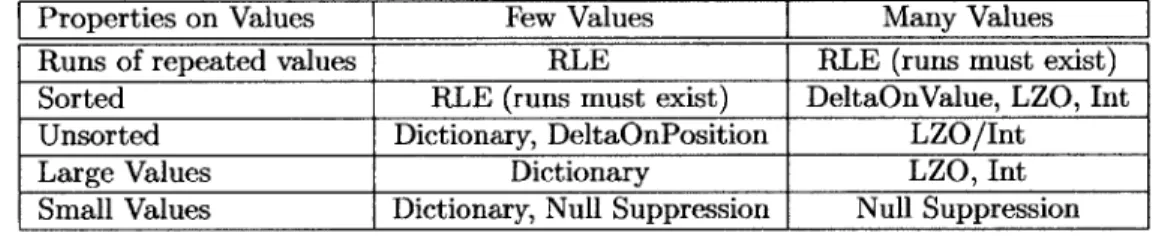
We have described six compression schemes currently implemented in CStore. The compression ratios that each scheme is able to acheive depends greatly on the properties of the sequence of values we are encoding. Figure 3-7 provides a rough guide of the effectiveness of different compression schemes on different types of data.
Properties on Values Few Values Many Values
Runs of repeated values RLE RLE (runs must exist) Sorted RLE (runs must exist) DeltaOnValue, LZO, Int
Unsorted Dictionary, DeltaOnPosition LZO/Int
Large Values Dictionary LZO, Int
Small Values Dictionary, Null Suppression Null Suppression Figure 3-7: What Compression Scheme to Pick
We have described a rough selection criteria for compression schemes. However, it is important to note that the choice of compression scheme also depends on the queries that use this data. The performance of a given operator is largely dependent on the structure of the coded data it is operating on. Therefore, to maximize performance we may wish to use a less compact scheme to improve a query's performance. For a varied query load, we may have a particular column stored redundantly under many compression schemes
so to increase overall query performance.
3.5
Properties of Column Compression
Compression schemes may alter the ordering of a sequence of values. We introduce a set of properties that allow us to describe the structure of compressed data relative to the original sequence. To begin this discussion, there are two general classes of questions we can ask about a sequence of values:
1. What is the fourth value in the sequence?
2. Where does the value 3 occur?
The first question has a single answer, for every position there is only one value. The second question may not have a unique answer since the value 3 can occur at multiple positions. Therefore, to describe a single instance of a value we have to specify both the value and position. We denote the set {value, position} as a Pair.
When we consider the compression schemes described in this chapter, not all schemes preserve the original order of the sequence on disk. For example. if we consider delta encoding on position, we code a delta list for each value, and store each of these list contiguously on disk. If a particular value did not occur in runs, but was interspersed in other values then original order of the column is not preserved on disk.
It may seem that storage order does not matter, since SQL operators are order independent. However, the entire table is expected by operators to be stored in the same order. With different compression schemes for different columns, and the delivery of data as it its physical order, operators no longer receive two columns in the same order. We build support in the query executor for out order values and deliver every values to the executor as a stream of pairs. The entire stream of Pairs represents the original data. Pairs are delivered in the query executor in Blocks, where a Block contains an arbitrary number of Pairs. Abstractly, we can think of Blocks as non-overlapping subsets of the total set of Pairs in a column. Let's formalize our discussion of columns by introducing some notation. Let:
" P[i] be the ith Pair in a stream of Pairs. " C=UN 1 P[i] be the set of all Pairs in a column.
" Value(P[f]) =value part of ith pair
" Position(P[i]) =position part of ith pair " Si are subsets of C, C=U7i1 Si = C where
- Sa =
U=
3 P[i] where j k & 1 < j, k < N-
SalSb = o iff a b & 1 < a,b < mWe can now consider some properties over the Pair stream, and Blocks of the Pairs in that stream. In particular:
1. Are the values sorted? (i.e. Is Value(P[i]) < Value(P[j]) Vi < j ?)
3. Does this Block only hold one value? (i.e. Is Value(P[i]) = Value(P[j]) = k Vi,j : P[i]&P[j]
c
Si ?)4. Does this Block hold contiguous positions? (i.e. Is Position(P[i]) + 1 Position(P[i + 1]) Vi P[i]&P[i+1]
C
Si ?)5. Is this Block value sorted? (i.e. Is Value(P[i]) _< Value(P[j]) Vi < j : i&j E Si ?)
6. Is this Block position sorted? (i.e. Is Position(P[i]) < Position(P[j]) Vi < j : i&j E Si ?)
With 6 properties, there is a set of 26 = 64 possible combinations of properties that any Block could have. However, we can limit this number by noting the following relations between these properties:
- 1 -+ 5: If the stream is value sorted, then each subset must be value sorted
- 2 -+ 4: If the stream is position sorted then all positions in stream are adjacent to each other, therefore each subset is position contiguous.
- 2 -+ 6: If the stream is position sorted, then each subset must also be position sorted. - 3 -> 5: If the subset holds only one value, then the subset is trivially value sorted - 4 -+ 6: If subset is position contiguous, it must be position sorted
This gives us a total of 18 possible combinations. This result is important due to its generality. If we consider any coding scheme we can always classify it according to one of these 18 general classes formed by these properties.
This result has a large impact on the complexity of the query executor. It implies that if we abstract away compression schemes but provide operators with a stream of Blocks, then their are at most 18 cases they have to deal with. In practice, operators deal with fewer than 18 cases for two main reasons. Firstly, only a few of these properties can be used fruitfully for optimization. For example, code that deals with a multi-valued Block is able to deal with single value subsets, as a single value subset is a special case of the more general multi-value subset. Secondly, for some operators, many of these properties are irrelevant. A select operator is only concerned with the values in a Block suggesting that postion oriented properties (i.e. 2,4 and 6) are irrelevant.
We must operate on Blocks instead of the entire column for several reasons: for one, we can only deal with subsets of the column at any point in time, as in general the entire column will not fit in memory. Additionally, most compression schemes create data structures that represent a subset of the data. For example, an RLETriple represents a run of a particular value in the original column. The compressed data structures themselves represent subsets of the entire column, and are therefore well suited to the Block model. Lastly, data on disk is stored in pages, and for reasons described in chapter 4, we code subsets of a
column until we have a page worth of data. When we decompress a page we have a subset of the column to operate on. In the next chapter, we look at how compressed sequences are actually stored on disk within the CStore system.
Chapter 4
Storage model for CStore
For the current CStore system, we use Sleepycat's BerkeleyDB for storage management. BerkeleyDB ("BDB") "is an open source embedded database library that provides scalable, high-performance, transaction-protected data management services to applications." [17] CStore currently uses BDB as a storage manager. We store 64K pages as BLOBs (Binary large objects) within BDB. Pages contained coded data, created by running a coding scheme until we have a page worth of data to write. Each page contains sufficient header information to decompress all its contents.
Within BerkeleyDB we store different types of B-Tree indexes on compressed pages depending on the properties of the compressed data.
1. If pages are sorted by value, we store two indexes: a primary index on value and a secondary index on
position.
2. If pages are not sorted by value, we store a single index: a primary index on position.
It is important to note that indices are on pages, but pages have multiple values and positions. We pick the last value and position in each page as the key for the index. To lookup a particular value, we perform a lookup on the primary index. We find the first leaf in the index where the key is greater than or equal to the value we are searching for. The page pointed to by this index entry is guaranteed to be the only page where that value could be located 1.
Some of the schemes described in Chapter 3 require storing more than one column on disk. In particular:
Delta Coding on Position codes a delta list for each value. We store these as separate objects in BDB, each delta list with a primary index on position. A second type of column is also stored that provides a
1
We can proof this by contradiction: if the value we are searching is in fact contained in another page, then the index entry for that page must be greater than or equal to that value. However, we traverse the index in order, so there can only be one page where the value is contained.
list of all the values for which delta lists exist. This value column is sorted with both value and position indexes. The value column operates as a catalog for the delta lists available, in that it allows us to discover what delta lists are available. To maintain this system within BDB, a strict naming convention is followed. The value column is named <column name>VALS and each value sub-column is named <column name><value>. This layout of data allows us to read down each delta list independently and have an independent position index for each value.
Dictionary Encoding requires storing a value table to allow us to map tokens back to the original value. The table is an uncompressed column named <column name>Table. The table column and coded columns are both sorted if the original data was sorted. The table and coded column therefore have both value and position indexes if the original data was sorted. If the original data was unsorted, both the table and compressed columns are stored with only position indexes.
Data stored and indexed by BerkeleyDB is compression specific. Within the CStore architecture, Dat asources are responsible for opening the correct BerkeleyDB objects to provide the executor with Blocks to operate. In the next chapter, we begin a more detailed discussion of how Datasources, Blocks and other components operate within the executor.
Chapter 5
Software Architecture
Thus far, we have described at a high level the overall architecture of the CStore query executor. In this chapter, we study the details as to the implementation of the CStore executor. To start the discussion, let us consider the sample query introduced in Chapter 2. In this query, we want to find the number of orders on each day since the beginning of the year. We can express such a query in SQL:
SELECT count(orderID), shipdate
FROM lineitem
WHERE shipdate > 1/1/05
GROUP BY shipdate
Figure 2-2 illustrates a query plan that might be instantiated within a traditional DBMS and Figure 2-6 illustrates the query plan instantiated within the CStore executor.
We recall that in a traditional DBMS the query plan involves a single access method, a projection and finally a COUNT aggregation operator. The CStore query plan differs as:
1. There is an access method for every column.
2. Unlike the traditional plan, the CStore query plan is not trees.
3. Datasources are used to filter positions. The Datasources aggressively tries to limit the number of
disk accesses required, by taking advantage of its knowledge of the structure of the compressed column on disk and the properties of the filter Blocks.
In the next sections, we describe in more detail how we can handle the cases introduced by each of these points. We begin our discussion by describing Blocks, which are the central component exchanged between all components in the design.
5.1
Blocks
Recall that a Block carries compressed data and provides a common interface to access compressed data.
A Block contains a subset of the compressed column and exposes to operators the set of six properties
indicated in section 3.5. These properties indicate to operators the structure of the Block as well as the Block stream in which it is contained. The interface to a Block is shown in Figure 5-1.
Block* clone(Block&) bool hasNext()
bool hasNext(int value-) Pair* getNext()
Pair* peekNext()
Pair* getPairAtLoc(uint loc.)
int getCurrLoc() int getSize() int getSizeInBits () Pair* getStartPair() void resetBlock() bool isValueSorted() bool isPosSorted() bool isOneValueo) bool isPosContiguous() bool isBlockValueSorted() bool isBlockPosSorted()
Copy the block.
Does the iterator contain any remaining Pairs. Does the iterator contain any Pairs with this value. Get the next Pair in the iterator.
Get the next Pair in iterator without advancing it. Get the Pair at this location.
Return the current location of the iterator. Return the number of Pairs in this Block. Return the size of the Block in bits. Get the first Pair in the Block.
Reset the iterator to point to the first Pair. Returns true if the Block stream is value sorted. Returns true if the Block stream is position sorted. Returns true if the Block has a single value.
Returns true if the Block is position contiguous. Returns true if the Block is value sorted.
Returns true if the Block stream is position sorted.
Figure 5-1: ValueBlock interface
Blocks provide the ability to decompress on the fly, providing an iterator style interface to the Pairs it contains. Our goal, however, is for most operators to use knowledge of a Block's structure to avoid decompression. We can illustrate this most clearly through an example: consider a Block stream that is value and position sorted, where each Block in the stream contains one value and is position contiguous. Suppose we have a second Block stream which is also value and position sorted, and where Blocks are not single-valued. Now consider a selection filtering based on whether the value is greater than some constant k. With a single-valued Block, all the select operator needs to do is look at the first value and if the value satisfies the predicate it can return that entire Block. If the value does not satisfy the predicate, it simply goes on to process the next Block. With multi-valued Blocks, the select would have to test the predicate on each value, effectively requiring the Block to decompress each value. It may be that the single value property is irrelevant to some operators. For example, a count aggregation operator aggregating on a Block
stream never needs to access to values, hence whether the Blocks are one-valued or not is irrelevant. Blocks provide access to uncompressed data through an iterator interface, as shown in Figure 5-1 for ValueBlocks. ValueBlocks provide a getNextPair() call, while PositionBlocks provide a getNextPosition()
addition, random access is provided by a call to getPairAtLoc (int i) which allows us to jump to
ith
Pair or Position in the stream.A particular Block may not be unique in a Block stream between operators. For example, there could
be multiple instances of a set of values and positions after a join operator. We capture this information in a numccurences field within each Block, to avoid copying Blocks.
5.1.1
Value Blocks
ValueBlocks represent the column value data, as opposed to PositionBlocks that just contain the set of positions in the column. In the terminology from chapter 3.5, Blocks hold a subset of a coded sequence.
A Block holds the smallest possible compressed data structure. These data structures are by their nature
coding scheme specific, thus an RLEBlock is different from a DeltaOnPositionBlock ("DeltaPosBlock" for brevity). In the next subsections, we look at the current types of ValueBlocks and their properties.
5.1.2
BasicBlocks
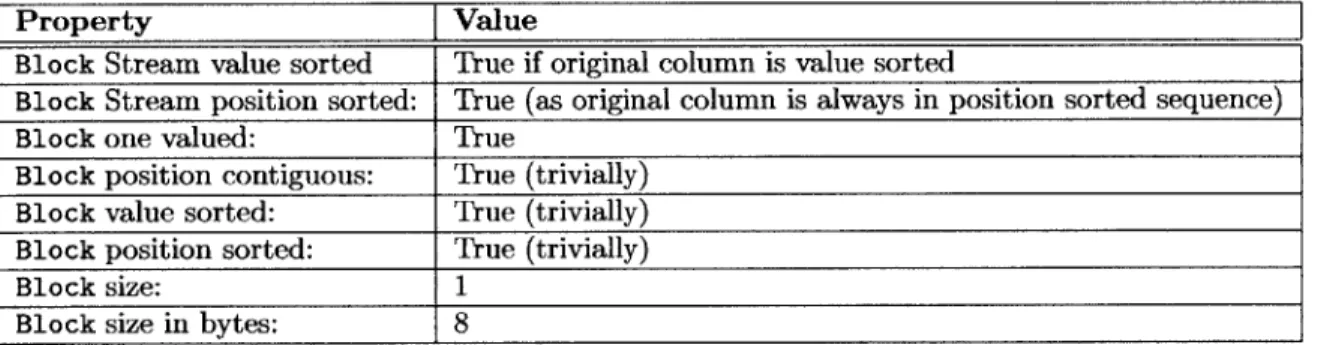
BasicBlocks, as their name implies, are the simplest type of Blocks in the CStore query executor. They contain a single pair, have a size of 1 and take 8 bytes in memory1. BasicBlocks are used for uncompressed data or data that is decompressed before it is exposed to the executor. BasicBlocks have properties as shown in Figure 5-2.
Property Value
Block Stream value sorted True if original column is value sorted
Block Stream position sorted: True (as original column is always in position sorted sequence)
Block one valued: True
Block position contiguous: True (trivially) Block value sorted: True (trivially) Block position sorted: True (trivially)
Block size: 1
Block size in bytes: 8
Figure 5-2: BasicBlock Properties
5.1.3
RLEBlocks
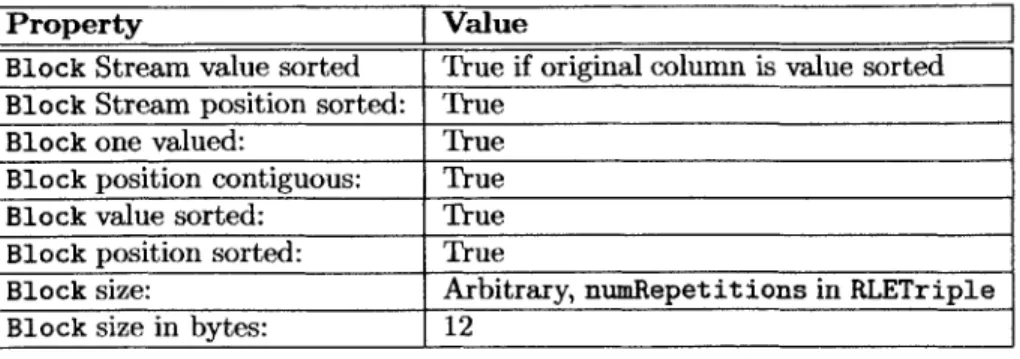
RLEBlocks contain a single RLETriple. RLEBlocks are decompressed through calls to getNext 0. The first call to getNext 0 returns the Pair {value, startPos}, the second call returns {value, startPos+1}, the
ith call returns {value, startPos+i-1} all the way up to {value,startPos+reps}. Random access in
RLEBlocks is fast, as it only requires us to check if the position requested is contained in the RLEBlock, 'the size of a Pair: 4 bytes for the value, 4 bytes for position
which requires at most two comparisons. We note that it is computationally simple to decode RLEBlocks, however the overhead of the function calls adds up. The properties of RLEBlocks, are shown in Figure 5-3.
Property Value
Block Stream value sorted True if original column is value sorted
Block Stream position sorted: True
Block one valued: True
Block position contiguous: True
Block value sorted: True
Block position sorted: True
Block size: Arbitrary, numRepetitions in RLETriple
Block size in bytes: 12
Figure 5-3: RLEBlock Properties
5.1.4
DeltaPosBlocks
DeltaPosBlocks differ greatly from BasicBlocks and RLEBlocks. We stated earlier that a Block contains the smallest possible compressed data structure. In the case of delta encoding on position, the smallest compressed data structure is a disk page of delta on position data2. As a reminder, a page of DeltaPos data contains a header with the number of deltas found on the page, the initial position and the value this page encodes followed by a delta list that fills the page. DeltaPosBlocks' properties are shown in Figure 5-4.
Property Value
Block Stream value sorted True, regardless of whether initial data was sorted.
Block Stream position sorted: False
Block one valued: True
Block position contiguous: False
Block value sorted: True
Block position sorted: True
Block size: Arbitrary, numDeltasInDeltaList + 1 (for the startPos).
Block size in bytes: One Page
Figure 5-4: DeltaPosBlock Properties
DeltaPosBlocks are decoded on the fly by walking down the delta list. The ith pair returned by
getNext( ois {value, position [i] }where position [i] = position [i-1] + delta[i-1] and position [1]
= startPos. Random access in DeltaPosBlocks is slow as we have to walk down the delta list adding and subtracting depending on the direction of traversal.
DeltaPosBlocks have the appealing feature that they order the original column. This allows a number of optimizations to be performed on delta on position coded columns as operations can assume the output
2