J. M. Caffrey, P. R. F. Barrett, M. T. Ferreira, I.S. Moreira, K. J. Murphy & P. M. Wade (eds), Biology, Ecology and Management of Aquatic Plants.
© 1999 Kluwer Academic Publishers. Printed in the Netherlands.
257
Aquatic plant management: ecological effects in two streams
of the Swiss Plateau
Barbara R. Kaenel
∗& Urs Uehlinger
Swiss Federal Institute for Environmental Science and Technology (EAWAG), CH-8600 Duebendorf, Switzerland
Key words: plant management, stream, disturbance, macrophytes, invertebrates, habitat conditions, oxygen
concentrations
Abstract
Effects of plant removal on habitat conditions, stream metabolism and benthic invertebrates were studied in two macrophyte-rich streams (Chriesbach, Mühlibach) of the Swiss Plateau. We monitored a control reach (no treat-ment) and two impact reaches (removal of plants by cutting or dredging) in each stream. Sampling was conducted during a 2–4 month period before and a 9 month period after the removal of 84–94% of the plant biomass. Oxygen concentrations were continuously recorded for 3–4 months. Plant removal decreased water depth and increased current velocity. The total number of invertebrates decreased by about 65%. Plant cutting mainly affected taxa that used macrophytes as habitat. Highly mobile taxa and taxa living on or within the bed sediment were less affected. Invertebrate densities recovered within 4–6 months. The removal of plants resulted only in a moderate increase in nocturnal oxygen concentrations. In the stream where plants were cut in spring, macrophytes recovered within the same growing season. In the other stream, where plant growth started later, plants were cut in summer and no recovery of plants occurred until the following spring.
Introduction
Aquatic macrophytes are a common feature of many nutrient-rich unshaded lowland streams with stable flow regimes (Pieterse & Murphy, 1990; Dawson et al., 1991). Macrophytes change habitat conditions, influence the oxygen balance and modify the struc-ture and spatial distribution of benthic invertebrates in streams (Edwards & Owens, 1962; Marshall & Westlake, 1990; Ward, 1992). Excessive plant growth may increase the risk of bank-overtopping and result in large diel oxygen fluctuations due to the photo-synthetic and respiratory activity of macrophytes and associated epiphytic algae (Dawson, 1978; Hearne & Armitage, 1993). However, plant removal is tradi-tionally related to the improvement of the hydraulic conditions.
Plant removal is a disturbance that affects the struc-ture of habitats and communities. Studies on the im-pacts of plant removal on streams have usually focused on single aspects such as invertebrates, plants or
meta-∗ Author for correspondence
bolism (e.g. Simonsen & Harremoës, 1978; Ham et al., 1982; Caffrey, 1990; Dawson et al., 1991). In this paper, we summarise the effects of plant management techniques (cutting and dredging) on habitat condi-tions, oxygen concentrations and invertebrates in two streams of the Swiss Plateau. We discuss the applied management regimes in relation to their ecological impacts and their efficiency in reducing interference with human demands. Based on these results, we make suggestions for future plant management practices.
Methods
Study sites
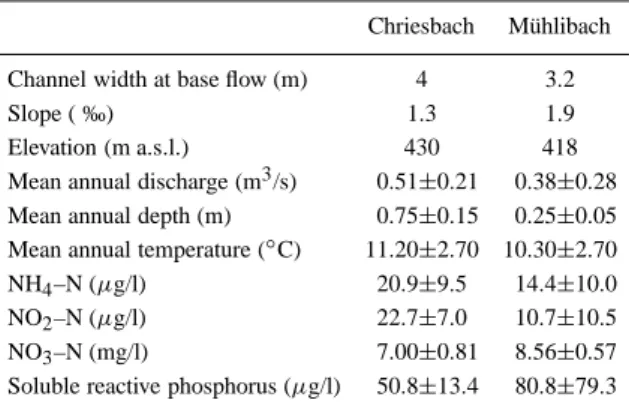
The study was performed in two nutrient-rich streams of the Swiss Plateau, Chriesbach and Mühlibach, that were similar with respect to their chemical and phys-ical characteristics (Table 1). The wetted channels of both streams were sparsely shaded. Macrophyte com-munities were dominated by Ranunculus fluitans Lam. in the Chriesbach and by Ranunculus trichophyllus
258
Table 1. Morphometric and chemical properties of the Chriesbach
and Mühlibach in 1995. Mean annual values and standard devi-ation are based on continuous measurements of depth, discharge and temperature. Mean annual values and standard deviation of nutrient concentrations were calculated from monthly samples
Chriesbach Mühlibach
Channel width at base flow (m) 4 3.2
Slope ( ‰) 1.3 1.9
Elevation (m a.s.l.) 430 418
Mean annual discharge (m3/s) 0.51±0.21 0.38±0.28 Mean annual depth (m) 0.75±0.15 0.25±0.05 Mean annual temperature (◦C) 11.20±2.70 10.30±2.70
NH4–N (µg/l) 20.9±9.5 14.4±10.0
NO2–N (µg/l) 22.7±7.0 10.7±10.5
NO3–N (mg/l) 7.00±0.81 8.56±0.57
Soluble reactive phosphorus (µg/l) 50.8±13.4 80.8±79.3
Chaix in the Mühlibach. In summer, macrophytes cover ca. 100% of the streambed. Macrophytes are removed twice a year by water management authorit-ies to prevent bank overtopping (Chrauthorit-iesbach) or water logging of adjacent agricultural fields (Mühlibach). A detailed description of both streams is given by Kaenel et al. (1998).
Experimental design
Macrophyte biomass, current velocity and water depth were monitored in three stream reaches subject to different management regimes: 1. no management = control, 2. cutting and 3. dredging. Benthic inver-tebrates were sampled in the control and in the cut reaches. Oxygen concentration and water temperature were measured at the up- and downstream ends of the control and impact sections. Control reaches were located upstream of the impact reaches. Additional replication was not possible due to the changing char-acteristics of the macrophytic vegetation upstream and downstream of the study reach. Samples were taken using a stratified random design (after Green, 1979; length of strata = 50 m) during a 2–4 month period before and a 9 month period after the removal of mac-rophytes. The four strata within each reach correspond to a spatial interspersion of replicates that has been described as clumped segregation (Hurlbert, 1984). Macrophytes were removed on 22–23 May 1995 in the Chriesbach and on 24–26 July in the Mühlibach (for more details see Kaenel et al., 1998; Kaenel & Uehlinger, 1998).
Methods
Invertebrates and plant biomass were simultaneously collected with a Surber sampler modified to allow sampling in water up to 1.2 m in depth (surface area = 0.09 m2, mesh size = 250 µm, Mensch et al., 1997). Macroinvertebrates were separated from plants and stored at –20◦C. Invertebrates were identified to order level (except Mollusca to class, Crustacea to species and Diptera to family level) and counted under a ste-reomicroscope. Plants were sorted to species and dried to constant weight at 85 ◦C. Water depth and cur-rent velocity were measured within the sampling area. Estimates of mean channel depth were based on con-tinuous water level recordings and four staff gauges that were read at weekly – biweekly intervals. Mean current velocities were determined by monitoring the downstream movement of an uranin cloud with an
in situ pulse light fluorometer at different discharges.
Oxygen concentrations were continuously monitored at the ends of the control and impact reaches. Meas-urements were performed with YSI equipment (probe 5739 with stirrer 5795A and O2-meter 54 or 58, YSI
Inc., Yellowsprings, Ohio, U.S.A.). Signals were aver-aged for 3 – 10 min and stored in 10 min intervals (Tattletale Model IV single card datalogger, Onset Corporation, N. Falmouth, Massachusetts, U.S.A). Macrophyte biomass, invertebrates and habitat condi-tions on control and impact reaches (dredged and cut) were compared with the two-sided Mann-Whitney U-test. Differences were assumed to be significant if p = 0.05.
Results
Plant biomass
In both streams, plant biomass was similar in all reaches before plant removal. Macrophyte removal re-duced plant biomass by 87% in the cut and by 94% in the dredged reach in the Chriesbach and by 84% in the cut and by 90% in the dredged reach in the Mühlibach (Figure 1). Plants exhibited different recovery traject-ories in the two streams. In the Chriesbach, where
R. fluitans had been removed before flowering,
mac-rophytes recovered within the same growing season and recovery was faster in the cut than in the dredged reach. In the Mühlibach, where plants had been re-moved after flowering of R. trichophyllus, plants did not recover until the following spring.
Figure 1. Macrophyte biomass (g dry weight m−2) in the control (solid line), cut (dashed line) and dredged reaches (fine line) of both streams. Error bars represent standard errors.
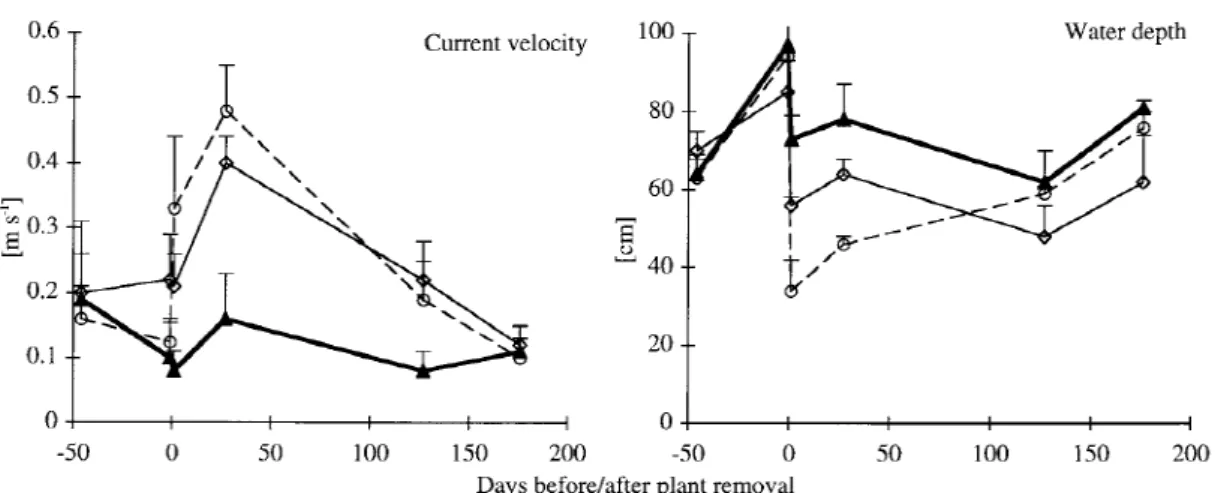
Figure 2. Current velocity and water depth in the control (solid line), cut (dashed line) and dredged reaches (fine line) in the Chriesbach. Error
260
Habitat conditions
Apart from the dredged reach in the Mühlibach, depth and current velocity in impact and control reaches were similar before plant removal. Plant removal re-duced mean depth and increased mean current velocity in both streams (Figure 2). Plant dredging did not have a significantly greater effect on current velocity than cutting. In the Chriesbach, water depth and current ve-locity were not significantly different between control and impact reaches 127 d (depth) and 176 d (velocity) after plant removal. In the Mühlibach, both parameters were similar 125 d after plant management.
Oxygen concentrations
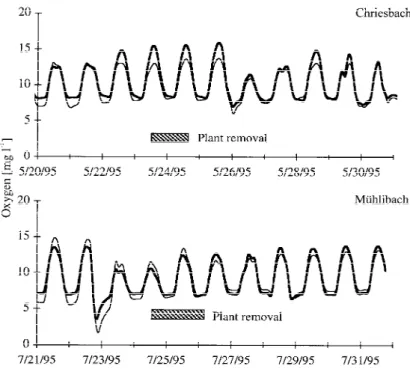
Before plant removal, diel O2fluctuations were higher
at the end of the impact reaches than at the end of the control reaches in both streams (Figure 3). The gradual increase of daily O2maxima until the spate of 26 May
in the Chriesbach continued only in the control reach after plant removal, in the impact reach nocturnal O2
concentrations increased from 7 to 8 mg/l. In the Müh-libach, nocturnal O2 concentrations increased from 6
to 7 mg/l after plant removal.
Invertebrates
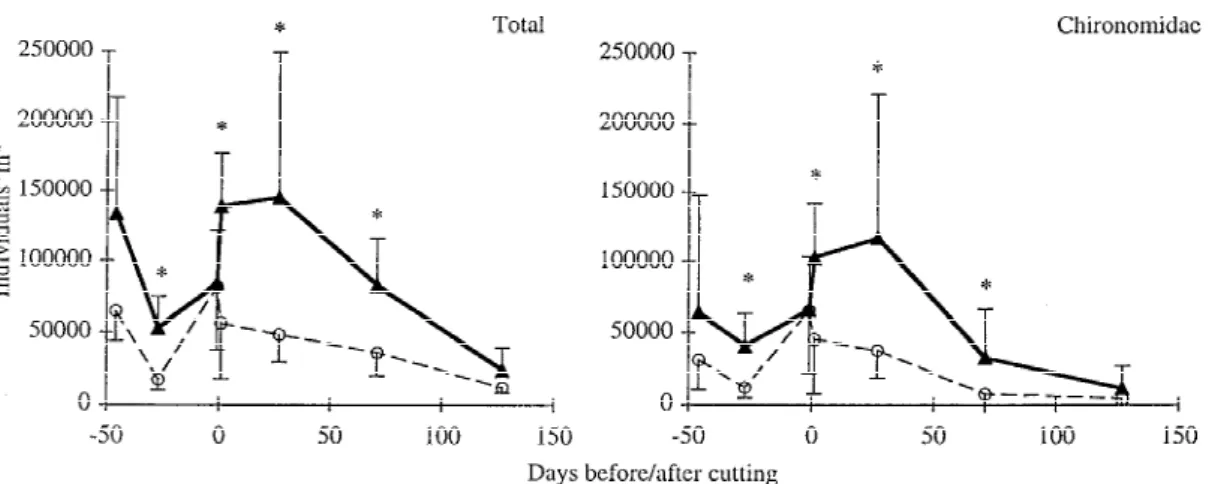
In both streams, plant removal decreased the total number of invertebrates by about 65% (Figure 4). Plant cutting affected mainly taxa that used mac-rophytes as habitat (e.g. Chironomidae; Figure 4), whereas highly mobile taxa (e.g. Ephemeroptera) and taxa living on or within the bed sediments (e.g. Bivalvia, Trichoptera) were less affected. Although recovery of macrophytes differed between streams, taxa affected by plant removal recovered within 4– 6 months in both streams. In the Mühlibach, plant removal affected benthic invertebrates less distinctly than in the Chriesbach (Kaenel et al., 1998).
Discussion
Ecological effects of plant management
Macrophytes modify habitat conditions in streams. As expected, mean plant biomass after plant removal was lower in dredged than in cut reaches, but these dif-ferences were rarely significant. Cutting and dredging neither differed in their effect on depth and current ve-locity. The dredging method used in this study might
explain the only small differences between the two management procedures. In the dredged reaches of our study, plants were cut immediately above the stream bottom and parts of the below ground plant material were eliminated by raking. There is some evidence that the periodic removal of macrophytes results in a plant community that is dominated by disturbance tolerant species (Kaenel, 1998).
Plant removal decreases community respiration and enhances the oxygen exchange between water and atmosphere, and thus, reduces the risk of low oxy-gen concentrations at night (Simonsen & Harremoës, 1978; Kaenel, 1998) which may threaten fish and benthic invertebrates (Gammeter, 1988; Alabaster & Lloyd, 1998). For example Brooker et al. (1977) repor-ted massive fish kill when water temperatures varied between 21 and 28◦C and diel oxygen concentrations between 0.5 and 5 mg/l. However, oxygen conditions in Chriesbach and Mühlibach were far from such ex-tremes, and thus, do not justify plant removal in this respect.
Plant removal is a disturbance with a distinct short-term effect on benthic invertebrates, mainly taxa that use macrophytes as habitat. Kaenel & Uehlinger (1998) demonstrated that the spatial distribution of plants after plant removal was more heterogeneous in the Mühlibach than in the Chriesbach. This sug-gests that maintaining a high spatial heterogeneity of the remaining plants can moderate the impact of plant removal on invertebrates (Kaenel et al., 1998). How-ever, recovery of invertebrates did not coincide with plant recovery, indicating that factors other than plant biomass, current velocity and depth influence rate of recolonization. Such factors may include individual life history, the presence of undisturbed reaches up-stream and the timing of plant removal (Mackay, 1992; Ward, 1992). Plant removal in spring has presumably a more severe impact on stream invertebrates than re-moval in summer (Pearson & Jones, 1978; Kaenel et al., 1998).
Efficiency of plant management
Plant removal immediately reduced the risk of bank-overtopping and agricultural fields becoming water-logged because water depth decreased and current velocity increased. However, the long-term benefits of plant removal with respect to improved channel hy-draulics were limited by the macrophyte’s ability to recover. Dredging retarded the recovery of plant bio-mass compared to cutting, and thus was more effective
Figure 3. Oxygen concentrations at the end of the control (solid line) and cut (dashed line) reaches of both streams immediately before and
after plant removal.
in maintaining the drainage capacity of a channel. Plant recovery can probably further be delayed if the dredging procedure normally used by management au-thorities (Haslam & Wolseley, 1987; Wade, 1992) is applied instead of raking, the method used in this study. However, the negative impact on the stream ecosystem (e.g. benthic invertebrates, fish) of the tra-ditional method would be more severe. Plant recovery also depends on the timing of plant removal. Fast re-covery of macrophytes after plant removal in spring is apparently a common phenomenon (e.g. Murphy et al., 1987; Caffrey, 1990; this study). Macrophytes are stimulated to regrow and flower if plants are cut prior to flowering (Dawson, 1978). If plants are left uncut, decay starts soon after flowering (Ham et al., 1982; this study). Plant recovery may further be delayed if plants are removed along a whole stream and not only from relatively small reaches; i.e. untreated stream reaches provide plant propagules and also may buffer the impact of spates.
Suggestions for further plant management
We recommend removing plants after flowering in summer or autumn. Then, plant removal is most
ef-fective with respect to plant recovery and thus, reduces the cost of stream maintenance. Plant removal in sum-mer or autumn is also preferable for ecological reasons because the impact on benthic invertebrates appears to be less severe than in spring. We would like to emphasise that macrophytes considerably improve en-vironmental conditions for invertebrates and fish in channelized streams with low habitat heterogeneity. If plant management is inevitable, negative impacts on benthic invertebrate communities should be reduced by maintaining a minimum degree of spatial hetero-geneity of the habitat. This can be obtained by leaving some macrophyte beds untreated.
However, the need for plant management should be critically evaluated. Plant management is typic-ally based on a traditional approach, which perceives the main function of a river as the efficient drain-age of a catchment (Wade, 1992). Plant mandrain-agement is often done because of tradition and not necessar-ily because it is an effective management strategy (Haslam & Wolseley, 1987). Plant removal techniques do not result in a long-term reduction of plant bio-mass, as they do not reduce growth conditions for aquatic plants. Shading a stream by riparian vegetation (Krause, 1977; Dawson & Kern-Hansen, 1979;
Can-262
Figure 4. Abundance of all invertebrates and Chironomidae in the control (solid line) and cut (dashed line) reaches of Chriesbach. Error bars
represent standard errors.∗ indicates significant differences between reaches (p = 0.05).
field & Hoyer, 1988) or leaving streams unmanaged after several years of regular plant removal (Dawson, 1976) are two management methods that can result in a sustainable long-term reduction of plant biomass; and thus are interesting from an ecological and economic point of view.
Acknowledgements
The Water Protection Authority of the Kanton Zurich (AGW) funded this project. We thank T. Boesch, U. Holliger and R. Mensch for sample processing. We are also grateful to P. Burgherr, C. Robinson, R. Zah, Prof. J. V. Ward and two anonymous reviewers for critical comments on the manuscript.
References
Alabaster, J. S. & R. Lloyd, 1980. Water quality criteria for freshwater fish. Butterworths, London: 297 pp.
Brooker, M. P., D. L. Morris & R. J. Hemsworth, 1977. Mass mor-tality of adult salmon, Salmo Salar, in the R. Wye 1976. J. appl. Ecol. 14: 409–417.
Caffrey, J. M., 1990. Problems relating to the management of
Potamogeton pectinatus L. in Irish rivers. In Proc. 8th Symp.
Aquatic Weeds. Uppsala: 61–68.
Canfield, D. E. & M. V. Hoyer, 1988. Influence of nutrient en-richment and light availability on the abundance of aquatic macrophytes in Florida streams. Can. J. Fish. aquat. Sci. 45: 1467–1472.
Dawson, F. H., 1976. The annual production of the aquatic macro-phyte Ranunculus penicillatus Var. calcareus (R. W. Butcher) C. D. K. Cook. Aquat. Bot. 2: 51–73.
Dawson, F. H., 1978. The seasonal effects of aquatic plant growth on the flow of water in a stream. In Proc. 5th Symp. Aquatic Weeds. Amsterdam: 71–78.
Dawson, F. H. & U. Kern-Hansen, 1979. The effect of natural and artificial shade on the macrophytes of lowland streams and the use of shade as a management technique. Int. Rev. ges. Hydrobiol. 64: 437–455.
Dawson, F. H., E. M. F. Clinton & M. Ladle, 1991. Invertebrates on cut weed removed during weed-cutting operations along an English river, the River Frome. Aquacult. Fish. Mgmt 22: 113– 121.
Edwards, R. W. & M. Owens, 1962. The effects of plants on river conditions IV. The oxygen balance of a chalk stream. J. Ecol. 50: 207–220.
Gammeter, S., 1988. Kurzzeiteffekte anthropogener Belast-ungsparameter auf Fliesswasser-Makroinvertebraten. Diploma Thesis, Swiss Federal Institute of Technology, Zurich. Green, R. H., 1979. Sampling design and statistical methods for
environmental biologists. John Wiley & Sons Inc, New York: 257 pp.
Ham, S. F., J. F. Wright & A. D. Berrie, 1982. The effect of cut-ting on the growth and recession of the freshwater macrophyte
Ranunculus penicillatus (Dumort.) Bab. var. calcareus (R. W.
Butcher) C. D. K. Cook. J. Envir. Mgmt 15: 263–271.
Haslam, S. M. & P. A. Wolseley, 1987. River plants of West-ern Europe: the macrophytic vegetation of watercourses of the European Economic Community. Cambridge University Press, Cambridge: 512 pp.
Hearne, J. W. & P. D. Armitage, 1993. Implications of the annual macrophyte growth cycle on habitat in rivers. Regul. Riv.: Res. Mgmt 8: 313–322.
Hurlbert, S. H., 1984. Pseudoreplication and design of ecological field experiments. Ecol. Monogr. 54: 187–211.
Kaenel, B. R., 1998. Effects of aquatic plant removal on lotic ecosystems. PhD Thesis, Nr. 12651, Swiss Federal Institute of Technology, Zurich.
Kaenel, B. R. & U. Uehlinger, 1998. Effects of plant cutting and dredging on habitat conditions in streams. Arch. Hydrobiol. 143: 257–273.
Kaenel, B. R., C. D. Matthaei & U. Uehlinger, 1998. Disturb-ance by aquatic plant management in streams: effects on benthic invertebrates. Regul. Riv.: Res. Mgmt 14: 341–356.
Krause, A., 1977. On the effect of marginal tree rows with respect to the management of small lowland streams. Aquat. Bot. 3: 185– 192.
Mackay, R. J., 1992. Colonisation by lotic macroinvertebrates: a review of processes and patterns. Can. J. Fish. aquat. Sci. 49: 617–628.
Marshall, E. J. P. & D. F. Westlake, 1990. Water velocities around water plants in chalk streams. Folia geobot. phytotax. 25: 279– 289.
Mensch, R., B. Kaenel & U. Uehlinger, 1997. Kurzfristige Aus-wirkungen einer Entkrautung auf einen Mittellandbach (Chries-bach bei Dübendorf, ZH). Vjsschr. Natf. Ges. Zurich 142: 23–31.
Murphy, K. J., A. M. Fox & G. Hanbury, 1987. A
multivari-ate assessment of plant management impacts on macrophyte communities in a Scottish canal. J. appl. Ecol. 24: 1063–1079. Pearson, R. G. & N. V. Jones, 1978. The effects of weed-cutting on
the macro-invertebrate fauna of a canalised section of the river Hull, a northern English chalk stream. Envir. Mgmt 7: 91–97. Pieterse, A. H. & K. J. Murphy, 1990. Aquatic Weeds: the
eco-logy and management of nuisance aquatic vegetation, Oxford University Press, Oxford: 593 pp.
Simonsen, J. F. & P. Harremoës, 1978. Oxygen and pH fluctuations in rivers. Wat. Res. 12: 477–489.
Wade, P. M., 1992. Management of macrophytic vegetation. In Ca-low, P. & G. E. Petts (eds), The Rivers Handbook: Hydrological and Ecological Principles. Blackwell Scientific Publications, Oxford: 363–385.
Ward, J. V., 1992. Aquatic insect ecology, John Wiley & Sons Ltd, New York: 438 pp.