HAL Id: hal-02398897
https://hal.archives-ouvertes.fr/hal-02398897
Preprint submitted on 9 Nov 2020HAL is a multi-disciplinary open access archive for the deposit and dissemination of sci-entific research documents, whether they are pub-lished or not. The documents may come from teaching and research institutions in France or abroad, or from public or private research centers.
L’archive ouverte pluridisciplinaire HAL, est destinée au dépôt et à la diffusion de documents scientifiques de niveau recherche, publiés ou non, émanant des établissements d’enseignement et de recherche français ou étrangers, des laboratoires publics ou privés.
Integrating the VO Framework in the EOSC
Marco Molinaro, Mark G. Allen, Sara Bertocco, Catherine Boisson, François
Bonnarel, Margarida Castro Neves, Markus Demleitner, Françoise Genova,
Dave Morris, André Schaaff, et al.
To cite this version:
Marco Molinaro, Mark G. Allen, Sara Bertocco, Catherine Boisson, François Bonnarel, et al.. Inte-grating the VO Framework in the EOSC. 2020. �hal-02398897�
Marco Molinaro,1Mark Allen,2Sara Bertocco,1Catherine Boisson,3 François Bonnarel,2Margarida Castro Neves,4Markus Demleitner,4
Françoise Genova,2Dave Morris,5André Schaaff,2Giuliano Taffoni,1and Stelios Voutsinas5
1INAF – Osservatorio Astronomico di Trieste, Trieste, Italy; marco.molinaro@ inaf.it
2Centre de Données astronomiques de Strasbourg, Strasbourg, France 3Observatoire de Paris - Meudon, Paris, France
4Universität Heidelberg, Astronomisches Rechen-Institut, Heidelberg,
Germany
5University of Edinburgh, Edinburgh, Scotland, UK
Abstract. The European Open Science Cloud (EOSC) is starting to build up, from its portal with metadata catalogues to higher level structures. In the astrophysical do-main already exists an open approach to science data: the Virtual Observatory view put in place by the International Virtual Observatory Alliance (IVOA) architecture of standards. The ESCAPE (European Science Cluster of Astronomy & Particle physics ESFRI research infrastructures) project has, among its tasks, to demonstrate that the VO architecture can be integrated within the EOSC building one and to provide guidelines to ESFRI partners (European Strategy Forum on Research Infrastructures) in doing this. This contribution reports on the progress of this integration after the first months of work inside ESCAPE.
1. Introduction
The European Open Science Cloud (EOSC1 with metadata catalogues to higher level structures. In the astrophysical domain already exists an open approach to science data: the Virtual Observatory view put in place by the International Virtual Observatory Alliance (IVOA2) architecture of standards. The ESCAPE (European Science Cluster of Astronomy & Particle physics ESFRI research infrastructures3) project has, among its tasks, to demonstrate that the VO architecture can be integrated within the EOSC building one and to provide guidelines to ESFRI partners (European Strategy Forum on
1https://ec.europa.eu/research/openscience/index.cfm?pg=open-science-cloud) is
starting to build up, from its portal
2http://ivoa.net/
3https://projectescape.eu/
2 Molinaro et al.
Research Infrastructures) in doing this. This contribution reports on the progress of this integration after the first months of work inside ESCAPE. After a quick overview of the EOSC goals (Sec. 2) and a brief description of the ESCAPE WP4 Task-4.1 (Sec. 3), the contribution summarises the planned and ongoing activities (Sec. 4) and quickly describes the nect steps (Sec. 5).
2. The EOSC
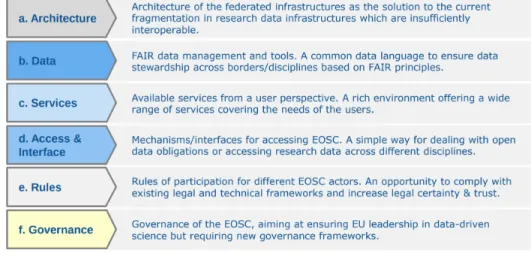
Over the past years, numerous policy makers from around the world have articulated a clear and consistent vision of global Open Science as a driver for enabling a new paradigm of transparent, data-driven science. In Europe, this vision is being realised through the European Open Science Cloud (EOSC). The EOSC will offer a virtual envi-ronment with open and seamless services for storage, management, analysis and re-use of research data, across borders and scientific disciplines by federating existing sci-entific data infrastructures, currently dispersed across disciplines and the EU Member States. In Fig. 1 a representation of the EOSC Model action lines as available from the Implementation Roadmap for the European Open Science Clouddocument4.
Figure 1. EOSC roadmap: action lines from the implementation document.
3. ESCAPE CEVO Task 4.1
CEVO (Connecting ESFRI projects to EOSC through VO framework) is the work pack-age 4 of the ESCAPE project. It deals with continuing on the EURO-VO contribution to the IVOA works (see, e.g., Genova et al. (2015)) within the larger scenario the project is defining. While refining implementation of FAIR principles (Wilkinson et al. 2016) for astronomy data via common standards for interoperability and establishing data stewardship practices for adding value to the scientific content of ESFRI data archives,
4 https://ec.europa.eu/research/openscience/pdf/swd_2018_83_f1_staff_working_
CEVO also aims, with Task 4.1, to map the VO framework to the EOSC, attempting to include the VO enabled archive services from ESFRIs in the latter.
To reach its goals the task members will focus on four main points:
• interfacing the VO framework with the EOSC; • build an Astronomy portfolio of VO services; • contributing to the EOSC Hybrid Cloud; • containerising domain-specific services.
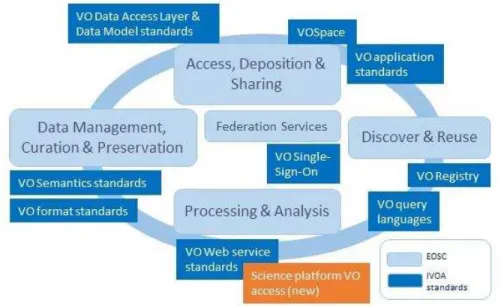
Planning and ongoing work for Task-4.1 is detailed in the nect section (Sec. 4, while Fig. 2 shows a graphical representation of how the VO framework and technolo-gies can be mapped onto the EOSC data lifecycle blocks (the diagram is taken from the ESCAPE’s proposal Document of Work for the CEVO WP detailed description).
Figure 2. VO mapping onto the EOSC data lifecycle.
4. Planned Activities for CEVO Task 4.1
Activities for Task-4.1 have been planned among the Task participants and reported also in the first deliverable document of the CEVO WP. They can be roughly summarised as:
• Inclusion of the VO Registry into the EOSC service catalogues;
• assessment of the methods for contributing an Astronomy Portfolio to the EOSC Marketplace;
4 Molinaro et al.
• study of accessing VO-compliant data and services using science analysis plat-forms (in coordination with WP5);
• Assessment of the possibility to bring existing VO standards for data sharing (VOSpace) within the EOSC services;
• Identification of existing VO services or tools to serve as test-cases for container-isation.
In the first months, that included some ramp up and preparation of the work, a few points have been already worked out, namely:
• VO Resource mapping against EUDAT B2-FIND metadata has been proven pos-sible, first step on Registry inclusion in EOSC;
• contact points have been identified for catalogue integration and service portfolio; • first steps in identifying a VOSpace back-end storage solution to allow VO
stan-dard data sharing;
• preliminary identification of the services and tools to be used in containerisation tests.
Among the latter, the most advanced activity is the one on the IVOA Registry Resources inclusion in the EOSC catalogue. The metadata mapping of VO resources to the DataCite-based5 EUDAT catalogue service has been done and proven working. Give it a try through the EUDAT B2-FIND service itself6.
5. Further Steps
The deliverable document for the work plan of the CEVO package includes a list of activities to be brought on. This is an help to cross-check the progress of the activities. For Task-4.1 next steps to pursue include consolidating the contact points in the EOSC architecture to pave the way to ESFRIs resources inclusion, inclusion of estab-lished VO services and technologies within the EOSC Hybrid Cloud and container-isation, but also bringing feedback to the EOSC building projects and stakeholders symposia.
Acknowledgments. Authors acknowledge support from ESCAPE project (the Eu-ropean Science Cluster of Astronomy & Particle Physics ESFRI Research Infrastruc-tures) that has received funding from the European Union’s Horizon 2020 research and innovation programme under the Grant Agreement n. 824064.
References
Genova, F., et al. 2015, Astronomy and Computing, 11, 181. 1506.06567 Wilkinson, M. D., et al. 2016, Scientific Data, 3, 160018
5DataCite Metadata Schema: https://schema.datacite.org/
6IVOA is listed as one of the communities in it: http://b2find.eudat.eu/group?q=ivoa&sort=