HAL Id: hal-02485721
https://hal.archives-ouvertes.fr/hal-02485721
Submitted on 21 Feb 2020HAL is a multi-disciplinary open access archive for the deposit and dissemination of sci-entific research documents, whether they are pub-lished or not. The documents may come from
L’archive ouverte pluridisciplinaire HAL, est destinée au dépôt et à la diffusion de documents scientifiques de niveau recherche, publiés ou non, émanant des établissements d’enseignement et de
Gatekeepers Controlling GPCR Export and Function
Stéphane Doly, Stefano Marullo
To cite this version:
Stéphane Doly, Stefano Marullo. Gatekeepers Controlling GPCR Export and Function. Trends in Pharmacological Sciences, Elsevier, 2015, 36 (10), pp.636-644. �10.1016/j.tips.2015.06.007�. �hal-02485721�
1
Gatekeepers controlling GPCR export and function 2
3
Stéphane Doly and Stefano Marullo 4
5
Institut Cochin, INSERM, CNRS, Université Paris Descartes, Sorbonne Paris Cité, 6
Paris, France 7
8 9
Corresponding author: Marullo, S. ([email protected]). 10
11
Keywords: G-protein-coupled receptors (GPCRs); -aminobutyric acid (GABA); 12
GABAB receptor; endoplasmic reticulum gatekeeper; Prenylated Rab Acceptor 13
Family 2 (PRAF2); regulated export 14
15 16 17 Manuscript
Abstract 18
Regulated export of G protein-coupled receptors (GPCRs) from intracellular 19
stores involves chaperones and escort proteins, which promote their progression to 20
the cell surface, and gatekeepers, which retain them in intracellular compartments. 21
Functional GABAB receptors, the paradigm of this phenomenon, are composed of 22
GB1 and GB2 subunits forming a hetero-dimer. GB1 is retained in the endoplasmic 23
reticulum (ER) in the absence of GB2. A specific ER-resident gatekeeper, PRAF2, is 24
involved in GB1 retention and prevents its progression into the biosynthetic pathway. 25
GB1 can be released from PRAF2 only upon competitive interaction with GB2. 26
PRAF2 is ubiquitous and belongs to a subgroup of the mammalian Ypt-interacting 27
protein (Yip) family. Several other GPCRs are likely regulated by Yip proteins, which 28
might be involved in the pathophysiology of human diseases that are associated with 29
impaired receptor targeting to the cell surface. 30
31 32
Molecular mechanisms regulating receptor cell surface density 33
The number of receptors present at the cell surface that can be reached and 34
activated by cognate ligands is evidently essential in terms of downstream signaling 35
outputs. Most studies addressing regulation of G protein coupled receptors (GPCRs) 36
have focused on desensitization, the termination of activated receptor signaling, on 37
GPCR endocytosis and recycling, and on the transcriptional control of GPCR-coding 38
genes. Indeed, for a long time it has been assumed that, apart from translation, the 39
only level of regulation of native receptor proteins engaged in the secretory pathway 40
was to successfully pass through quality-control check points, which prevent 41
unfolded proteins to reach the cell surface, redirecting them to the degradation 42
pathway. The regulated export of nascent GPCRs from intracellular stores is a 43
concept that has emerged recently. It is based on the observation that in primary 44
cells several GPCRs are only marginally expressed at the cell surface, whereas 45
abundant stores exist both in the endoplasmic recticulum (ER) and in the Golgi 46
apparatus. One of the pioneering observations of this phenomenon was that in both 47
primary and transfected cells, an important proportion of the PAR1 thrombin receptor 48
was intracellular and co-localized with Golgi markers. Whereas surface PAR1 was 49
internalized and subsequently targeted to lysosomes upon thrombin activation, the 50
intracellular pool was translocated to the plasma membrane, leading to the recovery 51
of thrombin responsiveness [1]. Subsequently, a series of independent observations 52
coincided to suggest that the regulated export of GPCRs from the Golgi apparatus 53
and the ER was actually a much wider phenomenon than previously anticipated (see 54
[2, 3] for an historical overview). It also appeared that receptors are released from 55
intracellular compartments upon appropriate extracellular signals and/or association 56
with a variety of chaperones or escort proteins (reviewed in [2, 3]). However, some 57
key issues of this novel paradigm of regulation, such as the identification of the 58
molecular tethers that retain GPCRs in the intracellular compartments or the 59
characterization of the mechanisms of their release from these compartments 60
remained poorly understood. 61
62
The GABAB receptor paradigm
63
The metabotropic GABAB receptor has been one of the most intensively 64
investigated GPCRs over the past three decades, because of the very unusual 65
regulation of its cell surface export. It belongs to the class-C family of GPCRs, also 66
comprising the metabotropic glutamate receptor, the calcium sensing receptor and 67
the taste T1R, which is characterized by a large extracellular Venus flytrap (VFT) 68
domain involved in ligand recognition. Together with the ionotropic GABAA receptor, 69
GABAB responds to the -aminobutyric acid (GABA), the major inhibitory 70
neurotransmitter in the central nervous system (CNS). Presynaptic GABAB receptor 71
reduces neurotransmitter release, whereas postsynaptic receptor causes 72
hyperpolarization of neurons [4]. By inhibiting synaptic transmission, GABAB plays a 73
key role in modulating neuronal activity and impaired function of GABAB has been 74
associated with multiple neurological and psychiatric diseases [5-7]. Peripheral 75
GABAB receptors have also been identified, particularly in the gastrointestinal tract 76
[8]. Baclofen, a GABAB agonist, is currently used to treat spasticity of various 77
pathophysiological origins and alcoholism, whereas peripherally-restricted GABAB 78
agonists devoid of CNS side effects are under investigation to treat 79
gastroesophageal reflux disease [9]. In addition, recent studies indicate that 80
peripheral GABAB receptors might represent a pharmacological target for tumor 81
therapy [10] and for improving pancreatic β-cell survival [11]. 82
In addition to its functional roles, the GABAB receptor occupies a special 83
position among GPCRs, since several paradigms established for the GPCR family 84
are based on pioneering studies based on GABAB as receptor model. Unlike the 85
other class-C GPCRs, which form homo-dimers, functional GABAB receptors are 86
obligate hetero-dimers made of one GB1 and one GB2 subunit [12-14]. Mice lacking 87
GB1 do not exhibit any detectable electrophysiological, biochemical, or behavioral 88
response to agonists [15, 16]. Similarly, GB2-/- mice display spontaneous seizures, 89
hyperalgesia, hyperlocomotor activity, and severe memory impairment, analogous to 90
GB1-/- mice, although atypical electrophysiological GABAB responses are present in a 91
few areas of the brain [17]. The loss of normal GABAB function in vivo and in vitro 92
when either GB1 or GB2 is missing is explained by the particular distribution of key 93
functional tasks between receptor subunits. Indeed, GB1 is responsible for ligand 94
recognition through its VFT domain, whereas GB2 does not bind to any known 95
GABAB ligand [18]; its VFT domain only behaves like an allosteric modulator of the 96
GB1 VFT, enhancing its agonist affinity [19]. The transmembrane region of GB2, 97
instead, is responsible for G-protein coupling [20, 21] and also facilitates cell surface 98
expression of GB1 [22]. 99
100
A missing mechanistic aspect in the regulated delivery of GABAB to the cell surface
101
The cell surface density of functional hetero-dimeric GABAB receptors is 102
controlled by a unique mechanism of delivery from the biosynthetic compartments to 103
the plasma membrane. Early studies reported that recombinant GB1 subunits fail to 104
reach the cell surface when expressed in heterologous systems or overexpressed in 105
ganglion neurons [23]. The explanation of this phenomenon is that GB1 is retained in 106
the ER and does not reach the cell surface in the absence of GB2 [12-14]. 107
Subsequent investigations identified an arginine based ER retention/retrieval “RSRR” 108
signal in the carboxyterminal tail of GB1 [22]. This signal is a variant of a more 109
general RXR motif (two arginine residues separated by any aminoacid) found in a 110
variety of ER-retained subunits of multimeric protein complexes, such as the 111
octameric ATP-sensitive K+ channels [24] or the N-methyl-D-aspartate (NMDA) 112
receptors [25]. The alanine substitution of the arginine residues of the RXR motif 113
allowed the corresponding GB1-AXA subunit to reach the cell surface even in the 114
absence of GB2. It was then proposed that only the shielding of this retention signal 115
via a coiled-coil interaction with the C-terminus of GB2 might allow the GB1-GB2 116
hetero-dimer to progress along the secretory pathway delivering functional GABAB 117
receptors to the cell surface [22]. A second key di-leucine motif was subsequently 118
identified upstream of the RXR motif in the carboxyterminal tail of GB1, which also 119
controls the cell surface export of the receptor in hippocampal neurons [26]. It was 120
observed that in the absence of co-expressed GB2 the GB1-AA-ASA mutant, 121
encompassing the mutation of both the RXR and the di-leucine motifs, was much 122
better exported to the cell surface than the wild type GB1 or the single GB1-ASA 123
mutant. Because the GB1-ASA mutant was partially accumulated within the trans-124
Golgi network (TGN) and because this accumulation was rescued by the double 125
mutation, a two-step sequential mechanism regulating GABAB export at distinct 126
checkpoints in the ER and the Golgi was postulated [26]. However, a missing 127
mechanistic aspect of the complex regulation of the GABAB hetero-dimer delivery to 128
the cell surface has remained for long time: the nature of the tether(s) that in the 129
absence of association with GB2 retain(s) GB1 in the ER and in the TGN. This tether, 130
which is responsible for the predominant ER localization of the GB1 subunit in 131
primary neurons [27], might play an essential role in GABAB receptor physiology. 132
PRAF2, the missing ER gatekeeper controlling GABAB delivery to the cell surface 133
The coiled-coil domain of the carboxyterminal tail of the GB1, containing both 134
RXR and LL motifs, is presumably involved in the interaction with a putative ER-135
resident “gatekeeper”, which regulates the delivery of the GABAB heterodimer to the 136
cell surface. 137
During the past ten years, multiple GB1 interacting proteins have been 138
reported, which regulate GABAB expression in some way, often interacting with the 139
GB1 coiled-coil domain. However, under physiological conditions, none of these 140
proteins appears to retain GB1 in the ER via a direct interaction. The cytoplasmic 141
scaffolding protein 14-3- can dissociate GABAB receptor hetero-dimers present at 142
the plasma membrane [28] [29] and does not interact with GB1 in the ER [29, 30]. 143
The cytoplasmic coatomer COP1 might rather be involved in the retrieval of 144
monomeric GB1 from the cis-Golgi to the ER [30]. Msec-7, an ARF1, 3,6 guanine-145
nucleotide exchange factor, which specifically interacts with the GB1 tail di-leucine 146
motif, enhances GABAB trafficking from the Golgi to the cell surface, after its exiting 147
from the ER. GISP, another scaffolding protein of the AKAP family, was reported to 148
enhance GABAB receptor function possibly by slowing down receptor desensitization 149
and lysosomal sorting [31]. The transcription factor CCAAT/enhancer-binding protein 150
homologous protein CHOP is markedly overexpressed upon ER stress, for example 151
during cerebral ischemia. In this context, CHOP interacts with both GB1 and GB2 in 152
the ER preventing or disrupting hetero-dimerization, and forward trafficking of the 153
receptors to the plasma membrane [32]. Because of its marginal level of expression 154
under physiological conditions and the fact that it is not an ER resident protein, it is 155
unlikely that CHOP is responsible for GB1 retention in this compartment. In 156
conclusion, none of the GB1-interacting partners identified so far displayed the 157
expected biochemical and/or functional properties for a GB1 gatekeeper in the ER. 158
Ultimately, Prenylated Rab Acceptor Family 2 (PRAF2), an ER-resident 4-159
transmembrane domain protein, was identified recently as a major GABAB 160
gatekeeper [27]. PRAF2 interacts with the GB1 subunit of GABAB but not with the 161
GB2 subunit, this interaction involving both RXR and LL motifs of the carboxy-162
terminal tail of GB1. PRAF2-bound GB1 remains trapped in the ER and its release 163
only occurs upon competitive displacement of PRAF2 by GB2. Thus, the local 164
concentration of PRAF2, relative to that of GB1 and GB2, tightly controls cell surface 165
receptor density and thus impacts on GABAB function in neurons or in transfected 166
cells (Figure 1). Interestingly, minor (less than two-fold) modifications of PRAF2 167
concentration in a localized region of mouse brain, the ventral tegmental area (VTA), 168
caused major behavioral effects in animal models (Figure 2). These effects could be 169
attributed to the resulting local changes in cell surface GABAB receptor expression 170
[27]. 171
Although identified ten years ago as an interacting partner of the CCR5 172
chemokine receptor in a two-hybrid screen [33], PRAF2 had no clearly identified 173
functions so far; it was found enriched in human brain [34], overexpressed in multiple 174
cancers [35, 36] being correlated with poor prognosis [37]. PRAF2 belongs to a 175
family of three ubiquitous 4-transmembrane domain proteins [35], localized either in 176
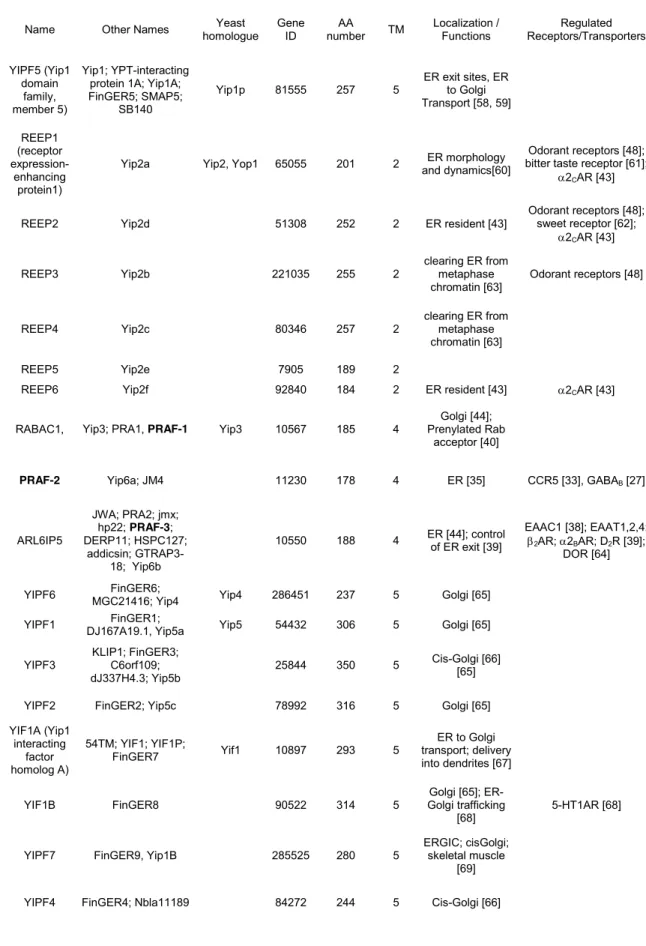
the ER (PRAF2 and 3) or in the Golgi apparatus (PRAF1) (Table 1). Similarly to the 177
function of PRAF2 on GABAB export, PRAF3 was reported to delay the ER exit of the 178
Na+-dependent glutamate transporter Excitatory Amino-Acid Carrier 1 (EAAC1) [38, 179
39]. PRAF1, the first identified member of the PRAF family, was proposed to activate 180
the dissociation of prenylated Rab proteins from the GDP dissociation inhibitor GDI, 181
thus facilitating the association of prenylated Rabs with target Golgi membranes [40]. 182
The property of PRAF1 (also known as PRA1) to interact with numerous prenylated 183
Rab GTPases [41] led to classify PRAF family members among mammalian Yips 184
(Ypt-interacting proteins, Ypts being the yeast Rab homologues) [42]. Mammalian 185
Yips (Table 1) also comprise 5-transmembrane proteins of the YIPF (YIP1 domain 186
family, 1 to 7) and YIF1 (Yip1 interacting factor homolog A and B) groups, as well as 187
the 2-transmembrane protein family REEP (receptor expression enhancing proteins, 188
1 to 6). Collectively, Yips are involved in the control of cellular vesicle trafficking 189
between the ER and the Golgi network, REEPs displaying the additional function of 190
adapter proteins for cargo receptors [43]. 191
192
PRAF gatekeepers might regulate other GPCRs in various tissues 193
Although the mechanistic aspects of PRAF2-dependent regulation have only 194
been elucidated for the GABAB receptor, it is quite plausible that PRAFs might 195
collectively regulate several other GPCRs. Indeed, as indicated above, PRAF2 was 196
originally identified in two-hybrid screens as an interaction partner of the chemokine 197
CCR5 receptor, regulating in some way its membrane localization [33]. PRAF3, on 198
the other hand, was reported to restrict the subcellular localization of the 2-199
adrenoceptor and the D2-dopaminergic receptor to the ER [39]. In preliminary 200
studies, we found that PRAF gatekeepers associate (in BRET and co-IP 201
experiments) with other chemokine receptors, such as CCR2 and CCR7, and with 5-202
HT2 serotoninergic receptors (unpublished data). Finally, both PRAF2 [35] and 203
PRAF3 [38, 44] are expressed in most tissues, where they coexist with multiple 204
GPCRs. 205
In addition to the GABAB receptor, several other GPCRs undergo regulated 206
translocation to the plasma membrane from ER or Golgi stores [2], where they might 207
possibly be retained by PRAFs or PRAF-like gatekeepers. In tubular renal cells, 208
intracellular dopamine D1 receptors are recruited to the plasma membrane by 209
agonist activation of cell surface receptors [45] or via atrial natriuretic peptide-210
dependent heterologous activation [46]. Similarly, the sustained stimulation of µ-211
opioid receptors can redistribute -opioid receptors (DOP) to the plasma membrane 212
in vivo, improving DOP-dependent anti-nociceptive effects [47]. Several other 213
GPCRs poorly expressed at the plasma membrane, such as the odorant receptors 214
[48], the human GnRH receptor [49], the 1D-adrenoceptor [50],the LH receptor [51], 215
and the CCR5 chemokine receptor [52] represent other candidates for gatekeeper-216
controlled translocation to the cell surface. 217
Although the functional organization of the GABAB receptor as an obligatory 218
hetero-dimer is quite unique among GPCRs, it is currently admitted that most if not 219
all the receptors of this family are expressed at the cell surface as homo-dimers [53]. 220
Several observations indicate that, among other functions, homo-dimerization might 221
also contribute to quality control of newly synthesized receptors [54]. An interesting 222
hypothesis in this context is that the homo-dimerization of two correctly folded 223
receptors might displace the interaction with resident gatekeepers similarly to hetero-224
dimerization. The GABAB model might thus represent an atypical example of a more 225
general phenomenon. 226
227
Potential involvement of PRAFs in human disease 228
Similar or even larger changes of PRAF2 than those we observed inducing 229
phenotypic effects in animals can either be detected physiologically, during neuronal 230
differentiation for example, or in pathological samples, such as human cancer tissues 231
[36] and brain areas of persons deceased after excessive alcohol intake [55]. These 232
findings indicate a potential causative connection between the concentration of PRAF 233
gatekeepers and pathological changes in humans. In addition, although not 234
functionally investigated so far, several variants of PRAF2 have been reported (see 235
the link www.nextprot.org/db/entry/NX_O60831/sequence), which are located in 236
various domains of the protein, including within the regions that are likely at the 237
interface with GB1 [27]. Therefore, both qualitative and quantitative changes of these 238
gatekeepers might have an impact on GPCR receptivity and consequently be 239
involved in human disease. 240
Finally, the new concept of GPCR gatekeepers might lead to revisit already 241
known pathophysiological mechanisms. For example, in the kidney, where both 242
PRAF2 and PRAF3 are present, variants of the V2 vasopressin receptor (V2R) are 243
poorly expressed at the cell surface of tubular cells, impairing water reabsorption and 244
causing nephrogenic diabetes insipidus [56]. Membrane-permeable pharmacological 245
chaperones have been reported, which bind to intracellular receptors and facilitate 246
their cell surface export, with a partial rescue of receptor function and of excessive 247
diuresis [57]. It would be interesting in this context to examine the association of wild-248
type and variant V2Rs with PRAFs, as an increased affinity of the variant receptor for 249
its cognate gatekeeper, might well explain its retention in the ER. 250
251
Concluding remarks 252
The identification of the resident gatekeeper, which retains the GB1 subunit of the 253
GABAB receptor in the ER upon interaction with both the di-leucine and RXR motifs 254
of the carboxyterminal tail of GB1 until it is displaced by the GB2 subunit, completes 255
the picture of the complex mechanism regulating the delivery of functional GABAB 256
receptors to the cell surface. PRAFs were already reported to interact with and/or 257
regulate several other GPCRs and plasma membrane transporters. In addition, 258
among mammalian Yips, REEP family proteins, which were initially considered as 259
GPCR escorts, might also behave like gatekeepers regulating the ER exit of some 260
receptors [43]. Therefore, for many GPCRs and more generally for multi-span 261
plasma membrane proteins, the gatekeeper-regulated release from intracellular 262
stores might become a new parameter to be considered when analyzing the 263
effectiveness of receptor response in physiological conditions, during agonist 264
treatment or in the case of pathological export defects. These considerations raise a 265
number of new questions* in the field, such as how gatekeepers are themselves 266
regulated, how many other GPCRs are potentially regulated by these types of 267
gatekeepers, in which organs and for which functions, and are changes in 268
gatekeeper concentration or point mutations at the interface with receptors involved 269
in human disease. We anticipate that these questions are sufficiently important to 270
promote additional investigations in the years to come. 271
272
Acknowledgements 273
We thank Dr Hervé Enslen and Dr Mark GH Scott of our laboratory for having 274
reviewed the manuscript. The research of our laboratory is supported by grants of the 275
Fondation pour la Recherche Médicale And Ligue Contre le Cancer, Comité de 276
l’Oise. 277
References 279
1 Hein, L. et al. (1994) Intracellular targeting and trafficking of thrombin
280
receptors. A novel mechanism for resensitization of a G protein-coupled
281
receptor. J Biol Chem 269, 27719-27726
282
2 Achour, L. et al. (2008) An escort for G Protein Coupled Receptors to find their
283
path: implication for regulation of receptor density at the cell surface. Trends
284
Pharmacol Sci 29, 528-535
285
3 Shirvani, H. et al. (2012) Regulated GPCR Trafficking to the Plasma
286
Membrane: General Issues and the CCR5 Chemokine Receptor Example.
287
Sub-cellular biochemistry 63, 97-111
288
4 Bettler, B. et al. (2004) Molecular structure and physiological functions of
289
GABA(B) receptors. Physiol Rev 84, 835-867
290
5 Gambardella, A. et al. (2003) Gaba-B receptor 1 polymorphism (G1465A) is
291
associated with temporal lobe epilepsy. Neurology 60, 560–563
292
6 Tyacke, R.J. et al. (2010) GABAB receptors in addiction and its treatment. Adv
293
Pharmacol 58, 373-396
294
7 Cryan, J.F. and Slattery, D.A. (2010) GABAB Receptors and Depression:
295
Current Status. Adv Pharmacol 58, 427-451
296
8 Hyland, N.P. and Cryan, J.F. (2010) A Gut Feeling about GABA: Focus on
297
GABA(B) Receptors. Front Pharmacol 1, 124
298
9 Lehmann, A. et al. (2010) GABAB receptor agonism as a novel therapeutic
299
modality in the treatment of gastroesophageal reflux disease. Adv Pharmacol
300
58, 287-313
10 Zhang, X. et al. (2013) Expression of gamma-aminobutyric acid receptors on
302
neoplastic growth and prediction of prognosis in non-small cell lung cancer. J
303
Transl Med 11, 102
304
11 Tian, J. et al. (2013) gamma-Aminobutyric acid regulates both the survival and
305
replication of human beta-cells. Diabetes 62, 3760-3765
306
12 Jones, K.A. et al. (1998) GABA(B) receptors function as a heteromeric
307
assembly of the subunits GABA(B)R1 and GABA(B)R2. Nature 396, 674-679
308
13 Kaupmann, K. et al. (1998) GABA(B)-receptor subtypes assemble into
309
functional heteromeric complexes. Nature 396, 683-687.
310
14 White, J.H. et al. (1998) Heterodimerization is required for the formation of a
311
functional GABA(B) receptor. Nature 396, 679-682.
312
15 Prosser, H.M. et al. (2001) Epileptogenesis and enhanced prepulse inhibition
313
in GABA(B1)-deficient mice. Mol Cell Neurosci 17, 1059-1070
314
16 Schuler, V. et al. (2001) Epilepsy, hyperalgesia, impaired memory, and loss of
315
pre- and postsynaptic GABA(B) responses in mice lacking GABA(B(1)).
316
Neuron 31, 47-58
317
17 Gassmann, M. et al. (2004) Redistribution of GABAB(1) protein and atypical
318
GABAB responses in GABAB(2)-deficient mice. J Neurosci 24, 6086-6097
319
18 Kniazeff, J. et al. (2002) No ligand binding in the GB2 subunit of the GABA(B)
320
receptor is required for activation and allosteric interaction between the
321
subunits. J Neurosci 22, 7352-7361
322
19 Galvez, T. et al. (2001) Allosteric interactions between GB1 and GB2 subunits
323
are required for optimal GABA(B) receptor function. EMBO J 20, 2152-2159
20 Margeta-Mitrovic, M. et al. (2001) Function of GB1and GB2 subunits in G
325
protein coupling of GABA(B) receptors. . Proc. Natl Acad. Sci. USA 98,
326
14649–14654
327
21 Robbins, M.J. et al. (2001) GABA(B2) is essential for G-protein coupling of the
328
GABA(B) receptor heterodimer. J Neurosci 21, 8043-8052
329
22 Margeta-Mitrovic, M. et al. (2000) A trafficking checkpoint controls GABA(B)
330
receptor heterodimerization. Neuron 27, 97-106.
331
23 Couve, A. et al. (1998) Intracellular retention of recombinant GABAB
332
receptors. J Biol Chem 273, 26361-26367
333
24 Zerangue, N. et al. (1999) A new ER trafficking signal regulates the subunit
334
stoichiometry of plasma membrane K(ATP) channels. Neuron 22, 537-548
335
25 Scott, D.B. et al. (2001) An NMDA receptor ER retention signal regulated by
336
phosphorylation and alternative splicing. J Neurosci 21, 3063-3072
337
26 Restituito, S. et al. (2005) Multiple motifs regulate the trafficking of GABA(B)
338
receptors at distinct checkpoints within the secretory pathway. Mol Cell
339
Neurosci 28, 747-756
340
27 Doly, S. et al. (2015) GABAB receptor cell surface export and inhibitory
341
neurotransmission is controlled by an endoplasmic reticulum gatekeeper Mol
342
Psychiatry, doi: 10.1038/mp.2015.1072. [Epub ahead of print]
343
28 Couve, A. et al. (2001) Association of GABA(B) receptors and members of the
344
14-3-3 family of signaling proteins. Mol Cell Neurosci 17, 317-328
345
29 Laffray, S. et al. (2012) Impairment of GABAB receptor dimer by endogenous
346
14-3-3zeta in chronic pain conditions. EMBO J 31, 3239-3251
30 Brock, C. et al. (2005) Assembly-dependent surface targeting of the
348
heterodimeric GABAB Receptor is controlled by COPI but not 14-3-3. Mol.
349
Biol. Cell 16, 5572-5578
350
31 Kantamneni, S. et al. (2009) GISP increases neurotransmitter receptor
351
stability by down-regulating ESCRT-mediated lysosomal degradation.
352
Neuroscience letters 452, 106-110
353
32 Maier, P.J. et al. (2014) Ischemia-like oxygen and glucose deprivation
354
mediates down-regulation of cell surface γ-aminobutyric acidB receptors via
355
the endoplasmic reticulum (ER) stress-Induced transcription factor
356
CCAAT/enhancer-binding protein (C/EBP)-homologous protein (CHOP). J Biol
357
Chem 289, 12896-12907
358
33 Schweneker, M. et al. (2005) JM4 is a four-transmembrane protein binding to
359
the CCR5 receptor. FEBS Lett 579, 1751-1758
360
34 Koomoa, D.L. et al. (2008) Expression profile of PRAF2 in the human brain
361
and enrichment in synaptic vesicles. Neurosci Lett 436, 171-176
362
35 Fo, C.S. et al. (2006) Genomic organization, expression profile, and
363
characterization of the new protein PRA1 domain family, member 2 (PRAF2).
364
Gene 371, 154-165
365
36 Borsics, T. et al. (2010) Subcellular distribution and expression of prenylated
366
Rab acceptor 1 domain family, member 2 (PRAF2) in malignant glioma:
367
Influence on cell survival and migration. Cancer Sci 101, 1624-1631
368
37 Yco, L.P. et al. (2013) PRAF2 stimulates cell proliferation and migration and
369
predicts poor prognosis in neuroblastoma. Int J Oncol 42, 1408-1416
370
38 Lin, C.I. et al. (2001) Modulation of the neuronal glutamate transporter EAAC1
371
by the interacting protein GTRAP3-18. Nature 410, 84-88
39 Ruggiero, A.M. et al. (2008) The endoplasmic reticulum exit of glutamate
373
transporter is regulated by the inducible mammalian Yip6b/GTRAP3-18
374
protein. J Biol Chem 283, 6175-6183
375
40 Sivars, U. et al. (2003) Yip3 catalyses the dissociation of endosomal Rab-GDI
376
complexes. Nature 425, 856-859
377
41 Lin, J. et al. (2001) Membrane topography and topogenesis of prenylated Rab
378
acceptor (PRA1). J Biol Chem 276, 41733-41741
379
42 Pfeffer, S. and Aivazian, D. (2004) Targeting rab GTPases to distinct
380
membrane compartments. Nat Rev Mol Cell Biol 5, 886-896
381
43 Björk, S. et al. (2013) REEPs are membrane shaping adapter proteins that
382
modulate specific g protein-coupled receptor trafficking by affecting ER cargo
383
capacity. PLoS One 8, e76366
384
44 Abdul-Ghani, M. et al. (2001) PRA isoforms are targeted to distinct membrane
385
compartments. J Biol Chem 276, 6225-6233
386
45 Brismar, H. et al. (1998) Dopamine-induced recruitment of dopamine D1
387
receptors to the plasma membrane. Proc Natl Acad Sci U S A 95, 5573-5578
388
46 Holtback, U. et al. (1999) Receptor recruitment: a mechanism for interactions
389
between G protein-coupled receptors. Proc Natl Acad Sci U S A 96,
7271-390
7275
391
47 Cahill, C.M. et al. (2007) Trafficking of delta-opioid receptors and other
G-392
protein-coupled receptors: implications for pain and analgesia. Trends
393
Pharmacol Sci 28, 23-31
394
48 Saito, H. et al. (2004) RTP family members induce functional expression of
395
mammalian odorant receptors. Cell 119, 679-691
49 Janovick, J.A. et al. (2006) Regulation of G protein-coupled receptor trafficking
397
by inefficient plasma membrane expression: molecular basis of an evolved
398
strategy. J Biol Chem 281, 8417-8425
399
50 Uberti, M.A. et al. (2005) Heterodimerization with beta2-adrenergic receptors
400
promotes surface expression and functional activity of alpha1D-adrenergic
401
receptors. J Pharmacol Exp Ther 313, 16-23
402
51 Pietila, E.M. et al. (2005) Inefficient maturation of the rat luteinizing hormone
403
receptor. A putative way to regulate receptor numbers at the cell surface. J
404
Biol Chem 280, 26622-26629
405
52 Achour, L. et al. (2009) CD4 - CCR5 interaction in intracellular compartments
406
contributes to receptor expression at the cell surface. Blood 113, 1938-1947
407
53 Rivero-Muller, A. et al. (2013) Di/oligomerization of GPCRs-mechanisms and
408
functional significance. Prog Mol Biol Transl Sci 117, 163-185
409
54 Bulenger, S. et al. (2005) Emerging role of homo- and heterodimerization in
G-410
protein-coupled receptor biosynthesis and maturation. Trends Pharmacol Sci
411
26, 131-137
412
55 Enoch, M.A. et al. (2013) A factor analysis of global GABAergic gene
413
expression in human brain identifies specificity in response to chronic alcohol
414
and cocaine exposure. PLoS One 8, e64014
415
56 Morello, J.P. and Bichet, D.G. (2001) Nephrogenic diabetes insipidus. Annu
416
Rev Physiol 63, 607-630
417
57 Bernier, V. et al. (2004) Pharmacological chaperone action on
G-protein-418
coupled receptors. Curr Opin Pharmacol 4, 528-533
419
58 Tang, B.L. et al. (2001) A membrane protein enriched in endoplasmic
420
reticulum exit sites interacts with COPII. J Biol Chem 276, 40008-40017
59 Heidtman, M. et al. (2003) A role for Yip1p in COPII vesicle biogenesis. J Cell
422
Biol 163, 57-69
423
60 Voeltz, G.K. et al. (2006) A class of membrane proteins shaping the tubular
424
endoplasmic reticulum. Cell 124, 573-586
425
61 Behrens, M. et al. (2006) Members of RTP and REEP gene families influence
426
functional bitter taste receptor expression. J. Biol Chem 281, 20650-20659
427
62 Ilegems, E. et al. (2010) REEP2 enhances sweet receptor function by
428
recruitment to lipid rafts. J Neurosci 30, 13774-13783
429
63 Schlaitz, A.L. et al. (2013) REEP3/4 ensure endoplasmic reticulum clearance
430
from metaphase chromatin and proper nuclear envelope architecture. Dev Cell
431
26, 315-323
432
64 Wu, Y. et al. (2011) JWA regulates chronic morphine dependence via the
433
delta opioid receptor. Biochem Biophys Res Commun 409, 520-525
434
65 Shakoori, A. et al. (2003) Identification of a five-pass transmembrane protein
435
family localizing in the Golgi apparatus and the ER. Biochem Biophys Res
436
Commun 312, 850-857
437
66 Tanimoto, K. et al. (2011) Characterization of YIPF3 and YIPF4, cis-Golgi
438
localizing Yip domain family proteins. Cell Struct Funct 36, 171-185
439
67 Kuijpers, M. et al. (2013) The ALS8 protein VAPB interacts with the ER-Golgi
440
recycling protein YIF1A and regulates membrane delivery into dendrites.
441
EMBO J 32, 2056-2072
442
68 Carrel, D. et al. (2008) Targeting of the 5-HT1A serotonin receptor to neuronal
443
dendrites is mediated by Yif1B. J Neurosci 28, 8063-8073
69 Barone, V. et al. (2015) Yip1B isoform is localized at ER-Golgi intermediate
445
and cis-Golgi compartments and is not required for maintenance of the Golgi
446
structure in skeletal muscle. Histochem Cell Biol 143, 235-243
447 448 449 450 451
Figure Legends 452
453
Figure 1. Retention and release of GB1 is governed by the relative 454
concentrations of GB1, GB2 and PRAF2. (A) In neurons GB2 and PRAF2 compete 455
for binding to GB1. Hetero-dimerization of GB1 with GB2 allows the release from the 456
ER and the export of the functional GABAB receptor to the cell surface. Association 457
with PRAF2 maintains the GB1 subunit in the ER. (B) The heterologous expression 458
of GB1 in transfected cells, which contains endogenous PRAF2 and no GB2, 459
reproduces the conditions existing in neurons of GB2-KO mice. GB1 is retained in 460
the ER and no GABA binding sites can be measured at the cell surface. (C) If PRAF2 461
concentration is decreased (i.e. siRNA treatment) in transfected cells expressing 462
exogenous GB1, or GB1 markedly overexpressed, the available PRAF2 molecules 463
are completely saturated by GB1. Unbound GB1 is not retained and can reach the 464
cell surface. Surface GABA binding sites can be measured in these conditions 465
corresponding to surface GB1. However, because of the absence of GB2 subunits, 466
functional GABAB receptors capable of transducing a signal are lacking. 467
468
Figure 2. Locomotor activity in mice expressing exogenous PRAF2 in the VTA. 469
To examine whether perturbing the stoichiometry of GB1, GB2 and PRAF2 might 470
affect GABAB-dependent regulations in vivo, PRAF2 concentration was enhanced (2-471
3 folds) in the ventral tegmental area (VTA), a brain area containing GAGAB-472
expressing neuron, by stereotaxic injection of an adenovirus driving the local 473
expression of the exogenous gatekeeper. Activation of the dopaminergic circuits from 474
the VTA to the nucleus accumbens (NAcc) produces locomotor activity, which is 475
inhibited by GABAB activation (blue-boxed panels). In case of loss of surface GABAB 476
receptors in VTA dopaminergic neurons, caused by PRAF2-mediated GB1 retention, 477
dopamine release is increased and locomotor activity enhanced (red-boxed panels). 478
The unilateral change of PRAF2 concentration in the VTA led to a remarkable
479
contralateral turning phenotype (see supplemental videos in [26]).
480 481
Name Other Names homologue Yeast Gene ID number AA TM Localization / Functions Receptors/Transporters Regulated YIPF5 (Yip1 domain family, member 5) Yip1; YPT-interacting protein 1A; Yip1A; FinGER5; SMAP5;
SB140
Yip1p 81555 257 5 ER exit sites, ER to Golgi Transport [58, 59] REEP1 (receptor expression-enhancing protein1)
Yip2a Yip2, Yop1 65055 201 2 and dynamics[60] ER morphology
Odorant receptors [48]; bitter taste receptor [61];
2CAR [43]
REEP2 Yip2d 51308 252 2 ER resident [43]
Odorant receptors [48]; sweet receptor [62];
2CAR [43] REEP3 Yip2b 221035 255 2 clearing ER from metaphase
chromatin [63] Odorant receptors [48] REEP4 Yip2c 80346 257 2 clearing ER from metaphase
chromatin [63]
REEP5 Yip2e 7905 189 2
REEP6 Yip2f 92840 184 2 ER resident [43] 2CAR [43] RABAC1, Yip3; PRA1, PRAF-1 Yip3 10567 185 4 Prenylated Rab Golgi [44];
acceptor [40]
PRAF-2 Yip6a; JM4 11230 178 4 ER [35] CCR5 [33], GABAB [27]
ARL6IP5 JWA; PRA2; jmx; hp22; PRAF-3; DERP11; HSPC127; addicsin; GTRAP3-18; Yip6b 10550 188 4 ER [44]; control of ER exit [39] EAAC1 [38]; EAAT1,2,4; 2AR; 2BAR; D2R [39]; DOR [64] YIPF6 MGC21416; Yip4 FinGER6; Yip4 286451 237 5 Golgi [65]
YIPF1 DJ167A19.1, Yip5a FinGER1; Yip5 54432 306 5 Golgi [65] YIPF3 KLIP1; FinGER3; C6orf109;
dJ337H4.3; Yip5b
25844 350 5 Cis-Golgi [66] [65] YIPF2 FinGER2; Yip5c 78992 316 5 Golgi [65] YIF1A (Yip1 interacting factor homolog A) 54TM; YIF1; YIF1P; FinGER7 Yif1 10897 293 5 ER to Golgi transport; delivery into dendrites [67] YIF1B FinGER8 90522 314 5 Golgi trafficking Golgi [65];
ER-[68] 5-HT1AR [68] YIPF7 FinGER9, Yip1B 285525 280 5 ERGIC; cisGolgi; skeletal muscle
[69] YIPF4 FinGER4; Nbla11189 84272 244 5 Cis-Golgi [66] 482
Table 1. Classification and nomenclature of PRAFs and mammalian Yips
*Outstanding Questions Box
484 485
- How many GPCRs undergo a similar regulation of their cell surface export by 486
PRAFs, other Yips or functionally equivalent additional ER and Golgi gatekeepers? 487
- What is the molecular basis of gatekeeper selectivity for cargo receptors? 488
- How are ER and Golgi gatekeepers coordinated to regulate the export of a specific 489
receptor? 490
- Is GPCR oligomerization a more general mechanism controlling receptor export to 491
the cell surface? 492
- How are PRAFs and more generally Yips themselves regulated? How this type of 493
regulation might be connected with receptor function and regulation? 494
- Are there pathological conditions associated with mutations or quantitative changes 495
of receptor gatekeepers? 496
- Can diseases associated with impaired cell surface targeting of GPCR variants be 497
explained by enhanced interaction between receptors and ER or Golgi gatekeepers? 498
- Is it possible to target receptor – gatekeeper interfaces with chemical compounds to 499
enhance receptor export and treat diseases? 500
Highlights
Functional GABAB receptors are obligate hetero-dimers of the GB1 and GB2 subunits
The agonist binding GB1 is retained inside the cells in the absence of association with GB2
GB2 competitively releases GB1 from PRAF2, a specific, endoplasmic reticulum-resident gatekeeper
The stoichiometry of PRAF2 relatively to GB1 and GB2 is a key parameter for GABAB function in vivo