HAL Id: hal-01769615
https://hal-amu.archives-ouvertes.fr/hal-01769615
Submitted on 18 Apr 2018
HAL is a multi-disciplinary open access
archive for the deposit and dissemination of
sci-entific research documents, whether they are
pub-lished or not. The documents may come from
teaching and research institutions in France or
abroad, or from public or private research centers.
L’archive ouverte pluridisciplinaire HAL, est
destinée au dépôt et à la diffusion de documents
scientifiques de niveau recherche, publiés ou non,
émanant des établissements d’enseignement et de
recherche français ou étrangers, des laboratoires
publics ou privés.
Distributed under a Creative Commons Attribution - NonCommercial - NoDerivatives| 4.0
International License
Enterococcus hirae, an unusual pathogen in humans
causing urinary tract infection in a patient with benign
prostatic hyperplasia: first case report in Algeria
Nadjette Bourafa, L. Loucif, N Boutefnouchet, Jean-Marc Rolain
To cite this version:
Nadjette Bourafa, L. Loucif, N Boutefnouchet, Jean-Marc Rolain. Enterococcus hirae, an unusual
pathogen in humans causing urinary tract infection in a patient with benign prostatic hyperplasia:
first case report in Algeria. New Microbes and New Infections, Wiley Online Library 2015, 8, pp.7-9.
�10.1016/j.nmni.2015.08.003�. �hal-01769615�
NEW MICROBES IN HUMANS
Enterococcus hirae, an unusual
pathogen in humans causing
urinary tract infection in a patient
with benign prostatic hyperplasia:
first case report in Algeria
N. Bourafa1,2,3, L. Loucif1,4, N. Boutefnouchet2and
J.-M. Rolain1
1) Unité de recherche sur les maladies infectieuses et tropicales émergentes (URMITE), UM 63, CNRS 7278, IRD 198, INSERM 1095, IHU
Méditérranée Infection, Faculté de Médecine et de Pharmacie,
Aix-Marseille-Université, Marseille, France, 2) Laboratoire de microbiologie et biochimie appliquée, Département de biochimie, Université Badji mokhtar Annaba, 3) Département de biologie, Faculté des sciences de la nature et de la vie, Université Mohamed Cherif Messaadia-Souk-ahras and 4) Laboratoire de Biotechnologie des Molécules Bioactives et de la Physiopathologie Cellulaire (LBMBPC), Université El Hadj Lakhdar, Batna, Algeria
Abstract
Enterococcus hirae is a zoonotic pathogen rarely isolated from human infections. This case is the first description of E. hirae causing urinary tract infection in a diabetic man with benign prostatic hyperplasia from Algeria. The clinical isolate was identified by MALDI-TOF MS and displayed a multisensitivity antibiotic profile.
New Microbes and New Infections © 2015 The Authors. Published by Elsevier Ltd on behalf of European Society of Clinical Microbiology and Infectious Diseases.
Keywords: Algeria, Enterococcus hirae, MALDI-TOF MS, prostate enlargement, urinary tract infection
Original Submission: 8 July 2015; Accepted: 10 August 2015 Article published online: 17 August 2015
Corresponding author: J.-M. Rolain, Unité de recherche sur les maladies infectieuses et tropicales émergentes (URMITE), UM 63, CNRS 7278, IRD 198, INSERM 1095, IHU Méditérranée Infection, Faculté de Médecine et de Pharmacie, Aix-Marseille-Université, Marseille, France
E-mail:[email protected]
Introduction
Enterococci are important opportunistic pathogens and have become increasingly known as a significant cause of nosocomial and community-acquired infections; Enterococcus faecalis and E. faecium are the most common species implicated[1]. E. hirae is known to cause infections in animals but is rarely isolated from human clinical samples [2]. In the present report, we describe a case of E. hirae causing urinary tract infection in a diabetic man with benign prostatic hyperplasia. This case rep-resents thefirst report of infection by this organism in Algeria.
Case report
A 50-year-old man presented with a medical history of diabetes mellitus type 2 and had prostate enlargement for approximately 1 year. He was previously hospitalized twice as a result of an inability to fully empty his bladder. He underwent urinary catheterization; however, no antibacterial therapy was admin-istered. The last hospitalization was 2 months before this pre-sent admission.
Clinically, the patient presented with symptoms shared be-tween benign prostatic hyperplasia, including straining to uri-nate, weak urine stream and inability to fully empty the bladder, and symptomatic lower urinary tract infection, including dysuria with cloudy urine, suprapubic pain, urinary frequency and ur-gency. The patient had a negative blood culture; however, the microscopic analysis of urine indicated the presence of white blood cells (>10 leukocytes per high-powerfield). The urine culture was positive, and the isolate was identified at the genus level using phenotypic methods including Gram staining, cata-lase test and growth on bile esculin azide agar and 6.5% NaCl media. The primary bacteriologic diagnosis indicated that the isolated strain belonged to the genus Enterococcus. The biochemical identification using an API 20 Strep system (bio-Mérieux, Marcy l’Etoile, France) could not identify the species involved. Characterization of the clinical isolate to the species level was achieved by MALDI-TOF MS (matrix-assisted laser desorption/ionization time-of-flight mass spectrometry) (Microflex; Bruker Daltonics, Bremen, Germany) using Flex Control and Biotyper 3.0 software (Bruker Daltonics) as pre-viously described[3]. The identification of the strain by
MALDI-TOF MS revealed the E. hirae species, with a correct identi fi-cation score of 2.263. The isolate was multisensitive against nearly all antibiotics tested, including high-level (HL) amino-glycosides (HL gentamicin and HL kanamycin), ampicillin, line-zolid, ciprofloxacin, nitrofuran and vancomycin. However, the
New Microbe and New Infect 2015; 8: 7–9 New Microbes and New Infections © 2015 The Authors. Published by Elsevier Ltd on behalf of European Society of Clinical Microbiology and Infectious Diseases This is an open access article under the CC BY-NC-ND license (http://creativecommons.org/licenses/by-nc-nd/4.0/)
strain presented resistance only to trimethoprim/sulfamethox-azole. The patient received oral treatment with antimicrobial combinations of ampicillin and gentamicin for 10 days. A ure-thral catheter was inserted for 5 days to empty the bladder. Urine samples were analyzed during treatment until the culture result was negative. The clinical status of the patient improved after 5 days of hospitalization, and the patient was discharged and continued antibiotic therapy at home.
Discussion
Urinary tract infection (UTI) caused by enterococci is very common and is primarily due to E. faecalis and E. faecium spe-cies[4]. Most cases of urinary tract infections occur in women and are uncommon in men [5]. Prostate enlargement, also called benign prostatic hyperplasia, represents an important risk factor for UTI and bacterial prostatitis in men [5,6]. This structural abnormality is mainly associated with aging and most often affects men who are 60 years of age and older[7]. This chronic condition can prevent the bladder from emptying completely, which increases the likelihood that bacteria will grow and trigger an infection[6].
In our case, we report the occurrence of symptomatic lower UTI in a diabetic man with an enlarged prostate caused by an unusual pathogen in humans, E. hirae. Clinical diagnosis of our
patient showed that the infection was limited to the lower urinary tract based on the absence of clinical signs related to upper UTI, such asflank pain, vomiting and nausea [4], and to prostatitis, such as prostate pain, fever, chills, body aches and perineal pain [5,8]. Notably, in addition to prostate enlarge-ment, urinary tract instrumentation, infection with HIV, in-terventions of the male urogenital tract and underlying illnesses, such as diabetes, are the main predisposing risk factors for UTI in men[8,9]. In the current case, benign prostatic hyperplasia was the main factor for the occurrence of UTI. Nonetheless, diabetes and urinary catheter indwelling performed for this patient during the previous hospitalizations represent also two other factors that may increase the risk of UTI.
The causative agent isolated in this case was identified as E. hirae. This species causes infections in animals, but reported cases in humans are rare[2]. This species was identified for the
first time in young chickens[4]. The first report of a human infection caused by E. hirae was described in 1998 by Gilad et al.
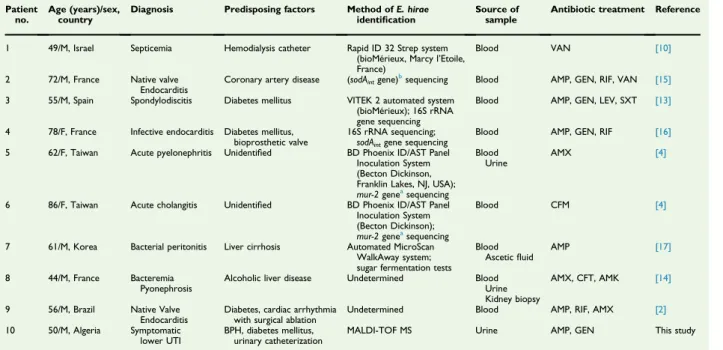
[10] in a case of septicemia in a 49-year-old man with renal insufficiency treated with hemodialysis. Since then, few cases have been described in humans[2,4](Table 1). Notably, among all enterococcal infections in humans, the low incidence of E. hirae species has previously been described[1,4]. The bac-terium may be underdiagnosed or misdiagnosed by standard identification approaches [4]. Our case demonstrates that MALDI-TOF MS is an important tool useful for rapidly and
TABLE 1.Case reports ofEnterococcus hirae in human infections
Patient no.
Age (years)/sex, country
Diagnosis Predisposing factors Method ofE. hirae
identification Source ofsample
Antibiotic treatment Reference
1 49/M, Israel Septicemia Hemodialysis catheter Rapid ID 32 Strep system (bioMérieux, Marcy l’Etoile, France)
Blood VAN [10]
2 72/M, France Native valve Endocarditis
Coronary artery disease (sodAintgene)bsequencing Blood AMP, GEN, RIF, VAN [15]
3 55/M, Spain Spondylodiscitis Diabetes mellitus VITEK 2 automated system (bioMérieux); 16S rRNA gene sequencing
Blood AMP, GEN, LEV, SXT [13]
4 78/F, France Infective endocarditis Diabetes mellitus, bioprosthetic valve
16S rRNA sequencing; sodAintgene sequencing
Blood AMP, GEN, RIF [16]
5 62/F, Taiwan Acute pyelonephritis Unidentified BD Phoenix ID/AST Panel Inoculation System (Becton Dickinson, Franklin Lakes, NJ, USA); mur-2 geneasequencing
Blood Urine
AMX [4]
6 86/F, Taiwan Acute cholangitis Unidentified BD Phoenix ID/AST Panel Inoculation System (Becton Dickinson); mur-2 geneasequencing
Blood CFM [4]
7 61/M, Korea Bacterial peritonitis Liver cirrhosis Automated MicroScan WalkAway system; sugar fermentation tests
Blood Asceticfluid
AMP [17]
8 44/M, France Bacteremia Pyonephrosis
Alcoholic liver disease Undetermined Blood Urine Kidney biopsy
AMX, CFT, AMK [14]
9 56/M, Brazil Native Valve Endocarditis
Diabetes, cardiac arrhythmia with surgical ablation
Undetermined Blood AMP, RIF, AMX [2]
10 50/M, Algeria Symptomatic lower UTI
BPH, diabetes mellitus, urinary catheterization
MALDI-TOF MS Urine AMP, GEN This study AMK, amikacin; AMP, ampicillin; AMX, amoxicillin; BPH, benign prostatic hyperplasia; CFM, cefmetazole; CFT, ceftriaxone; CIP, ciprofloxacin; GEN, gentamicin; LEV, levofloxacin; MALDI-TOF MS, matrix-assisted laser desorption/ionization time-of-flight mass spectrometry; RIF, rifampin; SXT, trimethoprim/sulfamethoxazole; VAN, vancomycin.
aMuramidase gene (mur-2) of E. hirae.
bGene encoding manganese-dependent superoxide dismutase.
8 New Microbes and New Infections, Volume 8 Number C, November 2015
NMNI
New Microbes and New Infections © 2015 The Authors. Published by Elsevier Ltd on behalf of European Society of Clinical Microbiology and Infectious Diseases, NMNI, 8, 7–9 This is an open access article under the CC BY-NC-ND license (http://creativecommons.org/licenses/by-nc-nd/4.0/)
correctly identifying the pathogen at the species level without any complementary tests. The ability of MALDI-TOF MS to identify bacterial colonies from agar was evaluated for a broad range of clinically relevant bacterial strains. The proper identi-fication to the species level is achieved in 80–95% of bacterial isolates[11]. Although the strain isolated in our patient showed a sensitive profile against the majority of antibiotics tested, the study of Robredo et al. [12] showed that this species may harbour vancomycin resistance genes and may participate in their transmission to other species of enterococci. The resis-tance of E. hirae to ampicillin and high-level gentamicin has also been reported[13]. More importantly, enterococci long-term urinary tract colonization can worsen and can lead to subse-quent invasive infections, such as bacteraemia[4,14].
In conclusion, we report thefirst case of symptomatic UTI involving E. hirae in a patient with benign prostatic hyperplasia from Algeria; this is the first report describing E. hirae in this country. This case emphasizes that MALDI-TOF MS is a powerful diagnostic tool for fast and accurate identification of this unusual pathogen at the species level.
Con
flict of interest
None declared.
Acknowledgements
We are grateful to L. Hadjadj for technical assistance. We thank American Journal Experts for English-language editing. This work was partly funded by CNRS (CNRS 7278) and IHU Méditerranée Infection.
References
[1] Chan TS, Wu MS, Suk FM, Chen CN, Chen YF, Hou YH, et al. Enterococcus hirae-related acute pyelonephritis and cholangitis with bacteremia: an unusual infection in humans. Kaohsiung J Med Sci 2012;28:111–4.
[2] Salem-Bekhit MM, Moussa IM, Muharram MM, Alanazy FK, Hefni HM. Prevalence and antimicrobial resistance pattern of multidrug-resistant enterococci isolated from clinical specimens. Indian J Med Microbiol 2012;30:44–51.
[3] Anghinah R, Watanabe RG, Simabukuro MM, Guariglia C, Pinto LF, Goncalves DC. Native valve endocarditis due to Enterococcus hirae presenting as a neurological deficit. Case Rep Neurol Med 2013;2013: 636070.
[4] Benagli C, Rossi V, Dolina M, Tonolla M, Petrini O. Matrix-assisted laser desorption ionization–time of flight mass spectrometry for the identification of clinically relevant bacteria. PLoS One 2011;6:e16424. [5] Wagenlehner FM, Weidner W, Pilatz A, Naber KG. Urinary tract in-fections and bacterial prostatitis in men. Curr Opin Infect Dis 2014;27: 97–101.
[6] Bradway C, Bixby MB, Hirschman KB, McCauley K, Naylor MD. Case study: transitional care for a patient with benign prostatic hyperplasia and recurrent urinary tract infections. Urol Nurs 2013;33. 177–179, 200.
[7] Zhang SJ, Qian HN, Zhao Y, Sun K, Wang HQ, Liang GQ, et al. Relationship between age and prostate size. Asian J Androl 2013;15: 116–20.
[8] Seminerio JL, Aggarwal G, Sweetser S. 26-year-old man with recurrent urinary tract infections. Mayo Clin Proc 2011;86:557–60.
[9] Arrellano-Valdez F, Urrutia-Osorio M, Arroyo C, Soto-Vega E. A comprehensive review of urologic complications in patients with diabetes. Springerplus 2014;3:549.
[10] Gilad J, Borer A, Riesenberg K, Peled N, Shnaider A, Schlaeffer F. Enterococcus hirae septicemia in a patient with end-stage renal disease undergoing hemodialysis. Eur J Clin Microbiol Infect Dis 1998;17: 576–7.
[11] Vlek AL, Bonten MJ, Boel CH. Direct matrix-assisted laser desorption ionization time-of-flight mass spectrometry improves appropriateness of antibiotic treatment of bacteremia. PLoS One 2012;7:e32589. [12] Robredo B, Singh KV, Torres C, Murray BE. Streptogramin resistance
and shared pulsed-field gel electrophoresis patterns in vanA-containing Enterococcus faecium and Enterococcus hirae isolated from humans and animals in Spain. Microb Drug Resist 2000;6:305–11.
[13] Canalejo E, Ballesteros R, Cabezudo J, Garcia-Arata MI, Moreno J. Bacteraemic spondylodiscitis caused by Enterococcus hirae. Eur J Clin Microbiol Infect Dis 2008;27:613–5.
[14] Brule N, Corvec S, Villers D, Guitton C, Bretonniere C. Life-threat-ening bacteremia and pyonephrosis caused by Enterococcus hirae. Med Mal Infect 2013;43:401–2.
[15] Poyart C, Lambert T, Morand P, Abassade P, Quesne G, Baudouy Y, et al. Native valve endocarditis due to Enterococcus hirae. J Clin Microbiol 2002;40:2689–90.
[16] Talarmin JP, Pineau S, Guillouzouic A, Boutoille D, Giraudeau C, Reynaud A, et al. Relapse of Enterococcus hirae prosthetic valve endocarditis. J Clin Microbiol 2011;49:1182–4.
[17] Sim JS, Kim HS, Oh KJ, Park MS, Jung EJ, Jung YJ, et al. Spontaneous bacterial peritonitis with sepsis caused by Enterococcus hirae. J Korean Med Sci 2012;27:1598–600.
NMNI
Bourafaet al. Human infection caused by E. hirae in Algeria 9New Microbes and New Infections © 2015 The Authors. Published by Elsevier Ltd on behalf of European Society of Clinical Microbiology and Infectious Diseases, NMNI, 8, 7–9 This is an open access article under the CC BY-NC-ND license (http://creativecommons.org/licenses/by-nc-nd/4.0/)