Knowledge
likely held by others affects speakers’ choices of referential expressions at
different
stages of discourse
Amélie M. Achima,b, André Achimcand Marion Fossardd a
Département de psychiatrie et neurosciences, Université Laval, Quebec, QC, Canada
Effective communication requires adjusting one’s discourse to be understood by the addressee. While some suggest that choices of referring expressions are dependent on the addressee’s accessibility to the referent, there is also evidence for an egocentric bias in speech production. This study relied on two new experimental tasks designed to assess whether speakers adapt their choices of referential expressions when introducing movie characters that are either likely known or likely unknown by their addressee, and when maintaining or reintroducing these characters at a later point in the discourse. Results revealed an adjustment to the addressee in the use of character’s names (increased for likely known characters) and definite expressions (increased for likely unknown characters) observed at all the discourse stages. Use of indefinite expressions and names was affected by the participant’s own knowledge specifically when introducing the characters. These results indicate that speakers take their addressee’s likely knowledge into account at multiple discourse stages.
KEYWORDS
Reference markers; discourse; interactive task; common ground; audience design
Introduction
In everyday life, it is very common to be involved in social situations that lead us to share ideas or to get involved in cooperative tasks. In such situations, we often use language to build upon previously established common ground information and develop newly shared knowledge with the person we are conversing with, that is, with our addressee. In other words, addres-sees necessarily possess some knowledge that they have previously acquired and once the interaction is in pro-gress speakers can quickly assess their addressee’s expertise on a given topic and adjust their speech accordingly.
This quick adjustment was initially demonstrated by Isaacs and Clark (Isaacs & Clark, 1987) who gave pairs of participants two identical sets of postcards of common New York landmarks. One participant acted as the speaker who had to describe the scenes in a pre-determined order so that the other participant, the matcher, could arrange his cards in the same order. The study showed that speakers are sensitive to their addressees’ knowledge, using their partner’s responses to adjust quickly after the beginning of the task by using more proper names of places when interacting with addressees with a good knowledge of New York
and more physical descriptions of places with addressees that show a limited knowledge of New York. Interest-ingly, speakers who were not initially familiar with the New York landmarks learned the names of the places from their addressee’s feedback when interacting with an addressee with a good knowledge of New York and they increased their use of proper names through the six trials of the same task. Isaacs and Clark’s study thus showed that over the course of a conversation speakers can acquire knowledge about what constitutes initial common ground, build new common ground knowl-edge, and use this common ground information when formulating their subsequent messages.
Although feedback is one important source of infor-mation about another person’s knowledge, other sources of information can also provide insights into an addressee’s likely knowledge of a given referent (Achim, Guitton, Jackson, Boutin, & Monetta, 2013; Fussell & Krauss, 1992). For instance, there is evidence that speakers adjust their messages when speaking to someone with a foreign accent (Kingsburry, 1968, cited in Krauss (1987)), when speaking to close friends (Fussell and Krauss, 1985, cited in Krauss (1987), or when speaking to someone with established shared knowledge (Heller, Gorman, & Tanenhaus, 2012). In a b
Centre de recherche de l’Institut Universitaire en Santé Mentale de Québec, Quebec, QC, Canada
c
Département de psychologie, Université du Québec à Montréal, Montréal, QC, Canada
d
task used by Heller et al. (Heller et al., 2012), the speaker and his addressee first had to learn the names of some abstract shapes together, while the speaker learned other shape names alone. The study showed that speak-ers use more names for the shapes for which the other participant had also previously learnt the names, in com-parison to shapes for which the other participant had not learnt the names. Interestingly, names were also used for shapes for which only the speaker had learnt the name, but shape names were in this case typically accompanied by descriptive information, suggesting that speakers were able to distinguish shared from privileged infor-mation. Overall, these different studies provide evidence that speakers are sensitive to their addressee’s knowl-edge, a phenomenon known as audience design or reci-pient design (Brennan, Galati, & Kuhlen, 2010; Horton & Gerrig, 2002; Newman-Nrolund et al., 2009).
Despite these established evidence that speakers can adapt their verbal productions to their addressees’ knowledge, egocentric biases have also been clearly documented both in speech comprehension and in speech production (Horton & Keysar, 1996; Wardlow Lane & Ferreira, 2008; Wardlow Lane, Groisman, & Fer-reira, 2006). For example, in a series of experiments Wardlow Lane et al. (e.g. Wardlow Lane & Ferreira, 2008; Wardlow Lane et al., 2006) showed that speakers inappropriately refer to privileged objects (i.e. objects that their addressee cannot see) when presenting shared objects to another person, even when explicitly asked to avoid references to the privileged objects. Given that such egocentric biases are particularly promi-nent when participants are under time pressure (Horton & Keysar, 1996), it was suggested that speakers plan their utterances in an egocentric way and only subsequently adjust their utterances to take common ground into account (Horton & Keysar, 1996; Wu & Keysar, 2007).
These previously mentioned studies mostly focused on how new referents are introduced when an addressee has to identify the referents from a given set. While interest-ing, these studies are however not very informative of how reference choices are adjusted during a continuous conversation. Furthermore, these previously mentioned studies typically analysed the content of the referential expressions (e.g. “circle” versus “small circle”) used by the speakers during the verbal interaction, while few such studies considered the choices of reference markers (e.g. an indefinite marker as in “a circle”, a definite marker as in “the circle” or a pronoun such as “it”). Refer-ence content and reference markers are two distinct characteristics of referring expressions that could even-tually depend on distinct sources of influence. Different theoretical models have suggested that choices of refer-ence markers are affected by the accessibility – or the
cognitive status – of the referents in the unfolding dis-course model, including Ariel’s accessibility marking hier-archy (Ariel, 1990, 1996) or Gundel et al ’.s givenness hierarchy (Gundel, Hedberg, & Zacharski, 1993, 2012). For instance, unaccented pronouns are expected for highly accessible referents that are maintained in focus, whereas more explicit expressions such as indefinite or definite noun phrases are expected for less accessible referents. However, most studies that initially supported these models relied on non-interactive tasks (e.g. Arnold & Griffin, 2007; Hendriks, Koster, & Hoeks, 2014; Vogels, Krahmer, & Maes, 2013), or on tasks in which accessibility varies in parallel for the speaker and for the addressee as the experimental task progresses (e.g. Champagne-Lavau et al., 2009; Fukumura, van Gompel, & Pickering, 2010). Given that the verbal interactions studies that appropri-ately documented audience design focused on reference content and that the studies of reference markers typically relied on non-interactive tasks, there is surprisingly little evidence supporting the suggestion that speakers’ choices of reference markers are influenced by the acces-sibility of the referent for their addressee during verbal interactions. It is thus possible that speakers could adjust their reference content but not their reference markers depending on the accessibility of the referent for their addressee.
Two recent studies assessed the reference markers used during verbal interactions between a speaker and his addressee, and both studies separately manipulated the accessibility of the referents for the speaker and for the addressee (Fukumura & van Gompel, 2012; Vogels, Krahmer, & Maes, 2015). Both studies revealed that redu-cing the speaker’s accessibility to the target referent sig-nificantly reduced their use of pronouns, even for referents that were highly accessible to the addressee (Fukumura & van Gompel, 2012; Vogels et al., 2015). While Fukumura and van Gompel (Fukumura & van Gompel, 2012) proposed that referential choices are determined by the accessibility of the referent in the speaker’s own discourse model, the subsequent study by Vogels et al. (2015) suggested that the accessibility for the addressee can also influence the choices of refer-ence markers, at least when the referent is accessible for the speaker. More specifically, when referents were highly accessible for themselves, speakers used pro-nouns to a greater extent if the referent was also acces-sible for the addressee (which was the case in their second experiment) than when the referent was not salient for the addressee (which was the case in their first experiment). The accessibility for the speaker and the accessibility for the addressee may thus represent two complementary sources of influence on the choices of reference markers.
Of note, in normal conversations, discourse is typically public and conversational partners therefore share the same linguistic context (Arnold, 2010). Hence, the two studies presented above had to artificially dissociate the discourse context between the speaker and his addressee by presenting part of the linguistic context only to the speaker through earphones. While linguistic context is most often shared, other factors can give rise to different levels of referential accessibility between the speaker and his addressee.
For example, we have recently documented that speakers adjust their choices of reference content based on their addressee’s likely prior knowledge of the referents, even when these referents are introduced for the first time to an addressee (Achim, Fossard, Couture, & Achim, 2015). That study relied on the intro-duction of a series of movie characters that were either typically well-known (assumed to be accessible) or typi-cally little-known (not assumed to be accessible), and we notably showed that speakers more often use descriptive information when presenting little-known movie characters to their addressee, even when control-ling for their own knowledge of the characters. That study documented an effect of the addressee’s likely accessibility for referents but focused on the reference content and did not consider the reference markers used by the speakers when introducing the movie char-acters. Here, a first objective was to further analyse the data from that initial study to determine whether the speakers also adapted their choices of reference markers on a stimulus-by-stimulus basis when present-ing unconnected stimulus items that vary in terms of the likeness that their addressee will know them (i.e. likely known versus likely unknown items).
Then, a second objective was to determine if adjust-ments to the addressee’s likely knowledge are also observed in narrative speech and if so, if this effect is limited to the initial introduction of the referent in the narration or also observed for subsequent discourse stages. The discourse stages that can be distinguished include introducing new referents (this time in a narra-tive context instead of in an identification context) as well a maintaining a referent in focus or later reintrodu-cing a referent that was previously not in focus in the recent discourse.
In addition, given evidence that people sometimes have difficulties to inhibit their own perspective to take their interaction partner’s perspective into account, a third objective was to assess the effect of the speaker’s own knowledge on their choices of reference markers at the different discourse stages.
Based on Ariel (1990, 1996) and Gundel et al. (1993, 2012), and based on prior evidence of audience design
for the introduction of new referents (Gorman, Gegg-Harrison, Marsh, & Tanenhaus, 2013; Heller et al., 2012; Isaacs & Clark, 1987), we expected to observe an adjust-ment of reference markers choices as a function of the addressee’s likely knowledge when introducing new referents, both in the identification task and in the narra-tion task. Along with expecting such a modulation for the introduction of new referents, we also expected a similar modulation in narrative speech when reintroducing a previously introduced referent, but not when maintain-ing an already salient referent because the degree of accessibility is already high and prior knowledge should not be necessary to facilitate access to the refer-ent. We further expected that participant’s referential choices would depend on their own knowledge, at least to the extent that people cannot use a name for a referent that they do not themselves know, forcing them to chose an alternative referring expression. However, there is evidence that people sometimes have difficulties to inhibit their own perspective to take their interaction partner’s perspective into account (Apperly et al., 2010; Keysar, Barr, Balin, & Brauner, 2000) and it is thus possible that referential choices could reflect the speaker’s own perspective rather than that – or in addition to that – of their interaction partner.
Currently, little is known about the processes involved in discourse construction during natural interactions. Demonstrating that discursive choices are influenced not only by personal knowledge but also by the addres-see’s likely knowledge of the referent would provide empirical support to Ariel’s accessibility model (Ariel, 1990, 1996) and Gundel et al.’s givenness hierarchy (Gundel et al., 1993, 2012), and would further suggest the involvement of knowledge inference processes that can take place at different times before or during a verbal interaction.
Method
Participants
Forty participants were recruited from the community through ads in local media and through word of mouth. They were all native French speakers aged between 18 and 40 years old (mean age = 24.2; 32 men; mean education = 14.2 years). Potential partici-pants were not eligible to take part in the study if they reported a history of neurological disorder, head trauma or psychiatric disorder or reported taking a psy-choactive medication when asked for screening pur-poses. The local ethics board approved the study and all participants provided informed consent.
communication during the verbal interaction. Before each trial of the task, both partners were presented with an identical set of image cards. For this study, the partici-pants received the image cards in a predetermined order whereas the addressee received cards with the same images in a random order. For each set of image cards, the participant had to present each card in the given order so that the addressee could replace her set in the same order. The addressee could give some feedback to signal understanding (e.g. “ok”) or to point out misunder-standings or ambiguities (e.g. “can you give me more details”), and the participant could provide additional information. The procedure was repeated seven times with different sets of card (see below).
For this study, the role of the addressee was held by a trained research assistant, always a woman in her 20s, which was required to standardise the feedback given for the different items of the card set. While the use of confederate addressees has been criticised as it can introduce biases (Kuhlen & Brennan, 2013), for example linked to the timing of their responses, here our analyses focussed on the reference marker produced at the onset of the reference (see below for more details) and hence before the feedback had a chance to occur for the current trial. Focussing our analyses on the reference markers produced at the onset of the referential expression minimised the potential impact of the con-federate’s feedback on the current trial while allowing the necessary control over the knowledge displayed by the addressee for the stimuli of the previous trials.
To avoid that the participants assume all image cards are known by the addressee, which would happen if the same addressee performs the task several times with the same images, a concealment strategy was developed to make the participants believe that, though the addressee was part of our research team and had done the task before, she was discovering the sequences of images used with them for the first time (i.e. we told them that
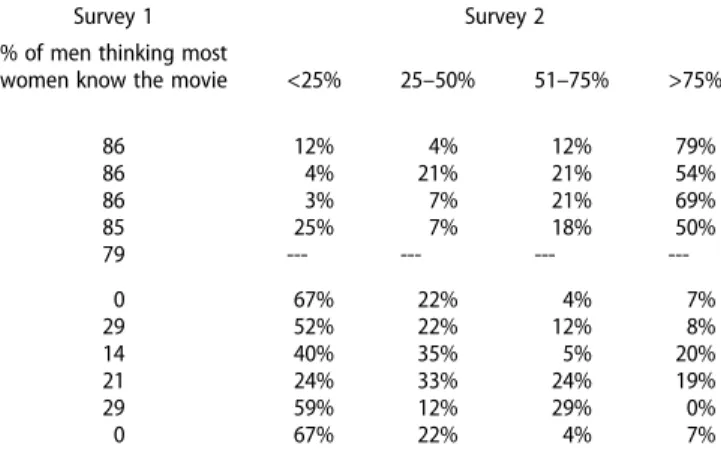
Table 1.Likely known and likely unknown characters that the participants had to present in the identification task.
Survey 1 Survey 2
Character Movie
% of men thinking most
women know the movie <25% 25–50% 51–75% >75% Likely known characters
Harry Potter Harry Potter and the Philosopher’s Stonea 86 12% 4% 12% 79%
Jack Sparrow Pirates of the Caribbeana 86 4% 21% 21% 54%
E.T. E.T. the Extra-Terrestriala 86 3% 7% 21% 69%
Gandalf The Lord of the Rings 85 25% 7% 18% 50%
Maximus Gladiator 79 --- --- ---
---Likely unknown characters 0 67% 22% 4% 7%
Leonidas 300a 29 52% 22% 12% 8%
Martin Riggs Lethal Weapona 14 40% 35% 5% 20%
Don Vito Corleone The godfathera 21 24% 33% 24% 19%
Wolverine X-men 29 59% 12% 29% 0%
Alex A Clockwork Orange 0 67% 22% 4% 7%
aIndicates movies also included in the narration task.
Procedure
Because the image set is based on movies (see Table 1), participants first completed a questionnaire to deter-mine their general knowledge of each of the movies included in our study (i.e. they answered if they had seen the movies or not), and then completed a series of cognitive tasks for another study (Achim et al., 2013; Achim, Ouellet, Roy, & Jackson, 2012) before performing our experimental task.
Experimental task
The current project is based on the referential communi-cation paradigm (Champagne-Lavau et al., 2009; Clark & Wilkes-Gibbs, 1986), which reproduces a communication situation that implies a social interaction based on the col-laboration between two partners. As shown in Figure 1, an opaque screen was placed between the two partners, one being a female experimenter, to prevent non-verbal
Figure 1.Illustration of the procedure used for this study. The participant (on the left) has an image set with images placed in a predetermined order. The addressee (on the right) has the same images in a random order and has to replace them in the correct order based on the verbal utterances of the participant.
the images were different for every participant, which was in fact not the case). More specifically, the images were presented in sealed envelopes and participants were told that the addressee had previously done the task but each time with different sets of images, so they had not been exposed to the images that were in the envelopes. A pre-test previously confirmed the success of this strategy, with none of the 10 pilot subjects reporting suspecting that the addressee was familiar with the material used for the task.
Stimuli
The material consisted of images taken from movies that either could be safely assumed to be known by women in their 20s (the likely known condition) or could not be assumed to be known by women in their 20s (the likely unknown condition). Classification of the movies into the likely known or likely unknown categories was confirmed by two surveys. The first survey included 27 movie titles. The 33 participants (19 women and 14 men, aged between 20 and 30-years-old) indicated if they had seen the movie or not and whether they would assume that most women in their 20s had seen the movie. This allowed us to eliminate the movies for which there was little agreement on whether it was likely known or not (9 movies) and those that had been seen by too few people (6 movies). For the remain-ing 12 movies, we performed a second survey in which 54 participants (22 women and 32 men, aged between 18 and 30-years-old) were again questioned about the movies but also about the three main male characters in each movie, confirming that the movies and their main characters were correctly classified into the likely known (5 movies) and likely unknown (7 movies) cat-egories. From these 12 movies, 10 were selected for our final stimulus set (5 likely known and 5 likely unknown). Results from the 2 surveys are presented in Table 1for each of these 10 movies. These stimuli were used to create the stimulus sets for an identification task and a narration task (see below). The identification task was always performed before the narration task. Identification task
The identification task was based on a single stimulus set representing 10 different male movie characters, 5 from likely known movies and 5 from likely unknown movies (see Table 1 and Figure 1). This task allowed us to deter-mine the reference markers used for the introduction of likely known and likely unknown referents in the context of an identification task, consistent with our first objec-tive. As described in the Experimental task section, par-ticipants were asked to present the cards to the addressee so that the addressee could place her 10
image cards in the same order. For the identification task there was no obvious links between the card, and participants thus presented each character one at the time. The addressee knew all the characters of the likely known movies and was trained to provide feed-back as if she knew none of the characters from the likely unknown movies, meaning that she was asked to disregard any movie-related information provided about these characters (ex: ignore the character’s name, role in the movie, movie title, etc.), and to instead strictly rely on the visually descriptive infor-mation provided by the participant as a basis to identify the movie characters from the likely unknown condition.
This material was created so that participants had to take into consideration the knowledge that they attri-bute to the addressee for each of the different movie characters (i.e. which movie character’s are likely known) on an image-by-image basis in order to produce appropriate referential information.
Narration task
In line with our second objective, the narration task allowed us to determine whether the use of certain reference markers is affected by the likely known or likely unknown nature of the referents at different discourse stages in nar-rative speech. More specifically, this task allowed us to examine the introduction of likely known and likely unknown referents, this time in a narrative context, and also the maintenance of a referent in focus and the reintro-duction of a referent at a later point in the story.
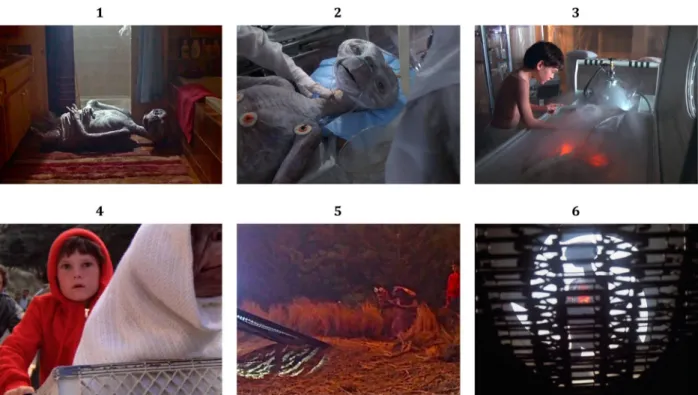
As depicted in Figure 2, each of the six stimulus sets for the narrative task included six images, all from a same movie (three likely known movies and three likely unknown movies, representing a subset of the movies used for the identification task, see Table 1), forming six scenes that each involved two male characters. The images were selected so that, for each scene, images 1 and 2 focused on the main character, images 3 and 4 focused on the second character and images 5 and 6 focused again on the main (first) character. This allowed us to collect data on the referential expressions used to introduce, maintain or reintroduce the main character, that is, covering all three discourse stages (Colle, Baron-Cohen, Wheelwright, & van der Lely, 2008; Van der Lely, 1997). For these six narration card sets, the participants were asked to tell the story of the scene so that the addressee could place her cards in the same order. Again, the addressee provided feedback as if she knew the characters of the likely known movies, but not those of the likely unknown movies. The addres-see was asked to maintain this distinction regardless of how the character had been introduced in the identifi-cation task. The action could however sometimes
disambiguate which character was being referred to, for example, if there was only one character performing the mentioned action in the image set. Hence, even if a name was used for a likely unknown character, the addressee sometimes had enough information to ident-ify the image without making a clarification demand. On the other hand, even for likely known characters, clarifi-cations could be requested by the addressee if the infor-mation provided did not allow her to select a targeted image. For example, clarification would be requested if the participant says “Character X is fighting”, when char-acter X is fighting in two different images.
For both the identification and the narration tasks, participants were requested not to name the actors and to really focus on the characters.
Data processing and analyses
The interactions were tape-recorded and then tran-scribed verbatim. We then extracted the references to
the main character and, as shown in Table 2, we coded whether the referential expression began with (a) a name, (b) an indefinite marker, (c) a definite marker or (d) an unaccented pronoun. The definite markers cat-egory was widely defined to include definite and posses-sive expressions a well as a few demonstratives and accented pronouns that are thought to signal an inter-mediate level of accessibility (Ariel, 1990, 1996; Cornish, 1999).
Identification task
For the identification task, we coded the reference marker for each character of the card set, for a total of 10 references per participant (i.e. 5 for likely known and 5 for likely unknown characters).
Narration task
For the narration task, we also coded the reference marker used to refer to the main character, but this
Figure 2.Illustration of the material used for one of the six sequences of the narration task.
Table 2.Types of reference markers.
Type Included in that category Example
Character’s names (CN) Names “Harry Potter” Indefinite markers (IN) Indefinite “un monsieur” (a man) Definite markers (D+) Definite
Possessive Demonstrative
Accented pronouns (‘disjoint” in French)
“Le monsieur” (the man) “Son ami” (his friend) “Ce monsieur” (this/that man)
“ … et donc lui, il … ” (… and thus, HE …) Unaccented pronouns (PR) Clitic pronouns
time there were several mentions of the main character within each narrative sequence, and for each reference we had to determine whether it occurred while introdu-cing, maintaining in focus or reintroducing the referent. These reference stages were not systematically linked to specific images in the card sets, requiring an alterna-tive way of identifying the discourse stages.
To identify the references linked to each discourse stages (introduction, maintaining or reintroduction), nar-rative speech was thus first divided into clausal units (C-units). A C-unit is a maximal grammatical unit consisting of an independent clause together with any dependent clauses embedded within it (Biber, Johansson, Leech, Conrad, & Finegan, 1999). Structured around a verb phrase, a clause typically contains two main parts: the subject and the predicate, semantically representing the topic (what is being talked about) and the comment (what is being said about the topic). A C-unit may be a simple clause (a single clause), such as “the man goes to the hospital” or a complex clause (a main clause with one or more dependent clauses) such as “he goes to his bedside to take care of him” or “when his son learns the news he runs to the hospital to go and see his father”. Clearly incomplete utterances or repeated words were merged with more complete clauses to form a C-unit (ex: “the right hand man … the character who’s the right hand man comes to see him”). On the other hand, coordinated or juxtaposed clauses, such as “the man goes to the hospital // and then (he) sits by his son’s bed” or “he runs, // (he) jumps into the train”, were divided in two clauses (as indi-cated with // in the examples) and counted as two clausal units as they each function as an independent clause, which holds true whether or not they express explicitly the subject of the second clause (as indicated in brackets in the examples).
A second research assistant also divided 10% of the transcribed verbatim (i.e. the verbatims of four partici-pants for each of the six car sets) into clauses to evaluate the reliability of our initial division into C-units. This revealed that 18/283 (6.3%) C-units in these re-examined verbatims had been kept together when they should have been divided, which resulted in the exclusion of the second C-unit and its reference marker (typically a clitic or zero pronoun used for a second action by a same character) from our analyses, whereas 4/283 (1.4%) C-units had been unnecessarily divided, which produced spurious extra C-units. These error rates were judged acceptable given the challenges that this type of work can represent and the original scoring was accepted as is.
For each C-unit thus identified, we extracted the reference to the main character and coded the type of
expression used to refer to him (see Table 2). Occur-rences in which the main character was mentioned together with the second character as a plural pronoun (e.g. they) or plural description (e.g. the two boys) were excluded from the analyses. This was done to focus the analyses on individualised mentions of the main character for which our survey had established his likely known or likely unknown categorisation. Across all participants, there were 69 cases of plurals for the likely known movies and 103 cases for the likely unknown movies.
For each narrative sequence, the first individualised mention of the main character was considered as the introduction of that character. To distinguish the other discourse stages, namely maintaining of the main character or reintroduction of the main character, for each individualised mention of the main character after its initial introduction we determined whether it occurred in a C-unit where (1) the main character was present and in focus in the immediately preceding C-unit (maintaining); (2) the main character was not present or clearly not in focus in the immediately pre-ceding C-unit (reintroduction). Given that there is no unique grammatical way of determining whether a character is in focus or not, we asked three different research assistants to rate their subjective impression of the character that was the most salient (i.e. con-sidered in focus) for all the clauses in which the main character was present along with another character. Cases where the main character in focus could not clearly be determined by convergence between the raters or after consultations to resolve inter-rater discrepancies were excluded from the ana-lyses (24 cases across all participants), to keep only the clear maintains and clear reintroductions for sub-sequent analyses.
While discourse is a world of liberty and some decisions required more subjective interpretations than others, the well-defined procedure that we developed and strictly applied for separating the C-units and deter-mining the discourse stages provided a systematic way of identifying the different discourse stages.
Statistical analyses
First, answers to our self-report movie knowledge ques-tionnaire were used to classify, for each movie from which the character stimuli were drawn, whether each participant had seen it or not. Then, for each type of reference marker presented in Table 2(names, indefinite, definite or unaccented pronouns), we used logistic mixed model analyses to assess the effect of the addres-see’s knowledge (two levels: likely known, likely unknown) and its interaction with the task/stage (four
levels: identification task, and the three stages of the nar-ration task, namely introduction, maintaining, reintro-duction). These effects were tested by comparing regression models with or without the effect of interest (see the Supplement for more details on these analyses). When testing the interaction, the identification task was specified as the reference stage from which changes in parameters were assessed for the other three task/ stages. These analyses were performed using only the references produced for the movies the participants had themselves seen according to the movie knowledge questionnaire in order to control for their own knowledge.
For each participant in each condition, an empirical logit transformation was first applied to accommodate the small counts. While this transformation was necess-ary to avoid counts of zeros when applying the logistic mixed modelling analyses, we noticed that it introduced a bias when there were more references to the charac-ters in one condition than the other, which was the case with more movies and hence more references kept in the analyses for the likely known then for the likely unknown movies (see the Supplement for more details). The logistic mixed model analyses were thus complemented with paired-sample t-tests on the pro-portions for the likely known and likely unknown con-ditions. Since the differences in proportions were far from being normally distributed, the probability of the observed t-values was assessed via label permutations (i.e. random attribution of the likely known and likely unknown status for each subject), separately for each task/stage. This allowed us to estimate the empirical probability associated with the observed t-value (i.e. how often a t-value of this magnitude is observed by chance). Typically, 1000 random reassignments were performed to establish the probability. If, however, the observed probability was then within the 95% confi-dence interval of the significance threshold (alpha = .05; i.e. between ranks 36 and 63 of the 1000 random t’s), the number of sign reassignments was raised to 20,000 to get a finer evaluation of the probability.
The same analytic steps were then employed to examine the effect of the participants’ personal knowl-edge (also two levels: seen by the participant or not seen by the participant according to the movie knowl-edge questionnaire). These analyses were performed keeping only the referential expressions produced for the likely unknown stimulus items. This restriction to the likely unknown items controlled for the addressee’s likely knowledge, allowing us to determine if partici-pants were influenced by their own knowledge for trials in which their knowledge would be better
inhibited to favour the addressee’s perspective (e.g. the addressee was unlikely to identify these characters by their names).
In addition, these separate analyses of the effect of the addressee’s likely knowledge (likely known versus likely unknown movies) and of the participant’s own knowledge were favoured given that there were very few instances of likely known movies that the partici-pants had not themselves seen, and as such we could not assess simultaneously both variables (participant’s knowledge and addressee’s likely knowledge) and their interaction.
Results
The first 12 participants had missing data given that we initially administered only one likely known and one likely unknown narrative sequence (instead of all 3 sequences of each type), both randomly selected from the movies that the participant had seen. After nine par-ticipants, we then decided to increase the number of sequences. Participant 10 did 3 narrative sequences, par-ticipants 11 and 12 did four sequences and the remain-ing 28 participants performed all 6 narrative sequences. While having less narrative sequences for 12 of our par-ticipant could be seen as a limitation of this study, there were no objective reasons to completely exclude these participants from our analyses. All participants did the full version of the movie questionnaire and the full version of the identification task including all ten images. Results from the movie questionnaire
Of the 10 movies used for the identification task, the par-ticipants had seen a mean of 4.3/5 likely known and 2.6/5 likely unknown movies. When considering the 6 movies used for the narration task, participants had seen a mean of 2.5/3 likely known and 1.4/3 likely unknown movies.
Results from the experimental tasks
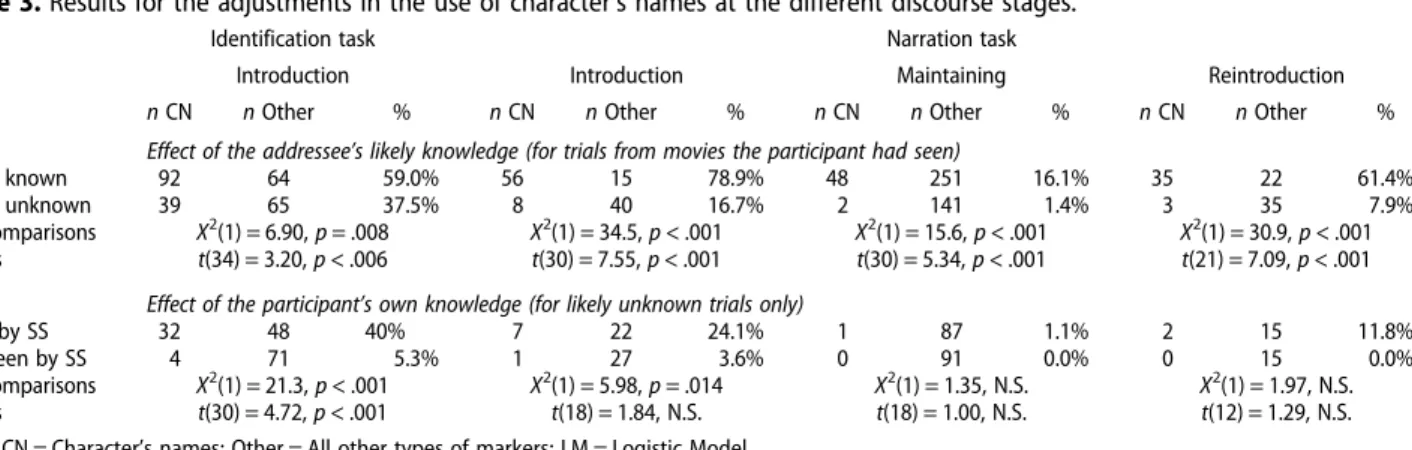
The proportions of each type of markers used for the likely known and for the likely unknown movie charac-ters are presented in Figure 3, as well as in Tables 3–6. The following sections present the results from the logis-tic model analyses for each type of reference marker (names, indefinite, definite or unaccented pronouns). The statistical comparisons (effect of addressee’s knowl-edge or effect of participant’s knowledge) performed separately for each task/stages (identification, introduc-tion, maintaining and reintroduction) are presented in
Tables 3–6, including the comparisons from the logistic modelling and from the t-tests.
Character’s names
The comparisons of logistic models revealed an effect of the addressee’s likely knowledge (X2(2) = 66.8, p < .001) and a significant interaction between the addressee’s likely knowledge and task/discourse stage (X2(3) = 19.4, p < .001) on the production of names. As presented in
Table 3, the effect of the addressee’s likely knowledge was significant for all four task/stages, characters’ names being more often used for the likely known movies. In the model that included the interaction, the parameters indicated that compared to the effect of the addressee’s knowledge observed for identification
task (selected as the reference in the model), the effects were significantly greater for the introduction stage (β = 1.10, SE = .29, t = 3.77) and the reintroduction stage of the narration task (β = .93, SE = .31, t = 2.99), but not for the maintaining stage (β = .12, SE = .26, t = 0.46)
For the participant’s own knowledge, comparisons of logistic models revealed a significant effect (X2(2) = 30.7, p < .001) as well as an interaction with task/discourse stages (X2(3) = 13.8, p = .003). As shown in Table 3, names were more often used when the participant had seen the movies, but these effects were restricted to the identification task and to the introduction of the nar-ration task. In the model that included the interaction, the parameters indicated that, compared to the identifi-cation task, the effects were significantly reduced for the
Figure 3. Proportion of trial for which participants used each type of reference markers during the identification task and for each stages of the narrative task. Each type of reference marker is presented with a distinct colour.
maintaining stage (β = −0.95, SE = .28, t = −3.41) and the reintroduction stage (β = −.90, SE = .34, t = −2.68), while only a trend emerged for the introduction stage (β = −.52, SE = .29, t = −1.81).
Indefinite markers
The comparisons of logistic models revealed an effect of the addressee’s likely knowledge (X2(2) = 21.8, p < .001) and no interaction between the addressee’s likely knowl-edge and task/stage (X2(3) = 2.43, p = .487) on the pro-duction of indefinite markers. However, further examination of the proportions with which participants used indefinite markers for each task/stage revealed numerically modest differences between the likely known and the likely unknown conditions and, as shown in Table 4, the unbiased t-test could not confirm the effects. The observed effect of the addressee’s knowl-edge should thus be considered with care as it likely reflects differences in the number of non-cases (the “n Other” columns in Table 4), rather than a real difference in proportions between the likely known and likely unknown conditions (see Supplement for additional information on this bias).
For the participant’s own knowledge, comparisons of logistic models revealed a significant effect (X2(2) = 13.6,
p = .001) while the interaction with task/discourse stage did not reach significance (X2(3) = 7.26, p = .064). Given
the trend-level probability for the interaction, we none-theless examined the effects for each task/stage. As shown in Table 4, participants used indefinite markers more often for movies they had not seen both during the identification task and during the introduction stage of the narration task, but not during the maintain-ing or the reintroduction stage. In the model that included the interaction, the parameters indicated no significant difference from the identification task for the introduction stage (β = −.08, SE = .33, t = −0.24) and only trends for reduced effects during the maintaining (β = .62, SE = .32, t = 1.96) and the reintroduction stages (β = .76, SE = .40, t = 1.91).
Definite markers
The comparisons of logistic models revealed an effect of the addressee’s likely knowledge (X2(2) = 67.8, p < .001) and no interaction between the addressee’s likely knowl-edge and the task/stage (X2(3) = 2.5, p = .473) on the
Table 3.Results for the adjustments in the use of character’s names at the different discourse stages.
Identification task Narration task
Introduction Introduction Maintaining Reintroduction n CN n Other % n CN n Other % n CN n Other % n CN n Other % Effect of the addressee’s likely knowledge (for trials from movies the participant had seen)
Likely known 92 64 59.0% 56 15 78.9% 48 251 16.1% 35 22 61.4% Likely unknown 39 65 37.5% 8 40 16.7% 2 141 1.4% 3 35 7.9% LM comparisons X2(1) = 6.90, p = .008 X2(1) = 34.5, p < .001 X2(1) = 15.6, p < .001 X2(1) = 30.9, p < .001 t-tests t(34) = 3.20, p < .006 t(30) = 7.55, p < .001 t(30) = 5.34, p < .001 t(21) = 7.09, p < .001
Effect of the participant’s own knowledge (for likely unknown trials only)
Seen by SS 32 48 40% 7 22 24.1% 1 87 1.1% 2 15 11.8%
Not seen by SS 4 71 5.3% 1 27 3.6% 0 91 0.0% 0 15 0.0%
LM comparisons X2(1) = 21.3, p < .001 X2(1) = 5.98, p = .014 X2(1) = 1.35, N.S. X2(1) = 1.97, N.S. t-tests t(30) = 4.72, p < .001 t(18) = 1.84, N.S. t(18) = 1.00, N.S. t(12) = 1.29, N.S. Note: CN = Character’s names; Other = All other types of markers; LM = Logistic Model.
Table 4. Results for the adjustments in the use of indefinite markers at the different discourse stages.
Identification task Narration task
Introduction Introduction Maintaining Reintroduction n IN n Other % n IN n Other % n IN n Other % n IN n Other % Effect of the addressee’s likely knowledge (for trials from movies the participant had seen)
Likely known 16 140 10.3% 11 60 15.5% 1 298 0.3% 1 56 1.8% Likely unknown 14 90 13.5% 16 32 33.3% 1 142 0.7% 1 37 2.6% LM comparisons X2(1) = 4.49, p = .034 X2(1) = 7.47, p = .006 (X2(1) = 17.7, p < .001)a (X2(1) = 3.47, p = .062)a t-tests t(34) = 0.61, N.S. t(30) = 1.92, N.S. t(30) = 0.78, N.S. t(21) = 0.78, N.S.
Effect of the participant’s own knowledge (for likely unknown trials only)
Seen by SS 12 68 15.0% 6 23 20.7% 1 87 1.1% 1 16 5.9%
Not seen by SS 30 45 40.0% 14 14 50.0% 2 89 2.2% 0 15 0.0% LM comparisons X2(1) = 8.70, p = .003 X2(1) = 4.31, p = .038 X2(1) = 0.03, N.S. X2(1) = 0.24, N.S. t-tests t(30) = 3.17, p < .006 t(18) = 2.25, p < .064 t(18) = 0.62, N.S. t(12) = 1.00, N.S. Note: IN = Indefinite markers; Other = All other types of markers; LM = Logistic Model.
a
These statistics appear biased given the low number of indefinite markers combined with the uneven number of other cases. The statistics based on permu-tations thus provide a more reliable estimate of these effects.
production of definite markers. As presented in Table 5, definite markers, which denote intermediate levels of accessibility, were more often used to present the likely unknown characters.
For the participant’s own knowledge, comparisons of logistic models revealed a significant effect (X2(2) = 6.40, p = .041) while the interaction with task/stage did not reach significance (X2(3) = 7.6, p = .055). Given the trend-level probability of the interaction, we examined the effects for each task/stage. As shown in Table 5, the only condition in which participants used definite markers significantly more often for the movies they had not seen was the reintroduction stage of the narra-tion task. The effects for the other task/stages were not significant (introduction and maintaining) or showed a trend in the opposite direction (identification task; see
Table 5). In the model that included the interaction, the parameters indicated that, compared to the identifi-cation task, the effect significantly differed during the reintroduction stage (β = −1.32, SE = .47, t = −2.78), consistent with the observation of effects going in oppo-site directions. There was however no significant differ-ence from the identification task for the introduction (β = −.27, SE = .39, t = −0.69) or the maintaining stages (β = −.33, SE = .34, t = −0.95).
Pronouns
The comparisons of logistic models revealed a significant effect of the addressee’s likely knowledge (X2(2) = 9.44, p = .009) and no interaction with task/stage (X2(3) =
0.76, p = .860) on the production of unaccented pro-nouns (see Table 6). However, the unbiased t-test could not confirm the effects, suggesting that the comparison of the logistic models with and without the knowledge status should be considered with care as it likely reflects differences in the number of non-cases (the “n Other” columns in Table 6), rather than a real difference in pro-portions between the likely known and likely unknown
conditions (see Supplement for additional information on this bias).
For the participant’s own knowledge, comparisons of logistic models revealed no significant main effect (X2(2) = 3.11, p = .211) but the interaction with task/stage was significant (X2(3) = 10.6, p = .014). As shown in Table 6, the only condition in which participants used pronouns significantly more often for movies they had not seen was the introduction stage. The effects at the other stages were not significant (introduction and maintain-ing) or showed a trend in the opposite direction (reintro-duction; see Table 6). In the model that included the interaction, the parameters indicated that, compared to the identification task, there were significant differences with the maintaining stage (β = .82, SE = .33, t = 2.46) and the reintroduction stage (β = 1.33, SE = .45, t = 2.93), but not with the introduction stage (β = .75, SE = .40, t = 1.90).
A further examination of the pronouns used in the identification task revealed that in this context pronouns were typically used in expressions such as “Il a une cape rouge” (“He has a red cape”).
Discussion
This study relied on a new experimental task to assess whether speakers adapt their choices of referential expressions on a stimulus by stimulus basis when intro-ducing, maintaining or reintroducing movie characters that vary in terms of the likelihood that they will be known to their addressee. Given that egocentric biases have previously been reported in language production, we also assessed the effect of the participant’s own knowledge. Consistent with our hypotheses, results from this study showed that participants adapted their referential choices depending on the likely knowledge of an addressee, here a woman in her 20s. This was reflected by an increased use of names when referring to a likely known character and an increased use of
Table 5. Results for the adjustments in the use of definite markers at the different discourse stages.
Identification task Narration task
Introduction Introduction Maintaining Reintroduction n D+ n Other % n D+ n Other % n D+ n Other % n D+ n Other % Effect of the addressee’s likely knowledge (for trials from movies the participant had seen)
Likely known 15 141 9.6% 4 67 5.6% 5 294 1.7% 10 47 17.5%
Likely unknown 27 77 26.0% 21 27 43.8% 12 131 8.4% 22 16 57.9% LM comparisons X2(1) = 18.7, p < .001 X2(1) = 22.9, p < .001 (X2(1) = 20.2, p < .001)a X2(1) = 14.6, p < .001 t-tests t(34) = 3.46, p < .002 t(30) = 3.96, p < .002 t(30) = 1.67, N.S. t(21) = 3.84, p < .003
Effect of the participant’s own knowledge (for likely unknown trials only)
Seen by SS 22 58 27.5% 13 16 44.8% 11 77 12.5% 9 8 52.9%
Not seen by SS 10 65 13.3% 12 16 42.8% 10 81 11.1% 14 1 93.3% LM comparisons X2(1) = 3.21, p = .073 X2(1) = 0.06, N.S. X2(1) = 0.01, N.S. X2(1) = 5.30, p = .021 t-tests t(30) = 1.36, N.S. t(18) = 0.55, N.S. t(18) = 0.01, N.S. t(12) = 2.00, N.S. Note: D+ = Definite markers; Other = All other types of markers; LM = Logistic Model.
during the narration task, especially for the maintaining and the reintroduction stage. For definite references and pronouns, the main effect of the participant’s own knowledge was not significant (though a trend emerged for definite markers) and the interaction reflected effects that were in opposite directions for the reintroduction stage of the narration task compared to the identification task. The effects for definite refer-ences and pronouns did not approach significance for the other stages of narration (introduction and maintaining).
For the pronouns, the significant effect of the partici-pant’s own knowledge during the identification task was in the opposite direction than what would be expected if pronouns were used for more accessible referents (i.e. we observed greater use for the movie characters that the participants did not know during the identification task). As mentioned in the results section, the use of pro-nouns in this context occurred in sentences such as “He has a red cape”, something that happened infrequently and mainly in the identification task. The effect during the reintroduction stage did not reach significance but was in the expected direction.
For the definite markers, the only stage at which the effect of the participant’s knowledge reached signifi-cance was the reintroduction stage, with a very high pro-portion of definite references for movies the participants had not seen (93.3%). When they had seen the movies, participants still used a majority of definite references to reintroduce the likely unknown characters (52.9%) but they also used a surprisingly high proportion of pro-nouns (29.4%). This pattern of results is in line with pre-vious studies that reported increased use of pronouns when the referents are more accessible to the speaker (Fukumura & van Gompel, 2012; Vogels et al., 2015). However, we have to stress that even if the speakers were influenced their own knowledge, they were also clear effects of the addressee’s likely knowledge, consist-ent with the long held view that the addressee is
Table 6.Results for the adjustments in the use of pronouns at the different discourse stages.
Identification task Narration task
Introduction Introduction Maintaining Reintroduction n PR n Other % n PR n Other % n PR n Other % n PR n Other % Effect of the addressee’s likely knowledge (for trials from movies the participant had seen)
Likely known 9 147 5.8% 0 71 0.0% 245 54 81.9% 11 46 19.3% Likely unknown 10 94 9.6% 1 47 2.1% 127 16 88.8% 12 26 31.6% LM comparisons (X2(1) = 8.26, p = .004)a (X2(1) = 22.3, p < .001)a X2(1) = 0.97, N.S. X2(1) = 1.2, N.S. t-tests t(34) = 1.17, N.S. t(30) = 1.00, N.S. t(30) = 1.12, N.S. t(21) = 0.82, N.S.
Effect of the participant’s own knowledge (for likely unknown trials only)
Seen by SS 5 75 6.3% 1 28 3.5% 74 14 84.1% 5 12 29.4%
Not seen by SS 19 56 25.3% 1 27 3.6% 78 13 86.7% 1 14 6.7% LM comparisons X2(1) = 7.66, p = .006 X2(1) = 0.04, N.S. X2(1) = 0.04, N.S. X2(1) = 3.14, p = .076 t-tests t(30) = 2.05, p < .061 t(18) = 0.00, N.S. t(18) = 0.00, N.S. t(12) = 1.14, N.S. Note: PR = Pronouns; Other = All other types of markers; LM = Logistic Model.
definite expressions for likely unknown characters. These effects of the addressee’s likely knowledge were observed for all the task/stages conditions, namely the identification task and the introduction, maintaining and reintroduction stages of the narration task. Names and definite expressions thus showed complementary distributions across our different task conditions. Inter-estingly, the effect of the addressee’s likely knowledge on the use of names increased following the initial mention of the character in the identification task, suggesting that further adjustments can happen as the verbal interaction progresses. In a previous paper (Achim et al., 2015), we however reported that in that same identification task, participants who used names tended to combine these names with additional descrip-tive information, saying for example “it is Leonidas, he has a beard and a red cape”. While such combinations were frequently observed during the identification task (Achim et al., 2015), shorter forms may have been favoured during the narration task, leading participants to use definite references without first mentioning the name when presenting likely unknown characters. None-theless, the effect of the addressee’s likely knowledge on the use of names was already significant during the identification task, though even more pronounced when introducing or reintroducing referents in the narra-tion task.
When assessing the effect of the participant’s own knowledge, the analyses revealed either significant or trend-level interactions with task/stages for all four types of references (names, indefinite, definite and pro-nouns), further highlighting the adjustments that occur as the verbal interaction unfolds. For names and indefi-nite reference, there was also a main effect of the partici-pant’s knowledge, with more names when the participant had seen the movies and more indefinite references when the participant had not seen the movie. These effects were however most important during the identification task and were then reduced
important to consider when making reference choices (Clark & Marshall, 1981; Clark, Schreuder, & Buttrick, 1983; Isaacs & Clark, 1987).
Adjustments to the addressee’s likely knowledge across discourse stages
Even if participants’ personal knowledge significantly influenced their use of names during the identification task, at least to the extent that participants were unable to name characters that they did not know, when they did know the characters they still markedly adapted their choices of referential expressions to their addressee’s likely knowledge. It was interesting that the use of the character’s name was affected by the likely knowledge of the addressee even when maintain-ing a character in focus. This observation goes against our initial hypothesis that there would be no modulation of referential choices related to the addressee’s likely knowledge for the maintaining stage. Given that there were always two male characters in the narrative sequences, it is possible however that names known by both the participant and the addressee were used to avoid confusion, even if chances of confusion were low given that the character was maintained (Arnold & Griffin, 2007). While names and definite expressions tended to have complementary distributions throughout the discourse stages, names being more likely used for likely known movies and definite expressions for likely unknown movies, there was a relatively low rate of defi-nite expressions used for maintaining a character in focus. This observation is consistent with the model of Ariel (Ariel, 1990, 1996) that predicts the preferred use of definite expressions for referents with lower accessibil-ity levels.
It was suggested that speakers can be affected by an egocentric bias when they initially plan their utterances and that they subsequently monitor and adjust these plans to take common ground with their addressee into account (Horton & Keysar, 1996). In this study, an effect of the participant’s own knowledge was generally greater when introducing the referents and thereafter reduced or even reversed. This observation is consistent with a model in which the initial plan and hence the initial mention of a given referent is particularly affected by the speaker’s own perspective, while subsequent mentions seem less affected by the speaker’s knowledge but remain affected by the speaker’s evaluation of his addressee’s knowledge.
Given that in this study the addressee always dis-played prototypical knowledge, the factors that led the speakers to determine the addressee’s likely knowledge would however need to be further clarified. More
specifically, the influence of the initial assumptions about the addressee’s knowledge (global adaptation based on stereotypes) and the influence of the addres-see’s feedback (local adaptation based on previous feed-backs) could not be disentangled (Brennan et al., 2010). In addition, it remains possible that not knowing a given character led the participants to judge that the addressee was less likely to know that character. Future studies could clarify the findings about the effect of the address’s likely knowledge by further distinguishing the impact of initial, discourse external influences (ex: the speaker’s initial assessment of the address’s knowl-edge based on stereotypes, with a possible influence of his/her own knowledge), versus discourse-internal influ-ences acquired during the interaction (ex: the addres-see’s feedback for previous items), given that both sources of information could potentially influence the speaker’s assessment of the address’s likely knowledge for future referents.
Reference choices at different task/stages
The pattern of results clearly indicates that names and definite expressions are not restricted to specific dis-course stages but rather used in diverse contexts, with the choice of names or definite expressions influenced by prior knowledge that can be attributed to the addres-see, consistent with Ariel’s accessibility model (Ariel, 1990) and Gundel et al.’s givenness hierarchy (Gundel et al., 1993, 2012).
In contrast, indefinite markers and pronouns were used at more specific discourse stages, respectively intro-duction and maintenance, and there was no convincing evidence of an influence of the addressee’s likely knowl-edge. These observations are consistent with the sugges-tion that introducing and maintaining references with these markers “can be based on the properties of the dis-course and does not require the speaker to mentalise about the listener’s knowledge” (p. 395, Hendriks et al., 2014see also Kuijper, Hartman, & Hendriks, 2015). Inter-estingly, indefinite markers and pronouns are linked to the two opposite extremes of accessibility in the dis-course (Gundel et al., 1993, 2012), with indefinite markers being preferred for low-accessibility referents that have not yet been introduced (Gundel et al., 1993, 2012), while pronouns are preferred for highly accessible referents that are maintained in focus (Ariel, 1990, 1996; Gundel et al., 1993, 2012).
Hendriks et al. had also suggested that “topic shift cru-cially requires speakers to take into account the listener’s perspective” (p. 395, Hendriks et al., 2014; Kuijper et al., 2015), and our results support this idea but also further document that the listener’s perspective can influence
choices of referring expressions at different discourse stages, especially when it comes to the use of definite expressions or names.
Overall, our results suggest that names and definite expressions are influenced by the speaker’s assessment of the addressee’s likely knowledge across discourse stages, while indefinite markers are rather influenced by the speaker’s personal knowledge, in particular when introducing the referents. This study thus support the sug-gestion that “reference production during dialogue is shaped not only by one’s partner’s state of mind, as pre-dicted by the collaborative approach, but also by infor-mation availability from one’s own point of view” (p. 339; Knutsen & Le Bigot, 2012).
Limitations and strengths of this study
One limitation of this study that has to be acknowledged is that the identification task was always performed before the narration task, and the main character from the six narrative sequences were all part of the identifi-cation task. It is thus possible that the characters were not perceived as novel characters when beginning the narration task, and this could have affected our results, in particular during the introduction stage. Another limit-ation is that the movie knowledge questionnaire only asked participants if they had seen the movies or not and did not include questions about whether they knew the names of the movie characters. While it remains possible that participants could have used more names for the likely known characters because they could better recollect these names, the effect of the participant’s own knowledge on their use of names was restricted to the identification task and to the intro-duction of the narration task, while the effect of the addressee’s likely knowledge on the use of names was significant across both tasks and across all discourse stages, even increasing following the initial mention in the identification task. This suggests that while the par-ticipant’s own knowledge and the addressee’s likely knowledge both influence the choices of referential expressions when identifying a new referent, it is truly the speaker’s assessment of the addressee’s likely knowl-edge that influenced the choices of referential expressions when referring to the different characters in the context of a narrative discourse.
Despite these limitations, our study is the first one to target the effect of the addressee’s likely knowledge in a narrative context. In addition, previous item-identifi-cation task had either focussed on the speaker’s evalu-ation of the addressee’s knowledge for the full set of items in the task (Isaacs & Clark, 1987), or for items for which the address’s knowledge did not need to be
evaluated by the speaker given that items were abstract shapes for which the names were learned by the speaker with only a subset being also learned by the addressee (Heller et al., 2012; Wu & Keysar, 2007). Only one recently published study examined adjustments to the address’s likely knowledge on an item by item basis, but that pre-vious study, like the ones previously cited (Achim et al., 2015), focussed the analyses on the type of information included in the reference (ex: name, description, name plus description, etc.). The current study is thus the first one to assess the effect of the speaker’s assessment of the addressee’s likely knowledge on the choices of refer-ence markers (pronouns, types of determiners, also including names).
Conclusion
This study revealed a very interesting pattern of results in which the adaptation in the use of referential expressions was sometimes linked to the addressee’s likely knowl-edge (for names and definite expressions across both tasks) and sometimes influenced by the participant’s per-sonal knowledge (particularly indefinite expressions and names). Overall, this study thus represents an important advance in the study of the factors that affect the use of specific referential expressions. First, it introduces a method which allowed us to distinguish the three main discourse stages in narrative speech. Second, it presents unique evidence for a modulation of the use of referen-tial expressions as a function of the addressee’s likely knowledge not only during the presentation of indepen-dent stimuli, but also at all three discourse stages, namely the introduction of new referents, the mainten-ance of highly accessible referents and the reintroduc-tion of a referent that was previously not in focus. This effect observed even during the maintaining stage rep-resent an important finding of this study. Third, it docu-ments an effect of the speaker’s personal knowledge that is particularly important during the identification of new referents. Overall, these results further our understand-ing of the factors that affect choices of referential expressions at different stages during a natural verbal interaction with another person.
Acknowledgements
We would like to thank Jacinthe Bédard-Lacroix, Marie-Audrey Lavoie and Laurence Brunelle-Haman for their help with the administration of the protocol and Sophie Couture and Jessie Cadoret for scoring the data.
Disclosure statement