Are low tolerable upper intake levels for vitamin A
undermining effective food fortification efforts?
Klaus Kraemer, Monika Waelti, Saskia de Pee, Regina Moench-Pfanner, John N Hathcock,
Martin W Bloem, and Richard D Semba
Vitamin A deficiency (VAD) is a major health problem, particularly in low-resource
countries, putting an estimated 125–130 million preschool-aged children at
increased risk of morbidity and mortality from infectious diseases. Vitamin A
supplementation reduces VAD and increases child survival; it is complemented by
fortifying foods with vitamin A. Concern over increased risk of bone fracture
associated with vitamin A intakes below the tolerable upper intake level (UL) among
populations in affluent countries conflicts with the need to increase intakes in less
developed countries, where populations are at greater risk of VAD and intakes are
unlikely to reach the UL as diets include fewer foods containing retinol while
vitamin A from carotenoids poses no risk of overdose. With the implementation of
recently developed risk management tools, vitamin A can be used safely in food
fortification, including point-of-use fortification in the context of supplementation
among specific target groups in low-resource countries.
© 2008 International Life Sciences Institute
INTRODUCTION
Vitamin A deficiency is a major cause of morbidity, mor-tality and blindness in the developing world, affecting an estimated 125–130 million preschool-aged children and 7 million pregnant women in low-income countries.1An estimated 350,000 vitamin A-deficient children become blind every year,2 and about half of them die within a year of becoming blind. The World Health Organization (WHO) estimated in 1995 that 3 million preschool chil-dren throughout the world present ocular signs of vitamin A deficiency and 254 million preschool children had mild-to-moderate vitamin A deficiency, indicated by low serum retinol levels.3The prevalence of low serum retinol levels among children under the age of 5 years in various regions of the developing world ranged from 15% to 60% at the end of the 1990s, with Latin America, the Eastern Mediterranean, and Western Pacific at the low end of this range, and Africa and Southeast Asia at
the high end.1,3The impact of mild-to-moderate vitamin A deficiency on children’s resistance to infectious dis-eases has been recognized but not fully captured in sta-tistical reports; hence, the magnitude of the vitamin A problem may be underestimated. Vitamin A deficiency not only causes night blindness in pregnant and lactating women, it also contributes to maternal mortality and other poor health outcomes.4 The recent 2005–2006 National Family Health Survey (NFHS-3) in India indi-cates that vitamin A deficiency is still a significant public health problem in the wider population, as about 9% of Indian women had night blindness during their recent pregnancy.5
Vitamin A supplementation reduces morbidity and mortality among preschool children in developing coun-tries.6The scaling up of vitamin A supplementation has made progress over the last decade but is still not reaching all vulnerable children with the desired dose.7,8 High-dose vitamin A supplementation is one of the most
Affiliations: K Kraemer is with SIGHT AND LIFE, Basel, Switzerland. M Waelti is with the School for Dieticians, University Hospital, Zurich, Switzerland. S de Pee and MW Bloem are with the World Food Programme, Rome, Italy. R Moench-Pfanner is with the Global Alliance for Improved Nutrition, Geneva, Switzerland. JN Hathcock is with the Council for Responsible Nutrition, Washington, DC, USA. RD Semba is with the Department of Ophthalmology, Johns Hopkins University School of Medicine, Baltimore, Maryland, USA.
Corresponding author: K Kraemer, SIGHT AND LIFE, PO Box 2116, Basel 4002, Switzerland. E-mail: [email protected], Phone: +41-61-815 8756, Fax +41-61-815 8190.
Key words: food fortification, risk management tools, safety, vitamin A deficiency
cost-effective health interventions in developing coun-tries. Fortification of foods with vitamin A is a comple-mentary approach applying a valid technology to combat vitamin A deficiency where existing food supplies do not provide adequate amounts of the nutrient.9In doses of 200,000 IU (60 mg) of preformed vitamin A per child only transient undesirable effects (such as nausea) have been reported in a few cases, and the long-term protec-tion against the severe pathologies related to vitamin A deficiency clearly outweighs such minimal risk. The dif-ficulty of distribution at the community level, not the adverse effect, is the primary constraint on the use of high-dose vitamin A supplementation.
For safety considerations, combined continuous intakes from fortification and supplementation should not exceed the tolerable upper intake level (UL) which is defined as the highest level of daily intake that is likely to pose no risk of adverse health effects in almost all individuals. The UL is not pertinent to the intermittent high-dose vitamin A supplementation used in some intervention programs.
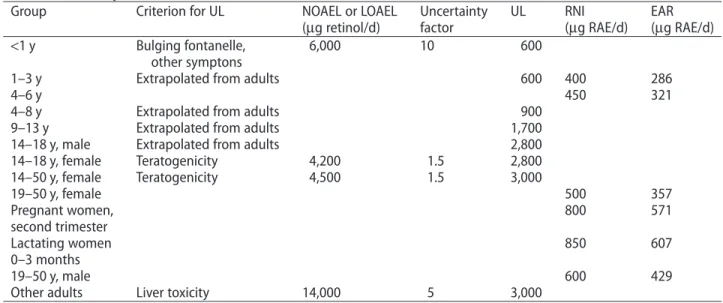
Recently, as reviewed by Penniston and Tanumi-hardjo,10 new concerns about the safety of vitamin A intake have arisen from population observations in Western countries, suggesting an association between pre-formed vitamin A (retinol) intakes below 3,000 mg/day, the UL for adults, and increased risk of bone fracture. Therefore, the UK Expert Group on Vitamins and Minerals (EVM) has decided to assign a guidance level for long-term intake of vitamin A of 1,500 mg/day,11,12which is less than two times the recommended nutrient intake (RNI) of 800 mg/day for pregnant women. Table 1
pro-vides an overview of ULs as well as RNIs and estimated average requirements (EARs) for vitamin A intake (mg/d). Following the recommendations of the UN Food and Agricultural Organization (FAO) and WHO, estimates of vitamin A requirements are expressed as “retinol equiva-lents” (REs), where 1 mg RE = 1 mg of retinol = 6 mg of b-carotene = 12 mg of other carotenoids with provitamin A activity = 3.33 IU of vitamin A activity from retinol. In contrast, the US Food and Nutrition Board recently con-cluded that the bioconversion of provitamin A caro-tenoids from plants is only half the previously assumed level, which led to the new designation of retinol activity equivalent, or RAE.13
The purpose of this paper is to review the safety of vitamin A in food fortification, including multiple food fortification, and in targeted high-dose vitamin A supple-mentation. It is not meant to be a systematic review of all the evidence; rather, it is designed to highlight issues for further discussion. It also aims to document recent devel-opments in risk management with regard to vitamin A.
CHRONIC HIGH VITAMIN A INTAKES
Chronic hypervitaminosis A is relatively rare. It is, however, a potential concern with any vitamin A fortifi-cation program. The manifestations of chronic hypervi-taminosis A are varied and non-specific, and include central nervous system effects, skin disorders, conjunc-tivitis, nausea, vomiting, teratogenicity, and hepatotoxic-ity in adults.11,13,14In infants and young children, skeletal and intracranial (e.g., transient bulging fontanelle) abnor-malities are of particular concern.13
Table 1 Tolerable ULs with criteria for derivation, RNIs, and EARs (calculated from RNIs) for vitamin A intake
recommended by WHO/FAO.
Group Criterion for UL NOAEL or LOAEL (mg retinol/d) Uncertainty factor UL RNI (mg RAE/d) EAR (mg RAE/d) <1 y Bulging fontanelle, other symptons 6,000 10 600
1–3 y Extrapolated from adults 600 400 286
4–6 y 450 321
4–8 y Extrapolated from adults 900
9–13 y Extrapolated from adults 1,700
14–18 y, male Extrapolated from adults 2,800
14–18 y, female Teratogenicity 4,200 1.5 2,800 14–50 y, female Teratogenicity 4,500 1.5 3,000 19–50 y, female 500 357 Pregnant women, second trimester 800 571 Lactating women 0–3 months 850 607 19–50 y, male 600 429
Other adults Liver toxicity 14,000 5 3,000
Abbreviations: EAR, estimated average requirements; LOAEL, lowest observed adverse effect level; NOAEL, no observed adverse effect
level; RAE, retinol activity equivalents; RNI, recommended nutrient intakes. Data compiled from Allen et al. (2006)4and Allen and Haskell (2002).37
Bone abnormalities
Several studies in industrialized countries have suggested an association exists between chronic higher intakes of preformed vitamin A and bone fracture risk15–18 or reduced bone mass in humans.16,19However, the relation-ship between vitamin A intake and bone fracture risk has been inconsistent, as several other studies have failed to show any such associations.20–27 Although the adverse effects of toxic doses of vitamin A on bone fragility in animals have been established (as reviewed by Hathcock et al.28), studies suggesting such an effect in humans were retrospective and observational; since they did not involve the extremely high intakes used in animal studies, their results must be interpreted with caution. Most human studies were not specifically designed to examine the relationship between retinol intake and bone health.12 Some studies used plasma retinol or fasting serum retinyl esters as biomarkers for vitamin A intake, although fasting serum retinyl esters do not correlate with total vitamin A intake.29They may reflect recent excess intake rather than long-term intake. In addition, dietary assess-ment methods used in most studies were inadequate for obtaining reliable estimates of total vitamin A intake. Retinol is found in high concentrations in a limited number of foods (e.g., liver), that are consumed infre-quently by most populations. Thus, dietary assessment of preformed vitamin A intake can result in high inter- and intra-individual variance and reliable individual estima-tion requires either long-term assessment (>20 d)30or a semi-quantitative food frequency questionnaire.31In the only available randomized clinical trial, short-term high vitamin A supply (7,500 mg/day over 6 weeks) did not affect bone turnover in men.32Although very high doses of vitamin A clearly affect bone adversely (as reviewed by Dary and Mora9), it is still not clear whether those detri-mental effects occur at usual intakes, such as<3,000 mg retinol/day.
b-carotene
b-carotene and other pro-vitamin A carotenoids have no vitamin A toxicity.9,33This may explain why no increased risk of bone fracture has been observed with high levels of b-carotene intake15,16,21,26,27or in association with high b-carotene serum levels.17 However, prolonged high-level intake of b-carotene may cause carotenodermia, a yellow-orange discoloration of the skin, which is harm-less and without other consequences. Two clinical trials reported an increase in lung cancer in heavy tobacco smokers and asbestos workers associated with daily b-carotene supplements of 30 mg and 20 mg, respec-tively, but these doses are much higher than those nor-mally available in the diet.34,35
SETTING TOLERABLE U INTAKE LEVELS
Tolerable upper intake levels are set to protect the popu-lation from adverse health effects. They are derived from NOAELs (no observed adverse effect levels) or, if these are not available, from LOAELs (lowest observed adverse effect levels) by applying uncertainty factors.13A UL is only set with an identified hazard and typically when dose-response data is available; it is thus considered to protect virtually 100% of the population.36A transient increase above the UL is considered as safe for most people because of the built-in generous safety margin.
Table 1 provides an overview of ULs for retinol intake (mg/day) and the criteria upon which they are based. The US Food and Nutrition Board based the UL for women of reproductive age on teratogenicity and for all other adults on liver abnormabilities.13Based on pos-sible birth defects as a critical safety issue, the US Food and Nutrition Board identified a NOAEL of 4,500 mg/day from food and supplements, and applied an uncertainty factor of 1.5 to arrive at a UL of 3,000 mg/day for women of reproductive age. In order to define a UL for men, a LOAEL of 14,000 mg/day for hepatotoxicity and an uncer-tainty factor of 5 were applied to arrive at a UL of 3,000 mg/day. The US Food and Nutrition Board judged that the conflicting results from the studies on bone frac-ture risk were not useful for setting a UL for retinol. To derive a UL for infants (aged 0–12 months), case reports of hypervitaminosis in infants were used. A LOAEL of 6,460 mg/day was identified and an uncertainty factor of 10 was applied to arrive at a UL of 600 mg/day. Due to limited case report data of hypervitaminosis A in children and adolescents, the UL values for them were extrapo-lated from those established for adults on the basis of relative body weight.
The EU Scientific Committee on Food (SCF) iden-tified the following LOAELs: 7,500 mg/day for hepatotox-icity, 3,000 mg/day for teratogenicity and, tentatively, 1,500 mg/day for bone density/fracture.14 These differ from those of the US Food and Nutrition Board.13The adverse effects on bone health were reported at lower daily intakes than the other effects. However, the EU Scientific Committee on Food considered that the data on fracture risk provided insufficient evidence and were not appropriate for establishing a UL. Therefore, the UL for adults has been set at 3,000 mg/day from foods and supplements, based on the LOAEL for teratogenicity. Post-menopausal women are advised to restrict their intake to 1,500 mg/day because of a possible higher risk of osteoporosis. The UL values for infants and children were extrapolated from the value of 3,000 mg/day for adults, with correction for differences in basal metabolic rate using scaling according to body surface area (body weight0.75).
The UK Expert Group on Vitamins and Minerals decided there was insufficient evidence to set a “safe upper level”, therefore a “guidance level” of 1,500 mg RE (correctly, RE in the form of retinol/day) was estab-lished.11,12As with the US Food and Nutrition Board and the EU Scientific Committee on Food, they judged it prudent to take 3,000 mg/day as the threshold for terato-genicity. The risk of hip fracture, in contrast, is a continu-ous, graded response associated with exposure levels that include average dietary intakes. Thus, they judged that total intakes of >1,500 mg/day may be inappropriate. Nevertheless, because of overlap with reasonable dietary intakes, a change in dietary advice to all consumers was not justified.12No guidance level was set for children.11
VITAMIN A INTAKE IN INDUSTRIALIZED AND DEVELOPING COUNTRIES
Natural sources of vitamin A include retinol and retinyl esters from animal products and provitamin A caro-tenoids (mainly b-carotene) from fruits, vegetables, and oils. Consumption of natural sources of vitamin A rarely results in toxicity, with the exception of excessive and continued consumption of liver over a long period of time.37
Industrialized countries
Vitamin A intake can be relatively high in specific segments of the population. The UK National Diet and Nutrition Survey (NDNS) for adults aged 19–64 years found that the diet of 9% of men and 4% of women include retinol at levels above 1,500 mg/day.38Liver and supplements (including fish liver oil) were the major sources for those with retinol intakes>1,500 mg/day, con-tributing 70% and 16–17% of total retinol intake, respec-tively. In the United States, about 25% of preschool children exceed the UL of 600 mg/day from foods, but remain below the LOAEL of 6,000 mg/d.37 In non-pregnant and non-lactating women aged 19–30 years in the United States, however, the 99thpercentile of retinol intake from food alone does not exceed the UL. Cases with clinical signs of vitamin A deficiency are rare but do occur in marginalized populations and need due atten-tion (personal communicaatten-tion: Richard Semba).
In developed countries, several foods are being for-tified with vitamin A. Important food vehicles include margarine, breakfast cereals, and milk.37The increased consumption of fortified foods and dietary supplements containing vitamin A may result in a larger percentage of the population with vitamin A intakes higher than recommended.37 This may not, however, guarantee an adequate supply of vitamin A in all population groups, particularly in vulnerable groups, such as pregnant and
lactating women. Health advice discourages pregnant women from consuming food sources rich in vitamin A, i.e., liver and some types of fish.39,40Recently, concern was raised about low vitamin A status in new mothers of high-to-moderate socioeconomic backgrounds in Germany.41Accordingly, mothers and their offspring of lower socioeconomic status may be at even greater risk. Developing countries
Risk factors for vitamin A deficiency in developing coun-tries include low dietary intakes of preformed vitamin A from dairy products, liver, eggs, and fortified foods. Vitamin A intake in developing countries mostly consists of provitamin A carotenoids from fruits and vegetables as vitamin A from animal sources is commonly not afford-able for the poor. Hence, dietary diversification is regarded as inadequate for controlling vitamin A defi-ciency.42 The presence of infections such as measles, diarrheal diseases and helminth infections also contribute to vitamin A deficiency.6 Recently, the US Food and Nutrition Board concluded that the bioefficacy of provi-tamin A carotenoids of plant origin is only half of what was previously assumed.13 Studies in developing coun-tries estimate that 21 mg of b-carotene from a typical mixed plant-based diet of vegetables and fruits, 26 mg of b-carotene from green leafy vegetables or 12 mg of b-carotene from fruits yield 1 mg RAE. At these conver-sion rates, it is impossible for young children to consume sufficient quantities of vegetables and seasonal fruits to meet the RNIs or Recommended Dietary Allowances (RDAs). Moreover, most developing areas of the world neither produce nor consume adequate amounts of pro-vitamin A-rich plants.43
There is limited information on the contribution of fortified foods to total dietary vitamin A intake in devel-oping countries. Fortified foods have been shown to con-tribute substantially to vitamin A intake in children, to improve vitamin A status and to reduce the vitamin A-related anemia burden.44,45Data from Guatemala indi-cate that in the 1990s a maximum of 600 mg of vitamin A/day may have come from fortified foods.44Preschoolers who consumed fortified foods in addition to a diet that contained vitamin A-rich foods may have temporarily exceeded the UL of 600 mg/day, but this would have been well below the LOAEL of 6,000 mg of retinol. About 40% of Indonesian children aged 11–23 months obtained at least one-third of their RNI for vitamin A from retinol-rich animal-derived and fortified foods; the 95th percen-tile from all sources amounted to 500 mg/day.46Data were collected between 1999 and 2001 among urban dwellers having access to vitamin A-fortified foods (e.g., dry milk, instant noodles, complementary foods, and infant formula).
FOOD FORTIFICATION AND POINT-OF-USE FORTIFICATION IN THE CONTEXT OF
SUPPLEMENTATION
In recent years, mass fortification with vitamin A has become more frequent in developing countries. The most common food vehicles for vitamin A fortification include sugar, margarine, vegetable oils, cereal flours, milk, and instant noodles.4,47
Excessive retinol exposure from a single source in developing country settings is unlikely. However, con-cerns about inadvertent excessive retinol intakes have arisen due to overly frequent periodic supplementation combined with concurrent use of multiple micronutrient supplements, point-of-use fortification with micronutri-ent powders, fortified staple foods, as well as voluntarily fortified commercial foods.
Periodic supplementation with high-dose vitamin A capsules is the approach commonly used for controlling vitamin A deficiency and reducing related morbidity and mortality among children aged 6–59 months in develop-ing countries. Many countries also have policies to provide high-dose vitamin A capsules to women shortly after delivery. Over the last decade, progress has been made in efforts to increase the coverage of vitamin A supplementation programs, but these programs are still not reaching all vulnerable children with the desired dose.8In 2004, just 58% of all children under the age of 5 years received two doses of vitamin A per year. In 2005– 2006, on average, only 18% of Indian children under the age of 5 years received a vitamin A supplement in the 6 months prior to the national survey.5
High-dose vitamin A supplements are used for pro-phylaxis in breast-feeding women and young children. The WHO and the International Vitamin A Consultative Group currently recommend two doses of 200,000 IU vitamin A administered at least 24 hours apart within 6 weeks after delivery to the mothers; their infants should receive 50,000 IU at 6, 10, and 14 weeks.42,48Between 6 and 11 months of age, a single dose of 100,000 IU is recommended, followed by 200,000 IU every 4–6 months between the ages of 12 and 59 months. However, in the Philippines, the prevalence of vitamin A deficiency (serum retinol <0.7 mmol/L) among children under 5 years rose from 35.8% to 38% between 1993 and 1998 despite a comprehensive biannual vitamin A capsule dis-tribution program.49Moreover, the effect of the supple-mentation on serum retinol persisted in most areas and periods for only 1–2 months, rather than the recom-mended 6 months between doses.
Among malnourished children, only 30–50% of a high-dose supplement is retained.6Even the administra-tion of 200,000 IU vitamin A monthly between the ages of 12 and 24 months is likely to be safe, with only mild,
transient, adverse effects. Only in the highly unlikely situ-ation that a child’s catabolic rate is close to that of an adult and the child receives 200,000 IU monthly between 12 and 24 months of age will liver vitamin A concentrations exceed the proposed cut-off of 300 mg/g.37 Hence, it appears likely that there is no risk from two high-dose vitamin A supplements per year given to a child under the age of 5 years in the context of concurrent fortification or point-of-use fortification programs.
Periodic high-dose vitamin A supplementation alone is inadequate to address vitamin A deficiency (see discus-sion on vitamin A intake above). Low coverage with vitamin A supplementation due to lack of supplements and poor compliance, low absorption rate, and the bioki-netics of single high-dose vitamin A supplements point to the need for additional approaches to meet the vitamin A requirements of target groups. Moreover, other popula-tion groups that are potentially at risk of vitamin A defi-ciency are excluded from supplementation programs. Dietary diversification is regarded as inadequate to control vitamin A deficiency in this respect.42 Fortifica-tion of food (mandatory and voluntary), use of low-dose supplements, and point-of-use fortification provide complementary approaches and should, on a mid- to long-term basis, replace high-dose vitamin A supplemen-tation under developing country settings. This may encourage increased intake of vitamin A by other high-risk groups that are often unnecessarily excluded from vitamin A supplementation, such as pregnant women.
MODELS FOR SAFE ADDITION OF VITAMIN A A comparatively narrow range of safe intake is a big chal-lenge to setting safe levels for vitamin A fortification and supplementation. On one hand, there is a potential risk that some consumers may exceed the UL on a daily basis due to the consumption of a limited number of foods (e.g., liver and liver products); on the other, there are significant numbers of people at risk of insufficient intake.10Moreover, the UK National Diet and Nutrition Survey38demonstrated clearly that the range of intakes for different age and sex groups varies widely, reflecting the limited distribution of preformed vitamin A in foods, i.e., the intake distribution of vitamin A is skewed with median intakes typically 20–50% below mean intakes,50 indicating that a significant proportion of the population is at risk of inadequate intake.
To ensure that the outcome of a fortification program is adequate and does not lead to harmful intakes, it is important to collect food intake data on all types of food consumed (fortified, unfortified, and point-of-use fortified), as well as other sources such as dietary supplements.4 This should be supported by findings on nutritional status, including biochemical or clinical data.
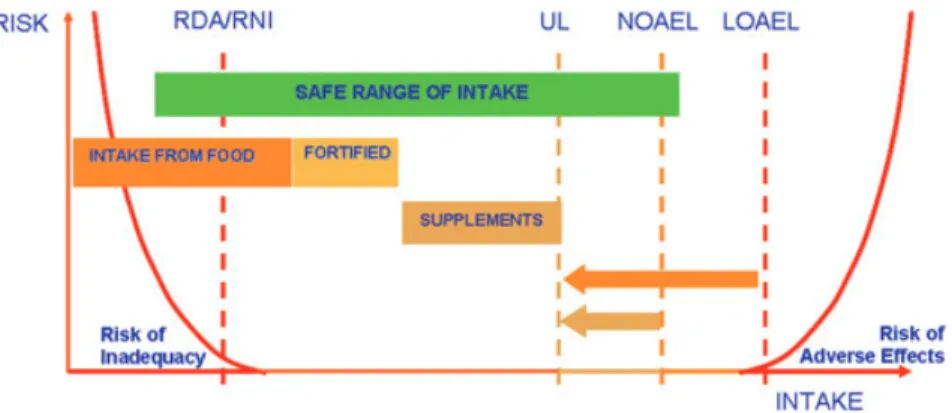
Quantitative food and nutrient intake data should be col-lected from different population groups. The fortification guidelines of the World Health Organization define the dietary goal of fortification as being to provide most (97.5%) individuals in the population group(s) at greatest risk of deficiency with an adequate intake of specific micronutrients, without causing a risk of excessive intakes in this or other groups.4 Figure 1 depicts how a safe range of nutrient intakes from all dietary sources and supplements can be assembled.
The EAR cut-point method: model for mass food fortification
The WHO/FAO guidelines on food fortification with micronutrients recommend the EAR cut-point method (Figure 2).4 This method has been proposed and
described in detail by the US Food and Nutrition Board.51 The method requires the assessment of food and nutrient intake data in specific population subgroups, particularly in the subgroups with the highest risk of deficiency and the highest risk of excess. The EAR is used to estimate the proportion of inadequate intake of a given nutrient in every population subgroup. The aim is to shift the intake distribution upwards so that only 2.5% of the target population remains below the EAR. Knowing the intake distribution of the chosen food vehicle also enables the effect of adding different levels of nutrient to the food vehicle to be simulated. This allows calculating the pro-portion of intakes below the EAR and above the UL for different fortification levels. Thus, the most appropriate fortification level can be identified, i.e., a level that pre-vents deficiency in a population at risk, but avoids a high proportion of very high intakes.4
Figure 1 Safe range of nutrient intakes: from all dietary sources and supplements.
Abbreviations: RDA, recommended dietary allowance; RNI, recommended nutrition intake; UL, upper limit of tolerable upper
intake level; NOAEL, no observed adverse effect level; LOAEL, lowest observed adverse effect level. Supplements also comprise micronutrient powders.
Figure 2 EAR cut-point method for fortification programs taking benefit and safety into consideration. Assessment of
intake distribution among population subgroups and selection of EAR for planning of “target median intake” shows that 50% of the population is still below the nutrient requirement, which is not acceptable; selection of RDA for planning of “target median intake” reveals that 2.5% of population is below the RDA requirement, which increases the risk of exceeding the UL. Therefore, the recommended planning strategy is to shift intake distribution upwards so that only 2.5% of the target popula-tion remains below the EAR, as depicted in the figure.
Abbreviations: EAR, estimated average requirement (median); RDA, recommended dietary allowance.
For mass fortification, it is common practice to use staple foods as food vehicles. Staples are usually con-sumed in higher quantities by adults than by children. This is different for market-driven fortification. Market-driven fortified processed foods (e.g., breakfast cereals, beverages, nutritional bars) are usually marketed to all family members, and the same serving size may be con-sumed by all members of the family. Therefore, the maximum micronutrient content per serving size needs to be defined by taking into account the UL for the most vulnerable groups (e.g., children aged 4–8 years), the amount of nutrients provided by the diet and fortified foods (in the context of a concurrent mass fortification program involving this group), and the number of servings per day.4
Maximum micronutrient content per40kcal serving size 15
=UL− +(a b)
In this formula, UL represents the UL for children aged 4–8 years; a represents the amount of micronutrients provided by diet at the 95thpercentile of the 4–8-year group; and b represents the amount of micronutrients provided to the 4–8-year-old group by fortified foods in the context of a concurrent mass fortification program.
It is assumed that a maximum of 30% of an individu-al’s daily energy intake (2,000 kcal) is derived from forti-fied processed foods. If the smallest dietary serving size is 40 kcal, the number of daily servings of children aged 4–8 years equates to at least 15.
International Life Sciences Institute Europe: model for voluntary fortification of processed foods
Flynn et al.52have developed a model for Europe to deter-mine the safe maximum levels of voluntary micronutri-ent addition to foods. The maximum amount of a nutrient that can be safely added to foods can be esti-mated as the difference between the UL and the mean intake of the nutrient at the 95thpercentile. The model calculates the amount of nutrient (FAn) that can be safely added to each 100 kcal portion:
FA UL CI PFF n n =
[
−]
× × 95 0 5 36.In this model, UL represents the UL for adult males;
CI95represents the intake of micronutrients from
non-fortified foods of adult males at the 95thpercentile; PFF
n
represents the proportion of food in the market that is available for fortification.
The 95thpercentile of daily energy intake by adult males in Europe is estimated to be about 3,600 kcal, which corresponds to 36 portions of 100 kcal. Further, it is assumed that no more than 50% of food energy is suited for food fortification because some foods, such as
non-processed, non-packaged or traditional foods, are unlikely to be fortified. Other factors limiting food forti-fication include technological, cost, organoleptic and other constraints. In the development of the model, intakes from supplements were not taken into account because supplement users were considered to represent only a minority of the population.
In Europe, the 95th percentile intake of retinol of adult men exceeds the UL.52Therefore, there is no need to fortify other foods or to increase the fortification level of retinol in Europe. More recently, the International Life Sciences Institute model was applied to propose maximal levels for fortification in the Netherlands.53
CONCLUSION
In developing countries, the most common nutritional problem is still inadequate provision of vitamin A. Rarely, if ever, is overly frequent dosing or vitamin A intake from too many sources a problem. Indeed, vitamin A supple-mentation is important to alleviate vitamin A deficiency. However, it remains a short-term solution for practical and economic reasons. In the mid- and long-term, an integrated approach is required that combines low-dose supplementation, food fortification, point-of-use fortifi-cation, and promotion of locally available and culturally acceptable vitamin A-rich foods. This will enable the delivery of vitamin A tailored to the needs of all groups in the population. This approach may potentially put some individuals at risk of excessive intake but, in recent years, models have been developed for the safe addition of nutrients to foods. These models should be applied and further adapted to the situations in developing countries, where quality data on vitamin A intakes and status are frequently lacking.
Public health nutrition interventions need to accom-modate potential benefits and risks, i.e., achieving optimal nutrient intakes with low prevalence of both inadequate and excessive nutrient intakes. Narrow safety margins for nutrients between desired effects in target populations and potential hazards in others require that public health spe-cialists and policy makers familiarize themselves with simultaneous analyses of hazards and benefits. Thus, an overly cautious setting of the UL, at as low as 1,500 mg retinol/day, would create a substantial barrier to supple-mentation and fortification with vitamin A in developing countries, because it would conflict with an efficacious intake of the vitamin from all sources. The well-documented and widespread problem of excessive mor-tality and morbidity in children and mothers as a result of vitamin A deficiency in low-resource countries contrasts sharply with the speculative and inadequately docu-mented risk of osteoporosis in old age in industrialized countries.
Acknowledgments
KK developed the concept for the publication. MW searched the literature and summarized the relevant find-ings. SDP, RMP, JNH, MWB, and RDS contributed to literature citations as well as evaluated vitamin A effects. All authors interpreted the data, wrote the text, and reached the conclusions.
Declaration of interest. KK manages a humanitarian ini-tiative of a vitamin manufacturer that assists in combat-ing micronutrient deficiencies in developcombat-ing countries. JNH is employed by a vitamin and dietary supplement industry trade association. MW, SDP, RMP, MWB, and RDS have no interests to declare.
REFERENCES
1. West Jr KP. Extent of vitamin A deficiency among preschool children and women of reproductive age. J Nutr. 2002; 132(Suppl):S2857–S2866.
2. Whitcher JP, Srinivasan M, Upadyay MP. Corneal blindness: a global perspective. Bull World Health Organ. 2001;79: 214–221.
3. WHO/UNICEF. Global Prevalence of Vitamin A Deficiency. World Health Organization, Geneva, 1995 (WHO/NUT/95.3.) (MDIS Working Paper #2).
4. Allen L, de Benoist B, Dary O, Hurrell RF. Guidelines on Food
Fortification with Micronutrients. World Health Organization/
Food and Agriculture Organization of the United Nations, Geneva, 2006.
5. National Family Health Survey-3 (NFHS-3), India. International Institute for Population Sciences, Mumbai, 2007. Available at: http://www.nfhsindia.org/nfhs3_national_report.html. Accessed March 2008.
6. Sommer A, West Jr KP. Vitamin A Deficiency. Health, Survival
and Vision. Oxford University Press, Oxford, UK, 1996.
7. Berger SG, de Pee S, Bloem MW, Halati S, Semba RD. High malnutrition and morbidity among children who are missed by periodic vitamin A capsule distribution for child survival in rural Indonesia. J Nutr. 2007;137:1328–1333.
8. UNICEF. Vitamin A Supplementation. A Decade of Progress. UNICEF, New York, 2007.
9. Dary O, Mora JO. Food fortification to reduce vitamin A defi-ciency: International Vitamin A Consultative Group recom-mendations. J Nutr. 2002;132(Suppl):S2927–S2933. 10. Penniston KL, Tanumihardjo SA. The acute and chronic toxic
effects of vitamin A. Am J Clin Nutr. 2006;83:191–201. 11. Expert Group on Vitamins and Minerals (EVM). Safe Upper
Levels for Vitamins and Minerals. Food Standards Agency,
London, UK, 2003.
12. Scientific Advisory Committee on Nutrition (SACN). Review of
Dietary Advice on Vitamin A. The Stationary Office, London,
UK, 2005.
13. Food and Nutrition Board (FNB), Institute of Medicine. Dietary
Reference Intakes for Vitamin A, Vitamin K, Arsenic, Boron, Chromium, Copper, Iodine, Iron, Manganese, Molybdenum, Nickel, Silicon, Vanadium, and Zinc. National Academies Press,
Washington DC, 2000.
14. Scientific Committee on Food (SCF). Opinion of the Scientific
Committee on Food on the Tolerable Upper Intake Level of
Preformed Vitamin A (Retinol and Retinyl Esters). European
Commission, Brussels, 2002 (SCF/CS/NUT/UPPLEV/24 Final). 15. Feskanich D, Singh V, Willett WC, Colditz GA. Vitamin A intake
and hip fractures among postmenopausal women. JAMA. 2002;287:47–54.
16. Melhus H, Michaelsson K, Kindmark A, Bergstrom R,
Holmberg L, Mallmin H, Wolk A, Ljunghall S. Excessive dietary intake of vitamin A is associated with reduced bone mineral density and increased risk for hip fracture. Ann Intern Med. 1998;129:770–778.
17. Michaelsson K, Lithell H, Vessby B, Melhus H. Serum retinol levels and the risk of fracture. N Engl J Med. 2003;348:287– 294.
18. Opotowsky AR, Bilezikian JP. Serum vitamin A concentration and the risk of hip fracture among women 50 to 74 years old in the United States: a prospective analysis of the NHANES I follow-up study. Am J Med. 2004;117:169–174.
19. Promislow JH, Goodman-Gruen D, Slymen DJ, Barrett-Connor E. Retinol intake and bone mineral density in the elderly: the Rancho Bernardo Study. J Bone Miner Res. 2002;17:1349–1358.
20. Lim LS, Harnack LJ, Lazovich D, Folsom AR. Vitamin A intake and the risk of hip fracture in postmenopausal women: the Iowa Women’s Health Study. Osteoporos Int. 2004;15:552– 559.
21. Rejnmark L, Vestergaard P, Charles P, Hermann AP, Brot C, Eiken P, Mosekilde L. No effect of vitamin A intake on bone mineral density and fracture risk in perimenopausal women. Osteoporos Int. 2004;15:872–880.
22. Sowers MF, Wallace RB. Retinol, supplemental vitamin A and bone status. J Clin Epidemiol. 1990;43:693–699.
23. Barker ME, McCloskey E, Saha S, Gossiel F, Charlesworth D, Powers HJ, Blumsohn A. Serum retinoids and beta-carotene as predictors of hip and other fractures in elderly women. J Bone Miner Res. 2005;20:913–920.
24. Ballew C, Galuska D, Gillespie C. High serum retinyl esters are not associated with reduced bone mineral density in the Third National Health and Nutrition Examination Survey, 1988–1994. J Bone Miner Res. 2001;16:2306–2312. 25. Freudenheim JL, Johnson NE, Smith EL. Relationships
between usual nutrient intake and bone-mineral content of women 35–65 years of age: longitudinal and cross-sectional analysis. Am J Clin Nutr. 1986;44:863–876.
26. Houtkooper LB, Ritenbaugh C, Aickin M, Lohman TG,
Going SB, Weber JL, Greaves KA, Boyden TW, Pamenter RW, Hall MC. Nutrients, body composition and exercise are related to change in bone mineral density in premenopausal women. J Nutr. 1995;125:1229–1237.
27. Sigurdsson G, Franzson L, Thorgeirsdottir H,
Steingrimsdottir L. A lack of association between excessive dietary intake of vitamin A and bone mineral density in seventy-year-old Icelandic women. In: Burckhardt P, Dawson-Hughes B, Heaney RP, (eds). Nutritional Aspects of
Osteoporosis. Academic Press, San Diego, CA, 2001;295–302.
28. Hathcock JN, Hattan DG, Jenkins MY, McDonald JT,
Sundaresan PR, Wilkening VL. Evaluation of vitamin A toxicity. Am J Clin Nutr. 1990;52:183–202.
29. Krasinski SD, Russell RM, Otradovec CL, Sadowski JA, Hartz SC, Jacob RA, McGandy RB. Relationship of vitamin A and vitamin E intake to fasting plasma retinol, retinol-binding protein, retinyl esters, carotene, alpha-tocopherol, and cho-lesterol among elderly people and young adults: increased plasma retinyl esters among vitamin A-supplement users. Am J Clin Nutr. 1989;49:112–120.
30. Nelson M, Black AE, Morris JA, Cole TJ. Between- and within-subject variation in nutrient intake from infancy to old age: estimating the number of days required to rank dietary intakes with desired precision. Am J Clin Nutr. 1989;50:155– 167.
31. Gibson RS. Principles of Nutritional Assessment. 2nd Edition. Oxford: University Press, Oxford, UK, 2005.
32. Kawahara TN, Krueger DC, Engelke JA, Harke JM, Binkley NC. Short-term vitamin A supplementation does not affect bone turnover in men. J Nutr. 2002;132:1169–1172.
33. Food and Nutrition Board (FNB), Institute of Medicine. Dietary
Reference Intakes for Vitamin C, Vitamin E, Selenium, and Caro-tenoids. National Academies Press, Washington, DC, 2000.
34. Omen GS, Goodman GE, Thornquist MD, Balmes J, Cullen MR, Glass A, Keogh JP, Meyskens Jr FL, Valanis B, Williams Jr JH, Barnhart S, Cherniack MG, Brodkin CA, Hammar S. Risk factors for lung cancer and for intervention effects in CARET, the Beta-Carotene and Retinol Efficacy Trial. J Natl Cancer Inst. 1996;88:1550–1559.
35. The Alpha-Tocopherol, Beta Carotene Cancer Prevention Study Group. The effect of vitamin E and beta carotene on the incidence of lung cancer and other cancers in male smokers. N Engl J Med. 1994;330:1029–1035.
36. Renwick AG, Flynn A, Fletcher RJ, Muller DJ, Tuijtelaars S, Verhagen H. Risk-benefit analysis of micronutrients. Food Chem Toxicol. 2004;42:1903–1922.
37. Allen LH, Haskell M. Estimating the potential for vitamin A toxicity in women and young children. J Nutr 2002(Suppl); 132:S2907–S2919.
38. Henderson L, Irving K, Gregory J, Bates CJ, Prentice A, Perks J, Swan G, Farron M. The National Diet and Nutrition Survey:
Adults Aged 19 to 64 years. Volume 3: Vitamin and Mineral Intake and Urinary Analytes. The Stationary Office, London,
UK, 2003.
39. Food and Drug Adminsitration.Food Safety for Moms-to-Be, 2005. Available at: http://www.cfsan.fda.gov/~pregnant/
safemea.html. Accessed March 2008.
40. Food Standards Agency.Eat Well Be Well. When You’re Preg-nant. Available at: http://www.eatwell.gov.uk/healthydiet/
nutritionessentials/vitaminsandminerals/vitamina/. Accessed April 2008.
41. Schulz C, Engel U, Kreienberg R, Biesalski HK. Vitamin A and beta-carotene supply of women with gemini or short birth intervals: a pilot study. Eur J Nutr. 2007;46:12–20.
42. Sommer A, Davidson FR. Assessment and control of vitamin A deficiency: The Annecy Accords. J Nutr. 2002;132(Suppl): S2845–S2850.
43. West CE, Eilander A, van Lieshout M. Consequences of revised estimates of carotenoid bioefficacy for dietary control of vitamin A deficiency in developing countries. J Nutr. 2002;132(Suppl):S2920–S2926.
44. Krause VM, Delisle H, Solomons NW. Fortified foods
contribute to one half of recommendation vitamin A intake in poor urban Guatemalan toddlers. J Nutr. 1998;128:860– 864.
45. West Jr KP, Gernand AD, Sommer A. Vitamin A in nutritional anemia. In: Kraemer K, Zimmermann MB (eds). Nutritional
Anemia. SIGHT AND LIFE Press, Basel, Switzerland, 2007:133–
153.
46. De Pee S, Martini E, Moench-Pfanner R, Firdaus MA, Stormer A, Halati S, Sari M, Palmer J, Kosen S, Bloem MW.
Nutrition and Health Trends In Indonesia 1999–2003. Nutrition and Health Surveillance System Annual Report 2003. Helen
Keller International, New York, NY, 2004.
47. Allen LH. New approaches for designing and evaluating food fortification programs. J Nutr. 2006;136:1055–1058. 48. Ross DA. Recommendations for vitamin A supplementation. J
Nutr. 2002;132(Suppl):S2902–S2906.
49. Pedro MR, Madriaga JR, Barba CV, Habito RC, Gana AE, Deitchler M, Mason JB. The national Vitamin A Supplementa-tion Program and subclinical vitamin A deficiency among preschool children in the Philippines. Food Nutr Bull. 2004;25: 319–329.
50. Richardson DP. Risk management of vitamins and minerals: a risk categorisation model for setting of maximum levels in food supplements and fortified foods. Food Science and Technology Bulletin: Functional Foods. 2007;4:51– 66.
51. Food and Nutrition Board, Institute of Medicine. Dietary
reference intakes: applications in dietary assessment. National
Academy Press, Washington, DC, 2001.
52. Flynn A, Moreiras O, Stehle P, Fletcher RJ, Muller DJ, Rolland V. Vitamins and minerals: a model for safe addition to foods. Eur J Nutr. 2003;42:118–130.
53. Kloosterman J, Fransen HP, de Stoppelaar J, Verhagen H, Rompelberg C. Safe addition of vitamins and minerals to foods: setting maximum levels for fortification in the Netherlands. Eur J Nutr. 2007;46:220–229.