HAL Id: hal-02378108
https://hal.archives-ouvertes.fr/hal-02378108
Submitted on 6 Jan 2020HAL is a multi-disciplinary open access archive for the deposit and dissemination of sci-entific research documents, whether they are pub-lished or not. The documents may come from teaching and research institutions in France or abroad, or from public or private research centers.
L’archive ouverte pluridisciplinaire HAL, est destinée au dépôt et à la diffusion de documents scientifiques de niveau recherche, publiés ou non, émanant des établissements d’enseignement et de recherche français ou étrangers, des laboratoires publics ou privés.
Chimpanzees use tree species with a resonant timbre for
accumulative stone throwing
Ammie Kalan, Eleonora Carmignani, Richard Kronland Martinet, Sølvi
Ystad, Jacques Chatron, Mitsuko Aramaki
To cite this version:
Ammie Kalan, Eleonora Carmignani, Richard Kronland Martinet, Sølvi Ystad, Jacques Chatron, et al.. Chimpanzees use tree species with a resonant timbre for accumulative stone throwing. Biology Letters, Royal Society, The, 2019, Biology Letters, 15 (12), pp.6. �10.1098/rsbl.2019.0747�. �hal-02378108�
1
Chimpanzees use tree species with a resonant timbre for accumulative stone throwing
Ammie K. Kalan1, Eleonora Carmignani1, Richard Kronland-Martinet2, Sølvi Ystad2, Jacques
Chatron3, Mitsuko Aramaki2
1Max Planck Institute for Evolutionary Anthropology, Department of Primatology, Deutscher
Platz 6, 04103 Leipzig, Germany
2Aix Marseille Univ, CNRS, PRISM (Perception, Representations, Image, Sound, Music), 31,
Chemin Joseph Aiguier, CS 70071, 13402 Marseille Cedex 09, France
3Aix Marseille Univ, CNRS, Centrale Marseille, LMA, 4 impasse Nikola Tesla, CS 40006 13453
Marseille Cedex 13, France
Keywords: animal communication, bioacoustics, buttress roots, Pan troglodytes verus, percussion sounds, tool use
2
Abstract
Animals use tools for communication relatively rarely compared to tool-use for extractive foraging. We investigated the tool-use behaviour accumulative stone throwing (AST) in wild chimpanzees, who regularly throw rocks at trees, producing impact sounds and resulting in the aggregations of rocks. The function of AST remains unknown but appears to be communication-related. We conducted field experiments to test whether impact sounds produced by throwing rocks at trees varied according to the tree’s properties. Specifically, we compared impact sounds of AST and non-AST tree species. We measured three acoustic descriptors related to intrinsic timbre quality, and found that AST tree species produced impact sounds that were less damped, with spectral energy concentrated at lower frequencies compared to non-AST tree species. Buttress roots in particular produced timbres with low frequency energy (low spectral centroid) and slower signal onset (longer attack time). In summary, chimpanzees use tree species capable of producing more resonant sounds for AST compared to other tree species available.
Background
Many animals use specially adapted organs to effectively communicate with conspecifics, attract mates and advertise territories [1]. Additionally, some species use flexible behaviours to optimize acoustic signals relative to their environment. For example, frogs will select tree holes [2] and drainage pipes [3] that better resonate their calls. Similarly, tree crickets use leaves as acoustic baffles to increase the intensity of their sounds [4]. Among mammals, many species possess specialized vocal sacs to amplify their calls, such as those found among nonhuman primates (henceforth ‘primates’) [5]. One effective behavioural strategy for modifying
3
communication is the use of tools; where tool-use is defined as the “external employment of an unattached or manipulable attached environmental object to alter more efficiently the form, position, or condition of another object, another organism, or the user itself, when the user holds and directly manipulates the tool during or prior to use and is responsible for the proper and effective orientation of the tool” [6]. Although, tool-assisted animal communication is rare relative to tool-use for foraging [6–8], pertinent examples include palm cockatoo drumming [9] and orang-utan ‘kiss squeaking’ with leaves [10]. Among animals, chimpanzees are one of the most adept tool users [7], using sticks, stones and leaves for extractive foraging and communication [7,11–13]. Recently, four wild chimpanzee communities were observed accumulative stone throwing (henceforth ‘AST’; [14]) where individuals, usually adult males, habitually (i.e., occurs repeatedly in several individuals [11]) throw rocks at trees resulting in aggregations of rocks at these trees. AST was also suggested to be a cultural tradition [14]. Other examples of primate stone tool-use in non-foraging contexts include throwing rocks as a threat to intruders or predators [15–18], and female capuchin monkeys throwing rocks towards males, putatively to elicit copulations [19]. However, chimpanzee AST is unique because the rock is thrown towards an external object, the tree. It has been hypothesized to be a form of communication, an enhanced male display or even for territory marking [12].
To date, all observations of chimpanzee AST have been collected via camera-traps where it is difficult to hear whether the impact of the rock being thrown against trees produces a sound [14]. Moreover, in almost all cases, the chimpanzee emits a long-distance vocalization, the pant-hoot, right before throwing the rock [14]. The behaviour is thus reminiscent of the ubiquitous buttress drumming behaviour observed in all wild chimpanzees, which is often also accompanied by a pant-hoot [20]. Consequently, there are redundant auditory signals
4
occurring during chimpanzee AST making the potential communicative function of this behaviour difficult to disentangle. To investigate one possible function of AST, namely to produce a salient sound, we tested whether chimpanzees use tree species with particular acoustic properties.
Studies on how variation in the sound-production properties of different tree species might affect animal behaviour are lacking despite observations of chimpanzees [20] and palm cockatoos [9] drumming on trees. In comparison, humans fashion a variety of wooden musical instruments whereby the quality of sound for each instrument is dependent upon the intrinsic sound properties of the tree species used, otherwise referred to as ‘timbre’ [21]. In particular it has been shown that mechanical properties of wood species such as internal friction, density and the longitudinal modulus of elasticity are important aspects that instrument makers take into account when selecting tree species. For example, the internal friction, which determines the way the sound fades out (characterized as damping factor by acousticians), seems to be the most important characteristic of wood species for constructing xylophones [22]. In this study, we conducted field experiments to record impact sounds produced by throwing rocks at trees, and specifically compared impact sounds produced by tree species used for AST with non-AST tree species (those never used for AST). We predicted that chimpanzee AST trees produce sounds that have energy concentrated at lower frequencies and a greater resonance since these impact sounds would be optimal for long-distance communication [1,23]. Accordingly, we predicted that chimpanzees use AST tree species that possess the following physical features because they may aid the production of low frequency, high resonating sounds: trees with (a) a large diameter, (b) buttress roots and (c) hollow cavities, formed either by roots merged together or a hollowed out tree trunk.
5 Materials and Methods Field work was conducted in Boé, Guinea-Bissau from February to June 2017 encompassing a 50km2 area. Data were collected via 87 kilometres of reconnaissance survey and supplemented with infrared-sensor camera-trap recordings. In total, we found 39 AST sites, defined as a tree with visible wound marks from repeated impact by rocks and the accumulation of rocks at, or inside, the tree [16]. Of these 39 AST sites, 21 had fresh impact signs indicating recent use (Figure 1). All AST trees, both with fresh and old impact signs, were only one of seven species ( Table 1 and Markhamia tomentosa). Non-AST tree species were selected based on their relative abundance as well as similar tree size and bark structure to AST species (see Supplementary Information).
Table 1. Summary of experiments comparing impact sounds of tree species used for accumulative stone throwing (AST) and a selection of tree species not used by chimpanzees for AST (non-AST).
tree
species tree density (trees/km2)*
# of trees mean tree size (DBH) ± sd^ # of impact sounds analyzed AST Tree Species Bombax costatum Ceiba pentandra Pterocarpus erinaceous Crossopteryx febrifuga Cola cordifolia Treculia africana 417 8.62 1640 80.5 167 0.00 3 2 3 3 2 1 68 ± 30cm 340 ± 28 66 ± 13 35 ± 6 105 ± 24 60 15 8 16 31 6 9 Non-AST Tree Species Cordyla pinnata Erythrophleum guineense Detarium senegalensis Parinari excelsa Parkia biglobosa Daniellia oliveri Khaya senegalensis 621 532 77.6 17.2 767 175 144 2 2 2 1 2 2 2 55 ±7cm 83 ± 25 105 ± 35 155 72 ± 9 100 ± 7 95 ± 21 5 8 6 3 7 5 6 TOTAL 13 species 357 27 97 ± 76cm 125 *calculated from reconnaissance transects totaling 87 km ^DBH is the diameter of the tree measured at breast height (1.2 m high); sd is standard deviation
6
During field experiments, we aimed to control the properties of rocks (tools), as much as possible, and focussed on three tree properties, namely species, size (DBH), and part of the tree impacted (buttress root, hollow cavity or trunk). However, since buttress roots and hollow cavities were only observed on AST tree species, throws targeted at these parts were only possible for AST trees. We used the same experimental design to record multiple simulated chimpanzee throws on 27 trees. An AKG C451-B microphone, used to record percussive sounds, was mounted on a stand at a height of 50cm, covered with a windshield and connected to a Marantz PMD661 solid state recorder. All impact sounds were recorded using a sampling rate of 48 kHz with 32 bits/s. AKK was the sole thrower and impact sounds were produced using standardized rocks (SI1, SI2, SI3). The standardized rocks represented the predominant laterite and the rarer igneous type in the region. Due to SI1 breaking mid-way, SI3 was used thereafter (Table S5). We further supplemented experimental throws using presumed chimpanzee stone tools (Table S1). Importantly, the main results did not change when including these non-standardized rocks. Throwing force was standardized during experiments using a carefully controlled gesture and every throw was repeated with the same rock, once with the sound recording level set to 4 and again at 3. For details see Supplementary Information.
Impact sounds from throws were extracted and sent to the PRISM lab for acoustic analyses removing any information about the tree species. Only 125 of the 172 impact sounds recorded were free of clipping or other interference, permitting analyses (Table S5). Acoustic analyses were based on algorithms developed by the PRISM lab and validated in previous studies [21,22,24]. The analyses identified patterns that reveal acoustic timbre differences between signals generated by impacting one material compared to another [24]. Such patterns can be
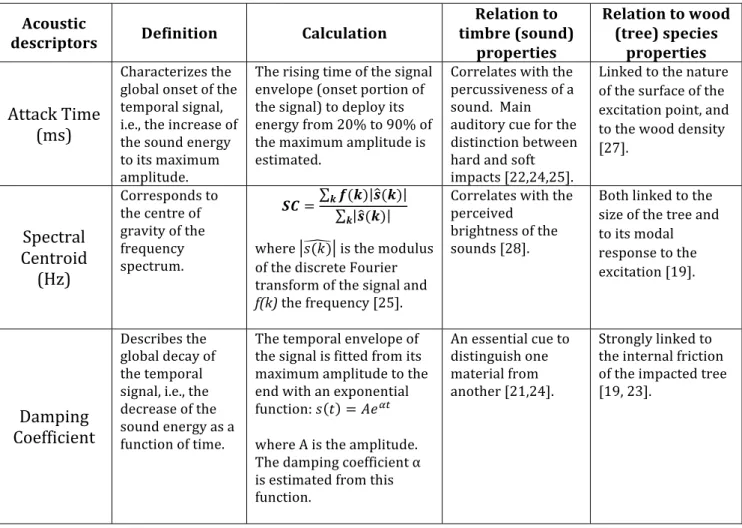
7 revealed through audio descriptors that characterize various sound attributes, such as timbre [21,22,25]. We investigated three timbre descriptors known to reflect intrinsic properties of a tree species: a) the internal friction of the wood species, linked to the way the sounds fade out (Damping Coefficient), b) the hardness of the tree at the impact point, linked to the signal onset (Attack Time) and c) the modal response of the tree to the impact, linked to the center of gravity of the frequency spectrum (Spectral Centroid; Table umérotation2, Figure S1). Note that these descriptors are not a function of the sound recording level (Supplementary Information). For statistical analyses, each of the three timbre descriptors served as a response variable in three linear mixed models (LMMs). All models were run in R version 3.4.3 (R Core Team 2017) using the function ‘lmer’ of the package lme4 [26]. All models comprised the critical test predictors of whether the tree was an AST tree species (y/n), where on the tree the rock was thrown (trunk, buttress or hollow) and the tree’s DBH. LMMs also included multiple control variables including sound recording level, weight of rock and type of rock. Random effects further accounted for repeated observations of impact sounds (i.e., throws) using the same rock, tree species or same individual tree (details in Supplementary Information and File S2).
8
Figure 1. AST sites and a non-AST tree used in this study: a) screenshot from camera-trap video of a Crossopteryx febrifuga AST site, b) an Erythrophleum guineense non-AST tree species, c) a Treculia africana AST site from a camera-trap video, and d) close-up of a Bombax costatum AST site where fresh impact points on the rock and tree are visible (circled in yellow).
9 Table 2. Description of the three timbre descriptors used in this study (cf. Figure S1) and their relation to the perceived sound or timbre produced and how they reflect intrinsic properties of tree species. Acoustic
descriptors Definition Calculation
Relation to timbre (sound) properties Relation to wood (tree) species properties Attack Time (ms) Characterizes the global onset of the temporal signal, i.e., the increase of the sound energy to its maximum amplitude. The rising time of the signal envelope (onset portion of the signal) to deploy its energy from 20% to 90% of the maximum amplitude is estimated. Correlates with the percussiveness of a sound. Main auditory cue for the distinction between hard and soft impacts [22,24,25]. Linked to the nature of the surface of the excitation point, and to the wood density [27]. Spectral Centroid (Hz) Corresponds to the centre of gravity of the frequency spectrum. 𝑺𝑪 = 𝒌𝒇(𝒌) 𝒔(𝒌) 𝒔(𝒌) 𝒌 where 𝑠(𝑘) is the modulus of the discrete Fourier transform of the signal and f(k) the frequency [25]. Correlates with the perceived brightness of the sounds [28]. Both linked to the size of the tree and to its modal response to the excitation [19]. Damping Coefficient Describes the global decay of the temporal signal, i.e., the decrease of the sound energy as a function of time. The temporal envelope of the signal is fitted from its maximum amplitude to the end with an exponential function: 𝑠 𝑡 = 𝐴𝑒./ where A is the amplitude. The damping coefficient α is estimated from this function. An essential cue to distinguish one material from another [21,24]. Strongly linked to the internal friction of the impacted tree [19, 23]. Results The acoustic features of impact sound timbres exhibited significant variation with respect to whether or not the tree was an AST species and the part of the tree impacted by the rock. The other predictor, tree DBH, had no effect on any of the timbre features (Table S2-S4). The absolute damping coefficient was significantly smaller for AST tree species compared to non-AST tree species (χ2=13.27, df=1, P<0.001, N=125; Figure 2a), meaning that impact sounds
10 were more resonant for AST tree species (Figure S1). Damping did not differ depending on the part of the tree impacted (χ2=2.94, df=2, P=0.23, N=125; Table S4). For attack time, impacts on buttress roots had longer attack times relative to the trunk or hollow cavities (χ2=10.86, df=2, P=0.004, N=125; Figure 2c). However, attack time did not differ significantly between AST tree species and non-AST tree species (χ2=2.86, df=1, P=0.09, N=125; Table S2). The spectral
centroid was significantly lower in AST tree species (χ2=5.85, df=1, P=0.02, N=125; Figure S1)
and in buttress roots, while hollow cavities and trunks did not differ from one another (χ2=9.13, df=2, P=0.01, N=125; Figure 2b and 2d).
11
Figure 2. AST tree species relative to non-AST tree species had a) lower absolute damping coefficients and b) a spectral centroid concentrated at lower frequencies. The physical characteristics of where a tree was impacted also affected acoustic properties, namely buttresses had c) a longer attack time and d) a lower spectral centroid. Medians of all impact sounds (i.e., throws) per category are represented by solid horizontal lines and model estimates by dashed horizontal lines when all other variables are at their average value.
12
Coloured boxes represent quartiles and vertical lines show 2.5% and 97.5% of the data. Asterisks indicate significance levels (P<0.05=*; P<0.001=***) or otherwise non-significant. Sample size is 125 impact sounds for all models.
Discussion
These results show that chimpanzees use AST tree species that produce resonating impact sounds with spectral energy concentrated in the lower frequencies. Buttress roots are also an important AST tree feature because they emit low frequency impact sounds and have longer attack times, meaning a longer sound duration. However, buttress roots cannot account for all the variation observed since two AST tree species never develop buttresses but instead often form hollow cavities (Crossopteryx febrifuga and Markhamia tomentosa). Moreover, tree species, target of throw and DBH were all tested simultaneously thereby accounting for the average effect of one whilst testing the significance of the other.
The longer attack time suggests that buttress roots are softer or more pliant than trunks or hollow cavities. This seems counterintuitive since buttress roots function as mechanical supports or tension elements [29]. However, the function of buttress roots is not well understood, and a single explanation is unlikely to apply to all species since their anatomy demonstrates a large degree of variability due to the trade-off between structural integrity and vascularization [29,30]. The latter predicts roots that should be more pliant, whereas the former suggests a reduction in elasticity. These factors, including age and bark composition, may affect how hard or soft the root or tree is when impacted by a rock. Large variation in throw force may also influence attack time despite standardization of the throw gesture and experimenter. However, attack time was not a distinguishing feature of AST tree species (Table
13
S2), therefore a systematic experimental bias in throw force variation is unlikely (see also Supplementary Information).
Overall, this study suggests that at least one function of AST behaviour is sound production. Low frequency sounds travel further in the environment and are better suited for long-distance communication [23]. A sound that is more resonant will also persist in the environment for longer which is characteristic of AST tree species. However, with respect to sound transmission, a single throw would be less effective than the multiple beats characteristic of chimpanzee buttress drumming [20]. Moreover, AST is almost always accompanied by a pant-hoot vocalization [14] which is far more conspicuous than the impact sound. Therefore, despite our evidence for one functional explanation for AST, there must be additional explanations to account for the persistence of this behaviour in some communities. Only 39 individual trees had any signs of use by chimpanzees out of the potentially hundreds of AST trees available (Table 1). Future research should focus on testing the factors influencing individual tree and tool selection, including, testing more tree species, and more trees per species. Additional studies investigating putative cultural aspects of AST would also be important for their potential to assist chimpanzee conservation efforts in the wild [13,31]. Acknowledgements: We thank the Chimbo Foundation, particularly Annemarie Goedemakers, and Abdullai Diallo, Djey Balde, and Balue Séra for excellent assistance in the field. AKK thanks Adam van Casteren for discussions about buttress root mechanics, Will Archer for help with rock typology and Christophe Boesch and Hjalmar Kühl for their support. We thank Christian Rutz and two anonymous reviewers for suggestions that improved this manuscript.
Funding: This study was funded by a National Geographic Exploration Grant #GEFNE171-16 and the Max Planck Society.
14 References 1. Bradbury JW, Vehrencamp S. 1998 Principles of Animal Communication. Sunderland, Mass.: Sinauer Associates. 2. Lardner B, Lakim M bin. 2002 Animal communication: tree-hole frogs exploit resonance effects. Nature 420, 475. (doi:10.1038/420475a) 3. Tan W-H, Tsai C-G, Lin C, Lin YK. 2014 Urban canyon effect: storm drains enhance call characteristics of the Mientien tree frog. Journal of Zoology 294, 77–84. (doi:10.1111/jzo.12154) 4. Mhatre N, Malkin R, Deb R, Balakrishnan R, Robert D. 2017 Tree crickets optimize the acoustics of baffles to exaggerate their mate-attraction signal. eLife 6. (doi:10.7554/eLife.32763) 5. Fitch WT, Hauser MD. 2003 Unpacking “honesty”: vertebrate vocal production and the evolution of acoustic signals. In Acoustic Communication (eds AM Simmons, RR Fay, AN Popper), pp. 65–137. New York, NY: Springer. (doi:10.1007/0-387-22762-8_3) 6. Shumaker RW, Walkup KR, Beck BB. 2011 Animal Tool Behavior: The Use and Manufacture of Tools by Animals. Baltimore, Maryland: JHU Press. 7. Sanz CM, Call J, Boesch C. 2013 Tool Use in Animals: Cognition and Ecology. Cambridge, UK: Cambridge University Press. 8. Bentley-Condit VK, Smith EO. 2010 Animal tool use: current definitions and an updated comprehensive catalog. Behaviour 147, 185–221. (doi:10.1163/000579509X12512865686555) 9. Heinsohn R, Zdenek CN, Cunningham RB, Endler JA, Langmore NE. 2017 Tool-assisted rhythmic drumming in palm cockatoos shares key elements of human instrumental music. Science Advances 3, e1602399. (doi:10.1126/sciadv.1602399) 10. Hardus ME, Lameira AR, van Schaik CP, Wich SA. 2009 Tool use in wild orang-utans modifies sound production: a functionally deceptive innovation? Proceedings of the Royal Society of London B: Biological Sciences 276, 3689–3694. (doi:10.1098/rspb.2009.1027) 11. Whiten A, Goodall J, McGrew WC, Nishida T, Reynolds V, Sugiyama Y, Tutin CEG, Wrangham R, Boesch C. 1999 Cultures in chimpanzees. Nature 399, 682–685. (doi:10.1038/21415) 12. Kalan AK, Boesch C. 2018 Re-emergence of the leaf clip gesture during an alpha takeover affects variation in male chimpanzee loud calls. PeerJ 6, e5079. (doi:10.7717/peerj.5079)
15 13. Kühl HS et al. 2019 Human impact erodes chimpanzee behavioral diversity. Science 363, 1453–1455. (doi:10.1126/science.aau4532) 14. Kühl HS et al. 2016 Chimpanzee accumulative stone throwing. Scientific Reports 6, 22219. (doi:10.1038/srep22219) 15. Hamilton WJ, Buskirk RE, Buskirk WH. 1975 Defensive stoning by baboons. Nature 256, 488–489. (doi:10.1038/256488a0) 16. Goodall J. 1964 Tool-using and aimed throwing in a community of free-living chimpanzees. Nature 201, 1264–1266. (doi:10.1038/2011264a0) 17. Moura AC de A. 2007 Stone banging by wild capuchin monkeys: an unusual auditory display. Folia Primatologica 78, 36–45. (doi:10.1159/000095684) 18. Leca J-B, Nahallage CAD, Gunst N, Huffman MA. 2008 Stone-throwing by Japanese macaques: form and functional aspects of a group-specific behavioral tradition. Journal of Human Evolution 55, 989–998. (doi:10.1016/j.jhevol.2008.06.004) 19. Falótico T, Ottoni EB. 2013 Stone throwing as a sexual display in wild female bearded capuchin monkeys, Sapajus libidinosus. PLOS ONE 8, e79535. (doi:10.1371/journal.pone.0079535) 20. Arcadi AC, Robert D, Boesch C. 1998 Buttress drumming by wild chimpanzees: temporal patterning, phrase integration into loud calls, and preliminary evidence for individual distinctiveness. Primates 39, 505–518. (doi:10.1007/BF02557572) 21. Aramaki M, Besson M, Kronland-Martinet R, Ystad S. 2011 Controlling the perceived material in an impact sound synthesizer. IEEE Transactions on Audio, Speech, and Language Processing 19, 301–314. (doi:10.1109/TASL.2010.2047755) 22. Aramaki M, Baillères H, Brancheriau L, Kronland-Martinet R, Ystad S. 2007 Sound quality assessment of wood for xylophone bars. The Journal of the Acoustical Society of America 121, 2407–2420. (doi:10.1121/1.2697154) 23. Waser PM, Brown CH. 1986 Habitat acoustics and primate communication. American Journal of Primatology 10, 135–154. (doi:10.1002/ajp.1350100205) 24. Aramaki M, Gondre C, Kronland-Martinet R, Voinier T, Ystad S. 2009 Imagine the sounds: an intuitive control of an impact sound synthesizer. In Auditory Display, pp. 408–421. Berlin, Heidelberg: Springer. 25. McAdams S, Winsberg S, Donnadieu S, De Soete G, Krimphoff J. 1995 Perceptual scaling of synthesized musical timbres: common dimensions, specificities, and latent subject classes. Psychological Research 58, 177–192. (doi:10.1007/BF00419633)
16 26. Bates D, Maechler M, Bolker B, Walker S, Christensen RHB, Singmann H, Dai B, Grothendieck G, Green P. 2016 lme4: Linear Mixed-Effects Models using ‘Eigen’ and S4. See https://cran.r-project.org/web/packages/lme4/index.html. 27. Freed DJ. 1990 Auditory correlates of perceived mallet hardness for a set of recorded percussive sound events. The Journal of the Acoustical Society of America 87, 311–322. (doi:10.1121/1.399298) 28. Beauchamps JW. 1982 Synthesis by spectral amplitude and ‘brightness’ matching of analyzed musical intrument tones. Journal of the Audio Engineering Society 30, 396–406. 29. Clair B, Fournier M, Prevost M-F, Beauchêne J, Bardet S. 2003 Biomechanics of buttressed trees: bending strains and stresses. American Journal of Botany 90, 1349–1356. (doi:10.3732/ajb.90.9.1349) 30. Christensen-Dalsgaard KK, Fournier M, Ennos AR, Barfod AS. 2007 Changes in vessel anatomy in response to mechanical loading in six species of tropical trees. New Phytologist 176, 610–622. (doi:10.1111/j.1469-8137.2007.02227.x) 31. Brakes P et al. 2019 Animal cultures matter for conservation. Science 363, 1032–1034. (doi:10.1126/science.aaw3557)
17 Supplementary Tables & Figures Supplementary Table S1. Data summarizing the rocks used to impact trees during field experiments where impact sounds were suitable for acoustic and statistical analyses. Three standardized rocks were used during the course of the experiment (SI1, SI2, SI3) supplemented by other rocks assumed to be chimpanzee tools based on impact signs at AST sites.
rock ID type weight (kg) length (cm) width (cm) height (cm)
SI1 igneous 3.00 16 15 8 SI2 laterite 3.00 16 16 7 SI3 igneous 3.00 16 14 8 rock A laterite 8.50 22 17 15 rock B laterite 6.00 18 15 12 rock C laterite 3.50 18 12 11 rock D laterite 2.25 14 13 8 rock E laterite 3.25 19 13 9 rock F laterite 3.75 17 15 8 rock G laterite 3.25 16 13 8 Supplementary Table S2. LMM results for attack time (ms*1000) as the response variable.
estimate ± SE T Chisq df P CI 2.5% CI 97.5%
Intercept 4.22 ± 0.75 5.65 - - - 2.70 5.69 throw.target.hollo w -1.40 ± 0.67 -2.10 10.86 2 0.004 -2.83 0.04 throw.target.trunk -2.07 ± 0.55 -3.73 -3.92 -0.94 ASTspecies.yes 0.97 ± 0.61 1.60 2.86 1 0.09 -0.25 2.24 z.tree.dbh 0.42 ± 0.26 1.60 2.28 1 0.13 -0.17 1.47 z.stoneweight -0.04 ± 0.17 -0.25 0.06 1 0.80 -0.63 0.52 stone.type.laterite -0.10 ± 0.32 -0.32 0.10 1 0.75 -0.78 0.68 recording.level.3 0.24 ± 0.48 0.50 0.21 1 0.65 -0.95 1.34 Full versus null model comparison χ2=18.84, df=4, P<0.001, N=125 Supplementary Table S3. LMM results for spectral centroid (Hz) as the response variable.
18 Intercept 3910 ± 559 7.00 - - - 2731 5086 throw.target.hollow 2840± 638 4.45 9.13 2 0.010 937 4352 throw.target.trunk 2073 ± 347 5.97 1114 2798 ASTspecies.yes -1590 ± 643 -2.47 5.85 1 0.016 -2932 -181 z.tree.dbh 491 ± 289 1.70 0.63 1 0.43 -1057 1176 z.stoneweight -93 ± 91 -1.02 0.99 1 0.32 -419 369 stone.type.laterite -284 ± 165 -1.73 2.14 1 0.14 -776 121 recording.level.3 -15 ± 169 -0.09 0.007 1 0.93 -469 350 Full versus null model comparison χ2=23.33, df=4, P<0.001, N=125 Supplementary Table S4. LMM results for the absolute damping coefficient as the response.
estimate ± SE T Chisq Df P CI 2.5% CI 97.5%
Intercept 126 ± 17 7.50 - - - 92.5 163 throw.target.hollow 22.5 ± 15 1.46 2.94 2 0.23 -15.3 61.8 throw.target.trunk 24.2 ± 13 1.88 -13.7 51.2 ASTspecies.yes -59.5 ± 14 -4.23 13.27 1 0.0003 -104.4 -29.5 z.tree.dbh -0.23 ± 5.6 -0.04 0.002 1 0.97 -15.2 28.3 z.stoneweight 12.69 ± 6.1 2.07 2.82 1 0.09 -3.58 35.5 stone.type.laterite -11.0 ± 7.4 -1.50 2.04 1 0.15 -40.4 5.43 recording.level.3 15.8 ± 6.9 2.31 5.11 1 0.024 2.30 37.6 Full versus null model comparison χ2=15.62, df=4, P<0.01, N=125 Supplementary Table S5. Summary of the sound field experiment. Throws were repeated with each rock thrown at a tree for a total of 172 impact sound recordings (see also Table S1).
tree.no date time* AST or non-AST species rocks used throw targets of throws total no. 1 March 2, 2017 9:13 AST species SI1, SI2, rockH buttress, trunk, hollow 14
19
2 March 2, 2017 9:45 AST species SI1, SI2 buttress 4 3 March 2, 2017 10:14 AST species SI1, SI2 buttress 4 4 March 2, 2017 10:52 AST species SI1, SI2 buttress 4 5 March 2, 2017 11:15 non-AST species SI1, SI2 trunk 4
6 March 2, 2017 11:48 AST species SI1, SI2 trunk 4
7 March 2, 2017 12:00 non-AST species SI1, SI2 trunk 5 8 March 3, 2017 8:34 AST species SI1, SI2, rockA hollow 6 9 March 3, 2017 9:05 non-AST species SI1, SI2 trunk 4 10 March 3, 2017 9:18 non-AST species SI1, SI2 trunk 4 11 March 3, 2017 10:37 non-AST species SI1, SI2 trunk 4 12 March 3, 2017 11:22 AST species SI1, SI2, rockB, rockC trunk, hollow 24 13 March 4, 2017 8:07 AST species SI3, SI2, rockJ buttress 6 14 March 4, 2017 8:37 AST species SI3, SI2, rockD buttress 6 15 March 4, 2017 9:15 non-AST species SI3, SI2 trunk 4 16 March 4, 2017 9:48 non-AST species SI3, SI2 trunk 4 17 March 4, 2017 10:24 non-AST species SI3, SI2 trunk 4 18 March 4, 2017 11:20 non-AST species SI3, SI2 trunk 4 19 March 4, 2017 11:45 non-AST species SI3, SI2 trunk 4 20 March 6, 2017 8:42 AST species SI3, SI2, rockE trunk, buttress 12 21 March 6, 2017 10:00 AST species SI3, SI2, rockF trunk, buttress 13 22 March 6, 2017 10:54 non-AST species SI3, SI2, rockG* trunk 6 23 March 6, 2017 11:33 non-AST species SI3, SI2 trunk 4 24 March 6, 2017 11:46 non-AST species SI3, SI2 trunk 4 25 March 11, 2017 8:15 AST species SI3, SI2 trunk, buttress 8 26 March 11, 2017 8:54 AST species SI3, SI2 buttress 4 27 March 11, 2017 10:18 AST species SI3, SI2 hollow 8
*We found a site with no impact marks on the tree but rocks accumulated at the base, few with slight impact signs. One of these rocks was used as an additional impactor during the experiment. However, camera-trap data failed to confirm any AST behaviour by chimpanzees here. Instead observations over the course of the study suggest the rocks may have been used to aid food processing by primates which is why they had marks but not the tree.
20
Figure S1. Signal representations of an impact sound recorded on a a) non-AST tree, Erythrophleum guineense, and an b) AST tree Ceiba pentandra using the same impactor and recording level. The upper part of the figure corresponds to the sound pressure signal with respect to time (black). The temporal envelope (gray line), the attack time (red) and the exponential function (magenta) on which the damping coefficient is estimated are also represented. This signal clearly lasts longer for the AST tree (i.e., a weaker damped exponential function and consequently a lower damping coefficient). The middle part corresponds to the frequency spectrum of the sound pressure signal, showing emergent resonances around 100Hz for the AST tree. The spectral centroids are indicated at blue line positions. The lower part corresponds to the modulus of the time-frequency representation of the sound pressure signal obtained by Short-Time Fourier Transform. This illustrates the genuine acoustic signature of the two impact sounds by highlighting both the time and the frequency behaviour of the sounds generated. Again, the lower damping of the emergent resonances in the AST tree is visible. (a) (b)
21
Supplementary Information Field Experiment Details
Field experiments were intentionally conducted within a short period during the dry season (March 2nd - 11th), to keep climatic variables as similar as possible (rainfall was 0 mm and
mean temperature was 30.6˚C; range: 17.2 - 44.8˚C), since wood expands with heat and moisture resulting in variation in wood properties that can change acoustic properties [1]. Only six of the seven tree species observed for AST behaviour were used in the experiments because one (Markhamia tomentosa) was only clearly identified as different from another AST tree species (Crossopteryx febrifuga) at the end of the field season. For non-AST species, we chose seven species from the 28 remaining tree species clearly identified during reconnaissance surveys. These seven non-AST tree species were chosen because they were relatively abundant, have a DBH (diameter at breast height) greater than 35cm (the smallest mean DBH of an AST tree species; Table 1), as well as having no thorns or spikes protruding from their bark. We aimed to have all experiments completed before midday and randomised testing of AST and non-AST species within days when possible (Table S5). Field Experiments- Standardized Throwing Gesture To standardize throws, the microphone stand was always positioned at a horizontal distance of 1.4m from the base of the tree, AKK was positioned 1m from the centre of the microphone stand’s base and 1m horizontal distance from the base of the tree. AKK held the rock with her elbows resting against the inner sides of both knees whilst bent at the hips with legs straight. A target impact point for the tree was temporarily marked with flagging tape at 75cm above ground. All throws were underhand with the initial position of the rock being in-between AKK’s feet, hovering above the floor and parallel to her legs. The rock was then released once it was level with her knees. The dimensions and weight of all rocks thrown were measured beforehand and all presumed chimpanzee tools were handled with sterile gloves and put back in their original position. Only chimpanzee tools that had fresh impact signs at AST sites and were easily accessible were used to cause minimal disruption to sites. Two sound recording levels were used to strike a balance between a good signal to noise ratio and to avoid microphone clipping.
22
The attack time characterizes the signal onset and corresponds to the time it takes for the signal to reach 90% of its maximum amplitude [1]. This sound descriptor correlates with the percussiveness of a sound and is one of the main auditory cues for the distinction between hard and soft impacts [2]. The spectral centroid is the centre of gravity of the modulus of the frequency spectrum. It is known to be strongly correlated with the perceived brightness of the sounds [3]. As opposed to the attack time, which is a temporal timbre descriptor, the spectral centroid is a spectral descriptor. Finally, the damping coefficient describes the global decay of the temporal signal, in other words the decrease of the sound energy as a function of time. The damping coefficient is strongly linked to the material properties of the impacted object and is an essential cue to distinguish one material category from another for the generation of sounds [2,4]. In our study, impact sounds result from the interaction between the thrown rock and the tree at a given excitation point. Attack time was multiplied by 1000 to ease interpretation of model estimates since absolute values produced by the algorithm were in milliseconds (Table S2). Similarly, the absolute damping coefficient was used since all values were negative due to the natural decreasing of the sounds (Table S4 and Figure 2). Among the three acoustic descriptors used in this study, the attack time and the spectral centroid might be influenced by the hardness of the impact (i.e., throwing force) and the excitation point. However, since the thrower’s gesture was carefully controlled, the throwing force was comparably similar across throws. Note that despite our attempts to be standardized in throws, small variations in force could have occurred. As predicted by the modal analysis technique, substantial variations of impact force may influence the frequency range on which the resonances of the tree are excited, i.e., the harder the impact, the larger the frequency range. However, for small variations of force such as in our study, and considering that due to the relationship between the size of the trees and the size of the rocks, we are in the context of so-called linear vibrations. Only the global energy of the acoustic signals may be influenced, hereby the signal intensity, which was not considered as a descriptor in the analyses. The natural resonances of the tree excited by the impact (characterized by resonance frequencies and damping) are uncorrelated with the throwing force. Hence for a given type of rock and excitation point, we assume that the three timbre descriptors primarily characterize the intrinsic acoustic properties of the trees. For example, the internal friction of the wood species is linked to the way the sound decays (Damping Coefficient) as the sound energy is altered by both dispersion and dissipation phenomena which occur when acoustic waves propagate in the
23
medium. The hardness of the tree bark at impact point is linked to the signal onset (Attack
Time) and the modal response of the tree to the impact is linked to the center of gravity of the
frequency spectrum (Spectral Centroid). In addition, the descriptor measurements are not influenced by recording level, meaning that no normalisation process was needed to analyse the impact sounds. The fact that attack time was not a significant descriptor for separating AST and non-AST trees but damping coefficient was, further support the hypothesis that any unconscious bias that may have resulted in variation in force by the experimenter did not obviously differ between AST and non-AST tree throws.
Statistical Analyses- Details of Linear Mixed Models
Models were fit with a Gaussian error distribution and default identity link function for LMMs since all response variables were continuous and assumed to follow a normal distribution [5,6]. These assumptions were verified by ensuring residuals were homogeneous and normally distributed via visual inspection of QQ-plots and plotting residuals against fitted values, indicating no violations. All LMMs were fit with the function ‘lmer’ of the package lme4 in R with the argument REML set to false to obtain maximum likelihood estimates [6,7]. All continuous fixed effects were z-transformed before running the models and all categorical predictors were dummy coded and centred. Random slopes for all fixed effects within the levels of the random effects were included when applicable (see Supplementary Information S2 for detailed R code of the Linear Mixed Models). We further checked for collinearity among fixed effects by running a linear model with no random effects and calculating the Variance Inflation Factors (VIFs) for all predictors [8] using the function ‘vif’ of the package car [9]. VIFs were between 1.01-1.31 demonstrating negligible collinearity. Model stability was verified by removing levels of random effects one at a time and ensuring model estimates did not vary strongly. Model significance was first assessed by conducting a full versus null model comparison using a likelihood ratio test with the function ‘anova’ set to a Chisq approximation [10]. If this showed significance (P<0.05) we determined the significance of individual test predictors using the ‘drop1’ function, again set to a Chisq approximation, to calculate likelihood ratio tests [5,11]. For significant categorical predictors, a post hoc test was conducted using the function ‘glht’ from the package multcomp with pairwise comparisons using a Tukey test [12]. To ensure our results were robust if only standardized rocks were used in the experiment, we further tested whether the removal of throws produced by rocks other than the standardized ones (i.e., S1,
24
S2, S3; Table S1) changed any of our results. These LMMs could no longer include rock type because it is collinear with standardized rock ID, and standardized rock ID was fit as a fixed rather than random effect since three levels are insufficient for fitting random effects [5,6]. All other aspects of these LMMs remained the same, as described above. Despite the lower sample size (N=103 impact sounds) there was no change in significance for any of the full versus null model comparisons, nor any of the predictors, other than the effect of AST species on the absolute damping coefficient becoming P<0.01 rather than P<0.001 and the control variable of sound recording level no longer had a significant effect on damping measurements (Table S4). References 1. Aramaki M, Baillères H, Brancheriau L, Kronland-Martinet R, Ystad S. 2007 Sound quality assessment of wood for xylophone bars. The Journal of the Acoustical Society of America 121, 2407–2420. (doi:10.1121/1.2697154) 2. McAdams S, Winsberg S, Donnadieu S, De Soete G, Krimphoff J. 1995 Perceptual scaling of synthesized musical timbres: common dimensions, specificities, and latent subject classes. Psychological Research 58, 177–192. (doi:10.1007/BF00419633) 3. Beauchamps JW. 1982 Synthesis by spectral amplitude and ‘brightness’ matching of analyzed musical intrument tones. Journal of the Audio Engineering Society 30, 396–406. 4. Aramaki M, Besson M, Kronland-Martinet R, Ystad S. 2011 Controlling the perceived material in an impact sound synthesizer. IEEE Transactions on Audio, Speech, and Language Processing 19, 301–314. (doi:10.1109/TASL.2010.2047755) 5. Dobson AJ, Barnett A. 2008 An Introduction to Generalized Linear Models. 3rd edition. Boca Raton, FL: Chapman and Hall/CRC. 6. Bates D, Mächler M, Bolker B, Walker S. 2015 Fitting linear mixed-effects models using lme4. Journal of Statistical Software 67, 1–48. (doi:10.18637/jss.v067.i01) 7. Bates D, Maechler M, Bolker B, Walker S, Christensen RHB, Singmann H, Dai B, Grothendieck G, Green P. 2016 lme4: Linear Mixed-Effects Models using ‘Eigen’ and S4. See https://cran.r-project.org/web/packages/lme4/index.html. 8. Bowerman BL, O’Connell R. 2000 Linear Statistical Models: An Applied Approach. 2nd edition. Belmont, CA: Duxbury Press. 9. Fox J, Weisberg HS. 2001 An R Companion to Applied Regression. Thousand Oaks, CA: Sage Publications.
25 10. Forstmeier W, Schielzeth H. 2011 Cryptic multiple hypotheses testing in linear models: overestimated effect sizes and the winner’s curse. Behav Ecol Sociobiol 65, 47–55. (doi:10.1007/s00265-010-1038-5) 11. Barr DJ, Levy R, Scheepers C, Tily HJ. 2013 Random effects structure for confirmatory hypothesis testing: keep it maximal. Journal of Memory and Language 68, 255–278. (doi:10.1016/j.jml.2012.11.001) 12. Hothorn T, Bretz F, Westfall P, Heiberger RM, Schuetzenmeister A, Scheibe S. 2017 multcomp: Simultaneous Inference in General Parametric Models. See https://cran.r-project.org/web/packages/multcomp/multcomp.pdf.