
Long range time transfer with optical fiber links and cross comparisons with satellite based methods
182
0
0
Texte intégral
(2)
(3)
(4) i. Acknowledgements. I am heartily thankful to my supervisors for their immense help and support. Their enlightening discussions and constant motivation have been the guiding light throughout the journey of my thesis. In addition to the rich professional learning experience that I have gained while working with them, the time spent with them has strengthened and shaped my personality. I wish to express my deep gratitude for their generosity, affection, and understanding. It has been an honor and an absolute pleasure to work with them and I am very grateful for this life-changing opportunity. I would like to thank Javier Diaz, Rafa Rogriguez, J. Gabriel Ramirez at Seven Solutions and Felipe Torres Gonzalez at University of Granada, Spain for their collaboration and support. I would also like to thank the White Rabbit community for their help by sharing issues through the mailing list and would like to specially thank Javier Serrano, Alessandro Rubini, T. Wlostowski and Mattia Rizzi at CERN for their help and support. I would also take the opportunity to thank Noel Dimarcq for his stimulating conversations and goodwill. I would specially like to thank the members of SYRTE belonging to Time and Frequency group, Electronics group, Computing group, Fiber link group and administration for their continuous help, support and for their valuable time for urgent matters. I extend my profound gratitude to my Mom and Dad for being my ever increasing strength and motivation. I would also like to acknowledge my family and all my dearest friends, specially Navnina and Vishnu for being my backbone and for always being there in difficult times. I am truly grateful and I cherish their invaluable friendship. This work was supported by the LABEX Cluster of Excellence FIRST-TF (ANR10-LABX-48-01), within the Program d’Investissements d’Avenir and by BPIFrance under the SCP Time project..
(5)
(6) iii. I dedicate this thesis to my Mom and Dad..
(7)
(8) v. Contents Acknowledgements. i. 1. Introduction. 1. 1.1. Time and frequency metrology . . . . . . . . . . . . . . . . . . . . . . .. 1. 1.1.1. Accuracy . . . . . . . . . . . . . . . . . . . . . . . . . . . . . . . .. 1. 1.1.2. Stability . . . . . . . . . . . . . . . . . . . . . . . . . . . . . . . .. 2. 1.2. The Oscillator signal . . . . . . . . . . . . . . . . . . . . . . . . . . . . .. 2. 1.3. Noise analysis . . . . . . . . . . . . . . . . . . . . . . . . . . . . . . . . .. 3. 1.3.1. Frequency domain . . . . . . . . . . . . . . . . . . . . . . . . . .. 3. 1.3.2. Time domain . . . . . . . . . . . . . . . . . . . . . . . . . . . . .. 4. 1.3.2.1. Allan Variance . . . . . . . . . . . . . . . . . . . . . . .. 4. 1.3.2.2. Overlapping Allan Variance . . . . . . . . . . . . . . .. 5. 1.3.2.3. Modified Allan Variance . . . . . . . . . . . . . . . . .. 5. 1.3.2.4. Time Variance . . . . . . . . . . . . . . . . . . . . . . .. 5. 1.4. Clocks and timescales . . . . . . . . . . . . . . . . . . . . . . . . . . . .. 6. 1.5. Introduction to time transfer methods . . . . . . . . . . . . . . . . . . .. 8. 1.5.1. One way time transfer method . . . . . . . . . . . . . . . . . . .. 8. 1.5.1.1. GNSS time dissemination . . . . . . . . . . . . . . . . .. 9. 1.5.1.2. GNSS time transfer methods . . . . . . . . . . . . . . . 10. 1.5.2. Two way time transfer method . . . . . . . . . . . . . . . . . . . 11. 1.5.3. Two way Satellite Time and Frequency transfer (TWSTFT) . . . 13. 1.5.4. Time and frequency transfer over Optical fiber links . . . . . . . 15. 1.5.5. Time over Internet . . . . . . . . . . . . . . . . . . . . . . . . . . 16. 1.5.6 1.6. 1.7. 1.5.5.1. Network Time Protocol (NTP) . . . . . . . . . . . . . . 16. 1.5.5.2. Precision Time Protocol . . . . . . . . . . . . . . . . . . 17. 1.5.5.3. SONET and SDH . . . . . . . . . . . . . . . . . . . . . 18. 1.5.5.4. White Rabbit PTP (WR-PTP) . . . . . . . . . . . . . . . 18. Performance comparison of some time transfer methods . . . . 19. Implemented and Potential applications of White Rabbit . . . . . . . . 20 1.6.1. For Scientific experiments . . . . . . . . . . . . . . . . . . . . . . 20. 1.6.2. Calibration in the RF domain . . . . . . . . . . . . . . . . . . . . 21. 1.6.3. Smart power grids . . . . . . . . . . . . . . . . . . . . . . . . . . 21. 1.6.4. 5G mobile networks . . . . . . . . . . . . . . . . . . . . . . . . . 21. 1.6.5. Financial transactions and timestamping . . . . . . . . . . . . . 21. Outline of the thesis . . . . . . . . . . . . . . . . . . . . . . . . . . . . . . 21.
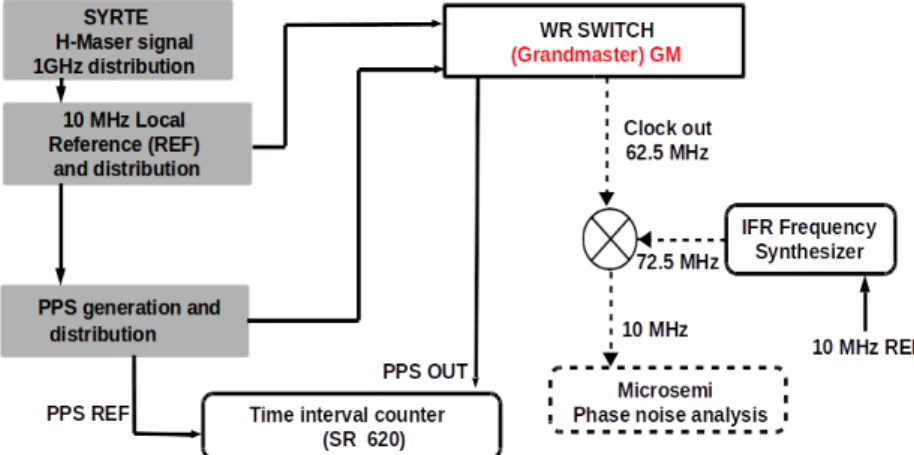
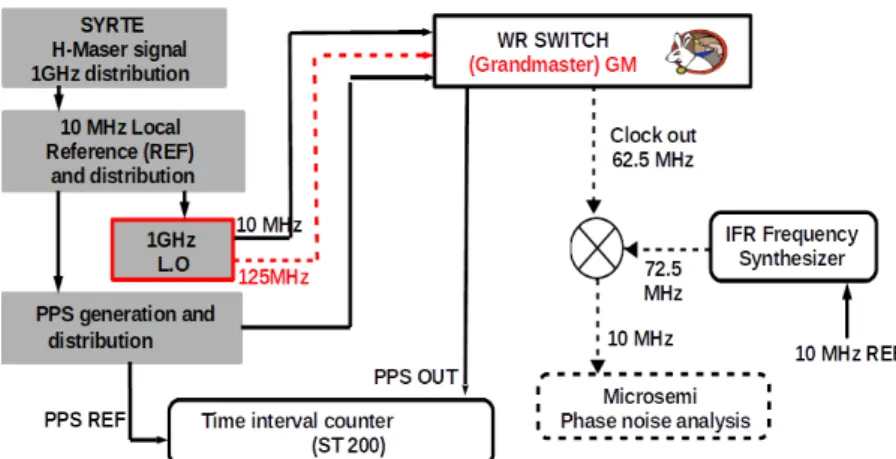
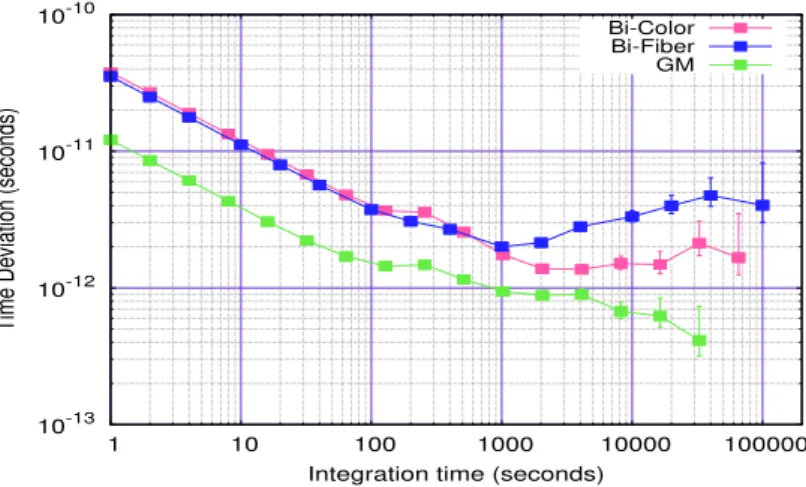
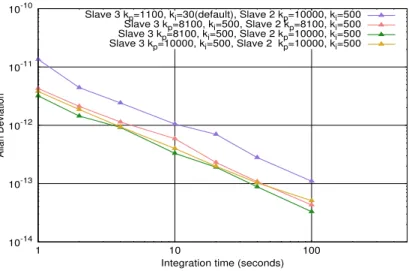
(9) vi 2. Introduction to White Rabbit Precision Time Protocol (WR-PTP). 23. 2.1. Introduction to WR project . . . . . . . . . . . . . . . . . . . . . . . . . . 23. 2.2. Introduction to WR-PTP . . . . . . . . . . . . . . . . . . . . . . . . . . . 23 2.2.1. Precision time Protocol (PTP) . . . . . . . . . . . . . . . . . . . . 23. 2.2.2. Synchronous Ethernet . . . . . . . . . . . . . . . . . . . . . . . . 26. 2.2.3. Digital Dual Mixer time difference (DDMTD) phase detector . . 26. 2.3. A typical White Rabbit Network . . . . . . . . . . . . . . . . . . . . . . 28. 2.4. Synchronization in White Rabbit . . . . . . . . . . . . . . . . . . . . . . 29 2.4.1. Syntonization . . . . . . . . . . . . . . . . . . . . . . . . . . . . . 30. 2.4.2. Link Delay measurement . . . . . . . . . . . . . . . . . . . . . . 30. 2.4.3. Link asymmetry evaluation . . . . . . . . . . . . . . . . . . . . . 31. 2.4.4. Clock offset evaluation . . . . . . . . . . . . . . . . . . . . . . . . 34. 2.5. Unification of White Rabbit into PTP . . . . . . . . . . . . . . . . . . . . 34. 2.6. Components of a White Rabbit Network . . . . . . . . . . . . . . . . . . 35. 2.7. White Rabbit equipment . . . . . . . . . . . . . . . . . . . . . . . . . . . 35 2.7.1. The White Rabbit Switch . . . . . . . . . . . . . . . . . . . . . . . 35. 2.7.2. The White Rabbit Nodes . . . . . . . . . . . . . . . . . . . . . . . 36. 2.8. Optical emitters . . . . . . . . . . . . . . . . . . . . . . . . . . . . . . . . 37. 2.9. The transmission medium - Optical fibers . . . . . . . . . . . . . . . . . 38. 2.10 White Rabbit clocking Scheme . . . . . . . . . . . . . . . . . . . . . . . . 41 2.11 The potential performance limitations . . . . . . . . . . . . . . . . . . . 42 2.12 Outlook . . . . . . . . . . . . . . . . . . . . . . . . . . . . . . . . . . . . . 45 3. Improving the White Rabbit Switch performance. 47. 3.1. Introduction . . . . . . . . . . . . . . . . . . . . . . . . . . . . . . . . . . 47. 3.2. The White Rabbit Switch in Grandmaster mode . . . . . . . . . . . . . 47. 3.3. 3.4. 3.5. 3.2.1. Experimental setup . . . . . . . . . . . . . . . . . . . . . . . . . . 47. 3.2.2. Phase noise power spectral density . . . . . . . . . . . . . . . . . 48. Improving the Grandmaster WRS performance . . . . . . . . . . . . . . 49 3.3.1. Phase noise Power Spectral Density and Allan Deviation . . . . 50. 3.3.2. Time Stability performance . . . . . . . . . . . . . . . . . . . . . 53. Performance of a Slave White Rabbit Switch . . . . . . . . . . . . . . . 55 3.4.1. Testing Optical link configurations . . . . . . . . . . . . . . . . . 55. 3.4.2. Experimental setup . . . . . . . . . . . . . . . . . . . . . . . . . . 55. 3.4.3. Effect of Chromatic dispersion . . . . . . . . . . . . . . . . . . . 56. 3.4.4. Results . . . . . . . . . . . . . . . . . . . . . . . . . . . . . . . . . 58. Improving the performance of a Slave WRS . . . . . . . . . . . . . . . . 60 3.5.1. Phase Locked Loops (PLL) . . . . . . . . . . . . . . . . . . . . . 60. 3.5.2. Experimental Setup . . . . . . . . . . . . . . . . . . . . . . . . . . 62. 3.5.3. Phase locked loop Bandwidth variation . . . . . . . . . . . . . . 62. 3.5.4. A mid range White Rabbit link . . . . . . . . . . . . . . . . . . . 65. 3.5.5. Phase locked loop bandwidth optimization . . . . . . . . . . . . 65.
(10) vii 3.5.6. 4. 3.6. The Local Oscillator performance . . . . . . . . . . . . . . . . . . . . . . 68. 3.7. Increasing the PTP message exchange rate . . . . . . . . . . . . . . . . . 70. 3.8. Summary . . . . . . . . . . . . . . . . . . . . . . . . . . . . . . . . . . . . 72. Towards long range time and frequency dissemination using White Rabbit 74 4.1. Introduction . . . . . . . . . . . . . . . . . . . . . . . . . . . . . . . . . . 74. 4.2. A realistic Telecommunication network span . . . . . . . . . . . . . . . 74 Experimental Setup . . . . . . . . . . . . . . . . . . . . . . . . . . 74. 4.2.2. Phase locked loop Bandwidth optimization . . . . . . . . . . . . 75. 4.2.3. Experimental results . . . . . . . . . . . . . . . . . . . . . . . . . 76. 4.2.4. Fiber thermal noise . . . . . . . . . . . . . . . . . . . . . . . . . . 78. 4.2.5. Limitations for the time stability performance . . . . . . . . . . 81. Effect of Chromatic Dispersion . . . . . . . . . . . . . . . . . . . . . . . 82. 4.4. Tackling Chromatic Dispersion . . . . . . . . . . . . . . . . . . . . . . . 84. 4.5. Cascaded White Rabbit links using DWDM technique . . . . . . . . . . 85. 4.7. 4.8. 6. 4.2.1. 4.3. 4.6. 5. Frequency and Time stability performance . . . . . . . . . . . . 67. 4.5.1. Experimental Setup . . . . . . . . . . . . . . . . . . . . . . . . . . 85. 4.5.2. Phase locked loop Bandwidth optimization for cascaded stages. 4.5.3. Frequency and time stability performance . . . . . . . . . . . . 90. 4.5.4. Extension to a Cascaded 400 km White Rabbit link . . . . . . . . 91. 86. 4.5.4.1. Phase locked loop bandwidth optimization . . . . . . 93. 4.5.4.2. Frequency stability performance . . . . . . . . . . . . . 93. 4.5.4.3. Time stability performance . . . . . . . . . . . . . . . . 94. A long haul telecommunication span White Rabbit link . . . . . . . . . 98 4.6.1. Experimental setup . . . . . . . . . . . . . . . . . . . . . . . . . . 98. 4.6.2. Frequency stability performance . . . . . . . . . . . . . . . . . . 99. 4.6.3. Time stability performance . . . . . . . . . . . . . . . . . . . . . 101. 4.6.4. Effect of reduced PTP rate . . . . . . . . . . . . . . . . . . . . . . 105. 4.6.5. Effect of reduced Bandwidth of locking . . . . . . . . . . . . . . 107. A multi user 4x125 km White Rabbit link . . . . . . . . . . . . . . . . . 110 4.7.1. Experimental Setup . . . . . . . . . . . . . . . . . . . . . . . . . . 110. 4.7.2. Frequency and time stability performance . . . . . . . . . . . . 111. Conclusion . . . . . . . . . . . . . . . . . . . . . . . . . . . . . . . . . . . 113. Deployments. 116. 5.1. Introduction . . . . . . . . . . . . . . . . . . . . . . . . . . . . . . . . . . 116. 5.2. A short range in-campus dissemination network . . . . . . . . . . . . . 116. 5.3. A mid range suburban WR link using dark fiber network . . . . . . . . 117. Time Accuracy. 118. 6.1. Introduction . . . . . . . . . . . . . . . . . . . . . . . . . . . . . . . . . . 118. 6.2. Calibration of fiber spools using White Rabbit . . . . . . . . . . . . . . 119 6.2.1. Calibration: A sensitive task . . . . . . . . . . . . . . . . . . . . . 120.
(11) viii 6.2.2 6.3. Wavelength swapping technique . . . . . . . . . . . . . . . . . . . . . . 126 6.3.1. 6.4. 7. Implementation and Results . . . . . . . . . . . . . . . . . . . . 129. Dual wavelength technique . . . . . . . . . . . . . . . . . . . . . . . . . 130 6.5.1. 6.6. Implementation and Results . . . . . . . . . . . . . . . . . . . . 127. Fiber swapping technique . . . . . . . . . . . . . . . . . . . . . . . . . . 128 6.4.1. 6.5. Calibration by forcing asymmetry in a uni-directional link . . . 120. Implementation and Results . . . . . . . . . . . . . . . . . . . . 134. Summary . . . . . . . . . . . . . . . . . . . . . . . . . . . . . . . . . . . . 137. Conclusion. 139. 7.1. Summary . . . . . . . . . . . . . . . . . . . . . . . . . . . . . . . . . . . . 139. 7.2. Perspectives . . . . . . . . . . . . . . . . . . . . . . . . . . . . . . . . . . 141. A. 143. Bibliography. 153.
(12) ix. List of Figures 1.1. The relationship between accuracy and stability for a frequency standard of nominal frequency f 0 [1]. . . . . . . . . . . . . . . . . . . . . . .. 1.2. 2. The time evolution of the uncertainty of Cesium and Optical clocks. Fractional uncertainty of primary Cesium atomic clocks to realize the second in the SI (squares) and optical frequency clocks (dots). Green dots represent optical clocks with estimated standard uncertainties whose optical frequency can be determined only with the accuracy of the frequency comparison with a primary Cesium clock [7]. . . . . .. 7. 1.3. One way time and frequency transfer. . . . . . . . . . . . . . . . . . . .. 8. 1.4. One way time and frequency transfer. . . . . . . . . . . . . . . . . . . .. 9. 1.5. GPS common-view technique [10]. . . . . . . . . . . . . . . . . . . . . . 10. 1.6. General schematic of a two way time transfer method. . . . . . . . . . . 12. 1.7. Two way satellite time and frequency transfer [18]. . . . . . . . . . . . . 14. 1.8. NTP two way message exchange process. . . . . . . . . . . . . . . . . . 17. 1.9. WR synchronization performance for initial experiments by CERN[42]. 19. 1.10 Performance comparison of some time transfer methods. . . . . . . . . 20 2.1. PTP two way messsage exchange mechanism [39]. . . . . . . . . . . . . 25. 2.2. Comparison between Standard and Synchronous Ethernet [56]. . . . . 26. 2.3. Schematic of an analog DMTD phase detector [56] . . . . . . . . . . . . 27. 2.4. Schematic of a digital DMTD phase detector [56]. . . . . . . . . . . . . . 28. 2.5. A typical White Rabbit Network [42]. . . . . . . . . . . . . . . . . . . . . 29. 2.6. A White Rabbit link delay scheme [56]. . . . . . . . . . . . . . . . . . . . 30. 2.7. Delay asymmetries in a White Rabbit link [56]. . . . . . . . . . . . . . . 31. 2.8. White Rabbit transceiver PHY calibration scheme [56]. . . . . . . . . . 32. 2.9. WR-PTP message exchange flow [56]. . . . . . . . . . . . . . . . . . . . 35. 2.10 A White Rabbit Switch (WRS) [59]. . . . . . . . . . . . . . . . . . . . . . 36 2.11 SPEC board hosting the five channel FMC card DIO [60]. . . . . . . . . 37 2.12 The White Rabbit Zync embedded node (WR-ZEN) [61]. . . . . . . . . 38 2.13 Types of Small form factor pluggable (SFP) optical transceivers. . . . . 38 2.14 Optical attenuation variation with wavelength [63]. . . . . . . . . . . . 39 2.15 Refractive index, group index and material dispersion of silica fibers [63]. . . . . . . . . . . . . . . . . . . . . . . . . . . . . . . . . . . . . . . . 40 2.16 Clocking scheme of the White Rabbit switch hardware v3.4v (v3.3 lacks the 10 MHz clock output) [71]. . . . . . . . . . . . . . . . . . . . . 42.
(13) x 2.17 Illustration of a typical Phase noise power spectral density for a free running local oscillator, for the external reference signal and for the locked local oscillator. . . . . . . . . . . . . . . . . . . . . . . . . . . . . 43 2.18 A WR Slave system review for studying its potential performance limitations [71]. . . . . . . . . . . . . . . . . . . . . . . . . . . . . . . . . . . 44 2.19 Pictorial representation of the potential noise sources that could limit the frequency stability performance of a typical Grandmaster and Slave White Rabbit Switch. . . . . . . . . . . . . . . . . . . . . . . . . . . . . . 45 3.1. Experimental setup for GM switch performance analysis. . . . . . . . . 48. 3.2. Phase noise power spectral density for the Grandmaster WR clock. . . 48. 3.3. Schematic of the external 1 GHz local oscillator box. . . . . . . . . . . . 49. 3.4. Phase noise power spectral density of the 10 MHz output signal of the 1 GHz local oscillator box. . . . . . . . . . . . . . . . . . . . . . . . . . . 50. 3.5. Experimental setup for the "improved" GM switch performance analysis. . . . . . . . . . . . . . . . . . . . . . . . . . . . . . . . . . . . . . . . 51. 3.6. Phase noise power spectral density for default and improved Grandmaster WR clock. . . . . . . . . . . . . . . . . . . . . . . . . . . . . . . . 51. 3.7. Phase noise power spectral density of the improved Grandmaster WR clock for PLL bandwidth optimization. . . . . . . . . . . . . . . . . . . 52. 3.8. Allan Deviation (NEQ BW=500 Hz) for default and Improved Grandmaster WR clock (the solid light blue and red lines are their respective noise floors). . . . . . . . . . . . . . . . . . . . . . . . . . . . . . . . . . . 52. 3.9. Comparison of Allan Deviation (NEQ BW=50 Hz) of our Improved Grandmaster WRS with OPNT enhanced WR. . . . . . . . . . . . . . . 53. 3.10 Phase data for the improved Grandmaster WRS (constant offset has been removed). . . . . . . . . . . . . . . . . . . . . . . . . . . . . . . . . 53 3.11 Time Deviation for default and Improved Grandmaster switch (Bandwidth of measurement = 1 Hz). . . . . . . . . . . . . . . . . . . . . . . . 54 3.12 Experimental setup for comparison of uni-directional (Bi-fiber) and bi-directional (Bi-color) 25 km White Rabbit links. . . . . . . . . . . . . 56 3.13 Optical spectrum of the 1310 and 1490 nm (Bi-directional) CWDM SFPs. 57 3.14 Optical spectrum of the 1541 and 1560 nm (Uni-directional) DWDM SFPs. . . . . . . . . . . . . . . . . . . . . . . . . . . . . . . . . . . . . . . 57 3.15 Phase data for the uni-directional (Bi-fiber) and bi-directional (Bi-color) setups. . . . . . . . . . . . . . . . . . . . . . . . . . . . . . . . . . . . . . 59 3.16 Overlapping Allan Deviation (calculated from phase data) for the unidirectional and bidirectional setups (Bandwidth of measurement = 1 Hz). . . . . . . . . . . . . . . . . . . . . . . . . . . . . . . . . . . . . . . 59 3.17 Time Deviation (calculated from phase data) for the unidirectional and bidirectional setups (Bandwidth of measurement = 1 Hz). . . . . . 60 3.18 Block diagram of a typical phase locked loop [81]. . . . . . . . . . . . . 61.
(14) xi 3.19 Experimental setup for a 25 km White Rabbit uni-directional link. . . . 62 3.20 Power spectral density of the Slave clock for different k p values for a constant k i =30. . . . . . . . . . . . . . . . . . . . . . . . . . . . . . . . . 63 3.21 Power spectral density of the Slave clock for different k i values for a constant k p =800. . . . . . . . . . . . . . . . . . . . . . . . . . . . . . . . 64 3.22 Power spectral density of the Slave clock for different k p values for a constant k i =300. . . . . . . . . . . . . . . . . . . . . . . . . . . . . . . . . 64 3.23 Experimental setup for a 50 km White Rabbit uni-directional link. . . . 65 3.24 Power spectral density of the Slave clock for fine tuning of k p values for a constant k i =300. . . . . . . . . . . . . . . . . . . . . . . . . . . . . . 66 3.25 Allan deviation (NEQ BW=50 Hz) for the Slave switch for default and optimized gain parameters. . . . . . . . . . . . . . . . . . . . . . . . . . 66 3.26 Phase data of the Slave WRS for the 50 km WR link (constant offset has been removed). . . . . . . . . . . . . . . . . . . . . . . . . . . . . . . 67 3.27 Frequency stability for a 50 km White Rabbit link. . . . . . . . . . . . . 67 3.28 Time Deviation for a 50 km White Rabbit link. . . . . . . . . . . . . . . 68 3.29 Relative frequency noise for the Slave switch, error signal of the Slave switch and for the local oscillator of the WRS. . . . . . . . . . . . . . . . 69 3.30 Relative frequency noise contribution from the 3.3 V and 5 V internal power supply, for the Grandmaster and the Slave switch. . . . . . . . . 70 3.31 Frequency stability (calculated from phase data) comparison for default and increased PTP rate for the Slave WRS (100 km link). . . . . . 72 4.1. Experimental setup for a 100 km White Rabbit uni-directional link. . . 75. 4.2. Phase noise power spectral density of the Slave clock for k p =4000 and k i values. . . . . . . . . . . . . . . . . . . . . . . . . . . . . . . . . . . . . 76. 4.3. Allan Deviation of the Slave clock for different k p and k i values. . . . . 77. 4.4. Phase data for the two Slaves (constant offset removed). . . . . . . . . . 77. 4.5. Overlapping Allan deviation (calculated from phase data) for the 100 km uni-directional WR link. . . . . . . . . . . . . . . . . . . . . . . . . . . . 78. 4.6. Time deviation (calculated from phase data) for the 100 km uni-directional WR link. . . . . . . . . . . . . . . . . . . . . . . . . . . . . . . . . . . . . 79. 4.7. Ambient temperature variations experienced and recorded by the time interval counter STS201 and the calculated phase fluctuations. The green trace is the Slave switch data as in Fig. 4.4. We observe a compression factor of about 5 at half a day. . . . . . . . . . . . . . . . . . . . 80. 4.8. Overlapping Allan deviation (calculated from phase data) for the 100 km uni-directional WR link with evidence of the fiber thermal noise bump. 81. 4.9. Limitations for the time stability (calculated from phase data) performance of the 100 km White Rabbit link. . . . . . . . . . . . . . . . . . . 82. 4.10 Chromatic dispersion contribution to the time stability performance of the Slave switch (100 km telecom span uni-directional link). . . . . . 83.
(15) xii 4.11 Experimental setup for the cascaded 300 km White Rabbit link. . . . . 86 4.12 Phase noise power spectral density of the Second Slave clock for different k p values with constant k i =500. . . . . . . . . . . . . . . . . . . . 87 4.13 Phase noise power spectral density of the third Slave clock for default gain values and different k p values for constant k i =500. . . . . . . . . . 87 4.14 Allan Deviation (NEQ BW=5 Hz) for the third Slave clock for default gain values and higher k p values for constant k i =500. . . . . . . . . . . 88 4.15 Phase noise power spectral density comparison for the cascaded stages. 89 4.16 Allan Deviation (NEQ BW=500 Hz) for the cascaded stages. . . . . . . 89 4.17 Phase data for the 200 and 300 km cascaded stages (constant offset removed). . . . . . . . . . . . . . . . . . . . . . . . . . . . . . . . . . . . 90 4.18 Overlapping Allan Deviation (calculated from the phase data) for the 200 and 300 km cascaded stages. . . . . . . . . . . . . . . . . . . . . . . 91 4.19 Time Deviation (calculated from the phase data) for the 200 and 300 km cascaded stages. . . . . . . . . . . . . . . . . . . . . . . . . . . . . . . . . 91 4.20 Experimental setup for the cascaded 400 km White Rabbit link. . . . . 92 4.21 Relative frequency deviation for each of the cascaded stages of the 400 km cascaded White Rabbit link. . . . . . . . . . . . . . . . . . . . . 93 4.22 Overlapping Allan Deviation (calculated from frequency data) for the 400 km cascaded White Rabbit link. . . . . . . . . . . . . . . . . . . . . 94 4.23 Phase data for the cascaded 300 km stage and for the user end node at 400 km (constant offset removed). . . . . . . . . . . . . . . . . . . . . 94 4.24 Time Deviation calculated from the phase data for the 300 km cascaded stage and for the user end node at 400 km. . . . . . . . . . . . . . 95 4.25 Phase data measurement for the 300 and 400 km cascaded link for the test of short term stability limitation. . . . . . . . . . . . . . . . . . . . . 96 4.26 Comparison of Overlapping Allan Deviation (calculated from phase data) for the 300 and 400 km cascaded stages for counter swapped case. 96 4.27 Comparison of Time Deviation (calculated from phase data) for the 300 and 400 km cascaded stages for counter swapped case. . . . . . . . 97 4.28 Time stability comparison for the frequency data and phase data for the 400 km cascaded link. . . . . . . . . . . . . . . . . . . . . . . . . . . 97 4.29 Experimental setup for the cascaded 500 km White Rabbit link. . . . . 98 4.30 Relative frequency deviation for each of the cascaded stages of the 500 km White Rabbit link with increased PTP rate and increased BW of locking. . . . . . . . . . . . . . . . . . . . . . . . . . . . . . . . . . . . 100 4.31 Allan Deviation for the 500 km cascaded White Rabbit link and comparison with different GPS receivers. Solid line depicts stability calculated from Frequency data, Dashed line depicts stability calculated from Phase data. . . . . . . . . . . . . . . . . . . . . . . . . . . . . . . . . 101.
(16) xiii 4.32 Top: Free running phase fluctuations calculated from the temperature fluctuations of the experimental room (constant offset removed for both), and the Slave ZEN phase fluctuations (blue trace). The blue trace is zoomed in the bottom figure. We observe a compression factor of about 20. . . . . . . . . . . . . . . . . . . . . . . . . . . . . . . . . . . . 102 4.33 Time stability (calculated from phase data) for the cascaded 500 km White Rabbit link and comparison with infield applications. . . . . . . 103 4.34 Time stability calculated from the frequency data for the cascaded 500 km White Rabbit link. . . . . . . . . . . . . . . . . . . . . . . . . . . 104 4.35 Wavelength fluctuations for the 1541 nm SFP (constant offset removed).104 4.36 Relative frequency deviation for each of the cascaded stages of the 500 km White Rabbit link with default PTP rate. . . . . . . . . . . . . . 105 4.37 Allan Deviation (calculated from frequency data) for the 500 km cascaded White Rabbit link for default PTP rate. . . . . . . . . . . . . . . . 106 4.38 Time stability calculated from the frequency data for the cascaded 500 km White Rabbit link for default PTP rate. . . . . . . . . . . . . . . 107 4.39 Relative frequency deviation for each of the cascaded stages of the 500 km White Rabbit link with default bandwidth of locking and default PTP rate. . . . . . . . . . . . . . . . . . . . . . . . . . . . . . . . . . 108 4.40 Allan Deviation (calculated from frequency data) for the 500 km cascaded White Rabbit link for default bandwidth of locking along with default PTP rate. . . . . . . . . . . . . . . . . . . . . . . . . . . . . . . . . 109 4.41 Time stability calculated from the frequency data for the cascaded 500 km White Rabbit link for default bandwidth of locking along with default PTP rate. . . . . . . . . . . . . . . . . . . . . . . . . . . . . . . . . 109 4.42 Time stability comparison calculated from phase data for the cascaded 500 km White Rabbit link for default bandwidth of locking along with default PTP rate. . . . . . . . . . . . . . . . . . . . . . . . . . . . . . . . . 110 4.43 Experimental setup for the multi user 125 km White Rabbit link. . . . . 110 4.44 Relative frequency deviation for each of the Slaves at 125 km . . . . . . 111 4.45 Allan Deviation (calculated from frequency data) for the multi-user 4x125 km White Rabbit links. . . . . . . . . . . . . . . . . . . . . . . . . 112 4.46 Time Deviation calculated from frequency data for the multi-user 4x125 km White Rabbit links. . . . . . . . . . . . . . . . . . . . . . . . . . . . . . . 112 4.47 Pictorial representation of the short term and long term limitations for time stability performance of a long haul White Rabbit link. . . . . . . 113 5.1. Experimental setup of the UTC room to Laboratory White Rabbit link. 116. 5.2. A 43 km suburban telecommunication network White Rabbit link between SYRTE and LPL (Université Paris 13), Paris. . . . . . . . . . . . . 117. 6.1. Experimental setup for the calibration of the fiber spool. . . . . . . . . 120.
(17) xiv 6.2. Variation of the delay (offset has been removed) for connecting/disconnecting the fiber link. . . . . . . . . . . . . . . . . . . . . . . . . . . . . . . . . . . 121. 6.3. Experimental setup of the UTC room to Laboratory White Rabbit link. 127. 6.4. A 43 km sub-urban active telecommunication network White Rabbit link between SYRTE and LPL (Université Paris 13), Paris. . . . . . . . . 129. 6.5. The two way PTP scheme for dual wavelength technique. . . . . . . . 130. 6.6. The two way PTP scheme for dual wavelength technique with Thales theorem representation. . . . . . . . . . . . . . . . . . . . . . . . . . . . 131. 6.7. Experimental setup for a 125 km White Rabbit uni-directional link for two Slave WRS. . . . . . . . . . . . . . . . . . . . . . . . . . . . . . . . . 134. 6.8. Round trip time fluctuations for both the Slaves over 16 days of measurement (offset has been removed for both). The trace for Slave 2 has been shifted by 2 ns for clarity. . . . . . . . . . . . . . . . . . . . . . . . 135. 6.9. Fluctuations of the round trip time difference Slave2-Slave1 (offset has been removed). . . . . . . . . . . . . . . . . . . . . . . . . . . . . . . . . 136. 6.10 Fluctuations of β over 16 days of measurement. . . . . . . . . . . . . . . 136.
(18) xv. List of Tables 1.1. Characterization of different noise types for a typical oscillator [2]. PM-Phase modulation, FM- Frequency modulation. . . . . . . . . . . .. 1.2. Different noise processes and their dependence on α and τ in the frequency and time domain respectively. . . . . . . . . . . . . . . . . . . .. 3.1. 3 6. Comparison of the effect of Chromatic Dispersion on stability for commercial SFPs in two setups: a bi-color link using 1490/1310 nm emitters and a single fiber, and a bi-fiber link using the DWDM emitters at 1541 nm and dual fibers. . . . . . . . . . . . . . . . . . . . . . . . . . . . 58. 3.2. Summary of the main results. . . . . . . . . . . . . . . . . . . . . . . . . 73. 4.1. Allan Deviation (62.5 MHz) at one second of integration time for the Slave clock for different k p and k i values. . . . . . . . . . . . . . . . . . 76. 4.2. Comparison of the optimized set of gain parameters for increasing link length. . . . . . . . . . . . . . . . . . . . . . . . . . . . . . . . . . . . 88. 4.3. Summary of the main results. ADEV-Allan Deviation, ODAEV- Overlapping ADEV, TDEV- Time deviation. * the stability is calculated from K+K frequency counter data, else the stability is calculated from time interval counter data. . . . . . . . . . . . . . . . . . . . . . . . . . . 115. 6.1. The measured round trip time (RTT) and bitslide values for Step 1, 2, 3. 122. 6.2. The calculated propagation delay for the fiber spool 1 from step 2,3 and the corresponding calculated length of the fiber spool. . . . . . . . 123. 6.3. Time interval counter readings for Step 1, 2, 3 for Spool 1. . . . . . . . . 124. 6.4. The measured round trip time (RTT) and bitslide values for Step 1, 2, 3 for Spool 2. . . . . . . . . . . . . . . . . . . . . . . . . . . . . . . . . . . 125. 6.5. The calculated propagation delay for the fiber spool from step 2,3 and the corresponding calculated length of the fiber spool for Spool 2. . . . 125. 6.6. Time interval counter readings for Step 1, 2, 3 for Spool 2. . . . . . . . . 126. 6.7. Wavelength swapping of the two links and corresponding variation of δ values. . . . . . . . . . . . . . . . . . . . . . . . . . . . . . . . . . . . 128.
(19) xvi. List of Abbreviations BC. Boundary clock. CWDM. Coarse Wavelength Division Multiplexing. DAC. Digital to Analog Converter. DDMTD. Digital Dual Mixer Time Difference. DFB. Distributed Feedback Laser. DWDM. Dense Wavelength Division Multiplexing. EDFA. Erbium-doped Fiber Amplifier. Fig.. Figure. FMC. FPGA mezzaine card. FPGA. Field-programmable Gate Array. GM. Grandmaster. GNSS. Global Navigation and Satellite System. GPS. Global Positioning System. GTX. Gigabit Transceivers. ITU. International Telecommunication Union. L.O. Local Oscillator. LAN. Local Area Network. NMI. National Metrology Institute. NTP. Network Time Protocol. OADM. Optical Add Drop Multiplexer. OC. Ordinary clock. OSI. Open Systems Interconnection. PLL. Phase Locked Loop.
(20) xvii PPS. One Pulse Per Second. PSD. Power Spectral Density. PTP. Precision Time Protocol. RTT. Round Trip Time. SDH. Synchronous Digital Hierarchy. SFP. Small formfactor pluggable optical transceiver. SONET. Synchronous Optical Networking. SPEC. Simple PCI express Carrier board (White Rabbit node). Sync-E. Synchronous Ethernet. TAI. International Atomic Time. TC. Transparent clock. TIC. Time Interval Counter. TWSTFT. Two Way Satellite Time and Frequency Transfer. UTC. Coordinated Universal Time. VCTCXO. Voltage Controlled Temperature Compensated Crystal Oscillators. WAN. Wide Area Network. WR-PTP. White Rabbit PTP. WR-ZEN. White Rabbit Zync Embedded node. WRPC. White Rabbit PTP core. WRS. White Rabbit Switch.
(21) 1. Chapter 1. Introduction 1.1 Time and frequency metrology Atomic clocks are the most accurate time and frequency standards known, and are used as primary standards for international time distribution services. An atomic frequency standard is a complex system in which the frequency of an oscillator is locked to the frequency of an atomic transition. A timescale is obtained by counting the oscillations of a frequency standard, expressing the number of cycles as a date and time, with some choice of origin. A clock is therefore the combination of a frequency standard and a counter, although frequency standards alone are commonly referred to as clocks. For metrologists, it is essential to compare the frequency standards and timescales among themselves 1 to assess their accuracy, study possible offsets and measure fine physical effects. These comparisons can measure either time difference or frequency difference, and are referred to as Time or Frequency transfer. The comparison can be done to very high performance over short distances (for instance if in the same laboratory) and the comparison gradually becomes difficult over long distances. This thesis is about Time and Frequency transfer. First we describe some essential notions and tools. In particular, frequency standards and timescales are metrologically characterized by their accuracy and stability.. 1.1.1. Accuracy. For a metrological reference such as a frequency standard, accuracy refers to its offset from its ideal or nominal value. More precisely, since all signals contain statistical fluctuations, it refers to the long-term average value of this offset. Thus accuracy corresponds to the systematic error of the standard. For a frequency reference, accuracy may be expressed in Hz, or very commonly as a dimensionless value, relative to the nominal frequency. 1 Time/Frequency. signals can be transmitted by electrical or electromagnetic signals..
(22)
(23) 1.3. Noise analysis. 3. 1.3 Noise analysis 1.3.1. Frequency domain. In the frequency domain, the power spectral density of the fractional frequency deviation Sy ( f ) is used to analyze the different noise processes whereas in the time domain, Allan variance σy2 (τ ) is employed for noise analysis as described in the following section. The fluctuations of an oscillator are characterized by a power law spectrum [2]: α =2. Sy ( f ) =. ∑. hα f α. (1.4). α=−2. where f is the Fourier frequency in Hertz, hα is the intensity coefficient and α is the power law exponent. The different noise types are characterized as follows: Noise type White PM Flicker PM White FM Flicker FM Random walk. α 2 1 0 -1 -2. TABLE 1.1: Characterization of different noise types for a typical oscillator [2]. PM-Phase modulation, FM- Frequency modulation.. The power spectral density of the phase fluctuations Sφ ( f ) in units of rad2 /Hz is related to the power spectral density of the fractional frequency fluctuations Sy ( f ) in units of 1/Hz by the equation [2]:. Sφ ( f ) =. v0 f. !2. Sy ( f ). (1.5). where v0 is the carrier frequency and f is the Fourier frequency. The single side band phase noise (SSB phase noise) L( f ) is its logarithmic equivalent and is commonly used to specify phase noise [2]:. ". 1 L( f ) = 10 · log Sφ ( f ) 2. #. (1.6). with units of dBc/Hz. The Allan Variance is calculated from the power spectral density of the fractional frequency deviation Sy ( f ) by the following integral [3, 4]:.
(24) 4. Chapter 1. Introduction. σy2 (τ ) = 2 ×. Z ∞ 0. Sy ( f ) ×. α =2. = 2×. ∑. α=−2. ×. Z ∞ 0. sin4 (π × τ × f ) × df ( π × τ × f )2. sin4 (π × τ × f ) f × hα × × df ( π × τ × f )2. (1.7). α. where f is the Fourier frequency, τ is the integration time. The above integral for each of the noise types described by α can be written in terms of power of τ [3, 4]: 1 (2π )2 τ + h−1 × 2 × ln(2) + h0 × 6 2τ 3 fh h1 × 1.038 + 3ln(2 × π × f h × τ ) + h2 × + 2 2 (2π ) τ (2π )2 τ 2. σy2 (τ ) = h−2 ×. (1.8). An interesed reader can find details of the above equation in [3, 4].. 1.3.2. Time domain. 1.3.2.1 Allan Variance Statistical methods are used to estimate the frequency or time fluctuations of a signal over time. One of the most widely used statistical estimator is Allan Variance for the measure of frequency stability. The utilized statistic is the Allan Deviation (σy (τ )) which is the square root of Allan variance and is given by the equation [2]: σy2 (τ ) =. 1 2( M − 1). M −1. ∑ [ y i +1 − y i ] 2. (1.9). i =1. where yi is a set of relative frequency varitaion measurements (see Equation 1.3), and M is the number of measurements and the measurement data are equally spaced by the measurement interval τ. The yi may be expressed in Hz or as dimensionless values relative to the nominal frequency. It can also be calculated from phase measurements i.e. time measurements as [2]: σy2 (τ ) =. 1 2( N − 2) τ 2. N −2. ∑ [ xi+2 − 2xi+1 + xi ]2. (1.10). i =1. where xi is a set of phase measurements in time units, N is the number of measurements and the data are equally spaced by the measurement interval τ. Note that σy (τ ) expresses the stability as a function of τ. The interpretation of this is that σy (τ ) gives the noise contribution of the reference to a measurement which is averaged over a duration of τ..
(25) 1.3. Noise analysis. 5. 1.3.2.2 Overlapping Allan Variance Another statistical estimator is the Overlapping Allan variance which utilizes overlapping samples for calculations. The calculation is performed by utilizing all possible combinations of the recorded data set at each averaging time τ. It can be determined from a set of M frequency measurements for averaging time τ= mτ0 , where m is the averaging factor and τ0 is the basic measurement interval. It is expressed as [2]: 1 σy2 (τ ) = 2 2m ( M − 2m + 1). M−2m+1. ∑. j =1. (. j + m −1. ∑ i= j. [ yi +m − yi ]. )2. (1.11). In terms of set of N = M + 1 phase measurements, it is expressed as [2]: σy2 (τ ) =. 1 2( N − 2m)τ 2. N −2m. ∑. i =1. [ xi+2m − 2xi+m + xi ]2. (1.12). The use of the overlapping samples improves the confidence of the stability estimate [2]. 1.3.2.3 Modified Allan Variance The modified Allan Variance Mod σy2 (τ ), is estimated from a set of M frequency measurements for averaging time τ = mτ0 , where m is the averaging factor and τ0 is the basic measurement interval. It is expressed as [2]:. 1 Mod σy2 (τ ) = 4 2m ( M − 3m + 2). M −3m+2. ∑. j =1. (. j + m −1. i + m −1. i= j. k =i. ∑. ∑. [ yk+m − yk ]. !)2. (1.13). In terms of set of N = M + 1 phase measurements, it is expressed as [2]:. Mod. σy2 (τ ). 1 = 2 2 2m τ ( N − 3m + 1). N −3m+1. j + m −1. j =1. i= j. ∑. ∑. [ xi+2m − 2xi+m + xi ]. !2. (1.14). The Modified Allan Deviation Mod σy (τ ) has an advantage of distinguishing between the white and flicker phase modulation noise. The Table also depicts the different τ dependence of Allan Deviation and Modified Allan deviation for White and Flicker PM noise. The following table summarizes the different noise processes with α and τ dependence in the frequency and time domain respectively. 1.3.2.4 Time Variance The Time Variance with square root as the Time deviation is derived from Modified Allan Variance. It is a measure of the time stability and is widely used for time.
(26) 6. Chapter 1. Introduction Noise type White PM Flicker PM White FM Flicker FM Random walk. σy (τ ) τ −1 τ −1 τ −1/2 τ0 τ +1/2. α 2 1 0 -1 -2. Modσy (τ ) τ −3/2 τ −1 τ −1/2 τ0 τ +1/2. TABLE 1.2: Different noise processes and their dependence on α and τ in the frequency and time domain respectively.. distribution networks. It is defined as [2]: σx2 (τ ). =. τ2 3. !. · Mod σy2 (τ ). (1.15). 1.4 Clocks and timescales Time is one of the seven fundamental physical quantities and the second is one of the seven base units described in the International System of Units (SI). The former definition of second was based on the astronomical event such as the Earth rotation. Motivated by the advances of quantum physics and with the advent of atomic frequency standards providing superior stability and accuracy, the second was redefined in 1967 to the present atomic definition: the second is the duration of 9,192,631,770 periods of the radiation corresponding to the transition between the two hyperfine levels of the ground state of the Cesium-133 atom. Cesium clocks are primary frequency standards. Presently, Cesium fountains exhibit best performance with typical accuracy of a few parts in 10−16 and short term stability of 1.6 × 10⁻¹⁴ averaging down to 10−16 after one to a few days [5]. Optical. clocks are a new generation of clocks, based on optical transitions in various atoms and ions. An optical lattice clock with accuracy and stability performances at the level of 10−18 [6] has been demonstrated. Note that this level of uncertainty refers to. the clock’s own reference transition, not to its capability of realizing the second as currently defined by the Cesium atom. With such remarkable performance, the redefinition of the SI second in terms of an optical transition is expected in the coming decade [7]. The National Metrology Institutes (NMI) realize and maintain timescales based on the highest precision atomic clocks such as cesium fountains, hydrogen masers and optical clocks. All the NMIs over the world compare their time and frequency standards regularly and report the measurement data to the Bureau International des Poids et Measures (BIPM). The BIPM combines the collected data and generates two timescales, International Atomic Time (TAI) and Coordinated Universal Time (UTC), which is obtained from TAI by addition of leap seconds for synchronization.
(27)
(28) 8. Chapter 1. Introduction. 1.5 Introduction to time transfer methods The clock systems used to realize and maintain timescales are very complex and non transportable systems with restricted access thus giving rise to the development of different techniques to disseminate timescales such as UTC to users. Typically, this is based on a comparison, then the user clock is steered to correct its time offset. The main time and frequency transfer methods are as follows: • Satellite-based methods such as GNSS and TWSTFT are adequate for comparison of Cesium clocks. • Optical fiber link methods for very high performance comparison of Optical clocks. • Packet-based network protocols used for local and wide area network synchronization. For discussion on different time and frequency transfer methods, let us consider two clocks, A and B, which are linked by a propagation channel. Let us consider Clock A as the reference clock and Clock B as the local clock of a user. For any time transfer method, different type of delays need to be evaluated in order to synchronize the local clock to the reference clock. Fig. 1.3 presents the various types of delays associated with a time transfer method. One needs to evaluate the instrumental delays such as the transmission and reception delays of the clocks and associated equipment, the propagation delay arising due to the propagation channel, including all relevant contributions such as atmospheric effects, Sagnac effects [8, 9], etc depending on the medium.. F IGURE 1.3: One way time and frequency transfer.. Two general classes of time and frequency transfer methods are called as "One way" and "Two way". They are described in the following sections. Note that we will not give the relativistic definitions of the time transfer equations, as it will not be needed in this thesis.. 1.5.1. One way time transfer method. Fig. 1.4 displays the general scheme of the one way time transfer method. In this method, Clock A sends a time signal to Clock B through the propagation medium..
(29) 1.5. Introduction to time transfer methods. 9. Clock B uses this signal to synchronize itself to A. For best accuracy, B must take into account the propagation delay The propagation delay may be determined from the knowledge of factors such as celerity of the waves, modelling of the propagation medium and spatial co-ordinates. The measurement uncertainty is due to the error in determining the one way delay.. F IGURE 1.4: One way time and frequency transfer.. Clock A and B are associated with equipment delays (measurement and transmission and reception). Let us consider ∆T as the offset between the two clocks, which we aim to measure. Let us denote t1 as the time at which the signal leaves the reference point of clock A, as measured by A. The time t2 is the time at which the signal arrives at the reference point of Clock B, as measured by B. The transmission delay of Clock A is denoted by ∆txA , which is the time delay between the reference point of A and the point where the signal is injected into the medium (antenna, optical emitters). The reception delay for Clock B is denoted by ∆rxB , which is the time delay between the arrival of the signal at the receiving point of Clock B (antenna, photodetector) and the reference point of B. The propagation time in the medium (between the emitter and receiver) is given by δAB . With these definitions we have: t2 = t1 + ∆txA + δAB + ∆rxB + ∆T. (1.16). ∆T = t2 − t1 − ∆txA − δAB − ∆rxB. (1.17). thus ∆T is calculated as:. 1.5.1.1 GNSS time dissemination The one way time transfer method is the basis of Global Positioning System (GPS) and more generally GNSS time transfer. GPS is a navigation system operated by the U.S. Department of Defense (DoD) comprising of 24 satellites orbiting the Earth. The GPS satellites transmit time signals to the receivers on the Earth. The GPS satellites transmit signals at 1.5 GHz (L1) and 1.2 GHz (L2) (and now also at L5) and the signals are modulated with pseudo-random noise (PRN) code sequences. There are two types of PRN codes. The first is the coarse/acquisition (C/A) codes with 1023 bits per millisecond rate which are available to all users and the second is the precise.
(30)
(31) 1.5. Introduction to time transfer methods. 11. Clocks A and B are measured against two GPS receivers. A GPS satellite is in common view for both the receivers. The transmitted signal is received simultaneously by both the receivers. respectively. Each receiver station compares the received signal to its clock to measure offset from GPS time, Clock A - GPS time and Clock B GPS time. Then the two sites exchange data to compute their difference. The GPS time cancels out as it is common mode with the final result as (Clock A - Clock B). The measurement uncertainty is limited by the factors such as the ephemeris errors, ionospheric and tropospheric delay errors, hardware delays and multipath reflections [11, 12]. If the sites are separated by short distance, then the receiving conditions tend to be same at both the locations and same errors tend to cancel as they are common to the two propagation paths. But if they are far apart then the receiving conditions tend to differ resulting in less errors canceling out during the subtraction of the data. Dual frequency GNSS time dissemination can compensate for the effect of ionospheric delay [13]. The All-in-view method (also known as the melting pot method) is a variant of above method particularly useful for long distances. In this method, the receiver station receives signals from all the satellites in view. It has an advantage that it is more robust and users can continuously compare standards with no gaps in their measurements. This method is a way of accomplishing global coverage by utilizing multiple satellite transmitters whose signals are synchronized to a common reference [11]. High performance GPS time transfer is achieved by the GPS-Precise Point Positioning (PPP), which is one form of Carrier-Phase GPS technique. This technique utilizes both the time codes transmitted by the GPS satellite along with the phase of the carrier. Utilization of the carrier frequency which is a thousand times higher than the C/A code results in the improvement of the measurement resolution [10]. GPS carrier phase measurements are two orders of magnitude more precise than the GPS code data and a better estimate of the atmospheric effects can be done[14]. This method uses the precise satellite orbit data provided by the International GPS service (IGS) [15]. This technique is used for international comparisons between primary frequency standards [16, 17] and for TAI computation [14]. Table 1.3 shows the typical uncertainties (instabilities) of GPS measurement techniques [10].. 1.5.2. Two way time transfer method. Fig. 1.6 shows a general schematic of the two way time transfer. In this method, both the clocks Clock A and B transmit time signals. Each of the Clocks measure the arrival time of the signal of the other clock..
(32)
(33) 1.5. Introduction to time transfer methods. ∆T =. 13. (t2 − t1 ) − (t4 − t3 ) (δAB − δBA ) (∆txA − ∆rxA ) (∆txB − ∆rxB ) − − − (1.20) 2 2 2 2. In case of symmetric propagation delays δAB = δBA , the second term reduces to zero. In general the propagation delays are asymmetric and this term may be needed to achieve the required accuracy. The same is true for instrumental delays. Defining the round-trip time, RTT, as RTT = ∆txA + δAB + ∆rxB + ∆txB + δBA + ∆rxA. = ( t2 − t1 ) + ( t4 − t3 ). (1.21). and the time transfer equation can be rewritten as. ∆T = (t2 − t1 ) −. RTT (δAB − δBA ) (∆txA − ∆rxA ) (∆txB − ∆rxB ) − − − 2 2 2 2. (1.22). This is similar to the one-way time transfer equation 1.17. RTT/2 can be considered as a first approximation to the sum of the instrumental and propagation delays from A to B, but in general be corrected for the asymmetries of these delays. The disadvantage of the two way method is that the technique is full duplex, for which both the stations should be able to transmit and receive signals.. 1.5.3. Two way Satellite Time and Frequency transfer (TWSTFT). One of the most precise and accurate techniques for comparison of frequency standards located at remote sites is the Two way Satellite Time and Frequency transfer [16, 17]. This is an implementation of the principle described above with signal transmission as follows [11]: 1. The metrology signal is carried at high frequencies in free space. The method utilizes a modem to generate a pseudo random code synchronized to the local clock and this code is used to modulate a microwave signal of about 14 GHz. This modulated signal is transmitted to a geostationary telecommunication satellite from the Earth station and is referred to as the uplink. 2. The satellite re-transmits this modulation on a downlink at a frequency of 12 GHz which is received at the remote site. The signal is demodulated by a modem and the received pseudo random code is cross correlated with the locally generated pseudo random code. The scheme for TWSTFT is illustrated in Fig. 1.7 [18]. At Clock A station, a time interval counter measures the time difference (TA ) between the Clock A (C A ) signal and the received signal from Clock B (delayed by the propagation and instrumental delays). Similarly, at the Clock B station, a time interval counter measures the time.
(34)
(35) 1.5. Introduction to time transfer methods. 15. satellite. This method provides high accuracy due to the high frequency signals used for transmission and the nearly symmetric path delays. The high operational cost of this method is a disadvantage.. 1.5.4. Time and frequency transfer over Optical fiber links. Over the last fifteen years, optical fiber links have been intensively studied for frequency dissemination. They have demonstrated frequency transfer with uncertainties below 10−19 over several hundred km [19, 20]. It allows comparison of optical signals with accuracy and stability down to 10−20 level, comparison of remote clocks with unprecedented uncertainty [21, 22] opening doors to new stringent tests of fundamental physics and relativity [23] and chronometric geodesy [24]. In the RF and time domain, the link from AOS to GUM in Poland is running almost continuously from 2013 with state of the art time uncertainty [25]. Applications to VLBI were explored in the RF and optical domain [26, 27, 28, 29, 30]. Time transfer was by comparison less intensively studied. A seminal experiment was carried out by imprinting a modulation on the optical carrier as in [31, 32] and an absolute time accuracy of 250 ps and long-term timing stability of 20 ps was achieved for a 540 km public telecommunication optical fiber network [31]. Another significant time transfer experiment was carried out by transferring a femto-second laser over a 159 km installed fiber network [33]. They achieved a time deviation of 300 fs at 5 s and an accuracy at the 100 ps level. One of the most mature technique is the active stabilization of the propagation delay for joint time and frequency transfer, also referred as the ELSTAB technique [34, 35]. They extend and test this system up to 600 km long fibers installed in an urban Polish telecommunication network [36]. They demonstrate a time stability below 1 ps for averaging time up to 103 seconds which increases to about 3 ps for longer averaging times and a time calibration with accuracy well below 50 ps [36]. Two configurations are possible for optical fiber links. The first is a bi-directional setup which utilizes single fiber for propagation of forward and backward signals. The second configuration is a uni-directional setup which utilizes two separate fibers for propagation of forward and backward signals. Such high performance experiments utilize fully bi-directional architecture (same wavelength, same frequency, same fiber) and fit to point-to-point network architecture or point-to-a few network architecture..
(36) 16. Chapter 1. Introduction. 1.5.5. Time over Internet. At the other extreme of fiber based synchronization solutions, there are also packetbased protocols over Ethernet and Internet, including their optical fiber implementations. 1.5.5.1 Network Time Protocol (NTP) NTP was developed by David Mills [37] and is the most widely utilized Internet protocol. It uses only the highest OSI layer [38] of telecommunication, which is the software layer. NTP is a client-server service. There is no modification at all of the telecommunication backbone and it only requires software installation at the end user. Any computer with commonly used operating system can run NTP daemon and synchronize its clock to the time reference. It works on a wide area network (WAN). The use of NTP is for free. For these reasons, it is extremely popular. But this service may not be traceable and accurate, as the propagation delay is not constant and is not precisely known, and depends on the data traffic. NTP is a two way technique based on packet exchange process between the Client (local time) and the Server (reference time). Fig. 1.8 displays the NTP packet exchange process. The Client initiates the message exchange process by sending a packet including the value of time t1 , which is the time at which the message was sent. This message is received by the Server at a time t2 in its timescale. Then this process is reversed, the Server sends a packet timestamped with t3 along with the t1 , t2 values, which is received at time t4 by the Client. The Client thus has the knowledge of the timestamps needed to evaluate the time offset between the Client and Server timescales. With these four timestamps value, one can calculate the round trip time as the sum of the one way delays δ1 (from Client to Server) and δ2 (Server to Client). The round trip time (RTT) is given by the equation assuming δ1 =δ2 = δ: RTT = δ1 + δ2. (1.26). and assuming δ1 = δ2 = δ and ignoring the instrumental delays, then we have δ = RTT/2. (1.27). ∆T = t2 − t1 − δ. (1.28). the clock offset (∆T) is calculated:. The source of inaccuracy is the above assumption because the path delays for both the directions are never same due to routing and switching in a network (cf Two-way time transfer method). With this method, the achievable time accuracy is typically.
(37) 1.5. Introduction to time transfer methods. 17. F IGURE 1.8: NTP two way message exchange process.. in the ms to a few hundred of ms range over WANs. NTP includes different algorithms for selecting the best time servers among all available and to turn down the unreliable ones. One of the main advantages of NTP is that it doesn’t require expensive complex hardware, and the timestamps are generated in software. It is easy to implement, robust and cost effective.. 1.5.5.2 Precision Time Protocol Precision Time Protocol (PTP) also known as the IEEE-1588 standard [39] was developed to provide better synchronization for network measurements and control systems. Despite the advantages of NTP, its performance is limited because the timestamps are generated in software and because congestion causes asymmetries in network nodes such as switches and routers. PTP improves over NTP in that hardware timestamping is implemented in PTP technology. Furthermore, PTP provides the solution to node asymmetries by utilizing special switches and routers called transparent clocks or boundary clocks [39]. PTP is able to achieve accuracy in the range of microseconds. Its synchronization is strictly dependent on routing through the network and thus PTP is a suitable synchronization solution for devices in a local area network (LAN). PTP is described in detail in the next chapter..
(38) 18. Chapter 1. Introduction. 1.5.5.3 SONET and SDH Seminal work was done by Jefferts et al. in the early 90’s on time and frequency over Synchronous Ethernet, using SONET/SDH frames [40]. Their SONET two way time transfer system demonstrated stabilities less than 10 ps over short distances (km). Relatively few experiments were carried out over the following decade as Global Navigation Satellite System (GNSS) solutions fulfilled most needs and covered wide area (the free space advantage). In 2010, significant work was done on two way optical passive time transfer based on packet over SONET/SDH utilizing the Swedish telecommunication network. This work performed long distance time transfer over a 560 km fiber link with precision (relative to the GPS link) less than 1 ns for over several months of measurement[41].. 1.5.5.4 White Rabbit PTP (WR-PTP) White Rabbit (WR) is an extension of PTP with Synchronous Ethernet and digital phase measurements to achieve much higher performance [42]. White Rabbit was developed by CERN and other scientific laboratories as a successor of their dedicated timing system for CERN’s accelerators. It integrates synchronization with the scalability and flexibility of regular Ethernet networks. The initial White Rabbit experiment by the CERN team was a short range synchronization between a WR Master and three WR Slaves in a daisy chain configuration [42]. Each Slave was synchronized by a 5 km fiber spool to the previous stage. The accuracy and precision of the synchronization between the Master and each of the Slave is displayed in Fig. 1.9. The histogram depicts the master to slave offset below 1 ns for each of the Slaves. The accuracy is within ± 200 ps and standard deviation for each of the Slaves is in the order of 6 ps.. Such impressive results led metrology laboratories to consider White Rabbit PTP for precise time and frequency dissemination. It was initially developed for synchronization of thousands of nodes up to 10 km range. Two seminal experiments were carried out to show that the technique is extentable to long distances over a telecommunication network. The first experiment by the Finnish metrology laboratory VTT, is a dual fiber 950 km link between Espoo and Kajaani in Finland, where WR is carried over an active Dense Wavelength Division Multiplexing (DWDM) network of Finnish University and Research network FUNET (uni-directional, including chromatic dispersion compensation spools). They demonstrated time stability as low as 20 ps at 1000 seconds of integration time [43]. They utilized an external method of.
(39)
(40) 20. Chapter 1. Introduction. covering the Global scale. The last category in the performance comparison is the time over Internet providing synchronization accuracy in milliseconds for NTP, in microseconds for PTP and in nanoseconds range for White Rabbit PTP.. F IGURE 1.10: Performance comparison of some time transfer methods.. Our work falls in the third category of performance providing synchronization to many sectors such as telecommunication, industries and power grids and focuses on the implementation of White Rabbit PTP for precise time and frequency dissemination over long haul links.. 1.6 Implemented and Potential applications of White Rabbit We describe briefly the current and future applications of White Rabbit in various areas.. 1.6.1. For Scientific experiments. With its promising timing capabilities and high performance, it is being utilized for many scientific experiments ranging from time synchronization for particle detectors such as LHAASO, HiSCORE, KM3net, CSNS, for Radioastronomy, for trigger distribution systems, Seismic measurements at CERN and their details can be found at [46]. A lot of other scientific projects such as SKA (Square Kilometer array), CTA (Cherenkov Telescope array) and others are evaluating WR for their time applications..
(41) 1.7. Outline of the thesis. 1.6.2. 21. Calibration in the RF domain. White Rabbit signals can be used as reference for calibration. The users can calibrate their local oscillators with respect to the WR signals.. 1.6.3. Smart power grids. Precision timing is one of the fundamental elements for optimal wide area monitoring, control and protection in the power industry. Last year, the National Institute of Standards and Technology (NIST) addressed the issue of precision timing needs in power systems. In this regard, they established a Smart Grid Testbed, which includes the Precision Timing module to support the IEEE 1588 Power Profile efforts. A detailed study on the timing needs and challenges in Smart grid can be found in [47]. In this regard, a White Rabbit High-availability Seamless Redundancy (WRHSR) protocol has been developed to conform a leading-edge deterministic and reliable ultra-accurate timing system with high-availability data features for industrial facilities [48].. 1.6.4. 5G mobile networks. The journey towards the fifth generation of mobile communication has began. Synchronization is prime in cellular networks and the future networks require nanosecond and picosecond time error [49]. White Rabbit appears to be a potential candidate for network operators for future 5G mobile networks.. 1.6.5. Financial transactions and timestamping. According to the new regulations introduced in 2018 by the European Securities Market Authority (ESMA), all the trading deals need to be timestamped within one microsecond [50], which leads to a stringent time traceability for the finance sector. For instance, in the UK, NPLTime provides ’time-over-fiber’ service to the financial sector in partnership with network infrastructure providers and overcomes the weaknesses of GPS time service[51]. In France, a new commercial service SCPTime, is being made available for precise and secure time for a wide range of applications. White Rabbit is likely to be used for the highest performance applications.. 1.7 Outline of the thesis Time and frequency dissemination service from an NMI to an ensemble of highly demanding users at reasonable cost is motivated by the deprecation of other services such as time over phone, radio signals and Loran-C and also by the increasing.
(42) 22. Chapter 1. Introduction. need in performance beyond the usual fiber based services but beneath the ultrahigh performance of point to point methods. A technology gap emerges between the software based application such as NTP and the high performance optical fiber techniques. Thus, a question arises is there a method compatible with the telecommunication network and potentially multi user which can meet the performances of GNSS signals? This is the central question of my thesis. If so, a novel time and frequency service could be developed which would allow interesting comparison studies of the different time and frequency methods for instance fiber based methods vs GNSS techniques. In view of the impressive timing capabilities of WR-PTP, it appears as a good candidate to bridge the gap between performance, competitive cost and scalability. The following chapters describe the work under taken. In the next chapter, we give an overview of the White Rabbit PTP. The third chapter describes our initial laboratory experiments with White Rabbit in order to determine its strengths and weaknesses for our applications. Then, we further concentrate on improving its performance, for which a collaboration with the White Rabbit manufacturer Seven Solutions [52] was established and performances of mid range White Rabbit links of 25 km and 50 km were studied. In the fourth chapter, we perform a careful and detailed noise analysis for various situations, extending the range of our laboratory experiments gradually from 100 km to 500 km. In the fifth chapter, we describe two deployments of White Rabbit links. Finally, in chapter 6 we present some initial investigations of methods for calibration of time delays of White Rabbit links. We focused on methods which would not require any external method of calibration and focused on methods that would involve measurements using the optical fiber network and equipment..
(43) 23. Chapter 2. Introduction to White Rabbit Precision Time Protocol (WR-PTP) 2.1 Introduction to WR project The White Rabbit (WR) project [42] is a multi-laboratory and multi-company collaboration for the development of a deterministic, accurate timing solution based on existing network standards serving thousands of nodes. White Rabbit was initiated at the European Organization for Nuclear Research (CERN) in 2008 as a potential successor for their General Machine Timing (GMT) system. It was developed to provide accurate timing synchronization for CERN’s accelerator complex consisting of particle detectors such as ATLAS, ALICE and others. White Rabbit is an open hardware and software project providing a novel and flexible environment for collaboration among research laboratories, public institutes and companies [45]. The White Rabbit community being an open community greatly benefits the users through exchange of ideas and solutions over an active project mailing list.. 2.2 Introduction to WR-PTP White Rabbit is an Ethernet-based network providing deterministic packet delivery and an accurate clock synchronization mechanism. It is based on Precision Time Protocol (PTP), Synchronous Ethernet (Sync-E) and Digital Dual mixer Time difference (DDMTD) phase detection to achieve high performance [53]. It demonstrates sub-nanosecond time stability for the synchronization of arrays over 10 km scale networks. Work has been done ans is ongoing on extending it to long haul links of up to 1000 km [43]. The following subsections describe the building technologies for White Rabbit.. 2.2.1. Precision time Protocol (PTP). The IEEE Standard 1588 [39] defines a Precision Clock Synchronization Protocol for networks and measurement and control systems applicable to local area networks. PTP was developed in order to address the growing demands from military, industrial automation, utility power generation and telecommunication users for accurate.
(44) 24. Chapter 2. Introduction to White Rabbit Precision Time Protocol (WR-PTP). timing. Compared to NTP (Network Time Protocol), PTP provides microsecond level synchronization accuracy and utilizes hardware-based timestamping as well as compensating for asymmetries in network node equipment to achieve high performance. There are three types of PTP clocks defined in the IEEE 1588 standard as follows: • Ordinary clock (OC) is a single port device which can be configured as a Master (the reference for synchronization) or as a Slave synchronized to the Master. • Boundary clock (BC) is a multi-port device that can be configured as a Slave synchronized to the Master and it may also serve as a reference for the adjacent nodes. • Transparent clock (TC) is a multi-port PTP node which passes the PTP packets through and inserts in them a record of the transiting delay value. It cannot serve as a Master or a Slave because it does not contain a servo controlled local oscillator. The PTP standard is based on a master-slave hierarchy mechanism where the free running local oscillator of the Slave node is locked to the reference oscillator of the Master node. The protocol describes a method to evaluate the clock offset between the Master and the Slave through exchange of timestamped Ethernet packets. Fig. 2.1 illustrates the PTP two way message exchange technique. The message exchange consists of two types of messages: the timestamped event messages which are used for clock offset calculation (depicted in red in Fig. 2.1) and the general messages which are used for PTP node identification, clock hierarchy establishment and for management purposes. The Master sends the first general Announce message for clock hierarchy establishment. Afterwards, the Master sends an event message Sync at time t1 , which is received at the Slave timescale at time t2 . This process is then reversed, the Slave sends an event message Delay_Req at time t3 , which is received at the Master timescale at time t4 . For synchronization process, the Slave requires the values of t1 and t4 timestamps which are measured in the Master timescale. The t1 value is either embedded in the Sync message directly (One step clock) or is transfered by a discrete message Follow_up (Two step clock). The t4 value is transferred in a similar manner. Let us denote δMS as the one way delay propagation from Master to Slave and δSM as the one way propagation delay from Slave to Master. Similar to the two way time transfer equations described in the last Chapter (Section 1.3.2), the clock offset between the Master and the Slave can be calculated as:. clock offset =. (t2 − t1 ) − (t4 − t3 ) (δMS − δSM ) (∆txm − ∆rxm ) (∆txs − ∆rxs ) − − − 2 2 2 2 (2.1).
(45) 2.2. Introduction to WR-PTP. 25. F IGURE 2.1: PTP two way messsage exchange mechanism [39].. where δMS = δSM for symmetric path delays and the other terms represent the difference in instrumental delays (transmission (∆txm/s ) and reception (∆rxm/s ) of the Master and the Slave. The messages are exchanged often to maintain synchronization depending upon user requirements. One of the limitations of typical PTP implementations is that it utilizes free-running oscillators in each node, which leads to an increasing time drift between the Master and Slave unless the message exchange and calculation of δ happen repeatedly. PTP does support frequency transfer between the nodes but is dependent on the Sync message rate. Even if there is such a continuous exchange of messages, the time bases will drift during the time interval between two calculations of δ. Thus the ideal case would be to syntonize the Slave clock to the Master clock in order to eliminate the error arising due to the different clock rates of the Master and the Slave. Another limitation is that the minimal attainable clock offset is limited by the resolution of the timestamps..
(46) 26. Chapter 2. Introduction to White Rabbit Precision Time Protocol (WR-PTP). 2.2.2. Synchronous Ethernet. Synchronous Ethernet (Sync-E) is an ITU-T (Telecommunication Standardization Sector of the International Telecommunications Union) standard for computer networking used for physical layer syntonization [54, 55]. This Layer-1 syntonization mechanism uses a common reference frequency for all the nodes in a network. In standard Ethernet, each node utilizes its own free running local oscillator to encode the data it sends to the other nodes of the network, as depicted in Fig. 2.2. Whereas, in Synchronous Ethernet, a clocking hierarchy is established with a system timing master as the primary reference (such as atomic clock or a GPS receiver) for the entire network. The system timing master encodes the data on its output frequency. All the other Slave nodes use Phase locked loops (PLLs) to recover the reference clock from the incoming data. Then the recovered clock is used to encode the outgoing data for the nodes being lower in the network hierarchy and for the data sent back to the Master. Thus, all the nodes end up beating at the same rate. White Rabbit combines PTP with Sync-E thus eliminating the drift problem present in typical PTP implementations as described above. With Sync-E performing the syntonization process, PTP solely handles the synchronization process.. F IGURE 2.2: Comparison between Standard and Synchronous Ethernet [56].. 2.2.3. Digital Dual Mixer time difference (DDMTD) phase detector. White Rabbit PTP utilizes the Digital Dual Mixer time difference technique for precise phase measurements. Fig. 2.3 illustrates the basic principle of Dual Mixer time difference method in analog domain [4]. This technique involves a frequency down conversion of the input signals into low frequency signals by utilizing mixers, and the phase difference of the down converted signals is measured by a time interval.
(47) 2.2. Introduction to WR-PTP. 27. counter.. F IGURE 2.3: Schematic of an analog DMTD phase detector [56]. . Let’s consider two input clock signals with similar amplitude and frequency f clk as: a(t) = cos(2π f clk t + φa ). (2.2). b(t) = cos(2π f clk t + φb ). (2.3). where φa and φb are the phases of the two clocks respectively. Both the clocks are multiplied separately with the signal c(t)= cos(2π f offset t + φoffset ). The f o f f set is chosen such that it is very close to the frequency of the input signals f clk . The output of the first mixer presented in Fig. 2.3 is given by the following equation: a(t) · c(t) = cos(2π f clk t + φa ).cos(2π f offset t + φoffset ). (2.4). 1 = cos(2π ( f clk + f offset )t + φa + φoffset ) + 2 (2.5) 1 cos(2π ( f clk − f offset )t + φa − φoffset ) 2 A similar equation can be written for the second mixer output. The first term with a higher frequency is filtered out by the low pass filter and the other term with lower frequency ( f clk - f offset ) is preserved. The frequency down-conversion process alters the frequency but retains the original phase (φa , φb ) of each of the input signals. Hence, the phase difference between the two input clock signals is estimated as the phase difference of the two down-converted clocks as measured by a time interval counter. For instance, we consider a reference clock of 125 MHz and an offset clock of 124.99 MHz, then the down-conversion process will result in an output signal at 10 kHz, which allows the phase difference to be easily measured by employing a.
Figure

![Fig. 2.6 presents the White Rabbit link delay scheme [56]. This scheme identifies the different types of delays involved in the precise evaluation of master to slave delay (delay ms )](https://thumb-eu.123doks.com/thumbv2/123doknet/14726419.571884/49.892.173.683.122.519/presents-white-rabbit-identifies-different-involved-precise-evaluation.webp)
![Fig. 2.15 displays the variation of the refractive index with wavelength for silica fibers [63].](https://thumb-eu.123doks.com/thumbv2/123doknet/14726419.571884/59.892.172.687.253.584/fig-displays-variation-refractive-index-wavelength-silica-fibers.webp)
+7



Documents relatifs
• Cholesterol burden makes risk evaluation challenging in hypercholesterolemia • CAC Score is a validated method predicting cardiovascular events in young subjects • A high
Long range time transfer over optical fiber links and cross-comparison with satellite based methods.
White Rabbit for precise time transfer on long haul fiber links In view of the timing capabilities of WR, several studies have focused on precise time and frequency transfer using
7, showing the junction between the gametangial cell and the auxospore with its multiple columns of scales (Fig. 1), the increased thickness of the wall and change in pattern
For hydrogen bonds (H-bonds) the shortening of the covalent bond length upon deuteration is usu- ally accompanied by a change of the donor-acceptor distance of similar order..
Long range time transfer using optical fiber links and cross comparison with satellite based methods
White Rabbit for precise time transfer on long haul fiber links In view of the timing capabilities of WR, several studies have focused on precise time and frequency transfer using
We derive the unsuppressed delay noise for three configurations of optical links : two-way method, Sagnac interferometry, and actively compensated link, respectively designed
Long-distance frequency transfer over an urban fiber link using optical phase stabilization.. Haifeng Jiang, Fabien Kéfélian, Scott Crane, Olivier Lopez, Michel Lours, Jacques
In this work we demonstrate for the first time that it is possible to transfer simultaneously an ultra-stable optical frequency and precise and accurate timing over 540 km using
