DETECTING BUFFER OVERFLOWS USING TESTCASE
SYNTHESIS AND CODE INSTRUMENTATION
by
MICHAEL A. ZHIVICH
S.B., Electrical Engineering and Computer Science (2004) Massachusetts Institute of Technology
SUBMITTED TO THE DEPARTMENT OF ELECTRICAL ENGINEERING AND COMPUTER SCIENCE
IN PARTIAL FULFILLMENT OF THE REQUIREMENTS FOR THE DEGREE OF
MASTER OF ENGINEERING IN ELECTRICAL ENGINEERING AND COMPUTER SCIENCE
at the
MASSACHUSETTS INSTITUTE OF TECHNOLOGY June 2005
c
Massachusetts Institute of Technology 2005. All rights reserved.
Author . . . . Department of Electrical Engineering and Computer Science
May 19, 2005
Certified by . . . . Richard Lippmann Senior Scientist, MIT Lincoln Laboratory Thesis Supervisor
Accepted by . . . . Arthur C. Smith Chairman, Department Committee on Graduate Students
Detecting Buffer Overflows Using Testcase Synthesis and Code Instrumentation
by
Michael A. Zhivich
Submitted to the Department of Electrical Engineering and Computer Science on May 19, 2005, in partial fulfillment of the
requirements for the degree of
Master of Engineering in Electrical Engineering and Computer Science
Abstract
The research presented in this thesis aims to improve existing approaches to dynamic buffer overflow detection by developing a system that utilizes code instrumentation and adap-tive test case synthesis to find buffer overflows and corresponding failure-inducing inputs automatically. An evaluation of seven modern dynamic buffer overflow detection tools de-termined that C Range Error Detector (CRED) is capable of providing fine-grained buffer access information necessary for the creation of this system. CRED was also selected be-cause of its ability to provide comprehensive error reports and compile complex programs with reasonable performance overhead. CRED was extended to provide appropriate code instrumentation for the adaptive testing system, which also includes a test case synthe-sizer that uses data perturbation techniques on legal inputs to produce new test cases, and an analytical module that evaluates the effectiveness of these test cases. Using informa-tion provided by code instrumentainforma-tion in further test case generainforma-tion creates a feedback loop that enables a focused exploration of the input space and faster buffer overflow detec-tion. Applying the adaptive testing system to jabberd, a Jabber Instant Messaging server, demonstrates its effectiveness in finding buffer overflows and its advantages over existing dynamic testing systems. Adaptive test case synthesis using CRED to provide buffer access information for feedback discovered 6 buffer overflows in jabberd using only 53 messages, while dynamic testing using random messages generated from a protocol description found only 4 overflows after sending 10,000 messages.
Thesis Supervisor: Richard Lippmann
Acknowledgments
I am indebted to many people without whom this work would not be possible. First and foremost, I would like to thank my advisor, Richard Lippmann, for his guidance, suggestions and constructive criticism throughout this project. I would also like to thank Tim Leek for all his contributions to this work, including the real exploit evaluation of dynamic buffer overflow detection tools and modifications to the PCFG random message generator and CRED-HW compiler. Without Tim’s contributions and technical expertise, building an adaptive testing system would have been very difficult. I would like to thank Misha Zitser for developing a thorough classification of buffer overflows and providing the test corpus from his thesis, which was an invaluable part of the evaluation of dynamic buffer overflow detection tools. I would also like to thank Rob Cunningham, Graham Baker, Kendra Kratkiewicz, Chris Scott and all the folks in Group 62 at the Lincoln Laboratory, with whom I have had many interesting discussions, and who have made my experience at Lincoln so rewarding.
Last, but certainly not least, I would like to thank my family and friends for their encouragement and support throughout this time — I would not have made it here without you, and I give you my heartfelt thanks.
Contents
1 Introduction 13
1.1 Cost of Software Failures . . . 13
1.2 Types of Vulnerabilities in Software . . . 15
1.3 Buffer Overflows — A Persistent Vulnerability . . . 16
1.4 Approaches to Buffer Overflow Prevention . . . 16
1.5 Goals of this Thesis . . . 19
2 Exploiting Buffer Overflows 21 2.1 Memory Layout of a Process . . . 21
2.2 Arbitrary Code Execution . . . 23
2.2.1 Injecting Code . . . 23
2.2.2 Changing Code Pointer Directly . . . 24
2.2.3 Changing Code Pointer Indirectly . . . 24
2.3 Logic-based Attacks . . . 25
2.4 Unauthorized Access to Information . . . 26
2.5 Classifying Buffer Overflows . . . 26
2.5.1 Access Pattern . . . 27
2.5.2 Access Type . . . 27
2.5.3 Size of Overflow . . . 27
2.5.4 Location . . . 28
3 Approaches to Buffer Overflow Detection 29 3.1 Security Policies and Code Reviews . . . 29
3.2 Language Approach . . . 30
3.4 Operating System Extensions . . . 32
3.5 Static Analysis . . . 32
3.6 Runtime Buffer Overflow Detection . . . 33
3.6.1 Compiler-based Code Instrumentation . . . 33
3.6.2 Executable Monitoring . . . 35
3.7 Software Fault Injection . . . 37
3.8 Mini-simulation with Random Messages . . . 37
3.9 An Adaptive Testing System . . . 38
4 Evaluating Dynamic Buffer Overflow Detection Tools 39 4.1 Dynamic Buffer Overflow Detection Tools . . . 40
4.1.1 Executable Monitoring Tools . . . 40
4.1.2 Compiler-based Tools . . . 41
4.1.3 Common Limitations of Compiler-based Tools . . . 44
4.2 Variable-overflow Testsuite Evaluation . . . 45
4.2.1 Test Procedure . . . 45
4.2.2 Sample Analysis . . . 46
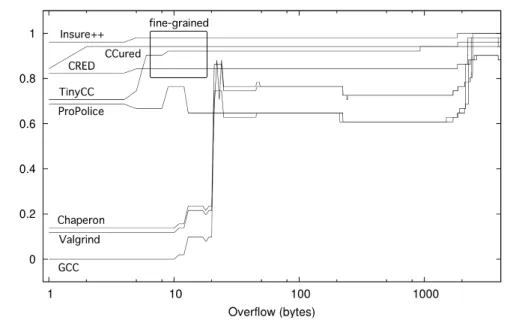
4.2.3 Variable-overflow Testsuite Results . . . 50
4.3 Artificial Exploit Evaluation . . . 52
4.3.1 Test Procedure . . . 53
4.3.2 Artificial Exploit Results . . . 53
4.4 Real Exploit Evaluation . . . 53
4.4.1 Test Procedure . . . 54
4.4.2 Real Exploit Results . . . 55
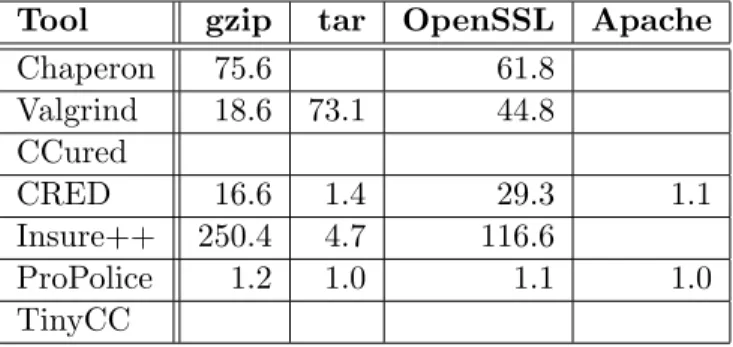
4.5 Performance Overhead . . . 55
4.6 Discussion . . . 57
5 Dynamic Testing with Code Instrumentation 59 5.1 Dynamic Testing Architecture . . . 60
5.1.1 Code Instrumentation . . . 61
5.1.2 Tester and Random Message Generator . . . 61
5.1.3 Process Monitor . . . 62
5.2.1 HMM Random Message Generator . . . 63
5.2.2 PCFG Random Message Generator . . . 64
5.3 Evaluating Dynamic Testing . . . 66
5.3.1 Jabber Instant Messaging Server . . . 66
5.3.2 Test Environment . . . 68
5.3.3 Test Procedure . . . 69
5.3.4 Test Results . . . 71
5.4 Discussion . . . 73
6 Adaptive Test Case Synthesis 75 6.1 Dynamic Testing with Feedback . . . 75
6.2 Message Database . . . 76
6.3 Test Case Generator . . . 78
6.3.1 Tokenizing Messages . . . 79
6.3.2 Mutating Tokens . . . 80
6.4 Feedback Loop . . . 81
6.4.1 CRED-HW Instrumentation . . . 81
6.4.2 Buffer Access Signature Analysis . . . 82
6.5 Static Analysis Module . . . 84
6.5.1 CIL: C Intermediate Language . . . 86
6.5.2 Source Analysis with CIL . . . 86
6.5.3 Literals in jabberd . . . 87
6.6 Evaluating Adaptive Testing System . . . 87
6.6.1 Test Environment . . . 87
6.6.2 Test Procedure . . . 88
6.6.3 Sample Test Run . . . 90
6.6.4 Test Results . . . 93 6.7 Discussion . . . 96 7 Future Work 99 7.1 Tokenizing Messages . . . 99 7.2 Token Mutations . . . 100 7.3 Buffer Instances . . . 100
8 Conclusions 103 8.1 Required Instrumentation . . . 103 8.2 Generating Test Cases . . . 104 8.3 Advantages of the Adaptive Testing Approach . . . 105
A HMM Description 107
B PCFG Description 123
C CRED Error Messages 127
D PCFG Messages 129
E Feedback Messages 135
List of Figures
1-1 Cumulative Exploits in Commonly Used Server Software . . . 17
2-1 Memory Layout of a Process . . . 22
4-1 Example of Discrete Overflow Test Case . . . 46
4-2 Stack Layout for Discrete Buffer Overflow Example . . . 48
4-3 Results for Discrete Buffer Overflow Example . . . 48
4-4 Example of Continuous Overflow Test Case . . . 49
4-5 Stack Layout for Continuous Buffer Overflow Example . . . 51
4-6 Results for Continuous Buffer Overflow Example . . . 51
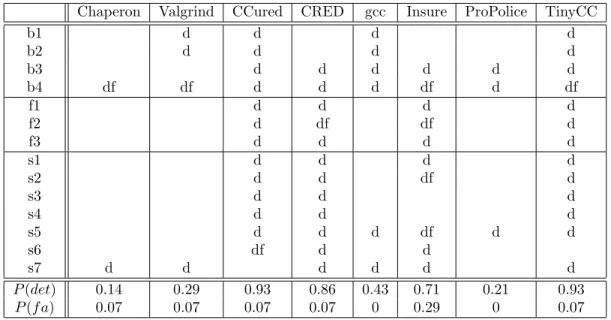
4-7 Summary of Results for Variable-overflow Testsuite . . . 52
5-1 System Architecture for Dynamic Testing with Code Instrumentation . . . 60
5-2 Typical Jabber Server Deployment . . . 67
5-3 Architecture of jabberd . . . 69
5-4 A Typical Jabber IM Message . . . 70
6-1 System Architecture for Adaptive Testing . . . 77
6-2 Test Case Generator Architecture . . . 78
6-3 A Legal Jabber IM Message . . . 89
6-4 A Malformed Jabber IM Message . . . 90
6-5 Buffer Access Signature for Original Message . . . 91
6-6 Buffer Access Signature for Mutated Message . . . 91
List of Tables
4.1 Summary of Tool Characteristics . . . 41
4.2 Summary of Results for Real Exploit Testsuite . . . 54
4.3 Instrumentation Overhead for Commonly Used Programs . . . 56
5.1 Control Characters in Jabber Messages . . . 71
5.2 Overflows Detected in Grammar-based Testing . . . 72
6.1 CRED-HW Buffer Access Info Fields . . . 82
6.2 Aggregate Buffer Statistics Fields . . . 83
6.3 Fields in the objects Table . . . 85
6.4 Fields in the stats Table . . . 85
6.5 Fields in the affected objects Table . . . 85
6.6 Literals Found in jabberd . . . 88
6.7 Buffers with Changed max high Statistic . . . 92
6.8 Targetable Buffers . . . 93
6.9 Overflows Detected using Adaptive Testing with Legal Message . . . 94
Chapter 1
Introduction
The use of computers and software has become essentially ubiquitous in modern society. Making a call on a mobile phone, using an ATM, providing electricity — almost everything in modern life directly or indirectly is supported by computers running software. Such broad reliance on software requires it to be secure and reliable — if it were not, the results could be catastrophic. While failures experienced by consumer electronics, such as a mobile phone rebooting because of a fault, are hardly disastrous, a failure in a mission-critical system can become life-threatening very quickly. For example, if control software in a nuclear power plant crashes or sends the wrong control signals, an explosion or reactor meltdown could occur and cause serious casualties in addition to lasting environmental damage. While such scenarios may seem far-fetched, other incidents, such as online fraud and identity theft, are affecting people every day because vulnerabilities in software enable crackers to obtain this information. Thus, finding and fixing vulnerabilities in software is necessary to avert potential disasters and utilize the full potential of available technology.
1.1
Cost of Software Failures
While significant resources are already invested to test software and find mistakes, errors still exist in deployed code and result in very serious, if not catastrophic situations. A buffer overflow was partly responsible for the blackout experienced by the Northeast in August of 2003. Due to a software error that was caused by abnormal conditions, the supervisory system failed to update the data on displays and notify operators of a serious strain on the physical infrastructure that triggered a collapse. The fault lay dormant in the software for
a number of years, and was only revealed under abnormal circumstances [19]. This service outage affected 50,000,000 people in the US and Canada and caused damage estimated at 7–10 billions of dollars [11, 42]. While not a security failure, this incident demonstrates that vulnerabilities exist even in mission-critical software.
Another major outage of a public service occurred in January of 1990 within the tele-phone network owned by AT&T. A failure of a single node triggered an error in the failure-recovery routine of 114 other nodes that provided long distance service, thus bringing the entire network down. The culprit was an incorrectly used break command in an if block nested inside a switch statement. The resulting outage lasted nine hours and affected an estimated 60,000 people. AT&T estimated lost revenue to be approximately 60 million dollars; however, this estimate does not include lost revenue of businesses that relied on the telephone network and were affected by the outage [5].
Many recent software faults have been exploited via cyber-attacks. In particular, popular targets are buffer overflows that exist in software providing web services. Most recently, worms such as Blaster and CodeRed overloaded and brought down corporate networks by rapidly infecting a large number of computers. The spread of the infection generated so much traffic that some networks were rendered completely unusable. Blaster exploited a buffer overflow in Microsoft’s RPC service, while CodeRed exploited a buffer overflow in IIS indexing service [6, 7]. The cost of lost productivity and necessary repairs due to Blaster has been estimated at 300–500 million dollars, and the estimated cost of CodeRed exceeds 1.2 billion dollars [33, 53].
Exploiting faults in software results in huge financial losses for businesses, loss of pri-vacy for consumers, and substantial amount of time and effort wasted by both trying to repair the damage. Currently, the only method of preventing exploitation of these faults is patching them as soon as the vulnerability is known and software developers can fix the problem. Unfortunately, patching is not an efficient or practical method of addressing this issue. For some companies, especially those whose business centers around e-commerce (like Amazon.com or Ebay), taking servers offline to perform updates is very expensive, and doing so every month is impractical. In addition, only faults that are discovered by well-meaning security experts get patched quickly. Faults discovered by malicious hackers may be exploited for a long time before the exploits are noticed and software developers are alerted to the problem.
1.2
Types of Vulnerabilities in Software
In order to discuss different types of software vulnerabilities, it is useful to establish some terminology. A software fault or error is a mistake that a programmer has made while creating the program or an unintended consequence of interaction between several programs running together. A vulnerability is a fault that can be exploited to make a program perform actions that its creator has not intended. An exploit is an input or sequence of actions that uses a vulnerability to obtain higher privileges on a computer system, execute arbitrary code or perform some other action that the program being attacked was not intended to do under these circumstances.
The previous section described several incidents relating to faults in software. While many different kinds of software faults can lead to devastating consequences, not all software faults are security vulnerabilities. Many different types of errors can occur in a program, including buffer overflows, race conditions, dangling pointers, integer overflows and under-flows, divide by zero errors, truncation errors, failures to reduce privileges, time of check to time of use errors, etc. The list is seemingly endless. While it is difficult for a software developer to ensure that none of these bugs creep into the program, it is even harder to test for these conditions automatically. Some faults, such as the one that caused the August 2003 blackout, occur under very obscure conditions and are triggered by input sequences that are very unlikely. Since testing all possible inputs is frequently impractical, such inputs are likely not explored during testing. Some faults, such as race conditions, are very hard to replicate, and may often appear as Heisenbugs1.
Certain kinds of faults can be exploited by a malicious person to take over the computer system and inflict damage on a usually unsuspecting victim. Although many different kinds of faults can be exploited, buffer overflows appear to be a recurring target for attacks on today’s Internet. Attacks are also becoming more complicated, using buffer overflows as stepping stones to obtaining higher privileges and taking control of machines.
1Heisenbugs are named after Heisenberg’s Uncertainty Principle. A Heisenbug disappears or alters its
1.3
Buffer Overflows — A Persistent Vulnerability
Today’s server software is under constant scrutiny and attack, whether for fun or for profit. Figure 1-1 shows the cumulative number of exploits found in commonly used server software, such as IIS, BIND, Apache, sendmail, and wu-ftpd. The data comes from the NIST ICAT database [37], and includes exploits across all versions of the software. Exploits are plotted according to the date they have been recorded in the ICAT database. The arrows indicate appearances of major worms, such as Lion, CodeRed and Welchia. As the data demonstrates, new vulnerabilities are still found, even in code that has been used and tested for years. A recent analysis by Rescorla agrees with this observation, as it shows that vulnerabilities continue to be discovered at a constant rate in many types of software [48]. Buffer overflows enable a large fraction of exploits targeted at today’s software. Such exploits range from arbitrary code execution on the victim’s computer to denial of service (DoS) attacks. During 2004, NIST recorded 889 vulnerabilities in its ICAT database, of which 75% are remotely exploitable. NIST further reports that 21% of the remotely ex-ploitable vulnerabilities are due to buffer overflows. Over the past three years, the fraction of remotely exploitable vulnerabilities ranged from 75% to 80%, and buffer overflows con-stituted 21%–22% of these vulnerabilities [38]. These statistics show that buffer overflows comprise a significant fraction of existing vulnerabilities and that new buffer overflow vul-nerabilities are still being discovered. Detecting and eliminating buffer overflows would thus make existing software far more secure.
1.4
Approaches to Buffer Overflow Prevention
The most desirable solution is, of course, to write perfect software. Since humans are imperfect, the next best solution is to find and eliminate faults in software before it is deployed. Even as stated, the problem is very difficult and, arguably, undecidable. However, extensive testing and validating of software before deployment decreases the chance that a fault will be found in production and require patching of a running system.
Available solutions that try to address the problem of software faults apply at different stages of software development. Some approaches try to standardize and regulate how the software is written, what language and libraries are used, etc. Such policy approaches help create better software by formalizing the development process, requiring code reviews
Figure 1-1: Cumulative exploits in commonly used server software. Exploits across all versions of server software are plotted against the date they were recorded in the ICAT database [37]. Arrows indicate appearances of major worms.
and organizing programmers’ efforts. However, such policies are often difficult to enforce due to deadlines, insufficient training or lack of proper incentives for the developers. This approach does not protect from all errors, as programmers performing the code reviews are not perfect either; however, it is a useful and necessary component to creating robust and secure software.
The opposite extreme of the available approaches are ones that try to foil exploits at runtime. Few are successful at creating an environment where all exploits can be stopped, since many exploits rely on actions that the program is technically allowed to take (though usually under different circumstances). Such tools range from compiler-based instrumenta-tion to executable monitoring and operating system extensions. All such approaches come with performance overhead; furthermore, more comprehensive protection results in heavier additional computational overhead. Thus, sophisticated protection of this sort is rarely used in production systems, since performance, not security, is more critical to company revenues.
An attractive and more realistic approach exists in-between. While developers will unavoidably create imperfect software, many of the mistakes can be found and fixed in the testing stage, before the product is deployed and vulnerabilities can be exploited. NIST
reports that the annual cost to the US economy due to software errors is estimated at 60 billion dollars; however, the cost could be reduced by over a third through improved software testing [36]. Furthermore, the cost of fixing a defect once software has been released in production is estimated to be up to 15 times more than the cost of the corresponding fix during the testing phase [57]. While unit-testing and creating integration tests is a responsibility that software developers must assume, it is generally very difficult and time-consuming. In addition, schedules and deadlines usually leave little time for testing, and time allocated for Quality Assurance (QA) is often cut first when the project is behind schedule.
An attractive testing approach is an automated system that can analyze source code, synthesize test cases and then run tests on the program. While test cases verifying function-ality have to be created by developers, testing robustness can, to some extent, be performed automatically. Such tests include verifying program’s ability to handle malformed inputs and its response to large volume of inputs. Several products have been developed that statically analyze software source to find patterns that correspond to faults. Even better analyzers can verify, in some cases, that accesses to a particular buffer do not exceed the up-per bound, regardless of the input. However, these analyses are very computation-intensive, and the tools frequently do not scale to large programs, where it is much harder to find faults.
An alternative to statically analyzing software is dynamic testing. The source code can be instrumented at the time of compilation and then tested on automatically-generated test cases. There are thus two challenges to the dynamic testing approach — finding the right granularity of instrumentation for the source code and generating inputs that trigger the latent faults. Current state of the art dynamic testing systems, such as the one developed in the PROTOS project at University of Oulu [28], use randomly-generated test cases based on an attribute grammar that describes the protocol of program inputs. The PROTOS system has been particularly effective in finding buffer overflows in open source server software, which is widely deployed on many systems comprising today’s Internet.
1.5
Goals of this Thesis
The goal of this thesis is to improve on the state of the art in dynamic testing and create a system that offers faster and more comprehensive buffer overflow detection. To achieve this, methods for instrumenting executables and automatically synthesizing test cases are investigated. Specifically, this thesis aims to do the following:
• Evaluate capabilities of modern dynamic buffer overflow detection tools and select a tool to provide code instrumentation for subsequent system development,
• Develop a system that uses code instrumentation to improve the random message testing approach developed by the PROTOS project,
• Design and build an adaptive testing system that uses code instrumentation and feedback in test case generation to enable more efficient and comprehensive buffer overflow detection.
Chapter 2
Exploiting Buffer Overflows
Before discussing the tools and approaches available for buffer overflow detection, it is useful to understand attacks that have been used to exploit vulnerabilities stemming from buffer overflows. This chapter provides some background information about memory layout of processes and offers a brief overview of different types of buffer overflow attacks.
2.1
Memory Layout of a Process
In order to understand how buffer overflow exploits work, it is important to know the memory layout of a process. The particular details described in this chapter pertain to Unix/Linux processes, and while some details may be different, the memory layout of pro-cesses on Windows is not fundamentally different.
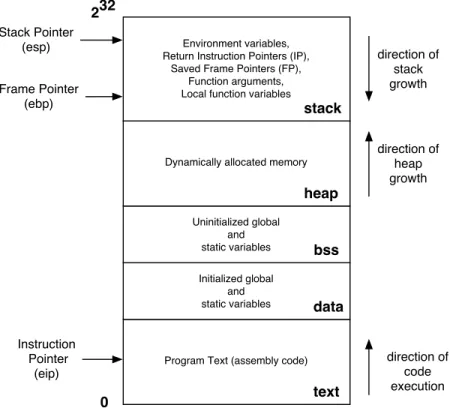
Figure 2-1 presents a diagram of different memory regions in a running program. The lower memory addresses are shown on the bottom while the higher addresses are on the top. The memory for a process is divided into five different segments — text, data, bss, heap and stack. The text segment contains the assembly instructions that are executed by the processor. This memory segment is usually mapped read-only, as the program should not need to modify its own instructions. The data segment contains global and static variables that have been initialized to some non-zero value in the program code. The bss segment contains all other, uninitialized, global and static variables. Both of these segments are mapped read-write into the memory space of a process.
The heap memory region is grown dynamically to accommodate requests of the program. Memory is requested via calls to malloc, realloc or calloc and then released by using free
Program Text (assembly code) Initialized global and static variables Uninitialized global and static variables Dynamically allocated memory
Environment variables, Return Instruction Pointers (IP),
Saved Frame Pointers (FP), Function arguments, Local function variables
stack heap bss data text direction of stack growth direction of heap growth direction of code execution 0 232 Stack Pointer (esp) Frame Pointer (ebp) Instruction Pointer (eip)
Figure 2-1: Memory layout of a process. This diagram shows different memory segments of a process. The text segment is mapped read-only into the process memory space, while all other segments are mapped read-write. The instruction, stack and frame pointers include the names of x86 registers that store these values.
when the memory is no longer needed. As shown, the heap memory region starts in lower address space and expands up as necessary. The stack segment is used for environment variables, function arguments, local variables and keeping record of the execution path. Whenever a function is called, a new stack frame is pushed onto the stack, containing the address of the instruction to which the process should return once the execution of the function is completed, as well as the value of the frame pointer that points to beginning of the stack frame currently in use. As shown, the stack starts at a high memory address (0xC0000000 for Linux systems) and expands downwards as necessary. Both heap and stack memory regions are mapped read-write into the memory space of a process.
The diagram also shows the typical contents of three registers that affect program ex-ecution. The instruction pointer (the eip register on x86) determines which instruction is executed. In general, it contains some address in the text segment of the program, though some Linux signal handlers have been known to put code in the stack segment and then
redirect the eip to point to the stack segment. The stack pointer (the esp register on x86) determines the next free memory location on the stack. It always points to the stack segment. The frame pointer (ebp register on x86) determines the location of the current stack frame. It always points to the stack segment as well. While not strictly necessary, the frame pointer is frequently used in calculating addresses of local variables on the stack. Since ebp always points to the location of the saved ebp from the previous stack frame, frame pointers can be used to determine the call chain that is stored on the stack.
2.2
Arbitrary Code Execution
Arbitrary code execution is one of the most severe consequences of an exploit, since the attacker can execute any code (usually a shell) with the privileges of the process that has been exploited. Frequently, such an attack is used as a stepping stone in obtaining higher privileges, since most remotely accessible processes, such as webservers, do not run as root. However, there are many exploits available to increase the privilege level from local user to root, thus giving the attacker full control of the compromised computer. Thus, the attacker can read and change sensitive files, modify permissions and install backdoors.
Two steps are needed to achieve this result, and there are multiple methods of completing each of these steps. First, the attacker needs to inject the code to be executed (usually assembly code for the system call execve("/bin/sh")). Then, he needs to change a code pointer so that it points to the injected code and then arrange for the code pointer to be used.
2.2.1 Injecting Code
The code is typically injected when the program copies some outside input into a buffer. Thus, the attack code could be residing in a request packet from the network, in an envi-ronment variable, or in a carefully-crafted file. The code is typically very short (only 46 bytes are needed to execute a shell), and thus fits into even a reasonably small buffer. For simple attacks, such as the “stack-smashing” attack [1], the attack code is inserted into the buffer that is being overflowed to change the code pointer. However, this is not necessary — attack code can be inserted into any buffer in the program, as long as the attacker knows the memory address of the beginning of the attack code. This address is then inserted into a changed code pointer, as described below.
2.2.2 Changing Code Pointer Directly
A variety of code pointers are targeted by attackers in order to change the execution path to contain injected code. Frequent targets include the return instruction pointer (IP) that is saved on the stack and function pointers that are frequently used by programs that need a way to describe handlers for different events. A direct way of changing code pointers is via a continuous overflow of a buffer located in the same memory region as the target code pointer. A continuous overflow is defined as an access pattern that consists of accesses to several consecutive elements in the buffer, including one or more bytes outside the boundary of the buffer. Such overflows frequently result from using string or I/O functions, such as gets or strcpy, as these functions copy consecutive bytes from the input stream or another buffer (respectively) into the target buffer. If the input is too long or the source buffer is larger than the destination buffer, then the destination buffer will be overflowed — the program will write memory that has not been allocated for use as part of this buffer.
As discussed above, the values for return instruction pointers are saved in the stack segment of process memory. Thus, stack buffers are often targeted, since an overflow in a stack buffer would enable an attacker to change the return IP to a desired value. Function pointers can be stored on the stack, on the heap or in the data or bss segments. An overflow in a buffer in the appropriate segment is needed to overwrite a function pointer. In addition, buffers are filled “up” — from low memory address to high memory address. Thus, in order to overwrite a return IP or a function pointer, an attacker needs to find a buffer that is stored lower in memory than the target of the attack.
2.2.3 Changing Code Pointer Indirectly
It is not necessary to find a buffer that can be overflowed continuously until the target code pointer is reached. Frequently, it is sufficient to find an overflow that allows the attacker to change some pointer in the program. For example, a 4-byte overflow is sufficient to change a pointer that is stored above a stack buffer in memory to contain the address of the return IP on the stack. If the attacker can also control the value written to memory when the overwritten pointer is used, then the return IP can be changed indirectly, without a continuous overflow.
Sometimes it is possible to use a single write to change a code pointer. Buffers are fre-quently aliased and accessed through pointers by using offsets. If this offset is miscalculated, the write can access memory outside of the buffer bounds. Often, such offset is controlled by some property of the input, such as length of a token or position of some delimiter in the input. The attacker can thus control the value of the offset and overwrite the code pointer with the desired value. This is an example of a discrete overflow — a single access outside the buffer bounds that is calculated via an offset from an in-bounds pointer.
Another target of discrete overflows is the saved frame pointer. A fake stack frame can be created by an attacker elsewhere, and the saved frame pointer changed to point to this stack frame. If the fake stack frame is created on the stack, its location is likely very close to that of the real stack frame, and thus only a single byte of the saved frame pointer needs to change to point it to the fake stack frame. This can be accomplished with a discrete overflow. Upon return from the current function, the program will use the fake stack frame that contains a return IP pointing to injected code, thus giving the attacker control of the program when the next return instruction is executed.
Another frequent attack target is a longjump buffer. This buffer is used to change program flow without using the stack. A setjump command sets up such a buffer, containing a saved frame pointer and a return IP, much like a stack frame. A longjump command can then use this buffer to change the execution path and jump to the location in the program specified by such buffer. It is a convenient target as an attacker can modify the values of return IP or saved frame pointer to hijack the process. Such buffers are frequently stored on the stack, and the necessary values could be changed by either a discrete or a continuous overflow.
2.3
Logic-based Attacks
Another class of attacks focuses on changing program flow by altering variables that control the logic of the program. While such attacks usually do not result in arbitrary code exe-cution, they frequently allow an attacker to raise his privilege level or perform some other action the program is not intended to do. For example, if a buffer with an exploitable over-flow is located close to a flag that specifies access permissions, the attacker can overover-flow the buffer and change his permissions. Alternatively, suppose that a program writes to a file,
whose filename is stored next to a buffer that an attacker can overflow. If the program is running as root, then by changing the filename to ‘‘/etc/passwd’’ and providing appro-priate input the attacker can create an account for himself on the target system. A famous logic-based attack was used in the Morris worm, that exploited sendmail by turning on its debug mode, thus making it execute commands on the worm’s behalf [51]. Logic attacks are possible in any memory region that can contain a buffer, and while they are not as common as some other attacks, they are equally dangerous.
2.4
Unauthorized Access to Information
Many attacks are designed to give an attacker control or higher privilege level on the target system, and they require an existence of an exploitable overflow that allows the attacker to write something to memory. However, read overflows can also be exploited to gain unauthorized access to information. Suppose that printf is used to print a buffer that has not been properly null-terminated. Then, printf will continue printing from memory until it encounters a NULL byte. If such an exploitable buffer is stored next to a cryptographic key, for example, the attacker will have gained very sensitive information. Since many string and I/O functions in the standard C library do not ensure null-termination of buffers, this exploit may sometimes occur with an appropriate input.
For performance reasons, programmers generally do not clear memory before they release it, so many memory locations in the heap (and stack) regions still store contents of previously used buffers. If a buffer with an exploitable read overflow exists nearby, an attacker can use it to gain potentially sensitive information. Such an attack was recently discovered in Google’s popular Gmail service — if an e-mail containing a malformed address was sent, the program displayed a large chunk of memory that was stored nearby, frequently including other people’s e-mails, which could have contained confidential information [43].
2.5
Classifying Buffer Overflows
As discussed in previous sections, different classes of attacks can be used to exploit buffer overflows. The characteristics of a buffer overflow determine which attack can be leveraged against it, and how successful such an attack will be. This section summarizes some of these properties in an attempt to classify different kinds of buffer overflows. A more thorough
taxonomy of buffer overflows with corresponding examples can be found in [62]. The prop-erties of buffer overflows discussed here will prove important in constructing test cases for the evaluation of dynamic buffer overflow detection tools, which is presented in Chapter 4.
2.5.1 Access Pattern
The access pattern describes whether a buffer overflow is continuous or discrete. A contin-uous overflow results in modification or exposure of several consecutive bytes outside the buffer boundary, and is achieved by consecutively accessing buffer elements and running past the upper bound. Such overflows are present in “stack-smashing” attacks, and attacks that utilize string functions. A discrete overflow usually results in a single access to memory outside the buffer bounds, due to a miscalculation of an offset from an in-bounds pointer. This kind of overflow can be used in logic-based attacks or attacks that modify a pointer, since changing a single byte of a pointer can be sufficient to exploit it.
2.5.2 Access Type
The access type describes whether a buffer overflow is a read or a write overflow. While write overflows give an attacker more control over the program that is executing, read overflows are also dangerous, as they can compromise sensitive information. Read overflows are also much more difficult to detect — since write overflows modify memory, an attacker must be very careful, as any mistake can cause program state to become corrupted, crashing the program and thus exposing the attack. Many read overflows will go completely undetected, as they do not corrupt program state.
2.5.3 Size of Overflow
The size of an overflow is likewise important in determining potential damage. Unfortu-nately, even off-by-one overflows can be exploitable, so miscalculating the buffer size by one byte may lead to serious consequences. Small overflows are much harder to detect than large overflows, since program state corruption may not be obvious — the goal of a small overflow may be to overwrite some internal variable resulting in a logic-based attack. Very large read and write overflows are easily detectable, as they will generate a segmentation fault — eventually the overflow will try to access memory beyond the boundary of the current memory page, and the operating system will report this error. However, the size of
a memory page on a modern Linux system is 4096 bytes, so a very large overflow is needed to trigger this behavior.
2.5.4 Location
Buffers can exist in four different memory regions — stack, heap, data and bss. As discussed above, different memory regions serve to separate memory segments designed for different purposes. The buffers in the stack memory segment are more likely targets for attacks, since overwriting return IP or function pointers on the stack is very attractive. However, depending on the location of the target code pointer or variable controlling program flow, a buffer in any of the above memory locations can potentially be used in an exploit.
Chapter 3
Approaches to Buffer Overflow
Detection
Various methods for finding and preventing buffer overflows have been developed, including policy techniques, such as enforcing secure coding practices and mandating the use of safe languages, halting exploits via operating system extensions, statically analyzing source code to find potential overflows and detecting buffer overflows at runtime [13]. Each approach has its advantages; however, each also suffers from limitations. This chapter discusses some of the available approaches and highlights their strengths and weaknesses. It also presents motivation for an adaptive testing approach that improves the dynamic testing method by mitigating some of its limitations.
3.1
Security Policies and Code Reviews
Due to a large number of security vulnerabilities in software many companies have devoted extensive resources to ensuring security. Considerable time and effort is expended on im-plementing and enforcing secure coding procedures, following proper software development cycle and conducting code reviews. Microsoft has recently announced its renewed focus on security and claims to have performed a large-scale review of its Windows codebase as part of its Trustworthy Computing initiative [31]. This code review involved up to 8,500 devel-opers and lasted several months [45]. However, bugs remain in Windows code, as evidenced by security patches for Windows Server 2003, released after the security review [30]. This anecdote demonstrates that it is very difficult to verify by inspection that a complex piece
of software contains no faults, and thus code reviews, no matter how thorough, will miss bugs. While policies and procedures encouraging secure coding and proper development practices aid in developing secure software, they cannot replace testing or guarantee the security of resulting code.
3.2
Language Approach
An alternative that guarantees absence of buffer overflows is writing code in a “safe” lan-guage. Languages such as Java provide built-in bounds checking for arrays and buffers, and thus programs written in Java are immune to buffer overflows, forgoing errors in JVM im-plementation. However, large legacy codebases have been written in C; furthermore, many developers are opposed to switching to a different language, commonly citing worse perfor-mance as the reason. Efforts have been made to create languages based on C that provide similar capabilities. CCured [35] and Cyclone [25] are good examples of such languages.
CCured works by executing a source to source transformation of C code and then com-piling the resulting code with gcc. CCured performs a static analysis to determine pointer types (SAFE, SEQ or WILD). Instrumentation based on pointer type is inserted into the re-sulting source code whenever CCured cannot statically verify that the pointer will always be within the bounds of the buffer. This instrumentation changes pointer representation, so code compiled with CCured cannot interoperate easily with code compiled with gcc — wrapper functions are needed to add or remove metadata used by the instrumentation whenever an object passes between instrumented and uninstrumented code. Since CCured compiler cannot handle large programs, the developer may be required to re-write or anno-tate 2-3% of the code in order to enable CCured to perform the necessary transformations. At runtime, the resulting executable performs bounds-checking and terminates program with an error message if a buffer access violation has been detected.
Cyclone is a dialect of C that has been developed to provide bounds-checking for C-like programs. Like CCured, it uses a combination of static and dynamic analysis to determine pointer types and only instruments pointers that require it. In order to make proper bounds information available at runtime, Cyclone changes C’s representation of pointers to include additional information, such as bounds within which a pointer is legal. A major disadvan-tage of Cyclone is that existing C code needs to be ported to the Cyclone language before it
can be compiled with the Cyclone compiler. In order to convert the code, a developer is re-quired to rewrite about 10% of the code, inserting special Cyclone commands. Furthermore, Cyclone differs enough from C that some C programmers may be reluctant to use it [25].
The main disadvantage of such safe languages is that they tend to be slower than C, and provide less control to the programmer. Another concern is the difficulty of translating the large amount of legacy code still in use today that has been written in C into a safe language. A good example is sendmail, in which multiple buffer overflows have been found over the years [37]. The effort to translate such programs into a safe language would be immense and the cost unacceptable. Some programs, such as CCured, aim for an automatic source to source transformation of C into a safe language; however, they generally require programmer intervention and fail to run successfully on large programs.
3.3
Safe C Libraries
A large class of overflows resulting in exploits is enabled by unsafe C library functions. Many functions in the C library are written to provide fast performance and relegate the responsi-bility of calculating appropriate buffer bounds to the programmer. Frequently, programmers miscalculate these bounds or else do not realize that the library function can overflow the buffer. Several alternative libraries, that claim to provide a “safe” implementation of func-tions in the C library have been developed; some are discussed here. Libsafe [2, 3, 54] is a dynamically loaded library that intercepts calls to functions in glibc that are considered dangerous. These routines include strcpy, strcat, getwd, gets, scanf, realpath, sprintf and others. The call to one of these routines is replaced with a wrapper function that attempts to compute the maximum size for each local buffer. The size of a buffer is computed as the distance from the start of the buffer to the saved frame pointer above it. If the size limitation allows it, the intercepted function is executed normally; otherwise, the program is terminated, thus turning a buffer overflow into a denial of service attack. Although Libsafe protects against a stack-smashing attack, it does not prevent overwriting of local variables, which can be used to change a code pointer indirectly. This method also fails if the executable has been compiled with -fomit-frame-pointer option, as the frame pointer is no longer saved on the stack. This option is frequently enabled during compilation to increase performance in the resulting executable.
Libverify [3] is an enhancement of Libsafe. During each function call, the return address is copied onto a special “canary stack” stored on the heap. When the function returns, the return address on the stack is compared to the address on the “canary stack” — if the two match, the program is allowed to proceed; otherwise, the program is terminated and an alert is issued. Libverify protects against a larger class of attacks than Libsafe; however, attacks using function pointers still remain undetected and lack of protection for the “canary stack” on the heap is a major limitation.
3.4
Operating System Extensions
Various methods for thwarting exploits based on buffer overflows using operating system extensions have been proposed and deployed. A commonly-used tactic is runtime random-ization of stack location and C library entry points [8]. This method does not prevent the overflow from occurring; however, it effectively converts the attack into denial of service. Since attacks that overwrite code pointers need to use an absolute address, randomizing stack location and C library entry points makes it very difficult for the attacker to guess the correct address value to change a code pointer. Thus, the guess will likely be incorrect, and the program will segfault when it tries to execute some random memory as instructions. The advantage of this method is that it is very lightweight and completely transparent to the program being executed; however, buffer overflows are not prevented, so any attack that does not rely on changing code pointers will still succeed.
3.5
Static Analysis
Static analysis seems like an attractive approach, since little additional effort from the programmer is needed to analyze code — the code is examined automatically and no test cases are required. Misha Zitser evaluated the capabilities and effectiveness of five modern static analysis tools, including both commercial (PolySpace C Verifier) and open source (ARCHER, BOON, SPLINT, UNO) products [52, 18, 22, 56, 60]. The tools were tested using historic versions of wu-ftp, bind and sendmail that contained real-world vulnerabil-ities [62]. The study found that none of the tools could process the entire source code of these programs; thus, model programs containing the buffer overflow vulnerabilities were extracted from the source of the full programs.
Two tests were performed on the resulting model programs, which were several hundred lines in size. Each static analysis tool was first executed on the model program containing the vulnerability, and a detection was recorded if the tool correctly identified the vulnerabil-ity. A patch was then applied to fix the vulnerability, such that no buffer overflow existed in the model program. Each static analysis tool was then executed on the resulting program, and a false alarm was recorded if the tool still indicated that the vulnerability existed.
The study found that most static analysis tools have a very low detection rate. PolySpace C Verifier and SPLINT had a higher detection rate, but also suffered from a high false alarm rate. Combined with the tools’ inability to handle the entire source of the programs, these characteristics make static analysis an impractical method for detecting buffer overflows [62].
3.6
Runtime Buffer Overflow Detection
A different approach to mitigating the problem of buffer overflows is to stop the attacks that exploit them at runtime. Such tools either use instrumentation inserted into the executable at compile time or monitor the binary executable itself to determine when an out-of-bounds access has occurred. By stopping the attack in its tracks, these tools convert the attack into a denial of service.
3.6.1 Compiler-based Code Instrumentation
Some of the runtime buffer overflow detection tools work by inserting appropriate instru-mentation at compile time. The instruinstru-mentation depends on the particular approach and the attacks the tool is trying to prevent.
Stack-smashing Protection
StackGuard [12] and ProPolice [17] take a similar approach to protecting an executable against a stack-smashing attack. During compilation, the prologue and epilogue of each function call is modified so that a “canary” value is inserted between the stack frame, which contains saved return IP and frame pointer, and local variables. Upon return from a function, this value is checked to ensure that it has not changed; if it has, there must have been an overflow attack that could have damaged the return IP — thus, the program is terminated with an error. StackGuard provides more sophisticated options, including
a terminator canary (consisting of four bytes — NULL, ‘\r’, ‘\n’, EOF). Such a canary provides better protection when the buffer is overflowed using a string library function, as these bytes serve as termination characters. By default, a random value picked at compile time is used for the “canary.”
A major limitation of this approach is that only continuous overflows that overwrite the canary on the stack are detected. Many other indirect attacks can still change the value of the return IP. ProPolice tries to mitigate this problem by rearranging local variables such that character stack buffers are directly below the canary value. While this method helps prevent some indirect stack attacks, it does not protect any heap buffers. Read overflows and underflows also remain undetected.
Fine-grained Bounds Checking
TinyCC [4] and CRED [50] both provide fine-grained bounds checking based on the “referent object” approach, developed by Jones and Kelly [26]. As buffers are created in the program, they are added to an object tree. For each pointer operation, the instrumentation first finds the object to which the pointer currently refers in the object tree. The operation is considered illegal if it references memory or results in a pointer outside said object. When an illegal operation is detected, the program is halted. TinyCC is a small and fast C compiler that uses a re-implementation of Jones and Kelly code; however, it is much more limited than gcc and provides no error messages upon an access violation — the program simply segfaults. CRED, on the other hand, is built upon Jones and Kelly code, which is a patch to gcc. Thus, CRED is able to compile almost all programs that gcc can handle. In addition, CRED adheres to a less strict interpretation of the C standard and allows illegal pointers to be used in pointer arithmetic and conditionals, while making sure that they are not dereferenced. This treatment of out-of-bounds pointers significantly increases the number of real world programs that can be compiled with this instrumentation, as many programs use out-of-bounds pointers in testing for termination conditions.
An interesting approach to mitigating buffer overflows via fine-grained bounds checking has been developed by Martin Rinard, as part of failure-oblivious computing [49]. Instead of halting program execution when an out-of-bounds access has been detected, a program compiled with the failure-oblivious compiler will instead ignore the access and proceed as if nothing has happened. This approach prevents damage to program state that occurs due
to out-of-bounds writes and thus keeps the program from crashing or performing actions it is not intended to do. Instrumentation likewise detects out-of-bounds reads and generates some value to return — for example, returning NULL will stop read overflows originating in string functions. The paper discusses several other values that may drive the program back into a correct execution path. This compiler is implemented as an extension to CRED and thus also uses “referent object” approach.
Insure++ [44] is a commercial product that also provides fine-grained bounds checking capabilities. The product is closed-source so little is known about its internal workings. According to its manual, Insure examines source code and inserts instrumentation to check for memory corruption, memory leaks, memory allocation errors and pointer errors, among other things. The resulting code is executed and errors are reported when they occur.
The main limitation of all these tools is that an overflow within a structure is not rec-ognized until the border of the structure has been reached. CRED is capable of detecting overflows within structures correctly, but only when structure members are accessed directly — if an access is made through an alias pointer, CRED will detect the overflow only when it reaches the border of the structure. These tools also cannot detect overflows within unin-strumented library functions. These issues are common to all compiler-based approaches, and are discussed further in Section 4.1.3. TinyCC seems to have some incorrect wrappers for library functions and cannot handle large programs, which is a significant drawback. Another limitation of TinyCC is that no error messages are provided — the program sim-ply terminates with a segmentation fault. Insure’s major flaw is the performance slowdown that it imposes on executables — some programs run up to 250 times slower.
3.6.2 Executable Monitoring
Another method of detecting and preventing buffer overflows at runtime is through ex-ecutable monitoring. Chaperon [44] is an exex-ecutable monitor that is part of the Insure toolset from Parasoft, and Valgrind [27] is an open-source project aimed at helping devel-opers find buffer overflows and prevent memory leaks. Tools such as Chaperon and Valgrind wrap the executable directly and monitor calls to malloc and free, thus building a map of heap memory in use by the program. Buffer accesses can then be checked for validity using this memory map.
There are several limitations to this approach. Since no functions are explicitly called to allocate and deallocate stack memory, these tools can monitor memory accesses on the stack only at a very coarse-grained level, and will not detect many attacks exploiting stack buffers. Another limitation is the large performance overhead imposed by these tools. Since Valgrind simulates program execution on a virtual x86 processor, testing is 25–50 times slower than gcc.
Program shepherding [29] is an approach that determines all entry and exit points of each function, and ensures that only those entry and exit points are used during execution. Thus, an attacker cannot inject code and jump to it by changing a code pointer — this will be noticed as an unspecified exit point and the program will be halted. Like operating system approaches discussed in Section 3.4, this method is transparent to the program running on the system. However, it is much more heavy-weight and incurs higher performance overhead. In addition, attacks that do not rely on changing code pointers will still succeed, as they do not change entry and exit points of a function.
A similar approach is used by StackShield [55]. One of the security models supported by this tool is a Global Return Stack. Return IP for each function that is entered is stored on a separate stack, and the return pointer is compared with the stored value when the function call is completed. If the values match, the execution proceeds as intended; however, if the values do not match, the value on the return stack is used as the return address. Thus, the program is guided back to its intended path. This approach detects attacks that try to overwrite the return IP or provide a fake stack frame. However, this method does not stop logic-based attacks or attacks based on overwriting a function pointer.
Another security model offered by StackShield is Return Change Check. Under this model a single global variable is used to store the return IP of the currently executing function, and upon exit the return IP saved on the stack is compared to the one saved in this variable. If they do not match, the program is halted and an error message is displayed. This security model also tries to protect function pointers by making the assumption that all function pointers should point into the text segment of the program. If the program tries to follow a function pointer that points to some other memory segment, it is halted and an alert is raised. While this method does not prevent logic-based attacks from proceeding, it makes attacking the system more difficult. Another limitation of this approach is that read overflows are not detected.
3.7
Software Fault Injection
A popular approach for testing program robustness is a dynamic analysis technique focused on injecting faults into software execution. This technique creates anomalous situations by injecting faults at program interfaces. These faults may force a particular program module to stop responding or start providing invalid or malformed data to other modules. By observing system behavior under such anomalous conditions, certain inherent vulnerabilities can be discovered. Tools such as FIST [21] and Fuzz [32] have been used to perform such testing, with some promising results.
The main drawback of software fault injection is that it requires considerable developer intervention and effort. The code must be manually prepared for testing and the developer needs to analyze the output of each test case reporting a system crash to determine where the error has occurred. Automating program execution with fault injection is also difficult, as the program is likely to crash or hang due to inserted faults.
3.8
Mini-simulation with Random Messages
An interesting dynamic testing approach has been developed at the University of Oulu, Finland. As part of the PROTOS project [28], researchers developed a mini-simulation system for functional testing. PROTOS tests applications that use standard protocols, such as HTTP, TCP, SNMP, etc; however, if a protocol grammar is provided, PROTOS can test an arbitrary application. Source code for the application is not necessary, as PROTOS works by testing executables directly. An attribute grammar is used to describe the protocol, and this description is used by the tester to automatically generate a large number of anomalous and normal test cases. The application under test is then executed on each input, and abnormal behavior, such as crashing or hanging is reported. Making the tests fully automatic is difficult, as the application being tested may need to be restarted. PROTOS has been used to test different applications including HTTP browsers, an LDAP server and SNMP agents and management stations. Of the 49 different product versions that were tested, 40 were found vulnerable to at least a denial-of-service attack.
While mini-simulation presents an automatic approach for finding buffer overflows, the method used to detect overflows is very coarse. Many small overflows will not cause a segfault and will thus be missed by the tool; however, these can still be exploited to alter
program logic and change code pointers, as discussed in Chapter 2. Most read overflows are not detected either, as they do not trigger a segfault unless they access memory outside a valid page. In addition, no information is provided to the developer about where the error occurred.
Another disadvantage of using the mini-simulation approach is that a revealing input that triggers the overflow is required; however, the input space for a program is generally very large. While the attribute grammar provides the mini-simulation system with a way to generate malformed inputs, it has no knowledge of how to generate revealing inputs. Thus, the input space is explored randomly and focusing on particular code paths is not possible.
3.9
An Adaptive Testing System
The mini-simulation system described above appears to be the most comprehensive tool available today for testing program robustness. In order to improve on this approach, the remainder of this thesis presents research aimed at mitigating the limitations of the mini-simulation approach. Some of the limitations can be addressed by instrumenting source code for the application to provide fine-grained bounds-checking capabilities. An instrumented executable will detect more buffer overflows and provide the developer with information necessary to locate the overflow. Chapter 4 presents an evaluation of modern dynamic buffer overflow detection tools, which could be used for this purpose. Chapter 5 describes a modified mini-simulation system that makes use of an instrumented executable in testing programs with random messages.
A partial solution to the problem of finding revealing inputs is a feedback loop that will allow the tester to make use of information about buffer access patterns in the executable. If such information were available, the tester could correlate the mutations in the input with variations in the buffer access pattern, and thus evaluate the effectiveness of a particular mutation. Then, the search through the input space can be directed by observing the changes in the access pattern and generating inputs that will bring the buffer closer to overflow. This method is explored as part of the adaptive test case synthesis, presented in Chapter 6.
Chapter 4
Evaluating Dynamic Buffer
Overflow Detection Tools
This chapter is a minor extension of a paper entitled “Dynamic Buffer Overflow Detection” by Michael Zhivich, Tim Leek and Richard Lippmann [61]. This paper has been submitted to the 2005 Symposium on the Foundations of Software Engineering. Section 4.4 describing Tim Leek’s evaluation of dynamic buffer overflow detection tools on model programs appears in this paper, and has been included here to maintain continuity.
In order to develop an approach that builds on the state of the art in dynamic testing, it is necessary to have the ability to detect buffer overflows of all sizes and in all memory seg-ments. The resulting system should be able to handle large, complex programs and support developer-defined extensions. This chapter focuses on evaluating the effectiveness of current dynamic buffer overflow detection tools with the above goals in mind. A similar evaluation has been conducted by Wilander et al. [59], but it focused on a limited number of artificial exploits which only targeted buffers on the stack and in the bss section of the program. Our evaluation reviews a wider range of tools and approaches to dynamic buffer overflow detec-tion and contains a more comprehensive test corpus, including Wilander’s artificial exploits. The test corpus consists of three different testsuites. Section 4.2 presents the results for variable-overflow testsuite, which consists of 55 small test cases with variable amounts overflow, specifically designed to test each tool’s ability to detect small and large overflows in different memory regions. Section 4.3 describes the results for artificial exploit testsuite, which consists of 18 artificial exploits from Wilander’s evaluation [59] that utilize buffer overflows to produce a shell. Section 4.4 presents the results for 14 model programs con-taining remotely exploitable buffer overflows extracted from bind, wu-ftpd and sendmail.
The chapter is organized as follows: Section 4.1 presents an overview of the tools tested in this evaluation, Sections 4.2 – 4.4 present a description and results for three different test-suites, Section 4.5 describes performance overhead incurred by the tools in this evaluation, and Section 4.6 summarizes and discusses our findings.
4.1
Dynamic Buffer Overflow Detection Tools
This evaluation tests modern runtime buffer overflow detection tools including those that insert instrumentation at compile-time and others that wrap the binary executable directly. This section presents a short description of each tool, focusing on its strengths and weak-nesses.
A summary of tool characteristics is presented in Table 4.1. A tool is considered to include fine-grained bounds checking if it can detect small (off-by-one) overflows. A tool compiles large programs if it can be used as a drop-in replacement for gcc and no changes to source code are needed to build the executable; however, minimal changes to the makefile are acceptable. The error report time specifies whether the error report is generated when the error occurs or when the program terminates. Since program state is likely to become corrupted during an overflow, continuing execution after the first error may result in in-correct errors being reported. Instrumentation may also be corrupted, causing failures in error checking and reporting. If a tool can protect the program state by intercepting out-of-bounds writes before they happen and discarding them, reporting errors at termination may provide a more complete error summary.
4.1.1 Executable Monitoring Tools
Chaperon [44] is part of the commercial Insure toolset from Parasoft. Chaperon works directly with binary executables and thus can be used when source code is not available. It intercepts calls to malloc and free and checks heap accesses for validity. It also detects memory leaks and read-before-write errors.
One limitation of Chaperon is that fine-grained bounds checking is provided only for heap buffers. Monitoring of buffers on the stack is very coarse. Some overflows are reported incorrectly because instrumentation can become corrupted by overflows. Like all products in the Insure toolset, it is closed-source which makes extensions difficult.
Tool Version OS Requires Source Open Source Fine-grained Bounds Checking Compiles Large Programs Error Re-port Time Wait for segfault
N/A Any No Yes No Yes Termination
GCC 3.3.2 Linux No Yes No Yes Termination
Chaperon 2.0 Linux No No No* Yes Occurrence
Valgrind 2.0.0 Linux No Yes No* Yes Termination
CCured 1.2.1 Linux Yes Yes Yes No Occurrence
CRED 3.3.2 Linux Yes Yes Yes Yes Occurrence
Insure++ 6.1.3 Linux Yes No Yes Yes Occurrence
ProPolice 2.9.5 Linux Yes Yes No Yes Termination
TinyCC 0.9.20 Linux Yes Yes Yes No Termination
Table 4.1: Summary of tool characteristics. (* = fine-grained bounds checking on heap only)
Valgrind [27] is an open-source alternative to Chaperon. It simulates code execution on a virtual x86 processor, and like Chaperon, intercepts calls to malloc and free that allow for fine-grained buffer overflow detection on the heap. After the program in simulation crashes, the error is reported and the simulator exits gracefully.
Like Chaperon, Valgrind suffers from coarse stack monitoring. Also, testing is very slow (25 – 50 times slower than gcc [27]), since the execution is simulated on a virtual processor.
4.1.2 Compiler-based Tools
CCured [35] works by performing static analysis to determine the type of each pointer (SAFE, SEQ, or WILD). SAFE pointers can be dereferenced, but are not subject to pointer arithmetic or type casts. SEQ pointers can be used in pointer arithmetic, but cannot be cast to other pointer types, while WILD pointers can be used in a cast. Each pointer is instrumented to carry appropriate metadata at runtime - SEQ pointers include upper and lower bounds of the array they reference, and WILD pointers carry type tags. Appropriate checks are inserted into the executable based on pointer type. SAFE pointers are cheapest since they require only a NULL check, while WILD pointers are the most expensive, since they require type verification at runtime.
The main disadvantage of CCured is that the programmer may be required to annotate the code to help CCured determine pointer types in complex programs. Since CCured requires pointers to carry metadata, wrappers are needed to strip metadata from pointers when they pass to uninstrumented code and create metadata when pointers are received
![Figure 1-1: Cumulative exploits in commonly used server software. Exploits across all versions of server software are plotted against the date they were recorded in the ICAT database [37]](https://thumb-eu.123doks.com/thumbv2/123doknet/14723907.571245/17.918.193.722.126.435/cumulative-exploits-commonly-software-exploits-versions-software-recorded.webp)
![Table 4.1: Summary of tool characteristics. (* = fine-grained bounds checking on heap only) Valgrind [27] is an open-source alternative to Chaperon](https://thumb-eu.123doks.com/thumbv2/123doknet/14723907.571245/41.918.140.778.107.351/table-summary-characteristics-grained-checking-valgrind-alternative-chaperon.webp)