Psychological Disturbance Following
T-Groups:
Relationship between the Eysenck Personality Inventory
and Family I Friends Perceptions
CARY L. COOPER
Cary L. Cooper obtained his B.S. and M.B.A. degrees in behavioural science from the University of California, Los Angeles and his Ph.D. from the University of Leeds. He is currently senior lecturer in psychology at the University of Manchester. Institute of Science and Technology. He has written two books, T-Groups: A Survey of Research, (John Wiley & Sons, 1971) and Croup Training for Individual and Organizational Development (S. Karger AG, Basel, Switzerland, 1973) and has another book, Theories of Group Processes (John Wiley A. Sons), in preparation for publication in late 1974. He is an Executive Member of the Group Relations Training Association and the European Editor of the international quarterly journal, Interpersonal Development.
S U M M A R Y
This study assessed the psychologically disturbing effects of sensitivity training. Two different measures of disturbance or distress were used, the Eysenck Personality In-ventory (a standardized personality test) and a Behaviour Change questionnaire com-pleted by the participant and his close family and friends. The relationship between the two measures was explored. Participants showed increases in neuroticism as a result of training but this was not confirmed by the participants' family and friends two weeks after the T-group (the most likely period of heightened disturbance from training). In fact, a large number of trainees saw themselves and were seen by their family, friends and children as slightly better able to cope with personal and family problems, more happy, better able to get on with their children and/or significant person/s, and better able to communicate.
Cries that sensitivity training and encounter groups are psychologically dangerous and in Gottschalk's1 opinion potentially 'psychiatrically
dis-ruptive to almost half of the delegates in a group' have not as yet been proved. Several case studies (Jaffe and Scherl2) or anecdotal reports have
been published (Gottschalk and Pattison3) supporting this view. Recently,
however, more empirical work has been carried out. On the negative side, Reddy4 found, using a paper-and-pencil personality inventory measuring
psychological disturbance, that participants in two T-groups compared with control groups (one of which was a therapy group) increased their scores more in the direction of greater disturbance following training. This could merely indicate a greater willingness on the part of the T-group participants to admit more personally threatening material in the question-naire, which may reflect greater openness or sensitivity to their symptoms
Br. J. Social Wk. 4, 1. Printed in Great Britain 39
and not disturbance. In a more comprehensive study involving eighteen different experiential groups, Yalom and Lieberman' found some evidence of psychiatric casualties, that is, participants becoming more 'psychologic-ally distressed or employing more maladaptive mechanisms'. They came to the conclusion, however, that this was more a function of the particular leadership style of the trainers or facilitators than the nature of the parti-cular group experience (i.e. T-groups, encounter groups, psychodrama groups, etc.). On the positive side, there is some evidence that indicates that T-groups may be less stressful than university examinations (Lubin and Lubin6) or perceptual isolation experiments of varying degrees of
intensity (Lubin and Zuckerman7). There is also some evidence that these
groups may enable participants to cope better with sexual and aggressive stimuli (Pollack and Stanley8) and with stressful periods in their life, for
instance, with the pressures of university life (Cooper9'10).
At present the one area that has not been given the attention it deserves in this context is the effect of this type of training on the family and close friends of participants. Do husbands, wives, children, close relatives and friends see the returning T-group participants as more or less disturbed, more or less able to communicate, more or less able to cope with personal and family problems ? The purpose of this study was to answer this question. In addition, it was hoped that one could examine the relationship between a paper-and-pencil test measure of psychological disturbance (or neuro-ticism) before and after training and the family and friends report on aspects of the participants' behaviour judged to be associated with psycho-logical distress.
METHOD
SUBJECTS AND TRAINING PROGRAMME
The T-group participants were members of the helping professions; social workers, psychiatrists, nurses, and probation officers. There were 30 trainees and 6 staff trainers, roughly half of whom were women and half men. The participants were separated into three groups to make them as heterogeneous as possible (in terms of sex, age, and occupation), with two trainers in each group. The training consisted of a one-week residential T-group run along lines described by Tannenbaum, Weschler and Mas-sarik11. First, the training was primarily 'process-oriented' rather than
'content-oriented'. That is, the primary stress was on the feeling level of communications rather than solely on the informational or conceptual level. This emphasis was accomplished by focussing on the here-and-now behaviour and themes in the group. Second, the training was not structured in a conventional manner. Opportunities were provided for the individuals to decide what they wanted to talk about, what kinds of problems they
desired to deal with, and what means they wanted to use in reaching their goals. As they concerned themselves with the problems occasioned by this lack of direction, they began to act in characteristic ways: some people remained silent, some were aggressive, some tended to initiate discussions, some attempted to structure the proceedings. With the aid of the staff member, these approaches and developments became the focal points for discussion and analysis. The trainer drew attention to events and behaviour in the group by occasional interventions in the form of tentative inter-pretations, which he considered would provide useful data for study. Third, the value of the T-group was its restriction to small groups, allowing a high level of participation, involvement, and free communication.
QUESTIONNAIRES
Eysenck Personality Inventory. The Eysenck Personality Inventory (EPI)
was administered to all trainees just before the start of the first session of the training week and just after the final session. The EPI is self-administer-ing and consists of 57 statements, which comprise two scales, I-E (intro-version/extraversion) and the N-scale (neuroticism). The N-scale of the EPI was used as an independent change measure of psychological disturb-ance, and in addition, as a measure to test the relationship between paper-and-pencil tests of disturbance and reports of behaviour by partici-pants' closest family and friends. The EPI has been widely used as a measure of personality disturbance or neuroticism in recent years and has been extensively validated (Eysenck and Eysenck12). Since the test-retest
reliability coefficients for the N-scale are very high, ranging from 0-81 to 0-91, it was decided that an untrained control group was not necessary. The anonymity of each subject was maintained throughout the study by asking each one to choose a number at random and to use that number in place of their name on the EPI and on all other research questionnaires.
Behaviour Change Questionnaire. The post-training behaviour change
questionnaire was designed by the author with the help of a consultant psychiatrist (Dr. R. Sandisotf, Director, Southampton Mental Health Centre) and a lecturer in social work with clinical casework experience (B. Hughes, University of Southampton). It consisted of eight statements with a five, six or seven choice Likert-type continuum for each one. Five of the questions were designed to assess behaviour patterns one might reasonably expect to reflect psychological disturbance. These questions were carefully constructed to be comprehensible to people unfamiliar with clinical-type questionnaires. The questions were: (1) Are you and he/she (T-group participant) communicating better or worse since the course (seven-point scale from very much better to very much worse); (2) Has
he/she been emotionally affected by the course (seven-point scale from
very much disturbed to much more stable); (3) Does he/she appear more or
less happy as a result of the course (five-point scale from much more happy to much less happy); (4) Does he/she seem more or less able to cope with difficult personal or family or relationship problems since the course (five-point scale from much more able to much less able); (5) Has his/her relationship with his/her children or other significant person/s been affected by the course (seven-point scale from very much better to very
much worse). Three additional questions were included, two at the
begin-ning to lead into the main statements ('How well did he/she communicate his/her experience after returning from the training course' and 'How far do you feel he/she has excluded you from the experience') and one at the end to give closure to the questionnaire ('How would you feel about his/her attending a future similar course').
There were two forms to this questionnaire; a 'self form, which the participant filled out (a modification of the above statements in the first person singular), and an 'other' form (stated as above), which was filled out by two or three of the participants' closest relatives and friends (i.e. husband, wife, older children, other close personal friends). At the con-clusion of the T-group training week, each participant was given a sealed envelope which included one 'self form and three 'others' forms and was told that it contained questionnaires which were to be completed by him-self and three close relatives and friends two weeks after the training course, and that the envelope should be opened at that time. Instructions were included in the envelopes together with four self-addressed stamped envelopes so that each respondent could send them back to the researchers without showing them to the participant. The instructions indicated that the respondents were to complete the questionnaires within three days of receiving them, that is, between fourteen and sixteen days after the training course. In addition, to minimize the possibility of response inhibition or social desirability in responding each participant was asked to place the number used on the EPI form on all Behaviour Change questionnaires before distributing them. This allowed the researchers to compare different perceptions of a given person and to provide the anonymity that would encourage honesty in responding.
Behaviour Change forms were received from all 30 participants and 70 members of their family and friends. Since three 'other' forms were given to each participant, the response rate was 77%. The 'real' response rate was, in fact, 88%, since ten participants indicated to the researchers (on returning their own forms) that they had distributed only two forms. These participants indicated that they had only two close relatives or friends who would have enough contact with them in the two-week period follow-ing trainfollow-ing to make the questionnaire meanfollow-ingful. 27% of the forms came
from the wives and husbands, 30% from the other close relatives and children, and 43% from close friends of the participants.
RESULTS AND DISCUSSION
In analysing the results it was decided to examine the data in the following order. First, an assessment of participant change on the neuroticism scale of the EPI. Second, an investigation into the relationship between the N-scale and each of the five questions on the Behaviour Change measure relating to perceptions of participant behaviour reasonably expected to reflect psychological disturbance or distress. Third, an inspection of the post-course Behaviour Change questionnaire results.
Differences between pre- and post-test scores on the N-scale of the EPI were tested by a r test for correlated means (two-tailed). The data are represented in Table 1 below.
TABLE 1. Means and Value for Significance of Differences between
Pre- and Post-Test N-Scale (neuroticism) Scores
Participants (N = 30) 10-53 11-73 212 <0-05
It can be seen that T-group trainees show statistically significant change on the N-scale in the direction of increased neuroticism following training. These results are consistent with Reddy's4 findings which also indicated
increased psychological disturbance following training using a different psychometric measure, the NDS (number of deviant signs) scale of the Tennessee Self-Concept Test (Fitts13). Once again, these results are not as
straightforward as they might appear, that is, that T-group participants became more neurotic as a result of training. Although they confirm a previous finding, both measures are paper-and-pencil tests which require the subject to admit the presence of specific physiological, psychological, and behavioural symptoms. As argued previously, it is quite conceivable that the increase in scores on these measures might indicate a greater willingness on the part of the participant to admit these symptoms follow-ing trainfollow-ing, reflectfollow-ing an increase in self-disclosure or openness and not psychological disturbance. Or alternatively, the increase in these scores could indicate a greater sensitivity by participants to their own physiologi-cal, psychological and behavioural patterns or symptoms. In either case, this would reflect the achievement of T-group goals and not the opposite. An assessment of the Behaviour Change questionnaire might help to clarify this point, for if participants who show increases in neuroticism on
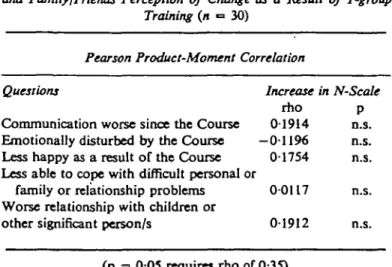
the EPI also are seen by their family and friends as being much worse at communicating since the course, disturbed by the course, and less happy as a result of the course, etc., then we might have greater confidence in generalizing from the results of the personality inventories. To examine this relationship, a change score for each participant was calculated for the N-scale (difference between before and after scores) and this was corre-lated, using a Pearson product-moment, with the mean scores of the perceptions of the trainee by his/her family and friends on each of the five questions judged to be related to psychological disturbance in the Behaviour Change questionnaire.
TABLE 2. Relationship between Participant Change in Neuroticism
and Family/Friends Perception of Change as a Result of T-group
Training (it = 30)
Pearson Product-Moment Correlation Questions
Communication worse since the Course Emotionally disturbed by the Course Less happy as a result of the Course Less able to cope with difficult personal or
family or relationship problems 0-0117 n.s. Worse relationship with children or
other significant person/s 0-1912 n.s.
(p = 0 0 5 requires rho of 0-35)
It can be seen from Table 2 that there appears to be no significant rela-tionship between an increase in neuroticism and the perceptions of the trainees' closest family and friends on behaviour which should be associ-ated with neuroticism; communicating worse, less happy, less able to cope with personal problems and relationships, emotionally disturbed by the course, and communicating worse with children or other significant person/s. There are a number of points that could be made about this set of results. First, that the Behaviour Change measure is not a good one and if it was there would be a positive relationship between these measures. Methodologically it could be that the family and friends of the participants were providing socially desirable responses, responses that would put the particular participant in a 'good light' or indicate that the participant was able to cope with the training. Although this may be possible, it is unlikely for two reasons. One, every effort was made to communicate to the
respon-Increase rho 01914 -01196 01754 MI N-Scale P n.s. n.s. n.s.
dents that their questionnaires would not be identifiable by name and that, in any case, the researchers were unaware of which number related to which participant. Two, if social desirability was present it should reflect itself in a skewed distribution on the positive end of the various scales, yet it was found that a sizable minority of respondents utilized the negative end of the continuum on several questions, for instance, 25% of the family/ friends felt excluded from the experience, over 30% felt that the participant had been emotionally disturbed by the course, etc. Second, and the most probable explanation, is that paper-and-pencil questionnaires attempting to measure psychological disturbance or neuroticism as a result of training may not be appropriate measures of change. The reason for this is that the line between a 'real' response (the expression of the onset of a symptom) and a response that indicates greater openness or willingness to admit symptoms or, in fact, increased sensitivity to symptoms, is a very thin one indeed. In any case, participants who showed increases in neuroticism scores on the EPI were not seen by family and friends during the two weeks following the training to display various behaviours one might associate with psychological distress or disturbance.
And finally, some interesting results emerged from the Behaviour Change questionnaire (Table 3).
There are two aspects of these data that will be examined; first, the overall responses of 'participants' and 'others' to each question, and second, the differences between 'participants' and 'others' perceptions of the effect of the training programme. In the first question it can be seen that both participants and close relatives and friends thought that they had ade-quately communicated their training experience. It is interesting to note that the family and friends had a slightly more positive view of the ability of the participant to communicate than the participant had himself. In the second question, on balance, both participants and the 'relevant others' felt included in the experience although there was a sizable minority who did not (24%). There seemed to be very little difference between the two groups. Question three seems to reveal something of a halo-effect, for although the participants themselves feel that they are communicating better since the course (62%), a smaller proportion of their family /friends agree (38%), in fact a majority see no change (58%). This same pheno-menon repeats itself in question four. Although a majority of participants felt slightly to more stable as a result of the course (53%), a very large minority of family and friends felt that they were unaffected (42%). Roughly the same number of 'participants' and 'others' (approximately 30%) felt that the participants were slightly disturbed or disturbed by the T-group. Although a large minority of respondents, 'participants' and 'others', felt that the course was disturbing, a majority of participants (51%) and a sizable minority of family/friends (39%) felt that the trainees
Percentages
1. How well did he/she communicate his/her experience after returning from the training course? Very well Well Fairly well Fairly badly Badly Very badly Participants 6 33 50 13 2 0 Family/friends 30 31 32 3 4 0
2. How far do you feel he/she has excluded you from the experience? Strongly Slightly
excluded Excluded excluded Participants 0 9 20 Family/friends 1 7 16
3. Aro you and he/she communicating better or worse since the course? Very much Slightly
better Betttr better Participants 0 27 35 Family/friends 4 12 22
4. Has he/she been emotionally affected by the course ? Very much Slightly
disturbed Disturbed disturbed Participants 0 9 20 Family/friends 0 7 24 sxpcrience? Slightly included 23 25 e the course? The same 38 58 Unaffected 18 42 Included 40 36 Slightly worse 3 4 Slightly more stable 44 19 Very included 8 15 Worse 0 0 Stable 6 4 Very much worse 0 0 Much more stable 3 4 o> • C o © o m 7>
5. Does Participants Family/friends 6. Does Participants Family/friends
he/she appear more or less happy as a result of the course? Much more happy 6 11 More happy 48 39 No difference 37 42 Less happy 9 8 Much less happy 0 0
he/she seem more or less able to cope with difficult personal or family or relationship problems since the course? Much more able 2 4 More able 49 35 No difference 49 57
7. Has his/her relationship with his/her children or othei
Participants Family/friends 8. How Participants Family/friends Very much better 0 5
would you feel t
Agreeable 74 68 Better 18 12 Slightly better 41 27
ibout his/her attending a future
Slightly agreeable 9 9 Neither agree-able or disagreeable 11 19 Less able 0 4 Much less able 0 0
r significant person/s been affected
The same 41 55 similar course? Slightly disagreeable 6 4 Slightly worse 0 1 Disagreeable 0 0 by the course ? Very much Worse worse 0 0 0 0 tn O 33 r\ w f
o
2
o r o (A -i c CDz
o
m O r r O Zo
H i O o cwere better able to cope with difficult personal, family, or relationship problems (question six), with virtually no respondents feeling that they were less able. This seemed to be the case with question seven as well, that a majority of participants (59%) and a sizable minority of 'others' (44%) felt that the trainees' relationship with his/her children or other significant person/s had been very much better since the course, and virtually nobody felt that it had been worse. In addition, when the participants and their close relatives and friends were asked whether they appeared more or less happy as a result of the course, over 50% of both groups felt they were more happy and only a very small minority felt they were less happy.
These results seem to indicate that although some T-group participants see themselves and are seen by others as disturbed by the experience, they also see themselves and are seen by their close family and friends as slightly better able to cope with problems, get on better in their relationships with their children and other significant people, are more happy and are slightly better able to communicate after the course. One must qualify this conclu-sion by making two points. First, it can be seen that participants seem to have a halo-effect as a result of the course, for on a number of questions they have responded more on the positive end of the continuum than the 'others*. Second, that there is still a sizeable group of participants and close family and friends who have used the categories labelled no difference or
the same, that is, that no change was perceived. Nevertheless, the fears of
many that this form of training may lead to 'acute pathological emotional responses' (Odiorne14) has not been substantiated by close family and
friends or the participants themselves. On the contrary, it appears that for a large number of trainees their familial and close relationships may have improved rather than become more maladaptive.
ACKNOWLEDGEMENT
I would like to thank all the participants of the Southampton Group Work Course 1973, their family and friends, and the staff of the course, particu-larly Brian Hughes and Dr. Ronald Sandison for their co-operation and help in making this study possible.
REFERENCES
1. Gottschalk, L. A. (1966) 'Psychoanalytic notes on T-groups at the human relations laboratory. Bethel, Maine', Comprehensive Psychiat., 7, 472-87.
2. Jaffe, S. L. and Scheri, D. J. (1969) 'Acute psychosis precipiated by T-group experi-ences', Arch. gen. Psychiat., 21, 443-8.
3. Gottschalk, L. A. and Pattison, E. M. (1969) 'Pjychiatric perspectives on T-groups and the laboratory movement', Amer. J. Psychiat., 126, 823-39.
4. Reddy, W. B. (1970) "Sensitivity training or group psychotherapy: the need for adequate screening', Int. J. grp. Psychother., 20, 366-71.
5. Yalom, I. D. and Lieberman, M. A. (1971) 'A study of encounter group casualties'.
Arch. gen. Psychial., 25, 16-30.
6. Lubin, B. and Lubin, A. W. (1971) 'Laboratory training stress compared with col-lege examination stress', J. appl. beh. sci., 7, 502-7.
7. Lubin, B. and Zuckerman, M. (1969) 'Level of emotional arousal in laboratory training', / . appl. beh. Sci., 5, 483-90.
8. Pollack, D. and Stanley, G. (1971) 'Coping and marathon sensitivity training',
Psychol. Rep., 29, 379-85.
9. Cooper, C. L, (1972a) 'An attempt to assess the psychologically disturbing effects of T-group training', Brit. J. soc. din. Psychol., 11, 342-5.
10. Cooper, C. L. (1972b) 'Coping with life stress after T-groups', Psychol. Rep. 31,602. 11. Tannenbaum, R., Weschler, I., and Massarik, F. (1961) Leadership and Organizations,
McGraw-Hill.
12. Eysenck, H. J. and Eysenck, S. B. G. (1969) Manual for the Eysenck Personality
Inventory (Educational and Industrial Testing Service, San Diego).
13. Fitts, W. H. (1965) Manual: Tennessee Self-Concept Scale, Nashville, Tenn: Depart-ment of Mental Health.