PEST MANAGEMENT AND SAMPLING
Trap Response and Fruit Damage
by
Oblique banded
Leafroller (Lepidoptera: Tortricidae) in Pheromone-Treated
Apple Orchards in New York
ARTHUR M. AGNELLO, W. HARVEY REISSIG, STEVE M. SPANGLER,! RALPH E. CHARLTON,2 AND DAVID P. KAIN
Department of Entomology, Cornell University, New York State Agricultural Experiment Station, Geneva, NY 14456
Environ. Entomol.25(2): 268-282 (1996)
ABSTRACT Pheromone disruptants were tested from 1989 to 1992 in western New York to determine effect on trap catch and potential use in the control of obliqueblmded leafroller. Clwristoneurct rosacearw (Harris), using polyethylene tube tie and controlled-release mem-brane dispensers in plots of 0.2-2.4 ha. Effectiveness of pheromone at different application rates and canopy locations was evaluated using synthetic pheromone-baited traps, molasses-baited traps, and by inspecting foliar terminals and fruit for leafroller damage. All pheromone treatments significantly reduced (by 56-97%) pheromone trap catches of male moths com-pared with catches in nontreated blocks. One application of a nahlral-blend formulation at 988 dispensers per hectare was better than 494/ha at dismpting trap catch of both Rights that occur during the year. However, mated female motlls were present in the orchard center as frequently as anywhere else in a pheromone-treated block, indicating either immigration from outside sources or resident females that were not prevented from mating by the pheromone. The membrane dispenser emitted the 3-component natural blend at proportions similar to those in wild female moths. Pheromone traps placed in the tops of trees in a pheromone-treated orchard always caught higher numbers of male moths than those in lower- or middle-canopy positions. Pheromonc treatment resulted in fruit damage similar to tlIat of a phero-mone + insecticide treatment under low to moderate leah'oller population pressure (i.e., 3-5% fruit damage in untreated orchards); however, no control method was able to reduce damage to acceptable levels in all cases.
KEY WORDS Choristolleurct rosacealla, mating disruption, apple, bait traps, canopy height, fruit damage
THE OBLIQUEBANDED LEAFHOLLEH, Choristoneu-ra rosaceana (Hanis), which is widely distributed in temperate North America, has become the most serious pest directly damaging fruit in New York apple orchards since it became resistant to the commonly used organophosphate insecticides in the 1970s (Reissig 1978, Reissig et aI. 1986). This leafroller overwinters as a 2nd- or 3rd-stage larva on the tree within a hibemaculum, becoming ac-tive in the spring when buds begin to open. Spring-generation larvae may eat away large por-tions of developing fruit. If the fruit survive, they are misshapen with large, deep cavities of healed-over injuries. Fruit damaged by these larvae gen-erally fall off the tree. Spring-generation moths emerge in early June, and summer-generation lar-vae complete their development in late July or ear-ly August, after initially feeding on leaf terminals
IDepartment of Entomology,501 Agricultural Sciences
Build-ing, PennsylvaniaState University,UniversityPark, PA16802. 2Department of Entomology,123Waters Hall, Kansas State University,Manhattan, KS66.506.
and later moving to the fruit. Feeding arcas on the fruit are shallow, irregular, and may range from small punctures to large excavations. This injury is more serious than that caused by the spring gen-eration because most injured fmit remain on the tree. Summer-generation moths begin flying in early August. Their larvae feed primarily on foliage but may cause surface injury to fruit if they are abundant. After feeding briefly, 2nd-generation larvae enter their winter hibernacula.
Growers began experiencing increased difficulty controlling C. rosaceana with the recommended pesticides during the last several years and, despite multiple insecticide applications, problem orchards usually end up with 3--4% damaged fruit at harvest (Reissig and Agnello 1991). The growing resistance of this pest to diverse classes of the currently avail-able insecticides has resulted in imprudent or at times extreme pesticide use patterns as growers at-tempt to find an application schedule or product mixture that will provide satisfactory control.
Pheromone mating disruption as a method of controlling tortricid pests has been examined by
April 1996 ACNELLO ET AL.: OBLlQUEBANDED LEAFROLLER DISRUPTION TIUALS 269
Tabl •• l. Orchard plot d••tuiJ. und pheromone treatments applied in obliqneb.mded leafroUer trials, 1989-1992
Ypar Orehard Tree height, Tree spaeing,III Plot size, ha Dispensers/l.a Dispenser type,
III pheromone hlend"
1989 Churd. North 5.5 11.0 by 11.0 1.0 988 Tie, natural
0.8 988 Tic, generiC' 0.7 1,976 Tie, generiC'
Chureh South 2.5 3.,5by 6.7 0.2 988 Memhrane, natural
Hiehal'dsoll 6.0 12.2 by 12.2 0.7 494 Tie. generic
0.7 988 Tie, generic 0.7 1,976 Tie, generic
Shepherd 2.5 6.0 by 7.5 0.8 494 Tie, generic
0.8 988 Tie, generic 0.8 1,976 Tie, generic
0.2 988 Membrane, natural
Sodus 3.0 4.5 by 6.0 0.2 988 Membrane, natural
1990 Eagle Ilarhor 3.0 3.7 by 5.5 2.1 988 Tie, natural
Kuekville 4.0 4.6 by 7.9 2.4 988 Tie, natural
Lyndonvill,' 2.0 1.8 by:3.7 1..5 988 Tie, natural
West Somerset 4.0 4.3 by 7.3 1.9 988 Tie, natural
1991 Eagle Harbor 3.0 3.7 by 5.5 2.] 988 Membrane, natural
Lyndonville 2.0 1.8 by 3.7 1.5 988 Tie, natural
North Rose 5.5 6.7 by 9.\ 1.\ 988 Mernbrane, natural
\Vest Somerset 4.0 4.3 by 7.3 1.9 988 Tie, natural
1992 Eagle Harbor 3.0 3.7 by 5.5 0.6 494 Membrane, natural
0.6 988 Membrane, natural
Kuckville 4.0 4.6 by 7.9 0.6 494 Membrane, natural
0.6 988 Membrane, natt.rat
'Nest Son1Prset 4.0 4.3 by 7.3 0.6 988 Membrane, nahlral
"Natural blend, 90:5:5%Z:E1J-I4:0Ae : Zl I-I4:0H; genelie hlend, 93:5:2%Z:El1-14:0Ac: inert carrier.
Rothschild (1975), Palaniswamy et a1. (1982), Vick-ers et a1. (1985), Charmillot and Vickers (1991), Pfeiffer et a1. (1993), Deland et a1. (1994), Karg et al. (1994), and Pree et aL (1994). C. rosaceana uses (Z)-1l-tctradecen-1-yl acetate (Zll-14:0Ac) as a primary pheromone component, together with 2% (E)-1l-tetradecen-1-yl acetate (Ell-14:0Ac) and =5% (Z)-1l-tetradecen-1-ol (Zll-14:0H) (Roe-lofs and Tette 1970, Hill and Roelofs 1979), In previous trials, Weires et aL (1978) obtained an 84% pheromone trap catch reduction for this spe-cies in 0.75-ha apple orchards treated with aerially applied hollow fibers containing a 50:50 blend of Z:Ell-14:0Ac (1976) and a blend containing 25% each of Z,Ell-14:0Ac and Z,Ell-14:0H (1977). In other tests where the pheromones were hand-applied, a release rate of 5 mglh/ha of Zll-14:0Ac was ineffective at dismpting the orientation of C. rosllcealla in plots (25 by 30 m), and required ad-dition of the other components of the natural blend, Ell-14:0Ac and Zll-14:0H, to obtain sig-nificant reductions in trap capture (Reissig et a!. 1978, Roelofs and Novak
1981).
Deland et a1. (1994) observed an 88-96% decrease in trap cap-ture using high rates of a 93:7% Z:Ell-14:0Ac blend in 0.09-ha plots. Most previous mating dis-ruption studies indicate that dismptants incorpo-rating the complete blend of pheromone compo-nents provide better dismption than partial blends, and do so at lower application rates (Carde and Minks 1995).To adequately assess the possibility of using mat-ing dismption as a control tactic for this pest, it is
desirable to determine the ability of the phero-mone to protect the fruit from feeding damage in treated areas that are as large as possible, hoth to disrupt mate-finding communication among resi-dent moths and to overcome the incidence of mat-ed moths immigrating into pheromone-permeated plots from surrounding habitats. If mated moths are found to be present in pheromone-treated ar-eas, it is valuable to know if the pheromone blend used in disruptant formulations is not optimal be-cause it does not precisely match the blend emit-ted by female moths. The studies reported here were conducted over a 4-yr period in Wayne, Or-leans, and Niagara counties in western New York to address the relationship between moth catch and larval damage in pheromone-treated orchards.
Materials and Methods
1989.The efficacy of different pheromone dis-pensers in disrupting mating of C. rosaceana males was evaluated in 5 commercial orchards in Wayne County (Table 1). All orchard blocks were estab-lished plantings of semidwarf or standard-size trees bordered by other apple plantings or mixed decid-uous woodland: Church North ('Rhode Island Greening'), Church South ('Jersey Mac'), Richard-son ('McIntosh' and 'Cortland'), Shepherd (Mc-Intosh and 'Golden Delicious'), and Sodus ('Ida Red'). Pheromones were released from dispenser products of 2 types: a 20-cm polyethylene tube (hereafter' designated as a "tie") sealed at both ends and incorporating a wire allowing it to be
270 ENVIRONMENTAL ENTOMOLOCY Vol. 2,5, no. 2
Table 2. Insecticide treatments applied in obliqnebnnded Ienfroller pheromone trials, 1989-1991
Year Orchard Insecticidfi" AI/ha Date applied Phennlngicalstageb Art'a treated 1989 Church South, Chlorpyrifos4 EC 1.68 kg 4 May Half-inch green NllIlr('plicatedplots at
Shepherd and Methomyl 1.8 L 756 g 12 July Fruit fill each site, Not treated
Sodus Or with pheromones:
Chlorpyrifos50 WP 1.68 kg 2 June Petal fall Church South, 0.1 ha; +12 July Fruit fill Sht'pard, 0.04 ha;
So-Or dus. 0.2 ha
Chlorpyrifos4 EC 1.63 kg 4 May Half-inch green Chlorpyrifos50 WP 1.68 kg 2 June Petal fall
+12 July Fruit fill Or
Methomyl 1.8 L 756g 2 June Petal fall +12 July Fruit fill
1990 Eagle Harbor a-Chlorpyrifos50 WP 723 g 11 July Fruit fill a-Edge and midioterior b-Chlorpyrifos50 WP 1.6Rkg 2 July Fruit fill sectious of
pheromooe-+12 July Fruit fill treated orchards Kuckville a-Chlorpytifos50 WP 1.6Rkg 6 July Fruit fill b-Nonreplicated
inseeti-+18 July Fruit fill dde-only blockson b-Chlorpyrifos50 WP 1.68 kg 2 July Froit fill samt~ farms as
phero-+ 12 July Fruit fill mone-treated orchards Lyndonville a-Chlorpyrifos50 WP 1.08 kg 11 July Froit fill
b-Chlorpyrifos50 WP J.68kg 2July Fruit fill +12 July Fruit fill West Somerset a-Chlorpyrifos50 WP 1.4kg 7 July Fruit fill a-Methomyl1.8 L 756 g 21 July Fruit fill
1991 Eagle Harbor Chlorpyrifos50 WP 1.01 kg 21 Juoe Fruit fill Edge and midiuterior +28 June Fruit fill sections of
phero1llollc-Mevinphos4 EC 896 g 15 July Froit fill treated orchards at Methyl parathion 2 FM 784g 13 Aug. Froit fill each site Lyndonville Chlorpyrifos50 WP 840 g 24 June Fruit fill
896 g 6 July Fruit fill West Somerset Methyl pamthion 2 FM 840 g 29 June Fruit fill Methyl pamthion 2 FM 420 g 12 July Fruit fill + methomyl 90 WP 303g
Richardson Chlorpyrifos50 WP 1.08 g 28 Jnne Fruit fill 0.02-ha Replicated plots: +10 July Fruit fill no pheromones Wolcott Chlorpyrifos50 WP 1.08 g 27 June Fruit fill 0.05-lia Replicated plots;
+9 July Fntit fiJI no pheromones
aChl0'1'yrifos4 EC and 50 WP (DowElanco, Indianapolis, IN); methomyl 1.8 Land 90 WP (Dupont, Wilmington, DE); methyl
parathion 2 Row-ablemicroencapsulated([FMJ. Elf Atochem. Philadelphia,PAl; mevinphos4 EC(DuPont).
bHalf-inch green, "'Y.iinch (1 cm) of leaf tissue projecting from fmit buds; petal fall. after"'75% of the petals haw f"lIen;fmit fill.
SlIlIlmerperiod of fmit growth and development.
twisted around a branch (Pacific Biocontrol, Van-couver, WA); and a prototype controlled-release membrane (hereafter designated as a "mem-brane") with an adhesive backing or a loop closure allowing it to be wrapped around a branch (Con-sep, Bend, OR). The tie dispensers contained 80.2 mg (AI) of either the obliquebanded leafroller nat-ural pheromone blend (90:5:5% Z:E11-14:0Ac: Zl1-14:0H) or a purported generic leafroller blend (93:5:2% Z:E11-14:0Ac: inert carrier); the membrane dispensers contained 100 mg (AI) of the natural blend. The tie dispensers had a release rate of ""'0.025 mglh and the membrane dispensers had a release rate of ""'0.020-0.027 mglh, accord-ing to information supplied by the respective man-ufacturers. Each test orchard was subdivided into several adjacent, nonreplicated plots to evaluate various combinations of dispenser types and appli-cation rates (Table 1.) All pheromone dispensers were placed in trees at a height of "'"1.5 m above ground level in accordance with mlillufacturer rec-ommendations, I wk before the 1st catch of C. rosaceana males in the region, which occurred on
16 June. To monitor orientation disruption of this flight, 3 pheromone traps (Pherocon Ie, Tr(~c{\ Sa-linas, CA) were placed in the interior of each plot on 9 June and checked twice weekly until 27 July. Each trap was baited with a standard rubber sep-tum lure impregnated with the natural pheromone blend components in the amounts 0.485 mg Z11-14:0Ac, 0.015 mg EI L-14:0Ac, and 0.025 mg Zl1-14:0H (Tnke). A group of 3 similar traps also was placed at the edge of each orchard in a plot that was not treated with any insecticides and did not contain pheromone dispensers, to serve as an un-treated control, and a single additional trap was placed in another untreated orchard block at least 100 m from the pheromone plots in the Shepherd, Church South, and Sodus sites, as a remote con-trol.
Additional plots were established at the Shep-herd, Church South, and Sodus sites to compare summer foliar damage in the pheromone treat-ments with that in trees receiving conventional in-secticide spray programs (Table 2). The only early-season insecticide in the pheromone plots was
April 1996 AGNELLO ET AI..: OBLIQUEBANDED LEAFROLLER DISRUPTION TRIALS 271 azinphosmethyl 35 WP ([wettable powder] 838 g
[AI]lha; Bayer, Kansas City, MO), applied at petal fall for the control of plum curculio, Conotrachelus llermphar (Herbst). Populations of C. rosaceana in New York have been shown to be resistant to this insecticide and were therefore assumed not to be affected by these applications (Reissig et al. 1986). Foliar terminals and fruit clusters (50 per tree, 10 trees per plot) were sampled to assess the number of sites infested with live summer-generation lar-vae (14-18 July).
1990. Nahlral pheromone blend ties similar to those used the previous year were tested in single, nonreplicated plots in commercial orchards in Or-Jeans and Niagara counties, to disrupt mating of both flights of obliquebanded leafroller male moths (Table 1). Pheromone dispensers were dis-tributed from 1-8 June, before the 1st regional catch of male moths, which occurred on 6 June, in all but the Eagle Harbor orchard, where the ties were placed on 8 June. The effectiveness of the pheromone treatments was evaluated by hanging 3 pheromone traps in each test orchard and three traps in a control orchard ""200 m away at each site. All pheromone traps were similar to those used the previous year. Traps were hung on 30 May and checked twice weekly until 21 Septem-ber. Plastic bucket traps (1 liter) covered with hardware cloth (0.6-cm2 mesh) and baited with
300 ml of a molasses and granulated baker's yeast bait (1:10, molasses to water plus 1.1 g of yeast per liter of solution) were used to monitor populations of both sexes in the pheromone-treated orchard blocks. On 28 June, 3 of these traps were hung in each test orchard on scaffold bnmches at a height of ""1 m above ground level; traps were checked twice weekly until 19 September. Moths collected from the bait traps were placed in 70% ethanol and dissected in the laboratory to determine their sex and mating status, by the presence of a sper-matophore in their bursa copulatrix. Single pher-omone traps were hung in each treated block at the orchard edge, in the midinterior region, and near the orchard center, to track moth dispersion patterns within the orchard. Bait traps were hung in a similar pattern using 3 different trees.
To simulate the effectiveness of using phero-mone dispensers over an area large enough to min-imize infestations by immigrating mated females, a matrix of trees (4 X 4) in the center of each test orchard received no insecticide applications against 1st summer-generation leafroller larvae. The growers applied their conventional spray pro-gram to the remainder of each orchard using chlor-pyrifos 50 WP and methomyl1.8 L (liquid) (Table 2). As a control, a group of 6-12 trees not treated with insecticides was established ""200 m from the test blocks at the Eagle Harbor and Kuckville sites, and in a nearby planting on a farm separate from the Lyndonville site. The number of foliar termi-nals or fruit clusters infested with live larvae was recorded from 50 sites per tree, 4-8 trees per
chard section at each site (9-12 July). The 3 or-chard sections sampled were oror-chard edge, midin-terior (hallWaybetween the orchard edge and the center) and the unsprayed orchard center. By the date of inspection, the growers at 2 of the 4 tria] sites had applied insecticide sprays in the orchard edge and midinterior sections of the pheromone-treated blocks, so these plots reRected the effects of both pheromone and insecticide treatments. As a comparison against the effectiveness of insecti-cides alone, samples also were taken from non-pheromone blocks at each site except for West Somerset in which chlorpyrifos ,50 WP had been applied as in a conventional management program (Table 2).
Fruits were evaluated for leah'oller damage just before the respective harvest dates for each of the varieties graded in the test blocks. Feeding injury was recorded in 250 apples from each of the 4 innermost unsprayed trees and from 4 trees that had received chemical control sprays in another portion of each pheromone-treated orchard. In ad-dition, 200-500 apples were inspected from each of 5-8 trees in the blocks that had received only insecticide treatments.
1991. The narnral pheromone blend ties simi-lar to those used the previous 2 yr and the mem-brane dispensers similar to those Ilsed in 1989 were evaluated in the same Eag]e Harbor, Lyn-donville, and West Somerset orchards as in 1990, and in a commercial planting, North Rose, of 'Wayne' apples in Wayne County (Tab]e 1). All pheromone dispensers were distributed from 29 May to 5 June; the 1st regional catch of male moths occurred on 28 May. Male moths were caught in 3 pheromone traps arranged in each test orchard in a series progressing from the periphery to the orchard center, the same as in 1990, and in 3 traps in a nonpheromone orchard ""200 m away at each site. All pheromone traps were similar to those used the previous 2 yr. Molasses bait traps were used as in the previous year to monitor pop-ulations of both sexes in the disrupted orchard blocks. A total of 24 bait traps per block was ar-ranged in 3 concentric rings of 12, 8, and 4 traps, proceeding from the perimeter to the orchard cen-ter, to track moth dispersion patterns within the planting. Moths collected were brought to the ]ab-oratory and dissected to determine their sex and mating starns. All pheromone and bait traps were set out on 22 May and checked twice weekly until 27 August.
A matrix of trees (4 X 4) in the center of each test orchard received no insecticide applications against first summer-generation leafroller larvae, similar to the previous year. In the Eagle Harbor, Lyndonville, and West Somerset orchards, the growers applied their conventional spray program to the remainder of each orchard (Table 2). Foliar terminals and fruit clusters were inspected for in-festation by obliquebanded leafroller larvae among treatments from 26 June to 3 July. Terminals or
272 ENVIRONMENTAL ENTOMOLOGY Yol. 25, no. 2 clusters infested with live larvae were recorded
from 50 to 100 sites per tree, 5-8 trees per orchard section (orchard edge, midinterior ,md the un-sprayed orchard center) at each site. To compare these infestations with those in a conventionally managed orchard, samples were also evaluated in 2 separate commercial orchards located in the same general area of the county as the North Rose site, Richardson, and Wolcott, in which applica-tions of chlorpyrifos 50 WP had been made for leafroller control (Table 2). As a control, samples were taken from trees that had not yet received leafroller insecticide sprays in the nonpheromone blocks containing the control pheromone traps. Fmits were evaluated for leafroller damage just before the respective harvest dates for each of the varieties graded in the test blocks. Late-season feeding injury was recorded for 100-180 apple samples from each of the 4 innermost unsprayed trees and from 4 trees that had received only chemical control sprays at each site.
1992. Laboratory studies were used to deter-mine whether the pheromone blend used in dis-mptant formulations is optimal. Gas chromato-graphic analyses of female pheromone gland extracts from both wild and laboratory strains were conducted to determine whether the sex phero-mone components and their ratios are in accord with mixtures released from the dispensers. The laboratory colony, which was reared in a green-house on fava bean plants (Glass and Hervey 1962), originated from larvae collected in several Wayne County orchards, and had been in culture for =17 generations. Last instars from wild, over-wintcred generation females were collected in Wayne County during late May, and completed their development in the laboratory. After pupa-tion, both laboratory and wild insects were trans-ferred to environmental chambers and maintained at 24°C under a photoperiod of 16:8 (L:D) hand 40% RH. Pheromone glands were excised during midscotophase and extracted in CS2. Each extract
contained 4-9 pooled female glands. Samples were concentrated under a gentle stream of N2.
Com-mercially formulated synthetic pheromone dis-pensers used were the controlled-release mem-brane in a plastic band (Consep), the same as in the previous field trials. Airborne volatile collec-tions were performed to verify that the membranes were emitting the pheromone components in the proper ratio. A fresh dispenser was suspended in a collection device as described by Baker et al. (1981). Purified nitrogen passed over the dispenser and volatiles were captured on a glass wool plug. The entrained pheromone was rinsed from the glass wool with CS2 and component ratios were
quantified by gas liquid chromatography.
To determine the extent of pheromone perme-ation in the field, a series of pheromone traps was set out in each of 2 pheromone-treated plots at the same Eagle Harbor, Kuckville, and West Somerset sites used the previous 2 yr (Table 1). Pheromones
were released from membrane dispensers placed from 28 May to 4 June in the canopies of trees using 1 of the following 2 methods: 1, appropriate number of dispensers per tree to attain the desired per-hectare rate (494 or 988), all located at a height of 1.5-2 m above ground level, midway be-tween the top of the canopy and the lowest scaf-fold branches; 2, appropriate number of dispensers per tree, with half of the dispensers located in the top of the canopy (3-3.7 m above ground level), and half in the bottom scaffold branches (0.9-1.2 m above ground level). At both the Eagle Harbor and Kuckville sites, 2 pairs of plots were set up in 2 separate blocks to test the high/low versus mid-canopy pheromone placement at the 494 and 988/ ha rates, and a single pair of plots was established at the West Somerset site to test the 988/ha rate.
A 2-tier trap unit was used to measure phero-mone ability to dismpt male flight orientation in the highest and lowest canopy regions of the or-chard for each of these dispenser arrangements. Each unit consisted of a 3-m pole made of metal conduit tubing (1.3 cm diameter), driven into the ground to reach a height of =2.7 m in the canopy at each orchard site. A Pherocon lC wing type pheromone trap similar to those used the previous 3 yr was positioned at the top of the pole, and another at the height of the lowest scaffold branch-es (0.9-1.2 m). A total of 5 trap units was placed in each pheromone-permeated plot, one in the center and one 3 rows by 3 trees inside of each corner of the plot; each trap was baited with a standard rubber septum lure as in the previous 3 yr. All traps were checked t\vice weekly from 5 June to 31 July, the duration of the 1st flight.
Pheromone trap catches were subjected to a 10glO(x
+
1) transformation, and all fmit and foliar damage percentages and bait trap catch percent-ages were transformed using arcsine square root. Analysis of variance (ANOYA) and a least signifi-cant difference test (PROC ANOYA, SAS Institute 1985) were used to separate treatment means, with a comparisonwise error rate of <0.05.Results
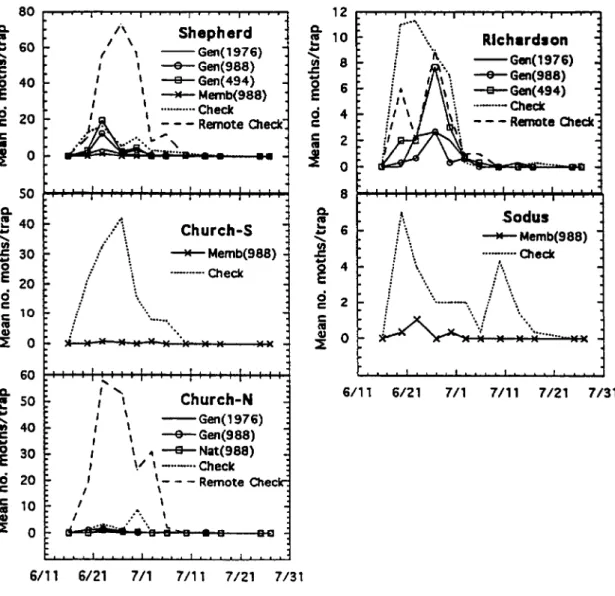
1989. Both the tie and membrane pheromone dispensers significantly depressed pheromone trap catches of obliquebanded leafroller in comparison with catches in the nonpheromone control plots (Table 3; Fig. 1). Across sites, the mean number of moths per trap caught dllling the 1st flight was statistically comparable among all pheromone treatments except for the generic blend ties at the lowest rate (494/ha), which achieved only a 55.9% trap reduction as opposed to an 81.3-97.0% trap reduction in the former cases. At the Shepherd site, where the membrane and generic blend tie dispensers were used, the lowest catches were ob-tained in plots treated \vith the membranes and the ties at the highest rate (1,976/ha). At the Rich-ardson site, where only generic blend ties were
April 1996 AGNELLO ET AL.: OBLIQUEBANDED LEAFROLLEH D1SUUPTlON TUIALS 273 Tabl., 3. M.,wt±SEM obliqu.,bwtded leofrollcr moths
ca~ht p.,r pheromone trap during 1st (1989) or both (1990, 1991) swmner flight I,eriods in
pberomolle-treat-".1
orchards, western New York, 1989-1991Trpahnent nO Moths per trapb
1989
Natllral blt'nd, tie, 988/ha 36 0.13 :!: 0.42a Natllral bl,'nd, membrane, 988/ha 108 0.16 :!: 0.57a (;enerie blend, tie, 1,976/ha 108 0.44 :!: 1.16a Generic bll'nd, til', 988/ha 108 0.80 :!: 2.41ab Cel",ric blend, tie, 494/ha 72 1.89:!: 5.57b
Control 180 4.28 :!: 8.Me
Uemote control 36 11.81:!:20.78d
1990
Natllral blend, tie, 988/ha 372 0.44 :!: 1.65a
Control 372 4.18 :!: 5.83b
19!H
Natural blend. tie, 988/ha 156 0.68 :!: 1.75a NatunJ blend, membrane, 988/ha 153 0.94 :!: 3.25a
Control 306 3.27 :!: 4.69b
oNlIl1Ib<'fof trap-reading obsl'lVations.
bWithin the same year, nllmbers followed by the same letter are not Si~lificantly different (1989: F = 14.17; df = 12, 635. 1990:/<' =56.93; df=6, 737. ]991: F=28.09; df=6, 608; P> O.()()()l, LSD test). Data transformed by loglO(x+1) before anal-ysis.
tested, the lowest rate resulted in higher trap catches than did the 2 higher rates. The natural blend ties were compared against the 2 higher rates of generic blend ties at the Church North site, but population pressure there was so light that virtually no moths were caught in any of the plots except for the remote control. At Church South and Sodus, the membrane dispenser almost com-pletely depressed trap catches compared with those obtained in the control plots.
Foliar terminal infestations on 14July were sig-nificantly lower in all the treatments than in the control plots, and the insecticide treatments were generally more effective than the pheromones in preventing these infestations (Table 4). The plots receiving applications of chlorpyrifos had the low-est overall inflow-estation rates, with no difference be-. tween 2 and 3 applications. There were no signif-icant differences in terminal infestation among the different pheromone treatments, and only the nat-ural blend ties and the lowest rate of the generic blend ties were statisticallycomparable with any of the chemical treatments. It is not known why the higher rates of tie dispensers were not more effec-tive, but these latter treatments were each tested at 3 sites, whereas the former were tested at only 1 ,md 2, respectively, so it is possible that greater intersite variability contributed to the observed
ranking. "
1990. Plots with pheromone dispensers exhib-ited an 89.5% reduction in pheromone trap catch-es, in comparison with catches in the control plots (Table 3; Fig. 2). Except for a 2-wk period at the end of August at the Lyndonville site, the ties suc-cessfully decreased pheromone catches to negligi-ble levels in all traps within the disrupted blocks.
Moreover, it appears that the eRective field life of the product indicates sufficient activity of a single application to cover the adult /lights of both gen-erations that occur each year in New York,a period of 90-100 d.
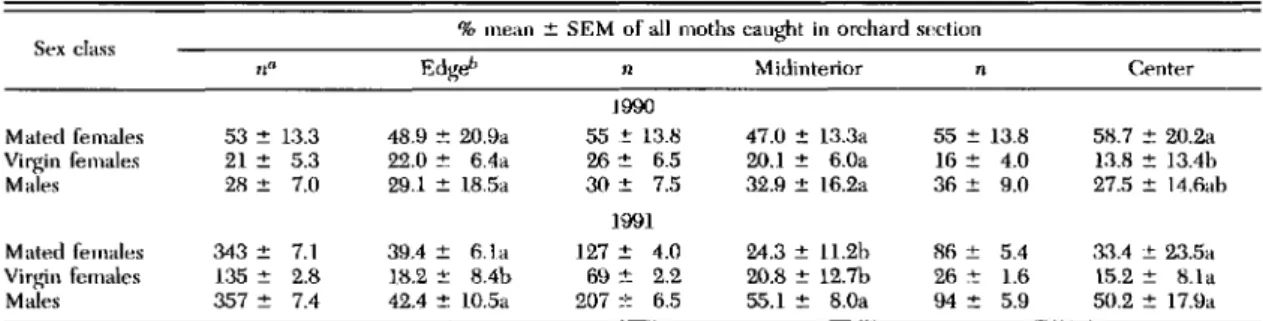
The bait station traps also caught a number of moths (Table 5), but the catch trends in these traps were dissimiJar to those in the pheromone traps, with no apparent pattern according to time of the season. Although the traps were present in all or-chards throughout the summer, the peak catches varied from early July and late August to early Sep-tember (West Somerset and Kuckville) to mid-September (Eagle Harbor), and at Lyndonville the catches were low and sporadic all season. More females than males were caught in all orchard sec-tions, and more of these females were mated than virgins, although these differences were significant only in the orchard center. The mean number of moths per trap caught of a given sex or mating status was not significantly different between the edge, midinterior and center of the orchards (df= 5, 6; males, F = 3.88; P
<
0'()65; total females, F=
1.40; P<
0.344; mated females, F=
1.91.;P<
0.217; virgin females, F = 0.29; P
<
0.9022, least significant difference [LSD] test). Out of 226 total females caught in the bait traps during the sum-mer, 72.1% were mated.Results of the foliar inspection (;Qnducted in mid-July were recorded first as the overall per-centage of terminals that had been fed on at some point in the season before the evaluation date, ir-respective of the presence of live larvae in the feeding site. The percentage of terminals being ac-tively fed on at the time of inspection was also noted (Table 6). This is the standard criterion rec-ommended to evaluate the need for chemical con-trol sprays against this larval generation in com-mercial orchards (Wilcox et aI. 1995). Current treatment threshold guidelines recommend an in-secticide spray at the 10% tenninal infestation lev-el in July for processing fruit, and at 3% for fresh market fmit. There were no statistical differences in the percentage of terminals with feeding dam-age among the pheromone and insecticide treat-ments, all of which showed damage as severe as that in the untreated checks except for the miclin-terior insecticide plots. The percentage of foliar terminals infested with live larvae was significantly lower than in the untreated control only in the pheromone
+
insecticide orchard edge and insec-ticide-only plots. Infestation in the plots receiving only insecticide sprays was no different from that in any of the pheromone plots. Preharvest fmit in-spection for larval feeding damage showed that only the insecticide treatment was significantly lower than the untreated control, but the insecti-cide-only plots and those receiving both phero-mones and insecticide sprays were not significantly different (Table 6).1991. As in the previous 2 yr, the natnral blend ties and membrane dispensers significantly
de-ENVIRONMENTAL ENTOMOLOGY 12 1\
Shepherd
~
10 I \ «I•..
I \ --Gen(1976) ...••
I I -&- Gen(988) lit 8
..c: I I -&- Gen(494)
~
I 0 6 I -M- Memb(988)E
I I I I ....-...Checkd
4J.A
I; - - Remote Cleekc:
c 2 .¥
w···. •. ,
«I;(
t.,.-...
• •
••
:!
0 8 BEl Vol. 25, no. 2 7/11 7/21 7/31Richardson
--Gen(1976)-e-
Gen(988)--e-
Gen(494) "-"'- Cheek - - - Remote Cheek 7/1 6/11 6/21 Q. «I.=
6.•...
.!
~ 4g
2 c «I CI)0
~
li\
Church-S
.. i -M-Memb(988)/
\
--thea
!
.
~ U)f lC M )( U °u U)( )C)(
...
: '\
Church-N
: \ --Gen(1976) I I-e-
Gen(988) , \ ~ ~ Nat(988) I \/ \ --- ..Check , I - - - Remote Ole I \ I \ I ..-.. 'm 'f·*···.•·•
"s Ili s • s 274 80~
III•..
60~
.•...
••
J::.~
40 0E
0
20c:
C III:!
0SO
~
~ 40~
"-
lit J::.~
30 0E
200
c c 10 «I CI)~
0 60~
IIISO
...
~
.•...
40••
J::.~
0 30E
0
20 c c 10 CII CI)~
06/11
6/21
7/1 7/11 7/21 7/31Fig. 1. Captures of C. rosaceana male moths in pheromone-baited traps in apple orchards with different phero-mone treatments (dispensers per hectare), Wayne County, 1989. Gen, generic blend tie dispenser; Memb, natural blend membrane dispenser; Nat, natural blend tie dispenser.
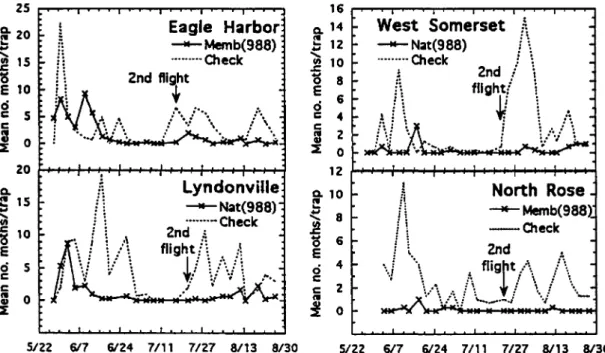
pressed moth catch in the pheromone-permeated orchards, averaging a 75.3% trap reduction across treatments compared with the control traps (Table 3; Fig. 3). The occasional higher counts in the pheromone blocks were a result of large catches in pheromone traps located at the orchard edge, where pheromone permeation presumably would not have been as high. In the molasses bait traps, there were no differences in each orchard section in the percentage of moths caught that were males or females (Table 5). The percentage of female moths that were mated versus unmated was nu-merically higher throughout the orchard, but sig-nificantly different only at the orchard edge. The magnitude of leafroller moths caught varied con-siderably at the 4 locations, ranging from a mean seasonal catch of 35.5 moths per trap at the Eagle Harbor site to 2.3 moths per trap at the North
Rose site. Similarly to 1990, the percentage of all moths caught of a given sex or mating status was not significantly different between the edge, mi-dinterior and center of the orchards (df = 5, 6; males, F = 1.54; P
<
0.305; total females, F = 1.45; P<
0.328; mated females, F = 1.07; P<
0.458; virgin females, F = 4.54; P
<
0.465, LSD test). The percentage of total females caught (786) that were mated was 70.7%, a value comparable to the previous year's measurement of this statistic.Assessments of treatment effects on foliar ter-minal infestation and feeding damage were not conducted until after the growers had made inticide applications in the edge and midinterior sec-tions of the pheromone orchards, so except for the North Rose site, where no insecticides were ap-plied against this pest, the pheromone-only treat-ment was confined to the center sections of these
April 1996 AGNELLO ET AL.: OBLlQUEBANDED LEAFROLLER DISRUPTION TRIALS
275
Tabl •• 4. M'>R11± SEM percent apple terminms infested with obliquebllJlded leafroUer larvae in orchards treuted with l'h.>rtnllones or uL~ecticides, Wayne Com.ty, 1989
Treatnlent % infestedb
Pheromones (;elleril' blend, ti,', 494/ha
(;('I\('I;l' blend, til', 9SS/ha (;('lIeril' hlend, til', 1,976/ha l'\atuml hl,'ud, til', 9SS/ha l'\atuml bl,',ul, Ill('mbran(', 988/ha
20 30 30 10 41 6.5 ± ,5.9b" 7.5 ± 5.I"d 5.3 ± 4B" 4.4 ± 3.5b" 6.8 ± 6.7" Insecticides I 2 :3 ,] CUlltrnl 4 May Chlorpyrifos 4 EC Chlorpyrifos 4 EC 2 June Chlorpyrifos 50 WP Methomyl 1.8 L Chlorpyrifos 50 WP .12July Methomyl 1.8 L Chlorpyrifos 50 WP Methomyl 1.8 L Chlorpyrifos 50 WI' 36 36 36 36 69 3.3 ± 4Bb 0.2 ± OBa 2.9 ± 3.8b 0.7 ± 1.3a 10.7± W.ld
aNUlIlbt'r of tt'rminal-inspt'ction obselVations.
bNUIllI",rs in til(' same eolumn followed by the same letter are not signifi"antly differell! (F= 7.24; df=36,307; P>0.0001, LSD t"st). Data trallsfonm'd by arcsine square root before analysis.
orchards (Table 6). As in 1990, none of the pher-omone plots had lower levels of feeding damage or infestation with live larvae than did the untreat-('d controls, and the percentage of damaged sites in these treatments was actually significantly high-('r than in the control plots. The insecticide-only plots averaged 5.3% terminal infestation, the same value as that obtained the previous year. This was statistically fewer infested terminals tll<ill in the other treatments, including those where insecti-cides had been used in addition to the phero-mones. The disparity between these treatments was most likely a result of conducting the insecti-cide trials on separate farms that had substantially
lower leafro]]er populations than at the pheromone test sites.
Fmit damage was significantly lower in all pher-omone and insecticide plots than in the untreated checks, and the insecticide-only treatments located at the Richardson and Wolcott sites showed the lowest level of damage. In the pheromone-treated blocks, fmit damage in the pheromone-only plots was statistically lower than in plots also receiving insecticide applications, but leafroller damage rates
>
5-6% generally are not considered acceptable for commercial fresh fmit pl'Oduction, so neither treatment was particularly successful in adequately protecting the crop from this pest.Kuckvllle
-Nat(988) --Check 2nd~ flight f\ •!\ 1 : ., •••••••••.•• 0.1 \ •••••• ~••00 ••",West Somerset /~
- Nat(988)! i -- Check!\ / \
/'.
2ndII!
I,\,
, flight ,! li \"
\ L }'V
:
T -''''' \.
f\
:\ : i I' ! i : i ii
~
I. .1 Ii \r~\
l\it
...•....
} \
: --.I i;~. 1\
!'-: 1 : i!
!
i \ , I j \ j\r
"-I '
f \.- ••••o
5 12li'
10•..
•..
~ 8 .co
6 Eo
4 c: c: 2 <'II ~ 0 25li'
20 l:l!
•...
15 oE
10Eagle Harbor
-Nat'(988) --Check 2nd flight~
.,
...". f \,Lyndonville
-Nat(988) --Check.~
2nd A1\
flight•.
.
i
\.1 \
" i V.'\
f
A II •i \
:\
! \
i ": i: ! I I \t-. f
I , , "I II \.
..1 ~ \ ! 5o
o
c: 25 Q. 20;
!
..
15 oE
10o
c: 5 c:••
!
0 25 Q. 20;
!
..
15 oE
10 5/31 6/16 7/3 7/19 8/5 8/21 9/7 9/24 5/31 6/16 7/3 7/19 8/5 8/21 9/7 9/24Fi~. 2. Captures of C. rosaceana male moths in pheromone-baited traps in apple orchards treated with pheromones (disp('ns('fs p('r hectare), Orleans and Niagara counties, 1990. Nat, natural blend tie dispenser.
276 ENVIRONMENTAL ENTOMOLOGY Vol. 25, no. 2 Table 5. Sex elllSSof all oblique banded leafroUer moths caught in each section of l'heromone-tr.mtml orchards using molasses bait traps, Orleans, Niagara, and Wayne conn ties, July-September 1990 and 1991
Sex class % mean:!: SEM of all moths caught in orchard section
ull Edg& n Midinterior n Center
1990
Mated females 53 :!: 13.3 48.9:!: 20.9a 55 .:t 13./l 47.0:!: 13.3a 55 :!: 13.8 5H.7 :!: 20.2a Virgin females 21 :!: 5.3 22.0 :!: 6.4a 26 :!: 6.5 20.1 :!: 6.0a 16 :!: 4.0 13.8 :!: ]3.4h Males 28 :!: 7.0 29.1 :!: 18.5a 30 :!: 7.5 32.9:!: 16.2a 36 :!: 9.0 27.5 :!: 14.6ab
1991
Mated females 343:!: 7.1 39.4 :!: 6.1a 127 :!: 4.0 24.3 :!: l1.2h 86 :!: 5.4 3.1.4 :!: 23.5a Virh'in females 135 :!: 2.8 18.2 :!: 8.4b 69 :!: 2.2 20.8:!: 12.7b 26:!: 1.6 1.5.2 :!: 8.1a Males 357 :!: 7.4 42.4 :!: 10.5a 207 :': 6.5 55.1 :!: 8.0a 94:!: 5.9 50.2 :!: 17.9a
aTotal moths caught (mean number per trap).
I,Within the same year, values in each column followed by the same letter are not significantly different (df =6, 9; ]990--~,dge: F
=6.20; P> 0.008; midinterinr: F =3.54; P > 0.044; center: F
=
3.74; P > 0.038; 1991-edg": F =5.67; P > 0.011; midinterior: F=3.57; P>0.043; center: F =1.27; P>0.359, LSD test). Data transfonned using arcsine sqnare root hefore analysis.
1992. Solvent extracts of pheromone glands from laboratory-reared females contained Ell-14: OAc, Zll-14:0Ac, and Zll-14:0H in a propor-tion of 3.7% (0.1, SE): 91.7% (0.2): 4.7% (0.4). The blend found in wild females differed slightly, in that it contained proportionately less of the alco-hol: Ell-14:0Ac: Zll-14:0Ac: Zll-14:0H was 4.3% (0.2): 93.4% (0.4): 2.4% (0.2). These blends are similar to those found in earlier analyses of OBLR pheromone glands (Hill and Roelofs 1979). The mean proportion of components actually emit-ted by the membrane dispensers was 89.7% Zll-14:0Ac, 5.4% Ell-140Ac, and 5.0% Zll-14:0H (n =4).
Unfavorably cool and wet summer weather re-sulted in lower pheromone trap catches than those
obtained in previous years. Statistically fewer av-erage moths per trap were caught in all plots treat-ed with 988 dispensers per hectare than in those treated with half this rate (Table 7). As in the trials for the previous 3 yr, traps hung in the lower can-opy locations caught very few moths, especially in contrast to traps in an orchard not treated with pheromones (Fig. 4). However, in every test plot at each site, the pheromone traps placed in the higher canopy locations caught significantlygreater numbers of moths than those placed in the lower canopy locations (Figs. 4-6). This effect was gen-erally less pronounced in the plots treated with 988 dispensers per hectare, but the magnitude of the differences was similar to those seen in the plots treated with 494 dispensers per hectare. At this
Table 6. Mewl± SEM percentage of apple termillal.~and fruits damaged by obliquebamled leafroller larvae in orchard sections treated with pheromones or insecticides, Orleans and Niagara cOlUlties,1990-1991
Tenninals Orchard section Treatment"
nb % damaged sites"·d % infestedC
1990
Edge Pheromone 8 10.3 :!: 6.9ab 5.1 :!: 5.0abc
Edge Pheromone +insecticide 8 7.1 :!: 3.2ab 2.3 :!: 2.7c
Midinterior Pheromone /l 13.0 :t 7.3ab 9.5 :!: 6.6ab
Midinterior Pheromone +insecticide 8 7,5 :t 5.3ab 4.8 :!: 4.9abc
Midinterior Insecticide 42 8.1 :t 8.5a 5.3 :!: 6.7bc
Center Pheromone 16 9.0 :': 6.2ab 6.3 :': 5.4ahc
Control 21 14.4 :': l1.6b 10.8 :!: 9.2a
1991
Edge Pheromone +insecticide 16 34.2 :!: 18.7a 18.1 :!: 6.6a Midintcrior Pheromone +insecticide 16 37.0:': 23.1a 16.6 :!: lO.4a
Midinterior Insecticide 8 5.3 :!: 6.0b
Center Pheromone 34 22.5:!: 14.0b 18.6 :': 14.1a
Control 26 17.4 :!: 16.0c 19.8 :!: 17.3a F'nlits n %damageC 20 3.9 :!: 3.2ah 21 2.1 :': 2.4b 20 4.8 :!: 3.8a 42 6.7 :!: 8.6a 37 9.5:t 4.7c 8 3.0 :': 2.0a 37 7.7 :!: 5.1b 8 15.5 :': 1O.9d "Pheromone treatments: natural blend ties (1990 and 1991) or membranes (1991), 988/ha; insecticides: chlorpyrifos or microcneap-sulated methyl parathion, applied Mean =5.7 d (range, 2-11) before temlinal-sampling date.
hNumber of tenninal- orfnlit-inspection obseTVations.
("Within the same year, numbers in the same column followed by the same letter are not significantly different (1900: percentage damaged sites, F = 1.65; df=24,86; P>0.0491; percentage infested, F= 1.61; df= 24, 86; P>0.0579. ]991: percentage damaged sites, F=10.21; df = 17,89; P>0.0001; percentage infested, F
=
:3.99; df=17,89; P>0.000], LSD test). Data transformed by arcsine square root hefore analysis.dFoliar terminals showing lecding damage, with or without live larvae present.
("For the same year, numbers followed by the same letter are not significantly different (1900: F =2.06; df=22,80; P>0.010,'5; 1991:F =6.12; df= 16, 73; P>0.0001, LSD test).
April 1996 AGNELLO ET AI,.: OBLIQUEBANDED LEAFROLLER DISRUPTION THIALS 277
Eagle Harbor
-Memb(988)
...- Check 2nd flight•
~
..
2ndi
i
flight! \It·
.tf \!
l/·-/
.; .•..!
North Rose
f\
j; -Memb(988l
n
--Check i i 2nd •••••/f '\, f1igtt /\ • ,. !-. ! \,.I \ ...._
'.:./
.f \. '\ \, ""'. ..' .•.•.._.-J:. \;.
West Somerset
-Nat(988)
...- Check 4 2o
d c c:,.
!
16 0.14 ~ 12...
1!
10o
8 Ed
6 c: 4 cm
2 ~ 0 12i"
10•..
~ 81!
o
6 E.'.'
f\..
\Lyndonville
-Nat(988)
. - Check 2nd ~ flighti\ .
II1/
\!\!\
t·
~: .:
'~"
..
..'
:.
..
; ; .\ : "'~::::.:._.\!
0.:.
V
' 0. l! lS~
(/I oS:. 10~
Eo
S c: c:m
0~
20 2Si"
20•..
oJ...
1!
1S~
Eto
o
c: S c: ~ 0~
Sl22 6/7 6/24 7/11 7/27 8/t3 8/30 Sl22 6/7 6/24 7/11 7/27 8/13 8/30 Fil(. 3. Captures ofC. rosaceana male moths in pheromone-baited traps in apple orchards with different phero-mone treatments (dispensers per hectare), Wayne, Orleans, and Niagara counties, 1991. Memb, natural blend mem-bram' dispenser; Nat, natural blend tie dispenser.lower application rate, where less complete pher-omone permeation and thus less orientation dis-ruption would be expected, the higher traps often caught moths when the lower traps caught none. A related trend was the frequent occurrence of lowpr average numbers caught in plots where the pllPromone dispensers were placed both higb and low in the trees, compared with those in plots whpre all the dispensers were hung in mid-canopy, although this was not significant across sites.
Discussion
Hedllction in the number of males trapped at synthptic sex pheromone sources can provide some
indication of the treatment ability of a pheromone to prevent males from Finding virgin females, but this method alone does not demonstrate whether mating is reduced. Harely is a reduction in mating linked to an equivalent decrease in trapped males, and for many tortricids it is particularly difficult to construct a relationship between males caught and fruit damage because a number of factors have an impact on trap catch, population dynamics, and adult movement and distribution (Hothschild 1981, Charmillot and Vickers 1991).
Studies in orchards not treated with pheromone disruptants have demonstrated a relationship be-tween pheromone trap location and catch size.
Table 7. Mean ± SEM oblique banded lenfroUer moths eaught in pheromone traps plaeed at different clInol'Y heights in pheromone-permeated orchllrds, western New York, 1992
Displ'nspr"
Displ"nser location nb Moths per trap,C
rate all traps
USH/ha Top +bottom of canopy 3.50 0.37 :!: 1.08a
lJSS/ha Midcanopy 350 0.53 :!: 1.83a
494/ha Top +hottom of canopy 230 1.20 :!: 3.02b
494/ha Midcanopy 230 1.34 ±3Anb
Trap
It Moths ppr trap"
locationd
High 1.75 0.02 :.!: 1.40a
Low 175 0.]2 :.!:0.5]b
High 175 ] .OJ :+2.4fJa
Low 175 0.0.5 ±0.2nh
IIigh lI5 2.20 ±3.lJSa
Low lI5 O.llJ ±0.n5h
High U5 2.11 :+. 4.01a
Low 115 0.57 ±2.nOh
" Natural hlend, 1lll'lllhranes.
h NIIIllIlt'r of tmp-n'ading obsl"rvations.
c NUlllll<'fs followl"d by thO" same letter are not significantly different (F
=
24.4\; df=
10, 1,149; P >(WOOl, LSD tpst). Data transfornlt'd by loglO(x + \)bl"forp analysis.dHigh, 2.7 m ahoV!' !V0und; low, 0.9-1.2 m above ground.
,. For tIlt' same dispenser rate and loeation, numbers followml by the same leuer are not significantly different (lJHH/ha, top +bottom:
F· n.S9; df
=
7,342. 988/ha, midpanopy: F= 13.44; df = 7,342. 494/ha, top +hottom: F = 10.70; df =n. 223. 494/ha, Illidcanopy:278 ENVIRONMENTAL ENTOMOLOGY Vol. 25, no. 2 494/ha High
a
Low In canopy 988/hl Higha
Low In canopyKuckvllle
-M- Pher-Hlgh ...- ..- Pher-Low-e-
Female-High - Female-Lowfi'20
•..
••
..•..
1!
15••
~ 10 ci c 5 c: l'lI II) 0~
25 25 i-20•..
••
..•..•.1!
15••
o
E
10ci
c 5 c l'lI:f
0Kuckvllle
988/ha, Mid-canopy--Chedc -M- Pher-Hlgh .... - ... Pher-Low -0- Female-High - Female-Low 494/ha Mid-canopy 40
a.
35 ~ 30 ..•..•. ~ 25••
020 ~ 15o
c
10 c ~ 5:!
0 25 ~20••
..•..•. ~ 15••
o
E
10ci
c 5c
~
II) 0~
6/5 6/1 5 6/25 7/5 7/15 7/25 6/5 6/15 6/25 7/5 7/15 7/25Fig. 4. Captures of C. msaceana male moths in traps placed high or low in tree canopy and baited with rubber septum pheromone lures (Pher) or virgin female moths (Female) in apple orchards treated with different rates of natural blend membrane dispensers, KuckviUe, Orleans County, 1992. Catches from a control orchard not treated with pheromones are shown in the 9SS/ha, midcanopy graph.
988/ha High' Low In canopy 494/ha High 81 Low In canopy
Eagle Harbor
-If- Pher-High - Pher-Low-e-
Female-High - Female-Low7
Q, 6~
..
~
5
I/)-S
4
o
E
3
o
2
c:li
1:I
07
Q,6
l'lI..
~ 5 I/)-5
4
~ 3o
2
c:li
1 II) ~ 0 988/ha Mid-canopy I 494/ha1\ldoca.DPY
Eagle Harbor
-M- Pher-Hlgh ...-- ... Pher-Low Female-High - Female-Low7
Q,6
l'lI•..
~
5
I/)-S
4
o
E
3 ci2
c:li
1:I
07
Q,6
~
..
~
5
I/)-S
4
o
E
3g
2
li
1 II) ~ 0 6/S 6/16 6/27 7/8 7/19 7/30 6/S 6/16 6/27 7/8 7/19 7/30Fig. 5. Captures of C. rosaceana male moths in traps placed high or low in tree canopy and baited with rubber septum pheromone lures (Pher) or virgin female moths (Female) in apple orchards treated with different rates of natuml blend membrane dispensers, Eagle Harbor, Orleans County, 1992.
April 1996 AGNELLO ET AL.: OBLIQUEBANDED LEAFROLLER DISRUPTION TRIALS 279
Fi~.6. Captures ofC. rosaceana male moths in traps placed hi~h or low in tree canopy and baited with rubber septum pheromone lures (Pher) or virgin female moths (Female) in apple orchards treated with natural blend membrane dispensers, West Somerset, Niagara County, 1992.
tree crops. However, more recent work has estab-lished a vertical variability in pheromone concen-trations found in orchards, based on the finding that higher air layers move more freely (Charmillot and Vickers 1991).
Electroantennagram studies in vineyards treated for mating dismption of Lobesia botmna (Denis & Schiffermiiller) suggest that pheromone is distrib-uted in treated areas as a dense cloud of relatively high concentration, with well defined boundaries and very few internal variations (Karg and Saller 1995). These studies also found the highest relative pheromone concentration at the same height as the dispensers, with rapidly declining levels both above and below this region. Such findings would be consistent with our results if C. rosaceana is more sexually active near the top of thc canopy than lower down.
An interpretation can be made tbat pheromone permeation, especially in the upper canopy areas, is lower and less uniform in the plots containing midcanopy dispensers. If the blend being emitted is correct, females could be mating because cov-erage is not complete, and relatively pheromone-free zones exist where males could find and mate with them. Carde and Minks (1995) postulate that, if a point source dispenser is located in the middle of the tree canopy, and the female moth conven-tionally calls from foliage at: the tree top, her plume will be produced in pheromone-free space. Even with as many as half of the per-hectare rate of dispensers placed in the tops of the trees, a cer-tain amount of dissipation could be expected be-cause of greater air movement in that location, leading to some trap catches in those sites.
Our results suggest that oblique banded leafroll-er mate locating behavior takes place in or above the top of the tree canopy, either when normal flight orientation in the lower canopy is dismpted, or under any circumstances regardless of phero-mone dismptants that may be present. It is com-monly observed that obliquebanded leafroller lar-val infestations tend to be higher near the tops of trees, but explanations of this fact generally center around poorer spray coverage and greater succu-lent shoot growth in this portion of the tree. It seems likely that a considerable amount of flight and mating behavior may be occurring in the up-per canopy areas. Still unexplored is the extent of moth immigration, and whether it occurs primarily near the tree tops, or if one or both sexes fly into the orchard nearer to the ground and work their way upward in response to extemal stimuli when attempting to locate mates. A logical extension of our trials would be to locate all the pheromone dispensers in the high canopy locations, to sec whether effectively increasing the permeation of the air at this level would have an effect on trap catch, mating status and fmit damage.
Traps baited with food lures occasionally have been used as a way of monitoring adults in or-chards, although these have been reported to
se-7/19 7/30 988/ha High
a
Low In canopy 7/8West
Somerset
988/ha, Mid-canopy -M- Pher-High .- ...- ... Pher-Low-e-
Female-High -.- Female-Low 6/16 6/27 6/5Riedl et al. (1979) found that trap height had the most significant effect on pheromone trap catches of codling moth, Cydia pomonella (L.), in apple and pear orchards, with greater catches as trap el-evation increased. Similarly, Howell et al. (1990) found that pheromone traps located 3.5 m high in sprayed apple trees caught more C. pomonella moths than those at 1.5 m 60% of the time, and pheromone traps placed 9 m above the ground in pecan orchards caught more adult males of hickory slmckworm, C. canjana (Fitch), than those placed 4.6 m high (McVay et al. 1995). Our results in pheromone-treated orchards correspond with these findings, to the extent that more meaningful trap catch data arguably could have been gathered had our traps been located in the upper 3rd of the canopy during all 4 yr of our trials; however, our insight into the mating behavior of this species was not sufficient to prompt this change until the 1992 season.
Optimal height of the pheromone dispensers is another factor dependent on the details of the sex-ual activity of target species. Rothschild (1975) concluded there was no significant difference in dismption of Cydia molesta (Busck) [=Gmpholita molesta (Busck)] when pheromone was released from the crowns of peach trees at 3.5 m or lower do\-vn at 1.5 m, a factor he attributed to adequate aerial distribution of the pheromone in orchard
1 0.8 0.6 d
c
0.4 c ~ 0.2 ~ 0 1.4fi'
1.2 ~ 1 lit~
1
0.8 0.6 d c 0.4c
CllI 0.2:!
0280 ENVIRONMENTAL ENTOMOLOGY Vol. 25, no. 2
lectively attract older mated females (Rothschild 1981, Tomkins et al. 1987, Charmillot and Vickers 1991, Suckling et al. 1994). Molasses bait traps in our studies caught more mated than virgin fe-males. We did not collect bait trap data from non-pheromone blocks, so it is not possible to deter-mine whether this is a normal occurrence for this species. However, our results show that mated fe-males were dispersed relatively uniformly through-out pheromone-treated blocks 1.0-2.4 ha in size, and were present in the center at least as frequent-ly as anywhere else in these orchards. In 1991, considering that the proportion of total traps in the edge to midinterior to center orchard sections was in the ratio of 50:33.3:16.7% at each site, the mean percentage of mated females caught in the differ-ent section of these orchards (61.7:22.8:15.5%) conformed fairly closely to these values, with a slight edge effect. This may indicate either that no portion of the permeated orchards was far enough away from nondismpted areas to overcome immi-gration potential of the moths, or that the orchards contained resident females that were not prevent-ed from mating by the pheromone treatments.
Foliar and fmit damage patterns, as measured in these trials, provide an indirect but economically relevant method for assessing the success of mat-ing dismption. If the pheromone dispensers had been effective in preventing mating, and if immi-gration had been negligible, there would have been no infested trees in these blocks, or at least very few in the centers. This was obviously not the case, as terminal infestation rates in the center were at least as high as those on the edge of the block. Fmit damage levels before harvest in 1991 were not as severe as would have been anticipated from the high July infestation readings (Table 6). Adverse summer weather most likely contributed to this outcome. Above-average temperatures (3.2-36°C higher than normal) (U.S. Department of Commerce 1991) in late July resulted in poor leaf quality during August, and informal foliar inspec-tions made during August revealed that many lar-vae had starved before being able to reach the fruit. These findings were consistent with those of Onstad et al. (1986), who demonstrated lower mortality of larvae developing on younger, more succulent apple leaves than those on older ones, which had lower food quality because of dimin-ished nitrogen and water content.
Results of fmit evaluations indicate that there is not always a good correlation between July termi-nal infestation levels and harvest damage. In 1990, the Kuckville and West Somerset blocks sustained low and high (1.7 and 9.6%) fmit damage, respec-tively, consistent with the July terminal infestations (1.4 and 5.2%). However, the Lyndonville phero-mone block technically had an above-threshold population (4.3% infested terminals) in July, yet at harvest the fruit damage was minimal (1.0%). Leafroller larval populations were larger in 1991, so virtually all treatment sites had foliar terminal
infestations >3% action threshold (Table 6), but a 13% reading at the Lyndonville location translated into only 3.1% fmit damage at harvest, which is considered economically acceptable by growers with routinely high leah'oller damage. Similar find-ings were reported by Pree et al. (1994), who con-cluded that the incidence of fmit damage at har-vest could not be predicted from the incidence of summer damage to peach twigs by larvae of G. nwlesta, another tortricid.
Except for the Ida Red trees at the West Som-erset site, where levels of leafroller-damaged fmit were particularly high (pheromone, 9.6%; insecti-cide
+
pheromone, 3.7%), the pheromone-treated trees showed fmit damage comparable with that in the orchard sections where growers had addition-ally applied insecticides on the individual farms (e.g., Eagle Harbor, 4.7:5.3% pheromone: insecti-cide+
pheromone; Lyndonville, 1.0:1.4%; Kuck-ville, 1.7:0.9%), although the mean damage levels across farms were statistically different for these two categories (Table 6). In the case of the West Somerset Cortland trees, neither treatment was ef-fective enough to prevent economically unaccept-able damage at harvest (pheromone, 6.9%; insec-ticide+
pheromone, 8.1%). Again in 1991, the fmit damage from trees treated with pheromones at a given site was not lowered appreciably by the addition of pesticide applications. Values for pher-omone: insecticide+
pheromone treatments at in-dividual sites were Eagle Harbor, 13.3:12.1%; Lyn-donville, 3.1:6.3%; North Rose, 8.1:12.0%; West Somerset Cortland, 6.9:9.6%; and West Somerset Ida Red, 8.1:8.3% fruit damage. Although no com-mercial formulation of obliquebanded leafroller sex pheromone is currently available for use as a mating dismptant, the cost effectiveness of such a strategy as opposed to using conventional pesti-cides would ultimately need to be ascertained by each grower according to the specifics of insecti-cide application costs and reductions in marketable fmit attributable to leafroller damage in each or-chard. Informal studies (W.H.R., unpublished data) have demonstrated that, depending on the potential packout loss in the absence of a treat-ment (i.e., as determined by the relative severity of leafroller damage in a given year), the costs of a given treatment program, and the costs and re-turns associated with specific packing categories (e.g., average returns of the different packs used, costs of processing culls), it is occasionallyless prof-itable to apply a leafroller treatment than it is to withhold it and allow negligible damage to occur. Such tends to be the case when leafroller pressure is in the low to moderate range (3-5% fmit dam-age in untreated orchards). Additionally, it is dif-ficult to evaluate the benefits of withholding leaf-roller insecticides that are harmful to mite predators, resulting in improved phytophagous mite control that may offset marginally higher fmit damage from leafrollers.April 1996 AGNELLO ET AL.: OBLlQUEBANDED LEAFROLLER DISHUPTlON TRIALS 281
Future research should address the effectiveness of pheromone application in areas much larger than those tested previously, with an emphasis on the characteristics of the immigration capabilities of this species. The mating behavior of this pest within the orchard remains largely unexplored, but locating the dispensers near the top of the tree canopy to maximize permeation in this region would provide useful information to compare with current findings. A sprayable pheromone formu-latioll, when such becomes available, should be ca-pable of permeating the tree canopy more uni-formly than the hand-applied dispensers used in this study.
Acknowledgments
We thank C. Bailey, D. Bartleson, J. Dubois, O. Kalir, G. Lamont, J. Misiti, D. Oakes, R. Paddock, W. H. Palm-er, J. Peters, T. Staples, and C. \'Vagemaker for allowing liS to work in their orehards and for supplying field ex-pertise. We also th,mk T. Harris, K. Davis, D. Dunham, K. Hannaeker, P. Hezel, J. Minns, Jr.,
c.
Momberger, N. Rivkin, J. Wagar, T. Wheeler, H. Wileox, M. Wileox, and S. Young (Cornell University) for their field and labora-tory assistance. Appreciation goes also to Consep ,md Pa-cific Biocontrol for their cooperation and for providing pheromone dispensers. This work was supported by grants from the New York State Department of Agrieul-tun' and Markets, Albany, through the Cornell Integrated Pest Management Program.References Cited
Baker, T. C., L. K. Gaston, M. M. Pope, L.P.S. Ku-enen, and R. S. Vetter. 1981. A high efficiency collection device for quantifYing sex pheromone
vol-atilized from female glands and synthetic sourees.
J.
Chem. Eeol. 7: 961-968.Carde, R. T., and A. K. Minks. 1995. Control of moth pl'sts by mating disruption: suecesses and constraints. Annll. Rev. Entomol. 40: 559-585.
Charmillot, P. J., and R. A. Vickers. 1991. Use of sex pheromones for control of tortricid pests in pome and stone fruits, pp. 487-496. InL.P.S. van del' Geest and H. H. Evenhuis [eds.], Tortricid pests, their bi-ology, natural enemies and control. "Vorld Crop Pests vol. 5. Elsevier, Amsterdam.
Deland, J. P., G.J.R. Judd, and B. D. Roitberg. 1994. Dismption of pheromone communieation in three sympatric leafroller (Lepidoptera: Tortricidae) pests of apple in British Columbia. Environ. Entomol. 23: 1084-1090.
Glass, E. H., and G.E.R. Hervey. 1962. Continuou.s reming of the red-banded leafroller, Argyrotaenia ve-llltitUlIIa.
J.
Eeon. Entomol. 55: 336-340.Hill, A. S., and W. L. Roelofs. 1979. Sex pheromone components of the obliquebanded leafroller moth, G1IOristoneura rosaceana.
J.
Chem. Eeol. 5: 3-11. Howell, J. F., R. S. Schmidt, D. R. Horton, S.U.K.Khallak, and L. D. While. 1990. Codling moth: male moth aetivity in response to pheromone lures and pheromone-baited traps at different elevations within and between trees. Environ. Entomol. 19: 573-577.
Karg, G., and A. E. Sauer. 1995. Spatial distribution of pheromone in vineyards treated for mating disrup-tion of the grape vine moth Lobesia botrana measured with electroantennograms.
J.
Chem. Ecol. 21: ]299-1314.Karg, G., D. M. Suckling, and S. J. Bradley. 1994. Absorption and release of pheromone of EpiphYl/s postvittana (Lepidoptera: Tortricidae) by apple leaves.
J.
Chem. Ecol. 20: 1825-1841.McVay,J. R., R. D. Eikenbary, R. D. Morrison, C. A. Kouskolekas, and M. Dennison. 1995. Effects of pheromone trap design and placement on capture of male Gydia cm1jana (Lepidoptera: Tortricidae: Olethreutinae) in Alabama pecan orchards and the re-lationship of trap captures to fruit infestation.
J.
En-tomol. Sci. 30: 165-175.Onstad, D. W., W. H. Reissig, and C. A. Shoelllaker. 1986. Influence of apple cultivar, tree phenology, and leaf quality on the development and mortality of Choristoneura rosaceana (Lepidoptera: Tortricidae). Can. Entomol. 118: 123-132.
Palamswamy, P., R. J. Ross, W. D. Seabrook, (;. C. Lonergan, C. J. Wiesner, S. H. Tan, and P. J. Silk. 1982. Mating suppression of caged spruce budworm (Lepidoptera: Tortricidae) moths in different phero-mone atmospheres and high populatiou densities.
J.
Eeon. Entomol. 75: 989-993.Pree, D. J., R. M. Trimble, K. J. Whitty, and P. M. Vickers. 1994. Control of oriental fruit moth by mating disruption using sex pheromone in the Niagara Peninsula, Ontario. Can. Entomol. 126: 1287-1299. Pfeiffer, D. G., W. Kaakeh, J. C. Killian, M. W.
La-chance, and P. Kirsch. 1993. Mating disruption to eontrol damage by leafrollers in Virginia apple or-ehards. Entomol. Exp. Appl. 67: 47-56.
Reissig, W. H. 1978. Biology and control of the obli-quebanded leafroller on apples.
J.
Econ. Entomo\. 71: 804-809.Reissig, W. H., and A. M. Agnello. 1991. Manage-ment of the oblique banded leafroller and the use of summer oil against the European red mite. Annu. Rep. Mich. Hortie. Soc. 121: 128-151.
Reissig, W. H., M. Novak, and W. L. Roelofs. 1978. Orientation dismption of Argyrotaenia velutiTWlla and Ghoristoneura rosaceana male moths. Environ. En-tomol. 7: 631-632.
Reissig, W. H., B. H. Stanley, ami II. E. HebdiJ1g. 1986. Azinphosmethyl resistance and weight-related response of obliquebanded leafroller (Lepidoptera: Tortricidae) larvae to .insecticides. J. Econ. Entolllol. 79: 329~'3,'3,'3.
Riedl, H., S. A. Hoying, W. W. Barnett, and J. E. DeTar. 1979. Relationship of within-tree placement of the pheromone trap to codling moth eatches. En-viron. Entomol. 8: 765-769.
Roelofs, W. L., and M. Novak. 1981. Small-plot orientation tests for sereening potential mating dis-mptants, pp. 229-242. In E. R. Mitchell [ed.], Man-agement of insect pests with semiochemicals. Plenum, New York.
Roelofs, W. L., and J.P. Telle. 1970. Sex pheromone of the oblique-banded leaf roller moth. Nature (Lond.) 226: 1172.
Rothschild, G.H.L. 1975. Control of oriental fruit moth (Cydia 11lolesta (Busek) (Lepidoptera, Tortrici-dae) with synthetic female pheromone. Bull. Ento-mo\. Res. 65: 473-490.
282 ENVIRONMENTAL ENTOMOLOGY Vol. 25, no. 2
1981. Mating dismption of lepidopterous pests: cur-rent status and future prospects, pp. 207-228. In E. R. Mitchell [ed.], Management of insect pests with semiochemicals. Plenum, New York.
SAS Institute. 1985. SAS user's guide: statistics, ver-sion 5 ed. SAS Institute, Cary, NC.
Suckling, D. M., J. F. Brunner, G. M. Burnip, and J.T.S. Walker. 1994. Dispersal of Epiphy(JS post-vittana (Walker) and Planotortrix octo Dugdale (Lep-idoptera: Tortricidae) at a Canterbury, New Zealand orchard. N.Z.
J.
Crop Hortic. Sci. 22: 225-234. Tomkins, A. R., D. R. Penman, and R. B. Chapman.1987. Use of traps for monitoring adult leafrollers in apple orchards. N.Z.
J.
Exp. Agric. 15: 91-96. U.S. Department of Commerce. 1991. Localclima-tological data, Rochester, N.Y., airport. National
Oce-anic and Atmospheric Administration, U.S. Depart-ment of Commerce, Asheville, NC.
Vickers, R. A., G.H.L. Rothschild, and E. L. Jones. 1985. Control of the oriental fmit moth, Cydia mo-lesta (Busck) (Lepidoptera: Tortricidae), at a district level by mating dismption with synthetic female pher-omone. Bull. EntomoI. Res. 75: 625-634.
Weires, R. W., W. L. Roelofs, and A. E. Robinson. 1978. Pheromone dismption of leafrollers in the Hudson Valley 1976-1977. Proc. Ann. Meet. N.Y.S. Hortic. Soc. 123: 130-135.
Wilcox, W. F., A. M. Agnello, J. Kovach, and W. C. Stiles. 1995. 1995 Pest management recommenda-tions for commercial tree-fruit production. Cornell University Press, Ithaca, NY.
Received for publication 3 July 1995; accepted 13 De-cember 1995.