Case-study of the Role of Environment as an Energy Externality
in Geneva Vineyard Cultivation and Wine Production
by
GONZAGUE PILLET, D.E.(Fribourg) Research Economist, Centre for Human Ecology
and Environmental Sciences,
University of Geneva, 1211 Geneva 4, Switzerland.
INTRODUCTION
Analysis of economic effects upon the environment is common practically throughout modern scientific litera-ture. In contrast with this situation, the environmental role in specific economic activities is rather little appreciated or even understood. Consequently, economics is only begin-ning to build efficient tools to deal with such environmen-tal, 'external' contributions. In general, environmental conservation is a topic with which only the most far-sighted among industrialists and economists are as yet concerned.
The aim in this paper is to indicate how to develop applied environmental economics by means of a case-stu-dy, that of Switzerland's Geneva Canton vineyard cultiva-tion and wine produccultiva-tion. The general framework of the study is composed of systems ecology (Odum, 1983), energy analysis procedure (Odum & Odum, 1983), and energy externality analysis (Pillet & Odum, 1984, 1987). Accordingly, the focus here is on the energy analysis of the environmental role, and the measurement of the energy externality in an economic subsystem—by means of an energy analysis overview of the Geneva vineyard cultiva-tion, and further processing of the product to wine with due featuring of the typical energy externality.
First, inputs and products of a representative agro-eco-system are portrayed with the use of energy circuit lan-guage, details concerning the evaluation procedure being duly pointed out. Then, the environmental role in the Geneva wine industry is analysed, including service inputs. Energy externalities are evaluated, and results are dis-cussed by means of indices and inferences.
GENERAL DESIGN OF AGRO-ECOSYSTEMS AND ENERGY ANALYSIS PROCEDURE
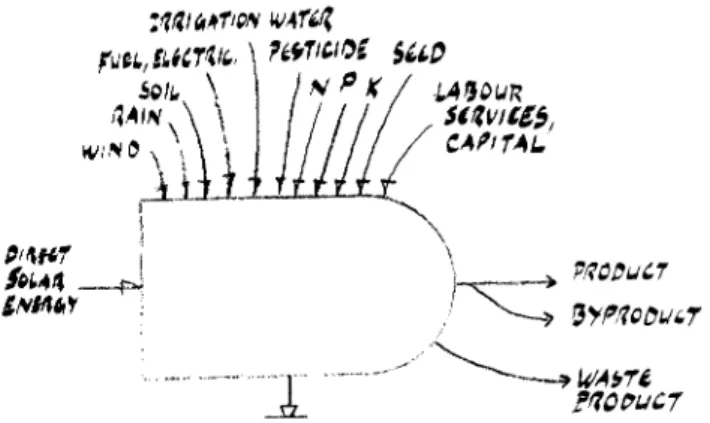
The inputs and products of any representative agricultu-ral production process are geneagricultu-rally portrayed as in Fig. 1, combining direct solar energy, wind, rain, soil, fuel and electricity, irrigation water, pesticide, nutrients, seed, land, labour, and capital, to yield products and by-products of food and fibre. All flows are arranged from left to right in the order approximately of their increasing solar transfor-mity (quality).
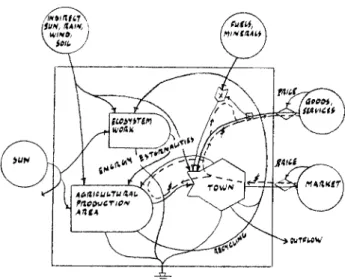
Yet, if we want to represent agricultural production in the broader context of some general agro-ecosystem (or of the web of energy transformation processes in which it is embedded), energy diagramming leads to some moderately complex inventory diagram such as that shown in Fig. 2. Agricultural production is displayed within energy
trans-WAiTt FH0DUC7 FIG. 1. Agricultural inputs arranged in order of their solar
trans-formity. Adapted from Odum (1984).
FIG. 2. Agricultural production process within the web of energy transformation processes (Odum, 1984).
formation processes, though in this ideal case only labour and services that are used directly on the farm are taken into account.
In reality, some of the inputs involve human labour; and some have to be paid for, at least indirectly—but not all of them. The first ones are purchased inputs (fuel, electricity,
54 Environmental Conservation irrigation water, pesticide(s), fertilizers, and seed(s), in Fig.
1), whereas the other required ingredients (direct Sun, wind, rain, and soil) appear as indirect, and even unrecog-nized, environmental contributions to the economic prod-ucts. So there are accompanying payments of money for some but not all inputs. Unpaid inputs constitute external-ities from an economic viewpoint. In this case, they are defined as energy externalities—namely inputs which are not included in the prices, but which are in the process. In other words, their works are not paid for—they are not included in the prices—but they take part in the product. Therefore, evaluating energy externalities means consider-ing indirect environmental contributions to the main econ-omy.
The word 'energy' appears to outline the fact that one has to evaluate those effects on an equivalent ability-to-do-work. No cash value is placed on them, but they carry energetic meanings (cf. Fig. 3). However, one must be care-ful in counting them, for some flows are mere by-products of the same source or process. In particular, this is the case when several solar-generated inflows converge in a produc-tion process. They are evaluated separately first, but only the largest one (e.g. rain) is counted. 'The others were by-products of the same initial solar energy in which less of the original total reached the area' (Odum, 1984). Reconver-gence of by-product flows in a web is shown in Fig. 4.
In contrast one must retain a dual calculation for pur-chased resources, for in this case there are two input energy sources to be evaluated. Thus on one hand there is the energy embodied in the commodity itself, and on the other there is the enmergy* of the human service involved, of which the unit is the enmjoule* (enmj). Enmergy is assigned to services in proportion to the money paid, depending on the monergy of the country, namely the ratio of its enmergy flow to dollar flow (Odum & Odum, 1983;
FIG. 3. Agro-ecosystem. Energy externalities (unpaid inputs) versus
purchased inputs.
* 'Emergy' and 'emjoule' had been proposed as terms but were
soon changed to avoid confusion—see the chapter (pp. 337-69) by Howard T. Odum, entitled 'Enmergy in Ecosystems', in our
Eco-system Theory and Application (John Wiley & Sons,
Chichester-New York-Brisbane-Toronto-Singapore: xv + 445 pp., illustr. 1986).-Ed.
fitfM ormn
AUAi
FIG. 4. Reconvergence of by-product flows in a web of energy
trans-formation processes (Odum, 1984).
Pillet & Odum, 1984). Monergy has been proposed by G. Pillet and H.T. Odum as a new name for enmergy/$ ratio. The assumption is made that the buying power of the money in a country, as measured by the gross national product, is due to the utilization of all of the energy avail-able (energy externalities included), and that the two are proportional.
Now, if an agro-ecosystem contributes to a large part of the total enmergy of the economy, then its contribution to services has to be subtracted from the services which are going to be counted as inputs to that subsystem (Odum,
1984). This is not the case here.
ENERGY ANALYSIS OF THE ENVIRONMENTAL ROLE IN GENEVA WINE INDUSTRY
Typical energy analysis of the environmental role in agriculture is that from Odum & Odum (1983) of United States industrial corn (maize), using data from Pimentel (1979) and adding environmental and service inputs. En-ergy analysis of sheep production in New Zealandf, and of Louisiana sugar-cane, are pioneer studies as well {see Odum & Odum, 1979, 1983; Odum, 1984).
As an example, energy analysis of Louisiana sugar-cane and sugar processing to ethanol was made, using data from Ricaud (1980) and adding environmental and service in-puts (Odum & Odum, 1983). Transformity of sugar, ba-gasse, and ethanol, were obtained ('transformity' having been proposed by D. Scienceman & H.T. Odum as a new name for energy transformation ratio [ETR], see Fig. 5). Thus, one main result of such a case-study is to provide typical energy transformation ratios, and then to calculate indices and to discuss inferences according to that case. The task is the same as regards the present study.
The total area of vineyards in the Canton de Geneve, Switzerland, is 1291 ha (ASS, 1984), constituting 9.13% of all Swiss vineyards. In 1983, the yield of must (unfer-mented grape-juice) was 51,422 hi, which was 8.86% of the total must produced in the country.
t A referee adds the case 'of Brazilian sugar-cane-alcohol (just published in Brazil)'.—Ed.
FIG. 5. Louisiana sugar-cane and sugar processing to ethanol
(Odum & Odum, 1983).
Energy analysis of Geneva vineyard production and fur-ther processing to wine is presented here, the data used being from Odum & Odum (1983), Pillet & Odum (1984), Vazquez-Duhalt (1984), and J. Schwarzenbach (pers. comm. from Service Romand de Vulgarisation Agricole, Lausanne, Switzerland).
Most of the energy is supplied as or by solar energy by-products (e.g. rains), as well as by purchased inputs such as phosphate (P2O5), potassium (K2O), and nitrogen (N).
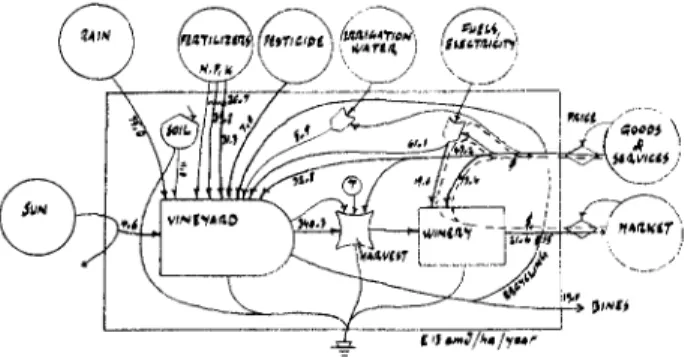
Fuels used directly as well as service inputs have been taken into account. The fermentation process needs sugar, elec-tricity, hot water (indirectly), and services. The bines (flexi-ble shorts) have been evaluated on the same energy-basis as reusable waste products. Energy evaluation has been in-cluded to provide solar transformity of grapes as well as of wine as a final product. Energy flows in one hectare have been evaluated, with Fig. 6 providing the energy diagram and the calculations shown in Table I.
DISCUSSION
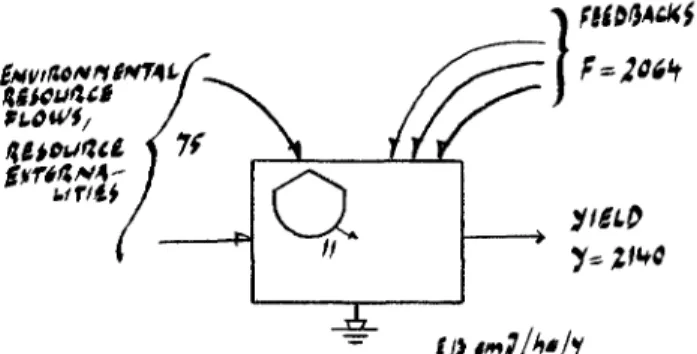
When the diagram has been completed with enmergy flows, one can build an aggregated three-armed diagram, calculated for the main flows (Fig. 7). Then useful ratios may be calculated to help interpretation (Odum & Odum, 1983).
Net Enmergy Yield and Enmergy Investment Ratios
The net enmergy yield ratio is the enmergy of the output (Y) divided by the enmergy of the inputs to the process which is fed back from the economy (F). Definition of the net enmergy yield ratio is depicted in Fig. 8. The ratio characterizing Geneva wines is 1.04, while that of Loui-siana sugar-cane production and further processing to etha-nol is 1.05.
TABLE I
Energy Flows in One Hectare of Vineyard Production and Further Processing to Wine, Geneva Canton.
Foot-notes Type of energy
Actual Energy J/v Solar Transformity enmJ/v Enmergy E 13 enmJ/v 1 2 3 4 5 6 7 8 9 10 11 12 13 14 15 16 17 18 19 20 21 Direct Sun Rain Soil used up Organic matter Irrigation water Nitrogen (N) Potassium (ICO) Phosphate (P2O5) Pesticide Direct fuels Steel in machinery Iron wires, stakes Services Grapes yield Sugar added Electricity Water Capital Services Wines yield Bines (when burned) 4.6 E 13 5.0 E 10 17.6 E 8 1.02 E 9 3.95 E 8 15.2 E 7 11.93 E 7 9.61 E 6 10.64 E 8 9.25 E 9 1.81 E 7 3.25 E 7 $6E3/ha/y 4.74 E 10 6.66 E 9 1.23 E 9 1.11 E 8 $2.3E4/ha/y $1.02E3/ha/y 3.3 E 10 2.84 E 10 1 1.5 E 4 6.24 E 4 6.24 E 4 1.5 E 5 1.69 E 6 2.62 E 6 4.14 E 7 6.6 E 4 6.6 E 4 1.01 E 7 1.01 E 7 .72E12 enmJ/$ 7.18 E 4 8.39 E 4 15.9 E 4 1.5 E 5 .72E12 enmJ/$ .72E12 enmJ/$ 6.7 E 5 6.7 E 3 4.6 75.0* 11.0 6.4 5.9 26.7 31.3 39.8 7.0 61.1 18.3 32.8 43.2 340.3 55.9 19.6 1.7 16.6 E15 73.4 21.4 E 15 19.0 Footnotes to Table I
1. Direct Sun: (1.1 E 6 kcal/m2/y) (1 E 4 m2/ha) (4186 J/kcal) = 4.6 E 13 J/ha/y (Odum & Odum, 1983; Pillet & Odum, 1984). By definition, solar transformity of direct Sun is 1.
2. Rain (water evapotranspired): 1020 mm/y (Geneva) (ASS, 1984); (1.02 m3/m2/y) (1 E 4 m2/ha) (1 E 6 g/m3) (4.9 J/g) = 4.998 E 10 J/ha/y. Transformity is for chemical potential energy in rain over land (Odum & Odum, 1983).
3. Soil used up. Total area: 1291 ha (1983) (ASS, 1984); erosion rate (estimation); 260 g/m2/y (Odum & Odum, 1983; Pillet & Odum, 1984); no successional area; organic fraction 0.03 (guess); (260 g/m2/y) (1 E 4 m2/ha) (0.03 organic) (5.4 kcal/g) (4186 J/kcal) = 17.63 E 8 J/ha/y. Transformity in topsoil for-mation and storage (Odum & Odum, 1983).
4. Organic matter added: (1500 kg/ha/y) (1 E 3 g/kg) (0.03 organic) (5.4 kcal/g) (4186 J/kcal) = 1.02 E 9 J/ha/y (CF, 1983; Odum & Odum, 1983). Transformity of organic matter in topsoil storage (Odum & Odum, 1983).
5. Irrigation water. Water added (irrigation): 40 mm/ha/y upon 1/5 of the vineland area (Vazquez-Duhalt, 1984). Public Util-ities supply irrigation water; energy used is estimated to 1203 kcal/mm/ha(Pimentalrta/., 1973; Vazquez-Duhalt, 1984);(1 E 4 m2) (0.2) (0.04 m/ha/y) (4.94 J/g) (1 E 6 g/m3) = 39.52 E 7 J/ha/y. Transformity in irrigation water (Odum, 1984); that is, including indirect fuels in service.
6. Nitrogen (N): 70 kg/ha/y (Vazquez-Duhalt, 1984); 2170 J/g (Odum & Odum, 1983); (70 E 3 g N) (2.17 E 3 J/g) = 151.9 E 6 J/ha/y. Transformity is for N (Odum & Odum. 1983). 7. Potassium (K2O): 170 kg/ha/y (Vazquez-Duhalt, 1984); 702
J/g (Odum & Odum, 1983); Gibbs free energy* in refined potash (energy evaluation of potash production from the Dead Sea works during 1980-81); (170 kg/ha/y K2O) (1 E 3 g/kg)
(702 J/g) = 11.934 E 7 J/ha/y. Transformity is for refined KC1 based on all inputs (Odum & Odum, 1983).
8. Phosphate (P2O5): 60 kg/ha/y (Vazquez-Duhalt, 1984) as 46%
triple phosphate; 348 J/g (Odum & Odum, 1983); Gibbs free energy * in the phosphorus concentration relative to prevailing solutions from which phosphorus was first concentrated by shellfish to 1% and further by swamps solution to 10% (solu-tion equilibrium with solid phosphate taken as 1 ppm); (60 kg/ha/y) (1 E 3 g/kg) (0.46) (348 J/g) = 9.6118 E 6 J/ha/y. Transformity in phosphate rock (Odum & Odum, 1983).
FIG. 6. Energy diagram of Geneva vineyard production, and further
processing to wine.
* In answer to our query about this the Author refers to the account of Odum & Odum (1983).-Ed.
56 Environmental Conservation
9. Pesticide: 70 kg/ha/y (Vazquez-Duhalt, 1984); 15% of con-centration (Green & McCulloch, 1976); 24.2 E 3 kcal/kg (Pi-mentel et ai, 1973), or oil equivalents used in pesticide manu-facture, 2.87 E 5 kcal fuel/ha (Pimentel, 1979; Odum & Odum, 1983); (70 kg/ha/y) (0.15) (24.2 E 3 kcal/kg) (4186 J/kcal) = 10.6366 E 8 J/ha/y. Transformity of fuel (Odum & Odum, 1983).
10. Direct fuels: 2,204.5 E 3 kcal/ha/y of motor fuels (Vazquez-Duhalt, 1984); (2.21 E 6 kcal/ha/y) (4186 J/kcal) = 9.251 E 9 J/ha/y. Transformity in liquid motor fuel (Odum & Odum,
1983).
11. Steel in machinery: 200 kg steel in machinery /ha/y (J. Schwarzenbach, pers. comm. 1985); 90.4 E 6 J/t Fe (Odum & Odum 1983); (0.26 t) (94 E 6 J/t Fe) = 1.808 E 7 J/ha/y. Transformity in refined iron and steel (Odum & Odum, 1983).
12. Iron wires and stakes: 60 kg of iron wires and 300 kg of iron stakes /ha/y (J. Schwarzenbach, pers. comm. 1985); 90.4 E 6 J/t Fe (Odum & Odum, 1983); (0.361) (90.4 E 6 J/t Fe) = 3.254 E 7 J/ha/y. Transformity in refined iron and steel (Odum & Odum, 1983).
13. Services in vineyard and in harvest: 1000 man-hours/ha/y (Vazquez-Duhalt, 1984); 15 E 3 SFR/ha/y (estimation 1983; CF, 1983; ASS, 1984). Swiss monergy (enmergy/$ ratio) 1982 used instead of transformity: 0.72 E 12 enmj($ (Pillet & Odum, 1984). Exchange rate, SFR 2.50 [1983].
14. Vine grapes yield: 150 q/ha (Station Cantonale de Viticulture, 1985); 100 ggrapes = 75.5 kcal (Vazquez-Duhalt, 1984); (150 q*/ha/y) (1 E 5 g/q) (0.755 kcal/g) (4186 J/kcal) = 4.74 E 10 J/ha/y. Transformity: (all inputs in enmj) / (output J): (75+11+6.4+5.9+26,7+31.3+39.8+7+61.1+32.8+43.2)E 13 enmj
4.74 E 10 J = 7.18 E4enmJ/J.
15. Sugar added in fermentation process. Mean volume over three years (1981, 1983, 1984): 3.5 kg/hi*; usual volume is 2 kg/hi; in fact, fermentation process only requires 0.5 kg/hi of must (J. Schwarzenbach, pers. comm. 1985). Must yield: 113.09 hl/ha/1983 (SCS, 1984); (113.09 hl/ha/y) (3.5 kg/hi) (4020 kcal/kg) (4186 J/kcal) = 6.66 E 9 J/ha/y. Transformity in Loui-siana sugar-cane (Odum & Odum, 1983).
16. Electricity: 3 kWh/hl (J. Schwarzenbach, pers. comm. 1985); (113.09 hl/ha/y) (3 kWh/hl) (3.6 E 6 J/kWh) = 1.23 E 9 J/ha/y. Transformity of hydroelectricity (Odum & Odum, 1983). 17. Water: In volume, two times the must yield
(J.Schwarzen-bach, pers. comm. 1985); (113.09 hi must/ha/y) (2 hi water/hi must) (1 E 5 g/q) (4.9 J/g) = 1.11 E 8 J/ha/y. Transformity of water supplied by Public Utilities.
18. Capital in bare land, machinery, and winery, flow per year over 25 years: SFR 522/hl wine/y (J. Schwarzenbach, pers. comm. 1985); 1001ofmust = 98 1 of industrial wine); (113.09 hi must/ha/y) (0.98 hi wine/hl must) (SFR 522/hl) = SFR 57,852/ha/y = $23,140.93/ha/y. Swiss monergy used instead of transformity (Pillet & Odum, 1984).
19. Services: 1.7 man-hour/hl/y; or, SFR 22.95/hl/y (J. Schwar-zenbach, pers. comm. 1985); (113.09 hi must/ha/y) (0.98 hi wine/hl must) (SFR 22.95/hl) = SFR 2,543.51/ha/y = $1017.40/ha/y. Swiss monergy used instead of transformity (Pillet & Odum, 1984).
20. Wines yield: 0.98 hi wine/hl must (J. Schwarzenbach, pers. comm. 1985); 100 hi = 6.9 E 6 kcal (Deleage et ai, 1977); (113.09 hi must/ha/y) (0.98 hi wine/hl must); (6.9 E 4 kcal/hl) (4186 J/kcal) = 3.20 E 10 J/ha/y. Transformity:
(340.3+55.9+19.6+1.7+1660+73.4) E 13 enmj 3.20 E 10 J
= 6.7 E 5 enmJ/J.
21. Bines as a waste product. Bines yield: 2.1-4.5 t/ha/y (Natal-iccho & Semeza, 1981); 1.5 t dry wood to burn; in general, bines are recycled within the system (J. Schwarzenbach, pers.
FIG. 7. Aggregated three-armed diagram calculated from data in
Table I.
FIG. 8. Diagram defining the Net Enmergy Yield Ratio (Y/F).
6»09) i
* In answer to our query about this the Author refers to the account of Odum & Odum (1983).-Ed.
* q = quintal = 100 kg. hi = hectolitre = 100 litres.
FIG. 9. Diagram defining the Enmergy Investment Ratio and the
Enmergy Externality Ratio. Enmergy Investment Ratio = F/I; Enmergy Externality Ratio = I/(I+F) (Odum & Odum, 1983; Pillet
& Odum, 1984).
comm. 1985); 4523 kcal/kg or dry bines, if burned down (Vazquez-Duhalt, 1984); (1.5 E 3 kg/ha/y) (4523 kcal/kg) (4186 J/kcal = 2.84 E 10 J/ha/y. Transformity is for softwood (Odum & Odum, 1983).
The enmergy investment ratio, defined in Fig. 9, is the ratio of the enmergy fed back from the economy to the enmergy inputs from the environment. Ratio characteriz-ing wine production in the Canton of Geneva is 24. It is 25 for US agriculture, 21 for ethanol production in Louisiana. This ratio is useful in comparing alternatives, as it indicates whether the process is economic as a utilizer of the econ-omy's investments in comparison with alternatives. The world ratio in 1980 was 1.4, and US ratio about 6.6 or even up to 8 (Odum & Odum, 1983).
Some systems do not really supply primary sources to the economy, but may have competitive net enmergy yield ratios. This is the case as regards wine production in the Geneva region, to the extent that wine appears as a final product. A competitive enmergy investment ratio may indicate a good secondary source when a system has a high net enmergy yield ratio, which is not the case here.
Yet, the energy analysis of subsystems may be useful for evaluating the degree of industrialization (which is the case here), for anticipating success of subsystems that are being considered for development (drawing more environmental energies than purchased ones may increase efficiency of some processes), and for evaluating contributions of the environment, namely energy externalities.
Energy Externality Ratio
In the case which we consider here, the ratio of use that is free is approximately I/(I+F) = .04 (see Fig. 9). It is less than the ratio calculated for Switzerland (.16; Pillet & Odum, 1984).
Energy externality as such (I) may be evaluated to SFR 18,000/ha/year, according to the monergy of the free envi-ronmental contribution to the Swiss economy (.12 E 12 enmJ/$; Pillet & Odum, 1984). This is less than the annual capital flow/ha (about SFR 58,000), and a little more than the flow of services spent ha/year in vineyard and harvest (SFR 15,000). As regards the total amount of services spent in Canton of Geneva wine production, one could say that energy externality contributes 30% of the works, or 15% if the capital flow is taken into account.
In general, this is more than economists usually put on environmental services or natural resources (from 1% to 2.5%), arguing that economic products are to the extent of 97.5 or even 99.0% made of embodied human labour only (Kolm, 1985).
This study of the environmental role in an economic subsystem by means of energy externality analysis shows that external, environmental contributions to the economy have to be taken into account when we are concerned with the vitality of economic systems in the full context of their environment.
ACKNOWLEDGEMENT
Part of this research was done when the Author was Adjunct Research Associate, Department of Environmen-tal Engineering Sciences, and Center for Wetlands, Univer-sity of Florida, Gainesville, Florida, USA. Thanks are due to Professor Howard T. Odum for substantial contribu-tions in the preparation of this study. Financial support by the Swiss National Science Foundation under Grants Numbers 81.079.0.83 & 1.378-0.86 is gratefully acknow-ledged.
SUMMARY
There is a need today for accurate understanding of the relationships between economic activities and the environ-mental realm. In particular, it is urgent from an economic viewpoint to put quantitative meanings upon external,
environmental contributions to the economy. Energy analysis and energy externality evaluation procedures are useful in this respect.
This paper focuses on the analysis of an economic sub-system, in order to evaluate the environmental role by means of the energy externality procedure. Energy analysis of the Geneva Canton's vineyard cultivation and wine production is presented as a case-study, and comparisons are made with other, similar agro-ecosystems. Energy externality is evaluated, and useful ratios are duly calcu-lated. New or unfamiliar terms are explained.
With a rather high enmergy investment ratio, similar to that of US agriculture, wine production in the Geneva Canton shows that very large amounts of enmergy are fed back from the economy in comparison with enmergy inputs from the environment. In this respect, the energy externality ratio (or, the ratio of use that is free) is rather low (.04). It is one quarter of that calculated for the main economy of Switzerland. Energy externality as such has been evaluated to SFR 18,000/ha/year. This is a little more than the flow of services spent in one hectare/year in vineyard and harvest. However, it is more than economists usually place on environmental services.
REFERENCES
ASS (1984). Annuaire Statistique de la Suisse. Office federal de la statistique, Birkhauser, Bale, Switzerland: ix + 658 pp. CF (1983). Enquete sur lesfrais de production en viticulture.
Com-mission federate du prix de revient des raisins et du vin, Lausanne, Switzerland: 3 tables.
DELEAGE, J.-P., NANDIN, N. SAUGET & SOUCHON, C. (1977).
Ana-lyse eco-energetique du systeme agricole francais.
CEGER-MA, Paris, France: 33 pp.
GREEN, M.B. & MCCULLOCH, A. (1976). Energy considerations in
the use of herbicides. J. Sci. Food Agric, 27, pp. 95-100. KOLM, S.C. (1985). Le contrat social liberal. Presses Universitaires
de France, Paris, France: 485 pp.
NATALICCHO, E. & SEMEZA, C. (1981). Possible Production,
Recov-ery Techniques, Present and Alternative Uses of Agricultural Byproducts. C.N.R. —Progetto finalizzato meccanizzasione
agricola, Roma, Italy: Quaderno no. 23. [not available for checking].
ODUM, H.T. (1983). Systems Ecology: An Introduction. Wiley-Interscience, New York, NY, USA: 678 pp., illustr. ODUM, H.T. (1984). Energy analysis of the environmental role in
agriculture. Advanced Series in Agriculture (Springer-Verlag, Berlin), Vol. 14, pp. 24-51.
ODUM, H.T. & ODUM, E.C. (1979). Energy system of New Zealand
and the use of embodied energy for evaluating benefits of international trade. Proceedings of Energy Modelling
Sympo-sium, New Zealand Ministry of Energy, Christchurch, New
Zealand, (Technical Publication No. 7). [Not available for checking.]
ODUM, H.T. & ODUM, E.C. (1983). Energy Analysis Overview of
Nations. (WP-83-82.) International Institute for Applied
Sys-tems Analysis, Laxenburg, Austria: 469 pp., illustr.
PILLET.G. & ODUM, H.T. (1984). Energy externality and the
econ-omy of Switzerland. Schweiz. Zeitschrift fiir Volkswirtschaft
und Statistik / Revue Suisse d'economie politique et de statis-tique, 120, pp. 409-35.
PILLET, G. & ODUM, H.T. (1987). E3
—Energie, Ecologie,
Econom-ie. Georg & Cie SA, Geneva, Switzerland: xvi + 299 pp.,
illustr.
PIMENTEL, D. (1979). Energy in agriculture. Pp. 73-106 in Food,
Climate, and Man (Eds M.R. Biswas & A.K. Biswas). J. Wiley
58 Environmental Conservation
PIMENTEL, D., HURD, L.E., BELLOTTI, A.C., FOSTER,. J.J., OKA, SCS (1984). Annuaire statistique du Canton de Geneve. Service
I.N.,SHOKES, O.D. & WHITMAN, R.J. (1973). Food production cantonal de statistique, Geneve, Switzerland: 316 pp.
and the energy crisis. Science, 182, pp. 443-50. STATION CANTONALE DE VITICULTURE [ET D'CENOLOGIE] (1985).
Rapport d'activite—Essais 1984, Geneva, Switzerland: 17
RICAUD, R. (1980). Energy input and output for sugar cane in
PP-Louisiana. Pp. 135-6 in Handbook of Energy Utilization in VAZQUEZ-DUHALT, R. (1984). Geneve: agriculture et energie.
Agriculture (Ed. D. PIMENTEL). CRC Press, Boca Raton, Flo- Memoire. CUEH, Universite de Geneve, Switzerland: 173