i
THREE ESSAYS ON PROBLEM-SOLVING IN COLLABORATIVE
OPEN PRODUCTIONS
by
Marco Tonellato
A dissertation submitted for the degree of Doctor of Philosophy (PhD) in Economics
Institute of Management Faculty of Economics
Università della Svizzera italiana (USI), Lugano, Switzerland
Committee Members:
Prof. Alessandro Lomi (thesis advisor, Università della Svizzera italiana) Prof. Nickolaus Beck (Università della Svizzera italiana)
Prof. Martin Kilduff (University College London) Prof. Andrew Parker (Grenoble Ecole de Management) Prof. Christian Steglich (University of Groningen)
iii
v
ABSTRACT
The term “open production” is frequently used to describe production systems that rely on volunteer participants who are willing to participate, produce, and bear private costs in order to provide a public good. Examples of open production are becoming increasingly common in many industries. What make these productions possible? How may they be sustained in a world of organizations in which the evolutionary products of economic selection are elaborate hierarchical forms of organization? One way to address these questions is to look at how open productions solve problems that are common to all production organizations such as, for example, problems in the division of labor, allocation of tasks, collaboration, coordination, and maintaining balance between inducement and contributions. Under the conditions of extreme decentralization that are the defining feature of open productions, this approach implies a detailed observation of individual problem solving practices. This is the approach I develop in my dissertation. Unlike much of the prior literature on open productions, I deemphasize motivational elements, status-seeking motives, and allocation of property rights issues. I focus instead on actual work practices as revealed by the day-by-day problem solving activities that qualify open productions projects as production organizations despite the absence of formal contractual arrangements to regulate principal-agent relations. What my work adds to the extensive, informative, and well-developed discipline-based explanations that are currently available, is a focus on the emergence of micro-organizational mechanisms through which problem assignment (Chapter 2), problem resolution (Chapter 3), and sustained participation (Chapter 4) are obtained in open productions. In my essays, I draw from organizational sociology and the behavioral theory of the firm to specify models that relate individual problem-solving activities to structured patterns of action through emergent work practices. In the models that I specify and test, I emphasize processes of attention allocation (Chapter 2), repeated collaboration and group diversity (Chapter 3) and identity construction (Chapter 4) as central to our understanding of the dynamics of problem-solving in organizations. One element of novelty in my study is that my research design makes these work practices directly observable at a level of detail, completeness, and precision that was inaccessible in the past. To illustrate the empirical value of the view that I develop I examine problem-solving activities – i.e., bug fixing and code production – within two Free/Open Source Software (F/OSS) projects during their entire life span. Readers of my work will know more about how organizational micro-mechanisms emerge in open productions.
vii
TABLE OF CONTENTS
ABSTRACT...v TABLE OF CONTENTS...vii LIST OF FIGURES...ix LIST OF TABLES...x AKNOWLEDGEMENTS...xi CHAPTER 1: INTRODUCTION...1 1.1 Motivating Question...21.2 Research On Collaborative Open Production...6
1.3 Open Productions As Problem-Solving Organizations...10
1.4 Outline Of The Empirical Studies...11
1.5 Empirical Setting...16
1.6 Outline Of The Thesis...18
CHAPTER 2: RELATIONAL COORDINATION IN AN OPEN SOURCE SOFTWARE PROJECT: THE ROLE OF ATTENTION NETWORKS...24
2.1 Introduction and motivation...25
2.2 Illustration of research issues in the empirical context...29
2.3 Theory and hypotheses...32
2.3.1 Attention clustering...36
2.3.2 Attention spread...39
2.3.3 Interaction hypotheses: the role of individual experience...41
2.4 Methods...42
2.4.1 Data...42
2.4.2 Variables and Measures...43
2.4.3 Stochastic Actor-oriented models...50
2.4.4 Model estimation and evaluation...52
2.5 Results...53
2.6 Discussion and conclusions...57
CHAPTER 3: THE EFFECT OF EXPERTISE DIVERSITY ON GROUP LEARNING AND PERFORMANCE: A CASE STUDY IN OPEN SOURCE SOFTWARE...67
3.1 Introduction...68
3.2 Theory and Hypotheses...71
3.3 Empirical Setting: Bug-Fixing in Free/Open Source Software Projects...79
3.4 Methods...82
3.4.1 Data and Sample...82
viii
3.4.3 Model specification and estimation...91
3.5 Results...93
3.6 Discussion and Conclusions...99
CHAPTER 4: IDENTITY CONSTRUCTION AND SUSTAINED PARTICIPATION IN AN OPEN SOURCE SOFTWARE PROJECT...109
4.1 Introduction and Motivation...110
4.2 Theory and Hypotheses...113
4.2.1 Literature review: participation in open productions...113
4.2.2 Identity construction in open productions...116
4.3 Empirical setting: code development in the Apache HTTP server...121
4.4 Methods...123
4.4.1 Data and sample...123
4.4.2 Variables and measures...125
4.4.3 Empirical model specification and estimation...130
4.5 Results...131
4.6 Discussion and Conclusions...140
CHAPTER 5: CONCLUSIONS...147
5.1 Summaries of chapter results and contributions...148
5.1.1 Chapter 2...149
5.1.2 Chapter 3...150
5.1.3 Chapter 4...152
5.2 Scope conditions and limitations...153
5.2.1 Modularity...155
5.2.2 Transparency...156
ix
LIST OF FIGURES
Fig. 1.1 Inputs-Mediators-Outputs-Inputs Model...11
Fig. 1.2 Constructs studied in the empirical part of the dissertation and their relations...12
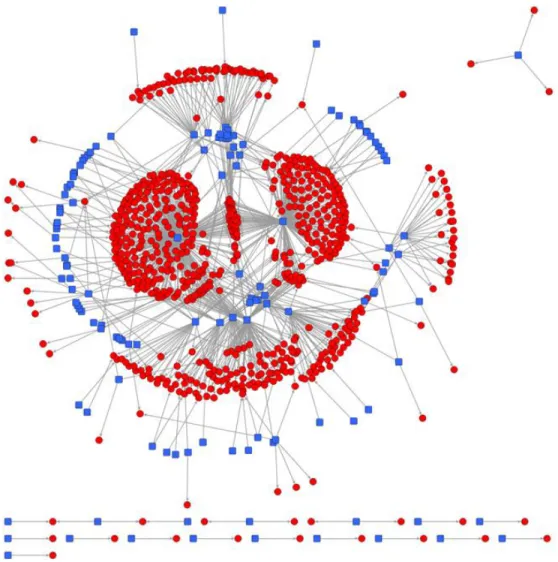
Fig. 2.1 The observed organizational attention network...30
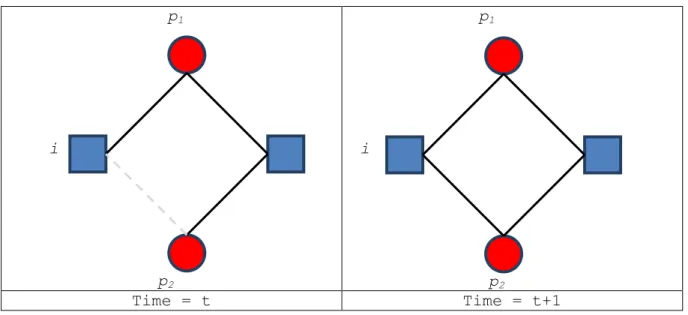
Fig. 2.2 Attention Clustering visual representation...38
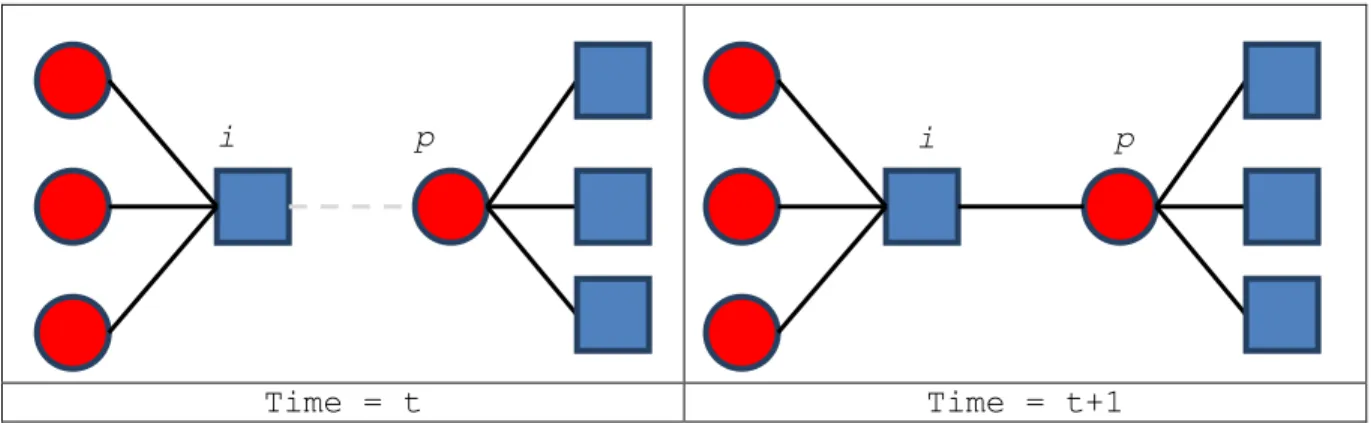
Fig. 2.3 Attention Spread visual representation...39
Fig. 3.1 Repeated Collaboration visual representation...87
Fig. 3.2 Expertise Diversity visual representation...89
Fig. 3.3 Kaplan-Meyer estimator for bug resolution in Apache HTTPD Server, 2001-2013...94
Fig. 3.4 The relationship between repeated collaboration, expertise diversity and bug resolution in Apache HTTPD Server, 2001-2013...98
Fig. 4.1 Kaplan-Meyer estimator for time of sustained participation, Apache HTTP Server, 1996-2013...134
Fig. 4.2 Interaction between Cumulated Experience and Identity Specialization...138
x
LIST OF TABLES
Tab. 2.1 Summary of Attentional Mechanisms of Theoretical Interest...46
Tab. 2.2 Summary of Endogenous Network Controls...47
Tab. 2.3 Summary Table for Exogenous Actor-specific Covariates...48
Tab. 2.4 Summary of Actor-relations Interaction Terms...49
Tab. 2.5 Method of Moment Estimates of SAOM for Bipartite Networks...54
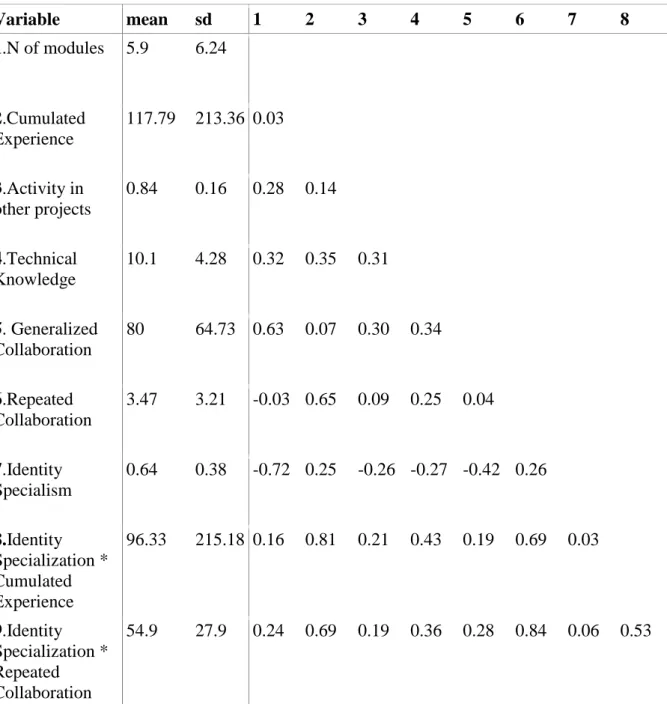
Tab. 3.1 Descriptives and Correlations Table for Bug Resolution in Apache HTTPD Server, 2001-2013...93
Tab. 3.2 Repeated events Cox hazard regression of bug resolution in Apache HTTPD Server, 2001-2013...95
Tab. 4.1 Descriptives and correlations table for code commits to Apache HTTPD Server, 1996-2013...133
xi
AKNOWLEDGEMENTS
The incredible, life-changing journey that brought me to this final stage of my tenure as PhD student has been challenging, maybe hard and frustrating at times, but extremely rewarding overall. Needless to say, I wouldn’t be here now if it wasn’t for the invaluable encouragement of many people whom I had the privilege to have around me during this long ride.
First of all I would like to thank my advisor Alessandro Lomi, whose constant support and outstanding intellectual stimuli have been paramount for my formation as a researcher. He has been a fantastic mentor who worked relentlessly to provide me with all I needed – and much more – to pursue my ambitions of becoming a management scholar. Ever since he recruited me, he has opened up so many doors for me, and believed in me when I had doubts. I most sincerely hope that we will continue collaborating on new, exciting projects in the future.
I owe a special debt of gratitude to my friend and colleague Guido, without whom this thesis wouldn’t have been possible. He shared with me his passion for research on open source communities, which inspired so profoundly my intellectual growth. He helped me immensely in collecting, coding and managing the data that were used in this dissertation. He has been a terrific counselor and source of relief when things weren’t the best. Special thanks to Francesca for her invaluable intellectual as well as emotional support, to Vanina for her precious advices and feedback during seminars and conferences, to Beth for her crucial and passionate help and to the rest of Alessandro’s collaborators in Lugano, Alberto, Christoph, Giorgia and Paola.
I would also like to express my gratitude to all students, post-docs and faculty members at the Institute of Management in Lugano. At IMA I found the best learning environment I could hope for, and I’ve benefited from an endless number of fruitful discussions that helped me craft, challenge and develop the ideas on which this dissertation is based. In particular I would like to thank Chanchal, Ivona, Jaime, Margarita, Martina and Pooya, all of whom have been fantastic colleagues in the doctoral program. I feel privileged for the opportunity to share ideas, gossip, worries, and drinks with them.
I am also extremely grateful for the time spent at Carnegie Mellon University where I had the enormous privilege to have the chance to discuss my work with some of the smartest and nicest scholars in the world. Special thanks to faculty members Linda Argote and Brandy Aven for their
xii terrific mentoring and to PhD students Jonathan Kush and Evelyn Zhang for our endless discussions, brainstorming and sharing of research ideas.
I would like to thank my committee members Nickolaus Beck, Martin Kilduff, Andrew Parker and Christian Steglich who kindly accepted the burden of reading through my material and providing me with helpful comments and remarks. Special thanks to Andrew for believing in me and being the main sponsor of my next, exciting career challenge in Grenoble.
Finally I would like to mention the most important persons in my life, my parents Franca and Mauro and my brothers Michele and Giulio, for just being there for me at any time, without the need to ask for anything at all. I feel incredibly blessed to be part of our family. This thesis is dedicated to you, to us. Last, but not least, thank you Marika. Your generous patience, your continuous support, your love throughout this amazing yet extremely demanding endeavor mean the world to me. You are the best.
1
CHAPTER 1
2 1.1 Motivating Questions
“Is the apparently anarchistic process of open source production, in which no one tells anybody else
what to do, a new model of business organization?” (Josh Lerner and Jean Tirole)
When economists Josh Lerner and Jean Tirole (2001: 821) raised this fundamental question, Free/Open Source Software (F/OSS) was just on the verge to turn from a curiosity for few enthusiasts into a mainstream phenomenon affecting business corporations, end users and policy makers alike (Levine & Prietula, 2014). Now F/OSS is ubiquitous and the number of F/OSS projects is constantly growing. Sourceforge, the most popular F/OSS infrastructure repository, hosts more than 430,000 projects and 3.7 million registered users. Each day users of Sourceforge alone download on average more than 4 million programs, commit more than 14,000 changes to source code, and track more than 2,700 software bugs. The Linux and Android operating systems, and the Apache Web Server are the largest, most successful and influential projects. They operate on millions of computers and devices
and rely on the distributed contributions of thousands of individuals. F/OSS projects span a wide range of applications, including programming languages (such as Perl and Python), user software (such as Mozilla Firefox and LibreOffice) and programming environments (such as Eclipse).
The term Free/Open Source Software refers to software released under a license that permits inspection, use, modification and redistribution of the software’s source code (Crowston et al., 2012). F/OSS represents an alternative approach to technology development and innovation. Rather than implementing formal intellectual property rights that induce the formation of contracts between firms, developers and final users, F/OSS projects “open” their boundaries by enlisting all participants as project contributors and giving them access to the software source code. F/OSS projects aim at
3 providing private incentives to maximize adoption and individual contributions but reduce the opportunities for appropriating the economic value of the innovation, as in the case of public goods (West, 2003). F/OSS may be seen as a private-collective innovation model that combines elements of individual investment and collective action (von Hippel & von Krogh, 2003). This innovation model is based on the creation of incentives for individuals and organizations to sustain private costs in order to generate public goods innovations, which are non-rival and non-exclusive in consumption. Although software with F/OSS licenses and proprietary software may be developed in the same way, most F/OSS products are developed by teams of geographically dispersed participants who often work on a voluntary basis (Lee & Cole, 2003).
The private-collective model of collaboration, innovation and production can now be generalized beyond software. The term “open production” has been introduced to describe production systems relying mostly on volunteer participants who are willing to collaborate, bear private costs and defer self-interest in order to provide a public good (Baldwin & von Hippel, 2011). Similarly to Levine and Prietula’s (2014) definition of open collaboration, open productions are entities that (i) create goods of economic value; (ii) grant open access to participants to contribute and consume freely; (iii) are based on constant interactions and information exchange; (iv) coordinate purposefully participants’ labor. Examples of open production are becoming increasingly common in engineering (Enkel, Gassman & Chesbrough, 2009), health care (Kamel Boulos & Wheeler, 2007; Eysenbach et al., 2004), product design (Jeppesen & Fredericksen, 2006; Dahlander & Wallin, 2006), and software development (Raymond, 1999; West & Gallagher, 2006) – the specific production activity that I examine in my dissertation.
What makes these productions possible, and how may they be sustained in a world of organizations in which selection favors the proliferation of hierarchical forms of organization (Simon,
4
1965)? How can production organizations “in which no one tells anybody else what to do” (Lerner and Tirole, 2002: p. 821) substitute traditional organizational arrangements such as hierarchy-based decision making and contracts that regulate principal-agent differences in the incentive structure?”
These are questions of core theoretical importance in the study of organizations. During the last decade economists (Lerner & Tirole, 2002; 2001), organizational sociologists (Bailey, Leonardi & Barley, 2012), political scientists (Feldman, 2010), students of technological innovation (Baldwin & von Hippel, 2011; Dahlander & Gann, 2010) and legal scholars (Benkler, 2006) have recognized the importance – and difficulty – of providing coherent answers in the context of open production. In my dissertation I address these difficulties directly, by examining the internal organizational logic of open production – i.e., by considering open production projects as specific forms of economic production. As such, open productions have to address the same issues facing conventional hierarchical organizations such as, for example, division of labor, allocation of skills to tasks, collaboration, and coordination. My work adds to existing research a focus on the micro-organizational mechanisms that make open production effectively possible as a strategy for technology development. Unlike much of the prior literature on open productions, I do not emphasize incentives, status-seeking or efficient
allocation of property rights. I concentrate instead on the actual day-to-day activities through which fundamental organizational mechanisms such as task assignment, collaboration for problem resolution, and sustained participation emerge and ultimately make open productions sustainable problem-solving arrangements. The research design that I have implemented and the models I have developed allow me to examine work practices at a level of resolution that has so far been inaccessible for prior research.
I focus on individual acts of problem solving - the smallest possible constituent unit of work practices, emphasizing emergence of micro-organizational mechanisms through which problem assignment (Chapter 2), problem resolution (Chapter 3), and sustained participation (Chapter 4) are obtained in open productions. In particular, I am interested in understanding how interaction between
5
participants and problems generates and sustain the basic coordination micro-mechanisms produced by hierarchical arrangements in more conventional production organization. Inspired by this general orienting question, I aim at answering the following research questions, each centered on a specific aspect of such emergence. Highlighting interdependencies of attention allocation processes, in Chapter 2 I ask “How do individuals in self-managing, decentralized work teams decide which task to work on”? In Chapters 3 and 4 I instead focus more on the performance implications of collaborative work practices in open productions, in terms of time to solve problems and the likelihood to retain and sustain voluntary contributions in presence of fluid organizational boundaries. Stressing processes of repeated collaboration and expertise heterogeneity in groups, in Chapter 3 I ask: “How does the internal composition of collaborative work groups in open productions affect the time in which problems are solved”? Finally, based on the idea that voluntary contributors construct their identity profiles as specialists or generalists by narrowly focusing or widely dispersing their efforts across knowledge domains, chapter 4 addresses the following question: “How do decentralized work groups in open productions manage to retain their human capital despite the presence of porous boundaries that favor constant member turnover”? In the remaining parts of the introduction I expand and motivate these research questions in a broader context informed by organizational sociology, the behavioral theory of the firm and open innovation.
The goals of this dissertation may be summarized as follows: the first goal is to provide an overarching framework for the concept of “open production”, showing how it emerges from, and extends beyond, the basic model of problem-solving organizations. I build on previous work on open innovation (Lakhani, Lifshitz-Assaf & Tushman, 2013) and decentralized production communities (Benkler & Nissenbaum, 2006), but capture a broader range of processes, drawing from a behavioral perspective on organizations (Gavetti et al., 2012), including very fundamental concepts such as attention allocation, organizational learning, and division of labor. The second goal is to extend current
6
explanations based on motivation and incentives to show how open productions are sustained through mundane work practices. In open productions problem-solving acts that link individuals to tasks are transparent (i.e., immediately visible) to all participants. I argue that both individual decision-making and organizational outcomes are embedded in, and determined by, this transparent problem-solving structure. The third goal is to identify future avenues of research related to open productions to inspire organizational scholars to study how these new organizational arrangements affect collaborative practices and the production of innovation.
1.2 Research on collaborative open production
In the last fifteen years, organizational scholars have tried to understand how open production in general, and F/OSS projects in particular, work as organizational solutions to the problem of producing and distributing public goods (Bonaccorsi & Rossi, 2003). The task has proven particularly challenging because of the ‘‘anarchistic’’ nature of the production process of F/OSS. This type of “open production” manifests itself in extreme forms of decentralized decision-making, and in the absence of exogenously established hierarchical structures and formal coordination mechanisms (Lerner & Tirole, 2001). How are F/OSS productions possible under such apparently adverse organizational conditions? More specifically I ask how do fundamental organizational mechanisms such as the ones outlined in the previous paragraph emerge in these conditions to make open productions sustainable. Available research suggests a variety of possible answers such as the expected returns on reputation and knowledge that participation in successful projects may afford (Lakhani & von Hippel, 2003; von Krogh & von Hippel, 2006), the presence of a diffuse shared gift-exchange culture (Bergquist & Ljungberg, 2001; Zeitlyn, 2003), the widespread availability of efficient and effective communication technologies (Lanzara & Morner, 2005; Scacchi, 2004), the fact that direct monitoring may act as an efficient safeguard against free riding problems (Baldwin & Clark, 2006),
7 and the presence of conscious processes of boundary maintenance (Ferraro & O’Mahony, 2012). Available explanations typically strive to answer the fundamental question, first raised by Lerner and Tirole in their seminal paper (2002: 198): “Why would thousands of top-notch software developers contribute for free to the creation of a public good?” Most research has focused on individual motivations. Empirical studies on this subject have documented a series of factors that induce individuals to contribute to F/OSS projects.
In a recent review Crowston and colleagues (2012) show that motivations are highly heterogeneous and generally fall into three broad families. The first includes extrinsic motivations, which such as status or reputation which may represent signals of competence and hence contribute to future career development (Hars & Ou, 2002; Hertel, Niedner & Hermann, 2003; Stewart, 2005). The second includes intrinsic motivations, like pure enjoyment and satisfaction deriving from sharing information or learning opportunities (Ghosh, 1998; Shah, 2006; Stewart & Gosain, 2006). Finally, the third family includes motivations that are extrinsic in principle, but could be internalized so that they are felt as self-regulating behavior instead of exogenous impositions (Deci and Ryan, 1987; Roberts, Hann & Slaughter, 2006). These internalized extrinsic motivations include, among others, peer recognition and reciprocity. For instance, Lakhani and von Hippel (2003) show that mundane, but necessary tasks in F/OSS projects – tasks that couldn't be explained by purely extrinsic or intrinsic motivations – are performed because participants feel part of a community where free user-to-user assistance is the standard modus operandi. Socialization and collaborative work practices induce the establishment of unwritten norms and informal institutions that encourage and foster individual participation in the project. While early work on motivation focused mostly on the intrinsic vs extrinsic framework, recent developments have advanced this latter line of research by exploring the role of actual work practices in sustaining collaborative behavior (von Krogh et al., 2012). Building on the social philosophy of Alasdair MacIntyre (1981; 1998), von Krogh and colleagues (2012) illustrate a
8 "motivation-practice" framework that depicts how the relationship between individual motivation and economic outcomes is embedded in day-to-day social practices and their supporting institutions.
Although recent studies have documented increasing synergies between business corporations – such as IBM and Microsoft – and open source communities (Dahlander & Magnusson, 2008; West & Gallagher, 2006) this work purposely look at projects composed almost entirely by volunteers, in order to rule out alternative explanations due to extrinsic pay-based motivations. In this dissertation I take an alternative approach grounded in a detailed examination of how individual problem-solving attempts actually happen as a consequence of dynamic work practices linking problems and participants (Pentland, Hærem & Hillison, 2011; McGrath & Argote. 2001). Attention to work practices is not completely new in studies of open productions. In F/OSS projects the actual activities of software contributors have been directly investigated with a focus on their emergent, decentralized character (Crowston, Li, Wei, Eseryel, & Howison, 2007; Crowston & Scozzi, 2008; see also Crowston, Wei, Howison, & Wiggins, 2012, for recent literature reviews discussing this stream of research). For instance, reuse of software code has been investigated as a specific form of knowledge recombination fostering the ability to generate innovation in F/OSS production (Haefliger, von Krogh & Spaeth, 2008). What I add to these studies is an attempt to analyze work practices founded on an overarching perspective on individuals and problems in organizations which views them as existing in a relation of mutual constitution, in the sense of Breiger (1974, 2000, 2002) and Breiger and Mohr (2004). According to this perspective, organizations may be understood in terms of a dual association between individual carriers of potential solutions (whose organizational identities are defined in terms of the problems with which they are associated) and problems (whose organizational identities are defined in terms of the individuals engaged in their resolution). Although important in any organization, the quality of contributors and the nature of their tasks and work practices are rarely sufficient, in isolation, to explain how and why one specific organizational arrangement is more or less effective than the
9 feasible alternatives. Given the key organizational characteristics of open productions – the weakness of centralized control and formal coordination and the direct and unrestricted access of participants to problems – all the basic components of organizational structure are endogenous, interdependent, and regulated by processes of self-selection and self-assignment (von Krogh, Spaeth & Lakhani, 2003). In particular, self-assignment to problem-solving activities lies at the heart of any F/OSS project because both the implementation of new software functionalities and also ‘‘bug-fixing’’ – that is, the correction of defects and misbehaviors generically called ‘‘software bugs’’ – can be conceived of as problems that contributors have to resolve if their software product is to progress into any sort of stable state.
This leads to a view of open productions as problem-solving organizations in which the micro-mechanisms of problem solving become the focus of investigation. Work practices, observed for the first time at the most fine-grained level of detail, emerge from sequences of actions linking participants and problems in F/OSS projects. As Lakhani and von Hippel write (2003: p. 940): “We think that it is important to analyze the micro-level functioning of successful open source projects to really understand how and why they work. For example, we think it would be useful to conduct empirical studies to explore other puzzling aspects of how an open source project functions such as: how is coordination achieved among open source software contributors; how can problems be segmented into modules of a size that fit the sources and incentives of individual users to effectively contribute?” Although these suggestions were put forward over ten years ago, most literature on F/OSS and open innovation either investigated a variety of motivation and incentives-related reasons for understanding contributors’ participation or explored a series of hybrid strategies for firms to tap into open production communities to produce innovation. Those questions may be addressed only by considering open productions as specific problem-solving arrangements and by concentrating on their internal organizational logic. My research design and the very fine-grained level of detail of the continuous time problem-solving data that I collected allow for one of the first times to respond to that call.
10 1.3 Open productions as problem-solving organizations
One way to think about organizations is as problem-solving arrangements designed to economize on the limited cognitive resources of their members, simplify decisions, encourage coordination, and reproduce production relations (Cyert & March, 1963; March & Simon, 1958). Building conceptually on the path breaking work of Herbert Simon on problem-solving (Simon, 1969; Newell & Simon, 1972) and on its more recent “evolutionary” developments (Marengo et al., 2000; Marengo & Dosi, 2005), I consider organizational problem-solving as a particular form of production activity. I posit that the dual association linking participants to problems generates information through individual acts of production. Participants use this information to allocate their attention and decide their level of engagement with the overall project. The global structure of this open production system emerges from individual acts of problem-solving which crystallize into interdependent work practices – defined analytically as structured sequences of problem-solving events. The individual decision to engage organizational problems is modeled as a function of: (i) the characteristics of the problems; (ii) the characteristics of the participants, and (iii) the characteristics of the associations linking participants to problems.
In this dissertation I consider “bug-fixing” – or attempts by project participants to resolve software problems (software “bugs”) – and production of software code as the core organizational problem-solving activity. Bug-fixing possibly represents the most transparent example of organizational problem-solving, as it exemplifies a setting in which problems, problem-solvers and solutions encounter each other in a space of decision opportunities (Cohen, March & Olsen 1972). Bug-fixing and code production have long been recognized as the essential activities in the development and maintenance of F/OSS products (Crowston, 2008; Michlmayr, 2007) and are frequently viewed as providing a significant contribution to the success of F/OSS projects (Crowston &
11 Scozzi, 2008; Crowston et al., 2012). Yet, the conditions of extreme decentralization characterizing problem-solving activities in F/OSS environments poses the question of how collaboration may be
fostered and sustained in the absence of centralized control. In decentralized productions characterized by distributed work carried out by highly autonomous participants, the answer to this question does not reside in the design of optimal hierarchical control systems or incentives. My attempt to address this concern starts from a simple representation of organizational problem-solving activities as embedded in structures of connections linking problems and participants – the latter being the bearers of potential solutions (Cohen March & Olsen, 1972).
1.4 Outline of the empirical studies
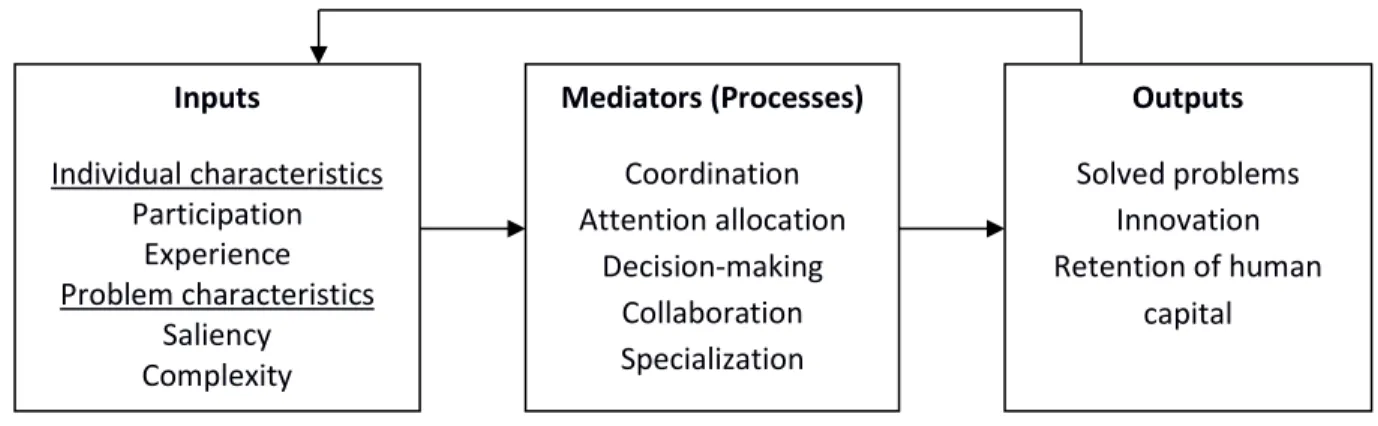
I organize the empirical chapters of this work using the inputs-mediators-outputs-inputs (IMOI) model (Ilgen, et al., 2005) – a general framework that has been repeatedly used in research on teams and teamwork (Hackman & Morris, 1978; McGrath, 1991). Figure 1 shows the baseline IMOI model.
Figure 1.1: Inputs-Mediators-Outputs-Inputs Model (adapted from Ilgen et al., 2005)
This model most closely matches the theoretical constructs I use to support my arguments and provides additional structure for framing the empirical studies of my dissertation. I opt for the IMOI model rather than its predecessor, the Input-Process-Output (IPO) model (Hackman & Morris, 1978) because it postulates the existence of feedback processes linking outputs to inputs, conceiving outputs as inputs to upcoming processes (Crowston et al., 2012). This view is consistent with the idea that the constant encounter of participants and problems in a transparent environment endogenously generates new solutions and new opportunities for problem-solving. Furthermore, this framework is consistent
12 with the idea that while organizations transform inputs into outputs they are also transformed by the very same process (Padgett & Powell, 2012; Padgett, Lee & Collier, 2003). This model of team production is also apposite because problem-solving processes in open production occur in small teams with porous boundaries whereas most studies have been conducted at the project level of analysis. When needed I adapt the framework to include theoretical constructs directly related to the development of F/OSS software.
Figure 1.2 reports the resultant framework with the relevant constructs that I adopt in the empirical part of the dissertation. Inputs characterize starting conditions of the production process, such as organizational participants’ characteristics and problems characteristics. Mediators characterize processes that drive the transformation of inputs into outputs. These processes represent typically group level variables or dynamic interdependencies among individuals that affect organizational participants as they work to solve their problems, conducting to the outputs of the model. Examples of mediators are social and cognitive processes that underlie the production process, such as collaboration, allocation of attention and decision-making. They usually represent the variables of theoretical interest in the models I specify. Outputs characterize relevant consequences of the production process, typically performance measures such as time to fix problems or quantity of innovation produced. They are usually, but not always, the dependent variables in my models.
Figure 1.2: Constructs studied in the empirical part of the dissertation and their relations Inputs Individual characteristics Participation Experience Problem characteristics Saliency Complexity Mediators (Processes) Coordination Attention allocation Decision-making Collaboration Specialization Outputs Solved problems Innovation Retention of human capital
13 I build on behavioral theories of organizations to specify models that relate individual problem-solving activities to the structured pattern of action through emergent work practices (Barley & Kunda, 2010). In the models that I specify and test, I emphasize processes of relational coordination – i.e., coordination emerging from direct interaction among participants (Gittell, 2002) – as central to our understanding of the dynamics of problem-solving in open production. Not only do I build on behavioral theories of organizations, but also I maintain the analytical focus on the interaction among individuals determined by joint involvement in problem-solving activities. To illustrate the empirical value of this perspective I examine problem-solving activities within several large F/OSS projects. This setting is particularly useful because the decentralization typical of F/OSS projects implies that organizational structures are not exogenously imposed, but emerge directly from the problem-solving activities of individual participants. This empirical setting facilitates more direct observation of the emergence of organizational structures and routines from actual work practices linking participants to problems. More specifically, I focus on processes of attention allocation (Chapter 2), repeated collaboration and expertise diversity (Chapter 3) and identity specialization (Chapter 4) which take place when a distributed group of software contributors coordinate to produce software and fix bugs.
Figure 1.2 illustrates the overall organization of my work into three studies – each examining specific aspects of problem solving in collaborative open productions. The first study (Chapter 2) is designed to address the following question: “How do individuals in decentralized work teams decide which task to work on”? The chapter focuses on inputs and processes to explain the mechanisms behind task self-assignment decisions. The chapter builds on the view that organizational decision-making is the outcome of interacting flows of problems, opportunities and problem solvers (Cohen, March & Olsen, 1972). The study is centered on the idea that attention allocation is the mechanism by which problems and problem solvers meet each other in a space of decision opportunities (Ocasio, 2012). Because attention is a scarce resource in information-intensive organizations, understanding
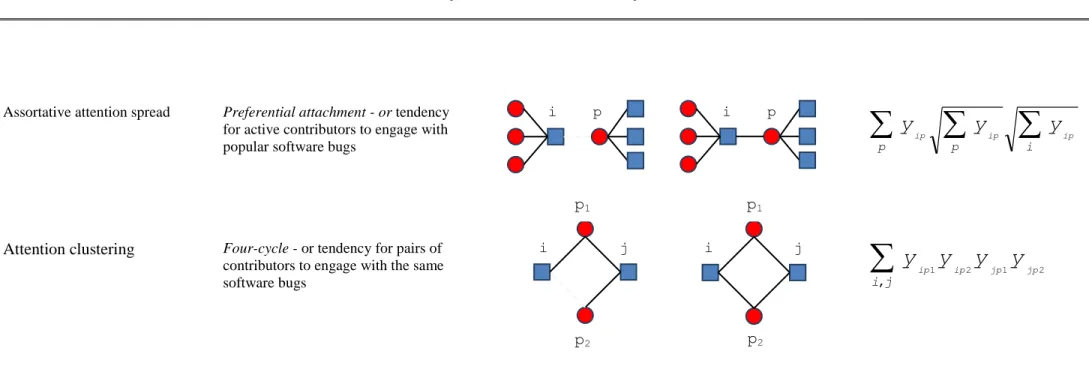
14 patterns of attention allocation is crucial for achieving effective coordination and division of labor (Simon, 1947; Sullivan, 2010). Extant literature has focused mainly on bottom-up (i.e., driven by problem characteristics) or top-down (i.e., driven by problem solvers’ cognitive schemas) processes of attention allocation in organizations. I argue that problem selection decisions are embedded in a relational context that constitutes patterns of information usage, inducing organizational members to lower their search costs and better evaluate problems at stake. Hence, problem selection decisions don't occur in isolation, but are situated within a connected system made of attention allocation ties linking problems to other individuals. I analyze the structure of this system by proposing and investigating two fundamental mechanisms that sustain a situated view of attention: attention clustering and attention spread. By using newly developed Stochastic Actor Oriented Models (SAOM) for bipartite graphs
(Conaldi, Lomi & Tonellato, 2012), I find that problem selection decisions show a tendency towards attention clustering and a tendency toward disassortative attention spread, and that these two effects are compounded by the high levels of experience of problem solvers. This chapter contributes to the literature on organizational attention and distributed cognition by extending recent work on attention networks (Prato and Stark, 2013). Whereas current work emphasizes that market valuations are embedded in attention networks that shape individual perceptions, my study sheds light on two specific mechanisms that inform organizational participants when they self-select specific problems to solve.
The second and third studies (chapters 3 and 4) focus more on processes and outputs, as they intend to illuminate the factors enhancing performance in open productions. In the second study I delve into the performance implications of distributed problem-solving in open productions by looking at how organizations learn to coordinate activities that reduce the average problem latency time, or the time passed between the appearance of a problem and its resolution. The chapter addresses the following question: “How does the internal composition of decentralized work groups in open productions affect the way in which individuals collaborate to solve problems”? The emergence of
15 open, collaborative forms of economic organization, such as open source software projects, invites reconsideration of the relationship between organizational structures and learning activities. Repeated collaboration represents a crucial mechanism through which organizations learn. Research on group learning shows that experience in working together helps groups within organizations to achieve better coordination, establish shared norms, and reduce task completion time (Reagans, Argote & Brooks, 2005). However, extended collaboration time may induce group members to overly focus on existing solutions and available routines, which in turn hinders the search for solutions that may be more effective but more distant from established practices (Katz, 1982; Levinthal & March, 1993). Following existing work (e.g., van der Vegt & Bunderson, 2005) I argue that group learning is contingent on the distribution of task-related expertise among group members. My results build on prior research and go beyond it by suggesting that the effect of repeated collaboration on group performance is moderated by the degree of expertise diversity in the group. Groups that are composed of individuals with homogeneous expertise outperform groups with heterogeneous expertise at lower levels of prior collaboration, because homogeneity helps establish common ground in the early phases of collaborative practices. At the other end, groups composed of individuals with heterogeneous expertise outperform groups with homogeneous expertise at higher levels of prior collaboration, because specialization and expertise diversity are essential to establish a clear understanding of “who knows what” in the group (Liang, Moreland & Argote, 1995). This study is important as it extends theory on organizational learning by investigating relevant contingency effects for performance-based learning, whereas prior work has instead supported arguments about unconditional and linear effects of experience working together.
The third study addresses the following question: “How do decentralized work groups in open productions manage to retain their human capital despite the presence of porous boundaries that favor constant member turnover”? I investigate how open collaborative productions take advantage of a
16 modular structure to achieve outcomes, such as specialization and knowledge transfer, which are obtained through formal organizational design solutions in more traditional production settings (Simon, 1969; Baldwin & Clark, 2006; Baldwin, 2008). In particular, I observe how organizations are able to retain, and benefit from, participants who tend to specialize their identity within modules and knowledge domains, because other participants find it easier to understand their expertise and their role in the project (Shah, 2006; Fang & Neufeld, 2009). However, participants who reach out and collaborate with the same contributors within or across different modules are able to gain legitimacy without the need to constrain their identity on a narrow knowledge domain. As a result they tend to stay longer in the project. This chapter contributes to the literature on open innovation by identifying the mechanisms that sustain individual participation in open productions, in absence of evident economic incentives.
Taken together, the three studies included in my dissertation help advance our understanding of relational coordination in open collaborative productions by identifying specific processes and mechanisms that facilitate collective problem-solving under extreme conditions of decentralization.
1.5 Empirical setting
Consistent with the literature on F/OSS and open innovation, I focus my attention on bug-fixing and code commits, the two most prominent problem-solving activities in software projects (Crowston and Scozzi, 2008). Bug-fixing refers to the sequence of tasks that are intended to resolve software problems that cause computer programs to behave in unintended and undesirable ways. Code commits refer to submitting the latest changes of the software source code to the repository with the aid of a concurrent version control (CVS) system (i.e., a system devoted to tracking and providing control over concurrent changes to source code).
17 Using the software Bicho (Robles et al., 2009) and CVSAnalY (Robles et al., 2005), I collected the raw data by parsing the web pages of all relevant bug reports and CVS commits within two F/OSS projects, Epiphany (a web browser) and Apache (a web server application). The raw data were then dumped in a MySQL database and subsequently imported into R - the statistical modelling environment within which I conduct all my analyses. For study 1, I coded the complete set of bug-fixing activities recorded in Epiphany’s bug repository during one release cycle of the software (from March to September 2006). Throughout the release cycle 135 developers were active in resolving 719 bugs. All bugs engaged by developers during the release cycle are included and all actions taken while working on them are included. I then coded the complete set of bug-fixing activities (Study 2) and code commits (Study 3) within the Apache HTTPS server between 1996 and 2013. During this period 2630 participants were active in the bug repository attempting to solve 5646 bugs, whereas 111 participants were active in the CVS repository making 1454 commits to modify 10757 software files. Detailed descriptions of the data and the samples are contained in each of the chapters that are structured as independent, self-contained studies.
An important feature of my research design that makes F/OSS a good empirical setting for studying problem-solving in open productions is social transparency (Stuart et al., 2012; Dabbish et al., 2012). Social transparency refers to a new and growing phenomenon affecting collaboration practices over the internet. The contemporary social web provides an unprecedented level of transparency in the form of immediate traceability, and extensive visibility, of participants’ history of actions on public or shared artefacts, such as bug or code repositories in F/OSS projects. The decisions of any participant are thus immediately visible to all members of the community and produce information that other participants may take into account in their own process of decision-making. In the case of F/OSS projects, patterns of past interactions between contributors and software bugs or code repositories induce local dependencies that may influence future associations between participants – as bearers of
18 potential solutions – and problems. This process of endogenous structuration generates the possibility of observing recurrent work practices, or patterns of association between problems and participants, and, indirectly, between participants through problems. Inherent characteristics of participants and problems also influence the likelihood of their association, thus leading to complex patterns that may give rise to core organizational properties such as collaboration, coordination, and specialization (Lomi, Conaldi & Tonellato, 2012).
1.6 Outline of the thesis
The next three chapters are focused on the three empirical studies that I briefly outlined in this introduction. Parts of Chapter 2 are based on the following two papers that I had published with my co-authors:
Conaldi, G., Lomi, A., & Tonellato, M. (2012). Dynamic models of affiliation and the network structure of problem solving in an open source software project. Organizational Research Methods, 15(3), 385-412.
Lomi, A., Conaldi, G., Tonellato, M., & Pallotti, F. (2014). Participation motifs and the emergence of organization in open productions. Structural Change and Economic Dynamics, 29, 40-57.
Chapters 3 and 4 are working papers constituted by unpublished material. In Chapter 5 I draw general theoretical implications based on the three empirical studies, identify current limitations and propose further directions that have the potential to advance our understanding of problem solving in collaborative open productions.
References
Bailey, D. E., Leonardi, P. M., & Barley, S. R. (2012). The lure of the virtual. Organization Science,
19 Baldwin, C. Y. (2008). Where do transactions come from? Modularity, transactions, and the
boundaries of firms. Industrial and corporate change, 17(1), 155-195.
Baldwin, C. Y., & Clark, K. B. (2006). The architecture of participation: Does code architecture mitigate free riding in the open source development model?. Management Science, 52(7), 1116-1127. Baldwin, C., & von Hippel, E. (2011). Modeling a paradigm shift: From producer innovation to user
and open collaborative innovation. Organization Science, 22(6), 1399-1417.
Barley, S. R., & Kunda, G. (2001). Bringing work back in. Organization science, 12(1), 76-95.
Benkler, Y. (2006). The wealth of networks: How social production transforms markets and freedom. Yale University Press.
Benkler, Y., & Nissenbaum, H. (2006). Commons‐based Peer Production and Virtue. Journal of
Political Philosophy, 14(4), 394-419.
Bergquist, M., & Ljungberg, J. (2001). The power of gifts: organizing social relationships in open source communities. Information Systems Journal, 11(4), 305-320.
Bonaccorsi, A., & Rossi, C. (2003). Why open source software can succeed. Research policy, 32(7), 1243-1258.
Breiger, R. L. (1974). The duality of persons and groups. Social forces, 53(2), 181-190. Breiger, R. L. (2000). A tool kit for practice theory. Poetics, 27(2), 91-115.
Breiger, R. L., & Mohr, J. W. (2004). Institutional logics from the aggregation of organizational networks: Operational procedures for the analysis of counted data. Computational & Mathematical
Organization Theory, 10(1), 17-43.
Cohen, M. D., March, J. G., & Olsen, J. P. (1972). A garbage can model of organizational choice.
Administrative science quarterly, 1-25.
Conaldi, G., Lomi, A., & Tonellato, M. (2012). Dynamic models of affiliation and the network structure of problem solving in an open source software project. Organizational Research Methods,
15(3), 385-412.
Crowston, K. (2008). The bug fixing process in proprietary and Free/Libre Open Source Software: a coordination theory analysis. In: Grover, V., Markus, M.L. (Eds.), Business Process Transformation:
Advances in Management Information Systems. Armonk, NY: M.E. Sharpe.
Crowston, K., Li, Q., Wei, K., Eseryel, U. Y., & Howison, J. (2007). Self-organization of teams for free/libre open source software development. Information and software technology, 49(6), 564-575. Crowston, K., & Scozzi, B. (2008). Bug fixing practices within free/libre open source software
development teams. Journal of Database Management (JDM), 19(2), 1-30.
Crowston, K., Wei, K., Howison, J., & Wiggins, A. (2012). Free/Libre open-source software development: What we know and what we do not know. ACM Computing Surveys (CSUR), 44(2), 7. Cyert, R. M., & March, J. G. (1963). A behavioral theory of the firm. Englewood Cliffs, NJ:
20 Dabbish, L., Stuart, C., Tsay, J., & Herbsleb, J. (2012, February). Social coding in GitHub: transparency and collaboration in an open software repository. In Proceedings of the ACM 2012
conference on Computer Supported Cooperative Work (pp. 1277-1286). ACM.
Dahlander, L., & Magnusson, M. (2008). How do firms make use of open source communities? Long
Range Planning, 41(6), 629-649.
Dahlander, L., & Gann, D. M. (2010). How open is innovation?. Research policy, 39(6), 699-709. Dahlander, L., & Wallin, M. W. (2006). A man on the inside: Unlocking communities as
complementary assets. Research Policy, 35(8), 1243-1259.
Deci, E. L., & Ryan, R. M. (1987). The support of autonomy and the control of behavior. Journal of
personality and social psychology, 53(6), 1024.
Enkel, E., Gassmann, O., & Chesbrough, H. (2009). Open R&D and open innovation: exploring the phenomenon. R&d Management, 39(4), 311-316.
Eysenbach, G., Powell, J., Englesakis, M., Rizo, C., & Stern, A. (2004). Health related virtual communities and electronic support groups: systematic review of the effects of online peer to peer interactions. Bmj, 328(7449), 1166.
Fang, Y., & Neufeld, D. (2009). Understanding sustained participation in open source software projects. Journal of Management Information Systems, 25(4), 9-50.
Feldman, M. S. (2010). Managing the organization of the future. Public Administration Review, 70(1), 159-163.
Ferraro, F., & O’Mahony, S. (2012). Managing the boundary of an “open” project. In J. F. Padgett & W. W. Powell (Eds.), The Emergence of Organizations and Markets (545-565). Princeton, NJ: Princeton University Press.
Gavetti, G., Greve, H. R., Levinthal, D. A., & Ocasio, W. (2012). The behavioral theory of the firm: Assessment and prospects. The academy of management annals, 6(1), 1-40.
Ghosh, R. A. (1998). Cooking pot markets: an economic model for the trade in free goods and services on the Internet. First Monday, 3(3).
Gittell, H. J. (2002). Coordinating mechanisms in care provider groups: Relational coordination as a mediator and input uncertainty as a moderator of performance effects. Management Science, 48(11), 1408-1426.
Haefliger, S., Von Krogh, G., & Spaeth, S. (2008). Code reuse in open source software. Management
Science, 54(1), 180-193.
Hackman, J. R. & Morris, C. G. (1978) Group tasks, group interaction process, and group performance effectiveness: A review and proposed integration. In L. Berkowitz (Ed.) Group Processes, volume 8
of Advances in Experimental Social Psychology (45-99). New York, NY: Academic Press.
Hannan, M. T., & Freeman, J. (1984). Structural inertia and organizational change. American
21 Hars, A., Ou, S., (2002). Working for free? Motivations for participating in Open-Source projects.
International Journal of Electronic Commerce, 6, 25–39
Hertel, G., Niedner, S., and Herrmann, S. 2003. “Motivation of software developers in open source projects: An internet-based survey of contributors to the Linux Kernel,” Research Policy (32:7), pp. 1159-1177.
Ilgen, D. R., Hollenbeck, J. R., Johnson, M., & Jundt, D. (2005). Teams in organizations: From input-process-output models to IMOI models. Annual Review of Psychology, 56, 517-543.
Jeppesen, L. B., & Frederiksen, L. (2006). Why do users contribute to firm-hosted user communities? The case of computer-controlled music instruments. Organization science, 17(1), 45-63.
Kamel Boulos, M. N., & Wheeler, S. (2007). The emerging Web 2.0 social software: an enabling suite of sociable technologies in health and health care education1. Health Information & Libraries Journal, 24(1), 2-23.
Katz, R. (1982). The effects of group longevity on project communication and performance.
Administrative Science Quarterly, 81-104.
Lakhani, K. R., & Von Hippel, E. (2003). How open source software works:“free” user-to-user assistance. Research policy, 32(6), 923-943.
Lakhani, K. R., Lifshitz-Assaf, H., & Tushman, M. (2013). Open innovation and organizational boundaries: task decomposition, knowledge distribution and the locus of innovation. Handbook of
economic organization: Integrating economic and organizational theory, 355-382.
Lanzara, G. F., & Morner, M. (2005). Artifacts rule! How organizing happens in open source software projects. Actor-network theory and organizing, 67-90.
Lee, G. K., & Cole, R. E. (2003). From a firm-based to a community-based model of knowledge creation: The case of the Linux kernel development. Organization science, 14(6), 633-649.
Lerner, J., & Tirole, J. (2001). The open source movement: Key research questions. European
Economic Review, 45(4), 819-826.
Lerner, J., & Tirole, J. (2002). Some simple economics of open source. The journal of industrial
economics, 50(2), 197-234.
Levine, S. S., & Prietula, M. J. (2014). Open Collaboration for Innovation: Principles and Performance. Organization Science. In press.
Levinthal, D. A., & March, J. G. (1993). The myopia of learning. Strategic management journal,
14(S2), 95-112.
Liang, D. W., Moreland, R., & Argote, L. (1995). Group versus individual training and group performance: The mediating role of transactive memory. Personality and Social Psychology Bulletin,
21(4), 384-393.
Lomi, A., Conaldi, G., & Tonellato, M. (2012). Organized anarchies and the network dynamics of decision opportunities in an open source software project. Research in the Sociology of
22 Lomi, A., Conaldi, G., Tonellato, M., & Pallotti, F. (2014). Participation motifs and the emergence of
organization in open productions. Structural Change and Economic Dynamics, 29, 40-57. MacIntyre, A. (1981). After virtue. London: Duckworth.
MacIntyre, A. (1998). Politics, Philosophy and the Common Good. In K. Knight (Ed.) The MacIntyre
Reader (235–252), University of Notre Dame Press.
March, J. G., & Simon, H. A. (1958). Organizations. Oxford, England: Wiley.
Marengo, L., & Dosi, G. (2005). Division of labor, organizational coordination and market mechanisms in collective problem-solving. Journal of Economic Behavior & Organization, 58(2), 303-326.
Marengo, L., Dosi, G., Legrenzi, P., & Pasquali, C. (2000). The structure of problem-solving knowledge and the structure of organizations. Industrial and Corporate Change, 9(4), 757-788. McGrath, J. E. (1991). Time, interaction, and performance (TIP): A theory of groups. Small Group
Research 22, 147-174.
McGrath, J. E., L. Argote. (2001). Group processes in organizational contexts. In, M. A. Hogg, R. Scott Tindale, eds. Blackwell Handbook of Social Psychology: Group Processes Blackwell
Malden, MA, 603–627. Michlmayr, M., 2007. Quality improvement in volunteer free and open source software projects: exploring the impact of release management. PhD. dissertation. Centre for Technology Management, Institute for Manufacturing, University of Cambridge (U.K).
Newell, A., & Simon, H. A. (1972). Human problem solving. Englewood Cliffs, NJ: Prentice-Hall. Obstfeld, D. (2005). Social networks, the tertius iungens orientation, and involvement in innovation.
Administrative science quarterly, 50(1), 100-130.
Ocasio, W. (2012). Situated attention, loose and tight coupling, and the garbage can model. Research in
the Sociology of Organizations, 36, 293-317.
Osterloh, M., and Rota, S. G. 2007. “Open Source Software Development – Just Another Case of Collective Invention?,” Research Policy (36:2), pp. 157-171.
Padgett, J. F., Lee, D., & Collier, N. (2003). Economic production as chemistry. Industrial and Corporate Change, 12(4), 843-877.
Padgett, J. F., & Powell, W. W. (2012). The Problem of Emergence. In J. F. Padgett & W. W. Powell (Eds.), The Emergence of Organizations and Markets (1-30). Princeton, NJ: Princeton University Press.
Pentland, B. T., Hærem, T., & Hillison, D. (2011). The (N) ever-changing world: stability and change in organizational routines. Organization Science, 22(6), 1369-1383.
Prato, M., & Stark, D. (2013). Peripheral Vision in Financial Markets: How attention networks shape valuation. In Academy of Management Proceedings (Vol. 2013, No. 1, p. 15923). Academy of Management.
23 Reagans, R., Argote, L., & Brooks, D. (2005). Individual experience and experience working together: Predicting learning rates from knowing who knows what and knowing how to work together.
Management science, 51(6), 869-881.
Roberts, J. A., Hann, I., and Slaughter, S. A. 2006. “Understanding the Motivations, Participation, and Performance of Open Source Software Developers: A Longitudinal Study of the Apache Projects,” Management Science (52:7), pp. 984-999.
Robles, G., Gonzalez-Barahona, J. M., Izquierdo-Cortazar, D., & Herraiz, I. (2009). Tools for the study of the usual data sources found in Libre Software projects. International Journal of Open Source Software & Processes, 1(1), 24-45.
Scacchi, W. (2004). Free and open source development practices in the game community. Software,
IEEE, 21(1), 59-66.
Shah, S. K. (2006). Motivation, governance, and the viability of hybrid forms in open source software development. Management Science, 52(7), 1000-1014.
Simon, H. A. (1947). Administrative behavior. New York, NY: Macmillan.
Simon, H. A. (1965). The architecture of complexity. General systems, 10(1965), 63-76. Simon, H. A. (1969). The sciences of the artificial. Cambridge, MA: MIT press.
Stewart, D. (2005). Social status in an open-source community. American Sociological Review, 70(5), 823-842.
Stewart, K. J., and Gosain, S. (2006). The Impact of Ideology on Effectiveness in Open Source Software Development Teams. MIS Quarterly, 30(2), 291-314.
Stuart, H. C., Dabbish, L., Kiesler, S., Kinnaird, P., & Kang, R. (2012). Social transparency in networked information exchange: a theoretical framework. In Proceedings of the ACM 2012
conference on Computer Supported Cooperative Work (pp. 451-460). ACM.
Sullivan, B. N. (2010). Competition and beyond: Problems and attention allocation in the organizational rulemaking process. Organization Science, 21(2), 432-450.
van Der Vegt, G. S., & Bunderson, J. S. (2005). Learning and performance in multidisciplinary teams: The importance of collective team identification. Academy of Management Journal, 48(3), 532-547. von Hippel, E., & von Krogh, G. (2003). Open source software and the “private-collective” innovation
model: Issues for organization science. Organization science, 14(2), 209-223.
von Krogh, G., Spaeth, S., & Lakhani, K. R. (2003). Community, joining, and specialization in open source software innovation: a case study. Research Policy, 32(7), 1217-1241.
von Krogh, G., & von Hippel, E. (2006). The promise of research on open source software.
Management science, 52(7), 975-983.
von Krogh, G., Haefliger, S., Spaeth, S., & Wallin, M. W. (2012). Carrots and rainbows: Motivation and social practice in open source software development. Mis Quarterly, 36(2), 649-676.
West, J. (2003). How open is open enough?: Melding proprietary and open source platform strategies.
24 West, J., & Gallagher, S. (2006). Challenges of open innovation: the paradox of firm investment in
open‐source software. R&D Management, 36(3), 319-331.
Zeitlyn, D. (2003). Gift economies in the development of open source software: anthropological reflections. Research policy, 32(7), 1287-1291.
25
Chapter 2
RELATIONAL COORDINATION IN AN OPEN SOURCE
SOFTWARE PROJECT:
THE ROLE OF ATTENTION NETWORKS
ABSTRACT
Drawing from insights of a structural perspective within the attention-based view of the firm and social cognition, this paper argues that the process through which organizational members self-assign to competing problems in open productions unfolds through the interdependent acts of attention allocation linking members and problems. Hence attention processes are not individual, but embedded in the evolving portfolio of problems to which a member is attentive and in the evolving attention structures of other members to whom he or she is tied. In this way multiple members are linked to multiple problems by attention networks. I analyze the bipartite dynamic structure of these networks by proposing and investigating two fundamental mechanisms that sustain a situated view of attention: attention clustering and attention spread. I explore these mechanisms by examining problem-solving attempts performed by 135 participants in an open source software project on the 719 problems (software bugs) recorded during a complete release cycle of the software. I find that attention allocation decisions show a tendency towards clustering of related problems and towards disassortative attention spread, and that these two effects are driven by the high levels of experience of problem solvers. The discussion focuses on the broad theoretical implications of the study for the relationship between attention and problem-solving in open productions.
26
2.1 Introduction and motivation
When organizational participants are involved in the process of finding solutions to problems, attention becomes crucial as decision-makers tend to concentrate organizational resources to areas where attention has been allocated (March & Simon, 1958; Sullivan, 2010). However, the task of spreading attention over a broad spectrum of organizational problems is complex. Instead of trying to uniformly distribute the limited attention across all problems, as if they were equally important to the organization (Bouchet & Birkinshaw, 2008), effective problem-solving practices require that organizational participants are selective in their efforts. As attention has always being recognized as a scarce resource in organizations (Simon, 1947; Ocasio, 2011), the principle of selective attention allocation across competing problems becomes crucial for achieving effective problem-solving. But how is this process structured?
Extant research focuses on the role that formal structures play in guiding members' attention toward the most salient problems and the most attractive opportunities (Ocasio, 1997; Ocasio & Joseph, 2005). This top-down approach – driven by goals, schemas, and rules – links attention to cognitive primers. According to this view participants are not perfectly rational individuals, but individuals who are embedded in a social and cultural system, based on cognitive schemas that are often taken for granted and not necessarily optimal from a purely economic standpoint. Actors are anchored to categorical interpretations of the task environment, each rooted in established institutional logics that drive attention and ultimately action (Fligstein, 2002; Lounsbury, 2007; Thornton & Ocasio, 2008). A second, competing stream of research investigates how certain characteristics of problems render them visible or accessible beyond the constraints of these top-down procedural structures, to capture the attention of individual members more effectively (Hansen & Haas, 2001; Sullivan, 2010). This bottom-up approach is stimulus-driven and links attention to characteristics of the stimuli that are