Causal cognition in a non-human primate: ®eld
playback experiments with Diana monkeys
Klaus ZuberbuÈhler
a,b,*
aMax-Planck-Institute for Evolutionary Anthropology, Inselstrasse 22, D-04103 Leipzig, Germany bCentre Suisse de Recherches Scienti®ques, TaõÈ Monkey Project, Abidjan, Ivory Coast
Abstract
Crested guinea fowls (Guttera pucherani) living in West African rainforests give alarm calls to leopards (Panthera pardus) and sometimes humans (Homo sapiens), two main preda-tors of sympatric Diana monkeys (Cercopithecus diana). When hearing these guinea fowl alarm calls, Diana monkeys respond as if a leopard were present, suggesting that by default the monkeys associate guinea fowl alarm calls with the presence of a leopard. To assess the monkeys' level of causal understanding, I primed monkeys to the presence of either a leopard or a human, before exposing them to playbacks of guinea fowl alarm calls. There were signi®cant differences in the way leopard-primed groups and human-primed groups responded to guinea fowl alarm calls, suggesting that the monkeys' response was not directly driven by the alarm calls themselves but by the calls' underlying cause, i.e. the predator most likely to have caused the calls. Results are discussed with respect to three possible cognitive mechanisms ± associative learning, specialized learning programs, and causal reasoning ± that could have led to causal knowledge in Diana monkeys. q 2000 Elsevier Science B.V. All rights reserved.
Keywords: Causal cognition; Non-human primate; Field playback experiments; Diana monkeys
1. Introduction
Non-human primates respond to their own and other species' alarm calls in a way that suggests that they have rather sophisticated knowledge of the calls' semantic content (Seyfarth & Cheney, 1990; Seyfarth, Cheney & Marler, 1980; ZuberbuÈhler, Cheney & Seyfarth, 1999a). West African Diana monkeys, for example, react to the
* Fax: 149-341-995-2119.
leopard alarm calls of sympatric Campbell's guenons (Cercopithecus campbelli) and chimpanzees (Pan troglodytes) as if they themselves have witnessed a leopard as the cause for the alarm calls (ZuberbuÈhler, 2000a,b). From a comparative evolu-tionary perspective, this behavioral pattern is of interest because it raises questions about the capacity of non-human primates to perceive and perhaps understand the causal relations underlying other individuals' behavior.
Research on causal understanding in non-humans has yielded mixed results. On the one hand, causal reasoning seems to be a uniquely human trait (Tomasello, 1998). This becomes most evident when non-human primates are confronted with problems in the physical domain: individuals experience severe dif®culties when asked to solve simple technical problems requiring ± from a human perspective ± only modest levels of causal understanding (e.g. Visalberghi & Limongelli, 1994; ZuberbuÈhler, Gygax, Harley & Kummer, 1996). Even chimpanzees need a surpris-ingly large number of trials before they can reliably use a stick to gain a reward by pushing it through a tube, thereby avoiding a mid-tube trap (Limongelli et al., 1995). On the other hand, primates perform quite well when causal problems are introduced through another individual's behavior rather than the physical interactions of inan-imate objects. Premack and Premack (1994), for example, reported an experiment with captive chimpanzees in which subjects ®rst observed how an apple and a banana were hidden underneath two containers. After a brief distraction, the chimp saw a trainer eating either an apple or a banana. When being allowed to choose, it reliably selected the container with the fruit the trainer was not eating at the moment.
Field playback studies provide additional evidence that non-human primates are able to perceive causal relationships in the social domain. Cheney, Seyfarth and Silk (1995), for example, have shown that free-ranging Chacma baboons (Papio cyno-cephalus ursinus) may perceive or even recognize cause-effect relations in the context of social interactions. In this species, dominance relationships are partially mediated by two kinds of vocalizations, the `grunts' given by a female to lower-ranking group members and the `fear barks' given to higher-lower-ranking ones. Through the use of a playback experiment, it was possible to show that causally inconsistent call sequences ± a higher-ranking animal responding with fear barks to a lower-ranking animal's grunts ± elicited stronger responses in recipients than control sequences that were made causally consistent.
Kummer (1995) has proposed three different cognitive mechanisms that may generate causal knowledge. First, causal knowledge can be the result of an associa-tive learning process (Rescorla & Wagner, 1972). Knowledge of this kind is weak and does not require any specialized cognitive abilities. The individual undergoes a simple conditioning process through repeated exposures to a cause-effect relation-ship, resulting in a learned association, for example, between the acoustic features of an alarm call stimulus and the corresponding predator class. Second, causal knowl-edge may be stronger due to the presence of specialized innate learning programs or `causal detectors'. This cognitive mechanism is characterized by stimulus selectivity and ef®ciency (often one-trial learning), a prominent example being taste aversion learning in rats (Garcia, Ervom & Koelling, 1966). Considering the strong selective
pressure that predation imposes and the limited learning possibilities animals have to avoid it, it is conceivable that such specialized learning programs have also evolved to guide antipredator behavior (e.g. Curio, Ernst & Veith, 1978). According to these two learning hypotheses, the acoustic features of the alarm calls act as a surrogate or substitute for a predator class which is ultimately driving the antipredator response (e.g. Dickinson & Shanks, 1995, p. 22). Finally, causal knowledge may be the result of a reasoning process similar to the process that underlies humans' responses to surprising and unexpected events. In this case, causality problems are solved with an understanding of how and why one event may lead to another, which allows recon-struction of missing events in a causal sequence. Under this hypothesis, the monkeys' response is not directly driven by the alarm call stimulus but by the predator most likely to have caused the calls.
In this study, I examined Diana monkeys' ability to recognize the possible causes of another species' alarm calls. When encountering ground predators, Diana monkeys respond with two different antipredator strategies. To human poachers, who hunt with weapons, monkeys typically produce a small number of alarm calls followed by silent hiding in the forest canopy (ZuberbuÈhler, NoeÈ & Seyfarth, 1997). To leopards, who hunt by stealth and surprise, individuals produce conspicuous alarm calls at high rates, sometimes even approaching the predator until it moves on and leaves the area (ZuberbuÈhler, Jenny & Bshary, 1999b). Crested guinea fowls, a ground-dwelling gregarious bird species, typically give conspicuous alarm calls to leopards and respond with silent ¯ight to humans (personal observation). When actively chased by a human, however, guinea fowls may change their strategy and give loud and conspicuous alarm calls as they do to leopards. Hence, when hearing guinea fowl alarm calls, Diana monkeys cannot de®nitively identify the reason why the birds have called. Instead, the monkeys have to respond to a causal sequence with a missing and uncertain component, i.e. the actual predator that has caused the birds to give alarm calls. To investigate how Diana monkeys respond to this causal sequence I conducted two kinds of playback experiments.
The ®rst experiment investigated how Diana monkeys interpret the alarm call of guinea fowls in the absence of any additional information. Different groups heard playback of human speech, leopard growls, and the alarm calls of two species of guinea fowls, while their vocal response was recorded at the same time. In the second experiment, additional information about the predator present was provided to disambiguate the causal sequence. Groups were primed with either human speech or leopard growls to suggest the presence of one of the two predators. Five minutes later, the same group heard guinea fowl alarm calls from the same location to investigate whether monkeys were capable of establishing a causal connection between the predator and the alarm calls. If the monkeys were able to take the predator as the cause of the alarm calls, then their response to the alarm calls should resemble their response to the predator. Alternatively, if the monkeys' causal knowl-edge is simply based on a learned association between the alarm calls and, for example, the presence of a leopard, then the response to the alarm calls should remain constant and the priming history should have little effect on the monkeys' behavior.
2. Methods
2.1. Study site and subjects
Data were collected in the TaõÈ National Park, CoÃte d'Ivoire, between July 1994 and February 1999 in an approximately 50 km2large area of primary rain forest
surrounding the CRE research station (58 500N, 78 210W). Diana monkey groups consist of one adult male and several adult females with their offspring. The average home range size of a group has been estimated to be about 0.5 km2(HoÈner, Leumann
& NoeÈ, 1997), with the females defending the group's range against neighbors (Hill, 1994). Based on these data, I estimated the Diana monkey population in the study area to consist of at least 50 different groups. To avoid dependencies in the data, I never tested a particular group more than once with a particular playback stimulus unless trials were separated by at least 1 year. This level of independence was obtained by testing a group only if it was located at least 1 km (i.e. two home range diameters) away from any previously conducted trial of the same series. 2.2. Playback stimuli
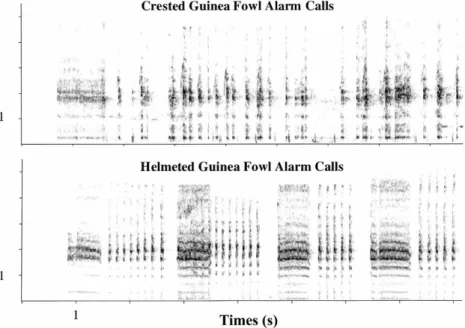
The playback stimuli were broadcast with a Sony WMD6C Professional Walk-man connected to a Nagra DSM speaker-ampli®er. The vocal response of the monkeys to the playback stimuli was tape-recorded with the Sony WMD6C or TCM5000EV recorders in combination with a Sennheiser ME80 directional micro-phone. The following recordings were used as playback stimuli: (i) the alarm calls of crested guinea fowls, (ii) the alarm calls of helmeted guinea fowls (Numida meleab-ris), (iii) the growls of a leopard, and (iv) the speech of a human. Helmeted guinea fowls occur in Savannah habitats throughout Africa but are not found in rain forests (Brown, Urban & Newman, 1982). Because the alarm calls of this species resemble that of crested guinea fowls in their acoustic features they were thought to be suitable as a control stimulus for a semantically unknown alarm call played from the ground. Fig. 1 depicts spectrographic representations of the guinea fowl alarm calls used as stimuli. Spectrograms of leopard growls and human speech sounds used as playback stimuli have been published elsewhere (e.g. ZuberbuÈhler et al., 1997). 2.3. Frequency (kHz)
Stimuli were presented as natural series of about 15 s duration. Leopard growls and helmeted guinea fowl alarm calls were purchased from the National Sound Archive, London. Crested guinea fowl vocalizations and human speech sound were recorded in the study area. I assumed that wild Diana monkeys could recognize the calls of their predators. This assumption seems warranted given a number of playback studies that have documented predator recognition in non-human primates (e.g. Hauser & Wrangham, 1990; NoeÈ & Bshary, 1997; ZuberbuÈhler et al., 1997).
2.4. Diana Monkey vocal behavior
Male alarm calls consist of very loud and low-pitched syllables that differ in the acoustic structure depending on whether the males encounter a crowned-hawk eagle (Stephanoaetus coronatus) or a leopard (ZuberbuÈhler, 2000c). To their other two predators, chimpanzee and humans, the males typically remain silent. Adult females also produce distinct alarm calls to leopards and crowned-hawk eagles but these calls differ in their acoustic structure from those of the males (ZuberbuÈhler et al., 1997). When detecting chimpanzees or humans, females give a small number of soft alert calls before becoming silent for prolonged periods (ZuberbuÈhler, 2000a). 2.5. Procedure
In conducting playback experiments, I systematically searched the study area until I located a Diana monkey group. To ensure that my presence did not distort the monkeys' behavior, each group's vocal behavior was monitored for about 15 min prior to an experiment, while visual contact was avoided completely. A play-back trial was initiated if no alarm calls were given during that period and no monkey had detected me. The speaker was positioned at an elevation of about 2 m from the ground and at a distance of about 50 m from the group, outside of the monkeys' visual range. Recordings of the subjects' vocal behavior began 5 min
Fig. 1. Spectrographic representations of the playback stimuli used. (Top) Alarm calls of the crested guinea fowl; (bottom) alarm calls of the helmeted guinea fowl (x-axis indicates time in seconds, y-axis indicates frequency in kHz).
before the ®rst playback stimulus and lasted for 15 min. In all cases, sample sizes indicate the number of groups tested.
3. Results
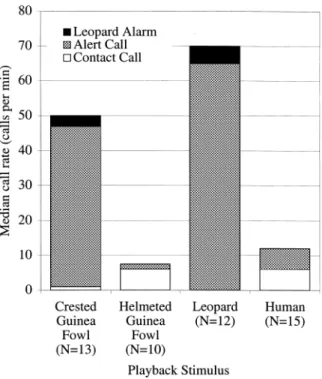
3.1. Experiment 1: vocal responses to predators and guinea fowl alarm calls When hearing crested guinea fowl alarm calls Diana monkeys responded as if a leopard were present (Fig. 2). There were no signi®cant differences between the monkeys' vocal response to crested guinea fowl alarm calls and leopard growls (Mann±Whitney U-test, two-tailed, NGF 13, NL 12; overall call rate,
z 1:687, P , 0:1; female leopard alarm calls, z 0:274, P . 0:7; male leopard alarm calls, z 0:847, P . 0:3). However, monkeys did not simply respond with leopard alarm calls to any disturbance from the ground. There were signi®cant differences between the responses to crested guinea fowl alarm calls and human speech (NGF 13, NH 15; overall call rate, z 3:686, P , 0:001; female leopard
alarm calls, z 3:528, P , 0:001; male leopard alarm calls, z 4:209, P , 0:001). Signi®cant differences were also found between the monkeys' response to the alarm calls of crested guinea fowl and the alarm calls of allopatric helmeted guinea fowl
(NGF 13, NheGF 10; overall call rate, z 3:724, P , 0:001; female leopard
alarms, z 3:026, P , 0:003; male leopard alarm calls, z 3:532, P , 0:001). 3.2. Experiment 2: vocal responses to different causes of guinea fowl alarm calls
In experiment 1, Diana monkeys responded to crested guinea fowl alarm calls as if a leopard were present (Fig. 2). This could be the result of (1) a learned association between the alarm calls and leopards or (2) a cognitive process that allowed the monkeys to respond to the leopard as the most probable cause of the birds' alarm calls. To distinguish between these two hypotheses, monkeys were primed with playback of either human speech or leopard growls and then tested with guinea fowl alarm calls or leopard growls 5 min later from the same location.
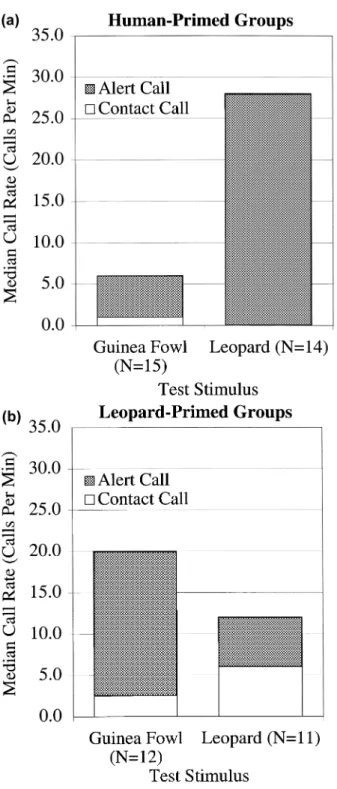
Monkeys responded with a signi®cantly lower call rate to guinea fowl alarm calls when primed with human speech than when primed with leopard growls (Mann± Whitney U-test, two-tailed, NH 15, NL 12, z 2:615, P , 0:009, Fig. 3). The
number of leopard alarm calls produced, however, did not separate the two groups: in only one out of 15 cases (6.7%) did monkeys (male or female) produce leopard alarm calls to guinea fowl alarm calls after being primed with human speech. Similarly, groups primed with leopard growls produced leopard alarm calls to guinea fowls in only three out of 12 cases (25.0%). No signi®cant differences were found in the number of female leopard alarm calls (z 1:421, P . 0:1) or male leopard alarm calls (z 1:584, P . 0:1) to guinea fowl alarm calls between human-primed and leopard-primed groups. This paralleled the behavior of control groups primed and re-tested with leopard growls, where females produced leopard alarm calls in only one out of 11 cases (9.1%) to the second leopard playback. 3.3. An alternative explanation
When Diana monkeys heard the alarm calls of crested guinea fowl in the absence of any other stimuli, they gave leopard alarm calls. In other words, they responded as if they assumed that a leopard was nearby. When Diana monkeys heard the alarm calls of crested guinea fowl after being primed with (and responding to) the growls of a leopard, they typically gave no more leopard alarms but responded with loud alerting calls (Fig. 3). In other words, they responded as if the leopard growl had already informed them that a leopard was nearby and the guinea fowl alarm calls, once again indicating the presence of a leopard, provided redundant information. Finally, when Diana monkeys heard the alarm calls of crested guinea fowl after being primed with (and responding to) the voices of humans, they typically gave no leopard alarms and signi®cantly fewer loud alerting calls; that is, they largely remained silent. In other words, they responded as if the sound of humans `overrode' the usual information conveyed by guinea fowl alarms and indicated that humans, not a leopard, were nearby.
Alternatively, one could argue that monkeys did not take humans or leopards as the cause of guinea fowl alarm calls but that priming with human speech simply elicited long-term cryptic behavior to any subsequent stimulus, regardless of the
Fig. 3. Diana monkey responses to guinea fowl alarm calls and leopard growls after having been primed with either human speech (a) or leopard growls (b).
underlying causality. If this hypothesis is correct, then the following two predictions can be made.
First, if human speech sound causes long-lasting cryptic behavior, then human-primed groups should respond weakly to any other subsequent stimulus, including, for example, leopard growls. There should be no signi®cant differences, therefore, between human-primed groups responding to leopard growls and human-primed groups responding to guinea fowl alarm calls. However, this was not the case. Priming with human speech had little effect on the subsequent response to leopard growls (Fig. 3). Instead, signi®cant differences were found between human-primed groups tested with leopard growls and tested with guinea fowl alarm calls (Mann± Whitney U-test, two-tailed, NH-L 14, NH-GF 15; overall call rate, z 2:842,
P , 0:005; female leopard alarm calls, z 2:328, P , 0:02; male leopard alarm calls, z 2:267, P , 0:03). No signi®cant differences were found, however, between leopard-primed groups tested with leopard growls and with guinea fowl alarm calls (Fig. 3; Mann±Whitney U-test, two-tailed, NL-L 11, NL-GF 12;
overall call rate, z 1:232, P . 0:2; female leopard alarm calls, z 0:932, P . 0:3; male leopard alarm calls, z 0:181, P . 0:8).
Second, in the TaõÈ National Park there is substantial variation in poaching pres-sure. Monkey groups with a home range in the research area located east of the CRE research station (`habituated groups') are reasonably well protected against human predation and exposed daily to human speech by researchers, assistants, and other people passing by. Most other groups, however, live in less protected areas and suffer from various degrees of poaching pressure (`unhabituated groups'). Given this, there should be a signi®cant difference in how habituated and unhabituated groups are affected by playback of human speech. To habituated groups, human presence is not a predatory threat and priming with human speech should not cause any cryptic behavior nor should it affect the monkeys' response to subsequent guinea fowl alarm calls. To unhabituated groups, however, human presence is highly dangerous and priming with human speech should elicit cryptic antipredator beha-vior.
If the associative account is correct and the monkeys' response is simply the result of a learned association between guinea fowl alarm calls and leopard presence, then priming with human speech should have opposing effects on habituated and unha-bituated groups in the way they respond to guinea fowl alarm calls. Haunha-bituated groups (who are not afraid of humans and therefore do not respond with cryptic behavior) should respond to guinea fowl alarm calls as if a leopard were present (i.e. give a large number of leopard alarm calls and general alert calls). In contrast, unhabituated groups (who are afraid of humans and therefore respond with cryptic behavior) should continue to respond cryptically to guinea fowl alarm calls because of the danger of human presence.
If monkeys respond to the causal reason of guinea fowl alarm calls, however, then no differences are predicted in the way habituated and unhabituated groups respond to guinea fowl alarm calls in the presence of humans. Consistent with the second hypothesis, habituated groups showed little response to guinea fowl alarm calls when primed with playback of human speech sounds. No signi®cant differences
were found in the vocal behavior of habituated and unhabituated groups (Mann± Whitney U-test, two-tailed, Nhab 5, Nunhab 15; overall call rate, z 0:308,
P . 0:7; female leopard alarm calls, z 0:577, P . 0:5; male leopard alarm calls, z 0:577, P . 0:5), suggesting that the monkeys' weak response to guinea fowl was not due to overall cryptic behavior caused by human speech.
4. Discussion
If Diana monkeys hear the alarm calls of crested guinea fowls in the absence of additional information, they respond as if a leopard is present (Fig. 2). This is not simply the result of Diana monkeys responding with leopard alarm calls to any conspicuous alarm calls coming from the ground: the alarm calls of helmeted guinea fowl cause a response that resembles the monkeys' response to humans, not leopards. This response pattern raises questions about the nature of the underlying cognitive mechanism driving the monkeys' response. According to a ®rst hypoth-esis, monkeys rely on a learned association between a conditioned stimulus, the guinea fowl alarm calls, and an unconditioned stimulus, the leopard. According to a second hypothesis, monkeys attend to the most likely cause of the alarm calls, i.e. the presence of a leopard.
Behavioristic accounts of cognitive phenomena, as outlined in the ®rst hypothesis, are generally dif®cult to reject (e.g. Shanks & Dickinson, 1987), typically because (1) one can always think of a way the animal has solved the problem with an elaborate chain of associations and (2) in wild animals little is known about their previous natural experiences with the experimental stimuli. Since associative accounts are typically considered to be more parsimonious, the following three sets of data are at least consistent with the second hypothesis.
First, priming with playback of human speech causes the monkeys to produce a signi®cantly lower call rate to guinea fowl alarm calls than no priming or priming with leopard growls. Human-primed groups respond to guinea fowl alarm calls like groups responding to human speech, suggesting that monkeys interpreted the alarm calls as human-caused (Figs. 2 and 3). The number of leopard alarm calls given to both human speech and human-primed guinea fowl was very low and no statistical differences were found. This could have been the result of two different mechanisms with the same outcome since groups primed and tested with leopard growls also exhibit a low tendency to produce leopard alarm calls to the second stimulus (Fig. 3) (ZuberbuÈhler et al., 1999a).
Second, the cryptic response to guinea fowl alarm calls of human-primed groups was not due to general cryptic behavior caused by the prime. This is because human-primed groups respond signi®cantly stronger when tested with leopard growls instead of guinea fowl alarm calls.
Third, habituated monkey groups where human speech does not induce cryptic behavior nevertheless show little response to guinea fowl alarm calls, suggesting that monkeys responded to the fact that humans were the most likely cause for the guinea fowl alarm calls.
So far, the focus has been on the predator±prey relationship between guinea fowls and two of their predators but nothing has been said about the relationship between humans and leopards. Leopards are hunted by poachers and consequently avoid human presence (Jenny, 1996; Martin, 1991). One could argue, therefore, that monkeys know about this and that human priming not only informs them about the presence of humans, but also informs them that a leopard will no longer attack and is likely to leave the area (J. Call, pers. commun.). This is a plausible scenario with the following consequences. If monkeys have simply associated guinea fowl alarm calls with the presence of a leopard and the calls act as a substitute for a leopard, then one would not predict a difference in the vocal response of human-primed groups to either leopard growls or guinea fowl alarm calls. Although human priming, according to this hypothesis, lowers the risk of a leopard attack both stimuli simply indicate the presence of a leopard and no response differences are predicted. Fig. 3 shows that this was not the case. Human-primed groups respond signi®cantly weaker to guinea fowl alarm calls than to leopard growls, indicating that even though the chances of a leopard attack might be reduced in the presence of humans, monkeys respond differently to the two stimuli.
Data show, therefore, that the monkeys' response to another species' alarm calls is not the result of a one-to-one association between two types of stimuli, i.e. the guinea fowl alarm calls and the leopard, despite what Fig. 2 suggests. Instead, it seems that monkeys are able to respond ¯exibly to alarm calls as a function of their eliciting cause. However, can one conclude from these data that monkeys truly understand the causality underlying guinea fowl alarm calls? Understanding caus-ality requires knowledge of the laws that describe the relation between events, that is, how and why one event may lead to another. When humans have to solve similar problems in which only the outcome of a process but not its cause are presented they reconstruct the missing events through a mental process termed `causal reasoning'. Causal reasoning produces a strong form of causal knowledge because here the individual can access and combine different sources of existing knowledge in order to solve a novel problem, even without ever having encountered it before (Kummer, 1995). The experiments presented here can only give an incomplete account of how Diana monkeys could have solved the causal problem. This is mainly because nothing is known about the previous experiences monkeys have had with guinea fowl alarm calls and the presence of particular predators. The crucial information, i.e. how often groups have witnessed encounters between alarm calling guinea fowls and human poachers, is unknown. A laboratory study would be necessary at this point to clarify the matter. If a causal reasoning process underlies the monkeys' response, then the following needs to be the case. (1) Monkeys must have knowledge that guinea fowl alarm calls can be caused by various disturbances, such as leopards or chimpanzees. (2) Monkeys must have knowledge that the best response to human poachers is to respond with cryptic behavior. (3) When hearing guinea fowl alarm calls in the presence of humans for the ®rst time, monkeys must be able to combine these two sets of information and respond with cryptic behavior even though they normally respond with leopard alarm calls to this stimulus. Although with the data presented in this paper little
can be said in favor or against the causal-reasoning hypothesis, the monkeys' beha-vior strongly contrasts with associatively learned weak causal knowledge. Subjects have shown that they can ¯exibly assign two different behavioral responses to the same alarm call stimulus, depending on the causal information they have received. Acknowledgements
The study was funded by the National Science Foundation (IBN 9520566), the Canton St. Gallen (Department of Education), the Canton Zurich (KNK Research Stipend), the Swiss Academy of Natural Sciences (Travel Grant), the University of Pennsylvania's Department of Psychology (Graduate Fellowship) and Institute for Research in Cognitive Science (NSF-STC Grant No. 8920230), the National Geographic Society (Grant No. 6344-98), the Janggen-Poehn Foundation, and the Max-Planck-Institute for Evolutionary Anthropology. In CoÃte d'Ivoire, I thank the ministries of research and agriculture, the Centre Suisse de Recherches Scienti®-ques, the PACPNT, and the CRE for logistic support and permission to conduct research in the TaõÈ National Park. I am grateful to Josep Call, Dorothy Cheney, Jennifer McClung, Robert Seyfarth, and Mike Tomasello for their comments and thoughts.
References
Brown, L. H., Urban, E. K., & Newman, K. (1982). The birds of Africa. London: Academic Press. Cheney, D. L., Seyfarth, R. M., & Silk, J. B. (1995). The responses of female baboons (Papio
cynoce-phalus ursinus) to anomalous social interactions: evidence for causal reasoning? Journal of Compara-tive Psychology, 109 (2), 134±141.
Curio, E., Ernst, U., & Veith, W. (1978). The adaptive signi®cance of avian mobbing: II. Cultural transmission of enemy recognition in blackbirds: effectiveness and some constraints. Z. Tierpsych., 48 (2), 184±202.
Dickinson, A., & Shanks, D. (1995). Instrumental action and causal representation. In D. Sperber, D. Premack, & A. J. Premack (Eds.), Causal cognition. A multidisciplinary debate (pp. 5±25). Oxford: Claredon Press.
Garcia, J., Ervom, F. R., & Koelling, R. A. (1966). Learning with prolonged delay of reinforcement. Psychonomic Science, 5, 121±122.
Hauser, M. D., & Wrangham, R. W. (1990). Recognition of predator and competitor calls in nonhuman primates and birds: a preliminary report. Ethology, 86 (2), 116±130.
Hill, C. M. (1994). The role of female diana monkeys, Cercopithcecus diana, in territorial defence. Animal Behaviour, 47 (2), 425±431.
HoÈner, O. P., Leumann, L., & NoeÈ, R. (1997). Dyadic associations of red colobus and diana monkey groups in the TaõÈ National Park, Ivory Coast. Primates, 38, 281±291.
Jenny, D. (1996). Spatial organization of leopards (Panthera pardus) in TaõÈ National Park, Ivory Coast: is rainforest habitat a tropical haven? Journal of Zoology, 240, 427±440.
Kummer, H. (1995). Causal knowledge in animals. In D. Sperber, D. Premack, & A.J. Premack (Eds.), Causal cognition. A multidisciplinary debate.
Limongelli, L., Boysen, S. T., & Visalberghi, E. (1995). Comprehension of cause-effect relations in a tool-using task by chimpanzees (Pan troglodytes). Journal of Comparative Psychology, 109, 18±26. Martin, C. (1991). The rainforests of West Africa: ecology, threats, conservation. Basel: BirkhaÈuser.
NoeÈ, R., & Bshary, R. (1997). The formation of red colobus diana monkey associations under predation pressure from chimpanzees. Proceedings of the Royal Society of London, Series B, 264, 253±259. Premack, D., & Premack, A. J. (1994). Levels of causal understanding in chimpanzees and children.
Cognition, 50 (1±3), 347±362.
Rescorla, R. A., & Wagner, A. R. (1972). A theory of Pavlovian conditioning: variations in the effec-tiveness of reinforcement and nonreinforcement. In A. Black, & W. Prokasy (Eds.), Classical condi-tioning II: current research and theory (pp. 64±69). New York: Appleton-Century-Crofts. Seyfarth, R. M., & Cheney, D. L. (1990). The assessment by vervet monkeys of their own and another
species' alarm calls. Animal Behaviour, 40 (4), 754±764.
Seyfarth, R. M., Cheney, D. L., & Marler, P. (1980). Vervet monkey alarm calls: semantic communication in a free-ranging primate. Animal Behaviour, 28 (4), 1070±1094.
Shanks, D. R., & Dickinson, A. (1987). Associative accounts of causality judgment. In G. H. Bower (Ed.), The psychology of learning and motivation: advances in research and theory (pp. 229±261). San Diego, CA: Academic Press.
Tomasello, M. (1998). Uniquely primate, uniquely human. Developmental Science, 1 (1), 1±30. Visalberghi, E., & Limongelli, L. (1994). Lack of comprehension of cause-effect relations in tool-using
capuchin monkeys (Cebus apella). Journal of Comparative Psychology, 108 (1), 15±22.
ZuberbuÈhler, K. (2000a). Causal knowledge of predators' behaviour in wild Diana monkeys. Animal Behaviour, 59 (1), 209±220.
ZuberbuÈhler, K. (2000b). Interspeci®c semantic communication in two forest monkeys. Proceedings of the Royal Society of London, Series B, 267, 713±718.
ZuberbuÈhler, K. (2000c). Referential labeling in wild Diana monkeys. Animal Behaviour (in press). ZuberbuÈhler, K., Gygax, L., Harley, N., & Kummer, H. (1996). Stimulus enhancement and spread of a
spontaneous tool use in a colony of long-tailed macaques. Primates, 37 (1), 1±12.
ZuberbuÈhler, K., NoeÈ, R., & Seyfarth, R. M. (1997). Diana monkey long-distance calls: messages for conspeci®cs and predators. Animal Behaviour, 53 (3), 589±604.
ZuberbuÈhler, K., Cheney, D. L., & Seyfarth, R. M. (1999a). Conceptual semantics in a nonhuman primate. Journal of Comparative Psychology, 113 (1), 33±42.
ZuberbuÈhler, K., Jenny, D., & Bshary, R. (1999b). The predator deterrence function of primate alarm calls. Ethology, 105, 477±490.