HAL Id: halshs-00821180
https://halshs.archives-ouvertes.fr/halshs-00821180v2
Submitted on 5 Aug 2013HAL is a multi-disciplinary open access archive for the deposit and dissemination of sci-entific research documents, whether they are pub-lished or not. The documents may come from teaching and research institutions in France or abroad, or from public or private research centers.
L’archive ouverte pluridisciplinaire HAL, est destinée au dépôt et à la diffusion de documents scientifiques de niveau recherche, publiés ou non, émanant des établissements d’enseignement et de recherche français ou étrangers, des laboratoires publics ou privés.
Yongning Na: a synchronic description and analysis
Alexis Michaud
To cite this version:
Alexis Michaud. The tone patterns of numeral-plus-classifier phrases in Yongning Na: a synchronic description and analysis. Nathan Hill & Tom Owen-Smith. Transhimalayan Linguistics. Historical and Descriptive Linguistics of the Himalayan Area, De Gruyter Mouton, pp.275-311, 2013, Trends in Linguistics. Studies and Monographs [TiLSM] 266, 978-3-11-031083-2. �halshs-00821180v2�
Berlin: De Gruyter Mouton (2013), pp. 275-311.
The tone patterns of numeral-plus-classifier phrases
in Yongning Na: a synchronic description and
analysis
*Alexis Michaud
1. Introduction
Level-tone systems in the Sino-Tibetan family are now well-attested, and increasingly well-described (about Pumi, see Ding 2006 and Jacques 2011; about Hakha Lai: Hyman and VanBik 2002, 2004; see also the synthesis by Evans 2008). The present study aims to contribute to this strand of research by describing a specific area of the tonal morphology of the Yongning Na language, namely the tone patterns of its numeral-plus-classifier phrases. This is part of a broader endeavour to describe the entire tonal morphology of this language.
*
Many thanks to Duan Bingchang , Wang Weidong , Yang Liquan (Yunnan University) and Latami Dashi • (Ninglang Research Centre in Ethnology) for making my fieldwork possible, and to the Na language consultants and friends, in particular Latami Dashilame • . Many thanks to Yu Qian for information on sandhi in Mandarin; to Séverine Guillaume for making the audio and electroglottographic data available online with their annotation in the Pangloss Collection; to Roselle Dobbs, Liberty Lidz and an anonymous reviewer for useful comments and suggestions; and to Jean-Michel Roynard for assistance with editorial matters. I alone am responsible for remaining shortcomings.
Fieldwork was partly funded by the Agence Nationale de la Recherche as part of the research projects PASQi (“What defines Qiang-ness? Towards a phylogenetic assessment of the Southern Qiangic languages of Muli”, 2008-2012) and HimalCo (Parallel corpora in languages of the Greater Himalayas, 2013-2015). Finally, the present chapter is a contribution to the strand “Phonetic and phonological complexity” within the LabEx project “Empirical Foundations of Linguistics” (EFL, 2011-2020).
Yongning Na (endonym: /n - w /) is a member of the Naish subgroup of Sino-Tibetan, which also includes the Naxi and Laze languages (Guo Dalie and He Zhiwu 1994, 5–9; Jacques and Michaud 2011, Appendix 1). It is spoken in the plain of Yongning, Lijiang Municipality, China (Lìjiāng shì Nínglàng xiàn Y ngníng xiāng
). A salient characteristic of this language is its complex tonal morphology, which is apparent from the first contact with the language, witness sentences (1) and (2) (from field notes):
(1) nj bi -zo -ho
nj bi zo ho
1SG to_go OBLIGATIVE FUT(/DESIDERATIVE) “I have to go. / I’m afraid I have to leave.”
(2) nj i -bi -zo -ho
nj i bi zo ho
1SG to_take to_go OBLIGATIVE FUT(/DESIDERATIVE) “I have to go and take [my luggage] now.”
The difference in the lexical tone on the main verb – in (1): /bi / ‘to go’, Mid tone; in (2): / i / ‘to take’, Low tone – is reflected in the tones of the following syllables, all the way to the end of the sentence. Such phenomena permeate numerous aspects of the morphosyntax of Yongning Na; a detailed description is called for.
Tonal alternations are best described in dialects where they are most widespread: an example from Sinitic languages
Tonal alternations in numeral-plus-classifier phrases are not uncommon in East/Southeast Asian languages. But in quite a few cases, these phenomena are so marginal as to become elusive. For instance, Chao Yuen-ren reports tonal change from tone 1 to tone 2 for the Standard Mandarin numerals ‘one’, ‘seven’ and ‘eight’ ( , , ; Pinyin: y , q , b ) before tone-4 classifiers: , and (‘1’, ‘7’ and ‘8’ with the classifier for items/articles) are realized as yí jiàn, qí jiàn and bá jiàn, not *y jiàn, *q jiàn and *b jiàn (Chao Yuen-ren 1968, 571). However, this sandhi pattern has now receded. Surveys involving a total of more than 300 speakers were conducted in the 1980s; they show a considerable generation gap, with no speaker under age 34 having sandhi for ‘7’, and only about 5% of the same age group having sandhi for ‘8’ (Hu Mingyang 1997; this
sandhi pattern has now been officially removed from Standard Mandarin as defined by the People’s Republic of China). The figures suggest that the evolution was not identical for the two numerals, despite their identical lexical tone: sandhi for ‘8’ seems more resilient to change. In the 1980s, averaging across age groups about 40% of speakers still realized the tone sandhi for ‘8’, versus less than 25% for ‘7’ (same source as above). On the other hand, sandhi for ‘1’ remains, so that speakers now say yí jiàn (with tone change) but q jiàn and b jiàn (without change).
The origin of this phenomenon is not easy to investigate. Not all the numerals that have the same tone (for tone 1: ‘1’, ‘3’, ‘7’, ‘8’) behave similarly. The fact that only ‘1’, ‘7’ and ‘8’ partake in the alternation in the dialect described by Chao Yuen-ren, and only ‘1’ in present-day Beijing Mandarin, must be attributed to dialect mixture, or described as remnants of an earlier pattern that used to be regular and phonetically motivated. In such a situation, one hopes to come across a dialect that has a symmetrical, full-fledged system of regular tonal alternations, which can in turn shed light on the vestigial or borrowed alternations found in other dialects. For Mandarin, the place to look for seems to be dialects spoken in the Northeast and in the Central Plains, where sandhi is indeed attested for the four numerals that have the same lexical tone: ‘1’, ‘3’, ‘7’, ‘8’, thus pronouncing
yí jiàn, sán jiàn, qí jiàn and bá jiàn for , , and (Qian Yu, p.c.). This systematic sandhi pattern, also found in the vicinity of Beijing, presumably influenced Beijing Mandarin without being adopted in full. Evidence for dating this phenomenon comes from reconstructions of Middle Chinese. These four numerals are reconstructed as * jit, *sam, *ts it and *p t, respectively (Baxter 2000, 2, 107, 118, 161), i.e. as a non-homogeneous set: three of these have a final stop, whereas ‘3’ with its nasal final is a conspicuous odd-man-out. This suggests that the tone sandhi does not predate the formation of the tonal category in which all four numerals now belong, and could, in fact, be much more recent.
Within the small group of Naish languages, tonal alternations in numeral-plus-classifier phrases are vestigial in Naxi (as spoken in the plain of Lijiang, Yunnan, China), limited in Laze (spoken in the neighbouring prefecture of Liangshan, Muli county; see Huang Bufan 2009; Michaud 2009; Michaud and Jacques 2012), and ubiquitous in Yongning Na, making the latter a fascinating object for study. As a first sample, consider the diversity of tones found on classifiers in: / i - i / ‘two days’, /so - i / ‘three days’, / v - i / ‘four days’; and: / i -k v / ‘two years’, /so -k v / ‘three years’, / v -k v / ‘four years’. A previous study (Michaud 2011)
brought out similarities between Na, Naxi and Laze in the tone patterns of their numeral-plus-classifier phrases. As the objective of the 2011 study was to pursue the phylogenetic implications of these similarities, only limited detail was provided on the synchronic facts for Yongning Na. The aim of the present study, on the other hand, is to attempt a complete synchronic description and analysis.
2. Background: The tone system of Yongning Na
This section presents the tone system of Yongning Na, as a background to the analysis of the tones of numeral-plus-classifier phrases. This presentation is organized in analytical order. It starts out from a static inventory of tone patterns over domains of different lengths, and gradually progresses towards an analysis – the same process that will be applied below to numeral-plus-classifier phrases. This mode of exposition replicates the progression of analysis during fieldwork, working up from the surface facts; this is intended to allow the reader to evaluate the analysis step by step, and to reflect on possible alternatives. Attention focuses on nouns, since this part of the tone system is the most relevant to the analysis of numeral-plus-classifier phrases.
2.1. A static inventory of tone patterns for nouns
Words said in isolation are what one starts out from in the earliest stages of fieldwork. Table 1 presents an overview of the tone patterns over monosyllabic nouns said in isolation. It was not possible to find a minimal set (words distinguished solely by tone) due to the relatively low number of monosyllabic nouns in the language.
Table 1. Tone patterns attested over monosyllabic nouns said in isolation
phonetic realization label example non-rising, non-low M wæ ‘horse’
low-rising LM bo ‘pig’
mid-rising MH æ ‘deer’
The second column of Table 1 proposes an analysis of the three patterns into level tones: L(ow), M(id), H(igh), and their combinations. Justification
for this analysis comes from morpho-phonological alternations in which the tones partake; pieces of evidence will be provided in the course of the analysis. At an initial stage, the essential information is that provided in the leftmost column in Table 1, describing the three patterns in so many words as follows: a non-rising, non-low pattern; a low-rising pattern; and a mid-rising pattern.
The restrictions on the tones of monosyllables said in isolation are the following. (i) There are no examples of falling contours. (ii) There is no opposition between a high tone and a mid tone: only one type of non-low, non-rising tone is observed. Its realizations occupy the entire upper part of the tonal space, varying from mid to high, with a flat or falling contour. The choice of the label M (rather than H) for this pattern will be explained further below, at the stage of phonological analysis. (iii) There is only one contour that starts on a low pitch. Using level-tone labels, this observation can be phrased as follows: there is no opposition between LM and LH.
The surface patterns are the same for other word classes, such as verbs. Over disyllabic nouns, seven patterns are observed, as shown in Table 2.
Table 2. Tone patterns attested over disyllabic nouns said in isolation
1st syllable 2nd syllable label example non-low low M.L /d i / ‘mule’ non-low low-rising *M.LM * non-low mid-rising M.MH /hw li / ‘cat’ non-low mid M.M /po lo / ‘ram’ non-low high M.H /hwæ æ / ‘squirrel’
low low *L.L *
low low-rising L.LM /k v mi / ‘dog’ low mid-rising L.MH /õ dv / ‘wolf’ low mid (or high) L.M ( L.H) /bo mi / ‘sow’
Table 2 shows all logical possibilities; those that are not attested have a star (*) in the example and label columns. If the tone of the first syllable is non-low, there are four tonal possibilities on the second syllable: low; mid; high; or mid-rising. If the tone of the first syllable is low, there are three possibilities on the second syllable: low-rising; mid; or mid-rising.
The restrictions on the distribution of tones on disyllables can be described as follows. (i) Only two tones contrast on the first syllable: low
and non-low. There can be no contour on the first syllable. (ii) A Mid tone cannot be followed by a low-rising tone. (iii) A disyllable cannot be low throughout, any more than a monosyllable. (iv) There is no contrast between a low+mid pattern and a low+high pattern; the notation adopted is L.M.
There are also strong limitations on tone patterns over three syllables: only twelve patterns are attested. The data in Table 3 are from trisyllabic nouns whose degree of lexical integration ranges from transparent compounds, such as ‘Year of the Dragon’, to fully undecomposable words, such as ‘lips’. A hyphen is placed between the two parts of decomposable compounds.
Table 3. Tone patterns attested over trisyllabic nouns said in isolation
1st 2nd 3rd label example
non-low mid mid M.M.M q w e ‘awl’
non-low mid low M.M.L mv gv -k v ‘year of the Dragon’ non-low mid high M.M.H njo bi li ‘lips’
non-low mid mid-rising M.M.MH bv v -k v ‘year of the Serpent’ non-low low low M.L.L mo jo mi ‘owl’
non-low high low M.H.L æ tse p æ ‘kneebone’ low low mid L.L.M t o k v mi ‘male dog’ low low low-rising L.L.LM d n mi ‘wilderness’ low mid mid L.M.M t wæ mi ‘donkey’ low mid high L.M.H æ li p æ ‘mirror’ low mid mid-rising L.M.MH bi p v -d ‘flood’ low mid low L.M.L bæ bv -bv ‘ladybird’
Since there is a three-way opposition on the second syllable, the three terms are labelled as ‘low’, ‘mid’ and ‘high’, whereas for the first syllable the two terms are simply labelled ‘low’ and ‘non-low’.
Some generalizations can be proposed in view of data from the three tables. The first generalization is that non-final syllables never carry a contour. The second is that the entire word (or phrase, or sentence) cannot carry low tone on all of its syllables. The third is that there can never be a trough: a tone surrounded by higher tones (non-low followed by low followed by mid, for instance).
Data from Table 3 confirm the observation made in Table 2, that a mid (non-low) tone can be followed by one of four tones: low, mid, high, or mid-rising, whereas a low tone can only be followed by low-rising, mid or mid-rising. Additionally, the data from Table 3 suggest that a high tone can only be followed by a mid tone.
After this static inventory, a dynamic approach to the tones of nouns can be proposed.
2.2. A dynamic view, bringing out six underlying tonal categories for monosyllabic nouns, and eleven categories for disyllabic nouns
2.2.1. Monosyllabic nouns
It was mentioned above that there are three patterns for monosyllables said in isolation: low-rising; non-low; and mid-rising. The set of nouns realized as non-low in isolation is not homogeneous, however, witness the behaviour of /jo / ‘sheep’, / wæ / ‘horse’ and /l / ‘tiger’, all of which are realized with a non-low tone in isolation.
In association with the copula, they yield: /jo i / ‘is (a/the) ram’, with low tone on the noun; / wæ i / ‘is (a/the) horse’, with mid tone on the noun, and high tone on the copula; and /l i / ‘is (a/the) tiger’, with mid tone on the noun and low tone on the copula. Since the morphosyntactic context is the same, these three words must be considered as representatives of three different lexical tones. These three tones all neutralize to mid (non-low) when the noun is said in isolation.
The set of nouns realized as low-rising in isolation is not homogeneous either: in some contexts, such as object+verb combinations, / æ / ‘leopard’ and /bo / ‘pig’ have a different behaviour. For example, ‘…has bought leopards’ is / æ hwæ -ze /, with a L tone on the accomplished suffix, whereas ‘…has bought pigs’ is /bo hwæ -ze /, with M tone on the suffix.
As an aside about the research method: needless to say, these combinations were elicited with the greatest care, and verified over several field trips; an appropriate context was devised with the help of the main consultant, e.g., for ‘…has bought leopards’, imagining that a king sends out someone to purchase leopards from hunters. Examples found in recorded narratives confirm the patterns that were obtained through systematic elicitation. The data are gradually archived and made available
online through the Pangloss Collection (currently at
http://lacito.vjf.cnrs.fr/pangloss/index_en.htm).
To sum up, out of the three surface patterns on monosyllables in isolation, one (MH) corresponds to a single phonological set: all the words realized with MH tone in isolation have the same tone pattern in a given morphosyntactic context. The two others constitute the neutralization of underlying patterns: LM corresponds to two underlying categories, and M to three categories. A dynamic view thus brings out six tonal categories of monosyllables.
The same approach is applied below to disyllables. The phonological nature of the categories will then be analyzed.
2.2.2. Disyllabic nouns
The same procedure as above was also applied to disyllabic nouns: looking at the behaviour of nouns in different morphosyntactic contexts, in order to find out how many tone classes need to be distinguished.
It was realized that the nouns realized with a M.M pattern in isolation make up two distinct sets: one after which the copula carries L tone; and one after which the copula carries H tone. One set is illustrated by /po lo / ‘ram’, /po lo i / ‘is (a/the) ram’. The other is illustrated by / wæ zo / ‘colt’, / wæ zo i / ‘is (a/the) colt’.
Likewise, the nouns realized with a M.M pattern in isolation make up two distinct sets, the one illustrated by /kv e / ‘flea’, /kv e i / ‘is (a/the) flea’, the other by /hwæ æ / ‘squirrel’, /hwæ æ i / ‘is (a/the) squirrel’. Finally, the nouns realized with a L.M pattern in isolation fall into no less than three categories. These three categories are brought out by intersecting evidence from two contexts: with a following copula, and with a following possessive, as shown in Table 4.
Table 4. Examples illustrating the existence of three tone categories neutralized to L.M in isolation
in isolation gloss with copula with possessive bo mi sow bo mi i bo mi -bv
bo boar bo i bo -bv
n h Naxi n h i n h -bv
Addition of the copula sets apart a class exemplified by ‘Naxi’, after which the copula receives H tone. Addition of the possessive sets apart a
class exemplified by ‘boar’, which depresses the tone of the possessive to L, as opposed to its realization as M for the other words. While the evidence used to bring out the tone classes is morphotonological – looking at the behaviour of nouns in context –, the tone classes must be described as lexical, since the difference in the surface-phonological tone strings shown in Table 4 must be ascribed to a difference between the lexical items at issue, and hence, to a difference in lexical tone category.
In total, this yields eleven tonal classes of disyllables. 2.3. A phonological analysis of the tone categories of nouns
A number of different tonal categories were brought out on the basis of their different behaviour in different morphosyntactic contexts. This raises an issue for the analysis of each category: it is advisable to progress from the simplest cases to the most complex, but the tone categories of the simplest units – monosyllabic nouns – can only be brought out by examining their combinations with various other morphemes, whose tones, at this stage, have not been analyzed either. In theory, this raises an issue of circularity. In practice, bootstrapping is often required when analyzing a new language variety: groping for a correct analysis by trial and mistake.
A step forward in the analysis of the tones of nouns was made possible by progress in the analysis of the tones of other morphemes: it was realized that the copula carried L tone, and that the possessive carried M tone (it can also be analyzed phonologically as toneless). On this basis, it became possible to propose a phonological analysis for each of the tones of nouns.
The two tonal categories of nouns illustrated by /l i / ‘is (a/the) tiger’ and / wæ i / ‘is (a/the) horse’ were reanalyzed as follows. In the first case, the copula surfaces with its own lexical tone. ‘Tiger’ represents the simplest case, analyzed as having M tone: a phonological tone identical with the surface tone in this context. (The same analysis can be proposed for the category of disyllables illustrated by /po lo / ‘ram’.) In the second case, ‘horse’, the copula surfaces with a H tone which must be supposed to be projected onto it by the noun. ‘Horse’ exemplifies a tone category characterized by a H tone which can only surface on a following syllable: a floating H tone. Discussion of this phenomenon warrants a separate subsection.
2.3.1. A floating H tone
The floating H tone is never realized on the word itself, and can only be realized after it. The case of ‘colt’, realized in isolation as / wæ zo /, offers a neat opportunity to extend the analysis to disyllables. The H tone that appears in / wæ zo i / ‘is (a/the) colt’ is interpreted as reflecting the floating H tone lexically attached to the noun ‘colt’.
Since this is the only type of H tone that may be lexically attached to a monosyllable, it appears convenient to transcribe it as a simple H tone on monosyllabic nouns in the glossary and in examples within this volume: e.g. ‘horse’ is transcribed as / wæ /. For disyllables, however, there is an opposition between this floating H tone and a word-final H tone (as in /hwæ ts / ‘rat’). This complexity of syllabic anchoring makes it necessary to use a nonstandard symbol: a symbol not used in the International Phonetic Alphabet. The pound symbol # was (arbitrarily) chosen to stand for the end of a lexical word, adopting notation as / wæ zo# /.
To repeat this important point with another example, the #H-tone word ‘little brother’ and the M-tone word ‘little sister’ have the same tonal pattern in isolation (M on both syllables: /gi z / ‘little brother’, /go mi / ‘little sister’), but the former yields /gi z i / ‘…is little brother’ (tone sequence: M.M+H), the latter /go mi i / ‘…is little sister’ (tone sequence: M.M+L). The analysis proposed is that ‘little brother’ has a final H tone which remains unassociated unless it can associate to a following syllable: a H tone that is floating at the end of the word. The association of this floating H tone requires specific morphosyntactic conditions. For instance, the possessive, as a clitic, is not a suitable host for a floating tone; it receives M tone (by default), and the H tone remains unassociated (and thus does not surface in the resulting pattern), hence /gi z -bv / ‘…of [a/the] little brother’, tonally identical with /go mi -bv / ‘…of [a/the] little sister’.
2.3.2. Word-final and morphological-nucleus-final H tones
It was mentioned above that the words ‘squirrel’ and ‘flea’, realized with a M.H pattern in isolation (as /hwæ æ / and /kv e /, respectively), had different underlying tones.
The former has a simple tonal behaviour: its H tone attaches to the last syllable of the lexical word. This is where it appears in all contexts. Under
the present analysis, the first syllable of the word receives a M tone by default, yielding a surface-phonological M.H pattern.
The latter has a H tone that attaches to the last syllable of a unit which will be referred to here as the morphological nucleus. A further complexity is that this tone only surfaces if the last syllable in the morphological nucleus is an appropriate host. When a word carrying this tone is pronounced in isolation, the end of the lexical word is also the end of the morphological nucleus, and the H tone lands there, hence the surface tone sequence M.H: /kv e / ‘flea’. When the noun is followed by the possessive, the H tone does not surface, because this clitic is not an appropriate host. The result is / kv e -bv / ‘…of (a/the) flea’, with M tone on both syllables of the noun, and also, by default, on the possessive.
Another nonstandard symbol was devised to transcribe the boundary that is relevant to the attachment of this type of tone: the end of the morphological nucleus. Again in an arbitrary way, the dollar sign $ was chosen to stand for this boundary.
To sum up, disyllabic (and polysyllabic) nouns with H tone must be divided into three categories: H#, #H and H$, depending on how the H tone manifests itself. A H tone on the last syllable of a disyllabic or polysyllabic noun may have different origins. It may be the realization of a High tone that is anchored to the end of the morphological nucleus (a tone transcribed as H$). Or it may be a High tone anchored to the last syllable of the lexical word: H#. It is impossible to distinguish these in isolation, as both positions coincide. In order to find out the underlying tones of words, they have to be heard in various contexts. For nouns, these are: tone-group-final position (as when they are said in isolation); tone-group-internal position; and when followed by a toneless clitic such as the possessive. The lexical tone can be arrived at with certainty by matching up the behaviour of the word in these various contexts.
2.3.4. L tones: existence of a repair phenomenon for all-L tone groups
‘Sheep’, realized in association with the copula as /jo i /, is a case where the noun’s phonological tone is hypothesized to surface as such: a L tone. A slight complexity is that the copula surfaces with a rising tone. This makes sense in view of the exceptionless observation that an entire utterance cannot carry low tone on all of its syllables. The sequences L+L (monosyllabic noun+copula) and L.L+L (disyllabic noun+copula) cannot surface as such, due to a general prohibition against all-L tone groups in
Na. The contour observed at the end of a sequence of L tones is interpreted as resulting from the post-lexical addition of an extra tone: a High tone, creating a rising contour. The same applies to the tonal class of disyllables exemplified by /k v mi / ‘dog’.
2.3.5. Contour tones: sequences of level tones on the same syllable
As mentioned in the static overview presented earlier, there are no falling contours in Yongning Na: no syllables carrying tones HL, HM, or ML. Also, tone-group-initial H is never observed.
Rising contours, on the other hand, do exist. They are restricted to the last syllable of a tone group: a rising contour is never observed on a non-group-final syllable. The two observed contours are M-to-H and L-to-H (the latter constituting the neutralization of LM and LH in the underlying phonological form).
The phonological behaviour of the MH contour is straightforward. When the word is tone-group-final, the contour is realized as such: a rising tone with a non-low starting-point, e.g. in / æ / ‘deer’ and /hw li / ‘cat’. (Note that when a word is pronounced in isolation, it constitutes a tone group on its own: the beginning of the word is also the beginning of the tone group, and the end of the word is the end of the tone group.) When there is a following syllable within the tone group, the MH contour unfolds, projecting its H part onto that syllable.
Unlike the floating High tone (#H), which cannot attach to a following clitic, the MH contour can unfold over any syllable. With the copula, this yields (again taking the same examples) / æ i / ‘is [a/the] deer’ and /hw li i / ‘is [a/the] cat’. With the possessive, this yields / æ -bv / ‘of [a/the] deer’ and /hw li -bv / ‘of [a/the] cat’.
2.4. An overview
This is not the place to provide a full treatment of the many interesting issues raised by the Yongning Na tone system; the above developments hopefully allow the reader to get a feel for the type of analytical challenges encountered in this language. Table 5 sets out a synthetic overview, presenting the six tone categories of monosyllabic nouns and the eleven categories of disyllabic nouns.
To date, no single morphosyntactic context bringing out all the tonal oppositions on nouns has been found: each context brings out only some of
the oppositions, whereas others are neutralized. For instance, addition of the copula brings out the opposition between M and #H tones (M+L vs. M+H for monosyllables, M.M+L vs. M.M+H for disyllables). This opposition is neutralized to M and M.M respectively in isolation. On the other hand, addition of the copula neutralizes the tonal contrasts that appear in isolation between #H, MH# and H$ on disyllables: all three yield M.M+H with the copula, whereas they are realized as M.M, M.MH and M.H respectively in isolation. So it is necessary to elicit a word in several contexts to determine its lexical tone. The table provides information on the tone categories (i) in isolation, (ii) when followed by the copula / i / (in frame (3): see below), and (iii) when followed by the possessive clitic [bv ], which carries M tone (and which may be phonologically analyzed as underlyingly toneless).
(3) __________ i
DEM.PROX target item COP
‘This is (a/the) ________ .’
This set of three contexts is sufficient to bring out all oppositions, except that between LM and LH on monosyllables, which only surfaces in a very restricted number of contexts due to the general neutralization of LH and LM sequences at the surface-phonological level. (One such context is in association with the verb ‘to buy’: for instance, the LM-tone word ‘pig’ yields /bo hwæ -ze / ‘…bought pigs’, whereas the LH-tone word ‘leopard’ yields / æ hwæ -ze / ‘…bought leopards’.)
The tone of the proximal demonstrative [ ] in (3) is M, regardless of the tonal class of the following item; as a consequence, only the tonal pattern of the rest of the sentence is indicated in Table 5. On the other hand, no tone is indicated for the copula in frame (3), because its surface tone changes according to the tone category of the target-word.
Dots indicate boundaries between syllables within the lexical word, and the ‘+’ sign indicates the boundary between the noun and a following morpheme. For instance, the information provided in Table 5 for disyllabic L-tone nouns is: L.LH in isolation, and L.L+H with copula and with possessive clitic. As an example, the word ‘dog’ is /k v mi / in isolation, yielding /k v mi i / ‘…is [a/the] dog’ and /k v mi -bv / ‘…of [a/the] dog’.
The leftmost column in Table 5 (“analysis”) presents the phonological categories. Examples are transcribed according to these categories,
indicating tones at the end of the syllable using International Phonetic Alphabet tone-letters (Chao Yuen-ren 1930), e.g. /bo / ‘pig’. This is strictly equivalent to /bo/ in Africanist notation, or to other notations such as /boLM/ or /LMbo/.
Table 5. The lexical tones of monosyllabic and disyllabic nouns.
M ono sy ll ab le s LM LH L+H L+H bo pig LH LH L+H L+H æ leopard M M M+L M+M l tiger L M L+LH L+M jo sheep #H M M+H M+M wæ horse MH# MH M+H M+H æ deer D is y ll abl es M M.M M.M+L M.M+M po lo ram #H M.M M.M+H M.M+M wæ zo# colt MH# M.MH M.M+H M.M+H hw li cat H$ M.H M.M+H M.M+M kv e $ flea L L.LH L.L+H L.L+H k v mi dog L# M.L M.L+L M.L+L d i mule LM+MH# L.MH L.M+H L.M+H õ dv wolf LM+#H L.M L.M+H L.M+M n h # Naxi LM L.M L.M+L L.M+M bo mi sow LH L.H L.H+L L.H+L bo boar H# M.H M.H+L M.H+L hwæ æ squirrel
In light of this synthetic view, the distributional observations made above can be flipped around. For instance, instead of stating that a
monosyllabic noun that carries a M tone when it is said in isolation may belong in one of three distinct underlying categories, it can now be said
that the three non-contour lexical tones, M, L and #H, all neutralize to [M] on monosyllables. Among disyllables, M and #H neutralize to [M.M]; LM and LM+#H neutralize to [L.M]; and H$ and H# neutralize to [M.H].
When the possessive clitic /bv/ is added after a monosyllabic noun, yielding, for example, [bo -bv ] ‘of the pig’, contours unfold over the two syllables of the resulting combination: LH yields L+H (as does LM, following neutralizing with LH), and MH yields M+H. The non-contour tones, M, L and #H, do not affect the possessive, which surfaces with default M.
This last point offers crucial evidence for the distinction between contours (LM, LH and MH#) on the one hand and the floating H tone (/#H/) on the other. The second part of a contour is realized on the possessive; the floating H tone is not. The interpretation proposed is that the possessive clitic cannot provide anchorage for a tone, whereas it can host a tone level that is part of a tone anchored to a preceding syllable. The MH# contour tone in Table 5 has a stable phonological anchorage: it is anchored to the syllable preceding the clitic. From there, the second part of the contour can be projected onto the possessive clitic – a process of contour unfolding which is distinct from processes of tonal anchoring. A schematic representation is presented below:
MH MH
On the other hand, the floating H tone initially lacks anchorage, and the possessive clitic is unable to provide such anchorage. Since this H tone receives syllabic anchoring neither onto the word to which it is lexically attached, nor on the possessive clitic that follows it, it remains unassociated, and does not surface at all.
2.4.1. Reflections on the structure of the system: phonological regularities or morphophonological oddities
Looking back at the data in Table 5, it is tempting to look for phonological regularities that would account for all the observed data. The search for phonological regularities is soon up against sets of facts that resist phonological generalizations, however. For instance, there is no obvious reason why L should surface as M in isolation. This may have to do with the prohibition of all-L tone groups, and a fortiori all-L utterances; but for verbs this is remedied by adding a post-lexical final H tone, so that verbs with lexical L tone surface with a LH contour when they are said in isolation. If the tone system were based on a set of phonological rules – rules applying uniformly in all morphosyntactic contexts –, lexical L on a noun would be expected to surface as LH, not as M. A similarly puzzling case is that of the L tone on disyllabic nouns. A word such as /k v mi / ‘dog’ yields /k v mi / in isolation, as expected, but when followed by the copula it yields /k v mi i / ‘is [a/the] dog’: the copula loses its lexical L
tone. There is no obvious reason why this should be so: one would have expected a /*L.L.L/ sequence, realized as /*k v mi i / following the
addition of a post-lexical H tone to avoid an all-L phonological word. This asymmetry in the tonal treatment of the copula after a L-tone noun, depending on the number of syllables in the noun, points to a crucial aspect of Yongning Na tone: many tone rules have narrowly restricted fields of application; they apply in highly specific morphosyntactic contexts, and are sensitive to the number of syllables (and internal makeup) of the morphemes at issue.
The key phonological facts are few in number; they can be summarized as follows. Within a tone group, contours are only realized as such in tone-group-final position; in non-tone-group-final position, the second level (the H portion in MH, for instance) associates to the following syllable. L tone spreads progressively (left-to-right). All tones following H are lowered to L. Finally, H and M are neutralized to M in tone-group-initial position.
The points brought out in this introduction are central to the analysis of numeral-plus-classifier phrases presented below.
3. Elicitation procedures
All the data presented here were provided by one female consultant born in 1950 in the hamlet of / l - w / (Chinese rendering: ), in the Yongning plain, and who has lived there all her life, except for two years in the city of Lijiang, at the home of one of her sons. Her speaker code in the author’s database of Naish languages is F4; our collaboration began in 2006. For each noun in the vocabulary list collected in the course of fieldwork1 (slightly above 800), a note was made of the classifiers typically associated with the noun (following the example of E. Henderson’s dictionary of Bwe Karen [1997]). This obviously does not capture the full range of stylistic possibilities in the choice of classifiers, which are best studied from their actual use: “a noun can be accompanied by various classifiers depending on context, so that it may not be adequate to describe
1
The vocabulary list is available from the STEDT project (http://stedt.berkeley.edu/). About the classifiers of Yongning Na, see also Lidz 2006, 8–14 and Lidz 2010, xxxiv–xxxv, 216–223, 232. Thomas Pinson’s Naxi-Chinese-English glossary (Pinson 1998: 245-251) contains an inventory of comparable size: about 90 classifiers.
one of those as fundamental at a lexical level” (François 2000, 167, my translation).
To the list of classifiers obtained through lexical elicitation were added measure words (inch, armspan, heap…) and time units (day, month, year…): the term “classifier” is understood here in the syntactic sense of
any noun that may appear directly after a numeral. Table 1 presents the
classifiers brought to light so far. The notation of tones is based on the system outlined above, as set out systematically in Michaud 2008 (with apologies for the recurring self-reference). The asterisk * after the tone category (L*, M*, H*…) indicates defective classifiers, which only appear with the numeral ‘1’: for instance, there exists a specific classifier for individuals, /v /, appearing only after ‘1’, ‘11’, ‘21’ etc, in complementary distribution with /kv /. Numerals in the ‘Tone’ column (e.g. the ‘1’ in ‘L1’) are explained in 5.2 below.
Table 1. A list of Yongning Na classifiers, by alphabetical order
Classifier Tone Description æ L1 cl. for fires
bæ M1 cl. for sorts/types of things bæ L1 self-classifier for flowers b MH1 cl. for scarves
bi L3 self-classifier for animal hooves; also used for footprints bv dze L* a ladleful of
i H2 one hundredth of a yuan, one penny
i H1 100
d MH2 self-classifier for blows (from the verb 'to strike') æ L1 section of (road); bolt of cloth
di L3 self-classifier for plains do H1 cl. for partitions/walls
dv L* cl. for a flock of cattle and a group of people wæ H1 cl. for steps (of stairs)
dze L1 cl. for pairs of separable objects, e.g. a pair of bottles dzi M2 cl. for pairs of non-separable objects, e.g. a pair of shoes dzi L2 cl. for trees, bamboo
L1 cl. for spans of time
H1 self-classifier for marketplaces/towns u H1 cl. for beams (in carpentry)
gi H1 cl. for halves h MH1 night
h M2 a few, some, a little (note: can be used in the plural) j MH1 cl. used for some domestic animals
i M2 cl. for places ju L2 ounce k MH1 one-sixth of an acre k MH1 cl. for sticks/rods k L1 bottle of k MH1 basket of k L2 cl. for threads k v MH1 year; year of age
k w H1 piece of, chunk of; mouthful of ku M1 cl. for small objects, e.g. cigarettes kv MH2 cl. for humans (plural)
kw L1 string, cluster of i M2 month i L2 arm span
M2 cl. for round objects; also used as generic cl. lo L2 self-classifier for valleys
lo dzi L* handful (using both hands) mæ L1 yuan
mæ L1 10,000
m L1 a few, a little (note: can be used in the plural) mi L2 cl. for chicken mu M1 cl. for corpses n M1 cl. for tools i H2 day p M* a big step p H2 cl. for statues
p L2 cl. for ladders, doors… p æ MH1 sheet (of paper)
p u MH1 a member of a pair; also used for large domestic animals pi MH1 a little (note: can be used in the plural)
pu M1 cl. for plants with a stalk, and for pieces of clothing pu L2 cl. for packs, e.g. a pack of cigarettes
q L3 a (large) bundle
q wæ MH1 cl. for hemp fibre before spinning q w MH1 bowl of
M2 cl. for families u L2 sort of
w M1 heap, e.g. of grains, of cut wood
s H* a sort of; only used in the construction “there is not a thing” æ MH1 small bundle of cut cereal
L2 times (doing something n times) so L1 some, a few
t MH1 entirely, all; everyone (note: can be used in the plural) t i L2 cl. for meals
t u L* in combination with 'one', means 'together' t i M1 some, a few (note: can be used in the plural) t i MH1 cl. for loads carried by a pack-animal t i MH1 pound of
H1 drop of (liquid)
t v MH1 cl. for steps (in walking) ti MH1 cl. for layers (of dust etc)
i H1 handspan (between the thumb and index finger) to H1 armful of
to pi L time (n times as many/much as…) æ MH1 cl. for ears of corn
ts MH1 cl. for cockscombs, leaves, and heads of garlic ts i H1 cl. for animal skins
ts i L3 cl. for roof parts tso L3 cl. for rooms
w M1 handful tv M1 one tenth of a yuan tv M1 1,000
v L2 large chunk of v H2 self-classifier for pots v M* cl. for one individual (human) w L2 cl. for generations
w L2 load, charge, weight wu L2 cl. for teams (of oxen)
L3 cl. for lines/patterns (in weaving, drawing etc)
Establishing the underlying tonal categories was not a straightforward task, because the tone of the classifier is affected by the numeral with which it is associated, witness the examples cited above: / - i / ‘one day’, / i - i / ‘two days’, /so - i / ‘three days’, / v - i / ‘four days’;
/ -k v / ‘one year’, / i -k v / ‘two years’, /so -k v / ‘three years’, / v -k v / ‘four years’. The first step consisted of conducting systematic elicitation, to find out how many tonal categories there were. A first data set was elicited in 2009, covering the range of numerals from 1 to 30, and a second set in 2011, covering the range from 1 to 100 and including more classifiers.
Elicitation yielded less than fully consistent results, due in part to the unusual nature of the counting task for the consultant. Although familiar with the process of linguistic elicitation, she easily became confused when counting all the way from 1 to 30 or 100. One and the same combination was realized in different ways during different elicitation sessions. When such discrepancies were pointed out to the consultant, she would identify one pattern as correct and reject the others as mistaken. However, these a
posteriori judgments also wavered: a variant that had been brushed aside as
mistaken would come up again in a later session, and the consultant would then insist that it was correct. Initially, I wrongly assumed that only one tone pattern could be correct: it gradually became clear that there exist two variants for some of the phrases. For instance, the association of ‘47’ with the classifier for round objects can be realized either as / v ts i - / or as / v ts i - /. (Variants like this one are discussed in Section 5.1; to preview the result of analysis: in the first variant, the phrase is parsed into two tone groups, whereas in the second, it is parsed as a single tone group.) Taking into account these two factors – that occasional mistakes are not uncommon in systematic elicitation, and that two variants can both be correct –, a comprehensive description could finally be arrived at.
The entire set of transcribed recordings is available online, with both a surface-phonological transcription and an indication of the underlying tonal pattern. Some technical details are presented in the next paragraphs.
4. Recordings
In 2009 the recordings were in stereo, collecting the signal from two microphones: a head-mounted Sennheiser HSP 2, and an AKG C-900. In 2011, an electroglottographic signal was collected simultaneously with the audio from the head-mounted microphone. The electroglottographic signal allows for a high-precision measurement of the voice’s fundamental frequency (as well as of other glottal parameters; about electroglottography, see the initial report of the invention: Fabre 1957; a synthesis: Baken 1992;
some caveats: Orlikoff 1998; discussions about parameters that can be measured: Henrich et al. 2004, Michaud 2004; and applications to the study of specific linguistic issues, e.g. Brunelle et al. 2010).
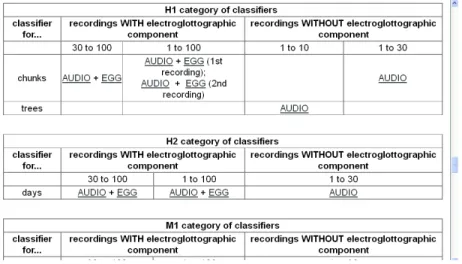
A total of 2,810 numeral-plus-classifier phrases were recorded, divided into 41 files, 28 of which have an electroglottographic component. In the recordings that extend from 1 to 100, the intervals [50..59] and [80..89] were not recorded, because previous elicitation had shown that their tone patterns were identical with those of [40..49] and [60..69], respectively, and shortening the list of numerals reduced consultant fatigue.
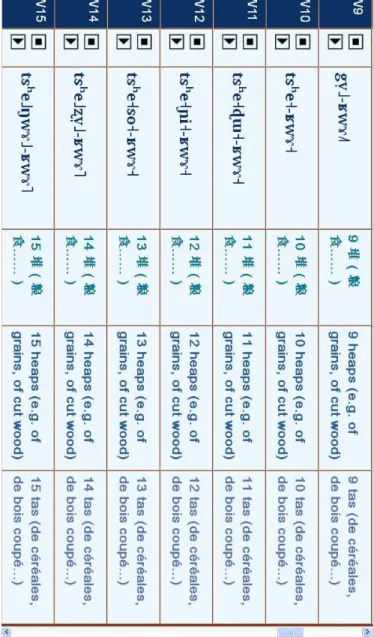
The entire set is available online from the Pangloss Collection (about which see Michailovsky, Michaud, and Guillaume 2011, and Michaud et al. 2012), synchronized with transcriptions in English, Chinese and French. The current address is http://lacito.vjf.cnrs.fr/archivage/index_en.htm; the Yongning Na data can be accessed directly from http://lacito.vjf.cnrs.fr/archivage/languages/Na_en.htm (see Figures 1 and 2).
These documents are perennially archived and will continue to be accessible even when the above addresses eventually change.
Figure 1. Screen shot showing how the list of resources is presented on the web
The availability of these audio and electroglottographic data with synchronized transcriptions makes it possible to get a feel for the data; it also opens perspectives for further research into a broad range of phonetic topics. Given the amount of time that is necessary to produce a state-of-the-art experimental phonetic investigation, it is simply impossible for linguists who are working at the description of an entire language (or of several languages) to launch into a phonetic study to substantiate and refine each of their observations; on the other hand, it appears feasible to collect a sufficient amount of data for interested colleagues to conduct such a study.2
No amount of continuous speech would be enough to obtain all the numeral-plus-classifier combinations from 1 to 100, hence the choice to resort to systematic elicitation. However, some of the combinations are
2
Here are two examples (among many others) of phonetic phenomena that can be studied in future on the basis of the Yongning Na data:
(i) The implementation of tone. The electroglottographic signal was not exploited in the present study, except for its occasional use in auditory verification (the pitch can be clearer when listening to the electroglottographic signal than when listening to the audio). This signal could serve in future for a phonetic study of the implementation of tone in Yongning Na. There is a large gap between phonological representations in terms of sequences of level tones, on the one hand, and observed fundamental frequency curves, on the other: “both F0 height and F0
velocity are relevant parameters (…) even for the simplest level tone languages” (Yu 2010, 1). A study of the implementation of tone sequences in Na would be a useful addition to the existing literature on contextual tonal variation and segmental effects on tone, as studied e.g. by Abramson 1979, Gsell 1985 and Gandour and Potisuk 1992 for Thai, and Xu Yi 1997, 1998 for Mandarin.
(ii) The weakened (hypo-articulated) realization of repeated words. When a consultant pronounces a sequence of numeral-plus-classifier phrases, such as / -k w i --k w so -k w v -k w / (‘one piece, two pieces, three pieces, four pieces…’), the tone of the classifier changes (High, High, Low-to-High, Mid…) but its consonants and vowels do not. As a result, the speaker’s attention focuses on the realization of the new information (essentially: the correct tone sequence for the phrase); in terms of the continuum from hyper-articulation to hypo-articulation (Lindblom 1990), the classifier is hypo-articulated. Specifically, the unvoiced lateral / / in classifiers such as / i / ‘month’ and / i / ‘armspan’ is occasionally realized as voiced, despite the existence of a voicing opposition between / / and /l/ in Na. Pursuing such observations would shed light on the field of allophonic dispersion of Na phonemes. Due to the nature of the corpus, numerous tokens of each numeral and classifier are available, offering a good basis for statistical treatments.
attested in the narratives with transcriptions, glosses and translations that are also available online from the Pangloss Collection.
5. Results
5.1. A summary of the results
A summary of all the results is presented in Table 2, which contains, in tightly packed form, the information necessary to generate the surface-phonological tone patterns of all numeral-plus-classifier phrases in Yongning Na. The mass of information presented in this table may seem staggering; were it not for the clear evidence from recorded data (presented in the previous section), one could suspect that this multiplicity of tone patterns is an artefact of elicitation procedures.
As in Table 1, the tonal labels for the nine categories anticipate the results of the analysis presented further below. Variants are separated by a slash (/). For typographical reasons, the table is divided into two halves: the H and MH tones (H1, H2, MH1 and MH2) in a first table, and the M and L tones (M1, M2, L1, L2 and L3) in a second table.
Table 2. The underlying tone patterns of the nine categories of
numeral-plus-classifier phrases of Yongning Na, for all numerals from 1 to 100.
Part 1: H and MH tones.
H1 H2 MH1 MH2 1 H$ H$ MH# MH# 2 H$ H$ MH# MH# 3 L L L L 4 #H #H L# L 5 #H #H L# L 6 H$ H$ H# H$ 7 #H #H MH# MH# 8 H$ H$ H# H$ 9 #H #H L# L 10 L L L L 11 L L L L 12 L L L L 13 L L L L 14 L+H$ L L+H# L+H# 15 L+H$ L L+H# L+H# 16 L+H$ L L+H# L+H# 17 L L L L 18 L+H$ L L+H# L+H# 19 L+H$ L L+H# L+H# 20 #H #H MH# MH# 21 H$ H$ MH# MH# 22 H$ #H MH# MH# 23 °L °L °L °L 24 #H #H °L# °L 25 #H #H °L# °L 26 H$ H$ H# H$ 27 #H #H MH# MH# 28 H$ H$ H# H$ 29 #H #H °L# °L 30 #H #H MH# MH# 31 H$ H$ MH# MH# 32 H$ #H MH# MH# 33 °L °L °L °L 34 #H #H °L# °L 35 #H #H °L# °L
36 H$ H$ H# H$ 37 #H #H MH# MH# 38 H$ H$ H# H$ 39 #H/°L #H °L# °L 40 L#° L#° L#° L#° 41 L#°H$ / L#° L#°H$ / L#° L#°MH# / L#° L#°MH# 42 L#°H$ / L#° L#°#H / L#° L#°MH# / L#° L#°MH# 43 L#°L L#°L / L#° L#°L L#°L 44 L#°#H / L#° L#°#H / L#° L#°L# L#°L 45 L#°#H / L#° L#°#H / L#° L#°L# L#°L 46 L#°H$ L#°H$ L#°H# L#°H$ 47 L#°#H L#°#H L#°MH# L#°MH# 48 L#°H$ L#°H$ L#°H# L#°H$ 49 L#°#H / L#°L L#°#H / L#° L#°L# L#°L 50 L#° L#° L#° L#° 51 L#°H$ / L#° L#°H$ / L#° L#°MH / L#° L#°MH# 52 L#°H$ / L#° L#°#H / L#° L#°MH / L#° L#°MH# 53 L#° L#° L#°L L#°L 54 L#°#H / L#° L#°#H / L#° L#°L# L#°L 55 L#°#H / L#° L#°#H / L#° L#°L# L#°L 56 L#°H$ L#°H$ L#°H# L#°H$ 57 L#°#H L#°#H L#°MH# L#°MH# 58 L#°H$ L#°H$ L#°H# L#°H$ 59 L#°#H / L#° L#°#H / L#° L#°L# L#°L 60 LM°H$ LM°H$ LM°H# LM°#H 61 LM°H$ LM°H$ LM°H# LM°#H 62 LM°H$ / LM°#H LM°#H LM°H# LM°H# 63 LM°H$ / LM°L LM°H$ / LM°L LM°H# LM°H# 64 LM°#H LM°#H LM°H# LM°H# 65 LM°#H LM°#H LM°H# LM°H# 66 LM°H$ LM°H$ LM°H# LM°H# 67 LM°#H LM°#H LM°H# LM°H# 68 LM°H$ LM°H$ LM°H# LM°H# 69 LM°#H / LM°L LM°L LM°H# LM°H# 70 L#° L#° L#° L#° 71 L#°H$ / L#° L#°H$ L#°MH# / L#° L#°MH# 72 L#°H$ / L#° L#°#H L#°MH# / L#° L#°MH# 73 L#°L L#°L L#°L L#°L
74 L#°#H L#°#H L#°MH# / L#° L#°L 75 L#°#H L#°#H L#°MH# / L#° L#°L 76 L#°H$ L#°H$ L#°H# / L#° L#°H# 77 L#°#H L#°#H L#°MH# / L#° L#°MH# 78 L#°H$ L#°H$ L#°H# / L#° L#°H# 79 L#°#H / L#°L L#°#H L#°L# L#°L 80 LM°H$ LM°H$ LM°H# LM°H# 81 LM°H$ LM°H$ LM°H# LM°H# 82 LM°H$ LM°#H LM°H# LM°H# 83 LM°H$ LM°H$ / LM°L LM°H# LM°H# 84 LM°#H LM°H$ LM°H# LM°H# 85 LM°#H LM°#H LM°H# LM°H# 86 LM°H$ LM°H$ LM°H# LM°H# 87 LM°#H LM°#H LM°H# LM°H# 88 LM°H$ LM°H$ LM°H# LM°H# 89 LM°#H LM°#H LM°H# LM°H# 90 L#° L#° L#° L#° 91 L#°H$ L#°H$ L#°MH# / L#° L#°MH# / L#° 92 L#°H$ L#°#H L#°MH# / L#° L#°MH# / L#° 93 L#°L L#°L L#°L L#°L 94 L#°#H L#°#H L#°L# / L#° L#°L 95 L#°#H L#°#H L#°L# / L#° L#°L 96 L#°H$ L#°H$ L#°H# / L#° L#°H# / L#° 97 L#°#H L#°#H L#°MH# / L#° L#°MH# / L#° 98 L#°H$ L#°H$ L#°H# / L#° L#°H# / L#° 99 L#°L L#°#H L#°L# / L#° L#°L 100 #H #H MH# MH#
Part 2: M and L tones.
M1 M2 L1 L2 L3 1 M M L# L# L# 2 M M L# L# L# 3 M M L M M 4 L L H# H# H# 5 L L H# H# H# 6 H# H$ H# H# H# 7 M M L# L# L# 8 H# H$ H# H# H# 9 L L H# H# / L# H# 10 M M L M L
11 M M L# L# L# 12 M M L# L# L# 13 M M L# L# L# 14 L+H# L L+H# L+H# L+H# 15 L+H# L L+H# L+H# L+H# 16 L+H# L L+H# L+H# L+H# 17 M M L# L# L# 18 L+H# L L+H# L+H# L+H# 19 L+H# L L+H# L+H# L+H# 20 M M °L °L °L 21 M M °L# °L# °L# 22 M M °L# °L# °L# 23 °L / M M / °L °L °L °L 24 °L °L H# H# H# 25 °L °L H# H# H# 26 H# H$ H# H# H# 27 M M °L# °L# °L# 28 H# H$ H# H# H# 29 °L °L H# °L# / H# H# 30 M M °L# °L °L# 31 M M °L# °L# °L# 32 M M °L# °L# °L# 33 °L °L °L °L °L 34 °L °L H# H# H# 35 °L °L H# H# H# 36 H# H$ H# H# H# 37 M L °L# °L# °L# 38 H# H$ H# H# H# 39 °L °L H# / °L# H# / °L# H# / °L# 40 L#° L#° L#° L#° L#° 41 L#° L#°M / L#° L#°L# / L#° L#°L# / L#° L#°L# / L#° 42 L#° L#°M / L#° L#°L# / L#° L#°L# / L#° L#°L# / L#° 43 L#° L#°M / L#° L#°M / L#°L L#°M / L#° L#°M / L#° 44 L#°H# / L#° L#° L#°H# / L#° L#°H# / L#° L#°H# / L#° 45 L#°H# / L#° L#° L#°H# / L#° L#°H# / L#° L#°H# / L#° 46 L#°H# / L#° L#°H$ / L#° L#°H# / L#° L#°H# / L#° L#°H# / L#° 47 L#°M / L#° L#°M / L#° L#°L# / L#° L#°L# / L#° L#°L# / L#° 48 L#°H# / L#° L#°H$ / L#° L#°H# / L#° L#°H# / L#° L#°H# / L#° 49 L#°H# / L#° L#°L L#°H# / L#° L#°H# / L#° L#°H# / L#°
50 L#° L#° L#° L#° L#° 51 L#° L#°M / L#° L#°L# / L#° L#°L# / L#° L#°L# / L#° 52 L#° L#°M / L#° L#°L# / L#° L#°L# / L#° L#°L# / L#° 53 L#° L#°M / L#° L#°M / L#°L L#°M / L#° L#°M / L#° 54 L#°H# / L#° L#° L#°H# / L#° L#°H# / L#° L#°H# / L#° 55 L#°H# / L#° L#° L#°H# / L#° L#°H# / L#° L#°H# / L#° 56 L#°H# / L#° L#°H$ / L#° L#°H# / L#° L#°H# / L#° L#°H# / L#° 57 L#°M / L#° L#°M / L#° L#°L# / L#° L#°L# / L#° L#°L# / L#° 58 L#°H# / L#° L#°H$ / L#° L#°H# / L#° L#°H# / L#° L#°H# / L#° 59 L#°H# / L#° L#°L L#°H# / L#° L#°H# / L#° L#°H# / L#° 60 LM°H# LM°H$ LM°H# LM°H# LM°H# 61 LM°H# / L+MH#°M LM°H$ LM°H# LM°H# LM°H# 62 LM°H# / L+MH#°M LM°H$ LM°H# LM°H# LM°H# 63 LM°H# / L+MH#°M LM°H$ LM°H# LM°H# LM°H# 64 LM°H# / L+MH#°L LM°H$ LM°H# LM°H# LM°H# 65 LM°H# / L+MH#°L LM°H$ LM°H# LM°H# LM°H# 66 LM°H# LM°H$ LM°H# LM°H# LM°H# 67 LM°H# / L+MH#°M LM°#H LM°H# LM°H# LM°H# 68 LM°H# LM°H$ LM°H# LM°H# LM°H# 69 LM°H# / L+MH#°L LM°H$ / LM°L LM°H# LM°H# LM°H# 70 L#° L#° L#° L#° L#° 71 L#° / L#°M L#°M / L#° L#°L# / L#° L#°L# / L#° L#°L# / L#° 72 L#° / L#°M L#°M / L#° L#°L# / L#° L#°L# / L#° L#°L# / L#° 73 L#° / L#°M L#°M / L#° L#°L L#°M / L#° L#°M / L#° 74 L#° / L#°H# L#°L L#°H# / L#° L#°H# / L#° L#°H# / L#° 75 L#° / L#°H# L#°L L#°H# / L#° L#°H# / L#° L#°H# / L#° 76 L#°H# / L#° L#°H$ / L#° L#°H# / L#° L#°H# / L#° L#°H# / L#° 77 L#°M / L#° L#°M / L#° L#°L# / L#° L#°L# / L#° L#°L# / L#° 78 L#°H# / L#° L#°H$ / L#° L#°H# / L#° L#°H# / L#° L#°H# / L#° 79 L#°L / L#°H# L#°L L#°H# / L#° L#°H# / L#° L#°H# / L#° 80 LM°H# LM°H$ LM°H# LM°H# LM°H#
81 LM°H# / L+MH#°M LM°H$ LM°H# LM°H# LM°H# 82 LM°H# / L+MH#°M LM°H$ LM°H# LM°H# LM°H# 83 LM°H# / L+MH#°M LM°H$ LM°H# LM°H# LM°H# 84 LM°H# / L+MH#°L LM°H$ LM°H# LM°H# LM°H# 85 LM°H# / L+MH#°L LM°H$ LM°H# LM°H# LM°H# 86 LM°H# LM°H$ LM°H# LM°H# LM°H# 87 LM°H# / L+MH#°M LM°#H LM°H# LM°H# LM°H# 88 LM°H# LM°H$ LM°H# LM°H# LM°H# 89 LM°H# / L+MH#°L LM°H$ / LM°L LM°H# LM°H# LM°H# 90 L#° / L#° L#° L#° L#° L#° 91 L#°M / L#° L#°M / L#° L#°L# / L#° L#°L# / L#° L#°L# 92 L#°M / L#° L#°M / L#° L#°L# / L#° L#°L# / L#° L#°L# 93 L#°M / L#° L#°M / L#° L#°M / L#° L#°M / L#° L#°M / L#° 94 L#°L / L#°H# L#° L#°H# / L#° L#°H# / L#° L#°H# 95 L#°L / L#°H# L#° L#°H# / L#° L#°H# / L#° L#°H# 96 L#°H# / L#° L#°H$ / L#° L#°H# L#°H# / L#° L#°H# 97 L#°M / L#° L#°M / L#° L#°L# / L#° L#°L# / L#° L#°L# 98 L#°H# / L#° L#°H$ / L#° L#°H# L#°H# / L#° L#°H# 99 L#°L / L#°H# L#°L L#°H# L#°H# / L#° L#°H# / L# 100 M M L# L# L#
As mentioned in §2.3, the complexities of the tone system of Yongning Na make it necessary to use two nonstandard symbols in addition to the International Phonetic Alphabet “tone-letters”.
(i) The pound symbol # stands for the last syllable of the unit to which it is lexically attached: thus #H is a High tone that can only be realized after the last syllable of the unit to which it is lexically attached. This tone therefore does not surface in isolation. For instance, ‘7 pieces’ and ‘7 plus the classifier for tools’ are both realized with a Mid+Mid tone pattern in
isolation ([ -k w ] and [ -n ], respectively), but their underlying tone is different, witness their behaviour when followed by the copula, / i /: [ -k w i ] vs. [ -n i ]. The first of these two phrases has a ‘floating’ High tone (a phenomenon also observed, though less commonly, in Naxi: Michaud 2006; Michaud and He Xueguang 2007). The notation used here is: / -k w # / vs / -n /.
(ii) The dollar sign $ stands for the end of the morphological nucleus. Drawing examples from the same classifiers as above, ‘6 pieces’ and ‘6 plus the classifier for tools’ are both realized with a Mid+High tone pattern in isolation ([q v -k w ] and [q v -n ], respectively), but their underlying tone is different, witness their behaviour when followed by the copula, / i /: [q v -k w i ] vs [q v -n i ]. The notation used here is: /q v -k w $/ vs /q v -n #/.
(iii) The symbol ° indicates the juncture between the two halves of the phrase for numerals 20 or higher, i.e. those that have an indication of a digit for tens. For instance, the indication L#°L for the numeral ‘93’ associated with a classifier of category H1 (such as /k w / ‘piece of’) means that the string of syllables, in this case /gv.ts i.so.k w /, receives a L# tone on its first half (/gv.ts i/ ‘90’) and a L tone on its second half (/so.k w / ‘3 pieces’). L# is a Low tone that associates immediately before the last syllable (this anchoring is indicated by the # symbol explained above); the first syllable receives M by default. This yields /gv ts i /. As for the simple L tone of the second half, it associates to all syllables, yielding /so k w / and the final output /gv ts i so k w /. For visual clarity, a hyphen is added to indicate the syntactic juncture between the numeral and classifier; /gv ts i so -k w /, even though this juncture does not play any role in tone assignment.
Importantly, the juncture indicated by ° is internal to the tone group: it does not separate two tone groups. Numeral-plus-classifier phrases typically constitute one single tone group – although speakers can choose to split them into two groups for expressive (emphatic) purposes, as will be discussed at the beginning of section 6.
The items in Table 2 that begin with ° do not have any specified tone on their first portion; that portion receives a Mid tone by default. Thus, the phrase ‘33 days’ has a °L tone pattern: a Low tone that associates after the juncture, yielding /…so i /. Since Low tones do not spread regressively (“right-to-left”), the first portion receives M by default (/so ts i …/), resulting in the final output /so ts i so - i /.
Likewise, the items that end with ° do not have any specified tone on their second portion. That portion receives its tones by the application of the tonal rules that govern tonal groups in Yongning Na. For instance, ‘40 years’ has the tone pattern L#°: tone L# (a final L tone) associates to the first half of the phrase, yielding / v.ts i …/, then / v ts i …/ (As mentioned above, tones do not spread leftward; the first syllable receives a Mid tone by default.) At this point a tonal rule applies (see section 6 for more details): a tone cannot be surrounded by higher tones within a tone
group (there are no MLM sequences, nor are there HMH , HLM ,
MLMH , and so on; the symbol indicates the juncture between tone groups). The only possible tone on the second portion of the phrase is therefore L. The final output is / v ts i -k v /.
5.2. How the tonal categories were brought out and labelled
All of the classifiers in Table 1 fall into one of nine tonal categories: the nine data columns of Table 2, based on their tonal behaviour when combined with numbers. In turn, these categories were grouped into four sets on the basis of their similarities. For instance, H1 and H2 are identical except for fourteen of the numerals: {[14..16], [18..19], 22, 32, 42, 52, 62, 72, 82, 92, 99}. Finally, labels were chosen for these four sets and the nine subcategories, as explained below.
Decisive evidence for the analysis of the tones of classifiers could, in principle, come from those classifiers that correspond transparently to a noun (or verb). Only few such classifiers were observed; all bear a straightforward relationship to the corresponding noun or verb, but this does not shed light on their affiliation to one subcategory or other. The classifier for blows is /d /; under the hypothesis made here (that its tonal category is MH), the correspondence with the verb /d / ‘to hit, to strike’ looks transparent, whereas its affiliation to the subcategory MH2 within MH still requires explanation. ‘Bowl’ is /q w / (MH tone), and as a classifier it yields /q w / ‘bowlful’ (MH1 category). ‘Mountain, hill’ is / w / (M tone); as a classifier it yields / w / ‘heap(s) of’ (M1 category); /k / ‘star’ yields /k / (M2 category) as a self-classifier. ‘Beam’, / o /, has / o / (category H1) as its self-classifier. The classifier for marketplaces and cities is / / (category H1), and the noun ‘city’ has a H tone: / /. On the basis of these examples, it appears that the tone category of a classifier is identical to that of its corresponding noun or verb.
Another source of evidence could be the treatment of Chinese borrowings: it can be assumed that the tone subcategories used to accommodate recent borrowings are productive in synchrony. However, only one borrowing was observed: /t i / for ‘pound (weight unit)’. As expected, its tonal category is MH1, i.e. the majority category for classifiers with a MH tone, but it would be unreasonable to draw general conclusions from this isolated example.
In the absence of decisive evidence from either of these two sources, the choice of labels for the nine categories brought out by distributional analysis was guided by structural hints. The tone of the classifiers after ‘6’ and ‘8’ is not highly informative, since almost all tonal oppositions are neutralized in this context (the only tones that are observed are H# and H$). Likewise, in phrases involving ‘3’ and ‘10’, only two patterns are observed. After ‘4’ and ‘5’, four groups can be distinguished; but if these patterns were indicative of the classifiers’ lexical tone, the system would only contain two High tones (#H and H#) and two L tones (L# and L). There would be no Mid tones, and no contours. This would be completely unlike the lexical tones of the other monosyllabic nouns found in Yongning Na, which consist of: H, M, L, and two types of rising contours, analyzed as MH and LM.
On the other hand, the tone patterns in association with the numerals ‘1’ and ‘2’ make good sense as labels for tonal categories: these four patterns are H, MH, M and L, all of which exist as lexical tones for nouns. They are therefore adopted, adding a numeral to distinguish the subcategories (two for H, MH and M, and three for L), by order of decreasing frequency (e.g. there are more classifiers in category M1 than M2).
These labels also make sense under the (admittedly simplistic) assumption that the contribution made by the tone of the classifier will be reflected statistically in the tone pattern of the numeral-plus-classifier phrase. Averaging over the entire range of tone patterns from the number 1 to the number 100, the categories that have a High tone after ‘1’ and ‘2’ (labelled H1 and H2 in Table 2) are also those with the highest proportion of H tones (either on their own: H#, #H, H$, or as part of a MH or MH# contour) and the lowest proportion of L tones. Conversely, the categories that have a Low tone after ‘1’ and ‘2’ (labelled L1, L2 and L3 in Table 2) have the lowest proportion of H tones and the highest of L tones. The other two subgroups (M1 and M2; and MH1 and MH2) are between these two extremes; again as predicted, M1 and M2 have a higher proportion of M tones, and a lower proportion of H tones, than MH1 and MH2. These
rule-of-thumb comparisons, which do not carry demonstrative value, are simply mentioned to convey a feel for the overall outlook of the data. Another indirect way of approaching these data consists of examining the occasional mistakes made by the consultant: this is one of the benefits of having an extensive set of recordings at hand.
5.3. About mistaken realizations in the recordings
As was mentioned earlier, the task of realizing long sequences of numeral-plus-classifier phrases was challenging for the consultant. Among the 2,810 tokens, 7% have a mistaken tone pattern:i a tone pattern which the consultant (F4) consistently judged to be incorrect (a tonal slip of the tongue) when we returned to the data after recording sessions.
Under the hypothesis that these mistakes reflect in part the phonological complexity of the tone patterns at issue, their distribution can shed some light on which parts of the system are more complex. (The notion that mistakes may provide insights about language dates back at least to Henri Frei’s La grammaire des fautes [1929]; see also Fromkin 1973 and Rossi and Peter-Defare 1998, among others.)
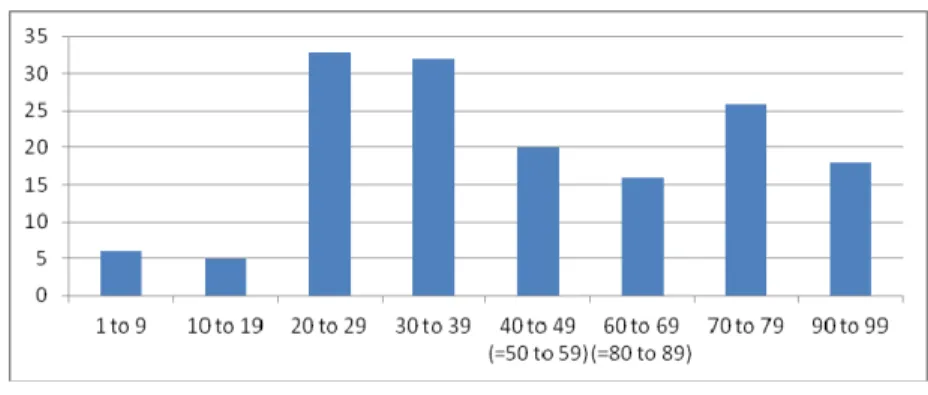
Table 3 shows the distribution of mistakes as a factor of the range of tens: how many of the observed mistakes concern numerals between 1 and 9 (leftmost bar), 10 and 19 (second bar), etc. Table 4 shows the distribution of mistakes as a factor of the last digit (units): how many mistakes concern numbers ending in ‘1’, in ‘2’, etc.
The data are not symmetrical enough for a full-fledged statistical treatment. In particular, (i) there are more data for some tonal categories than others, (ii) some combinations have several repetitions, and (iii) there are slightly more data in the range [1..10] than for higher numerals.
Table 3. Number of mistakes in the recorded numeral-plus-classifier phrases as
a factor of the range of tens.
Table 4. Number of mistakes in the recorded numeral-plus-classifier phrases as
a factor of the last digit (units).
The numerals ending in ‘6’ and ‘8’ (e.g. ‘6’, ‘16’, ‘26’; ‘8’, ‘18’, ‘28’) are noticeably less subject to mistakes, and those beginning in these figures (e.g. ‘60’, ‘61’, ‘62’, ‘63’, ‘89’) are also slightly less often mispronounced than neighbouring “numeral-runs”. Numerals ending in ‘6’ and ‘8’ are also the least complex, many tonal distinctions being neutralized after these numerals. Those ending in ‘7’ and ‘9’, which according to the consultant’s intuition are the most difficult, are indeed among the most frequently mistaken, although ‘7’ does not stand out within the top half of the list of mistakes, which includes {2, 4, 5, 7, 9}.
6. Discussion
6.1. About variants of the tone patterns
No observed numeral-plus-classifier phrase has more than two acceptable variants for its tone pattern. Many of the variants can be explained in light of general rules which hold within a tone group in Yongning Na: if the numeral-plus-classifier phrase is treated as one single tone group, then these rules apply, and modify the tone pattern. The rules are the following:
(i) all tones following a H tone are lowered to L (H tone is culminative); (ii) if a tone group only has L tones, a post-lexical H tone is added to its last syllable, creating a contour;3
(iii) a tone cannot be surrounded by higher tones within a tone group: there are no MLM sequences, nor are there HMH , HLM , MLMH , and so on. (Note that the juncture between tone groups is indicated by the symbol ; this juncture is indicated in the transcription of the narratives available online).
For instance, in the case of ‘44’ plus the classifier for tools, /n / (category M1), the phrase / v ts i v -n / is not a well-formed tone group, since it is not in keeping with rule (iii) above: the L tone on /ts i / is surrounded by higher tones. This syntactic phrase is therefore to be analyzed as consisting of two tone groups: / v ts i v -n / (tone pattern: L#°H#). If this phrase were treated as one single tone group, the tones of its last two syllables would be lowered to L. This is precisely what happens in the tonal variant that is attested for this phrase: / v ts i v -n / (tone pattern: L#°). The two variants can therefore be described as (i) a form consisting of two tone groups, and (ii) a simplified form, whose tonal pattern results straightforwardly from its treatment as a single tone group.
The same applies to all tonal patterns in the range [40..59], [70..79] and [90..99], since the first two syllables (corresponding to ‘40’, ‘50’, ‘70’ and ‘90’ respectively) have a Mid-plus-Low pattern. This pattern precludes any tone other than L on the following syllables within the same tone group (since that would not be in keeping with rule (iii) above). One would
3
This post-lexical tone was described as M in my first study of this topic, Michaud 2008; there is in fact no opposition between LM and LH, and it may be more appropriate to describe the postlexical tone as H.