Oecologia (2004) 139: 383–391 DOI 10.1007/s00442-004-1516-4
P L A N T A N I M A L I N T E R A C T I O N S
Marcel Goverde . Andreas Erhardt . Jürg Stöcklin
Genotype-specific response of a lycaenid herbivore to elevated
carbon dioxide and phosphorus availability in calcareous
grassland
Received: 16 March 2003 / Accepted: 21 January 2004 / Published online: 24 February 2004
# Springer-Verlag 2004
Abstract Effects of elevated CO2 and P availability on
plant growth of the legume Lotus corniculatus and consequences for the butterfly larvae of Polyommatus icarus feeding on L. corniculatus were investigated in
screen-aided CO2 control chambers under natural
condi-tions on a calcareous grassland in the Swiss Jura
mountains. Elevated CO2 conditions and P fertilisation
increased the biomass production of L. corniculatus plants
and affected the plant chemical composition. CO2
enrich-ment increased the C/N ratio and sugar concentration and decreased the N and P concentrations. C- and N-based allelochemicals (cyanoglycosides, total polyphenols and
condensed tannins) were only marginally affected by CO2
enrichment. P fertilisation increased the specific leaf area and concentrations of water, N, sugar and P, while the C/N ratio and the concentration of total polyphenols decreased. Furthermore, P availability marginally enhanced the effect
of elevated CO2 on the total dry mass and sugar
concentration while the opposite occurred for the total polyphenol concentration. The changes in food-plant chemistry as a result of P fertilisation positively affected larval mass gain and accelerated the development time of P. icarus. Only a marginal negative effect on larval mass
gain was found for CO2enrichment. However, we found
genotype-specific responses in the development time of P.
icarus to elevated CO2 conditions. Larvae originating
from different mothers developed better either under
elevated CO2 or under ambient CO2 but some did not
react to CO2elevation. As far as we know this is the first
finding of a genotype-specific response of an insect
herbivore to elevated CO2which suggests genetic shifts in
insect life history traits in response to elevated CO2.
Keywords Elevated carbon dioxide . Lotus corniculatus . Nutrient availability . Plant-insect interaction .
Polyommatus icarus
Introduction
The current anthropogenic increase in atmospheric CO2is
likely to affect plant-insect interactions (e.g. Watt et al.
1995; Coviella and Trumble 1999). Changes in leaf
chemistry under elevated CO2, especially reduced leaf
protein concentration which is most limiting for
phytoph-agous insect development (Schoonhoven et al.1998), can
lead to decreased insect herbivore growth, increased larval development time, or compensatory feeding (e.g. Fajer et
al. 1989; Ayres 1993; Lincoln et al. 1993; Bezemer and
Jones1998).
The impact of CO2 enrichment on herbivores has been
investigated in about 60 studies (see e.g. Coviella and
Trumble 1999; Goverde et al. 2002b). Most of these
studies have been conducted under standardised experi-mental conditions with a relatively high power to detect even small effects of experimental treatments. However, the extrapolation of greenhouse and growth-chamber data to natural conditions is difficult and of limited value since the conditions of these experiments may neglect processes of ecological relevance and lead to the detection of effects
not occurring in the field (Peters1993; Körner2000). For
example, the effect of elevated CO2on the development of
a satyrid butterfly found in a greenhouse study (Goverde
and Erhardt 2003) could not be found when using a
M. Goverde (*) . A. Erhardt
Department of Integrative Biology, Section of Conservation Biology, University of Basel,
St Johanns-Vorstadt 10, 4056 Basel, Switzerland e-mail: [email protected] Tel.: +41-61-4220355 Fax: +41-61-4220357 J. Stöcklin
Department of Integrative Biology, Institute of Botany, University of Basel, Schönbeinstrasse 6, 4056 Basel, Switzerland Present address: M. Goverde Melchtalstrasse 21, 4102 Binningen, Switzerland e-mail: [email protected]
screen-aided CO2 control (SACC) system under natural
conditions on a calcareous grassland (Goverde et al.
2002b). The lack of agreement between these two
experiments might be a result of natural climatic conditions, food-plant choice and long-term effects in the field experiment which mask the effect of elevated
CO2found in the greenhouse (Körner1995; Goverde et al.
2002b).
The present study investigates effects of elevated CO2
on biomass production and leaf chemistry of the legume Lotus corniculatus L. (Fabaceae), and consequences for the butterfly larvae of Polyommatus icarus Rottemburg (Lepidoptera, Lycaenidae) feeding on L. corniculatus in a SACC system under field conditions [for further details on
the SACC see Leadley et al. (1999)]. The same
plant-insect system has been investigated in a growth-chamber
and greenhouse study (Goverde et al. 1999; Bazin et al.
2002) and, therefore, comparisons of results can be made.
Under elevated CO2 conditions L. corniculatus plants
grown either in growth-chambers or in the greenhouse, increased concentrations of starch, condensed tannins and total polyphenols, and decreased cyanoglycoside
concen-trations (Goverde et al. 1999; Bazin et al. 2002). In both
experiments, P. icarus developed faster under elevated
CO2 than under ambient CO2 conditions. Since L.
corniculatus plants were grown in a nutrient-rich soil,
they were not N limited and, hence CO2 enrichment had
no effect on the protein concentration of L. corniculatus. The faster development of the larvae on plants grown
under elevated CO2conditions was probably a result of the
higher starch concentration of these plants compared to
plants grown under ambient CO2 conditions (Goverde et
al. 1999).
As shown by Stöcklin and Körner (1999) the biomass
increase of legumes as a result of elevated CO2conditions
is much larger when plants are fertilised with P. This
indicates that legumes’ responsiveness is largely
con-trolled by P availability. Therefore, in the present study, we added a P-fertiliser treatment to investigate its direct
and interactive effect with CO2enrichment on the growth
of L. corniculatus and its consequence for insect performance. Positive effects of fertilisation on insect growth were found in many other studies (e.g. Kinney et
al. 1997; Kerslake et al. 1998; Hättenschwiler and
Schafellner 1999). Larvae of the satyrid butterfly
Coeno-nympha pamphilus reared on fertilised plants showed a lower development time and higher weights than larvae
feeding on unfertilised plants (Goverde and Erhardt2003).
Furthermore, adult butterflies showed lower preferences for amino acid-rich nectar mimics when reared on fertilised plants, which indicates that their fertilised larval food plants were more nutritious than unfertilised control
plants (Mevi-Schütz et al. 2003). However, in these
studies interactive effects of elevated CO2and fertilisation
were found neither for larval development nor for adult
nectar preference. Increased effects of elevated CO2as a
result of fertilisation were found for plant characters such as dry mass, leaf N and starch concentrations (e.g. Conroy
et al.1992; Entry et al.1998; Goverde et al.2002a), but so
far not for insect growth (e.g. Williams et al. 1997;
Hättenschwiler and Schafellner 1999; Goverde and
Erhardt 2003but see Kerslake et al.1998).
Finally, the effect of elevated CO2 on insect
perfor-mance has been shown to be species-specific or to depend
on the insects’ feeding guild (Bezemer and Jones1998).
Genotype-specific responses to elevated CO2 have been
shown for plants (e.g. Leadley and Stöcklin 1996;
Goverde et al. 1999; Mansfield et al. 1999; Roumet et
al. 1999; Lindroth et al. 2001). However, so far few
studies have investigated the effect of elevated CO2 on
different genotypes of herbivores. Larvae of P. icarus originating from different mothers show differences in larval, pupal and adult mass, in development time and in
conversion efficiency (Goverde et al. 1999; Bazin et al.
2002). Thus the question arises if there are interactive
effects of larval genotype and elevated CO2 conditions,
which could result in an evolutionary advantage for a specific genotype within a population.
In the present study, we tested the following hypotheses:
1. Elevated CO2 conditions increase starch and C-based
allelochemical concentrations of L. corniculatus plants. 2. Growth of L. corniculatus plants increases with P
fertilisation, and the latter amplifies the effect of CO2
enrichment for plant growth.
3. The changes in leaf chemistry of L. corniculatus plants
as a result of elevated CO2and fertilisation positively
affect the performance of P. icarus.
4. Larvae of P. icarus originating from different mothers
differ in their responses to elevated CO2.
Materials and methods
Study site and CO2enrichment
The present study was carried out in a semi-natural, undisturbed calcareous grassland near the village of Nenzlingen (47°27′N, 7°34′ E) in the Swiss Jura mountains. The site is a moderately steep (ca. 20°), south-west-facing slope at an altitude of 520 m a.s.l.. The Rendzina soil consists of a 10- to 15-cm silty clay loam top horizon underlain by calcareous debris (Leadley et al. 1999). Originally covered by beech forest, these grasslands have been grazed by cattle for many centuries, leading to the characteristic Teucrio-Mesobro-metum vegetation (Schläpfer et al.1998). Snow usually covers the area for <1 month per year.
Beginning with the onset of the growing season in late March 1994, elevated CO2 was applied using SACC (for details see Leadley et al. 1997, 1999). Twenty-four experimental plots were arranged in a randomised block design. Each block contained six hexagonal SACC chambers reaching a height of 50 cm and enclosing 1.27 m2. In three plots per block, the atmospheric CO2 concentration was raised to 600μl l-1, whereas the other three plots were exposed to present-day CO2concentrations (368μl l-1). In the outer part of the 1.27-m2area of each plot several tubes (diameter 9.5 cm, depth approximately 30 cm) were dug in. For the present study L. corniculatus plants were planted in six tubes per plot (three tubes were situated in the upper left part of the plot and three in the lower right part).
Plant and insect material
Lotus corniculatus L. (Fabaceae) seeds were obtained from a local distributor (Wildstaudengärtnerei Willi-Durrer, Eschenbach), and were germinated in compost and transplanted after 12 days into small pots. On 12 March 1998, 27 days after sowing, two L. corniculatus plants per pot (10 cm diameter) were planted. The soil in these pots originated from the study site at Nenzlingen described above. To ensure nodulation of all plants, pots were watered with a solution containing rhizobial bacteria. Nodules of roots of L. corniculatus plants collected at Nenzlingen were crushed with a mortar and pestle, and left for 24 h in 100 mmol mannitol in tapwater (J. Müller, personal communication). This procedure was repeated 1 week later to ensure nodulation. Plants were grown in a greenhouse at the Botanical Institute Basel for 6 weeks. On 2 April 1998, L. corniculatus plants were randomly assigned to the tubes described above and planted in the field. To ensure growth, plants were watered on 25 April, and 4 8 11 and 13 May.
Polyommatus icarus Rottemburg (Lepidoptera, Lycaenidae) females were captured at different sites in the Swiss Jura mountains. Butterflies were kept in cages in the greenhouse to oviposit [for further detail see Goverde et al. (1999)]. Eggs from six different females were obtained and these were kept, separated by female, on moist filter paper in petri dishes covered by a nylon mesh. After hatching, batches of eight to ten larvae per female were placed in petri dishes containing shoots of L. corniculatus. Since the mortality of young larvae is high, P. icarus caterpillars were reared in the greenhouse until reaching their third larval instar (I3).
Experimental design
The six tubes per plot were randomly assigned to two groups. One group acted as control while the other group received granulated P fertiliser on 3 April and on 4 May. The total amount of P fertiliser per tube was 15 kg P ha-1.
On 8 June, 67 days after planting, shoots and leaves of all L. corniculatus plants were counted. Additionally, the cages for larval rearing were installed in the field. Each tube was covered by a fine nylon mesh of 30 cm height which was attached to a stick placed in the centre of the tube. Between 10 and 13 June freshly emerged I3P. icarus larvae were weighed and released into the cages. Four of the six cages (two control and two with P fertiliser) per plot received one I3 caterpillar originating from one specific female. The two remaining tubes were used as control without herbivory. Per female genotype, two ambient and two elevated CO2 plots were used,
resulting in four plots per female genotype and a total of six female genotypes.
Twelve days after they had been released in the cages, larvae were collected, weighed and returned to the original plants from which they were obtained. Between 7 and 9 July all larvae had reached their pupal stage. Pupae were collected and weighed, and singly placed in one of 18 compartments of a plastic box (21 cm×12 cm) with a nylon webbing floor. Boxes were placed in a greenhouse 5 cm above a pan with water to maintain high humidity. Boxes were daily checked for emerging adults. After they emptied their gut, emerged butterflies were weighed.
After removing the pupae, plant characteristics were measured. First, the number of leaves and shoots of the remaining L. corniculatus plants were counted. Then, to analyse cyanide concentration, six to seven leaves from each plant were removed, frozen in liquid nitrogen and stored at −80°C until analysis. To determine the specific leaf area (cm2g-1dry mass), a subsample of leaves was harvested and their leaf area was measured using a planimeter (LI-3100 area meter; LI-COR, Lincoln, Neb.). Finally, all remaining plants (above-ground and 20 cm of the root system) were harvested, weighed and dried at 60°C for 48 h. Leaf water concentration was measured as the proportional difference between fresh and dry leaf mass. Total shoot and root dry mass were determined. N and C concentrations were determined from dried leaves using a CHN analyser (model 932; LECO Instruments, St. Joseph, Mich.), which uses a combustion procedure. Non-structural carbohydrates (NSC) were determined using a series of enzymatic digestions (Wong 1990; Körner and Miglietta 1994). With this method, soluble-neutral sugar and NSC concentrations are measured whereas the starch concentration was calculated as the difference between NSC and the soluble-neutral sugar concentration. The P concentration was determined by using the molybdate blue ascorbic acid method (Watanabe and Olsen 1965). Cyanide samples were ground with liquid N using a mortar and pestle, and the HCN released was fixed in 0.5 ml of 1 N NaOH in a 37°C oven for 12 h. The HCN concentration was estimated by the method of Lambert et al. (1975) and expressed in equivalent mg CN g-1 dry mass. A standard absorption curve at 725 nm was established with commercial KCN (Prolabo, Briare, France). For total polyphenol and condensed tannin analysis, approximately 70-mg dried leaf samples were extracted in 10 ml of 70% acetone overnight (15 h) at 4°C in the dark. After filtration, the condensed tannin concentration [estimated at 550 nm and expressed by the extinction coefficient (E‰550)=150 in units of mg g
-1
; condensed tannins measured as anthocyanidin equivalents] was assessed using the acid butanol assay (Porter et al.1986). For total polyphenols, the Prussian blue assay (Price and Butler1977) was used with a standard curve of Table 1 Skeleton ANOVA for measured plant characters and insect
characters. Split-plot ANOVA, sum of squares type I, n =144 for plant characters; n =96 for weight of third instar larvae; n =81 for
weight of larvae after 12 days; n =68 for pupal weight, adult weight and development time
Plant characters Insect characters
Source of variation df Mean square (MS) Variance-ratio (F) Source of variation df Mean square Variance-ratio (F)
Block (B) 3 MSB MSB/MSP CO2 1 MSCO2 MSCO2/MSP
CO2 1 MSCO2 MSCO2/MSP Female genotype (FG) 5 MSFG MSFG/MSP
Plot (P) 19 MSP MSP/MSR CO2×FG 5 MSCO2×FG MSCO2×FG/MSP
Fertilisation (F) 1 MSF MSF/MSR Covariate sex (S) 1 MSS MSS/MSP
Herbivory (H) 1 MSH MSH/MSR Plot (P) 11 MSP MSP/MSR
CO2×F 1 MSCO2×F MSCO2×F/MSR Fertilisation (F) 1 MSF MSF/MSR
CO2×H 1 MSCO2×H MSCO2×H/MSR CO2×F 1 MSCO2×F MSCO2×F/MSR
F×H 1 MSF×H MSF×H/MSR FG×F 5 MSFG×F MSFG×F/MSR
CO2×F×H (all) 1 MSall MSall/MSR CO2×FG×F (all) 5 MSall MSall/MSR
Error (residuals; R) 114 MSR S 1 MSS MSS/MSR
Error (residuals; R) 59a MSR aModel df, i.e. since there were some larvae or pupae lost, the effective error df is <59
T able 2 Summary of plant parameters (means±SEM) under ambient and elevated CO 2 conditions without (Contr ol ) and with P fertiliser . The proportional ef fect of elevated CO 2 and P fertilisation (P ) is indicated. Significant CO 2 or P main ef fects are shown (for interactive and mar ginal ef fects see the text). n No. of samples per treatment, SLA specific leaf area, d.m. dry mass n Ambient CO 2 Elevated CO 2 CO 2 ef fect P ef fect Control P fertiliser Control P fertiliser Control P fertiliser Ambient CO 2 Elevated CO 2 Number of shoots (before herbivory) 12 20.06±0.56 23.28±0.98 20.25±0.53 24.00±0.99 1.0% 3.1% 16.1% 18.5% F1,1 1 4 =17.64, P <0.001 No. of leaves (before herbivory) 12 129.50±4.1 1 163.31±8.39 131.22±5.91 161.61±6.17 1.3% − 1.0% 26.1% 23.2% F1,1 1 4 =27.57, P <0.001 No. of shoots (after herbivory) 12 25.19±0.96 28.78±1.27 26.06±0.86 29.44±1.66 3.4% 2.3% 14.2% 13.0% F1,1 1 4 =8.40, P =0.005 No. of leaves (after herbivory) 12 159.83±8.82 225.28±13.42 160.89±5.79 220.53±14.02 0.7% − 2.1% 40.9% 37.1% F1,1 1 4 =40.87, P <0.001 T otal dry mass (g) 12 2.99±0.20 3.96±0.16 3.63±0.21 5.40±0.38 21.5% 36.3% F1,19 =1 1.48, P =0.003 32.6% 48.8% F1,1 1 4 =46.06, P <0.001 Leaf water (%) 12 67.5±0.6 69.1±0.8 66.6±0.7 68.2±0.8 − 1.4% − 1.2% 2.4% 2.5% F1,1 1 4 =1 1.92, P <0.001 SLA (cm 2 g − 1 d.m.) 4 167.94±7.93 180.19±1 1.54 147.07±17.73 187.80±20.76 − 12.4% 4.2% 7.3% 27.7% F1,9 =9.84, P =0.012 N (%) 12 2.82±0.08 3.13±0.06 2.54±0.05 2.78±0.05 − 10.0% − 1 1.2% F1,19 =22.98, P <0.001 10.9% 9.4% F1,1 1 4 =32.95, P <0.001 C/N ratio 12 14.99±0.44 13.72±0.30 16.74±0.34 15.44±0.31 1 1.7% 12.5% F1,19 =21.04, P <0.001 − 8.5% − 7.8% F1,1 1 4 =24.34, P <0.001 Sugar (%) 12 3.74±0.20 4.16±0.36 4.33±0.38 5.47±0.23 15.7% 31.5% F1,19 =6.90, P =0.017 1 1.1% 26.3% F1,1 1 4 =9.59, P =0.002 Starch (%) 12 9.74±1.05 8.64±1.09 10.89±1.1 1 10.46±1.42 1 1.9% 21.1% − 1 1.2% − 4.0% P (%) 12 4.49±0.31 6.59±0.23 3.54±0.22 5.34±0.21 − 21.1% − 19.1% F1,19 =15.50, P <0.001 46.9% 50.7% F1,1 1 4 =102.41, P <0.001 Cyanide (mg g -1 ) 1 2 0.97±0.08 1.03±0.10 0.87±0.09 0.85±0.05 − 10.6% − 17.7% 6.2% − 2.2% T otal polyphenols (mg g -1 ) 1 2 2.98±0.12 2.93±0.13 3.48±0.15 3.04±0.17 16.8% 3.8% − 1.9% − 12.7% F1,1 1 4 =4.78, P =0.031 Condensed tannins (mg g -1 ) 1 2 96.31±4.59 97.1 1±6.39 1 19.17±7.01 101.36±7.49 23.7% 4.4% 0.8% − 14.9%
absorption at 725 nm established with commercial tannic acid (catechin; Fluka Chemie, Switzerland).
Statistical analysis
The data were analysed using the skeleton ANOVA presented in Table 1which corresponds to a hierarchical split-plot design. For plant characters, first the variation of the factor block was fitted. Then, the main effect of elevated CO2was fitted and tested against the variation among plots. All remaining factors and interactions were then tested against the residuals (Table1). For insect characters the factor block could not be tested since the factor female genotype was not orthogonal to the factor block. The main factors CO2and female genotype were tested against the variation in plots. The factor fertilisation and all other interactions were then tested against the residuals (Table1). To eliminate the variation of differences between males and females, the covariate sex was fitted for both strata (plot-stratum and plots-by-units (plot-stratum; Table1). Two statistical models were used for analysing larval mass after 12 days of growth in the field. First, larval mass was analysed using the model described above. Second, larval mass was analysed using the larval mass at the beginning of the experiment in the field facility as covariate. Finally, to meet the assumptions for ANOVA, some data were transformed. Square root transformation was applied for shoot/root ratio and total polyphenol concentration, log-transformation was used for sugar concentration and weight of third instar larvae, and inverse sine transformation was applied for leaf water concentration (Zar1999). All statistical analyses were performed using Genstat 5 release 3.2 (Payne1993). Values are given as mean ± 1 SEM.
Results
Effects of elevated CO2and P fertilisation on plant
characters
The effects of elevated CO2 and P fertilisation on plant
parameters measured are given in Table 2. Elevated CO2
increased the total dry mass, C/N ratio and sugar concentration of L. corniculatus, and decreased the N
and P concentrations (Table 2). Marginal effects were
found for all allelochemicals measured. The cyanide
concentration marginally decreased (F1,19 =3.13, P
=0.09) while the total polyphenol and condensed tannin concentrations of L. corniculatus plants marginally
increased under elevated CO2 conditions (F1,19 =3.19, P
=0.09 and F1,19=3.13, P =0.09, respectively).
Most plant parameters were positively affected by P
fertilisation (Table 2). The strongest effects of P
fertilisa-tion were found for the number of shoots and leaves, for total dry mass and for P concentration of L. corniculatus
plants (Table 2). A negative effect of P fertilisation was
only found for the C/N ratio and the total polyphenol
concentration (Table 2).
Additionally, one significant and some marginally
significant interactive effects of elevated CO2 and P
fertilisation were found. The effect of elevated CO2 on
root dry mass was stronger when plants were fertilised (F1,114=4.80, P =0.031). For total dry mass as well as for
sugar concentration the effect of elevated CO2tended to be
more pronounced in fertilised plants (Table2; F1,114=3.88,
P =0.051 and F1,114=2.91, P =0.091, respectively). The
opposite effect appeared for concentrations of total
polyphenols and condensed tannins, where P fertilisation
tended to decrease the effect of elevated CO2 (Table 2,
F1,114=3.39, P =0.068 and F1,114=3.72, P =0.056,
respectively).
Effects of herbivory on plant characters
The feeding of P. icarus caterpillars negatively affected the
number of L. corniculatus leaves (F1,114=5.03, P =0.027).
Plants that experienced herbivory had 11.2% fewer leaves than control plants without caterpillars. The number of shoots and the total dry mass, however, were unaffected (F1,114 =0.67, P =0.42 and F1,114=0.10, P =0.76,
respectively). Feeding of P. icarus caterpillars increased
the concentration of N by 4.2% (F1,114=5.31, P =0.023).
Corresponding to this, the C/N ratio was significantly
reduced by herbivory (F1,114 =5.95, P =0.016). The
strongest effect of herbivory was found for starch concentration, where plants with herbivore damage had 26.2% less starch than control plants without caterpillars (F1,114 =26.43, P <0.001). Additionally, this effect
depended on P fertilisation (F1,114 =5.16, P =0.025). The
effect of herbivory on starch concentration was stronger in unfertilised (34.0%) than in fertilised (16.3%) L. cornicu-latus plants. Finally, herbivory marginally increased condensed tannin concentrations by 10.4% in plants with
herbivore damage compared to control plants (F1,114
=3.66, P =0.058).
Effects on insect development and insect genotype-specific responses
Larval mass after 12 days of growth in the field was
marginally reduced under elevated CO2conditions (Fig.1,
Table 3). Larval mass was increased by P fertilisation
(Fig. 1), and additionally this increase depended on the
female genotype (fertilisation-by-female genotype
interac-tion; Table 3). Some larvae originating from a specific
mother reacted more strongly to P fertilisation than others. However, when using larval mass at the beginning of the experiment as a covariate only the main effect of
fertilisation remains significant (F1,44 =23.57, P <0.001).
For pupal and adult fresh mass no significant main effect
of elevated CO2 was found (Table 3). However, a
three-way interaction of CO2, female genotype and fertilisation
appeared, i.e. the effect of elevated CO2on pupal and adult
mass depended on the origin of the larvae as well as on P fertilisation. Strong differences in pupal and adult fresh mass among larvae from different females were found
(Table 3; female genotype effect). Additionally, as for
larval mass, female genotype affected the outcome of the P fertilisation effect on pupal and adult fresh mass, while only a marginal main effect of P fertilisation on pupal
fresh mass was found (Table 3). Finally, the effect of
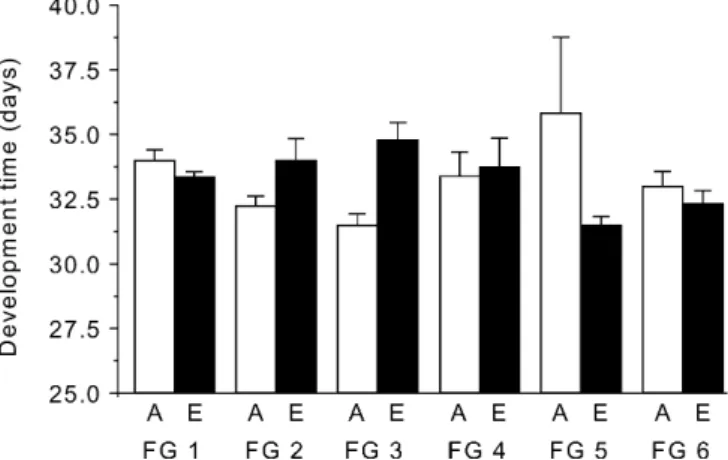
elevated CO2 on development time depended on female
genotype, i.e. some larvae originating from a specific
ambient CO2 and some did not react to CO2 elevation
(Fig. 2). As for larval mass, development time was
affected by fertilisation (Table 3). Larvae feeding on
fertilised L. corniculatus plants developed within 32.4 ±0.3 days, while they took 34.0±0.6 days to fully develop on unfertilised plants.
Discussion
The novelty of the present study is to investigate the interactive effects of maternal butterfly-specific, i.e.
gen-otype-specific, responses to elevated CO2 and P
fertilisa-tion under natural condifertilisa-tions in the field, thus larvae from
a specific mother might react differently to elevated CO2
and/or P fertilisation than other larvae. Many studies have
demonstrated that the effect of elevated CO2on plants can
influence insect herbivores. However, most studies investigating this effect were conducted under controlled conditions in greenhouse or growth-chamber experiments and, so far, genotype-specific responses of an insect herbivore have not been considered.
Although there are some studies investigating the effect
of elevated CO2 on insect herbivores under more natural
conditions (e.g. Bezemer et al. 1998; Jones et al. 1998;
Stiling et al. 2003) there is still a lack of studies which
connect findings from greenhouse studies with findings from experiments conducted under more natural
condi-tions (but see Bezemer et al.1999; Goverde et al.2002b).
The plant-insect system used here had already been investigated in a growth-chamber and a greenhouse
experiment (Goverde et al. 1999; Bazin et al. 2002). In
these studies elevated CO2 conditions caused L.
cornicu-latus to increase its biomass, to accumulate starch and C-based allelochemical and to reduce N-C-based allelochem-icals. However, the N concentration did not change. Larvae of the butterfly P. icarus feeding on plants grown
under elevated CO2 conditions showed higher rates of
consumption, conversion efficiency and consequently accelerated growth.
In the present study, an increase in atmospheric CO2
affected L. corniculatus plant growth and foliar chemistry.
L. corniculatus plants grown under elevated CO2
condi-tions showed a decrease in N concentration. A lower N
concentration under elevated CO2 conditions has been
found in many plants (Cotrufo et al. 1998), but was not
expected in the present study due to earlier findings from a
greenhouse experiment (Goverde et al. 1999). The
difference might be an effect of soil type. In the greenhouse study a nutrient-rich soil (compost) was used while in the present study plants were grown in their original soil in a nutrient-poor calcareous grassland. Results, thus, confirm that the choice of soil type and/or the environmental conditions of the experiments with
elevated CO2 can affect the outcome. It is, therefore,
difficult to extrapolate results gained from greenhouse
experiments to natural conditions (see also Körner2000).
The surplus C in the elevated CO2 treatment was mainly
stored as sugar and not as starch as predicted. However, since sugar and starch are both easily digested carbohy-drates for insect herbivores, the surplus of carbohycarbohy-drates
might positively affect insect growth (Chapman 1998).
Finally, the predicted increase in C-based allelochemicals
under elevated CO2 conditions was only marginally
significant.
Amplification of CO2effects by P fertilisation
N-fixing plants obtain a large amount of their N requirement from the atmosphere and, therefore, N-fixing plants might rather be P-limited than N-limited and interactive responses of P availability and elevated
atmo-spheric CO2are likely (Stöcklin et al.1998; Stöcklin and
Körner 1999). The predicted interactive effect of P
fertilisation and CO2 enrichment on the growth of L.
corniculatus was significant for root dry mass and some marginal effects (for details see Results). As suggested by
Stöcklin and Körner (1999), nutrient availability has an
Fig. 1 Mass of Polyommatus icarus larvae after feeding for 12 days on Lotus corniculatus plants exposed to ambient (A) and elevated (E) CO2conditions, without or with P fertilisation. Means +SEM, n =48
Fig. 2 Development time from third larval instar to adult eclosion of P. icarus under ambient (open bars) and elevated (black bars) CO2conditions. Means+SEM for the six different female genotypes (FG) are presented, n =8 in each case. For other abbreviations, see Fig. 1
over-riding effect on CO2 responsiveness, and
species-specific responses in biomass to elevated CO2 and
fertilisation will affect community structure and biodiver-sity by suppressing the less responsive species. Thus, N-fixing plants may play a very important role in a future
CO2-enriched environment (Cotrufo et al.1998).
Further-more, as predicted in our second hypothesis, the growth of L. corniculatus plants was enhanced by P fertilisation. Fertilised plants had more shoots, leaves and a higher dry mass. Also, most other plant characteristics were increased
(Table2). Probably a combination of all these changes did
affect insect growth positively. P. icarus larvae feeding on fertilised plants had higher weights and developed faster. However, the difference in larval weight disappeared in the adult stage, indicating compensatory feeding (Bezemer
and Jones 1998).
The effect of herbivory on L. corniculatus
The feeding of P. icarus larvae on L. corniculatus plants had several, probably connected effects. Plants with herbivore damage had less leaves but their dry mass was the same. This indicates compensatory growth after herbivory which has already been found in this plant
species (Bazin et al. 2002). Since young or fresh leaves
have higher protein concentrations (e.g. Gleadow and
Woodrow 2000; Alonso and Herrera 2002; Riipi et al.
2002), compensatory growth might also explain the higher
N concentration in L. corniculatus leaves with herbivore damage. The lower starch concentration in L. corniculatus plants with herbivore damage indicates the preference for digestible C by P. icarus larvae. Herbivores feeding on N-fixing legumes might rather be limited by the accessibility of digestible carbohydrates than by protein (Goverde et al.
1999), and plants with higher starch concentrations are
more digestible for herbivores (Slansky and Rodriguez
1987; Lincoln et al.1993). Finally, the marginal increase
in condensed tannin concentrations in L. corniculatus plants with herbivore damage may indicate a potential of
the plant to show an induced response (Schoonhoven et al.
1998).
Effects on insect performance
Especially the higher C/N ratio of plants grown under
elevated CO2 conditions reduces the tissue quality for
herbivorous insects. This reduction in food-plant quality is likely to reduce herbivore fitness (Bezemer and Jones
1998; Stacey and Fellowes2002). We predicted a positive
effect of elevated CO2on insect performance, since such
an effect had been found in greenhouse studies for the
same insect-plant system (Goverde et al.1999; Bazin et al.
2002). However, the present study does not support this
prediction. Elevated CO2had no effect on pupal and adult
mass, but a marginally negative effect on larval mass after
12 days—which, however, disappears when using larval
mass at the beginning as a covariate. These results differ clearly from previous ones from a growth-chamber study where mass gain of P. icarus larvae was increased under
elevated CO2 conditions (Goverde et al. 1999). As
mentioned above, the choice of a low-fertility soil and the environmental conditions did affect the outcome of the experiment.
Larval genotype matters
In the present study we found insect genotype-specific
responses to elevated CO2and to P fertilisation. The effect
of elevated CO2 on the development time of P. icarus
depended on the origin of the larvae. Larvae of two mothers prolonged their development time while larvae of three mothers did not react, and the larvae from one mother even accelerated their development time under
elevated CO2conditions. A similar effect was found in the
growth chamber and greenhouse study for the same
plant-insect system (Goverde et al. 1999; Bazin et al. 2002).
CO2 concentration can thus be considered as a potential
Table 3 ANOVA for larval, pupal and adult fresh mass and development time of Polyommatus icarus reared on Lotus corniculatus plants grown under ambient or elevated CO2conditions with or without P fertilisation
Source of variation Larval mass after 12 days Pupal fresh mass Adult fresh mass Development time
df MS F P df MS F P df MS F P df MS F P CO2 1 3,270.1 4.55 0.056 1 190.7 2.33 0.155 1 25.5 1.65 0.225 1 3.7 1.31 0.277 Female genotype (FG) 5 70.5 0.10 0.990 5 847.6 10.36 <0.001 5 192.0 12.42 <0.001 5 2.6 0.91 0.507 CO2×FG 5 1,099.8 1.53 0.258 5 43.1 0.53 0.752 5 32.7 2.12 0.139 5 16.2 5.71 0.008 Covariate sex (S) 1 8,794.2 12.25 0.005 1 517.3 6.32 0.029 1 62.3 4.03 0.070 1 20.7 7.32 0.020 Plot (P) 11 718.1 2.34 0.035 11 81.8 1.52 0.176 11 15.5 0.91 0.546 11 2.8 0.39 0.950 Fertilisation (F) 1 7,028.0 22.88 <0.001 1 207.3 3.84 0.059 1 21.2 1.24 0.274 1 50.6 7.02 0.013 CO2×F 1 391.2 1.27 0.269 1 32.8 0.61 0.441 1 53.6 3.14 0.086 1 0.5 0.07 0.792 FG×F 5 792.6 2.58 0.049 5 372.2 6.90 <0.001 5 69.2 4.05 0.006 5 10.8 1.49 0.220 CO2×FG×F 5 291.4 0.95 0.466 5 205.3 3.80 0.008 5 51.8 3.03 0.024 5 8.6 1.20 0.333 S 1 1,278.1 4.16 0.051 1 442.0 8.19 0.007 1 1.9 0.11 0.738 1 0.8 0.11 0.738 Error (residual) 27 307.2 1.11 31 54.0 31 17.1 31 7.2
selective factor for some genotypes of this butterfly species if rapid development is advantageous, i.e. a change in selective pressure might affect the genetic diversity of single species. Thus, we find not only species-specific but
also genotype-specific responses to elevated CO2in insect
herbivores (Bezemer and Jones1998). In addition, larvae
from a specific mother reacted more strongly to P fertilisation-induced changes in larval food quality than other larvae (significant interaction between P fertilisation and female genotype). As in the response of development
time to elevated CO2 this finding suggests genetic
variation in insect life history traits in response to P
fertilisation. Finally, the effect of elevated CO2 on pupal
and adult mass depended not only on the origin of larvae but also on P fertilisation (three-way interaction). A further
three-way interaction among CO2 enrichment, insect
genotype and plant genotype does appear for several insect life history traits of P. icarus feeding on different L.
corniculatus genotypes under ambient and elevated CO2
(Goverde et al. 1999). These results show the complexity
of ecological systems and the challenge to investigate real
effects of the ongoing increase in atmospheric CO2 on
plant-insect dynamics.
Conclusion
In conclusion, we showed that CO2enrichment in SACC
chambers affected the growth and chemical composition of L. corniculatus plants. These changes in food-plant quality partially affected the development of the butterfly
P. icarus. Remarkably, the interactive effect of CO2
enrichment and origin of larvae showed that there is genetic variability in the insect population leading them to react differently to changes in the quality of larval
food-plants caused by increased atmospheric CO2 conditions
and P fertilisation. Thus, the effect of environmental changes on insect-plant interactions can depend on genotype-specific responses in both plants and insects. So far, genotype-specific responses in insect-plant inter-actions have been poorly investigated. However, both are of high relevance for evolutionary processes, i.e. a change in selective pressure will affect the genetic composition within populations of a species and hence the genetic diversity of single species. Our study suggests that rising
levels of CO2 might be such a selective factor, affecting
both plant and herbivore populations and their interaction. Therefore, genotype-specific responses must be
consid-ered because this will affect the outcome of elevated CO2
for plant-herbivore interactions.
Acknowledgements We are especially grateful to Kathrin Schweizer, Daniel Bretscher, Monika Wohlfender, Olivier Bignu-colo, Susanna Pelaez-Riedl for technical support, to Bernhard Schmid and Christian Körner for providing us with the facility in Nenzlingen. This research was supported by grants from the Swiss Priority Program Environment of the Swiss National Science Foundation to A. Erhardt (no. 5001–044622/1) and to C. Körner (no. 5001–035214).
References
Alonso C, Herrera CM (2002) Seasonal variation in leaf characteristics and food selection by larval noctuids on an evergreen Mediterranean shrub. Acta Oecol 21:257–265 Ayres MP (1993) Plant defense, herbivory, and climate change. In:
Kareiva PM, Kingsolver JG, Huey RB (eds) Biotic interactions and global change. Sinauer, Mass., pp 75–94
Bazin A, Goverde M, Erhardt A, Shykoff JA (2002) Influence of atmospheric CO2 enrichment on induced defence and growth compensation after herbivore damage in Lotus corniculatus. Ecol Entomol 27:271–278
Bezemer TM, Jones TH (1998) Plant-insect herbivore interactions in elevated atmospheric CO2: quantitative analyses and guild effects. Oikos 82:212–222
Bezemer TM, Jones TH, Knight KJ (1998) Long-term effects of elevated CO2 and temperature on populations of the peach potato aphid Myzus persicae and its parasitoid Aphidius matricariae. Oecologia 116:128–135
Bezemer TM, Knight KJ, Newington JE, Jones TH (1999) How general are aphid responses to elevated atmospheric CO2? Ann Entomol Soc Am 92:724–730
Chapman RF (1998) The insects. Structure and function. Cambridge University Press, Cambridge
Conroy JP, Milham PJ, Barlow WR (1992) Effect of nitrogen and phosphor availability on the growth response of Eucalyptus grandis to high CO2. Plant Cell Environ 15:843–847 Cotrufo MF, Ineson P, Scott A (1998) Elevated CO2 reduces the
nitrogen concentration of plant tissues. Global Change Biol 4:43–54
Coviella CE, Trumble JT (1999) Effects of elevated atmospheric carbon dioxide on insect-plant interactions. Conserv Biol 13:700–712
Entry JA, Runion GB, Prior SA, Mitchell RJ, Rogers HH (1998) Influence of CO2enrichment and nitrogen fertilization on tissue chemistry and carbon allocation in longleaf pine seedlings. Plant Soil 200:3–11
Fajer ED, Bowers MD, Bazzaz FA (1989) The effects of enriched carbon dioxide atmospheres on plant-insect herbivore interac-tions. Science 243:1198–1200
Gleadow RM, Woodrow IE (2000) Temporal and spatial variation in cyanogenic glycosides in Eucalyptus cladocalyx. Tree Physiol 20:591–598
Goverde M, Erhardt A (2003) Effects of elevated CO2 on development and larval food-plant preference in Coenonympha pamphilus (Satyridae). Global Change Biol 9:74–83
Goverde M, Bazin A, Shykoff JA, Erhardt A (1999) Influence of leaf chemistry of Lotus corniculatus (Fabaceae) on larval development of Polyommatus icarus (Lepidoptera, Lycaeni-dae): effects of elevated CO2and plant genotype. Funct Ecol 13:801–810
Goverde M, Arnone JA, Erhardt A (2002a) Species-specific reactions to elevated CO2 and nutrient availability in four grass species. Basic Appl Ecol 3:221–227
Goverde M, Erhardt A, Niklaus PA (2002b) In situ development of a satyrid butterfly on calcareous grassland exposed to elevated carbon dioxide. Ecology 83:1399–1411
Hättenschwiler S, Schafellner C (1999) Opposing effects of elevated CO2and N deposition on Lymantria monacha larvae feeding on spruce trees. Oecologia 118:210–217
Jones TH, Thompson LJ, Lawton JH, Bezemer TM, Bargett RD, Blackburn TM, Bruce KD, Cannon PF, Hall GS, Hartley SE, Howson G, Jones CG, Kampichler C, Kandeler E, Ritchie DA (1998) Impacts of rising atmospheric carbon dioxide on model terrestrial ecosystems. Science 280:441–443
Kerslake JE, Woodin SJ, Hartley SE (1998) Effects of carbon dioxide and nitrogen enrichment on a plant-insect interaction: the quality of Calluna vulgaris as a host for Operophtera brumata. New Phytol 140:43–53
Kinney KK, Lindroth RL, Jung SM, Nordheim EV (1997) Effects of CO2and NO3-availability on deciduous trees: phytochemistry and insect performance. Ecology 78:215–230
Körner C (1995) Biodiversity and CO2: global change is under way. Gaia 4:234–243
Körner C (2000) Biosphere responses to CO2-enrichment. Ecol Appl 10:1590–1619
Körner C, Miglietta F (1994) Long-term effects of naturally elevated CO2 on mediterranean grassland and forest trees. Oecologia 99:343–351
Lambert JL, Ramasamy J, Paukstelis JV (1975) Stable reagents for the colorimetric determination of cyanide by the modified Konig reactions. Anal Chem 47:916–918
Leadley PW, Stöcklin J (1996) Effects of elevated CO2on model calcareous grasslands: community, species, and genotype level responses. Global Change Biol 2:389–397
Leadley PW, Niklaus P, Stocker R, Körner C (1997) Screen-aided CO2 control (SACC): a middle ground between FACE and open-top chambers. Acta Oecol 18:207–219
Leadley PW, Niklaus PA, Stocker R, Körner C (1999) A field study of the effects of elevated CO2on plant biomass and community structure in a calcareous grassland. Oecologia 118:39–49 Lincoln DE, Fajer ED, Johnson HJ (1993) Plant-insect herbivore
interactions in elevated CO2 environments. Trends Ecol Evol 8:64–68
Lindroth RL, Roth S, Nordheim EV (2001) Genotypic variation in response of quaking aspen (Populus tremuloides) to atmo-spheric CO2enrichment. Oecologia 126:371–379
Mansfield JL, Curtis PS, Zak DR, Pregitzer KS (1999) Genotypic variation for condensed tannin production in trembling aspen (Populus tremuloides, Salicaceae) under elevated CO2 and in high- and low-fertility soil. Am J Bot 86:1154–1159
Mevi-Schütz J, Goverde M, Erhardt A (2003) Effects of fertilisation and elevated CO2on larval food and butterfly nectar amino acid preference in Coenonympha pamphilus. 54:36–43
Payne RW (1993) Genstat 5, Release 3. Reference Manual. Clarendon Press, Oxford
Peters RH (1993) A critique for ecology. Cambridge University Press, Cambridge
Porter LJ, Hrstich LN, Chan BG (1986) The conversion of procyanidins and prodelphinidins to cyanidin and delphinidin. Phytochemistry 25:223–230
Price ML, Butler LG (1977) Rapid visual estimations and spectro-photometric determination of tannin content of sorghum grain. J Agric Food Chem 25:1269–1273
Riipi M, Ossipov V, Lempa K, Haukioja E, Koricheva J, Ossipova S, Pihlaja K (2002) Seasonal changes in birch leaf chemistry: are there trade-offs between leaf growth and accumulation of phenolics? Oecologia 130:380–390
Roumet C, Laurent G, Roy J (1999) Leaf structure and chemical composition as affected by elevated CO2: genotypic responses of two perennial grasses. New Phytol 143:73–81
Schläpfer M, Zoller H, Körner C (1998) Influences of mowing and grazing on plant species composition in calcareous grassland. Bot Helv 108:57–67
Schoonhoven LM, Jermy T, van Loon JJH (1998) Insect-plant biology. Chapman & Hall, London
Slansky F Jr, Rodriguez JG (1987) Nutritional ecology of insects, mites, spiders, and related invertebrates. Wiley, New York Stacey DA, Fellowes DE (2002) Influence of elevated CO2 on
interspecific interactions at higher trophic levels. Global Change Biol 8:668–678
Stiling P, Moon DC, Hunter MD, Colson J, Rossi AM, Hymus GJ, Drake BG (2003) Elevated CO2lowers relative and absolute herbivore density across all species of a scrub-oak forest. Oecologia 134:82–87
Stöcklin J, Körner C (1999) Interactive effects of elevated CO2, P availability and legume presence on calcareous grassland: results of a glasshouse experiment. Funct Ecol 13:200–209 Stöcklin J, Schweizer K, Körner C (1998) Effects of elevated CO2
and phosphorus addition on productivity and community composition of intact monoliths from calcareous grassland. Oecologia 116:50–56
Watanabe FS, Olsen SR (1965) Test of an ascorbic acid method for determing phosphorus water and NAH-CO3extracts from soil. Soil Sci Soc Am Proc 29:677–678
Watt AD, Whittaker JB, Docherty M, Brooks G, Lindsay E, Salt DT (1995) The impact of elevated atmospheric CO2 on insect herbivores. In: Harrington R, Stork NE (eds) Insects in a changing environment. Academic Press, London, pp 197–217 Williams RS, Thomas RB, Strain BR, Lincoln DE (1997) Effects of
elevated CO2, soil nutrient levels, and foliage age on the performance of two generations of Neodiprion lecontei (Hy-menoptera: Diprionidae) feeding on loblolly pine. Environ Entomol 26:1312–1322
Wong SC (1990) Elevated atmospheric partial pressure of CO2and plant growth. II. Non-structural carbohydrate content in cotton plants and its effect on growth parameters. Photosynth Res 23:171–180