O R I G I N A L A R T I C L E
Martina Hug Æ Martin To¨nz Æ Georges Kaiser
Parental stress in paediatric day-case surgery
Accepted: 11 November 2004 / Published online: 5 January 2005 Ó Springer-Verlag 2005
Abstract Day-case surgery involves a considerable amount of stress not only for the children who undergo surgery but also for their parents. In a prospective sur-vey analysis performed in 1995/1996, we identified the following main factors influencing the amount of stress experienced by parents: feelings of insufficient prepara-tion and problems with postoperative pain at home. As a consequence, measures were taken regarding infor-mation and pain management, including the creation of an interactive CD-ROM. We then analysed the conse-quences of our interventions regarding parental stress. In this study we collected the data of all patients who underwent day-case surgery during two additional 13-month periods in 1997/1998 and 1999/2000. The meth-ods of data collection remained unchanged for all three periods and included a questionnaire for the parents. In total, 1,490 questionnaires were analysed. Comparing the three time periods, parents’ feelings of being well-informed improved significantly (91% vs. 98% vs. 97%, P<0.0001). However, the percentage of those experi-encing moderate to severe stress did not change sub-stantially (16% vs. 9% vs. 19%, not significant). Analgaesics were given more frequently over the years in a general as well as a prophylactic manner (20% vs. 35% vs. 43%, P<0.0001). Nevertheless, problems with pain control at home remained unchanged (33% vs. 23% vs. 29%, not significant). Despite considerable efforts to improve information, parental stress did not sig-nificantly decrease. It cannot be assessed yet whether wrong information was given or whether a certain
degree of stress cannot be prevented. There is some evidence that improvements in coping with pain-related problems might be a promising next step.
Keywords Day surgery Æ Parental stress Æ Child
Introduction
Paediatric surgery done in the outpatient setting has increased considerably and continues to do so. Day-case surgery offers several well-known advantages over inpatient procedures. Besides the economic benefits [1, 2], others include reduced emotional stress experienced by the child due to the short hospital stay and minimal family disruption [2, 3]. On the other hand, the burden on the parents is obviously increased in that preopera-tive preparation and postoperapreopera-tive treatment become their responsibilities. Because children depend on their parents for support and guidance in dealing with new or stressful situations, parents play a critical role in the setting of day surgery [4,5].
We therefore analysed, as a first step, parental per-ceptions of ambulatory surgery and the factors associ-ated with parental stress and discomfort. The results showed an association of the following factors on parental stress: feelings of insufficient preparation; insecurity in providing nursing care at home; problems at home such as fever, vomiting, sleep disorders, and others; problems with postoperative pain at home; the parents’ being foreign-language speakers; and no previ-ous experience with surgery [6]. Consequently, we deci-ded to concentrate on two topics for improving the situation: information given to the parents and pain management. To provide better information to parents and their children, we created an interactive CD-ROM. For better pain management, we instructed parents about pain medication and its prophylactic administra-tion. The aim of this study was to analyse the impact of these interventions on parental stress.
M. Hug (&)
University Children’s Hospital, 8032 Zurich, Switzerland
E-mail: [email protected] Tel.: +41-1-2667111
Fax: +41-1-2667171
M. Hug Æ M. To¨nz Æ G. Kaiser Department of Paediatric Surgery,
University Children’s Hospital, Bern, Switzerland DOI 10.1007/s00383-004-1333-1
Patients and methods Patients
All patients undergoing elective day-case surgery in our tertiary care centre for paediatric surgery during three selected time periods were enrolled in this prospective study. The first period consisted of 18 months between January 1995 and July 1996, the second consisted of 13 months between November 1997 and December 1998, and the third period was 13 months between November 1999 and December 2000.
Patients were either seen and informed in our out-patient department before their operations or were sent directly for surgery by their family doctors or paedia-tricians. Each patient scheduled for surgery received clear written instructions before admission explaining the standard routine of the day. The children were nursed throughout their stay by the paediatric nursing staff and also by their parents, who remained with their children. Since 1999, all patients have received a booklet together with an interactive CD-ROM with extensive information.
All children were admitted at 7:30 a.m. and were examined by the surgeon and the anaesthesiologist. According to the patient’s age and the planned proce-dures, the operation list was prepared. The children were operated on by a consultant surgeon. While waiting, the children had the opportunity to play in the nearby kin-dergarten. All operations were performed in the morn-ing, and the children were discharged in the afternoon after they had again been seen by the surgeon and the anaesthesiologist. If advisable or desired, they were kept overnight in the hospital. Parents were informed by nursing staff and the surgeon about basic nursing care at home and the postoperative course of recovery. The day after surgery, the families were contacted by the day-care nurse to assess the children’s postoperative status and to offer further assistance if necessary.
Methods
The methods of data collection remained unchanged for all three time periods and have been published in detail [6]. Data were collected from demographic and periop-erative information obtained by the physicians. In addition, a questionnaire was given to all patients’ par-ents prior to discharge, and they were requested to re-turn it within the first postoperative week. Completion and return of the survey was voluntary and thus implied consent to participate in the study. On the day of admission, all parents were asked by the responsible physician, who was seeing the patients for the first time, whether they felt adequately prepared for day surgery. Parents/patients whose mother tongue was not German and were unable to communicate in more or less fluent German were considered as speaking a foreign language.
The questionnaire included structured questions addressing preoperative, perioperative, and discharge preparation; problems with fasting; preoperative waiting time; their feelings in the day surgery environment; the quality of nursing in the clinic; nursing care in the home environment; postoperative problems at home such as fever, vomiting, sleep disorders, eating disorders, and others; pain at home; management of pain at home; and the willingness to do the same procedure again as a day case. For the third period (1999/2000), the questionnaire included questions concerning the CD-ROM. As a ma-jor outcome variable, families were asked to rate on a three-point scale how stressful the day-case surgery experience had been for them: no stress/mild stress, moderate stress, or severe stress. The questionnaire was based on data published by Voepel-Lewis et al. [7].
The interactive CD-ROM was designed for children and parents in order to prepare them for the event of surgery. It was distributed prior to admission to all families with children scheduled for day surgery. The CD gave information about situations and procedures, including problems the children and their families might face before admission, on the day of surgery, and the day after. The combination of an informational bro-chure with the animation on the CD-ROM was partic-ularly designed for children and parents who might have been indifferent to the problems of day surgery and for parents with major language difficulties. The CD-ROM was enclosed in a booklet containing the same infor-mation as on the CD-ROM for those parents unable to play the CD.
Statistics
The data for all three periods were analysed identically, and the results were compared. Values are reported as mean ± standard deviation. For proportions, 95% confidence intervals (CI) are given in parentheses. The measure of association between variables is reported as odds ratio (OR) with 95% CI. For this purpose, the groups reporting moderate and severe stress were col-lapsed to one group. Chi-square analysis and Fisher’s exact test were employed for categorical data. In addi-tion, logistic regressions were performed to test for dif-ferent associations between several variables and the main variable, stress. Differences were considered sig-nificant at a probability level of P<0.05.
Results
Survey
The data for 1,490 paediatric patients who were oper-ated on in an ambulatory setting during three periods of time were analysed and compared. Perioperative and demographic data for all three periods are listed in Table1. The return rate decreased slightly during the
observed period. The percentage of foreign-language-speaking parents remained nearly unchanged, as did the type of performed operations (circumcisions, metal re-moval, hernia/hydrocoele repair, soft tissue excisions, anorectal procedures, cystoscopy, orchidopexy, etc.). There was no significant difference in these data between the three periods.
Information
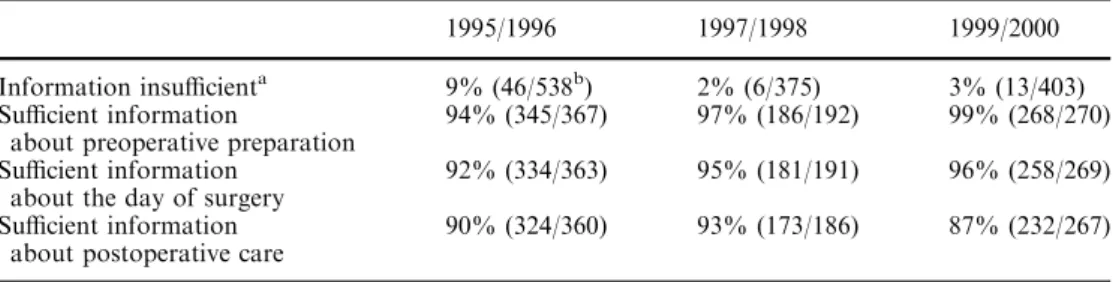
Comparing the results of all three periods, significantly fewer parents in the later time periods felt insufficiently prepared by the day of the surgery. Whereas in 1995/ 1996 9% felt inadequately prepared, only 2% and 3% did in the second and third periods, respectively (P<0.0001). Detailed analysis of the type of insufficient information showed no difference during the three time periods (Table2).
During the first period, parents who were seen at the outpatient clinic felt significantly better prepared on the day of surgery than did parents who were sent by their family doctor or paediatrician (94% vs. 87%, P<0.01). During the subsequent two periods, however, there was no difference (1997/1998: 98% vs. 98% and 1999/2000: 97% vs. 97%).
In the first period, parents speaking a foreign language felt significantly less informed than German-speaking parents did (21% vs. 6%, P<0.0001, OR=0.24, 0.13–0.46). Similar results were found in the third period (56% vs. 23%, P<0.0001, OR=0.24, 0.12– 0.44). During the first period parents who felt in-sufficiently prepared for surgery at the time of admission completed and returned the questionnaire significantly less frequently than the parents who felt prepared (48% vs. 67%, P=0.01, OR=0.30, 0.19–0.47), which was not the case in the subsequent periods (1997/1998: 49% vs. 53% and 1999/2000: 53% vs. 54%).
Insecurity about providing postoperative nursing care at home did not differ significantly over the three periods: 5% (17) of the answering parents during the first period, 2% (four) during the second, and 3% (eight) during the third period felt insecure. The telephone call made by the nurse the day after surgery was considered by 300 (84%) of the parents to be helpful during the first period, by 154 (92%) during the second period, and by 206 (86%) during the third period.
Information and CD-ROM
For the third period, the questionnaire included ques-tions about the CD-ROM.
In 1999/2000 all patients scheduled for surgery re-ceived a CD-ROM prior to admission. Seventy-two percent (111/155) of the answering parents considered the CD to be helpful, while 27% (50/187) were unable to play it. There was no significant association between the CD-ROM and feelings of sufficient preparation (P=0.64).
Pain
Problems dealing with postoperative pain and its man-agement at home were always considered to be of major concern. Pain after discharge was a problem for 30% (110/367) during the first period, 24% (43/183) during the second period, and 29% (75/255) during the third period. Nineteen (5%) of the children had more pain than their parents had expected during the first period, seven (4%) during the second, and 19 (7%) during the third period.
Over the course of time, parents administered anal-gaesics significantly more frequently in a general as well as a prophylactic manner (P<0.0001 and P<0.0001,
Table 1 Perioperative and
demographic data 1995/1996 1997/1998 1999/2000
Patients 568 394 528
Questionnaires returned 368 (65%) 194 (49%) 277 (53%)
Male patients 378 (67%) 288 (73%) 370 (71%)
Age 6.3±4.3 years 6.8±4.4 years 6.8±4.7 years
Preoperative waiting time 1.8±1.1 h 1.7±1.0 h 2.0±1.2 h Postoperative complications 50 (9%) 48 (13%) 51 (11%)
Overnight stay 17 (3%) 2 (0.5%) 3 (0.6%)
Foreign-language-speaking parent 97 (17%) 47 (13%) 61 (13%)
Table 2 Assessment of the information given to parents
aP<0.0001
bSecond number indicates the
number of responses to ques-tion
1995/1996 1997/1998 1999/2000 Information insufficienta 9% (46/538b) 2% (6/375) 3% (13/403) Sufficient information
about preoperative preparation
94% (345/367) 97% (186/192) 99% (268/270) Sufficient information
about the day of surgery
92% (334/363) 95% (181/191) 96% (258/269) Sufficient information
about postoperative care
respectively; see Table 3). The proportion of parents who gave their children no analgaesic drug despite the children’s having pain decreased from 16% (12/110) in 1995/1996 to 5% (2/43) in 1997/1998 and 8% (6/75) in 1999/2000 (P<0.0001).
Other postoperative problems at home
The percentage of postoperative problems at home other than pain remained fairly constant during all three time periods: fever (5% vs. 3% vs. 5%), infections (2% vs. 3% vs. 2%), sleep disorders (6% vs. 6% vs. 6%), eating disorders (4% vs. 2% vs. 4%), and vomiting (5% vs. 6% vs. 7%).
Stress
Sixteen percent (59/363) of the respondents in the first period, 9% (18/190) in the second period, and 19% (49/ 264) in the third period experienced moderate to severe stress associated with day surgery.
Factors associated with the amount of parental stress are shown in Table4. The following factors were sig-nificantly associated with stress in more than one period of time: insecurity providing nursing care at home (1995/ 1996 P<0.01; 1999/2000 P<0.043), problems with pain after discharge (1995/1996 P<0.0007; 1999/2000 P<0.014), and the need to administer analgaesics for several days (1997/1998 P<0.018; 1999/2000 P<0.01).
The answer to the question of whether parents would repeat their child’s operation on an ambulatory basis remained constant for all three periods: 98% (355) vs. 98% (188) vs. 99% (263) would agree to enter the day-case unit again.
Analysis of the data of all years
Finally, a logistic regression model was constructed including data for all the years (1995–2000) that referred to the main variable, stress. Differences were worked out by introducing factor variables. In all, considerably more variables turned out to be significant than in the separately analysed time periods. Significant variables for stress were insufficient information (OR 4.34, CI 1.81–10.4), parents’ being foreign-language speakers (OR 2.63, CI 1.27–5.42), feelings of discomfort in the hospital (OR 2.17, CI 1.09–4.34), perception of the hospital atmosphere as unfriendly (OR 2.80, CI 1.15– 6.81), and more pain at home than expected (OR 3.07, CI 1.35–6.97).
In addition, two time-related variables were identified as significant: the duration of the anaesthesia and the postoperative waiting time. The OR was calculated for the difference of 1 h for the duration of anaesthesia. Prolonging anaesthesia by 1 h increased the chance of the parents’ feeling stressed by a factor of 3.82 (CI 1.16– 12.6). Regarding the postoperative waiting time, the OR was calculated for waiting times between 3 and 6 h and more than 6 h. The chance of feeling stressed was 2.19-fold greater if the waiting time was more than 6 h than for a duration of 3–6 h (CI 1.21–3.98).
Discussion
In our previously published study [6], we tried to identify the factors associated with parental stress and discom-fort. In the setting of day surgery, parental stress is a subjective perception of burden, worry, and trouble connected with the event.
On the basis of the data collected and analysed in 1995/1996, we continued with the study over the
Table 3 Administration of analgaesics at home
a
P<0.0001
b
Second number indicates the number of responses to ques-tion
1995/1996 1997/1998 1999/2000 Administration of analgaesicsa 166/369b(45%) 112/193 (58%) 190/264 (72%) Analgaesics given 1 day 124/365 (34%) 78/190 (41%) 132/259 (51%) Analgaesics given more than 1 day 42/350 (12%) 33/194 (17%) 56/255 (22%) Prophylactic administrationa 73/366 (20%) 63/182 (35%) 107/249 (43%)
Table 4 Significant factors associated with the amount of parental stress (analysis of the three time periods)
Factors associated with parental stress 1995/1996 1997/1998 1999/2000 Insufficient information OR=3.34
Insecurity giving nursing care at home OR=3.36 OR=4.62
Problems at home OR=3.15
Problems with pain OR=2.43 OR=2.33
Foreign-language speaker OR=2.28
Duration of anaesthesia P=0.0002
Total time in hospital P=0.0057
Administration of analgaesics for several days OR=3.64 OR=2.55
More pain than expected OR=5.81
Male gender OR=2.58
following years and now present the results of the data including the years of 1997/1998 and 1999/2000.
Lack of information and the consequent feeling of insufficient preparation were identified in 1995/1996 [6, 7] as main factors influencing parental stress . In light of these results, we took measures to improve the infor-mation given to parents, with the aim of reducing their stress. Although the intervention was successful in the sense that more parents felt well informed in the years 1997–2000 compared with 1995/1996, the degree of experienced stress did not change substantially over the course of time. This finding may lead to some questions: Are we conveying the wrong information, or is stress just not preventable?
The goal is to equip the child and his or parents with information they can use to deal with otherwise un-known circumstances [8]. But many different aspects and challenges are included in what seems to be a simple aim. The extent of the information given is considerable. It includes practical information about preparation for the day, the day’s routine, the postoperative care, possible risks and complications, and so on. Because most of the families had never been in this situation before, they were confronted with many eventualities and probabil-ities. Furthermore, it must be remembered that what may be routine to health care providers is often fright-ening for parents [8]. What if detailed informa-tion—including risks, possible complications, and possible difficulties referring to anaesthesia, surgical intervention, and postoperative nursing care—actually enhances parental anxiety and consequently increase stress? Kain et al. [9], in identifying the perioperative anaesthetic information that parents wanted, suggested in their study that providing detailed anaesthetic risk information was not associated with increased parental anxiety. The vast majority of parents wished to have thorough and comprehensive information addressing all possible complications.
Specific methods of preparation have long been demanded [7]. Kain et al. [10] reported on the effec-tiveness of an already experienced method, behavioural preparation programs. They revealed that this inter-vention is best undertaken with knowledge of the child’s age and his or her past medical experiences, thus emphasizing the importance of individually addressing children’s and families’ needs and concerns. This requires recognizing individual demands based on various information such as demographic data and intellectual and psychological aspects of the parents and children. The design of an interactive CD-ROM that presents in a playful way the story of a child undergoing surgery seemed to us a promising tool of modern communication and up-to-date in terms of psychological preparation. Although a majority of the answering parents considered it helpful, a great num-ber were not able to use it; 27% were unable to play it. If the use of computers increases, the benefits of the CD-ROM will have to be analysed in the future. Furthermore, it must be considered whether our
interactive CD-ROM’s design concentrated too much on preparing the children rather than on preparing their parents.
Apart from feelings of insufficient preparation, problems with pain at home were significantly associated with parental stress. According to recent studies, the postoperative pain management of children at home remains an issue of interest to many health care pro-viders [4–6, 11–14]. Several studies have demonstrated that postoperative pain management at home is far from being perfect. Parents’ underestimation of their chil-dren’s pain is a known phenomenon, with the conse-quence of inadequate delivery of analgaesia [11]. The importance of adequate treatment of postoperative pain lies not only in preventing parental stress but also in preventing the child’s stress. Our pre-intervention study also showed that only 45% of the children received analgaesics at home (16% of the children received no painkillers even though they expressed pain) and that prophylactic administration was given to only 20% of the patients. After our interventions, the situation im-proved significantly, with a total of 72% of patients receiving analgaesic drugs and 43% of children receiving prophylaxis. But again, even though the situation with regard to pain medication improved considerably, the percentage of parents expressing problems with pain at home remained stable over the three time periods, and pain problems continued to be a significant stress factor for parents. It might well be that the child profited from the more extensive administration of analgaesics, but our questionnaire did not include questions to the chil-dren, and therefore we do not have the corresponding data. The reason for failing to prevent stress related to postoperative pain might be twofold. First, parents still may not receive enough information. Second, as parents’ knowledge improved considerably over the years with regard to preparing for surgery and for the day itself, the situation did not change concerning the information about postoperative care; 13% of parents still felt insufficiently prepared for postoperative problems.
Our study reflects that families in general are very satisfied with day-case surgery and that a vast majority would undergo the same procedure again. But despite considerable efforts, the amount of parental stress did not significantly decrease. Families’ perception of day surgery must be the subject of further studies in order to improve health quality.
References
1. Glen PM, El-Shafie M, Klippel C (1980) Outpatient paediatric surgery: the consumer’s view. Ohio State Med J 76:731–733 2. Sadler GP, Watkins G, Richards H, Foster ME (1992)
Day-case paediatric surgery: the only choice. Ann R Coll Surg Engl 74:130–133
3. Vernon DTA, Thompson RH (1993) Research of the effect of experimental interventions on children’s behaviour after hospitalisation: a review and synthesis. J Dev Behav Pediatr 14:36–44
4. Kart T, Van der Laan K, Crombach J (1996) Postoperative pain management in children has been improved, but can be further optimized. Eur J Paediatr Surg 6:259–264
5. Reid GJ, Hebb JPO, McGrath PJ, Finley GA, Forward SP (1995) Cues parents use to assess postoperative pain in their children. Clin J Pain 11:229–235
6. To¨nz M, Herzig G, Kaiser G (1999) Quality assurance in day surgery: do we do enough for the parents to prevent stress? Eur J Paediatr 158:984–988
7. Voepel-Lewis T, Andrea CM, Magee SS (1992) Parent per-ceptions of paediatric ambulatory surgery: using family feed-back for program evaluation. J Post Anesth Nur 7:106–114 8. Zuckerberg AL (1994) Perioperative approach to children.
Pediatr Clin North Am 41:15–29
9. Kain ZN, Mayes CM, Caramico LA (1996) Preoperative preparation in children: a cross-sectional study. J Clin Anesth 8:508–514
10. Kain ZN, Wang SM, Caramico LA, Hofstadter M, Mayes LC (1997) Parental desire for preoperative information and in-formed consent: a two-phase study. Anesth Analg 84:299–306 11. Wolf AR (1999) Tears at bedtime: a pitfall of extending pae-diatric day-case surgery without extending analgesia. Br J Anaesth 82:319–320
12. Moore EW, Pollard BJ, Elliott RE (2002) Anaesthetic agents in paediatric day case surgery: do they affect outcome? Eur J Anaesth 19:9–17
13. Sepponen K, Kokki H, Ahonen R (1999) Training of medical staff positively influences postoperative pain management at home in children. Pharm World Sci 21:168–172
14. Sepponen K, Ahonen R, Kokki H (1998) The effects of a hospital training program on the treatment practices of post-operative pain in children under 8 years. Pharm World Sci 20:66–72