Bacterial flagella explore microscale
hummocks and hollows to increase adhesion
The MIT Faculty has made this article openly available.
Please share
how this access benefits you. Your story matters.
Citation
Friedlander, R. S., H. Vlamakis, P. Kim, M. Khan, R. Kolter, and
J. Aizenberg. “Bacterial flagella explore microscale hummocks
and hollows to increase adhesion.” Proceedings of the National
Academy of Sciences 110, no. 14 (April 2, 2013): 5624-5629.
As Published
http://dx.doi.org/10.1073/pnas.1219662110
Publisher
National Academy of Sciences (U.S.)
Version
Final published version
Citable link
http://hdl.handle.net/1721.1/83364
Terms of Use
Article is made available in accordance with the publisher's
policy and may be subject to US copyright law. Please refer to the
publisher's site for terms of use.
Bacterial
flagella explore microscale hummocks
and hollows to increase adhesion
Ronn S. Friedlandera,b, Hera Vlamakisc, Philseok Kimb,d, Mughees Khanb, Roberto Kolterc, and Joanna Aizenbergb,d,e,1
aHarvard–Massachusetts Institute of Technology Division of Health Sciences and Technology, Cambridge, MA 02139;cDepartment of Microbiology
and Immunobiology, Harvard Medical School, Boston, MA 02115; anddSchool of Engineering and Applied Sciences,bWyss Institute for Biologically
Inspired Engineering, andeKavli Institute for Bionano Science and Technology, Harvard University, Cambridge, MA 02138
Edited by Pablo Gaston Debenedetti, Princeton University, Princeton, NJ, and approved February 23, 2013 (received for review November 14, 2012)
Biofilms, surface-bound communities of microbes, are
economi-cally and medieconomi-cally important due to their pathogenic and ob-structive properties. Among the numerous strategies to prevent bacterial adhesion and subsequent biofilm formation, surface topography was recently proposed as a highly nonspecific method that does not rely on small-molecule antibacterial compounds, which promote resistance. Here, we provide a detailed investiga-tion of how the introducinvestiga-tion of submicrometer crevices to a surface
affects attachment ofEscherichia coli. These crevices reduce
sub-strate surface area available to the cell body but increase overall
surface area. We have found that, during thefirst 2 h, adhesion to
topographic surfaces is significantly reduced compared with flat
controls, but this behavior abruptly reverses to significantly
in-creased adhesion at longer exposures. We show that this reversal coincides with bacterially induced wetting transitions and that flagellar filaments aid in adhesion to these wetted topographic
surfaces. We demonstrate thatflagella are able to reach into
crevi-ces, access additional surface area, and produce a dense,fibrous
network. Mutants lackingflagella show comparatively reduced
adhesion. By varying substrate crevice sizes, we determine the
conditions under which having flagella is most advantageous
for adhesion. Thesefindings strongly indicate that, in addition
to their role in swimming motility,flagella are involved in
attach-ment and can furthermore act as structural eleattach-ments, enabling bacteria to overcome unfavorable surface topographies. This work contributes insights for the future design of antifouling surfaces and for improved understanding of bacterial behavior in native, structured environments.
microbial adhesion
|
structured surfaces|
bacterial appendages|
surface texture|
surface wettingT
he attachment of bacteria to solid surfaces is thefirst step in the formation of biofilms—communities of sessile microbes surrounded by a polymeric matrix (1, 2). A growing appreciation of the ubiquity and importance of biofilms in medicine and in-dustry has led to a proliferation of antiadhesion strategies that include chemical, biological, and physical approaches (3–12). Attempts to block biofilm formation must also take into account the rapid evolution of bacteria and their ability to resist many chemical assaults (13–17). By preventing adhesion in a manner that is nontoxic for the bacteria as well as for the application (e.g., medical implants), there is hope that we may reduce the costs associated with biofilm formation without imposing selec-tive pressures for the development of antibiotic resistance. Phys-ical strategies, particularly the use of rationally designed surface topographies, have gained attention recently as highly nonspecific methods for prevention of attachment without the use of anti-microbials (6, 8, 11, 18–20).Understanding how bacteria interact with surfaces that have roughness on the micrometer and submicrometer length scales (i.e., comparable with the length scale of the bacteria themselves) is critical to the development of antiadhesive topographies. Such surfaces are also relevant for a deeper understanding of the native bacterial lifestyle, because most surfaces in nature are not atomi-cally smooth. Indeed, the microvilli of the intestines are between 80 and 150 nm in diameter (21), creating considerable topographic
constraints for enteric pathogens that might attempt to colonize the epithelium. Geometric considerations suggest that surfaces with roughness on the bacterial length scale provide less available sur-face area and fewer attachment points for rigid bacterial bodies than smooth surfaces (Fig. 1A). However, the simplistic view of bacteria as rigid rods or spheres ignores the presence of bacterial appendages, such as pili andflagella (Fig. 1A, Right).
Previous work has demonstrated that type I pili andflagella are required for biofilm formation by Escherichia coli (22). Flagella have been suggested to aid in overcoming surface repulsive forces and, possibly, to aid in spreading of cells along a surface. Addi-tionally, exopolysaccharides and surface antigens help to develop biofilm morphology (23, 24). It is possible that such extracellular features also play important roles in allowing bacteria to adapt and adhere to bumpy surfaces. Using wild-type cells and deletions of several biofilm-associated genes, we herein examine the role of surface appendages on adhesion to patterned substrates and show that flagella in particular appear to aid in attachment to surfaces inaccessible to the cell body, by reaching into crevices and masking surface topography. By measuring adhesion to var-ious surface patterns, we are able to better separate the adhesive role offlagella from their role in improving surface access via swimming motility and to suggest that flagella may provide an additional, structural function in biofilm formation.
Results
E. coli cells form biofilms on surfaces submerged in liquid (25). A relevant clinical example of this is catheter-associated urinary tract infections by uropathogenic E. coli. We asked whether micrometer-scale surface topography could reduce bacterial adhesion to submerged substrates. By introducing bumps sepa-rated by valleys smaller than a cell diameter, we hypothesized that there would be reduced surface area available to cells, and thus adhesion would be diminished compared with smooth sur-faces (Fig. 1A). To choose an appropriate surface pattern, wefirst required an accurate measurement of cell diameter. Due to the inadequate resolution of light microscopy and the distortion as-sociated with sample preparations for electron microscopy (EM), we chose to use atomic force microscopy (AFM) to measure the diameters of hydrated cells. Exponential phase E. coli (strain ZK2686) cells were probed with an AFM in liquid using contact mode. The measured cell diameters were 0.60± 0.10 μm (n = 48). We designed and manufactured silicon wafers with a honeycomb pattern using photolithography. These wafers acted as molds to generate polydimethylsiloxane (PDMS) surfaces with an array of hexagonal features 2.7μm in height and 3 μm in diameter, sepa-rated by 440-nm trenches (designated as“HEX” patterns; Fig. 1B).
Author contributions: R.S.F., R.K., and J.A. designed research; R.S.F. and H.V. performed research; P.K. and M.K. contributed new reagents/analytic tools; R.S.F., H.V., and J.A. analyzed data; and R.S.F., H.V., R.K., and J.A. wrote the paper.
The authors declare no conflict of interest. This article is a PNAS Direct Submission.
Freely available online through the PNAS open access option.
1To whom correspondence should be addressed. E-mail: [email protected].
This article contains supporting information online atwww.pnas.org/lookup/suppl/doi:10. 1073/pnas.1219662110/-/DCSupplemental.
Notably, the spacing of the trenches was more than 1 SD below the measured mean cell diameter. We grew wild-type bacteria on smooth and HEX-patterned PDMS coupons submerged in M63+ medium. These static cultures were incubated for 24 h at 37 °C and then prepared for scanning electron microscope imaging (Fig. 1 C and D). Surprisingly, our observations indicated that there was more surface coverage by the E. coli cells on HEX than onflat surfaces. Furthermore, we noted the presence of a dense,fibrous network surrounding the surface-bound cells.
Matrix components are salient characteristics of most biofilms; indeed, many bacterial species, including E. coli, have been shown to produce several kinds of polysaccharide, protein, and DNA elements in their biofilm matrices. Because the E. coli cell bodies could not access the entire surface of HEX-patterned substrates, it seemed likely that the observedfibers were helping to augment surface attachment to these topographies. To identify the components of the fibrous material, we constructed and obtained mutants with deletions in known biofilm-associated genes, including the following: wcaF, coding for the polysaccharide colanic acid; bcsA, a cellulose gene;fimA, coding for type I pili; csgA, coding for curlin amyloid fiber subunits; and flhD, the master regulator forflagella synthesis. We grew each of these strains on HEX substrates as described above and imaged with a scanning EM (Fig. 2). All of the mutants resembled the wild type, except forΔflhD, which had a clear lack of associated fibers. FlhD is a transcriptional regulator that controls expression of many genes including, but not limited to, theflagellar apparatus (26). To de-termine whetherflagella or motility specifically were required for better colonization, we constructed deletion mutants forfliC, the flagellin subunit gene, and motB, a motor protein that enables fla-gellar rotation (Fig. 2). TheΔfliC mutant displayed the same phe-notype as seen forΔflhD, indicating that the observed effect was due to the absence offlagella. Furthermore, the ΔmotB motility mutant was able to colonize the surface and it generatedfibers similar to the wild type. Thesefindings are consistent with the fibrous material being predominantly composed offlagellar filaments.
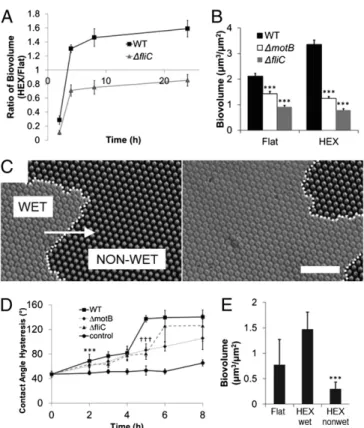
We examined the time course of adhesion for wild type and ΔfliC mutant on HEX-patterned versus flat surfaces to deter-mine whetherflagella play a role in the increased adhesion of the wild type to HEX surfaces observed in Fig. 1 B and C. To analyze this, we plotted the ratio of biomass on HEX/flat surfaces at
different times over a period of 24 h. For both strains, there was a reduction in adhesion to the HEX surface versus theflat sur-face at 2 h, the earliest time analyzed (Fig. 3A). At later time points, however, the wild-type cells accumulated more on the HEX surfaces than on the flat surfaces. In contrast, the ΔfliC strain showed more biomass onflat surfaces than on HEX sur-faces at all time points, although the ratio approached unity toward 24 h. These data suggest that, although adherence of wild-type cells appears to benefit from surface patterning, the cells lackingflagella are unable to exploit the additional surface area provided by the microtopography.
It had previously been shown that mutants lacking flagella (ΔfliC) or unable to rotate flagella (ΔmotB) produce less robust biofilms than wild-type strains on flat surfaces (22). To determine whether this was also the case when cells are grown on patterned surfaces, we compared biofilm production of the wild type to that of theΔmotB and ΔfliC strains at 24 h. These strains were each grown on submergedflat and HEX-patterned PDMS coupons, as above, for 24 h, and adherent cells werefixed and quantified by acquiring confocal z stacks of hydrated cells. Consistent with previous findings (22), the ΔmotB and ΔfliC strains each had significantly less biomass than the wild type regardless of surface topography (Fig. 3B). This indicates that motility, not just the presence of flagella per se, is required for optimal biofilm for-mation. Interestingly, although still more defective than wild type, theΔmotB mutant accumulated more biomass than ΔfliC on both Fig. 1. Bacterial surface adhesion. (A) Schematics of en face (Upper) and
cross-sectional (Lower) views of rod-like bacteria adhering toflat (Left) or patterned (Center) substrates and attachment of bacteria possessing surface appendages to a patterned substrate (Right), when the length scale of sur-face topography is on the order of the bacterial diameter. (B) Scanning EM of a HEX PDMS substrate. (Scale bar, 2μm.) Inset is orthogonal view at lower magnification. (Scale bar: Inset, 5 μm.) (C) Scanning EM of wild-type E. coli grown for 24 h at 37 °C in M63+ on a HEX-patterned PDMS substrate. Inset is higher magnification. (D) E. coli grown on flat PDMS substrate. Inset is higher magnification. (Scale bars: in C and D, 10 μm; Inset in C and D, 2 μm.)
Fig. 2. Phenotypes of biofilm-associated knockouts on patterned PDMS. Wild-type (ZK2686) and mutant derivatives (as labeled) were grown on to-pographically patterned PDMS substrates for 24 or 48 h at 37 °C in M63+. Scanning electron micrographs depict the morphological properties of each strain. (Scale bar, 2μm.)
Friedlander et al. PNAS | April 2, 2013 | vol. 110 | no. 14 | 5625
MICROBIO
LOGY
flat and patterned surfaces, suggesting that the presence of fla-gella, albeit paralyzed ones, may play a role in adhesion (Fig. 3B). Although biofilm formation at 24 h was more robust in the wild type, both the flagella mutant and the wild type showed a dramatic preference for adherence to theflat substrate at the earliest (2 h) time point (Fig. 3A). Why was the patterned sub-strate successful at preventing adhesion at early time points, but not later? To better understand this phenomenon, we examined the substrates microscopically during the adhesion process. We noted that the HEX surface remained nonwetting, harboring trapped air bubbles within the trenches until ∼4 h, when the medium began to displace the entrapped air bubbles (Fig. 3C andMovie S1). This property, where the liquid phase rests atop a composite interface of air and solid, is termed the Cassie– Baxter wetting state, and is characteristic of superhydrophobic microtextured or nanotextured surfaces such as the lotus leaf
(27, 28). We observed that this effect was lost over time in the presence of bacteria, resulting in complete wetting of the sub-strates (termed the Wenzel wetting state).
The difference in wetting properties of sterile medium versus medium with bacteria could be due to a change in surface tension of the medium or due to a change in surface energy of the sub-strate. Using the pendant drop method (29), we measured the surface tension of the M63+ medium to initially be 70.1 ± 0.6 mN/m at 20 °C. After 16 h of conditioning with E. coli, the medium was extracted by centrifugation andfiltration, and its surface tension was measured to be 69.1± 0.5 mN/m at 20 °C. Although mea-surements were not carried out at culture temperatures, the pre-dicted decrease in surface tension by increasing to 37 °C would be unlikely to cause wetting. Furthermore, conditioned medium did not cause wetting of fresh HEX substrates incubated at 37 °C.
To determine whether bacteria produce a substance that functions to precondition the surface and allow for increased wetting, we measured contact angle hysteresis (CAH) of water on dry HEX substrates after they had been placed in the pres-ence of growing E. coli for 0–8 h (Fig. 3D). CAH is the differpres-ence between advancing and receding contact angles, and can be due to changes in surface energy or changes in surface topography. This value changes dramatically during Cassie–Baxter to Wenzel wetting transitions and so serves as a sensitive indicator of wet-ting state (30). All bacteria were removed by sonication before measurements, so as to avoid measuring properties of the bac-teria themselves. CAH was significantly increased (P < 0.001) by 2 h of culture for all strains compared with control and continued to increase over the period measured. The medium-only controls did not wet during this period, resulting in the maintenance of a relatively low CAH. This difference in surface wetting prop-erties indicates that the bacterial modification of the substrate surface energy (rather than modification of the liquid medium) is the dominant contributor to wetting properties. By 5 h, we ob-served a large increase in CAH for the wild type, but this was still significantly higher than CAH of the two mutant strains (P < 0.001). A commensurate increase did not happen until 6 or 8 h in theΔmotB and ΔfliC strains, indicating that the surface wetting brought about by bacteria–surface interactions is aided by the presence of motileflagella. Examining advancing and receding contact angles individually (Fig. S1), we observed that all sam-ples maintained a relatively constant advancing contact angle over time with a slight downward trend, likely due to surface conditioning by bacteria. As the surface transitioned from the Cassie–Baxter to the Wenzel wetting state, there was an increase in drop pinning, which was measured as a decrease in the re-ceding contact angle (30). It is this rere-ceding angle that changed more drastically and differentiated the behavior of the wild type from that of the mutant strains.
Onflat substrates, the lack of microstructure prevents the pos-sibility of a Cassie–Baxter wetting state; thus, the surface is entirely available to the cells from the outset. On the structured surfaces, wetting did not significantly occur until after 2 h. During this initial period, only the structure tips (not the trenches) are available to cells. Only upon wetting does the complete surface become avail-able. We tested this by force-wetting the HEX substrates before inoculation with wild-type cells. At 2 h, we measured adherent biovolume, noting a significant increase in attachment to prewet surfaces compared with the untreated HEX substrates (Fig. 3E).
We reasoned that if the superior attachment by wild-type cells to HEX substrates is due to the access provided by theirflagella, then varying feature size would only affect overall adhesion and biomass insofar as it changes overall surface area. In contrast, the ΔfliC cells would experience a reduction in attachment whenever portions of the substrate remained inaccessible to the cell body. We compared attachment of wild-type cells andΔfliC mutants to substrates as we varied the feature diameters and spacings, maintaining a constant pitch (Fig. 4A). Indeed, the ΔfliC cells increased attachment as the feature spacing became larger, eventually surpassing their adhesion toflat substrates. For wild-type cells, the increased spacing had the opposite effect. Fig. 3. Colonization of patterned substrates by wild-type and nonmotile
bacteria and its relationship to surface wetting. (A) Biovolume on patterned (HEX) relative toflat substrates for wild-type and ΔfliC cells at various times. (B) Biovolume of cells adherent to submergedflat or HEX-patterned PDMS coupons after 24 h. Error bars indicate standard error of the mean of at least five independent experiments (five z stacks per experiment). ***P < 0.001 by Student’s two-tailed t test, compared with WT. (C) Phase-contrast images of the advancement of the wetting front during culture, at 4 h. The meniscus (dotted line) advances through the patterned substrate, exposing channels between surface features, thus increasing available surface area for bacterial attachment. The area to the Left of the dotted line is fully wetted, whereas the area to the Right of the line contains air pockets. The white arrow indicates the direction of the wetting front progression. Thirty minutes have elapsed between the images on the Left and Right. (Scale bar, 20μm.) For full movie, seeMovie S1. (D) Contact angle hysteresis measurements of substrates that have been exposed to growing E. coli cells for increasing incubation periods or M63+ medium only, followed by sonication. Error bars represent SD. ***P< 0.001 by Student’s two-tailed t test, comparing WT to control at 2 h.†††P< 0.001 by Student’s two-tailed t test, comparing WT to ΔfliC or ΔmotB. See alsoFig. S1. (E) Biovolume of cells adherent to sub-merged substrates after 2 h of culture. HEX substrates were either force-wet using ethanol followed by rinsing (HEX-wet), or left in their nonwetting state (HEX-nonwet). Error bars represent SD. ***P< 0.001 by Student’s two-tailed t test, comparing HEX-wet to HEX-nonwet.
Whereas the wild-type cells had over four times the biomass of ΔfliC cells on HEX-patterned substrates (0.44-μm spacing), this difference was less than twofold on substrates with 1.70-μm spacing (Fig. 4B).
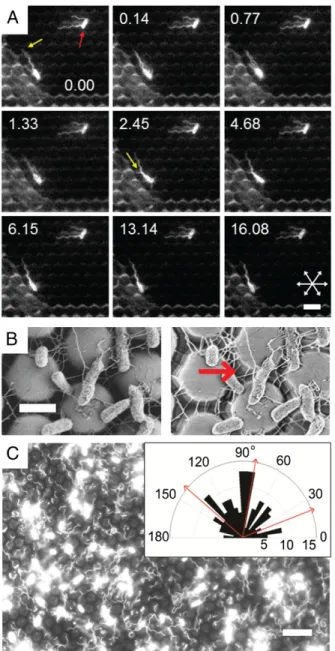
It appears that the benefit of having flagella is greater during adhesion to substrates with trenches smaller than the cell body than during adhesion toflat substrates or substrates with larger feature spacings. This phenomenon is unlikely to be due solely to the motility provided byflagella, because surface access should have been similar for all substrates tested. To further investigate the role offlagella in adhesion of wild-type cells to topographical substrates, we examined their dynamics in live cells during the adhesion process by fluorescently staining their flagellar fila-ments (31). Wild-type E. coli cells were placed in contact with HEX substrates and allowed to adhere. During the adhesion process, we observed attachment behavior. We noted that some cells were adhered by their flagella and exhibited tethering be-havior (Fig. 5A and Movie S2). Additionally, some flagella inserted between surface features and attached within the sub-micron trenches, which was consistent with scanning EM find-ings, where flagella were observed to adhere between features (Fig. 5 A and B, andMovies S2andS3). After 4 h of incubation, we observed alignment of some flagella with the underlying substrate. There was a tendency of flagella to orient along the planes of symmetry of the substrate (Fig. 5C), which implies that the filaments were interacting with the PDMS surface and responding to its topography.
Discussion
We herein set out to characterize the bacterial adhesive response to substrates with regular surface topography. Specifically, we were interested in the role of surface appendages in this response. We tested the hypothesis that surface feature length scale could, on its own, reduce bacterial attachment by reducing available surface area. Indeed, we observed that submicrometer trenches between features were able to reduce attachment of mutants withoutflagella. However, the geometric simplification of bacte-ria as rigid rods becomes invalid when applied to wild-type bac-teria possessing surface appendages. Wild-type E. coli achieved better adhesion to surfaces with trenches than to flat surfaces. Because their surface appendages could access the trenches, the wild-type cells actually experienced an increase in available sur-face area on HEX substrates compared with flat, whereas the nonflagellated cells experienced the predicted decrease. These results indicate that bacterial adhesion to patterned surfaces is far more nuanced than anticipated by simplistic geometric models.
During the early adhesion process, we observed that all strains adhered more toflat substrates than to HEX substrates. Upon microscopic inspection, we could observe a wetting front pro-gressing across the sample at 4–6 h into incubation, consistent with an initial Cassie–Baxter wetting state. Similarly, substrates removed from culture at 2 h appeared to be nonwetting, and the medium was observed to easily cascade off the substrates. At later time points, the samples remained wet upon removal. These observations were consistent with CAH measurements taken over 8 h of culture, showing a steady increase in hysteresis over time. Given thisfinding, it appears that, for short durations, the meniscus forming over each trench prevents bacterial adhe-sion and reduces surface availability to only the tips of the bumpy surface projections. At that time, structured surfaces do inhibit bacterial attachment.ΔfliC and ΔmotB mutants were delayed in surface wetting of HEX substrates compared with the wild type, as measured by CAH. We conclude that motileflagella increase the probability of generating pinning points, thereby resulting in low receding contact angles. This difference in receding contact angle, but similarity in advancing angle between mutants and wild type indicates that their effects on surface chemistry are Fig. 4. Differential response of wild-type andΔfliC cells to changes in surface
feature spacing. (A) Schematic of underlying surface topography, illustrating increasing spacing with constant pitch (left column) and the scanning EM and confocal images of wild type andΔfliC cells (center and right columns) grown for 24 h on corresponding PDMS substrates and thenfixed. Samples were imaged in the hydrated state using confocal microscopy, and then dehydrated and imaged using scanning EM. Scanning EM images are shown, with rep-resentative thickness maps derived from confocal z stacks shown in the cor-responding Inset (color mapping is for clarity and has arbitrary scale). (Scale bar, 5μm.) (B) Biovolume was quantified for each topographical pattern and normalized to projected surface area. Biovolumes are shown for wild type and
ΔfliC mutants (plotted as bars), as well as their ratios (black squares con-nected by lines). Error bars indicate SEM of≥26 data points.
Friedlander et al. PNAS | April 2, 2013 | vol. 110 | no. 14 | 5627
MICROBIO
LOGY
similar, but they differ in their ability to expose surface features, which act as pinning points. We propose that the motor-driven motion of theflagella and/or cell body provides an input of vi-brational energy that disrupts the metastable air–liquid interface and drives the recession of the liquid phase, thus enabling local wetting of trenches. This argument is further supported by mi-croscopic observations of local advancement of the meniscus into trenches in areas where there is notable agitation by bacterial motion (Movies S4 andS5). Once the trenches are in contact with the culture medium, they can become conditioned with secreted proteins and/or medium components, and they become vacant attachment surfaces.
As has been noted in the literature, conditioning films can render surfaces more favorable for bacterial adhesion (32, 33). In our case, these conditioningfilms had the added effect of main-taining surface wetting. For the wild-type cells, accessibility of the interfeature trenches was critical in achieving increased adhesion. Once the initial layer of cells is able to anchor, these cells begin to alter the surface topography by their presence alone and can facilitate further attachment. In a sense, the adhesion of bacteria masks the surface features and acts as a topographical condi-tioningfilm, analogous to chemical conditioning films composed of macromolecules, which mask surface chemistry.
Several studies have reported thatflagella are necessary for biofilm formation by E. coli and other bacteria such as Listeria monocytogenes and Yersinia enterocolitica (22, 34, 35). Further-more, in addition to the presence of flagellar filaments, motor proteins that cause flagellar rotation are required. It has been suggested that swimming motility allows improved access to surfaces for initial attachment (22, 35). In low-shear environ-ments, however, motility has been shown to have no effect on attachment of E. coli to glass (36). It has long been known that E. coli can adhere to surfaces via flagella (37), and somewhat more recently, several pathogenic strains have been shown to adhere to epithelial tissue usingflagella-mediated adhesion (38–40).
Here, we found that theΔmotB mutant, which has flagella that are paralyzed, was only marginally better at adhering than the mutant lackingflagella and still had a marked reduction in sur-face adhesion compared with wild type (Fig. 3B). We posit that it is not simply the presence of flagellar filaments that enables access to the interfeature trenches, but the motion of these fil-aments as well. In examining the process of cell adhesion, it is apparent that the wild-type cells are able to rotate theirflagella, even after initial attachment (Movies S2andS3). This movement allows theflagella to explore the local geometry. There does not appear to be a strong long-range attractive force between the surface and theflagellar filament, but once the flagella adhere, it seems to be an irreversible process. From a functional stand-point,flagella should not typically be sticky, as this could impede swimming along a surface. Instead, there appears to be a low-affinity, high-avidity bond between flagella and the surfaces studied. This may be analogous to a cooperative binding event, where the initial binding reduces energy requirements for binding of additional monomers in theflagellar chain by forcing them into proximity with the surface. Still, there is some probability that nonmotilefilaments would eventually make intimate contact with the substrate, perhaps aided by thermal motion. This possibility may account for the slight increase in biomass attained byΔmotB cells overΔfliC cells, despite their ostensibly reduced translational diffusion, owing to the presence offlagella, which increase the effective hydrodynamic radius of the cells (41).
We have herein revealed that theflagella play an important role in surface adhesion, apart from their swimming function. This is supported by thefinding that the surface-bound biomass of nonflagellated cells is less than 25% of the biomass of wild-type cells on HEX surfaces, but when interfeature spacing is large enough to accommodate the cell bodies, the ΔfliC cells achieve greater than 50% of the wild-type biomass. Our data indicate that the flagellar filaments, aided by motor-driven ro-tation, are able to penetrate subsurface features inaccessible to the cell bodies. Furthermore, they may bridge gaps between Fig. 5. Flagellar appendages“reach” and “grasp” to improve surface
ad-hesion on patterned surfaces. (A) Selected frames from a video of Alexa 594-stained cells taken at 15 frames per second. Times are given (in seconds) in each panel. In frame 1, note that the upper cell (red arrow) is fully adherent (it remains stationary throughout the frames). Notably, its middleflagellum is nestled between the surface features slightly out of focus, because it is below the imaging plane. The other twoflagella are resting atop the surface features in the focal plane. The lower bacterium is in the early steps of ad-hesion, tethered by oneflagellum (yellow arrow), also nestled between the surface features. Its remaining freeflagella continue to rotate rapidly until 2.45 s, at which time another (short)flagellum makes surface contact (yellow arrow). The cell body continues to slowly reorient as it makes more intimate contact (via otherflagella and/or pili) and settles in its final position at 13.14 s. (Scale bar, 5μm.) Axes of symmetry of the substrate are indicated by arrows in the bottom-right image. For full movie, seeMovie S2. (B) Scanning EM images of the samefield of wild-type E. coli grown on HEX PDMS posts. Images were acquired with Everhart-Thornley (Left) and in-lens detectors (Right). The difference in shadowing between the two images highlights the depth of penetration of theflagellar filaments into the channels between the surface features. Note specifically the region indicated by the red arrow. (Scale bar, 2μm.) (C) Image of Alexa 594-stained cells after initial adhesion to HEX substrate. (Scale bar, 10μm.) Inset shows angular histogram of filament orientations of adherent E. coli. The histogram illustrates preferential alignment offilaments along the two of the three planes of symmetry of the hexagonal surface pattern. Axes of symmetry of the substrate are indicated with red arrows.
features, thus weaving a web for improved attachment of addi-tional cells. We speculate that the presence of multipleflagella in a peritrichous arrangement may be of substantial benefit for surface adhesion in topographical environments. In some spe-cies, such as Aeromonas spp. and Vibrio parahaemolyticus, lateral flagella are under differential genetic control from polar flagella (42). Efforts to isolate their individual functions have led to several interpretations concerning adhesion, virulence, and dif-ferent forms of motility (43). We note that there are numerous enteric bacterial species possessing peritrichous and/or lateral flagella systems, which may be particularly important in an in-testinal environment carpeted with microvilli.
Regardless of physiological interpretations, it is clear that bacterial adhesive abilities have evolved to enable attachment to a vast array of substrates. As the microscopic world tends to be highly structured, it is hardly surprising that bacteria should be able to cope with patterned landscapes. This work highlights the difficulties associated with prevention of bacterial surface colonization, and demonstrates the robustness and versatility of the bacterial adhesion repertoire. In light of this, we must in-corporate multiple feature designs to improve antifouling sur-faces. For example, if surfaces can be created that have stable Cassie–Baxter wetting states in biological settings, their super-hydrophobicity may be exploited to reduce bacterial attachment, as we observed at early time points in the current study. The fact that bacteria can reach into small crevices and adhere with their flagella should prompt investigation into surfaces that can
min-imize flagellar adhesion, but can still be topographically con-trolled to limit access of the cell body and shorter appendages (such as pili). By increasing our understanding of the physiology of bacterial attachment in general and flagella–substrate inter-actions in particular, we can improve the parameters for the design of next-generation antibiofilm surfaces.
Materials and Methods
E. coli strain ZK2686 was used for all assays and as the genetic background for all deletion mutants. A summary of strains used is provided inTable S1. Growth and adhesion assays were carried out in static culture using M63 salts plus 0.5% (wt/vol) casamino acids and 0.2% (wt/vol) glucose (M63+). HEX substrates were cast in PDMS from a Bosch-etched silicon master, and feature sizes were varied using polypyrrole electrodeposition onto epoxy-negative replicas of the silicon master, followed by PDMS casting (44). Bio-volume was quantified using image analysis of confocal z stacks. Detailed materials and methods are described inSI Materials and Methods. ACKNOWLEDGMENTS. We thank Karen Fahrner for helpful discussions aboutflagella and bacterial swimming behavior, and Michael Bucaro and Wendong Wang for helpful experimental discussions. This work was par-tially funded by the Office of Naval Research under the award N00014-11-1-0641 and by the BASF Advanced Research Initiative at Harvard University. R.S.F. is supported by the National Science Foundation (NSF) Graduate Research Fellowship Program. Part of this work was carried out through the use of the Massachusetts Institute of Technology’s Microsystems Technology Laboratories and the Center for Nanoscale Systems at Harvard University, a member of the National Nanotechnology Infrastructure Network, sup-ported by the NSF under Award ECS-0335765.
1. Bos R, van der Mei HC, Busscher HJ (1999) Physico-chemistry of initial microbial ad-hesive interactions—its mechanisms and methods for study. FEMS Microbiol Rev 23(2): 179–230.
2. Costerton JW, Stewart PS, Greenberg EP (1999) Bacterial biofilms: A common cause of persistent infections. Science 284(5418):1318–1322.
3. Aslam S, Darouiche RO (2011) Role of antibiofilm-antimicrobial agents in controlling device-related infections. Int J Artif Organs 34(9):752–758.
4. Regev-Shoshani G, Ko M, Miller C, Av-Gay Y (2010) Slow release of nitric oxide from charged catheters and its effect on biofilm formation by Escherichia coli. Antimicrob Agents Chemother 54(1):273–279.
5. Park KD, et al. (1998) Bacterial adhesion on PEG modified polyurethane surfaces. Biomaterials 19(7–9):851–859.
6. Chung KK, et al. (2007) Impact of engineered surface microtopography on biofilm formation of Staphylococcus aureus. Biointerphases 2(2):89–94.
7. Carlson RP, Taffs R, Davison WM, Stewart PS (2008) Anti-biofilm properties of chitosan-coated surfaces. J Biomater Sci Polym Ed 19(8):1035–1046.
8. Xu L-C, Siedlecki CA (2012) Submicron-textured biomaterial surface reduces staphy-lococcal bacterial adhesion and biofilm formation. Acta Biomater 8(1):72–81. 9. Trautner BW, et al. (2012) Nanoscale surface modification favors benign biofilm
formation and impedes adherence by pathogens. Nanomedicine 8(3):261–270. 10. Hachem R, et al. (2009) Novel antiseptic urinary catheters for prevention of urinary
tract infections: Correlation of in vivo and in vitro test results. Antimicrob Agents Chemother 53(12):5145–5149.
11. Díaz C, Schilardi PL, Salvarezza RC, de Mele MFL (2007) Nano/microscale order affects the early stages of biofilm formation on metal surfaces. Langmuir 23(22):11206–11210. 12. Darouiche RO (2001) Device-associated infections: A macroproblem that starts with
microadherence. Clin Infect Dis 33(9):1567–1572.
13. Francolini I, Donelli G (2010) Prevention and control of biofilm based-medical device related infections. FEMS Immunol Med Microbiol 59(3):227–238.
14. Davies D (2003) Understanding biofilm resistance to antibacterial agents. Nat Rev Drug Discov 2(2):114–122.
15. Stewart PS, Costerton JW (2001) Antibiotic resistance of bacteria in biofilms. Lancet 358(9276):135–138.
16. Mah TF, O’Toole GA (2001) Mechanisms of biofilm resistance to antimicrobial agents. Trends Microbiol 9(1):34–39.
17. Høiby N, Bjarnsholt T, Givskov M, Molin S, Ciofu O (2010) Antibiotic resistance of bacterial biofilms. Int J Antimicrob Agents 35(4):322–332.
18. Reddy ST, et al. (2011) Micropatterned surfaces for reducing the risk of catheter-associated urinary tract infection: An in vitro study on the effect of sharklet micro-patterned surfaces to inhibit bacterial colonization and migration of uropathogenic Escherichia coli. J Endourol 25(9):1547–52.
19. Campoccia D, et al. (2006) Study of Staphylococcus aureus adhesion on a novel nanostructured surface by chemiluminometry. Int J Artif Organs 29(6):622–629. 20. Singh AV, et al. (2011) Quantitative characterization of the influence of the nanoscale
morphology of nanostructured surfaces on bacterial adhesion and biofilm formation. PLoS One 6(9):e25029.
21. Brown AL, Jr. (1962) Microvilli of the human jejunal epithelial cell. J Cell Biol 12(3): 623–627.
22. Pratt LA, Kolter R (1998) Genetic analysis of Escherichia coli biofilm formation: Roles offlagella, motility, chemotaxis and type I pili. Mol Microbiol 30(2):285–293.
23. Danese PN, Pratt LA, Dove SL, Kolter R (2000) The outer membrane protein, antigen 43, mediates cell-to-cell interactions within Escherichia coli biofilms. Mol Microbiol 37(2):424–432.
24. Danese PN, Pratt LA, Kolter R (2000) Exopolysaccharide production is required for de-velopment of Escherichia coli K-12 biofilm architecture. J Bacteriol 182(12):3593–3596. 25. O’Toole GA, et al. (1999) Genetic approaches to study of biofilms. Methods Enzymol
310:91–109.
26. Liu X, Matsumura P (1994) The FlhD/FlhC complex, a transcriptional activator of the Escherichia coliflagellar class II operons. J Bacteriol 176(23):7345–7351.
27. Cassie ABD, Baxter S (1944) Wettability of porous surfaces. Trans Faraday Soc 40:546–551. 28. Barthlott W, Neinhuis C (1997) Purity of the sacred lotus, or escape from
contami-nation in biological surfaces. Planta 202(1):1–8.
29. Stauffer CE (1965) The measurement of surface tension by the pendant drop tech-nique. J Phys Chem 69(6):1933–1938.
30. Lafuma A, Quéré D (2003) Superhydrophobic states. Nat Mater 2(7):457–460. 31. Turner L, Ryu WS, Berg HC (2000) Real-time imaging offluorescent flagellar
fila-ments. J Bacteriol 182(10):2793–2801.
32. Murga R, Miller JM, Donlan RM (2001) Biofilm formation by gram-negative bacteria on central venous catheter connectors: Effect of conditioningfilms in a laboratory model. J Clin Microbiol 39(6):2294–2297.
33. Banerjee I, Pangule RC, Kane RS (2011) Antifouling coatings: Recent developments in the design of surfaces that prevent fouling by proteins, bacteria, and marine or-ganisms. Adv Mater 23(6):690–718.
34. Duan Q, Zhou M, Zhu L, Zhu G (2013) Flagella and bacterial pathogenicity. J Basic Microbiol 53(1):1–8.
35. Lemon KP, Higgins DE, Kolter R (2007) Flagellar motility is critical for Listeria mono-cytogenes biofilm formation. J Bacteriol 189(12):4418–4424.
36. McClaine JW, Ford RM (2002) Characterizing the adhesion of motile and nonmotile Escherichia coli to a glass surface using a parallel-plateflow chamber. Biotechnol Bioeng 78(2):179–189.
37. Meadows PS (1971) The attachment of bacteria to solid surfaces. Arch Mikrobiol 75(4):374–381.
38. Yamamoto T, Fujita K, Yokota T (1990) Adherence characteristics to human small intestinal mucosa of Escherichia coli isolated from patients with diarrhea or urinary tract infections. J Infect Dis 162(4):896–908.
39. Erdem AL, Avelino F, Xicohtencatl-Cortes J, Girón JA (2007) Host protein binding and adhesive properties of H6 and H7flagella of attaching and effacing Escherichia coli. J Bacteriol 189(20):7426–7435.
40. Girón JA, Torres AG, Freer E, Kaper JB (2002) Theflagella of enteropathogenic Escherichia coli mediate adherence to epithelial cells. Mol Microbiol 44(2):361–379. 41. Tavaddod S, Charsooghi MA, Abdi F, Khalesifard HR, Golestanian R (2011) Probing
passive diffusion offlagellated and deflagellated Escherichia coli. Eur Phys J E Soft Matter 34(2):1–7.
42. McCarter LL (2004) Dualflagellar systems enable motility under different circum-stances. J Mol Microbiol Biotechnol 7(1–2):18–29.
43. Kirov SM (2003) Bacteria that express lateralflagella enable dissection of the multi-functional roles offlagella in pathogenesis. FEMS Microbiol Lett 224(2):151–159. 44. Kim P, et al. (2012) Structural transformation by electrodeposition on patterned
substrates (STEPS): A new versatile nanofabrication method. Nano Lett 12(2):527–533.
Friedlander et al. PNAS | April 2, 2013 | vol. 110 | no. 14 | 5629
MICROBIO
LOGY