An Analysis of the Differences Between National and Local
Coverage Determinations of Medical Procedures in the US
by
Rafael Diaz Trevinto
B. Eng. Chemical Engineering
Universidad Iberoamericana, Mexico City, 2000
MASSACHUSETTS INSTIJTE OFTECHNOLOGY
OCT
2 1 2010
LIBRARIES
MBAInstituto Panamericano de Alta Direcci6n de Empresa (IPADE), Mexico City, 2002 Submitted to the Harvard-MIT Division of Health Sciences and Technology
in Partial Fulfillment of the Requirements for the Degree of Master of Science in Health Sciences and Technology
at the
Massachusetts Institute of Technology September, 2010
@ 2010 Massachusetts Institute of Technology
All rights reserved
Signature of Author
Harvard-MIT Division Certified by
Certified by
Senior Lecturer, Harvard-MIT
'/Biomedical Enterprise Program of Health Sciences and Technology
Richard Anders, JD Mass Medical Angels
Thesis Supervisor
Teo Forcht Dagi, MD, MPH, MBA Division of Health Sciences and Technology Thesis Supervisor
Accepted by
Ram Sasisekharan, PhD Edward Hood Taplin Professor of Health Sciences and Technology and Biological Engineering Director, Harvard-MIT Division of Health Sciences and
An Analysis of the Differences Between National and Local Coverage Determinations of Medical Procedures in the US
by
Rafael Diaz Trevinio
Submitted to the Harvard-MIT Division of Health Sciences and Technology on September, 2010 in Partial Fulfillment of the Requirements for the Degree of
Master of Science in Health Sciences and Technology at the Massachusetts Institute of Technology
Abstract
Medicare coverage policies of medical procedures can be promulgated at a national level by the Centers of Medicare and Medicaid Services (CMS) as National Coverage Determinations (NCDs) or at a local level by Medicare contractors as Local Coverage Determinations (LCDs).
Although LCDs shouldn't contradict NCDs, they can differ. In the present study, I analyze some factors that could partially account for the differences between NCDs and LCDs.
Using the Medicare Coverage Database from CMS, I searched for differences between NCDs and LCDs in five benefit categories: inpatient hospital services, durable medical devices, diagnostic laboratory tests, physician's services and other diagnostic tests.
There is a reasonable degree of homogeneity in coverage policies for procedures for which an NCD has been issued: 82% are exactly the same. Most of the differences took the form of exclusions from LCDs, but not from NCDs.
For each state, I computed the number of times that LCDs were issued and the number of times that LCDs differed from NCDs and searched for possible linear or exponential correlation models. The following factors were initially hypothesized to account for these differences: number of Schools of Medicine, number of physicians, GDP per capita by state, state ranking according to number of Level 1 and Level 2 Trauma Centers and the profile of MEDCAC members.
At a national level, I found no correlation between the number of LCDs issued or the number of differences between LCDs and NCDs and any of these variables. However, on a sub-analysis at a local level, in some regions I found a positive correlation (r2>.94) between the following three variables: 1) number of Schools of
Medicine, 2) number of physicians, and 3) state ranking according to the number of Level 1 and Level 2 Trauma Centers and the following two parameters: 1) the level of LCD issuing activity, and 2) the number of times that LCDs differ from NCDs.
The correlations shown by the performed sub-analysis within regions may imply that more LCDs are issued to restrict coverage when there is a local need to control the excessive demand partially driven by the higher number of hospitals and physicians that are active in pursuing their interests. The fact that these correlations were shown only at a regional level may indicate that when local factors are disregarded, the original hypothesized factors do influence LCD activity, however, at a national level, other hypothetical local factors may have a greater influence on LCD activity and policy discrepancies.
In order to have a better understanding of my results and the factors that could account for the differences between NCDs and LCDs, I interviewed four Contractor Medical Directors (CMDs). These interviews indicated that other factors could account for these differences, including the following: a history of abuse and fraud, contractor's budgets, the CMD's special interests and experience, data analysis capabilities, the number of claims and the novelty of the procedure. The impact of these variables on the differences between national and local coverage policies can be an interesting topic for future research on the subject.
To my wife Luisa: thanks for your infinite love and daily support;
to my parents, Norah and Rafael, who have nurtured me with a great education, human values and love; and
to the ones, alive or passed away, who have influenced my thinking and passion for science through their ideas and courage to search for the truth.
Acknowledgements
I would like to thank Richard Anders and Teo Dagi for their
constant guidance, valuable input and time dedicated through out this project.
I would also like to thank all the faculty, mentors, staff, alumni and students from the Harvard Medical School, MIT and the Massachusetts General Hospital communities, who made this program a great, meaningful, unique learning and life experience.
Table of Contents
I. Introduction 7
- Research Objectives 7
- Significance, utility and implications of this research 8
- Background 9
II. Hypothesis 29
III. Research Methods 30
-Data 30
-Limitations of the approach 33
-Data limitations and challenges 33
IV. Results 34
V. Discussion 43
VI. Conclusions and recommendations 47
VII. Tables 51
VIII. Appendix A 68
IX. Statement of Conflicts of Interests 84
X. Glossary of Abbreviations 85
I. Introduction
Reimbursement is often cited by healthcare entrepreneurs, investors and managers as a key factor for the success or failure of adoption of medical technologies. In terms of value creation, reimbursement is more important for medical devices and diagnostics for which FDA approval usually represents a lower risk than pharmaceuticals or biologics. Manufacturers of medical technologies often report that Medicare is the most influential payer not only in terms of market power but also in its influence on other payer's coverage policies. In the same way, positive coverage decisions by the largest and most influential private payers can also influence decisions from other private payers.
Research Objectives
In some cases, Medicare or its contractors issue coverage policies to determine if a specific procedure or medical technology will receive reimbursement and under which circumstances. These policies can be stated at a national or at a local level.
National Coverage Determinations (NCDs) are policies developed by the Centers for Medicare and Medicaid Services (CMS) to direct the nationwide conditions for Medicare coverage for a specific item or service. The decision is usually made at CMS Staff discretion based on benefit categories and statutory exclusions previously defined by the Social Security Act and on an assessment of whether the service or item is reasonable and necessary. For some services, CMS bases its decisions on Technology Assessments (TAs) or on the judgment of the Medicare Evidence Development & Coverage Advisory Committee (MEDCAC).
On the other hand, Local Coverage Determinations (LCDs) are coverage policies developed by Medicare contractors to decide whether to cover a particular service in their jurisdiction. They can be developed in the absence of an NCD or as a supplement to an NCD as long as the LCD policy does not conflict with national policy. The contractor makes the decision based on an assessment of whether the service is reasonable or necessary. LCDs are more specific administrative and educational tools to assist providers in submitting correct claims for payment, including the acceptable billing codes, which usually are not mentioned in NCDs because they are broader in scope. The vast majority of coverage policies are developed by contractors locally. Sometimes NCDs are released after various LCDs have been issued for the same service by different contractors, indicating the necessity to regulate
coverage at a national level. This is the reason why there are more than five thousand LCDs and only 314 NCDs currently in effect. LCDs are used as a way to implement automated review for those circumstances under which coverage for a service will always be denied. LCDs take significantly less time than NCDs to develop (approximately 4 months vs 9-12 months), particularly
if NCDs require TAs or MEDCACs.
According to CMS, LCDs shouldn't contradict NCDs, but in reality they present some differences, although not strictly contradictions. The ultimate aim of this research is to describe the factors that account for the differences between local and national coverage determinations of medical procedures in
the US.
Significance, utility and implications of this research
The present thesis will be relevant for any person interested in the US health care industry. It will help policy makers and payers understand the drivers of coverage disparities between different US regions or states, to propose new administrative or policy tools that improve their cost, effectiveness, quality, uniformity and accessibility standards. It will help health technology entrepreneurs, investors and managers by shedding light on the factors that have to be taken into account in order to obtain more favorable reimbursement. For the general population, this study will help to explain the variables that account for the difference in coverage decisions and policies, for insurance purchasing or other purposes.
Background
Medicare Coverage Decisions
With a 2010 budget of approximately $460 billion and serving nearly 46 million beneficiaries, the Centers for Medicare & Medicaid Services (CMS) are a key player in the US health care system. CMS defines coverage, coding, and payment processes and how they relate to each other. Payment for many new medical technologies can be made under one of Medicare's payment methodologies without being preceded by an explicit coverage determination, coding change, and/or payment decision by CMS. However, the Agency will specifically evaluate issues involving coverage, coding, and/or payment with respect to certain technologies. According to the CMS Innovator's Guide to Navigating Medicare (Version 2.0, 2010), the basic analytical framework that
CMS uses for each of these issues is as followsi: 1) Coverage
Medicare's authority to cover or exclude certain items or services is governed by the Social Security Act (the Act) and implementing regulations.
Benefit Category - Does the new technology fall into at least one defined
benefit category or categories under the Act?
Statutory Exclusion - Does the new technology involve an item or
service that is specifically excluded by the Act?
Reasonable and Necessary - Is the new technology "reasonable and
necessary" for the diagnosis or treatment of illness or injury, or to improve the functioning of a malformed body member?
2) Coding
Clinically Different - Are changes in coding needed to accommodate the
new technology? In most cases, new items and services are adequately described in existing codes. However, some new technologies may warrant differentiation through the creation of new codes.
3) Payment
Payment System - Which fee-for-service payment system(s) does the
new technology fit into (e.g., hospital inpatient prospective payment system, physician fee schedule)?
Payment Amount - If the new technology warrants a new code, how
Coverage"i
Fiscal intermediaries and carriers are legal entities that have contracted with
CMS to process Medicare claims for Part A and Part B. In December 2003,
Congress passed the Medicare Prescription Drug, Improvement, and Modernization Act (MMA) of 2003. Under section 911 of the MMA, Congress requires that, between year 2005 and 2011, CMS replace the current fiscal intermediary (FI) and carrier contracts with competitively procured contracts that conform to the Federal Acquisition Regulation (FAR). New contracting entities known as Medicare Administrative Contractors (MACs) will merge Part A and Part B claims processing under a single authority. The provisions contained under section 911 are collectively referred to as Medicare Contracting Reform and its main purpose is to make Medicare's administrative structure more dynamic, competitive and performance-based. Under the new structure, most beneficiaries will have their claims processed
by only one contractor, which will be required to develop an integrated and
consistent approach to medical coverage across its service area. The full fee-for-service (FFS) program functional environment vision includes functional contractors working with the MACs. The major business functions of the MACs are: claims processing, beneficiary and provider customer service, appeals, provider education, financial management, provider enrollment, reimbursement, payment safeguards and information systems security. They will serve as the providers' primary point-of-contact for enrollment, training on Medicare coverage and billing requirements, and the receipt, processing, and payment of Medicare FFS claims within their respective jurisdictions. The new contracting reform created new jurisdictions to be administered by the MACs, which were assigned to balance the allocation of workloads (the number of fee-for-service beneficiaries and providers) and promote competitionili. CMS has awarded 19 MACs through a competitive bidding process during the initial implementation phase. These include 15 A/B MACs servicing the majority of all types of providers (both Part A and Part B), and four specialty MACs servicing durable medical equipment suppliers.
The fifteen jurisdictions and its A/B contractors areili:
*
Jurisdiction
1 (J1) - American Samoa, California, Guam, Hawaii,Nevada, Northern Mariana Islands- Awarded to Palmetto GBA
*
Jurisdiction
2 (J2) -Alaska, Idaho, Oregon, Washington Awardedto National Heritage Insurance Company
Dakota, Utah, Wyoming- Awarded to Noridian Administrative Services
- Jurisdiction 4 (J4) - Colorado, New Mexico, Oklahoma,
Texas-Awarded to Trailblazers Health Enterprises
*
Jurisdiction
5 (J5) - Iowa, Kansas, Missouri, Nebraska- Awardedto Wisconsin Physician Services Health Insurance Corporation
*
Jurisdiction
6 (J6) - Illinois, Minnesota, Wisconsin. Awarded toNoridian Administrative Services, LLC
e Jurisdiction 7 (J7) -Arkansas, Louisiana, Mississippi. Awarded to
Pinnacle Business Solutions Inc.
*
Jurisdiction
8 (J8) - Indiana, Michigan. Awarded to NationalGovernment Services, Inc. On January 26, 2009, a protest against the award was filed. CMS is undertaking corrective action on the award. The legacy fiscal intermediaries and carriers will continue to service the providers in those workloads until further notice.
*
Jurisdiction
9 (J9) - Florida, Puerto Rico, United States VirginIslands. Awarded to First Coast Service Options, Inc.
e Jurisdiction 10 (J10) - Alabama, Georgia, Tennessee. Awarded to
Cahaba Government Benefit Administrators, LLC (Cahaba GBA)
*
Jurisdiction
11 (J11) - North Carolina, South Carolina, Virginia,West Virginia Awarded to Palmetto Government Benefits Administrator, LLC (Palmetto GBA). On June 1, 2010 CIGNA Government Services filed a protest against the award. The legacy fiscal intermediaries and carriers will continue to service the providers until further notice.
-
Jurisdiction
12 (J12) - Delaware, District of Columbia, Maryland,New Jersey, Pennsylvania -Awarded to Highmark Medicare Services Inc.
-
Jurisdiction
13 (J13) - Connecticut, New York- Awarded toNational Government Services
-
Jurisdiction
14 (J14) - Maine, Massachusetts, NewHampshire-Awarded to National Heritage Insurance Corporation (NHIC)
*
Jurisdiction
15 (J15) - Kentucky, Ohio. Awarded to HighmarkMedicare Services, Inc. (HMS). Two protests against the award were filed. CMS is undertaking corrective action on the award. The legacy fiscal intermediaries and carriers will continue to service the providers in those jurisdictions until further notice.
The four jurisdictions for Durable Medical Equipment (DME) Specialty MAC carriers aremii:
*
Jurisdiction
A- Connecticut, Delaware, District of Columbia,Maine, Maryland, Massachusetts, New Hampshire, New Jersey, New York, Pennsylvania, Rhode Island, and Vermont. Awarded to National Heritage Insurance Company
*
Jurisdiction
B- Illinois, Indiana, Kentucky, Michigan, Minnesota,Ohio, and Wisconsin. Awarded to AdminaStar Federal
Jurisdiction C- Alabama, Arkansas, Colorado, Florida, Georgia, Louisiana, Mississippi, New Mexico, North Carolina, Oklahoma, Puerto Rico, South Carolina, Tennessee, Texas, U.S. Virgin Islands, Virginia, and West Virginia. Awarded to CIGNA Government Services
Jurisdiction D- Alaska, American Samoa, Arizona, California, Guam, Hawaii, Idaho, Iowa, Kansas, Missouri, Montana, Nebraska, Nevada, North Dakota, Northern Mariana Islands, Oregon, South Dakota, Utah, Washington, and Wyoming. Awarded to Noridian Administrative Services
CMS and its administrative contractors, have the authority to develop
coverage determinations for particular items or services or to decide claims on a case-by-case basis. Most coverage policies are developed at a local level
by contractors, but sometimes CMS may choose to develop a national
coverage policy to ensure that similar claims will be adjudicated under uniform criteria. Coverage policies are more likely to be developed when the item or service produces significant clinical consequences for beneficiaries, when the medical community is divided about the merits of an item or service for a particular population, or when the item or service has a significant impact on the Medicare programi.
A Medicare administrative contractor develops Local Coverage
Determinations (LCDs) that apply only within their jurisdictions.
Administrative Law Judges (ALJs) consider LCDs but are not bound to follow them. CMS makes National Coverage Determinations (NCDs) that are binding policies for all fiscal intermediaries, carriers, MACs, Quality Improvement Organizations (QIOs), Quality Independent Contractors (QICs), ALJs, and the Medicare Appeals Councili.
Codingi
Currently, CMS uses the International Classification of Diseases, 9th Edition, Clinical Modification (ICD-9-CM) and the Healthcare Common Procedure Coding System (HCPCS) for processing Medicare claims. The updated International Classification of Diseases, 10th Edition (ICD-10) is scheduled for implementation on October 1, 2013. In contrast to coverage decisions, changes to coding systems are made strictly at the national level. New technologies are sometimes adequately described by existing codes. Under the Health Insurance Portability and Accountability Act of 1996 (HIPAA), contractors can no longer establish local codes, although new technologies are sometimes accommodated by 'not otherwise classified' codes pending determination of a new code assignment.
Paymenti
Payment levels for most of Medicare's fee-for-service payment systems are structured to gradually adjust to the use of a new technology, and in general do not require major modifications. In the end, the relative use of a new technology will be reflected in payments for the service using the technology. However, in certain cases, payment adjustments for new technologies are appropriate. Medicare's inpatient and outpatient prospective payment systems include provisions designed to provide an extra payment amount for certain new technologies, based on whether the new technology represents a substantial clinical improvement relative to existing technologies and meet specific cost thresholds. However, under the outpatient prospective payment system, a service may be assigned to a new technology Ambulatory Payment Classification (APC) group and a new drug may receive "pass-through" payment without demonstrating substantial clinical improvement.
Timing of Policy Decisionsi
Coverage, coding, and payment decisions are not necessarily made in any particular order. Sometimes a new technology manufacturer secures a new code before Medicare coverage, or applies for a new technology hospital inpatient add-on payment before FDA has approved the device, anticipating that FDA will grant approval before CMS makes its coverage decisions. Timelines for Medicare coding, coverage and payment decisions may often span a 12-month period. Local and national coverage decisions are made under statutory timeframes, usually taking between 4 and 12 months. Coding changes are commonly made on an annual basis, while some payment changes may occur quarterly.
National Coverage Determination (NCD)i
NCDs are developed by CMS to describe the nationwide conditions for Medicare coverage for a specific item or service. NCDs generally outline the conditions for which an item or service is considered to be covered (or not covered) under section 1862(a)(1) of the Social Security Act or other applicable provisions of the Act. NCDs are issued as program instructions. Once published in a CMS program instruction, an NCD is binding on all Medicare Administrative Contractors (MACs), fiscal intermediaries, carriers,
Quality Improvement Organizations (QIOs), Qualified Independent
Contractors (QICs), Administrative Law Judges (ALJs), the Medicare Appeals Council and Program Safeguard Contractors (PSCs). Medicare Advantage (Part C) health plans are required to cover all items and services that are offered under Part A and Part B, which comply with NCDs, while Medicare Part D plans are excluded from the requirement of following NCDs.
NCD Processiiv
The NCD process consists of three major steps: initiation, review, and completion. A formal request for an NCD can be initiated either by an outside party or internally by CMS staff. However, CMS formally initiates the NCD process by "opening" the NCD. This is announced to the public by posting a
"tracking sheet" on the CMS coverage web site. After that, CMS reviews the particular items and services to determine whether they meet the statutory requirements.
Time frames required for the NCD process are statutory, as mandated by the Medicare Modernization Act (MMA). The time frame does not begin until CMS formally accepts an NCD request. When the volume of formal requests is
heavy, CMS may set priorities - reviewing applications for technologies likely
to have a greater impact on the Medicare program and its beneficiaries before those with lesser impacts. Once a completed request is accepted, CMS notifies the requester and posts a tracking sheet announcing the NCD review on the
CMS coverage website.
For NCD requests not requiring an external technology assessment (TA) or Medicare Evidence Development & Coverage Advisory Committee (MEDCAC) review, CMS must post a proposed decision no later than six months after the date CMS accepts the completed formal request. For NCDs that require either a TA or MEDCAC review, or both, the proposed decision must be posted no later than nine months after the date CMS accepts the completed request.
Before the final decision is reached, CMS staff considers any public comments that may be relevant to the policies. When an NCD currently exists, any individual or entity may request CMS to reconsider any provision of that NCD. The reconsideration request must contain additional medical or scientific information that was not considered during the NCD process or arguments to prove that the NCD misinterpreted the existing evidence. There is also a process by which aggrieved parties may elect to challenge an existing NCD.
Technology Assessmen tsi
Technology Assessments (TAs) are systematic reviews, conducted and coordinated by CMS staff to review relevant evidence and inform a determination if the item or service is reasonable and necessary. CMS usually requests TAs when there is conflicting or complex medical and scientific literature available, or when CMS believes an independent analysis of all relevant literature will assist them determine whether an item or procedure is reasonable and necessaryiv. To minimize bias, systematic reviews emphasize a comprehensive search of all potentially relevant medical and scientific articles and use explicit, reproducible criteria in the selection of articles for review. Primary research designs and study characteristics are appraised in accordance with a hierarchy of medical evidence. Data are summarized and the evidence is appraised to assess its validity (how credible it is), clinical relevance (its applicability in real health care settings), and weight (magnitude of effect). CMS staff generally performs TAs internally but may contract with an external party to perform a TA.
Medicare Evidence Development & Coverage Advisory Committee (MEDCAC) For coverage topics that are highly controversial or have a major potential impact (cost being an important factor) on the Medicare program or its beneficiaries, CMS may draw on the expertise of the MEDCAC. The primary role of the MEDCAC is to provide independent, expert advice to assist CMS in making sound coverage decisions for the topic under review. The MEDCAC reviews and evaluates medical literature and TAs, listens to testimony, deliberates, and provides CMS with recommendations as to the strength of the evidence reviewed.
The MEDCAC is composed of 100 experts in clinical and administrative medicine, biologic and physical sciences, public health administration, patient advocacy, health care data and information management and analysis, health care economics and medical ethics. For each MEDCAC meeting, approximately
15 members are selected with knowledge specific to the topic in question.
These can be non-MEDCAC members who have relevant expertise to provide additional input to panel members. The panel meets in a public forum approximately 6 times a year to review medical evidence for the topic under deliberation, listen to public testimony, and provide advice about the quality of the evidence.
Medicare Payment Advisory Commission (MedPAC)v
The Medicare Payment Advisory Commission (MedPAC) is an independent Congressional agency established by the Balanced Budget Act of 1997 (P.L.
105-33) to advise the US Congress on issues affecting the Medicare Program.
The Commission's statutory mandate is quite broad: in addition-to advising the Congress on payments to private health plans participating in Medicare and providers in Medicare's traditional fee-for-service program, MedPAC is also tasked with analyzing access to care, quality of care, and other issues affecting Medicare.
The Commission has 17 members, who have diverse expertise in the financing and delivery of health care services. Commissioners are appointed to three-year terms (subject to renewal) by the Comptroller General and serve part time. Appointments are staggered; the terms of five or six Commissioners expire each year. The Commission is supported by an executive director and a staff of analysts, who typically have backgrounds in economics, health policy, public health or policy.
MedPAC meets publicly to discuss policy issues and formulate its recommendations to the Congress. In the course of these meetings, Commissioners consider the results of staff research, presentations by policy experts, and comments from interested parties. Commission members and staff also seek input on Medicare issues through frequent meetings with individuals interested in the program, including staff from congressional committees and CMS, health care researchers, health care providers, and beneficiary advocates.
Two reports - issued in March and June each year -are the primary outlet for
Commission recommendations. In addition to these reports and others on subjects requested by the Congress, MedPAC advises the Congress through other avenues, including comments on reports and proposed regulations issued by the Secretary of the Department of Health and Human Services, testimony, and briefings for congressional staff.
Currently, MedPAC is only an advisory Commission with no formal power to make decisions. However, a 2009 bill introduced by Senator Jay Rockefeller and endorsed by the Obama administration, proposes moving decisions from Congress to MedPAC, turning it into an executive agency. The bill has caused a lot of controversy, because, among other things, it would cease the influence that industry, hospitals and physicians play in policy making through lobbying with members of Congress.
NCD Implementationi
The NCD is the formal instruction to the Medicare claims processing contractors regarding how to process claims (e.g., when to pay, when not to pay, pay only when certain clinical conditions are met). Appropriate payment or other changes to accommodate the coverage decision are effective at the time a final decision is posted to the CMS website. In some instances CMS implements an NCD through the change management process and provides detailed coding and billing instructions. The instructions specify appropriate coding and detail how the NCD criteria are to be implemented in the claims processing systems. Those instructions have a specific effective date dictating when claims will be processed according to the new criteria. The contractors implement the NCD within their own jurisdictions and may subsequently develop LCDs or policy articles to supplement the NCD.
Coverage with Evidence Developmenti
Coverage with Evidence Development (CED) is a coverage decision made through an NCD. These NCDs require additional data collection, such as data collected in a clinical trial, as a condition of coverage. The purpose of CED is to provide Medicare coverage for a particular item or service and to develop evidence of its impact on the health of Medicare beneficiaries. Examples of NCDs that require CED are Continuous Positive Airway Pressure Therapy for Obstructive Sleep Apnea and Positron Emission Tomography for Solid Tumors and Myeloma.
Local Coverage Determination (LCD)vi
Section 522 of the Medicare, Medicaid, and SCHIP Benefits Improvement and Protection Act of 2000 (BIPA) created and defined the term "local coverage determination" (LCD) as a decision by a contractor whether to cover a particular service on a contractor-wide basis. LCDs may be developed in the absence of an NCD or as a supplement to an NCD as long as the LCD policy does not conflict with national policy. Since Administrative Law Judges (ALJs) are bound by NCDs but not LCDs, simply repeating an NCD as an LCD will cause confusion as to the standing of the policy. Contractors are supposed to apply NCDs when reviewing claims for services addressed by NCDs. The contractor should ensure that all LCDs are consistent with all statutes, rulings, regulations, and national coverage, payment, and coding policies.
LCDs specify the clinical circumstances under which a service is considered to be reasonable and necessary. They are administrative and educational tools which assist providers in submitting correct claims for payment and guide the medical community and others within their jurisdictions. Contractors develop LCDs by considering medical literature, the advice of local medical societies and medical consultants, public comments, and comments from the provider community. Contractors educate the provider community on new or significantly revised LCDs through such things as training sessions, speaking at meetings or writing articles in the newsletters.
Medicare contractors previously developed Local Medical Review Policies (LMRPs) as vehicles for local policy. In 2003, CMS instructed the contractors to create LCDs and convert all LMRPs into LCDs. The difference between LMRPs and LCDs is that LCDs consist of only "reasonable and necessary" information, while LMRPs may also have contained benefit category and statutory exclusion provisions. Therefore, CMS further instructed that all other guidance from contractors should be published in a contractor article. Codes describing what is covered and what is not covered can be part of the
LCD. This includes lists of HCPCs codes that spell out which services the LCD
applies to, lists of ICD-9-CM codes for which the service is covered, lists of
ICD-9 codes for which the service is not considered reasonable and necessary,
etc. These coding descriptions are only included if they are integral to the discussion of medical necessity. However, coding guidelines are not elements of LCDs and Medicare states that they should be deleted from the LCDs and instead published in articles.
When a new or revised LCD is needed, contractors do the following:
* Contact the CMD facilitation contractor, other contractors, the local carrier or intermediary, the Durable Medical Equipment Regional Carrier (DMERC) (if applicable), the Medicare Coverage Database or QIOs to inquire if a policy which addresses the issue in question already exists;
0 Adopt or adapt an existing LCD, if possible; or
- Develop a policy if no policy exists or an existing policy cannot be
adapted to the specific situation.
A contractor with LCD jurisdiction for two or more states is strongly
encouraged by CMS to develop uniform LCDs across all its jurisdictions. To ensure that all LCDs remain accurate and up-to-date at all times, at least annually, contractors review and revise LCDs based upon CMS NCDs,
coverage provisions in interpretive manuals, national payment policies and national coding policies.
Contractors may review claims on either a prepayment or post-payment basis regardless of whether an NCD, coverage provision in an interpretive manual, or LCD exists for that service. However, automated denials can be made only when a clear policy exists. The use of an LCD helps avoid situations in which claims are paid or denied without a provider having a full understanding of the basis for payment and denial. In this way, contractors develop LCDs when they have identified a service that is never covered under certain circumstances and wish to establish automated review in the absence of an
NCD or coverage provision in an interpretive manual that supports
automated review.
Contractors have the option to develop LCDs when any of the following occur:
A validated widespread problem demonstrates a significant risk
to the Medicare trust funds (identified or potentially high dollar and/or high volume services). Multi-state contractors may develop uniform LCDs across all its jurisdictions even if data analysis indicates that the problem exists only in one state.
* An LCD is needed to assure beneficiary access to care.
- A contractor has assumed the LCD development workload of
another contractor and is undertaking an initiative to create uniform LCDs across its multiple jurisdictions; or is a multi-state contractor undertaking an initiative to create uniform LCDs across its jurisdiction.
* Frequent denials are issued (following routine or complex review) or frequent denials are anticipated.
According to CMS, LCDs are supposed to be clear, concise, properly formatted and not restrict or conflict with NCDs or coverage provisions in interpretive manuals. Coverage provisions in interpretive manuals are instructions that are used to further define when and under what circumstances services may be covered (or not covered). If an NCD or coverage provision in an
interpretive manual states that a given item is "covered for
diagnoses/conditions A, B and C," contractors are not supposed to use that as a basis to develop LCDs to cover only "diagnoses/conditions A, B and C." When an NCD or coverage provision in an interpretive manual does not exclude coverage for other diagnoses/conditions, contractors usually allow for individual consideration unless the LCD supports automatic denial for some or all of those other diagnoses/conditions.
In order to be covered under Medicare, a service shall be reasonable and necessary. According to the CMS Manual System, contractors shall consider a service to be reasonable and necessary if the contractor determines that the service is:
* Safe and effective;
* Not experimental or investigational (exception: routine costs of
qualifying clinical trial services with dates of service on or after September 19, 2000 which meet the requirements of the Clinical Trials NCD are considered reasonable and necessary); and
e Appropriate, including the duration and frequency that is
considered appropriate for the service, in terms of whether it is:
- Furnished in accordance with accepted standards of
medical practice for the diagnosis or treatment of the patient's condition or to improve the function of a malformed body member;
- Furnished in a setting appropriate to the patient's
medical needs and condition; or
- Ordered and furnished by qualified personnel;
- One that meets, but does not exceed, the patient's
medical need; and
- At least as beneficial as an existing and available
medically appropriate alternative.
LCDs are based on the strongest evidence available. The initial action in gathering evidence to support LCDs has to be always a search of published scientific literature for any available evidence pertaining to the item/service in question. In order of preference, LCDs are based on:
* Published authoritative evidence derived from definitive randomized clinical trials or other definitive studies, and
General acceptance by the medical community (standard of practice), as supported by sound medical evidence based on:
- Scientific data or research studies published in
peer-reviewed medical journals;
- Consensus of expert medical opinion (i.e., recognized
authorities in the field); or
- Medical opinion derived from consultations with medical
associations or other health care experts.
Contractors sometimes implement new Least Costly Alternative (LCA) determinations through an LCD. "Least Costly Alternative" is a national policy provision that is applied by contractors when determining payment for all durable medical equipment (DME). Contractors have the discretion to apply
this principle to payment for non-DME services as well. When strong clinical justification exists, contractors may also develop LCDs that contain absolute words such as "is never covered" or "is only covered for". When phrases with absolute words are clearly stated in LCDs, contractors are not required to make any exceptions or give individual consideration based on evidence. Contractors create edits/parameters that are as specific and narrow as possible to separate cases that can be automatically denied from those requiring individual review.
Acceptance by individual health care providers, or even a limited group of health care providers, normally does not indicate general acceptance by the medical community. Testimonials indicating such limited acceptance, and limited case studies distributed by sponsors with financial interest in the outcome, are not sufficient evidence of general acceptance by the medical community. LCDs that challenge the standard of practice in a community and specify that an item is never 'reasonable and necessary', should be based on sufficient evidence to convincingly refute evidence presented in support of coverage. Less stringent evidence is needed when allowing for individual consideration or when the used criterion is the least costly alternative.
The Medicare Prescription Drug, Improvement, and Modernization Act of
2003 (MMA), section 731, requires the Centers for Medicare & Medicaid
Services (CMS) to develop a plan to evaluate new LCDs to decide which local decisions should be adopted nationally. CMS currently has policies in place that address the MMA requirements to promote greater consistency among LCDs, require Medicare contractors within an area to consult on new local coverage policies, and to disseminate information on LCDs among Medicare contractors.
When assessing whether an LCD topic should be referred to the 731 Advisory Group for NCD consideration, contractors consider the following criteria:
* Net impact on clinical health outcomes;
* Current and projected local utilization patterns outside of perceived reasonable and necessary boundaries;
Current and projected national utilization patterns outside of perceived reasonable and necessary boundaries;
* Unit cost;
* Collateral costs;
Associated quality and access to care issues including capacity of health system to use technology safely; and
The Carrier Advisory Committee (CAC)vi
Carriers usually establish one CAC per state. Where there is more than one carrier in a state, the carriers jointly establish a CAC. If there is one carrier for many states, each state has a full committee and the opportunity to discuss draft LCDs and issues presented in their state. Carriers that develop identical policies for their entire jurisdiction may sometimes establish a single CAC. A contractor with LCD jurisdiction for two or more states is strongly encouraged to develop uniform LCDs across all its jurisdictions.
The purpose of the CAC is to provide:
A formal mechanism for physicians in the state to be informed of
and participate in the development of an LCD in an advisory capacity;
e A mechanism to discuss and improve administrative policies
that are within carrier discretion; and
e A forum for information exchange between carriers and
physicians.
While the CAC reviews all draft LCDs, the final implementation decision about LCDs rests with the Contractor Medical Director (CMD).
The CAC is to be composed of physicians, a beneficiary representative, and representatives of other medical organizations. CAC members serve to improve the relations and communication between Medicare and the physician community. Specifically, they:
Disseminate proposed LCDs to colleagues in their respective state and specialty societies to solicit comments;
- Disseminate information about the Medicare program obtained
at CAC meetings to their respective state and specialty societies; and
e Discuss inconsistent or conflicting policies.
Each specialty has one member and a designated alternate with approval of committee co-chairs. Additional members sometimes attend when policies that require their expertise are under discussion. The CAC is co-chaired by the CMD and one physician selected by the committee. Co-chairs present all proposed LCDs to the CAC for discussion. The CAC holds a minimum of 3 meetings a year, with no more than 4 months between meetings. Each meeting should include a discussion and presentation of comparative utilization data that has undergone preliminary analysis by the carrier and
relates to discussion of the proposed LCD. Carriers solicit input from CAC members to help explain or interpret the data and give advice on how overutilization should be addressed. Sometimes the Committee uses data to illustrate the extent of problem billing (e.g., average number of services per
100 patients) to help justify the need for a particular policy. Participation in
the CAC is considered a service to physician colleagues. Carriers do not provide an honorarium or other forms of compensation to members. Expenses are the responsibility of the individuals or the associations they represent.
The LCD process and some factors that may influence it
Local Coverage Determination Time Frames'
Unlike the NCD time clock that begins with the acceptance of a formal request to open an NCD, the time clock for an LCD begins with the initiation of a minimum 45-day comment period following publication of a draft LCD. During this time, comments on the draft LCD must be solicited from several outside parties, including affected health professionals, other contractors,
--providers, and QIOs. In addition to the draft LCD comment period, contractors provide open meetings for the purpose of discussing draft LCDs prior to presenting the policy to the Contractor Advisory Committee (CAC). Once the
contractor has considered all the comments and developed the final LCD, it must be published on Medicare's coverage website. A minimum notice period
of 45 days is required prior to the effective date of implementation.
Principal differences between NCDs and LCDs
NCD LCD
Developed by CMS Contractors
Geographical Nation-wide Contractor-wide
applicability
MACs, Fis, Carriers,
Binding to QIOs, QICs, ALJs, MAC Jurisdiction
PSCs and Medicare Appeals Council
Not binding to Medicare Part D plans ALs
Process initiated Both Internally, by the
internally or externally MACs
Process open to the Yes Yes
public?
45 days after draft
9-12 months after LCD is issued and 45
Time to complete NCD is accepted, days of notice period
before it is effective. Total process takes
about 4 months
CMS Staff Review and Medical literature,
Base of decision sometimes TAs and CMS, other
MEDCACs contractors and CACs
Contains applicable No Yes
codes?
Conditions and More general More restrictive
limitations
Number of policies
currently in effect 314 More than 5'000
publicated in CMS website
Private payers coverage decisions
The private US health care system works mainly through employer-based insurance contracted either through traditional indemnity insurance or Managed Care Organizations (MCOs). Managed Care refers to a constellation of networks, payment policies, utilization review and other functions wrapped around the traditional insurance function whose goal is to rationalize the care received and reduce its cost. Managed Care Organizations include:
Health Maintenance Organizations (HMOs), which manage health plans with a closed network of physicians outside of which care is not reimbursed.
* Point of Service (POS) health plans, which is the same as an HMO but with the option to go out of network with substantial additional coverage.
Preferred Provider Organizations (PPOs), which manage health plans that contract with a network of "preferred" physicians but also offers reduced coverage outside of that network.
Most of the private health in the US is provided by MCOs either directly or because insurers subcontract their services with an MCO. There are hundreds of Managed Care Organizations in the United States and each has different structures and procedures for making coverage decisions. For a technology to be eligible for reimbursement by a Managed Care Organization, usually the technology must not be excluded by the language of the health insurance contract between the MCO and insurers, who are the payers at the end. This generally means that the technology must contribute to provision of one of the broad categories of services specified as being covered (hospital services, physician office visits, durable medical equipment), must be "medically necessary" under the particular circumstances of the case, and must not be "experimental" or "investigational". In addition, many contracts exclude or limit coverage for various more-or-less specific services. The contractual framework is typically determined through negotiations between purchasers (employers) and MCOs. Within this framework, MCO personnel, such as a medical director and utilization review staff, interpret contracts to make decisions about coverage and payment for emerging technologiesvii.
Sometimes an MCO undertakes a formal process to determine whether a technology should be covered under any circumstance. Such decisions can require judgments about whether the technology pertains to a covered benefit or is investigational, or about the conditions under which its use is safe and effective. Many of these issues can be informed by a Technology
Assessment (TA), which is a somewhat structured effort to judge the clinical effectiveness and sometimes the cost-effectiveness of medical technologies, similar to Medicare TAs. It usually involves critical evaluation and synthesis of evidence available from clinical studies and other systematic evidence; often, expert opinion is incorporated. On top of peer-reviewed journals, local academics and physicians leaders, MCOs often obtain assessments from
public and private organizations like the Health Care Financing
Administration (HCFA), the Agency of Healthcare Research and Quality (AHRQ), the National Institutes of Health (NIH), the Emergency Care Research Institute (ECRI), Hayes Inc. and the Blue Cross, Blue Shield Technology Institute for Health Care Management Research and Educational Foundation.
If medical directors, committees, or other staff determines that a technology
is covered, patient-selection criteria are often developed. These criteria specify the circumstances under which use of the technology is viewed as medically necessary. On medical necessity determinations sometimes it is difficult to distinguish between medical factors such as mortality, and non-medical factors, like quality of life and conveniencevii.
Formal TAs are typically performed by large payers, which usually have several affiliated health plans operating in various locations; however, a positive coverage decision by one of these large MCOs does not guarantee coverage by its affiliated plans. Formal coverage decisions may not be crucial to how extensively a new technology is used. Sometimes new technologies are reimbursed without MCO personnel even being aware of that fact, usually because it is being used by a plan's providers and billed under a pre-existing Current Procedural Terminology (CPT) code, so that the bill is paid without anyone within the MCO being aware that a new technology is involvedvii.
A positive decision on coverage does not mean that every enrollee has access
to the procedure; MCOs have processes for determining whether the procedure is medically necessary in particular cases. These processes are performed at a local level, even if coverage decisions are made nationally. MCOs that provide care through contracts with capitated medical groups may delegate medical-necessity decisions to them. This is because capitated medical groups bear the financial risk by accepting a flat fee to provide covered benefits to a specific group of individualsvii.
MCOs generally lack systematic surveillance mechanisms for new
technologies. They tend to react to triggers such as physician and patient demand, prior-authorization requests and claims submitted without a CPT code. MCOs also base their coverage decisions on their competitor's decisions. When several of their physicians report receiving payment from one of their
competitors, an MCO is likely to assess whether it should cover the procedure. The importance of MCOs has grown in the last two decades due to concerns of increased cost. MCOs have different degrees to which they -or their providers- bear the financial risk for use of some procedures or medical technologiesvii.
MCOs also consider nonmedical factors in making coverage decisions, includingvii:
* State insurance mandates and other state regulatory
requirements
* Publicity about and controversy surrounding a procedure or medical device
* Demand for a technology among patients and physicians * Potential for litigation
Denials of coverage can be difficult in cases of life-threatening illnesses in which patients have the right to appeal for denial of coverage. Typically, indemnity insurers are more willing to cover some procedures and in many cases, they reimburse more generouslyvii.
I. Hypothesis
The hypothesis of the present research is that disparities between local and national coverage policies are influenced in a statistically significant manner at the state level by the following variables:
- Number of Schools of Medicine;
- Number of physicians;
e Gross Domestic Product (GDP) per capita by state, which is the
state's economic output divided by its number of inhabitants (also called Gross State Product per capita);
- State Ranking according to number of Level 1 and Level 2
Trauma Centers + Population density per square mile;
e MEDCAC member's characteristics.
We would expect the correlations to be as follows: Negatively Correlated Variables:
* Number of Schools of Medicine and number of physicians: Because LCDs are usually more restrictive than NCDs, and don't contradict them, an LCD tends to restrict physician's ability to use new tools and therefore would be against their interests. The more medical schools there are, the more active physicians there would be to advocate for their interests, which would be reflected in less discrepancies between LCDs and NCDs and less
LCD issuing activity.
e GDP per capita per state. In a similar way, a higher GDP per
capita is expected to be correlated with a more inclusive coverage policy, which would be reflected in less discrepancy between LCDs and NCDs and less LCDs issued. The reasoning here is that greater purchasing power usually leads to higher
consumption levels for health care services.
* State Ranking according to number of Level 1 and Level 2 Trauma Centers, adjusted for population density. A better ranking in number of Level 1 and Level 2 Trauma Centers (which means a lower number in the ranking) is also expected to be correlated with a more inclusive coverage -policy (less discrepancy between LCDs and NCDs and less issued LCDs), because more sophisticated Medical Centers have a wider offering of health services and advocate for their reimbursement.
Finally, for procedures that require a MEDCAC to make a decision, it is expected that the MEDCAC composition will influence the number and characteristics of issued LCDs, according to the MEDCAC's member's profile.
III. Research methods Data
The Centers for Medicare and Medicaid Services (CMS) have a
Medicare Coverage Database accessible by the Internet at
http://www.cms.gov/mcd. Using the Advanced Search option, I found 314 matches for National Coverage Decisions (NCDs) that are currently in effect. From those, I narrowed my search to all NCDs currently in effect in the following benefit categories, which I think are the most important areas in terms of market size for development of health technologies:
* Inpatient Hospital Services * Durable Medical Devices * Diagnostic Laboratory Tests * Physician's Services
* Diagnostic Tests (other)
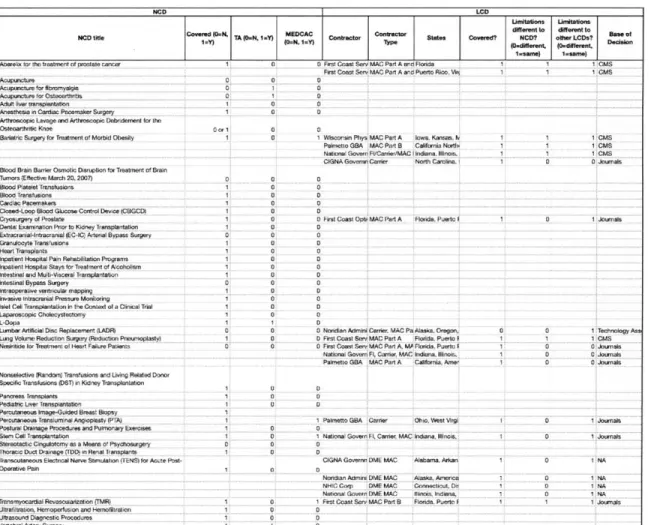
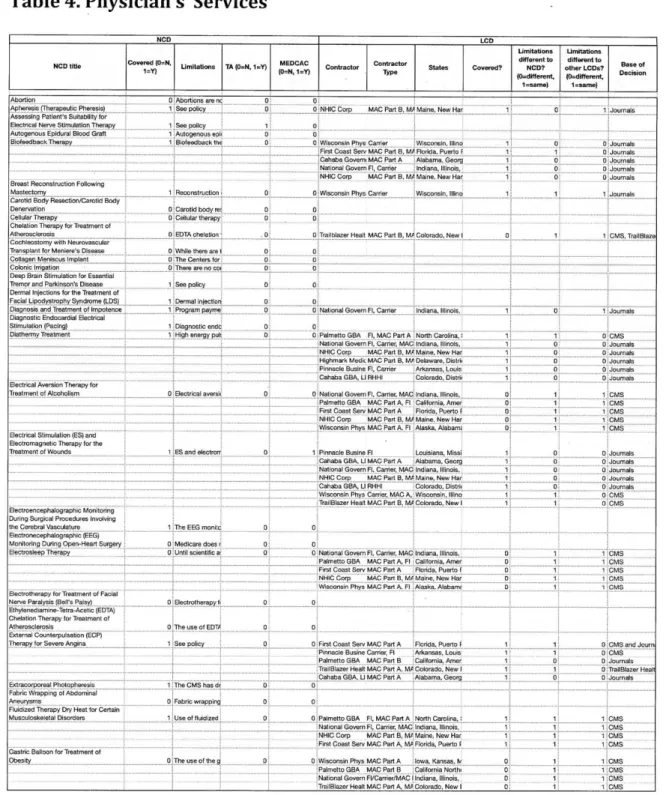
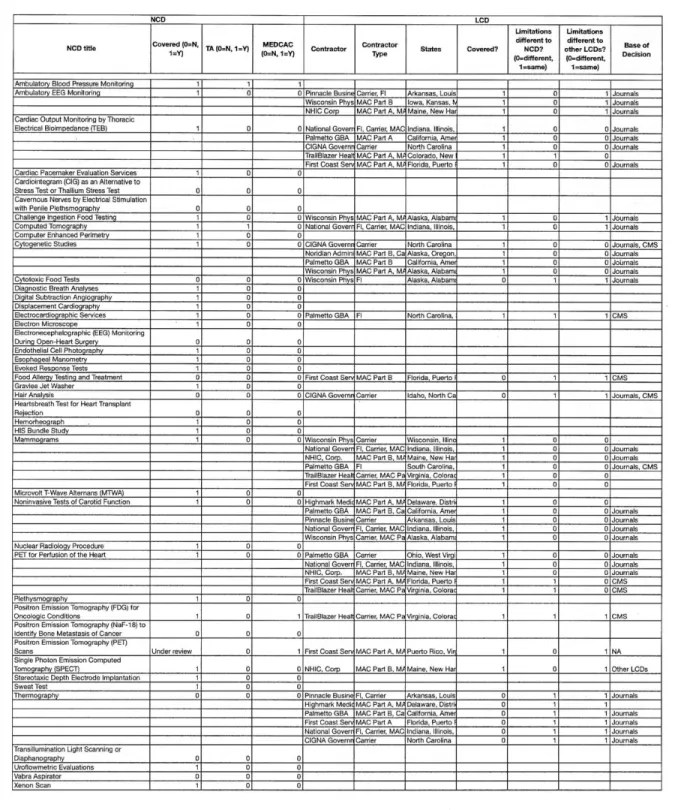
The previous search narrowed the NCDs to 193 matches. On these matches, I gathered the following information to assemble a database for this research purposes:
-National Coverage Determination (NCD) section
- NCD title
-Implementation date
-National Decision (Covered=1 or Not Covered=O)
-National Coverage Limitations
- Technology Assessment (TA) (0=no TA to make decision, 1=TA)
-MEDCAC (0= no MEDCAC required, 1=MEDCAC required)
-Local Coverage Determination (LCD) number - Contractor
-Contractor Type
-FI=Fiscal intermediary - Carrier
- MAC Part A=Medicare Administrative Contractor Part A
- MAC Part B=Medicare Administrative Contractor Part B
- DME MAC= Durable Medical Equipment Medicare
-RHHI= Regional Home Health and Hospice Intermediary
-State where LCD is applicable
-Effective date of LCD
-Local Coverage Decision (0=Not covered, 1=Covered)
-Local Coverage limitations
-Difference of Coverage Limitations between NCD and LCD
(0=Different, 1= the same)
-Difference of Coverage Limitations between different states (0=at
least one state has a different policy, 1=all states have the same policy)
-Base of Decision (Journals, CMS, specific sources, etc)
After the previous information was obtained (see Tables 1 to 5), I computed for each state the number of times that LCD Coverage Limitations coincided with their NCD counterparts, the number of times that they were different and the total number of times that a state issued an LCD (see Table 6). For this research purposes, different Coverage Limitations between LCDs and NCDs means there is at least one different criterion for coverage.
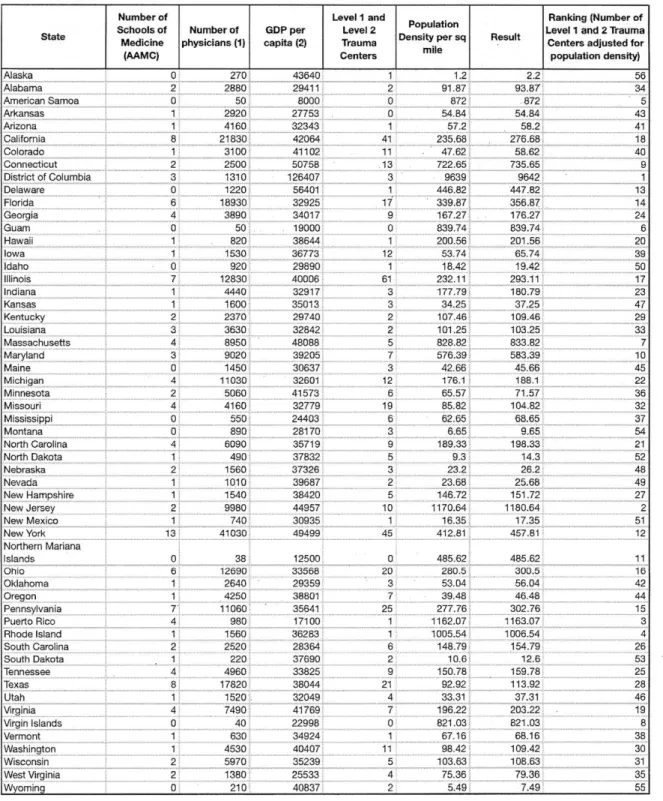
As shown in Table 7, I collected the following data for each state from their indicated sources:
- Number of Schools of Medicine, from the Association of American
Medical Colleges (AAMC)
- Number of physician's, from the United States Department of Labor,
Occupational Employment Statistics, May 2009. It doesn't include self-employed doctors.
- Gross Domestic Product (GDP) per capita by state, from the US
Department of Commerce, Bureau of Economic Analysis, 2008
- Number of Level 1 and Level 2 Trauma Centers, from DataMasher
(www.datamasher.org)
- Population density per square mile, from DataMasher
(www.datamasher.org)
- Number of Level 1 and Level 2 Trauma Centers + Population density
per square mile, from DataMasher (www.datamasher.org)
- State Ranking according to Number of Level 1 and Level 2 Trauma
Centers + Population density per square mile, from DataMasher
(www.datamasher.org)
Once I assembled the database I used the Excel LINEST, LOGEST and
and the Pearson product-moment correlation coefficient between various pairs of variables for each State. The pairs of variables I analyzed were:
-Number of times an LCD differed from an NCD versus:
- Number of schools of medicine
-Number of physicians
-GDP per capita
- Ranking according to number of Level 1 and 2 Trauma Centers
adjusted for population density
-Number of times an LCD was the same as an NCD versus:
-Number of schools of medicine
-Number of physicians
-GDP per capita
-Ranking according to number of Level 1 and 2 Trauma Centers
adjusted for population density
-Total number of times an LCD was issued versus:
- Number of schools of medicine
- Number of physicians
- GDP per capita
- Ranking according to number of Level 1 and 2 Trauma Centers
adjusted for population density
I quantified the number of times an LCD was the same as an NCD because it is
not exactly the difference between the total LCDs and the number of times an
LCD differed from NCDs, since for some procedures the difference couldn't be
determined due to lack of information. On the other hand, although the total number of times an LCD was issued was expected to be highly correlated with the number of times an LCD differed from an NCD, I measured its correlation with the chosen variables separately because it may not always be the case. To analyze the MEDCAC members characteristics, first I downloaded the
members list from the CMS website at
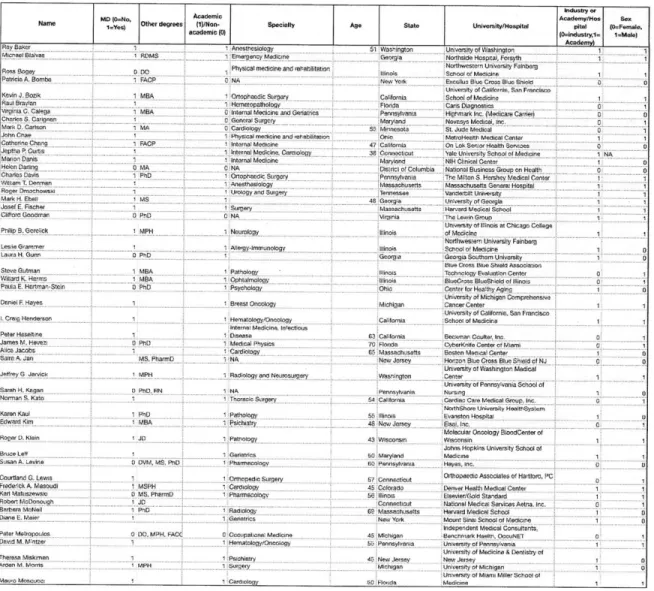
https://www.cms.gov/FACA/02 MedCAC.asp, under the archive "Roster" (updated 05/05/2010). The list includes name, academic grades, occupation and organization affiliation. I gathered the following information from various Internet public sources:
- Specialty
- Age (In some cases, it was available at www.healthgrades.com or it
was approximated when the number of years since graduation was provided)
- State where the organization to which the member is affiliated is
located
From the MEDCAC database I obtained the Committee profile, according to the members characteristics.
In order to test my conclusions further and to understand more the local and national coverage determination processes and other possible factors that influence them, I interviewed four Contractor Medical Directors (CMDs), who are the key players in the LCD process. The interview questions and responses can be found in Appendix A.
Limitations of the approach
The present research is focused on discrepancies between NCDs and LCDs. It doesn't analyze discrepancies between LCDs. As most of the currently issued policies are LCDs, this research approach fails to assess most of the discrepancies at the local level. However, with the Medicare contractor's consolidation taking place in the last seven years as part of the Medicare Contracting Reform, national policies are gaining importance as means to homogenize the current disparities in coverage. Analyzing discrepancies between local policies, although an interesting exercise, would give a picture of the past state of affairs of coverage policies, instead of the expected future trends.
A second limitation of the present approach is its focus on Medicare coverage
policies. The other big player in coverage policies is the private insurance sector. But due to the difficulty in collecting information from the private sector, as well as the chosen limits for this research, the present research study is limited in that regard to the public sector. However, because Medicare coverage policies influence to a great extent coverage decisions of private payers, the present approach is of great importance to understand the system as a whole. Also, private payers are generally happy to rely on Medicare coverage guidelines in developing their own.
Data limitations and challenges
The data necessary for this research were easily accessible from public sources in the Internet, mainly from the CMS website. However, detecting the differences between NCDs and LCDs coverage limitations posed a greater challenge for assembling the database. It meant reading the different national and local policies for 193 procedures, which was very time-consuming and