Publisher’s version / Version de l'éditeur:
Vous avez des questions? Nous pouvons vous aider. Pour communiquer directement avec un auteur, consultez la première page de la revue dans laquelle son article a été publié afin de trouver ses coordonnées. Si vous n’arrivez pas à les repérer, communiquez avec nous à [email protected].
Questions? Contact the NRC Publications Archive team at
[email protected]. If you wish to email the authors directly, please see the first page of the publication for their contact information.
https://publications-cnrc.canada.ca/fra/droits
L’accès à ce site Web et l’utilisation de son contenu sont assujettis aux conditions présentées dans le site LISEZ CES CONDITIONS ATTENTIVEMENT AVANT D’UTILISER CE SITE WEB.
Workshop on innovation and research for water infrastructure in the 21st century
[Proceedings], p. 7, 2006-03-20
READ THESE TERMS AND CONDITIONS CAREFULLY BEFORE USING THIS WEBSITE. https://nrc-publications.canada.ca/eng/copyright
NRC Publications Archive Record / Notice des Archives des publications du CNRC :
https://nrc-publications.canada.ca/eng/view/object/?id=cd52ed5a-5d1c-441b-b730-18aaff6e92dc https://publications-cnrc.canada.ca/fra/voir/objet/?id=cd52ed5a-5d1c-441b-b730-18aaff6e92dc
NRC Publications Archive
Archives des publications du CNRC
This publication could be one of several versions: author’s original, accepted manuscript or the publisher’s version. / La version de cette publication peut être l’une des suivantes : la version prépublication de l’auteur, la version acceptée du manuscrit ou la version de l’éditeur.
Access and use of this website and the material on it are subject to the Terms and Conditions set forth at
Condition assessment of water pipes
Hunaidi, O.
http://irc.nrc-cnrc.gc.ca
Condit ion a sse ssm e nt of w at e r
pipe s
N R C C - 5 0 3 0 6
H u n a i d i , O .
M a r c h 2 0 0 6
A version of this document is published in / Une version de ce document se trouve dans:
Workshop on innovation and research for water infrastructure in the 21st century,
sponsored by the US EPA (Arlington, Virginia, March 20, 2006)
The material in this document is covered by the provisions of the Copyright Act, by Canadian laws, policies, regulations and international agreements. Such provisions serve to identify the information source and, in specific instances, to prohibit reproduction of materials without written permission. For more information visit http://laws.justice.gc.ca/en/showtdm/cs/C-42
Les renseignements dans ce document sont protégés par la Loi sur le droit d'auteur, par les lois, les politiques et les règlements du Canada et des accords internationaux. Ces dispositions permettent d'identifier la source de l'information et, dans certains cas, d'interdire la copie de documents sans permission écrite. Pour obtenir de plus amples renseignements : http://lois.justice.gc.ca/fr/showtdm/cs/C-42
Workshop on Innovation and Research for Water Infrastructure in the 21st Century, sponsored by the United States Environmental Protection Agency, 20-21 March 2006, Arlington, Virginia
Condition Assessment of Water Pipes
Osama Hunaidi
National Research Council, Institute for Research in Construction, Ottawa, Canada K1A 0R6 Tel.: (613) 993-9720, e-mail: [email protected]
The purpose of this summary paper is two-fold. First, it will present an overview of the current state-of-the-science of condition assessment and inspection technologies for water pipes (excluding concrete pipes). Second, it will introduce a new destructive and non-disruptive testing method that was recently developed for measuring the remaining general wall thickness of water pipes.
Simply stated, condition assessment is the process or processes that help establish a record of the state of the critical aspects of water pipes. For example, critical aspects for cast and ductile iron pipes are general remaining wall thickness and extent or degree of corrosion pitting.
Condition assessment is needed to develop options for future action in order to prevent failure. For example, based on the condition of a pipe, a utility may choose to implement cathodic protection, reline, or simply replace the pipe. Condition assessment also
establishes a record against which future change in the condition of a pipe can be judged to predict its remaining service life. Such predictions of performance are important for optimizing the cost of rehabilitation and replacement programs.
Condition assessment methods can be generally classified into direct or indirect methods. Direct methods include visual inspection, including the use of CCTV probes. They also include sampling programs – it’s uncertain how widespread these programs are in the U.S. and Canada but they are widely used in the U.K. Typically a 30 cm (1 foot) long pipe sample is exhumed every 1 km (2/3 mile). The sample is cut in half, sand blasted, its remaining wall thickness measured and used to perform a variety of material tests and analyses. Non-destructive testing (NDT) methods also fall under the direct category. NDT methods that can be used on water pipes include acoustic emission, acoustic leak
detection, remote field eddy current, magnetic flux leakage, ultrasonic pulse echo and guided Lamb waves, as well as seismic methods including impact echo and spectral analysis of surface waves. Indirect methods include analysis of failure history, water audits to determine leakage levels, flow testing, and measurement of soil resistivity to determine the risk of corrosion.
In the United States and Canada about 70% of water pipe networks consist of old cast iron and ductile iron pipes. The remainder is plastic, steel, asbestos cement and pre-stressed concrete. A large proportion of these pipes are nearing the end of their “expected life” and their replacement cost will be huge – one estimate for the United States is $6,500 per household. Cost is expected to peak in about 20 years and that’s when pipes installed during construction booms in the 1920s and 30s as well as the post WWII boom begin to fail en masse. It’s very unlikely that water utilities will have the huge funds to meet
expected replacement needs. Therefore, pipe replacement has to be done selectively and rehabilitation options need to be considered when feasible.
Traditionally, decisions to rehab or replace water pipes have been based on general indicators such as failure history, age, size and type of pipe. These may lead to
sub-optimal decisions. To be sub-optimal, information about the actual condition of pipes is needed. But gaining access to inspect buried pipes is difficult, disruptive and costly. Hence, the need for non-destructive and non-disruptive inspection tools.
Most non-destructive techniques mentioned earlier are developed enough to be used for inspecting the condition of water pipes but they are rarely used by water utilities. The result is that most utilities don’t have a definite picture about the condition of their pipes. Limited use of NDT methods can be attributed to several causes including their high cost,
disruptiveness, and for most methods the lack of a track record. Unfortunately,
development of NDT methods for water pipes has been progressing slowly – there are only few players on the scene and breakthroughs are few and far in between.
Slow development of NDT methods for water pipes may be attributed to one or more of the following reasons. First, the market is not lucrative enough to attract major players – there are only few dollars to spend on inspection (most utilities may not be willing to spend more than 5% of their maintenance budgets); consequences of most pipe failures are viewed as “minor”; and there are no legislative requirements for periodic inspection for water pipes (unlike for oil and gas pipelines). Second, testing conditions for water pipes are
challenging – pipes are underground and hence access is difficult; the geometry of pipe networks is complex; pipes are full of obstacles such as partially open valves, tubercles and debris; and importantly the operating environment is very restrictive as most utilities are not willing or unable to take pipes out of service to be inspected. Finally, there is a lack of consensus regarding the requirements for pipe inspection – this perhaps stems from the current insufficient understanding of failure mechanisms of water pipes.
In view of the current situation, there is a long list of research needs. Following is a partial list, in no particular order, with the time range expected for the need to be met indicated between parentheses:
− Non-destructive and non-disruptive tools for detecting defects such as graphatization, cracks, and corrosion pits and identifying their criticality (3-10 years). Such tools would be used for periodic inspection to monitor deterioration. − Online monitoring and warning systems for critical pipes (3-10 years). Such
systems could be to detect the inception of leakage and warning signs of imminent catastrophic failures.
− Non-disruptive pipe sampling techniques (1-3 years). These would be used to obtain pipe coupons under live conditions, i.e., without taking pipes out of service.
− Information about the rate of deterioration for various types and sizes of pipes under different conditions (3-10 years).
− Condition rating system or scale, e.g., an infrastructure condition factor (ICF) on a scale from 1 to 10 (1-3 years). Such a system together with information about the rate of deterioration is needed for optimizing the cost of rehab and replacement programs.
− Network-wide leakage monitoring systems (3-10 years). Currently, the most commonly used system in Europe is district metering areas or DMAs but these may not be suitable for North American systems because of fire flow
-requirements and water quality concerns. An alternative might be the use of wireless sensor networks for acoustic leak detection and / or pressure monitoring for inverse transient analysis.
− GIS-based rehab and replacement decision support system including
documentation of pipe and environmental characteristics and failure history (1-3 years). Although analysis of failure history is the most common basis, from a structural point of view, for rehab and replacement decisions, required historical information is often missing or inadequately documented, especially for smaller utilities). A system is needed to address this deficiency.
− Optimization of condition assessment activities, e.g., inspection frequency based on a system for establishing risk of failure for water pipes (1-3 years).
− Understanding of failure mechanisms for large diameter pipes (3-10 years). Next, a brief overview will be given for a new NDT method developed at the National Research Council Canada for measuring the remaining general wall thickness for water pipes. Existing methods to estimate the pipe wall thickness, such as pipe sampling programs and the remote field eddy current technique, are too disruptive and costly to be justified by water utilities for inspection at the network level. The new method provides a promising solution that’s non-destructive and does not require taking pipes out of service. In principle, the new method can be used on all types of pipes including cast and ductile iron, steel, PVC, asbestos cement and PCCP.
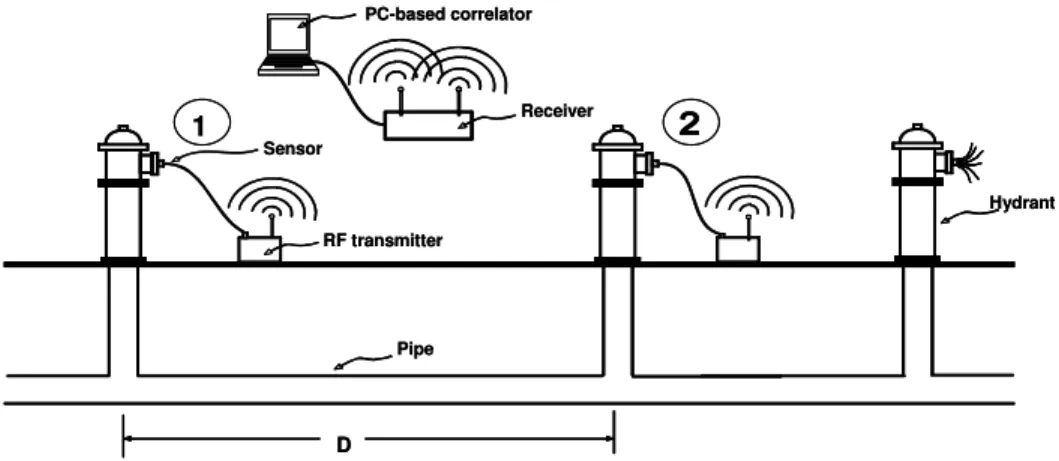
The new method works by measuring how quickly acoustic signals are transmitted along a section of pipe. Acoustic signals are induced in pipes by releasing water at fire hydrants or lightly tapping pipes in a controlled manner. The signals are then measured by using sensors positioned at two longitudinally separated points on a pipe. The sensors can be attached at easy-to-access points, such as fire hydrants and control valves, or directly on pipes in existing access manholes. A schematic of the measurement setup is shown in Figure 1. The acoustic propagation velocity is calculated based on the sensor spacing and time delay between the measured acoustic signals. Average wall thickness of the pipe section between the acoustic sensors is then back calculated from a theoretical model of its relationship with the acoustic velocity, the pipe’s internal diameter and Young’s modulus of its wall, and the bulk modulus of elasticity of water, all of which are usually known or easily determined.
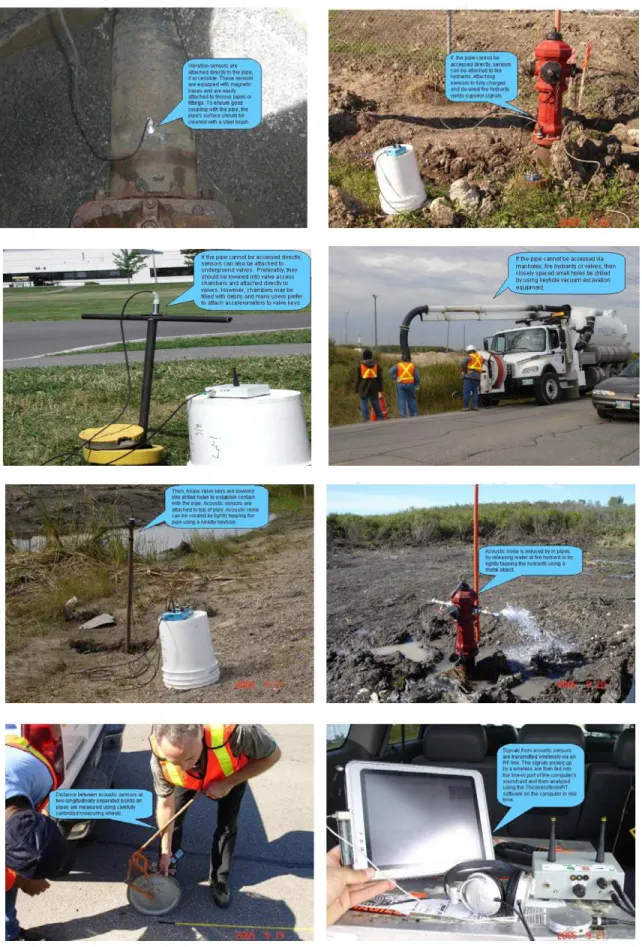
The length of the pipe section over which the acoustic velocity is measured can be arbitrarily chosen. Initially, a 100 to 200 metres long section, which is the usual distance between fire hydrants or valves in urban areas, may be chosen. Subsequently, if a higher thickness resolution is needed, for example, when a bad section of pipe is found, or when a pipe owner has concerns about a particular section, the resolution can be increased by moving the acoustic sensors closer together. To do so, closely spaced small holes to access the pipe may be drilled, for example, by using keyhole vacuum excavation equipment. Alternatively, arrays of closely spaced hydrophones may be inserted into pipes, while they are in service, thru corporation stops or fire hydrants.
Velocity measurement can be performed with hardware normally used for locating pipe leaks using the cross-correlation method, e.g., see system shown in Figure 2. However, measurement of the velocity tends to be more technical than the usually straightforward leak correlation. Velocity measurement and wall thickness calculations are made in real
-time using specially developed software, known as ThicknessfinderRT, see software interface in Figure 3. Photographs in Figure 4 show how measurement of acoustic velocity is actually done. Recent research and development have led to several improvements of the method. This included a refined theoretical model for non-uniform pipe sections, an optimal procedure for acoustic velocity measurement, and a method for inspecting the quality of the measurements.
The pipe wall thickness determined by the new method represents an average value for the pipe section over which acoustic velocity is measured. This is not a limiting aspect of the method. Generally, pipes will have a more-or-less uniform thickness profile over significant lengths, say 50 to 100 metres, as soil and bedding conditions are unlikely to change significantly over such distances. Also, the average general wall thickness is believed to be a better indicator than the depth of individual corrosion pits of the general structural condition and remaining life of pipes, especially for the purpose of long-term planning of rehab and replacement needs.
Pilot tests to evaluate the accuracy of the new method were performed at the water distribution system of a major City in Ontario, Canada. Ten test sites were selected based on soil type and break history of pipes. They included large and small diameter pipes at different levels of deterioration (two pipes had a diameter of 20 inches). The pipes were all of the cast iron type (both pit and spun cast) and they were installed between 1860 and 1960.
Accuracy of the remaining pipe wall thickness measured by the new method was evaluated in comparison with average wall thickness and visual appearance reported independently for 1-metre long pipe samples exhumed at 8 of the test locations. The samples were sand blasted and analyzed to determine average wall thickness, average pit depth, % pitted area and a variety of other corrosion-related information.
Pipe wall thicknesses that were measured by using the new acoustic method were in excellent agreement with average thicknesses and / or corrosion condition rating for exhumed pipe samples reported independently by the City’s corrosion Consultant. The most dramatic and interesting agreement was for the pipe at one particular site where 4 pipe sections were tested. Predicted thickness loss for 3 of these sections that were in clay was between 30 and 50%, which is significantly higher than losses predicted for pipes at other sites. Independent corrosion analysis indicated that pipe samples from this site were
in extremely poor condition in comparison to samples from other sites. The 4th pipe
section, which was in sand, suffered a thickness loss of only 12%, the lowest of the 4 pipe sections tested. At other sites, thickness losses measured by the new method were between 0.5% and 9%, which were in close agreement with independently measured losses and consistent with their good to very good corrosion rating.
The new method is anticipated to be a helpfull tool for asset managers to prioritize which pipes in their distribution systems require replacement or rehabilitation. An added bonus from water utlities’ perspective is that leak detection can be done at the same time as pipe wall thickness measurements since both can be done using the same instrumentation and setup.
-Receiver PC-based correlator Pipe Hydrant RF transmitter Sensor D 1 Receiver PC-based correlator Pipe Hydrant RF transmitter Sensor D 1
Wave propagation velocity (v) = D / ΔT, where ΔT is time delay between signals 1 and 2 Figure 1 Measurement of acoustic propagation velocity
RF signal transmitters RF signal receiver LeakfinderRT software
Acoustic sensors
Figure 2 The ThicknessfinderRT system
Figure 3 User interface of ThicknessfinderRT
Figure 4 Testing of pipes using the new acoustic method