ANALYZING MULTI-OBJECTIVE
LINEAR AND MIXED INTEGER
PROGRAMS BY LAGRANGE
MULTIPLIERS
V. S.
Ramakrishnan
and J.F. Shapiro
ANALYZING MULTI-OBJECTIVE LINEAR AND MIXED INTEGER PROGRAMS
BY LAGRANGE MULTIPLIERS
by V. S. Ramakrishnan and Jeremy F. Shapiro July, 1991
Abstract
A new method for multi-objective optimization of linear and mixed programs based on Lagrange multiplier methods is developed. The method resembles, but is distinct from, objective function weighting and goal
programming methods. A subgradient optimization algorithm for selecting the multipliers is presented and analyzed. The method is illustrated by its application to a model for determining the weekly re-distribution of railroad cars from excess supply areas to excess demand areas, and to a model for balancing cost minimization against order completion requirements for a dynamic lot size model.
Key Words: Programming: linear and integer, multiple criteria, relaxation/subgradient.
ANALYZING MULTI-OBJECTIVE LINEAR AND MIXED INTEGER PROGRAMS
BY LAGRANGE MULTIPLIERS*
by V. S. Ramakrishnan and Jeremy F. Shapiro** July, 1991
Introduction
In this paper, we present a new approach to analyzing multi-objective linear and mixed integer programs based on Lagrangean techniques. The approach resembles classical methods for using non-negative weights to combine multiple objectives into a single objective function. The weights in our construction, however, are Lagrange multipliers whose selection is determined iteratively by reference to targeted values for the objectives. Thus, the Lagrangean approach also resembles goal programming due to the central role played by the target values (goals) in determining the values of the multipliers. The reader is referred to Steuer [1986] for a review of
weighting and goal programming methods in multi-objective optimization. The plan of this paper is as follows. In the next section, we formulate the multi-objective LP model as the LP Existence Problem. We then
demonstrate how to convert the LP Existence Problem to an optimization problem by constructing an appropriate Lagrangean function. The dual problem of minimizing the Lagrangean is related to finding a solution to the LP Existence Problem, or proving that there is no feasible solution. In the
Research supported by grants to MIT from The Charles Stark Draper Laboratories, Inc. and Coopers Lybrand. An earlier version of this paper appeared as an MIT Operations Research report (OR 228-90)
following section, we provide an economic interpretation of efficient solutions generated by the method. In the section after that, we present a subgradient optimization algorithm for analyzing the LP Existence Problem by optimizing the dual problem. This algorithm provides a sequence of solutions which converge to a solution to the LP Existence Problem, if the Problem has a solution. A summary of the computational methods is then given. In the following section, we extend the analysis to the multi-objective MIP model which is reformulated as the MIP Existence Problem.
The paper continues with two illustrative examples taken from actual planning situations where the methods could be applied. One is the railroad car redistribution problem (Maiwand [1989]) which has been modeled as a multi-objective transportation model. The other application is cost vs. order completion optimization of dynamic lot size problems. This application is an example from a family of production and distribution problems of increasing interest to practitioners. The paper concludes with a brief discussion of areas of future research and applications.
Statement of the Linear Programming Existence Problem and Lagrangean Formulation
We formulate the multi-objective linear programming model as the LP Existence Problem: Does there exist an xRn satisfying
Ax < b (1)
ckx gk for k = 1,2, ... , K (2)
x 0 (3)
In this formulation, the matrix A is mxn, each ck is a lxn objective function vector, and each gk is a target value for the kth objective function. We assume for convenience that the set
is non-empty and bounded. We let xr for r=1, ... , R denote the extreme points of X . For future reference, we define the Kxn matrix
C = i
and the Kxl vector g with coefficients gk . We say that the vector g in the LP Existence Problem is attainable if there is an xEX such that Cx g;
otherwise, the vector g is unattainable.
Letting it = ( 1, 2, *--, 7K) 0 denote Lagrange multipliers associated with the K objectives, we price out the constraints (2) to form the Lagrangean
L (X) = - g + maximum Cx
Subject to Ax < b (5)
x 0
We let x (X) denote an optimal solution to (5). The following definition and result, which is well known and therefore stated without proof, characterizes these solutions.
DEFINITION: The solution xX is efficient (undominated) if there does not exist a yX such that Cy Cx with strict inequality holding for at least one component.
THEOREM 1: Any solution x () that is optimal in the Lagrangean (5) is efficient if nik > 0 for k=1, 2, ... ,K .
We say that the solution x () spans the target vector Cx(nt) ; if xt has all
positive components, x (x) is an efficient solution for the Existence Problem with this target vector.
The two possible outcomes for the LP Existence Problem (the Problem is either feasible or infeasible) can be analyzed simultaneously by optimizing the Multi-Objective LP Dual Problem
D = minimize L ()
Subject to (6)
THEOREM 2: If the LP Existence Problem has a feasible solution, L () > 0 for all 7rc 0 and D = 0 . If the LP Existence Problem has no feasible solution, there exists a X7 > 0 such that L(n
)
< implying L (o*)-as 0 - + oo and therefore D = -oo.
Proof:
It is easy to show that L () 0 for all 2> 0 when there exists an
i
> 0satisfying Ax < b and Cx > g . For then, we have x (C - g) 0 for all
t > 0 which implies L () 0 since L(it) R(Cx- r g).
To complete the proof, we consider the phase one LP for evaluating the LP Existence Problem W = minimize K k=l Subject to Ax < b (7) ck X + k gk x 0, sk 0 for k=1, ... , K for k=l, ... , K . The linear programming dual to this problem is
-oA + C < 0
< Sk < 1 for k=l, ... , K o 0, X > 0
, denote an optimal solution to the primal problem (7) found by
*F *
the simplex method, and let a , c denote an optimal solution to the dual problem (8). By LP duality, we have W = -b + n g
*(b
- Ax*) A + C)x W (9) (10) = 0 0 = -aAx + (11) g --xCx + g = f- x*(cx - g)where the first equality follows from (9) and (10), and the second equality If the LP Existence Problem has a feasible solution, we have
W = 0 and L( ) = Ir (C x - g) = 0 . This completes the first part of the proof because iT must be optimal in (6) and D = 0 .
Let x , s
Thus,
from (11).
If the LP Existence Problem does not have a solution, we have
W
>0
, orI(C - g) = -W < 0
Our next step is to show L (n*) = - W.
To this end, consider any x 2 0 satisfying Ax^ < b . We have
(- A + * C)x < 0
since - A + C < 0 , implying
x Cx < o* Aix
<
o bwhere the second inequality follows because o sides of the inequality, we obtain
0 . Adding - g to both
x (Cx - g) <c b - g = -W = (Cx - g) (13)
Thus, L(7 ) = 7r*(Cx* - g) < 0 . Moreover, (13) implies for any 0 > 0 that
L(0i') = -W = (*)(Cx* - g) 0*(cx- t)
This establishes the desired result in the case when the LP Existence Problem is infeasible. x
It is well known and easy to show that L is a piecewise linear convex function that is finite and therefore continuous on RK. Although L is not everywhere differentiable, a generalization of the gradient exists everywhere. A K-vector is called a subgradient of L at L if
L() 2 L(X) + - a)
A necessary and Sufficient condition for Xt to be optimal in the
Multi-Objective LP Dual Problem is that there exist a subgradient of L at such that
Xk = 0 if 1Ck > 0
(14)
tk 0 if k = 0
Algorithms for determining an optimal are based in part on exploiting this condition characterizing optimality. The K-vectors Cx () - g are the
subgradients with which we will be working.
It is clear from the definition of the Lagrangean that L ( 7R) = L(() for any r > 0 and any X > 0; that is, L is homogeneous of degree one. Equivalently, for each extreme point xr E X , the set
({it1T>0
and L(r) X (Cxr - t)is a cone. The geometry is depicted in Figure 1 where r = Cxr - t for r = 1, 2,3, 4
The implication of this structure to our analysis of the LP Existence Problem is that we could restrict the vectors to lie on the simplex
Rk = 1, k 0 )
Theorem 2 can be re-stated as
Corollary 1: Suppose the multipliers are chosen to lie on the simplex S. If the LP Existence Problem has a feasible solution, L () 0 for all X E S and
for all
D = 0. If the LP Existence Problem has no feasible solution, there exists a X E S such that L r) < 0 .
For technical reasons, we choose not to explicitly add this constraint. When reporting results, however, we will sometimes normalize the Irk so
K
that A irk = 1 . The normalization makes it easier for the decision-maker k=l
to compare solutions.
L () = '1 L () = RT2
L () = IR4
Conic Structure of the Lagrangean Figure 1
Of course, the reader may have asked him(her)self why we need the Lagrangean method when we can test feasibility of the LP Existence Problem simply by solving the phase one linear program (7). The answer is that the decision-maker is usually unsure about the specific target values gk that he (she) wishes to set as goals. The Lagrangean formulation and the algorithm discussed in the next section allow him (her) to interactively generate
efficient solutions (assuming all the k > 0 ) spanning target values in a neighborhood of given targets gk if these given targets are attainable. If the targets prove unattainable, undesirable, or simply uninteresting, the decision-maker can adjust them and re-direct the exploration to a different range of efficient solutions.
Economic Interpretation of Efficient Solutions
Frequently, one of the objective functions in the LP Existence Problem, say cl, refers to money (e.g., maximize net revenues). In such a case, each efficient solution generated by optimizing the Lagrangean function (5) lends itself to an economic interpretation. Consider xt with xtk > 0 for all k,
and let x* denote an optimal solution to (5). Furthermore, let g* = Cx*. It is easy to show that x* is optimal in the linear program
max cl x (15.1)
s. t. ckx 2 gk k = 2,..., K (15.2)
Ax < b (15.3)
THEOREM 3: The quantities
-7k tk = *
71
k = 2, ..., K
are optimal dual variables for the constraints (15.2) in the linear program (15). Proof: The proof is similar to the proof of Theorem 1 and is omitted.
Thus, when the objective function cl refers to revenue maximization or some other money quantity, each time the Lagrangean is optimized with
all I7k > 0, the quantities 7tk for k = 2,..., K given by (16) have the usual
LP shadow price interpretation. Namely, the rate of increase of maximal revenue with respect to increasing objective k at the value g spanned by the efficient solution x is approximated by
- k
The quantity is only approximative because the 7k may not be unique
optimal dual variables in the linear program (15) (see Shapiro [1979; pp. 34-38] for further discussion of this point).
Subgradient Optimization Algorithm for Selecting Lagrange Multipliers Subgradient optimization generates a sequence of K-vectors (w} according to the rule:
1. If L (w) < 0 or nrw and Xw satisfy the optimality conditions (14),
stop. In the former case, the LP Existence Problem is infeasible. In the latter case 17w is optimal in the Multi-Objective LP Dual Problem and
L (w) = 0 = D. Otherwise, go to Step 2. 2. For k = 1, ... , K
w+l,k = maximum 0, wk - [ Xw (18)
where Ar is any subgradient of L at ni , e1 < ow < 2 - 2 for
c1
> 0 and £2 > 0 , and II II denotes Euclidean norm. The subgradient typically chosen in this method is w = Cxw - g where x is the computed optimal solution to the Lagrangean at 7rw .At each w, the algorithm proceeds by taking a step in the direction - w; if the step causes one or more components of XL to go negative, rule
(18) says set that component to zero. The only specialization of the standard subgradient optimization algorithm is the assumption in the formula (18) that the minimum value D = 0 , and therefore that the step length is determined by the value L (w) which is assumed to be positive.
The following theorem characterizes convergence of the algorithm as we have stated it. The proof is a straightforward extension of a result by Polyak
[1967] (see also Shapiro [1979]); the reader is referred to those references for the proof.
THEOREM 4: If the LP Existence Problem is feasible (g is attainable), the subgradient optimization algorithm will converge to a x such that
L (r*) = 0. If the LP Existence Problem is infeasible (g is unattainable), the algorithm will converge to a c such that L (r) < 0 .
If the LP Existence Problem is infeasible, the subgradient algorithm may not converge finitely. In this case, the algorithm may generates subsequences converging to Xt such that L **) = 0, and the algorithm fails to indicate
infeasibility. Of course, it is likely that the procedure will terminate finitely by finding w such that L (n w) < 0. Alternatively, if we knew that the LP Existence problem were infeasible, we could replace the term L (c w) in (18) by
L( w) + for 8 > 0 and the algorithm would converge to it such that
L (7**) --8. In effect, this is equivalent to giving the subgradient
optimization algorithm a target of -8 < 0 as a value for L. The danger is that if we guess wrong and the Existence Problem is infeasible, then the
algorithm will ultimately oscillate and fail to converge.
Another drawback of the subgradient optimization algorithm is that attainment of the optimality conditions (14) at an optimal solution xt may require convexifying subgradients computed at that point. The generalized primal dual simplex algorithm is an alternative approach to subgradient optimization for selecting the Xt vectors that does not suffer from such a
deficiency. This issue is discussed again at the end of the section below on the application of the method to a railroad car redistribution problem.
Summary of Computational Methods
A computational scheme based on our constructions thus far are shown in Figure 2. Step 3, Compute L (t), is an LP optimization. Except for the first such optimization, an advance starting basis is available for reducing the computation time. Step 4, Display Solution, is a point at which the user can exert control. After viewing the solution, he/she is asked if he/she would like to adjust the targets. If not, and L () < 0, the user is faced with the alternative of exiting with the information that the LP Existence Problem is infeasible (and with a number of efficient solutions), or continuing by adjusting the targets, even though he/she was not previously inclined to do SO.
Computational Scheme Figure 2
On the other hand, if L (Tr) > 0, the method proceeds (Step 9) by computing a subgradient of L at based on the optimal solution found in Step 3. Then the optimality conditions (14) are checked (Step 10). If the optimality conditions hold, the user is again faced with the alternative of exiting, this time with the information that the LP Existence Problem is
feasible (and with a number of efficient solutions), or continuing by adjusting the targets. If the optimality conditions do not hold, the method proceeds (Step 11) by computing new multipliers based on the formula (18). Then the process is repeated.
Extension to Multi-Objective Mixed Integer Programs
The MIP Existence Problem is: Does there exist x, y, with x E R, y E R 2 satisfying
Ax + Qz < b
ckx + fkZ < gk
x 0,
Let Z = ((x,y) I Ax + Qz z = z, we assume the set
for k = 1,..., K (19)
Zj = 0 or 1
< b, x > 0, j = 0 or 1). For each zero-one
Z(z) = (x I Ax b - Qz, x 0)
is bounded. Moreover, for at least one z, the set is also non-empty. Let C denote the kxnl matrix with rows ck, and F denote the kxn2 matrix with
rows
M(RT) = - g + max( )x + (F)y
s.t. Ax + Qz < b (20)
x 2 0, zj = 0 or 1
Let (x (), z ()) denote an optimal solution to (20). As before, we say the solution (x, y) E Z is efficient if there does not exist
(x,
E y) Z such that Cx + F z Cx + Fz with strict inequality holding for at least onecomponent. If T7k > 0 for k = 1, ..., K, any solution (x(4), z( ) in (20) is
efficient. Unlike the LP case, however, there may be efficient MIP solutions for which no ir exists such that they are optimal in (20) (see Bitran [1977]).
This is not a serious drawback to our analysis in most cases since we wish merely to systematically sample the set of efficient solutions, rather than generate them all.
The Multi-Objective MIP Dual Problem is
E = minimize M ()
Subject to r > 0 (21)
The following theorem, which we state without proof since it draws on well known results about the relationship of a mixed integer program to its Lagrangean relaxation, generalizes Theorem 2. First, we state the MIP Relaxed Existence Problem: Does there exist x, y with x E Rm', x E Rm2 satisfying
Ax + Qy < b
ckx + fkz gk for k = 1,...,K
THEOREM 5: If the MIP Existence Problem has a feasible solution, M () 0
for all 7r > 0 and E = 0. If the MIP Existence Problem has no solution but the MIP Relaxed Existence Problem does, M () 0 for all > 0 and
E = 0. Finally, if the MIP Existence Problem and the MIP Relaxed Existence Problem both have no feasible solution, there exists a 2> 0 such that
M(it) < 0 implying M (07) - - as 0 + and therefore E = -o.
The subgradient optimization algorithm given above for optimizing the Multi-Objective LP Dual Problem can be applied to iteratively select the multipliers for optimizing the Multi-Objective MIP Dual Problem. By
Theorem 5, however, we run the risk that M () 0 for all > 0 but the
MIP Existence Problem is infeasible. A resolution of this difficulty is to imbed the entire procedure in a branch-and-bound scheme, an approach that would add another worthwhile dimension of user control to the exploration process.
Railroad Car Redistribution Problem
We illustrate the Lagrangean method for multi-optimization of linear programs with a specific example drawn from the railroad industry (Maiwand
[1989]). A railroad company wishes to minimize the cost of relocating its railroad cars for the coming week. Distribution areas 1 through 6 are forecasted to have a surplus (supply exceeds demand) of cars whereas distribution areas 7 through 14 are forecasted to have a deficit (demand
exceeds supply). Unit transportation costs are shown in Table 1, surpluses for distribution areas 1 through 6 in Table 2, and deficits for distribution areas 7 through 14 in Table 3. Storage of excess cars at each of the 14 locations are limited to a maximum of 20.
7 8 9 10 11 12 13 14 1 58 86 150 100 130 110 80 85 2 77 58 62 90 92 114 110 125 3 170 142 112 114 100 97 127 128 4 160 130 72 140 120 145 150 175 5 160 135 55 75 60 75 90 103 6 150 130 141 92 94 70 80 58
Unit Transportation costs cij
Table 1 Distribution Area 1 2 3 4 5 6 Surpluses 102 85 60 25 78 44 Surpluses Si Table 2 Distribution Area 7 8 9 10 11 12 13 14 Deficits 48 31 30 6 27 25 44 39 Deficits Di Table 3
Management is also concerned with other objectives for the week's redistribution plan. First, they would like to minimize the flow on the link
from location 2 to location 8 because work is scheduled for the roadbed.
Second, they would like to maximize the flow to locations 7 because they anticipate added demand there.
The relocation problem can be formulated as the following multi-objective linear program.
Indices:
i =
Decision Variables:
xij = number of cars to be transported from distribution area i to
distribution area j.
Ei = number of excess cars at distribution area i. Ej = number of excess cars at distribution area j.
Constraints: 14 E Xij + Ei = Si j=7 6 Z xij - Ej = D i=1 0 Ei, Ej < 20 Xij 0 for i = 1,...,6 for j = 7, ... , 14 for i = 1, ... , 6; j = 7,..., 14. fori = 1,..., 6; j = 7,..., 14. Objective functions: * Minimize cost 6 14 Z = E Cij xij i=1 j--7
* Minimize flow on link (2, 8)
Z2 = 28
6 Z3 = I Xi7
i=l
We begin our analysis by optimizing the model with respect to the first objective function. The result is
Objective: Minimize Z1 (cost)
Solution: ZI = Z2 = Z3 = 19222 51 48
This data is used by the decision-maker in setting reasonable targets on the three objectives: 6 14 cij x 20000 i=1 j=7 X28 30
I
Xi7 58 i=1Taking into account that the cost and flow objectives are minimizing ones of the form ck x < gk' we multiply by -1 to put the Existence Problem in standard form. In addition, to enhance computational efficiency and stability, we scale the cost targets and objective function by .001 to make them commensurate with the other two. We now form the Lagrangean as detailed in the previous section and apply the subgradient optimization algorithm.
(Actually, we applied a modified and heuristic version of the algorithm outlined above that ensures ic vectors with positive components are
generated at each iteration. For further details, see Ramakrishnan [1990]). The results of nine steps are given in Table 4. Each row corresponds to a solution. The first column gives the value of L () and the next three columns contain Z1 (cost), Z2 (flow on link (2, 8)) and Z3 (flow to area 7)
respectively. The percentage increase over minimal cost (PIC) is also provided to help the decision-maker's evaluation.
No. L () Z1 Z2 Z3 2 771 73 PIC 1 12.976 21029 0 68 0.334 0.333 0.333 9.4 2 6.569 21029 0 68 0.516 0.113 0.371 9.4 3 4.175 19556 35 68 0.608 0.001 0.391 1.7 4 7.347 21029 0 68 0.654 0.228 0.118 9.4 5 3.711 21029 0 68 0.757 0.103 0.140 9.4 6 1.878 21029 0 68 0.809 0.040 0.151 9.4 7 1.919 19572 31 68 0.835 0.008 0.157 1.8 8 1.937 21029 0 68 0.887 0.086 0.027 9.4 9 0.979 21029 0 68 0.914 0.053 0.033 9.4 10 0.721 19572 31 68 0.928 0.036 0.036 1.8
RR Car Redistribution Problem Table 4
The results in Table 4 point out a deficiency of the subgradient
optimization algorithm for minimizing the piecewise linear convex function L. Among the ten distinct dual vectors xr that were generated during the descent, we find only three distinct efficient solutions to the Existence
Problem. This is partially, but not entirely, the result of the small size of the illustrative example.
An alternative descent algorithm for MODP that would largely
eliminate this deficiency is one based on a generalized version of the primal-dual simplex algorithm (see Shapiro [1979]). The generalized primal-primal-dual is a
local descent algorithm that converges finitely and monotonically to a R
optimal in MODP. Moreover, it easily allows the constraints
K
rk =1
k=l
to be added to MODP. It has, however, two disadvantages: (1) it is
complicated to program; and (2) for MODP's where L has a large or dense number of piecewise linear segments, the algorithm would entail a large number of small steps. Given the intended exploratory nature of the multi-objective proceeding, it appears preferable to use the subgradient optimization algorithm and present only distinct solutions to the decision-maker.
The generalized primal-dual algorithm can be viewed as a constructive procedure for finding a subgradient satisfying the optimality conditions (14) by taking convex combinations of the subgradients derived from extreme points to X. Indeed, we may only be able to meet all our targets by taking such a combination of extreme point solutions. This suggests a heuristic for choosing an appropriate convex combination of the last two solutions in Table 4. For example, if we weight the solution on row 9 by .032 and the solution on row 10 by .968, we obtain a solution satisfying all three targets with the values
Z1 = 19619
Z2 = 30
Z3 = 68
Taking the same convex combination of the multipliers associated with solutions 9 and 10, and applying the result of Theorem 3, we obtain
RT2 = $48.30 as the (approximate) rate of increase of minimal cost with respect to decreasing the flow on link (2, 8) at a flow level of 30, and
respect to increasing the flow to distribution area 7 at a delivered flow level of 68.
Cost vs. Order Completion Optimization of Dynamic Lot-Size Problems
The classic dynamic lot-size model is concerned with achieving an optimal balance of set-up costs against inventory carrying costs in the face of non-stationary demand for a single item over a multiple period planning horizon (Wagner and Whitin [1958]). Through the years, this model and numerous extensions have been studied by many researchers. A review is given in Shapiro [1990].
Recognizing that demand is frequently composed of a number of smaller, individual orders, a production manager has the option of adjusting demand, and thereby reducing costs, by deciding which orders to complete in a given period. Such decision options can be explicitly incorporated in the classic models, but require a multi-objective approach to reconcile the opposing objectives of cost and customer service. Models for this type of analysis are timely since measuring the impact of customer service (and quality) on product pricing strategies has recently become a topic of increased managerial interest (CRA [1991], Shycon [1991]).
In this section, we apply our Lagrange multiplier method to a single item dynamic lot-size model to which the order completion decisions are added. Our main purpose is to illustrate the multi-objective approach to a potentially important class of problems and associated models. Research is underway to extend the approach to multi-item, dynamic lot-size problems, and to distribution planning problems.
First, we state the classic model. After that, we discuss its extension to incorporate order completion decisions, and how the Lagrange multiplier method can be used to evaluate them. The section concludes with a numerical example.
Parameters:
f = set-up cost ($)
h = inventory carrying cost ($/unit)
rt = demand in period t (units)
M t = upper bound on production in period t (units)
yT = lower bound on inventory at the end of the planning horizon
Decision Variables:
Yt = inventory at the end of period t
xt = production during period t
1 if production occurs during period t at =
0 otherwise
CLASSIC DYNAMIC LOT-SIZE MODEL
T v = min (f at t=-+ hyt) Subject to yt = yt-1 + Xt - rt xt - Mt 6t < 0 yo given, yT Yt 0, xt 0, t = 0 or for t=l, ... , T yT 1 (22) (23) (24) (25)
In this formulation, the objective function (22) includes production set-up costs and inventory carrying costs, but not direct production costs since they cannot be avoided. The constraints (23) are the usual inventory balance and fixed charge constraints. Since yt 0 , no backlogging is allowed. In (24), note that a lower bound (which may be zero) on inventory at the end of the planning horizon is included. Selecting this lower bound is actually a third objective that could be analyzing by our Lagrange multiplier methods.
Suppose now that demand consists entirely of orders of size wj for
j = 1, ... , N , where each order has a promised completion (shipping) date tj Suppose further than every order must be 100% complete before it is shipped. Finally, suppose an order is allowed to be completed one or two periods after the due date tj . Management is concerned with limiting late deliveries, or somewhat equivalently, with penalizing late shipments.
We extend the classic model and its optimization as follows. Let
Jt =
j
tj = t}This is the set of orders that the company promised to ship in period t. Our assumption is that
rt = E wj for all t
j Jt
Let jo, ,jli, j2 denote zero-one variables that take on values of one only if order j is completed in periods tj, tj + 1, tj + 2, respectively. Let go and gl denote customer service targets for shipping orders on-time, and one period late, respectively. The gk integers are less than or equal to J I, the total number of orders. We would expect go < gl.
The classic model becomes
COST VS. ORDER COMPLETION DYNAMIC LOT-SIZE MODEL
T V = min t=1
(f
t + hyt) Subject to yt = yt1 + Xt -xt - MtSt wj jl +x
jE Jt-1 jE Jt-2 < 0f
for t =1,..., T [jo + j + j2 = 1 k Ni
E Pij 2 gk 1=0 j=1 yo given, YT YT yt 0, Xt t 0, 0, t for j =1, ... , N for k =0, 1 = 0 or 1, Pjk = 0 orIn this formulation, we have modified the inventory balance equation in (27) to incorporate the effective demand satisfied. This is the term in parentheses on the right expressing, for each t, orders promised in period t that were shipped on-time, orders promised in period t-1 that were shipped one
period late, and orders promised in period t-2 that were shipped two periods late. The multiple choice constraints (28) determine the timeliness of each order j. The inequalities (29) describe the customer service requirements.
(26) (27) (28) (29) (30) (31) I
wj Pjo +
jEJtFor example, if JI = 25 and go = 20 and gl = 23, the customer service
requirement is at least 80% of the orders shipped on-time, and at least 92% of the orders shipped more than one period late.
Clearly, the model just described is one of many possible formulations describing cost vs order completion decisions. One could consider, for
example, delaying some orders for more than two weeks. The customer service requirements (29) could be expressed in terms of total quantity
shipped, rather than by numbers of orders shipped, since some orders will be much larger (and more important) than others. Or, there may be priority classes of orders, with different customer service requirements for each. Anyone of these generalizations, and many others as well, could be modeled and analyzed in much the same manner.
As we have stated it, the Cost vs. Completion Dynamic Lot-Size Model is not a multi-objective problem. We propose to treat it as such because the customer service levels gk are somewhat arbitrary. Moreover, we can presume that the production manager would like to investigate the tradeoff between cost and customer service, rather than impose rigid service levels.
To this end, we elect to dualize the target constraints (29). The Lagrangean is
M(no, r1) = rkgk
k=O
T N N
+
min
(f
St +hyt)
- (To + 1) jo - E7 1 jlLt=1 j= j=1
Subject to yt , xt, It, Pjk satisfy (27), (28), (30), (31)
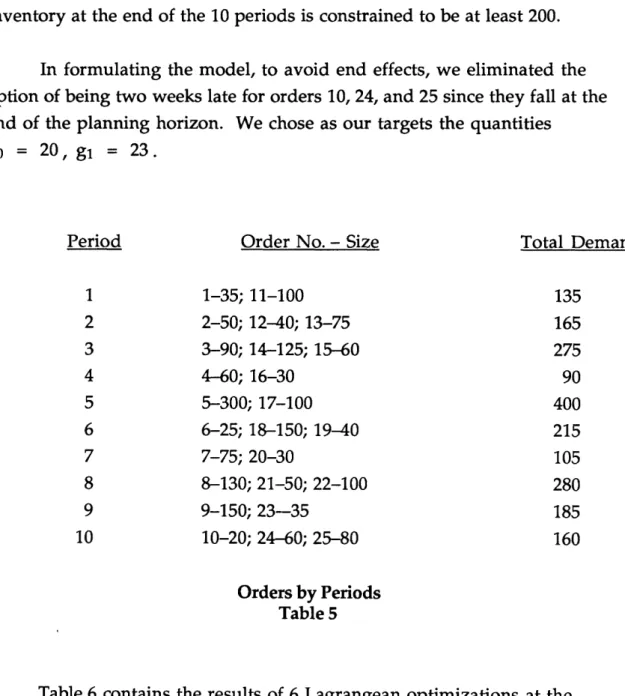
We illustrate the approach with a numerical example. Consider production of a single item with f = 3750, h = 7, yo = 300. Demand over the next ten periods by promised shipping period for 25 orders is given by Table 5. Inventory at the end of the 10 periods is constrained to be at least 200.
In formulating the model, to avoid end effects, we eliminated the option of being two weeks late for orders 10, 24, and 25 since they fall at the end of the planning horizon. We chose as our targets the quantities
go = 20, gl = 23.
Period Order No. - Size Total Demand
1 1-35; 11-100 135 2 2-50; 12-40; 13-75 165 3 3-90; 14-125; 15-60 275 4 4-60; 16-30 90 5 5-300; 17-100 400 6 6-25; 18-150; 19-40 215 7 7-75; 20-30 105 8 8-130; 21-50; 22-100 280 9 9-150; 23-35 185 10 10-20; 24-60; 25-80 160 Orders by Periods Table 5
Table 6 contains the results of 6 Lagrangean optimizations at the indicated multiplier values. Recall that these solutions are optimal for the customer service levels they span. The sequence of values of 7o and 7nl were selected by taking steps in subgradient directions.
Solution Number 1 2 3 4 5 6
ico 100 340 460 720 600 780
~R1 100 220 340 580 460 400
Solution Cost 13905 4400 14400 17655 15855 17655
Lagrangean Value 15105 16080 16560 16355 16600 16595
Order No. Order Qty
1 35 2 50 3 90 1 wk 4 60 5 300 2 wks 1 wk 1 wk 1 wk 1 wk 1 wk 6 25 1 wk 7 75 8 130 2 wks 2 wks 2 wks 1 wk 9 150 2 wks 2 wks 2 wks 1 wk 1 wk 10 20 11 100 12 40 13 75 14 125 1 wk 15 60 1 wk 16 30 2 wks 2 wks 2 wks 2 wks 2 wks 17 100 2 wks 1 wk 1 wk 1 wk 1 wk 1 wk 18 150 1 wk 19 40 1 wk 20 30 21 50 2wks 2 wks 2wks 1 wk 22 100 2 wks 2 wks 2 wks 1 wk 23 35 1 wk 1 wk 1 wk 24 60 25 80 1 wk Lagrangean Analysis Table 6
Several points are worth noting. The initial values of o and tli are
insufficient to induce a strategy near the desired customer service levels. By solution 4, however, the values of no and tl1 have increased significantly to
yield a strategy that exceeds the prescribed levels. In that strategy, 21 orders are shipped on-time (the target is 20) and 24 orders are shipped no later than one period late (the target is 23). This solution costs $17,655 compared to the
cost $22,455 associated with the solution in which all orders must be shipped on their promised dates, a reduction of 21.4%.
At the next iteration, solution 5, the subgradient optimization
algorithm selects lower values of nt0 and 7l . This solution violates the first goal by a little, namely 18 orders are shipped at their promised times rather than 20, but satisfies the second goal, namely 24 orders are shipped no later than one period late as opposed to the target of 23. Moreover, the cost of
strategy 5 is $15,860., or 10.2% lower than strategy 4.
The analysis is continued for one additional iteration to strategy 6, which is the same as strategy 4. One could argue that strategies 4 and 5
represent two attractive alternatives for the manager. He/She can save 20.4% of his/her avoidable costs by the relative mild slippage in the promised
shipping schedule given by strategy 4, or he/she can save an additional 10.2% by selecting strategy 5 which allows the number of orders shipped one period late to increase from 3 to 6.
Finally, we note that maximization of the Lagrangean E appears to occur around 16600. For the purposes of comparison, we formulated and optimized the MIP model (26) to (31), of which maximization M (R) is a relaxation, and found its value to be 17760. Thus, the duality gap appears to be on the order of 6%, a level to be expected for this type of MIP model.
Future Directions
We envision several directions of future research and development for the Lagrangean approach to multi-objective optimization developed in this paper. The approach needs testing on live industrial applications. In this regard, the railroad car distribution example presented above is an actual application where we hope the technique will one day be used. The cost vs. order completion optimization example was stimulated by planning
problems faced by production managers in the food and forest products industries.
The technique was successfully applied in the construction of a pilot optimization model for allocating budgets to acquire, install, and maintain new systems for the U.S. Navy submarine fleet (Manickas [1988]). For this class of problems, the multiple objectives were various measures of
submarine performance with and without specific system upgrades. Unfortunately, the project did not continue beyond the pilot stage to
implementation of an interactive system for supporting decision making in this area at the pentagon. The method was also applied to multi-objective optimization of personnel scheduling problems (Shepardson [1990]).
For effective practical use, the models and methods discussed here should be imbedded in decision support systems with graphical user
interfaces for displaying efficient solutions and soliciting human interaction. Korhonen and Wallenius [1988] report on the successful implementation of a pc-based interactive system for a multi-objective linear programming model used to manage sewage sludge, and for other applications. Interaction in this system is based on a "Pareto Race" method that allows the decision maker to freely search the efficient frontier by controlling the speed and direction of motion. A reconciliation of the Pareto race method with our Lagrangean and subgradient method is being studied.
Interactive analysis of multi-objective models would allow the
underlying preference structure, or utility function, of the decision-maker to be assessed by asking him/her to compare the most recently generated
efficient solution with each of the previously generated ones. The
information about preferences gleaned from these comparisons could be represented as constraints on the decision vector x (see Zionts and
Wallenius [1983] or Ramesh et al [1989]). Alternatively, we could apply the method of cojoint analysis developed by Srinivasan and Shocker [1973] to identify the decision-maker's ideal target vector g from the pairwise preferences.
References
G. R. Bitran [1977], "Linear multi-objective programs with zero-one variables," Math. Prog., 13, pp 121-139.
Charles River Associates [1991], "Quality-based pricing for service industries," Charles River Associates Review, Boston, March, 1991.
P. Korhonen and J. Wallenius [1988], "A Pareto Race," Nav. Res. Log., 35, pp 615-623.
K. Maiwand [1989], "Software engineering platform for OR/Expert system integration," paper presented at the ORSA/TIMS Joint Meeting, New York City, October, 1989.
J. A. Manickas [1988], "SSN configuration planning optimization model (pilot implementation)," Combat Systems Analysis Department Report, Naval Underwater Systems Research Center, Newport, Rhode Island/New London, Connecticut.
B. T. Polyak [1967], "A general method for solving extremal problems," Soc. Math. Dokl., 8, pp 593-597.
V. S. Ramakrishnan [1990], "A Lagrange multiplier method for solving multi-objective linear program," Master's Thesis in Operations Research.
R. Ramesh, M. H. Karwan and S. Zionts [1989], "Preference structure
representation using convex cones in multicriteria integer programming," Man. Sci., 35, pp 1092-1105.
J. F. Shapiro [1979], Mathematical Programming: Structures and Algorithms," John Wiley & Sons.
J. F. Shapiro [1990], "Mathematical programming models and methods for production planning and scheduling," Report OR-191-89, MIT Operations Research Center, revised October, 1990.
F. Shepardson [1990], private communication.
H. N. Shycon [1991], "Measuring the payoff from improved customer service," Prism, pp 71-81, Arthur D. Little, Inc. Cambridge, MA First Quarter, 1991. V. Srinavasan and A. D. Shocker [1973], "Linear programming techniques for multi-dimensional analysis of preferences," Psychometrika, 38, pp 337-369. R. E. Steuer [1986], Multiple Criteria Optimization: Theory, Computation, and Application, John Wiley & Sons.
H. M. Wagner and T. M. Whitin [1958], Dynamic version of the economic lot size model," Man. Sci., 5, pp 89-96.
S. Zionts and J. Wallenius [1983], "An interactive multiple objective
programming method for a class of underlying nonlinear utility functions," Man. Sci., 29, pp 519-529.