HAL Id: halshs-00552243
https://halshs.archives-ouvertes.fr/halshs-00552243
Preprint submitted on 5 Jan 2011
HAL is a multi-disciplinary open access
archive for the deposit and dissemination of
sci-entific research documents, whether they are
pub-lished or not. The documents may come from
teaching and research institutions in France or
abroad, or from public or private research centers.
L’archive ouverte pluridisciplinaire HAL, est
destinée au dépôt et à la diffusion de documents
scientifiques de niveau recherche, publiés ou non,
émanant des établissements d’enseignement et de
recherche français ou étrangers, des laboratoires
publics ou privés.
Evidences from Deforestation
Sébastien Marchand
To cite this version:
Sébastien Marchand. Historical and Comparative Institutional Analysis: Evidences from
Deforesta-tion. 2011. �halshs-00552243�
Document de travail de la s´
erie
Etudes et Documents
E 2010.16
Historical and Comparative Institutional Analysis: Evidences from
Deforestation
S´
ebastien Marchand
∗November 2010
∗Ph.D Student in Development Economics. Centre d’ ´Etudes et de Recherches sur le D´eveloppement International
(CERDI-CNRS), Universit´e d’Auvergne. 65, Boulevard F. Mitterrand, 63000 Clermont-Ferrand, France. Tel: (+33) 4 73 17 75 01, Fax: (+33) 4 73 17 74 28. E-mail address: [email protected].
I am very grateful to Martine Bouchut for her help. I also thanks participants to the graduate school seminar CES-CERDI-LEO held at Centre d’Economie de la Sorbonne in Paris (France), November 5-6, 2009 and participants to the NAKE research day held at University of Utrecht (23 April 2010). I also thank the multi-training program “International Governance, Universalism and Relativism Rules and Institutions: What Roles for International Institutions?” for financial support.
Historical and Comparative Institutional Analysis: Evidences from
Deforestation
S´
ebastien Marchand
Abstract
This paper investigates if inherited legacies (i.e legal origins on law and regulations and colonial legacies) interact in shaping the current institutional performances on deforestation in 116 developed and developing countries. A two step approach is implemented. First we investigate relations between colonial legacies-legal traditions and current institutional performances. We find that common law countries and previous British colonies have better institutions that French civil law and other past colonized countries. Second we provide two econometrics procedures to capture institutional persistences on deforestation by estimating current institutional effects on deforestation conditioned to inherited legacies. In a first time we run the deforestation model on different samples (according to three inherited legacies) and in a second time, interactive variables are introduced. We find that (i) French civil law countries deforest less than English common law ones; (ii) less corruption and more secured property rights decrease deforestation in English common law countries; (iii) better rules of law reduce deforestation but this result is more likely in previous British colonies or non colonized countries. Thereby this paper shows that current institutional performances are important factors in the process of present deforestation but also that these factors are shaped by past influences.
Keywords: Deforestation; Institutional persistences; Colonial legacies; Legal Origins; Corruption; Prop-erty Rights.
1
Introduction
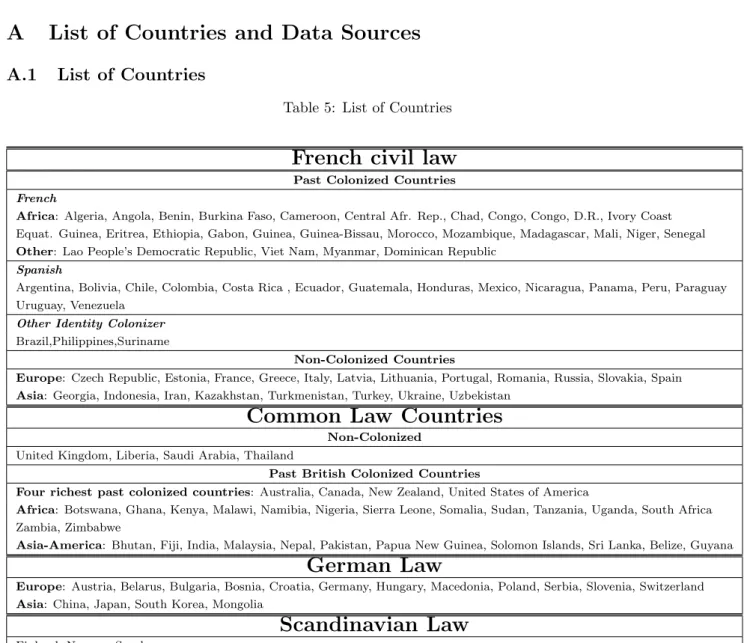
Institutional persistences have been studied to investigate relations between inherited legacies (economic, insti-tutional, social, political or cultural) and current institutional performances (Acemoglu et al.,2001;Acemoglu and Johnson, 2005; Chong and Zanforlin, 2000; Lange, 2004; La Porta et al., 2007). This literature argues that legal origins on law and regulation, the identity of the colonizer, conditions within past colonies or the form of colonization have shaped the institutional and political background, influencing, then, present economic and social performances1. These inherited legacies (legal origins, colonial legacies) are so considered as a main
“indirect” factor of development. Thus this paper belonged to the literature on historical and comparative in-stitutional analysis (HCIA) which states that the current inin-stitutional framework “is a reflection of an historical process in which past economic, political, social, and cultural features interrelate and have a lasting impact on the nature and economic implications of a society’s institutions” (Greif,1998, P.82). More precisely this study investigates implications of institutions shaped by inherited legacies on environmental performances measured through deforestation.
Moreover in the literature on determinants of deforestation, the institutional background is view as a signif-icant underlying cause (Geist and Lambin, 2002) which shapes economic incentives of economic agents. This way past institutional influences as legal origins or colonial legacies have patterned the current institutional framework implying some institutional persistences influencing the present deforestation. In this paper, we sug-gest that the level of corruption, the quality of the legal structure and property rights represent main features of the current institutional framework which could influence deforestation according to the literature. Hence the basic assumption is that corruption, property rights and legal structure have been shaped by legal origins on law and regulation and colonial legacies.
The main hypothesis found in the literature on institutional persistences is based on the role of European colonization implementing institutional rules in colonies. For instanceNovoa(2007) argues that “former British colonies have better property rights [...] (so) that former British colonies prospered relative to former French [...] colonies because economic and political institutions and culture were inherited from Britain” implying better conditions to reduce deforestation in these former English colonies. Thus this paper shows that legal origins and colonial legacies inherited could influence current institutional performances and so present deforestation.
In order to assess the effects of institutional persistences on deforestation, a two step approach is used. First we investigate relations between inherited legacies (as colonial legacies and legal origins) and current institutional performances. Second two econometrics procedures are implemented to capture institutional persistences on deforestation by estimating current institutional effects on deforestation conditioned to inherited legacies. In a first time, we run our deforestation model on different samples (divided according to inherited legacies) and in a second time we use interactive variables. We do not implement an IV procedure because, as noticed byLa Porta et al.(2007), “the problem here is the risk - which has grown larger as legal origin has been shown to correlate with more characteristics of the legal and regulatory environments - that legal origin affects finance through channels other than the laws protecting investors”. The problem for finance may be the same for deforestation. In fact inherited legacies as legal traditions or colonial variables shaped past institutional, politic and economic performances and so the direct “intrumented” effect may be spurious. Thus legal origins, colonial dummies or past conditions within colonies may influence deforestation through other channels than institutional variables used. For these reasons, we do not use an IV approach with inherited legacies as instruments for current institutions. By the way, the aim of this paper is to highlight the role of institutional persistences in the process
1The influence of legal origins on economics performance is well documented in literature. La Porta et al.(2007) provide a review
of the literature andGlaeser and Shleifer(2002) provide a historical and theoretical explanation of the emergence of the common law in Great Britain and the civil law in France. Klerman and Mahoney(2007) invalidate the Glaeser and Shleifer’s hypothesis against the historical evidence.
of deforestation and an IV procedure is not the sole econometric solution. In consequence we prefer to implement our two stage procedure.
Another important econometric issue relies on the use of time-invariant variables (i.e the inherited legacies) in a fixed effect framework. A panel dataset is used in order to assess a more “robust” effect of legal origins and colonial legacies on deforestation through current institutional performances. However, traditional fixed effect model does not allow to estimate the effect of time-invariant variables. Therefore we implement the fixed effect vector decomposition (fevd) proposed byPl¨umper and Troeger (2007). This method provides unbiased and efficient estimations of varying time variables but also of rarely changing/time invariant variables and is well suitable for our estimation.
The rest of the paper is organized as follow. Section 2 provides an overview of the literature on institutional persistences. Section 3 introduces the issue concerning the persistence of institutions in the current deforestation process. We highlight the role of legal origins and colonial legacies on corruption, property rights and legal structure as well as implications for deforestation. Section 4 introduces the econometric approach. Then section 5 shows and discusses main econometric results. To conclude a final section tries to put forward some political implications.
2
Overview on the Literature of Institutional Persistences
Over the past few years, several studies have investigated the persistence of both politic and economic institu-tions. These studies investigate how these persistences over time have shaped economic development. In order to clarify this review, we firstly discuss some possibilities explaining institutional persistences. Then literature on legal origins is presented followed by the literature on colonial legacies linked to conditions within colonies.
2.1
Are there institutional persistences?
Acemoglu et al.(2001) argue that paths of institutional development relies on economic or political mechanisms which explain why institutions persist over time. More deeply North (1994, p.359) notices that “institutions form the incentive structure of a society, and the political and economic institutions, in consequence, are the underlying determinants of economic performance”. Thus institutions are the incentive structure created by humans and imposed on human interactions in order to determine human choices that shape the performance of societies and economies over time. Put differently institution are the rules of game and these rules could persist over time trough legacy or cultural heritage. This way the colonization of the New World by European give a natural experiment to understand why some political or/and economic institutions have persisted after independence.
In several papers with different co-authors, Daron Acemoglu provides different explanations of institutional persistences. First the design of institutions that encourage property rights, limit corruption, build some re-strictions on government power or provide other public goods may be costly (Acemoglu and Verdier, 1998;
Acemoglu et al., 2001). Thus the investment in de facto political power for citizens is important and if this cost had not been supported previously by the colonizer, at independence the elites could maintain institutions favouring them (extractive institution in Acemoglu et al.(2001) or labor repressive institutions inAcemoglu and Robinson(2008)). Hence, political or economic institutions could persist over time due to the great cost to change institution.
Second the size of the elite may determine the persistence of institutions. The size of the leader group conditions the allocation of resources given that the expected returns from controlling politics is greater with small elites. Therefore, economic institutions as well as bad political ones (dictatorship,..) may persist if the
power, after independence is given to a small domestic elites2.
Third as noticed by Acemoglu et al. (2001, p.1376), institutional persistences occur ”if agents make some irreversible investments that are complementary to a particular set of institutions (doing them), they will be more willing to support them, making these institutions persist”. Put differently, public good investments (human capital or infrastructure) made by colonizer push agents to invest to protect them (enforce property rights, government effectiveness,...).
More broadly institutional persistences rely on cultural, social or political legacies provided almost by col-onization through legal origins on law and regulations and colonial strategies depending on conditions within colonies.
2.2
The Legal Origins Theory
The Legal Origins Theory of development has been developed by La Porta, Lopez-Silanes, Vishny and Shleifer (LLSV-several papersLa Porta et al.(1997,1998,2007)) and focuses on inherited legal system and investigates the trade-off civil law/common law system to explain economic and social performances. According to these authors, legal traditions are defined by “the style of social control on economic life” (La Porta et al.,2007) and determine the legal system. In fact they argue that the legal framework is influenced by political institutions (legal procedures,...), ideology, broader attitudes and philosophy which depend on the historical institutional framework represented by legal origins.
Thereby as noted by La Porta et al. (2007) the “foundation of research on legal origins is the idea that some national legal system are sufficiently similar in some critical respects to others to permit classification of national legal system into major families of law” to study economic performances through legal traditions3.
This way, this theory suggests that all law in a country is influenced by the English common law or the French civil law. The first one originates in the laws of England and has been transposed through conquest and colonization to England’s colony, including the United States, Canada, New-Zealand, Australia and many countries in Africa and Asia. The second one originates in the Roman law. Rediscovered in the eleventh century by the Catholic Church (Glaeser and Shleifer, 2002), the civil Roman law shaped the law in many European countries. However, the French civil law is ascertained at the beginning of the nineteenth century after the French Revolution with Napoleon Bonaparte. This French law had been exported in many countries like Spain, Portugal, Belgium, Italy, Netherlands through Napoleon’s conquests. Moreover, the French civil law had been transposed in many countries in the world through colonization and conquest by France in the nineteenth century in Oceania, Indochina, Africa and some Caribbean Islands. Besides, French civil law influences had also been implemented in Latin South American countries in the nineteenth century after independence of Spanish colonies and Portuguese ones. Hence French civil law is now present in many South American, African and Asian countries.
In the literature La Porta et al.(1997, 1998) investigates the link between the law and finance. They show that in civil law system the legal framework has been designed to keep investors poorly and stock market less developed contrary to the common law one protecting and motivating their investors. La Porta et al.(1999) studies determinants of political institutions as government performance (provision of public good, effectiveness, government spending). They highlight some political theories to explain the quality of government and assume that legal origins can be good proxies for these political theories. They argue that the legal traditions on law and regulation could predict “inefficient, interventionist and distortionary policies”. For instance they show that
2SeeAcemoglu et al.(2001) for some Latin American and African examples.
3However, each country has a particular national legal system because each country has experienced its own change and its
own local circumstances. However as noted byLa Porta et al.(2007) “although this singular adaptation and individualization, fundamental transplanted features have remained and persisted”.
common law countries are less interventionist, better public good suppliers, more efficient and democratic than civil law countries. They argue that “the state-building intend incorporated into the design of the French legal system translates, many decades later, into significantly more interventionist and less efficient government, less political freedom and evidently less provision of basic public goods” (La Porta et al.,1999, p.261-262). In another paper, La Porta et al. (2004) investigate the role of legal origins on judicial independence and constitutional review. In this study, they argue that common law countries have a better judicial independence associated to more economic freedom than civil law ones. The basic idea is that past judicial features, representing by legal origins, influence current judicial institution.
Besides Mahoney (2001) investigates the role of legal origins on growth through better property rights and contract rights using legal traditions as a reflection of different philosophies of government. He argues that common law system emphasizes personal freedom in order to aim individual claims whereas the civil law framework emphasizes government’s freedom in order to pursue collective ends. He shows that common law system enhances property rights and contract rights.
Others papers focuses on inherited legal system in African countries. For instanceJoireman(2001) compares the effectiveness of the rule of law inherited from civil and common legal systems in Africa. She finds that the civil law system appears to be worse to provide the rule of law than common law according to the ICRG Rule of Law index. She discusses the bureaucratic effectiveness issue suggesting that common law countries rely more on the process rather than the application of a code so that this system is less dependent on an effective bureaucracy to give a proper application of the law. This argument is closer to the Hernando de Soto’s thesis on the necessity of a efficient legal system to reduce opportunity costs and increase investment (de Soto,2000) given that a weak effective application of law due to an inefficient bureaucracy creates some costs (pecuniary, time,...). Moreover Grier (1999) investigates relationship between the identity of the colonizing power and current economic growth in former African colonies. He finds that former British colonies have better economic performances than French ones. He argues that “it is perhaps not surprising that the former British colonies have performed significantly better in the post-colonial era, given the fact that British decentralization and flexibility allowed colonies to adopt the institutions that best suited their situation. While centralization and bureaucratisation may have [...] allowed the French to pursue The “republican ideal” in West Africa, it may have established colonial institutions and customs that were not conducive to development and growth after the colonial period” (Grier, 1999, p.320). He highlights econometrically that the level of education at the time of independence explains the development gap between the former British and French colonies in Africa suggesting that political institutions brought by the colonizer shaped the past economic and politic institutions in colonies creating some legal features encouraging or impeding the post-colonial development.
To conclude as noticed byLa Porta et al. (2004, p.449), “legal origin has proved to be a particularly useful variable for economic analysis because laws have been transplanted by relatively few colonial powers, leading to systematic variation in the legal rules”. This way, legal origins could represent several past institutions (judicial features, political, law,...) allowing us to study theirs consequences on deforestation in order to highlight the role of institutional persistences.
2.3
Institutional Persistences and Development: Conditions within Colonies
Among the literature on institutional persistences, some papers focus on colonial institutions and argue that they could persist over time4.
This way the paper ofAcemoglu et al.(2001), on the role of colonial origins in development process through institutions, highlights the importance of the issue of institutional persistences. In this study, Acemoglu and
4The literature on legal origins, of course, is linked to this literature but other authors try to study differently this issue suggesting
his co-authors argue that Europeans colonizers adopted several colonization strategies with separate associated institutions depending on conditions in colonies. They explain that the feasibility of European settlement characterized by the mortality rates of colonizer determined the colonization strategy. More precisely conditions in colonies (the disease environment and the density of population) had conditioned the European strategies. Besides they argue that past institutions have persisted over time so that current effects of present institutions on economic development could be explained by past institutions designed by Europeans in their colonies. They show econometrically that previous “extractive colonies” characterized by a high level mortality of settlers experienced bad institutions impeded their current ones and so their level of development. Unlike these extractive colonies, the “settler colonies” had good institutions brought by the colonizer which have persisted over time encouraging economic development in these past colonies.
In several papers Stanley Engerman and Kenneth Sokoloff (Engerman and Sokoloff, 1994, 2000;Engerman et al., 2002) argue that initial conditions or factor endowments explain persistences of economic institutions as inequality in the distributions of wealth, human capital and political institutions. As they notice, colonies established in the Caribbean or Brazil, with a climate and soil conditions well suited for growing crops (sugar,...) produced on large slave plantations, were characterized by large numbers of slaves obtained through the inter-national slave market, generating a huge uneven distributions of wealth, human capital, and political power. In contrast, they argue “that family-sized farms were the rule in the northern colonies of the North America, where climatic conditions favoured a regime of mixed farming centred on grains and livestock that exhibited quite lim-ited economies of scale in production and used few slaves” (Engerman et al.,2002, p.46). This circumstances allowed an equal distribution of wealth and human capital encouraging investment and development. Hence they argue that economical inequality (unequal land, wealth, human and physical accumulation distribution) justifies institutional persistences given the fact that economical inequalities leads to bad political institutions which endorses huge economic inequalities and so after bad political institutions (corruption, persistence of elites,...).
Moreover Lange et al.(2006) argue that differences between the British and Spanish economic model had large consequences for the type of areas they preferred to settle, the extent of colonial institutional building they designed and so legacies they left after independence. They show that Spanish and British colonizers pursued different levels in the colonial institutional founding due to factor endowments in pre-colonial areas. Spanish mostly settled and concentrated colonial institutions in the most populous, politically and economically developed colonies at the beginning of the colonial era whereas British limited settlement and institutional transformation in the more populous, politically and economically developed pre-colonial areas. Thereby they find that the level of colonialism had opposite effects on long-run socio-economic development for the Spanish and British colonies. More extensive British colonialism introduced an effective administration and a rule of law promoting development after independence whereas more extensive Spanish colonialism produced inefficient markets and predatory states leaving stratified societies after independence. Thus this study explains that colonialism depends on both the colonizer’s identity and conditions within colonies arguing that these separate colonialisms shaped past political and economical institutions with current impacts on present institutions.
Finally Lange (2004) investigates the relationship between the form of colonialism and post-colonial de-mocratization in 33 former British colonies. This paper uses the general framework of Acemoglu et al.(2001) suggesting that the form of colonialism was made up by the density of pre-colonial population and the disease factor. However Lange (2004) focuses on two forms of dominations: an integrated one or directly ruled and an dispersed one or indirectly ruled. He finds that the legal-administrative institutions in the indirectly ruled dominations which linked the colonial administration to local people via chiefs enhancing their executive, leg-islative and judiciary powers, experienced bad current institutional performances (measured by the ICRG index and the democracy index of Freedom House) contrary to the direct ruled system based on formal rules and a
structured legal-administrative system.
3
Institutional Persistences and Deforestation
In order to theoretically study institutional persistences in the process of deforestation, we investigate the role of colonial legacies on deforestation. Thereby we suggest that these persistences may influence present institutions and deforestation through colonialism effects divided into three categories: the identity of colonizer, the legal origins on law and regulations and conditions within colonies.
3.1
Colonizer’s Identity: Forest Law Legacies in French and British Colonies
We argue that French or British legacies could influence present deforestation through the past forest colonial policy implemented and political/cultural legacies (rule of law and property right).
Overview of the Past Forest Legal Framework in France and Great Britain The regulation of forest activities is a political preoccupation for a long time (Maurry, 1850; Cox, 1905; Huffel, 1925; Dev`eze, 1973;
Gaurier, 2006) with several differences between countries and more particularly between France and Great Britain. In 1827, French monarchy implemented the Code Forestier in order to improve the economic, social and environmental value of forested areas5 whereas Great Britain did not enhance its medieval royal forest law implying more and more deforestation during the nineteen century (Brousse, 1828)6.
This separate conception of the forest between these two main colonizer countries in the nineteenth century had deeply conditioned the role of forest law in their colonies.
British legacies Contrary to forest management in the Great Britain, British colonies had been hardly environmentally protected. Under the British imperialism emerged important environmental initiatives, begun in 1806 in India. As noticed by Ribbentrop (1900), the General Inspector of forest in India, an embryo of conservation was born in some states7 to ensure sustainable production of Teak for the construction of vessels for the British Navy in a context of increase and irreversible shortages of Oak in the metropolis.
The Empire forestry really began in 1855 with Lord Dalhousie’s forest Charter which implemented a per-manent forestry policy with a forestry administration. The empire forestry was founded by environmentalists and legislators to implement a durable management of forestry resources to serve industrial, budgetary, environ-mental and settlement purposes (Barton, 2001, p.529-530). Using French and German experiences in scientist management, British colonizers developed an huge proper management of forestry resources. Indian empire was the first area practising this management and as noted by Barton (2001, p.534) “Indian forestry (was) slowly transformed into “empire forestry” (d)ue to the massive drain on forest resources that World War I entailed, shortages heightened national security concerns over timber supply”. Concerning British Africa, forests depart-ments were progressively created with Indian expertise. In East Africa forest law began by forest regulations in 1902 and the formation of a forest department for British East Africa. An Indian forest officer, H. N. Thompson, created a forest department in southern Nigeria and then in the Gold Coast. Finally, a forest department was formed in Sierra Leone in 1911.
5After the French revolutionary, forest resources considered as royal resources plundered and ravaged through enclosures and
privatisation. To stop this huge deforestation, the Code forestier was created.
6As in France until the Code forestier, forest resources being royal and medieval resources were privatized through enclosures
to promote agricultural and industrial development of British society. However, contrary to France, the legal forest framework had not been improved. The past royal forest law inherited from Normans Dukes remained the legal framework until the first world war.
French legacies In West African French colonies, a forest law had been implemented in July 1900 by the Colonial Service of Agriculture and Forests (Ribot, 2001). This first forestry legislation based on the French Forest Code, implement that all forested areas are under colonial state control. Thereby permits and concessions were created and allocated by the Governor-General and his delegates so that all woodcutting decisions were handled only by the executive and not by the forest service. Moreover this code designed use rights for local populations previously possessed (grazing, hunting,...). More broadly as noticed byRibot(2001, p.2) “this first West African forestry code placed commercial rights under state control while relegating rural populations to forest products considered to have no commercial value”.
In 1935, a New French West Africa forestry code (covering Senegal, Guinea, Sudan, Niger, Upper Volta, Dahomey and Mauritania) was implemented to shape forest law in all of Francophone West Africa. This new code reinforced state ownership and control on forested areas and still defined limited non-commercial rights for natives. Similar to the 1900 code, this code created permits for all commercial forest exploitations but unlike the 1900 code, it had implemented several use restrictions and penalties for infractions. Moreover for the first time classified forests were legally introduced allowing these areas to be protected from natives’ use rights. Another important issue of this code is related to the identity of permit holders given the fact the permit holders had to be French nationality8. To resume the main issue in the French colonial forestry policy was
commercial preoccupations and how control revenues generated as noticed byRibot(2001, p.6) who argues that ”the few controls concerned who could do it, rather than whether or how cutting should take place (so that) (a)n elaborate system of forestry regulations served to enrich a small, mostly urban elite while relegating rural people to those uses that did not interfere with trade”.
After independence, this dual system between rural agent with use right and urban/elite agent with com-mercial right has persisted in the countries of the Sahel. The power of forestry department over planning, production, and marketing is still important by determining commercial uses for licensed professionals and sub-sistence ones. This forestry management approach “fits into a larger system of citizen and subject where citizens have commercial rights and subjects are relegated to usufruct. Use rights of rural populations are privileges that can be taken away at any time, if commercial interests choose to expand their operations. At Independence, the distinction between citizens and subjects was dropped in law, but was maintained in the de facto distribution of rights between rural and urban worlds”Ribot(2001, p.11).
Some papers discuss of the pattern of forestry management in past French African colonies. For instance
Becker(2001) investigates this issue in Mali arguing that colonial legacies represented by a centralized forestry management with nationalization of all forested land continued after independence. This persistence has resulted in a constant difference between state’s use and peasant’s use of natural resources. This study of past state initiatives and current peasant activities contributes to understand contemporary changes in land use. The author compares finally a local-level management approach, developed recently in Africa (Ribot and 2006.,
1995) with the past state-level management approach. BesidesWardell et al. (2003) investigate the effects of colonial legacies on contemporary land use pattern in the Central-West Region, Burkina Faso and the Upper East Region in northern Ghana. They argue that pre-colonial determinants and the colonial forestry interventions may have influenced current land and natural resources management regimes. They show that historical factors actually shape the degree of access that local communities have on natural resources in areas protected by the state. This study highlights the importance to analyse the effects of historical determinants in the process of deforestation for two reasons. First these factors allow to apprehend the pace of deforestation in a long term view and second because past evolutions conditioned current ones such as dynamics of population, institutions,
8By the Indigenat Code, only French citizens (from France) and Senegalese living in the urban centres and fluent in French were
considered as French nationality. Thus trade of forestry resources were concentrated in the hands of urban elites and Europeans. Despite the abrogation of Indigenat code, this system has persisted over time until independence and after (Ribot,2001;Becker,
and so on.
Therefore to resume, French forest management legacies in previous African colonies is, above all, a uneven dual system with a non community-based participation and a strong forestry administration deciding where and how much cutting wood. The colonial system was implemented to manage durable forestry resources in order to provide commercial revenues for the metropole. Though forest policies and forest laws in former colonies, and especially in African countries, have been modified since their independence, our main assumption is that there are some institutional differences in these countries which could be explained by the former colonial forestry policy. Thereby despite many improvements like more decentralization of forest management (Karsenty, 1999;
Ribot, 2001), current differences in deforestation could be explained by legal origins on forest law and forest policy.
To conclude we put forward that colonial strategies to manage forest in colonies had been different between French and British colonizer. However it may be difficult to assess this effect i.e the past colonial influences on the present forest law framework through the past forest law one. A colonial dummy may not capture this effect given the fact that a such dummy could captured more information that only forest legal legacies. Other colonial legacies may be political, cultural and so on. Thus the sole conclusion could be that French or British legacies outperform the other legacies in term of deforestation. Above all, it is interesting to study colonial legacies on deforestation.
3.2
Legal Legacies: the Role of Legal Origins
Legal origins of law and regulations could influence current deforestation by shaping the current institutional performances as legal system/property rights and corruption.
3.2.1 Legal Origins, Property Rights and Deforestation
As shown earlier the Legal Origins Theory argues that legal traditions on law and regulation shape the current legal framework. For instance La Porta et al.(2004) highlight that common law countries have more secure property rights that French civil law ones due to a more judicial independence9. This legal feature in common
law countries (see Glaeser and Shleifer (2002) for an historically and theoretically explanation of judicial in-dependence in common law countries) represents the judge’s inin-dependence to executive and legislative powers. Following Montesquieu andHayek(1960), those authors explain that the administration of the justice and the creation of law have to be independent. This independence between justice and legislature allows to develop and secure property rights given that judicial independence is important to guarantee an impartial judgement in a private dispute almost if one party is politically connected or a fortiori if the state is a litigant. Thereby this independence secures property rights and enhances economic freedom.
The literature on factors of deforestation highlights theoretically (Mendelsohn,1994;Angelsen,1999;Hotte,
2001) and empirically (Deacon,1994;Araujo et al.,2009) the influence of secured property rights on deforesta-tion. This wayDeacon(1999);Bohn and Deacon(2000) emphasized that capital intensity of resource extraction could differ between natural resources implying separate effects of risk ownership. For instance a less intensive capital extraction process as deforestation implies that miss-defined property rights produce over extraction. Thereby in a case of miss secured property rights, the discount rate would be less important due to the fact that the risk of losing ownership conditions future returns for forestry activities. Hence an agent prefers to cut wood and develop agricultural activities rather than forestry ones because it is discounted heavily to maintain forestry activities.
3.2.2 Legal Origins, Corruption and Deforestation
The role of legal origins on deforestation could be explained by the influence of corruption. In fact legal traditions shape the extend of corrupt activities in a society. For instance (La Porta et al., 1999) show that common law countries have less-corrupt societies than civil law ones because the latter is often associated with an important government ownership and regulation which are associated with many adverse impacts on markets such as corruption10.
In the literature on causes of deforestation, the role of corruption is well admitted but less studied (Amacher,
2006; Søreide, 2007). More precisely given that corruption is associated to interactions between public and private entities, corruption is studied in the implementation of concessional rights in which a private logger can harvest on a public land (Karsenty et al.,2008). Consequently to have the right to cut wood, the logger has to obtain a permit and after could be controlled in order to verify if quotas are respected. In this private-public relationship, corruption is defined like an informal pro-deforestation policy enhancing rent seeking activities and allowing a miss-management forestry production which leads to an over-extraction of resources. Moreover corrupt activities in forestry are more relevant in the case of tropical deforestation for three reasons put forward by Callister (1999); Contreras-Hermosilla (2000). First forest activities are often located in remote areas, far away from the press, political power and public (Hotte, 2001). Second timber is not inventoried but only valuable so that it is very difficult to assess how much wood was illegally extracted. Third in developing countries government officials are often badly paid and have often an important discretionary power which This combined with high valued timber-logs, favours corruption. Thereby a well-developed corruption could enhance illegal activities and the extent of these corrupt activities in the forestry is often reported either at the “grand” level (policy makers) or at the “petty” level, (civil agents)(Callister,1999;Søreide,2007;Transparency-International,
2007).
In the literature, few papers analyse theoretically and empirically this issue. For instance Eerola (2004) analyses interactions between two lobbying agents, a monopoly harvester and an environmental organization, to compete to influence the principal (the incumbent government) who determines the forestry policy. He shows that the effect of lobbying i.e grand corruption depends on if the monopoly is an exporting industry or a domestic market provider. Moreover Barbier et al.(2005) provide a lobbying and natural resource conversion model to analyse the role of corruption on deforestation showing that corruption increases land conversion.
Wilson and Damania (2005) analyse the effects of political competition on natural resources protection and show that competition could reduce only a type of stratified corruption. Bulte et al. (2007) investigate the effect of rural subsidies on deforestation through agricultural efficiency. They use a principal-agent model but their analysis focuses more on efficiency than on deforestation. Delacote(2008) provides a theoretical model to explain the link between systemic corruption (grand and petty corruption associated) and forest harvesting. He shows that this link relies on the nature of scale effects in the forestry. Moreover he considers several loggers and three forestry policy goals whereas previous papers likeEerola(2004) orBarbier et al.(2005) consider only one political aim, the level of forest conservation.
3.3
Conditions Within Colonies
As pointed earlier conditions within colonies shape the type of colonialism which in turn shaped the past legal framework and the current one. This way these conditions could influence current deforestation through the current institutional performances. Thereby we focus on different forms of colonialism belong the disease environment and the pre-colonial population and use the level of mortality of settler provided by Daron Acemoglu
10Several papers study the impact of government regulation and government ownership of economics activities. For instance
to capture these effects.
4
The Econometric Model
4.1
The Deforestation Model: The Basic Equation
Our empirical approach is given by an equation in which the rate of deforestation is explained by variables suggested by the literature. The basic assumption is that there is a steady-level of the logarithm of the forest cover in a country i at time t, lnFi,t∗. Hence the steady state is determined by traditional factors of deforestation and the dynamic to go toward this steady-state is represented by a linear first-order difference equation given by lnFi,t = θlnFi,t−1+ θ0 with θ0 is a constant. A first-order Taylor approximation around the steady-state
gives
lnFi,t= lnF∗+ (lnFi,t−1− lnFi,t∗)θ (1)
Subtracting LnFi,t−1 from both sides to have a rate of deforestation and arranging, we have
− (lnFi,t− LnFi,t−1) = (1 − θ)LnFi,t−1+ (θ − 1)lnFi,t∗ (2)
If we replace (θ − 1)lnFi,t∗ by Xi,tγ, with γ represents coefficients associated to the matrix of explanatory
variables, X, we have
− (lnFi,t− LnFi,t−1) = (1 − θ)LnFi,t−1+ Xi,tγ + ζi,t (3)
With ζi,t, a disturbance term.
Thus the level of forest cover in a country follows a pace determined by (1 − θ) and the steady-state level is influenced by explanatory variables as institutional ones.
However we suggest that there are institutional persistences which could explain the current level of defor-estation through their effects on current institutional variables. In order to model and test our predictions, we use a two step approach. The first one consists in analysing correlations between inherited legacies (legal origins, colonizer’s identity and settlers’ mortality) and intermediate outcomes (current institutions). This first stage allows to assess the role of past influences on current institutions i.e to highlight institutional persistences. The second step focus on the relationships between institutional persistences and deforestation using two method: i) we divide the sample belong to three main inherited legacies - legal origins, colonizer’s identity and settlers’ mortality; and ii) we use interactive variables between inherited legacies and current institutional variables to analyse the effect of institutional variables on deforestation conditioned to inherited legacies.
4.2
Econometric Procedures to Assess Institutional Persistences
4.2.1 Inherited Legacies and Current Institutions
Institutional persistences may be studied by estimating the role of inherited legacies on current institutions. Thus current institutional variables are regressed on inherited legacies i.e the legal origins on law and regulation, colonial dummies (colonizer’s identity) and European settlers’ mortality.
Hence the following equation is estimated
institutioni,t= α0+ α1legaciesi+ n X k=1 αkX i,t k + εi,t (4)
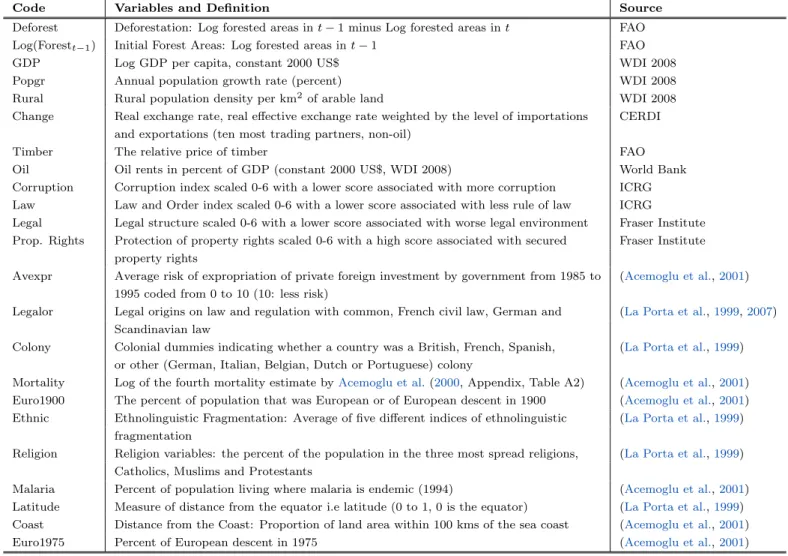
measure these performances, we use five institutional variables: the level of corruption, the quality of the legal structure (Legal index), the quality of property rights (Prop. Rights index), the rule of law (Law) and the average expropriation risk from 1985-1995 (see table6, page28for more details).
Institutional performances are explained by legacies variables which are i) legal origins on law and regulation with common law (the reference), French civil law, German law and Scandinavian law (this two last legal origins are considered as a mix of common and French civil law); ii) colonial dummies for past British colonies (the reference), French ones, Spanish ones and an other category gathered previous German, Italian, Belgian, Dutch or Portuguese colonies; iii) the log of European settlers’ mortality to assess European colonialism strategies.
Moreover Xi,t represents control variables which could conditioned the institutional persistence effect. First
in the regressions with legal origins and colonial dummies, these following control variables are used: i) eth-nolinguistic fractionalization (measured as the average of several measures of ethnic diversity), ii) religious (composition of the population - the percentage of the population in the three most widely spread religions, Catholics, Muslims and Protestants), iii) latitude and, iv) the log of per capita income11. As noticed byLa Porta et al.(1999), legal origins and religion can be correlated given that common law and Scandinavian countries have more protestants whereas Catholics countries have more a civil law system. Another control variable is used in the specific case with colonial dummies. Given that the model is run only on previous colonized countries, we introduce a dummy variable Rich4 = 1 for USA, Canada, New Zealand and Australia. In fact these four richest countries in the sample, called the Neo-Europe, are coded as previous British colonies and to avoid outliers, their income specific effect is controlled.
Second we use different control variables following Acemoglu et al.(2001) in the third regression (i.e settler mortality). The fraction of the population of European descendants in 1975 is used. In fact as noticed by
Acemoglu et al. (2001, p.1391), “a related concern is that in colonies where Europeans settled, the current population consists of a higher fraction of Europeans. One might be worried that we are capturing the direct effect of having more Europeans (who perhaps brought a “European culture” or special relations with Europe)”. Besides the percent of population living in potential malaria areas is used to capture the direct effect of malaria on economic performances. Last we control for the population living within 100 kilometres of the sea coast. Moreover latitude, Rich4, log of per capita income and the the ethnolinguistic fractionalization are used.
To assess coefficients of time-invariant variables (i.e our inherited legacies) with a Fixed Effect model, the fixed effects vector decomposition (fevd) model developed byPl¨umper and Troeger(2007) is used. This method uses a three stage estimator for the estimation of time-invariant variables in panel data models with fixed effects. We develop this estimator in the section4.3.
4.2.2 Inherited Legacies, Current Institutions and Deforestation
The “Divide Sample” Procedure To study conditional effects of institutions according to inherited legacies on deforestation, we divide the sample according to inherited legacies. First legal origins divided between French civil law and English common law are used to represent legal and cultural legacies. Second the colonizer’s identity separated between French, British and Spanish constitute more broadly political and institutional legacies. Third settlers’ mortality divided in three groups is used in order to study, notably, consequences of colonial strategies. More precisely 26 countries represent the first group with a settler mortality (in log) of ≤ 4.26, 19 countries in the second group if mortality is < 4.26 and ≥ 5.10. The final group have 22 countries and the maximum settler mortality is 7.98 in Mali.
11We useLa Porta et al.(1999)’s data where religious features are the percentage of total population in 1980, the ethnolinguistic
fractionalization is an average value of five different indices ranges from 0 to 1 and the latitude is the absolute value of the latitude of the country, scaled to take values between 0 and 1.
Thereby the following equation is estimated
def oresti,t= γ0+ γ1ln(F oresti,t−1) + γ2ln(GDPi,t) + γ3ln(GDPi,t2) + γ4rurali,t +γ5P opgri,t+ γ6T imberi,t+ γ7Changei,t+ γ8Institutioni,t+ ζi,t
(5)
With def oresti,t is the rate of deforestation so −(lnFi,t− LnFi,t−1), F oresti,t−1 is the level of forest cover
in t − 1, ln(GDPi,t) is the logarithm of GDP per capita and ln(GDPi,t2) its squared equivalent, popgr is the
growth of population, rural is the rural population density, timber is the relative price of timber, change is the real exchange rate and ζi,t represents the idiosyncratic error and the unit fixed effect.
Last the variable Institution is successively corruption, Legal index, property right index, rule of law and expropriation risk.
The “interactive variable procedure” Another way to assess institutional persistences relies on using interactive variables. Although we could interpret these variables in two ways, the use of inherited legacies allows to interpret reasonably these variables in one way. For instance an interactive with a positive coefficient between corruption (compute as high score for high corruption) and the past forested areas could be analysed in two ways. First more the forested areas is important, more an increase in corruption raises deforestation (previous forested areas strengthen the positive effect of corruption on deforestation). Second more the level of corruption is high (i.e more the variable corruption increases), more will be the scarcity effect (the positive effect of forested areas on deforestation). However using inherited legacies we could analyse interactive results in one way: the institutional effect is weakened or strengthened according to each legacies variable.
Thus each institutional variable is interacted with each following inherited legacies: legal origins (French, German and Scandinavian, i.e common law is the reference), colonial dummy (French, British, Spanish, Other colony, i.e Non-Colonized is the reference) and settler mortality.
Hence the following equation is estimated
def oresti,t= γ0+ γ1ln(F oresti,t−1) + γ2ln(GDPi,t) + γ3ln(GDPi,t2 ) +γ4Rurali,t+ γ5P opgri,t+ γ6timberi,t+ γ7Changei,t +γ8Institutioni,t+ γ9Institution ∗ Legaciesi,t+ γ10Legaciesi+ ζi,t
(6)
Where Institution ∗ Historical is the interactive term. However Legaciesi is the additive term or the
“direct” effect of inherited legacies. In fact we argue that even if these legacies influence current institutional effects on deforestation (i.e institutional persistences), they could have some effects on deforestation through other omitted variables given that inherited legacies represent political, cultural and institutional legacies.
Besides in order to assess coefficients of time-invariant variables (i.e our historical variable) with the Fixed Effect model, the fixed effects vector decomposition (fevd) model developed by Pl¨umper and Troeger (2007) is used. This method uses a three stage estimator for the estimation of time-invariant variables in panel data models with fixed effects. We develop this estimator in the following part.
4.3
A Panel Data Approach with Non-Time Varying Variables
The estimation of inherited legacies effects can constrain us to use a cross-country approach and so it does not allow to control for fixed-state effects and temporal effects. In order to do this, we could use dummy variables for each country and each year but this approach goes up the number of control variables and so reduces the number of degrees of freedom.
In order to control for these specific countries and temporal effects, a panel data approach is used. The problem is that inherited legacies as legal origins are time-invariant variables and dropped in a fixed effect (FE) model. Hence two solutions occur. The first one is to use a random effects model but this model implies orthogonality between explanatory variables and random effects12
The second solution is to assess coefficients of time-invariant variable with the FE model by using the fixed effects vector decomposition (fevd) model developed byPl¨umper and Troeger(2007). This method uses a three stage estimator for the estimation of time-invariant variables in panel data models with fixed effects. This estimator also allows to assess rarely changing variable defined as having a low within variance. A traditional FE model results from its inefficiency in estimating the effect of these variables so that the inference could be wrong. Our variables of corruption are typically those rarely changing variables with a little longitudinal variance (or within variance). This method is called “fixed effects vector decomposition” (fevd) because the estimator decomposes the unit fixed effect into two parts: a part explained by the time-invariant (or the rarely changing variables) and an unexplained part (the error term). More precisely the fevd technique implies three steps. In the first one the unit FE is estimated by running a FE model (within estimator) estimate of the baseline model. In the second stage the procedure separates the unit effects into its two parts by regressing the unit effects on the time-invariant (and/or rarely changing explanatory variables) of the original model. Last the third step implements a pooled-OLS estimation of the baseline model by including all explanatory time-variant variables (present in the first stage), the time-invariant variables (and/or the rarely changing variables) and the unexplained part of vector of FE (estimated in the second step). This latter stage allows computing correct standard errors for the coefficients of invariant variables. Thus the procedure is as follow
yi,t= β0+ M X m=1 βm.Xm,i,t+ K X k=1 βkZk,i+ µi+ ζi,t (7)
where the m-variables are time-varying variables, the k-variables are assumed to be time-invariant variables. µi represents the unit fixed effect and ζi,t is the iid error-term.
This model deals with the unobserved individual heterogeneity and the traditional transformation results by averaging the previous equation (eq.7) over T
yi= β0+ M X m=1 βm.Xm,i+ K X k=1 βkZk,i+ µi+ ζi (8) where yi= 1/TPT t=1yi,t, Xi = 1/T PT t=1Xi,t and ζi= 1/T PT t=1ζi,t.
This way the within estimator consists in subtracting equation 7 from equation 8. This transformation removes fixed effects µi and time-invariant variables Z. Hence we have
yi,t− yi= βm M X m=1 (Xm,i,t− Xm,i) + βk K X m=1
(Zk,i− Zk,i) + (µi− µi) + (ζi,t− ζi) (9)
Thus this first step is only used to estimate the unit fixed effectµbiwhich includes all time-invariant variables.
Hence we have b µi= yi− β F E m M X m=1 Xm,i+ ζi (10)
Thus µbi includes the unobserved fixed effects as well as the observed fixed effect (Z), the mean unit error 12The Hausman test could be run in order to choose between a fixed effects specification or a random effects specification. In all
and the time-varying variables (X). Thereforeµbi does not equal µi which only includes the specific fixed effect.
In the second step,µbi is regressed on time-invariant variables (Z) in order to have the unexplained part of
b µi. So we get b µi= βk K X k=1 Zk,i+ hi (11)
Thus the unexplained part is the residuals of the previous equation, bhi.
Last in the latter stage, the full model is re-run without the fixed effect µi but with its unexplained part,
b
hi. Thereby unobserved fixed effects can be controlled as in the first step but not in the same way. This third
stage is assessed by pooled-OLS, as followed
yi,t= β0+ M X m=1 βm.Xm,i,t+ K X k=1 βkZk,i+ bhi+ ζi,t (12)
Pl¨umper and Troeger(2007) show that their estimator is consistent if time-invariant variables are orthogonal to the unobserved fixed effect. In presence of non-orthogonality, the bias is only due to omitted variables in the second stage implying a correlation between the z-variables and the residuals, bh13.
HencePl¨umper and Troeger(2007) explain that this problem is a trade-off between efficiency (more informa-tion) and consistency (unbiased estimainforma-tion). In one hand a traditional FE estimator does not use the between information and the invariant information but estimates efficiently and consistently coefficients of time-varying variables (with large within variance). In the other hand the FEVD model allows to use this between information and estimate time-invariant variables (or rarely-changing variables) but could be biased (if Z vari-ables and µ are correlate). A more developed model in the second stage allows to reduce the potential omitted variables bias and so improve the exogeneity of z-variables. Moreover as noticed by Akhter and Daly(2009), ”researchers necessarily face a choice between using as much information as possible and using an unbiased estimator [then] the FEVD procedure thus gives as much power as possible to the available variables unless the within variation is sufficiently large to guarantee efficient estimation” with a traditional FE estimator. Moreover coefficients estimated with the FEVD model are more consistent than an estimation from OLS or random effect because FEVD model does not impose a strict exogeneity of time-varying variable with individual effects. Last
Pl¨umper and Troeger(2007, p.33) resume advantages of this method: “It does not require strict exogeneity for time-varying right hand side variables and keeps the efficiency of OLS for the estimation of rarely changing and time-invariant variables”.
5
Data and Statistical Results
5.1
Dataset
An unbalanced panel dataset covering 116 countries from 1990 to 2005 is used (see table5, page27for complete list of countries). All variables are four-year averages, the sub-periods being 1990-1993, 1994-1997, 1998-2001 and 2002-2005 (see the table6, page28for more details on each variable).
The dependant variable is the average annual rate of deforestation. Statistics for deforestation and previous forested areas are taken from FAOSTAT. The GDP per capita, the annual population growth rate and the rural population density come from the World Development Indicators 2008 database. The relative price of timber is provided by FAOSTAT. The real exchange rate is approximated by the real effective exchange rate weighted by
the level of importations and exportations for the ten most trading partners (non-oil). The oil rents (percent of GDP) come from the Adjusted Net Saving Data Centre of the World Bank.
As said earlier we use five institutional variables. Corruption is the index from the International Country Risk Guide (ICRG) which is scored on a scale 0-6 with a lower score associated with more corruption. This index is “concerned with actual or potential corruption in the form of excessive patronage, nepotism, job reservations, “favor-for-favors”, secret party funding, and suspiciously close ties between politics and business” as reported in the International Country Risk Guide Methodology.
Rule of law is the Law and Order index provided by ICRG which is scored on a scale 0-6 with a lower score associated with low judicial efficiency. Law and Order represent the strength and impartiality of the legal system and the popular observance of the law.
The Legal index and the property rights index are provided by the Fraser Institute. The first index is a general overview of the legal structure in a country and gathers Judicial independence, Impartial courts, Protection of property rights, Military interference in rule of law and the political process, Integrity of the legal system, Legal enforcement of contracts and Regulatory restrictions on the sale of real property. The property rights index is the sub-component namely Protection of property rights. However given that data for the property rights index are less important, we also use the Legal index.
The expropriation risk index is the average risk of expropriation of private foreign investment by government from 1985 to 1995. This index is coded from 0 to 10, where a higher score means less risk. These data were provided by Daron Acemoglu and come from the IRIS Centre (University of Maryland Political Risk Services). Concerning inherited legacies variables, the legal origins variable used comes from (La Porta et al., 1999,
2007). Previous colonial status, the colonizer’s identity, settlers’ mortality and European in 1900 were provided by Daron Acemoglu. Settler mortality used is the log of the fourth mortality estimate byAcemoglu et al.(2001, Appendix, Table A2). European in 1900 is the percent of population that was European or of European descent in 1900.
5.2
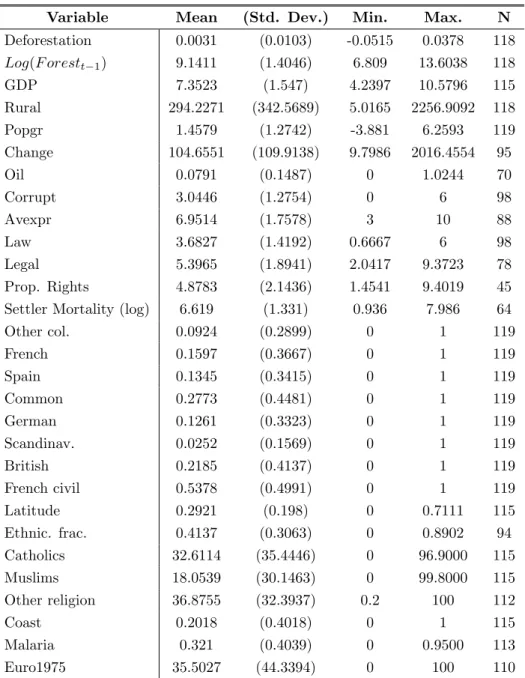
Descriptives Statistics and Statistical Tests
In order to test the presence of institutional persistences in the pace of deforestation, we compute relevant descriptive statistics and statistical tests based on mean differences on deforestation and institutions. We focus on legal origins on regulations and law, past colonization status (dummy variable) and the identity of colonizer to show if there are some differences in current deforestation and current institutional performances according to these political and institutional inherited legacies.
5.2.1 Some Interesting Descriptive Statistics
Before running tests on mean differences, we compute some relevant statistics of deforestation and our five institutional variables: corruption, the Legal Index (legal structure), the property rights index (secured property rights), the rule of law and the expropriation risk.
In the following table 1, summary statistics of deforestation and institutional variables according to legal origins and colonial status are presented. First we show that past colonized countries have higher deforestation and worse institutional performances than no colonized countries. This result suggests the presence of influences of some colonial legacies on current environmental performances though these results do not draw any causal relation. Second English common law countries have better institutional performances than French civil law ones given that a common law system is associated to low corruption, low expropriation risk, strong legal structure and secured property right (La Porta et al.,1999;Chong and Zanforlin,2000).
Table 1: Two-way table : Legal Origins, Past Colonial Status, Institutions and Deforestation
Past Col. stat. (0,1) Legal Origins
French Common German Scandinav. Total Mean of Deforest. rate
0 -0.004 0.002 -0.002 -0.001 -0.002
1 0.005 0.009 0.006
Total 0.002 0.007 -0.002 -0.001 0.003 Mean of Corruption (ICRG)
0 3.11 3.89 4.51 3.96 3.77
1 2.60 2.56 2.59
Total 2.60 2.94 3.96 5.74 3.05
Mean of Legal Index (Fraser)
0 5.97 8.26 6.98 8.83 6.92
1 4.24 4.99 4.51
Total 4.75 5.74 6.98 8.83 5.42
Mean of Property Rights Index (Fraser)
0 4.84 7.69 5.98 8.09 5.96
1 3.58 4.21 3.79
Total 4.10 5.37 5.98 8.09 4.86
Mean of Expropriation Risk (85-95) (IRIS)
0 8.15 8.42 9.10 9.72 8.60
1 6.06 6.17 6.10
Total 6.55 6.84 9.10 9.72 6.95
In the following table 2, summary statistics of deforestation and institutions according to the former col-onizer’s identity are presented. We find that non colonized countries have better institutions that colonized countries. However this result could be viewed as an income effect given that non colonized countries are more developed ones. However an interesting result is that past British colonies have better institutions than French and Spanish ones (Joireman,2001)14.
Table 2: Past Colonizer Identity, Institutions and Deforestation
Coloniz. ident. Deforest. rate Corrupt. Legal Index Prop. Rights Index Rule of Law Exprop. Risk
None Colonized -0.0014 3.72 6.83 5.88 4.75 8.57 French 0.004 2.66 4.26 3.86 2.99 5.90 British 0.0092 2.51 4.93 4.21 3.08 6.15 Spanish 0.0051 2.81 4.45 3.42 3.02 6.44 Other (Portugal, ...) 0.0037 2.37 3.67 4.05 2.61 5.46 Total 0.0031 3.05 5.42 4.86 3.68 6.95
5.2.2 Test of the Mean Differences
Deforestation and institutional data are used to test the null hypothesis that there is no difference in the pace of deforestation and the quality of current institutions between i) civil law and common law countries, ii) previous and not colonized countries15 and iii) the identity of the past colonizer (French/British).
An independent samples t-test is used to compare the means of a normally distributed interval dependent variable for two independent groups.
In the following table 3, tests concerning the mean differences of deforestation are presented. First we show that the mean of deforestation in civil law countries is statically and significantly lower than the mean
14Spanish colonies have better corruption index score and expropriation risk score than English ones but these results disappears if
we consider United-States, Australia, Canada and New-Zealand as former British colonies. In this later case British ones experience less corruption and expropriation risk index i.e British colonial legacies outperform Spanish colonial legacies (Lange et al.,2006;
Novoa,2007).
of deforestation in common law countries suggesting that legal traditions seem to play a role in the process of deforestation. Second the mean difference is negative concerning the identity of the colonizer implying that previous French colonized countries deforest less than British ones. Another time colonial legacies seem to influence current deforestation. Third non-colonized countries deforest less than colonized ones.
Table 3: Mean of Deforestation according to Legacies
Stat. Legal Origins Colonizer Ident. Past Col. Stat. 0/1 Civil/Common French/British Ex-Colony./No Colony
0 : Obs. 64 19 47
1 : Obs. 33 26 72
t student t = -4.91 t = -3.42 t = -10.15
Ha: diff (0-1) < 0 p-value = 0.00 p-value = 0.00 p-value = 0.00 Ha: diff ! = 0 p-value = 0.00 p-value = 0.00 p-value = 0.00 Ha: diff > 0 p-value = 1 p-value = 1 p-value = 1
Ho: diff = 0 with diff = mean(deforest civil/french/excolony) - mean(deforest common/british/no excolony).
Tests computed with no equal variance between two samples. Results do not change if equal variance is considered.
In the following table 4, tests concerning the mean differences of five institutional variables are presented. We show that there is no statically differences in the mean of corruption between common law and civil law countries. However for all other institutional variables, the difference is significantly negative suggesting that civil law countries have worse institutions than common law ones. These results confirm our previous summary statistics on the superiority of common law origins.
Table 4: Institutional Performances and Legal Origins
Statistics Corrupt. Legal Index Prop. Rights Index Exprop. Risk Rule of Law
0: Civil, Obs. 53 50 28 49 53 1: Common, Obs. 28 26 14 27 28 t-student t = -0.95 t = -4.75 t = -4.01 t = -1.57 t = -2.00 Ha: diff < 0 p = 0.17 p = 0.00 p = 0.00 p = 0.05 p = 0.02 Ha: diff ! = 0 p = 0.34 p = 0.00 p = 0.00 p = 0.11 p = 0.05 Ha: diff > 0 p = 0.83 p = 1 p = 0.99 p = 0.00 p = 0.98
Tests computed with no equal variance between two samples. Results do not change if equal variance is considered.
To resume two main results are obvious. First deforestation is lower in civil law countries and previous French colonies than in common law and British ones. Second institutional performances are higher in common law countries. Given that there is a negative link between institutions and deforestation, we have a theoretical issue: i) How civil law countries could deforest less if they are worse institutions? and ii) Does the superiority of common law countries really allow to reduce deforestation? In order to ask to these questions we compute two econometric procedures presented in subsection4.2with main results presented in the following subsection 5.3.
5.3
Institutional Persistences and Deforestation
We suggest that there are institutional persistences which could explain the current level of deforestation. In order to model and test our predictions, we first assess correlations between inherited legacies and intermediate outcomes (current institutions) and second we estimate institutional persistences on deforestation by i) dividing sample according to three main inherited legacies i.e legal origins, identity of the colonizer and settlers’ mortality and ii) using interactive variables.
5.3.1 Inherited Legacies and Current Institutional Performances
In this first stage, institutional persistences are studied by estimating the role of inherited legacies on current institutions. Thus current institutions are regressed on legacies i.e legal origins on law and regulation, colonial dummies and European settler mortality.
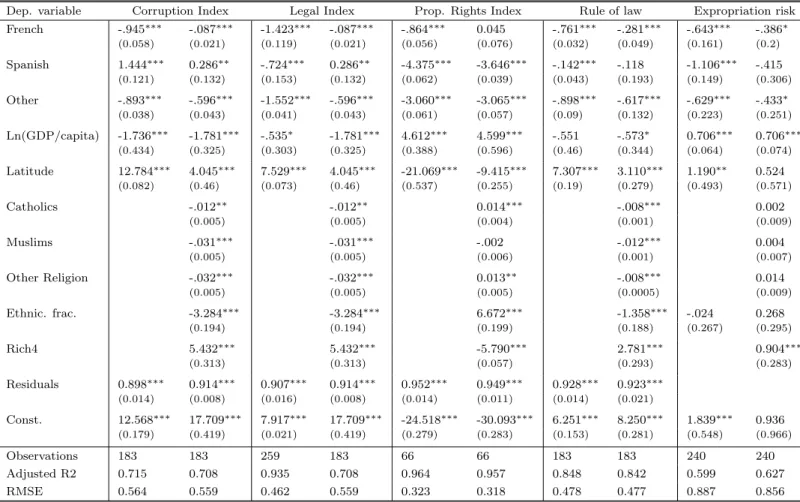
First in order to highlight that common law countries experience less corruption and well-defined property rights, table8(30) provides some correlations between legal origins and five institutional features. Some control variables are used in order to have a more relevant effect of legal origins: ethnolinguistic fractionalization, religions, latitude and the log of per capita income. This way two regressions are presented with and without religious features. We find that common law countries have experienced less corruption, better legal structure, more secured property rights, better rule of law and less expropriation risk relatively to civil law ones. Thus common law countries have better legal institutions than civil law ones (Glaeser and Shleifer,2002; La Porta et al., 1999, 2007; Mahoney, 2001) so that in these countries deforestation could be less important in the case where better institutions are linked to low deforestation. However the following procedure allows us to investigate deeper these relations.
Second in table 9 (page31), differential colonial effects on current institutions are investigated. We show that past British colonies have experienced less corruption, less expropriation risk, better rule of law and better legal environment than French ones. Moreover former Spanish colonies are more corrupt, have a worse legal structure and experience more expropriation risk than former British colonies. Thus some British legacies seem to influence positively the current institutional performances (Joireman,2001).
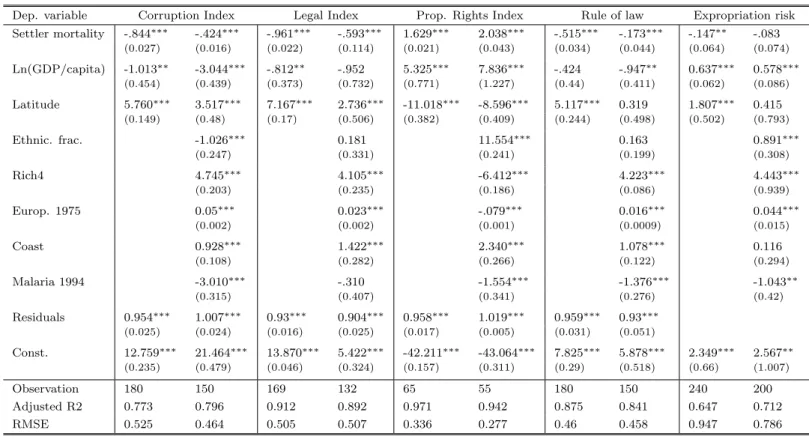
Third in table 10 (page 32), previous settlers’ mortality effects on current institutional performances are studied. We highlight that in countries where previous European settlers faced high mortality because of geographical and disease environment (Acemoglu et al.,2001), current institutional performances are worse. In fact settlers’ mortality negatively influence all our institutional variables (except property rights index certainly because of the weakness of observations) suggesting that past European colonialism strategies have shaped current institutions through legal legacies.
Last in this part we put forward the importance of legacies to explain current institutional performances suggesting the existence of institutional persistences. Knowing that institutions shape deforestation, we could assume that legal legacies could influence current deforested activities through the present institutional frame-work. We study this issue in the following subsection5.3.2.
5.3.2 Inherited Legacies, Current Institutions and Deforestation
The “Divide Sample” Approach To study the conditional effect of institutions on deforestation according to legal and colonial legacies, two dimensions are implemented: i) current institutions i.e corruption, the Legal structure and security of property rights (Legal index), the quality of property rights, the quality of rule of law and the average expropriation risk; ii) inherited legacies i.e legal origins divided between French civil law and common law to capture legal and cultural influences; the identity of the colonizer separated between French, British and Spanish identity to capture colonial legacies; settlers’ mortality divided in three groups to study consequences of colonial strategies. All results are computed from ordinary least squared estimator with region and year fixed effects and are presented in table11(page34) to table 13(page36).
First we focus on institutional influences on deforestation conditioned to legal traditions. Table 11 (page 34) presents this result for five current institutions: corruption, the Legal index, the propriety rights index, the Rule of law and expropriation risk. First we find that corruption is a factor of deforestation in both legal origins countries (col.1-2, table 11). However as suggested in our previous regression in table 8 (page 30), common law countries experience less corruption than civil law ones. Hence reducing corruption to fight deforestation