HAL Id: hal-00687836
https://hal.archives-ouvertes.fr/hal-00687836
Preprint submitted on 16 Apr 2012
HAL is a multi-disciplinary open access
archive for the deposit and dissemination of sci-entific research documents, whether they are pub-lished or not. The documents may come from teaching and research institutions in France or abroad, or from public or private research centers.
L’archive ouverte pluridisciplinaire HAL, est destinée au dépôt et à la diffusion de documents scientifiques de niveau recherche, publiés ou non, émanant des établissements d’enseignement et de recherche français ou étrangers, des laboratoires publics ou privés.
Homonyms with forgeable identifiers
Carole Delporte-Gallet, Hugues Fauconnier, Hung Tran-The
To cite this version:
Carole Delporte-Gallet, Hugues Fauconnier, Hung Tran-The. Homonyms with forgeable identifiers. 2012. �hal-00687836�
Homonyms with forgeable identifiers
Carole Delporte-Gallet1, Hugues Fauconnier1, and Hung Tran-The1
LIAFA- Universit´e Paris-Diderot
email:{cd,hf,Hung.Tran-The}@liafa.jussieu.fr
Abstract. We consider here the Byzantine Agreement problem (BA) in synchronous systems with homonymsin the case where some identifiers may be forgeable. More precisely, then processes share a set ofl (1 ≤ l ≤ n) identifiers. Assuming that at most t processes may be Byzantine and at mostk (t ≤ k ≤ l) of these identifiers are forgeable in the sense that any Byzantine process can falsely use them, we prove that Byzantine Agreement problem is solvable if and only ifl > 2t + k. Moreover we extend this result to systems with authentication by signatures in which at mostk signatures are forgeable and we prove that Byzantine Agreement problem is solvable if and only if l > t + k.
Regular paper
1 Introduction
Most of distributed algorithms assume that each process has an unique identity. Yet assuming that every process has unique identity given by a checkable identifier might be too strong (and costly) an assumption in practice especially if some processes are malicious. For example, very simple systems giving MAC addresses as identifier are not reliable, because MAC addresses may be duplicated and more sophisticated mechanisms using for example digital signatures are costly and difficult to implement. Moreover, for privacy reason, the processes may prefer to not have an unique identifier. For example, agents may be registered as members of groups and may want to act as member of the groups not as individuals. Hence it could be useful and interesting to relax the unicity of identifiers assumption. However, lack of identifiers is very restrictive and in fully anonymous systems very few problems are solvable (e.g. [1, 3, 4, 11]).
In [6], the authors presented a general model with homonyms in which processes may share the same identifier and may then be homonyms. In this model n processes share a set of l identifiers (1 ≤ l ≤ n). More precisely, each process p has an unique identifier belonging to the set ofl identifiers, but several processes may have the same identifier. The processes cannot distinguish between processes having the same identifier. A process may only send messages to all the processes with some identifier and when a process receives a message it knows only the identifier of the origin of the message without knowing which particular process it is. When l = n each proces has its own identifier and at the other extreme the case l = 1 corresponds to the fully anonymous system.
An important point in the model described in [6] is that there is no “masquerading” and even a Byzantine process is not able to lie about its identifier: if any processp receives a message, then processp knows that the sender of this message has identifier id. Hence even a Byzantine
process cannot lie about its identifier. Yet it is rather natural that Byzantine processes may at least form a coalition and “exchange” their identifiers.
In this paper we present an extension of homonyms processes in which some identifiers are “forgeable” and a Byzantine process may freely use any such identifier. Moreover we restrict ourselves to the classical synchronized rounds model. More precisely, we keep on ensuring that each process has an unique identity, but some identifiers are forgeable in the sense that Byzantine processes may use such an identifierid to send messages. A process receiving this message falsely believes that the identifier of the sender isid. Of course the set of forgeable identifiers is not known by the processes, we only assume that we havel identifiers for the n processes, and among these identifiers at mostk are forgeable. As Byzantine are able to form coalitions and exchange their identifies, we assume that the set of forgeable identifiers contains at least all identifiers of Byzantine processes. Hence ift is the maximum number of Byzantine processes, we havet ≤ k ≤ l.
To determine the power of the model of homonyms with forgeable identifiers, as in [6], we are going to consider the problem of Byzantine agreement [13]. As a Byzantine process is able to send in each round messages with all forgeable identifiers, intuitively, it means that it is the same as having at least one Byzantine process per forgeable identifier. Recall from [6] that Byzantine agreement is solvable in the homonyms model if and only ifl > 3t, then considering forgeable identifiers as similar to groups of processes with Byzantine processes, we get directly a solution withl forgeable identifiers if l > 3k and we could suppose that we have a solution if and only ifl > 3k. But surprisingly, we prove a better bound, we prove that there is solution for the Byzantine agreement withk forgeable identifiers if and only if l > 2t + k. In fact, this result comes from the fact that if a Byzantine process forges the identifier a group of process containing correct processes, this group of processes has the same behaviour as a group of processes containing Byzantine process and correct processes together and it is proven in [7] that such groups of processes are weaker adversaries than groups containing only Byzantine processes.
From a more practical point of view, it is easy to implement homonyms with help of digital signatures as with [9] in which at each identifier is associated a public key and processes with the same identifiers share corresponding private keys. In this way we get a (strictly) stronger authentication mechanism as defined in [14]. With this authentication mechanism a process cannot retransmit falsely messages. More precisely, if the identifier is unforgeable, then it is not possible for any processq to wrongly pretend that it received message m coming from a process with this identifier. It is well known that with this kind of authentication, the Byzantine agree-ment problem can be solved if and only ifn > 2t in the classical case in which all processes have unique and different unforgeable identifiers, giving an > 2k bound with k forgeable iden-tifiers. With homonyms and at mostk forgeable identifiers, we prove that Byzantine agreement is solvable if and only ifl > t + k. Again the a priori expected result would be l > 2k.
Due to the lack of space some proofs are omitted and will appear in the full version of the paper.
The rest of the paper is organized as follows. Section 2 describes the model of homonyms with forgeable identifiers and gives the specification of Byzantine Agreement. Then in Section 3
we prove the impossibility results concerning Byzantine Agreement with homonyms and forge-able identifiers. In Section 4, we propose a specification of Authenticated Broadcast and give a corresponding algorithm. Section 5 contains the algorithm for Byzantine Agreement using Au-thenticated broadcast. Then, in Section 6 we study the authentication case. Finally in Section 7, we discuss some related work and perspectives.
2 Model and definitions
Identifiers and homonyms. We consider a distributed message-passing system ofn processes. Each process gets an unique identifier from a set of identifiersL = {1, 2, . . . , l}. We assume that each identifier is assigned to at least one process but some processes may share the same identifier. Hence we havel ≤ n. If p is a process then Id(p) is the identifier of process p.1For an identifierid, the group of processes with identifier id, G(id), is the set of all processes with identifierid.
For example, ifl = 1 then the system is fully anonymous and if n = l each process has an unique identifier.
Process failure. A correct process does not deviate from its algorithm specification. Some pro-cesses may be Byzantine, such a process can deviate arbitrarily from its algorithm specification. In particular, a Byzantine process may send different messages than its algorithm specifies or fails to send the messages it is supposed to. In the followingt is an upper bound on the number of Byzantine processes.
From [13, 14], we know that Byzantine Agreement is impossible to solve ifn < 3t, so we assumen > 3t.
Forgeable Identifiers. To each messagem is associated the origin group of m that is an identifier inL denoted f rom(m). When the sender of the message m is a correct process p, this identifier is the identifier of this process: f rom(m) = Id(p). Remark that f rom(m) enables only to know the origin group but does not enable to know which process in this group is the sender.
We assume that Byzantine processes have the power to forge some identifiers. The set of identifiers that can be forge by Byzantine processes is a subset ofL and is denoted F. In the followingk designs an upper bound of the number of identifiers that can be forged: |F| = k.
Letidf be an identifier inF, a Byzantine process with identifier id may send a message m to groupid′with the forged identifierid
f. In this case, a processp with identifier id′receives the messagem with f rom(m) = idf. As a Byzantine process acts as an adversary it may divulge any information, then we assume here that ifp is a Byzantine process then Id(p) is also in F.
Consequently, if a process p receives a message m with f rom(m) = id, p knows that this message has been either sent by a correct process with identifierid or sent by a Byzantine process which has forged the identifierid.
1
For convenience, we sometimes refer to individual processes using names likep but these names cannot be used by processes in the algorithms.
We name(n, l, k, t)-homonym model such a model. In the following a correct group designs a group of processes with some identifier that contains only correct processes and whose its identifier is not forgeable.
Synchronous rounds. We consider a synchronous model of rounds. The computation proceeds in rounds. In each round, each process first sends a set of messages, which depends on its current state, to some identifiers. Then, each process receives all the messages sent to its identifier in the same round and finally changes its state according to the set of received messages.
As several processes may share the same identifier, in a round a process may receive several identical messages coming from processes with the same identifier (or Byzantine process that has forged this identifiers). But we assume here that when a process receives a messagem with f rom(m) = id, it does not know how many correct processes with identifier id (or Byzantine process that has forgedid) have sent this message.2
A Byzantine process can deviate arbitrarily from its algorithm specification and Byzan-tine process may send any set of messages (possibly an empty set) with any identifiers inF. Moreover, contrary to correct processes, we assume that Byzantine processes are able to send different messages to different processes in the same group.
Byzantine Agreement. In the following we are interested in the Byzantine agreement prob-lem [13, 14]. Recall that solutions to this probprob-lem are the basis of most of fault tolerant algo-rithms (e.g. [15]). Byzantine Agreement is an irrevocable decision problem that has to satisfy the following properties:
1. Validity: If all correct processes propose the same valuev, then no value different from v can be decided by any correct process.
2. Agreement: No two correct processes decide different values. 3. Termination: Eventually every correct process decides some value.
3 Impossibility result
Following the spirit of the impossibility of Byzantine Agreement in [8], we prove our impossi-bility results in(n, l, k, t)-homonym model.
Proposition 1. Byzantine Agreement is unsolvable in(n, l, k, t)-homonym model if l ≤ 2t + k.
Proof. It suffices to prove there is no synchronous algorithm for Byzantine Agreement when l = 2t + k. To derive a contradiction, suppose there is an algorithm A for Byzantine agreement withl = 2t + k. Let Ai(v) be the algorithm executed by a process with identifier i when it has input valuev.
We divide the set of processes into 4 subsets:A = ∪0<i≤tG(i), B = ∪t<i≤2tG(i), C = ∪2t<i≤3tG(i) and F = ∪3t<i≤k+2tG(i).
2Our results can be extended to the model of numerate processes as defined in [6] for which each process receives
in a round a multiset of messages and is able to count the number of copies of identical messages they receive in the round.
We consider a system of 8 sets: two setsA0 andA1 (respB0 andB1,C0 andC1,F0 and F1) with the same number of processes and the same repartition in group asA (resp. B, C, F ). Each process ofA0with identifieri executes the code Ai(0) and the analog for others sets and other input values.
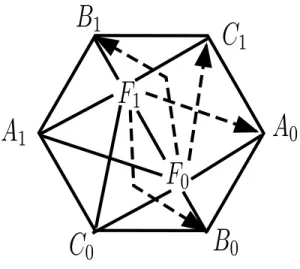
Imagine setting up a systemS as shown in Figure 1. Every process correctly executes the algorithm assigned to it. Communication between groups are indicated by continuous line. A dash arrow from groupX to group Y indicates that processes of X send its message also to Y . (We do not pretend that we have a Byzantine Agreement algorithm for this system.)
A
0
B
0
C
0
C
1
A
1
F
1
F
0
B
1
Fig. 1. communication from a process registered on serverl2to processes on serverl3.
We now define three executions of the algorithmA.
In executionα, processes of A, B and F are correct and have input 1, all the processes in C are Byzantine and the identifiers in F may be forged. By validity, all the correct processes must decide 1. A processc in C sends (1) the same messages to processes in A and F as the corresponding process inC0in systemS, (2) the same messages to processes in B and F as the corresponding process inC1in systemS, Moreover one process in C sends the same messages as processes inF0to processes inA, B and F .
In executionβ, processes of B, C and F are correct and have input 0, all the processes in A are Byzantine and the identifiers in F may be forged. By validity, all the correct processes must decide 0. A processa in A sends (1) the same messages to processes in C and F as the corresponding process inA1in systemS, (2) the same messages to processes in B and F as the corresponding process inA0in systemS, Moreover one process in A sends the same messages as processes inF1to processes inA, B and F .
In execution γ, processes of A, C and F are correct. Processes of A and F have input 1 and processes ofC have input 0. All the processes in B are Byzantine and the identifiers in F may be forged. Processes in B send (1) the same messages to processes in A and F as the
corresponding processes inB1 in systemS (and the same that in α) (2) the same messages to processes inC as the corresponding processes in B0in systemS (and the same that in γ)
Moreover one process in B sends the same messages as processes in F0 to processes in A, C and F . Note that processes in F and this Byzantine process sends the same message to processes inA as in run α and to processes in C as in run γ.
So, for the correct processes inA executions α and γ are undistinguishable and they decide 1. For the correct processes inC executions β and γ are undistinguishable and they decide 0. This decision in executionγ contradicts the agreement property of the Byzantine agreement.
4 Authenticated Broadcast
Our algorithms for Byzantine Agreement use an adaptation of Authenticated Broadcast as in-troduced by Srikanth and Toueg [16] in the classical case where each process has a different identifier (n = l).
First, recall some principles for Authenticated Broadcast. Authenticated Broadcast in [16] is defined by two primitives: Broadcast(p, m, r) and Accept(p, m, r). Computation is bro-ken up in superrounds. Roughly speaking a processp broadcasts a message m in superround r by Broadcast(p, m, r). If the process p is correct all processes receive the message and Accept(p, m, r). If the process p is a Byzantine process, the Authenticated Broadcast guar-antees that if some processAccept(p, m, r) at some superround r′ then all correct processes Accept(p, m, r) no later than in superround r′+1. Furthermore no correct process can Accept(p, m, r) from a correct processp if p has not broadcast it.
Considering the(n, l, k, t)-homonym model, we decompose the synchronous computation in superrounds too. All the processes of a group have to invoke broadcast of a messagem in the superroundr in order to ensure that this message will be accepted in the following superround.
More precisely, our Authenticated Broadcast is defined by two primitives:Broadcast(i, m, r) andAccept(i, m, r) where i is the identifier of some group. We assume that a process broad-casts at most one message in a superround. The Authenticated Broadcast primitive is specified as follows:
1. Correctness: If all the processes in a correct groupi perform Broadcast(i, m, r) in super-roundr then every correct process performs Accept(i, m, r) during superround r.
2. Relay: If a correct process performsAccept(i, m, r) during superround r′ ≥ r then every correct process performsAccept(i, m, r) by superround r′+ 1.
3. Unforgeability: If some correct process performs Accepts(i, m, r) in superround r′ ≥ r then all correct processes in groupi must Broadcast(i, m, r) in superround r.
The algorithm is described in Figure 2. A superroundr is composed of the two rounds 2r and2r + 1.
First, recall the principles of the algorithm of [16] withT Byzantine processes. To propose a valuev in superround r, process p sends message (init, p, v, r) to all processes (including itself). A process receiving such a message becomes a “witness” for(p, v, r) and sends a mes-sage of type echo to all processes. Any process that hasT + 1 witnesses for (p, v, r) becomes
Code for processp with identifier i ∈ {1, ..., l} Variable:
1 M = ∅;
Main code:
2 IN ROUNDR
3 ifR = 2r then if Broadcast(i, m, r) to perform 4 then send(M ∪ (init, i, m, r), R) to all 5 else send(M ∪ (noinit, i, ⊥, r), R) to all 6 else send(M, R) to all;
on receipt of the messages of the round
7 For allh ∈ {1, ..., l}
8 LetM[h, R] be the set of messages with form (init, h, ∗, r) received from processes in group h 9 if(R = 2r) and M [h, R] = {(init, h, m, r)}
10 thenM = M ∪ (echo, h, m, r) 11 For allr ∈ {1, ..., R/2}
12 For allm ∈ possible messages
13 if(echo, h, m, r) received from at least l − 2t distinct groups 14 thenM = M ∪ (echo, h, m, r)
15 if(echo, h, m, r) received from at least l − t distinct groups 16 thenAccept(h, m, r)
Fig. 2. Authenticated Broadcast algorithm in the(n, l, k, t)-homonym model.
itself witness (because at least one correct process has sent this message). When a process re-ceives more than(2T + 1) witnesses, it accepts (p, v, r) (T + 1 correct processes have sent this message then all correct processes will findT + 1 witnesses of this message).
The algorithm follows the same principles, to propose a valuev in supperround r process p with identifier i sends message (init, i, v, r) to all processes (including itself) (line 4). A process receiving such a message from some processes with identifieri becomes “witness” for (i, v, r) and sends a message of type echo to all processes (line 10). Any process having l − 2t witnesses for (i, v, r) becomes itself witness (if l − 2t > k at least one process in a correct group has sent this message) (line 13). When a process receives more than(l − t) witnesses, it accepts(i, v, r) (at least t + 1 processes from correct groups have sent this message) (lines 15 to 16). In this way we ensure correctness and relay properties
To ensure the unforgeability property, a correct process that has no message to broadcast in a superround broadcast anoinit message in the corresponding even round. In this way, if some correct process with identifieri has no message to broadcast in superround r, every correct process getsM [i, 2r] (line 9) different from one message init and wil not become witness of any message(i, ∗, r).
The formal proof is standard and will be omitted due to lack of space. We have:
Proposition 2. Ifl > 2t + k, the algorithm Figure 2 implements Authenticated Broadcast in (n, l, k, t)-homonym model.
5 Byzantine Agreement Algorithms
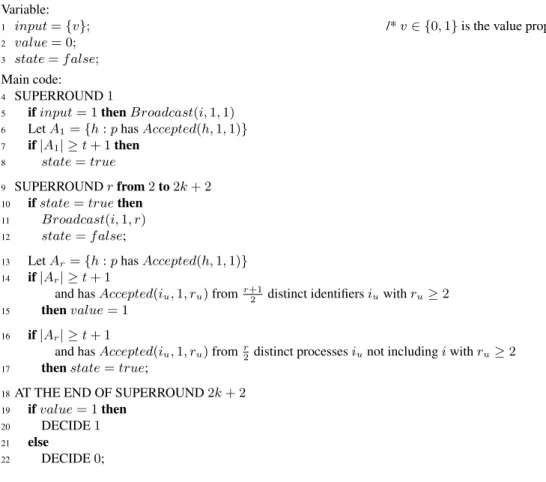
Code for processp with identifier i Variable:
1 input = {v}; /*v ∈ {0, 1} is the value proposed value */ 2 value = 0;
3 state = f alse;
Main code:
4 SUPERROUND1
5 ifinput = 1 then Broadcast(i, 1, 1) 6 LetA1= {h : p has Accepted(h, 1, 1)} 7 if|A1| ≥ t + 1 then
8 state = true
9 SUPERROUNDr from 2 to 2k + 2 10 ifstate = true then
11 Broadcast(i, 1, r) 12 state = f alse;
13 LetAr= {h : p has Accepted(h, 1, 1)} 14 if|Ar| ≥ t + 1
and hasAccepted(iu, 1, ru) from r+1
2 distinct identifiersiuwithru≥ 2 15 thenvalue = 1
16 if|Ar| ≥ t + 1
and hasAccepted(iu, 1, ru) from r
2 distinct processesiunot includingi with ru≥ 2 17 thenstate = true;
18AT THE END OF SUPERROUND2k + 2 19 ifvalue = 1 then
20 DECIDE1 21 else
22 DECIDE0;
Fig. 3. Synchronous Byzantine Agreement algorithm with at mostk forgeable identifiers and at most t Byzantine processes
Our algorithm follows the line of the algorithm in [16] defined in the classical case where each process has a different identifier (n = l). One of the main difference here is the fact that the behaviour of groups of processes is different from the behaviour of processes. In partic-ular, correct processes in groups with forgeable identifiers or in groups containing Byzantine processes have to decide and have to participate to the decision.
The algorithm proceeds in synchronous superrounds (set of successive rounds). In this al-gorithm,1 is the only value that may be broadcast and value 0 is decided upon by default if 1 is not decided. Hence, all processes in superround1 broadcast 1 if their input is 1. A process p sets variable value to1 (and then will decides 1) in superround r < 2k, if it has (1) accepted (iu, 1, 1) messages from t + 1 distinct identifiers iu, and (2) accepted(ju, 1, ru) from (r + 1)/2
withru ≥ 2. Condition (1) ensures that at least one correct group has broadcast and condition (2) corresponds to the one of [16]. Condition (1) ensures the validity property of consensus and the condition (2) ensures the agreement property. The correctness and relay properties of Authenticated Broadcast ensure that by the next superround (superroundr + 1), all messages accepted by processp are also accepted by all correct processes. Hence, they all set the variable
stateto true. By superroundr + 2, they broadcast and by correctness and relay properties, all correct processes decide1 by setting value to 1. If p decides in superround 2k + 2, then it can be proved that at least one group of correct processes set its variable value to 1 by superround 2k, and all correct processes decide by superround 2k + 2.
We now prove that the algorithm of Figure 3 satisfies the specification of Byzantine agree-ment. First we give without proofs the easy following lemmata:
Lemma 1. If, at superroundr, a correct process p has |Ar| ≥ t + 1 then at each superround r′withr + 1 ≤ r′ ≤ 2k + 2 each correct process has |A
r′| ≥ t + 1.
Lemma 2. If every process of a correct group with identifier i0 broadcasts some message in
some superroundr > 1, then every correct process sets value to 1 by superround r.
Proposition 3. (Validity) If all correct processes propose the same initial valuev then no value
different fromv can be decided by any correct process.
Proof. Assume all correct processes propose1.
In superround 1, every process of correct group with identifieri broadcasts (i, 1, 1) message. The correctness of the authenticated broadcast ensures that every correct process will accept (i, 1, 1) message. As there are at least l − k > t, it is easy to verify that |A1| of every correct process is greater thant. Thus every correct process sets state to true in superround 1 Line 8. In superround 2, every correct process p broadcasts (Id(p), 1, 2) . As l > t + k there is at least one correct groupi in which every process broadcast (i, 1, 2). By Lemma 2, every correct process sets value to 1 in Line 15 and will decide 1.
Assume now that all the correct process propose0. We prove that no correct process sets value to 1. For contradiction, assume that some correct process p sets value to 1 in some super-roundr. Thus, |Ar| of p must be greater than t. Since there are at most t Byzantine processes, there is at least one correct group, sayi, in Ar. By unforgeability property, all processes of this group broadcast(i, 1, 1) in superround 1 and then the input value of every process in this group must be1, a contradiction. Thus, every correct process keeps value to 0 and decides 0 Line 22. Proposition 4. (Termination) Eventually every correct process decides some value.
Proof. A correct process decides at superround2k + 2 Line 20 or Line 22.
Assume that, in the execution, some correct process setsvalue to 1 at Line 15, and decides 1. Letr1 be the first superround in which some correct process setsvalue to 1. Let p1be such a correct process that setvalue to 1.
With the help of Lemma 2, we prove:
Whenr1is greater than2k, p1has accepted(ju, 1, ru) from2k+22 distinct processesju, then from at leastk + 1 distinct processes. Then there is at least one correct group, say i0, in this set. Then we get:
Lemma 4. Ifr1 > 2k, then every correct process sets value to 1 by superround r1. Proposition 5. (Agreement) No two correct processes decide different values.
Proof. Assume that some correct process sets value to 1 at Line 15 and decides 1. Let r1 be the first superround where some correct process setsvalue to 1.
Lemma 4 shows that if2k + 2 ≥ r1 > 2k then every correct process sets its value variable to 1 by superroundr1. Lemma 3 shows that ifr1 ≤ 2k then every correct process sets its value variable to 1 by superroundr1+ 2. Thus, all correct processes decide 1.
Otherwise, if no correct process setsvalue to 1 then value is 0 for all correct processes and they decide 0.
We have:
Theorem 1. Assuming ifl > t + k, algorithm of Figure 3 implements Byzantine Agreement
using Authenticated Broadcast in(n, l, k, t) homonym model.
Combining this with algorithms for Authenticated Broadcast we get:
Corollary 1. Ifl > 2t + k, the algorithms of Figure 3 and 2 implement Byzantine Agreement
in(n, l, k, t) homonym model.
6 Authentication
Authentication [14] ensures that Byzantine process may “lie” about its own values but may not relay altered values without betraying itself as faulty. Currently this property may be ensured with a system of signatures using public keys cryptography.
The implementation of homonyms with authentication is rather natural: the members of a group share a secret key. The origin group of a message may be verified by a signature scheme of this group. Messagesm are authenticated by the identifier of the sender. Each process can verify if a message carries the signature of a given identifier. As before we assume that the signatures of at mostk identifiers can be forged.
With homonyms and this scheme of authentication, ifid is not forgeable (any process with this identifier is correct) then it is not possible for any process to wrongly pretend that it has received some messages coming from identifier id, hence we get the authentication property of [14].
For this model with authentication, we improve our bound: l > t + k is necessary and sufficient to achieve Byzantine Agreement. (Recall that in the classical model in which each process has its own identifier and without forgeable identifiers the bound isn > 2t.)
The proofs of the lower bound is essentially the same as for the case without authentication in Section 3.
The Byzantine Agreement algorithm of Figure 3 directly works withl > t + k if we have an Authenticated Broadcast. It remains to get an Authenticated Broadcast withl > k + t.
In [16], in the classical case in which each process has its own identity, Authenticated Broadcast can be obtained simply with authentication: it suffices to verify the signatures: A pro-cess that receives a message(p, m, r) accepts it if it can verify p’s signature (and then forwards this message). But if we apply this simple mechanism in our model, we do not get the unforge-ability property. In a forgeable group with identifieri containing some correct processes, it is possible that some correct accepts(i, m, r). Indeed, this message has been sent by a Byzantine process that has forged the identifieri.
To implement Authenticated Broadcast, we use the signatures and the mechanism of wit-nesses as in our previous algorithm. The implementation is based on the one presented in Sec-tion 4 ans some easy changes.
At some point, in algorithm 2 when a process receives some messages in roundR, it will sendecho in the next rounds. The process will forward all messages that produced this echo. In this way it gives a proof that it has the right to sendecho. We get an Authenticated Broadcast algorithm from algorithm Figure2 by: (1) removing from the received message all messages with a bad signature, (2) forwarding the proof of each newecho message, (3) replacing the line 13 of algorithm 2 by:
if received(echo, h, m, r) and the proof of (echo, h, m, r) and, (4) replacing the line 15 of algorithm 2 by
if received(echo, h, m, r) and the proof of (echo, h, m, r) from at least l − t distinct groups We have:
Theorem 2. With authentication Byzantine Agreement is solvable in(n, l, k, t)-homonym model
if and only ifl > t + k,
7 Related works and perspectives
When processes share identifiers and some of theses processes may be Byzantine, it is rather natural that some of these identifiers may be forged. Hence this work is a natural extension of [6] to forgeable identifiers.
At least for the authentication case, groups signature as introduced first in [5] are close to our model. Groups signature enables to sign messages on behalf of a group and clearly can be used to implement the model of homonyms. Note that group signatures generally ensures other properties than the one we consider here. Groups signatures may be a valuable way to implement models with homonyms.
In other works [2, 10, 12], a mixed adversary model is considered in the classical (l = n): the adversary can corrupt processes actively (corresponding to Byzantine process) and can forge the signature of some processes.
In some way, we combine here the idea of group signatures and forgeable signatures but contrary to group signatures the goal is not to develop protocol ensuring strong properties
like anonymity or unforgeability but try to develop algorithms (like agreement) in presence of groups of processes with Byzantine processes and forgeable identifiers.
Here we proved that with forgeable identifiers and homonyms Byzantine Agreement can be solved in a “reasonable” way (and without any assumption about cryptographic system). Interestingly, the solvability of Byzantine Agreement depends only on the number of identifiers and the number of forgeable identifiers. Hence adding correct processes does not help to solve Byzantine Agreement.
A natural extension of this work could be to consider partially synchronous models. As Byzantine Agreement is the basis for replication systems in the classical models in which each process has its own identity, a natural question is to know if it is still the case and envisage to develop algorithms for more difficult problems.
References
1. Hagit Attiya, Alla Gorbach, and Shlomo Moran. Computing in totally anonymous asynchronous shared memory systems. Information and Computation, 173(2):162–183, 2002.
2. Piyush Bansal, Prasant Gopal, Anuj Gupta, Kannan Srinathan, and Pranav K. Vasishta. Byzantine agreement using partial authentication. In DISC, volume 6950 of LNCS, pages 389–403, 2011.
3. Paolo Boldi and Sebastiano Vigna. An effective characterization of computability in anonymous networks. In DISC, volume 2180 of LNCS, pages 33–47. Springer, 2001.
4. Harry Buhrman, Alessandro Panconesi, Riccardo Silvestri, and Paul M. B. Vit´anyi. On the importance of having an identity or, is consensus really universal? Distributed Computing, 18(3):167–176, February 2006.
5. David Chaum and Eug`ene van Heyst. Group signatures. In EUROCRYPT, volume 547 of LNCS, pages 257– 265, 1991.
6. Carole Delporte-Gallet, Hugues Fauconnier, Rachid Guerraoui, Anne-Marie Kermarrec, Eric Ruppert, and Hung Tran-The. Byzantine agreement with homonyms. In PODC, pages 21–30. ACM, 2011.
7. Carole Delporte-Gallet, Hugues Fauconnier, and Hung Tran-The. Byzantine agreement with homonyms in synchronous systems. In ICDCN, volume 7129 of LNCS, pages 76–90, 2012.
8. Michael J. Fischer, Nancy A. Lynch, and Michael Merritt. Easy impossibility proofs for distributed consensus problems. Distributed Computing, 1(1):26–39, January 1986.
9. Taher El Gamal. A public key cryptosystem and a signature scheme based on discrete logarithms. IEEE Transactions on Information Theory, 31(4):469–472, 1985.
10. S. Dov Gordon, Jonathan Katz, Ranjit Kumaresan, and Arkady Yerukhimovich. Authenticated broadcast with a partially compromised public-key infrastructure. In SSS, volume 6366 of LNCS, pages 144–158, 2010. 11. Rachid Guerraoui and Eric Ruppert. Anonymous and fault-tolerant shared-memory computing. Distributed
Computing, 20(3):165–177, October 2007.
12. Anuj Gupta, Prasant Gopal, Piyush Bansal, and Kannan Srinathan. Authenticated byzantine generals in dual failure model. In ICDCN, volume 5935 of LNCS, pages 79–91, 2010.
13. Leslie Lamport, Robert Shostak, and Marshall Pease. The Byzantine generals problem. ACM Transactions on Programming Languages and Systems, 4(3):382–401, July 1982.
14. Marshall Pease, Robert Shostak, and Leslie Lamport. Reaching agreement in the presence of faults. Journal of the ACM, 27(2):228–234, April 1980.
15. Fred B. Schneider. Implementing fault-tolerant services using the state machine approach: A tutorial. ACM Computing Surveys, 22(4):299–319, December 1990.
16. T. K. Srikanth and Sam Toueg. Simulating authenticated broadcasts to derive simple fault-tolerant algorithms. Distributed Computing, 2(2):80–94, 1987.