HAL Id: hal-01759913
https://hal.archives-ouvertes.fr/hal-01759913
Submitted on 5 Apr 2018
HAL is a multi-disciplinary open access
archive for the deposit and dissemination of
sci-entific research documents, whether they are
pub-lished or not. The documents may come from
teaching and research institutions in France or
L’archive ouverte pluridisciplinaire HAL, est
destinée au dépôt et à la diffusion de documents
scientifiques de niveau recherche, publiés ou non,
émanant des établissements d’enseignement et de
recherche français ou étrangers, des laboratoires
Secure Multihop Key Establishment Protocols for
Wireless Sensor Networks
Ismail Mansour, Gerard Chalhoub, Pascal Lafourcade
To cite this version:
Ismail Mansour, Gerard Chalhoub, Pascal Lafourcade. Secure Multihop Key Establishment Protocols
for Wireless Sensor Networks. Cryptography and Security Systems - Third International Conference,
CSS 2014, Lublin, Poland, Sep 2014, Lublin, Poland. �hal-01759913�
Secure Multihop Key Establishment Protocols
for Wireless Sensor Networks
Ismail Mansour, G´erard Chalhoub and Pascal Lafourcade
LIMOS, Clermont University, Campus des C´ezeaux, Aubi`ere, France
Abstract. Designing secure communication protocols is not an easy task. Cryptography is often necessary but does not always guarantee the security of protocols as several famous examples attest in the litera-ture. Moreover, in the context of Wireless Sensor Networks (WSNs) the design is even more difficult due to the limited resources of sensor nodes that add extra constraints to take into account. During the life time of a secure WSN, one of the first crucial steps is the key establishment between two nodes. In this paper we propose four secure multihop key establishment protocols based on elliptic curve cryptography (ECC). For each protocol, we make a formal security proof using the automatic tool Scyther. Then, in order to evaluate their performances, we implemented them on testbeds using TelosB motes and TinyOS. Results allow us to estimate the overhead of our key establishment methods.
Keywords: Authentication, key establishment, Wireless Sensor Net-work, Security, Multihop, Formal Verification.
1
Introduction
Due to the technological advances, Wireless Sensor Networks (WSNs) are more and more used in diverse applications. In the first age of WSNs, the main concern was to efficiently transmit the data to the destina-tion using wireless communicadestina-tions. Only few applicadestina-tions, like military WSN examples, required a high level of security [7]. In this context, it is important to design secure efficient communication mechanisms between nodes of the network, using cryptography.
Moreover, with the expansion of the Internet of Things (IoT) more and more devices will be interconnected and monitoring critical human ac-tivities. For instance nowadays most of the smart phones have a GPS, a camera, and several sensors. In a close future our environment will be equipped with several sensors in order to collect data to inform the user. In this context the knowledge of this data can leak private information, one solution to avoid this is to use cryptography in order to preserve privacy of the users. One of the first steps in this situation is to design secure multihop key establishment protocols. This is the main motivation of this paper.
Contributions:
Our goal is to design several secure key establishment protocols for WSNs and to evaluate their performances on real nodes. Hence our contribu-tions can be split in three points:
– Design of key establishment protocols based on ECC. – Formal security analysis of the protocols.
– Evaluation on TelosB testbeds of the execution time of each solution. All our protocols are based on Elliptic Curve Cryptography (ECC) with a key of 160 bits. We propose a first protocol called M KES. It allows nodes that already share a key with the sink to establish a new secret key. The idea is to use the sink as a kind of third trusted party to establish a new key. In addition, we propose an improvement of this protocol called M KES− light. In this version, the sink performs costly computation instead of the nodes, since in many situations the sink has no limited battery and more computation power than nodes of the WSN. We also give two other protocols that establish a secret key between two nodes without passing by the sink. The first one is called M KEN K, it uses only the network key shared between all the authenticated nodes in the network. This authentication phase can be done for instance using one of the protocols proposed in [10]. The second protocol is called M KEK, also it does not use the sink, but it uses the symmetric keys shared between neighbor nodes. In order to guarantee the authentication of nodes involved, this protocol only requires two flows of messages instead of three as it is the case for the protocol M KEN K.
In order to prove the security of all these protocols, we used Scyther an automatic cryptographic protocol verification tool developed by Cas Cremers. It is easy to propose a flawed protocol, this tool helps to verify the correctness of the security protocol and make sure that it resists against several kinds of attacks. Each of our solutions uses a different approach to securely establish a new secret key, they vary according to the number of cryptographic operations involved and the trust level that we need to have in the network nodes.
Our last contribution is the implementation on real nodes of all our protocols. Our aim is to measure the execution time of each protocol, but also to compare them in order to be able to judge which one is the most suitable.
Related Work:
Many contributions have been made in the key establishment and sym-metric key distribution in WSNs. Some of them are based on a proba-bilistic predistribution that guarantees that any two nodes in the network are able to share a key with a certain probability, and others are deter-ministic but cause more storage overhead [1]. One of the most known symmetric key systems that were proposed for wireless sensor networks is SPINS (Security Protocols for Sensor Networks) [13] which uses a simplified version of TESLA (Timed, Efficient, Streaming, Loss-tolerant Authentication) protocol [12]. In SPINS, the base station plays an es-sential role in the key establishment process. It is a lightweight protocol but suffers from scalability and high dependency on the base station. Authors in [11] proposed a multi-hop key establishment between nodes called Micro-PKI. Their method is based on the pre-distribution of the public key of the base station. Using this public key, every node is able
to create a secret key with any other node of the network. The authenti-cation process in this proposal is only dependent on the public key of the base station, if a node has this key, it is considered authenticated. This makes the procurement of this public key very critical on which depends the whole security architecture.
In [3], authors proposed PIKE, peer intermediaries for key establishment, one of the most famous key establishment protocols that is not dependent on a central trusted node. According to PIKE, keys are pre-deployed in the nodes in such a way to guarantee that any two nodes in the network have at least one node in common with which each one of the two nodes has a secret key with it. Therefor, these two nodes are able to establish a secret key by using the trusted channel established with the common node. PIKE suffers from high memory storage to make sure that nodes are able to find at least one node in common to establish a new key. CARPY and CARPY+ were proposed in [15]. They are based on the symmetric keys of Blom [2] with a perturbation function that makes more difficult for an attacker to guess the pairwise keys. In their paper they discuss the five criteria that were proposed in [16] and claim that CARPY+ satisfies all of them. These criteria are: Resilience to the Ad-versary’s Interventionduring the key establishment phase, Directed and Guaranteed Key Establishment for any couple of nodes in the network, Resilience to Network Configurations nodes should be able to establish keys in any kind of network topology, Efficiency of the key establishment process in terms of memory storage, communication overhead and com-plexity, Resilience to Dynamic Node Deployment which allows nodes to be added at any time to the network and enabling them to establish keys. The main weakness of this scheme is the lack of a rekeying process. The preshared matrices will only help to create one pairwise key for every couple of nodes.
Table 1 summarizes a comparison between the related work schemes and our proposition. The comparison is based on some repudiated criterias in WSN area. As the table shows, Yu et al. scheme [15] is the closest one to our schemes. Nevertheless, the authors use TelosB motes to evaluate energy consumption of basic operations used in their schemes and they provide a large scale simulation for thousands of nodes based on these measurements.
Proposed scheme distributionPre- TrustedParty
Cryptographic
technique Simulation
Implemen-tation Verification Perrig et al.,
2000[12], 2002[13] yes Base station symmetric JAVA none manual Chan et al., 2005[3] yes Base station symmetric yes none manual Yu et al., 2009[15] yes none symmetric none TelosB manual
Munivel et al.,
2010[11] yes Base station
symmetric/
asymmetric manual none none
Our schemes yes Base station
symmetric/
asymmetric none TelosB automatic
In this paper, we did not compare our time execution results with other protocols from the state of the art because implementations are hard-ware and system dependent. In addition, they can be optimized for cer-tain platforms which makes the comparison unfair using different plat-forms and cryptographic primitives. Finally the main difference with other works is that we formally prove the security of all our protocols using the automatic verification tool Scyther [4].
Outline:
In the next section, we introduce the notations used and present four key establishment protocols. Then, in Section 3, we give the results of our implementation on TelosB motes. Finally, we conclude in the last section.
2
Multi-hop Key Establishment Protocols
In our evaluation testbed, we used public keys based on Elliptic Curve Cryptography (ECC), using parameters secp160r1 given by the Stan-dards for Efficient Cryptography Group [14]. Our implementation of ECC on TelosB is based on TinyECC library [8]. More precisely we used the Elliptic Curve Diffie-Hellman (ECDH) key agreement scheme [5]. For all symmetric encryption/decryption we use an optimized implementation of AES with a key of 128 bits proposed by [9].
Note that we only use the public keys in order to establish symmetric keys without doing any asymmetric encryption or decryption operations. Indeed, it helps us establish a pairwise key without interaction between nodes thanks to the predistribution of public keys before the deployment. Before deployment, each node N knows the public key pk(S) of the sink S and also its own pair of private and public keys, denoted (pk(N ), sk(N )) respectively. Based on ECC, we have that pk(N ) = sk(N ) × G, where G is a generator point of the elliptic curve. Using this material, each node N can compute a shared key with the sink S using a variation of the Diffie-Hellman key exchange without interaction between the nodes, denoted KDH(N, S). These computations can be done by the sink and by all nodes before deployment in order to preserve their energy.
– The sink knows its own secret key sk(S) and the public key pk(N ) of a node N . The sink computes KDH(N, S) = sk(S) × pk(N ). – Node N multiplies his secret key sk(N ) by the public key of the sink
pk(S) to get KDH(N, S).
Both computations give the same shared key since: KDH(N, S) = sk(N ) × pk(S)
= sk(N ) × (sk(S) × G) = (sk(N ) × G) × sk(S) = pk(N ) × sk(S) Notations
In what follows, we use the following notations to describe exchanged messages in our protocols:
– I: a new node that initiates the protocol, – R: a neighbour of node I,
– S: the sink of the network (also called base station), – Ji: the i-th intermediate node between R and S, – nA: a nonce generated by node A,
– pk(A): the public key of node A,
– sk(A): the secret (private) key of node A, – K(I, S): the session key between I and S,
– N K: the symmetric network key between all nodes of the network, – KDH(N, S): the shared symmetric key between N and S using the
Diffie-Hellman key exchange without interaction described above, – {x}k: the encryption of message x with the symmetric or asymmetric
key k.
In all the figures that describe our protocol, we denote a direct communi-cation by an arrow between two nodes, and a communicommuni-cation passing by several possible intermediate nodes by a dotted arrow. We also explicit above each exchanged message the size in Bytes.
Protocols with Intervention of the Sink
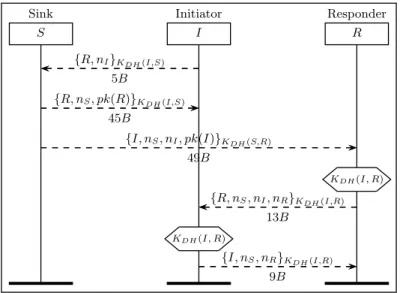
Our aim is to establish a shared key between any two authenticated nodes I and R of the network (not necessary in range). We propose two protocols, called M KESand M KES− light. Protocol M KES, depicted in Figure 1, uses the secure channels created between the sink and each node to communicate the public keys of I and R. Notice that in our context the sink knows all the public keys of all nodes and a node only knows its public key and the public of the sink. The initiator node I builds a request containing the identity of node R and a nonce nI. This request is encrypted with KDH(I, S) and sent to S. The sink S sends:
– to I, the identity of R, a nonce nS, the public key of R encrypted with the shared symmetric key KDH(I, S),
– to R, the identity of I, the same nonce nS, the nonce nI received from I and the public key of I encrypted with the shared symmetric key KDH(S, R).
Once these two messages received by I and R, the two nodes are able to compute KDH(I, R) as follows:
– Node I computes sk(I) × pk(R) = sk(I) × sk(R) × G = KDH(I, R). – Node R computes sk(R) × pk(I) = sk(R) × sk(I) × G = KDH(I, R). To ensure mutual authentication of R and I, node R generates a nonce nR, then uses KDH(I, R) to encrypt its own identity, the two received nonces from S plus its nonce nR. This cipher is sent to I, without neces-sary passing by S. Finally, node I verifies that the received nonce from Ris the same as the one sent by the sink. Then it confirms that it cor-rectly received the message by sending to R its own identity and the two nonces nSand nR, encrypted with KDH(I, R).
Notice that the computation of the new key KDH(I, R) can be done by the sink in order to save some computations on nodes R and I. This version called M KES− light is depicted in Figure 2.
Sink S Initiator I Responder R {R, nI}KDH(I,S) 5B {R, nS, pk(R)}KDH(I,S) 45B {I, nS, nI, pk(I)}KDH(S,R) 49B KDH(I, R) {R, nS, nI, nR}KDH(I,R) 13B KDH(I, R) {I, nS, nR}KDH(I,R) 9B
Fig. 1: M KES: Multihop Key Establishment using the sink S to deliver public keys. KDH(I, R) is computed by the initiator I and the responder R. Sink S Initiator I Responder R {R, nI}KDH(I,S) 5B KDH(I, R) {R, nS, KDH(I, R)}KDH (I,S) 21B {I, nS, nI, KDH(I, R)}KDH (S,R) 25B {R, nS, nI, nR}KDH(I,R) 13B {I, nS, nR}KDH(I,R) 9B
Fig. 2: M KES− light: Multihop Key Establishment using the sink S to computes and delivers KDH(I, R) to initiator and responder nodes.
Protocols without intervention of the Sink
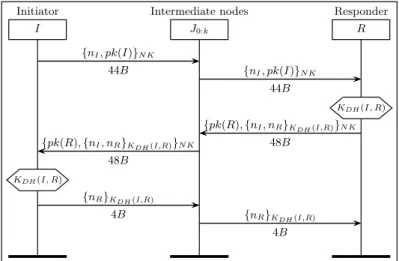
In order to avoid exhausting nodes situated near the sink, we propose two protocols, called M KEN K and M KEK, that do not need the in-tervention of the sink in the key establishment process. The protocol M KEN K, depicted in Figure 3, uses the network key N K allowing the initiator node I and the responder R to exchange their public key. The initiator node I builds a request containing his own identity and a nonce nI. This request is encrypted with N K and sent to R. After decrypt-ing this request, the responder R is able to extract pk(I) and compute KDH(I, R). In order to ensure mutual authentication of R and I, node R generates a nonce nR, then uses KDH(I, R) to encrypt the received nonce from I and its nonce nR. Then, node R builds the response message in-cluding this cipher and his own public key pk(R). The response message is encrypted using N K and sent to the initiator I. After decrypting the response message, node I extracts pk(R) and computes KDH(I, R). Us-ing this key, I decrypts the two nonces nI and nR. After verifying the nonce nI, node I builds a reply message containing nR, encrypted with KDH(I, R). Finally, node R verifies that the received nonce nR from I is the same as the one it originally sent.
Initiator I Intermediate nodes J0:k Responder R {nI, pk(I)}N K 44B {nI, pk(I)}N K 44B KDH(I, R) {pk(R), {nI, nR}KDH(I,R)}N K 48B {pk(R), {nI, nR}KDH(I,R)}N K 48B KDH(I, R) {nR}KDH(I,R) 4B {nR}KDH(I,R) 4B
Fig. 3: M KEN K: Multihop Key Establishment using the network key N K. No encryption/decryption operations on intermediate nodes.
We note that the use of N K to exchange public keys between nodes I and R can be useful when the initiator I is in the neighborhood of R. Indeed, node I sends directly its request to node R without the need of intermediate nodes to forward its request. Since the network key N K is known by all nodes before deployment, the protocol M KEN Kmay suffer
from man-in-the-middle attack when an intruder is able to recover N K by capturing any node in the network for example. In what follows, we describe the scenario of such attack.
An intruder, denoted E, captures a previously authenticated node N in the network and compromises the network key. Node E intercepts the request sent from I to R, decrypts the request and builds an intruder request instead by replacing the nonce nIby its own nonce nEand pk(I) by pk(E). Node E encrypts this new request using N K and sends it to R. Node R decrypts the request, extracts pk(E) and computes KDH(R, E). The response message to E becomes {pk(R), {nE, nR}KDH(E,R)}N K.
Upon reception, node E decrypts the response message with N K, extract pk(R) and computes KDH(R, E). Node E uses the key computed to de-crypt the nonce nRand sends it back to R encrypted with KDH(R, E). In order to finish his attack, node E builds a response message {pk(E),-{nI, nE}KDH(E,I)}N K and sends it to node I. Using pk(I), which was extracted from the request originally sent by I, node E is able to com-pute KDH(E, I). Upon reception, the initiator I decrypts the received response using N K, computes KDH(E, I) and replies with nEencrypted with KDH(E, I).
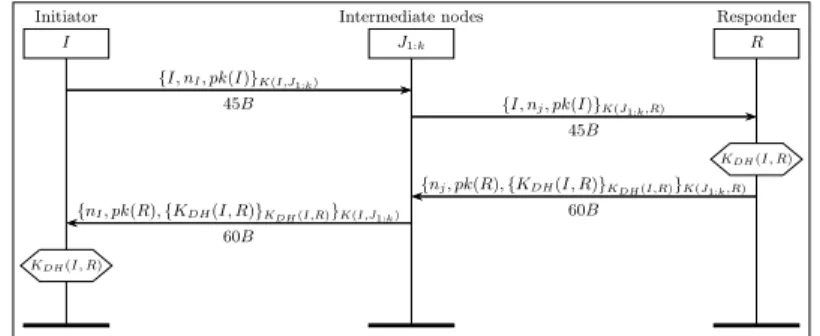
In order to make the key establishment more resilient to node capture, we propose another protocol, called M KEK that uses sessions keys pre-viously established with common neighbors in order to establish new keys. The protocol M KEK, depicted in Figure 4, uses the session keys established with common neighbors, denoted intermediate nodes J1 : k, in order to share a new key between an initiator I and a responder R. We assume that the trusted path from I to R is determined by a routing mechanism. Unlike the protocol M KEN K, nodes J1 : k are involved in the key establishment, they decrypt, modify and encrypt the exchanged messages between nodes I and R instead of just forwarding.
Initiator I Intermediate nodes J1:k Responder R {I, nI, pk(I)}K(I,J1:k)
45B {I, nj, pk(I)}K(J1:k,R)
45B
KDH(I, R)
{nj, pk(R), {KDH(I, R)}KDH(I,R)}K(J1:k,R)
60B {nI, pk(R), {KDH(I, R)}KDH(I,R)}K(I,J1:k)
60B
KDH(I, R)
Fig. 4: M KEK: Multihop Key Establishment using session keys. Encryp-tion/decryption on every intermediate node.
Indeed, each intermediate node Jj,(j = 1, ..., k), extracts only the nonce from the request of the initiator I and replaces it by its own nonce
nj. Upon the reception of a response message sent by the responder R, node Jj recovers and verifies its nonce nj and replies with the nonce extracted previously from the request. The adding of nonces nj at each hop helps to authenticate intermediate nodes. Note that KDH(I, R) is used as a common nonce between nodes I and R to ensure the mutual authentication between of I and R. Also, it should be noted that the protocol M KEK can only be used if nodes I and R have at least one common neighbor.
3
Results
We prove the correctness of all our protocols automatically using Scyther a tool for the automatic verification of security protocols. Cas Cremers has developed an automatic tool called Scyther [4]. It is a free tool avail-able on all operating systems (Linux, Mac and Windows). This tool can automatically find attacks on cryptographic protocols and prove their security for bounded and unbounded numbers of sessions. One main ad-vantage of Scyther is that it provides an easy way to model security properties like secrecy and authentication. This tool abstract the cost of the communications and the execution times of each cryptographic oper-ation. Scyther uses the Dolev-Yao intruder model [6]. In this model, the intruder controls the network and all communications pass through it. Which means that all packets can be captured by the intruder. Moreover the intruder has its own public and private pair of keys. Thus, it is able to play the role of any participant in the protocol. It can also encrypt messages with all public or symmetric keys that it knows and decrypts cipher-texts only if it knows the decryption key.
In Table 2, we present the execution time for our protocols using TelosB which are very limited in calculation resources and are used as a base for comparison between the different protocols and not for obtaining the best results in terms of performance. Notice that these results are done with the minimum required cryptographic operations necessary to realize each protocol. For example, the evaluation of M KES, M KES− light, and M KEN Kis done without intermediate nodes between node I and R. Indeed, the intermediate nodes are just forwarding the messages between Iand R. In contrast, we evaluated M KEK with one intermediate node between nodes I and R due to the necessity of one common neighbor node to use the session keys established with this neighbor.
Note that M KES− light is the most efficient of all protocols. Indeed, the computation of new shared keys are done by nodes I and R in all protocols except M KES− light where only the sink S is doing this com-putation. So M KES− light is very suitable for protocols where the sink has more capacities than the sensor nodes. We note that the computa-tion of new keys according to ECDH without interaccomputa-tion is about 3.2 seconds. This time consumption has a clear effect on the execution time of protocols.
While the number of computation of new keys are equal in the M KES, M KEN K and M KEK, M KEK differs from M KES and M KEN K by the decryption/encryption operations done by intermediate nodes. In-deed, the difference is more than 400ms per each intermediate node.
Protocol name with S (ms)Time without S (ms) GainTime deviation (ms)Standard M KES 6888.15 6625.94 4% 5.81
M KES− light 3679.30 365.85 90% 5.02 M KEN K 6853.26 6853.26 0% 5.01
M KEK 7434.95 7434.95 0% 3.44
Table 2: Execution times of all protocols.
In addition, M KES and M KEN K have almost the same cryptographic operations which is why their execution times are very close. We can expect that the protocol M KES is more suitable when nodes I and R are next to the sink while the protocol M KEN K is more suitable when these nodes are too far from the sink. So in a given topology, nodes should be able to execute the protocol that is less consuming according to their positions relative to the sink.
4
Conclusion
In this paper, we proposed different methods for establishing a secret key between two authenticated nodes in a WSN. We presented and validated two protocols that enables authenticated nodes to establish a common key in a multihop manner with the intervention of the sink or the base station of the WSN.
In order to avoid exhausting nodes that are located near the sink with the key establishment requests, we proposed two protocols that allow nodes to establish secret keys without the intervention of the sink M KEN K and M KEK. These latter protocols are based on the fact that nodes can use the network key to exchange key establishment messages or use previously established session keys on each hop.
Depending on the type of keys that are used and the intervention of the sink, the resiliency of the protocol against intruder attacks is different. The most vulnerable protocol is the one that uses the network key with-out the intervention of the sink M KEN K, but it is the fastest one. The most secure protocols are M KESand M KES− light, but they exhaust nodes that are near the sink and might take longer routes to reach the sink compared to M KEN K and M KEK.
In our future work, we plan on evaluating the performance of each of these protocols with the presence of intermediate nodes between nodes that are establishing a new key, and between these nodes and the sink as well. Depending on the network topology, a trade-off might arise and we might need to make these protocols available at the same time and to be used according the relative positions of the involved nodes.
References
1. S. Bala, G. Sharma, and A. Verma. Classification of symmetric key management schemes for wireless sensor networks. International Journal of Security and Its Applications, 7, 2013.
2. R. Blom. An optimal class of symmetric key generation systems. In International Conference on the Theory and Applications of Crypto-graphic Techniques, 1984.
3. H. Chan and A. Perrig. Pike: Peer intermediaries for key estab-lishment in sensor networks. In INFOCOM, pages 524–535. IEEE Computer Society, 2005.
4. C. Cremers. The Scyther Tool: Verification, falsification, and analy-sis of security protocols. In Computer Aided Verification, 20th Inter-national Conference, CAV 2008, Proc., volume 5123/2008 of Lecture Notes in Computer Science, pages 414–418. Springer, 2008.
5. W. Diffie and M. Hellman. New directions in cryptography. IEEE Transactions on Information Theory, 22:644–654, 1976.
6. D. Dolev and A. C. Yao. On the security of public key protocols. In Proceedings of the 22Nd Annual Symposium on Foundations of Computer Science, SFCS ’81, pages 350–357, 1981.
7. M. A. Hussain, P. Khan, and K. K. Sup. Wsn research activities for military application. In Proceedings of the 11th international con-ference on Advanced Communication Technology-Volume 1, pages 271–274. IEEE Press, 2009.
8. A. Liu and N. Ning. Tinyecc: A configurable library for elliptic curve cryptography in wireless sensor networks. In 7th International Conference on Information Processing in Sensor Networks, pages 245–256, April 2008.
9. N. Manica, M. Saloni, and P. Toldo. WSN - secure comunications with AES algoritms. University of Trento - Faculty of Computer Science, 2008.
10. I. Mansour, D. Rusinek, G. Chalhoub, P. Lafourcade, and B. Ksiezopolski. Multihop node authentication mechanisms for wire-less sensor networks. In 13th International Conference, ADHOC-NOW 2014, Lecture Notes in Computer Science. Springer, 2014. 11. E. Munivel and G. Ajit. Efficient public key infrastructure
implemen-tation in wireless sensor networks. In International Conference on Wireless Communication and Sensor Computing, pages 1–6, 2010. 12. A. Perrig, R. Canetti, J. Tygar, and D. Song. Efficient
authentica-tion and signing of multicast streams over lossy channels. In IEEE Symposium on Security and Privacy, April 2000.
13. A. Perrig, R. Szewczyk, J. Tygar, V. Wen, and D. Culler. SPINS: Security protocols for sensor networks. Wireless Networks, 2002. 14. C. Research. Standards for efficient cryptography, sec 1: Elliptic
curve cryptography, September 2000.
15. C. Yu, C. Lu, and S. Kuo. A simple non-interactive pairwise key establishment scheme in sensor networks. In IEEE International Conference on Sensing, Communication, and Networking, SECON, 2009.
16. W. Zhang, M. Tran, S. Zhu, and G. Cao. A random perturbation-based scheme for pairwise key establishment in sensor networks. In ACM International Symposium on Mobile Ad Hoc Networking and Computing, MobiHoc, 2007.