HAL Id: hal-00917435
https://hal.inria.fr/hal-00917435
Submitted on 11 Dec 2013
HAL is a multi-disciplinary open access
archive for the deposit and dissemination of sci-entific research documents, whether they are pub-lished or not. The documents may come from teaching and research institutions in France or abroad, or from public or private research centers.
L’archive ouverte pluridisciplinaire HAL, est destinée au dépôt et à la diffusion de documents scientifiques de niveau recherche, publiés ou non, émanant des établissements d’enseignement et de recherche français ou étrangers, des laboratoires publics ou privés.
Security Framework for Decentralized Shared Calendars
Jagdish Prasad Achara
To cite this version:
Jagdish Prasad Achara. Security Framework for Decentralized Shared Calendars. Distributed, Paral-lel, and Cluster Computing [cs.DC]. 2011. �hal-00917435�
Université Henri Poincaré
Henri Poincar´e University – Nancy 1
Security Framework for Decentralized
Shared Calendars
Master Thesis
presented and obtained publically on June 24, 2011
for obtaining the
Research Master of Henri Poincar´
e University – Nancy 1
(Computer Science: Services, Security and Networks)
by
Jagdish Prasad Achara
Composition of jury
Didier Galmiche Professor at Henri Poincar´e University – Nancy 1 Bernard Girau Professor at Henri Poincar´e University – Nancy 1 Claude Godart Professor at ESSTIN, Universiy of Lorraine
Dmitry Sokolov Associate Professor at Henri Poincar´e University – Nancy 1
Supervisor : Abdessamad Imine Associate Professor at Nancy 2 University
Acknowledgments
First, and foremost, I would like to thank Abdessamad Imine and Micha¨el Rusinowitch for introducing me to the interesting field of Computer Supported Collaborative Work (CSCW) and for giving me an excellent opportunity to work under their guidance. Their knowledge and commitment with their politeness have always inspired me. They have helped me explore ideas, to critically evaluate my work, and to express my results clearly. More importantly, they have taught me how to further my skills independently. I look forward to our future collaboration and continued friendship.
I am very thankful to Tigran Avanesov for helping me throughout the project.
I would also like to express my gratitude to all of my friends for making my stay in Nancy very pleasant.
Finally, I am extremely grateful to my parents – Vimla Devi and Vidyadhar Singh – and uncle – Surender Singh – for supporting me in everything I have chosen to do and for their unbounded love and affection; my siblings – Naveen and Nirmal – for a great friendship; my nephew – Aman – for providing constant entertainment.
In loving memory of my late grandparents, Dhanne Singh and Rami Devi, who had a sad demise in my absence when I was far away.
Contents
Chapter 1 Introduction 1
Chapter 2 Background 4
2.1 Desired Features of Shared Calendars . . . 4
2.2 DeSCal . . . 5
2.2.1 Is DeSCal the first one of its kind? . . . 5
2.2.2 A Deployment Scenario of DeSCal . . . 6
2.2.3 Ingredients of DeSCal . . . 7
2.2.4 DeSCal modules . . . 8
2.2.5 DeSCal Workflow . . . 9
2.2.6 What does a DeSCal user site need to store? . . . 9
Chapter 3 Security Requirements of DeSCal 11 3.1 Providing confidentiality to replicated shared calendar events . . . 11
3.2 Securing the communication between users . . . 12
Chapter 4 State of the art 13 4.1 Security mechanisms adopted in other shared calendars and decentralized collab-orative environments. . . 13
4.2 Securing replicated data. . . 14
4.3 Secrecy by splitting. . . 15
Chapter 5 Proposed Security Framework 18 5.1 Our proposed security framework . . . 19
5.1.1 Description . . . 21
5.1.2 Concurrency Issues . . . 26
5.2 An illustrating example . . . 28
5.3 Securing the communication between users . . . 31
Contents
Chapter 6 Implementation on iPhone OS 32
Conclusions and Possible Directions of Future Work 34
1 Conclusions . . . 34 2 Possible Directions of Future Work . . . 34
Chapter 1
Introduction
A shared calendar enables a user to share his calendar events only with some selected user(s) in the group to whom he wants to. In order to avoid a single point of failure, the shared calendar should not depend on a central entity. A centralized shared calendar will no more work if the central entity is down and all participating users will be affected by it instantly. A decentralized shared calendar provides far better fault tolerance as compared to its centralized counterpart. An attacker trying to stop functioning the decentralized shared calendar will only be able to do so if he can successfully perform Denial-of-Service (DoS) attack on all users of the shared calendar. On the other hand, it will take less efforts by an attacker in case of centralized shared calendar as he has to hijack only central entity on which centralized shared calendar depends. Also, Decentralized Shared Calendar provides support for Ad-Hoc networks (802.11 networks) and there is low overhead as the tasks are distributed equally among all peers. Considering the usefulness of such a decentralized shared calendar, DeSCal is proposed in [AIR11].
About DeSCal
DeSCal (abbreviation of Decentralized Shared Calendar for P2P and Ad-Hoc Networks) is a shared calendar application which provides users a decentralized infrastructure to share1 their calendar events. All users are allowed to insert a new event in the DeSCal and a user who inserts a new event is the administrator/owner of this event. A user can always ‘Read’, ‘Delete’ and ‘Edit’ the events which he administrates/owns and he is the only user in DeSCal who can specify other user(s) with whom he would like to share the events administered by him. For fault-tolerance, availability and crash recovery, DeSCal is based on full replication of data at each user site. This implies that each user sites stores the whole copy of the shared calendar. For more in-dept detail of DeSCal, see Chapter 2 or refer to [AIR11].
Problem Statement
As the whole copy of the shared calendar is replicated at each user site in DeSCal; in absence of access control, all users can ‘Read’, ‘Delete’ and ‘Edit’ any shared calendar event which they would like to, even if some events are not shared with them by their administrators/owners. However, in general, it is not practical for a user to share all his calendar events with everyone in the group. For instance, a user may have some private events which he might not like to
1
In this report, sharing of an calendar event may correspond to allow other users for any subset of <Read, Delete and Edit> operations on shared calendar event.
Chapter 1. Introduction User DeSCal Persistent Storage (1) (2) (1) legal access (2) illegal access
Figure 1.1: Direct access to shared calendar information in persistent storage
share with anyone in the group or he may have some secret group events which he might want to share only with some selected user(s) in the group.
To prevent unauthorized actions2
on shared calendar events by illegal users of DeSCal, an access control mechanism is needed. DeSCal provides an access control mechanism but it deals only with ‘Delete’ and ‘Edit’ unauthorized operations i.e., a user can’t delete and edit the events for which he is not authorized. This access control model adopted by DeSCal is principally based on [ICR09], a flexible access control model for distributed collaborative editors which doesn’t deal with ‘Read’ access control. However, DeSCal takes care of ‘Read’ access control on application level i.e., a user can’t read the events for which he is not authorized using DeSCal. This is accomplished by making visible to the user only the shared calendar events for which he is authorized to read. However, this is not enough to enforce ‘Read’ access control on shared calendar events as these events are always stored in plain-text and the whole copy of the shared calendar is replicated at each user site. A user can read these unauthorized events for ‘Read’ access without using DeSCal (See Figure 1.1). For example, a user can read the shared calendar events directly by reading the whole copy of the shared calendar stored locally in persistent storage (hard-disk) or reading the shared calendar events at network endpoint when they arrive from other user sites, thereby, losing/sacrificing the confidentiality of users’ calendar events which is possibly an important concern for a user.
Motivation
The motivation behind this work is to make DeSCal secure by providing both confidentiality and integrity to the shared calendar events. The access control model already employed by
2
In this report, an action may correspond to any subset of <Read, Delete and Edit> operations on shared calendar event.
DeSCal preserves the integrity of the replicated shared calendar events by restricting illegal users to ‘Delete’ and ‘Edit’ the events for which they are not authorized. In this report, we plan to address the issue of providing confidentiality to replicated shared calendar events by controlling the ‘Read’ access on shared calendar events i.e., a user should only be able to read the events for which he is authorized. However, only securing the replicated shared calendar events is not enough to ensure confidentiality and integrity of shared calendar events if the network communication between users is not secure. Both providing confidentiality to users’ calendar events and securing the communication between users, had been mentioned as the future work in the original paper of DeSCal [AIR11] and we plan to address these issues here.
Challenges
These security issues must be addressed in such a way that DeSCal doesn’t lose its characteristic features like fault-tolerance, crash recovery, availability of data. DeSCal must be able to survive crashes, it must be fault-tolerant and data must be replicated at each user site for high availabil-ity. In DeSCal, ‘Read’ access control on replicated shared calendar events must be decentralized i.e., there is no central server where shared calendar events can be stored and then, an access control policy is enforced on this centrally stored data. Decentralization leads to new challenges like self-organization, service availability and security. Moreover, in DeSCal, the group of users is dynamic i.e., users leave or join the group in an arbitrary manner at any point of time.
Contribution
Our contribution consists of (i) proposing a required security framework for DeSCal and (ii) implementing it on top of iPhone OS implementation of DeSCal [AIR11]. The proposed security framework provides (i) confidentiality to replicated shared calendar events and (ii) secures the communication between users in DeSCal. It is achieved using standard cryptographic protocols in the field of computer security. This proposed security framework preserves all characteristic features of DeSCal.
This report is organized as follows:
In Chapter 2, we detail the desired features of a shared calendar and briefly present a Decen-tralized Shared Calendar (DeSCal) [AIR11]. Chapter 3 establishes the security requirements of DeSCal whereas Chapter 4 presents the state of the art of securing replicated data in a de-centralized distributed context. Security framework is proposed in Chapter 5 and Chapter 6 describes its implementation on top of iPhone OS implementation of DeSCal. In the end, we present the summary of our work and possible directions of future work.
Chapter 2
Background
This chapter essentially brings forward what a reader has to know before proceeding to read this report any further. It investigates the desired features of a shared calendar, and then, briefly introduces DeSCal [AIR11]. In case a reader already knows the usefulness of a decentralized shared calendar and is familiar about DeSCal, this chapter can exceptionally be skipped solely based on reader’s own judgment (or decision). In any case, we strongly recommend reading this chapter to everyone as DeSCal is presented here in a better, different and compact manner.
2.1
Desired Features of Shared Calendars
The shared calendar must not depend on a third party.
Shared calendars based on a third party central server, for instance, Google Calendar [GCa], prevents users to create a dynamic Ad-Hoc group as users always have to communicate through this central server. Moreover, there is no direct communication between users and they need to have a constant connection to this third party central servers (e.g. an Internet connection to connect to Google Servers to use Google Calendar). Also, using third-party central server to store the shared calendar information, reduces availability of the data as the data has to be fetched from or stored at remote central server when modified by users. Above all, using a third party for sharing calendar events may also lead to sacrificing the confidentiality of these users’ calendar events which is possibly an important concern for a user. See Figure 2.1 to better understand the disadvantages behind using a third party to store the shared calendar information.
An access control mechanism is needed on shared calendar events.
It may not always be appropriate for a user to share all his calendar events with other users in the group. A user may have some secret events which he would like to share only with some selected user(s) in the group, not with everyone. To deal with this aspect of shared calendar, there must be some access control mechanism on shared calendar events. Moreover, access control on shared calendar events must be dynamic, i.e. users should be able to change the access rights on their shared calendar events at any point of time after the creation of an event (unlike the case where a user specifies access control for an event only at the time of creation or insertion of an event).
2.2. DeSCal
3rd party has all shared
calendar information Confidentiality? Availability? User 1 User 1 User 4 User 3 User 2
Figure 2.1: Disadvantages behind using a third party to store the shared calendar information
Eventual Consistency and High Concurrency
Eventual consistency helps concurrency and parallelism as there is no need to wait for all of the copies to be synchronized when updating shared calendar. Any number of users should be able to concurrently modify the shared calendar (by inserting, deleting and editing the events in the shared calendar) but users must eventually be able to see a converged view of all replicated shared calendar copies. Eventual consistency of the replicas is desired; otherwise, diverged replicas may result into a wrong insertion, deletion and edition of the events in the replicated shared calendar copies.
Scalability
The shared calendar must be dynamic in the sense that users may join or leave the application at any point of time during its runtime.
High responsiveness
The shared calendar must be as responsive as a personal calendar i.e. users should have an illusion that they are alone while using the shared calendar.
2.2
DeSCal
A decentralized shared calendar, DeSCal, complying with all these desired features of a shared calendar has been proposed in [AIR11].
2.2.1 Is DeSCal the first one of its kind?
Shared calendars are common nowadays but none of them is decentralized and self-configurable except DeSCal. Google Calendar [GCa] is a shared calendar application by Google but it needs
Chapter 2. Background
a constant connection to Google servers and a prior registration for its shared calendar service by each user. Consequently, it can’t be used over local Wi-Fi networks or over blue-tooth in an organization where mobile users can leave or join the group in an Ad-Hoc manner. This gives DeSCal an edge over its centralized counterparts.
A user can use mobile version of DeSCal and join or leave the group in an Ad-Hoc manner. There exists mobile version of Google Calendar which is made for small screen and also, mobile phone’s built-in calendars can be synchronized with Google Calendar when users are away from their desk but the need to depend on a third party (i.e. a constant connection to Google Servers) never goes away.
Zimbra platform calendar application [Zim] enables users to share their events with other users in a group but again, this is centralized and a server needs to be run before using this application. While using Zimbra platform calendar application, one can run his own server in an organization without depending on a third party but this central server becomes a single point of failure for the shared calendar. Furthermore, centralized server prevents users to create Ad-Hoc group as users need prior knowledge of central server to run the application.
Both Google Calendar and Zimbra platform calendar application use CalDAV (Calendar ex-tensions for Distributed Authoring and Versioning) [Cal] which is an Internet standard allowing a client to access scheduling information on a remote central server. To the best of our knowledge, all other shared calendars depends on a central entity to run and manage itself.
2.2.2 A Deployment Scenario of DeSCal
A research team in a research organization usually consists of a scientific and administrative leader, other members of the team and an administrative assistant. All members of the team can run an instance of DeSCal to keep track of their personal events and also, to share some group events with others. They can hide their personal events by not sharing these events with others. For group events involving two or more persons, one can create the event and share it with other members who are concerned by it. If few members of the team are in a group meeting, others can know this by just having a look on DeSCal. In addition, it is more intuitive for a team leader to share some administrative events with delete and/or edit right with the administrative assistant of the team so that extra hassle of communication can be avoided to deal with administrative tasks.
At the same time, we agree with the fact that this can also be easily done using a centralized shared calendar like Google Calendar but members of this research team can find DeSCal more appropriate if any one or all of the following possible scenarios are true:
• The central entity in the centralized shared calendar is not owned by the organization itself and also, this organization has no connectivity with the outside network of a third party on which centralized shared calendar depends. For example, this research team can’t use Google Calendar if they don’t have Internet connection as it is managed by a third party. • Members of the team want to keep their calendar events confidential i.e. they don’t want to disclose their calendar events with this third party (for instance, Google in case they use Google Calendar) who provides shared calendar service.
2.2. DeSCal
• A team member meets someone while going for lunch or for a coffee and he wants to share some events with this person. This can be done instantly without any overhead like registering for shared calendar service of a third party; just by allowing other person to join the group and sharing only some specific events which this team member wants to share.
2.2.3 Ingredients of DeSCal
Here, we briefly present the elementary entities of DeSCal as it is crucial to understand the proposed security framework.
Shared Calendar
The shared calendar can be modeled by the list abstract data type where each element of the list is an event [ICR09].
Definition 1. [Cooperative Operations]. The shared calendar state can be altered by the following set of cooperative operations: (i) Ins(p, e) where p is the insertion position in the shared calendar and e the event to be inserted at p; (ii) Del(p, e) which deletes the event e at position p; (iii) Up(p, e, e′) which replaces the event e at position p by the new event e′.
Policy
The access control model in DeSCal is based on authorization policy or access control policy3 where each user defines a policy to specify access control rules for the events created by him. A policy is a list of authorizations or rules; sometimes, also called authorization list. A policy specifies the operations a user can execute on shared calendar events. Three sets are used for specifying policies, namely:
1. S is the set of subjects where a subject is a user. 2. O is the set of objects where an object is an event.
3. R is the set of access rights. Each right is associated with an operation that a user can perform on shared calendar events. Thus, we consider the right of reading an event (rR), inserting an event(iR), deleting an event (dR) and updating an event (uR).
As each user is authorized to insert an event in the shared calendar, the insertion right (iR) is not dealt and so, DeSCal must deal with dynamic changes of rR, dR and uR rights.
Definition 2. [Policy]. A policy is a function that maps a set of subjects and a set of objects to a set of signed rights. We denote this function by P : P(S) × P(O) → P(R) × {+,–}, where P(S), P(O) and P(R) are the power sets of subjects, objects and rights respectively. The sign “+” represents a right attribution and the sign “–” represents a right revocation.
A policy P is represented as an indexed list of authorizations (or rules). Each authorization Pi is a quadruple hSi, Oi, Ri, ωii where Si ⊆S, Oi⊆O, Ri⊆R and ωi ∈ {+,–}. An authorization is said positive (resp. negative) when ω = + (resp. ω = –). Negative authorizations are just used to accelerate the checking process. When a user wants to perform an operation, DeSCal needs
3
In the rest of the report, we only write ‘policy’ instead of writing ‘access control policy’ or ‘authorization policy’ each time.
Chapter 2. Background
User Interface (UI)
Access Control Coordination
P2P or Ad-Hoc Network Administrative Logs Authorization Lists Cooperative Log Calendar State Peer i Peer 1 Peer 2 Peer 3
Figure 2.2: DeSCal design modules
to check whether the user is allowed to perform this operation or not. DeSCal uses a first-match semantics for this: when an operation o is generated, it checks o against its authorizations one by one, starting from the first authorization and stopping when it reaches the first authorization l that matches o. If no matching authorization is found, o is rejected, i.e. that operation can’t be executed on the shared calendar.
Definition 3. [Administrative Operations]. The state of a policy is represented by a list of authorizations hPi. A user can alter the state of his policy by the following set of administra-tive operations: AddAuth(p, l)/DelAuth(p, l) to add/remove authorization l at position p. An administrative operation r is called restrictive iff r = AddAuth(p, l) and l is negative or r = DelAuth(p, l).
2.2.4 DeSCal modules
The design of DeSCal is composed of four well-separated conceptual modules described below (See Figure 2.2):
Coordination
The job of coordination module is to handle the concurrent updates on the shared calendar by different users. This has to be done in a decentralized and scalable manner, i.e. without requiring a central server and where users can leave or join the group at any point of time. It is this module which is responsible for ensuring the same converged and consistent copy of the shared calendar at each participating node in all cases. It directly interacts with the local copy of the shared calendar and thereby, is responsible for maintaining its consistency. This module is based on [Imi09], a coordination module for distributed collaborative editors.
Access Control
This module is to control access on the shared calendar events so that a user is only able to access the events for which he is authorized. Also, the access control mechanism provided by this module is dynamic, decentralized and scalable. Here, dynamic access control on calendar events means a user can change access control for his shared calendar events at any point of time after the creation of an event.
2.2. DeSCal
P2P/Ad-Hoc Network
The role of this module is to maintain a local knowledge of the network infrastructure. It’s the responsibility of this layer to provide Peer-to-Peer distributed architecture services to DeSCal for any kind of network like Wireless Ad-Hoc networks, Short range communication (e.g. blue-tooth), LAN, Internet or Managed infrastructure Wireless LAN.
User Interface
It enables users to take actions on the shared calendar. However, this module can’t directly change the state of the shared calendar without interacting with the coordination and access control module. An action taken by the user on this module has to pass through access control module. If this action is authorized by access control module, it is passed to coordination module to change the state of the shared calendar and to deal with consistency issues.
2.2.5 DeSCal Workflow
Below, we present the sequence of major steps taken by DeSCal to better understand it while hiding the complexity behind these steps:
1. When a user manipulates an event in the local copy of the shared calendar by generating a cooperative operation, this operation will be granted or denied by only checking the local copy of the policy of the administrator of that particular event.
2. Once granted and executed, the local cooperative operation is then broad-casted to other users. On reception of this operation at remote user sites, a user has to check whether the remote operation is authorized with respect to his locally stored admin log4
of the event’s administrator before executing them on his local copy of the shared calendar.
3. When a user modifies his local policy by adding or removing authorizations, he sends these modifications, i.e. administrative operations, to other users in order to update their local copies of the policy.
2.2.6 What does a DeSCal user site need to store?
In DeSCal, all users are authorized to insert a new event and a user who inserts an event is the administrator of that event. An administrator can take any action on the shared calendar event created by him and he is the only one who can decide if some other user in the group is allowed to take these actions on this shared calendar event. An administrator exerts this authority on his shared calendar events by specifying authorizations or rules in his policy for the events administered by him. As each user is the administrator of the events created by him, there are as many policies as the number of users. Users can modify an event in shared calendar with respect to the locally stored policy of the administrator of that event.
Shared Calendar and Cooperative Log. DeSCal keeps a copy of the shared calendar at each user site to improve performance. Users can perform updates on his local copy of the shared calendar independently and then, these locally executed updates are transmitted to other users in the group. One has to note here that reception of these locally executed updates at other user
4
Short form of administrative log. Administrative log of user u1 stores all administrative requests generated by him.
Chapter 2. Background e1(admin:u1) e2(admin:u3) e5(admin:u3) e4(admin:u2) e3(admin:u3) e6(admin:u1) Shared Calendar Rule1 Rule2 Rule3 ... ... ... Rule1 Rule2 ... ... ... ... Rule1 Rule2 Rule3 Rule4 ... ... Policies u1 u2 u3 Cooperative_Req 1 Cooperative_Req 2 Cooperative_Req3 ... ... Cooperative Log admin_req1 admin_req 2 admin_req3 admin_req4 ... ... Admin Logs admin_req1 admin_req 2 ... ... ... ... admin_req1 admin_req 2 admin_req3 admin_req4 admin_req5 ... u1 u2 u3
Figure 2.3: Storage at u1’s local site
site is not guaranteed to be in the same order as they are executed locally at their corresponding local sites because of network latency variation, computer resources etc. Therefore, DeSCal needs a decentralized mechanism which can handle the coordination of concurrent updates by different users on shared calendar. The mechanism used in [AIR11] keeps track of both local and remote calendar update requests by storing them in a log called cooperative log. This log helps in maintaining the consistency of the shared calendar and it needs to be stored at each user site.
Policies and Admin Logs. To deal with latency and dynamic access changes, it uses an optimistic access control technique (inspired from [ICR09]) in such a way that enforcement of authorizations is retroactive. Access control is the ability to grant or deny the manipulation of information by someone. A data structure (policy in our case) is used to store all access rights. This policy is checked whenever the controlling-access is started. We store the policy at each user site because high responsiveness can be lost if every update must be authorized by some authorization coming from a distant central server. DeSCal follows the access control model described in [ICR09] but this access control model doesn’t satisfy all the requirements of DeSCal. The model proposed in [ICR09] is single-administrator whereas in DeSCal, each user is the administrator of the events created by him. The single administrator model, proposed in [ICR09], keeps a copy of the admin log containing all administrative requests and policy at each user site. DeSCal extends this model to make it a multi-administrator model where each user has his own 1) policy for the events created by him and 2) admin log to store his administrative requests. Eventually, this requires each user to keep a copy of the policy and admin log of all other users in the group.
To sum up, we illustrate what a user site stores by presenting an example scenario (See Figure 2.3). Suppose, there are three users in DeSCal at a given time t: u1, u2 and u3, and they insert concurrently two, one and three events respectively. After insertion of these events, each user will have the same copy of the shared calendar. In this case, events e1 and e6 are inserted by user u1; e2, e3 and e5 are inserted by u3 and e4 is inserted by u2. Cooperative log at each user site will contain all the cooperative requests generated locally and received from remote user sites. User u1 will store the policies and admin logs of each user including himself (i.e., u1, u2 and u3) and admin log stores all the administrative requests generated by the corresponding user. In this case, u1 will store the following at his local site : policies and admin log of u1, u2 and u3, whole copy of the shared calendar and his cooperative log.
Chapter 3
Security Requirements of DeSCal
Securing DeSCal had been left as the future work in the original paper of the DeSCal [AIR11] and because of absence of security measures, DeSCal remains vulnerable to all kind of attacks. Here, in this chapter, we list what is necessary to make DeSCal secure while at the same time, not loosing its unique features like fault-tolerance, crash recovery, availability, dynamic access control. Our focus is primarily on analyzing and precisely establish the security requirements for DeSCal.
Mainly, below two tasks were left as the future work in the original paper of the DeSCal [AIR11] and we will deal with these in this report.
3.1
Providing confidentiality to replicated shared calendar events
The whole copy of the shared calendar is replicated at each user site in DeSCal but a user should be able to read, delete or edit only the events for which he is authorized. For shared calendar events not to be deleted/edited by unauthorized users, DeSCal [AIR11] already employs an access control module, which essentially ensures the integrity of the replicated shared calendar events. However, this access control model can’t prevent users to read the shared calendar events for which they are not authorized. It is of no use to provide confidentiality to shared calendar events as in DeSCal, the whole shared calendar is replicated at each user site in plain-text. As a matter of fact, a user can read this locally stored shared calendar state directly without using the application (or outside the scope of the application) even if DeSCal generates a view of ‘Read’ access authorized calendar events for the user to hide the unauthorized shared calendar events for ‘Read’ access. This leads to loosing the confidentiality of shared calendar events. So, here, our primary goal is to provide confidentiality to shared calendar events i.e., only authorized users can read the shared calendar events. We highlight here that we don’t deal with the integrity of shared calendar events as it has been already dealt by access control module employed in DeSCal.
Below, we discuss informally what additional data needs to be secured apart from the repli-cated shared calendar and why this data needs to be secured. As it is clearly evident from the fact that DeSCal is pure P2P, we need to store the copy of the shared calendar at each user site. In addition to storing the shared calendar, as described in Chapter 2, a user in DeSCal also needs to store following four entities at each user site:
Chapter 3. Security Requirements of DeSCal
• Policies of each user
• Admin logs of each user and • Cooperative log
Storing local copy of all these data leads to high availability of data, thereby, also increasing the responsiveness and performance of the DeSCal. While providing confidentiality to shared calendar events, care must be taken as a cooperative log stores all local and remote cooperative requests. It requires us to provide confidentiality to shared calendar events stored as cooperative operations in cooperative requests. Policies and admin logs of all other users stored at each user site don’t need to be secured in DeSCal as they (policies and admin logs) contain the access control information on shared calendar events. Reading these copies of the policies and admin logs can’t help a user to get any significant information about shared calendar events except the unique event ids of events. Even if a user changes these locally stored copies of admin logs and policies of other users, he will end up having his own shared calendar copy diverged from other shared calendar copies stored at various other user sites. Other users won’t be affected by it because they will simply ignore his unauthorized actions on shared calendar events once they will be received at their corresponding local sites. On reception of his unauthorized actions at remote user sites, these actions can be checked against remote users’ local copies of the polices and admin logs; and can be rejected if not allowed according to their locally stored policies or admin logs.
3.2
Securing the communication between users
Besides confidentiality to replicated shared calendar events, DeSCal [AIR11] doesn’t provide any security measures to secure the messages exchanged among users. The network communication between users must be secured with respect to all basic security properties like confidentiality, integrity, non-repudiation, replay attack. It is an important fact to point out that in DeSCal, a number of users form a group to participate in the shared calendar but the group communication security mechanisms are not suitable for DeSCal. At first glance, it might seem a little bit awkward but in DeSCal, the messages broadcast are not intended to be read by everyone in the group; as opposed to DeSCal, it is actually the case in group communication. It is due to the fact that, unlike in group communication where all users are equally privileged, users in DeSCal have different rights. In DeSCal, for each event, only a subset of users in the group are authorized to read. A message broadcast to all users in DeSCal should not be read by the users who are not authorized to read it while it is in network transmission. For example, if a user u1 wants only user u2 to read his event, then, user u3 (also, part of the group) should not be able to read this event. Therefore, when this network message is broadcast to all the users in the group through a communication channel, it needs to be secured in such a way that user u3 (who belongs to this group) should also not be able to access it. Here, in DeSCal, a broadcast network message has to be secured from unauthorized users in shared calendar group of DeSCal as well as outsiders while it is in transit.
Chapter 4
State of the art
Today, P2P systems are rapidly growing in use because of their inherent nature to provide 1) scalability, 2) equal participation of peers and 3) tolerance. These systems are fault-tolerant as 1) there is no single point of failure and 2) they replicate the data at each participating node. However, with the absence of a central authority, security of 1) replicated data and 2) messages exchanged between peers, is a challenging task. Further, P2P systems can be classified broadly in three groups depending on their purpose of use: 1) Content distribution 2) Distributed computation and 3) Collaborative application. Likewise, security requirements for these different classes also differ from each other. We start by doing a literature survey of security aspects in collaborative applications and of course, in other decentralized shared calendars which is a variety of decentralized collaborative environment.
4.1
Security mechanisms adopted in other shared calendars and
decentralized collaborative environments.
To the best of our knowledge, there doesn’t exist other decentralized shared calendars where a literature survey of their security aspects can be done. Besides, securing a centralized shared calendar is totally different and is not relevant as it involves only securing the data stored at a single central entity. Though, as a matter of fact, DeSCal is fundamentally a type of decentralized collaborative environment where a group of users take part and share their calendar events by working on the same copy of the replicated shared calendar. Consequently, our first natural direction of literature survey is the field of decentralized collaborative environment. We explored few works [AD06], [Liu08], [LWR09], [AIS+
05], [Ada06] and [GJO+
06] for access control in the field of decentralized collaborative environment. However, we found out that all these works are based on trust i.e. they use trust-based access control (TBAC). Nonetheless, trust-based access control is not suitable to DeSCal as the requirements of DeSCal include immediate enforcement of user’s access control policy. In DeSCal, once a user revokes or shares his event(s) with some selected user(s), this must be followed/performed by the application strictly and immediately. DeSCal can’t tolerate the time taken to build the trust between users which is normally the case in trust-based access control systems. Moreover, trust-based access control mechanisms enforce access control based on trust and not according to the user’s access control policy.
We again remind here that DeSCal already employs an access control mechanism for preserving the integrity of the shared calendar (by restricting unauthorized ‘Delete’ and ‘Edit’ operations on shared calendar events) and this access control mechanism is based on strict access control
Chapter 4. State of the art
according to user’s policy and not based on trust. However, this access control mechanism doesn’t deal with ‘Read’ access control on shared calendar events loosing the confidentiality of users’ calendar events and here, in this report, our primary goal is to provide confidentiality to users’ calendar events.
4.2
Securing replicated data.
As outlined above, trust-based access control is not suitable for DeSCal. Regardless, we don’t limit ourselves only to works done for access control in the field of collaborative environments. We realize that the problem of providing confidentiality to replicated data seamlessly exists in other kinds of decentralized distributed systems which are based on replication of data. In this progression, first, we investigate the revolutionary work done by Herlihy and Tyger in their paper [HT88] for securing the replicated data. This paper describes a mechanism to make replicated data secure using 1) Quorum consensus replication [Her86] and 2) Shamir’s secret sharing algo-rithm [Sha79]. Here, securing replicated data means preserving its confidentiality and integrity. Authors describe protocols employing private and public key encryption to preserve the confi-dentiality (secrecy) and integrity of the data. However, this work preserves the conficonfi-dentiality of the data only against a passive adversary and not against an active adversary while in DeSCal, confidentiality of the data must be preserved against an active adversary. Here, active adversary means the owner of a user site where data is stored whereas passive adversary can be anyone else who tries to read/modify the contents of the data. One has to note here that, in [HT88], encrypted data is stored in replicated form in a quorum, while the key used for encrypting this data is stored using Shamir’s secret sharing scheme [Sha79].
Policy-based access control for weakly consistent replication systems is proposed in [WRT09]. Authors describe the design and implementation of this access control model within Cimbiosys replication framework [RRT+09]. They describe this access control system for replicated data
by presenting a real-world scenario. In this access control model, replicas have a version number associated with each update of the replica. Access control on these replicas is limited in the sense that revocation claims are applied only to those versions newer than the associated version vector. For example, if read right is revoked at version v for a peer p by the owner, p will not be able to read newer versions but still, he will be able to read v or versions older than v. However, in DeSCal, if an administrator revokes ‘Read’ right for his events at time t for a peer p, then, even concurrent modifications at the same time t at other user sites must not be read by user p i.e. in DeSCal, administrative operations are given more priority than cooperative operations. Not to mention, in the proposed access control model in [WRT09], data is weakly consistent because consistency of replicated data depends on time interval between two synchronization operations provided by replication framework whereas DeSCal is based on eventual consistency.
In an another work [PTHCR08], secure content access and replication in pure P2P networks, security aspects required in content sharing application are dealt with and a new security mech-anism is proposed which suits best to content sharing applications.. Authors deal with the security aspects like content authentication and content integrity checking in content sharing applications. Security mechanism is provided in a distributed fashion (i.e. without requiring a central authority) using Pathak and Iftode’s protocol [PI06] for public key authentication. The authentication of public key is very important to associate a user with a public key i.e., public-key authentication ensures that a user who claims to have a public-private public-key pair actually
4.3. Secrecy by splitting.
possesses the private key corresponding to that public key. The proposed protocol is based on associating content with security labels. Appropriate user clearances are required to access this labeled content. It is similar to PGP in the sense that content and authorization certificates are issued by the users. However, as opposed to PGP, it doesn’t rely on certificate directories for the distribution of certificates. In any case, this mechanism deals only with the integrity of data by preventing malicious users changing the content of the published data and confidentiality of the data is not dealt.
4.3
Secrecy by splitting.
For security and fault-tolerance, another set of works mainly rely on either Shamir Secret Shar-ing Algorithm [Sha79] or Rabin’s Information Dispersal Algorithm (IDA) [Rab89]. A different (and somewhat less efficient) perfect secret sharing scheme [Bla79] was also proposed by Blakley in the same year as Shamir’s. However, Shamir’s scheme is used more frequently than Blakley’s in the works based on perfect secret sharing schemes (possibly because of its efficiency advan-tage). As opposed to this, in our opinion, both Shamir’s and Blakley’s schemes can be used interchangeably when it comes to use a perfect secret sharing scheme (if efficiency factor can be ignored). Below, we briefly describe Shamir’s secret sharing and Rabin’s information dispersal schemes respectively for readability and completeness.
Shamir Secret Sharing Algorithm. It divides data D into n pieces in such a way that D is easily reconstructible from any k pieces, but even complete knowledge of k-1 pieces reveals absolutely no information about D. It can be used to divide the secret data D (preferably, a cryptographic key) into n pieces where pieces are stored in a distributed fashion. Secrecy of the data is preserved due to the fact that any lesser than k pieces of data don’t reveal any information about the secret data D. Likewise, fault-tolerance is achieved because of the fact that any k out of n pieces can be used to reconstruct the data D.
Rabin’s Information Dispersal Algorithm (IDA). It breaks a file F of length L into n pieces, each of length L/m, so that every m pieces suffice for reconstructing F. Dispersal and reconstruction are computationally efficient. The sum of the lengths is (n/m) × L. Since n/m can be chosen to be close to 1, it is space efficient. It has numerous applications to secure and reliable storage of information.
Shamir Secret Sharing Algorithm can only be used for the data which is (or can be made) a number, thereby, having an upper limit on the length of the data. It was originally designed for the construction of robust key management schemes for cryptographic systems that can function securely and reliably even when misfortune destroy half the pieces and security breaches expose all but one of the remaining pieces. As opposed to this, Rabin’s IDA can be used for any arbitrary length of data. Shamir’s and Rabin’s techniques achieve a different level of security with different performance and storage requirements. If the original file is b bytes in size and the file is to be divided into n pieces such that any k pieces suffice to reconstruct the file, Shamir’s scheme requires a total of n×b bytes, while Rabin’s requires (n×b)/k. Shamir’s requires more computation as well. To compensate for the extra storage and computation, Shamir’s scheme is more secure, achieving information theoretic security. Rabin’s security is far less, and would be unacceptable in many environments. However, in 1993, Krawczyk proposed a blending of Rabin and Shamir for improved security, by encrypting the data with a key-based encryption
Chapter 4. State of the art
algorithm, and then dispersing the encrypted data with an IDA and the key with a secret sharing scheme [Kra94]. This is called Secret Sharing Made Short (SSMS).
Below are some works which provide secrecy to the data by either splitting the data itself or the cryptographic key which is previously used to encrypt this data.
In this context, we start by investigating an approach for fault tolerant and secure data storage in collaborative work environments [SB05]. As, in collaborative work environments, it can be expected that there will be changes in the list of users authorized to read or update the sensitive data. When using the traditional approach, changes in the access list will require re-encrypting the stored data with a new cryptographic key, which may be cumbersome. For fine grained access list management, each file or document stored would require a unique key. The number of keys could then become large and unmanageable. To avoid such expensive operations during changes in the access list, authors of [SB05] propose to store the data itself using secret sharing techniques. However, it is not clear for us by reading this paper that how do authors really enforce these access list changes on the stored data (for example, addition of a new user in access list). Moreover, unlike in DeSCal, they store data at distributed data storage servers whereas in DeSCal, data must be fully replicated at each user site.
In [AAEM09], authors aim to outsource data in such a way that outsourced data is guaranteed to be secure. In this paper, authors describe scalable privacy preserving algorithms for data outsourcing. Instead of encryption, authors use distribution of data on multiple data provider sites and information theoretically proven Shamir’s secret sharing algorithm as the basis for privacy preserving outsourcing. However, Shamir’s shared secret method can’t be used in DeSCal because:
• Firstly, as already explained, Shamir’s secret sharing scheme applies only to the data which is (or can be made) a number, thereby, restricting the size of the secret data on which it can applied. It is frequently applied to provide secrecy to cryptographic keys which are generally small in size.
• Secondly, in DeSCal, users are dynamic i.e. users may join or leave the group at any point of time and hence, requiring the threshold of Shamir’s shared secret method to be changed accordingly. Moreover, this change in threshold must be performed without requiring the dealer (dealer is the one who breaks the secret data into pieces and distributes to others) because in DeSCal, an administrator of the event might not be present in the group when a new user joins the group or an existing user leaves the group.
Several works [TW], [SWP04], [BCSV94], [MMT01] exists in literature to change the thresh-old parameter of the Shamir’s shared secret method with or without requiring the dealer. Nev-ertheless, [TW] and [SWP04] only investigates the problem of increasing (not decreasing) the threshold parameter of the Shamir’s scheme. Furthermore, in actual, [TW] assumes that thresh-old t is beyond 160 which is, in any case, not practical for DeSCal as it is not practical to have number of users 160 or more in a shared calendar group of DeSCal. [MMT01] again addresses the problem of changing the threshold parameter of Shamir’s secret sharing scheme along with extra verification, in which the combiner can verify whether the pooled shares are correct or not and also, the participants can verify whether the share given by the dealer is correct or not. But, in this scheme, the threshold can be changed only plural times to the values determined in advance.
4.3. Secrecy by splitting.
[BCSV94] is specially designed for future threshold modification and is based on advanced share technique. Per contra, dynamic secret sharing schemes based on advanced share techniques can’t be used in DeSCal as the group of users is extremely dynamic and can’t be predicted at a certain point of time (even the number of users in DeSCal can’t be predicted in advance). Apart from the works done for changing the threshold of Shamir’s secret sharing method, in [WXYX07], a new dynamic threshold secret sharing scheme from Bilinear Maps is proposed. However, it needs a public bulletin board, under the control of the dealer, to publish auxiliary information. In [Cac95], an another work which uses bulletin board, a new construction for computationally secure secret sharing schemes with general access structures is proposed. This scheme provides the capability to share multiple secrets and to dynamically add participants on-line, without having to re-distribute new shares secretly to the current participants.
In [GKLL], a system, vanish is proposed to increase the privacy of data by self-destructing it after a user-specified time. This system seeks to protect the privacy of past, archived data – such as copies of emails maintained by an email provider - against accidental, malicious and legal attacks. Specifically, they wish to ensure that all copies of certain data become unreadable after a user-specified time. It is a new idea to destroy unwanted data after a specific time-limit and helps increase data privacy. They combine shamir’s secret key concept and DHTs in a nice way leading to develop this system. For security of data without using encryption techniques, as described above, a lot of works split and store the data across various physical locations. POTSHARDS [SG07] is a system designed to provide secure long-term archival storage to address the new challenges and new security threats posed by archives that must securely preserve data for decades or longer. This archival storage system, POTSHARDS, provides long-term security for data with very long lifetimes without using encryption. Secrecy is achieved by using provably secure secret splitting and spreading the resulting shares across separately-managed archives. However, shared secret splitting methods can’t be used in DeSCal to share a secret as the group of users in DeScal is highly dynamic.
Dispersing data across multiple sites yields a variety of obvious benefits, such as availability, proximity and reliability. Less obviously, it enables security to be achieved without relying on encryption keys. Standard approaches to dispersal either achieve very high security with correspondingly high computational and storage costs, or low security with lower costs. AONT-RS [RP11], a new dispersal scheme is proposed which blends an All-Or-Nothing Transform [Riv97] with Reed-Solomon coding to achieve hight security with low computational and storage costs. It uses Rabin’s IDA and enriches it in two ways: first, by employing a variant of Rivest’s All-or-Nothing Transform as a preprocessing pass over the data and second, by employing a systematic erasure code instead of non-systematic one. Unlike SSMS [Kra94], it enriches the security of Rabin’s IDA without secret sharing. But again, we can’t use Rabin’s IDA in DeSCal due to below reasons. In DeSCal, when a new user joins the group, the administrator of the event must send him his share but at the time of joining the group, the administrator may not be present in the group. Also, a new user must contact all the existing users in the group to get his shares of the shared calendar events at the time of joining the group which is not practical.
In some other work [JAV08], a privacy service for DHTs is proposed by applying the principles of Hippocratic database to P2P systems to enforce purpose-based privacy which prevents privacy violation by prohibiting malicious data access. However, data is not replicated and is stored only at a single data provider site.
Chapter 5
Proposed Security Framework
In this chapter, our primary goal is to propose a decentralized security mechanism which can fulfill all security requirements of DeSCal. The proposed security framework satisfies all the security requirements of DeSCal while at the same time, not loosing DeSCal’s characteristic features. This novel security framework makes use of well-established cryptographic protocols in the field of computer security.
Things to be taken care of while proposing the security framework for DeSCal (Security Framework Design Requirements).
Both providing confidentiality to a user’s calendar events and full replication insists DeSCal to store the shared calendar events in some non-readable (encrypted) form where a user can read only the events for which he is authorized. However, just storing these shared calendar events in a non-readable form doesn’t make any sense. In the original paper of DeSCal [AIR11], the motivation behind full replication was to increase the availability of the data, ensuring recovery of the data in case of crash and to make DeSCal fault-tolerant. Therefore, it is very important to store this non-readable in such a way that DeSCal doesn’t loose it’s all above mentioned salient features.
Fault-tolerance is the ability of DeSCal to continue operating properly when a user site crashes. In addition, DeSCal has the ability to survive the crash of a user site i.e. if a user site is crashed, this user can join the group and participate again in the same manner as it was participating before the crash by restoring the whole state of the shared calendar. A term ‘maintainability’ was also coined for this later aspect of DeSCal. Availability of data ensures that the shared calendar events are readily available to a user site when they are needed i.e. if a user wants to access the shared calendar events for any subset of ‘Read’, ‘Delete’ or ‘Edit’ operations, these shared calendar events must be retrieved as quickly as possible. For immediate retrieval to increase the availability of the data, these shared calendar events must be stored at each user site. Storing these shared calendar events at each user site ensures that these events are present and ready for use all the time. Furthermore, for these stored shared calendar events to be available all the time, the security framework used to provide confidentiality must also be functioning correctly all the time. Ensuring availability also involves preventing denial-of-service attacks. Therefore, while proposing a security framework (‘Read’ access control on shared calendar events and securing the communication) for DeSCal, one must take extremely care that these salient features of DeSCal are retained.
5.1. Our proposed security framework
Here, we would also like to point out that security framework must essentially be designed on top of DeSCal [AIR11] where coordination and access control models already employed by DeSCal are not changed substantially. They must remain as intact as possible and can have merely very minor modifications. We remind here that these coordination and access control models used in DeSCal are mainly based on coordination and access control models proposed in [Imi09] and [ICR09] for decentralized distributed collaborative editors respectively.
DeSCal is based on broadcast group communication i.e., it doesn’t need to send specific messages to different users. And, coordination and access control modules already employed by DeSCal are designed keeping in mind this fact. Thereupon, another design requirement of security framework for DeSCal includes preserving this broadcast group communication.
In the end, we would like to emphasize the fact that providing the required security mecha-nisms for DeSCal in such an environment is very challenging task and has never been dealt by the research community in this field so far to the best of our knowledge. The challenges are:
1. ‘Read’ access control must be decentralized i.e., there is no central server where we can store the data and then, enforce an access control policy on this centrally stored data. 2. DeSCal must be able to survive crashes; it must be fault-tolerant and data must be
repli-cated at each user site for high availability
3. Users in DeSCal are dynamic i.e. a user can leave or join the group at any point of time. 4. For securing the communication between users in DeSCal, standard group communication security mechanisms can’t be used despite the fact that users in DeSCal form shared calendar groups. It is described in Chapter 3 why this group communication security mechanisms are not appropriate for DeSCal.
5.1
Our proposed security framework
To meet all security requirements of DeSCal, we propose here a security framework complying with all the design requirements mentioned above. This security framework uses basic security protocols in such a way that it makes DeSCal secure and robust. It uses public key cryptography where each user is linked with a public key. Generally, to build a secure system of multiple users, it is very important to identify them in some way. Here, we identify a user by his public key. To associate a user (or user id) with a public key correctly, authentication of users’ public keys is required and this first step is decisive for the correct working of rest of the security framework. As well, the authentication of users’ public keys must be done in a decentralized way without using trusted third parties (TTPs). For this, a byzantine fault-tolerant public key authentication for pure Peer-to-Peer systems is proposed in [PI06] by Pathak and Iftode which suits best to our needs. For readability and completeness, we describe this protocol in brief below.
Pathak and Iftode’s protocol
Pathak and Iftode [PI06] apply the ideas presented in the Byzantine Generals Problem [LSP82] for providing public key authentication in pure P2P systems, where generally one cannot assume the existence of a PKI. They postulate that a correct authentication depends on an honest majority of a particular subgroup of the peers’ community, labeled “trusted group”. However,
Chapter 5. Proposed Security Framework
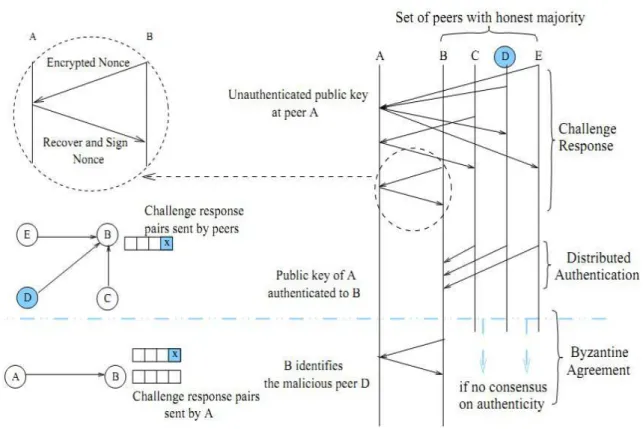
Figure 5.1: Authentication protocol example: A peer A is authenticated by B using its trusted peers. D is a malicious peer that tries to prevent authentication of A.
in this kind of systems, an authenticated peer could create multiple fake identities and could act maliciously in the future (Sybil attack [Dou02]). For this reason, the classification of the rest of the community maintained by each node has to be proactive and periodically flushed. Thus, honest members from trusted groups are used to provide a functionality similar to that of a CA (certification authority) through a consensus procedure.
The authentication protocol (see Figure 5.1, figure taken from the original paper [PI06]) consists of four phases: admission request, challenge response, distributed authentication and Byzantine agreement. The protocol begins when Bob runs into a newly discovered peer, Alice, with an unauthenticated public key (KA), and then asks for the key to a subgroup of its trusted members, in order to verify its authenticity. Each notified peer challenges Alice by sending a random nonce encrypted with Alice’s supposed public key (sent by Bob) in the signed challenge message. Alice will be able to return the recovered nonce in a signed response message (if and only if she holds the corresponding private key (K−1
A )). Each challenger waits for an application specific timeout, and if a correct response is received, he gets a proof of possession for KA. All announced peers send their proofs of possession to Bob.
If all peers are honest, then there will be consensus and Bob will get the authentication result. Note that Alice or some of the peers can be detected as malicious or faulty if some votes differ. In this case, Bob first verifies if Alice is malicious by sending her the request message containing the proof. Alice must respond with all the challenge messages received and her respective
5.1. Our proposed security framework
responses. If Alice can prove that she is not malicious, then some of the peers must be; in that situation, Bob must communicate a Byzantine fault to the group, which will send the Byzantine agreement message to others. All these transmitted messages have timestamps, source and destination identifiers, and digital signatures. Finally, successful authentication moves a peer to the trusted group, whereas encountered malicious peers are moved to the untrusted group.
For further details, we refer the reader to the original paper in [PI06].
Notations used
1. Symmetric key: A symmetric key used for event e is denoted as Ke.
2. Public/Private key pair: Public/private key pair of a user u is denoted as Ku and Ku−1 respectively.
3. Symmetric cryptography: Symmetric encryption and decryption of an event e using key Ke is denoted as EKe(e) and DKe(e) respectively.
4. Asymmetric cryptography: Asymmetric encryption and decryption of message ’m’ using public/private key pair of user u is denoted as {m}Ku and {m}K−1
u respectively.
5.1.1 Description
Here, we detail our proposed security framework and describe how it is enforced on top of coordination and access control model already employed by DeSCal [AIR11].
We present our security framework by describing the mechanism to be followed with respect to all possible happenings during the whole life cycle of DeSCal.
These possible happenings can be categorized based on their type:
1. User-generated happenings: This type of happenings are generated by a user by tak-ing an action either on the shared calendar or on policy (by generattak-ing cooperative and administrative operations respectively).
2. System-wide happenings: A new user joins or an existing user leaves DeSCal. An existing user may disconnect for a while and then, may connect back i.e., goes off-line and then, comes on-line again.
1. User-generated happenings
A user can take various cooperative and administrative operations at any point of time during DeSCal’s lifetime. We describe the steps taken to enforce our security framework for each of these operations.
Chapter 5. Proposed Security Framework
Inserting a new event. As all users in DeSCal are allowed to insert a new event. So, insertion of a new event is not checked against the local copy of the policy before it’s execution at locally stored copy of the shared calendar. Once it’s inserted in the local copy of the shared calendar, a cooperative request of insertion type is generated and broadcast to all other users in DeSCal. This cooperative request comprises the locally inserted new event which is to be inserted at all other copies of the shared calendar. Likewise, on reception of this cooperative request at other user sites, this new event is always allowed to be executed on remote copies of the shared calendar as all users are authorized to insert a new event in the shared calendar.
However, adding security framework requires the cooperative request to store the newly in-serted event in some non-readable form which if broadcast, only authorized users can read. Extreme care has to be taken to construct this non-readable form keeping in mind all the secu-rity requirements of DeSCal and design requirements of secusecu-rity framework are satisfied.
When a user inserts a new event ‘e’ in the shared calendar, DeSCal needs to generate a new symmetric key ‘Ke’ corresponding to this newly created event. Next, the newly created event ‘e’ is encrypted by this symmetric key ‘Ke’ using a symmetric key encryption algorithm. Side-by-side, this symmetric key is first encrypted using the public key of the owner (who inserted this event ‘e’) and also, using public keys of other authorized users for ‘Read’ access to this event. All these encrypted forms constitutes a new form of event (which we call e′, See 5.1). This new form e′ can only be read by authorized users when broadcast in the group.
e′ = E
Ke(e), {Ke}KOwner,{Ke}KAuthU ser1,{Ke}KAuthU ser2, .... (5.1) Just replacing the event i.e., ‘e’ by ‘e′’, in insert operation of broadcast cooperative request helps us in keeping the coordination and access control models almost untouched while propos-ing this new security mechanism for insertion of an event. Also, it is very important to note here that it is e′ which is stored in cooperative request, thereby, requiring no security mechanism for securing cooperative log. Also, confidentiality to the broadcast cooperative request is au-tomatically provided during network transmission as no one (both inside or outside the group) except authorized users can read these events. We will describe later how other basic security properties are preserved for network communication.
This new form of event ‘e′’ consists of 1) encrypted event and 2) the symmetric key used for encryption of the event, encrypted separately with public key of the owner and all other authorized users. On reception of this broadcast cooperative request at remote user sites, only authorized users are to recover the event ‘e’ from ‘e′’. An authorized user can do this by getting the symmetric key used for the encryption of the event by decrypting the encrypted symmetric key with his private key and then, decrypting the event using this symmetric key. This ensures that only authorized users can get the event ‘e’ back but not other users.
Practically, it is possible that at the time of creation of an event, no other user is authorized to read this event and in this case, e′ will take the following form (See 5.2):
e′= E
Ke(e), {Ke}KOwner (5.2)
In 5.2, it can be easily seen that owner can always get the event ‘e’ back in case his site crashes; just by demanding the whole state of the shared calendar from any nearby user.
5.1. Our proposed security framework
Deleting an existing event. When a user wants to delete an event in the shared calendar, it is checked against his local policy if he is authorized to do so or not. If authorized, this event is deleted from the local copy of the shared calendar and then, a cooperative request is generated which is to be broadcast to all other users in the group. On reception, this cooperative request is checked against the admin log and if authorized, the event in the local copy of the shared calendar is deleted. It must be noted that events are always stored in encrypted form ‘e′’ in the shared calendar and a view (the events for which he is authorized to read) is generated for the user from this encrypted calendar. In case of deletion, nothing extra has to be done with respect to our proposed security framework.
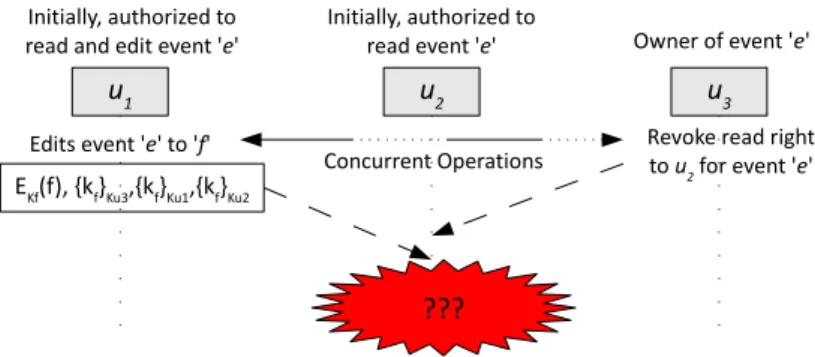
Editing an existing event. It is the job of the access control model already employed by DeSCal to ensure that an unauthorized user can’t edit an existing event in the shared calendar. Edition of an event is same as inserting a new event from the perspective of our proposed security framework except the fact that editing an existing event doesn’t always necessitate to generate a new symmetric key as is the case in inserting a new event. If the edition of the event by some authorized user is immediately after a revocation of ‘Read’ right to some user(s) by the owner, the editor must generate a new symmetric key because the set of authorized user(s) for ‘Read’ right has changed after this revocation operation. This new symmetric key is used for encrypting the edited event and the symmetric key is encrypted by the public key of the owner and new set of authorized user(s). It results into a new form of edited event e′ where only authorized users can read the event in plain-text if it is broadcast to all other users in the group.
Also, we would like to point out that encryption of symmetric key with the public key of the owner and all authorized user is not needed to be computed and broadcast each time a user edits an event. Only if there is an immediate revocation of ‘Read’ right to a set of user(s) before the edition of an event, we need to generate this whole new form of event e′ (See 5.1) corresponding to these newly set of authorized user(s) by generating a new symmetric key. Otherwise, we only need to compute and broadcast the encrypted edited event with the same symmetric key which is already being used for this event.
Granting ‘Read’ right. Only the owner of an event can grant a ‘Read’ right to a set of user(s). When the owner grants ‘Read’ right to a set of user(s), an administrative operation is generated after changing the locally stored policy. This administrative operation is broadcast to all other users in the group to make the change effective at policies stored at all other remote user sites. However, just broadcasting this administrative operation to grant ‘Read’ access to a set of user(s) on this event only enables them to change their locally stored policy. These ‘Read’ right granted user(s) still can’t get access to the event in plain-text. For this, the owner must send the symmetric key used for this event encrypted with the public key of all granted user(s) along with this administrative operation. Suppose, the owner grants ‘Read’ access to two users u1 and u2 for some event ‘e’. Symmetric key used for encrypting event ‘e’ is denoted by Ke. In this case, the owner must send information ‘i ’ (See 5.6) along with the administrative operation.
i= {Ke}Ku1,{Ke}Ku2 (5.3)
By doing this, the users who are granted ‘Read’ access can first decrypt the symmetric key which is being used for encrypting this event. This can be done by decrypting their corre-sponding encrypted part of the symmetric key in the received information ‘i ’ (along with the