PLEASE SCROLL DOWN FOR ARTICLE
Access details: Access Details: [subscription number 918836320]
Publisher Taylor & Francis
Informa Ltd Registered in England and Wales Registered Number: 1072954 Registered office: Mortimer House,
37-41 Mortimer Street, London W1T 3JH, UK
Journal of Vertebrate Paleontology
Publication details, including instructions for authors and subscription information:
http://www.informaworld.com/smpp/title~content=t917000010
New material and a reassessment of soft-shelled turtles (Trionychidae)
from the Late Cretaceous of Middle Asia and Kazakhstan
Natasha S. Viteka; Igor G. Danilovb
a Yale University, PO 202411, New Haven, Connecticut, U.S.A. b Department of Herpetology, Zoological Institute, Russian Academy of Sciences, Universitetskaya Emb. 1, St. Petersburg, Russia Online publication date: 24 March 2010
To cite this Article
Vitek, Natasha S. and Danilov, Igor G.(2010) 'New material and a reassessment of soft-shelled turtles
(Trionychidae) from the Late Cretaceous of Middle Asia and Kazakhstan', Journal of Vertebrate Paleontology, 30: 2, 383
— 393
To link to this Article: DOI:
10.1080/02724631003617548
URL:http://dx.doi.org/10.1080/02724631003617548
Full terms and conditions of use: http://www.informaworld.com/terms-and-conditions-of-access.pdf
This article may be used for research, teaching and private study purposes. Any substantial or systematic reproduction, re-distribution, re-selling, loan or sub-licensing, systematic supply or distribution in any form to anyone is expressly forbidden.
The publisher does not give any warranty express or implied or make any representation that the contents will be complete or accurate or up to date. The accuracy of any instructions, formulae and drug doses should be independently verified with primary sources. The publisher shall not be liable for any loss, actions, claims, proceedings, demand or costs or damages whatsoever or howsoever caused arising directly or indirectly in connection with or arising out of the use of this material.
ARTICLE
NEW MATERIAL AND A REASSESSMENT OF SOFT-SHELLED TURTLES (TRIONYCHIDAE)
FROM THE LATE CRETACEOUS OF MIDDLE ASIA AND KAZAKHSTAN
NATASHA S. VITEK1and IGOR G. DANILOV*,2
1Yale University, PO 202411, New Haven, Connecticut 06520, U.S.A., [email protected]; 2Department of Herpetology, Zoological Institute, Russian Academy of Sciences, Universitetskaya Emb. 1,
199034, St. Petersburg, Russia, [email protected]
ABSTRACT—In this paper we describe previously unpublished trionychid turtle material, consisting of numerous shell frag-ments, from two Late Cretaceous (Santonian–early Campanian) localities from Middle Asia and Kazakhstan (Central Asia in the U.S. tradition): Kansai (Tadjikistan) and Shakh-Shakh (Kazakhstan). This material can be attributed to two forms of trionychids present in both localities. One of them is the named species Trionyx riabinini Kuznetsov and Chkhikvadze, 1987, described from Shakh-Shakh. New data on its shell morphology provided by our study allow attribution to the genus Aspidere-toides Gardner et al., 1995, known previously only from the Campanian–Maastrichtian of North America. The presence of this taxon in both Middle Asia and North America provides the first clear evidence for the relationship between Cretaceous Asian and North American trionychids. The second form is established as a new species, “Trionyx” kansaiensis, sp. nov., with unclear systematic position within Trionychinae. We lastly present a brief review of other named taxa of Cretaceous trionychids of Middle Asia and Kazakhstan.
INTRODUCTION
The Trionychidae Gray, 1825 (see Joyce et al., 2004), or soft-shelled turtles, are a group of highly aquatic cryptodires (Mey-lan, 1987). They first appeared in Asia in the Early Cretaceous (Aptian-Albian), then in North America in the Late Cretaceous (Cenomanian), and spread to the other continents in the Ceno-zoic (Nessov, 1995; Hutchison, 2000; Brinkman, 2003; Danilov, 2005). The systematics and phylogeny of this group of turtles are very tangled and still not entirely determined (Meylan, 1987; Gardner et al., 1995; Karl, 1998). This is especially true about Cretaceous trionychids, which are important for understanding the early diversification and evolution of this group (see Fig. 1 for known distribution of Cretaceous trionychids). Their record is poor and includes, besides numerous indeterminate materi-als, mostly taxa based only on either skulls or shells (Hutchi-son, 2000). More complete skull-shell-associated materials have been described only for trionychids from the Campanian of North America (Gardner et al., 1995) or otherwise from the Cenozoic.
Here we provide new data on Late Cretaceous trionychids de-rived from our study of both published and previously unde-scribed materials from two Asian localities (Fig. 2), situated in the region that Soviet and Russian geographers have tradition-ally called Middle Asia and Kazakhstan; it genertradition-ally corresponds to Central Asia in the U.S. tradition. These localities are Kan-sai, which is in the early Santonian Yalovach Formation in the Fergana Depression, Tadjikistan; and Shakh-Shakh, which is in the Santonian–early Campanian Bostobe Formation in the north-eastern Aral Sea area, Kazakhstan (see Nessov, 1997, for local-ity data). Much of the material that we studied (see Referred Material in the Systematic Paleontology section) was collected by expeditions of the Paleontological Institute of the Academy of Sciences of the USSR in the 1950s to 1960s (Rozhdestvensky and Khosatzky, 1967). L. I. Khosatzky studied the material, but never published his observations. Some results were present in
*Corresponding author.
the diploma of Khosatzky’s student I. Yu. Levshakova (1982), and there she assigned all trionychids from Kansai to Trionyx (Aspideretes) z akhidovi Khosatzky, 1966 (see Discussion for sta-tus of this taxon). The material from Kansai is more abundant and more complete than the material from Shakh-Shakh. Our study of these materials allows us to clarify the systematic po-sition of two trionychid species, one of which is new. These new data present the first evidence of relationships between Creta-ceous trionychids of Asia and North America.
Anatomical terms of the trionychid shell follows Meylan (1987), Gardner and Russell (1994), and Karl (1999).
Institutional Abbreviations—IZK, Institute of Zoology, Academy of Sciences of Kazakhstan, Almaty, Kazakhstan; ZIN
PH, Paleoherpetological collection, Zoological Institute of the
Russian Academy of Sciences, St. Petersburg, Russia.
SYSTEMATIC PALEONTOLOGY TESTUDINES Batsch, 1788
CRYPTODIRA Cope, 1868 TRIONYCHIDAE Gray, 1825 TRIONYCHINAE Gray, 1825
ASPIDERETOIDES Gardner, Russell, and Brinkman, 1995 ASPIDERETOIDES Gardner et al., 1995:632.
Content—Four species: Aspideretoides allani (Gilmore, 1923); Aspideretoides foveatus (Leidy, 1856) (type species); Aspidere-toides riabinini (Kuznetsov and Chkhikvadze, 1987), comb. nov.; Aspideretoides splendidus (Hay, 1908).
Diagnosis—See Gardner et al., 1995.
ASPIDERETOIDES RIABININI (Kuznetsov and Chkhikvadze, 1987), comb. nov.
Trionyx riabinini Kuznetsov and Chkhikvadze, 1987 (part.):35, figs. 3, 4, 6, 7.
383
FIGURE 1. Temporal and geographic distri-bution of the Cretaceous Trionychidae. Gaps in record are filled with grey. Data on diversity and age of Cretaceous trionychids are taken from the following sources: China: Yeh (1994), Brinkman et al. (1993); Japan: Hirayama et al. (2001); Middle Asia and Kazakhstan: Brinkman et al. (1993), Danilov (2007), Kuznetsov and Chkhikvadze (1987), Nessov (1995, 1997), this paper; Mongolia: Chkhik-vadze and Shuvalov (1988), Khosatzky (1976, 1999); North America: Brinkman (2003), Eaton et al. (1999), Gardner et al. (1995), Hutchison and Holroyd (2003). Sinamyda fuchiensis (Yeh, 1974) from the ?Early Cre-taceous of China (Yeh, 1974) is not included due to uncertainty of its age. See text for other explanations.
“Plastomenus” riabinini: Chkhikvadze and Shuvalov, 1988:199; Chkhikvadze, 1990:22, 75.
Paraplastomenus riabinini: Kordikova, 1991aa (manuscript):5; 1991b:4; 1994a:343–345; 1994b:8; Nessov, 1997:109.
Crassithecachelys riabinini: Chkhikvadze, 2000a:56; 2007:127. Holotype—IZK R-3919, a partial nuchal.
Referred Material—Kansai locality: ZIN PH 939/64, posterior
half of carapace; ZIN PH 901/64, a posterior carapace fragment, consisting of neurals 6 and 7 and right costals 6 and 7; IZK R-3927, ZIN PH 603/64, ZIN PH 604/64, ZIN PH 628/64, and ZIN PH 633/64, partial nuchals; ZIN PH 820/64 and ZIN PH 822/64, costals 1; ZIN PH 901/64 and ZIN PH 930/64, costals 5; ZIN PH 899/64, costal 6; ZIN PH 903/64, costal 7; ZIN PH 864/64, costal 8; ZIN PH 860/64, costals 7 and 8; ZIN PH 664/64, epiplastron; ZIN PH 680/64, ZIN PH 755/64, ZIN PH 764/64, and ZIN PH 852/64, partial hyoplastra; ZIN PH 716/64, hypoplastron; ZIN PH 675/64,
xiphiplastron; Shakh-Shakh locality: ZIN PH 189/10, a carapace fragment, consisting of two anterior neurals and fragments of costals; IZK R-3919 and ZIN PH 192/10, partial nuchals; ZIN PH 175/10, partial costal 1; IZK R-3921 partial hyoplastron; IZK R-3929 and ZIN PH 169/10, partial hypoplastra. Also, numerous additional specimens from both localities in the collections ZIN PH 10 and ZIN PH 64.
Locality, Horizon, and Age—Kansai, Fergana Depression,
Tadjikistan; Yalovach Formation, early Santonian; Shakh-Shakh (type locality), northeastern Aral Sea area, Kazakhstan; Bostobe Formation, Santonian–early Campanian.
Diagnosis—Largest carapace size approximately 50 cm; can
be differentiated from Aspideretoides foveatus by bigger size and sculpture pattern; from Aspideretoides allani by bigger size and presence of sculptured plastral callosities at both large and small sizes; from Aspideretoides splendidus by having
FIGURE 2. Map showing localities of Cretaceous trionychids of Middle Asia and Kazakhstan mentioned in the text. A, Dzharakuduk; B, Baybishe; C, Shakh-Shakh;
D, Kyrkkuduk; E, Kansai; F, Kylodzhun. See
text for more data.
FIGURE 3. Reconstructions of shells. A, pideretoides riabinini, adult carapace; B, As-pideretoides riabinini, subadult carapace; C, “Trionyx” kansaiensis, carapace; D, Aspidere-toides riabinini, plastron; E, “Trionyx” kan-saiensis, plastron. Entoplastron reconstruction based on basic trionychine entoplastron (Mey-lan, 1987).
inguinal hypoplastral border not thickened and by shape of xiphiplastra.
Description of Material from Kansai—The carapace is
moder-ately large; a reconstruction (Fig. 3A) based on the largest com-plete nuchal (ZIN PH 604/64, Fig. 4A) is approximately 50 cm long. Outline is subcircular, with a broadly convex anterior bor-der and a straight or notched posterior borbor-der. Sculpturing is a pattern of thin, connected ridges forming a honeycomb or net-like pattern, similar to Aspideretoides allani and Aspideretoides splendidus (Gardner et al., 1995:fig. 3B–E).
Nuchal width is more than four times nuchal length, but can vary from about four to six times, similar to the degree of variation in Aspideretoides foveatus. Postnuchal fontanelles are found only in one specimen (ZIN PH 633/64, Fig. 4B), a small partial nuchal approximately 16 cm wide. Nuchals are weakly emarginated anteriorly. Some smaller specimens (ZIN PH 633/64 and ZIN PH 628/64, Fig. 4C) may not be covered entirely by sculpturing. However, this is a juvenile characteristic (Gardner and Russell, 1994) and sculpturing covers the entirety of all large, presumably adult specimens. Some small specimens are entirely sculptured (ZIN PH 603/64, Fig. 4D), indicating that they are also adults. This kind of variation in size of adults is common for some extant trionychid species such as Apalone mutica (LeSueur, 1827) and Ap. spinifera (LeSueur, 1827) (Webb, 1962; Meylan, 1987; Gardner and Russell, 1994).
Although no neurals were found that could be definitively identified as a preneural, several costals 1 have an outline that indicates the presence of a preneural (ZIN PH 820/64, Fig. 4E). One costal 1 (ZIN PH 822/64, Fig. 4F) does not show the clear outline of a preneural, but this occurs occasionally among some extant trionychid species with a preneural (Gardner and Russell, 1994:fig. 8E) and does not exclude the possibility that a preneural was present in that individual. It may also be the case that this specimen represents an anomalous individual without a preneu-ral, as sometimes happens in modern species usually having preneurals (Gardner and Russell, 1994). In general, though, the size of the available first neurals and the outline of almost all of the costals 1 indicate that Aspideretoides riabinini has a preneu-ral, like other species of Aspideretoides. Among Cretaceous
trionychids, besides Aspideretoides, the presence of a preneural is also supposed for “Trionyx” kyrgyz ensis Nessov, 1995, and “As-pideretes” maortuensis Yeh, 1965, from the Early Cretaceous of Kirghizia and China respectively (Yeh, 1965, 1994; Nessov, 1995; Chkhikvadze, 1999).
There are seven continuous neurals. Typically, neurals 1 to 4 are hexagonal short-sided posteriorly, neural 5 is tetragonal, neural 6 is hexagonal short-sided anteriorly, and neural 7, which occurs between costals 6 and 7, is pentagonal (ZIN PH 901/64, Fig. 4G). The described neural pattern is common for mem-bers of the Trionychini (sensu Meylan, 1987), including, among Cretaceous forms species of Aspideretoides, “Amyda” men-neri Chkhikvadze and Shuvalov, 1988, and “Amyda” orlovi Khosatzky, 1976, both from the Late Cretaceous of Mongo-lia (Khosatzky, 1976, 1999; Chkhikvadze and Shuvalov, 1988; Sukhanov, 2000). As mentioned above, neural reversal usually occurs at neural 5, but this character is variable, as shown by ZIN PH 939/64 (Fig. 4H), where reversal occurs at neural 6. This kind of variation occurs among Aspideretoides foveatus and other species of trionychids (Gardner et al., 1995; Meylan, 1987). Neu-rals are longer than wide, but the ratio of width to length is vari-able.
Eight pairs of costals are present, with costals 8 reduced like most other Cretaceous trionychines, except “Trionyx” kyrgyz en-sis. The medial border of costal 1 is longer than or equal to the length of its lateral border. The lateral border of costals 5 (or 6) are usually expanded (ZIN PH 930/64, Fig. 4I). Although it is not uncommon for costals to under- or overlie one another, the char-acter is not consistent for any costal pairs excepting costals 6 and 7. Costal 7 (ZIN PH 903/64, Fig. 4J) always underlies costal 6 such that the lower edge of costal 7 grows past the suture with costal 6 (ZIN PH 899/64, Fig. 4K). The posterior margin of the carapace is made up by costals 6 to 8. Costals 8 vary in shape from being longer than wide (ZIN PH 860/64, Fig. 4L) to wider than long (ZIN PH 864/64, Fig. 4M). A notch may or may not be present where the medial line meets the posterior border; the character is variable. If costals have an unsculptured margin, it is narrow, with a vertical or shallowly beveled lateral edge. Costal rib ends are short, but visible in dorsal aspect at least in some costals.
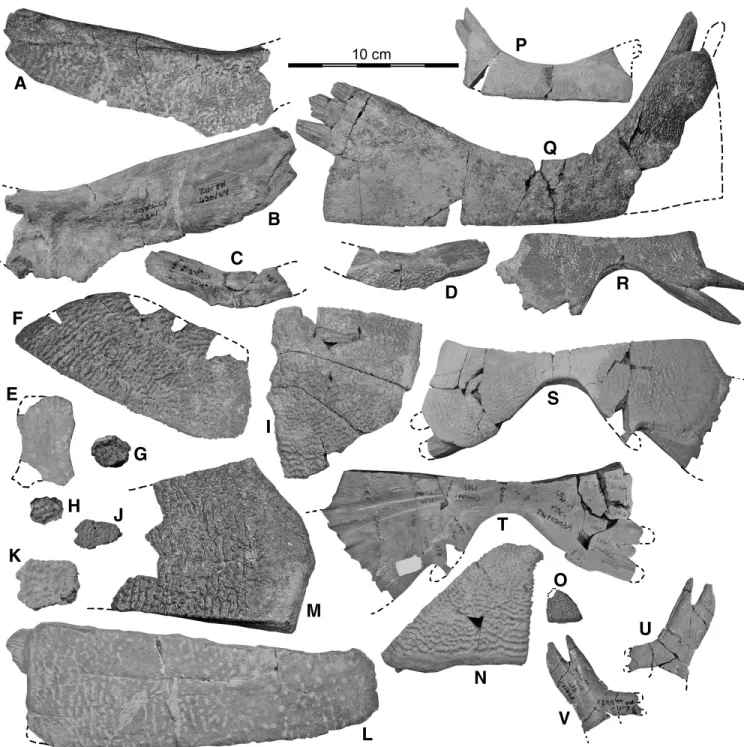
FIGURE 4. Aspideretoides riabinini specimens from Kansai. A, ZIN PH 604/64, nuchal; B, ZIN PH 633/64, partial nuchal; C, ZIN PH 628/64, nuchal;
D, ZIN PH 603/64, nuchal; E, ZIN PH 820/64, costal I; F, ZIN PH 822/64, costal I; G, ZIN PH 901/64, costals 6–7 and neurals 6–7; H, ZIN PH 939/64,
posterior half of carapace; I, ZIN PH 930/64, costal 5; J, ZIN PH 903/64, costal 7; K, ZIN PH 899/64, costal 6; L, ZIN PH 860/64, costals 7–8; M, ZIN PH 864/64, costal 8; N, ZIN PH 664/64, epiplastron; O, ZIN PH 764/64, medial hyoplastron, ventral view; P, ZIN PH 764/64, medial hyoplastron, dorsal view; Q, ZIN PH 680/64, medial hyoplastron, dorsal view; R, ZIN PH 680/64, medial hyoplastron, ventral view; S, ZIN PH 755/64, lateral hyoplastron;
T, ZIN PH 852/64, partial hyoplastron; U, ZIN PH 716/64, hypoplastron, ventral view; V, ZIN PH 716/64, hypoplastron, dorsal view; W, ZIN PH
675/64, xiphiplastron, ventral view; X, ZIN PH 675/64, xiphiplastron, dorsal view.
Plastral sculpturing resembles carapacial sculpturing, and is present on the callosities covering the entirety of the hyo- and hypoplastra and on the xiphiplastra (making four callosities in total). A single epiplastron (ZIN PH 664/64, Fig. 4N), only condi-tionally attributed to this species, has no sculpturing and is similar in shape and proportions to those of Aspideretoides splendidus. No entoplastra are present among the material from the Kan-sai. If the hyo- and hypoplastra contact across the midline, it is only very briefly through the medial processes of the hypoplastra. In any case, it is entirely unlike the characteristic, extensive me-dial contact seen in Paraplastomenus mlynarskii (Chkhikvadze, 1970) from the Middle Eocene of Kazakhstan (Chkhikvadze, 1970, 1973, 2000b; Kordikova, 1994b) or in Plastomenus thomasii Cope, 1873, from the Middle Eocene of North America (Hay, 1908). The medial fontanelle between the hyo- and hypoplastra is hourglass-shaped (Fig. 3D). The degree of midline contact be-tween the xiphiplastra is unknown because that area is not pre-served. The hyo- and hypoplastra are connected by a suture and are not fused, as they are in Aspideretoides allani. Plastral bridge length is just over 50% of the maximum hypoplastral length. The medial hyoplastral processes are small and numerous; the two specimens with complete medial edges, ZIN PH 764/64 (Fig. 4O, P) and ZIN PH 680/64 (Fig. 4Q, R), have five and six processes, respectively. Sculpturing grows with age to cover these processes nearly entirely, as shown by ZIN PH 680/64. The lateral hyoplas-tral lobe is about the same length as the hyoplashyoplas-tral bridge (ZIN PH 755/64, Fig. 4S); it may be slightly longer than that (ZIN PH 852/64, Fig. 4T), but it is never longer than the medial hyoplastral lobe. The inguinal hypoplastral border is not thickened (ZIN PH 716/64, Fig. 4U, V), unlike Aspideretoides splendidus, in which this border is thickened (Gardner et al., 1995). The medial hy-poplastral processes are divided into anterior and posterior sec-tions. They are not clustered as in “Aspideretes” maortuensis or “Trionyx” kyrgyz ensis.
Only one partial xiphiplastron (ZIN PH 675/64, Fig. 4W, X) can be definitively assigned to Aspideretoides riabinini. It shows a weak emargination on the lateral border. Judging from the significant extent of sculpturing on the plate, this emargination probably does not disappear with age, so whatever shape the xiphiplastra take, it is not the triangular outline of Aspidere-toides splendidus and is probably more similar to the subtrian-gular xiphiplastron of Aspideretoides foveatus.
Description of Material from Shakh-Shakh—The
recon-structed carapace is approximately 50 cm long, based on the most complete nuchal (ZIN PH 192/10, Fig. 5A). Sculpturing is a pat-tern of thin, connected ridges, similar to those in material from the Kansai. Nuchal is approximately four times wider than long (IZK R-3919, Fig. 5B, C) and weakly emarginated (IZK R-3927, Fig. 5D, E). The available neurals are represented by two anterior elements, which are hexagonal short-sided posteriorly and longer than wide (ZIN PH 189/10, Fig. 5F). Although the medial edge of costal 1 is not preserved (ZIN PH 175/10, Fig. 5G), it is probably longer than the lateral edge. The length of the lateral lobe of the hyoplastron (IZK R-3921, Fig. 5H) is about the same length as the hyoplastral bridge. The lateral edge of the hypoplastra (ZIN PH 169/10, Fig. 5I; IZK R-3929, Fig. 5J) is the same shape as in the material from the Kansai.
Remarks—Comparison of Aspideretoides riabinini with some
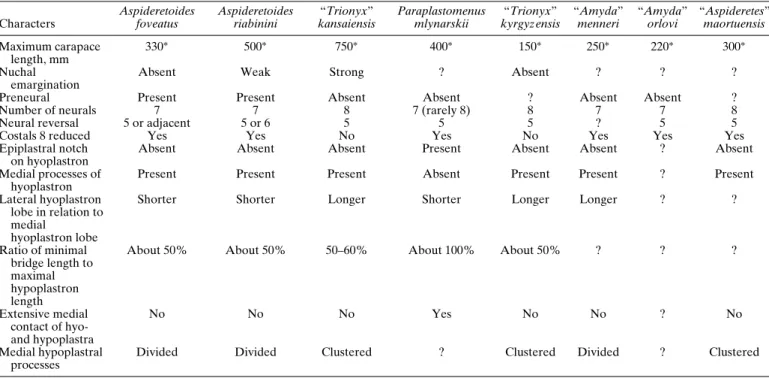
other species of Cretaceous and Paleogene trionychines is given in Table 1.
TRIONYX Geoffroy, 1809 sensu lato “TRIONYX” KANSAIENSIS, sp. nov.
Trionyx riabinini Kuznetsov and Chkhikvadze, 1987 (part.):figs. 2, 5.
Khunnuchelys sp. nov.: Vitek and Danilov, 2008:17.
Etymology—Kansai- for the Kansai locality. Holotype—ZIN PH 630/64, a partial nuchal.
Referred Material—Kansai locality: ZIN PH 630/64, partial
nuchal; ZIN PH 629/64, partial nuchal; ZIN PH 934/64, neu-ral 1, ZIN PH 824/64, costal 1; ZIN PH 658/64, neuneu-ral 5; ZIN PH 642/64, neural 8; ZIN PH 643/64, hexagonal neural; ZIN PH 655/64, hexagonal neural; ZIN PH 871/64, partial costals 6–8; ZIN PH 781/64, costal 3; ZIN PH 917/64, partial costal; ZIN PH 882/64, costal 8; ZIN PH 862/64, costal 8; ZIN PH 824/64, hyoplastron; ZIN PH 775/64, hyoplastron; ZIN PH 726/64, hy-poplastron; ZIN PH 705/64, hyhy-poplastron; Shakh-Shakh local-ity: ZIN PH 190/10, partial costal ?3 or ?4; IZK R-3815, hyo-hypoplastron; ZIN PH 169/10, partial medial hyoplastron; IZK R-3963, partial medial hyoplastron; Also, numerous additional specimens from both localities in the collections ZIN PH 10 and ZIN PH 64.
Locality, Horizon, and Age—Kansai, Fergana Depression,
Tadjikistan; Yalovach Formation, early Santonian; Shakh-Shakh, northeastern Aral Sea area, Kazakhstan; Bostobe Formation, Santonian–early Campanian.
Diagnosis—A trionychine, which can be differentiated from
all other Cretaceous trionychines with known shells (see Ta-ble 1) by bigger size, strong nuchal emargination, eight neurals (except “Aspideretes” maortuensis and “Trionyx” kyrgyz ensis), unreduced costals 8 (except “Trionyx” kyrgyz ensis), lateral lobe of hyoplastron longer than its medial lobe (except “Trionyx” kyr-gyz ensis), and, probably, absence of the separate anteromedial process of the hypoplastron (except “Aspideretes” maortuensis and “Trionyx” kyrgyz ensis); besides that, can be differentiated from species of Aspideretoides by absence of preneural and by sculpturing pattern, and from “Trionyx” kyrgyz ensis by presence of sculpturing on plastron.
Description of Material from Kansai—Carapace is large, much
larger than all known species of Cretaceous trionychids; a re-construction (Fig. 3C) based on the largest nuchal (ZIN PH 630/64, Fig. 6A, B) is approximately 75 cm long. Outline is oval, with a strongly concave anterior margin and a shallowly concave posterior margin. Sculpturing is a pattern of wide, dis-connected ridges and tubercules raised above the plate. Where the ridges occasionally cross each other (which is more com-mon in smaller, younger individuals such as ZIN PH 629/64, Fig. 6C, D), they do so at irregular intervals. Sculpturing never forms pits, as is common in Aspideretoides riabinini. Although the sculpture pattern of old specimens of Aspideretoides ri-abinini may begin to look like the sculpture pattern of young specimens of “Trionyx” kansaiensis, they can be differenti-ated based on size and other morphological characters (see be-low).
The nuchal is strongly emarginated anteriorly, unlike any tri-onychine (Meylan, 1987; Gardner and Russell, 1994), without postnuchal fontanelles in all examined specimens. Nuchal width ranges from five to six times nuchal length. Sculpturing ranges from covering only about 50% of the nuchal in small (and prob-ably young) individuals (ZIN PH 629/64, Fig. 6C, D) to covering everything but the anterior-lateral areas in large individuals (ZIN PH 630/64).
The size of neural 1 (ZIN PH 934/64, Fig. 6E) and the outline of costal 1 (ZIN PH 824/64, Fig. 6F) do not indicate a preneural, and no preneural plates with “Trionyx” kansaiensis–type sculp-turing were found. The neural series includes eight continuous neurals, which is present among Cretaceous trionychines only in “Aspideretes” maortuensis and “Trionyx” kyrgyz ensis and as a variation in Apalone latus (Gilmore, 1919) from the Late Cre-taceous of North America (Gardner et al., 1995) and Aspidere-toides allani. As in most trionychids without a preneural, neural 1 is longer than the posterior neurals. Neurals 1 to 4 are hexagonal short-sided posteriorly, neural 5 is tetragonal (ZIN PH 658/64, Fig. 6G), neurals 6 and 7 are hexagonal, short-sided anteriorly,
FIGURE 5. Aspideretoides riabinini specimens from Shakh-Shakh. A, ZIN PH 192/10, partial nuchal; B, IZK R-3919 (holotype), partial nuchal dorsal view; C, IZK R-3919 (holotype), partial nuchal ventral view; D, IZK R-3927, partial nuchal dorsal view; E, IZK R-3927, partial nuchal ventral view; F, ZIN PH 189/10 fragment of costals ?2–3 and neurals ?2–3; G, ZIN PH 175/10, partial costal 1; H, IZK R-3921 partial lateral hyoplastron I, ZIN PH 169/10 partial lateral hypoplastron; J, IZK R-3929, partial lateral hypoplastron.
TABLE 1. Comparison of shell characters of some species of Cretaceous and Paleogene trionychines.
Characters Aspideretoides foveatus Aspideretoides riabinini “Trionyx” kansaiensis Paraplastomenus mlynarskii “Trionyx” kyrgyz ensis “Amyda” menneri “Amyda” orlovi “Aspideretes” maortuensis Maximum carapace length, mm 330∗ 500∗ 750∗ 400∗ 150∗ 250∗ 220∗ 300∗ Nuchal emargination
Absent Weak Strong ? Absent ? ? ?
Preneural Present Present Absent Absent ? Absent Absent ?
Number of neurals 7 7 8 7 (rarely 8) 8 7 7 8
Neural reversal 5 or adjacent 5 or 6 5 5 5 ? 5 5
Costals 8 reduced Yes Yes No Yes No Yes Yes Yes
Epiplastral notch on hyoplastron
Absent Absent Absent Present Absent Absent ? Absent
Medial processes of hyoplastron
Present Present Present Absent Present Present ? Present
Lateral hyoplastron lobe in relation to medial
hyoplastron lobe
Shorter Shorter Longer Shorter Longer Longer ? ?
Ratio of minimal bridge length to maximal hypoplastron length
About 50% About 50% 50–60% About 100% About 50% ? ? ?
Extensive medial contact of hyo-and hypoplastra No No No Yes No No ? No Medial hypoplastral processes
Divided Divided Clustered ? Clustered Divided ? Clustered
∗Estimation.
FIGURE 6. “Trionyx” kansaiensis specimens from Kansai. A, ZIN PH 630/64, partial nuchal, dorsal view; B, ZIN PH 630/64, partial nuchal, ventral view; C, ZIN PH 629/64, partial nuchal, ventral view; D, ZIN PH 629/64, partial nuchal, dorsal view; E, ZIN PH 934/64, neural 1, F, ZIN PH 824/64, costal 1; G, ZIN PH 658/64, neural 5; H, ZIN PH 642/64, neural 8; I, ZIN PH 871/64, partial costals 6–8; J, ZIN PH 642/64, hexagonal neural; K, ZIN PH 655/64, hexagonal neural; L, ZIN PH 781/64, costal 3; M, ZIN PH 917/64, partial costal; N, ZIN PH 882/64, costal 8; O, ZIN PH 862/64, costal 8; P, ZIN PH 824/64, hyoplastron; Q, ZIN PH 775/64, hyoplastron; R, ZIN PH 726/64, hypoplastron; S, ZIN PH 705/64, hypoplastron, dorsal view; T, ZIN PH 705/64, hypoplastron, ventral view; U, ZIN PH 678/64, partial xiphiplastron, dorsal view; V, ZIN PH 678/64, partial xiphiplastron, ventral view.
and neural 8 is pentagonal (ZIN PH 642/64, Fig. 6H); it is located on the border between costals 7 and 8. This is shown most clearly in ZIN PH 871/64 (Fig. 6I), a carapace fragment with the medial outline of costals 6 to 8. Neurals are longer than wide, but ratio of width to length is variable (see ZIN PH 643/64 and ZIN PH 655/64, Fig. 6J–K).
Eight pairs of costals are present. No costals significantly over or underlie adjacent costals. If costals have an unsculptured
lateral margin, it is narrow, with a vertical or shallowly beveled lateral edge. Only one costal 1 is preserved (ZIN PH 824/64, Fig. 6F); its medial and lateral lengths are roughly equal. Only one complete costal (ZIN PH 781/64, Fig. 6L) that is not costal 1 or 8 is preserved. Its medial outline indicates a shortened side di-rected anteriorly and then a lengthened side didi-rected posteriorly. Its lateral length is only about 1.5 times its medial length, and the rib end is at the anterior end of the lateral margin. Judging from
these characteristics it is probably costal 3. Partial costals, such as ZIN PH 917/64 (Fig. 6M), indicate that other costals, proba-bly located more posteriorly, have much wider, expanded lateral ends. Costals 8 are triangular, not reduced, and form most of the posterior margin of the carapace (Fig. 6I, N, O), somewhat sim-ilar to “Trionyx” kyrgyz ensis and unlike most other Cretaceous trionychines. Costal rib ends are short, but visible in dorsal aspect at least in some costals.
Plastral sculpturing is similar to carapace sculpturing. There is a wide unsculptured area along the medial borders of the hyo-and hypoplastron; sculpturing of the epiplastra, entoplastron, hyo-and xiphiplastra is unknown as the first two elements are absent from the material and the latter cannot be definitely attributed to “Tri-onyx” kansaiensis. The number of plastral callosities, therefore, is also unknown. There is no significant contact between the hyo-and hypoplastra, like in Aspideretoides riabinini, although shape of the medial fontanelle is not hourglass-shaped (Fig. 3E). The hyo- and hypoplastra are connected by a suture and not fused. The length of the plastral bridge ranges from approximately 50% to 60% of hypoplastral maximum length. The medial hyoplastral processes are large and not covered by callosities in both small (ZIN PH 775/64, Fig. 6P) and large (ZIN PH 824/64, Fig. 6Q) sizes. There are three processes in the one complete specimen (ZIN PH 824/64) available; it is unknown whether the number of spikes is a variable character in this trionychid. The lateral hy-oplastral lobe ranges from moderately covered by sculpturing in younger specimens (ZIN PH 775/64) to almost entirely covered in sculpturing in older specimens (ZIN PH 824/64). The lateral hyoplastral lobe is longer than the medial hyoplastral lobe; the medial lobes range from being approximately 60–65% the length of the lateral lobes. Positions and number of medial hypoplas-tral processes are variable, with a large anterior-most process in smaller individuals (ZIN PH 726/64, Fig. 6R) that probably be-comes less prominent as the hypoplastra gets larger (ZIN PH 705/64, Fig. 6S, T), becoming similar to the finger-like processes of “Trionyx” kyrgyz ensis and “Aspideretes” maortuensis.
As previously stated, no xiphiplastra can be definitely at-tributed to “Trionyx” kansaiensis. The partial xiphiplastron used in the reconstruction (ZIN PH 678/64, Fig. 6U, V) is covered by an unsculptured callosity; whether it is naturally unsculptured or whether sculpturing was weathered away is unclear. It is long and narrow, with two medial processes. No significant emargina-tion of the lateral border, as in Aspideretoides riabinini, is visible.
Description of Material from Shakh-Shakh—No nuchals with
“Trionyx” kansaiensis–type sculpturing were found in the Shakh-Shakh. A reconstruction based on a partial costal (ZIN PH 190/10, Fig. 7A, assumed from shape to be the lateral part of costal 3 or 4) is about 65 cm long. Sculpturing is absent on the medial processes of the hyoplastron (IZK R-3963, Fig. 7B, C; ZIN PH 169/10, Fig. 7D, E; and IZK R-3815, Fig. 7F, G). IZK R-3963 has three or four medial hyoplastral processes; the num-ber of processes on the other specimens is not clear. The lateral lobe of the hyoplastron, as shown in the reconstruction of IZK R-3815, is clearly longer than the medial hyoplastral lobe. There may be some medial contact between the hyo- and hypoplastra, but the exposed hyoplastral processes indicate that this contact is not extensive. Although the medial lobe of the hypoplastron is not preserved entirely in the same specimen, it is unlikely that it has any emargination similar to Aspideretoides riabinini. Because the hyo-hypoplastral callosity entirely covers the processes, it is not clear how many medial hypoplastral processes there are and in what arrangement they are in.
Remarks—Specimens IZK R-3815 and IZK R-3963 (see
Re-ferred Material) were originally considered Trionyx riabinini (Kuznetsov and Chkhikvadze, 1987:figs. 2 and 5). Herein, they are referred to “Trionyx” kansaiensis based on sculpturing and morphology.
DISCUSSION
Systematic Position of “Trionyx” riabinini and “T.”
kan-saiensis—Our study of both published and previously unde-scribed materials on trionychids from the Kansai and Shakh-Shakh localities shows the presence of two trionychid species (As-pideretoides riabinini and “Trionyx” kansaiensis) in each locality. The identification of the same trionychid taxa in both localities is based on their similarities in size, sculpturing and morphology of all available elements, and takes into account the similar age of these localities.
Aspideretoides riabinini was originally described as Trionyx ri-abinini from the Shakh-Shakh locality in Kazakhstan (Kuznetsov and Chkhikvadze, 1987) based on isolated nuchal (the holo-type) and additional fragmentary shell specimens. Kordikova (1994a) placed this species in the genus Paraplastomenus Ko-rdikova, 1994a, and Chkhikvadze (2007) in the genus Cras-sithecachelys Chkhikvadze, 2000b (the earlier suggested name Paraplastomenus Kordikova, 1991, is not available according to ICZN [Art. 11.1] because it was given in an unpublished draft manuscript [Kordikova, 1991a]). As both genera were based on the same type of species (Plastomenus mlynarskii Chkhikvadze, 1970), Crassithecachelys should be considered as a junior ob-jective synonym of Paraplastomenus. The content of Paraplas-tomenus varies from 2 to 10 species, according to different au-thors (Kordikova, 1994a; Chkhikvadze, 2007). The new data on the morphology of Trionyx riabinini provided by our study allow us to suggest a new generic assignment of this species. Certain characters of Trionyx riabinini, such as nuchal shape and pro-portions, the presence of the preneural, plastral bridge length greater than one-half hypoplastral maximum length, presence of four plastral callosities, and, probably, similar length of the epi-plastral projections allow confident attribution to the genus Aspi-deretoides. Comparison of Aspideretoides riabinini with Paraplas-tomenus mlynarskii (Table 1) shows many differences between these species discordant with their supposedly close relationship. The generic attribution of “Trionyx” kansaiensis is more ques-tionable. In its shell morphology it differs from all known triony-chids of the Cretaceous and Paleogene (Table 1). “Trionyx” kan-saiensis clearly demonstrates the following shell synapomorphies of the Trionychinae (Meylan, 1987): the nuchal bone at least three times wider than long, the anterior and posterior costiform processes united, no peripheral bones, and the presence of at least one reversal in the neural series. The position of “Trionyx” kansaiensis within the Trionychinae is unclear. Based on shell morphology, we only can state its position outside the Triony-chini Gray, 1825 (sensu Meylan, 1987), because “Trionyx” kan-saiensis has eight neurals, whereas all members of the Trionychini have seven or fewer neurals, if a preneural is not counted (Mey-lan, 1987). Among Cretaceous trionychines, “Trionyx” kansaien-sis shows the most similarities in its shell morphology with “As-pideretes” maortuensis and “Trionyx” kyrgyz ensis. These similar-ities include the presence of eight neurals, a large eighth pair of costals (except “Aspideretes” maortuensis) and, probably, also an absence of the separate anteromedial process of the hypoplas-tron, although distribution of the latter character is unclear. Sys-tematic position of “Aspideretes” maortuensis and “Trionyx” kyr-gyz ensis is also questionable (see below). On the other hand, the large size and strong nuchal emargination of “Trionyx” kan-saiensis correlate with the big head of the skull-based genus Khunnuchelys Brinkman et al., 1993, which is represented by two species from the Late Cretaceous of Uzbekistan and China (Brinkman et al., 1993; see below). Recently, a skull specimen of Khunnuchelys was reported from the Baybishe locality in Kaza-khstan (Glinskiy, 2008; Glinskiy and Danilov, 2008), which is in the same area and formation as the Shakh-Shakh (Fig. 2; Nessov, 1997). Thus, it is probable that “Trionyx” kansaiensis belongs to Khunnuchelys, as was supposed previously by Vitek and Danilov
FIGURE 7. “Trionyx” kansaiensis specimens from Shakh-Shakh. A, ZIN PH 190/10, partial costal ?3 or ?4; B, IZK R-3963, partial medial hyoplas-tron, dorsal view; C, IZK R-3963, partial medial hyoplashyoplas-tron, ventral view; D, ZIN PH 169/10, partial medial hyoplashyoplas-tron, dorsal view; E, ZIN PH 169/10, partial medial hyoplastron, ventral view; F, IZK R-3815, hyo-hypoplastron, ventral view; G, IZK R-3815, hyo-hypoplastron, dorsal view.
(2008), although here we refrain from such an assignment pend-ing new discoveries and descriptions of Cretaceous trionychids from Asia.
Prior to our study, all Late Cretaceous and Paleogene triony-chids of Middle Asia and Kazakhstan were considered to be-long to one of two groups, which were given a taxonomic value and arranged as follows: (1) paedomorphic trionychids with un-derdeveloped shells, known as Ulutrionychini Kordikova, 1994a, or Rafetini Chkhikvadze, 1999 (Kordikova, 1994b; Chkhikvadze, 1999); and (2) trionychids with hyperossified shells, known as “Plastomenus” of Kazakhstan or Paraplastomenini Kordikova, 1994a (Chkhikvadze, 1990; Kordikova, 1994b). Contrary to this arrangement, both of the trionychids described in our study demonstrate a degree of shell ossification that is normal for tri-onychids (see Meylan, 1987), with “Trionyx” kansaiensis being only slightly more ossified than Aspideretoides riabinini.
Other Cretaceous Trionychids of Middle Asia and Kaza-khstan—Besides Aspideretoides riabinini and “Trionyx” kan-saiensis, four more named trionychid taxa have been reported from the Cretaceous of Middle Asia and Kazakhstan. These are (Fig. 2): Khunnuchelys kiz ylkumensis Brinkman, Nessov and Peng, 1993; Paleotrionyx riabinini Kuznetsov and Chkhikvadze, 1987; “Trionyx” kyrgyz ensis Nessov, 1995; and Trionyx z akhidovi Khosatzky, 1966.
Khunnuchelys kiz ylkumensis is a skull-based taxon, described from the Dzharakuduk locality, which is in the late Turonian Bissekty Formation of the central Kizylkum Desert, Uzbekistan (Brinkman et al., 1993). Besides K. kiz ylkumensis, there is a second trionychid in the Dzharakuduk, which was previously mentioned as an “undescribed trionychid with slender jaws” (Brinkman et al., 1993) or Paleotrionyx sp. (Nessov, 1997:145)
and recently determined as Trionychini indet. based on skull ma-terials (Danilov, 2007). The shell morphology and shell-skull as-sociations of the Dzharakuduk trionychids need special study. The second species of Khunnuchelys (K. erinhotensis Brinkman et al., 1993), based also only on skull material, is from the Erinhot locality, which is in the Late Cretaceous Iren Dabasu Formation, Inner Mongolia, China.
Paleotrionyx riabinini was described from Shakh-Shakh local-ity in Kazakhstan based on an isolated nuchal (Kuznetsov and Chkhikvadze, 1987). Later, Paleotrionyx riabinini was referred to various other genera: Axestemys Hay, 1899 (= Conchochelys Hay, 1905; = Paleotrionyx Schmidt, 1945), Eurycephalochelys Moody and Walker, 1970, or Khunnuchelys (Kordikova, 1994a, 1994b; Nessov, 1997; Chkhikvadze, 1999; Chkhikvadze, 2007; Glinskiy, 2008). The nuchal of Paleotrionyx riabinini (Fig. 8) is comparable in size and degree of nuchal emargination to Aspi-deretoides riabinini, but has a significant unsculptured area, simi-lar to those present only in smaller specimens of the latter species. Besides that, the proportions of the nuchal, being three times wider than long, are different from both Aspideretoides riabinini and “Trionyx” kansaiensis. Sculpturing on the plate, which would help diagnose the species, is unclear. Thus, new materials are needed to clarify the status of this taxon.
“Trionyx” kyrgyz ensis was described from the Kylodzhun lo-cality, which is in the early-middle Albian Alamyshik Formation of southeastern Fergana Depression, Kyrgyzstan (Nessov, 1995). This species is based on an isolated xiphiplastron, associated shell fragments, a partial skull and a lower jaw (Nessov, 1986:pl. I, figs. 10–12; 1995:figs. 3 and 4). Generic attribution of this species varies: Chkhikvadze (1999) placed it in the genus Kuh-nemys Chkhikvadze, 1999 (type species—Aspideretes
FIGURE 8. Paleotrionyx riabinini, holotype nuchal, from Shakh-Shakh. IZK R-3920. A, dorsal view; B, ventral view.
sis Yeh, 1965) of the tribe Rafetini Chkhikvadze, 1999, whereas Karl (1999) put “Trionyx” kyrgyz ensis in the synonymy of A. maortuensis and placed the latter species into the extant triony-chid genus Dogania Gray, 1844, considered as a member of the tribe Pelodiscini Meylan, 1987. We think that both opinions, al-though possible, have very little evidence and need verification by phylogenetic analysis. Until this is done we do not accept either arrangement.
Trionyx z akhidovi was described from the area of Kyrkkuduk well (= Sary-Agach; Kordikova, 1994a; = Kyrkkuduk I; Nessov, 1997), which is in the Syuk-Syuk Formation and probably the lower part of the Darbaza Formation (Santonian–?middle Cam-panian) in southern Kazakhstan (Khosatzky, 1966; Nessov, 1997). The species is based on a giant (about 20 cm in length) femur. Be-sides that, the caudal part of a large trionychid carapace (with an estimated shell length of about 70 cm) from the same locality was assigned to this species. Later, some authors (Kordikova, 1994a; Chkhikvadze, 2007) supposed that Trionyx z akhidovi might be a synonym of one of two other contemporaneous taxa from Kaza-khstan (Paleotrionyx riabinini or Trionyx riabinini) and/or placed it in the Trionychidae, gen. indet. However, according to the re-cent state of knowledge, limb bones of trionychids are consid-ered undiagnostic below the family level (Meylan, 1987) and can-not characterize a species. For this reason, we consider Trionyx zakhidovi as a nomen dubium and ignore it from further con-siderations. The shell fragment attributed to Trionyx z akhidovi (Khosatzky, 1966) demonstrates similarities with “Trionyx” kan-saiensis in the outline of the posterior carapace border, large size and triangular shape of the posterior pair of costals, and, proba-bly, also in sculpturing. However, the last neural in this trionychid is situated more anteriorly than in “Trionyx” kansaiensis, a varia-tion common in trionychids (Meylan, 1987). Pending new discov-eries and descriptions of Cretaceous trionychids from Asia, we refer this shell specimen to Trionychinae, gen. et sp. indet.
In addition to the taxa considered above, Cretaceous triony-chids of Middle Asia and Kazakhstan are represented by nu-merous records of Trionychidae indet. (see Kordikova, 1994a; Nessov, 1997), which need a special study.
Biogeography of Cretaceous Trionychids—Another important
result of our study is that it presents new evidence of rela-tionships between Cretaceous trionychids of Asia and North America. The genus Aspideretoides, formerly known only in the
Campanian–Maastrichtian of North America, is now recognized in the Santonian–early Campanian of Asia. This fact suggests that Aspideretoides appeared in Asia before the Santonian and then moved to North America, most probably using land connec-tions that existed between the two continents in the Cretaceous (Hutchison, 2000). Other evidence of relationships between Cre-taceous trionychids of Asia and North America are based on poor and mostly undescribed data, including a record of Apalone-like trionychids: Platypeltis and Apalonina indet. from the Maas-trichtian of Mongolia and Apalone latus from the Campanian of North America (Fig. 1; Merkulova, 1978; Khosatzky, 1999; Gard-ner et al., 1995). Besides that, “Paleotrionyx” riabinini from the Late Cretaceous of Kazakhstan (see Introduction) was consid-ered as an Asian representative of Paleotrionyx (now Axeste-mys), a genus distributed in the Paleogene of North America (Hutchison and Holroyd, 2003). However, as shown above, sta-tus and systematic position of “Paleotrionyx” riabinini is unclear and it cannot be used in biogeographic speculations.
ACKNOWLEDGMENTS
N.V. thanks V. Schneider and P. Brinkman for the introduc-tion to paleontology. Both authors thank anonymous reviewers for their useful comments. This study was done under finan-cial support of grants of the President of the Russian Federa-tion to the Leading Scientific Schools (NSh-119.2008.4), Russian Foundation for Basic Research 07-04-91110-AFGIR a, Civilian Research and Development Foundation RUB1-2860-ST-07, Pal-SIRP Sepkoski Grant (2006) to I.G.D., and by a Leitner Project Award to N.V.
LITERATURE CITED
Batsch, A. J. G. C. 1788. Versuch einer Anleitung, zur Kenntniß und Geschichte der Thiere und Mineralien. Akademische Buchhand-lung, Jena, 528 pp.
Brinkman, D. B. 2003. A review of nonmarine turtles from the Late Cre-taceous of Alberta. Canadian Journal of Earth Science 40:557–571. Brinkman, D. B., L. A. Nessov, and J.-H. Peng. 1993. Khunnuchelys gen.
nov., a new trionychid (Testudines: Trionychidae) from the Late Cretaceous of Inner Mongolia and Uzbekistan. Canadian Journal of Earth Science 30:2214–2223.
Chkhikvadze, V. M. 1970 [The oldest Cenozoic turtles of the USSR]. Soobshcheniya Akademii Nauk Gruzinskoi SSR 60:749–752. [Rus-sian]
Chkhikvadze, V. M. 1973. [Tertiary turtles of the Zaissan Depression]. Metsniereba Publishers, Tbilisi, 100 pp. [Russian]
Chkhikvadze, V. M. 1990. [Paleogene turtles of USSR]. Metsniereba Pub-lishers, Tbilisi, 95 pp. [Russian]
Chkhikvadze, V. M. 1999. [Some fossil soft-shelled turtles of Asia (Rafe-tini trib. nov.)]. Trudy Tbilisskogo gosudarstvennogo pedagogich-eskogo universiteta 5:215–225. [Russian]
Chkhikvadze, V. M. 2000a. Fossil trionychid turtles from the territory of the former Soviet Union; p. 56 in Fourth Asian Herpetological Con-ference, Chengdu. Program and Abstracts.
Ckhikvadze, V. M. 2000b. [On the systematic position of some extinct trionychids of North America and Asia]. Trudy Tbilisskogo gosu-darstvennogo pedagogicheskogo universiteta 7:199–213. [Russian] Chkhikvadze, V. M. 2007. [A brief catalogue of fossil turtles of the North
Eurasia]. Problems of Paleobiology, Tbilisi 2:126–137. [Russian] Chkhikvadze, V. M., and V. F. Shuvalov. 1988. [A new species of a
tri-onychid from the Upper Cretaceous deposits of Mongolia]. Izvestiya Akademii Nauk Gruzinskoi SSR 14:198–204. [Russian]
Cope, E. D. 1868. On the origin of genera. Proceedings of the Academy of Natural Sciences of Philadelphia 1868:242–300.
Cope, E. D. 1873. Some extinct turtles from the Eocene strata of Wyoming. Proceedings of the Academy of Natural Sciences of Philadelphia 1873:277–279.
Danilov, I. G. 2005. Die fossilen Schildkr ¨oten Europas; pp. 329–441 in U. Fritz (ed.), Handbuch der Reptilien und Amphibien Europas. Band 3/IIIB: Schildkroten (Testudines) II. Aula, Wiebelsheim.
Danilov, I. G. 2007. New data on soft-shelled turtles (Trionychidae) from the Bissekty Formation (Late Turonian) of Dzharakuduk,
Uzbekistan. Journal of Vertebrate Paleontology 27(3, Supplement): 66A.
Eaton, J. G., R. L. Cifelli, J. H. Hutchison, J. I. Kirkland, and J. M. Parrish. 1999. Cretaceous vertebrate faunas from the Kairparowits Plateau, south-central Utah. Utah Geological Survey Miscellaneous Publication 99:345–353.
Gardner, J. D. and A. P. Russell. 1994. Carapacial variation among soft-shelled turtles (Testudines: Trionychidae), and its relevance to taxo-nomic and systematic studies of fossil taxa. Neues Jahrbuch f ¨ur Ge-ologie und Pal ¨aontGe-ologie 193:209–244.
Gardner, J. D., A. P. Russell, and D. B. Brinkman. 1995. Systematics and taxonomy of soft-shelled turtles (Family Trionychidae) from the Ju-dith River Group (mid-Campanian) of North America. Canadian Journal of Earth Science 32:631–643.
Geoffroy, St.-H. M. 1809. Sur les tortues molles, nouveau genre sous le nom de Trionyx, et sur la formation des carapaces. Annales du Mus ´eum d’Histoire Naturelle 14:1–20.
Gilmore, C. W. 1919. New fossil turtles, with notes on two de-scribed species. Proceedings of the United States National Museum 56:113–132.
Gilmore, C. W. 1923. A new species of Aspideretes from the Belly River Cretaceous of Alberta, Canada. Transactions of the Royal Society of Canada 17:1–10.
Glinskiy, V. N. 2008. [About the finding of a skull of a gigantic soft-shelled turtle of the genus Khunnuchelys in the Late Cretaceous of Kazakhstan]; pp. 21–23 in Geologiya—nashe budushchee. Materi-aly molodezhnoy nauchnoy konferentsii. St. Petersburg State Uni-versity, St. Petersburg, Russia. [Russian]
Glinskiy, V. N., and Danilov, I. G. 2008. [About the finding of a skull of a gigantic soft-shelled turtle of the genus Khunnuchelys in the Late Cretaceous of Kazakhstan]; pp. 18–19 in Modern Paleontol-ogy: Classic and Newest Methods. The Fifth All-Russian Scientific School for Young Scientists in Paleontology. Abstracts. Paleonto-logical Institute of the Russian Academy of Sciences, Moscow. [Rus-sian]
Gray, J. E. 1825. A synopsis of the genera of reptiles and amphibia, with a description of some new species. Annals of Philosophy 10:193–217. Gray, J. E. 1844. Catalogue of the tortoises, crocodiles, and
amphisbae-nians, in the collection of the British Museum. Taylor and Francis, London, 80 pp.
Hay, O. P. 1899. On the nomenclature of certain American fossil verte-brates. American Geologist 24;345–349.
Hay, O. P. 1905. On the skull of a new trionychid, Conchochelys ad-mirabilis, from the Puerco beds of New Mexico. Bulletin of the American Museum of Natural History 21;335–338.
Hay, O. P. 1908. The Fossil turtles of North America. Carnegie Institute of Washington Publication 75:1–568.
Hirayama, R., Brinkman, D. B., and I. G. Danilov. 2000. Distribution and biogeography of non-marine Cretaceous turtles. Russian Journal of Herpetology 7:181–198.
Hutchison, J. H. 2000. Diversity of Cretaceous turtle faunas of eastern Asia and their contribution to the turtle faunas of North America. Paleontological Society of Korea, Special Publication 4:27–38. Hutchison, J. H., and P. A. Holroyd. 2003. Late Cretaceous and early
Paleocene turtles of the Denver Basin. Rocky Mountain Geology 38:121–142.
Joyce, W. G., J. F. Parham, and J. A. Gauthier. 2004. Developing a pro-tocol for the conversion of rank-based taxon names to phylogenet-ically defined clade names, as exemplified by turtles. Journal of Pa-leontology 78:989–1013.
Karl, H.-V. 1998. Zur Taxonomie der k ¨anozoischen Weichschildkr ¨oten ¨
Osterreichs und Deutschlands (Trionychidae: Trionychinae). Mit-teilungen der Abteilungs f ¨ur Geologie und Pal ¨aontologie der Lan-desmuseum Joanneum 56:273–328.
Karl, H.-V. 1999. Paleogeography and systematics of the genus Dogania Gray, 1844 (Testudines: Trionychidae). Studia Geologica Salmanti-censia 35:3–8.
Khosatzky, L. I. 1966. [About a gigantic Mesozoic representative of trionychids and several features of the shell of these turtles]; pp. 150–157 in Pozvonochnye zhivotnye Sredney Azii. Fan Publishers, Tashkent. [Russian]
Khosatzky, L. I. 1976. [A new representative of trionychids from the Late Cretaceous of Mongolia]. Gerpetologiya. Kubanskiy Gosudarstven-nyy Universitet. Nauchnye Trudy 218:3–19. [Russian]
Khosatzky, L. I. 1999. [Turtles—trionychids of the Cretaceous of Mongo-lia]; pp. 141–149 in Voprosy Paleontologii. Tom 11. St. Petersburg State University, St. Petersburg, Russia. [Russian]
Kordikova, E. G. 1991a. [Fossil trionychid turtles of Kazakhstan]. Avtoreferat dissertatsii na soiskanie uchenoy stepeni kandidata geologo-mineralogicheskikh nauk. Abstract of candidate disserta-tion, Tbilisi, Institute of Paleobiology, Academy of Sciences, Repub-lic of Georgia, 16 pp. [Russian]
Kordikova, E. G. 1991b. [Catalogue of the fossil trionychids of the So-viet Union]. Tbilisi, Institute of Paleobiology, Academy of Sciences, Republic of Georgia, 15 pp. [Russian]
Kordikova, E. G. 1994a. About systematics of fossil trionychids in Kaza-khstan. Selevinia 2:3–8.
Kordikova, E. G. 1994b. Review of fossil trionychid localities in the Soviet Union. Courier Forschungs-Institut Senckenberg 173: 341–358.
Kuznetsov, V. V., and V. M. Chkhikvadze. 1987. [The Late Cretaceous trionychids from Shakh-Shakh locality in Kazakhstan]. Materialy po istorii fauny i flory Kazakhstana 9:33–39. [Russian]
Leidy, J. 1856. Notices of the remains of extinct reptiles and fishes discov-ered by Dr. F.V. Hayden in the bad lands of the Judith River, Ne-braska Territory. Proceedings of the Academy of Natural Sciences of Philadelphia 8:72–73.
LeSueur, C. A. 1827. Note sur deux especes de tortues, du genre Trionyx de Geoffroy St. Hilaire. M ´emoires du Mus ´eum National d’Histoire Naturelle Paris 15:257–268.
Levshakova, I. Yu. 1982. [Trionychids of the Cretaceous and Cenozoic of Middle Asia and Mongolia]. Diploma, St. Petersburg State Univer-sity, St. Petersburg, Russia, 60 pp. [Russian]
Merkulova, N. N. 1978. [A new Trionyx from the Nemegt (MPR)]. Byul-leten’ Moskovskogo Obshchestva Ispytateley Prirody. Otdel Geo-logicheskiy 53:156. [Russian]
Meylan, P. A. 1987. The phylogenetic relationships of soft-shelled turtles (family Trionychidae). Bulletin of the American Museum of Natural History 186:1–101.
Moody, R. T. J., and C. A. Walker. 1970. A new trionychid turtle from the British Lower Eocene. Journal of Paleontology 13:503– 510.
Nessov, L. A. 1986. Some Late Mesozoic and Paleocene turtles of Soviet Middle Asia. Studia Palaeochelonologica 2:7–22.
Nessov, L. A. 1995. On some Mesozoic turtles of the Fergana depres-sion (Kyrgyzstan) and Dzhungar Alatau ridge (Kazakhstan). Rus-sian Journal of Herpetology 2:134–141.
Nessov, L. A. 1997. [Cretaceous nonmarine vertebrates of Northern Eurasia]. St. Petersburg State University, Instititute of Earth’s Crust, St. Petersburg, Russia, 218 pp. [Russian]
Rozhdestvensky, A. K., and L. I. Khosatzky. 1967. [Late Cretaceous land vertebrates of the Asiatic region of the USSR]; pp. 82–92 in Strati-grafiya i paleontologiya mezozoyskikh i kainozoyskikh kontinen-tal’nykh otlozheniy aziatskoy chasti SSSR. Nauka Publishers, St. Pe-tersburg. [Russian]
Schmidt, K. P. 1945. A new turtle from the Paleocene of Colorado. Fiel-diana Geology 10:1–4.
Sukhanov, V. B. 2000. Mesozoic turtles from Mongolia; pp. 309–367 in M. J. Benton, M. A. Shishkin, E. N. Kurochkin, and D. M. Unwin (eds.), The Age of Dinosaurs in Russia and Mongolia. Cambridge University Press, Cambridge, U.K.
Vitek, N., and I. G. Danilov. 2008. [Morphology and systematic posi-tion of trionychid turtles from the Late Cretaceous of Kazakhstan and Tadzhikistan]; pp. 17–18 in Modern Paleontology: Classic and Newest Methods. The Fifth All-Russian Scientific School for Young Scientists in Paleontology. Abstracts. Paleontological Institute of the Russian Academy of Sciences, Moscow. [Russian]
Webb R. G. 1962. North American Recent soft-shelled turtles (Family Trionychidae). University of Kansas Publications Museum of Natu-ral History 13:429–611.
Yeh H.-K. 1965. New materials of fossil turtles of Inner Mongolia. Verte-brata PalAsiatica 9:47–69.
Yeh, H.-K. 1974. [A new fossil Trionyx from Fuchien]. Vertebrata PalAsi-atica 12:190–192. [Chinese]
Yeh H.-K. 1994. Fossil and Recent Turtles of China. Science Press, Bei-jing, 112 pp.
Submitted February 20, 2009; accepted May 22, 2009.