Automatic Test Suite Evolution
Doctoral Dissertation submitted to the
Faculty of Informatics of the Università della Svizzera Italiana in partial fulfillment of the requirements for the degree of
Doctor of Philosophy
presented by
Mehdi Mirzaaghaei
under the supervision of
Mauro Pezzè
Dissertation Committee
Walter Binder University of Lugano, Switzerland
Cesare Pautasso University of Lugano, Switzerland
Darko Marinov University of Illinois at Urbana-Champaign, USA
Paolo Tonella Fondazione Bruno Kessler, Trento, Italy
Dissertation accepted on 9 November 2012
Research Advisor PhD Program Director
Mauro Pezzè Antonio Carzaniga
I certify that except where due acknowledgement has been given, the work presented in this dissertation is that of the author alone; the work has not been submitted previously, in whole or in part, to qualify for any other academic award; and the content of the dissertation is the result of work which has been carried out since the official commencement date of the approved research pro-gram.
Mehdi Mirzaaghaei
Lugano, 9 November 2012
To Shima
Abstract
Software testing is one of the most common approaches to verify software sys-tems. Despite of many automated techniques proposed in the literature, test cases are often generated manually. When a software system evolves during de-velopment and maintenance to accommodate requirement changes, bug fixes, or functionality extensions, test cases may become obsolete, and software devel-opers need to evolve them to verify the new version of the software system. Due to time pressure and effort required to evolve test cases, software developers do not update test cases often and many test cases become quickly obsolete. As a consequence, the effectiveness of the test suites drops over time.
In this thesis, we propose a new technique for automating test suite tion aiming to reduce both the developers effort and the costs of software evolu-tion. To understand the evolution of test cases, we conducted an empirical study on real-world software systems to gain an insight on how software developers evolve the test cases. Our study shows that many test cases of software systems are similar. These similarities lead developers to follow common activities for repairing and generating test cases by using some common processes. Based on this observation, we identify some of Test Reuse Patterns that can be applied to fix many test cases and generate new test cases.
In this thesis we define five Test Reuse Patterns: change of method declara-tion, extension of class hierarchy, implementation of interface, introduction of overloaded methods, and introduction of overridden methods. We propose a framework for generating and repairing test cases for evolving software by au-tomating Test Reuse Patterns. The framework, called Test Care Assistant (TCA), repairs test cases that do not compile after the code changes and generates test cases when new classes or methods are added to the software. We evaluated TCA on several open-source projects, and the results suggest that TCA can be suc-cessfully adopted in software testing process to help software developers evolve the test cases with less effort and time. The empirical evaluation of the frame-work shows that TCA can be successfully applied in many cases and that the effectiveness of the test cases generated and repaired by TCA is comparable with
vi
the effectiveness of the test cases written manually by software developers and generated automatically by existing techniques.
This dissertation makes several contributes to the state of the art. First, it introduces Test Reuse Patterns, Second, it proposes a framework, TCA, that ex-ploits the Test Reuse Patterns to repair and evolve test cases in the software, Third, it performs an empirical study of software evolution conducted on differ-ent test suite repositories, Fourth, it implemdiffer-ents the TCA prototype, and Finally it performs an empirical evaluation of the applicability and effectiveness of the approach on open-source projects.
Acknowledgements
First, I would like to thank my advisor, Mauro Pezzè. Your expertise and sug-gestions contributed significantly to this work. I am grateful for giving me the freedom to explore the things that I considered worthy to investigate and your encouragement for my academic growth. I learned a lot from your mature way of thinking. Your support and advice were priceless.
I wish to thank Fabrizio Pastore which advised me much beyond his time as a post-doctoral fellow at University of Lugano. The collaboration with him taught me more than he might think. The many discussions we had influenced significantly the research presented in this thesis. Grazie, Fabrizio!
Special thanks to Walter Binder, Cesare Pautasso, Darko Marinov, and Paolo Tonella for accepting to serve as scientific committee members of my work as well as your detailed feedback on the dissertation proposal. I really appreciate your time and thanks for taking me seriously.
Many thanks to Mehdi Jazayeri for being available for any discussion during my PhD studies and for showing interest in my research in all the stages of my work. I would like to thank other faculty members of University of Lugano specially Carlo Ghezzi, Marc Langheinrich, Michal Young, Fernando Pedone, and Antonio Carzaniga for investing a part of your precious time to teach me new things.
Extensive discussions with Darko Marinov and Danny Dig greatly improved the empirical studies of this thesis. During my visit of Darko’s group, I enjoyed discussing my PhD thesis with people in UIUC: Thanks Darko, Danny, Vilas, Milos, Qingzhou, Adrian, Mohsen, Samira, Cosmin, Steve, and Brett.
Thanks to all the graduate students in University of Lugano that I had fun and shared my endeavor with: Amir, Alessandra, Alessio, Alex, Andrea, Cyrus, Gia-como, Giovanni, Jochen, Konstantin, Marcello, Marco, Mattia, Mauro, Mircea, Mostafa, Navid, Nemanja, Nicolas, Nicolò, Paolo, Parisa, Parvaz, Roman, and Saeed: I am thankful for your company.
I am always grateful for support of my family specially my parents. Thanks for your unconditional love, trust, and support. I am proud to be your son. I am
viii
very luck to have the support of two lovely sisters and my brothers-in-law which gave me hope throughout my PhD. I am also thankful for all the encouragement of my parents-in-law.
The last but not the least, a big thank you goes to Shima, for sharing with me an unforgettable time in Lugano. Thank you for your love, encouragement, and patience. Without you I could not have concluded this thesis.
Mehdi Mirzaaghaei
Contents
Contents ix
List of Figures xiii
List of Tables xv
Listings xv
1 Introduction 1
1.1 Research Hypothesis and Contributions . . . 3
1.2 Scope of Research . . . 4
1.3 Structure of the Dissertation . . . 5
2 State of The Art 7 2.1 Test Case Generation . . . 7
2.1.1 Random Test Case Generation . . . 7
2.1.2 Symbolic and Concolic Execution . . . 9
2.1.3 Search-Based Test Generation . . . 10
2.1.4 Model-Based Testing . . . 11
2.1.5 Heuristic-Based Approaches . . . 12
2.2 Regression Testing . . . 13
2.2.1 Regression Test Selection . . . 13
2.2.2 Test Suite Prioritization . . . 13
2.2.3 Test Suite Augmentation . . . 14
2.2.4 Test Suite Minimization . . . 14
2.3 Test Suite Repair . . . 15
2.3.1 Repairing GUI Test Cases . . . 16
2.3.2 Repairing Test Oracles . . . 17
2.3.3 Refactoring Techniques . . . 18 ix
x Contents
3 Test Evolution 19
3.1 TestCareAssistant . . . 20
3.2 Test Reuse Patterns . . . 21
3.2.1 Change of Method Declaration . . . 22
3.2.2 Extension of Class Hierarchy . . . 25
3.2.3 Implementation of Interface . . . 27
3.2.4 Introduction of Overloaded Method . . . 29
3.2.5 Introduction of Overridden Method . . . 30
4 Test Suite Repair 33 4.1 Motivating Example . . . 33
4.2 Automatic Test Repair . . . 37
4.3 Analyze the Change . . . 38
4.4 Determine the Initialization Values . . . 38
4.4.1 Input Parameters . . . 39
4.4.2 Variables Following Modified Method . . . 42
4.5 Repair Test Case . . . 45
4.5.1 Update Variable Definitions . . . 45
4.5.2 Initialize New Variables . . . 46
5 Test Suite Adaptation 49 5.1 Motivating Example . . . 49
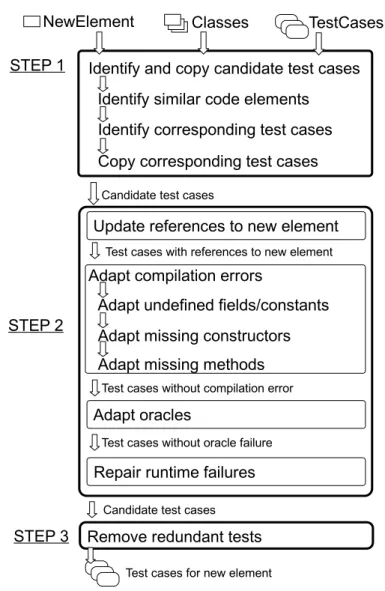
5.2 Overview of Test Adaptation Process . . . 51
5.3 Identify and Copy Candidate Test Cases . . . 52
5.3.1 Classes Added to a Hierarchy . . . 52
5.3.2 Interface Implementations . . . 56
5.3.3 Overloaded Methods . . . 56
5.3.4 Overridden Methods . . . 58
5.4 Adapt Candidate Test Cases . . . 59
5.4.1 Update References to New Element . . . 59
5.4.2 Adapt Compilation Errors . . . 60
5.4.3 Adapt Oracles . . . 64
5.4.4 Repair Runtime Failures . . . 65
5.5 Removing Redundant Test Cases . . . 66
6 Prototype Implementation 67 6.1 The Test Repair Toolsuite . . . 67
xi Contents
7 Evaluation 73
7.1 Evaluation Methodology . . . 73
7.2 Case Study Subjects . . . 75
7.3 Applicability of Test Reuse Patterns . . . . 77
7.3.1 Change of Method Declaration . . . 77
7.3.2 Extension of Hierarchy and Implementation of Interface . 78 7.3.3 Introduction of Overriding and Overloading Methods . . . 80
7.4 Effectiveness of Change of Method Declaration . . . 80
7.5 Effectiveness of Generating Tests for New Classes . . . 82
7.5.1 Code Coverage . . . 83
7.5.2 Conciseness . . . 85
7.6 Effectiveness of Generating Tests for New Methods . . . 86
7.6.1 Code Coverage . . . 86
7.6.2 Conciseness . . . 87
7.7 Discussion . . . 88
7.7.1 Availability of Test Cases to Reuse . . . 88
7.7.2 Using Mock Objects . . . 90
8 Conclusion 93 8.1 Contributions . . . 94
8.2 Future Research Directions . . . 96
Figures
3.1 Test Care Assistant (TCA) . . . 20
3.2 Comparing Similar Test Pairs inCopticChronologyof JodaTime . 22 3.3 Similar Test Pairs in Empirical Studies . . . 23
3.4 A Portion of Class Hierarchy in JodaTime Version 1.2 . . . 27
4.1 Parameter Type Change . . . 34
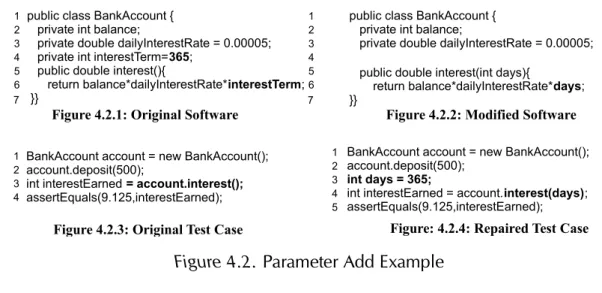
4.2 Parameter Add Example . . . 35
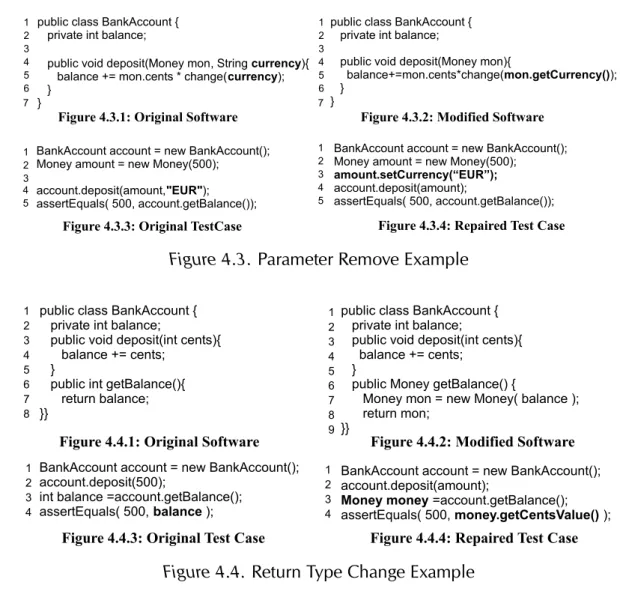
4.3 Parameter Remove Example . . . 36
4.4 Return Type Change Example . . . 36
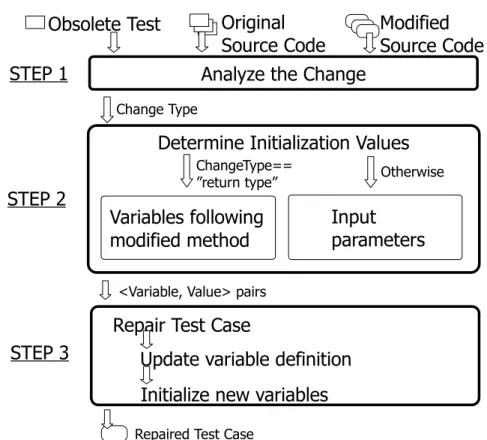
4.5 The TCA approach to repair test cases . . . 37
4.6 The ini t i t ial izepr e algorithm. . . 40
4.7 The ini t i t ial izepost algorithm. . . 43
5.1 A test case written by developers for classCopticChronology . . 50
5.2 A generated test case by TCA for classEthiopicChronology . . . . 51
5.3 The process that generates test cases for new elements . . . 53
5.4 The algorithm to Identify candidate test cases . . . 54
5.5 The algorithm that computes class similarity . . . 55
5.6 The algorithm that Identifies the tests for Overloaded Methods . . 57
5.7 The algorithm that identifies the tests for overridden methods . . 58
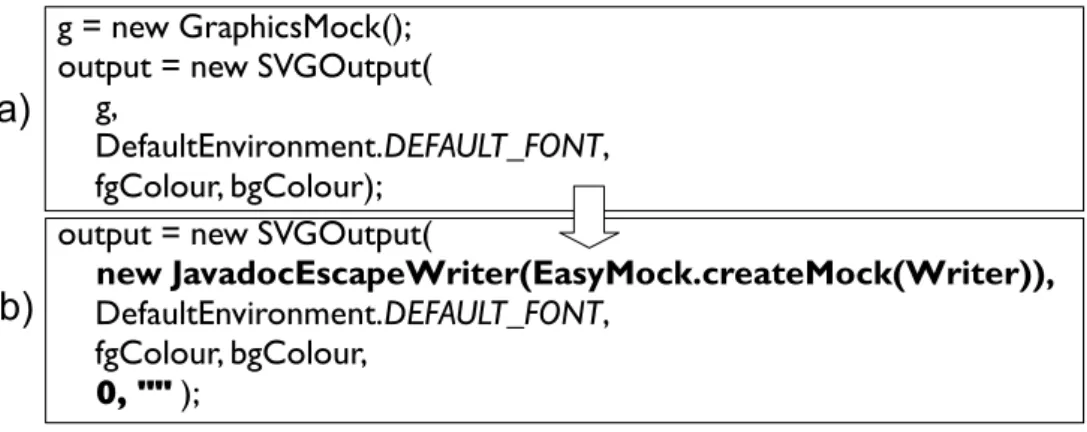
5.8 An example of constructor call adaptation. . . 61
5.9 Algorithm to Find Similar Constructor . . . 62
5.10 Algorithm to Calculate Similarity of Constructors . . . 62
5.11 Algorithm to Find Similar Method . . . 65
5.12 An example of method invocations repair . . . 66
6.1 A screenshopt of the TCA Eclipse plugin . . . 68
6.2 TCA Test Repair Screenshot . . . 68
6.3 The architecture of TCA Test Repair . . . 69
6.4 The architecture of the TCA Test Adaptation Toolsuite . . . 71 xiii
Tables
7.1 Subject Programs . . . 75 7.2 Applicability of TCA on open source projects . . . 78 7.3 Amount of changes supported by TCA across projects . . . 78 7.4 Applicability on Test Generation for Class Hierarchies and Interface 79 7.5 Applicability of TCA on Override/Overload Test Reuse Pattern . . . 80 7.6 Effectiveness of Generating Repairs . . . 81 7.7 Effectiveness of Finding Initialization Values . . . 82 7.8 Effectiveness of Test Generation for "extension of class hierarchy" . 83 7.9 Effectiveness on Test Generation for "implementation of interface" 84 7.10 Average number of test cases "extension of class hierarchy" . . . . . 85 7.11 Average number of test cases for "implementation of interface" . . . 86 7.12 Effectiveness on "introduction of overloaded method" . . . . 87 7.13 Effectiveness on "introduction of overridden method" . . . . 87 7.14 Average number of tests with "introduction of overloaded method" 88 7.15 Average number of tests with "introduction of overridden method" . 88
Listings
3.1 Method Report.addRule in PMD 1.0 . . . 24
3.2 Method Report.addRule in PMD 1.1 . . . 24
3.3 Test case for methodReport.addRulein PMD 1.0 . . . 24
3.4 Test case of Listing 3.3 repaired to work with PMD 1.1 . . . 24
3.5 Two Test Methods in test suite ofEthiopicChronology . . . 26
3.6 Two Test Methods in test suite ofCopticChronology . . . 26
3.7 A Test Method in test suite ofFastScatterPlot . . . 28
3.8 A Test Method in test suite ofCompassPlot . . . 28
3.9 Test Method callinggetInstance() . . . 29
3.10 Test Method callinggetInstance(DateTimeZone) . . . 29
3.11 Test Method of classCategoryTextAnnotation . . . 30
3.12 Test Method of classCategoryPointerAnnotation . . . 30
7.1 A test case for classEthipicChronologyby EvoSuite. . . 84
7.2 ClassISO8601GregorianCalendarConverter . . . 89
7.3 Test Case of developers for classASTVariableDeclaratorId . . . 90
7.4 A TCA test case that uses mock objects . . . 91
7.5 A manually repaired test case of TCA . . . 91
Chapter 1
Introduction
Software testing is the most common practice for validating and verifying soft-ware systems. During development, softsoft-ware developers write test cases to check the compliance of the developed applications with their specifications. Due to the complexity of software systems, software testing is an expensive ac-tivity, and the cost and complexity of software testing increases when software evolves to reflect changes in the system [PY07].
Testing activities include test case design, execution, and maintenance, which are often performed manually by software developers during the evolution of the system, when software components are added, removed, or changed. After mod-ifying the system, developers re-execute existing test cases to identify regressions in the functionality, repair the existing test cases if they have been broken by the changes performed, and develop and execute new test cases to verify the new functionality. Evolution of test cases is particularly common because of the wide adoption of agile software development processes such as Scrum[SB02], which are characterized by frequent changes of requirements and functionality and at the same time by the early definition of test cases, which consequently should be adapted quite often during the lifespan of a software system. In this dissertation, we use the term test evolution to refer to the activities performed to keep the test cases up to date while software evolves, including test repair and generation of new test cases.
The process of evolving test cases is often performed manually by software developers, with the consequence of an increase in the software costs. Manual adaptation of test cases is also time consuming: software developers rewrite the test cases according to changes in the API or in the software specifications, or they add new test cases to cover new functionality.
Researchers developed several techniques to reduce the efforts of test case 1
2
generation and evolution. Many techniques generate test cases by using ap-proaches like symbolic [Kin76], concolic [GKS05, SMA05], or random execu-tion [PE07]. These techniques are effective, but come with some limitations: (1) they automatically generate test cases that are difficult to understand for software developers, (2) they do not leverage domain information, (3) they can-not identify the necessary setup actions to run the test cases, (4) they generate many invalid test inputs that are not desirable for the developers, and (5) they do not provide oracles with the generated test cases. Therefore, the software developers need to inspect and understand the generated test cases to complete and execute them [JLDM09]. Model-based testing generates both test inputs and oracles from software specifications, and thus does not require developers to modify or complete the generated test cases[DNSVT07]. Unfortunately soft-ware engineers usually define specifications only for few components, often the critical ones, thus the applicability of model-based techniques remains limited in practice. In practice, although there are several test generation techniques available, but software developers still largely rely on manual definition and implementation of the test cases [XKK+10].
The goal of this dissertation is to define a framework to automate test suite evolution. Our framework uses exiting test cases to evolve test suites by repair-ing obsolete test cases and generatrepair-ing new test cases while software evolves. We argue that existing test cases encapsulate domain knowledge and thus can be reused to generate test setup actions, inputs, and oracles without requiring complete specifications. We reuse existing test cases and automatically adapt both test inputs and test oracles to reduce developers effort thus alleviating the limitations of current test case generation techniques.
We manually inspected different versions of several open-source systems and found out that software developers often reuse and adapt existing test cases rather than writing the test cases from scratch, to evolve test suites. We identi-fied frequent actions for adapting test cases that developers commonly apply to correct and generate test cases, hereafter Test Reuse Patterns, and we relied on the identified actions to define algorithms for evolving test cases as a solution to support software developers in the evolution of test cases.
The Test Reuse Patterns are the basis for the definition of algorithms that gen-erate test cases by automating the activities captured by the reuse patterns. For example, to generate test cases for classes that extend a class hierarchy, soft-ware developers usually apply the following test adaptation pattern: copy the test cases of another class in the hierarchy, replace the instances of the original class with the instances of the new one, replace old test inputs with new valid test inputs for new class, and update test oracles. A concrete example of this Test
3 1.1 Research Hypothesis and Contributions
Reuse Patternwhich is called "extension of class hierarchy" is shown in Listings 3.5 and 3.6. Our approach automates these activities to generate test cases similar to the test cases that the developer manually writes.
The availability of test cases for the software under test is a prerequisite for the automatic generation of new test cases with our proposed approach. We expect that the developers generate a set of test cases for the original version of the system either manually or with automated test generation tools. Then, software developers can apply the framework proposed in this dissertation to generate test cases for added or modified functionality during the evolution of the system. While agile software development practices such as test-driven de-velopment urge the developers to write test cases before the code, the test cases are not maintained properly in practical development environments.
We evaluated our framework on a set of open-source case studies written in Java. We compared the test cases produced by our technique with the test cases written by the developers of those projects and with the test cases automatically generated by some of best known state-of-the-art test generation tools such as Randoop [PLEB07], CodePro [Cod12], and EvoSuite [FA11a].
The results of our experiments suggest that our framework can generate and repair many test cases comparable with test cases written by the developers and generated by the state-of-the-art test case generation techniques. Moreover, the test cases generated by our framework are as readable as the ones written by software developers, thus they result tend to be more understandable and concise than the ones automatically generated by test case generators.
1.1
Research Hypothesis and Contributions
The main hypothesis that motivates our work is:Existing test suites contain domain knowledge that can be automati-cally reused to generate new test cases and repair existing test cases
The first part of the hypothesis describes the main intuition of this disserta-tion, which is that existing test cases are a good source of information to gen-erate test cases for exercising evolving software, but reusing existing test cases is neither well exploited in the current test case maintenance techniques nor fully investigated in the literature. While best software development practices do not recommend using anti-patterns such as code clones, in paratactical devel-opment environments, the developers clone the code to extend the functionality of software systems [JS09, GJS08]. We can reuse the knowledge of developers
4 1.2 Scope of Research encoded in the existing test cases to test modified and extended part of software systems. This intuition comes from the observation of similarities of the new test cases generated for the modified software and the changes in the original test cases. When the developers write new test cases for extended functionality or repair existing test cases, they reuse the test cases available for the former version of the software.
This dissertation contributes to the state-of-the-art by:
• Identifying a set of reuse patterns for test cases, i.e., activities commonly performed by software developers to generate test cases by reusing and adapting existing ones[Mir11, MPP10, MPP12].
• Defining a framework to automatically generate test cases for evolving soft-ware systems based on the identified Test Reuse Patterns. The underlying idea is to reuse existing test cases as the source of information to generate test cases for functionality modified and added to the system during its evolution[MPP11].
• Providing experimental evidence of the effectiveness of the approach in repairing over 138 test cases and generating test cases for over 700 classes and 2400 methods in 5 open-source projects. The evaluation shows that TCA can be effectively used in software maintenance processes and reduce the efforts of the developers by allowing to evolve test cases automati-cally[MP11, MPP12].
1.2
Scope of Research
In this dissertation we consider white-box test suite generation and evolution which implies availability of the internal structure of the software, i.e., its source code. We focus on fine grained changes in software systems and consider changes in the structure of source code. Our technique applies during the development and maintenance phases of the software development lifecycle and we assume that software developers generate test cases while developing software (we call the test cases generated in this stage as developer test cases).
We use programs written in Java as proof of concept; however, our approach is applicable in general to any typed object-oriented language. We consider unit test cases written for a class under test, and we use JUnit1 as test automation
framework.
5 1.3 Structure of the Dissertation The approach presented in Chapter 4 relies on static def-use analysis of the classes under test, and operates at byte code level. The approach generates test cases in Junit format by modifying the source code of the test case that should be available to the tool. The approach presented in Chapter 5 uses both the AST of the classes under test and test cases to generate test cases from existing test cases, thus requires the AST of the classes and the source code of the test cases, but not the source code of the dependent libraries of the systems under test.
1.3
Structure of the Dissertation
The remainder of this dissertation is organized as follows:
• Chapter 2 overviews several techniques related to test suite evolution. We define a taxonomy that we use to classify techniques that generate and maintain test suites. We discuss the state-of-the-art techniques on auto-matic test case generation, augmentation, and repair.
• Chapter 3 introduces the test repair and adaptation framework that we call Test Care Assistant, TCA, which automates test suite evolution by using a set of test reuse patterns. We define a catalogue of test reuse patterns for test suite repair and adaptation, and illustrate each pattern with examples taken from open-source projects.
• Chapter 4 explains the details of the algorithms developed for the TCA framework to repair test cases. TCA repairs compilation errors induced by parameter type change, parameter addition, parameter deletion, and return type change.
• Chapter 5 introduces the details of the algorithms that we developed for generating test cases by adapting existing test cases, following different
Test Reuse Patterns. The chapter discusses the algorithms for four Test Reuse
Patternsthat apply when adding a class to a hierarchy, implementing new interfaces, overriding methods, and overloading methods. TCA follows a similar process to generate test cases for all the identified Test Reuse
Pat-terns.
• Chapter 6 presents a prototype implementation of TCA that we developed as an Eclipse plugin. Our prototype tool supports the developers in re-pairing and generating test cases for evolving software. We explain the
6 1.3 Structure of the Dissertation underlying implementation details and the technology that we used in the prototype.
• Chapter 7 presents the empirical results of the experiments that we con-ducted on several case studies by applying our prototype on open-source projects. This chapter compares the TCA framework with the competing state-of-the-art techniques.
• Chapter 8 concludes this dissertation by discussing our approach, summa-rizing our contributions, and outlining future research directions of this research work.
Chapter 2
State of The Art
During the lifetime of a software system, software developers maintain test suites by generating test cases for new functionality and by repairing the test cases that become obsolete due to changes in the specification of the existing components.
Many researchers focus on the reduction of test maintenance costs by defin-ing techniques to automatically generate and repair test cases or prevent prob-lems caused by changes in existing components, which typically occur after sys-tem refactoring. This Chapter overviews the state-of-the-art and highlights the limitations of current approaches. In particular, this chapter first overviews the current approaches to automatically generate test cases, then introduces the techniques that reduce cost of test maintenance such as test suit repair and re-gression testing, and finally presents approaches that propose new test processes and test maintenance techniques.
2.1
Test Case Generation
We classify the techniques that automatically generate test cases in five main categories: random testing, symbolic execution, search-based, model-based, and heuristic-based techniques.
2.1.1
Random Test Case Generation
Random test case generation produces test inputs by randomly sampling the input space. Random testing generates test cases very efficiently, is simple to implement, and scales in large software systems [CLOM08, GKS05, CKMT10]. Pure random test generation tends to produce many illegal test cases and can
8 2.1 Test Case Generation hardly generate test cases that exercise particular behaviors. To improve the ef-fectiveness of random testing, researchers have extended the approach in several ways.
Pacheco et al. [PE07, PLEB07, REP+11] propose directed random testing that explores the input space by selecting random inputs that do not cause the software to raise exceptions. Directed random teasing uses a feedback directed approach to generate a sequence of method calls that creates and mutates ob-jects, plus an assertion about the result of a final method call. Directed random testing builds a test by randomly selecting a method or a constructor, using pre-viously computed values as inputs. Directed random testing only builds legal sequences of method calls, and uses the feedback obtained from executing the sequence as it is being constructed, to guide the search toward sequences that yield new and legal object states. The implemented technique is called Randoop and works with applications written in Java[PE07] and .Net [PLB08], and is ex-tensively evaluated on large applications. Randoop has been recently extended to generate maintainable test cases[REP+11].
Andrews et al. [AML10, ALM07, AM09] use genetic algorithms to improve the effectiveness of random testing. They generate a pure randomized test suite for the software under test and place them in a pool of objects. They design a genetic algorithm to find the best objects from the pool with the goal of opti-mizing test coverage. The results of their evaluation suggests that the technique reduces the size of randomized test suite while achieving the same coverage. Designing the genetic algorithm and tuning it requires some prior knowledge and the approach is not yet applied to large scale software systems.
Chen et al.[CKMT10, CM07, CM05] propose another way of trimming ran-dom inputs by systematically guiding ranran-dom generated candidates to cover contiguous areas that are empirically identified as likely to be faulty. The ap-proach uses adaptive mechanisms to improve the failure-detection effectiveness of random testing. Adaptive approaches systematically guide or filter randomly generated candidates to take advantage of the likely presence of failure pat-terns. Empirical studies identify faulty areas of software systems on numerical input domain and guide the input generator to exercise those software sections. For instance, the algorithm guides random test generator to generate inputs that lead to division by zero. The effectiveness of the approach is shown on small numerical programs. Despite of extensive discussions, the scalability of the ap-proach remains challenging.
Ciupa et al. [CLOM08] use another approach to prune generated random inputs. The approach generates candidate inputs randomly and at every step selects the test inputs that are more distant from the already generated inputs.
9 2.1 Test Case Generation The distance is measured as the elementary distance between the direct values of the objects, a distance between the types of the objects, and recursive distances between the fields of the objects. This way they make sure the generated test cases evenly test the whole program.
Although random approaches are argued as effective as systematic approaches, random approaches still face challenges in practice to generate sequences for achieving target states [VPP06a, DN84]. The reason is that the probability of randomly generating test cases that reach some specific target states is very low. When the source code and the specifications are unavailable or incomplete, ran-dom testing may be the only practical choice. Ranran-dom testing has been used ex-tensively both as a testing method itself, and as a core part of other testing meth-ods. Random test generation techniques do not deal with evolution in software systems. However a recent work tried to generate maintainable test inputs that can be used when the software is evolving in an industrial settings[REP+11].
2.1.2
Symbolic and Concolic Execution
Symbolic execution[Kin76] is a technique that uses the program code to derive a general representation of its behavior. The program is executed on symbolic rather than concrete inputs, and a set of constraints on the symbolic inputs is collected along an execution trace. A constraint solver is then used to gener-ate test inputs that satisfy the symbolic constraints. The resulting test inputs are guaranteed to force the program execution along the path chosen by the symbolic execution. There are many techniques that use symbolic execution to generate test cases for methods and classes in object-oriented software. For ex-ample, researchers [Kin76, GKS05, PMB+08, SRRE08, TBV07, VPK04] identify the inputs that cover the feasible elements of a program by solving the path conditions of the program paths (typically using an automatic theorem prover). Unfortunately for large and complex systems, it is computationally intractable to precisely maintain and solve the constraints required for generating test cases with symbolic execution.
To overcome some limitations of symbolic execution, researchers proposed dynamic symbolic execution (a.k.a concolic execution) that combines symbolic with concrete execution[God07, GKS05, MS07, SMA05, TDH08]. The approach differs from the traditional symbolic execution because it executes a program on concrete inputs while simultaneously recording symbolic path constraints. Which branch to take is then determined by concrete values. By adjusting the
10 2.1 Test Case Generation path constraints, usually by negating one of its branch conditions, standard con-straint solving techniques[dMB08] can produce new concrete values that force the program execution down a different program path. Pex is one of the most popular symbolic execution engines developed at Microsoft Research for ana-lyzing .NET code. It uses the Z3 constraint solver [dMB08], which provides decision procedures for most constraints encountered in the .NET intermedi-ate language as well as constraints involving low-level pointers and memory references. CUTE [SMA05] and DART [GKS05] are some other techniques that use concolic execution to reduce some of the constraint solving limitations by combining path constraints evaluation with random generation of test in-puts[GKS05, SMA05, CLOM08, AML10].
Bounded exhaustive testing reduces some of the limitations of test input gen-eration techniques by requiring specifications of the valid test inputs from devel-opers and by exhaustively generating inputs that satisfy these conditions in a subset of input domain [CYK+05, SYC+04, GGJ+10, BKM02]. However, target sequences involving classes from real-world applications often require longer sequences beyond the small bound handled by bounded-exhaustive approaches.
2.1.3
Search-Based Test Generation
Search-Based Software Testing (SBST) has recently attracted a lot of attentions in research community. SBST uses meta-heuristic algorithms1 to automate the generation of test inputs that meet a test adequacy criterion. Branch cover-age is one of the most widely-studied test adequacy criteria in SBST [McM05]. Search based techniques that are used in the area of test data generation utilize hill climbing, simulated annealing, and evolutionary algorithms (like genetic al-gorithms). Hill climbing is a local search algorithm that tries to improve one solution by exploring the neighborhood of a first solution. Hill climbing is fast, but can achieve sub optimal results, also called local optima. Simulate anneal-ing improves on hill climbanneal-ing by exploranneal-ing new and potentially better solutions by randomly choosing new points thus avoiding local optimum. However it might take an infinite amount of time to reach global optimum because the al-gorithm recursively backtracks if global optimum is not reached. Evolutionary approaches [HM10, BM10, IX08, LMH10, Ton04] maintain a population of so-lutions and produce better generation of soso-lutions by combining the maintained solutions. Specifically, they accept an initial set of sequences and evolve those 1meta-heaurisitic algorithms optimize a problem by iteratively improving a candidate solution with regard to a quality measure
11 2.1 Test Case Generation sequences to produce new sequences that can generate desired object states. Harman and McMinn further investigated some global search techniques used in evolutionary approaches [McM04, HM10]. Here we briefly discuss some of these test generation techniques.
Tonella proposes a test case generation technique based on genetic algorithm to automatically produce test cases for the unit testing of classes[Ton04]. Test cases include information on which objects to create, which methods to invoke, and which values to use as inputs. The proposed algorithm mutates the inputs aiming to maximize a given coverage measure.
Fraser and Arcuri propose a search based technique, and accompanying tool called EvoSuite, that automatically generates test cases with assertions for classes written in Java code [FA11b, FA11a]. They combined static data flow analysis and genetic algorithm that generates and optimizes whole test suites towards satisfying a coverage criterion. Optimizing with respect to a whole test suite cov-erage criterion rather than individual covcov-erage goals alleviate the problem that derive from the infeasibility of individual coverage goals. For the produced test suites, EvoSuite suggests possible oracles by adding small and effective sets of assertions that concisely summarizes the correct behavior; these assertions allow developers detect deviations from expected behavior and capture the correct be-havior to protect against future defects breaking this bebe-havior, i.e., regressions. Evosuite obtains reduced sets of assertions by generating a set of oracles and reducing them by their mutation killing scores. The assertions of the test case can only be used for regression testing since it extracted from code but not from specification.
2.1.4
Model-Based Testing
Model-Based Testing (MBT) relies on explicit behavioral models that encode the intended behaviors of a software under test and the behavior of its environment. Test cases are generated from one of these models or their combinations, then executed on the software unit or system under test. The use of explicit models is motivated by the observation that traditionally, the process of deriving test cases tends to be unstructured, not reproducible, not documented, lacking detailed test design, and dependent on the ingenuity of single engineers. The idea is that artifacts that explicitly encode the intended specification of software under test and possibly environment behaviors can help mitigate these problems.
There is a lot of research work done in the area of model based testing that use different artifacts of software development process such as UML diagrams, finite state machines, Z specifications [Jac90]. Model based testing approaches
12 2.1 Test Case Generation evaluate the test generation effectiveness by a variety of criteria such as struc-tural model coverage, data coverage, requirement-based coverage, fault based coverage. Despite the availability of many model based techniques, only few techniques find industrial applications and are extensively evaluated. The mod-els used for generating test cases are often not integrated within the software development process [Utt05] and extra work is required to extract the models and keep them updated while software evolves. Moreover, model based tech-niques require knowledge about the modeling language, the coverage criteria, the generated output format, and the supporting tools which make the use of MBT difficult in real world scenarios[DNSVT07, CPU07, Muc07, FAW07].
2.1.5
Heuristic-Based Approaches
Recently, researchers propose to reuse application code to generate new test cases toward improving test coverage [TXT+09, dPX+06, VPP06b]. The goal of these techniques is to reduce the number of invalid test cases generated with automatic techniques without affecting their effectiveness. These techniques identify and remove invalid inputs by extracting method call sequences that are not present in the source code of other software systems that use the software module under test.
MSeqGen [TXT+09] and Seeker [TXT+11] mine client code bases and ex-tract frequent patterns as implicit programming rules that are used to assist in generating test cases. Such approaches can be sensitive to the specific client code, thus the results depend on the quality of client code base provided by the code search engine.
DyGen[TdHTW10] generates test cases by mining dynamic traces recorded during program execution. DyGen uses symbolic execution to find test cases that cover new paths that are not already covered by the existing test cases. DyGen achieves better coverage than seeding test cases, however, there are no information available on the overheads on running, recording, and symbolically executing programs under tests.
Although heuristic-based approaches can reduce the number of generated test cases while improving code coverage, their applicability remains limited. These techniques still generate test cases that are often difficult to be under-stood, thus forcing software developers to spend time in understanding the gen-erated test cases.
Automatic test case generation techniques often do not identify the setup actions necessary to execute the test cases, and tend to generate a huge amount of test inputs without distinguishing among valid and invalid inputs thus causing
13 2.2 Regression Testing invalid failures. Since the automatically generated test inputs are too complex to be understood by software developers, practical applicability of these techniques is limited to regression testing or detection of unexpected exception conditions.
2.2
Regression Testing
Regression testing is the activity of testing software after it has been modified to gain confidence that (1) newly added and changed code behaves correctly and (2) unmodified code does not misbehave because of the modifications[HO08]. The problem of deriving regression test cases includes some subproblems: test selection, test prioritization, test augmentation, and test minimization.
2.2.1
Regression Test Selection
When a software changes, the developers need to know which test cases to up-date and which test cases to generate. The process of selecting the test cases to be executed on the new version is called regression test selection. Although executing all test cases is a possibility, it can result in a waste of testing re-sources because of executing unnecessary test cases. An analysis of the changes between original and modified software can select a subset of test cases to re-run on the modified software. Regression test selection techniques identify the part of software that need to be retested by creating a representation of the changes. Some techniques use source code representations, referring to enti-ties such as statements [VF97], branches [RH97], control and data dependen-cies[HR90, GHS96, Bin97], functions and non-executable components [CRV94, NMS+11], and program paths [Bal98a] or traces [RGJ06]. Other techniques use representations based on software artifacts other than the source code, such as UML diagrams [BLH09, BLO03], architectural models [MDR06], and pro-gram spectra [XN05]. There are similar techniques on different types of lan-guages, such as object-oriented languages [HJL+01, HMF92, OSH04, RRST05] and aspect-oriented languages[XR07], and for different types of programs, such as graphical user interfaces (GUI)[MNX05, MS03, Bin97, Mem04, Mem04] and component-based systems[ZRWS06].
2.2.2
Test Suite Prioritization
After selecting a subset of test cases to be re-executed, the number of test cases might still be infeasible for available resources and timings. In this case, it can
14 2.2 Regression Testing be useful to order the test cases according to some criteria. This activity is called test case prioritization. The criteria can refer to the code coverage or the estimated fault detection ability. These techniques use various kinds of in-formation about original and modified software such as requirements [HS05], source code [ST02, JH03], models of the software [KTH05, CPU02], time to run test cases [WSKR06], and interactions among events [BM07]. Some re-search exploits techniques such as evolutionary algorithms to determine the test case ordering[LHH07]. Jonatan et al. [JLM11] propose a technique to prioritize regression test suite of multi threaded software.
2.2.3
Test Suite Augmentation
The test cases written for original software may not be enough to adequately ex-ercise modified or new functionality. In these situations, some test cases need to be created and added to the test suite. This activity is called test suite augmenta-tion. Like regression test selection, test suite augmentation techniques also gen-erate some models of original and modified software and assess the differences between them to identify the characteristics of test cases to be added. The char-acteristics of test cases can be extracted with data-flow[LM90, Tah92], control-flow [RH97, LS92], and both data-flow and control-flow techniques [RH94, Bal98b, Bal98a, GHS96]. More recent techniques use symbolic execution re-lated to the changes as a way to compute and characterize differential behavior in original and modified software [XR09, XKK+10, ASC+06, SCA+08]. Xu et al. generate test cases that cover execution paths of the modified software not covered by existing test cases [XR09, XKK+10]. They first identify the test cases affected by the changes in the software, then run the existing test cases to determine the branches not covered during test execution. They use concolic execution to cover remaining branches by negating the path conditions.
Similarly, Santelices et. al. propose an algorithm that indicates which ex-ecution paths should be covered by new test cases of the application to verify the behavior of the modified software [SCA+08, ASC+06]. They use symbolic execution to determine which inputs generate different outputs in two consec-utive versions of the software, then suggest the test requirements to cover the modified execution paths.
2.2.4
Test Suite Minimization
Adding test cases to the test suite improves the effectiveness and supports the evolution of test suites along software evolution, but the size of the test suites
15 2.3 Test Suite Repair grows incrementally, resulting in insufficient resources to run and maintain the test cases. To address this issue, some techniques identify and remove test cases that are redundant, for example, if they exercise the same behaviors in the software. This activity is called test suite minimization. Researchers have ex-tensively investigated the problem of test-suite minimization by identifying test cases that are redundant according to some criteria and removing them. Re-searchers have proposed techniques that operate directly on programs source code[HGS93, JH03] and use coverage information to identify redundancy. Sev-eral researchers have investigated limitation of test suite minimization with dif-ferent results [MM07, RHOH98, WHLB97]. They argue that although mini-mizing test suite significantly reduce the size of a test suite, but also reduces fault-detection ability of the test suite.
Regression testing approaches work only in the case of modifications of ex-isting methods, but do not handle the changes that derive from introduction of new components to the system. Among subproblems of regression testing de-scribed above, this dissertation is closer to test augmentation techniques with two essential differences: (1) test augmentation techniques cover alternative paths introduced in the modified software, while this dissertation focuses on the addition of new functionality to the software systems, (2) test augmentation techniques use test case generation techniques to cover alternative paths while this dissertation focuses on generating test cases by reusing existing test cases and adapting them for new functionality.
2.3
Test Suite Repair
When software evolves, some of the test cases that are designed to test the original software become obsolete. Obsolete test cases are test cases that ei-ther cannot be executed, or execute, but do not check the functionality of the modified software. After each modification, the developers need to examine the obsolete test cases to make them compatible with the modified software or fix the bug. This process is called test suite repair. Currently most test cases are repaired manually by the developers. Since the developers are not rewarded to update test cases, they often simply remove obsolete test cases from the test suites, thus reducing the effectiveness of test suite[REP+11]. Therefore, during software evolution, the test suites become less and less effective. This shows the importance of automatically repairing test cases.
16 2.3 Test Suite Repair Some researchers focused on repairing obsolete test cases for GUI applica-tions, while others focused on repairing the oracles of test cases. We are not aware of any technique that deal with interface changes in general unit test cases.
2.3.1
Repairing GUI Test Cases
In the context of GUI testing, software developers create test scripts using capture-and-replay tools [HZ93]. Such scripts may become invalid due to even simple modification of the interfaces of the system, such as graphical widgets and pro-gramming APIs.
Several techniques have been proposed to correct GUI test cases broken by changes in the system. Memon et al. propose a technique that repairs obsolete GUI test cases by representing changes with Event Flow Graphs (EFGs)[Mem08, MNX05, MS03]. An EFG models all possible event sequences that may be exe-cuted on a GUI. An EFG contains nodes (that represent events) and edges. An edge from node x to y means that the event represented by y may be performed immediately after the event represented by node x. Memon et al. developed an automated tool, called GUI ripper, that traverses the GUI by opening the win-dows and extracting all the widgets, properties, and values. GUI ripper gen-erates partial test sets. Test designers should review the generated EFGs, and produce the missing parts of EFGs by means of classic capture and replay tools.
Fu et al. propose a technique to repair GUI-based test cases for specific scripting languages like JavaScript[XGF08, FGX09]. The technique models GUI of both original and modified software by navigating the GUI screens under test and uses an automated tool, called GUI Modeler, to obtain information about the structure of the GUI and the properties of individual objects. The GUI Modeler outputs GUI trees for the original and the modified software. The comparator with the help of test engineer determines the modified objects in GUI trees. The Script Analyzer analyzes test scripts, utilizing modified objects, to determine possible failures in test scripts. Test engineers review the potential failures and modify the original test script for the GUIs of the original version so that it can test modified GUI of the software. This technique relies on the intervention of the users who ultimately recommend the possible repair to the user based on the information provided by the generated models. The required effort highly depends on the expertise level of the user and the size of the software under test.
All the above approaches, repair the test cases after they become obsolete. On the contrary, Daniel et al. propose a technique to record changes in the GUI
17 2.3 Test Suite Repair of applications and later apply them to test cases. In fact this technique tend to record the process of modifying the GUI by the developers. This process is called the refactoring of application GUI [DLM+11]. The approach is preliminary, but can significantly improve the GUI test suite repair if suitably implemented.
The approaches presented in this section are specifically designed for GUI test cases, and can not be easily generalized to other classes of software systems. This dissertation focuses on repairing general purpose test cases.
2.3.2
Repairing Test Oracles
When changes cause the failure of the assertions in existing test cases, devel-opers should inspect the failures. The failures are either caused by regressions, or by changes in the intended system behavior. In the former, the developers must revise the application code to make the test cases pass. In the latter, the developers must repair the broken test cases or remove them from the test suite. Repairing broken test cases is time consuming, therefore, automating oracle re-pair can help developers keep the test cases up to date at a lower cost.
Daniel et al. propose a technique, called ReAssert, that suggests repairs for failing unit test cases while retaining their power to detect regressions[DJDM09]. When test cases fail their assertions, ReAssert suggests changes to the test case that cause the tests to pass. If the suggested repairs match the developers’ in-tentions, ReAssert repairs the test case with little overhead. The ReAssert repair process starts when the user chooses a set of failing test cases to repair by fol-lowing multiple strategies. For each test, ReAssert iteratively attempts to repair the code until the test case passes, no strategies apply, or the iteration limit is reached. To repair a single failure in a test case, ReAssert first instruments the test classes to record values of method arguments for failing assertions. It then re-executes the test and catches the failure exception that contains both the stack trace and the recorded values[DGM10]. Next, ReAssert traverses the stack trace to find the code to repair by examining the structure of the code and the recorded values. It finally recompiles the code changes and repeats these steps if the test has another failure.
A recent empirical study shows that in practice the techniques that focus on repairing oracles such as ReAssert can only target a small subset of broken test cases [PSO12]. Moreover, the suggestions proposed by ReAssert must be validated by software developers. Since ReAssert modifies test cases to make them pass, it could erroneously mask a failure. Another practical limitation
18 2.3 Test Suite Repair is that ReAssert only repairs test oracles while it cannot fix test inputs, thus developers still need to manually update test inputs.
2.3.3
Refactoring Techniques
Refactoring techniques are designed to restructure a software system without altering the external behavior, while improving internal structure of the code [Opd92]. In the context of test case maintenance, the behavior of the test case may be altered when software evolves.
Since current integrated development environments support test case cre-ation and the test cases are maintained in the same project as the source code, refactoring tools can access the test cases as well as source code for any changes in the interface of the system. Therefore, automatic refactoring techniques can be partially used to repair test cases although they are not specifically designed for test maintenance [MT04]. Refactoring techniques can prevent simple er-rors by automating some of the possible refactoring activities like moving or renaming methods, modifying class hierarchies [SS04], or improving concur-rency [DME09] and reentrancy [WST09]. Unfortunately, common refactor-ing practices like addrefactor-ing new parameters to methods [XS06] are only par-tially automated by existing tools and techniques. Some tools, for example, ReBa [DNMJ08] and Eclipse2, avoid compilation errors caused by parameter
changes only when the modified parameters can be replaced by default values, thus software developers still need to adjust test cases manually. This disser-tation provides a framework to improve the test repair from simple program refactoring to full test suite repair.
In this Chapter we provide an overview of the state-of-the-art techniques re-lated to this dissertation in three main categories of test generation, test repair, and regression testing. We discuss the advantages and shortcomings of these techniques as well as the differences between current techniques and our pro-posed technique.
Chapter 3
Test Evolution
Software developers need to update test suites whenever they change or ex-tend software functionality. To save maintenance effort, software developers reuse and adapt existing test cases instead of rewriting them from scratch. For example, to write test cases of a class that extends a class hierarchy, software developers often reuse and adapt the test cases of another class in the same hierarchy. Software developers behave similarly when they need to repair test cases broken by API changes. When a change in a method declaration like the change of a parameter type causes compilation errors in the test cases, software developers identify the values to initialize the modified parameter by inspecting the original and the modified methods.
By investigating different versions of open-source software systems, we iden-tified several Test Reuse Patterns that the developers apply to repair and reuse existing test cases. In our analysis we manually inspected the test cases written by software developers during the evolution of several software systems. We put particular attention in identifying similarities among test cases for classes that implement the same interfaces or extend the same classes as well as test cases for modified methods. The inspection led us to identify several Test Reuse
Pat-ternsapplied by software developers when they repair test cases after changes in method declarations, extend a class hierarchy, implement an interface, overload a method, and override a method.
This chapter provides an overview of our novel approach to evolve the test suite automatically during software evolution. We present the overall building blocks of our framework and describe the usage scenario, then we provide a catalog of Test Reuse Patterns.
20 3.1 TestCareAssistant
3.1
TestCareAssistant
To support the evolution of software systems, we propose a framework, Test Care
Assistant(TCA), that automates the generation and maintenance of test cases by
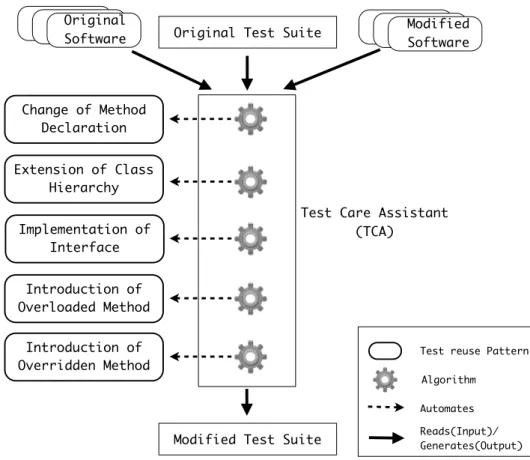
applying algorithms that implement common Test Reuse Patterns. Figure 3.1 shows the overall structure of TCA framework. TCA receives as input the original and the modified software plus the test cases for the original software version. As a result TCA generates the test cases for the modified software. To this end, TCA implements the algorithms designed for automation of Test Reuse Patterns. The algorithms for repairing and adapting test cases share the same structure with slight customization for each specific Test Reuse Pattern.
Automates Algorithm
Test reuse Pattern
Reads(Input)/ Generates(Output) Extension of Class Hierarchy Implementation of Interface Introduction of Overridden Method Introduction of Overloaded Method Change of Method Declaration
Test Care Assistant (TCA)
Modified Software Original Test Suite
Original Software
Modified Test Suite
Figure 3.1. Test Care Assistant (TCA)
TCA generates test cases by reusing and adapting existing test cases written for other classes. This characteristic makes the test cases easier to understand, thus software developers can easily modify the generated test cases if neces-sary. In fact, the test cases adapted by TCA can serve as a starting point for the developers to write the test cases for modified software.
21 3.2 Test Reuse Patterns TCA can either repair existing test cases or generate new test cases. It repairs test cases that are affected by changes in the method declarations. In particular it can handle changes in the return type, changes in the parameter type, parameter addition and removal of parameters. TCA does not consider the types of changes in method declarations that are already addressed by existing techniques, like method renaming or parameter swapping. It generates test cases for extension of class hierarchy, implementation of interface, introduction of overloaded method, and introduction of overridden method. In all these cases, the new code shares some elements with the source code of the existing software elements. We expect that TCA will be applicable to other type of changes where there are shared interfaces between the extended and the existing functionality. TCA cannot work when the new functionality does not share any interface element with existing modules.
3.2
Test Reuse Patterns
Software developers often reuse existing test cases to test new and modified functionality of software systems. We use the term Test Reuse Pattern to indicate common practices adopted by software developers to the activity of reusing and adapting test cases.
To identify Test Reuse Patterns applied by software developers to write new test cases from existing ones, we analyzed test cases belonging to open-source systems: JFreeChart1, PMD2, and JodaTime3. The goal of our analysis is to identify typical activities performed by developers when they reuse existing test cases to write new ones. In more detail, we identify pairs of similar test cases which help us to understand when software developers write similar test cases by reusing and adapting existing test cases. Our analysis identified both the test cases that the developers write by reusing existing test cases, and the test cases that the developers write from scratch. Our final goal was to identify general test reuse patterns.
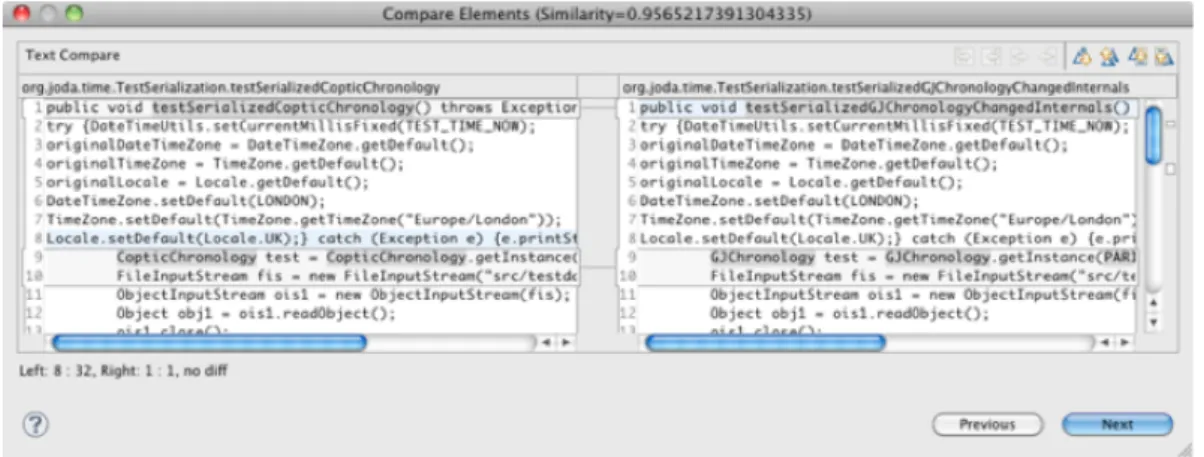
We compare all the possible pairs of test methods in the projects using a tool called RefactoringCrawler [DCMJ06]. RefactoringCrawler has been originally designed to detect refactoring in evolving software. We modified its kernel to extract and display the differences of similar test method pairs in a comparison dialog box as the one is shown in Figure 3.2. We then manually identified the
1http://www.jfree.org 2http:/pmd.sourceforge.net 3http://jodatime.sourceforge.net
22 3.2 Test Reuse Patterns similarities and differences of test pairs.
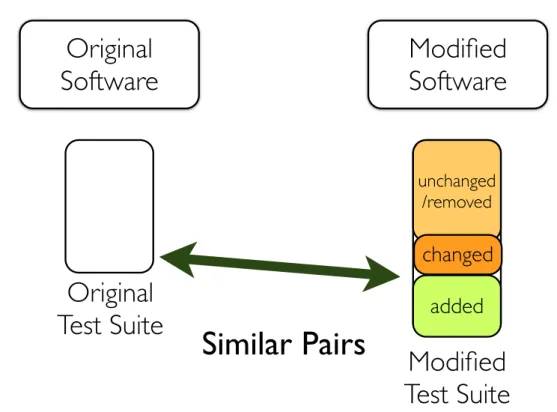
Figure 3.2. Comparing Similar Test Pairs inCopticChronology of JodaTime We categorized the modified test suite as unchanged, removed, changed, and added. We used fully qualified names of methods to identify these categories. We then compared the changed and added test cases in modified software with original test cases. Figure 3.3 shows an abstract view of these categories.
By comparing the structure of test pairs we detected recurrent Test Reuse
Patterns that are applied for different kinds of changes: method declaration changes, extension of class hierarchies, implementation of interfaces, introduc-tion of new overloading methods, and introducintroduc-tion of overriding methods. In the following sections we describe each Test Reuse Pattern.
3.2.1
Change of Method Declaration
Software developers often change method declaration when they refactor a soft-ware system. As a consequence, they need to update existing test cases. The test cases that execute the modified method do not compile anymore and the developer need to fix the compilation error. Our experiments show that, apart from simple refactoring like rename of method, most of the changes that cause compilation errors are changes in the method declarations. The changes that cause compilation error in method declaration are:
• Parameter Type Change • Parameter Addition • Parameter Removal
23 3.2 Test Reuse Patterns
1
Original
Software
Software
Modified
unchanged /removed
added
Original
Test Suite
Modified
Test Suite
Similar Pairs
changed
Figure 3.3. Similar Test Pairs in Empirical Studies • Return Type Change
We illustrate this Test Reuse Pattern by considering an example4 taken from PMD5 a well known open-source program that checks static properties of Java
applications.
Listings 3.1 and 3.2 show how PMD developers modified the declaration of method Report.addRule during the development of version 1.1 of PMD: they changed the type of the second parameter from StringtoContext.
One of the consequences of the change is the compilation errors in the 13 test cases that use the modified method. Listing 3.3 shows one of the broken test cases. The change in the method declaration caused a compilation error on line 4 because the test is passing variablefilename, which is of typeString, the second parameter of methodReport.addRule, but methodReport.addRule
requires a parameter of typeContextin version 1.1 of PMD.
Listing 3.4 shows the repair for the test case of Listing 3.3: the developers in-stantiated a new object of typeContextand used the value of variablefilename
to initialize the new objectctx(line 3). This way PMD developers preserved the 4We slightly modified the example to make it easier to understand.
24 3.2 Test Reuse Patterns behavior of the test; a randomStringor the emptyStringwould not properly test the functionality of method because the name should correspond with the name of an existing file.
1 public void addRule(int line, String file){
2 this.line = line;
3 this.name = file;
4 }
Listing 3.1. Method Report.addRule in PMD 1.0
1 public void addRule(int line, Context ctx){
2 this.line = line;
3 this.name = ctx.getFilename();
4 }
Listing 3.2. Method Report.addRule in PMD 1.1
1 public void testBasic() {
2 Report r= new Report();
3 String filename="foo";
4 r.addRule(5, filename);
5 assertTrue(!r.isEmpty());
6 }
Listing 3.3. Test case for methodReport.addRulein PMD 1.0
1 public void testBasic() {
2 Report r= new Report();
3 Context ctx= new Context("foo");
4 r.addRule(5, ctx);
5 assertTrue(!r.isEmpty());
6 }
Listing 3.4. Test case of Listing 3.3 repaired to work with PMD 1.1 Although test maintenance activities such as the change of PMD test case
testBasiccould be straightforward, the number of test cases to be repaired can be very large. Developers often do not have time to update all the test cases along with the modified classes, thus many test cases become obsolete. While software systems evolve, many obsolete test cases diverge from the system and become hard to repair, thus developers need to rewrite new test cases[BWK05]. The change of method Report.addRuleis an example of a fairly common sit-uation. Existing automated solutions such as automated refactoring techniques cannot handle this simple problem because file "foo" should exist.
25 3.2 Test Reuse Patterns IDEs like Eclipse provide simple solutions that might help software devel-opers. In fact the refactoring menu of Eclipse provides the Introduce Parameter
Object action that allows developers to automatically replace a parameter with a new type introduced by the developer[FBB+99]. This menu action automates the boxing of the object and automatically modifies also the test cases to gener-ate a test like the one in Listing 3.4 thus preventing the compilation error.
Unfortunately the simple repair provided by Eclipse does not work in multi-ple cases:
• It is not applicable when a parameter should be replaced with an existing type;
• It does not allow developers to introduce types that require the invocation of a setter to encapsulate the value in the object (the only possible behavior is to pass the original value as argument of the constructor);
• It is not applicable to multiple methods (once applied to a method it gen-erates the new type and thus cannot be applied to other methods);
• It is not applicable when developers need to manually modify the method declaration;
• It is not applicable when test cases are developed as side projects (this is a general limitation of many automated refactoring techniques).
The PMD case study described in this section is a typical example of an appli-cation that cannot be successfully maintained using simple techniques like the ones implemented by IDEs: the classContexthas not been introduced with the refactoring of version 1.1 but was already used in version 1.0, furthermore the refactoring has been applied to two overloaded versions ofaddRule.
3.2.2
Extension of Class Hierarchy
In object oriented systems developers often extend software functionality by adding classes to hierarchies. Whenever a new class is introduced, develop-ers write test cases to verify the functionality of the new class. To save testing effort, software developers reuse existing test cases and adapt test inputs and oracles to the specification of the new class. This practice is successful when the new class shares some behaviors with its siblings and parent classes. There-fore, existing test cases that verify sibling and parent classes can be success-fully reused to test the new class. We discovered that the test cases designed
26 3.2 Test Reuse Patterns for similar siblings and sub-siblings can be reused as a template to derive the test cases for new class. We illustrate this Test Reuse Pattern with the example shown in Figure 3.4, which is a portion of class hierarchies in JodaTime ver-sion 1.2. To write test cases for classEthiopicChronology, test cases of classes
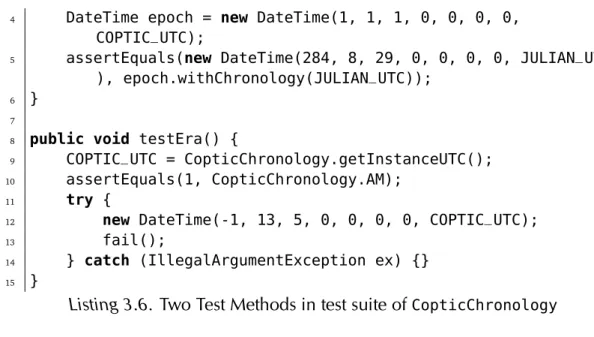
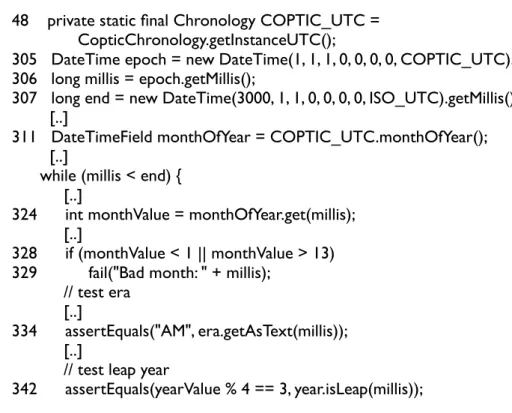
CopticChronologyandIslamicChronologycan be reused as the candidate test cases (because classesBasicFixedMonthChronologyandBasicChronologyare abstract). This choice depends on the fact that all the classes in a hierarchy might share a common behavior thus their test cases can be used to write new test cases for the classes in the hierarchy. For example, developers use the test cases written for CopticChronology (Listing 3.6) to write test cases for class
EthiopicChronology, shown in Listing 3.5. The structure of test cases is often similar except class references. Other than that, some input and oracle values are different because each Chronology employs specific algorithms to calculate date and time.
Software developers use their domain knowledge to identify the most similar siblings and sub-siblings of the class under test. Then, they copy the test case for that class, and finally modify the test inputs and outputs to fit the specifications of the new class.
1 public void testEpoch() {
2 ETHIOPIC_UTC = EthiopicChronology.getInstanceUTC();
3 JULIAN_UTC = JulianChronology.getInstanceUTC();
4 DateTime epoch = new DateTime(1, 1, 1, 0, 0, 0, 0,
ETHIOPIC_UTC);
5 assertEquals(new DateTime(8, 8, 29, 0, 0, 0, 0, JULIAN_UTC),
epoch.withChronology(JULIAN_UTC)); 6 }
7
8 public void testEra() {
9 ETHIOPIC_UTC = EthiopicChronology.getInstanceUTC();
10 assertEquals(1, EthiopicChronology.EE);
11 try {
12 new DateTime(-1, 13, 5, 0, 0, 0, 0, ETHIOPIC_UTC);
13 fail();
14 } catch (IllegalArgumentException ex) {}
15 }
Listing 3.5. Two Test Methods in test suite ofEthiopicChronology
1 public void testEpoch() {
2 COPTIC_UTC = CopticChronology.getInstanceUTC();