Democratic and Popular Republic of Algeria
Ministry of Higher Education and Scientific Research
University of Oran-2 Es-Sénia
Faculty of Letters, Languages and Arts
Department of English
The Dialect(s) of Sidi Bel-Abbes :
Variation, Accommodation and Change
Dissertation submitted in partial fulfilment of the requirements for the degree
of DOCTORAT ès-Sciences in SOCIOLINGUISTICS
Defended by Nadjouia RAOUD
Under the supervision of Pr Mohamed MILIANI
Co-director Pr Catherine MILLER
Board of examiners
Chair: Pr Lotfi BENHATTAB University of ORAN
Supervisor: Pr Mohamed MILIANI University of ORAN
Co-director: Pr Catherine MILLER AMU/IREMAM (Aix, France)
Examiner: Pr Bakhta ABDELHAY Univ. of MOSTAGANEM
Examiner: Pr Zoubir DENDANE University of TLEMCEN
-Declaration
Declaration for Doctorat ès sciences
I undersign that all the material presented for examination is my own work and has not been written for me, in whole or in part by any other person. I also certify that any quotation or paraphrase from the published or unpublished work of any author has been duly
acknowledged in the work which I present for examination.
Signed:
RAOUD Nadjouia
The Dialect(s) of Sidi Bel-Abbes: Variation, Accommodation and Change Abstract
The present research deals with contact-induced dialectal variation and change among Belabbesi speakers of rural origin and, to a lesser extent, among those of Tlemceni origin, thus raising issues relating to the formation of new dialects, the question of prestige dialects and the direction of change in the new urban vernacular of Sidi Bel-Abbes. In addition to the phonological level -interdentals/dentals, namely- on which several contemporary studies have previously focused, this work attempts an analysis of other linguistic level features: morpho-syntactic and semantic features. The data collected during over 7 years are based on analyses of interviews and life accounts by more than 300 speakers, of which the speech of 125 consultants is further scrutinized. To investigate dialectal change, two approaches are adopted: real-time and apparent-time observations. The corpuses collected on the field are constituted of notes and diaries based mainly on participant observation, recorded face-to-face and telephone conversations with speakers by means of indirect, semi-directive and directive interviews as well as large-scale and small-scale surveys.
Investigations on the field reveal that the question of the development of the dialect of Sidi Bel-Abbes is not a straightforward one: on the one hand, the inhabitants use a relatively “uniform” dialect, with its regional features; on the other, they display speech characteristic of urban places. Because of the complex situation of Arab (and Arabic-speaking) countries, studies on dialectal contact in these situations have suggested various scenarios as to the direction of the change. In this study, variation and change were first handled within a variationist framework, which proved insufficient in explaining variation and change. A three-generational model of migration time was then tested, and there again, both inter-personal and intra-personal discrepancies sprang out, as other factors were responsible for variation and change in Sidi Bel-Abbes. These factors pertain to social networks and communities of practice, in addition to context of situation, attitudes, and representations, whereby speakers -irrespective of their communal origin- are seen to take different trajectories, evidence of the need for a more complex, anthropological/ethnographic analysis.
In this thesis, the findings -based on analyses of 13 linguistic features- unveil that a new urban dialect is emerging in Sidi Bel-Abbes, with the 20-29 year-old educated speakers in the lead, though neither education nor young age per se promotes dialectal change. Rather, it is a combination of factors that come into play to enhance or inhibit dialectal change in Sidi Bel-Abbes.
Acknowledgements
I am deeply grateful to my supervisor, Professor Mohamed Miliani, without whose academic spirit and support this work would not have been possible. My sincere thanks go to Professor Catherine Miller for having kindly accepted to co-direct this thesis, and for her guidance and insightful comments.
Many scholars at the IREMAM (Institut de Recherches et Études sur le Monde Arabe et Musulman) were particularly inspiring through their seminars and conferences: Ghislaine Alleaume, IREMAM's former director, for her high-quality seminars (and invaluable help in the Excel analyses); Belguidoum for granting me his precious time with discussions on the sociology of the region of Oran; Salem Chaker for the Berber linguistics seminars; Pierre Larcher and Frédéric Imbert for the Arabic linguistics seminars.
Other scholars were extremely encouraging right at the beginning of (and for some of them all throughout) this project; among these are Professor Martin Atkinson, my Master's degree supervisor, Féthi Hassaine, Philippe Blanchet, Louis-Jean Calvet, Dominique Caubet, Enam Al-Wer, Zoubir Dendane, Sidi Mohamed Lakhdar-Barka, David Britain, Atiqa Hachimi, Bakhta Abdelhay, Niloofar Haeri, Dalila Morsly and Cherif Sini.
I also wish to present my deepest thanks to Ms Annie Rinaudo for having facilitated my settling in Aix-en-Provence; Mohamed for being there during the holidays when I needed to use the IREMAM doctorants office; and Céline and Christelle for their countless “invitations”.
I would like to thank the Algerian Ministry of Higher Education and Scientific Research for their financial support during my 11-month study stay in Aix-en-Provence.
I thank my family and friends for their unconditional love and support.
It would be impossible to name everyone who supported this project, but I would like to express my deepest gratefulness to my consultants from Sidi Bel-Abbes and Tlemcen, namely, for their hospitality and generosity all throughout these long years of research. All the people who, directly or indirectly, contributed to the fulfilment of this work, will find the expression of my entire gratefulness.
CONTENTS
Declaration ……….………ii
Abstract...………..….iii
Acknowlegements...iv
Table of contents ………...v
List of tables... xiii
List of figures………...……..xiv
Key to abbreviations and acronyms...xv
Phonetic symbols...………..xvi
General Introduction ………...1
1. Arabic dialectology and sociolinguistics ………..11
1.1 Introduction ……...………12
1.2 Dialect genesis ………...………13
1.2.1 Koineisation ………..………….…13
1.2.2 The language drift hypothesis ………14
1.2.3 The pidginization hypothesis………..15
1.2.4 The Maghribi language: Elimam ………...…15
1.3 Early studies in Arabic variation ………15
1.4 The beginnings of Arabic dialectology ………..16
1.4.1 Bedouin/sedentary and rural/urban dialects ………...…17
1.4.2 The early pioneers in Arabic dialectology ……….…18
1.4.3 Diglossia ……….19
1.4.3.1 William Marçais ……….………..19
1.4.3.2 Ferguson ………..……….20
1.4.4 The stratified model ………...20
1.4.5 The codeswiching/continuum model ……….21
1.5 Recent developments in Arabic sociolinguistics ………...22
1.5.2 Dialectology/Sociolinguistics and urban studies in the MENA region…..24
1.6 Dialects in contact and new urban vernaculars………...25
1.6.1 Accommodation and koineisation in Arab countries ……….26
1.6.2 Accommodation between speakers of different Arabic countries ……….28
1.6.3 Arabic in cities : resistance, history, and identity ………..29
1.6.4 Religious and communal dialects ………..29
1.6.5 Social networks, social mixing, and flexibility of variables..……….31
1.6.6 Education and communal dialects: interdentals and the q variable..……..31
1.6.6.1 Interdentals ……….……..31
1.6.6.2 The q variable ……….. 32
1.6.7 Men, women, and dialectal change ………34
1.7 Some “scenarios” for the development of Arabic urban vernaculars ………35
1.8 Conclusion ……….36
2. Setting the stage ………. 37
2.1 Introduction ……….….38
2.2 The linguistic situation in Algeria ……….…..38
2.2.1 Languages in Algeria ………...…………..38
2.2.1.1 Ethnologue‘s list ………..39
2.2.1.2 Arabic ………..………….41
2.2.1.3 Berber / Tamazight ………...43
2.2.1.4 French ………...…44
2.2.1.5 The legal status of languages in Algeria ………..44
2.2.2 Linguistic Diversity in Algeria ………..45
2.2.3 Language change in Algeria ………...47
2.3 The city of Sidi Bel-Abbes ……….48
2.3.2 History ………51
2.3.2.1 The Berbers ………..…51
2.3.2.2 The Romans………..51
2.3.2.3 The Arabs………..51
2.3.2.4 The Spaniards and the Turks ………52
2.3.2.5 The French presence……….52
2.3.2.6 El-Emir Abd-El-Kader………..53
2.3.2.7 Architecture ………..54
2.3.2.8 Sidi Bel-Abbes today ………...54
2.3.2.9 Sid Lahcen ………56
2.4 The linguistic situation in Sidi Bel-Abbes ……….56
2.4.1 The Berber substratum in SBA ………..57
2.4.2 Bedouin and sedentary dialects in the ‘county’ of Oran ………57
2.4.2.1 The sedentary dialects of the ‘county’ of Oran ………....58
2.4.2.2 The Bedouin dialects of the ‘county’ of Oran ………..60
2.4.2.3 Some distinctive features of three regional/communal dialects ……...63
2.5 Conclusion ……….68
3. Variation and change in the dialect of Sidi Bel-Abbes………69
3.1 Introduction ………..………..70
3.2 Universal factors influencing language change ……….70
3.2.1 Directionality ………...71
3.2.2 Inclusiveness ………..…71
3.2.3 Acquisition and pidginization ………....72
3.2.4 Favouring conditions ………..…72
3.3 Investigating dialectal change in Sidi Bel-Abbes ………...73
3.3.1.1 Real time observation ………...…73
3.3.1.2 Apparent time observation ………...73
3.3.2 Observation language variation and change in SBA ………..74
3.3.3 Data collection ………...…75
3.3.3.1 Methods of research………..75
3.3.3.2 Speaker selection and interviews ……….76
3.3.3.3 Speaker sampling………..76
3.3.3.4 Variable selection ………...78
3.4 Apparent time variation in SBA ………...79
3.4.1 The groupof elder speakers ………...…….79
3.4.2 The main features of old SBA speech ………....80
3.4.2.1 Phonology……….80
3.4.2.2 Morphology ………..82
3.4.2.3 Lexicon ……….83
3.4.2.4 Lexico-phonetic features ………..…84
3.4.3 The group of young speakers ………...…..85
3.4.4 Features of the young speakers ………..85
3.4.4.1 Phonology ………..…………..85
3.4.4.2 Morphology ………..86
3.4.4.3 Lexicon ……….86
3.4.5 Other linguistic changes ……….86
3.4.6 Features maintained ………...87
3.5 Quantitative analyses of stopping in Sidi Bel-Abbes ……….92
3.5.1 Stopping and age in SBA – a random sample ………....93
3.5.2 Stopping and educated speakers ……….94
3.5.3 Stopping and illiterate speakers ………...95
3.5.5 Stopping and rural origin ………...…96
3.5.6 Results of stopping in age, education and origin – a random sample ……97
3.5.7 Stopping and age – a quota sample ………....98
3.5.8 Stopping and sex – a quota sample of 54 speakers ………....99
3.5.9 Significance of the results of the quota and random samples …………..100
3.6 Koienisation ………..…...100
3.6.1 Siegel ………101
3.6.2 Trudgill accommodation and levelling ………102
3.6.2.1 Short-term accommodation and long-term accommodation ………..103
3.6.2.2 Salience as a factor promoting the acquisition of features ………….104
3.6.2.3 Markedness as a factor promoting the acquisition of features …...…105
3.6.2.4 Extra-strong salience as an inhibitory factor in accommodation …...105
3.6.2.5 Three stages in the formation of a new koiné……….106
3.6.3 Koineisation in Sidi Bel-Abbes and in Sidi Lahcen ………108
3.6.3.1 Investigating stopping and koineisation: speakers of rural origin…..108
3.6.3.2 A quantitative survey of 13 variants among 17 speakers …………...111
3.6.3.3 Results and tendencies ………...131
3.7 Conclusion ………...132
4. A complex approach of variation and change ………...………135
4.1 Introduction ………..136
4.2 Social relations and linguistic contact ……….137
4.2.1 Social networks ………137
4.2.2 Communities of practice ………..137
4.2.3 Contact-induce dialectal change ………..138
4.3 The maintenance of communal/regional features ………139
4.3.2 The maintenance of Tlemcen rural features ……….144
4.3.3 Understanding maintenance of communal features ……….149
4.4 Levelling out of communal features ………150
4.4.1 Levelling out of among speakers of SBA/rural origin ……….150
4.4.2 Levelling out of among Tlemceni speakers ……….152
4.4.3 Understanding levelling among Belabessi dwellers ………156
4.5 Variation and accommodation among SBA dwellers ……….156
4.5.1 Phonological variation ……….157
4.5.2 Morpho-syntactic variation ………..159
4.5.3 Lexical variation ………..160
4.5.3.1 Variation in the verb ‘to go’ among speakers of Belabbesi origin….160 4.5.3.2 Variation in the verb “to go” among speakers of Tlemceni origin….168 4.5.3.3 Is mʃa a Tlemcen or an old SBA variant (or both) ?...170
4.5.3.4 Concluding remarks on ‘to go’………...171
4.5.3.5 Variation in the verb ‘to call’………..171
4.5.3.6 Variation in the verb ‘to be able to’ ………...175
4.5.3.7 Variation in time adjuncts………...177
4.5.3.8 Urban and formal variants ………..178
4.5.3.9 Understanding variation and accommodation in Sidi Bel-Abbes…...178
4.6 Education, social networks and communities of Practice ………179
4.6.1 Case studies: individual speakers and comparative descriptions …….…180
4.6.1.1 Profession and workplace: Ali versus Hamid……….180
4.6.1.2 Place of living and contact: Zoulikha versus Khdija and stopping...180
4.6.1.3 Contact and social networks: Abdelghafour and the variant mʃa …..181
4.6.1.4 A community of practice: Abdelkader and his coworkers ………….181
4.6.1.5 A three-generational model and a social network: Adel …………....181
4.6.1.7 A community of practice and an open Tlemceni network: Bilal…....182
4.6.1.8 A burnout in the city: Monir………...183
4.6.2 Case studies: families ………...189
4.6.2.1 A combination of factors: Nesrine’s family ………...189
4.6.2.2 Extreme variability: Omar’s family………....190
4.6.2.3 A three-generational model...so far: Mounir’s family………....191
4.6.2.4 A three-generational model and time of migration: Amina’s family..192
4.6.3 Results and findings ……….192
4.6.4 From short-term accommodation to long-term accommodation ……….194
4.7 Attitudes, representations and identity ………196
4.7.1 Urban SBA as a prestige dialect ………..196
4.7.2 Tlemcen as a prestige dialect ………...198
4.7.3 Algiers as a prestige dialect ……….201
4.7.4 Prestige and stigma ………..202
4.7.4.1 French as a prestige language……….203
4.7.4.2 Rural speech as a stigmatised variety………..204
4.8 Dialectal change in SBA: a qualitative analysis ………..205
4.8.1 Types of dialectal change ………....206
4.8.1.1 Reduction and Phonetic/phonological simplification ………206
4.8.1.2 Morphological simplification ……….209
4.8.1.3 Lexico-phoneticsimplification………....211
4.8.1.4 Reallocated lexico-phonological mergers ………..211
4.8.1.5 Lexical reallocation ………....212
4.8.2 Understanding dialectal change in SBA ………..215
4.8.2.1 Inter-dental mergers ………...215
4.8.2.2 Resistance of highly salient features………...215
4.8.2.4 The SBA variety in radio programmes………...221
4.9 Conclusion ………...222
General conclusion ……..……….224
Appendices ……….234
- Appendix 1: The family tree ……….235
- Appendix 2: lʕarbiyya ttaʕna ………….………...………...240
- Appendix 3: The blue card ………...243
List of Tables
1 Phonetic symbols 10
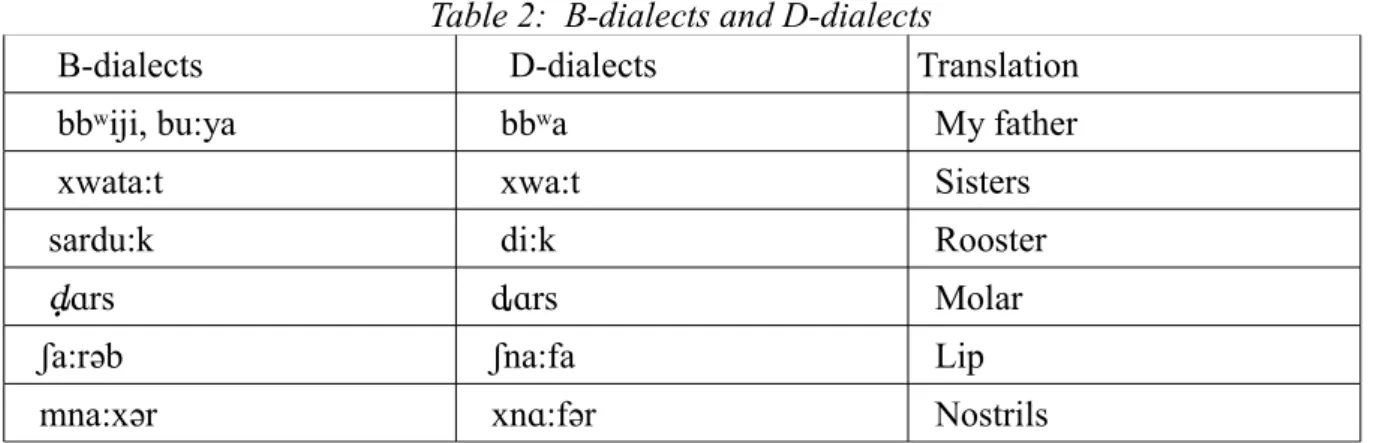
2 D-dialects and B-dialects 62
3 Old features of three three regional dialects: SBA, Tlemcen and Algiers 64 4 Old and New SBA features 89 5 Stages in the formation of a new dialect 107 6 Profiles of the 17 main speakers 112
7 17 speakers and 13 variants 113
8 Stopping among 17 representative speakers 116 9 De-diphthongisation among 17 representative speakers 117
10 Vowel elision 118
11 Vowel bounce 119
12 Marked feminine case 120
13 Negation in imperatives 121
14 Negation in participles 122
15 ħa:ʒa “something” 123
16 Reflexive pronouns and “alone”: waħǝd + agreement 124
17 The variants for “to go” 126
18 “To call” as ʕayya( 127
19 “To be able to”: jnaʒəmm ; jqadd ; jaqdarr 129
20 Time adjuncts 130
21 Mounir's linguistic change from 2010 to 2013 187 22 Lexemes for “sitting”, “staying” and “resting” in old and new SBA speech 213
List of Figures
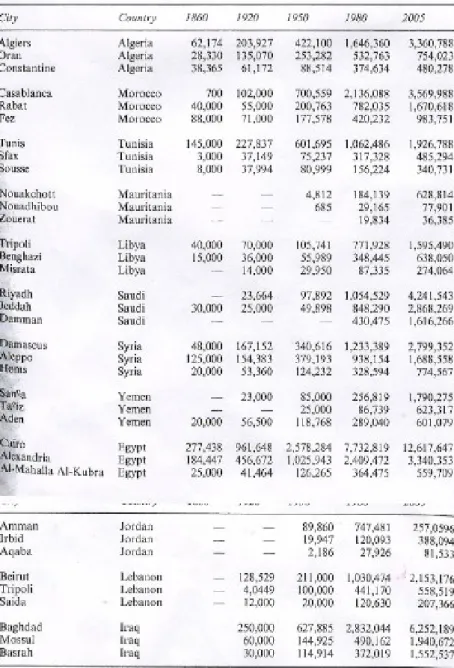
Figure 1: 27
Population growth in Arab cities
Figure 2: 50
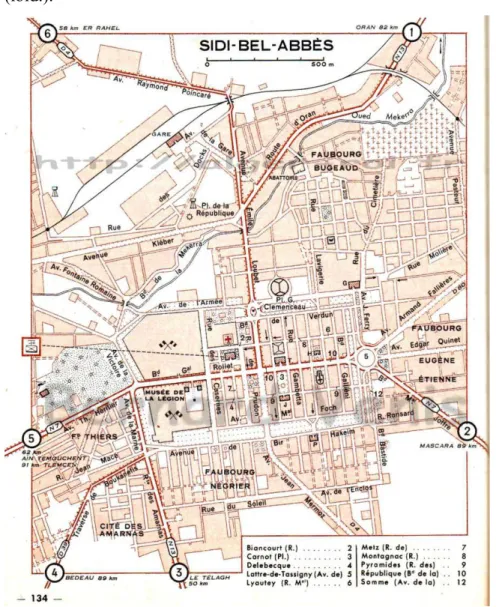
Sidi Bel-Abbes and the surrounding cities, towns and villages
Figure 3: 55
Major headquarters of the city of Sidi Bel-Abbes
Figure 4: 92
Correlation of age and the fronting of aw in the Philadelphia Neighborhood study
Figure 5: 93
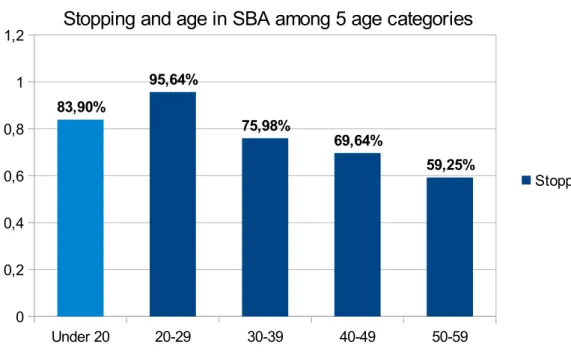
Stopping among 5 age categories in SBA
Figure 6: 94
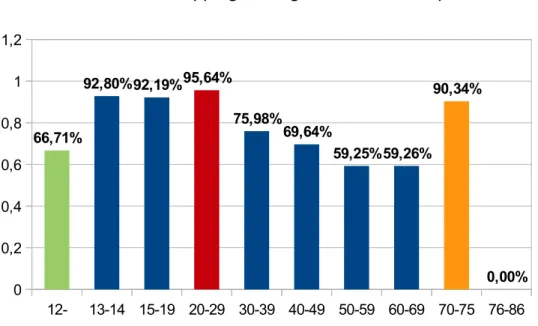
Stopping and age in SBA - a random sample
Figure 7: 95
Stopping and educated speakers
Figure 8: 95
Stopping and illiterate speakers
Figure 9: 96
Stopping and urban origin Figure 10
Stopping and rural origin 97
Figure 11: 98
Stopping and age in SBA - a quota sample
Figure 12: 99
Stopping and sex in SBA
Figure 13: 109
Stopping and the three-generational model in SBA 1
Figure 14: 110
Key to abbreviations and acronyms - Morpheme boundary / Or Adjt/s Adjunct/s Agr. Agreement CA Classical Arabic
CAP Certificat d'Aptitude Primaire, equivalent to a Certificate of Qualification. Dipht. Diphthong/isation
ESA Educated Spoken Arabic Eg. For example
Fem. Feminine Imp./s Imperative/s Imperf. Imperfective Indep. Independent Interd./s Interdental/s Interrog. Interrogative Masc. Masculine
MSA Modern Standard Arabic Neg. Negative
N./s Noun/s
NSA Nonstandard Arabic
ONS Office National des Statistiques Partic. Participle/s Pers. Person Pl. Plural Pr. Pronoun Rec. Recording SA Standard Arabic SBA Sidi Bel-Abbes Sch. School Sing. Singular SK Sidi Khaled SL Sidi Lahcen V/s Verb/s Vow./s Vowel/s Vs Versus
Phonetic symbols
Consonants
IPA Arabic Example Gloss IPA Arabic Example Gloss
; ا
;²na
I, meḍ ض
Ḍ²rw²k
Nowb ب
bént
A girl( ط
(rè!g
A roadt ت
Tro!=
You go" ظ
"²lm²
Darknessç ث
çu!m
Garlic: ع
:alama
Greatj ج
Ja!t
She camec غ
ca!di
Be going to= ح
=di!d
Metalf ف
Fénn
Artx خ
xwata!t
Sistersq ق
qr²!t
She studiedd د
Da!r
A housek ك
K²!cé(
Paperà ذ
àu!k
Thosel ل
l)i!)
Therer ر
R²!=
He wentm م
Mr²
A womanz ز
Za!d
He was bornn ن
Na!s
Peoples س
socr
Youth) ه
)a!da
This-masc.< ش
<u!f
Look!w و
W²!)
Yesᵴ
ص
ᵴ²br
Patiencey ي
ya!més
YesterdayVowels Short Example Gloss Long Example Gloss Diph--thongs Example Gloss
I/è
nti/ntè You-fem.I!
Mi!l Lean (V.)a/é
Ma/éll He grewtired of
a!/ è!
Ma!l/mè!l Treasure
U/o
Kull/koll Every/ eachU!/O!
U!
Ku!l/ko!l; ;u!d Eat-imp. A twigaw
;awd A horseThis study proposes an analysis of dialectal development in Sidi Bel-Abbes, a city in northwestern Algeria, with particular focus on migrants living in Sidi Lahcen, a suburb about 10 kilometres away from the city centre. Sidi Bel-Abbes has known an important internal migratory flux not only from the neighbouring rural areas but also from various towns and cities, namely, Oran, Mascara, Saida and Tlemcen. Although no direct description of the earlier dialect of Sidi Bel-Abbes is available, it is known from the works of early dialectologists that it belongs to the bedouin (nomadic) group (W. Marçais 1938; Ph. Marçais 1940) - itself divided into the A-dialects, B-dialects and D-dialects of Algeria (Cantineau 1940). These bedouin dialects are distinguished from the sedentary dialects of the old city centres of Algiers, Constantine and Tlemcen. The latter group display significant discrepancies between the dialects of the old city centres and the rural dialects of the surrounding villages while the distinction between the bedouin and the rural dialects in Sidi Bel-Abbes is not attested; thus, in the present study, the terms “bedouin/nomadic/rural” will be used interchangeably as concerns the dialect of Sidi Bel-Abbes. Conversely to other Arabic-speaking situations (see Miller 2007: 6), and though many bedouin dialects share important aspects -a conclusion drawn from the literature on Algerian folk tales, namely that by Bourayou (1993)- tribal or genealogical (bedouin/sedentary) affiliation is generally less relevant in categorising Algerian dialects than regional/geographical membership. The old bedouin dialect of Sidi Bel-Abbes shares several characteristics with one of the dialects in use in Oran, that is the bedouin dialect of the "département" (county) of Oran, classified as a D-dialect by Cantineau (1940, 1960). Today, urbanisation, the growing mobility of the Algerian population, and the influence of the media (television, mainly) have brought in contact people of diverse origins, leading to much uniformisation across mutually intelligible varieties of Arabic but also a high degree of variation between inhabitants of the same city, town, village, community and even between members of the same family. Some linguistic features show great instability and correlate much more with age, gender and social and communal origin than with geographical factors. For example, dialects now spoken in urban settings display some of the features characteristic of bedouin speech; the same process seems to apply to bedouin dialects, which have incorporated many of the features typical of sedentary varieties. However, as will be shown in the present work, the situation is not that straightforward, and appeal to investigations beyond the purely socio-linguistic level is necessary.
Why a study of the dialect(s) of Sidi Bel-Abbès?
Apart from Cantineau’s monographs, namely on Oran (1940), to which I shall refer at different stages in this study, there are few works on the Algerian dialects, in general, and on the dialect of Sidi Bel-Abbes, in particular. Sidi Bel-Abbes is known for fostering literary and artistic creation, as many plays are written and performed in the local dialect. It was in Sidi Bel-Abbes that the Nedjma novel writer Kateb Yacine -one of the outstanding figures of Algerian literature- put on Mohamed, prends ta valise (“Mohamed, pack up”), a play about the hardships of Algerian migrants in France. It is also the city of the cartoonist Slim with his endearing characters Zina, Bouzid, and the Gatt mdigouti [the depressed cat] (Cf. Lakhdar-Barka 1999 for an analysis of the issue of interlanguage, namely).
This variety, bedouin and rural at the same time, and like other dialectal varieties of the Algerian speech repertoire, has for long been stigmatised and its usage continues to be subjected to negative attitudes on the part of those who forget that it is a variety of Arabic that has inspired a number of Belabbesi poets, for example, Mestfa Ben Brahim1 and Ahmed
Benharrath (Dellaï 2003: 143-152). The former, the 19th century bard of the shi'r el Melhun
(folk poetry as opposed to (written) classical poetry) (cf. Tahar 1975), is known for having composed about fifty poems on his beloved woman Bakhta, some of which are superbly interpreted by one of the best-known and most talented singer, Ahmed Wahby; and the poet and singer Abdelkader El Khaldi.
Sidi Bel-Abbes is also the birth place of bedouin poetry and rai music (cf. Daoudi and Miliani, H. 1996), some of whose representatives bear such mythical names as Raina Rai -known for their top hit “Ya Zina! diri la ta:y (Hey, Zina! Make tea!) and Rimiti – nicknamed the “rai granny”, whose Saîda is a planetary hit, and all those who have contributed in propelling rai music on the international scene and, by way of consequence, in making this variety of Arabic known, with its accent and lexical idioms some of which now characterize the speech of many Algerian youths. It is also the language of the heart, of the proverbs and sayings of all those- literate and illiterate- that share it and enrich it day after day; it thus deserves all our respect and attention.
Sidi Bel-Abbes is neither the capital nor the economic city of Algeria. However, a study of its linguistic situation is important for many reasons. The first one is due to the appearance of new varieties of vernacular Arabic, as the former regional distinctions are fading away, subsequently to the various movements from rural to urban settings in most Arab countries,
and in Algeria, for our present purpose. The second reason is its complex linguistic situation, where at least two main distinct dialects coexist: several varieties of bedouin origin, spoken by the Bellabesis themselves and migrants from the surrounding cities and towns (Saida, Mascara, Oran, etc.) and of rural areas, and a number of varieties of sedentary descent spoken mainly by first, second, and third (and subsequent)-generation speakers of Tlemceni origin. The third reason lies in that it may be enlightening in our quest for change in progress, to examine not only such phonological features as interdentals/dentals (interdentals/stops) -most studies being restricted to a few phonological features- but also morpho-syntactic and semantic variants.
Due to the dialectal contact resulting from a massive migration from different parts of Algeria, the Arabic variety of Sidi Bel-Abbes variety is undergoing change; this work is thus an attempt to understand the impact of urbanisation and contact in this city upon the traditional bedouin/sedentary dialect distinction. It thus raises two important issues: the first examines what linguistic features are most involved in this change; the second one is whether change in progress is the result of social variation, koineisation, accommodation, or other factors. In the context of Arabic dialects, various hypotheses have been put forward to explain the direction of and the factors responsible for dialectal change: they are said to be of a communal, historical, demographic, and ideological order, namely. Trudgill's (1986) seminal work on dialects in contact posits that when speakers of different varieties of a language meet in a new town, a new form emerges; furthermore, he states that this new dialect -a koine- is stabilised after three or more generations of migrants. This koineisation process, which involves the disappearance of some of the features of the contributing dialects (levelling out) and emergence of some new ones, is supported by Al-Wer (2007) on Jordan, where "a kind of standardized koine Ammani vernacular is expected to stabilize and to represent the local identity, in spite of the continuous influx of foreign migrants”; Pereira (2007 a, b) on Lybia, and others, who claim that urban Arabic dialects are heading for a common shared vernacular, thus erasing many local/regional features (Miller 2007: 29). This view is challenged by Siegel (1993), who maintains that Arabic dialects cannot be said to have undergone such levelling, as distinct varieties may be preserved to mark segregation of space, community, and society (cf. Miller 2007: 7). Because of the complex situation in which language change is taking place in Sidi Bel-Abbes (and in many Arab cities), due mainly to a diglossic and multilingual context and a rapid urbanisation, the present project thus proposes a complex, trans-disciplinary study of contact-induced dialectal change in Sidi Bel-Abbes. First, it involves not
only the language varieties themselves but also their speakers, with their personal stories, their cultures, as well as their social motivations; this work is meant to analyse processes of dialectal variation and change among inhabitants of Sidi Bel-Abbes, who, at various periods, have come from surrounding cities, towns, and rural areas. Secondly, previous studies on language variation and change having focused mainly on phonological features -for example, interdentals and dentals- this study attempts an analysis of dialectal features at all linguistic levels: phonetic/phonological, morpho-syntactic and lexical. A study concentrating mainly on phonological variants such as interdentals and stops may not prove very productive for at least two reasons. The first one is that such change may be internally-conditioned, i.e., caused by universal natural phonetic constraints. The second reason is that an examination of further linguistic-level features may prove useful as a complementary, cross-comparative tool of investigation.
Theoretical framework and methodology
At the theoretical level, the choice of a complex approach is motivated by four major reasons. The first one involves the necessity of interdisciplinary research in a domain where language is at the crossroads of culture and society. Edgar Morin (1991: 162) introduces the third part of the fourth volume of his “méthode” [method], titled “Les idées” [Ideas] by a reflection on language, stating that “chaque énoncé témoigne de spécificités propres à la cohérence linguistique de chaque langue, de spécificités subjectives, de spécificités culturelles, sociologiques et historiques” [each utterance attests of specificities proper to the linguistic coherence of each language, of subjective specificities, of cultural, sociological and historical specificities], adding further(ibid., 163) that “le langage dépend des interactions entre individus, lesquels dépendent du langage. Il dépend des esprits humains, lesquels dépendent de lui pour émerger en tant qu’esprits humains” [language depends on interactions between individuals, which depend on language. It depends on human minds, which depend on it to emerge as human minds].
The second reason for the choice of a complex approach, largely discussed by Blanchet (2007), is of an epistemological order, and it relates to the radical divergence between “structuro-linguistics” and sociolinguistics, resulting in the hegemony of “hard core” linguistics, and the relegation of sociolinguistics to a marginal position, not to mention the other crisis which shook the scope of ethno-linguistics, sociolinguistics, and the sociology of language. In this respect, signs of pluralist evolution are, happily, gradually showing on the scene of language studies from the viewpoint of a constructive/constructivist “confrontation” of traditionally distinct disciplines such as linguistics, anthropology and sociology (Blanchet
2000; for a hegemony of another type (ie. colonial), see Calvet 1988).
The third reason pertains to a theoretical and methodological framework, wherein appeal to an interdisciplinary model implies that the complexity of the task should require methods of research whose aim is to examine the multi-faceted aspect of human linguistic interaction. The methodological framework of the present thesis has extensively drawn on Blanchet's (2000, 2007) works, based on an empirico-inductive qualitative method as a “linguistics of complexity” which reconciles two methods formerly considered incompatible: the hypothetico-deductive methods and the empirico-inductive methods; such a choice is motivated by the fact that neither method alone is capable of capturing the complexity of human interaction. On the one hand, variationist models, for example, following the techniques of sampling of modern sociology in using statistical analyses, have succeeded in showing how linguistic variables correlated with measurable social variables, a contribution which has had a tremendous impact on the study of language, in general, and, in particular, on the status of stigmatized minority linguistic varieties, illustrated by the works of William Labov on African American Vernacular English (1972, 1976, 1978). The efficiency of such quantitative methods in analysing actual processes of interpersonal communication is questioned by Blanchet (2000) for their exclusive reliance on quantitative results, thus often reducing human interaction to mere figures, though, as he suggests, quantitative analyses, despite their minor role, are nonetheless integrated within his "ethno-sociolinguistics"(Blanchet 2000) as a “complementary modality” (ibid. 2012). On the other hand, qualitative approaches have been criticized for the multiplicity of factors and their inability to capture certain regularities, and thus Blanchet (2000) pleads for an empirico-inductive, interpretative, “qualitative” approach, which, relying on contextualized corpuses collected on the field, will try to “understand” the phenomena under study (for a detailed account of Blanchet's approach, see Raoud 2010).
The fourth reason for a complex approach is ethical. According to Calvet (1994), research on languages and language varieties, which is first and foremost a study of the people who speak them (“les gens qui les parlent”), requires a posture where human dignity is at stake, a posture that avoids voyeurism, so that, instead of satisfying a mere mundane social need, the researcher’s contribution -no matter how modest- becomes an act of citizenship or a human act (Calvet 1994).
Data collection
The data come from fieldwork research which I carried out between December 2007 and September 2013 among over 300 speakers- including over half the number for short anonymous interviews and longer interviews with 125 speakers -52 males and 73 females. The youngest speaker is 8 and the oldest is 86. Contact with the informants has been facilitated by the fact that I am originally from Sidi Bel-Abbes, as well as by the “snowball effect” (Milroy and Gordon 2003) subsequent to the family ties and the friendship network woven in the course of this project. This, I hope, has kept to a minimum the “observer’s paradox”(see section 3.3.3.1). To complete this study, a commutation test relating to pronunciation has been established, as the recordings, though lengthy they might be, are not likely to cover all the phonetic and the phonemic oppositions between two (or more) features. The first speakers in this study are members of the eldest group, the first of whose is 86 year-old El-Hadj. The first young speakers in this investigation are college pupils (pupils in a CEM, Collège d’Enseignement Moyen “Middle School” in Sidi Lahcen; eventually, it became possible to "approach" older members of their respective families. The materials analysed are recordings of conversations and life accounts as well as direct and indirect interviews. For deontological reasons, the names (and, in some cases, the exact places of residence) of the consultants have been changed.
Interviews and speaker selection
The main methodological tools used in the present research are participant observation and interviews. Prior to any recorded material, my frequent visits and stays over a few years in Sidi Bel-Abbes were meant to have a relatively clear picture of the linguistic and cultural situation of Bellabesi society. In order to avoid a priori judgements which might have seriously jeopardized this field work, I deliberately went there with no pre-conceived hypotheses, to avoid being influenced by theory x or y -with some relative knowledge of Arabic dialectology, though. Once I had become familiar with the linguistic and social practices of Belabbesi speakers, I undertook a study of the various trends within Arabic sociolinguistics. As for the corpuses collected on the field, they are constituted of 1) notes and diaries based mainly on participant observation, 2) recorded face-to-face and/or telephone conversations with speakers either by means of semi-directive and directive interviews, and 3) directive surveys. To do so, I relied partly on methods suggested by Blanchet (2000) and
Milroy and Gordon (2003); as for my preliminary investigations on the speech of Sidi Bel-Abbes and that of Sidi Lahcen, I opted for a random sampling for the choice of the speakers to avoid any initial bias in the collection of the data; this was then completed by notes, transcription and analyses.
From among the 300 overall consultants, a random sample of 125 speakers was studied for the treatment of stopping. Thus, in addition to the eight age categories suggested by Labov (1994), two other categories were added: the 8-12 and the 76-86, thus bringing the number to ten categories: 8-12, 13-14, 15-19, 20-29, 30-39, 40-49, 50-59, 60-69, 70-75, and 76-86, subsequently to the quantitative results obtained. This division is necessary for at least three reasons:
1. to have a clear picture of the speech of the locality of an earlier period on the basis of the time-apparent hypothesis; that is to say, to compare the speech of older speakers with that of younger speakers in order to track new features or features having disappeared;
2. new features are found to occur in the speech of age groups only a few years younger than another category;
and,
3. as scientific evidence in language acquisition theories has shown, for instance, some phonological variants are not conditioned by social parameters but obey natural laws and thus are not acquired before a certain age (see Ferguson 1978: 437; Labov 2010: 311). Therefore, cautious analysis was made of the speech of pre-adolescents and very young speakers.
For a finer analysis, a quota sample of 78 speakers was extracted, and the speech of an equal number of speakers representative of their age range, education and origin was analysed. Subsequently, 17 speakers displaying differences in age, sex, education and of migration to Sidi Bel-Abbes, wherein analysis of 13 dialectal features were tested for change at the phonological, morpho-syntactic and lexical levels.
Chapters content
The present work comprises four chapters. Chapter One discusses the question of the emergence of the modern Arabic dialects and the different approaches suggesting explanations of the diglossic situation that resulted. The first part of Chapter One deals with the beginnings of Arabic dialectology and, in particular, the works of French dialectologists
on Algerian dialects across two different periods: those of the early 20th century until the
1960's as well as those of later dialectologists and sociolinguists. The second part of Chapter One offers a panorama of studies in sociolinguistics, including more recent developments in Arabic sociolinguistics, namely, variationist as well as contemporary post-independent sociolinguistic studies in in the Middle-East, and North Africa (MENA). Sociolinguistics represents an important advance in the field, although there is no doubt that without the works of dialectologists, sociolinguistic research would not have been possible. A shift has taken place from when dialectologists would track the NORMS, i.e. the non-mobile, old, rural, male speaker using the typical dialect of a particular region (cf. Chambers and Trudgill 1988), to sociolinguists, who are now showing interest for all varieties and variations, including those spoken by both rural and urban dwellers, perhaps with more emphasis on the latter, under the label urban sociolinguistics. The final parts of this chapter involve a brief introduction of contact-induced dialectal change among speakers of different communal dialects, and questions relating to the relation between education and the status of some variables are raised.
Chapter Two provides a brief overview of the linguistic situation in Algeria, setting the stage for discussion of the linguistic situation of Sidi Bel-Abbes, and a comparison of three Algerian dialects: old Sidi Bel-Abbes, old Tlemcen and old Algiers.
In Chapter Three, I embark on a description of the dialect of Sidi Bel-Abbes, on the basis of two related approaches: real time observation and observation in apparent time, with the first part of this chapter addressing the issue of language change according to Labov (1994) and Arabic specialists working within this theoretical and methodological (variationist) paradigm. Then a general picture of Sidi Bel-Abbes Arabic -as opposed to other varieties of Algerian Arabic- is drawn, presenting the main phonological, morpho-syntactic, and lexical features characteristic of this speech. In the second part, a number of linguistic features are tested within the variationist approach. The second part of Chapter Three deals with the question of koineisation, as presented within the models of Trudgill (1986); Kerswill and Williams (2000), Kerswill (2002), and Kerswill and Trudgill (2005) with more focus on immigrant koines. Finally, Trudgill’s three main stages of koine formation -mixing, levelling, and simplification- are tested against the linguistic change taking place in Sidi Bel-Abbes. In Chapter Four, a complex study of language variation and change in Sidi Bel-Abbes is proposed, wherein a substantial part is devoted to the relevance of accommodation, maintenance, and levelling within a more qualitative framework.
IPA and Doulos SIL phonetic symbols
One of the recordings on which the analyses in this study are based may be found in the sound archives of the Maison Méditerranéenne des Sciences de l'Homme (MMSH) médiathèque of Aix-Marseille University (under the title ELHADJ RAOUD). Transcribed excerpts of some speakers' conversations are in Appendices 1, 2 and 3. Unless otherwise indicated, the translations are mine; they are in square brackets, including those of long occurrences in French by the consultants. Because two or more distinct lexemes would have been phonetically confused in the varieties of Arabic which I purport to describe, and to ensure a more accurate reading of the actual pronunciations, I have used the phonetic symbols of the International Phonetic Alphabet (I.P.A.) mostly, in addition to some other Arabic Doulos SIL phonetic symbols. Consonants and vowels are presented below.
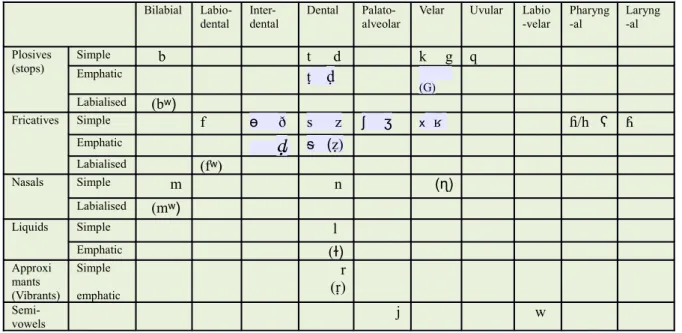
Table 1: Consonantal allophones (in brackets) and phonemes of SBA speech2 Bilabial Labio-dental Inter- dental Dental Palato-alveolar
Velar Uvular Labio -velar Pharyng -al Laryng -al Plosives (stops) Simple b t d k g q Emphatic ( ḍ (G) Labialised (bʷ) Fricatives Simple f ɵ à s z ʃ ʒ x c )/h ʕ = Emphatic " ᵴ (&) Labialised (fʷ) Nasals Simple m n (ɳ) Labialised (mʷ) Liquids Simple l Emphatic (ɫ) Approxi mants (Vibrants) Simple emphatic r (') Semi-vowels j w
The vocalic system of SBA comprises short and long vowels as well as diphthongs.
Short vowels:
/a/ has the variants [a, ə, ɛ] : mall, məll, mɛll « he is fed up ». /i/ has the variants [i and ɛ] : nʒi ou nʒɛ « I come ».
/ʊ/ has the variants [ʊ and o]: kʊlʃ(i) ; kolʃ(i) « all/everything ». /²/! ᵴ²b(b) “he poured”.
Long vowels: i! Mi!l “lean”; a! Ma!l/mè!l “treasure”; “what is the matter with” ”; ²! ᵴ²!b
“he found”; O! (o!l/(u!l “length”.
Diphthongs: aw: :awd “horse”; ²j: ᵴ²yf “summer”.
1.1 Introduction
Arabic belongs to the Semitic languages, members of the Afro–Asiatic (Hamito– Semitic) family of languages, which, in their turn, are said to descend from a common root, namely a proto-Semitic branch. The most recent discovery of the earliest record of the Arabic language is an inscription dated between 469-470, made by Frédéric Imbert in 2014 (France-Diplomatie 2014). The question of the number of Arabic speakers is very difficult to pin down, due firstly to the significant discrepancies between survey sources and, secondly, to the Arabic standard and non-standard varieties in use, as some figures estimate Standard Arabic speakers to 206 millions (SIL, cf. Calvet 2007: 36); therefore, the issue of the number of speakers of nonstandard Arabic remains problematic, as Calvet remarks (ibid., 38), though Ethnologue estimates it to 242 millions scattered across 22 countries!
Three forms of the Arabic language are distinguished: Classical Arabic, Middle Arabic, and the modern Arabic dialects. Classical Arabic is the language of pre-Islamic poetry and of the Qur'an. As to the term Middle Arabic, it is “not unequivocal” (Blau 1982:188): initially defined by Blau as “constitut[ing] the missing link between Classical Arabic and modern dialects”( Blau 1966-7: 1, 36, in Versteegh 2001: 114), it was subsequently characterised as a “mixed language of mediaeval texts, containing Standard Arabic, Neo-Arabic, and […] pseudo-correct features...”(Blau 1981: 219-22, in Versteegh 1984: 3). Modern Arabic dialects, which constitute the mother tongue of about 250-350 million people (Caubet and Miller 2010: 238) throughout the world -concentrated mainly in the Middle-East and North Africa- are in continuous change and exhibit a high degree of variation.
This chapter reviews the question of how modern Arabic dialects (i.e. post Arab conquest) and the diglossic situation emerged. Arabic sociolinguistics has studied the main factors of contemporary changes within dialects (this issue is discussed in Chapter Two); as to Arabic dialectology, various models of classification have been proposed, as we shall see in 1.4 below. A brief overview of some of the approaches on variation and change in Arabic dialects will be provided in this chapter, beginning with earlier as well as later developments of the concept of diglossia. Then more recent approaches to dialectal variation and change in Arabic-speaking contexts will be discussed, with particular emphasis on the Maghreb region, whose countries share socio-historical and linguistic features. Finally, issues relating to some of the most-widely studied variables in Arabic sociolinguistics -namely, the reflexes of interdentals and of q- will be introduced.
1.2 Dialect genesis
While there is consensus that the expansion of Islam in North Africa precedes its Arabisation, various approaches have been suggested to explain the emergence of modern Arabic dialects. Among these are the koineisation hypothesis (Ferguson 1959b), the language drift hypothesis suggested by David Cohen (1962) and Joshua Blau (1977) (cf. Belnap and Haeri 1997: 29), and the creolization /pidginization hypothesis (Versteegh 1984). For North Africa, a radically different view is held by Elimam on what he terms the Maghribi (Elimam 2003, 2009).
1.2.1 Koineisation
The concept of koineisation follows the Hellenistic tradition, which states that Arabic dialects have undergone a process of levelling, leading to the uniformisation of the Arabic dialects between themselves and with Classical Arabic (Miller 2007: 5). There are at least four types of koineisation in Arabic dialects: the first one refers to the diglossic situation in which a pre-Islamic koine emerged, as a result of contact between tribal dialects of the Arab bedouin and a supratribal variety used for poetry, while the second type refers to the military/urban dialect koine that emerged in the early centuries of the Muslim era. In an eponym article on the “Arabic koine”, Ferguson (1959b) traces it as far back as the early centuries of the Arab conquest in 732 when, alongside a variety analogous to Classical Arabic used among Bedouins, a koine developed in the armies and in cities as a result of that contact:
It seems highly probable that the beginnings of the koine already existed before the great expansion of Arabic with the spread of Islam, but it also seems probable that the full development of the koine coincided with this expansion, which brought about mingling of the original dialects, caused large numbers of speakers of other languages to adopt Arabic, and required intercommunication throughout the whole world of Islam. Also, it seems highly probable that the koine developed chiefly in the cities and in the armies and that its spread coincided roughly with the spread of urban Arabo-Islamic culture.
(Ferguson 1959b: 617-8)
Ferguson lists 14 features having contributed in the formation of the new koine, chiefly constituted by the sedentary dialects (ibid., 620-30, adapted):
I. Loss of the dual II. Taltalah
III. Loss of final -wjw verbs
IV. Re-formation of geminate verbs V. The verb suffix -l- 'to, for' VI. Cardinal numbers 3-10
VII. /t/ in the numbers 13-19
VIII. Loss of the feminine comparative IX. Adjective plural fu'al
X. Nisbah suffix -iyy XI. The verb 'to bring' XII. The verb 'to see' XIII. The relative *'illi
XIV. The merger of ḍ²ḍ and "²!'
The third type of koineisation involves the inter-Arabic variety used between Arabic speakers of different countries (Versteegh 1993: 66-71). As to the fourth type of koine, it concerns the contemporary dialect koines that have emerged as a result of accommodation between speakers in the same country in a fast-growing mobility and urbanisation in many Arab cities. This fourth type of koineisation constitutes the main concern of the present study.
1.2.2 The language drift hypothesis
A different view from Ferguson's is held by David Cohen (1962) and Blau (1965, 1977) (Cf. Belnap and Haeri 1997: 28-9). Arguing that the 14 features presented by Ferguson are unconvincing, David Cohen (1962) suggests that, instead of a single koine, several koines developed, following a wave-like diffusion, and that “modern sedentary dialects developed from dialects quite similar to each other which spread outside the Arabian Peninsula both before and after the advent of Islam”(Cohen 1962, in Belnap and Haeri 1997: 28-9). Corriente (1976) argues that the dialects “did not develop diglossically but contributed to the development of Classical Arabic” (see Owens 2001: 424). Blau (1977) posits that an Arabic koine was the consequence of the changes in Arabic dialects and that “drift and contact between the dialects were responsible for the similarities” (Blau 1977: 21-5, in Belnap and Haeri 1997: 29 ). Fûck (1955) states that, up to the 9th century, the bedouin dialects served as the fresh everlasting source on which
grammarians and philologists drew their knowledge of the 'Arabiyya, of the correct language [l]es dialectes bédouins avaient été, jusqu'au 3e/9e siècle compris, la source éternellement fraîche à laquelle grammairiens et philologues puisaient leurs connaissances de la 'Arabiya, de la langue correcte”
(Fûck 1955: 131).
1.2.3 The pidginization hypothesis
The pidginization hypothesis- is put forward by Versteegh (1984), who suggests
how contact with non-Arabic speakers through marriages between Muslim Arab men and non-Arab women of the conquered lands might have resulted in a pidginized Arabic, with a creolized form spoken naturally by the children of those mixed marriages. Later, Versteegh (1993) states that the modern Arabic dialects being the result of a pidginization/creolization process, with the advent of education and therefore exposure to Classical Arabic, eventually underwent a process of decreolization (Versteegh 1993: 69).
1.2.4 The Maghribi language: Elimam
In North Africa, Abdou Elimam (2009) asserts that the major linguistic substrata are predominantly Punic and Lybic. While the latter idiom has served as a substratum to the contemporary Berber forms, the development of Punic through Neo-Punic to Maghribi is largely attested by the discovery of Punic inscriptions. Similarly to other Semitic languages -Aramean, Hebrew and Arabic- Maghribi existed long before the diffusion of Islam (Elimam 2003). Stressing the importance of the Phoenician and Punic influence on North Africa at the economic and cultural levels, Elimam (2009) illustrates his statements by a large linguistic corpus displaying significant similarities between Punic and Maghribi.
1.3 Early studies in Arabic variation
The history of the interest of Arabic studies in social correlations may be traced back to eighth-century grammarian Sibawayhi's Kitab, where linguistic heterogeneity is rendered explicit by the abundance of such categories as “tribal variation”, “tribal variants”, e.g. “Bani Sulaym”, “Bedouins”, “'Arab” (Owens 2001: 421). For Owens, variation in Arabic had been acknowledged long before sociolinguistics emerged. Evidence of this was the different Koranic reading traditions (or qira'a:t) and, in a context of socio-political tension, the
proscriptions to which Koranic readers such as Ibn Sanabud were subjected. Studies in variation by Medieval Arab grammarians were led mainly with the aim of prescribing the “most correct” forms and thus variation both within the classical Arabic forms and those of the dialects were ignored even by Western Arabicists (Owens 2001: 422-3).As for the modern Arabic dialects, Cadora suggests a linear evolution from bedouin dialects to rural dialects to urban dialects (Cadora 1992, cited in Miller 2007: 7) while Miller suggests that, despite the fact that many Arabic dialects later underwent a process of bedouinization, migration has not resulted in the emergence of a single urban vernacular that erases all previous dialects; rather, communal, ethnic and religious dialectal variation still prevails, with this difference that accommodation processes very often intervene (ibid.). Furthermore, in a study on Upper Egyptian migrants in Cairo, Miller shows that the situation is not as straightforward: speakers are found to hesitate between “accommodation and resistance” (Miller 2005b). More recent findings are considering language change in complex situations such as those prevailing in Arab settings from several standpoints, namely, historical, anthropological, socio-cultural, and ideological (Miller et al. 2007).
1.4 The beginnings of Arabic dialectology
Many approaches and categorizations have been suggested to explain dialectal change; one of them is the bedouin/ sedentary distinction, epitomized in 14th century Ibn Khaldun’s
Muqaddimah, between the so-called sedentary (‘Hadhari’) dialects and the bedouin (‘Badawi’) dialects. This distinction, which “can be traced back to some of the early Arab grammarians such as Ibn Jinni in the 10th century” (Larcher 2006, in Miller 2007: 4), was used by
the European dialectologists as early as the late 19th century until the middle of the
20thcentury (for an overview of the developments and approaches in Arabic dialects, see
Miller 2004, 2007; Miller and Caubet 2010).A further division, within the sedentary dialects, was set for the first time between old city dialects (“parlers citadins”) and village dialects (“parlers villageois”) in 1925 by William Marçais and Abderrahmân Guida. Other distinctions are drawn between old city centres dialects (“dialectes citadins”) and urban dialects (“dialectes urbains”) (cf. Messaoudi 2002; Miller and Caubet 2010: 239). Examples of regional classification based on the bedouin/sedentary dichotomy include the qeltu versus geltu dialects in Mesopotamia, as well as pre-Hilali-rural, Jbâla and city dialects- versus Hilali dialects in North Africa (Miller 2007: 6; Miller and Caubet 2010: 240). Arabic dialects
are also divided linguistically into two major regional areas: Eastern (or Mashreqi) dialects -characterized by the isogloss for the inflection of 1st person singular and plural aktib/niktibu
« I write/we write », and Western (or Maghrebi) dialects -characterized by the n- isogloss: niktib/niktibu « I write/we write » (Palva 2006 : 605).
The Arabic dialects are also classified according to 5 major geographical zones (Versteegh 2001: 145):
I. dialects of the Arabian peninsula II. Mesopotamian dialects
III. Syro-Lebanese dialects IV. Egyptian dialects V. Maghreb dialects
1.4.1 Bedouin-sedentary, rural-urban dialects
The bedouin/sedentary distinction was also used to explain the socio-historical division in Algeria between the so-called bedouin (or nomadic) dialects and the sedentary dialects, due to the two distinct periods of the Arabisation of North Africa (cf. W. Marçais 1961). The first one is characterized by the settlement of the military of the “Orient” in the 1st
century of the Hegire/Hijra era corresponding to the VIIth century, where Tlemcen, Algiers, and Constantine and the adjacent villages, are islamized and arabized and where “le conquérant arabe installe des garnisons, répartissant des éléments du djund d'Orient à travers les contrées qu’il veut controller et administrer” [the Arab conqueror installs garrisons, allotting elements of the Orient soldiers regions he intends to control and administer] (Ph. Marçais 1940: 384-385). These dialects, known as pre-Hilalien- prior to the arrival of the Bani Hilal- are also called sedentary dialects. These sedentary dialects witnessed linguistic influences from non-Arabic speaking populations, namely Berber/Tamazight autochtons. Despite the fact that they came under theinfluence of Arabic, the regions of Nedroma (in western Algeria), Djidjell and Collo (in eastern Algeria) display specific features not shared with other Algerian cities. From the Vth/XIth century, the second period is marked by the settlement of the bedouin tribes of the Bani Sulaym, in Lybia, southern Tunisia, and northeastern Algeria, the Ma’kil in northwestern Algeria and Morocco, and in central Algeria, in particular, where the nomadic tribes of the
Banu Hilal find a familiar lifestyle in the flat grassy land and plains, then in the Tell and the Sahel: it is the propagation of the bedouin dialects, which continues until the end of the VIIIth/XIVth C (Ph. Marçais 1940: 384-390). This categorization has survived until now, though, as Miller notes,
[c]ategorizing a dialect X as a bedouin-bedouinized dialect does not mean that the speakers pursue a nomadic bedouin way of life but that they display in their speech a number of features associated with bedouin dialects. (Miller 2007: 5-6)
For convenience, however, I shall refer to these dialects as “bedouin/rural” and “sedentary” throughout this work. The sedentary dialects share phonetic, morpho-syntactic, and lexical characteristics between themselves; they are distinct from the bedouin dialects, which, in their turn, share many common features with one another. A detailed account will be provided in Chapter Two.
1.4.2 The early pioneers in Arabic dialectology
According to Miller and Caubet (2010: 239), the outstanding figures of Arabic dialectology are Barthélemy, Bauer, G. Bergstrasser, L. Brunot, G.S. Colin, J. Cantineau, M. Cohen, M. Feghali, G. Kampffmeyer, Landberg, W. Marçais, Ph. Marçais, and Spitta-Bey. In Algeria, the most influential works on Arabic dialects were carried out from the end of the nineteenth century until the 1960s, including monographs by William Marçais on Tlemcen (1902), on the Uled-Brahim of Saida (1908), on the old city dialects versus the village dialects (William Marçais and Abderrahmân Guida 1925) and on the Arabisation of North Africa (1938); J. Cantineau on the dialects of the “département” (county) of Oran (1940) and the “South Territories” of Algeria (1941), as well as studies in Arabic phonetics and linguistics (1960, 1960b); MarcelCohenon the Jewish speech in Algiers (1912) as well as his linguistic questionnaire of dialectology (1951); Philippe Marçais (1956) on the speech of Djidjelli (the North Constantine region), his article on Arabic dialects in Algeria (1957) and Arabic diglossia «La diglossie arabe» (1961); David Cohen's (1970) Études de linguistique sémitique et arabe (Studies in Semitic and Arabic linguistics) and his (1973) article «Pour un atlas linguistique et sociolinguistique de l’arabe» (for a linguistic and sociolinguistic Atlas of Arabic). Despite the fact that most dialectal descriptions were more concerned with delimiting geographical areas and identifying the isoglosses than they were with inter and intra-regional differences and, thus, less concerned with heterogeneity within the same
dialect, advances in sociolinguistics have been possible thanks to these early pioneers who paved the way for further investigation on language and dialect variation in Arabic urban sociolinguistics. The shift from interest in non-mobile rural speakers (NORMS) to interest on urban speakers corresponds to a shift of speakers to urban settings, where populations of various origins meet. More macro-level issues of linguistic situations were also raised, for example, diglossia and code-switching (see 1.4.3 and 1.4.5).
1.4.3 Diglossia
Although it is generally agreed that Ferguson is the pioneer of Arabic variation as an autonomous discipline, prior interest in such questions as diglossia had been expressed by such Arabicists as William Marçais on diglossia.
1.4.3.1 William Marçais
The term “diglossie” (diglossia) was introduced for the first time in 1930 by W. Marçais in a paper celebrating the centenary of the French presence in Algeria. Later, the term was applied to the Moroccan situation by G. S. Colin (1945), who stated that, similarly to all the Arabic-speaking world, both Classical Arabic and dialectal Arabic were in use, with this difference that the latter was the only spoken form while the former was more or less known only by the educated. To this “critical” situation, Marçais decreed a solution, the generalization of French (W. Marçais 1930:240, cited in Kouloughli 1996: 287-8).
A more significant contribution by William Marçais to Arabic dialectology is his 1938 article on the Arabisation of North Africa, where he states that it started when, having previously come from Syria and Arabia, XI th century Arab nomads had been dismissed by the Egypt Fatimide monarch to rid High Egypt from unwanted raiders (Marçais 1938: 186), the Hilal tribes, who penetrated Ifriqya in 1051, followed by the Beni Solaim. A few decades later, a group of Arab Yemenites, the Ma'qil tribes, headed southwards, reaching south Morocco and Western Sahara (Camps 1983: 16).
1.4.3.2 Ferguson
Ferguson defines diglossia as
...a relatively stable language situation in which, in addition to the primary dialects of the language (which may include a standard form or regional standards), there is a very divergent, highly codified (often grammatically more complex) superposed variety, the vehicle of a large and respected body of written literature, either of an earlier period or in another speech community, which is learned largely by formal education and is used for most written and formal spoken purposes but is not used by any section of the community for ordinary conversation. (Ferguson 1959a: 244-5)
Not ignoring the simplistic bipolarity of this model, he adds that, in the case of Arabic
a kind of spoken Arabic much used in certain semi-formal or cross-dialectal situations has a highly classical vocabulary with few or no inflectional endings, with certain features of classical syntax, and a generous admixture of colloquial vocabulary. (ibid., 240)
1.4.4 The stratified model
Ferguson’s bipolar characterization of diglossia was challenged by many Arabic studies on the grounds that 1) in Arabic-speaking countries, more than two varieties are in use, and 2) the diglossic view that each of the varieties was assigned a particular number of functions or domains was soon refuted by Arabic sociolinguists working within the variationist model inspired by the works of Labov. Prior to examining the stratified model, it is necessary to define some of the terms relating to varieties of Arabic. For example, Classical Arabic is the language of pre-Islamic poetry and the Qur'an, characterised by case and mood inflectional markers, namely. It is often used interchangeably with Standard Arabic, the only differences lying in vocabulary, hence the label Modern Standard Arabic. In a study based on the analysis of a corpus of conversations between educated Arabophones, Blanc (1960) suggests a stratified model and sets five functional styles: Standard Classical, Modified Classical, semi-literary or high non-standard, dialectal koine, and pure dialectal Arabic (Blanc 1960, cited in Owens 2001: 425;Blanc 1960, cited inKouloughli 1996: 3). In his 1973 work,
![Figure 2: Sidi Bel-Abbes and the surrounding cities, towns and villages [Source: Annuaire statistique 2010 PDF]](https://thumb-eu.123doks.com/thumbv2/123doknet/15044847.692767/69.892.75.735.62.948/figure-abbes-surrounding-cities-villages-source-annuaire-statistique.webp)