DOI 10.1007/s00027-007-0912-3 © Eawag, Dübendorf, 2007
Aquatic Sciences
Research Article
Spatio-temporal analysis of fi sh and their habitat:
a case study on a highly degraded Swiss river system
prior to extensive rehabilitation
Christine Weber1,*
, Armin Peter1
and Flavio Zanini2
1
Swiss Federal Institute of Aquatic Science and Technology (Eawag), Seestrasse 79, CH-6047 Kastanienbaum, Switzerland
2
Swiss Federal Institute of Technology Lausanne (EPFL), Geographical information Systems Laboratory (LaSIG), CH-1015 Lausanne, Switzerland
Received: 11 May 2006; revised manuscript accepted: 19 December 2006
Abstract. The failure of river rehabilitation projects is
often reported in the literature. One possible reason for this failure is the insuffi cient consideration of factors de-grading riverine ecosystems at large spatio-temporal scales. A precedent analysis of the evolution and signifi -cance of these factors at the watershed level is proposed as a prerequisite for a successful rehabilitation project. Based on a watershed-scale approach, we investigated the current and historical states of the fi sh assemblage and of relevant abiotic factors in the river Rhone, a sev-enth-order stream in Switzerland scheduled for large-scale rehabilitation. Recent fi eld data gathered by elec-trofi shing and habitat mapping were analysed by means of a mixed model approach and were qualitatively
com-pared to historical information derived from topographic maps and documentary sources.
The length of the entire active channel has been re-duced by 45% (102 km) since 1850, representing a sig-nifi cant diminution in lateral connectivity. Our recent fi sh survey revealed a depleted species set, with only two of 19 historically documented species found. The density of brown trout was generally low, but positively correlated with the presence of cover. Thus, morphological im-provements, e.g. through local river widening, offer ex-tensive potential for the restoration of native fi sh assem-blages, but will probably only be successful in combination with a more natural hydrological regime.
*
Corresponding author phone: +41 41 349 21 84; fax: +41 41 349 21 68; e-mail: [email protected] Published Online First: February 26, 2007
Key words. Catchment; hydropeaking; rehabilitation; brown trout; historical analysis; river Rhone.
Introduction
River management philosophy has changed fundamen-tally in recent years (Gleick, 2001). Today, it no longer focuses exclusively on total control and exploitation. On the contrary, environmental and socio-economic concerns are equally highlighted in many countries’ legislation (e.g. the European Water Framework Directive), and both
the conservation of pristine sites and rehabilitation of lost ecological structures and functions are seen as a priority.
However, this change in management philosophy is often very diffi cult to implement in practice. Today, 59% of the world’s large river systems are moderately to strongly affected by fl ow regulation, such as reservoir operation, irrigation or fragmentation by dams (Nilsson et al., 2005). In the United States only 2% of rivers and streams are categorised as relatively natural and more than one third is considered as heavily impaired or pol-luted (Benke, 1990). The majority of lowland rivers in Europe is canalised (Brookes and Shields, 1996). In
North America and Europe, 90% of all fl oodplains have lost their ecological functioning due to cultivation (Tock-ner and Stanford, 2002).
Despite the completion of numerous rehabilitation projects, the positive effects of rehabilitation measures on riverine biota have rarely been documented, while the failure of several practical measures such as placement of log weirs (Frissell and Nawa, 1992), artifi cial riffl es (Pretty et al., 2003), boulders (Lepori et al., 2005) or spawning gravel (Iversen et al., 1993) has been reported. The reasons for the biological failure could include fail-ure to consider different spatio-temporal scales or confu-sion between them (Kondolf and Downs, 1996; Moerke and Lamberti, 2003). For fi nancial or planning reasons, rehabilitation measures are often designed at a local lev-el, neglecting processes and defi cits operating at the wa-tershed scale (Kondolf and Downs, 1996). Similarly, temporal aspects, such as pristine morphology, the natu-ral fl ow regime (Poff et al., 1997; Richter et al., 1997) and the evolution of defi cits over time, are often ignored in project planning (Jungwirth et al., 2002).
To improve rehabilitation practice, the factors that
degrade a stream ecosystem need to be identifi ed at an extensive spatio-temporal scale (Kauffmann et al., 1997; Lewis et al., 1996; Moerke and Lamberti, 2003), i.e. by carrying out an analysis of the current and historical state at the watershed level (Kondolf and Downs, 1996). Both of these aspects were addressed in the presented project. We studied the evolution, distribution and relative infl u-ence of physico-chemical defi cits of relevance to fi sh along the river Rhone, a seventh-order stream in Switzer-land. The river is scheduled to undergo large-scale reha-bilitation as part of a fl ood protection project. Fish are highly suitable organisms for the detection of stream impairment and recovery due to their high mobility and longevity and the extensive knowledge available on their ecological role (Fausch et al., 1990; Jungwirth et al., 1995; Karr et al., 1986). Our watershed-scale approach is intended to achieve the following aims: 1) to demonstrate the importance of both spatially and temporally broader concepts that may be useful in rehabilitation practice and 2) to asses the potential to rehabilitate the fi sh assem-blage of a hydrologically and morphologically impaired river system.
Figure 1. Location of the river Rhone upstream from Lake Geneva in southern Switzerland (© 2003 swisstopo). Points indicate the study
Materials and methods
Study sites
This study was conducted in the Swiss section of the river Rhone (Fig. 1) from its source at the Rhone Glacier (1,763 m a.s.l.) to its mouth at Lake Geneva (374 m a.s.l.). Along this 167.5 km stretch, the river Rhone drains a catchment of 5,220 km2
consisting mainly of forest and pastures (46%), rocks (24%) and glaciers (14%), and agricultural land (16%) (Loizeau and Dominik, 2000; Spreafi co et al., 1992).
The river Rhone has been considerably altered over the past two centuries, morphologically due to two cor-rections of the river corridor carried out in the late 19th
and early 20th
centuries (Département Fédéral de l’Intérieur, 1964) and also as a result of hydrological al-terations arising from the exploitation of hydropower in the catchment (Loizeau and Dominik, 2000). Today, the Rhone is mainly channelized and river reaches with a near natural fl ow regime are rare. The mean natural an-nual discharge has been reduced by more than 20% along 22% (36 km) of the entire river course between the source and Lake Geneva. Hydropeaking prevails over a distance of 109 km (65% of the entire river course; data from Spreafi co et al., 1992). In most reaches affected by hy-dropeaking, winter fl ows are signifi cantly increased (Meile et al., 2005; Spreafi co et al., 1992) due to the pre-dominant release of water during the winter months.
It is planned to renovate and improve existing fl ood protection measures along a signifi cant part of the river Rhone (69.9 km) over the next 25 years. A simultaneous improvement of ecological and socio-economic concerns is also planned. The aim is to re-create a diverse, more naturally functioning river that will also provide a popu-lar recreation area for the local population and tourists.
Under current conditions, the river Rhone is catego-rized as a trout-grayling zone (Huet, 1959). Considerable stocking of brown trout with both young-of-the-year and adult trout exceeding the legal limit size of 240 mm is carried out along the entire river course. The annual stocking of the latter averages around 5 tons (R. Collaud, personal communication).
Study sites were selected by stratifi ed random sam-pling (Krebs, 1989). This method allows for possible heterogeneity within the sampled population due to vari-ation in environmental attributes (Jeffers, 1998). We di-vided the river Rhone into 18 segments or strata on the basis of topographical (slope), hydrological (infl uencing of the discharge volume by hydropower generation) and morphological (bank type) data. Sites accessible with fi eld equipment were determined randomly within each stratum. Because of the diffi cult topography, 7 shorter strata with a total length of 10.7 km (6.4%) could not be sampled. Altogether, 22 sites located in 11 strata were included in the investigation (Fig. 1).
Fish parameters
Each randomly determined site was electrofi shed once using a semiquantitative approach (one pass, without stop nets). The survey took place in February and March 2003 under winter, low fl ow conditions. A stationary electroshocker was used in most cases (EFKO, 8 kW, 150–300/300–600 V). Stretches that were diffi cult to ac-cess were fi shed using backpack electrofi shing equip-ment (EFKO, 1.5 kW, 150–300/300–600 V).
Fishing was conducted on strips of the riverbed of at least 100 m length. In the lower part of the river, sampling was restricted to the banks; a strip in the mid-channel was also included at sites with minor discharge. Bank and mid-channel strips were 3.2 m wide on average. Narrow reaches in the headwaters were fi shed over the entire width. A total of 36 strips were fi shed over the 22 sites, and the fi shed area was determined by multiplying strip length and width.
The fi sh were handled in accordance with a standard-ized procedure (controlled conditioning, anaesthesia with clove oil (Hänseler AG, Herisau, Switzerland; 0.5 mL diluted in 9.5 mL alcohol added to 20 L water)). Body length (±1 mm) and the presence and type of any anomalies were determined. All of the fi sh were released along the fi shed stretch after recovery.
The following biological parameters were determined from the catches: density of individuals in total and per species [individuals · m–2
], median length of brown trout [cm] and percentage of brown trout with anomalies and injuries.
Environmental variables
The strips were divided into 10 sectors of equal length for measuring environmental variables. Substratum compo-sition was estimated in four randomly selected sectors (Bain et al., 1985) and assigned to one of nine classes us-ing a modifi ed Wentworth scale (Cummins, 1962).
Aquatic habitats (Hawkins et al., 1993) were mapped and their percentages visually estimated in each sector. Based on this mapping, habitat diversity was determined using Shannon’s index of diversity and evenness (Arscott et al., 2001; Matthews, 1998). Presence and type of suitable fi sh cover were determined visually, i.e. the area providing shelter from predators and high current velocities was identifi ed. Both overhead cover and slow water areas behind submerged objects were considered in accordance with Peter (1992). Shoreline composition re-garding particle type and size was recorded.
Water samples were taken at each site directly after electrofi shing (one sample per site) and immediately deep frozen in dry ice. In the lab, the samples were thawed and analysed for total phosphorous (Tot-P), NO3
-N, NO2-N, NH4-N, pH, alkalinity, dissolved organic
car-bon (DOC), total organic carcar-bon (TOC) and suspended solids according to standard methods.
The impact of hydropower installations on each study site was expressed using selected hydrological parame-ters based on the hydrological atlas of Switzerland (Spre-afi co et al., 1992): the degree of water diversion was de-scribed by the percentage of the mean natural annual discharge remaining. The impact of hydropeaking on the seasonal discharge regime was quantifi ed as a percentage increase in the natural winter fl ow.
Statistical analysis
Abiotic factors were analysed by means of principal components analysis (PCA) to identify environmental variables that varied most between the sites. This proce-dure involves the creation of uncorrelated groups of in-tercorrelated variables, which are referred to as principal components. In order to determine the relationship be-tween environmental variables and biotic parameters, all principal components with an eigenvalue >1 were com-pared with the fi sh parameters using a linear mixed-ef-fects model procedure (SPSS Inc., 2005). This method allows the inclusion of both random and fi xed factors as well as the consideration of experimental units that are nested in a hierarchy (i.e. several strips per site). The analysis was conducted using the SPSS 11.0.1 for Win-dows software package. Prior to the analysis, all data were transformed using standard transformations (arcsin, log, square root).
Historical analysis
For quantifi cation of the former morphological state of the river Rhone, historical maps from 4 different periods (1850, 1900, 1950 and 2003) were georeferenced and digitized by using ArcMapTM
8.3 (ESRI). With the ex-ception of a small region on Lake Geneva in 1900 (1: 25,000) and all of the 1850 maps (1:100,000), most of these maps were at a scale of 1:50,000. Due to the lim-ited availability of suitable maps, the historical analysis was restricted to the region between Brig and Lake Ge-neva. Four measures quantifying important riverine characteristics were calculated on the basis of the digi-tizing: 1) The total length of the main channel [km], and
2) the total length of the entire active channel [km] char-acterize the river type and structure; 3) the wetted width of the active channel [m] gives information about fl ow patterns; and 4) to identify the degree of lateral connec-tivity, the shoreline length was measured in kilometres of shoreline per river kilometre (van der Nat et al., 2002).
Due to limitations in data availability, it was not pos-sible to carry out a more in-depth analysis of historical fi sh data. An estimate of the potential fi sh fauna was car-ried out from available historical sources (Fatio, 1882, 1890; Gattlen, 1955).
Results
Historical analysis
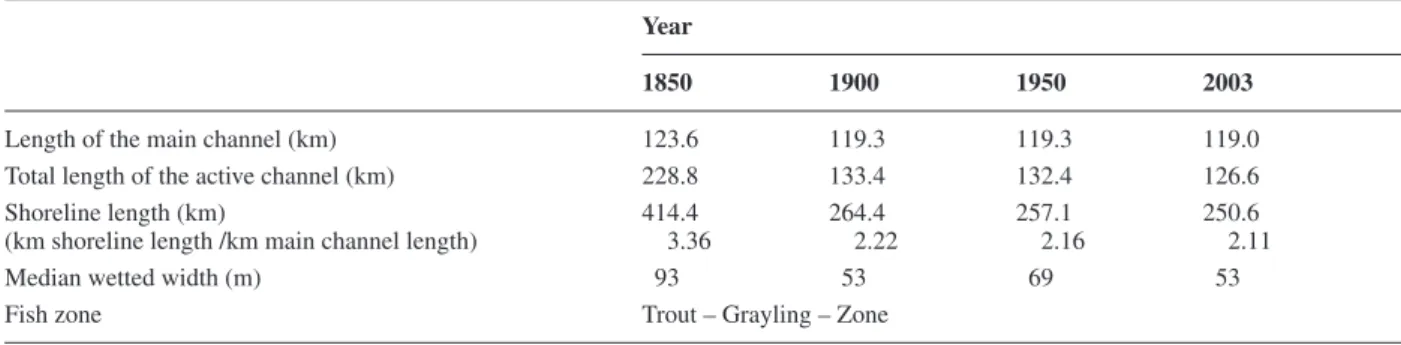
The main channel length of the river Rhone between Brig and Lake Geneva has been reduced by 4.6 km or 3.7% over the past 150 years (Table 1). This difference in-creases substantially (–102.2 km, –44.7%) when the length of the entire active channel (cumulative length of all branches) is considered. The most extensive decrease took place between 1850 and 1900. The length of the main channel and of the total active channel has been more or less stable since then.
The shoreline length of the river Rhone between Brig and Lake Geneva decreased by 39.5% (163.8 km) be-tween 1850 and 2003, and the shoreline length per river kilometre was reduced from 3.4 to 2.1. The most signifi -cant change in shoreline length took place between 1850 and 1900, with a decrease of 150.0 km (36.2%), indicat-ing a decline from 3.4 km · km–1
to 2.2 km · km–1
. The median wetted width has been reduced by 40 m or 43% since 1850, with the most important reduction also occurring between 1850 and 1900. This decline was interrupted by a temporary increase in the median wetted width in 1950.
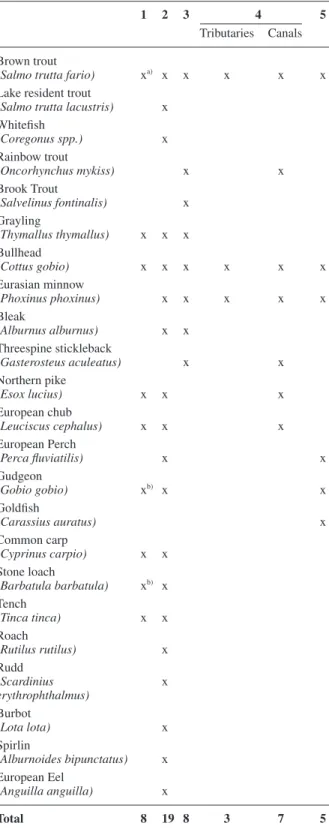
Based on the morphometric conditions retrieved from the historical maps, the river Rhone was categorized as a trout-grayling zone (Table 1). Eight fi sh species were
Table 1. Temporal evolution of four riverine features relevant to fi sh ecology and the fi sh-biological zonation for a section of the river Rhone
(between Brig and Lake Geneva).
Year
1850 1900 1950 2003
Length of the main channel (km) 123.6 119.3 119.3 119.0
Total length of the active channel (km) 228.8 133.4 132.4 126.6
Shoreline length (km) 414.4 264.4 257.1 250.6
(km shoreline length /km main channel length) 3.36 2.22 2.16 2.11
Median wetted width (m) 93 53 69 53
Table 2. Fish species in the river Rhone reported in historical sources
(columns 1–2) and in selected recent literature (columns 3–5).
1 2 3 4 5
Tributaries Canals Brown trout
(Salmo trutta fario) xa) x x x x x Lake resident trout
(Salmo trutta lacustris) x Whitefi sh (Coregonus spp.) x Rainbow trout (Oncorhynchus mykiss) x x Brook Trout (Salvelinus fontinalis) x Grayling (Thymallus thymallus) x x x Bullhead (Cottus gobio) x x x x x x Eurasian minnow (Phoxinus phoxinus) x x x x x Bleak (Alburnus alburnus) x x Threespine stickleback (Gasterosteus aculeatus) x x Northern pike (Esox lucius) x x x European chub (Leuciscus cephalus) x x x European Perch (Perca fl uviatilis) x x Gudgeon (Gobio gobio) xb) x x Goldfi sh (Carassius auratus) x Common carp (Cyprinus carpio) x x Stone loach (Barbatula barbatula) xb) x Tench (Tinca tinca) x x Roach (Rutilus rutilus) x Rudd (Scardinius x erythrophthalmus) Burbot (Lota lota) x Spirlin (Alburnoides bipunctatus) x European Eel (Anguilla anguilla) x Total 8 19 8 3 7 5
1 Sebastian Münster’s Kosmographie from 1544 (see Gattlen, 1955): a) inclusion of subspecies unclear. b) common name un-clear, gudgeon or stone loach.
2 Fatio (1882) and Fatio (1890) 3 Etat du Valais (1999)
4 Küttel (2001): Electrofi shing survey in selected tributaries and ca-nals of the Rhone valley.
5 Peter (2004)
mentioned in the oldest available documentary source dating from 1544 (Table 2; see Gattlen, 1955). In the late 19th
century, 19 fi sh species were documented in the river Rhone and its tributaries (Fatio, 1882; 1890).
Fish parameters
Our electrofi shing surveys revealed a low diversity of fi sh species in the river Rhone. Only two species, brown trout (Salmo trutta fario) and bullhead (Cottus gobio), were found in the 36 strips sampled. The relative abundances showed a high dominance of brown trout, amounting to 99.6% (714 individuals) of the total catch (717 individu-als). Generally, very low densities were found, ranging from 0 in 4 strips to 43 fi sh·100 m–2
, with a mean of 5 fi sh·100 m–2
.
Most brown trout were of medium body size. The average length per strip (median) ranged between 87 mm and 261 mm with a mean of 157 mm. Larger and young individuals were largely missing. A considerable number of brown trout (28%) showed anomalies such as de-formed fi ns and shortened opercula, as can often be found in hatchery-reared animals.
Environmental variables
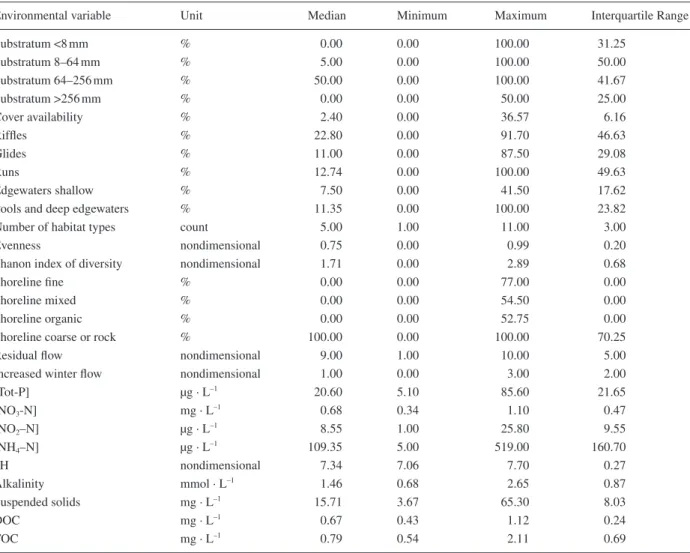
Table 3 summarizes the distribution of the untransformed original environmental variables. The values of all the chemical parameters were within the tolerable range for brown trout (Alabaster and Lloyd, 1980).
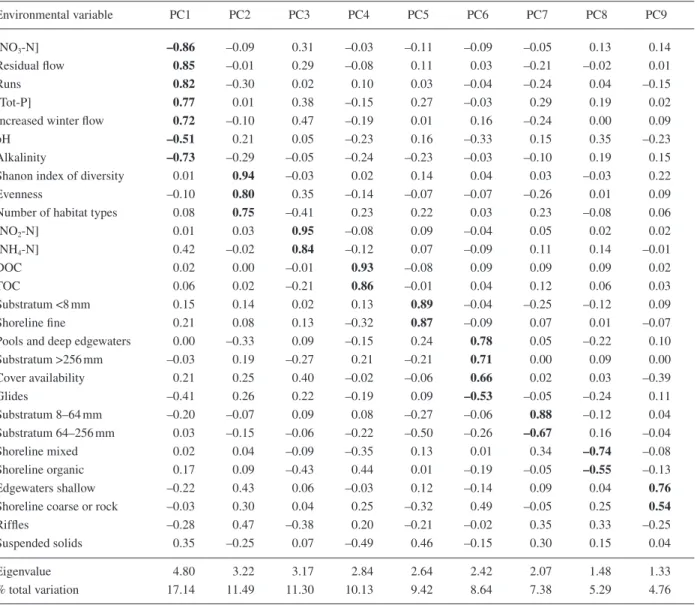
In the principal components analysis (PCA), the 28 original variables were reduced to 9 principal com-ponents, accounting for 85.6% of the total variation (Table 4). Every original variable displayed high loading (>0.5) in a single principal component only, thereby ena-bling clear interpretation. The variables “(abundance of) riffl es” and “(concentration of) suspended solids” did not show any loadings >0.5 (Table 4).
The extracted components can be labelled in accord-ance with the grouping of the original variables. Compo-nent 6, for instance, can be referred to as presence of cover, with variables like availability of cover, larger sub-stratum and pools being the most important (see the high positive loadings in Table 4). In addition, the percentage of glides is negatively correlated with component 6.
Component 4 summarizes the organic content of the water sample while component 7 includes the availability of middle-sized substratum (positive loading for particles between 8 and 64 mm, negative loading for larger parti-cles).
Comparison between abiotic and biotic variables
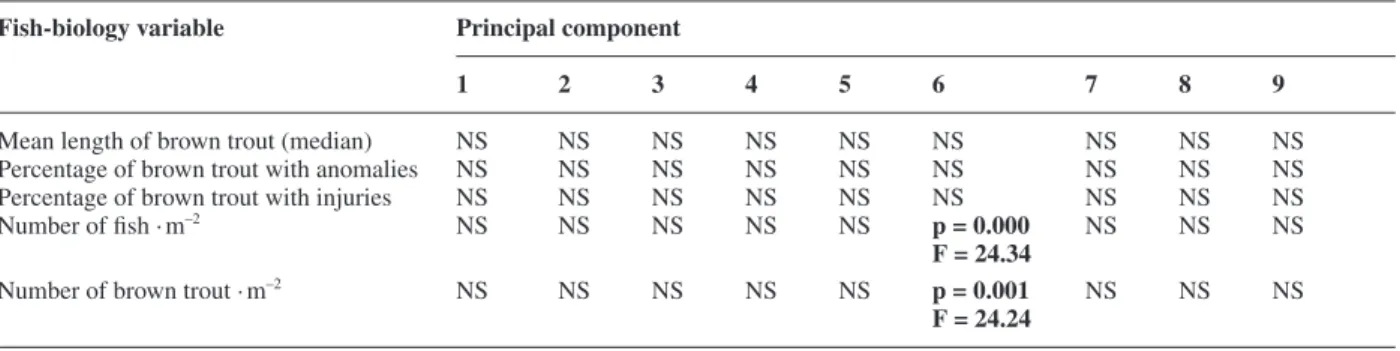
The linear mixed-effects model procedure revealed a signifi cant positive relationship between component 6 (cover availability) and two biotic variables (Table 5). Thus, large numbers of brown trout were found in stretches with a considerable amount of cover,
substra-tum larger than 25 cm in diameter, a high percentage of pools and a small percentage of glides.
It was not possible to establish any relationship be-tween the environmental variables and the percentage of anomalies and injuries found on the brown trout.
Discussion
Morphological and hydrological defi cits
In the mid-19th
century, the Rhone system was still in a near-natural state with isolated human modifi cations of limited spatial scope. Despite this low degree of struc-tural impairment in 1850, morphological characteristics such as the shoreline length clearly differ from contem-porary values obtained in the Tagliamento, NE Italy, i.e. the only large morphologically intact Alpine river re-maining in Europe (Ward et al., 1999). There, the shore-line length measured in the fi eld averaged 14.4 km · km–1
(van der Nat et al., 2002). Our values are substantially
lower. This discrepancy is most probably due to differ-ences in data collection and spatial resolution (high reso-lution dGPS vs. on-screen digitization of historical maps).
To our knowledge, shoreline length has never previ-ously been measured from historical maps. A critical problem in the comparison of various temporal states is that potential differences may indicate variations in dis-charge rather than changes in river morphology. Unfor-tunately, no information is available on the discharge conditions at the time of the cartographers’ work. This must be considered in the interpretation of the data. However, from the inundation pattern in the last remain-ing braided section in the Rhone (see below), it can be assumed that none of the four states displays extreme discharge conditions, i.e. neither extremely low nor ex-tremely high fl ows and that conditions are more or less comparable.
The geomorphological characteristics of the river Rhone have changed fundamentally over the past 150
Table 3. General statistics for environmental variables used for the Principal Component Analysis (PCA). The values are calculated on the
basis of the individual fi shing strips (N = 36).
Environmental variable Unit Median Minimum Maximum Interquartile Range
Substratum <8 mm % 0.00 0.00 100.00 31.25 Substratum 8–64 mm % 5.00 0.00 100.00 50.00 Substratum 64–256 mm % 50.00 0.00 100.00 41.67 Substratum >256 mm % 0.00 0.00 50.00 25.00 Cover availability % 2.40 0.00 36.57 6.16 Riffl es % 22.80 0.00 91.70 46.63 Glides % 11.00 0.00 87.50 29.08 Runs % 12.74 0.00 100.00 49.63 Edgewaters shallow % 7.50 0.00 41.50 17.62
Pools and deep edgewaters % 11.35 0.00 100.00 23.82
Number of habitat types count 5.00 1.00 11.00 3.00
Evenness nondimensional 0.75 0.00 0.99 0.20
Shanon index of diversity nondimensional 1.71 0.00 2.89 0.68
Shoreline fi ne % 0.00 0.00 77.00 0.00
Shoreline mixed % 0.00 0.00 54.50 0.00
Shoreline organic % 0.00 0.00 52.75 0.00
Shoreline coarse or rock % 100.00 0.00 100.00 70.25
Residual fl ow nondimensional 9.00 1.00 10.00 5.00
Increased winter fl ow nondimensional 1.00 0.00 3.00 2.00
[Tot-P] µg · L–1 20.60 5.10 85.60 21.65 [NO3-N] mg · L–1 0.68 0.34 1.10 0.47 [NO2–N] µg · L –1 8.55 1.00 25.80 9.55 [NH4–N] µg · L–1 109.35 5.00 519.00 160.70 pH nondimensional 7.34 7.06 7.70 0.27 Alkalinity mmol · L–1 1.46 0.68 2.65 0.87 Suspended solids mg · L–1 15.71 3.67 65.30 8.03 DOC mg · L–1 0.67 0.43 1.12 0.24 TOC mg · L–1 0.79 0.54 2.11 0.69
years. This development is refl ected in a slight decrease in main channel length and a dramatic reduction in shore-line length, total active channel length and, partly, median wetted width. The most signifi cant changes between 1850 and 1900 coincide with the systematic straightening of the river Rhone in the 1860s and 70s (Département Fédéral de l’Intérieur, 1964).
Lateral connectivity was most strongly affected by channelization. Characteristic aquatic habitats, such as backwaters, side arms, oxbow lakes and marshes, com-pletely disappeared or are now permanently uncoupled from the main channel, even during severe fl oods. With the loss of the natural riparian zone, a fundamental com-ponent of the river was reduced and impaired, affecting a variety of physical and ecological functions such as habi-tat structure, organic matter supply, etc. (Naiman and Décamps, 1997; Schiemer and Zalewski, 1992). The
negative effects of reduced lateral connectivity on fi sh stocks are well known (Welcomme, 1979).
Today, only one 6 km reach of the river Rhone be-tween Brig and Lake Geneva still shows a nearly natural braided structure (Pfynwald, upstream from Sierre, Fig. 1). However, despite this physical connection with the fl oodplain, the natural fl ow dynamics cannot develop to the maximum extent as an upstream water diversion causes residual fl ow throughout the year. Longer near-natural braided river reaches with extensive fl oodplains can still be found below Lake Geneva, in the French sec-tion of the river Rhone (Copp, 1989).
Instream structure has also been drastically reduced: prior to the fi rst correction, a high variability in stream width – and with it probably in depth – resulted in a di-verse physical habitat, an effect that was probably ampli-fi ed by the large woody debris deriving from the vast
Table 4. Loadings of environmental variables on principal components (PC) from PCA. Principal components with eigenvalues >1 were
extracted. Loadings >0.5 are shown in bold print.
Environmental variable PC1 PC2 PC3 PC4 PC5 PC6 PC7 PC8 PC9 [NO3-N] –0.86 –0.09 0.31 –0.03 –0.11 –0.09 –0.05 0.13 0.14 Residual fl ow 0.85 –0.01 0.29 –0.08 0.11 0.03 –0.21 –0.02 0.01 Runs 0.82 –0.30 0.02 0.10 0.03 –0.04 –0.24 0.04 –0.15 [Tot-P] 0.77 0.01 0.38 –0.15 0.27 –0.03 0.29 0.19 0.02 Increased winter fl ow 0.72 –0.10 0.47 –0.19 0.01 0.16 –0.24 0.00 0.09 pH –0.51 0.21 0.05 –0.23 0.16 –0.33 0.15 0.35 –0.23 Alkalinity –0.73 –0.29 –0.05 –0.24 –0.23 –0.03 –0.10 0.19 0.15
Shanon index of diversity 0.01 0.94 –0.03 0.02 0.14 0.04 0.03 –0.03 0.22
Evenness –0.10 0.80 0.35 –0.14 –0.07 –0.07 –0.26 0.01 0.09
Number of habitat types 0.08 0.75 –0.41 0.23 0.22 0.03 0.23 –0.08 0.06
[NO2-N] 0.01 0.03 0.95 –0.08 0.09 –0.04 0.05 0.02 0.02 [NH4-N] 0.42 –0.02 0.84 –0.12 0.07 –0.09 0.11 0.14 –0.01 DOC 0.02 0.00 –0.01 0.93 –0.08 0.09 0.09 0.09 0.02 TOC 0.06 0.02 –0.21 0.86 –0.01 0.04 0.12 0.06 0.03 Substratum <8 mm 0.15 0.14 0.02 0.13 0.89 –0.04 –0.25 –0.12 0.09 Shoreline fi ne 0.21 0.08 0.13 –0.32 0.87 –0.09 0.07 0.01 –0.07
Pools and deep edgewaters 0.00 –0.33 0.09 –0.15 0.24 0.78 0.05 –0.22 0.10 Substratum >256 mm –0.03 0.19 –0.27 0.21 –0.21 0.71 0.00 0.09 0.00 Cover availability 0.21 0.25 0.40 –0.02 –0.06 0.66 0.02 0.03 –0.39 Glides –0.41 0.26 0.22 –0.19 0.09 –0.53 –0.05 –0.24 0.11 Substratum 8–64 mm –0.20 –0.07 0.09 0.08 –0.27 –0.06 0.88 –0.12 0.04 Substratum 64–256 mm 0.03 –0.15 –0.06 –0.22 –0.50 –0.26 –0.67 0.16 –0.04 Shoreline mixed 0.02 0.04 –0.09 –0.35 0.13 0.01 0.34 –0.74 –0.08 Shoreline organic 0.17 0.09 –0.43 0.44 0.01 –0.19 –0.05 –0.55 –0.13 Edgewaters shallow –0.22 0.43 0.06 –0.03 0.12 –0.14 0.09 0.04 0.76
Shoreline coarse or rock –0.03 0.30 0.04 0.25 –0.32 0.49 –0.05 0.25 0.54
Riffl es –0.28 0.47 –0.38 0.20 –0.21 –0.02 0.35 0.33 –0.25
Suspended solids 0.35 –0.25 0.07 –0.49 0.46 –0.15 0.30 0.15 0.04
Eigenvalue 4.80 3.22 3.17 2.84 2.64 2.42 2.07 1.48 1.33
riparian forests indicated on the topographic maps. The systematic straightening of the river Rhone resulted in the development of a barely structured, uniform bed pro-fi le. Furthermore, due to the changes in land use and the removal of snags at the weirs, the structuring effect of large woody debris is now almost completely lacking. As a result, habitats with high current velocities and uniform depths prevail today. Habitats with slow fl owing or even standing-water like pools are strongly underrepresented. Such a shift from lentic to lotic conditions represents a typical development in channelized rivers (Welcomme, 1979).
Changes in channel morphology can also be assumed to alter water temperature (Hawkins et al., 1997). In a naturally structured system, temperature variation in the cross-section can exceed that occurring in the main chan-nel along the entire river course (Arscott et al., 2001). Standing water bodies of various connectivity with inter-stitial waters (phreatic or hyporheic) are responsible for much of this lateral temperature heterogeneity (Arscott et al., 2001). In a channelized river like the river Rhone, however, almost no lateral heterogeneity in water tem-perature exists. Temtem-perature is known to be a key envi-ronmental factor structuring fi sh communities (Welcom-me, 1979). In particular, the requirements of meso-eurythermal species like the European chub (Leuciscus
cephalus) or the gudgeon (Gobio gobio) are not fulfi lled
under the present homogeneous temperature conditions prevailing in the river Rhone.
Defi cits in the fi sh fauna
Assemblage level. Historical cartographical and
docu-mentary sources show a diverse habitat occupied by a relatively rich fi sh assemblage. Against this background, our recent survey revealed an extremely low species rich-ness in the river Rhone, with only two species present. Moreover, the fi sh fauna is almost completely composed of brown trout, with a few bullheads accounting for <0.5% of the total catch. Previous local studies, partly conducted at confl uences of tributaries, revealed a higher diversity, i.e. 6 and 8 species, respectively, but most spe-cies were represented by single individuals (Etat du
Val-ais, 1999; Peter and Weber, 2004). Similar results were reported for the tributaries (3 species, low densities), whereas a slightly larger species pool of 6 species and higher fi sh densities were found in the channels of the Rhone Plain (Küttel, 2001). A richer species set is re-ported from the French section of the river Rhone, below Lake Geneva (see e.g. Copp, 1989; Persat et al., 1994), where near-natural fl oodplains exist that are still large and have a rich habitat supply.
The low species diversity and unnatural assemblage composition in the main river constitutes a serious biotic defi cit. In our search for possible reasons, we confi ned ourselves to a qualitative interpretation. Because of the dominance of the brown trout, the statistical analysis had to be restricted to the population level of this species (see the following section). As described in the preceding chapter, the diversity of aquatic habitats in the river Rhone has suffered massive impairment. This morpho-logical degradation is further compounded by hydrologi-cal alterations related to hydropower generation. Five dams on the main river and a large number of weirs in the tributaries interrupt longitudinal connectivity and inhibit the passage of migratory species such as the lake resident trout (Salmo trutta lacustris). The effects on the fl ow re-gime are also considerable. Extensive variability in width and depth can often be observed in stretches under re-sidual fl ow. Because of the reduced discharge volume, however, the water column is very small, preventing larger fi sh from colonizing these sites. Furthermore, res-ervoir management has completely changed the daily and seasonal discharge patterns. The natural winter fl ow has increased substantially, and daily fl ow fl uctuations lead to a general increase in current velocities and a lateral displacement or even disappearance of rare lentic zones (Bain et al., 1988). Species or age classes limited to this habitat are forced to relocate, and some individuals, espe-cially smaller fi sh, may suffer from stranding (Saltveit et al., 2001).
Population level: brown trout. The observed densities of
brown trout are very low for a river of the trout-grayling zone. Moreover, the age structure represented in the
Table 5. Relationship between environmental and fi sh-biology variables (results from the linear mixed-effects model procedure).
Fish-biology variable Principal component
1 2 3 4 5 6 7 8 9
Mean length of brown trout (median) NS NS NS NS NS NS NS NS NS Percentage of brown trout with anomalies NS NS NS NS NS NS NS NS NS Percentage of brown trout with injuries NS NS NS NS NS NS NS NS NS Number of fi sh · m–2
NS NS NS NS NS p = 0.000 NS NS NS
F = 24.34
Number of brown trout · m–2 NS NS NS NS NS p = 0.001 NS NS NS
catches differs clearly from that of a natural population. Young trout (0+, 1+) are highly underrepresented in all sampled stretches. This observation is reinforced by former surveys that specifi cally documented the occur-rence of brown trout fry shortly after emergence (Peter and Weber, 2004). Natural 0+ brown trout could only be found at isolated sites. There are several reasons for these small cohort sizes. Firstly, adult, reproductive animals are only found in very low densities. Secondly, our habi-tat surveys indicate that both spawning and rearing con-ditions are unsuitable. As mentioned above, the habitat preferred by young trout, i.e. shallow riffl es with cobble substrata (Heggenes, 1988), is generally sparsely availa-ble in the river Rhone and, because of the fl ow fl uctua-tions induced by hydropeaking, often of reduced persist-ence. The effects of these unstable habitat conditions, in particular on fry and juvenile trout (e.g. stranding, in-creased drift), are widely reported in the literature (Free-man et al., 2001; Hunter, 1992; Liebig et al., 1999; Salt-veit et al., 2001).
The reproductive contribution of individuals inhabit-ing the tributaries is also of minor importance. Tributar-ies often lack a connectivity to the main river, and the impaired quality of spawning grounds and low densities of young fi sh (0+) have been documented (Küttel, 2001).
Although the brown trout densities observed in our study are low, variations could be observed between the different strips and sites. Some general relationships were observed in relation to the environmental variables. In general, more brown trout were caught where cover was available. This fact was particularly noticeable at sites where several strips with different cover availabili-ties were fi shed.
Cover in the river Rhone is mostly provided by artifi -cial structures, in particular embankments. The domi-nant embankment type is riprap, followed by groins dating mainly from the fi rst correction. Natural cover structures like woody debris, macrophytes or instream structures are largely missing. Cover is strictly reduced to the shoreline zone and is almost absent in the middle of the river. Accordingly, stretches fi xed with riprap per-formed best in respect of cover availability. Both the highest brown trout densities and the highest biomasses were found in these stretches (Fette and Weber, 2007). Contrary to this, brown trout were absent from or only represented by single individuals along sparsely struc-tured sandy shores secured by groins and in the monoto-nous median strips.
The large number of brown trout showing anomalies prompts the assumption that a signifi cant proportion of the stock is hatchery-reared fi sh. Negative consequences for reproduction, the state of health and genetic composi-tion of wild populacomposi-tions may be expected as a result (White et al., 1995).
Ecological potential and rehabilitation measures
Flood protection and river rehabilitation are no longer regarded as controversial in many countries (Nienhuis and Leuven, 2001). On the contrary, synergies have been identifi ed that give rise to benefi ts for both. This is also true of the river Rhone. The third correction will change the face of the river considerably over the next 25 years. What priorities can be identifi ed based on this study?
The most obvious structural defi cits are the low qual-ity of shoreline zones and the lack of instream structures such as pool-riffl e-glide patterns. Under present condi-tions, linear banks fi xed with riprap perform best in the promotion of brown trout density. They offer cover, but are not as diverse as well-structured near-natural shore-lines (Schiemer and Spindler, 1989; Schmetterling et al., 2001). Many ecological functions would benefi t from an improvement of the shoreline zone, and socio-economic services would increase (Hostmann et al., 2005; Naiman and Décamps, 1997; Tockner et al., 2008).
One measure that would enhance both the shoreline and the low instream habitat diversity and quality in for-merly braided rivers is local river widening (Rohde et al., 2005). This would involve a signifi cant widening of the river bed (Habersack et al., 2000), possibly by a factor >2 of the existing channel width, in order to re-create a braided river morphology. Apart from river-engineering advantages – stabilization of the bottom by decreasing the transport capacity of the widened channel (Hunz-inger, 1998) – local river widening offers many ecologi-cal improvements through morphodynamiecologi-cal processes such as braiding and gravel erosion and deposition, thus leading to increased structural and hydrological hetero-geneity. Up to now, local river widening has mainly been carried out in Switzerland, Germany and Austria (Haber-sack and Nachtnebel, 1995; Rohde et al., 2005; Völkl et al., 2002).
Few studies are available on the ecological success of local river widening, however their fi ndings are generally positive. Habersack (2000) describes the enhancement of aquatic habitat conditions and the increased stock of ju-venile grayling in local widenings of the river Drau, Austria. A comparison of the riparian vegetation in 5 river widenings in Switzerland revealed an increased de-gree of naturalness at both habitat and species level in most of the cases studied (Rohde et al., 2004; Rohde et al., 2005).
Local river widening under impaired hydrological conditions as found in the river Rhone is particularly delicate and challenging (Unfer et al., 2004). In most cases, purely morphological measures will probably not compensate for hydrological defi cits. Hydrological ac-tions such as the mitigation of hydropeaking using tech-nical measures are also necessary, e.g. slower ramping rates of the turbines (Halleraker et al., 2003) or storage of the turbinated water in retention basins (Moog, 1993).
This combination of structural and hydrological meas-ures alone can bring the anticipated success in degraded rivers with appropriate water quality and existing bed-load dynamics (Fette and Weber, 2007).
Acknowledgments
This study is part of the Rhone-Thur project (www.rhone-thur.eawag.ch), which is funded by the Federal Offi ce for the Environment (FOEN), the Swiss Federal Institute of Aquatic Science and Technology (Eawag) and the Swiss Federal Institute for Forest, Snow and Landscape Re-search (WSL).
We wish to thank B. Germann, M. Bia, E. Schäfer, E. Schager, A. Gouskov, M. Mihailova and the Eawag ap-prentice laboratory for their dedicated fi eld and labora-tory assistance. W. Stahel and H. J. Roth from the Statis-tical Seminar of the Swiss Federal Institute of Technology Zurich (ETHZ) provided helpful advice on the statistical analysis. We wish to thank A. Zehnder, J. Heggenes, C. Robinson, S. Cox and two anonymous reviewers for a critical review of the manuscript. We also valued the good level of collaboration we enjoyed with both the Fish and Wildlife Services of the cantons of Valais and Vaud and the local fi shery associations.
References
Alabaster, J. S. and R. Lloyd, 1980. Water quality criteria for fresh-water fi sh. Butherworths, London, 297 pp.
Arscott, D. B., K. Tockner and J. V. Ward, 2001. Thermal heteroge-neity along a braided fl oodplain river (Tagliamento River, northeastern Italy). Canadian Journal of Fisheries and Aquatic Sciences 58: 2359–2373.
Bain, M. B., J. T. Finn and H. E. Booke, 1985. Quantifying stream substrate for habitat analysis studies. North American Journal of Fisheries Management 5: 499–506.
Bain, M. B., J. T. Finn and H. E. Booke, 1988. Streamfl ow regula-tion and fi sh community structure. Ecology 69: 382–392. Benke, A. C., 1990. A perspective on America’s vanishing streams.
Journal of the North American Benthological Society 9: 77– 88.
Brookes, A. and F. D. Shields, 1996. River channel restoration: guiding principles for sustainable projects. John Wiley & Sons Ltd., Chichester, 433 pp.
Copp, G. H., 1989. The habitat diversity and fi sh reproductive func-tion of fl oodplain ecosystems. Environmental Biology of Fishes
26: 1–27.
Cummins, K. W., 1962. An evaluation of some techniques for the collection and analysis of benthic samples with special empha-sis on lotic waters. American Midland Naturalist 67: 477–504. Département Fédéral de l’Intérieur, 1964. La correction du Rhône
en amont du Lac Léman. Publication du Service fédéral des routes et des digues. Offi ce fédéral des imprimés et du maté-riel.
Etat du Valais, 1999. Milieux naturels. Données de base DB-R6, Service cantonal des routes et des cours d’eau, Canton du Va-lais.
Fatio, V., 1882. Histoire naturelle des poissons – première partie. H. Georg, Geneva, Basel, 786 pp.
Fatio, V., 1890. Histoire naturelle des poissons – deuxième partie. H. Georg, Geneva, Basel, 576 pp.
Fausch, K. D., J. Lyons, J. R. Karr and P. L. Angermeier, 1990. Fish communities as indicators of environmental degradation. American Fisheries Society Symposium 8: 123–144.
Fette, M. and C. Weber, 2007. Hydropower production and river rehabilitation: A case study on an alpine river. Journal of Envi-ronmantal Modelling and Assessment.
Freeman, M. C., Z. H. Bowen, K. D. Bovee and E. R. Irwin, 2001. Flow and habitat effects on juvenile fi sh abundance in natural and altered fl ow regimes. Ecological Applications 19: 179–190. Frissell, C. A. and R. K. Nawa, 1992. Incidence and causes of
physical failure of artifi cial habitat structures in streams of western Oregon and Washington. North American Journal of Fisheries Management 12: 182–197.
Gattlen, A., 1955. Die Beschreibung des Landes Wallis in der Kos-mographie Sebastian Münsters. Vallesia X: 97–151.
Gleick, P. H., 2001. Safeguarding our water – making every drop count. Scientifi c American 284: 40–45.
Habersack, H., M. Koch and H. P. Nachtnebel, 2000. Flussaufwei-tungen in Österreich – Entwicklung, Stand und Ausblick. Öster-reichische Wasser- und Abfallwirtschaft 52: 143–153. Habersack, H. and H. P. Nachtnebel, 1995. Short-term effects of
lo-cal river restoration on morphology, fl ow fi eld, substrate and bi-ota. Regulated Rivers-Research & Management 10: 291–301. Halleraker, J.H., S.J. Saltveit, A. Harby, J.V. Arnekleiv, H.P.
Fjeldstad and B. Kohler, 2003. Factors infl uencing stranding of wild juvenile brown trout (Salmo trutta) during rapid and frequent fl ow decreases in an artifi cial stream. River Research and Applications. 19: 589–603.
Hawkins, C. P., J. N. Hogue, L. M. Decker and J. W. Feminella, 1997. Channel morphology, water temperature, and assemblage structure of stream insects. Journal of the North American Benthological Society 16: 728–749.
Hawkins, C. P., J. L. Kershner, P. A. Bisson, M. D. Bryant, L. M. Decker, S. V. Gregory, D. A. McCullough, C. K. Overton, G. H. Reeves, R. J. Steedman and M. K. Young, 1993. A hierarchical approach to classifying stream habitat features. Fisheries 18: 3–12.
Heggenes, J., 1988. Physical habiat selection by brown trout (Salmo trutta) in riverine systems. Nordic Journal of Freshwater Re-search 64: 74–90.
Hostmann, M., M. Borsuk, P. Reichert and B. Truffer, 2005. Stake-holder values in decision support for river rehabilitation. Archiv für Hydrobiologie – Supplement 155: 491–505.
Huet, M., 1959. Profi les and biology of Western European streams as related to fi sh management. Transactions of the American Fisheries Society 88: 155–163.
Hunter, M. A., 1992. Hydropower fl ow fl uctuations and salmonids: a review of the biological effects, mechanical causes, and op-tions for mitigation. Department of Fisheries, State of Washing-ton, Technical report 119.
Hunzinger, L. M., 1998. Flussaufweitungen – Morphologie, Ge-schiebehaushalt und Grundsätze für die Bemessung. VAW-Mit-teilungen 159: 1–206.
Iversen, T. M., B. Kronvang, B. L. Madsen, P. Markmann and M. B. Nielsen, 1993. Reestablishment of Danish streams – restoration and maintenance measures. Aquatic Conservation-Marine and Freshwater Ecosystems 3: 73–92.
Jeffers, J. N. R., 1998. The statistical basis of sampling strategies for rivers: an example using River Habitat Survey. Aquatic Conser-vation-Marine and Freshwater Ecosystems 8: 447–454. Jungwirth, M., S. Muhar and S. Schmutz, 1995. The effects of
recre-ated instream and ecotone structures on the fi sh fauna of an epipotamal river. Hydrobiologia 303: 195–206.
Jungwirth, M., S. Muhar and S. Schmutz, 2002. Re-establishing and assessing ecological integrity in riverine landscapes. Freshwater Biology 47: 867–887.
Karr, J. R., K. D. Fausch, P. L. Angermeier, P. R. Yant and I. J. Schlosser, 1986. Assessing biological integrity in running wa-ters. A method and its rationale. Illinois Natural History Survey, Champaign, Special Publication 5.
Kauffmann, J. B., R. L. Beschta, N. Otting and D. Lytjen, 1997. An ecological perspective of riparian and stream restoration in the western United States. Fisheries 22: 12–24.
Kondolf, G. M. and P. W. Downs, 1996. Catchment approach to planning channel restoration. In: A. Brookes and F. D. Shields (eds.), River channel restoration: guiding principles for sustain-able projects, John Wiley & Sons Ltd, Chichester, pp. 129–148. Krebs, C. J., 1989. Ecological Methodology. Harper and Row, New
York, 654 pp.
Küttel, S., 2001. Bedeutung der Seitengewässer der Rhone für die natürliche Reproduktion der Bachforelle und Diversität der Fischfauna im Wallis. M.Sc. thesis, Swiss Federal Institute of Technology Zurich, Zurich.
Lepori, F., D. Palm, E. Brannas, and B. Malmqvist, 2005. Does restoration of structural heterogeneity in streams enhance fi sh and macroinvertebrate diversity? Ecological Applications 15: 2060–2071.
Lewis, C. A., N. P. Lester, A. D. Bradshaw, J. E. Fitzgibbon, K. Fuller, L. Hakanson and C. Richards, 1996. Considerations of scale in habitat conservation and restoration. Canadian Journal of Fisheries and Aquatic Sciences 53: 440–445.
Liebig, H., R. Cereghino, P. Lim, A. Belaud and S. Lek, 1999. Im-pact of hydropeaking on the abundance of juvenile brown trout in a Pyrenean stream. Archiv für Hydrobiologie 144: 439–454. Loizeau, J.-L. and J. Dominik, 2000. Evolution of the upper Rhone
River discharge and suspended sediment load during the last 80 years and some implications for Lake Geneva. Aquatic Sciences
62: 54–67.
Matthews, W. J., 1998. Patterns in freshwater fi sh ecology. Chap-man & Hall, New York, 756 pp.
Meile, T., A. Schleiss and J.-L. Boillat, 2005. Entwicklung des Ab-lussregimes der Rhone seit dem Beginn des 20. Jahrhunderts. Wasser Energie Luft 5/6: 133–142.
Moerke, A. H. and G. A. Lamberti, 2003. Responses in fi sh com-munity structure to restoration of two Indiana streams. North American Journal of Fisheries Management 23: 748–759. Moog, O., 1993. Quantifi cation of daily peak hydropower effects on
aquatic fauna and management to minimize environmental im-pacts. Regulated Rivers Research and Management 8: 5–14. Naiman, R. J. and H. Décamps, 1997. The ecology of interfaces –
riparian zones. Annual Review of Ecology and Systematics 28: 621–658.
Nienhuis, P. H. and R. Leuven, 2001. River restoration and fl ood protection: controversy or synergism? Hydrobiologia 444: 85– 99.
Nilsson, C., C. A. Reidy, M. Dynesius and C. Revenga, 2005. Fragmentation and fl ow regulation of the world’s large river systems. Science 308: 405–408.
Persat, H., J.-M. Olivier and D. Pont, 1994. Theoretical habitat tem-plets, species traits, and species richness – fi sh in the upper Rhone river and its fl oodplains. Freshwater Biology 31: 439– 454.
Peter, A., 1992. Analyse von Fischmikrohabitaten zur Beurteilung der strukturellen Komplexität eines Fliessgewässers. Jahresbe-richt EAWAG 1992: 60–61.
Peter, A. and C. Weber, 2004. Die Rhone als Lebensraum für Fische. Wasser Energie Luft 11/12: 326–330.
Poff, N. L., J. D. Allan, M. B. Bain, J. R. Karr, K. L. Prestegaard, B. D. Richter, R. E. Sparks and J. C. Stromberg, 1997. The natural fl ow regime. BioScience 47: 769–784.
Pretty, J. L., S. S. C. Harrison, D. J. Shepherd, C. Smith, A. G. Hildrew and R. D. Hey, 2003. River rehabilitation and fi sh populations: assessing the benefi t of instream structures. Journal of applied ecology 40: 251–265.
Richter, B. D., J. V. Baumgartner, R. Wigington and D. P. Braun, 1997. How much water does a river need? Freshwater Biology
37: 231–249.
Rohde, S., F. Kienast and M. Buergi, 2004. Assessing the restoration success of river widenings: A landscape approach. Environmen-tal Management 34: 574–589.
Rohde, S., M. Schuetz, F. Kienast and P. Englmaier, 2005. River widening: an approach to restoring riparian habitats and plant species. River Research and Applications 21: 1075–1094. Saltveit, S. J., J. H. Halleraker, J. V. Arnekleiv and A. Harby, 2001.
Field experiments on stranding in juvenile Atlantic salmon (Salmo salar) and brown trout (Salmo trutta) during rapid fl ow decreases caused by hydropeaking. Regulated Rivers-Research & Management 17: 609–622.
Schiemer, F. and T. Spindler, 1989. Endangered fi sh species of the Danube River in Austria. Regulated Rivers-Research & Man-agement 4: 397–407.
Schiemer, F. and M. Zalewski, 1992. The importance of riparian ecotones for diversity and productivity of riverine fi sh commu-nities. Netherlands Journal of Zoology 42: 323–335.
Schmetterling, D. A., C. G. Clancy and T. M. Brandt, 2001. Effects of riprap bank reinforcement on stream salmonids in the west-ern United States. Fisheries 26: 6–13.
Spreafi co, M., R. Weingartner and C. Leibundgut, 1992. Hydrologi-scher Atlas der Schweiz. Bundesamt für Wasser und Geologie, Bern.
SPSS Inc., 2005. Linear Mixed-Effects Modeling in SPSS: An In-troduction to the MIXED Procedure. Technical report. SPSS Inc., www.spss.com.
Tockner, K. and J. A. Stanford, 2002. Riverine fl ood plains: present state and future trends. Environmental Conservation 29: 308– 330.
Tockner, K., A. Paetzold, U. Karaus, C. Claret and J. Zettel, 2008. Ecology of braided rivers. In: G. H. Sambrook Smith, J. L. Best, C. S. Bristow and G. E. Petts (eds.), Braided Rivers – IAS Spe-cial Publication, Blackwell, Oxford.
Unfer, G., S. Schmutz, C. Wiesner, H. Habersack, E. Formann, C. Komposch and W. Paill, 2004. The effects of hydropeaking on the sucess of river-restoration measures within the LIFE-Project «Auenverbund Obere Drau». Proceedings of the Fifth Interna-tional Symposium on Ecohydraulics, Madrid, pp. 741–746. van der Nat, D., A. P. Schmidt, K. Tockner, P. J. Edwards and J. V.
Ward, 2002. Inundation dynamics in braided fl oodplains: Ta-gliamento River, northeast Italy. Ecosystems 5: 636–647. Völkl, W., A. von Hessberg, D. Mader, J. Metzner, P. Gerstperger, K.
H. Hoffmann, H. Rebhan and R. Krec, 2002. Natural succession in a dynamic riverine landscape and the protection of open are-as. In: B. Redecker (ed.), Pasture landscapes and nature conser-vation, Springer, Berlin, pp. 413–421.
Ward, J. V., K. Tockner, P. J. Edwards, J. Kollmann, G. Bretschko, A. M. Gurnell, G. E. Petts and B. Rossaro, 1999. A reference river system for the Alps: The ‹Fiume Tagliamento›. Regulated Rivers-Research & Management 15: 63–75.
Welcomme, R. L., 1979. Fisheries ecology of fl oodplain rivers. Longman, London, New York, 317 pp.
White, R. J., J. R. Karr and W. Nehlsen, 1995. Better roles for fi sh stocking in aquatic resource management. American Fisheries Society Symposium 15: 527–547.