Wild-Born Orangutans (Pongo abelii) Engage
in Triadic Interactions During Play
Thibaud Gruber
Received: 14 May 2013 / Accepted: 29 August 2013 / Published online: 19 December 2013 # Springer Science+Business Media New York 2013
Abstract It has long been held that triadic interactions, or interactions between individuals that include shared perception and goals concerning an outside entity, require elaborate cognitive processes such as joint attention. With their connection to shared intentionality, triadic interactions have been a key topic of interest for developmental and evolutionary psychologists, notably when making comparisons between humans and other ape species. There is good evidence that chimpanzees and bonobos engage in triadic interactions; however, convincing evidence for orangutans are more limited and so far have been found only in the context of feeding. I engaged 11 wild-born sanctuary orangutans through the medium of a stick, allowing them to decide how to use the object and how to interact with me. The participating orangutans developed idiosyncratic ways of using the stick and engaging with me during the activity, and six of them alternated their gaze between the stick and me. When I interrupted the activity, the participating orangutans displayed more numerous and different behaviors than before the interruption to actively reengage me in the game. Much like human infants, they appeared more interested in the social interaction than in the stick. These findings confirm that triadic interactions occur in nonenculturated orangutans and are consistent with studies of other nonhuman great ape species, which also show triadic interactions, suggesting that joint attention and potentially shared intentionality may have an early origin in our evolutionary history.
Keywords Great apes . Joint attention . Object play . Orangutan . Pongo . Triadic interaction
DOI 10.1007/s10764-013-9745-1
Electronic supplementary material The online version of this article (doi:10.1007/s10764-013-9745-1) contains supplementary material, which is available to authorized users.
T. Gruber (*)
Centre Norbert Elias, UMR8562, Ecole des Hautes Etudes en Sciences Sociales, France & Anthropological Institute and Museum, University of Zurich, Zurich, Switzerland e-mail: [email protected]
Present Address: T. Gruber
Introduction
The existence of triadic interactions and joint attention in great apes is a hotly debated issue, most notably because it is linked to the notion of shared intentionality. Triadic interactions and joint attention are different, but the terms have often been used interchangeably depending on the level of cognition involved. For instance, although triadic interactions may be understood simply as the interaction of two protagonists and a third object, and describe mainly the geometric aspect of the situation, they are also associated with shared goals and perceptions, thus acquiring a deeper cognitive mean-ing. Researchers focusing on this shared aspect of the interaction tend to use the term “joint interaction” (Tomasello et al.2005). Different researchers have proposed differ-ent definitions for joint attdiffer-ention. For instance, Leavens and colleagues have proposed joint intention to be“the intentional co-orientation of two or more organisms to the same locus” (Leavens and Racine2009, p. 141) and a joint attention episode to be“the intentional behavior of at least one social partner—that is, at least one being in a joint attention episode displays goal-directed behavior the success of which is dependent upon the shared regard of a particular focus” (Leavens and Bard2011, p. 10). Others have stressed the“shared” aspect of the interaction, i.e., the fact that partners “know together” that they are engaged in an interaction toward the same object (Carpenter and Call 2013; Tomasello 1995). According to Carpenter and Call, “in this view, both partners are (at least eventually) equally involved, actively sharing attention about the thing. This is what makes joint attention joint, rather than just parallel attention to the same object” (Carpenter and Call 2013, p. 4). This “feeling” of being engaged “together” in the same activity has led to the definition of the notion of “shared intentionality,” a concept that assumes that two individuals involved in a joint activity are not in“I” but in “we” mode, i.e., they are constantly aware of each other and adjust their behavioral and communicative output accordingly (Bratman1992; Gilbert1989; Searle 1995; Tomasello 2008; Tomasello et al.2005). Whether other animals than humans engage in this particular mode is controversial, and some researchers have proposed that“shared intentionality” is uniquely human and that it lies at the founda-tions of some of our most notable achievements, including sophisticated theory of mind and culture (Call2009; Tomasello et al.2005; Warneken et al. 2006). These claims emerge mainly from observations and experiments conducted with children, from a developmental perspective (Tomasello et al.2007). However, other researchers dis-agree with this cognitively rich approach to cognition in early infancy and favor leaner behavioral approaches that serve to bring this aspect of human and ape infant devel-opment closer to one another (D’Entremont and Seamans2007; Gómez2007).
Joint interactions are noticeable in behavior due to the apparent geometrical “triadicness” observed between the individuals and the object and the display of key criteria such as gaze alternation between social partners, sensitivity to their mutual attention states, and persistence in signaling or the use of new signals (elaboration) when initial attempts to communicate fail (Leavens and Bard2011). Some authors have proposed that vocalizations support joint attention episodes in nonhuman great apes (Gomez2004; Tanner and Byrne2010) and in non-Western human cultures (Akhtar and Gernsbacher2008). According to these authors, vocalizations can be used to attract attention, when associated with postural or gestural cues during joint attention episodes, and they can also signal shared reference. Finally, an important feature of the
interaction during triadic games is that an individual often reengages its social partner if the latter leaves the game (Ross and Lollis1987; Tomasello et al.2005; Warneken et al. 2006).
Some researchers suggest that animals engage in parallel attention rather than truly joint attention (Carpenter and Call 2013; Tomasello 1995). Many studies of joint attention in animals involve“enculturated apes” that are engaged in language studies or were hand-reared: chimpanzees (Pan troglodytes): Gua (Kellogg and Kellogg1933), Washoe (Gardner and Gardner1969), Sherman and Austin (Savage-Rumbaugh1986); bonobos (Pan paniscus): Kanzi (Savage-Rumbaugh et al. 1985); gorillas (Gorilla gorilla): Koko (Patterson and Linden 1981); see also Gómez (2010); orangutans (Pongo pygmaeus): Chantek (Miles 1990). Chantek the orangutan, for instance, displayed a number of seemingly intentional behaviors, being able to follow gaze, and producing and understanding pointing by human counterparts (Call and Tomasello 1994; Miles1990; Tomasello et al.1997). Although compelling in showing that great apes have the genetic endowment to engage in triadic interactions, it is unclear whether this is a result of their human training and whether they would display such behavior in their natural environment. Observations of mother–infant pairs of rehabilitant free-ranging Bornean orangutans (Pongo pygmaeus) suggest that infants display intentional behaviors toward their mothers in a feeding context (Bard1992). Recent observations of collaborative play involving objects between captive gorillas (Tanner and Byrne 2010) suggest that gorillas also display triadic interactions with conspecifics. Observations of wild-born individuals are now becoming available, notably for the genus Pan. Data obtained for wild-born bonobos engaged in social games in a sanctuary suggest that the ability to engage in joint interaction with human strangers may not depend on extended contact with humans (Pika and Zuberbühler 2008). Finally, a recent study involving a large number of sanctuary chimpanzees and bonobos shows that both species engage spontaneously in triadic interactions, mostly with human counterparts rather than conspecifics (Maclean and Hare2013).
Orangutans are the least gregarious great apes, but they are nonetheless social individuals (Wich et al. 1999). They have a complex communication system that includes community-specific behaviors such as the well-documented kiss-squeak (van Schaik et al.2003), and they use intentional gestures and pantomimes that are understood by their partners (Cartmill and Byrne2007; Russon and Andrews2011). In terms of physical cognition, some communities use tools customarily in the wild (van Schaik et al. 2003). However, no formal study has yet reported the existence of collaborative games or joint attention toward nonfeeding related external objects in nonenculturated orangutans. Here, I assessed whether recently rescued wild-born orangutans engaged in collaborative games with a human counterpart (me) and de-scribed and analyzed their behaviors toward me during the games and their reactions to my sudden reluctance to continue the activity. I compared orangutans’ behavioral displays before and during the interruption, to evaluate how they would respond to this interruption and whether they would display signs of persistence in use of given displays and new means of interaction. I predicted that if orangutans engaged inten-tionally with me, they would show signs of persistence and elaboration to attempt to make me resume the activity. In addition, they would show evidence of treating me as a collaborative partner rather than as a mere social tool to achieve their own individual goals.
Methods
Subjects and Study Site
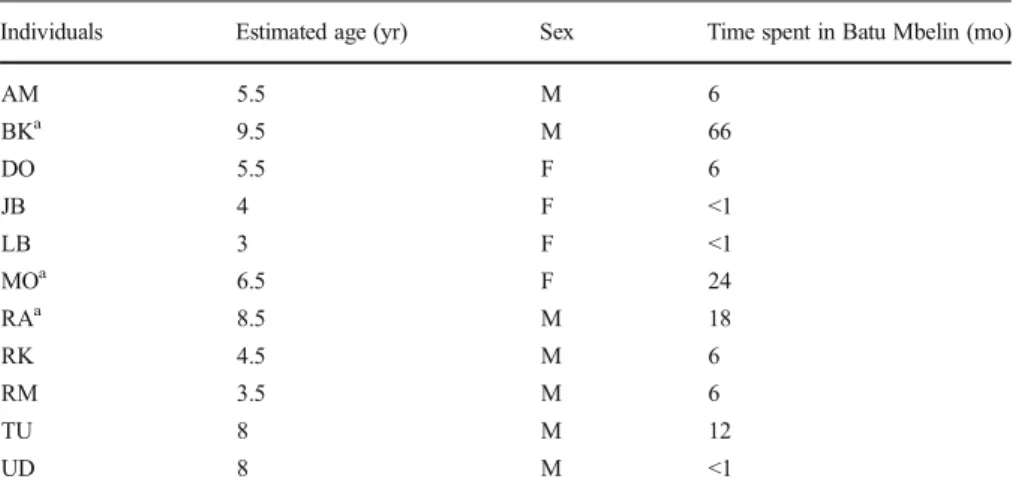
I conducted the study in the Batu Mbelin Quarantine Centre, Sibolangit, North Sumatra (3°19′42″N; 98°34′51″E), a center that rehabilitates confiscated wild-born orangutans (Pongo abelii) before releasing them into the Sumatran forests. As the main aim of the quarantine center is to release the individuals into the wild as soon as possible after their arrival, keepers limit affiliative behavior such as play and keep them as“wild” as possible. The orangutans are first housed individually in 2×2×2.5 m cages (isolation phase) from which they cannot see nearby individuals; although small doors between the cages and traveling sound allow them to know that other orangutans are nearby. The cages all include at least one suspended tire that can be used for nesting. When the medical staff judges the isolated individuals ready to meet other individuals, the orangutans join large social groups in 6×6×6 m cages that include various items (suspended tires, ropes, metallic platforms) to simulate the complexity of their natural environment (socialization phase). The current study took place with captive individ-uals in their isolation phase after one individual orangutan (LB) engaged me sponta-neously with a twig. Fifteen individuals participated in the experiment. Two individuals did not engage with me, two other individuals did not make use of the stick, and one individual (JB) engaged with a member of the veterinary staff but did not engage with me. I, therefore, report results for 11 individuals (TableI). Two of the orangutans (RK and RM) were housed together and engaged separately with me and with each other. Of 11 individuals tested, three had arrived <1 mo before at the sanctuary, four had spent <6 mo there, and one had spent a year in isolation (Table I). The remaining three individuals (BK, MO, and RA) had spent 1.5–5.5 yr at the sanctuary. These three individuals had spent periods of time back in the wild but SOCP staff brought them back to the sanctuary for health or security reasons. All individuals had had limited experience with humans before arriving at the center. I selected subjects that had not
Table I Details of the orangutans that participated in the experiment
Individuals Estimated age (yr) Sex Time spent in Batu Mbelin (mo)
AM 5.5 M 6 BKa 9.5 M 66 DO 5.5 F 6 JB 4 F <1 LB 3 F <1 MOa 6.5 F 24 RAa 8.5 M 18 RK 4.5 M 6 RM 3.5 M 6 TU 8 M 12 UD 8 M <1 a
been pets previously, to avoid potential human enculturation (Gruber et al.2012). I conducted the observations for this study between January 16 and February 3, 2012. Experimental Protocol
I allowed all individuals except LB to interact freely with a 40- to 50-cm stick that I collected near their cages. I then begged for the stick by presenting my hand in front of the cage, calling the orangutan by its name and looking toward the stick that it was holding. I deemed social participation effective when the orangutan held the stick outside its cage, directed toward me, and began an interaction with me that included the use of the stick, as described in the Results. I refused interactions that did not involve the stick.
Once an orangutan had been engaged continuously in a joint activity with me, involving the stick, for >1 min, I suddenly let go of the stick and left it in the orangutan’s possession. I stood motionless in front of the individual, facing it and looking toward it, but not seeking gaze contact nor replying to any behavioral display (except for DO, for whom the arrival of the quarantine staff resulted in the interruption but who did not resume activity). The interruption was of ca. 1 min in duration, depending on the individual tested and its reaction (I reinitiated contact if the tested individual appeared to lose interest in the interaction).
I stood and looked at the subject throughout the experiment, including during the interruption (the cages were 1.2 m above the ground). I recorded the way the orangutan engaged with me before and during the interruption on video using a Blackberry Torch 9800 and described the behavior of the subjects vocally. I vocalized directly to the orangutans only if they lost focus on the stick or appeared to lose interest in any kind of interaction with me. If the orangutan broke the stick, I gave it a new one. The trial ended when the orangutan lost interest in the game.
Two of 11 orangutans (AM and RK) had engaged in play behavior (with no stick) with me before the experiment, but the nine remaining orangutans had very limited exposure to me prior to the experiment (seeElectronic Supplementary Material). I tested all but two subjects only once to avoid habituation. I tested RK and RM 4 d in a row to observe their interactions together and with the stick.
I coded all videos from digitalized files. I coded all behaviors produced by the subjects before and during the interruption following Pika and Zuberbühler’s (2008) classification of intentional gestures, which I updated with additional behaviors displayed by the orangutans (Table II). Behaviors reported in Table II were often associated with eye contact, suggesting the communicative nature of the behavior, and gaze alternation, suggesting the referential nature of the behavior, and appeared to be used in an intentional way by the orangutans, indicated by the presence of response waiting (Genty et al.2009; seeElectronic Supplementary Material). However, these behaviors also occurred alone: for instance, an orangutan could re-offer the stick without looking at me (Video 2).
Data Analysis
I scored the number and diversity of behaviors displayed by the orangutan before and during the interruption of the activity for the nine individually housed orangutans that
engaged in an activity during the experiment. However, as DO did not resume interaction during the interruption, the comparison between before and during inter-ruption is only available for eight individuals.
I calculated the rate of each behavior based on the duration spent before and during the interruption. I defined the diversity of behaviors as the number of types of behavior displayed by an orangutan in a given condition and compared the diversity in the two conditions with a Wilcoxon signed rank test for small samples. I noted whether an individual displayed the same behaviors both before and during the interruption, and termed behaviors that appeared during the interruption that the subject had not displayed before the interruption“novel.” I defined persistence in communication on interruption as“persist in exhibiting a particular response” and elaboration as “elaborate on their communicative behavior” as in (Leavens et al.2005, p. 295). I defined a behavior as abandoned if it did not reappear during the interruption.
I also used a Wilcoxon signed rank test to compare the rates of each behavior between the two conditions. I could not test begging, grabbing, protruding lips, and vocalizing because they occurred too infrequently. I used a one-tailed test (α=0.05) to test whether the individuals increased the number of behavioral displays used or increased the frequency of use of a given behavior during the interruption when compared with before the interruption (Mosteller and Rourke1973). I calculated each W statistic value manually and checked them with the Vassar College statistical online program (www.vassarstats.net/wilcoxon.html).
As I did not spend the same amount of time engaging with each individual before the interruption, I ran a Kruskal–Wallis test to evaluate whether the duration of interaction before interruption had a significant effect on the observed rates of behav-iors both before and during the interruption. In addition, I calculated Spearman’s rank correlation coefficients both before and during the interruption to check whether the duration of interaction before interruption had an effect on the observed diversity in the two conditions.
I could not analyze the behavioral displays of the two orangutans housed together (RK and RM) quantitatively, because the interactions between myself and one of the individuals were always interrupted by the second orangutan. Instead, I give a descrip-tive account of particular behaviors displayed by these two orangutans.
Table II Behavioral displays produced by orangutans before and during the interruption when the experi-menter, after engaging with the orangutan for 1 min, stopped and stayed still, without responding to the orangutan’s attempts to reengage in the activity, if any (Pika & Zuberbühler,2008)
Beg Signaler outstretches its right or left hand with palm facing up toward the recipient. Grab Signaler takes hold of the recipient or the stick with the whole hand; fingers are bent. Offer Signaler extends its arm with an object in its hand and holds it in front of recipient. Protruded lips Signaler sticks out its lips and turns up its upper lip; the teeth are visible. Touch Signaler does a gentle and short (5 s) contact with the recipient using its flat hands,
body part, feet or the stick.
Insist in offer Signaler shakes the twig up and down or sideways in front of the recipient while offering. Vocalize Signaler produces“contact uff”awhile interacting with the recipient.
An independent observer coded the videos of the two conditions for individuals LB and BK, who displayed the broadest diversity in behavior (27.5 % of all videos). Cohen’s reliability test for the classification of behavioral displays was k=0.85, show-ing a strong agreement between the two coders (P (observed agreement)=0.875, P (chance agreement)=0.148).
Ethical Note
The research complied with the laws of the Republic of Indonesia. The Indonesian Ministry of Research and Technology (Ristek) and the veterinary staff at Batu Mbelin Quarantine Center reviewed and approved the research protocol.
Results
All subjects first took the stick completely inside the cage to engage with it on their own. The social game started either after I begged for the stick (7 of 11 individuals), or was spontaneously proposed by the orangutan (4 individuals; TableIIIandElectronic Supplementary Material). The 11 orangutans engaged with the stick differently as follows:
Modalities of Interaction and Response to the Interruption
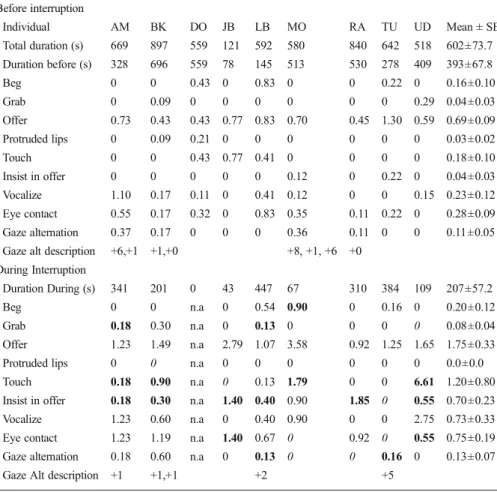
Orangutans produced vocalizations, gestures, made eye contact and alternated gaze between the object and me during the experiments (TableIII; Videos 1 and 2) often using several modalities of contact simultaneously. Offer was the most common behavior (mean number of occurrences: 4.0, range: 1–6, N=9; excluding DO mean 4.0, range: 1–6, N=8), followed by eye contact (1.67; 1.65, range: 0–3) and vocaliza-tions (1.33; 1.38, range: 0–6). Subjects often combined these behaviors: for example, an orangutan would offer the stick while vocalizing and making eye contact (see full description inElectronic Supplementary Material).
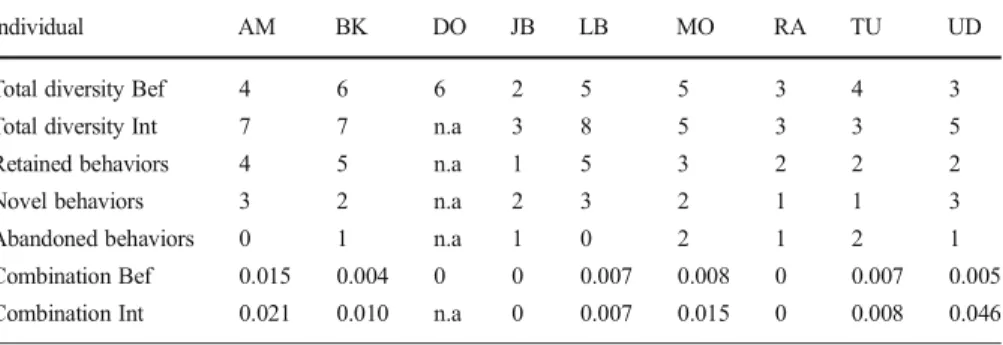
In terms of diversity, participants displayed a mean of 4.0 different behaviors before the interruption (N=8, range: 2–6, excluding DO; TableIV). During the interruption, they displayed significantly more behaviors, with a mean of 5.1 behaviors (N=8, range: 3–8, TablesIVandV). During the interruption, all individuals persisted in displaying at least one of the behaviors (mean: 3.0, N=8, range: 1–5) they had used previously. For instance, AM persisted in the four behaviors and LB persisted in the five behaviors they had displayed during the activity. However, they both elaborated their behavior by adding three novel behaviors during the interruption. JB retained only one behavior between the two conditions, but displayed two novel behaviors during the interruption. Other individuals continued to display two or three behaviors that they had shown during the activity. All subjects abandoned only one or two behaviors, retaining the majority of their behaviors before the interruption. Only one individual (TU) of eight displayed fewer (one) behaviors during the interruption than before. Individuals retained a mean of 3.0 (N=8, range: 1–5; TableIV) behavioral displays in their attempts to resume contact with me. They also produced a mean of 2.2 novel behaviors (N=8, range: 1–3) and abandoned a mean of 1.0 behavior (N=8, range: 0–2).
In terms of individual behaviors, there was a significant increase in the rates of offer and insist in offer during the interruption, compared with before the interruption (TableV). In contrast, I found no significant difference for touching, making eye contact, or alternating gazes in the two conditions. Four individuals displayed touch and six individuals displayed insist in offer during the interrup-tion while they had not produced these behaviors before. One individual, JB, knocked the stick on the cage bars, producing noise, before re-offering the stick. When their reengagement attempts remained fruitless, the orangutans withdrew the stick into the cage and engaged with it individually, dropped the stick on the ground, or threw it toward me.
Table III Rates per minute and mean rate (± standard error, SE) of behaviors, eye contacts, and gaze alternations produced by orangutans during activities with the human experimenter before and during the interruption when the experimenter, after engaging for 1 min with the orangutan, stopped and stayed still, without responding to the orangutan’s attempts to reengage the activity, if any
Before interruption Individual AM BK DO JB LB MO RA TU UD Mean ± SE Total duration (s) 669 897 559 121 592 580 840 642 518 602±73.7 Duration before (s) 328 696 559 78 145 513 530 278 409 393±67.8 Beg 0 0 0.43 0 0.83 0 0 0.22 0 0.16±0.10 Grab 0 0.09 0 0 0 0 0 0 0.29 0.04±0.03 Offer 0.73 0.43 0.43 0.77 0.83 0.70 0.45 1.30 0.59 0.69±0.09 Protruded lips 0 0.09 0.21 0 0 0 0 0 0 0.03±0.02 Touch 0 0 0.43 0.77 0.41 0 0 0 0 0.18±0.10 Insist in offer 0 0 0 0 0 0.12 0 0.22 0 0.04±0.03 Vocalize 1.10 0.17 0.11 0 0.41 0.12 0 0 0.15 0.23±0.12 Eye contact 0.55 0.17 0.32 0 0.83 0.35 0.11 0.22 0 0.28±0.09 Gaze alternation 0.37 0.17 0 0 0 0.36 0.11 0 0 0.11±0.05 Gaze alt description +6,+1 +1,+0 +8, +1, +6 +0
During Interruption
Duration During (s) 341 201 0 43 447 67 310 384 109 207±57.2
Beg 0 0 n.a 0 0.54 0.90 0 0.16 0 0.20±0.12
Grab 0.18 0.30 n.a 0 0.13 0 0 0 0 0.08±0.04
Offer 1.23 1.49 n.a 2.79 1.07 3.58 0.92 1.25 1.65 1.75±0.33
Protruded lips 0 0 n.a 0 0 0 0 0 0 0.0±0.0
Touch 0.18 0.90 n.a 0 0.13 1.79 0 0 6.61 1.20±0.80 Insist in offer 0.18 0.30 n.a 1.40 0.40 0.90 1.85 0 0.55 0.70±0.23 Vocalize 1.23 0.60 n.a 0 0.40 0.90 0 0 2.75 0.73±0.33 Eye contact 1.23 1.19 n.a 1.40 0.67 0 0.92 0 0.55 0.75±0.19 Gaze alternation 0.18 0.60 n.a 0 0.13 0 0 0.16 0 0.13±0.07
Gaze Alt description +1 +1,+1 +2 +5
The composition of gaze alternation (Gaze Alt) appears as the number of gaze alternations after the initial three (Object–Partner–Object or Partner–Object–Partner) as in Tanner and Byrne (2010). For instance, +3 is either OPOPOP or POPOPO. Bold: novel behavior produced during the interruption. 0: Behaviors that were present before but disappeared during the interruption
Orangutans used behavioral displays in combinations while engaging with me (N= 38 occasions), combining a mean of 2.3 behaviors (N=38, range 2–3). The most frequent combinations were: offer while vocalizing (9 cases, 23.7 %); offer while vocalizing and making eye contact (7 cases, 18.4 %); and touch while vocalizing (7 cases, 18.4 %). Offer and vocalization were most commonly found in combination with other behaviors (27 cases, 71 %, for each behavior in separate combinations). Orangutans used significantly more combinations during than before the interruption periods (TableV).
The time I spent engaging with the orangutans before the interruption had no significant effect on the rates of behaviors, both before (Kruskal–Wallis test, H = 5.826, df = 8, P= 0.667) and during the interruption (Kruskal–Wallis test, H= 6.033, df = 7, P= 0.536). In addition, I found no correlation between the time I spent engaging with the orangutans and the diversity of behaviors displayed both before (Spearman’s ρ=0.576, P=0.104) and during the interruption (Spearman’s ρ=0.086, P=0.839).
Table IV Total diversity; number of retained, novel, and abandoned behaviors (including eye contact and gaze alternation); and frequency of combinations (use of several behavioral displays at the same time) before (Bef) and during the interruption (Int), produced by each individual that engaged in an activity with the experimenter
Individual AM BK DO JB LB MO RA TU UD
Total diversity Bef 4 6 6 2 5 5 3 4 3
Total diversity Int 7 7 n.a 3 8 5 3 3 5
Retained behaviors 4 5 n.a 1 5 3 2 2 2
Novel behaviors 3 2 n.a 2 3 2 1 1 3
Abandoned behaviors 0 1 n.a 1 0 2 1 2 1
Combination Bef 0.015 0.004 0 0 0.007 0.008 0 0.007 0.005 Combination Int 0.021 0.010 n.a 0 0.007 0.015 0 0.008 0.046
Table V Wilcoxon signed ranks values for diversity, frequency of combinations and of individual behaviors, eye contact and gaze alternation before and during the interruption of activities
Diversity Combination Offer Touch Insist Eye contact Gaze alternation
W –17 –19 –34 –11 –32 –24 2
|W| 17 19 34 11 32 24 2
Ns/r 6 6 8 6 8 8 5
Critical W 17 17 26 17 26 26 15
Horejected Yes Yes Yes No Yes No No
For each column, the valid Ns/rappears (N obtained after subtracting the cases where the values before and
during the interruption are equal and for which the difference equals 0). The critical W is the upper edge of the critical area outside of which one rejects the Ho hypothesis (no difference in means between the two
Types of Games
The 11 orangutans engaged with the stick through four main types of social activities. Five individuals used it as a means to move me closer to them to engage with me; four engaged in various games with the stick and me (a stick holding game, where both partners had to hold the stick and pull; a slapping game, where the stick was used to slap the partner’s hand; a stick possession game where the partners alternated stick possession; and a breaking stick game where the orangutan broke the stick little by little while I was holding it); two orangutans used the stick as a tool in activities that included me (RM as a“probing tool” to touch the experimenter, UD as a “sex tool” where he handed the tool to me for masturbation after masturbating with the stick himself, while presenting his genitals, as if to indicate that I should continue the activity). Finally 2 of the 11 orangutans (RK and RM) also used the stick to engage with each other and displayed behaviors similar to other orangutans in their interaction with me: offering the stick, vocalizations, eye contact, gaze alternations (Videos 1, 2 and Electronic Supplementary Material).
Discussion
Consistent with studies of other nonhuman ape species (Maclean and Hare2013; Pika and Zuberbühler2008; Tanner and Byrne2010), this study shows that young rehabil-itant orangutans engaged spontaneously in joint activities involving an object with a human stranger or a conspecific, and showed many of the required characteristics of joint attention. Of 15 individuals tested, 11 engaged with me or another human via a stick. The subjects made idiosyncratic use of the stick, making it unlikely that they were primed beforehand by their interactions with the keepers who never handed them sticks to play (A. Danianto, pers. comm.). They engaged in a diversity of activities and used the stick in various ways, as a“means” of bringing me closer to them, as the main focus of the game, or as a tool. Interestingly, some older orangutans (TU, MO) did not appear to use the stick for“friendly” use, attempting to bring me closer to grab my arm violently. Although there was no collaborative play involved in these cases, the stick was the object of interest for both the orangutans, which used gaze alternation, and myself. It is thus possible that these individuals may have had some understanding that the stick was of interest to me, and used it in their attempts to bring me closer (I refused to come closer if no object was involved). When the stick became too short, TU replaced it with a rope hung from his cage and attempted to resume interaction with me, suggesting that his main aim was to engage with me and that he had apparently understood that I would approach only if he used an external object. Although it is possible that I and the orangutan had separate interests in the stick, these observations suggest that joint intention can serve competitive ends in orangutans.
Although some activities appeared to be clearly triadic, e.g., all four games described are centered on the stick; UD’s sexual tool; the stick could be seen as promoting a dyadic interaction in other activities, e.g., use of a stick to bring me within reach. However, all orangutans understood rapidly that I would not engage with them if the stick was not present. Thus, even in the latter cases, the activity could acquire a triadic characteristic, if both partners came to consider the stick as a necessary part of the
interaction. As in other studies, the impossibility of obtaining direct spoken feedback from the participants makes the interpretation of these results unclear (Maclean and Hare2013).
Orangutans combined different modalities (visual, auditory, tactile) to engage me during the test. They made eye contact with me, alternated gazes between the stick and me and also appeared to wait for a response when proposing the stick when I was reluctant to engage with them. Some of the interactions also included the combination of different behaviors. Facing the interruption of their activities, all but one individual who engaged with the experiment (10 of 15 individuals tested) tried to resume the interaction, displaying previous and novel behaviors toward their partner, similar to human children (Warneken et al.2006).
Orangutans showed evidence of persistence by continuing to display some of the behaviors they had displayed before interruption, as well as evidence of elaboration by producing novel behaviors in their attempts to resume the interaction with me. For instance, during the interruption, the orangutans used the offering gesture repeatedly, and elaborated on it by insisting in offering, completing the behavioral sequence with vocalizations. This augmentation of activity does not appear to result from spending more time engaging with me, as individuals that spent longer time interacting with me prior to the interruption did not have higher rates of behaviors than other individuals (TableIII). In addition, the difference in time spent engaging with me did not seem to affect the diversity or the choice of behaviors used by the orangutans. For instance, LB displayed more behaviors than the mean value despite having a shorter time engaging with me before the interruption. As such, the experimental design, which does not account for the duration spent before the interruption period, did not seem to influence the results, which are consistent across orangutans.
The finding of triadic interactions during play in orangutans suggests that they can occur in other contexts, in addition to during food-related interactions (Bard1992) in this species. The subjects tested were wild-born and had had limited exposure to humans, suggesting that their attitude toward me was not shaped by previous engage-ment with humans, and that enculturation is an unlikely explanation for their behavior. Seven of the subjects had reached the quarantine center <6 mo before the experiment (including three that had arrived in the weeks preceding the study) but nonetheless engaged with an unknown human partner, suggesting that engaging in triadic interac-tions is a normal feature of wild orangutans.
Although the interpretation of these results can remain at the behavioral level, the “triadicness” of the behaviors may also support the idea that orangutans engaged with their human counterpart in a“shared intentionality” at the mental level. In other words, these findings may suggest that orangutans experience a feeling of“togetherness” and engage with their social counterparts on a“we-mode” basis, displaying some kinds of “we-intentionality” (Bratman 1992; Gilbert 1989; Searle 1995; Tomasello 2008; Tomasello et al.2005). A leaner interpretation of the data is that it was only necessary for the orangutans to recognize that I intended to play by means of the stick to engage in the activities described, requiring the understanding of goals (Buttelmann et al. 2012), but not awareness that the two participants share a common goal. Although my findings suggest that the orangutans may have had some understanding of a shared attention to the stick, it is not clear, however, whether the combination of offering while vocalizing and alternating gazes toward the stick that some individuals showed during
their interaction with me qualifies as the kind of“protodeclarative” pointing toward the stick (used to share attention about this particular object), that human children use routinely and understand from an early age in joint interactions (Tomasello et al.2007). The vocalization the orangutans used during the shared activity was a“contact uff” that occurs in close face to face interactions in rehabilitant orangutans (Rijksen 1978). Orangutans also used this vocalization during independent non-tool using interactions with me, where the interaction was the sole interest of the activity. This suggests that this“contact uff” was related to the social activity rather than to the stick itself and contributed to the establishment of an interaction centered on the stick as a social activity.
In recent discussions, it has been suggested that, unlike human children, animals may consider their partners only as simple social tools to achieve a goal, rather than as collaborative partners (Warneken et al.2012). However, some orangutans here did not need a social tool to achieve their intended goal, e.g., masturbation for UD, but nonetheless offered the stick to me. Similar to children (Warneken et al.2012), the interaction with the social partner (me) seemed to be the most important feature of the activity, with most of the orangutans reengaging me in an activity when interrupted. Nonetheless, given that most“we-intentionality” claims in children have been devel-oped around more complex collaborative activities (Warneken et al.2012), which were not the focus of the present experiment, it is hard to interpret whether the activities described here qualify as“we-intentionality” because they were too simple to involve complex role-taking (other than taking consecutive role in handling the stick), a noticeable signature of we-intentionality.
Not all researchers agree that human children possess complex mind reading from an early age (D’Entremont and Seamans2007; Gómez2007). For example, Gómez (2007) suggests that human children’s communication should be studied in its own right, rather than being “forc[ed] into adult categories” (p. 733), and adopts an intermediate position between the lean and rich interpretations of their behavior. He notes that differences in motivation governing individuals (in both nonhuman and human primates) may lead to differences in behavior that one could interpret as differences in cognition. Although great apes request and attempt to direct the behavior of others in joint attention episodes, e.g., UD used me to fulfill his own purposes, human children put the emphasis on having their audience react to something. However, a recent study documented protodeclarative pointing in enculturated great apes (Lyn et al.2011), and Gómez (2007) also underlines that what is interpreted as informing, e.g., about a pile of letters, in a child’s behavior could also be a request to be brought closer or given the object. Therefore some great ape displays are not neces-sarily mere requests while some children may not necesneces-sarily make declarative state-ments while pointing, showing that the line between nonhuman apes and human children is blurrier than sometimes presupposed. D’Entremont and Seamans (2007) also propose alternative leaner hypotheses to explain children’s behaviors during joint attention episodes that do no rely on understanding that others have mental represen-tations and join Gómez in suggesting that young infants use pointing to influence others from a behavioral point of view, much like the current study showed in orangutans.
With the current data, it is unclear whether orangutans or human children have a clear understanding of their partner’s beliefs and representations. The interpretation of such data depends on whether we accept that shared intentionality must involve this
understanding. However, because we cannot access the orangutans’ mental states, a balanced approach such as that favored by Gómez (2007), that allows one to compare human children and nonhuman great apes on an equal grounding, may be most appropriate. With a developing field of neurobiology interested in studying the perception of others as intentional beings (Moore et al. 2013), there is hope that future data will allow scientists to evaluate whether triadic interactions and joint attention episodes in great apes and human children truly display shared intentionality or not.
Acknowledgments I thank the Indonesian Research and Technology Ministry (RISTEK) and all competent authorities for authorization to work in Indonesia, Ian Singleton and staff at Batu Mbelin, and Yayasan Ekosistem Lestari (YEL) for assistance at Sibolangit. I thank the Universitas Nasional (UNAS) for their support and collaboration, particularly Pak Tatang Mitra Setia, Ibu Sri Suci Utami Atmoko, and Fitriah Basalamah. I thank the Fyssen Foundation and the A. H. Schultz Foundation for supporting my work in Indonesia and Zanna Clay, Cat Hobaiter, Maria van Noordwijk, and Eliane Müller for English proofing and comments on earlier versions of the manuscript. I thank Joanna Setchell and two anonymous reviewers for their comments.
References
Akhtar, N., & Gernsbacher, M. (2008). On privileging the role of gaze in infant social cognition. Child Development Perspectives, 2, 60–66.
Bard, K. A. (1992). Intentional behavior and intentional communication in young free-ranging orangutans. Child Development, 63, 1186–1197.
Bratman, M. (1992). Shared co-operative activity. Philosophical Review, 101, 327–341.
Buttelmann, D., Schütte, S., Carpenter, M., Call, J., & Tomasello, M. (2012). Great apes infer others’ goals based on context. Animal Cognition, 15(6), 1037–1053.
Call, J. (2009). Contrasting the social cognition of humans and nonhuman apes: the shared intentionality hypothesis. Topics in Cognitive Science, 1, 368–379.
Call, J., & Tomasello, M. (1994). Production and comprehension of referential pointing by orangutans (Pongo pygmaeus). Journal of Comparative Psychology, 108(4), 307–317.
Carpenter, M., & Call, J. (2013). How joint is the joint attention of apes and human infants? In S. Terrace & J. Metcalfe (Eds.), Agency and joint attention. New York: Oxford University Press.
Cartmill, E. A., & Byrne, R. W. (2007). Orangutans modify their gestural signaling according to their audience’s comprehension. Current Biology, 17(15), 1345–1348.
D’Entremont, B., & Seamans, E. (2007). Do infants need social cognition to act socially? An alternative look at infant pointing. Child Development, 78(3), 723–728.
Gardner, R. A., & Gardner, B. T. (1969). Teaching sign language to a chimpanzee. Science, 165, 664–672. Genty, E., Breuer, T., Hobaiter, C., & Byrne, R. W. (2009). Gestural communication of the gorilla (Gorilla
gorilla): repertoire, intentionality and possible origins. Animal Cognition, 12, 527–546. Gilbert, M. (1989). On social facts. Princeton: Princeton University Press.
Gomez, J. (2004). Apes, monkeys, children and the growth of mind. Cambridge: Harvard University Press. Gómez, J.-C. (2007). Pointing behaviors in apes and human infants: a balanced interpretation. Child
Development, 78(3), 729–734.
Gómez, J.-C. (2010). The ontogeny of triadic cooperative interactions with humans in an infant gorilla. Interaction Studies, 11, 353–379.
Gruber, T., Singleton, I., & van Schaik, C. P. (2012). Sumatran orangutans differ in their cultural knowledge but not in their cognitive abilities. Current Biology, 22(23), 2231–2235.
Kellogg, W. N., & Kellogg, L. A. (1933). The ape and the child: A study of environmental influence upon early behavior. New York: Whittlesey House.
Leavens, D. A., & Bard, K. A. (2011). Environmental influences on joint attention in great apes: implications for human cognition. Journal of Cognitive Education and Psychology, 10(1), 9–31.
Leavens, D. A., & Racine, T. (2009). Joint attention in apes and humans: are humans unique? Journal of Consciousness Studies, 16, 240–267.
Leavens, D. A., Russell, J. M., & Hopkins, W. D. (2005). Intentionality as measured in the persistence and elaboration of communication by chimpanzees (Pan troglodytes). Child Development, 76(1), 291–306. Lyn, H., Greenfield, P. M., Savage-Rumbaugh, S., Gillespie-Lynch, K., & Hopkins, W. D. (2011). Nonhuman
primates do declare! A comparison of declarative symbol and gesture use in two children, two bonobos, and a chimpanzee. Language and Communication, 31, 63–74.
Maclean, E., & Hare, B. (2013). Spontaneous triadic engagement in bonobos (Pan paniscus) and chimpanzees (Pan troglodytes). Journal of Comparative Psychology, Advance online publication.
Miles, H. L. W. (1990). The cognitive foundations for reference in a signing orangutan. In S. T. Parker & K. R. Gibson (Eds.),“Language” and intelligence in monkeys and apes. Comparative developmental perspec-tives. Cambridge: Cambridge University Press.
Moore, J. W., Teufel, C., Subramaniam, N., Davis, G., & Fletcher, P. C. (2013). Attribution of intentional causation influences the perception of observed movements: Behavioural evidence and neural correlates. Frontiers in Psychology, 4, 23. doi:10.3389/fpsyg.2013.00023.
Mosteller, F., & Rourke, R. (1973). Sturdy statistics: Nonparametrics & order statistics. Reading: Addison-Wesley.
Patterson, F., & Linden, E. (1981). The education of Koko. New York: Owl.
Pika, S., & Zuberbühler, K. (2008). Social games between bonobos and humans: evidence for shared intentionality? American Journal of Primatology, 70(3), 207–210.
Rijksen, H. D. (1978). A field study on Sumatran orang utans (Pongo pygmaeus abelii Lesson 1827): Ecology, behaviour and conservation. Wageningen: H. Veenman Zonen BV.
Ross, H. S., & Lollis, S. P. (1987). Communication within infant social games. Developmental Psychology, 23, 241–248.
Russon, A., & Andrews, K. (2011). Orangutan pantomime: elaborating the message. Biology Letters, 7(4), 627–630.
Savage-Rumbaugh, E. S. (1986). Ape language. New York: Columbia University Press.
Savage-Rumbaugh, E. S., Rumbaugh, D. M., & McDonald, K. (1985). Language learning in two species of apes. Neuroscience & Biobehavioral Reviews, 9(4), 653–665.
Searle, J. (1995). The construction of social reality. New York: Free Press.
Tanner, J. E., & Byrne, R. W. (2010). Triadic and collaborative play by gorillas in social games with objects. Animal Cognition, 13, 591–607.
Tomasello, M. (1995). Joint attention as social cognition. In C. Moore & P. J. Dunham (Eds.), Joint attention: Its origins and role in development (pp. 103–130). Hillsdale: Lawrence Erlbaum.
Tomasello, M. (2008). Origins of human communication. Cambridge: MIT Press.
Tomasello, M., Call, J., & Gluckman, A. (1997). Comprehension of novel communicative signs by apes and human children. Child Development, 68(6), 1067–1080.
Tomasello, M., Carpenter, M., Call, J., Behne, T., & Moll, H. (2005). Understanding and sharing intentions: the origins of cultural cognition. Behavioral and Brain Sciences, 28(5), 675–735.
Tomasello, M., Carpenter, M., & Liszkowski, U. (2007). A new look at infant pointing. Child Development, 78(3), 705–722.
van Schaik, C. P., Ancrenaz, M., Borgen, G., Galdikas, B., Knott, C. D., Singleton, I., et al. (2003). Orangutan cultures and the evolution of material culture. Science, 299(5603), 102–105.
Warneken, F., Chen, F., & Tomasello, M. (2006). Cooperative activities in young children and chimpanzees. Child Development, 77, 640–663.
Warneken, F., Gräfenhain, M., & Tomasello, M. (2012). Collaborative partner or social tool? New evidence for young children’s understanding of joint intentions in collaborative activities. Developmental Science, 15, 54–61.
Wich, S. A., Sterck, E. H. M., & Utami, S. S. (1999). Are orangutan females as solitary as chimpanzee females? Folia Primatologica, 70, 23–28.