HAL Id: hal-01819302
https://hal.archives-ouvertes.fr/hal-01819302v2
Submitted on 23 Aug 2018
HAL is a multi-disciplinary open access
archive for the deposit and dissemination of
sci-entific research documents, whether they are
pub-lished or not. The documents may come from
teaching and research institutions in France or
abroad, or from public or private research centers.
L’archive ouverte pluridisciplinaire HAL, est
destinée au dépôt et à la diffusion de documents
scientifiques de niveau recherche, publiés ou non,
émanant des établissements d’enseignement et de
recherche français ou étrangers, des laboratoires
publics ou privés.
Rotten Green Tests A First Analysis
Julien Delplanque, Stéphane Ducasse, Andrew Black, Guillermo Polito
To cite this version:
Julien Delplanque, Stéphane Ducasse, Andrew Black, Guillermo Polito. Rotten Green Tests A First
Analysis. [Research Report] Inria Lille Nord Europe - Laboratoire CRIStAL - Université de Lille;
Portland State University, Oregon, USA. 2018. �hal-01819302v2�
Rotten Green Tests: A First Analysis
Julien Delplanque
Université de Lille, CRIStAL, CNRS, UMR 9189, RMoD Team, Inria Lille Nord Europe
Lille, France [email protected]
Stéphane Ducasse
RMoD Team, Inria Lille Nord Europe Lille, France
Andrew P. Black
Portland State University Oregon, USA & RMoD Team, Inria Nord Europe
Lille, France [email protected]
Guillermo Polito
CNRS, Université de Lille, CRIStAL, UMR 9189, RMoD Team, Inria Lille Nord Europe
Lille, France [email protected]
Abstract
Unit tests are a tenant of agile programming methodologies, and are widely used to improve code quality and prevent code regression. A passing (green) test is usually taken as a robust sign that the code under test is valid. However, we have noticed that some green tests contain assertions that are never executed; these tests pass not because they assert properties that are true, but because they assert nothing at all. We call such tests Rotten Green Tests.
Rotten Green Tests represent a worst case: they report that the code under test is valid, but in fact do nothing to test that validity, beyond checking that the code does not crash. We describe an approach to identify rotten green tests by combining simple static and dynamic analyses. Our approach takes into account test helper methods, inherited helpers, and trait compositions, and has been implemented in a tool called DrTest. We have applied DrTest to several test suites in Pharo 7.0, and identified many rotten tests, including some that have been “sleeping” in Pharo for at least 5 years. Keywords rotten green tests, unit tests, testing
1
Introduction
Agile methodologies such as Extreme Programming [4–6] promote Unit Testing [22] as a key tenant of the software development process. Executing a test suite after each change to the software helps to ensure that new functionality works, and that the old functionality remains working, that is, it helps avoid software regressions [1].
Tests are based on the execution of assertions that check that the system under test satisfies some property, for ex-ample, that a method returns a certain value, or that certain data is written to a stream. Developers value “green tests”, i.e.,tests that are passing, because they provide assurance that the software is working as expected.
RMOD Inria Technical Report, Jun - 2018, 2018.
Our concern in this work is with tests that were intended by their designer to execute some assertions, but do not actually do so — we call them rotten green tests. Such tests are insidious because they pass, and they contain assertions; they therefore give the impression that some useful property is being validated. In fact, a rotten green test guarantees nothing: it is worse than having no test at all!
Our approach is based on a combination of static analysis and dynamic monitoring of method execution. We identify whether or not a test is rotten, even in the presence of helper methods and trait compositions. A limitation of our current implementation is that a test with multiple assertions will be considered as rotten only when none of the assertions is executed. Future work will ensure that all the assertions are executed.
The contributions of the paper are:
• the recognition of rotten “green” unit tests that contain assertions that are not executed, and which therefore give the developers false confidence (Section 2); • a simple combination of static and dynamic analyses
that identifies such rotten green tests, (Section 3); and • a report on our experience applying this approach to
several large systems (Section 4).
2
The Problem of Rotten Green Tests
Before defining rotten green tests, we first describe the basics of unit testing, and then briefly explain “Smoke Tests”, to help distinguish them from the topic of this article. 2.1 Unit tests
Unit tests are commonly composed of a test fixture (which sets up the system to be tested), one or more stimuli (which exercise the component under test), and one or more asser-tionsthat verify some expected property [8, 21]. The follow-ing trivial example shows an SUnit test that checks that a set should not contain the same object twice.
SetTest >> testAddTheSameElementTwiceResultOneOccurrence
"Fixture" s := Set new. s add: 1. "Stimulus" s add: 1. "Assertions"
self assert: s size equals: 1. self assert: (s includes: 1).
In the example, the fixture is the code that declares and initializessto contain1; here the fixture is inline, but it can
also be factored-out into asetUpmethod. The stimulus is
the second addition of1tos; the assertions then verify the
property thatscontains1just once.
Provided that all of the assertions are true, this test will pass; we say that it is “green”. If a false assertion is executed, for example, if the set does not detect the duplicate and its size is2, the test will fail: it will be “yellow”. If an error occurs
during the running of the test, for example, ifSet newsignals
an exception, then the test will be “red”. 2.2 Smoke Tests
It is common practice to use unit testing frameworks to execute so-called “smoke tests” whose purpose is to check that the feature under test can be run without emitting “blue smoke” — that is, the test ran without raising an unexpected exception [25]. Here is an example of such a test.
SetTest >> testSetAddSmokeTest | s | "Fixture" s := Set new. s add: 1. "Stimulus" s add: 1
In its simplest form, a smoke test may contain no asser-tions at all, as in this illustration. This is the way that we use the term smoke test in the remainder of this article.
Smoke tests are useful because, if they are green, they provide a fast but cursory check that the feature concerned can be considered for further testing. Conversely, if a smoke test is red, there is a serious issue that should be addressed rapidly. Smoke tests are not the concern of this article; noth-ing that follows should be construed as advocatnoth-ing either for or against the use of smoke tests. Nevertheless, we do need to distinguish a smoke test that by design contains no assertions, from a rotten green test, which by accident executes no assertions.
2.3 Rotten Green Tests
Consider an empty test — a test method that contains no code at all: no fixture, no stimulus, and no assertion. If it is treated as a passing test, it will increase the number of green tests
TPrintOnSequencedTest >> testPrintOnDelimiter
| aStream result allElementsAsString | result := ''.
aStream := ReadWriteStream on: result. self nonEmpty printOn: aStream delimiter: ', '.
allElementsAsString := (result findBetweenSubstrings: ', ' ). allElementsAsString withIndexDo: [:el :i |
self assert: el equals: ((self nonEmpty at:i)asString)]
Figure 1.A rotten green test
without providing any value. Empty tests are bad because they may help to convince a developer that the software is working correctly, when in fact they guarantee nothing.
Empty tests do occur — perhaps as the remains of a test-writing session that was never finished. Fortunately, they are easy to spot and eliminate.
A much more insidious problem is caused by a test that does contain a valid fixture, stimulus and assertion, but which nevertheless does not execute any assertions. How can this happen? Let’s look at a real example, taken from Pharo issue 7478, and shown in Figure 1.
At first glance, this looks like a fine test of the collec-tionprintOn:delimiter:method. The first three lines of the test
method create a fixture — in this case they set upaStream.
Then comes the stimulus: the collectionself nonEmptyis sent
theprintOn: aStream delimiter: ’,’message, causing it (we hope)
to write its elements toaStreamseparated by commas. The
remainder of the test is intended to make assertions. The code looks as though it is parsing the contents ofaStream
and asserting that the elements it finds written there are the same as those in the original collection.
This test is green, so we know that everything is OK, right? Wrong! The programmer who wrote this test misun-derstood the way that streams work. The stringresultcan
neverbe modified by writing toaStream; indeed, the very
nameresultis misleading, becauseresultis initialized to the
empty string and never changes. Consequently,result find-BetweenSubstrings:will answer an empty collection, and the withIndexDo:block — which contains the only assertion — will
neverbe executed. We could put any assertion into this block, and the test would still run green.
We believe that such a test is worse than no test at all. First, the rotten test assures us of no property of the method under test. Second, it wastes time — remember that we want our tests to run quickly. Third, in the case of “no test at all”, test coverage statistics might reveal that theprintOn:delimiter:
method is not being exercised, and the developers would at least be aware that their testing is inadequate. Instead, with a rotten test in place coverage will tell us that the
printOn:delimiter:method is being executed — and we will be
unaware that it is not actually being tested.
Rotten green tests give developers a false sense of security: coverage may be good, and the tests may be green, but in
Rotten Green Tests: A First Analysis RMOD Inria Technical Report, Jun - 2018,
fact no properties are being checked (other than the property that the code runs without signaling an error). Moreover, when developers look at such a test superficially, they will probably not spot that there is a problem.
The example in Figure 1 was first reported as a bug in February 2013. However, because the test was green, the bug was easy to overlook, and the bug report was closed without any action being taken. As of the end of 2017, this rotten green test was still present in Pharo.
3
Identifying Rotten Green Tests
Once we accept that rotten green tests are bad, it is natural to ask how we can detect them. One might think that all that is necessary is to detect tests that makes no assertions, but this won’t let us distinguish smoke tests from rotten green tests. Can’t we identify smoke tests as those tests that contain no assertions? No, because many tests make assertions indirectly through the use of helper methods (as explained in Section 3.1); tests that use assertions in helper methods are not smoke tests, even though they contain no assertions directly.
To clarify the discussion, we will use the following terms. • an assertion primitive is a method of the unit-testing framework that performs the actual check. In Pharo,
assert:and assert:description:are the only assertion
primitives.
• a test method is a method identified as such by the unit-testing framework. In Pharo, test methods are zero-argument methods defined in a subclass ofTestCase
whose names start with “test”.
• a helper method is a method that makes an assertion directly (by invoking an assertion primitive) or indi-rectly (by invoking another helper method), but that is not a test method. In Pharo, SUnit provides helper methods likeassert:shouldRaise:; in addition,
develop-ers frequently write their own application-specific test helper methods, as we will discuss in Section 3.1. In Figure 2,testABCis a test method, andhelperand sec-ondHelperare helper methods, becausehelperinvokes sec-ondHelper, andsecondHelperinvokes an assertion primitive.
3.1 Helper methods
It is common practice for developers to factor-out assertions into helper methods. This affects our analysis in two ways: we need to know which messages invoke helper methods when we identify smoke tests, and we must take into account the possibility that helper methods, as well as tests, might be rotten.
What is a helper method? In our context, it is a method that makes an assertion, either using another helper method, or by using one of the assertion primitives. As a simple example, a test suite for approximate numerical methods, might define and use the helper methodassert:isRoughly:within:
RottenTest >> testABC
"Test method" false ifTrue: [self helper]
RottenTest >> helper "Indirect helper" self secondHelper RottenTest >> secondHelper "Direct helper" self assert: x
Figure 2.A rotten test that uses a helper method.
NumericalTests >> assert: actual isRoughly: desired within: tolerance
self
assert: (actual - desired) abs <= tolerance description: [ 'actual result ' , actual ,
' is not even roughly equal to ' , desired ]
For a more realistic example, we turn to the Pillar editing platform [11]. Pillar’s test suites use helper methods such as
assertWriting:includesText:; which is defined in the superclass
of Pillar’s test classes,PRDocumentWriterTest. This method
factors out the creation of aPRAnchorand its verification.
Here is its definition and a sample of its use:
PRDocumentWriterTest >> assertWriting: anItem includesText: aString
| result |
result := self write: anItem.
self assert: result includesSubstring: aString
PRHTMLWriterTest >> testAnchor
| item |
item := PRAnchor new name: 'foo'.
self assertWriting: item includesText: 'id="foo"'
Like a rotten test, a helper method might fail to make an assertion in some or all situations; in other words, helper methods might be rotten too. Any approach to detecting rotten green tests should also detect rotten helper methods. Moreover, since the action of a helper method may depend on the context (e.g., the test fixture, and the arguments to the helper method), a helper might work fine in one context, but be rotten in another. So, when detecting the rotten helper, we need to record the specific test that exposes the rot.
In Pharo, traits enable developers to reuse tests across several sub-hierarchies; the Collection tests are a good ex-ample [15, 16]. The situation with traits is the same as with helper methods: a trait method may show up as being rotten only for a certain trait use. This can happen because trait composition and inheritance can change the test fixture. 3.2 Classifying Tests
There are three situations that a rotten test analysis should identify.
Good tests. A test passes, contains some assertions (either directly, or indirectly though helper methods), and some assertions are executed: the test is good. Rotten tests. A test passes, and contains assertions (either
directly, or indirectly), but no assertion is executed: the test, or the helper method, is rotten.
Smoke tests. A test contains no assertions (either directly, or indirectly); it is a smoke test.
Note that distinguishing between good and rotten requires some dynamic analysis, because we need to ascertain whether an assertion is executed. In contrast, distinguishing between rottenand smoke requires some static analysis, because we need to ascertain whether the test contains assertions.
3.3 Combining Static and Dynamic Analyses Our analysis performs the following steps:
Step 1: identification of assertion primitives.We build the set of assertion primitives by identifying all the methods of the unit test framework that make as-sertions directly. This set depends only on the test framework.
Step 2: identification of helper methods.To build the set of helper methods, we start with a set S containing all the methods in the test class that are not test meth-ods but which self-send one of the assertion primi-tives. (“All the methods” includes methods introduced through inheritance or trait use.) We identify such methods using a simple static analysis of self- and super-sends. We then add to S any method in the test class that is not a test case but which self- or super-sends one of the methods in S. We repeat this step until no new methods are added to S; the set S now contains all the helper methods.
Step 3: test execution.We execute each test method (in-cluding inherited test methods) one at at time, while monitoring the following pieces of information:
a.the outcome of the test (pass, fail, or error), b. whether or not one of the helper methods is
exe-cuted, and
c. whether or not one of the assertion primitives is executed.
Because we are looking for rotten green tests, we consider only passing tests.
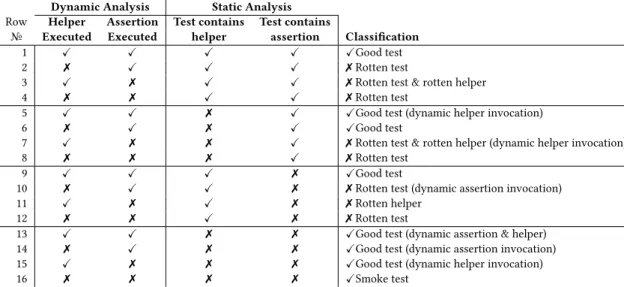
Step 4: classification.We combine the test execution in-formation from Step 3 with the static inin-formation collected in Steps 1 and 2. Table 1 shows how this in-formation is used to classify test methods. We discuss the classification in Section 3.4.
Step 5: report generation. DrTest’s final report has to take into account the way that methods are reused in the test hierarchy. A test method may be defined in a superclass and executed in a subclass. A test method may also be defined in a trait [15], and reused
by several classes. In general, the test fixture, and thus the meaning of the test, will be different in each place in which it is used, so we must report the class of the test as well as the method. Helper methods are designed to be used by many test methods; if a helper method is rotten, the test invoking it should be reported, so that we can understand the scenario in which the helper fails to make an assertion. Our current dynamic analysis has a coarse granularity: we monitor the execution of primitive assertions for the com-plete run of the test method under analysis. This means that we cannot attribute an executed assertion to a specific call site. So, if one primitive assertion in the test method was executed, the test will not be classified as rotten, even though there might be another primitive assertion that was not exe-cuted. We discuss this shortcoming further in Section 6.
3.4 Classification Discussion
We now discuss the reasoning behind the classification in Table 1. In the first four rows, the test contains (statically) sends of both assertion primitives and helper methods. If the test is good, we will see both helper and assertion executed, as in row 1. If no helper, or no assertion primitive, or neither, is executed, then the test is rotten.
In rows 5–8, there is no send to a helper method in the test, but there is a send of an assertion primitive. If an assertion is executed (rows 5 and 6), the test is good; if no assertion is executed (rows 7 and 8), we can say that the test is rotten. On rows 5 and 7, a helper method is executed even though there is no send of a helper message in the test! How can this happen? One possibility is that the test constructs the selector of the helper method dynamically, and then uses
perform:to send it. Another possibility is that the test invokes
a helper method with a message send that is not a self- or super-send, either because the message is actually sent to an object outside its class hierarchy, or because the receiver of the message is not the pseudo-variable self. We flag these entries with “dynamic helper invocation”; test like this are unlikely to occur in practice, but if they do, they are worth a second look.
Rows 9–12 are similar to rows 1–4, except that in rows 9–12 all of the assertions are made using helper methods. If both helper and assertion are executed (row 9), the test is good; if either is not executed, something is rotten. In row 11, the helper is executed, but the assertion is not, so it is the helper method that is rotten. In rows 10 and 12, no helper is executed, even though the test relies on helper methods, so we know that the test is rotten. This reasoning applies even in row 10 where, somehow, an assertion is executed even though no assertion message is sent!
In rows 13–16, no helpers and no assertions are used in the test. Such tests look like smoke tests — in which case we would expect that no helpers and no assertions are executed,
Rotten Green Tests: A First Analysis RMOD Inria Technical Report, Jun - 2018,
Dynamic Analysis Static Analysis Row Helper Assertion Test contains Test contains
№ Executed Executed helper assertion Classification
1 ✓ ✓ ✓ ✓ ✓Good test
2 ✗ ✓ ✓ ✓ ✗ Rotten test
3 ✓ ✗ ✓ ✓ ✗ Rotten test & rotten helper
4 ✗ ✗ ✓ ✓ ✗ Rotten test
5 ✓ ✓ ✗ ✓ ✓Good test (dynamic helper invocation)
6 ✗ ✓ ✗ ✓ ✓Good test
7 ✓ ✗ ✗ ✓ ✗ Rotten test & rotten helper (dynamic helper invocation)
8 ✗ ✗ ✗ ✓ ✗ Rotten test
9 ✓ ✓ ✓ ✗ ✓Good test
10 ✗ ✓ ✓ ✗ ✗ Rotten test (dynamic assertion invocation)
11 ✓ ✗ ✓ ✗ ✗ Rotten helper
12 ✗ ✗ ✓ ✗ ✗ Rotten test
13 ✓ ✓ ✗ ✗ ✓Good test (dynamic assertion & helper) 14 ✗ ✓ ✗ ✗ ✓Good test (dynamic assertion invocation) 15 ✓ ✗ ✗ ✗ ✓Good test (dynamic helper invocation)
16 ✗ ✗ ✗ ✗ ✓Smoke test
Table 1.Classifying tests using the results of our analyses. In all cases, the test passes. “Executed” means that the (helper or assertion) method was executed. “Contains” means that the test method contains (statically) a message send to a helper or to an assertion.
as occurs on row 16. If a helper or assertion is executed, it is likely to be because of a dynamic invocation.
Let us see how this classification works on the example in Figure 2. The dynamic analysis will report that neither a helper method nor an assertion primitive is executed. The static analysis will identifysecondHelperas a helper method
(because it makes a primitive assertion), andhelperas a helper
method (because it usessecondHelper). Hence, we look for
✗✗✓✗ in Table 1, which we find on row 12. As expected, this tells us that we have found a rotten test.
4
Results
Pharo is an open-source language with a growing community and a large number of mature projects. We have run DrTest on eight Pharo subsystems; we found that all subsystems except Iceberg have at least 1 rotten test. The results are shown in Table 2.
Subsystem Packages Classes Test classes Tests Rotten tests Calypso 58 705 128 2671 4 Collections 16 224 59 5858 7 Glamour 19 463 65 449 3 Iceberg 16 565 44 555 0 Opal Compiler 7 227 49 854 15 Pillar 33 358 112 3188 1 System 48 330 44 552 1 Zinc 9 184 43 412 3
Table 2.Rotten tests in Pharo subsytems.
ClyCompositeScopeTests>>#testEmptySubscopesAreForbidden
[ClyCompositeScope on: #().
self assert: false description: 'empty subscopes should be forbid-den'] ifError: [].
Figure 3.Rotten test in Calypso. The assertion is not reached on purpose, this is a false positive.
Calypso is the new system browser for Pharo. It allows developers to view and edit packages, classes, and meth-ods. DrTest found four rotten tests; two of them contained conditionally-executed sends ofTestAsserter » assert:description:
withfalseas the first argument, as shown in Figure 3. These
two tests are false positives: the developer intends that the assertion will not be executed if the code under test behaves correctly, that is, if it signals an exception. This test would be clearer if it simply asserted thatClyCompositeScope on: #()
should raise an error.
The two other rotten tests in Calypso contain helper meth-ods that are never executed. These tests are tagged with the<expectedFailure>pragma which indicates that they are
expected to fail by SUnit. Again, those are false positives.
Andrew ▶I don’t see why, but then, I can’t find the tests.◀
Collections are the basic data structures of Pharo [8]. The collections tests contain seven rotten tests. Two of them are tests that contain a guard clause checking which of the collection classes is being tested. This guard clause is present because the test is implemented in a superclass common to multiple test cases, but the test should be run only on certain subclasses. One rotten test contains a guard clause
TPrintTest >> testPrintElementsOn
| aStream result allElementsAsString tmp | result:=''.
aStream:= ReadWriteStream on: result. tmp:= OrderedCollection new.
self nonEmpty do: [:each | tmp add: each asString].
self nonEmpty printElementsOn: aStream .
allElementsAsString:=(result findBetweenSubstrings: ' ' ). 1 to: allElementsAsString size do: [:i |
self assert: (tmp occurrencesOf:(allElementsAsString at:i)) = (allElementsAsString occurrencesOf:(allElementsAsString at:i)). ].
Figure 4.A Rotten test of Pharo Collections. The stream API is used incorrectly.
that deliberately skips the test when the Dictionary subclass under test does not supportnilkeys.
The remaining four rotten tests are true positives that use theStreamAPI incorrectly. These methods test the
se-rialization of a collection on a stream, using the following process: (1) create a stream, (2) write a collection on the stream and (3) compare what was written on the stream to the original collection. As discussed in Section 2.3, the prob-lem here is that the comparison should be with the contents of the stream,aStream contents, and not with the variable result, which remains bound to the empty string. Because of
this, the assertion inside the loop is never executed. Figure 4 illustrates another such rotten test.
Glamour provides a high-level API for creating user in-terfaces. It has three rotten tests. After an investigation, we realised that two of them are expected failures. Andrew ▶So what? If the tests fail, then they can’t be rotten, so I assume that they pass. Are they rotten?◀ The last one is because a block
con-taining an assertion is never executed Andrew ▶Is this a true positive? Lets say so◀.
Iceberg is a tool to manage Git project within Pharo. It was found to contain no rotten tests.
OpalCompiler is the default compiler used in Pharo im-ages. It has 15 rotten tests; 10 of them are due to a guard clause that was incorrect. As shown in Figure 5, the comment above the guard clause specifies that the test should not be run unless the method’s source code is available. But the implementation of the condition in the guard clause ensures that the test is skipped if the source code is available.
The other five rotten tests of the OpalCompiler were in-tended to identify a bug related to dynamic bytecode rewrit-ing of boolean expressions. In Smalltalk, it is normally im-possible to make a non-Boolean object act as a Boolean in a condition, even if the object implements the Boolean inter-face. The reason is that common Boolean message like#ifTrue:
and#and:are compiled to optimized bytecode that raises an
OCContextTempMappingTest >>
testAccessingArgOfOuterBlockFromAnotherDeepBlock
| actual |
"Check the source code availability to do not fail on images with-out sources"
thisContext method hasSourceCode ifTrue: [ ^ self ].
actual := [:outerArg | outerArg asString.
[ :innerArg | innerArg asString. thisContext tempNamed: #outerArg ]
value: #innerValue. ] value: #outerValue.
self assert: actual equals: #outerValue
Figure 5.Rotten test in OpalCompiler. The guard clause im-plements the negation of what is described in the comment.
MustBeBooleanTests >> testAnd
| myBooleanObject |
myBooleanObject := MyBooleanObject new. self deny: (myBooleanObject and: [true])
MustBeBooleanTests >> testAnd (rewritten)
| myBooleanObject |
myBooleanObject := MyBooleanObject new. ^ (myBooleanObject) and: [ 1 halt ]
Figure 6.Rotten test in OpalCompiler: as written (top) as decompiled after rewriting (bottom).
exception when they are sent to non-Booleans. However, Pharo dynamically catches this exception and rewrites the bytecode to a de-optimized version. This allows one to use a non-Boolean receiver as a Boolean (provided that it imple-ments the methods of Boolean).
The five rotten OpalCompiler tests are intended to validate this feature. A bug in the bytecode rewrite process introduced an early return into the test methods. The return appears before the assertion can be executed. Thus, it leads to five tests passing but not executing any assertion. Figure 6 shows the source code of one of these five methods, both as it appears, and as it is dynamically rewritten. These rotten tests teach us that it can be extremely difficult to see whether or not an assertion is executed.
Pillar is a markup syntax and associated tools for writ-ing and generatwrit-ing documentation, books, and slides. This project contains 1 rotten test which is tagged as an expected failure. Andrew ▶again, what has expected failure to do with things?◀
System packages are also provided with test suites. These test suites contain one rotten test, which is tagged as an
Rotten Green Tests: A First Analysis RMOD Inria Technical Report, Jun - 2018,
expected failure. Andrew ▶again, what has expected failure to do with things?◀
Zinc is a library for interacting with the network. It con-tains three rotten tests. One of them is a test that sends#skip,
a method of TestAsserterwhose specification says “Don’t
run this test, and don’t mark it as failure”. Thus, we can be confident that the assertions in this test are skipped on purpose.
Another Zinc test is guarded by a check that a certain class exists in the system; if it does not, the test returns. By default, the class does not exist, so the test returns and no assertion is executed.
The last rotten test of Zinc performs a network HTTP operation. If the result is a redirection, the test returns im-mediately. The URL requested by the test does lead to a redirection, so the test returns and no assertion is executed.
5
Implementation
The implementation of DrTest has two points of interest: the detection of helper methods and the detection of method ex-ecution. Helper methods are detected through static analysis: we traverse the class hierarchy starting from the subclass of
TestCasethat interests us, and classify as helper methods all
non-test methods that make a direct or indirect send of an assertion primitive. For the dynamic analysis, the detection of method execution is done by instrumenting the assertion primitives and helper methods. We replace those methods by method spies that record that they were called, and then forward execution to the original method.
5.1 The Algorithm in Outline
To identify the rotten tests of a test class, DrTest starts by determining which methods are helpers (Section 5.2) and marking them with spy objects containing a flagcalled
(Sec-tion 5.3). Then, DrTest executes each test case by: 1. reseting all spies so thatcalled = false,
2. running the test, which will mark executed method by settingcalled = true, and
3. classifying the outcome of the test using the marked spies according to Table 1.
The code that classifies a test outcome is as follows. • Table Rows 1–4.
(containsAssertionPrimitive and: [ containsHelper and: [
(assertionPrimitiveExecuted and: [ helperExecuted ]) not ] ])
ifTrue: [ self addRottenTest: compiledMethod ].
• Table Rows 7–8.
(containsAssertionPrimitive and: [ (containsHelper not) and: [
assertionPrimitiveExecuted not ] ])
ifTrue: [ self addRottenTest: compiledMethod ].
• Table Row 11.
(containsAssertionPrimitive not and: [ containsHelper and: [
assertionPrimitiveExecuted not and: [ helperExecuted ] ] ])
ifTrue: [ self addRottenHelper: compiledMethod ].
• Table Rows 10 and 12.
(containsAssertionPrimitive not and: [ containsHelper and: [
helperExecuted not ] ])
ifTrue: [ self addRottenTest: compiledMethod ].
5.2 Detecting Helper Methods
DrTestdetects helper methods through static analysis. The analysis first collects all the test methods Andrew ▶do we mean the non-test methods?◀in the test class under analysis,
and all of its superclasses up toTestAsserter(which is the
superclass ofTestCase). All of these methods may be relevant
to the execution of the test class under analysis. We then use an AST visitor to visit the entire AST of each of these methods; every time the visitation encounters a self-send, it notes the method corresponding to the self-send. This gives us an enumeration of the relation “executes directly via a self-send”. We then compute the transitive closure of this relation, and note the methods that directly or indirectly self-send an assertion primitive. The noted methods are the helper methods.
5.3 Detecting Method Execution
The method spy mechanism uses the method wrapper vir-tual machine (VM) hook described by Martinez Peck et al. [19], which works as follows. When a message is sent to an object, the VM looks in the method dictionary of the re-ceiver’s class for an entry keyed by the method selector. In most cases, this entry will be a compiled method, that is, an instance of the classCompiledMethod, in which case the VM
executes the method with the arguments from the message. However, when the object found in the method dictionary is nota compiled method, the VM instead sends the message
run:with:in:to the found object, giving it a chance to execute
some behaviour. This hook is commonly used by profilers and other dynamic analysis tools.
In our case, the object in the method dictionary is an in-stance ofMethodTracer, a class that implements arun:with:in:
method that contains acalledflag, which is initialized to false, and a reference to the original method. When a Method-Traceris sent arun:with:in:it first “marks” itself by setting
thecalledflag totrue, and then forwards execution to the
original compiled method. Here is the relevant code from
MethodTracer:
MethodTracer >> run: aSelector with: someArguments in: aReceiver
self mark.
Distinct instances ofMethodTracerare used to spy on the
assertion primitives and on the helper methods. This allows us to keep a separate record of whether or not assertion primitives and helper methods have been executed.
6
Discussion and Future Work
As currently implemented, DrTest has two significant limita-tions.
6.1 Tests containing multiple assertions
When a test method uses multiple assertion primitives or helper methods, our approach does not currently distinguish between the case in which just one assertion primitive or helper methods is executed, and the case where they are all executed. In both cases, we report that the test is good.
For example, the test in Figure 1 is rotten, and is detected as such. However, if the developer had added
self assert: (self nonEmpty isNotEmpty) description: 'test fixture broken' at the top of the test, it would not be detected as rotten, even though this assertion does nothing to solve the problem. In-deed, because it is based on method-level monitoring, the cur-rent implementation cannot distinguish between assertions made at different call sites. This can result in false-negatives, that is, not all rotten tests will be detected. It will not cause false-positives: a test that is identified as rotten will always be rotten.
We cannot yet evaluate the number of false negatives due to multiple assertions, because doing so would require that we enhance our solution to eliminate them.
For the future, we can see several ways of dealing test that contain with multiple assertions. One possibility is to create, from each test method that contains multiple asser-tions, multiple tests, each with a single assertion, and then to apply our process to these new methods. Another possi-bility is to record, not just when an assertion is executed, but which send of the assertion message is being executed. These enhancements are the subject of ongoing work.
6.2 Location of Helper Methods
Another limitation of our approach is that our static analysis discovers only those helper methods that are in the hierarchy of the analysed test case. If the helper methods are located in a utility class, then they will not be detected. We can estimate how frequently this problem arises because some instances will manifest themselves as a test method executing an assertion even though it does not contain any assertions or helper methods — the cases classified as involving a dynamic invocation in Table 1. (Tests that contain self-sends that execute helper methods, and sends of helper messages to a utility object, will not be detected.) Our preliminary results indicate that these cases do not occur frequently.
7
Related Work
Software testing is an active area of research; many researchers have looked at improving the quality of tests, but we are not aware of any prior work that identifies rotten green tests.
Mutation testing is one of the earliest approaches used to improve test quality and robustness [13]. Mutation testing generates “mutant” programs from the program under test, and then selects tests that differentiate the mutants from the original program. Tests that detect few or no mutants are candidates for removal.
Several researchers have used mutation testing to improve branch coverage [18]. Tillmann and Schulte [23] use sym-bolic execution to find inputs for parameterized unit tests that achieve high code coverage. They turn existing unit tests into parameterized unit tests and generate entirely new parameterized unit tests that describe the behaviour of an existing implementation.
Baudry et al. [2] present a bacteriological approach to mutation testing.
Other approaches focused on other attributes of test qual-ity. Baudry et al. [3] addresses improving the value of tests for diagnosis. They propose a new attribute called the Dy-namic Basic Block, to assist in the task of locating faults in a program. For fault localization, the usual assumption is that test cases satisfying a chosen test-adequacy criterion are sufficient to perform diagnosis. This assumption is verified neither by specific experiments nor by intuitive considera-tions.
Often, unit test frameworks present failed unit tests in an arbitrary order, but developers want to focus on the most spe-cific ones first. Gaelli et al. [17] propose a partial order of unit tests corresponding to the containment hierarchy of their sets of covered method signatures. When several unit tests fail in the same hierarchy, the tool can guide the developer to the test involving the smallest number of methods.
Other work focuses on the selection of the tests to be run. For example, when a change is made to some software, it is desirable to rerun those tests that are most likely to be invalidated by the change. Beszedes et al. [7] propose to use code coverage for test selection testing to maximize the test surface. Blondeau et al. [9] analyse the problem of test selection surfaces in an industrial context. Verhaeghe et al. [24] examined the practices of developers when writing code, and the way they execute (or choose not to execute) tests. SmartTest [12, 24] is a tool that automatically selects the tests to be run.
Deursen et al. [14] present a list of “bad test smells” and their associated cures. They do not mention rotten green tests as a smell.
The term “smoke test” is used in various ways by different authors. Waletzky [25] says that the terms Smoke Test and Build Verification Test are sometimes used interchangeably,
Rotten Green Tests: A First Analysis RMOD Inria Technical Report, Jun - 2018,
but prefers to treat Smoke Tests as the subset of Build Ver-ification Tests that are extremely fast to run, and are the prelude to more thorough testing. Other authors use the term “smoke test” to include tests that make assertions. For example, Memon and Xie [20] discuss generating thousands of tests that contain sequences of simulated GUI events, and using various test oracles to check that the state of the GUI is as expected — which they still call smoke tests.
The implementation of DrTest uses a form of method wrap-per to count executions of helwrap-per methods and assertions. Brant et al. [10] discuss many techniques for implementing wrappers. Our approach relies on a Pharo VM hook that was not available to Brant et al., who instead subclassed compiled method. Martinez Peck et al. [19] describe the VM hook used by DrTest; they use it to implement Ghost proxies.
8
Conclusion
We have identified the existence of Rotten Green Tests, that is, tests that pass and contain assertions, but whose assertions are not executed. Such tests are worse than no tests at all, because they give developers false confidence in the system under tests. We have described an algorithm that identifies Rotten Green Tests, based on a combination of static and dynamic analysis, and a tool, DrTest, that implements the proposed approach. DrTest distinguishes rotten green tests from smoke tests (which also execute no assertions, but do so by design). We report on the tests found in eight large open-source projects.
DrTestis publicly available on github and can be loaded fromgithub://juliendelplanque/RottenTestsFinder/src.
Acknowledgements
This work was supported by Ministry of Higher Education and Research, Nord-Pas de Calais Regional Council, CPER Nord-Pas de Calais/FEDER DATA Advanced data science and technologies 2015-2020. Andrew Black was able to spend time at Inria because of a sabbatical granted by Portland State University.
References
[1] David Astels. 2003. Test-Driven Development — A Practical Guide. Prentice Hall.
[2] Benoit Baudry, Franck Fleurey, Jean-Marc Jézéquel, and Yves Le Traon. 2005. Automatic Test Case Optimization: A Bacteriologic Algorithm. IEEE Software22, 2 (2005), 76–82.
[3] Benoit Baudry, Franck Fleurey, and Yves Le Traon. 2006. Improving test suites for efficient fault localization. In ICSE ’06: Proceeding of the 28th international conference on Software engineering. ACM Press, New York, NY, USA, 82–91. https://doi.org/10.1145/1134285.1134299 [4] Kent Beck. [n. d.]. Manifesto for Agile Software Development. ([n.
d.]). http://agilemanifesto.org.
[5] Kent Beck. 2002. Test Driven Development: By Example. Addison-Wesley Longman.
[6] Kent Beck and Cynthia Andres. 2004. Extreme Programming Explained: Embrace Change (2Nd Edition). Addison-Wesley Professional.
[7] A. Beszedes, T. Gergely, L. Schrettner, J. Jasz, L. Lango, and T. Gy-imothy. 2012. Code Coverage-based Regression Test Selection and Prioritization in WebKit. In Software Maintenance (ICSM), 2012 28th IEEE International Conference on. 46–55. https://doi.org/10.1109/ICSM. 2012.6405252
[8] Andrew P. Black, Stéphane Ducasse, Oscar Nierstrasz, Damien Pollet, Damien Cassou, and Marcus Denker. 2009. Pharo by Example. Square Bracket Associates, Kehrsatz, Switzerland. 333 pages. http://rmod.inria. fr/archives/books/Blac09a-PBE1-2013-07-29.pdf
[9] Vincent Blondeau, Anne Etien, Nicolas Anquetil, Sylvain Cresson, Pas-cal Croisy, and Stéphane Ducasse. 2016. Test Case Selection in Industry: An Analysis of Issues Related to Static Approaches. Software Quality Journal(2016), 1–35. https://doi.org/10.1007/s11219-016-9328-4 [10] John Brant, Brian Foote, Ralph Johnson, and Don Roberts. 1998.
Wrap-pers to the Rescue. In Proceedings European Conference on Object Ori-ented Programming (ECOOP’98) (LNCS), Vol. 1445. Springer-Verlag, 396–417.
[11] Damien Cassou, Stéphane Ducasse, Luc Fabresse, Johan Fabry, and Sven Van Caekenberghe. 2015. Enterprise Pharo: a Web Perspective. Square Bracket Associates.
[12] Serge Demeyer, Benoît Verhaeghe, Anne Etien, Nicolas Anquetil, and Stéphane Ducasse. 2018. Evaluating the Efficiency of Continuous Testing during Test-Driven Development. In Proceedings VST 2018 (2nd IEEE International Workshop on Validation, Analysis and Evolution of Software Tests). 1 – 5. https://hal.inria.fr/hal-01717343
[13] R. A. DeMillo, R. J. Lipton, and F. G. Sayward. 1978. Hints on Test Data Selection: Help for the Practicing Programmer. Computer 11, 4 (April 1978), 34–41. https://doi.org/10.1109/C-M.1978.218136
[14] Arie van Deursen, Leon Moonen, Alex van den Bergh, and Gerard Kok. 2001. Refactoring Test Code. In Proceedings of the 2nd International Conference on Extreme Programming and Flexible Processes (XP2001), M. Marchesi (Ed.). University of Cagliari, 92–95.
[15] Stéphane Ducasse, Oscar Nierstrasz, Nathanael Schärli, Roel Wuyts, and Andrew P. Black. 2006. Traits: A Mechanism for fine-grained Reuse. ACM Transactions on Programming Languages and Systems (TOPLAS) 28, 2 (March 2006), 331–388. https://doi.org/10.1145/ 1119479.1119483
[16] Stéphane Ducasse, Damien Pollet, Alexandre Bergel, and Damien Cas-sou. 2009. Reusing and Composing Tests with Traits. In TOOLS’09: Proceedings of the 47th International Conference on Objects, Models, Components, Patterns. Zurich, Switzerland, 252–271. http://rmod.inria. fr/archives/papers/Duca09a-Tools2009-TraitTests.pdf
[17] Markus Gaelli, Michele Lanza, Oscar Nierstrasz, and Roel Wuyts. 2004. Ordering Broken Unit Tests for Focused Debugging. In 20th Inter-national Conference on Software Maintenance (ICSM 2004). 114–123. https://doi.org/10.1109/ICSM.2004.1357796
[18] R. Lingampally, A. Gupta, and P. Jalote. 2007. A Multipurpose Code Coverage Tool for Java. In System Sciences, 2007. HICSS 2007. 40th Annual Hawaii International Conference on. 261b–261b. https://doi.org/ 10.1109/HICSS.2007.24
[19] Mariano Martinez Peck, Noury Bouraqadi, Luc Fabresse, Marcus Denker, and Camille Teruel. 2015. Ghost: A Uniform and General-Purpose Proxy Implementation. Journal of Object Technology 98 (2015), 339–359. Issue 3. https://doi.org/10.1016/j.scico.2014.05.015 [20] Atif M. Memon and Qing Xie. 2004. Empirical Evaluation of the
Fault-Detection Effectiveness of Smoke Regression Test Cases for GUI-Based Software. In IEEE Intl Conf. on Software Maintenance. 8–17. [21] Gerard Meszaros. 2007. XUnit Test Patterns – Refactoring Test Code.
Addison Wesley.
[22] G. Meszaros, S.M. Smith, and J. Andrea. 2003. The Test Automation Manifesto. In Proceedings of the Third XP and Second Agile Universe Conference. 73–81.
[23] Nikolai Tillmann and Wolfram Schulte. 2005. Parameterized unit tests. In ESEC/SIGSOFT FSE. 253–262. ftp://ftp.research.microsoft.com/pub/
tr/TR-2005-64.pdf
[24] Benoit Verhaeghe, Nicolas Anquetil, Stéphane Ducasse, and Vincent Blondeau. 2017. Usage of Tests in an Open-Source Community. In Pro-ceedings of the 12th Edition of the International Workshop on Smalltalk Technologies (IWST ’17). ACM, New York, NY, USA, Article 4, 9 pages. https://doi.org/10.1145/3139903.3139909
[25] James Waletzky. 2012. Smoke Tests vs. BVTs. Crosslake Tech Blog. (Apr 2012). http://www.crosslaketech.com/smoke-vs-bvt/