HAL Id: lirmm-01081429
https://hal-lirmm.ccsd.cnrs.fr/lirmm-01081429
Submitted on 7 Nov 2014
HAL is a multi-disciplinary open access
archive for the deposit and dissemination of
sci-entific research documents, whether they are
pub-lished or not. The documents may come from
teaching and research institutions in France or
abroad, or from public or private research centers.
L’archive ouverte pluridisciplinaire HAL, est
destinée au dépôt et à la diffusion de documents
scientifiques de niveau recherche, publiés ou non,
émanant des établissements d’enseignement et de
recherche français ou étrangers, des laboratoires
publics ou privés.
Distributed under a Creative Commons Attribution - NonCommercial - NoDerivatives| 4.0
From Indexing Data Structures to de Bruijn Graphs
Bastien Cazaux, Thierry Lecroq, Eric Rivals
To cite this version:
Bastien Cazaux, Thierry Lecroq, Eric Rivals. From Indexing Data Structures to de Bruijn Graphs.
CPM: Combinatorial Pattern Matching, Moscow State University, Jun 2014, Moscow, Russia.
pp.89-99, �10.1007/978-3-319-07566-2_10�. �lirmm-01081429�
From Indexing Data Structures to de Bruijn
Graphs
∗
Bastien Cazaux
†, Thierry Lecroq
‡, Eric Rivals
††
L.I.R.M.M. & Institut Biologie Computationnelle
Universit´e de Montpellier II, CNRS U.M.R. 5506
Montpellier, France
‡
LITIS EA 4108 & UFR des Sciences et des Techniques,
Universit´e de Rouen, France
[email protected], [email protected], [email protected]
5
thMarch 2014
Abstract
New technologies have tremendously increased sequencing throughput com-pared to traditional techniques, thereby complicating DNA assembly. Hence, as-sembly programs resort to de Bruijn graphs (dBG) of k-mers of short reads to compute a set of long contigs, each being a putative segment of the sequenced molecule. Other types of DNA sequence analysis, as well as preprocessing of the reads for assembly, use classical data structures to index all substrings of the reads. It is thus interesting to exhibit algorithms that directly build a dBG of order k from a pre-existing index, and especially a contracted version of the dBG, where non branching paths are condensed into single nodes. Here, we formalise the relation-ship between suffix trees/arrays and dBGs, and exhibit linear time algorithms for constructing the full or contracted dBGs. Finally, we provide hints explaining why this bridge between indexes and dBGs enables to dynamically update the order k of the graph.
1
Introduction
The de Bruijn graph (dBG) of order k on an alphabet Σ with σ symbols has σkvertices
corresponding to all the possible distinct strings of length k on the alphabet Σ and there is a directed edge from vertex u to vertex v if the suffix of u of length k− 1 equals the prefix of v of length k− 1. De Bruijn graphs have various properties and
∗This work is supported by ANRColib’read(ANR-12-BS02-0008) and D´efiMASTODONS SePhHaDe
from CNRS.
† ‡
are more commonly defined on all the k-mers of the strings of a finite set rather than on all the possible strings of length k on the alphabet. When a vertex u has only one outgoing edge to vertex v and when v has only one ingoing edge from vertex u then the two vertices can be merged. By applying this rule whenever possible, one gets a contracted dBG. dBGs occur in different contexts. In bioinformatics they are largely used in de novo assembly due to a result of Pevzner et al [14]. Indeed recent sequencing technologies allow to obtain hundreds of million of short sequencing reads (about 100 nucleotides long) from one DNA sample. Next step is to reconstruct the genome sequence using assembly algorithms. However, the volume of read data to process has forced the shift from the classical overlap graph approach, which requires too much memory, towards a de Bruijn Graph where vertices are k-mers of the reads. In this context, there exist compact exact data structures for storing dBGs [7,3,15,5] and probabilistic data structures such as Bloom filters [12,6,5]. Onodera et al propose to add to the succinct dBG representation of [3] a bit vector marking the branching nodes, thereby enabling them to simulate efficiently a contracted dBG, where each simple path is reduced to one edge [11].
Suffix trees are well-known indexing data structures that enable to store and retrieve all the factors of a given string. They can be adapted to a finite set of strings and are then called generalised suffix trees (GSTs). They can be built in linear time and space. They have been widely studied and used in a large number of applications (see [1,9]). In practice, they consume too much space and are often replaced by the more economical suffix arrays [10], which have the same properties.
Read analysis and assembly include preliminary steps like filtering and error cor-rection. To speed up such steps, some algorithms index the substrings, or the k-mers of the reads. Hence, before the assembly starts, the read set has already been indexed and mined. For instance, the error correction software hybrid-shrec builds a GST of all reads [16]. It can thus be efficient to enable the construction of the dBG for the sub-sequent assembly, directly from the index rather than from scratch. For these reasons, we set out to find algorithms that transform usual indexes into a dBG or a contracted dBG. It is also of theoretical interest to build bridges between well studied indexes and this graph on words. Despite recent results [15,11], formal methods for constructing dBG from suffix trees are an open question. Notably, the String Graph, which is also used for genome assembly, can be constructed from a FM-index [17].
In this article, given a finite collection S of strings and an integer k we formalise the relationship between GSTs and dBGs and show how to linearly build the dBG of order k for S. Next we show how to directly build the contracted dBG of order k for S in linear time and space, without building the dBG. We also show how to perform the same task using suffix arrays. Finally, we give some hints on how to dynamically adapt our dBG construction from order k to k− 1 or from k to k + 1.
2
Preliminaries
An alphabet Σ is a finite set of letters. A finite sequence of elements of Σ is called a
wordor a string. The set of all words over Σ is denoted by Σ⋆, and ε denotes the empty word. For a word x,|x| denotes the length of x. Given two words x and y, we denote by
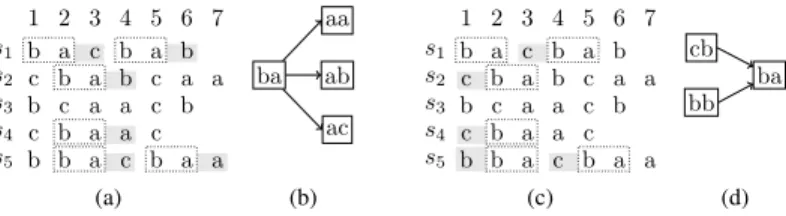
1 2 3 4 5 6 7 s1 b a c b a b s2 c b a b c a a s3 b c a a c b s4 c b a a c s5 b b a c b a a
Figure 1: SupportS(ba) = {(1, 1), (1, 4), (2, 2), (4, 2), (5, 2), (5, 5)}, RCS(ba) =
{ε, c, cb, cba, cbab, b, bc, bca, bcaa, a, ac, cbaa}, LCS(ba) = {ε, c, ac, bac, b, bbac} and
dS(ba) = 0. One has RCS(ba) ∩ Σ = {a, b, c}. Thus, the word ba is not right extensible
in S (see Def.2.2).
xythe concatenation of x and y. For every 1≤ i ≤ j ≤ |x|, x[i] denotes the i-th letter of x, and x[i .. j] denotes the substring or factor x[i]x[i + 1] . . . x[ j]. Let k be a positive integer. If|x| ≥ k, f irstk(x) is the prefix of length k of x and lastk(x) is the suffix of length k of
x. A substring of length k of x is called a k-mer of x. For i such that 1≤ i ≤ |x| − k + 1, (x)k,iis the k-mer of x starting in position i, i.e.(x)k,i= x[i .. i + k − 1]. Thus we have
f irstk(x) = (x)k,1and lastk(x) = (x)k,|x|−k+1. We denote by♯(Λ) the cardinality of any
finite set Λ.
Let S= {s1, . . . , sn} be a finite set of words. Let us denote the sum of the lengths
of the input strings bykSk := ∑si∈S|si|. We denote by FSthe set of factors of words of
S. For a word w of FS,
• SupportS(w) is the set of pairs (i, j), where w is the substring (si)|w|, j. SupportS(w)
is called the support of w in S.
• RCS(w) (resp. LCS(w)) is the set of right context (resp. left context) of the word
win S, i.e. the set of words w′such that ww′∈ FS(resp. w′w∈ FS).
• ⌈w⌉Sis the word ww′where w′is the longest word of RCS(w) such that SupportS(w) =
SupportS(ww′). In other words, such that w and ww′have exactly the same
sup-port in S.
• ⌊w⌋Sis the word w′where w′is the longest prefix of w such that
SupportS(w′) 6= SupportS(w).
• dS(w) := |⌈w⌉S| − |w|.
In other words,⌈w⌉Sis the longest extension of w having the same support than w
in S, while⌊w⌋Sis the shortest reduction of w with a support different from that of w
in S. These definitions are illustrated in a running example, with
S:= {bacbab, cbabcaa, bcaacb, cbaac, bbacbaa}, presented in Fig.1.
We give the definition of a de Bruijn graph for assembly (dBG for short), which differs from the original definition of a complete graph over all possible words of length
kstated by de Bruijn [8].
Definition 2.1 Let k be a positive integer and S := {s1, . . . , sn} be a set of n words.
1 2 3 4 5 6 7 s1 b a c b a b s2 c b a b c a a s3 b c a a c b s4 c b a a c s5 b b a c b a a (a) ba ab aa ac (b) 1 2 3 4 5 6 7 s1 b a c b a b s2 c b a b c a a s3 b c a a c b s4 c b a a c s5 b b a c b a a (c) ba cb bb (d)
Figure 2: Examples of arcs from DBG+k. (a)letters in the right context of ba, and(b)
the successors of node ba in DBG+2; one for each letter in RCS(w) ∩ Σ.(c)letters in the
left context of ba, and(d)the predecessors of node ba in DBG+2.
(V+, E+), whose vertices are the k-mers of words of S and where an arc links u to v if
and only if u and v are two successive k-mers of a word of S,i.e.: V+:= FS∩ Σkand
E+:= {(u, v) ∈ V+2| last
k−1(u) = f irstk−1(v) and v[k] ∈ RCS(u)}.
Examples of arcs are displayed on Fig.2.
Let us introduce now the notions of extensibility for a substring of S and that of a Contracted dBG (CdBG for short).
Definition 2.2 (Extensibility) Let w be a word of FS, w isright extensible in S if and
only if♯(RCS(w) ∩ Σ) = 1 and w is left extensible in S if and only if ♯(LCS(w) ∩ Σ) = 1.
As S is clear from the context, we simply omit the “in S”. Let w be a word of Σ⋆. The word w is said to be a unique k′-mer of S if and only if k′≥ k and for all
i∈ [1..k′− k + 1], (w)
k,i∈ FSand for all j∈ [1..k′− k], (w)k, jis right extensible and
(w)k, j+1is left extensible.
Definition 2.3 A contracted de Bruijn graph of order k, denoted by CDBG+k = (Vc+, Ec+),
is a directed graph where:
Vc+= {w ∈ Σ⋆| w is a k′-mer unique maximal by substring and k′≥ k} and Ec+= {(u, v) ∈
Vc+2| lastk−1(u) = f irstk−1(v) and v[k] ∈ RCS(lastk(u))}.
Note that in the previous definition, an element w in Vc+does not necessarily belong to FS, since w may only exist as the substring of the agglomeration of two words of
S. Thus, let w be a k′-mer unique maximal by substring with k′≥ k: lastk(w) is not
right extensible or RCS(lastk(w)) ∩ Σ = {a} and lastk−1(w) · a is not left extensible,
f irstk(w) is not left extensible or LCS( f irstk(w)) ∩ Σ = {a} and a · f irstk−1(w) is not
right extensible. With this argument, we have both following propositions. Proposition 1 Let(u, v) ∈ E+
c;(lastk(u), f irstk(v)) ∈ E+and there exists w∈ V+such
that(w, f irstk(v)) ∈ E+\{(lastk(u), f irstk(v))} or (lastk(u), w) ∈ E+\{(lastk(u), f irstk(v))}.
Proposition 2 Let(u, v) ∈ E+. If u is right extensible and v is left extensible, then there exists w∈ Vc+such that uv[k] is a substring of w. Otherwise, there exists (u′, v′) ∈ Ec+
such that u= lastk(u′) and v = f irstk(v′).
According to Prop. 1 and2, CDBG+k is the graph DBG+k where the arcs(u, v) are contracted if and only if u is right extensible and v is left extensible.
3
Definition of de Bruijn Graphs with words
Let k be a positive integer. We define the following three subsets of FS.
• InitExactS,k= {w ∈ FS| |w| = k and dS(w) = 0}
• InitS,k= {w ∈ FS| |w| ≥ k and dS( f irstk(w)) = |w| − k}
• SubInitS,k= InitExactS,k−1
A word of InitExactS,k is either only the suffix of some si or has at least two right
extensions, while the first k-mer of a word in InitS,k\ InitExactS,k has only one right
extension.
Proposition 3 InitExactS,k= InitS,k∩ {w ∈ FS| |w| = k}.
For w an element of InitS,k, f irstk(w) is a k-mer of S. Given two words w1et w2of
InitS,k, f irstk(w1) and f irstk(w2) are distinct k-mers of S. Furthermore for each k-mer
w′of S, there exists a word w of InitS,ksuch that f irstk(w) = w′. From this, we get the
following proposition.
Proposition 4 There exists a bijection between InitS,kand the set of the k-mers of S.
According to Def. 2.1and Prop.4, each vertex of DBG+k can be assimilated to a unique element of InitS,k. To define the arcs between the words of InitS,k, which
correspond to arcs of DBG+k, we need the following proposition, which states that each single letter that is a right extension of w gives rise to a single arc.
Proposition 5 For w∈ InitExactS,k and a∈ Σ ∩ RCS(w), there exists a unique w′∈
InitS,ksuch that lastk−1(w)a is a prefix of w′.
The set InitS,krepresents the nodes of DBG+k. Let us now build the set of arcs that is
isomorphic to E+. Let w be a word of InitS,kand Succ(w) denote the set of successors
of f irstk(w): Succ(w) := {x ∈ InitS,k| ( f irstk(w), f irstk(x)) ∈ E+}. We know that for
each letter a in RCS(w), there exists an arc from f irstk(w) to f irstk(last|w|−1(w)a) in
DBG+k. We consider two cases depending on the length of w:
Case 1 |w| = k. According to Prop.3, w∈ InitExactS,kand hence lastk−1(w) ∈ SubInitS,k.
Therefore, the outgoing arcs of w in DBG+k are the arcs from w to w′satisfying the condition of Prop.5. Then,
Succ(w) = ∪a∈Σ∩RCS(w)⌈lastk−1(w)a⌉S.
Case 2 |w| > k. As w is longer than k, it contains the next k-mer; hence
f irstk(last|w|−1(w)a) = f irstk(last|w|−1(w)), and there exists a unique
outgo-ing arc of w: that from w to ⌈w[2 .. k]⌉S. Indeed, by definition of InitS,k,
⌈w[2 .. k]⌉S∈ InitS,k, and thus Succ(w) = {⌈w[2 .. k]⌉S}.
Now, we can build integrally DBG+k or more exactly an isomorphic graph of DBG+k. Thus for simplicity, from now on we confound the graph we build with DBG+k. To do the same with CDBG+k, we need to characterise the concepts of right and left extensi-bility in terms of word properties. By the construction of DBG+k, we have the following results.
Proposition 6 Let w be a word of InitS,k. f irstk(w) is right extensible if and only if
|w| > k or ♯(RCS(w) ∩ Σ) = 1.
Proposition 7 Let w be a word of InitS,ksuch that f irstk(w) is right extensible. Let the
letter a be the unique element of RCS( f irstk(w)) ∩ Σ, then lastk−1( f irstk(w))a is left
extensible if and only if♯(SupportS( f irstk(w))) = ♯(SupportS(lastk−1( f irstk(w))a) \
{(i, 1) | 1 ≤ i ≤ n}).
We present a generic algorithm to build incrementally CDBG+k. In the following sections, we exhibit algorithms to compute DBG+k and CDBG+k for two important in-dexing structures.
4
Transition from the suffix tree to de Bruijn graphs
A generalised ST (GST) can index the substrings of a set of words. Generally for this sake, all words are concatenated and separated by a special symbol not occurring elsewhere. However, this trick is not compulsory, and an alternative is to keep the indication of a terminating node within each node.
4.1
The Suffix Tree and its properties
The Generalised Suffix Tree (GST) of a set of words S is the suffix tree of S, where each word of S does not finish necessarily by a letter of unique occurrence. Hence, for each node v of the GST of S, we keep in memory the set, denoted by SuffS(v), of pairs
(i, j) such that the word represented by v is the suffix of sistarting at position j. Let us
denote by T the GST of S (from now on, we simply say the tree) and by VT its set of
nodes. For v∈ VT, Children(v) denotes its set of children and f (v) its parent.
Some nodes of T may have just one child. The size of the union of SuffS(v) for
all node v of T equals the number of leaves in the GST when the words end with a terminating symbol. Hence, the space to store T and the sets SuffS(.) is linear in kSk.
By simplicity, for a node v of T , the word represented by v is confused with v. For each node v of T , v∈ FS. As all elements of FSare not necessarily represented by a node of
T, we give the following proposition.
Proposition 8 The set of nodes of T is exactly the set of words w of FS such that
dS(w) = 0.
We recall the notion of a suffix link (SL) for any node v of T (leaves included). Let
sl(v) denote the node targeted by the suffix link of v, i.e. sl(v) = v[2 .. |v|]. By definition of a suffix tree, for all w∈ FS, there exists a node v of T such that w is a prefix of v. Let
v′the node of minimal length of T such that w is a prefix of v, then|v′| = |w| + d
S(w),
and therefore⌈w⌉S= v′.
Proposition 9 Let w∈ FS. Then|⌈w⌉S| ≥ |w| > | f (⌈w⌉S)|, where f (⌈w⌉S) is the parent
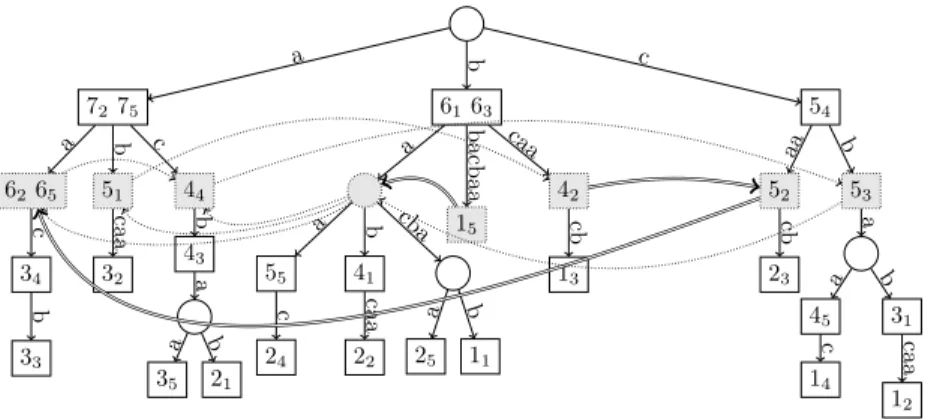
7275 6265 34 33 b c a 51 32 caa b 44 43 35 a 21 b a b c a 6163 55 24 c a 41 22 caa b 25 a 11 b cba a 42 13 cb caa b 54 52 23 cb aa 53 45 14 c a 31 12 caa b a b c 15 b ac b aa
Figure 3: The GST for our running example and the constructed dBG for k := 2. Square nodes represent words that occur as a suffix of some si, circle nodes are the other nodes
of T . Grey nodes represent the vertices of the dBG. Each square node contains ijwhen
it represents the suffix of sj starting at position i. The curved arrows are the edges of
the dBG; those in dotted lines correspond toCase 1and those in doubled lines toCase 2(see p.7).
4.2
Construction of DBG
+kLet[x1..xm] be the set of k-mers of S. According to the definition of InitS,k and to
Prop.4, InitS,k= [⌈x1⌉S..⌈xm⌉S]. Thus, by Prop.9, InitS,k= {v ∈ VT | | f (v)| < k and
|v| ≥ k}. Similarly, InitExactS,k= {v ∈ VT | |v| = k}. Now, it appears clearly that
InitExactS,kis a subset of InitS,k, since for all v∈ VT,| f (v)| < |v|.
We consider the same two cases as for the construction of E+on p.5, but in the case of a tree. Let v∈ InitS,k.
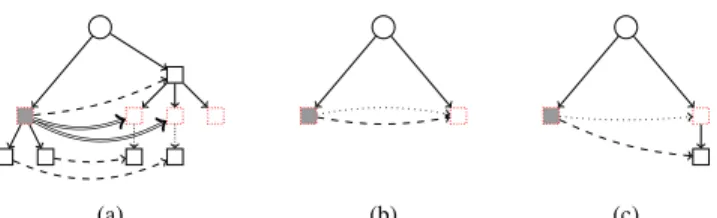
Case 1 |v| = k (Fig.4a). As v∈ InitExactS,k, sl(v) ∈ SubInitS,k. Therefore, each child
uof sl(v) is an element of InitS,k. Thus, the outgoing arcs of v in DBG+k are the
arcs from v to the child u of sl(v) where the first letter of the label between sl(v) and u is an element of the right context of v. As the set of the first letters of the label between v and children of v is exactly RCS(v) ∩ Σ, the number of outgoing
arcs of v in DBG+k is the number of children of v. To build the outgoing arcs of v in DBG+k, for each child u′ of v, we associate v with the node of InitS,k
between the root and sl(u′), i.e. ⌈ f irstk(sl(u′))⌉S.
Case 2 |v| > k (Fig. 4b and4c). We have that sl(v) is a node of VT. As |v| > k,
|sl(v)| ≥ k. Thus, there exists an element of InitS,kbetween the root and sl(v).
We associate v with this node, i.e.⌈ f irstk(sl(v))⌉S.
We illustrate these two cases in Fig.3. For Case 1: v is 6265, sl(v) is 7275, the
unique child u′of v is 34, and sl(u′) is 44, which is in Init
S,k. For Case 2: v is 15,
sl(v) is 25, and⌈ f irst
(a) (b) (c)
Figure 4: Figures(a),(b)and(c)showCase 1andCase 2for the arcs of DBG+k. The grey node is v. The dashed arcs correspond to suffix links. The arcs of the dBG are in bold(a)for theCase 1and in dotted lines(b) (c)for theCase 2.
In both cases, building the arcs of E+requires to follow the SL of some node. The node, say u, pointed at by a SL may not be initial. Hence, the initial node representing the associated first k-mer of u is the only ancestral initial node of u. We equip each such node u with a pointer p(u) that points to the only initial node on its path from the root. In other words, for any u∈ Init/ S,ksuch that|u| > k, one has p(u) := ⌈ f irstk(u)⌉S.
The algorithm to build the DBG+k is as follows. A first depth first traversal of T allows to collect the nodes of InitS,kand for each such node to set the pointer p(.) of
all its descendants in the tree. Finally to build E+, one scans through InitS,kand for
each node v one adds Succ(v) to E+using the formula given above. Altogether this
algorithm takes a time linear in the size of T . Moreover, the number of arcs in E+is linear in the total number of children of initial nodes. This gives us the following result. Theorem 10 For a set of words S, building the de Bruijn Graph of order k, DBG+k
takes linear time and space in|T | or in kSk.
4.3
Construction of CDBG
+kIn Section3, we have seen an algorithm that allows to compute directly CDBG+k pro-vided that one can determine if a node v is right extensible and if next(v) is left exten-sible, where next(v) denotes the only successor of v. Let us see how to compute the extensibility in the case of a Suffix Tree.
By applying Prop. 6 in the case of tree, for an element v of InitS,k, f irstk(v) is
right extensible if and only if|v| > k or ♯(Children(v)) = 1. Thus checking the right extensibility of a node takes constant time.
For the left extensibility of the single successor of a node, one only needs the size of support of some nodes (Prop.7). Let us see first how to compute♯(SupportS(.)) on
the tree, and then how to apply Prop.7.
Proposition 11 Let v be a word of FS and VT(⌈v⌉S) denotes the set of nodes of the
subtree rooted in⌈v⌉S. SupportS(v) = ∪v′∈VT(⌈v⌉S)SuffS(v
′).
Along a traversal of the tree, we compute and store♯(SupportS(v)) and
♯(SupportS(v) ∩ {(i, 1) | 1 ≤ i ≤ n}) for each node v in linear time in |T |.
Case 1 If|v| = k then f irstk(v) = v and ♯(Children(v)) = 1. Let u be the only child
of v. Thus, |u| > k, ♯(RCS(v) ∩ Σ) = {u[k + 1]}, and lastk−1(v)u[k + 1] =
f irstk(sl(u)). Hence, ♯(SupportS(v)) = ♯(SupportS( f irstk(sl(u))) \ {(i, 1) |
1≤ i ≤ n}) and by Prop.7, f irstk(sl(u)) is left extensible.
Case 2 If|v| > k then ♯(RCS( f irstk(v)) ∩ Σ) = {v[k + 1]} and lastk−1( f irstk(v)) · v[k +
1] = lastk( f irstk+1(v)) = f irstk(sl(v)). By Prop.7, f irstk(sl(v)) is left
exten-sible if and only if
♯(SupportS( f irstk(v))) = ♯(SupportS( f irstk(sl(v))) \ {(i, 1) | 1 ≤ i ≤ n})
As♯(SupportS( f irstk(v))) = ♯(SupportS(⌈ f irstk(v)⌉S)) and ♯(SupportS(v)\{(i, 1) |
1≤ i ≤ n}) = ♯(SupportS(v)) − ♯(SupportS(v) ∩ {(i, 1) | 1 ≤ i ≤ n}), determining if
next(v) is left extensible takes constant time. To conclude, as for any initial node v, we can compute in O(1) its set of successors Succ(v), its right extensibility, and the left extensibility of its single successor, we obtain a complexity that is linear in the size of
DBG+k, since each successor is accessed only once. This yields Theorem12.
Theorem 12 For a set of words S, building the Contracted de Bruijn Graph of order
k, CDBG+k takes linear time and space in|T | or in kSk.
5
dBG and CdBG from Suffix Array
For lack of space the reader is referred to [4] for the full details.
Theorem 13 The dBG of order k, CDBG+k, for a set of words S can be built in a time and space that are linear inkSk using the generalised suffix array of S.
6
Dynamically updating the order of DBG
+
.
Genome assembly from short reads requires to test multiple values of k for the dBG. Indeed, the presence of genomic repeats, makes some order k appropriate to assemble non repetitive regions, and larger orders necessary to disentangle (at least some) re-peated regions. Combining assemblies obtained from DBG+k for successive values of
kis the key of IDBA assembler, but the dBG is rebuilt for each value [13]. Other tools also exploit this idea [2]. It is thus interesting to dynamically change the order of the dBG. Here, we argue that starting the construction from an index instead of the raw sequences ease the update. On page7, we mention which information are needed in general to build DBG+k. Assume the words are indexed in a suffix tree T (as in Sec-tion4.2). Consider changing k to k− 1. First, only the nodes of InitS,kwhose parent
represents a word of length k− 1 are substituted by their parent in DBG+k−1, all other nodes remain unchanged. Thus, any arc of order k either stays as such or has some of its endpoints shifted toward the parent node in T . In any case, updating an arc de-pends only on the nature of its nodes in DBG+k−1(whether they belong to InitS,k−1 or
InitExactS,k−1), and can be computed in constant time.
The same situation arises when changing k to k+1. First, only nodes of InitExactS,k
on the nature of its nodes: it can create a fork towards the children of the destination node if the latter changes, or it can be multiplied and join each children of the source to one children of the destination if both nodes change. Then, the label of the children in T indicate which children to connect to. It can be seen that updating from DBG+k to
DBG+k+1in either direction takes linear time in the size of T . Moreover, as updating the support of nodes in T is straightforward, we can readily apply the contraction algorithm to obtain CDBG+k+1(see Section4.3).
References
[1] A. Apostolico. The myriad virtues of suffix trees. In A. Apostolico and Z. Galil, editors, Combinatorial Algorithms on Words, volume 12 of NATO Advanced
Sci-ence Institutes, Series F, pages 85–96. Springer, 1985.
[2] A. Bankevich, S. Nurk, D. Antipov, A. A. Gurevich, and et al. SPAdes: a new genome assembly algorithm and its applications to single-cell sequencing.
Jour-nal of ComputatioJour-nal Biology, 19(5):455–477, 2012.
[3] A. Bowe, T. Onodera, K. Sadakane, and T. Shibuya. Succinct de Bruijn Graphs. In WABI, volume 7534 of LNCS, pages 225–235, 2012.
[4] B. Cazaux, T. Lecroq, and E. Rivals. From Indexing Data Structures to de Bruijn Graphs. Technical report, lirmm-00950983, Feb. 2014.
[5] R. Chikhi, A. Limasset, S. Jackman, J. Simpson, and P. Medvedev. On the repre-sentation of de Bruijn graphs. ArXiv e-prints, Jan. 2014.
[6] R. Chikhi and G. Rizk. Space-efficient and exact de Bruijn graph representation based on a Bloom filter. Algorithms for Molecular Biology, 8:22, 2013.
[7] T. C. Conway and A. J. Bromage. Succinct data structures for assembling large genomes. Bioinformatics, 27(4):479–486, 2011.
[8] N. de Bruijn. On bases for the set of integers. Publ. Math. Debrecen, 1:232–242, 1950.
[9] D. Gusfield. Algorithms on strings, trees and sequences: computer science and
computational biology. Cambridge University Press, Cambridge, 1997.
[10] U. Manber and G. Myers. Suffix arrays: a new method for on-line string searches.
SIAM J. Comput., 22(5):935–948, 1993.
[11] T. Onodera, K. Sadakane, and T. Shibuya. Detecting superbubbles in assembly graphs. In WABI, volume 8126 of LNCS, pages 338–348. 2013.
[12] J. Pell, A. Hintze, R. Canino-Koning, A. Howe, J. Tiedje, and C. Brown. Scaling metagenome sequence assembly with probabilistic de Bruijn graphs. Proc. Natl
[13] Y. Peng, H. Leung, S. Yiu, and F. Chin. IDBA A Practical Iterative de Bruijn Graph De Novo Assembler. In RECOMB, volume 6044 of LNCS. 2010.
[14] P. Pevzner, H. Tang, and M. Waterman. An Eulerian path approach to DNA fragment assembly. Proc. Natl Acad. Sci. USA, 98(17):9748–9753, 2001. [15] E. A. Rødland. Compact representation of k-mer de Bruijn graphs for genome
read assembly. BMC Bioinformatics, 14:313, 2013.
[16] L. Salmela. Correction of sequencing errors in a mixed set of reads.
Bioinformat-ics, 26(10):1284–1290, 2010.
[17] J. T. Simpson and R. Durbin. Efficient construction of an assembly string graph using the FM-index. Bioinformatics, 26(12):i367–i373, 2010.