HAL Id: tel-00827926
https://tel.archives-ouvertes.fr/tel-00827926v2
Submitted on 26 Jun 2013HAL is a multi-disciplinary open access
archive for the deposit and dissemination of sci-entific research documents, whether they are pub-lished or not. The documents may come from teaching and research institutions in France or abroad, or from public or private research centers.
L’archive ouverte pluridisciplinaire HAL, est destinée au dépôt et à la diffusion de documents scientifiques de niveau recherche, publiés ou non, émanant des établissements d’enseignement et de recherche français ou étrangers, des laboratoires publics ou privés.
Alban Gaignard
To cite this version:
Alban Gaignard. Distributed knowledge sharing and production through collaborative e-Science plat-forms. Other [cs.OH]. Université Nice Sophia Antipolis, 2013. English. �NNT : 2013NICE4010�. �tel-00827926v2�
Sciences et Technologies de l’Information et de la Communication
THÈSE
pour l’obtention du grade de
Docteur en Sciences
de l’Université de Nice-Sophia Antipolis
Mention : I
NFORMATIQUEPrésentée et soutenue par
Alban G
AIGNARD
Distributed knowledge sharing and
production through collaborative e-Science
platforms
Thèse dirigée par Johan MONTAGNAT
preparée au laboratoire I3S, CNRS UMR-7271, équipe MODALIS
soutenue le 15 mars 2013Jury
Rapporteurs : Oscar CORCHO - Associate Professor, Universidad Politécnica de Madrid
Ollivier HAEMMERLÉ - Professeur, Université Toulouse le Mirail
Directeur : Johan MONTAGNAT - DR CNRS, Laboratoire I3S
Président : Andrea TETTAMANZI - Professeur, Université Nice Sophia Antipolis
Examinateurs : Olivier CORBY - CR INRIA, Laboratoire I3S
Bernard GIBAUD - CR INSERM, Laboratoire LTSI
Invitée : Catherine FARONZUCKER - Maître de Conférence, Université Nice Sophia Antipolis Cette oeuvre est mise à disposition selon les termes de la license Creative Commons Attribution - Pas d’Utilisation
avec moi dans cette aventure enrichissante. Ce travail doit beaucoup à sa rigueur méthodologique, expérimentale, à son goût pour les idées et projets scientifiques mêlant à la fois réalisme et ambition, à son exigence, à sa capacité d’écoute et à ses encourage-ments constants.
Ce travail n’aurait pas pu voir le jour sans le soutien actif de la direction du labora-toire I3S, Luc Pronzato puis Michel Riveill. Ce soutien m’a permis, parallèlement à des activités transverses de support, de mener des activités de recherche sur une thématique scientifique qui me tient à coeur. Merci en particulier à Michel Riveill de m’avoir soutenu et mis le pied à l’étrier, dès notre toute première rencontre.
Je tiens également à remercier les membres du jury d’avoir accepté d’évaluer mes travaux. Merci à Ollivier Haemmerlé pour l’étendue de son rapport et le temps consacré à l’examen de ce manuscrit, pour ses remarques constructives et ses encouragements.
Quisiera también agradecer a Oscar Corcho por aceptar esta tarea de evaluación. Gra-cias por su tiempo, sus comentarios constructivos y sus sugestiones para seguir adelante. Ces travaux ont été menés à l’interface entre plusieurs disciplines dans un contexte collaboratif (projets ANR NeuroLOG et VIP). Merci à Bernard, Tristan, Franck, Germain, Rafael pour l’efficacité, le sérieux, et la qualité des échanges dans ces travaux d’équipe (que les distances soient courtes, pour Franck mon co-bureau ou plus longues).
Merci également à Olivier et Catherine pour leur grande disponibilité et leur impli-cation dans ces travaux menés à l’interface entre systèmes distribués et ingénierie des connaissances.
I would also like to thank Silvia for allowing me to participate in the organization of an international scientific conference. This event was really a nice and enriching experi-ence.
Pour leur bonne humeur, l’ambiance chaleureuse, les repas partagés, merci aux mem-bres des équipes Rainbow, Modalis, et Wimmics, et particulièrement "aux" Philippes (Philippe L., Philippe C., Filip K., Philippe R.), à Mireille, Diane, Clémentine, Nadia, Sébastien, Simon, Stéphane, Jean-Yves, Gaëtan, Javier, Tram, Ketan.
Enfin, merci à Stéphane R.-D., pour sa curiosité, ses relectures approfondies et ses questionnements philosophiques. Plus généralement, merci à mes proches, famille et amis, pour leur présence indéfectible.
Merci à Ana pour sa patience, sa confiance, son soutien, et ces belles années.
1 Introduction 1
1.1 Context, motivations and objectives . . . 1
1.2 Research questions . . . 4
1.3 Thesis contributions . . . 6
1.3.1 Secured collaborations . . . 6
1.3.2 Knowledge base federation . . . 6
1.3.3 Semantic scientific workflows. . . 7
1.4 Applicative context: neurosciences and medical image simulation . . . 7
1.4.1 Collaborative neuroscience (NeuroLOG project) . . . 8
1.4.2 Multi-modal and multi-organ medical image simulation (VIP project) 10 1.5 Thesis outline . . . 13
I Sharing distributed resources in life-Sciences 15 2 Knowledge sharing in collaborative life-sciences: state of the art 17 2.1 Introduction . . . 17
2.1.1 Life-science resources . . . 18
2.1.2 Data representation and understanding . . . 19
2.1.3 Data integration: approaches and challenges . . . 20
2.2 Background informations on semantic data: representation, querying, rea-soning and persistency . . . 26
2.2.1 Semantic data representation . . . 26
2.2.2 Semantic data querying . . . 30
2.2.3 Semantic reasoning . . . 31
2.2.4 Semantic data persistency . . . 35
2.3 Virtualized data integration . . . 40
2.3.1 Distributed query processing approaches . . . 40
2.3.2 Discussion . . . 47
2.4 Data sharing through Life-science collaborative platforms . . . 48
2.4.1 Life-science collaborative platform examples . . . 48
2.4.2 Discussion . . . 52
2.5 Conclusion . . . 53
3 Secured collaborations in a life-science platform 55 3.1 Introduction . . . 55
3.1.1 Motivations . . . 56
3.1.2 Related works . . . 57
3.2 Life-science distributed security model. . . 61
3.2.1 From independent to collaborative trust domains . . . 61
3.2.2 Data protection . . . 61
3.2.3 Decentralized access control policy. . . 62
3.3 Results and implementation . . . 63
3.3.1 Use case: secured sharing of datasets through decentralized RBAC 63 3.3.2 Implementation . . . 65
3.4 Discussion and conclusion . . . 68
4 Semantic data and query distribution 71 4.1 Introduction . . . 71
4.2 Strategies for semantic query distribution . . . 74
4.2.1 Abstract knowledge graphs . . . 74
4.2.2 Distributed Query Processing principles . . . 75
4.2.3 Query rewriting optimizations . . . 77
4.2.4 Federator parallelism optimizations . . . 84
4.3 Distributed query processing performance and scalability evaluation . . . 88
4.3.1 Impact of the query rewriting optimizations . . . 91
4.3.2 Impact of the federator parallelism optimizations . . . 92
4.3.3 Impact of the dynamic source selection . . . 95
4.3.4 Impact of the edge grouping algorithm . . . 95
4.4 Discussion and conclusion . . . 99
II Extending knowledge bases through scientific workflows 103 5 Semantic services in scientific workflows 105 5.1 Introduction . . . 105
5.2 Semantic Web Services . . . 106
5.2.1 From service models to semantic web services . . . 108
5.2.2 From legacy web services to semantic web services . . . 109
5.2.3 Applied Semantic Web Services. . . 112
5.2.4 Positioning our contributions towards Semantic Scientific Workflows114 5.3 Provenance in scientific workflows . . . 115
5.3.1 Scientific workflows . . . 116
5.3.2 Domain-agnostic provenance . . . 117
5.3.3 Provenance and interoperability . . . 118
5.3.4 Meaningful, domain-specific provenance . . . 120
5.3.5 Positioning the provenance-based e-Science experiment summaries 121 5.4 Conclusion . . . 123
6.1 Introduction . . . 125
6.2 Motivating use case . . . 128
6.3 Background information . . . 129
6.3.1 Role modeling. . . 129
6.3.2 Roles in web service ontologies . . . 129
6.4 Knowledge capture in neuroimaging data processing . . . 131
6.4.1 Supporting ontologies . . . 131
6.4.2 Role concepts . . . 133
6.4.3 Differentiating neuroimaging Natural and Role concepts . . . 133
6.5 Knowledge extension through semantic workflow runs . . . 135
6.5.1 OPM provenance ontology . . . 135
6.5.2 Reusable and service independent rules to infer new meaningful statements . . . 136
6.6 Discussion and conclusion . . . 138
III Implementation and Evaluation 141 7 Implementation 143 7.1 Introduction . . . 143
7.2 Supporting semantic scientific workflows: NeuSemStore . . . 144
7.2.1 Features summary . . . 145
7.2.2 Architecture . . . 146
7.2.3 Discussion . . . 149
7.3 Semantic federation engine: KGRAM -DQP . . . 150
7.3.1 Features summary . . . 150
7.3.2 Architecture . . . 150
7.3.3 Integration of KGRAM-DQP within the existing framework . . . . 152
7.3.4 Discussion . . . 153
7.4 Conclusion . . . 153
8 Experimental evaluation 155 8.1 Introduction . . . 155
8.2 Large scale experiments . . . 156
8.2.1 Querying distributed DBpedia datasets . . . 157
8.2.2 The “FedBench” federation benchmark . . . 162
8.3 Federating distributed and heterogeneous neuroscience data sources with KGRAM . . . 169
8.3.1 Material and methods . . . 170
8.3.2 Results and discussion . . . 175
8.4 A real-life medical imaging simulation workflow: semantic mash-up ex-periment to infer meaningful exex-periment summaries . . . 178
8.4.1 Materials and methods. . . 179
8.4.2 Results and discussion . . . 186
8.5 Conclusion . . . 192
IV Conclusions 195 9 Conclusion and perspectives 197 9.1 Contributions summary . . . 197
9.2 Future directions . . . 199
9.2.1 Towards high performance semantic distributed querying . . . 199
9.2.2 Towards highly expressive semantic distributed querying . . . 199
9.2.3 Towards versatile and reliable knowledge-based data federations . 201 9.2.4 Towards reduced information overload in e-Science . . . 203
9.3 Concluding remarks . . . 204
V Appendix 207 10 Appendix 209 10.1 FedBench Life Science Queries . . . 209
1.1 The NeuroLOG platform eases the setup of neuroimaging multi-centric
studies through a semantic driven data federation. . . 9
1.2 The VIP platform, easing the access to medical image simulators, organ models, and leveraging the EGI distributed computing infrastructure to handle heavy simulation. . . 12
2.1 A sample materialized data integration where data from several dis-tributed and heterogeneous data sources is extracted, transformed and loaded into a centralized data warehouse. . . 21
2.2 A sample federated data integration setup in which result data is dynam-ically retrieved from multiple distributed and heterogeneous data sources through query rewriting and distributed query evaluation. . . 22
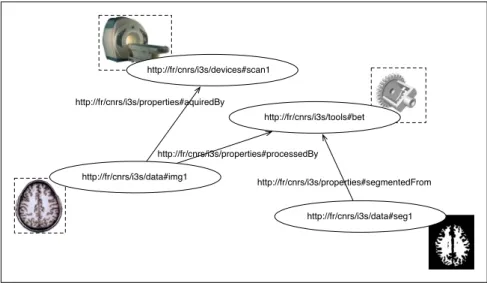
2.3 Linking raw and processed data to the acquisition equipment and process-ing tool . . . 27
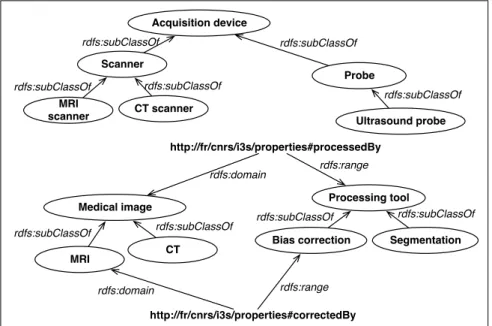
2.4 A sample controlled vocabulary expressed in RDFS . . . 28
3.1 Bridging independent sites trust domains. . . 62
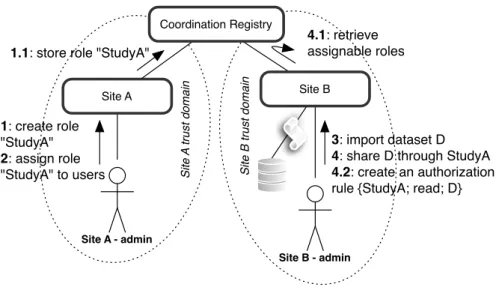
3.2 Activities involved in coherently sharing data. . . 64
3.3 Decentralized access control . . . 65
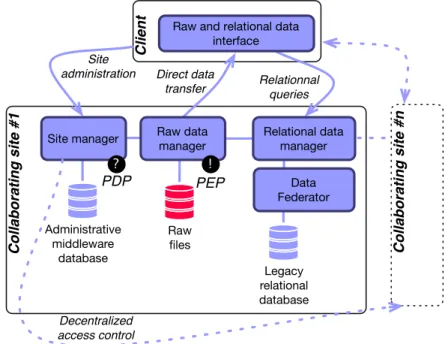
3.4 Policy decision and enforcement points in the NeuroLOG middleware. . . 66
4.1 Graph-based querying with KGRAM. . . 75
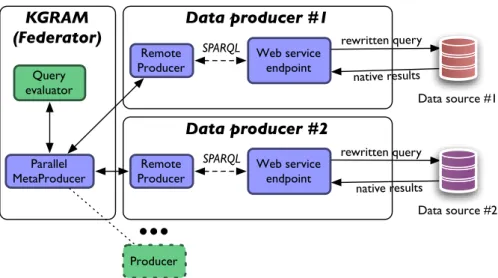
4.2 Distributed semantic query processing with KGRAM . . . 87
4.3 Semantic distributed query processing with KGRAM . . . 89
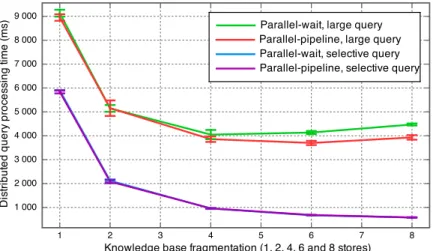
4.4 Impact of the federator parallelism optimization on a medium size (338K triples) knowledge base, fragmented into 1, 2, 4, 6 and 8 distributed stores. The parallel-pipeline strategy is beneficial for queries producing a lot of in-termediate results.. . . 93
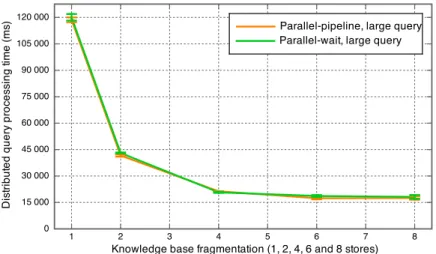
4.5 Decreasing distributed query processing (DQP) time for a large scale knowledge base (1.7M triples) fragmented into 1, 2, 4, 6 and 8 data stores, under full query rewriting strategy. . . 94
5.1 The main causal dependencies introduced in the OPM provenance model. 119 6.1 A typical neuroimaging workflow mixing several nature of data and pro-cessing. . . 126
6.2 Linking data and processes through generic and domain-specific relations. 128 6.3 A domain-specific role taxonomy characterizing how neuroimaging data can be related to neuroimaging processing tools. . . 134
6.5 OPM provenance statements tracked from the invocation of the running
example (Figure 6.1). . . 136
6.6 OPM statements tracked through the invocation of the registration workflow.137
6.7 Reusable inference rule automating the annotation of superimposable
im-ages. . . 138
7.1 A graphical user interface aiming at semantically annotating a
grid-instrumented jGasw service with VIP ontology concepts. . . 145
7.2 A graphical user interface aiming at navigating within process-oriented
provenance and data-oriented-provenance. . . 146
7.3 A UML static class diagram illustrating the main Java classes composing
the NeuSemStore framework. . . 147
7.4 An UML static class diagram illustrating the main Java classes composing the KGRAM distributed query processing extension. Green classes
repre-sent the KGRAM extensions dedicated to the distributed query processing. 151
8.1 Decreasing distributed query processing (DQP) time for a large scale knowledge base (1.7M triples) fragmented through up to 16 data stores,
under full query rewriting strategy. . . 159
8.2 Compared to a single distributed endpoint, both distributed queries are “supra-effective”. In the case of the less selective query Q8.2, the
dis-tributed querying becomes “ineffective” starting from 8 federated endpoints.160
8.3 Starting from 8 federated endpoints, the distribution algorithm becomes
less efficient due to communication overhead. . . 161
8.4 Compared to state-of-the-art federation approaches, the KGRAM federa-tion engine is able to process all FedBench Life Science queries. It delivers results in a reasonable amount of time, sometimes faster than AliBaba or
DARQ. . . 165
8.5 Comparing FedX and KGRAM mean evaluation time through the
Fed-Bench Life-Science queries. . . 168
8.6 Data management layer of the initial NeuroLOG platform. . . 171
8.7 Distributed semantic and relational metadata querying through the
KGRAM federated engine. . . 172
8.8 Simplified graphical representation of the SORTEOPET medical image
sim-ulation workflow. . . 180
8.9 A screenshot of the full OPM graph tracked through the invocation of the
Sorteo workflow. . . 182
8.10 A filtered OPM provenance graph with removed rdf:type properties for the
main OPM classes such as Artifact, Used, WasGeneratedBy, etc. . . 183
8.11 New inferred meaningful statements (dashed arrows) constituting the
se-mantic experiment summary. . . 186
ing a single week). Only 2656 triples summarize 118 medical image simu-lations while more than 15000 provenance triples were stored for a single
2.1 Comparison of several existing stores regarding their storage back-end and
reasoning capabilities . . . 39
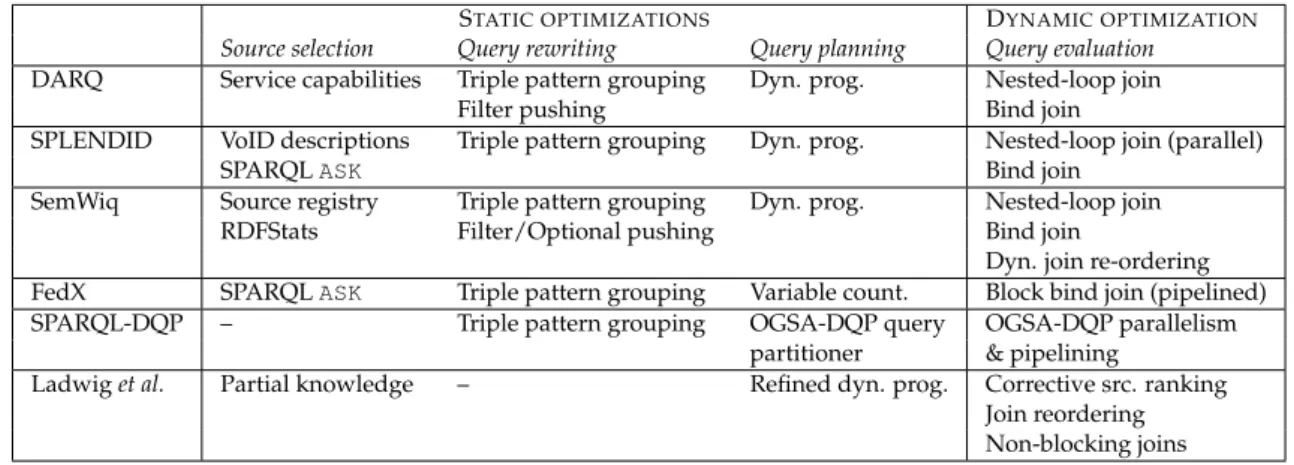
2.2 Static and dynamic optimizations proposed by state-of-the-art federated
querying approaches. . . 47
4.1 Mapping between RDF(S) and abstract knowledge graph representations 74
4.2 Searching, over two distributed DBpedia datasets, . . . 91
4.3 Evaluation of the time needed to perform each edge request. The
combi-nation of both filter and binding strategies shows the best results. . . 92
4.4 Several distributed query processing times under the parallel-wait and
parallel-pipeline strategies for the non-selective query Q4.9 performed over
8 inhomogeneous knowledge bases. . . 94
4.5 FedBench results for the KGRAM federation engine with and without
source selection. . . 95
4.6 Prohibitive evaluations (Q4.12) can be achieved in a reasonable amount of
time through edge grouping optimizations (Q4.13). . . 98
5.1 Despite most approaches cover annotation and discovery, none of them
address all challenges and target the domain experts. . . 114
8.1 Four experiments exploring several challenges related to Distributed
sys-tems, Knowledge engineering, or e-Science areas. . . 156
8.2 FedBench Life Science data collection (49M triples) fragmented over 6 data
sources. . . 163
8.3 FedBench results for the KGRAM federation engine considering both
vir-tual and physical federations. . . 164
8.4 Updated FedBench Life Science data collections (52M triples) fragmented
over 5 data sources. . . 166
8.5 10 consecutive evaluations of the FedBench Life-Science queries with the
FedX engine show an important variability for LS2 and LS6. . . 167
8.6 Stable 10 consecutive evaluations of the FedBench Life-Science queries
with the KGRAM engine. . . 167
8.7 Comparison of the KGRAM distributed query processing with the
DataFederator commercial tool achieving relational federated querying. . . 176
1 Sequencial distributed query processing, waiting after each remote
invoca-tion. . . 77
2 initIdxEdgeSrc(exp, idxEdgeSrc) initializes an index associating an edge
request to a set of data sources, based on SPARQL ASKqueries. . . 82
3 Initialization of an index associating data sources to a set of hosted edges.
The initialization is based on the reversed index previously introduced in
algorithm 2 . . . 83
4 Generation of SPARQLSERVICEclauses, based on the idxSrcEdge
associat-ing data sources and the correspondassociat-ing hosted edges.. . . 84
5 rewriteQueryWithServices(exp,idxSrcEdge)) introduces SPARQL 1.1SER
-VICEclauses in a SPARQL query based on the previously introduced index. 85
6 Fine-grained parallel distributed query processing, with an explicit wait
condition. . . 86
7 Edge producer for the parallel-pipelined strategy . . . 88
8 Edge consumer for the parallel-pipelined strategy . . . 88
9 the next() operation aimed at retrieving the next available object in the
syn-chronized queue, waiting if needed. . . 89
10 the hasNext() operation aimed at checking if the synchronized queue has a
Contents
1.1 Context, motivations and objectives . . . 1
1.2 Research questions . . . 4
1.3 Thesis contributions . . . 6
1.3.1 Secured collaborations . . . 6
1.3.2 Knowledge base federation . . . 6
1.3.3 Semantic scientific workflows. . . 7
1.4 Applicative context: neurosciences and medical image simulation . . . 7
1.4.1 Collaborative neuroscience (NeuroLOG project) . . . 8
1.4.2 Multi-modal and multi-organ medical image simulation (VIP project) 10 1.5 Thesis outline . . . 13
1.1 Context, motivations and objectives
From the first digital computers to the Data Deluge.Digital computers have been originally designed in the 1950s to automate calculation tasks [Holbrook and Brown,1982]: “[...] calculations were performed in part with slide rules and, mainly, with desk calculators. The magnitude of this load of very tedious routine computation and the necessity of carefully checking it indicated a need for new methods”. As an extension of these calculation tasks, digital computers have rapidly been dedicated to data processing and analysis.
In parallel with the continuous increase of computing and storage capacity of digital computers [Moore,1965], the need for (tele)communicating data through computers led to their massive and systematic interconnection in networks. The Internet was born in the 1990s as a global world-wide network of computers. The (World Wide) Web [Berners-Lee et al.,1994] led to the fast adoption of the Internet. The Web has generalized, on a global scale, the access to information through hypertext documents. Following the example of interconnected computers in networks, Web documents are linked together through
HyperText links. These links allow users to read and transparently navigate, without
specifying documents locations, into a global network of documents.
The generalization of (i) computers, with to a continuous increase of their computing, storage and communication capacities, and (ii) a Web which evolved from interconnected
documents towards interconnected data (or things), leads nowadays to massive data ac-quisition, production, and publication (also known as Data Deluge) which exceeds by far our current data processing and analysis capacities [Bell et al.,2009] [Baraniuk,2011].
As an example, high energy physics experiments conducted by CERN on the Large Hadron Colider (LHC) produced in 2010 13 petabytes of data. This amount of data would represent a 14 km high tower of CD-ROMs [Brumfiel, 2011]. To support these experiments, data is processed through a dedicated large-scale distributed computing infrastructure, the LHC Computing Grid, comprising around 200.000 computing cores, 150 petabytes of storage, and distributed over 34 countries. As another example, the Google web search engine was processing in 2008 more than twenty petabytes of data per day [Dean and Ghemawat, 2008]. Beyond pure data, we also witness a noticeable increase of medical knowledge discovery since 800.000 medical articles were catalogued in 2008 and 1 million articles were expected for 2012 [Gillam et al.,2009].
This massive and often poorly coordinated data production raises the general issue of finding the appropriate information in an unprecedented amount of data, spread at an unprecedentedly large scale.
Translational research in the Data Deluge.
Scientific activities nowadays face the data explosion challenge. Paradoxically, continu-ously producing more data does not imply that we have a better access to information and better means to interpret, analyze data, possibly opening opportunities for scientific discoveries. Data is massively produced from diverse sources, geographically dispersed, and constrained under their proper governance model. Data explosion is not only a mat-ter of volume but also a matmat-ter of diversity [Goble and Stevens,2008]: “Not only are the datasets growing in size and number, but they are only partly coordinated and often incompati-ble” [Goble and Roure,2009].
Translational science results from the need to cross several data, and several methods, both originating from diverse sources and scientific disciplines to more rapidly trans-late research outcomes. Translational science needs to cope with the multiplicity of data sources, their diversity, their size, while still considering data as hardly relocatable. The cost of copying large amount of data to a single workstation might be non realistic due to the multiplicity and the size of sources. In addition, distributing data to several in-dependent research centers may require dedicated and expensive infrastructures, which are often not affordable in the context of academic scientific research: “For research to be affordable, data analysis must increasingly be done where data sets reside [...]” [Bell et al.,2009]. Moreover, in a life-science context, biomedical data are sensitive and non relocatable for legal or ethical reasons.
Translational medicine thus faces the challenging issues of efficiently and coherently integrating large, but also diverse, distributed data, involving both structural1 and
se-mantic2heterogeneity.
1e.g. data may be expressed in incompatible formats.
lational research, in this context, raises the issues of poorly coordinated data production from diverse and autonomous data sources, resulting in data heterogeneity. Translational research discoveries are consequently conditioned by the way we handle the distribution of massive, and diverse, data. How to search over multiple distributed and autonomous data sources ? How to efficiently find data ? How to interpret the resulting data originat-ing from these diverse data sources ?
Understanding and integrating diverse data through Knowledge Engineering methods and Semantic Web technologies.
To coherently integrate multi-sources data, scientists need to have a clear understanding of the content of data sources. Knowledge Engineering, a discipline that emerged from Artificial Intelligence, is dedicated to build scalable knowledge based systems [Studer
et al.,1998]. In the context of the continuous increase of available data sources,
Knowl-edge Engineering has gained a lot of interest to ease the understanding of diverse data and their coherent integration. The Semantic Web is a technological layer based on Knowledge Engineering principles and applied at the scale of the Web: “information is given a well-defined meaning, better enabling computers and people to work in coopera-tion” [Berners-Lee et al.,2001]. More recently, Linked Data principles [Bizer et al.,2009a] more directly addressed the issue of the increase of data sources at the scale of the Web: “Linked Data is simply about using the Web to create typed links between data from different sources. These may be as diverse as databases maintained by two organizations in different ge-ographical locations, or simply heterogeneous systems within one organization that, historically, have not easily interoperated at the data level”. We have been moving from human-readable interlinked documents (the Web) to machine-readable interlinked resources, at global scale, with explicit and formal meaning (Knowledge Engineering).
Semantic e-Science.
Translational science relies on computing infrastructures to foster cooperations/collab-orations and shorten the “time-to-discovery”. E-Science [Hey and Trefethen,2005] ap-peared in this context of “Data Deluge” in which scientists need to achieve compute in-tensive tasks in highly distributed environments. We envisage in this thesis collaborative e-Science platforms as means to (i) perform in-silico experiments (ii) share the involved resources, and (iii) produce new meaningful information. For instance, such platforms should allow scientists to evaluate a single data analysis procedure onto several shared databases. Another typical use case would consist in comparing several data analysis procedures provided by several partners with a common reference database.
Reusing and re-purposing data sources is a major concern in this context of growing availability of, possibly opened, (linked-)data sources [Fox and Hendler,2009]. Seman-tic e-Science relies on SemanSeman-tic Web technologies and standards to address the sharing
and cooperation challenges of data-intensive science. Semantic approaches for e-Science allow scientists to refer to common conceptual referents (ontologies or controlled vocab-ularies) so that the interpretation of diverse multi-source data is facilitated. Beyond data integration, methods integration is also facilitated by Semantic approaches, easing the composition of data processing units through scientific workflows.
Objectives of this work.
To address the data volume, data distribution and data heterogeneity issues arising from medical translational research in the Data Deluge, the main objective of this thesis is to tackle the coherent production and sharing of knowledge in life-science.
The main challenge for knowledge sharing is to be able to perform advanced querying on diverse and multi-source data while still considering data sources as dynamic and autonomous.
Scientific data analysis procedures participate to the massive production of data whose interpretation is difficult, even for e-Scientists. Data might be considered as noisy, foggy, due to their volume and to the lack of clear meaning, thus hampering their inter-pretation and analysis. The underlying idea of knowledge production is that e-Science data analysis procedures, without being instrumented with knowledge engineering, con-tribute to the Data Deluge in its negative aspect. They massively feed data stores with hardly searchable / interpretable data. How to, on one hand, ease the access and the interpretation of massive diverse multi-sources data, while on the other hand producing new data, positively feeding the Data Deluge ?
The knowledge production challenge addressed in this thesis consists in tackling the production of a limited amount of meaningful data – opposed to the systematic produc-tion of generic technical (meaningless) data – so that data interpretaproduc-tion keeps simple, but not simpler3.
1.2 Research questions
In this thesis manuscript, we investigate how to coherently produce and share
knowl-edge from distributed Life-science resources. To address this general research question,
we will defend the following 3 thesis:
the federation of distributed resources (versus centralized warehousing) becomes a cornerstone to enhance the adoption and the scalability of col-laborative e-Science platforms.
T2 Large-scale data analysis or processing is complex for end-users.
Enhanc-ing e-Science platforms with Knowledge EngineerEnhanc-ing reduces the com-plexity of experiments setup, and eases the exploitation of data analyzed or produced.
T3 Widely spread into Life-science communities, Knowledge Engineering
methods and Semantic Web technologies are at the heart of domain mod-eling, and a foundation for knowledge sharing and capitalization.
While T1 is related to how is envisaged the architectural setup for resource distribution
in the general research question, T2 and T3are more related to the semantic coherency of
sharing and the expected knowledge resulting from the usage of collaborative platforms.
More precisely, we will address in the remainder of this manuscript the following con-crete questions :
RQ1 How to collect knowledge from multiple distributed data sources.
RQ1will lead to strong architectural constraints to address
distri-bution issues, and covers the areas of Distributed databases, Dis-tributed Query Processing, and Knowledge Representation (T1,
T3).
RQ2 How to enable collaborations in a competitive environment.
RQ2depends on architectural choices resulting from Q1and
cov-ers Security in Distributed Systems (T1).
RQ3 How to optimize the semantic querying over distributed resources.
RQ3 also depends on RQ1 architectural choices (T1, T3) and is
directly related to distributed query processing, knowledge rep-resentation and retrieval.
RQ4 How to correctly annotate produced data with semantics.
RQ4covers Knowledge Representation and semantic description
of data analysis procedures (T3).
RQ5 How to enhance the understanding of scientific data analysis results.
RQ5 also depends on RQ4 and covers Provenance (in scientific
1.3 Thesis contributions
Investigating these concrete research questions led to three main contributions in the fields of distributed knowledge bases and scientific data analysis procedures (modeled and digitally represented through workflows). Two of them focus on knowledge sharing in the context of e-Science platforms, through (i) “secured collaborations”, which address the control of data sharing in a competitive environment, and (ii) “knowledge base feder-ation”, which provides efficient and still expressive enough distributed query processing over scattered Semantic Web data graphs. The third contribution of this thesis focuses on the “production of knowledge based on the exploitation of workflow runs in e-Science platforms”. It provides meaningful experiment summaries leveraging domain ontologies and eases the understanding of massively produced data through “in silico” experiments.
1.3.1 Secured collaborations
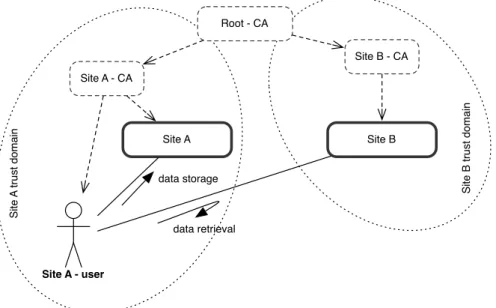
We propose in this thesis a model for secured collaborations in the context of distributed e-Science platforms. Distributed access control strategies have been proposed and im-plemented in the NeuroLOG neuroimaging platform, thus allowing the setup of multi-centric studies. This approach, based on classical public key infrastructures (PKIs), in-troduce an original and pragmatic strategy to enable collaborations in a competitive en-vironment (RQ2). This work has been published in the HealthGrid’09 conference as a
short paper [Gaignard and Montagnat,2009] and has been integrated and used in pro-duction in the NeuroLOG middleware [Montagnat et al.,2008b]. Secured collaborations are described in the chapter3of this manuscript.
1.3.2 Knowledge base federation
The second contribution of this thesis addresses the sharing of knowledge distributed over multiple data sources possibly participating in e-Science collaborative platforms. In the context of collaborative platforms dedicated to life-sciences, the autonomy prop-erty of participating data providers is fundamental. Indeed, for ethical or legal is-sues, it is generally not possible to re-locate sensitive data outside the data provider sites. For this reason, data warehousing approaches are disqualified. We propose in this thesis, transparent and efficient semantic federated querying strategies. Transpar-ent, in the sense that the query engine interprets standard SPARQLqueries and thus does
not require explicit distribution directives to be provided by query designers. Effective, in the sense that the cost of transparent federated querying is reduced through a set of static and dynamic optimizations. Moreover, our approach is based on abstract knowl-edge graphs and thus allows mediating structural heterogeneity, as soon as data sources can provide a graph view on hosted data. This approach allows to efficiently collect knowledge (RQ3) fragmented over distributed semantic repositories (RQ1), thus easing
knowledge sharing through collaborating data providers. Our approach for transpar-ent semantic federated querying is precisely described in chapter4 and its implemen-tation is described in chapter7. Our approach has been evaluated in a real controlled
workshop [Gaignard et al.,2012b] of the IC’12 conference, dedicated to semantic interop-erability in e-Health, in the MICCAI-DCICTAI workshop [Gaignard et al.,2012a] of the MICCAI’12 international conference, dedicated to Data- and Compute-Intensive Clinical and Translational Imaging Applications, and as a research paper of the Web Intelligence (WI’12) international conference [Corby et al.,2012]. Finally, this work let us envisage the evolution of the NeuroLOG platform from classical relational database federation to-wards semantic knowledge base federation, thus enabling distributed reasoning. It opens new research perspectives such as those currently under investigation by the CrEDIBLE4
initiative, tackling the new challenges of massive scientific data management.
1.3.3 Semantic scientific workflows
The last salient contribution of this thesis addresses the production of knowledge through the usage of e-Science platforms. On one hand, ontological modeling ap-proaches and knowledge engineering techniques are nowadays a corner-stone to provide meaningful and coherent data integration, and thus ease the navigation within the deluge of heterogeneous data the scientific communities are facing. On the other hand, scientific workflows, based on service oriented architectures, became the agreed paradigm to pro-cess data and finally populate scientific databases. We propose in this thesis to bridge together scientific workflows and domain ontologies to (i) assist in silico experiment de-signers in semantically composing data processing services together, through semanti-cally annotated composable services (RQ4), and (ii) to assist scientists in the exploitation
of their massive processed data (RQ5) through semantic experiment summaries, based
on technical fine-grained provenance information, and inference rules involving con-cepts and properties of domain ontologies. This work has been introduced in the IC’10 national workshop [Gaignard and Montagnat, 2010] dedicated to the medical seman-tic web, and presented in the KEOD’11 international conference [Gaignard et al.,2011], focusing on the requirements for role taxonomies to disambiguate the semantic annota-tion of data processing services. This work is extensively described in chapters6, and in the experimental evaluations presented in chapter8. Finally, this approach has been implemented through the NeuSemStore software framework introduced in chapter 7. NeuSemStore is currently used in production in the NeuroLOG neuroimaging platform and the VIP [Forestier et al.,2011a] virtual imaging platform.
1.4 Applicative context: neurosciences and medical image
simu-lation
This work took place in the context of two projects funded by the French National Re-search Agency (ANR): the NeuroLOG project (ANR-06-TLOG-024) and the VIP project (ANR-09-COSI-03). These two projects share methodological commonalities as they both
heavily rely on Lifscience ontologies and in-silico experiments performed through e-Science workflows.
1.4.1 Collaborative neuroscience (NeuroLOG project)
The NeuroLOG project [Montagnat et al.,2008b], [Michel et al.,2010], aimed at federat-ing four neuroscience research centers in France. It enables collaborative neurosciences through the support of multi-centric studies and the coherent sharing of large population datasets and neuroimaging processing tools.
Motivations and challenges. The NeuroLOG project has been driven by four test-bed
clinical application: multiple sclerosis, brain strokes, brain tumors and Alzheimer’s dis-ease. In this clinical context, neuroscientists manage, process and analyze a huge variety of data. Neuroimages differ by their nature (modalities for neuroimaging data such as T1 or T2 MRI, MRIs with gadolinium contrast agent, Diffusion MRI, etc.) and their struc-ture (several neuroimaging data formats such as DICOM, Nifti, Analyze, etc.). Moreover neuroimaging studies relies on the setup of brain image databases in which raw data are complemented with descriptive metadata. These metadata may describe the context of the clinical studies, the data acquisition protocols, the examined subjects, and the scores of neuropsychological tests. Data and metadata involved in neuroscience studies are thus highly heterogeneous both in terms of nature and structure. Coherently sharing these data and metadata is challenging and requires advanced neuroimaging data integration. Neuroscientists require means to achieve collaborative multi-centric studies, to coher-ently share valuable data or data analysis procedures. However, due to the sensitivity of data and the competitive nature of scientific research, neuroscientists want to collaborate but often in a limited extent, i.e. with a subset of the partners and over a subset of the available neuroimaging resources (both data and tools). The autonomy of neuroscience research centers must be guaranteed in terms of (i) daily operation of legacy databases, and (ii) access control over the hosted resources, which is partly conflicting with the setup of large-scale multi-centric studies.
Finally, neuroimaging data analysis pipelines involve generally several complex pro-cessing steps, and may be launched over large population datasets. The cost of these analysis procedures can be handled through large-scale distributed computing infras-tructures such as the EGI European Grid. However, these infrasinfras-tructures are difficult to comprehend for non IT experts. Although they propose security over distributed com-puting resources, they are not yet convincing in terms of sites autonomy, and resources access control.
Objectives. The NeuroLOG platform addresses several challenging issues when
ad-dressing the setup of multi-centric collaborative neurosciences. First it needs to lever-age existing large-scale distributed computing infrastructures while still guaranteeing the autonomy of participating sites. Then, it needs to address the distribution and the
population datasets and data analysis procedures.
NeuroLOG thus aims at easing the setup of neuroscience multi-centric studies through an ontology driven sharing of (i) complex data analysis workflows, enacted over dedicated large-scale distributed computing infrastructures, and (ii) autonomous, heterogeneous and distributed neuroimaging data sources.
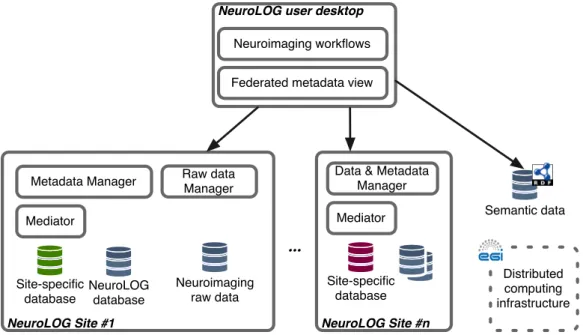
Platform coarse-grained architecture. Figure 1.1 illustrates the main components of the NeuroLOG platform. It consists in a middleware which coordinates several neuro-science research centers while still guaranteeing their autonomous operation. NeuroLOG sites are thus loosely coupled. They present data and metadata interfaces which adapt, through a mediator, to the specificities of their legacy databases.
NeuroLOG Site #1 Metadata Manager Distributed computing infrastructure Neuroimaging raw data Site-specific database Semantic data NeuroLOG database Mediator
NeuroLOG user desktop
Federated metadata view Neuroimaging workflows
NeuroLOG Site #n •••
Data & Metadata Manager Site-specific database Mediator Raw data Manager
Figure 1.1: The NeuroLOG platform eases the setup of neuroimaging multi-centric studies through a seman-tic driven data federation.
NeuroLOG metadata manager: data sharing has been driven in NeuroLOG by a
se-mantic approach. The NeuroLOG ontology has been developed to provide a uni-form and strong conceptualization of the neuroimaging domain. This ontology has then been derived into a relational schema aimed at providing a federated view over the heterogeneous site-specific legacy databases. Each site thus exposes its (read-only) legacy database through a mediator and allows uniform querying over the distributed legacy databases. In addition on each site, a writable NeuroLOG database is deployed, natively using the federated schema. This database aims at storing the data produced by the neuroimaging workflows enacted through the platform.
NeuroLOG semantic data repository: to allow rich semantic querying, a semantic data
store was periodically populated from the federated relational databases based on an SQL-to-RDF mapping tool.
NeuroLOG raw data manager: the raw data manager aims at retrieving and storing
raw neuroimaging files, indexed either in the legacy database, or in the NeuroLOG database. Raw neuroimaging data are considered as sensitive and the raw data manager thus requires strong access control, taking into account local security poli-cies.
NeuroLOG user desktop: the NeuroLOG client application mainly presents two facets.
First, a user interface aims at navigating and searching for available distributed data, in the context of multi-centric studies. Then, once selected, data can be pushed as input data of neuroimaging workflows which are enacted over either local or global (EGI infrastructure) computing resources.
NeuroLOG challenges provide strong motivations for this thesis. NeuroLOG fed-erates four neuroscience research centers and opfed-erates at a national scale (IFR49-Paris, GIN-Grenoble, IRISA-Rennes, INRIA-Sophia Antipolis). The heterogeneity and the po-tential volume of neuroimaging data correspond to the problematics of the data deluge considered in this work (RQ1).
Moreover NeuroLOG integrates two levels of metadata representation, distributed relational data and centralized semantic data. This is confusing from an end-user per-spective, due to different levels of query expressivity, and different distribution setups. Indeed, federated query processing has been implemented for relational databases in NeuroLOG but distributed querying technologies were not yet mature for handling distributed semantic data sources. In addition, NeuroLOG faces the issue of periodi-cally synchronizing a centralized semantic data repository, based on distributed and au-tonomous relational data sources, which also presents a single point of failure. In this context, studying how to combine expressive querying and distributed semantic data stores seems particularly appealing (RQ3).
Finally, NeuroLOG, as a collaborative e-Science platform, faces the challenge of easing the setup of multi-centric studies, while still guaranteeing the autonomy of participating data sources, at least in terms of access control. This security issue (RQ2) is relevant in
the context of this thesis since working with life-science resources differs from working with open datasets, due to legal or ethical concerns.
1.4.2 Multi-modal and multi-organ medical image simulation (VIP project) The Virtual Imaging Platform (VIP) [Glatard et al., 2013] addresses multi-modal and multi-organ medical image simulation. A medical image simulation consists in com-bining, i) a description of a medical image acquisition device, specifying its physical characteristics and its parameters, ii) a description of the simulation scene, specifying the geometry and the spacial coordinates of both the device and the object for which
(possibly pathological) or physiological objects.
Medical image simulation is envisaged in VIP as multi-modal and multi-organ. Multi-modal, because the platform integrates several simulators and predefined sim-ulation workflows for each modality (Computed Tomography, Magnetic Resonance, Positron Emission Tomography, and Ultrasound) ; and multi-organ, because the platform allows for using several anatomical or physiological models.
Motivations and challenges. This platform has been first motivated by medical image
simulation needs. Simulating the production of medical images is crucial when designing and prototyping new medical imaging devices. Moreover it is possible to perform several acquisition protocols on a single device. Simulation is also crucial when prototyping new acquisition protocols.
Beyond device manufacturers, simulating medical images is also interesting for sci-entists involved in medical image processing. Synthetic medical images are a form of ground truth needed when evaluating or comparing image processing algorithms. In addition, these synthetic medical images can be used to adapt the parameters of the anatomical/pathological models, to finally obtain more realistic simulation results.
Finally, having a platform which eases the production of synthetic medical images based on several medical image modalities and several anatomical models has lot of ed-ucational interests. Indeed, such a platform can help students focusing on the physi-cal, anatomiphysi-cal, pathologiphysi-cal, or physiological parameters of a simulation rather than the technical specifies of several independent simulators.
Performing medical image simulation is challenging due to the following reasons. First, simulators are complex softwares with a steep learning curve (fine parameteriza-tion, requiring for a deep understanding of their physical principles) and hardly interop-erable. Second, the organ models are also complex, possibly involving complex anatom-ical/pathological characteristics, movement or longitudinal follow-up. Finally, from a computing perspective, realistic simulation are heavy, in terms of calculation tasks, and thus require dedicated computing infrastructures.
Objectives. The VIP platform aims first at easing the access to medical image
simula-tors through a simple web interface which integrates several simulasimula-tors, several organ models, and leverage a dedicated distributed computing infrastructure required to han-dle multiple heavy simulation tasks. The second objective of the platform is to ease the sharing of both organ models, and simulators, following a semantic approach.
Platform architecture. Figure1.2 illustrates the main components of the VIP platform which, based on organ models such as the thorax model on the left part of the figure, allows producing synthetic medical images of this model, such as the CT and PET virtual acquisitions on the right part of the figure.
VIP Platform
VIP Portal
Simulated data VIP Execution Service
VIP Data Service Distributed computing infrastructure
Organ models Simulation workflows
Figure 1.2: The VIP platform, easing the access to medical image simulators, organ models, and leveraging the EGI distributed computing infrastructure to handle heavy simulation.
VIP Portal: the portal component provides a user interface with a direct web access
without requiring any software installation on the user workstation. Basically, it allows end-users to launch medical image simulations by selecting the appropriate simulator and specifying its parameters based on already launched simulations or new set of parameters. When launched, simulation tasks can be monitored through the portal. Due to their computing cost and their complex distribution over the EGI distributed computing infrastructure, it is important to provide information on the status of running simulations.
VIP Catalogs: the VIP platform is based on two main catalogs corresponding to the left
and right parts of figure 1.2. The organ model catalog is a semantic repository which stores, for each model, the set of its source raw files, and a set of semantic annotations leveraging the VIP simulation ontology. It allows associating a clear and formal meaning to organ model entities, and performing advanced querying. Similarly, the simulated data catalog consists in a set of semantic annotations de-scribing the nature of simulated data (their modality, their physical characteristics, etc.) based on the VIP ontology, and their provenance, in terms of input organ models and input parameters.
VIP Execution service: the execution service is based on the MOTEUR data-driven
workflow engine which handles the parallelization and the relocating of computing tasks. Simulation workflows are executed on the VIP platform and the generated computing tasks are processed on dedicated computing resources (the EGI euro-pean grid infrastructure).
VIP Data service: the data service is responsible for achieving the data transfers
be-tween the VIP platform and the EGI storage elements. Simulation processes are computed on the EGI resources and require having data stored and accessible be-forehand. At the end of a simulation, end-users want to retrieve their simulated data, and the data service is responsible for transferring back, on-demand, the re-sulting data through the portal.
sis. Indeed VIP is an e-Science platform in which simulation workflows can be considered as heavy “in silico” experiments. Medical image simulations are demanding in terms of computing resources, and VIP relies as a consequence on the EGI large-scale distributed computing infrastructure. Between november 2011 and november 2012, 1155 simulations were run, which corresponds to almost 400 CPU years, for 321 registered user originating from 38 countries.
VIP massively produces simulated data. It faces the issue of coherently sharing both the input organ models, the simulator themselves, the simulated data and their associ-ated knowledge. VIP faces the issues of producing not only raw data, but also populat-ing the simulated-data repository with meanpopulat-ingful data (RQ4, RQ5), bridging the gap
between the technical simulation workflows and the VIP domain ontology.
1.5 Thesis outline
This report is organized in three parts. Part I addresses the coherent sharing of knowl-edge in the context of digital life-science platforms. Part II addresses the coherent pro-duction of knowledge resulting from the usage of e-Science platform. Finally, part III presents how the thesis contributions have been implemented and evaluated, mainly in terms of querying scalability and expressivity, and in terms of automated knowledge production in a concrete medical image analysis scenario.
The remainder of this document is organized as follows:
Chapter 2: We first delineate, valuable life-science resources in the context of
collabora-tive e-Science platforms, and we introduce the main approaches and challenges of life-science data integration (RQ1). One of the challenges consists in providing rich
enough information sharing while still taking into account the specificities of life-science data sources. We then provide some background information on semantic data and analyze state-of-the art approaches targeting virtualized semantic data in-tegration (RQ4). We finally explore how data integration issues have been faced
through concrete and significative life-science collaborative platforms.
Chapter 3: We focus in the security issues arising from the setup of life-science
multi-centric studies (RQ2). After introducing the security requirements for life-science
collaborations, and analyzing the related works, we propose a security model which addresses mainly two partly conflicting objectives: (i) guaranteeing au-tonomous distributed life-science data sources with prevailing access control poli-cies, and (ii) allowing for data sharing through coherent multi-centric studies. The implementation of the proposed security strategies is then described in the context of the NeuroLOG platform. This chapter is based on [Gaignard and Montagnat,
Chapter 4: We propose a set of strategies and algorithms dedicated to the efficient
dis-tributed query processing over multi-source semantic data (RQ1, RQ3), while still
allowing for high expressivity with respect to the SPARQL 1.1 language features. Then we propose first experiments aimed at assessing the benefits of our approach (more deeply evaluated through chapter 8). This chapter is based on [Gaignard et al.,2012b], [Gaignard et al.,2012a], [Corby et al.,2012], and concludes the part I of this report, dedicated to knowledge sharing in collaborative life-science plat-forms.
Chapter 5: Towards automated knowledge production in e-Science platforms (RQ5), we
analyze first the state-of-the-art approaches aimed at bridging web services with domain ontologies, and by extension, at providing semantic scientific workflows. Then, we describe and discuss approaches based on provenance information result-ing from workflow runs. We finally position our proposal for semantic e-Science experiment summaries with respect to semantic workflows and provenance-based approaches.
Chapter 6: We highlight the need for precise enough semantic service annotations, both
in terms of the nature of parameters, but also in terms of their role. We introduce the need for roles modeling in service ontologies to disambiguate the meaning of consumed and produced data through processing services involved in workflows. Based on disambiguated semantic service annotations and fine-grained technical provenance information, we then propose to automatically produce, through infer-ence rules, new meaningful semantic annotations, leveraging domain ontologies and workflow runs. This chapter is based on [Gaignard and Montagnat, 2010] and [Gaignard et al., 2011], and concludes the part II of this report, dedicated to automated knowledge production in collaborative life-science platforms.
Chapter 7: This chapter provides technical details on the implementation of our
contri-butions. The NeuSemStore framework is first introduced as a mean to support se-mantic scientific workflows. Then, we technically described the distributed query processing extensions of the KGRAM framework which implements our approach for knowledge base federation.
Chapter 8: This chapter reports an experimental evaluation of the methods proposed
and the software designed. It consists in three experiments exploring how the dis-tributed query processing with KGRAM behaves at large scale, and in terms of heterogeneity and expressivity. We also explore through a real-life medical image analysis workflow, how our approach towards automated knowledge production allows better interpretation of workflows results.
Sharing distributed resources in
life-Sciences
life-sciences: state of the art
Contents
2.1 Introduction . . . 17
2.1.1 Life-science resources . . . 18
2.1.2 Data representation and understanding . . . 19
2.1.3 Data integration: approaches and challenges . . . 20
2.2 Background informations on semantic data: representation, querying, rea-soning and persistency . . . 26
2.2.1 Semantic data representation . . . 26
2.2.2 Semantic data querying . . . 30
2.2.3 Semantic reasoning. . . 31
2.2.4 Semantic data persistency . . . 35
2.3 Virtualized data integration . . . 40
2.3.1 Distributed query processing approaches . . . 40
2.3.2 Discussion . . . 47
2.4 Data sharing through Life-science collaborative platforms . . . 48
2.4.1 Life-science collaborative platform examples . . . 48
2.4.2 Discussion . . . 52
2.5 Conclusion . . . 53
2.1 Introduction
Collaborative e-Science platforms (also known as “scientific gateways”) are developed to ease the setup of scientific collaborations. These collaborations require exchanging scien-tific data and/or associated data analysis tools, in order to reduce the "time-to-discovery". In this thesis, we address data sharing issues, in the context of life-sciences, through the coherent integration of multi-source data (RQ1). We both consider raw data, and
asso-ciated domain-specific knowledge to achieve coherent integration of heterogeneous data sources.
This chapter delineates the contributions of this thesis with respect to the state-of-the-art approaches in semantic data integration. We first introduce specific resources under-lying life-science collaborative platforms (section2.1.1), general data representations and understanding layers (section2.1.2), and the general data integration approaches
(sec-tion2.1.3). Then we provide in section2.2 some background information on semantic
data representation, querying, reasoning and persistency. The most relevant approaches for virtualized semantic data integration are described in section2.3 and recent opera-tional life-science platform are described in section2.4in terms of data and knowledge integration.
2.1.1 Life-science resources
In the context of translational biomedical research, collaborative e-Science platforms gen-erally provide a wide range of resources, covering:
• Data resources correspond to the observational entities previously introduced and possibly associated information or knowledge. Life-science data resources are char-acterized by an important variability in the nature of data. Translational Life-science platforms may manipulate genomic data, micro and macro imaging, clinical case reports, thus facing structural and semantic heterogeneity. Moreover, several open databases may be contributing to the scientific activities conducted in the con-text of a given Life-science platform. Such platforms face distribution and integra-tion issues since data querying should be coherently achieved over several data providers, and coherently integrated back into the Life-science platform.
• Data processing resources are application codes, possibly exposed remotely through processing services. They are responsible for data analysis or data transforma-tions. In the context of e-Science platforms, data processing resources are gener-ally pipelined through scientific workflows to achieve complex data processing. Scientific workflows and their constituting data processing units are more deeply introduced in chapter5.
• Coordinating resources correspond to a set of metadata which coherently associate the raw data to the information needed to achieve a particular, possibly multi-centric, scientific or clinical study. These coordinating resources may involve in-formation on pathologies or epidemiology, on available research or clinical raw datasets, information on open reference databases, information on the coordinator of the study and the participating researchers, etc.
• Middleware resources correspond to a set of software components hiding the un-derlying computing and storage infrastructure. Since the analysis and process-ing of life-science data, especially biomedical imagprocess-ing data, requires compute-and storage-intensive capabilities, collaborative e-science platform generally rely on dedicated high-throughput clusters or open large-scale infrastructures such as
ally provide user interfaces to bridge the gap between e-Science activities and mid-dleware operation, however, user knowledge on the underlying midmid-dleware may be required to understand and analyze possible e-science experiment failures. • Computing and storage resources are a set of physical resources responsible for data
storage and the computations resulting from data processing. Similarly, these re-sources should be hidden from the end-user perspective, but in some cases, in-vestigating e-Science experiment failures may require technical knowledge on the underlying computing or storage infrastructure.
The contributions of this thesis mainly focus on data and data processing resources. Indeed we address in this work (i) the sharing of distributed knowledge associated to biomedical data and (ii) the production of knowledge through the usage of collaborative e-Science platforms, more precisely, through complex data processing achieved by the enactment of semantically enhanced scientific workflows.
2.1.2 Data representation and understanding
Several levels of data understanding are commonly represented through a pyramid grounded on data (observational entities). The data layer is topped with the information layer linking together data entities. The information layer is topped with the knowledge layer which organizes, or categorizes information. The knowledge layer is finally topped with wisdom, considered as a set of knowledge applied to a specific area [Ackoff,1989].
Data results from observational entities.Data is generally qualified as raw data. It may represent sensor acquisitions, medical image acquisitions in the context of the biomed-ical research area, or neuro-psychologbiomed-ical test results in the context of the cognitive-neuroscience community.
Information consists in linked data entities through established relations. In
computer-based systems, information is generally materialized through descriptive metadata phys-ically stored in files of relational databases. For instance some medical image formats include a file header (a text file companion). In the “Analyze” medical imaging format, the raw image file contains binary data and is suffixed with a .img, and a textual metadata file suffixed with .hdr. Metadata describes for instance, the spacial organization of each voxel, thus informing on how voxels are related to image slices, to patient orientation, finally allowing for navigation in 3D medical images and anatomical interpretation.
In the context of biomedical research studies, data are generally organized through databases to facilitate data search and scientific investigation. Relational databases of-fer a mean to represent information in the sense that data and relations are materialized through a set of tables, columns, and associations (through join operators and relation tables).
Knowledge represents the step further, in whichinformation is coherently organized into categories. In the knowledge representation area, ontologies and controlled vocabularies play a key role in categorizing information. Indeed they generally result from a consen-sual community effort, and aim at being adopted by a large community to foster infor-mation understanding, comparison, exchange and reuse.
Knowledge representation systems have traditionally been implemented through Re-lational Database Management Systems (RDBMS) which allow to organize information (relational tuples) through typed columns inside tables. However RDBMS are not con-venient to represent hierarchical organizations commonly used to understand several abstraction (generalization or specialization) layers, and they do not allow automated reasoning (i.e. classifying data) over possibly multiple categories.
Knowledge representation formalisms and languages such as Conceptual Graphs, OWL ontologies or RDF Schemas (RDFS) are dedicated to model the organization of information through categories (OWL or RDFS classes), and allow automated reasoning (entailments) through reasoners or inference engines. In these formalisms, Knowledge can be seen as a graph linking together semantic data entities trough semantic relations (prop-erties). Data and relations are qualified as semantic since they are grounded to meaningful concepts from ontologies or controlled vocabularies. Recently, ontologies have largely been adopted in collaborative e-Science initiatives to both capture domain knowledge, and address interoperability when retrieving data from multiple and heterogeneous data repositories.
Wisdom can be defined as making use ofknowledge. If we stay close to the information technology area, wisdom could be seen as the final, long-term objective of complex systems dedicated to decision support, or artificial intelligence.
With regards to these four layers, the contributions of this thesis, towards distributed knowledge sharing and production in collaborative e-science platforms, focus on both the information layer (the linked data entities) and the knowledge layer (the categorization of information).
2.1.3 Data integration: approaches and challenges
Data integration1consists in providing a unified, transparent, mean to work with
multi-ple distributed data sources. Two main approaches exist to tackle data integration [Haase
et al., 2010], namely, materialized data integration, also known as data warehousing or
Extract-Transform-Load approaches, and virtualized data integration, also known as fed-erated querying or Distributed Query Processing (DQP).
1“Information integration” may also be found in the literature to highlight the understandability of inte-grated data, but in this manuscript, we consider as synonyms “data integration” and “information integra-tion”.
Materialized data integration. This approach consists in populating a centralized
repository from multiple distributed data sources, following an Extract-Transform-Load (ETL) approach. The extract phase consists in selecting, from the available data sources, the target data to be integrated. Then, the transform phase is critical and possibly com-plex. It consists in transforming the target data to obtain an homogeneous representation from the centralized data warehouse perspective. This step addresses structural and/or semantic heterogeneity between data sources and the data warehouse, and each transfor-mation is specific to a data source. Finally, transformed data are aggregated and merged into the centralized data warehouse through the Load phase, possibly addressing redun-dancy and replication issues. Integrated data retrieval is achieved through centralized query processing against the populated data warehouse. Figure2.1 illustrates the gen-eral principles for materialized data integration.
Materialized query processor Data source 1 Data source 2 Data source N Data warehouse Query ETL 1 ETL 2 ET L N resu lts query
Figure 2.1: A sample materialized data integration where data from several distributed and heterogeneous data sources is extracted, transformed and loaded into a centralized data warehouse.
Virtualized data integration. This approach, also known asdata federation, consists on the other hand, in (i) splitting the initial query into subqueries, (ii) then evaluating these subqueries against the multiple distributed data sources, and (iii) finally providing re-sults combined together by the federated querying engine. In federated data integration approaches, data source heterogeneity is addressed through (i) query rewriting mecha-nisms, and (ii) data mediation to coherently fusion the results into a single query results set. Figure2.2illustrates the general principles for virtualized (or federated) data inte-gration.
Federated query processor Data source 1 Data source 2 Data source N Query sub-qu ery sub-query sub-q uery results results results
Figure 2.2: A sample federated data integration setup in which result data is dynamically retrieved from multiple distributed and heterogeneous data sources through query rewriting and distributed query evalu-ation.
To cope with the heterogeneity of multiple data sources, virtualized data integration systems provide a unified querying interface, based on a global schema. The global schema provides an homogeneous model over the organization of distributed data. Since data sources are generally autonomous in their day-to-day operation, they rely on local schemas to model the organization of their data. Inconsistencies between local schemas are tackled through mappings between local schemas and the global schema. Two main approaches are popular to address local schema heterogeneity in federated data integration, Global-as-View and Local-as-Global-as-View.
Definition 1 Global-As-View (GAV) approaches consist in representing the content of the global schema as a view over the data sources [Lenzerini,2002].
GAV approaches are considered as bottom-up approaches since the global schema is built from a set of data sources. The main drawback is that it is not adapted to dynamic federations when a new data source is added to the federation. Indeed, a new source added to the federation involves modifying the global schema. Moreover, a modification in a local schema may have an impact on the overall federation.
Definition 2 Local-As-View (LAV) approaches consist in representing the content of each data source as a view over the global (unifying) schema [Lenzerini,2002].
LAV approaches are considered as top-down approaches since the global schema is fixed a priori, and data source participating into the federation describe the database they want to publish, based on the global schema. The main advantage is that the federation