Clause Chaining, Switch Reference and Coordination
byRafael Nonato
B.A. Linguistics, UNICAMP, 2005 M.A. Linguistics, UNICAMP; 2008
Submitted to the Department of Linguistics and Philosophy in partial fulfillment of the requirements for the degree of
Doctor of Philosophy in Linguistics at the
Massachusetts Institute of Technology February 2014
@
2014 Rafael Nonato. All rights reserved.The author hereby grants to MIT permission to reproduce and to distribute publicly paper and electronic copies of this thesis in whole or in part in any medium now known of hereafter created.
Signature of A uthor ... ...
Depa
Certified by ... ...
Accepted by ...
I
Rafael Nonato rtment of Linguistics and PhilosophyNorvin Richards Professor of Linguistics Thesis Supervisor
David Pesetsky Professor of Linguistics Head, Department of Linguistics and Philosophy
MASSACHUSM ISTWEi-T OF TECHNOLOGY
FEB
2 7
2014
LBRARIES
2
Clause Chaining, Switch Reference and Coordination
byRafael Nonato
Submitted to the Department of Linguistics and Philosophy on February 7th, 2014 in partial fulfillment of the requirements for the degree of Doctor of Philosophy in Linguistics
Abstract
In this thesis I ponder over a constellation of phenomena that revolve around switch reference and coordination, drawing mainly on their instantiation in Kisedje (Je, Brazil). I start by investigating Klsedje's case system. In this language there is a case split along the finite/non-finite axis. I argue that nominative is assigned by INFL, whereas ergative is assigned to the subject of INFL-less clauses. Importantly, the particles I take to instantiated INFL in Kisedje don't have tense semantics, but rather modal semantics.
Investigating other properties of this modal INFL in Klsedje, I can determine the fine structure of its clause. This knowledge allows me to argue that the construction that has been identified elsewhere as clause chaining is actually asymmetric clausal coordination. The special properties that seem to distinguish clause chaining from asymmetric clausal coordination are argued to fall out from the structure of the clause in Kisedje. I further propose that the same type of structure is found in the other languages where asymmetric coordination has been called clause chaining.
Asymmetric clausal coordination in Kisedje features morphology which indicates whether adja-cent conjuncts have the same or different subjects (switch-reference marking). Important evidence for understanding how switch-reference is computed will come from the study of a deletion phe-nomenon that happens in the neighborhood of switch-reference markers in Kisedje. Besides isolat-ing evidence for a direct agreement relation between switch-reference markisolat-ing conjunction and the subject of one of the conjuncts, this study makes a contribution to the theory of morphology.
Knowing the structure of the clause in Kisedje and the featural composition of switch-reference markers allows me to support a specific theory of switch-reference computation. Given this theory, I argue that asymmetric coordination (the kind of coordination where switch-reference is marked) instances an X-structure, whereas symmetric coordination (which can't be marked for switch-reference) instances a flat structure. Such structural difference also allows me to explain other differences between symmetric and asymmetric coordination.
Thesis Supervisor: Norvin Richards Title: Professor of Linguistics
3
Acknowledgments
I would first like to thank the Kisedje people, who allowed me to come into their villages and taught me their language. Thanking the Kisedje feels a bit odd, though, because expressing one's gratitude orally isn't a big part of their culture. You ask what you need and accept what is given to you. Naturally, you also become thankful towards people who are helpful, and will be helpful towards them when you have a chance. Once I came to understand and accept this idea, the empty exchange of a gift for a word, what I grew up doing, started to seem a bit frivolous.
Anyways, I want to thank the Kisedje chief, Kuiussi,l not only because he accepted my research, but specially for adopting me into his numerous family as his tdmthwd 'grandson'. I would like to thank my Kisedje grandmothers, mothers, sisters and aunts for making manioc flour and cooking for us, and my Kisedje fathers, brothers and uncles, who brought fish and game for us. And all of my family, for tolerating and laughing at my ineptness at living the way they do.
Every single member of the community was my teacher, specially the monolingual children and elders. The fact that Kisedje was the only language I could use to communicate with them was a great motivation to really learn it. Some bilingual grown-ups have had the patience of sitting with me for formal elicitation sessions, and I would like to thank them individually: Kawiri, Jamth6, Kamikia, Yac6, Kaomi, Tepnti, Wegmeretxi and Wetajtxi.
I would also like to thank the person who introduced me to the Klsedje, Marcela Coelho de Souza. I came to understand many aspects of the grammar of Kisedje in our conversations about the language. She also taught me most of the things I know about the culture of the Kisedje and about their complicated kinship system. I am also very grateful to the person who introduced me to Marcela, Bruna Franchetto. I hope I didn't let them down.
Since I am talking about origins, let me thank the people who introduced me to the fascinat-ing world of fieldwork: Filomena Sandalo and Norvin Richards. About ten years ago, in the field methods course they co-taught, I found out what I would be doing in ten years.
The five years I spent in Cambridge would have been hard were it not for the delightful company of a little coterie: Sasha Podobryaev, Natasha Ivlieva, Samer Al Khatib, Young-Ah Do, Yasutada Sudo, Ayaka Sugawara, lain Giblin, and a bunch of other people who I didn't hang out with as much, but still brightened life.
I would have had no reason to move to Cambridge in the first place were it not for the chance
to meet and talk about languages with the many smart people I did. The people who contributed the most for this dissertation were also in its defense committee: Norvin Richards, David Pesetsky, Andres Salanova and Sabine Iatridou. I can't even recount their individual contributions to this thesis, made at every different stage of it.
Languages unfortunately don't only offer syntactic problems. Fortunately, I benefited a lot from meeting non-syntacticians. In particular, conversations with Adam Albright, Edward Flemming, and Morris Halle were of utmost importance for thinking through clitic deletion in Kisedje (chapter 4). Kai von Fintel, on the other side, helped me overcome my simplistic assumptions regarding the semantics of adjunct clauses, and Danny Fox helped me overcome all sorts of personal understated assumptions about coordination.
Livia Souza proof-read my whole thesis and, besides spotting every single agreement mistake, doubled words and missing words (hopefully), she also didn't let me get away with bad phrasing and confusing long-winded sentences that never came to an end. Before she helped me, I used to think I knew how to write.
4
I thank my parents, who didn't disinherit me when they found I wanted to be a linguist. The truth is it's actually all their fault. They were the ones who taught me to listen to the god in my heart, rather than the gods outside.
Contents
Overview
G losses . . . . . 1 The KisedjO case split
1. .1 Introduction . . . .
1.2 Case M arking . . . .
1.3 Case Licensing . . . .
1.3.1 Case licensing in transitive embedded clauses . . . . .
1.3.2 Case licensing in unergative embedded. clauses . . . . .
1.3.3 Case licensing in unaccusative embedded clauses . . .
1.3.4 Morphological realization. . . . .
1.3.5 Section summnnary . . . . 1.4 Apparently exceptional cases . . . . 1.4.1 D ative Subjects . . . .
1.5 C onclusion . . . . 2 The structure of the KisidjO clause
2.1 Introduction . . . . 2.2 Modal particles license nominative . . . .
2.3 The properties Ritter and Wiltschko (2008) attribute to INFL 2.4 The Semantics of INFI . . . ..
2.5 Subjects in Klsedj stay in situ . . . .
2.6 What you have to remember from this chapter . . . . .. 3 Clause chaining is asymmetric coordination
3.1 Introduction . . . . 3.2 Clause chaining . . . . 3.2.1 Chaining is a vP-combining construction . . . . 3.2.2 Switch-reference morphology is hosted. by coordi
3.3 Asymmetric vP coordination . . . . 3.3.1 Same-subject requirement . . . .
3.3.2 Different Extraction Possibilities . . . .
3.3.3 Switch-reference marking . . . . 3.4 IP coordination . . . . 3.5 Symmetric Coordination . . . . 3.6 Conclusion . . . . nat ing 9 . . . . 1 0 11 . . . . 1 1 . . . . 1 3 . . . . 1 5 . . . . 2 0 . . . . 2 1 . . . . . 22 . . . . . 2 3 . . . . 2 4 . . . . 2 5 . . . . 3 1 . . . . 3 3 35 . . . 3 5 . . . 3 7 . . . 3 8 . . . . 4 1 . . . 4 2 . . . 4 4 45 . . . 4 5 . . . 4 7 . . . . 5 0 conjunctions . . . . . 54 . . . . 5 5 . . . . 5 7 . . . . 6 0 . . . . 6 1 . . . . 6 1 . . . . 6 2 . . . . 6 3 5
CONTENTS
4 The morphology-phonology interface and Kisedji 65
4.1 Take-out lessons from this chapter . . . 65
4.2 Introduction . . . 66
4.3 T he data .. . . .. . . . .. .. . . . 68
4.3.1. Intolerable sequences of clitics. . . . . 68
4.3.1.1 Sequences of plural markers . . . . 68
4.3.1.2 Coordinator plus nominative pronoun . . . .. 71
4.3.2 Tolerated sequences of clitics . . . . 74
4.3.2.1 Inflection followed by nominative pronoun . . . . 74
4.3.2.2 Nominative pronouns followed by plural markers . . . . 75
4.4 Stress placement in Kisedje . . . . 77
4.5 Deriving clitic deletion . . . 78
4.5.1 The Features on Conjunctions . . . . 79
4.5.2 Domain of Evaluation . . . 80
4.5.3 Deriving Deletion . . . 84
4.5.4 Deriving Tolerance . . . 88
4.6 C onclusion . . . . 91
5 The syntax of switch-reference 93 5.1 The two types of theory of switch-reference . . . . 93
5.2 Switch-reference in complement clauses . . . . 96
5.2.1 Switch-reference marking is borne by cormplementizers . . . . 99
5.2.2 Switch-reference marking conjunctions agree with subjects . . . 100
5.3 Switch-reference between coordinated clauses . . . 101
5.4 A lingering problem . . . 103
5.5 C onclusion . . . 104
6 The structure of clausal coordination 105 6.1 Introduction . . . 105
6.2 Typology - two kinds of clausal coordination . . . 106
6.2.1 The coordinate structure constraint . . . 107
6.2.2 Sloppy reconstruction from across-the-board extraction . . . 108
6.2.3 Categories that can undergo extraction . . . 108
6.2.4 Gapping and contrastive focus . . . 109
6.2.5 German verb-last . . . 110
6.2.6 Constituent size . . . 110
6.2.7 Switch-reference marking . . . 111
6.2.8 Section Summary . . . 113
6.3 Two types and two structures . . . 113
6.4 The semantics of coordination . . . 115
6.4.1 The semantics of asymmetric coordination . . . . 115
6.4.2 The semantics of symmetric coordination . . . 117
6.4.3 Semantic computation of sentences featuring coordination . . . 117
6.5 Explaining other mnorphosyntactic differences . . . 119
6.5.1 Across-the-board extraction from symmetric coordination . . . 119
6.5.2 Extraction from asymmetric coordination . . . 120
6.5.3 Parasitic gap extraction and ATB extraction . . . 121
6.6 C onclusion . . . 123 6
CONTENTS 7 A Sketch of a grammar 125 A .1 Phonology . . . 125 A.1.1 Vowels ... ... 125 A.1.2 Consonants ... 125 A.1.3 Syllable ... ... 126
A.I.4 Phonological Processes . . . 127
A.1.4.1 Consonant Allophony . . . 127
A.1.4.2 Epenthesis . . . 128
A . 1.5 Stress . . . 130
A.1.6 Orthographic Representation . . . 130
A.2 Morpho-syntax . . . 132
A.2.i Parts of speech . . . 132
A.2.2 Word Order . . . 132
A .2.3 C ase . . . 132
A .2.3.1 N um ber . . . 136
A .2.4 N ouns . . . 137
A .2.5 Inflection . . . 138
A .2.6 V erbs . . . 139
A.2.6.1 Nominal forms . . . 140
A.2.6.2 Verbs of movement . . . 141
A.2.7 Clause Embedding . . . 142
A.2.7.1 Determiners . . . 143
A .2.8 Postpositions . . . 144
A.2.9 Coordination . . . 145
A.2.9.1 Clausal coordination . . . 145
Overview
When I first started writing this thesis I couldn't be entirely sure what it was going to become. All along the way I have been guided by one wish, though: I seriously want this thesis to still be useful after the theoretical framework it subscribes to withers away. Thinking of inspiring writings that have that trait, I realize that they have the following in common: they identified and documented interesting empirical issues and they proposed solutions that went beyond particular theoretical frameworks. I try my best to do the first of these here: for the latter, only time can tell.
In this thesis, I ponder over a constellation of phenomena that revolve around switch reference and coordination. My starting point was figuring out how these constructions are instantiated in
Kisedje, a J language spoken by around 400 people living in the southeastern outskirts of the
Brazilian Amazon. Trying to understand these phenomena in their cross-linguistic fullness directed my interest to other less studied languages and, finally, back to the well studied ones. This thesis was also organized from language-specific issues into general ones.
In chapter 1 I investigate Kisedj's case system. In this language there is a case split along the finite/non-finite axis. I will argue that nominative case is assigned by INFL, whereas ergative case is assigned to the subject of INFL-less clauses. Importantly, the particles I take to instantiated INFL in Kisedje don't have tense semantics, but rather modal semantics. In chapter 2 I investigate other properties of INFL in Kisedje and use them as evidence to determine the fine structure of the clause in the language. This knowledge allows me to argue, in chapter 3, that the construction that has been identified elsewhere as clause chaining is actually asymmetric clausal coordination. The special properties that would seem to distinguish clause chaining from asymmetric clausal coordination are argued to fall out from the structure of the clause in Kisedje, and I further propose that the same kind of structure must be found in other languages where asymmetric coordination has been called clause chaining.
Asymmetric clausal coordination in Kisedje features morphology which indicates whether adja-cent conjuncts have the same or different subjects (switch-reference marking). Important evidence for understanding how switch-reference is computed will come from the study of a deletion phe-nomenon that happens in the neighborhood of switch-reference markers in Kisedje. I investigate this deletion phenomenon in chapter 4. Besides isolating evidence for a direct agreement relation between switch-reference marking conjunction and the subject of one of the conjuncts, in that chapter I make a contribution towards a model of the relation between the morphological and the phonological components of human language.
In chapter 5 I exploit the knowledge accumulated in the previous chapters about the structure of the clause in Kisedje and the featural composition of its switch-reference markers to support a theory of switch-reference computation. Finally, in chapter 6, I make a proposal for the structure of clausal coordination: symmetric and asymmetric clausal coordination are argued to have different structures. The system of switch-reference computation I propose in chapter 5 plays a crucial role in the final chapter, as evidence that in one type of coordination conjuncts are in an asymmetric structural relation, whereas in the other type they are in a symmetric relation.
10
Glosses
DS SS 1, 2, 3, 1+2 NOM or nom ACC or acc ERG or erg ABS or abs PL LNK emb FACT FUT INF WIT COUNT PROSP DEFNT EMPH different subjects same subjects1st person, 2nd person, 3rd person, lst+2nd person nominative accusative ergative absolutive plural linking consonant embedded form factual future inferential witnessed counterfactual prospective definite emphatic
Chapter 1
The Kisedje case split*
Besides constituting a contribution to the broader project of figuring out how case and, in par-ticular, how case splits work, understanding the Kisedje case system is prerequisite evidence for studying the clausal structure of the language (chapter 2). Furthermore, case agreement between conjunctions and subjects plays an important part in the explanation of a deletion phenomenon whose acknowledgment (chapter 4) allows us to properly characterize coordinating conjunctions in
Isedje.
1.1
Introduction
This chapter begins in section 1.2 with a description of Kisedje's case morphology and its distri-bution.1 In section 1.3 I present a theory that deals with the initial dataset and in section 1.4 I proceed to investigate some apparently exceptional interactions between case and focus dislocation and between case and coordination. The structures that I argue underlie the apparently exceptional examples, however, allow me to derive their properties from the initial theory proposed in section
1.3. In section 1.5 I summarize the ideas advanced in this chapter.
Ksedje features a case split related to clause type that can be initially described as in (1).
Ergative marking in Kisedje is of a kind that has been characterized as prototypical in Woolford
(2013).2 In prototypical ergative systems intransitive subjects are marked as absolutive
across-the-board, as opposed to active ergative systems (like Hindi) where only intransitive subjects of unaccusative verbs are marked as absolutive, with intransitive subjects of unergative verbs being marked as ergative.
(1) SUBORDINATION SPLIT
The core arguments of a main clause are marked as nominative-accusative, whereas the core arguments of an embedded clause are marked as ergative-absolutive.
The ingredients I need to explain this split are the following: I assume with Woolford (2013); Legate
(2006) that ergative is a case that some flavors of little-v assign to the argument in [Spec, v]. I
don't assume, however, that ergative is restricted to agents introduced in that position. It can also be assigned to arguments dislocated to [Spec, v]. Another case that is prominently featured in this discussion is the dative, which some flavors of little-v assign to the experiencer introduced in their specifier (rather than ergative).
*Part of this chapter was presented at CILLA on October 8th 2011
'Section A.2.3 of the Appendix offers a more complete description of the case system of the language
2Kisedje is a counterexample to Woolford's claim that prototypical ergative languages don't exist.
CHAPTER 1. THE KISEDJA CASE SPLIT Nominative, accusative and absolutive, on the other hand, are assumed to be structural cases assigned respectively by INFL, little-v and n through AGREE (Chomsky, 2000, 2001b). I assume that every nominal in a sentence must bear case for the sentence to be grammatical (the CASE FILTER), an idea that can be traced back to Vergnaud (1977). Finally, I assume that a single nominal can be assigned case multiple times (Bejar and Massam, 1999; Richards, 2007; Levin, 2012; Baker, 2013; Pesetsky, 2013).
I derive the subordination split stated in (1) with the proposal that in Kisedje the head respon-sible for assigning nominative case in main clauses, INFL, is inactive in embedded clauses. As for the nature of INFL in the language, we will see in section 1.3 that KIsedje main clauses obligatorily include a modal particle, whereas those particles are absent from embedded clauses. Given such a correlation, I propose that this particle with modal semantics instantiates INFL in Kisedje. The modal particle/INFL is responsible for licensing nominative case in main clauses. Its absence from embedded clauses makes them non-finite. Nominative case can't be assigned in non-finite clauses. Its absence is compensated by a property non-finite verb phrases have in Kisedje: their functional structure is of a kind that licenses absolutive and ergative case.
Assuming that in Ksedje modal particles instantiate INFL constitutes a departure from the commonly held view that INFL is synonymous with TENSE. I attribute this common view to the combined effect of two widely influential proposals: in order to explain word-order differences between certain languages (mostly prominently English and French) Pollock (1989) proposed that INFL should be split into TENSE and AGR(eement). Variants of this structure became standard in the area for many years (see, for instance, Haegeman, 1991). A number of subsequent works argued in favor of removing AGR from syntax (Iatridou, 1990; Chomsky, 1995; Thrainsson, 1996; Fukui, 1999). The AGR-less structure then became the standard in the area (among the textbooks that
teach the AGR-less structure are Adger 2003, Radford 2004, Hornstein, Nunes, and Grohmann 2005 and Carnie 2012). A terminological effect of these changes was to rename the locus of nominative case assignment and subject-verb agreement: what used to be called INFL and was now called TENSE, in spite of the fact that the head's case and agreement properties remained essentially the same.
If in spite of the historical contingency of the connection between INFL and TENSE we still wanted to uphold that the category that heads finite clauses and licenses nominative case necessarily carries TENSE semantics, we would be forcing ourselves to give up a most straightforward explanation to the correlation found in Kisedje between the presence of modal particles and nominative case licensing. I don't believe there is enough reason to want to keep the correlation between INFL and TENSE.
Alternatively, we can adopt Ritter and Wiltschko's (2008) suggestion that INFL doesn't denote tense in every language. They formalize INFL as being the category obligatory in certain kinds of clauses (finite clauses) and absent from other kinds (non-finite), which furthermore fits a generalized semantic frame: INFL anchors the clause to the utterance situation. That anchoring is in terms of different parameters in different languages. Whereas INFL-anchoring is in terms of tense in English, they argue it is in terms of location in Halkomelem (Salish) and participant in Blackfoot (Algonquian). I will add the possibility that INFL can anchor a world variable in the clause to the world of the utterance situation, that being the semantics of INFL in KIsedje (the modal particles). As stated above, the main reason to equate the Kisedje modal particles with INFL is the fact that they are obligatory in the clauses where nominative case is assigned and ungrammatical in the clauses where nominative case isn't licensed. In this chapter I will be capitalizing on this correlation, and as long as we accept the premise that Kisedje modal particles license nominative case, nothing I say in this chapter hinges on whether these particles actually instantiate INFL. If
they don't, however, that would mean INFL is not the only category that can license nominative case on subjects, also a depart from received theories. A more thorough argumentation that the
1.2. CASE MARKING
Kisedje modal particles instantiate INFL is reserved for chapter 2.
In section 1.4 I look into two contexts where the generalization in (1) is apparently violated: in those contexts the transitive subject of an embedded clause appears with nominative case instead of the expected ergative case. The apparent exceptions come about in sentences that feature focus dislocation or clausal coordination. In those contexts we notice a functional layer being introduced on top of an embedded clause, namely, the layer of the modal particles (INFL), IP. I propose that in those contexts the subject is being assigned ergative case by little-v inside the embedded clause as well as nominative case by INFL (the modal particle). An optional (but most often than not applied) deletion process targeting the ergative link of the chain obscures that fact. As evidence for that proposal I present sentences where deletion doesn't occur, and where as a result both links of the chain are pronounced: the lower link with ergative case and the higher one with nominative case.
1.2
Case Marking
Table 1.1 below lists the Kisedje personal pronouns and table 1.2 list the case enclitics the lan-guage employs to mark its non-pronominal arguments.3 Pronouns only have person features, with plurality being marked on a separate word. Since the plurality marker doesn't inflect for case, it doesn't figure in this chapter's discussion, but see chapter 4 if you are interested in the behavior of such morphologically independent plurality markers.
As stated in (1), Kisedje features a case split whereby main clause arguments are marked as nominative-accusative whereas embedded clause arguments are marked as ergative-absolutive.
person nominative ergative absolutive I accusative case enclitic
1 wa 'ire i-2 ka 'kare a-1+2 ku 'kware wa-nominative =ra ergative =re/ra absolutive =0
3 0 'kre s-/0- khu-/-s/0- accusative =0
Table 1.1: Pronouns Table 1.2: Case enclitics
Morphophonologically, ergative pronouns are free forms, nominative pronouns are clitics (or, more precisely, leaners, c.f. Zwicky 1982), and accusative and absolutive pronouns are bound mor-phemes prefixed to the head that selects them.
Note that distinctive accusative morphology is only available for 3rd person pronouns, the rest
of the accusative morphology being homophonous with absolutive morphology. The use of the unambiguously accusative pronoun khu- is restricted to heads with a certain morphophonological profile: a single open syllable with filled onset. Furthermore, verbs that don't have distinct nominal and main forms don't take khu- -compare (2) and (3).4
(2) A monosyllabic verb with two forms (3) A monosyllabic verb with a single form
a. Wa khu-khr8. a. Wa 0-khre.
1nom 3
acc-devournain 1nom 3acc-plantnain 'I devoured it.' 'I plant it.'
b. Ire 0-khr~n ma. b. Ire 0-khre ma.
1
erg 3abs-devourenb FUT 1erg 3abs-plantemb FUT
'I will devour it.' 'I will plant it.'
3For the Kisedje orthographic conventions, consult section A.1.6 of the appendix. 4
More details on the verb forms can be found in section A.2.6 of the appendix.
CHAPTER 1. THE KISfJDJ CASE SPLIT I will discuss the case of the inalienable possessor in section 1.3, but in order to make the glosses of a few coming examples clear, let me advance right now that the case of the inalienable possessor is absolutive (at the very least, we need to say that genitive case in this language is completely homophonous with absolutive case).
Non-pronominal arguments are marked with the enclitics listed on table 1.2. Null morphology (which for consistency I am also representing as clitic) marks absolutive and accusative non-pronominal arguments (4). The enclitic re marks ergative non-non-pronominal arguments -note that
re is also a formative of the ergative pronouns, something I don't try to explain here.5
The ergative-marking enclitic re is in stylistic (and possibly generational) variation with ra (5), the latter also marking nominative non-pronominal arguments (6).
(4) [DP=0]abs/acc
a. H~n 0 i-nd={0/*re/*ra} mu.
FACT 3nom labs-mother=ACC see 'He saw my mother.'
b. Hin 0 [ i-nA={0/*re/*ra} th~m
]
mu. FACT 3nom [labs-mother=ABS g0emb see 'He saw my mother going.'(5) [DP=re/ralerg and [DP=0Iabs
a. H~n 0 [ i-nd={re/ra/*0} khwara={0/*re/*ra} khuru mu.
FACT 3nom [labs-mother=ERG manioc=ABS eatemb see
'He saw my mother eating manioc.'
(6) [DP=ra]nom
a. 0 I-nd={ra/*re/*0} mbdra. b. 0 I-nd={ra/*re/*0} khu-ku.
FACT labs-mother=NOM cry FACT labs-mother=NOM 3acc-eat
'My mother cried.' 'My mother ate it.'
The Kisedje case split -main clause arguments being marked as nominative-accusative and embed-ded clause arguments as ergative-absolutive- is nicely illustrated in the examples above. Example (4-a) shows a main clause object marked as accusative and the examples in (6) show main clause subjects (of a transitive and of an intransitive verbs) marked as nominative. The examples above also show arguments of embedded clauses being marked as ergative-absolutive -(4-b) shows the subject of an embedded intransitive verb marked as absolutive and (5) shows the subject of an embedded transitive verb marked as ergative and its object as absolutive.
Case marking on noun phrases is less contrastive than case marking on pronouns. In particular, absolutive is never distinguished from accusative on noun phrases, whereas they are distinguished on pronouns (though in the restricted fashion already discussed). In fact, looking only at examples with nominals -such as the examples from (4) to (6), we could model the case system with fewer case values. That is the reason why below I supply examples with all pronominal arguments. These examples illustrate the Kisedje case split with enough richness of overt detail. The example in (7) shows the pronominal arguments of a main clause marked as nominative-accusative and the examples in (8) show the arguments of an embedded clause marked as ergative-absolutive (as well as a nominative subject in the main clause).
5
Though this fact support at least an obvious and credible common historical source.
1.3. CASE LICENSING
(7) Main clause arguments are nominative/accusative
a.
0
{Wa/*Ire} th8. b. 0FUT {1nom/*1erg} go F
'I am going.' 'I
(8) Embedded clause arguments are ergative/absolutive a. 0 Ka [{ire/*wa} {0/*khu}-khuru
]
mu.FUT 2nom
[
{lerg/lnorn} {3abs/3acc}-eatemb see'You are going to see me eat it.'
b. 0 Wa [a-th~m ]mu. c. *0
FUT 1nom 2abs-goemb
]
see FUTI'I will see you go.' 'I W
{Wa/*Ire} {khu/*0}-ku. UT {1nom/*1erg} {3acc/* 3absJ-eat
am going to eat it.'
Wa
1
nom
ill see
[ka thim
J
mu. 2nom goemb see
you go.'
1.3
Case Licensing
Modal particles are obligatory in main clauses in Kisedje -these being precisely the clauses that mark their arguments as nominative-accusative- and banned from embedded clauses -these being precisely the clauses that mark their arguments as ergative-absolutive. Compare the main clause and the embedded clause in (9), and also the embedded clause in (10) with the semantically similar main clause in (11). In the examples below modal particles are placed in boxes.
(9) Main clauses require modal particles. Embedded clauses ban modal particles. *( H~n) wa [ hwikha (*= ) khdm a-pbt ] jare.
*(FACT) 1nom
[
car (*=FACT) in 2abs-arriveemb]
say 'I said that you arrived in the car.'(10) Embedded clauses ban modal particles Hn wa
[
(* k6t ) a-th~mJ
mba. FACT 1nom[
(*INF.FUT) 2abs-fallemb know'I know you (*may) fall'
(11) Main clauses require modal particles *( Kot) ka thdmi.
*(INF.FUT) 2nom fall 'You may fall.'
The syntax of wh-questions in embedded clauses provides another illustration of the fact that em-bedded clauses ban modal markers. First note that dislocation of the wh-word to the left of a factual marker (to a position I argue is the specifier of the particle) is obligatory in main clauses inflected as factual -(12) is a question inflected as factual. Now look at a counterfactual whose restriction is an affirmative counterpart to (12): (13). Note that the restriction is introduced as an embedded clause (we know that because its subject surfaces as ergative and its verb surfaces in the embedded form). (12) Obligatory wh-word dislocation (implemented via resumption)
Kupyt=ta with *(=r ) 0-kak6?
K.=NOM what *(=FACT) 3acc-Play
t I
'What (instrument) is K. playing?'
(13) Affirmative counterfactual
[Kupyt=te s-6 si kakbrO
]
=arnK.=ERG 3abs-POSS instrument playemb
J
=COUNT 'If K. were playing his flute you would be sleeping.'ka ng6r6. 2101 sleep
Now let us try to construct a wh-question in the embedded clause -the clause between brackets in
(13). In contrast to the main-clause question in (12), in the embedded clause the wh-word stays in 15
CHAPTER 1. THE KISEDJ CASE SPLIT situ (14). The wh-word doesn't move to the specifier of a modal particle, as would be obligatory in a main clause. This is due to the fact that embedded clauses can't host modal particles at all. Note that embedded clauses are not islands for extraction, so this isn't a possible alternative explanation
(15). Note as well that the wh-word can't move to the specifier of a modal particle in the main clause either (16), since main clauses can't host two modal particles. 6
(14) Forbidden wh-dislocation in an embedded clause
[Kupyt=te whta (*= ) kak6r6 ] =arn ka ng6r6?
[K.=ERG what (*=FACT) playemb
I
=COUNT 2nom sleep'What instrument is such that you would be sleeping if K. were playing it?'
(15) Embedded clauses are not islands for extraction
Wata =Fn ka [a-khra=re a-mA 0 -khuru
J
hrdm khere? what =FACT 2nom 2abs-son=ERG 2acc-to 3abs-eatembI
wantemb be.not 'What doesn't your son want to eat for you?'(16) Forbidden wh-dislocation from embedded clause into main clause wdtd (*= ) [Kupyt=te kak6r6 ] arn ka ng6rb?
what (*=FACT) [K.=ERG playemb
I
=COUNT 2nom sleep'What instrument is such that you would be sleeping if K. were playing it?'
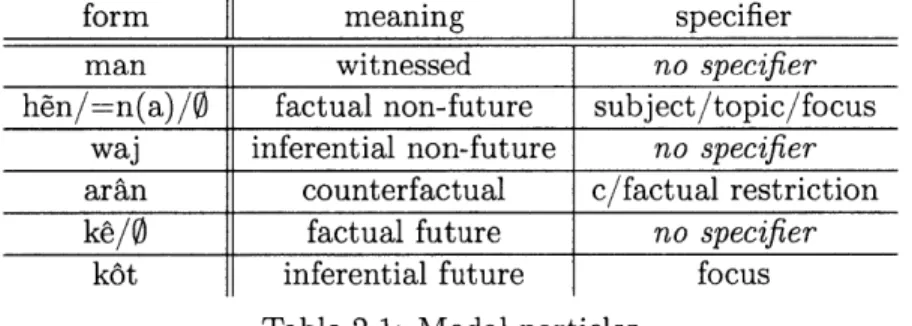
Kisedje's modal particles are listed in (17) alongside an example of each. Other properties of those particles that aren't related to case licensing are going to be discussed in more detail in chapter 2. In the present chapter we are mainly interested in the role the modal particles play in the case system of the language.
(17) The modal particles a. man 'witnessed'
Man ng6 thyk-ta ta.
WIT coffee=NOM stand
'There is coffee (in the thermos).'
b. h~n/=(n)a 'factual non-future'
H~n Ngaj =ta ng6 thyk nhihwre.
FACT N. =NOM coffee make
'N. makes/made the coffee.' c. 'inferential non-future'
[Waj
ng6 thyk=ta ta.INF coffee=NOM stand
'There must be coffee (left).'
d. arin 'counterfactual'
Ng6 thyk =arin wa 0-tho.ikhb. coffee =COUNT 1nom 3acc-drink
'If there were coffee I would drink it.' e. k6 'factual future'
Ke ng6 thyk=ta ta.
FACT.FUT coffee=NOM stand 'There will be coffee.'
f. kot 'inferential future'
Nhfm =kut ng6 thyk nhihwere? who =INF.FUT coffee make
'Who would make the coffee?'
6 There could be an alternative explanation to the ungrammaticality of (14), namely, the claim that it is impossible to embed a word with factual meaning inside a counterfactual restriction. That alternative explanation is straightforward to discard. Check the English example (i-a) and the Kisedj example (i-b) below, where factual-meaning adverbs are used in restrictions of counterfactuals.
(i) Factual adverb embedded in counterfactual environment
a. If he actually were a doctor, he would know what to do now. b. [Kupyt=te wi s-6 si kak6r6
]
ar n ka[K.=ERG actually 3
abs-POSS instrument playemnb I =COUNT 2,,m, 'If K. were actually playing his flute you would be sleeping.'
ng6r6. sleep
1.3. CASE LICENSING
If INFL is characterized cross-linguistically as the head that licenses nominative case, the two-way correlation between presence of modal particles and licensing of nominative case in Kisedje constitutes strong evidence that these particles instantiate INFL in this language. The fact that INFL (the modal particles) are banned from embedded clauses means that embedded clauses in this language are non-finite in a very strong sense: embedded clauses are simply not headed by INFL, that is to say, IPs aren't embeddable in Ksedje. Other languages with this property are Hixkaryana (Carib, Brazil), as reported by Derbyshire (1979); Mebengokre (Je, Brazil), as reported by Salanova
(2007) and Kamayura (Tupian, Brazil), as reported by Seki (2000). In those languages, embedded
clauses are usually claimed to be nominalizations, which is also how I think embedded clauses in Kisedje are best characterized.
Assuming the Case Filter, subjects of non-finite clauses still need to be assigned case somehow. Languages vary with respect to exactly which case is available to those subjects. In Latin, subjects of non-finite clauses can get accusative case. In English they can be assigned accusative case by a higher verb or preposition, or "null case" (in the contexts that license PRO). In Kisedje's non-finite clauses there is a mechanism through which ergative case is assigned to transitive subjects and absolutive case to intransitive subjects.7
Kisedje's embedded clauses can be analyzed as nominalizations, as Salanova (2007) proposes for the closely related language Mebengokre. There is plenty of empirical evidence for this point. Internally, we can observe that mono-argumental nouns (inalienably possessed nouns) pattern with embedded mono-argumental verbs in marking their single argument as absolutive (that single ar-gument is the possessor in the case of mono-arar-gumental nouns). Externally, embedded clauses also behave like nouns, in the sense that any position that subcategorizes for a noun will happily take an embedded clause as well.
The statement that mono-argumental embedded clauses behave internally like mono-argumental nouns, in taking absolutive arguments is true, at least as far as we can detect. Let us look at a context where it becomes unambiguous that mono-argumental nouns take absolutive arguments, just like mono-argumental embedded clauses. The conundrum is that accusative and absolutive are only distinguished on 3rd person pronouns, and only under a special condition. As we saw in
section 1.2, the unambiguous 3rd person accusative pronoun khu- will only be attached to verbs that
follow a certain phonological template: single open syllables with filled onset. There are nouns that follow this phonological template as well, but they never take the 3rd person accusative pronoun
khu-. Even if they follow the phonological template, nouns only take the null pronoun, which in
this situation is unambiguously absolutive (18).
(18) Mono-argumental nouns take absolutive arguments (possessors)
a. {/0-/*khu-}the b. {/0-/*khu-}te
{{/3abs-/*3acc-leg
{/3abs-/*3acc-}hammock
'his leg' 'his hammock'
Externally, embedded clauses also behave like nouns in the sense that any position that subcate-gorizes for a noun will happily take an embedded clause as well. Compare the embedded clause in subject position in (19) with the noun in subject position in (20). Note, for instance, how the embed-ded clause in subject position is marked as nominative. For a lengthier description of the syntactic equivalence between nouns and nominalized clauses consult section A.2.7.1 of the appendix.
7
That is not the whole picture, the complexities of which I am holding back for a few more paragraphs.
CHAPTER 1. THE KIS]DJE CASE SPLIT
(19) Embedded clause in subject position
[Amto ro s-anden ]=nda ajkhruru. [mouse with 3abs-pressemb ]=NOM be.two
'The pressings of it with the mouse are two.' i.e. 'Click twice.' (20) Noun in subject position
Amt6= ra ajkhruru. mouse=NOM be.two
'The mice are two.' i.e. 'There are two mice.'
My analysis of nominalization differs from Salanova's in that I assume that embedded clauses are
nominalizations of vPs, whereas Salanova assumes embedded clauses are nominalizations of VPs, lacking v altogether (in his system the external argument of embedded clauses is introduced in [Spec,
n]). Under my analysis, the structure of transitive embedded clauses is (21-a), that of unergative
embedded clauses is (21-b) and that of unaccusative embedded clauses (21-c). I am postulating that embedded clauses use a special kind of v, namely, one that assigns ergative to elements in its specifier and doesn't assign structural accusative case, and I characterize absolutive as a structural case assigned by n.
(21) The structure of embedded clauses
a. Transitive b. Unergative c. Unaccusative
nP nP nP
n VergP n vergP n vergP
A vIrg S v'/ Verg VP
Verg VP Verg V S V
o V
I already advanced in the introduction that in Kisedje ergative isn't only assigned to agents
(erga-tive is not an inherent case in this language). I didn't say further, which might have given the reader the idea that ergative is assigned in this language to and only to transitive subjects of non-finite/embedded clauses. That is also not true. Ergative is assigned not only to the transitive subject, but also to a dislocated and pleonastic replesentation of the intransitive subject in addition to its absolutive in-situ representation. In (22) we can see ergative being assigned to the pleonastic representation of an arguably unergative subject in addition to the its absolutive in-situ representa-tion and in (23) we can see ergative being assigned to the pleonastic representarepresenta-tion of an arguably unaccusative subject in addition to the its in-situ absolutive representation.
(22) Arguably unergative verb with absolutive subject doubled by ergative pronoun [(Ire) m8 kap~r8 khbt i-mbraj
]
khere[erg meetings at labs-gOemb
]
not.be'It is not the case that [ I went to those meetings ].' i.e. 'I didn't go to these meetings.'
1.3. CASE LICENSING
(23) Arguably unaccusative verb with absolutive subject doubled by ergative pronoun [(Ire) hwararo i-tO kham i-thim ] khere.
lerg yesterday labs-hammock LOC labs-fallemb not.be 'It is not the case that [ I fell off my hammock yesterday ].' i.e. 'I didn't fall off my hammock yesterday.'
Examples of this kind make Klsedje's case system unique. Ergative is not the case assigned to agents (ergative as an inherent case: Woolford 1997; Legate 2006) nor is it the case assigned to and only to subjects. In Kisedje ergative is a third thing. It is the extra case.8 In transitive embedded clauses, it is assigned to the subject. In intransitive embedded clauses, ergative is assigned to any extra pronoun that pleonastically represents the subject, in addition to the its absolutive in-situ representation (in the case system I develop below, this extra pronoun is modeled as the head of a chain whose tail receives absolutive case).
The fact that intransitive subjects can be expressed by an ergative pronoun in addition to the obligatory absolutive pronoun -(22) and (23)- lead me to propose that: (a) verg always assigns ergative case to the nominal in [Spec, Verg] (due to examples like 22); (b) Verg also assigns ergative case to an argument internally merged in [Spec, verg] -i.e. an argument moved to [Spec, verg]-(due to examples like 23), and (c) a nominal can be assigned case multiple times verg]-(due to these examples and others to be discussed in section 1.4, in which nominative is assigned to nominals that had been previously assigned ergative).
Besides these three non-standard assumptions, I also need to assume that (d) the EPP can be satisfied either before or after a probe associated with the same head is satisfied. This last assump-tion is important for the correct derivaassump-tion of transitive embedded clauses, as it allows the EPP feature associated with n to move a potential intervener (the ergative subject) out of the way before the absolutive-assigning probe associated with the same head matches the as-of-yet caseless object in its base position and assigns absolutive case to it (the derivation of transitive sentences is detailed in section 1.3.1). My four non-standard assumptions are listed under (24) for future reference.
(24) Non-standard assumptions
a. verg always assigns ergative case to the nominal in [Spec, Verg].
b. verg will assign ergative case to a nominal merged in [Spec, verg] through movement. c. A nominal can be assigned case multiple times.
d. The EPP can be satisfied either before or after a probe associated with the same head.
Employing these non-standard assumptions plus three fairly standard ones, listed in (25) allows me to characterize the derivation of case in transitive embedded clauses (section 1.3.1), unergative embedded clauses (section 1.3.2) and unaccusative embedded clauses (1.3.3) in KIsedje.
(25) Standard assumptions
a. The foot of a chain is syntactically inactive.
b. A probe's case feature must be discharged.
c. The case filter: every nominal in a convergent derivation must be assigned case. 8
These examples could invite the idea that ergative is a default case. I have tried to implement that idea in previous versions of this work, but was convinced that it was wrong when I encountered examples, discussed in section 1.4, where nominative is assigned to an ergative argument at a later point of the derivation.
CHAPTER 1. THE KISeDJE CASE SPLIT
1.3.1
Case licensing in transitive embedded clauses
The subject of transitive embedded clauses is assigned ergative case in [Spec, Verg] (26). After that,
n is merged with VergP and the EPP feature associated with n is satisfied through movement of the subject to [Spec, n]. The probe associated with n is activated and matches the object, assigning absolutive case to it (26-c). Between n and the object is the foot of the subject chain, but since the foot of a chain is assumed to be syntactically inactive, it doesn't create an intervention effect.
(26) Derivation of transitive embedded predicates
a. Vergp
A
v verg VP ERG O V b. nP A n' ERG n A. WG c. vergp nP A n' ERG v' verg VP O V n vergP A. v' verg VP(Inactive)
O V ABS IAbove I considered the derivation where the EPP feature associated with n is satisfied before the case probe associated with the same head is satisfied (an option I allowed myself by postulating (24-d)). Let us now take a look at the other possible derivation, where the EPP is satisfied only after the case probe associated with n is activated. That derivation crashes (27). Once the absolutive case feature is discharged on the subject (27-b) and then the EPP satisfied (27-c), all probes have been satisfied and the object is still caseless, in violation of the case filter.
(27) Crash-bound derivation of transitive embedded predicates
a. vergP A verg verg VP ERG O V b. nP c. n VergP A v' ERG ABF G verg VP O V nP A n' ERG ABS n A13S 9P verg V Left
A
caseless! 0 V 201.3. CASE LICENSING 21
1.3.2 Case licensing in unergative embedded clauses
The subject of an unergative verb is introduced in the derivation in [Spec, Vergl, where it receives ergative case from Verg (28-a). Once n is merged into the structure, it probes its c-command domain and further assigns absolutive case to the subject (28-b). Finally, n's EPP feature is satisfied by movement of the subject to [Spec, n] (28-c).
(28) Derivation of unergative embedded predicates
a. vergP S verg verg V ERG| b. nP n vergP S verg ERG ABS verg V c. nP S n/ ERG ABS n vergP S v E G ABs/ Verg V
In this derivation the EPP on n was satisfied after the case probe associated with the same head was satisfied, as usually stipulated to be the case. But since I am giving up on that stipulation (24-d), I need to consider the alternative derivation, namely, the one where the EPP is satisfied
before the absolutive-assigning probe is. Given the standard assumptions listed in (25), the
alter-native ordering crashes (29). After moving the subject to [Spec, n] to satisfy the EPP (29-b), there remains no active nominal in n's c-command domain to receive absolutive case (29-c), in violation of (25-b) -a probe's case feature must be discharged.
(29) Crash-bound derivation of unergative embedded predicates (EPP before case probe)
a. vergP S verg verg V ERG b. nP S n' ERG n c. nP S ERG vergP S vergv' Verg V n' n vergP S v EG Verg
(Inactive)
verg VABS not discharged!
Do we really need to assume both (25-a) and (25-b)? If, for instance, we dropped (25-a) -the foot of a chain is syntactically inactive- the different orderings between EPP and case probing wouldn't alter the result of the derivation of unergative embedded clauses (with absolutive case being assigned to the foot of the chain in either case). Such system would not be able to derive the case patterns of transitive clauses, though. Only the ordering where the EPP was satisfied before the probe associated with the same head allowed a convergent derivation of transitive clauses, as detailed in section 1.3.1.
no target found!
CHAPTER 1. THE KIS9DJEJ CASE SPLIT
If, on the other hand, we dropped (25-b) -a probe's case feature needs to be discharged-, the alternative ordering would give us an unattested result, where at the end of the derivation the subject of an unergative verb has only been assigned ergative case. Were we, therefore, to drop
(25-b), we would also have to drop special assumption (24-d) -the EPP can be satisfied either
before or after a probe associated with the same head. Even though a system like that could work for the derivation of unergative clauses, once more it would give a wrong derivation for transitive embedded clauses, as detailed in section 1.3.1. It is therefore essential to keep (25-b)
1.3.3 Case licensing in unaccusative embedded clauses
Below I am considering the derivation of unaccusative embedded predicates starting from the step at which Verg is merged. Though the kind of little-verg that selects unaccusative VPs doesn't introduce an argument as its specifier, I take it to have an EPP feature. That EPP feature is satisfied through movement of the internal subject to [Spec, Verg] (30-a). Once the subject is moved into that position,
Verg transfers its ergative case feature to it (30-b). The next step is merging n, which probes its
c-command domain and assigns absolutive case to the subject (30-c). Finally, n's EPP feature is satisfied through movement of the subject to [Spec, n] (30-d).
(30) Derivation of unaccusative embedded predicates
a. vergP S verg verg VP
S V
b. vergP S verg verg VP ERGA
S V
c. nP n vergP S verg ERG verg VPA
S v
d. nPS
n' ERG ABSn
vergP S v'erg verg VP S VAbove I considered a derivation where the EPP associated with n was satisfied after the cases probe associated with the same head. Since I am assuming that this ordering isn't obligatory, I need to discuss the alternative derivation. As was the case with unergative predicates, the alternative ordering crashes (31).
1.3. CASE LICENSING
(31) Crash-bound derivation of unaccusative embedded predicates a. VergP b. nP c. nP
S V/ erg S n' S n'
ERG ERG
Verg VP n VergP n VergP
ERG
A
S V
S v/ S v/ SVerg erg Verg VP Verg VPA
A
S V Inactive S VABS not discharged! 'no target' found!
Similar considerations as those discussed at the end of the previous section (1.3.2) regarding the (im)possibility of dropping the assumptions listed in (24) and (25) apply here as well: unless we adopt the stipulation that an EPP feature associated with a head can only be satisfied after probes associated with the same head are satisfied, we need to assume that: (a) only the head of a chain is syntactically active (25-a), and (b) also that case probes need to discharge their case features for a derivation to converge (25-b). On the other hand, if we disallowed an EPP feature associated with a head to be satisfied before a probe associated with the same head were satisfied, we would get the wrong result for the derivation of transitive embedded clauses, as discussed in section 1.3.1.'
1.3.4 Morphological realization
Previous sections detailed how a specific set of assumptions allowed arguments to be assigned case multiple times in Kisedje. In those sections I glossed over the important issue of how the links of those multiply-cased argument chains are morphologically realized. I hope that by doing so I didn't give the impression that arguments could be pronounced in full in multiple positions. As a matter of fact, only case and person features are spelled out in intermediate positions, with the subject fully spelled out only at the head of its chain.
In the embedded clause in (32), for instance, (embedded by the predicate janthd 'to be possible') you can see that only the head of the subject chain is fully spelled out -as a nominal phrase marked with the ergative clitic re. Following it, an intermediary link is spelled out by a third person ergative pronoun -k6re- and, finally, attached to the verb, the tail of the subject chain is spelled out as an absolutive pronoun. This example features a final derivational step that I don't discuss, which consists of raising the subject to a higher position, though arguably not for case reasons.
9
Richards (p.c.) has suggested an alternative system to account for the data discussed above. That data can be accounted for based on slightly different assumptions: (a) probes probe first down, then (if there's nothing in the down
direction) up (as assumed by Bjar and Rezac 2009); (b) EPP is always satisfied before Agree, and (c) probes keep probing until they have agreed with something (even if that thing has already been agreed with). Given only the phenomena presented above, this system and the one I developed seem to me to be nearly notational variants. Choice between them would require evaluating how well (or badly) they fare in the derivation of other, unrelated phenomena. Both incorporate the key empirical claim of this chapter, namely, that an argument chain can be assigned case multiple times, and are furthermore compatible with the extra data to be discussed in section 1.4.
CHAPTER 1. THE KISEDJE CASE SPLIT
(32) Pronouncing multiple links of the chain (ergative, ergative and absolutive)
[Khraje=re k6re ta khdm s-umbaj wyndu
J
jantha. [children=ERG 3erg something in 3abs-worryembJ
be.possible '(So that) it be possible that [ the children put their minds to some use(from Me khwi tho pa kand~j6 ro sujarini 'Explanation on how people became chiefs') Example (33) features a 4-clause coordinate complex embedded by the predicate wyrdkd 'to be so'. (Though I have only bracketed the individual clauses, it is the whole coordinate complex that is embedded by wyrdkd, not only the 4th clause. The subject of the first clause is fully spelled out only at the head of its chain -a nominal phrase marked with the ergative clitic re- whereas the base of the subject chain is spelled out as an absolutive pronoun. In the second clause you can also note the subject being spelled out both by an ergative pronoun and by an absolutive one.
(33) Pronouncing multiple links of the chain (ergative and absolutive)
[Hwararo wa-khrajO=re hrdm khdm s-Am ]i =nhy [ire i-them ]2
[yesterday 1+2abs-children=ERG hunger in 3
abs-stayemb
I
=and.DS[
lerg labs-gOemb=ne [ ire ngrytxi=0 pir 13 =ne [ tho i-mori 14 wyrdkd =and.ss
[
1erg big.animal=ABs killemb1
=and.ss [ 3.with labs-comeemb ] be.so'It is so that [ yesterday our children stayed hungry and I went and killed this big animal and brought it back ].'
(from Khdtpy re wapdmje th& thurun tho them nda 'Where Khdtpy carries our ancestor')
1.3.5 Section summary
In this section I developed a case theory that accounts for the distribution of nominals in Kisedje.
In embedded clauses Kisedj6 sports a system where absolutive is assigned across-the-board to all
intransitive subjects, but in which in addition to being assigned absolutive, intransitive subjects are also assigned ergative on a higher position. This kind of system resists traditional accounts, and my account had of necessity to include a few special assumptions.
The Kisedje case system poses a particularly hard problem for dependent-case approaches to ergativity (Marantz, 1991; Salanova, 2007; Preminger, 2011; Baker, 2013). In dependent-case ap-proaches, ergative case is assigned to a nominal in the same domain as a distinct unmarked nominal (34). Such a system can't make sense of the situations discussed above where a single argument is expressed both in the absolutive and in the ergative case.
(34) Dependent case is assigned by V+I to a position governed by V+I when a distinct position governed by V+I is:
a. not "marked" (not part of a chain governed by a lexical case determiner)
b. distinct from the chain being assigned dependent case Dependent case assigned up to subject: ergative Dependent case assigned down to object: accusative (Marantz, 1991)
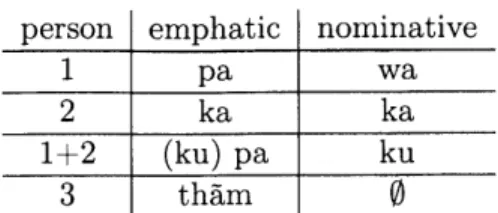
We could try to redeem the dependent-case approach by looking for evidence that what looks like an ergative pronoun in the problematic situations is actually a emphatic pronoun which happens to be homophonous with an ergative pronoun (in the same way emphatic pronouns in French are homophonous with oblique pronouns). The evidence doesn't seem to point in that direction, though. For one, Kisedje does have a set of emphatic pronouns, but it is not homophonous with the ergative pronouns -see table 1.3 and illustrative examples (35) and (36).
1.4. APPARENTLY EXCEPTIONAL CASES
person emphatic nominative
I pa wa
2 ka ka
1+2 (ku) pa ku
3 thdm 0
Table 1.3: Emphatic pronouns
(35) Use of emphatic pronoun
0 Ku pa Internet pi.
FUT 1+2nom 1+2emph Internet kill 'We will turn the Internet off ourselves.'
(36) Emphatic pronoun in the focus position
Ky, ture, ka=n wa ng'-ariri! Damn father youemph
Inom
2acc-wait
'Damn, father, it was you I was waiting for!'
"Contraction of a- (2,,c) and -j- (linking consonant)
A final idea we could try to pursue is that there is an ergative-looking set of emphatic pronouns
used exclusively in embedded contexts. That is also not true, as the emphatic pronouns used in embedded clauses are the same ones used in main clauses (37).
(37) Topic/focus pronouns in an embedded context Ire pa khwA i-kapere
]
ma.lerg lemph 3acc-tO labs-talkemb
J
PROSP 'I will talk to him myself.'1.4
Apparently exceptional cases
In this section we will learn about two contexts that appear to license exceptions to the initial description of the Kisedje case split given in (1). More precisely, in these contexts we will see nominative case being assigned to the subject of an embedded verb. Once we learn about the details of each context, though, we will realize that their exceptionality is only apparent and that they actually provide further evidence for the claim made in section 1.3 that different links in an argument chain can be assigned different cases in Kisedje.
The two aforementioned contexts involve the use of certain modifiers which behave like (and therefore must be) unaccusative verbs that select only for a clausal complement. Among such modifiers are 'not be', as in (39), and 'be always', as in (38). Due to the accident that in English those clause-embedding unaccusative verbs are most straightforwardly translated as adverbs, it becomes important to show that the they are indeed verbal in Kisedje. First note in (39) and (38) that the Kisedje clause-embedding verbs can be translated in English (albeit a tad unnaturally) as clause-embedding predicates ('It is always the case that I eat it.' and 'It is not the case that you ate it.'). Now also note that these modifiers take a nominalized clause for object. The agents in these sentences, rather than being arguments of the clause-embedding modifier verbs, that is, of the main predicate, must be arguments of the embedded clauses the modifiers selects. These agents are, therefore, expected to display ergative case, an expectation that is borne out in (39) and (38).