Linear Programme Writing
and Teacher Education
Miles Wisenthal
The pressures which have been exerted on aIl levels of our educational system to provide more extended schooling to an ever-increasing proportion of our youth have forced us to experiment with a wide range of devices and techniques in order to meet the challenge of numbers. The results have shown that it is possible to teach greater numbers more effectively than had been supposed, by changing curricula, aItering school organization, and by making more extensive use of technological devices.
Among the many innovations, none has created quite the impact that resulted from Skinner'sl introduction of the teaching machine. Initially it was the machine that captured the imagination of the profession aIs and the public at large; however, it was soon recog-nized that the crucial element was the programme. A simple defini-tion of a linear programme might be formulated as follows: a se-quence of informational steps out of which arise questions to which the learner responds, or steps in which certain informational bits are missing and are 8upplied by the learner. Each response gives rise to the next step or frame; thus, starting from a very simple piece of information it is possible to lead the learner to the point where he is responding to questions and supplying information which involve an understanding of complex and previously unknown concepts.
Programmes covering a wide variety of disciplines are now commercially available in textbook and machine format. These are published for use for learners of aIl ages; one finds elementary school arithmetic, high school algebra, and college level statistics on the market. Programming techniques are also being employed in mental hospitals and reformatories. Goldiamond2 has referred to
the effectiveness of highly structured reinforcement schedules which result in conspicuous behaviour change. In all cases it is important that the desired terminal behaviours be specified; it is also neces-sary to establish a point of departure for the particular programme which is in accord with the ability of the learner. These notions are hardI y new. They have been weIl stated by such early educational
MILES WISENTHAL
theorists as Plato, Comenius, and Locke. lt required the genius of a twentieth century psychologist, B. F. Skinner, to make scientifically explicit the intuitive ideas of great men of the pasto
The teaching act is, in essence, the structuring of situations so that learning has a high probability of occurring. The programming act is the committing to paper of a series of learner-response oppor-tunities which lead to sorne predetermined goal established by the programmer. Courses in educational methodology attempt to provide student-teachers with a wide range of strategies which will enable them to be effective classroom practitioners. Frequently these strat-egies are based on certain well-founded theories of learning; oc-casionally they are rooted in some intuitive notions arising from the methodology instructor's past classroom experience. Programme writing compels the programmer
to
structure a given body of ma-terial into a format which makes for self-teaching. lt would appear that the act of programme writing is closely related to or even identical with, careful lesson preparation and teaching. In other words, both teachers and programmers structure learner-response opportunities - they provide cues and hints, encourage overt re-sponses, and reinforce correct responses.Despite the seemingly obvious similarities between programme writing and teaching behaviour, there have been few attempts to make use of programme writing as a teacher training technique. The literature on programmed instruction has grown enormously du ring the past several years yet one finds practically no references to changes in teaching behaviour as a result of programme writing experience. Komoski3 reported that teachers who had taken courses
of training in programming stated that "they would never be able to teach in the old way again." Ellis' has shown that programme writing by students in education leads to more positive attitudes to their courses in methodology and to their training in general. Wisen-thal 5,8 has shown that programme writing, when used as an
ad-junct to the regular courses in methodology, produces teaching prac-tice results which are significantly higher than those achieved by student-teachers who completed only the methodology courses.
The previous findings of the author suggested that, during the programme writing act, a learning experience was taking place which exerted considerable influence on lesson presentation.
These findings were challenged on a number of grounds; it was suggested, quite rightly, by sorne critics that the additional treatment accorded the experimental subjects served as a form of enrichment in methodology; others pointed to the gross differences between experimental and control subjects as a se rio us weakness.
16
As a result of the critici::;ms and of a desire to continue experiment-ing with other techniques which might be used in teacher education, the author proposed that the previous studies be replicated with the modifications required to answer the criticisms. The proposaI included the following provisos: selection of experimental students to make matching possible; elimination of aIl methodology courses for the experimental group; and the use of specially selected judges to evaluate teaching practice of both control and experimental stu-dents. Unfortunately, it proved impossible to establish these condi-tions, but the following compromise was accepted: only students wha volunteered could be used as experimental subjects; only half of the methodology courses could be replaced by programme writ-ing; and evaluation of teaching practice would be carried out by regular staff in the usual way. Despite the fact that these condi-tions would still leave certain critical issues unresolved, and earlier criticisms unanswered, it was decided to proceed with the experi-ment.
The following hypotheses were formulated:
Hypothesis One - The substitution of half the total class-periods of instruction in methodology (i.e. 60 out of 120) by five class-periods of instruction in linear programme writing will make no significant difference in teaching practice results.
Hypothesis Two - Programme writing marks are a better pre-dictor of teaching practice competence th an marks obtained on methodology examinations.
Procedure
Candidates for a First Class teaching diploma who hold uni-versity degrees are accepted at the McGill Uniuni-versity Faculty of Education for a one-year professional programme. They may choose a course of study which will prepare them for teaching in the primary, elementary, or seconda l'y school grades. Candidates elect-ing the secondary school option are required to study the method-ologies of two subjects included in the high school curriculum. Selection of the level at which students wish to teach occurs after they have completed five weeks of a general "orientation to teach-ing" course, and two weeks of teaching practice in an elementary school.
When the students returned from this first school practice, those who elected mathematics and/or science as their high school options were invited to attend a meeting announced as an "exper-imental course in programmed instruction." Thirty-three students presented themselves, and the investigator explained the nature of his projects as follows:
I have been encouraged by previous investigations to continue seeking ways in which programmed instruc-tion techniques can be incorporated into teacher edu-cation (a brief description of linear programming followed). I already have some evidence which ap-pears to suggest that the act of writing a programme in your own area of specialization, appropriate for the Ievel at which you expect to teach, may be just as effective for you as the three-hour per week course in the methodology of the subject.
Only students preparing to teach high school mathe-mati cs and/or sciences have been asked to participate in this experiment because I have only a limited amount of time at my disposaI and I find it easier to specify terminal behaviours in these areas. In addi-tion, it is my experience that math-science graduates have a better understanding of the structure of their disciplines than other students.
Those of you who decide to parlicipate in the exper-iment will spend five class periods with me, as a group, during which time you will acquire sufficient understanding and skill to begin frame writing and programme construction. After that, I will meet with you individually for tutorials and discussion as re-quired.
Each member of the experimental class will be paired with a teacher in the campus high school who will provide information on subject matter, and supply pupils for programme try-outs.
If you decide to parlicipate in the experiment, you will be allowed to drop one of the two methodology courses which you have selected. You will turn in a completed programme prior to the final teaching practice session in April. This will be rated by me, and the grading will replace the mark for the sub-stituted methodology course. Marks will be awarded for programmes for the extent to which they dem-onstrate sophisticated employment of programming skills.
18
After answering a number of questions, many of which re-vealed a fear of possible course failure, the investigator arranged for the next class which was to be attended only by those who had decided to become members of the experimental· group. At the next meeting, and the four which followed, twenty-one students attended faithfuIly. One student withdrew from the College in March, leaving a total of twenty who began and completed the course.
Efforts were made to establish a control group which matched the experimental group on aIl of the characteristics considered important; this was found to be impossible. It was finally decided to include as control group subjects aIl students who had elected mathematics and/or science as their high school options but were not enrolled in the experimental class; this produced a total of thirty. Despite this rather casual method of selection, it will be seen from Table One that members of the control group do not differ in any statistically significant way from the experimental group. It will be noted that the experimental group everaged 2.3 undergraduate course failures pel' student, which is a considerably higher number than that of the control group; and is significantly higher than the class as a who le.
TABLE 1
DIFFERENCES IN MEANS BETWEEN EXPERIMENTAL (E), CONTROL (C), AND WHOLE CLASS (WC) GROUPS ON FEBRUARY TEACHING PRACTICE RATING, UNDERGRA-DUATE GRADE POINT AVERAGE(*), AND NUMBER OF UNDERGRAUNDERGRA-DUATE COURSES
FAILED
Experimental Control Whole Class DiJJerenees
(N=20) (N =30) (N =165) X S X S X S E-C E-WC Feb. Teaehing 3.54 .61 3.30 .58 3.35 .47 -.24 .19 Praetiee Grade Point 2.35 .43 2.43 .42 2.45 .20 -.08 .10 Average Undergraduate 2.30 3.03 1.73 Failures 2.25 1.16 1.87 -.57 -1.14(**)
*For G.P.A. a lower numerical value indicates higher attainment. **Significant at the .10 level.
MILES WISENTHAL
19
The mean age of the experimental group did not differ sig-nificantly from that of the control group or of the whole class. There were, however, significant differences between the groups with respect to the numbers of males and females in each. Table Two provides this information. Despite the absence of any obvious sex bias in the evaluation of teaching practice (the final criterion), it is entirely possible that the male-female differences in the samples may be distorting the results. There are too few studies on the effect of sex bias on teaching practice to provide any relevant information.TABLE II
NUMBER OF MEN AND WOMEN IN EXPERIMENTAL AND CONTROL GROUPS, AND WHOLECLASS
Experimental Control Whole Class
N % N % N %
Men ... 15 75 16 53 65 40
Women ... ... 5 25 14 47 100 60
TOTAL .... ... 20 100 30 100 165 100
It is difficult to do more than speculate on the importance one should attach to the differences in the mean number of under-graduate courses failed by each of the groups. The experimental subjects volunteered to participate, and to this extent are different from the controls who did not choose to participate. It is likely that "volunteering" traits are related to a willingness to take chances on courses which offer challenge and are above the level of "volunteering types" who select them.
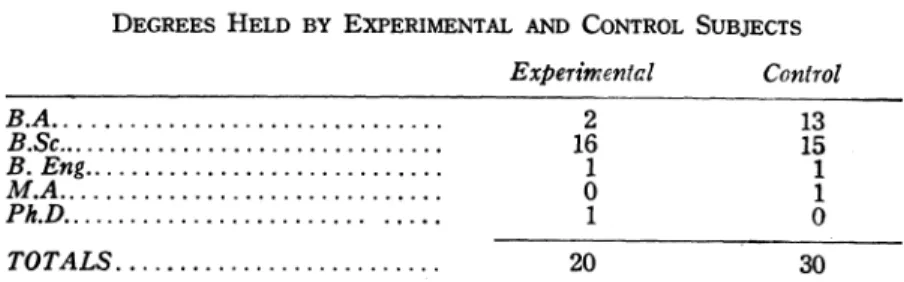
The experimental group included, as one might suspect, a preponderance of B.Sc.'s, whereas the control group was approxi-mately evenly divided between B.A.'s and B.Sc.'s. This is shown in Table Three. The single Ph.D. is a biochemist.
TABLE III
DEGREES fIELD BY EXPERIMENTAL AND CONTROL SUBJECTS
B.A ... . B.Sc ... . B. Eng ... . M.A ... . Ph.D ... .... . TOTALS ... ... . Experimental 2 16 1
o
1 20 Control 13 15 1 1o
30The difference between the experimental and control groups in terms of the proportion of science and arts graduates is highly significant. Using a 2 x 2 table the value of chi square is 7.414, which is significant at above the .01 level. This difference in under-graduate backgrounds is not likely to have produced any advantage for the experimental group. In fact, one could make a good case arguing that the verbal nature of arts training might be better preparation for teaching than the sciences.
The mathematics and/or science backgrounds of the control subjects was judged to be adequate by the staff members in charge of the courses of methodology in these disciplines. In general, students had taken three or more undergraduate courses in the discipline which they were planning to teach.
The evaluation of student teaching is carried out by members of the Faculty, and a limited number of retired teachers especially engaged for this purpose. In every case students are seen at least twice by staff members who rate the lessons they view; and, in addition, the assisting teacher to whom the student is assigned also submits a rating. A five-point scale is provided for this procedure, but the use of plus and minus signs creates a thirteen-point scale. To quantify the plus and minus signs, and to make more equal intervals possible, it was necessary for the purposes of this investigation to record a 2+, as 2.3, and 3-, as 2.6. The final mark for teaching practice was the mean of the ratings assigned by the staff evaluators and the assisting teacher, with equal weight given to rating from both sources. While one may have misgivings about the reliability and validity of teaching practice ratings, they are as yet, the only method devised for making the final judgment on the student-teacher. In any event, for purposes of this experiment no better method was available and it was used as the criterion measure.
Prior to the final teaching practice period, aIl of the experi-mental students had completed their linear programmes. Twelve sought advice from the experimenter beyond that avaiIable during the five class periods set aside for instruction. Each of the pro-grammes had been tested at least twice before the final form was submitted for marking. In sorne cases, trials had been conducted with single pupils in the high school; in other cases, whole classes had acted as test subjects for the programmes.
The programmes were evaluated, by the investigator, on the extent to which individual frames fulfilled the criteria for good frame construction, the degree of articulation between frames, the use of branching strategies, and the general level of sophistication demonstrated. Marks awarded ranged from 50 to 95 with a median
MILES WISENTHAL
of 70.75. The individual marks were recorded on the students' record cards before the final teaching practice period was com-pleted.
Results
Final teaching practice ratings and methods courses marks were made available to the author at the completion of the academic session. Table Four reveals no significant differences on final teaching practice ratings between the experimental and control groups. Furthermore no significant differences exist between either of these groups and the whole class.
TABLE IV
DIFFERENCES BETWEEN EXPERIMENTAL AND CONTROL GROUPS AND WHOLE CLASS ON FINAL TEACHING PRACTICE RATINGS
Experimental (N=20) X A 3.66 .593 Control lN =30) X A 3.45 .422 Whole Class (N=I65) X A 3.49 .498 Differences E-C E-WC +.21
+
.17The first hypothesis appears to be fully upheld. This stated that the subsitution of half the total class-periods of instruction in methodology by five class-periods of instruction in linear pro-gramme writing will make no significant difference in teaching practice results.
To test the second hypothesis, product-moment correlations were calculated between programme writing marks and teaching practice, and between methods course marks and teaching practice. These are shown in Table Five. AlI of the correlations between methods and teaching practice are significant above .01 level; the correlation of .736 between programme writing and teaching prac-tice is significant at above the .001 level. The difference between the correlation of .462, methods and teaching practice for the control group, and .736, programming and teaching practice for the experimental group, is significant at above the .05 level. Thus the second hypothesis also seems substantiated.
TABLE V
PRODUCT-MoMENT CORRELATIONS BETWEEN METHODS COURSES AND TEACHING PRACTIC!!.. AND PROGRAMM!!. WRITING AND TEACHING PRACTICE
Experimental Control
(N =20) (N =30)
Whole Class
(N =165)
---Me/hods and Teaching Practice . ... .
Programming and Teaching Practice .. .590 .736
.462 .339
That courses in methodology correlate significantly with teach-ing practice is an interestteach-ing departure from the results of previous investigations (unpublished) by this writer. In the earlier studies no significant correlations between these two teacher education activities were found. This change may reflect the fact that more effective instruction in methodology is being given, or at least, instr.uction that is more closely related to teaching practice.
The high positive correlation between programme writing and teaching practice suggests that programme writing behaviour and teaching behaviour are indeed closely related. In terms of transfer theory, it might be stated that good programme writing behaviour requires the use of a large number of skills which are needed for successful teaching. This would be entirely congruent with the theory of transfer and identical elements put forward by Thorn-dike7 • One is tempted to extrapolate from the fact that because there is a significantly higher correlation between programming and teaching practice than there is between methods courses and teaching practice, that programme writing provides better prep-aration for student teaching practice than courses in methodology; while this may be true, the experiment described here does not provide adequate proof. There is, however, enough evidence to sug-gest that it would be worthwhile to design a study in which this hypothesis could be tested.
Academie Attainment and Teaehing Practice Rating
Among other things which this investigation examined was the relationship between undergraduate attainment scores and teaching practice marks. In a previous study, Wisenthal5 found a
negligible correlation of -.183 between intelligence test scores and teaching practice ratings. For the present investigation it was impossible to administer intelligence tests, thus use was made of the average grades obtained by students over the four-year period of undergraduate education. The writer finds it difficult to accept
the immediate iriference which can he drawn from such a lack of correlation.
TABU. VI
PRODUCT-MoMENT CORRELATIONS BETWEEN UNDERGRADUATE GRADE POINT AVERAGE AND TEACHING PRACTICE
Experimental Control Whole Class
(N ... 20) (N=30) (N=l65)
Correlation . ... . -.01 -.004 -.008
If one accepts the result at face value, one is forced to con-clude that teaching practice is not in any measurable way related to academic ability. If this postulate is correct, one could argue that academic competence makes no real difference in the class-room performance of teachers. In other words, the holder of a pass B.A. with ten failures in his undergraduate record is just as good a candidate for teacher education as the holder of an honours degree with first-class standing. If this were so, it would appear that any effort to raise the academic requirements for admission to teacher education, and thus raise the academic level of teachers, is directed to no useful end.
On the other hand, if one rejects the obvious conclusions, referred to above, one is faced with the problem of offering some explanation. A reasonable hypothesis would be that these zero order correlations are a result of measuring only a single dimension of teaching, methodology, without regard to content. This hypo-thesis tends to be substantiated when an analysis is made of teach-ing practice evaluation reports. Strengths and weaknesses seldom, if ever, refer to anything other than procedures and techniques; subject matter competence tends to be ignored. It is of interest that the confidential reports submitted by assisting teachers are less guilty of this offence than those completed by staff who supervise and evaluate teaching practice.
Conclusion
The study was carried out under conditions which make any generalizations highly speculative. It was most difficult to estab-Hsh equivalence between experimental and control groups; it was impossible to have the evaluation of teaching practice carried out in a way which would meet the needs of the experiment. The most
serious problem arose in connection with the fact that the exper-imental group was not treated in a completely experexper-imental fashion.
Despite these shortcomings, the hypotheses advanced were upheld. However, much remains to be done in the field of teacher education which requires a scientific, experimental approach. Teach-er education has been acting on faith for genTeach-erations, and few attempts have been made to test assumptions which have remained unchallenged. Changes in educational procedures should have their origins in teacher preparation. Changes will arise from the results of experimental investigations, and perhaps the beginnings of such an experimental approach belong in institutions responsible for the preparation of teachers for the elementary and secondary schools.
References
1. B. F. Skinner, "The Science of Learning and the Art of Teaching,"
Harvard Educational Review, 24, (Spring 1954), 86-97.
2. 1. Goldiamond, A General Introduction to PrO'grammed Instruction.
Paper deIivered at ,McGill Conference on Teaching Affairs, Montreal, October, 1966.
3. K. Komoski, Address presented to Canadian Teachers' Federation Seminar on Programmed Learning, Ottawa, 1960.
4.J. F.Ellis, The Contribution of Writing Linear Program8 to Certain Competencie8 0/ Student Teacher8. Paper presented at Annual Meet-ing of Canadian Professors of Education, Charlottetown, P.E.I., 1964.
5.M. Wisenthal, "Programmed Instruction and Teacher Education,"
Canadian Education and Re8earch Dige8t, Vol. 5, No. 1, 1965, 66-76. 6. - - Linear Progrannming and EducatiO'n Methodology. Paper
pre-sented at Annual Meeting of Canadian Association of Professors of Education at University of British Columbia, Vancouver, 1965. 7. E. L .. Thorndike, Educational P8ychology, New York: The Science