HAL Id: hal-00101447
https://hal-insu.archives-ouvertes.fr/hal-00101447
Submitted on 7 May 2009
HAL is a multi-disciplinary open access
archive for the deposit and dissemination of sci-entific research documents, whether they are pub-lished or not. The documents may come from teaching and research institutions in France or abroad, or from public or private research centers.
L’archive ouverte pluridisciplinaire HAL, est destinée au dépôt et à la diffusion de documents scientifiques de niveau recherche, publiés ou non, émanant des établissements d’enseignement et de recherche français ou étrangers, des laboratoires publics ou privés.
Phase Equilibria of the Lyngdal Granodiorite (Norway):
Implications for the Origin of Metaluminous Ferroan
Granitoids.
Michel Bogaerts, Bruno Scaillet, Jacqueline Vander Auwera
To cite this version:
Michel Bogaerts, Bruno Scaillet, Jacqueline Vander Auwera. Phase Equilibria of the Lyngdal Gra-nodiorite (Norway): Implications for the Origin of Metaluminous Ferroan Granitoids.. Journal of Petrology, Oxford University Press (OUP), 2006, 47, pp.2405-2431. �10.1093/petrology/egl049�. �hal-00101447�
Phase Equilibria of the Lyngdal Granodiorite (Norway):
Implications for the Origin of Metaluminous Ferroan
Granitoids
MICHEL BOGAERTS1,*, BRUNO SCAILLET2 and JACQUELINE VANDER AUWERA1
1
U.R. PÉTROLOGIE ET GÉOCHIMIE ENDOGÈNE (B20), DÉPARTEMENT DE GÉOLOGIE, UNIVERSITÉ DE LIÈGE B-4000 SART TILMAN, BELGIUM
2
ISTO-CNRS UMR 6113, 1A RUE DE LA FÉROLLERIE, ORLÉANS, 45071 CEDEX 2, FRANCE
ABSTRACT
The Proterozoic (950 Ma) Lyngdal granodiorite of southern Norwaybelongs to a series of hornblende–biotite metaluminousferroan granitoids (HBG suite) coeval with the
post-collisionalRogaland Anorthosite–Mangerite–Charnockite (AMC)suite. This granitoid massif shares many geochemical characteristicswith rapakivi granitoids, yet granodiorites dominate over granites.To constrain both crystallization (P, T, fO2, H2O in melt) andmagma generation
conditions, we performed crystallization experimentson two samples of the Lyngdal granodiorite (with 60 and 65 wt% SiO2) at 4–2 kbar, mainly at fO2 of NNO (nickel–nickel
oxide) to NNO + 1, and under fluid-saturated conditions withvarious H2O–CO2 ratios for
each temperature. Comparisonbetween experimental phase equilibria and the mineral assemblagein the Lyngdal granodiorite indicates that it crystallized between4 and 2 kbar, from a magma with 5–6 wt % H2O at an fO2of NNO to NNO + 1. These oxidized and wet
conditions sharplycontrast with the dry and reduced conditions inferred for thepetrogenesis of the AMC suite and many other rapakivi granitesworldwide. The high liquidus temperature and H2O content ofthe Lyngdal granodiorite imply that it is not a primary magmaproduced
by the partial melting of the crust but is derivedby the fractionation of a mafic magma. Lyngdal-type magmas appearto have volcanic equivalents in the geological record. In particular,our results show that oxidized high-silica rhyolites, such asthe Bishop Tuff, could be derived via fractionation of oxidizedintermediate magmas and do not necessarily represent primarycrustal melts. This study underlines the great variability ofcrystallization conditions (from anhydrous to hydrous and reducedto oxidized) and petrogenetic processes among the metaluminousferroan magmas of intermediate compositions (granodiorites,quartz
mangerites, quartz latites), suggesting that there isnot a single model to explain these rocks.
KEY WORDS: ferroan granitoids; crystallization conditions; experiments; Norway;
Sveconorwegian; Bishop Tuff
INTRODUCTION
Metaluminous ferroan granitoids [using the terminology of Frostet al. (2001)] have been
reported from many different areasand geological epochs, but are particularly common in mid-Proterozoicterranes. In particular, the magmatic association characterizedby massif anorthosites and granitoids is restricted to the Proterozoicand is commonly referred to as an AMCG complex (acronym of Anorthosite–Mangerite–Charnockite–Granite).This study focuses on such a petrogenetic association. The majorityof granitoids associated with massif anorthosites can be classifiedinto two main types: (1) hypersthene-dominant granitoids, i.e. quartz mangerites (Opx monzonites)–charnockites (Opx granites);(2) hornblende–biotite granitoids. Some of these latterplutons locally display rapakivi textures and then are called rapakivi granites. Transitional facies, with orthopyroxene rimmedby hornblende, exist in a
number of complexes (e.g.Emslie etal., 1994). Both types of plutons are metaluminous
ferroan granitoidsbut show a large variation in their MALI index [(Na2O + K2O)– CaO in wt
%], from calc-alkalic to alkalic as indicatedin Fig. 1. All the granitoids and volcanic rocks discussed inthis paper (Fig. 1) are metaluminous with ASI 1 [molar ratioof Al2O3/(CaO –
3·3P2O5 + Na2O + K2O)] and agpaiticindex AI < 1 [molar ratio (K2O + Na2O)/Al2O3].
Ferroan peralkalineintrusions (e.g. the sodic series of the Pikes Peak batholith:Smith et al., 1999) are not considered here.
In many AMCG complexes, ilmenite is the dominant or sole Fe–Tioxide and mineral equilibria studies suggest that both typesof pluton crystallized from low fO2 and H2O-poor
magmas (e.g.Frost & Frost, 1997). Two main models have been proposedto explain the link between anorthosite massifs and associatedgranitic plutons in the AMCG complexes from North America (e.g.Laramie anorthositic complex, Nain Province). Emslie et al.(1994) proposed that the anorthosites ultimately formed froma mantle-derived magma differentiating in the lower crust, whereasthe granitic magmas were produced by melting of the lower crust. In their model, there is no parent–daughter relationshipbetween anorthosite and granite magmas and a wide range of felsicmagmas associated with the anorthosite massifs is expected.The second model relies, in part, on the observation that granitoidsfrom AMCG complexes usually have similar bulk-rock compositionsand crystallization conditions (Frost & Frost, 1997; Frostet al., 2002; Anderson et al., 2003). According to this modelthe reduced and H2O-poor metaluminous ferroan granitoids areultimately derived from tholeiitic magmas,
from which the massifanorthosites are proposed to crystallize (the so-called ‘tholeiite
connection’); the acid magmas are considered to be eitherdifferentiation products of parental basalts, or, and more likely,partial melts resulting from the anatexis of the differentiated products of such underplated basalts.
In both models, the implicit assumption is that the elevatediron content of the melt is due to the low fO2 prevailing inthe source, which prevents Fe–Ti oxide crystallizationduring the
early stages of differentiation as in arc magmasseries (Martel et al., 1999). However, there exist a numberof metaluminous ferroan granitoids that, despite having elevatediron contents, display a significantly higher redox state thanthose ferroan granitoids of clear tholeiitic affinity (e.g.Dall'Agnol et al., 1999). In the tholeiite model, one way toproduce the oxidized granitoids contemporaneous with the reducedones is through contamination of the parental magma by oxidizedcrust (e.g. Frost & Frost, 1997; Anderson et al., 2003).However,
Anderson & Morrison (2005) have observed variationsof fO2 among the ferroan granitoids at
the scale of a continent,which they related to the diversity in fO2 of their source inthe lower
crust. Such a large-scale trend suggests that oxidized,metaluminous ferroan granitoids may be disconnected from reducedgranitoids.
We base our work on the well-known geological setting of SWNorway, in which both types of metaluminous ferroan granitoids(opx- and hornblende–biotite granitoids) and anorthosite massifs have been documented within the Precambrian basement(e.g. Duchesne et al., 1985 ; Duchesne & Wilmart, 1997 ; VanderAuwera et al., 2003 ). These magmatic rocks were emplaced duringthe post-collisional stage of the orogeny between 960 and 920Ma. Previous experimental studies relevant to this area (VanderAuwera & Longhi, 1994 ; Vander Auwera
et al., 1998 ; Longhiet al., 1999 ) have only considered the origin of the opx-bearingrocks, i.e. the anorthosites and their potential derivativessuch as charnockites (hereafter referred to as the AMC suitefor Anorthosite–Mangerite–Charnockite). These studieshave shown conclusively that in southern Norway the petrogenesisof the AMC suite can be modelled by
fractional crystallizationof a dry jotunitic (opx-monzodiorite) parent magma evolvingunder low fO2 conditions.
As noted above, the hornblende–biotite granitoids, althoughcompositionally similar to charnockites, exhibit significantdifferences in mineralogy, most notably in the abundance of amphibole and magnetite (Bogaerts et al., 2003a; Vander Auweraet al., 2003). The main goal
of our experimental work is toconstrain the crystallization conditions (P, T, fO2, H2O inmelt)
of these hornblende–biotite granitoids. Such constraintsare important to evaluate petrogenetic models for these granitoidsin southern Norway.
We have performed phase equilibrium experiments on two representativesamples from the Lyngdal granodiorite, a metaluminous ferroanhornblende–biotite granitoid associated with the Rogaland–VestAgder anorthosite massif in southwestern Norway. Our results,combined with previous studies on the AMC suite (Vander Auwera& Longhi, 1994; Duchesne & Wilmart, 1997; Vander Auweraet al., 1998; Bolle et al., 2003), suggest that the metaluminous
ferroan granitoids of southwestern Norway may be derived froma variety of sources with contrasted redox states and H2O contents.
Besides their regional implications, our experimental data showthat some present-day oxidized high-silica rhyolites can beproduced via crystal fractionation of intermediate metaluminousferroan magmas. The data also provide a framework for a comparisonwith the voluminous quartz latite ash flows associated withflood basalt events such as those of the Etendeka–ParanáProvince, which exhibit a number of similarities to the intermediateferroan magmas of the AMCG complexes (Table 1, Fig. 1). Ourresults confirm the complexity of petrogenetic processes atwork in producing ferroan magmas.
GEOLOGICAL BACKGROUND
The Sveconorwegian orogen (1200–900 Ma), which forms thesouthwestern part of the Baltic Shield, is made up of severalPaleo-Mesoproterozoic lithotectonic domains separated by major lineaments (Bingen et al., 2001). From east to west (inset ofFig. 2), these domains are the parautochthonous segment (theEastern Segment) and two allochthonous terranes: the
Idefjordenand Telemarkia terranes; the Bamble–Kongsberg (B–K)sector is interpreted as an early Sveconorwegian collision zonebetween these two terranes (Bingen et al., 2005). Assemblageand stacking of these terranes occurred during the main phaseof the
Sveconorwegian orogeny accompanied by high-grade regionalmetamorphism (amphibolite to granulite facies) between 1030and 970 Ma (Bingen & van Breemen, 1998; Bingen & Stein, 2003) in the SW of the Telemarkia terrane (the Rogaland–VestAgder sector; Bingen et al., 2005) and between 980 and 970 Main the Eastern Segment (Möller, 1998; Johansson et al., 2001). This regional metamorphism was followed by extensivepost-collisional magmatism represented by numerous plutons,which preserve their original magmatic paragenesis (no metamorphicoverprint or alteration) and can be divided on a petrographicbasis into two groups: (1) hornblende–biotite granitoids(Vander Auwera et al., 2003); (2) plutons belonging to the charnockiticseries (e.g. Duchesne & Wilmart, 1997). The former groupis present in all the allochthonous terranes, whereas the lattergroup is restricted to the southwestern
outcropping part ofthe Telemarkia terrane forming the Rogaland anorthosite province (Duchesne et al., 1985). In this study, we restrict our discussionto the Sveconorwegian post-collisional magmatism of the Rogalandanorthositic province and to the hornblende–biotite plutonscropping out in the Telemarkia terrane (Lyngdal, Tranevåg,Holum, Svöfjell, Valle, Rustfjellet, Verhuskjerringi; Fig. 2).Magmatic rocks from the Rogaland anorthositic province (Fig. 1)form the AMC suite (Anorthosite–Mangerite–Charnockite),whereas the associated
hornblende–biotite granitoids aretermed the HBG suite (Hornblende–Biotite Granitoids), following Vander Auwera et al. (2003). The large hornblende–biotiteintrusions of the HBG suite define a differentiation trend from56 to 77 wt % SiO2 (Vander Auwera et al., 2003 ).
Small (<5km2), less differentiated intrusions (Handeland–Tveitand Åseral quartz diorites– monzodiorites: SiO2 between50 and 61 wt %) were also included by Vander Auwera et al.
(2003)in the HBG suite (Fig. 1).
The anorthosite complex suite was emplaced at c. 930 Ma (Schäreret al., 1996) whereas the
Lyngdal granodiorite was emplacedat 950 ± 5 Ma (Pasteels et al., 1979). Zircon dating suggests that the entire HBG suite was emplaced between 960and 920 Ma (Andersen et al., 2002; Bingen et al., 2006). TheFarsund granitoid, dated at 936 Ma, crops out between the AMCsuite and the Lyngdal massif, and shows mingling relations betweenthe AMC and HBG suites (Dupont & Vander Auwera, 2002; Dupontet al., 2005, and unpublished data); thus the
AMC and HBG suitescan be considered coeval.
The Lyngdal granodiorite
The Lyngdal massif is a large (300 km2) granodioritic intrusion(SiO2 60–65 wt %: Bogaerts et al., 2003a) and is the nearestHBG intrusion to the exposures of the AMC suite (Fig. 2). Its main minerals are plagioclase, K-feldspar, quartz, amphibole,biotite and clinopyroxene (found as inclusions in amphiboleand plagioclase). Accessory minerals are Fe–Ti oxides, apatite, zircon, titanite and allanite. The rocks are usuallyporphyritic, with plagioclase and K-feldspar phenocrysts (averagelength 1 cm, with a maximum of 2 cm in a few samples) includedin a coarse-grained groundmass (average mineral size 2–3mm; Fig. 3a), consisting of all other minerals, as well as plagioclaseand K-feldspar. Plagioclase phenocrysts (anhedral to subhedral)have the same composition as plagioclase in the groundmass andcontain
inclusions of Fe–Ti oxides and rare clinopyroxenes.They are weakly zoned from An35
(andesine core) to An22 (oligoclaserim). Myrmekite is commonly developed along the
boundaries betweenplagioclase and K-feldspar. The K-feldspar (in the groundmassor as a phenocryst) is perthitic orthoclase or microcline. K-feldsparphenocrysts (Fig. 3c and d) can contain all other mineral phasesas inclusions, suggesting their late crystallization. This isa common feature in granitoids, as discussed by Vernon (1986);the large size of the K-feldspars is probably due to their difficultyto nucleate.
Quartz forms large amoeboid grains around the other minerals.Amphibole is the dominant mafic mineral in Lyngdal but its modalproportion relative to biotite decreases with increasing bulk-rockSiO2 content. Amphibole appears as anhedral poikilitic grains,containing Fe–Ti
oxides and accessory minerals (apatite,zircon, allanite, titanite) or as sub-to euhedral grains (Fig. 3a),sometimes included in plagioclase, and in some samples amphibolecontains a core of clinopyroxene (Fig. 3b). All amphiboles have(Ca + Na)M4 > 1·34 and (Na)M4 < 0·67 and
are thus calcic amphiboles (Leake, 1978; Leake et al., 1997).Their composition is relatively homogeneous in a given samplebut exhibits some small variations between samples (edenitic hornblendes and magnesio-hastingites). The cationic ratio XFe[Fe/(Fe + Mg)] of the
amphiboles varies between 0·47and 0·58 and slightly increases with the SiO2 contentof the
whole-rock. The Al2O3 content varies between 9·6and 11·1 wt %. Biotite is anhedral to
euhedral and scarcein the less differentiated samples ( 60 wt % SiO2) but becomesmore
abundant with increasing SiO2 content. Its XFe varies between0·47 and 0·51. These XFe values
are similar tothose in biotite in other oxidized Proterozoic ferroan granitoids(e.g. Jamon granite, Dall'Agnol et al., 1999). Apatite is abundantand forms large euhedral crystals (up to 5 mm); it is generallyincluded in all other minerals. Zircon is also abundant, forminglarge euhedral crystals (up to 8 mm), and occurs as inclusionsin all the main minerals. Titanite
forms anhedral to subhedralgrains and is commonly found as coronas around Fe–Ti oxides. Allanite is generally a metamict phase in biotite.
The petrographic observations suggest the following sequenceof crystallization: apatite, ilmenite, magnetite and clinopyroxeneare probably the liquidus minerals and are followed by amphiboleand plagioclase, which are interpreted as crystallizing nearlytogether with zircon. Biotite appears later and is followedby quartz, potassic feldspar and titanite. Pressures calculatedusing the Al-in-hornblende geobarometer (Johnson & Rutherford,1989a) are between 3·6 and 5·1 kbar.
EXPERIMENTAL AND ANALYTICAL PROCEDURES
Two samples from the Lyngdal granodiorite (Table 1) were selectedfor the experimental study, 98N50 ( 60 wt % SiO2) and 98N06 ( 65wt % SiO2), which are the least and most
differentiated faciesof the pluton, respectively (Bogaerts et al., 2003a). Severallines of evidence suggest that these samples can be consideredas representative of the original magmas. First, their rareearth element (REE) patterns display slight negative Eu anomalies, an observation that is not in favour of plagioclase accumulation.Accumulation of early crystallized apatite/zircon would haveenriched the magma in P2O5/Zr and produced
unrealistic highapatite–zircon saturation temperatures. These saturationtemperatures are in the range of 1000–800°C, closeto the liquidus temperatures of ferroan granites (e.g.
Dall'Agnolet al., 1999), precluding significant apatite and zircon accumulation(Bogaerts et
al., 2003a; Vander Auwera et al., 2003). Second,despite its porphyritic character, the Lyngdal massif does notshow structural evidence of crystal accumulation and layering,as observed in some other plutons (e.g. Barbey et al., 2001).On the contrary, fine-grained samples collected near the marginsof the pluton have compositions similar to the more porphyriticones (sample MB99N32, Table 1). Sample 98N06 is similar in compositionto silicic volcanic rocks (e.g. quartz latites from the Etendeka–ParanáProvince: Table 1 and discussion below), which are consideredto represent liquid compositions (Ewart et al., 1998). Thisobservation does not definitively prove that sample 98N06 isrepresentative of the Lyngdal parent magma but at least showsthat it is a plausible composition for a silicate liquid.
The starting products for the crystallization experiments wereglasses obtained after two fusions (each at 1400°C and 1atm for 4 h) of the powdered rock samples. Cleaned Au capsuleswere successively loaded with weighed amounts of deionized H2O,silver oxalate
(Ag2C2O4) as a source of CO2, and glass powder.Au capsules were chosen to prevent Fe loss
to the container(e.g. Sisson & Grove, 1993). Upon heating, the silver oxalatedecomposes to blebs of silver and CO2 and a C–O–Hfluid is formed, in which almost all the C forms the CO2
speciesunder the investigated fO2 (see Scaillet et al., 1995). Foreach investigated temperature
and each bulk composition, 4–6capsules were prepared, each with a different initial fluid composition; i.e. the molar H2O/(H2O + CO2) ratio in the fluid,XH2Oin, was varied between
one [considering the H2O-saturatedmelt at P–T as the standard state: aH2O (melt) = aH2O
(fluid) = 1] and 0·5. Fluid-saturated conditions at 4kbar were achieved by keeping a mass ratio of 15% fluid for85% silicate powder. In two runs (4 kbar and 1000°C; 2 kbarand 850°C), H2O was the sole added volatile with the massratio H2O/silicate calculated to yield
H2O-undersaturated orH2O-saturated melts. The capsules were then welded shut andchecked
for leaks in an oil-bath at 120°C.
Experiments were mainly performed in an internally heated pressurevessel (IHPV ‘Gros Bleu’) pressurized with Ar–H2mixtures. The vessel was fitted with an H2-membrane (Scaillet
et al., 1992) for temperatures below 950°C. One experimentat 2 kbar and 850°C was performed in another IHPV, named‘Basset’ (Tables 2 and 3). This vessel can be pressurized only by Ar and imposes oxidized conditions (see below). Temperaturein the reaction zone was read by two sheathed type-K thermocouplesto check for thermal gradients. The
precisions on pressure andtemperature are estimated to be ±0·02 kbar and±5°C, respectively. High-temperature experiments(1000 and 950°C) were performed with a fast-quench device (Roux & Lefèvre, 1992) to prevent quench crystallization.The fO2 of H2O-saturated charges
was calculated using fH2 fromthe membrane, assuming that the fluid was pure H2O, and using
the H2O fugacity tables of Burnham et al. (1969) together withstandard thermodynamic
properties from Robie et al. (1979) forthe dissociation reaction of H2O at 1 bar. Knowing the fH2 andthe XH2Oin, the fO2 of the H2O-undersaturated charges was calculatedusing the
following equation: log fO2 = log fO2(aH2O = 1) +2 log XH2Oin (see Scaillet & Evans, 1999).
The quality offO2 control was evaluated by comparing membrane-derived fO2values with
those calculated using Fe–Ti oxide equilibrium,when good analyses were available. For the 880°C run, theformulation of Ghiorso & Sack (1991) gives 880°C and NNO = + 0·26 (where NNO is the nickel–nickel oxidebuffer), which is close to the NNO + 0·41 given by themembrane. In membrane monitored runs, we thus consider fO2 tobe known within 0·15
log units. In runs at 4 kbar and950–1000°C, fO2 can only be estimated via Fe–Tioxides.
Although the formulation of Ghiorso & Sack (1991)is not calibrated for high fO2, a graphical
estimation (Ghiorso& Sack, 1991, fig. 4) suggests that fO2 was above NNO +2·5 in the
high-temperature runs as well as one experimentat 2 kbar and 850°C performed in the IHPV ‘Basset’.
Mounted charges were examined using a petrographic microscopeand were then carefully analysed using a scanning electron microscopeequipped with EDS (JEOL-JSM 6400) at ESEM (Universitéd'Orléans) to identify the mineral assemblages. Quantitativeanalyses of the experimental glasses (defocused beam between5 and 10 µm) and minerals (focused beam of 1 µm)were obtained using a CAMECA SX-50 electron microprobe at theService commun BRGM–CNRS d'Orléans, operating at15 kV and 6 nA with a counting time of 10 s. During each analyticalsession, dacite to rhyolite glass standards with known H2O contents(0–9 wt
%) were analysed to correct for alkali migrationand to determine the H2Oglass of the charges
using the differenceto 100% method. The precision of this method is ±0·5wt % H2O (Devine et al., 1995).
Several lines of evidence suggest that the experiments closelyapproached equilibrium (e.g. Clemens et al., 1986; Dall'Agnolet al., 1999): (1) melts and minerals with euhedral shape are
homogeneously distributed across the charges; (2) their compositionsare homogeneous both at grain–melt pool and charge scale,and show progressive variations with experimental parameters;(3) T–fO2 values calculated with the experimental Fe–Tioxides using the
calibration of Ghiorso & Sack (1991) agreewith the conditions imposed during the experiments (see ‘Experimentaland Analytical Procedures’); (4) calculated concentration ratios between coexisting phases [(Fe/Mg)clinopyroxene/(Fe/Mg)melt,(Ca/Na)plagioclase/(Ca/Na)melt] are similar to those establishedin other experimental studies, as detailed below.
RESULTS
Phase diagram at 4 kbar
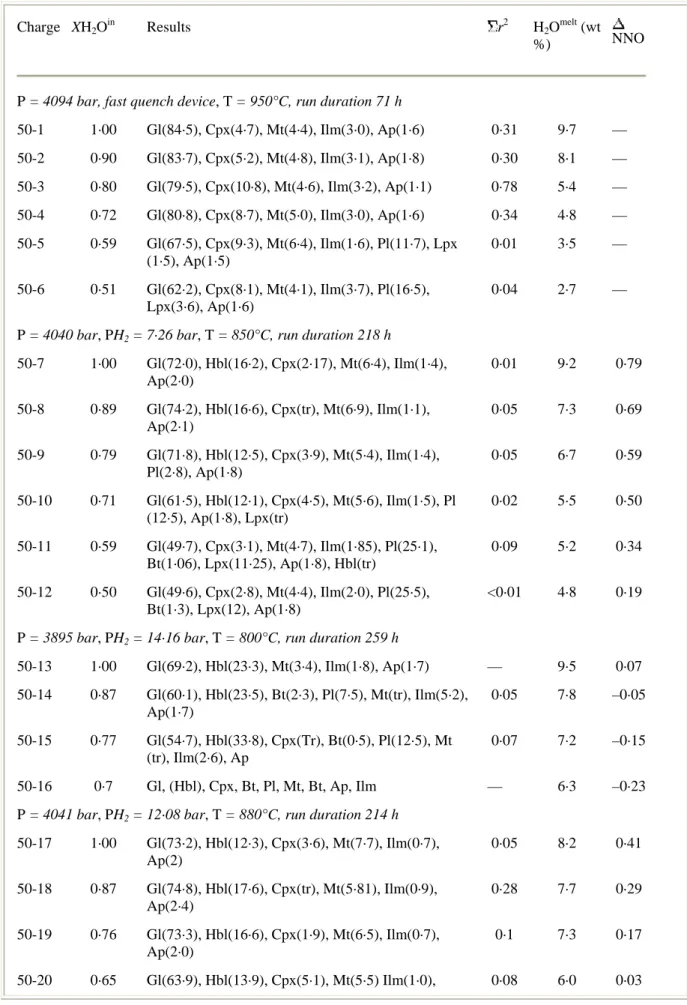
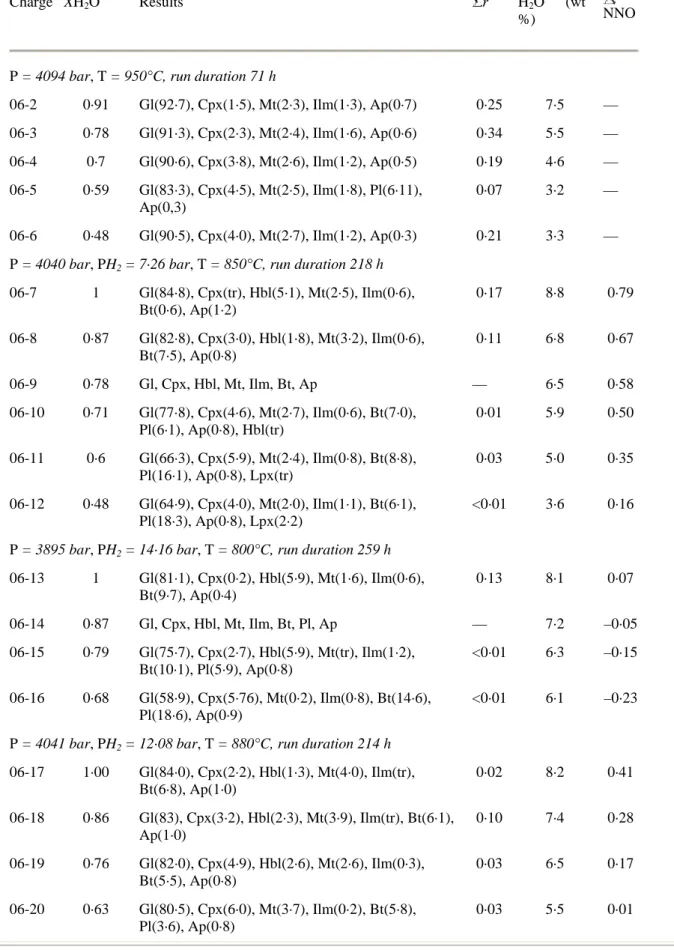
Experimental results at 4 kbar are given in Tables 2 (sample98N50) and 3 (sample 98N06). The related phase diagrams areillustrated in Fig. 4. In addition to glass and fluid phases (except in CO2-free charges undersaturated in H2O), the followingminerals were observed:
clinopyroxene, low-Ca pyroxene (eitherorthopyroxene or pigeonite), amphibole, biotite, plagioclase,magnetite, ilmenite, apatite. Anhedral zircon was locally observedbut its habit suggests it is actually a refractory mineral incompletelymelted during the preparation of the starting material. Thesolidus shown corresponds to that of the haplogranite systemas residual liquids trend toward this composition (Holtz &Johannes, 1994). H2O solubility varies
between 8·1 and8·8 wt % for 98N06 and between 8·2 and 9·7wt % for 98N50. These results are in good agreement with theH2O solubility calculated using the method of Burnham
(1979),except at high temperature for sample 98N50 (dotted line inFig. 4). The liquidus was not reached in our experiments butis slightly over 1000°C at aH2O = 1, as indicated by thelow
mineral proportions at this temperature and H2O content(Tables 2 and 3: 96% of glass in
98N06 and 92% of glass in 98N50).
Magnetite, ilmenite and apatite are the liquidus minerals andcrystallize at temperatures slightly above 1000°C at H2O-saturation.The slope of the saturation curve for the Fe–Ti
oxidesis not constrained by our experiments but inferred from otherexperimental studies (e.g. Dall'Agnol et al., 1999). Clinopyroxeneis the first silicate to crystallize (T > 950°C) andis present in all charges except at low temperature (T <850°C at aH2O = 1, Cpx-out curve) for
the bulk composition98N50, in which it reacts with melt to produce amphibole. Its
crystallization temperature decreases as aH2O increases. Plagioclasewas the only tectosilicate
obtained under the investigated conditions.Its crystallization temperature is very sensitive to H2Omelt:it is a near-liquidus mineral for low H2O content in the melt(H2Omelt < 3 wt %), and
its crystallization temperature islower than 750°C for H2O-saturated conditions. Quartz and
alkali feldspar were not observed in any of our experimentalcharges. This is not surprising, as experimental studies (e.g.Klimm et al., 2003) have shown that these minerals crystallizeclose to the solidus whereas our charges equilibrated at ourlowest investigated temperature (775°C) and with the lowestH2O content in melt still contain 51 and 59 wt % glass (charges50-31 and
06-32, respectively; Tables 2 and 3). Quartz and alkalifeldspar certainly crystallize at lower temperatures and/orH2O contents than those investigated here, in agreement with
petrographic observations (see above). The Low-Ca pyroxene (Lpx)stability field
encompasses a large interval of temperaturebut is restricted to H2Omelt < 6·5 wt % for 98N50
and < 5·2 wt % for 98N06. Because of lack of datafor T < 830°C at low H2Omelt, we cannot
specify whetherLpx is stable at lower temperature or if it is in reaction relationwith the liquid as temperature decreases (e.g. Lpx + liquid1 Biotite + liquid2), as suggested by the dashed
line in Fig. 4.The maximum crystallization temperature for amphibole is probablyslightly above 880°C and its stability field is restrictedto H2Omelt > 5 wt % for sample 98N50 and
H2Omelt > 6 wt% for sample 98N06. This topology has previously been observedin
experimental studies of granodioritic and granitic compositions(e.g. Naney, 1983; Dall'Agnol
et al., 1999; Costa et al., 2004).The biotite stability field is very sensitive to the magma composition:its saturation curve has a weak positive slope in the phasediagram of sample 98N06, with an upper T stability above 880°C.In contrast, in sample 98N50, biotite
crystallizes at 860°Cclose to the solidus, down to below 775°C at H2O saturation;the
biotite-in curve thus has a negative curvature biotite-in the T–H2Oprojection (Fig. 4).
Experiments at 2 kbar
Two additional experiments were performed at 2 kbar and 850°Cat two fO2 values [ NNO +
1·5 (Gros Bleu pressure vessel)and > NNO + 2·5 (Basset pressure vessel), Tables 2and 3]. The aim of these experiments was to investigate theeffect of pressure on the mineral stability fields, in particularthat of plagioclase (see below), and the liquid line of descent.We observed the same minerals as at 4 kbar, except that no low-Capyroxene crystallized. The lack of low-Ca pyroxenes is probablylinked to the more oxidized conditions imposed in these
experimentsat 2 kbar. Indeed, the experiments of Dall'Agnol et al. (1999)and Martel et al. (1999) at different fO2 showed the shrinkingof the low-Ca pyroxene stability field as fO2
increases. Anotherdifference between the two investigated pressures is the absenceof
amphibole at 2 kbar in the 98N06 composition. Either theamphibole is no longer stable in this composition at 2 kbaror it crystallizes below 850°C. In 98N50, below 3·4wt % H2O in the
melt, amphibole is replaced by clinopyroxene.Finally, the results for the 98N06 sample show that the crystallizationtemperature for clinopyroxene decreases with increasing fO2:it is
absent in the experiment at fO2 > NNO + 2·5whereas it crystallized at fO2 = NNO + 1·5.
Proportions and compositions of minerals
Individual mineral phases in our crystallization experimentsare homogeneous and the reported compositions (Tables 4–9)are considered representative of those present in a given experimentalcharge. Phase proportions were determined by mass balance, usingthe least-squares method (Tables 2 and 3).The sums of the least-squaresof residuals are generally low ( r2 < 0·35).
Fe–Ti oxides
Fe–Ti oxides obtained in our experiments are titanomagnetitesand hemoilmenites.
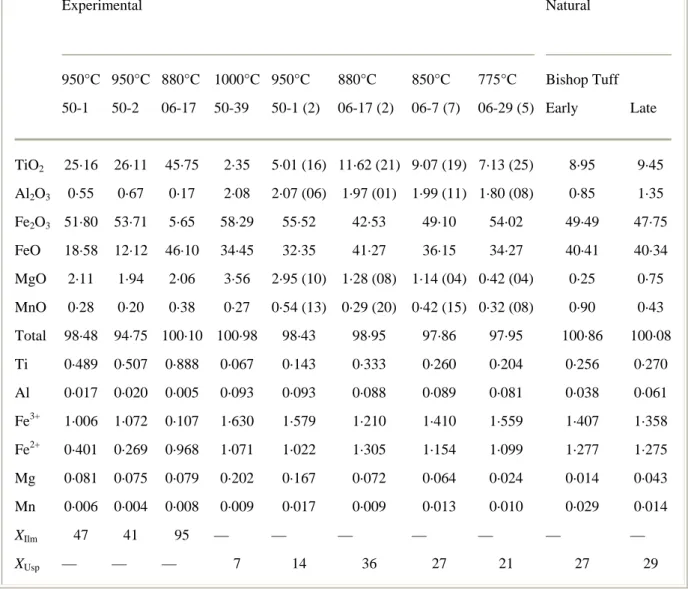
Representative analyses of experimental Fe–Tioxides are given in Table 4. The fractions of ulvöspinelin magnetite (XUsp) and of ilmenite in hemoilmenite (XIlm) werecalculated after
Stormer (1983). Magnetite and ilmenite formlarge cubic–octahedral and elongated crystals in H2O-saturatedcharges, respectively, but their sizes quickly decrease withdecreasing H2Omelt.
Ilmenite analyses are often contaminatedby glass.
For runs at 4 kbar between 880 and 775°C, XUsp ranges between0·21 and 0·43 and XIlm ranges
between 0·87and 0·95. The XUsp increases slightly with decreasingH2Omelt (e.g. at 880°C, XUsp
varies between 0·36to 0·44 for H2Omelt between 8·2 and 4·6wt %, respectively) as a result of
the lowering of fO2 withlowering fH2O. XUsp also decreases with decreasing temperatureas
expected (Verhoogen, 1962; Ghiorso & Sack, 1991). At950–1000°C, the ilmenite and ulvöspinel contentsare markedly lower (XUsp <0·15 and XIlm <0·50),because of the more
oxidizing conditions.
Plagioclase
The compositions of experimental and natural plagioclases aregiven in Table 5. Plagioclase crystallizing in both startingmaterials is similar at a given T and H2O. Its anorthite content
varies between An51 and An28, decreasing with decreasing T andH2Omelt. It partly overlaps the
range displayed by the naturalplagioclases but the latter are slightly more sodic (An34–22).This
slight discrepancy is interpreted as due to subsolidusre-equilibration of the natural feldspars as textural observationssuggest (e.g. presence of myrmekite).
Ca–Na exchange between plagioclase and melt (Kd) variesbetween 1·45 and 3·19 in the
investigated pressurerange, without any obvious correlation with H2Omelt (which varies
between 3·4 and 7·8 wt %). These observationsare in agreement with calculated Kd values for
other magmasof intermediate compositions under similar P–T–fO2conditions (2–4 kbar,
NNO or NNO + 2·5). For example,the Kd calculated for the Pinatubo dacite (Prouteau, 1999;
Scaillet& Evans, 1999) ranges between 1·76 and 3·94(H2Omelt 5·0–8·5 wt %) and that for the
Mt. Pelée andesites (Martel et al., 1999) ranges between2·05 and 4·71 (H2Omelt 4·8–7·6wt %).
As in our Lyngdal experiments, for both Pinatubo andMt. Pelée compositions, no clear correlation betweenthe H2O content in the silicate melt and the Kd is observed.This contrasts
which Kd increasesfrom 1·7 to 5·5 for 2–6 wt % H2Omelt, respectively.We suggest that the Kd sensitivity to H2Omelt decreases withthe lowering of the Ca/Na ratio in the melt. Indeed,
the majorityof experimental melts from Sisson & Grove (1993) have amolar ratio of (Ca/Na)melt > 1 whereas the experiments onintermediate rocks have a (Ca/Na)melt < 1. Lastly, it is important to note that the difference in experimentalplagioclase compositions between the Lyngdal granodiorite (An51–28)and Pinatubo (An62–30) or Mt. Pelée (An81–55)is
not due to different H2O contents or bulk Ca/Na ratios (0·98for the Mt. Pelée andesite and
0·94 for sample98N50; 0·59 for sample 98N06 and 0·60 for thePinatubo dacite). It rather reflects the important differencesin plagioclase crystallization temperature in these compositions(see below).
Amphibole and biotite
In Tables 6 and 7, experimental amphiboles and biotites arecompared with the natural mineral compositions. The experimentalamphiboles are calcic (hornblendes sensu lato) and usually occuras very large euhedral crystals (up to 300 µm) containingsmall Fe–Ti oxide inclusions. Amphiboles that crystallizedfrom the 98N50 and 98N06 starting products are very similarin composition for a given H2Omelt and T. The Al content isrelatively constant: it
varies between 1·67 to 2·03cations p.f.u. at 4 kbar and between 1·38 and 1·75cations p.f.u. at 2 kbar. In contrast, XFe varies with temperatureand H2Omelt. At H2O-saturated conditions, XFe
increases from0·38 at 880°C to 0·58 at 775°C. Variationsin H2Omelt have a smaller effect on XFe; for example, at 830°C,the XFe of amphibole crystallizing from 98N50 varies from 0·48
(8·3 wt % H2O) to 0·62 (6·5 wt % H2O).This evolution of XFe is mainly due to the lowering of
the mg-numberof the melt with decreasing T and H2Omelt. The influence offO2 on XFe is
examined below.
As for the amphiboles, the XFe in experimental biotites rangesbetween 0·39 and 0·63 at 4
kbar, as a result ofthe effect of H2Omelt and temperature. Table 7 shows that thecompositions
of the natural biotites are well reproduced byour experiments, in terms of their Fe/Mg ratio. The experimentalbiotites are, however, richer in Al2O3 and TiO2 and poorer inK2O. The
difference in the halogen contents between the experimentaland natural biotites and amphiboles could be due to their partialvolatilization during atmospheric melting of the samples orto the presence of an H2O–CO2 fluid in our experiments.
Pyroxenes
The compositions of the experimental clinopyroxenes are givenin Table 8 and can be compared with the composition of the naturalclinopyroxenes. The calculated KdFe–Mg =
[Fe/Mg]cpx/[Fe/Mg]melt (with all Fe as Fe2+) for the H2O-saturated charge (98N50) at950°C is
0·23, which is close to the calculated Kdfor the Mt. Pelée andesite (Kd = 0·25 at aH2O= 1,
900°C and 2 kbar; Martel et al., 1999).
As for amphibole, the experimental clinopyroxene compositionis similar in both starting materials for a given temperatureand H2Omelt. It is mainly a diopside–augite [after the
nomenclature of Morimoto et al. (1988)], trending toward hedenbergitein 98N06. Here too, the XFe ratio is a function of temperatureand H2Omelt. Under H2O-saturation, XFe increases
from 0·38at 880°C to 0·59 at 775°C, and at 850°C XFevaries from 0·33 for 8·8 wt % H2Omelt
to 0·56for 3·6 wt % H2Omelt. At low H2Omelt, a low-Ca pyroxene(pigeonite or orthopyroxene;
Table 9) crystallizes with theaugite. Orthopyroxene crystallizes with a Ca-rich augite, whereasaugite crystallizing with pigeonite has a lower Ca content.Calculated temperatures for coexisting pyroxenes with the QUILFprogram (Andersen et al., 1993) are between 57 and
259°Cabove the experimental temperatures. Such discrepancies arecommon in experimental studies (e.g. Vander Auwera & Longhi,1994; Villiger et al., 2004) and could be partially due to thecalculation procedures used to project pyroxenes with relativelyhigh contents of, for example, Al2O3 or TiO2, in the wollastonite–enstatite–ferrosilitecompositional space. Another
problem is the presence of pigeonitein some runs, up to 100°C below the minimum temperatureof its stability field determined by Lindsley (1983) in thesystem enstatite– ferrosilite–wollastonite. As wehave only few data on coexisting pyroxenes, we cannot explorein details the effects of pyroxene and melt compositions onthe differences between the experimental and calculated temperatures,and the possibility that the pyroxenes did not reach their equilibriumcompositions in the experimental charges with low H2O contents
cannot be excluded. However, the stability field for the low-Capyroxenes (Fig. 4) is likely to represent equilibrium conditionsas it is consistent over a large temperature range (950– 800°C)in our experiments and its T–H2Omelt relationships aresimilar to those in other
experimental studies (e.g. Naney,1983; Costa et al., 2004).
The natural clinopyroxenes are well reproduced in our experimentswith high H2O contents,
with the exception of the higher Al2O3content in the experimental clinopyroxenes (between
5·3and 1·2 wt % Al2O3 in the experimental clinopyroxenes,compared with between 1·5 and
1·2 wt % in thenatural ones). A possible explanation for the high Al2O3 contentin some
experimental clinopyroxenes arises from the observationthat their Al2O3 content is strongly
dependent on the activityof Al2O3 in the melt (Villiger et al., 2004). A general co-variation
between the Al2O3 molar fraction (XAl2O3) in the melt and theAl2O3 content of the
experimental clinopyroxenes is observed(Fig. 5). Actually, as we show below, our
experimental meltsare generally richer in Al2O3 than the natural liquid line ofdescent of the
HBG suite. In charges where the XAl2O3 valuesof the experimental melts are similar to those
of the HBG rocks,the Al2O3 content of the experimental clinopyroxenes (1·7–1·2wt % Al2O3)
is similar to that of the natural ones.
Glasses
Representative glass compositions are listed in Table 10. Withincreasing crystallization (lowering T and H2Omelt) the residualliquid becomes impoverished in MgO, FeO, CaO, TiO2
and Al2O3,whereas SiO2 and alkalis increase, in response to the precipitationof the
plagioclase–pyroxenes–oxides (± amphibole)assemblage. The glass SiO2 content for the
98N50 compositionvaries between 59 and 76 wt % at 1000°C and 800°C, respectively,and between 67 and 76 wt % for the 98N06 composition. The moreevolved liquids trend toward the minimum of the haplogranitesystem and closely resemble metaluminous to slightly peraluminoushigh-silica rhyolites erupted in extensional continental settingssuch as the Bishop Tuff (Table 10) or the Yellowstone rhyolites(Hildreth, 1979; Hildreth et al., 1991).
CRYSTALLIZATION CONDITIONS OF THE LYNGDAL MAGMA
H2O content
At a given pressure and fO2, the crystallization sequence dependson the H2O content in the
melt (Fig. 4). The following linesof evidence indicate that the natural sequence of
crystallizationcan be reproduced experimentally only if high H2Omelt prevailedduring the
early stages of crystallization. First, the low-Capyroxene stability field is restricted to low H2Omelt (H2Omelt < 6·5 wt % for 98N50, H2Omelt < 5 wt % for 98N06)whereas amphibole
crystallizes for H2Omelt > 5 wt %. Petrographicstudy of the Lyngdal granodiorite samples
shows that amphiboleis stable in both compositions and is an early crystallizingmineral, whereas neither orthopyroxene nor pigeonite was observed,nor were the latter two minerals observed in any other HBG plutonstudied by Vander Auwera et al. (2003). It appears that the
H2O content of the melt was probably above 6 wt % during thecrystallization of the Lyngdal
granodiorite. Even if we supposethat a low-Ca pyroxene had crystallized in the Lyngdal magmaand was later reacted out, another constraint on H2Omelt isprovided by the scarcity of
biotite in the least differentiatedLyngdal rocks ( 60 wt % SiO2) and its late crystallization
relativeto amphibole. Figure 4 shows that biotite crystallizes afteramphibole when H2Omelt is
above 5 wt % at 850°C and thisis a minimum estimate. Indeed, biotite is more abundant than amphibole when they coexist with a low-Ca pyroxene, i.e. forH2O contents between 5·5 and
6·5% at 830°C(see Table 2 for phase proportions in the experimental charges),in disagreement with the petrographic observations. It is alsoworth noting that high H2O
contents are supported by the abundanceand large size of pegmatites (outcrops up to several hundredsquare meters with crystals reaching the metre scale) in Lyngdalintrusion and in other members of the HBG suite (Svedrup, 1960;Nogarède, 2001).
For this elevated H2O content, near-liquidus phases are Fe–Tioxides, clinopyroxene and
apatite, in accordance with petrographicobservations, which also suggest that plagioclase crystallizestogether with or only slightly before amphibole. The crystallizationpath for a bulk-rock H2O content of 5 wt %, calculated assumingclosed-system behaviour and using
experimental phase proportions,is shown by the thick grey curve in Fig. 4. Clearly, under theseconditions, the natural sequence of crystallization is wellreproduced.
Oxygen fugacity
Oxygen fugacity exerts a strong control on the mineral composition(in particular, Fe–Ti oxide compositions and the XFe ofthe ferromagnesian minerals), and comparison between the
experimentalproducts and the natural minerals allows us to estimate thisparameter. However, natural Fe–Ti oxides typically re-equilibrateunder subsolidus conditions and, therefore, cannot be used toconstrain fO2. In contrast, ferromagnesian silicates betterpreserve the redox
conditions prevailing in the magma, evenif they re-equilibrated down temperature to some extent. Thefollowing observations suggest that both clinopyroxene and amphibole
compositions preserve magmatic conditions: (1) clinopyroxenesfound as inclusions in amphibole and plagioclase are similarto each other; (2) amphibole in plagioclase has a compositionclose to that in the matrix. It is unlikely that minerals includedin plagioclase would easily re-equilibrate by exchanging Feand Mg with other minerals in the matrix. Tables 6–8 showthat the compositions of the ferromagnesian minerals are wellreproduced by our experiments at 4 kbar and NNO or NNO + 1.Admittedly, our experiments do not cover a sufficiently widerange in fO2 to allow explicit constraints on the effect ofthis parameter on
mineral compositions. Some insight can begained, however, from the work of Dall'Agnol et
al. (1999),who performed experiments on a compositionally similar, yetmore evolved
composition (Jamon granite, 71 wt % SiO2; Fig. 1).In these experiments the XFe of amphibole
is 0·32 ±0·03 between 850 and 775°C at NNO + 2·5 and0·7 at 750°C and NNO – 1·5. Interestingly,the XFe of amphiboles synthesized in our experiments at NNOor NNO + 1
broadly fills the compositional gap of amphibolesobtained at NNO + 2·5 and NNO – 1·5 by Dall'Agnolet al. (1999), suggesting that, at fixed T, fO2 exerts a dominantcontrol on the
amphibole Fe/Mg ratio relative to the bulk composition.The fact that XFe values as high as
0·70 are not foundin Lyngdal amphiboles suggests an fO2 higher than NNO –1·5 for this
pluton. The Al content of our experimentalamphiboles is plotted against XFe in Fig. 6.
Amphibole crystallizingat NNO + 1·5 has a lower XFe than its natural counterpart,whereas
that obtained at NNO or NNO + 1 reproduces this ratio.Similarly, experimental clinopyroxene and biotite at NNO orNNO + 1 also reproduce fairly well the natural compositions(Tables 7 and 8). Altogether, these observations suggest thatthe Lyngdal magma crystallized at an fO2 between NNO and NNO+ 1.
Pressure
The large hornblende–biotite intrusions of the HBG suite(Fig. 2) define a differentiation trend from 56 to 77 wt % SiO2(Vander Auwera et al., 2003). The experimental glasses at 4kbar
reproduce the natural HBG for several elements except forCaO and Al2O3, whose content are
systematically higher in theexperimental glasses, as illustrated for CaO in a SiO2–CaO–(MgO
+ FeO + TiO2) diagram (Fig. 7). As the HBG trend is thoughtto reflect fractionation of Fe–Ti
oxides, clinopyroxene,plagioclase and apatite, with or without amphibole, from a magma similar in composition to sample 98N50 (Bogaerts et al., 2003a),this misfit requires further investigation. Two different processescould explain such a misfit: either the starting materials representliquids slightly laden with liquidus minerals (oxides and/orpyroxene) or the
experimental intensive parameters do not fullymatch the natural conditions. As previously discussed, accumulationof plagioclase, apatite and zircon is not supported by the available geochemical data (Bogaerts et al., 2003a, and section ‘Experimentaland analytical
procedure’) and a liquidus temperaturenear 1000°C for intermediate compositions is compatiblewith the high liquidus temperature of ferroan granites ( 900°Cfor a bulk composition with SiO2 = 71 wt %; Dall'Agnol et al.,1999). Moreover, the presence of
accumulated liquidus mineralsin the starting material would increase their proportions inthe experimental charges, but not greatly modify the compositionof the melt in equilibrium with plagioclase, clinopyroxene,Fe–Ti oxides, apatite and amphibole. A misfit relatedto an intensive parameter is thus favoured and examined below.
The modal proportions of representative experimental mineralassemblages from Tables 2 and 3 are normalized to 100% in Table 11and, as the composition of the individual minerals has beenmeasured, the chemical compositions of these assemblages canbe calculated. The experimental mineral assemblages and individualmineral are plotted (Fig. 7) in the
compositional space SiO2–CaO–(MgO+ FeO + TiO2). Based on major element modelling by
the least-squaresmethod on natural rocks, Bogaerts et al. (2003a) calculatedthe mineral assemblages that have to be fractionated to producethe natural trend from quartz
monzodiorite to granite in theHBG suite. This trend has been modelled in two steps, with step 1 (two possible models) starting from the least differentiatedsample (56 wt % SiO2) to an
intermediate composition (62 wt% SiO2), and step 2 starting from this latter composition to
give a residual melt of 72 wt % SiO2. The modal proportionsof the fractionated mineral
assemblages (hereafter referredto as modelled mineral assemblages) are given in Table 11 andplotted in Fig. 7 in the compositional space SiO2–CaO–(MgO+ FeO + TiO2) for
comparison with the experimental mineral assemblages.The modal proportions of the experimental mineral assemblages(Table 11) first show that the proportion of oxides and clinopyroxenein experiments at approximately NNO and NNO + 1 is similar tothe modelled mineral assemblages. This again supports our observationthat, if present, the proportion of accumulated minerals isnegligible. Second, the misfit between the experimental andmodelled mineral assemblages at 4 kbar is due to a higher amphibole/plagioclaseratio in the former. A higher proportion of crystallized plagioclaseshould lower the CaO and Al2O3 content in the
experimental glassesto fit with the HBG trend. The experiments conducted at 2 kbarshow that plagioclase crystallizes at 850°C for aH2O = 1,which is not the case at 4 kbar. However,
despite this higherproportion of plagioclase at 2 kbar, the experimental glassesare still richer in Al2O3 and CaO than the natural HBG suite.Figure 7 shows that the CaO content of residual
liquids is verysensitive to the plagioclase/Fe–Ti oxides ratio, whichdepends on pressure (mainly affecting plagioclase) and fO2 (mainlyaffecting the Fe–Ti oxides). In the
experimental mineralassemblages, this ratio appears too small when compared withthe modelled mineral assemblages, which reproduce the HBG trend(Table 11). As mentioned above, our experiments at 4 kbar (<950°C)fit well the fO2 of the Lyngdal magma, and the
experimental pressure that is too high, producinga plagioclase/Fe–Ti oxides ratio (P/O) that is too low.In contrast, the misfit at 2 kbar is probably due to an fO2that is too high (>NNO +
1·5), thus crystallizingtoo much Fe–Ti oxides despite crystallization of a largeramount of plagioclase, which yields again a P/O ratio that istoo low.
Based on the above considerations, we can constrain the emplacementpressure of the Lyngdal granodiorite. An emplacement pressureof 4 kbar is too high, as the melt does not crystallize enoughplagioclase. At 2 kbar, the amount of plagioclase is higher;however, amphibole is not stable at 850°C in experimentson sample 98N06 while biotite crystallizes. Amphibole could be stable in this composition at temperature below 850°Cbut the natural sequence of
crystallization indicates that amphibolecrystallizes before biotite. We therefore conclude that theLyngdal granodiorite most probably crystallized at pressuresbetween 2 and 4 kbar.
COMPARISON WITH OTHER EXPERIMENTAL STUDIES
All previous experiments on metaluminous ferroan granitoids(Clemens et al., 1986; Dall'Agnol et al., 1999; Klimm et al.,2003; see Fig. 1) focused on granitic magmas sensu
stricto (SiO2> 71 wt %). This study is the first experimental investigationon ferroan magmas
of intermediate compositions related to rapakivigranites, which both display low Al2O3
contents and high traceelement contents (e.g. Zr, Nb, REE). In the following discussion,we start by comparing our phase relationships with those obtainedon magmas that are more evolved, but of similar affinity (Clemenset al., 1986; Dall'Agnol et al., 1999; Klimm et al.,
2003).We then compare the Lyngdal data with phase equilibria obtainedfor other intermediate magma compositions. The rationale hereis (1) to illustrate common phase equilibrium features specificto metaluminous ferroan granitoids, (2) to highlight existing differences between this magma type and others generated indifferent tectonic settings. The near liquidus phase assemblage (plagioclase, amphibole,pyroxenes, Fe–Ti oxides) of the ferroan calc-alkalic granites(Dall'Agnoll et al., 1999; Klimm et al., 2003) compares wellwith that of their less silicic counterparts investigated here.Pyroxenes are near liquidus phases and react out as temperaturedecreases, as observed at least for clinopyroxene in the Lyngdal granodiorite compositions. The stability field of amphiboleextends to slightly lower H2Omelt
in granite, 4·5 wt% as compared with 5·5 wt % in intermediate rocks, althoughin the more evolved variety (73·6 wt % SiO2) amphiboleis unstable (Klimm et al., 2003). Plagioclase is
always thefirst tectosilicate to crystallize, followed by quartz and alkalifeldspar, which both appear at temperatures lower than 700°Cat H2O-saturation. Altogether, the phase equilibria of
graniteand intermediate metaluminous ferroan, calc-alkalic to alkali-calcicmagmas appear to be very similar, except of course that liquidustemperatures (c. 900°C) are depressed by c. 100°C ingranite compositions relative to the less silicic varieties.This similarity in topology and the fact that residual liquidsof intermediate metaluminous ferroan magmas (calc-alkalic toalkali-calcic) are nearly identical to the granites of similaraffinity suggest that the latter can be obtained by differentiationfrom the former.
Intermediate magmas from convergent tectonic settings (andesitesto dacites) typically have higher Al2O3 (>15 wt %) and CaOcontents, and lower FeO–TiO2 contents than the ferroan
magma compositions (e.g. Pinatubo dacite and Mt. Peléeandesite: Table 1 and Fig. 1). Comparison between the phasediagrams for sample 98N50 and that of the andesite from Mt. Pelée (Lesser Antilles volcanic arc: Martel et al., 1999)shows that this compositional difference mostly affects thestability of plagioclase, which is an early phase in the andesite while its crystallization temperature is 100–150°Clower in the Lyngdal composition (at aH2O
= 1). The same holdstrue when comparing composition 98N06 with the Pinatubo dacite (Luzon volcanic arc: Rutherford & Devine, 1996; Scaillet& Evans, 1999; Prouteau &
Scaillet, 2003). Whereas bothrocks have similar bulk-rock SiO2 contents (respectively 65and
64 wt %), plagioclase is on the liquidus at 4 kbar in thePinatubo dacite (Prouteau & Scaillet, 2003), crystallizingat near 900°C at H2O-saturation, whereas under similar P–H2Oconditions
the plagioclase saturation temperature is at least125°C lower in the Lyngdal granodiorite. Obviously thisdifference in plagioclase stabilities between Lyngdal and arcmagmas reflects the lower Al2O3 and CaO contents of the Lyngdalmagma. The lower crystallization
temperature of plagioclasein Lyngdal, as compared with our examples of arc magma
compositions,explains its lower anorthite content for similar H2Omelt andCa/Na ratios in the
bulk compositions, as discussed above. Whenplagioclase starts crystallizing in the Lyngdal magma, the Ca/Naratio of the melt has already decreased to <0·5 asa result of clinopyroxene crystallization, whereas in the Pinatubodacite and Mt. Pelée andesite, plagioclase is a liquidus phase and (Ca/Na)melt (Ca/Na)bulk–rock.
Finally, the Lyngdal phase equilibria can also be compared withthose of the Fish Canyon Tuff (FCT in Table 1 and Fig. 1; Johnson& Rutherford, 1989b), which is a quartz latite erupted duringthe mid-Cenozoic in Colorado (USA). Its tectonic setting isstill controversial, as the link between this magmatic episodeand the Oligocene subduction of the Pacific plate beneath NorthAmerica is not yet resolved (Bachmann et al., 2002). The FishCanyon Tuff shares some geochemical affinities with Lyngdal:both are ferroan and their MALI index [(Na2O + K2O) –CaO] is similar (FCT is alkali-calcic and Lyngdal straddlesthe
calc-alkaline–alkali-calcic boundary; Fig. 1). However,as for subduction zone magmas relative to Lyngdal, FCT is poorerin TiO2 and FeOt and richer in Al2O3 (Table 1). At H2O-saturation
Lyngdal has a higher liquidus temperature (c. 1000°C) thanFCT (c. 930°C). The plagioclase-in curve is much steeperin Lyndgal, inducing a lower crystallization temperature (<750°C) than in FCT (near 800°C at aH2O = 1) but near-liquidus crystallizationin Lyngdal (>1000°C)
at low H2O contents. Amphibole andbiotite display similar crystallization temperatures in
bothcompositions, although the amphibole stability field seems morerestricted in Lyndgal. In the FCT composition, the crystallizationtemperature of amphibole is near 900°C, even for low H2Ocontents in the melt, and there is no low-Ca pyroxene. The differencein stability of
amphibole is even more significant at lowerpressure, where its crystallization temperature at
aH2O = 1is near 900°C for the FCT composition and lower than 850°Cin Lyngdal. Moreover
for the FCT composition, clinopyroxeneis in peritectic reaction with hornblende near 825°C andis thus stable over a restricted temperature interval ( 100°C).In the Lyngdal composition, this temperature interval is twiceas large.
The above comparison shows that, although metaluminous ferroan,calc-alkalic to alkali-calcic granitoids are clearly rich inalkalis (especially K2O), in terms of phase relations the key
elements that readily distinguish them from intermediate magmasat convergent margins is their low contents of Al2O3 and CaO.Although this view might be considered merely the
reciprocalof an alkalis–alumina balance, the phase equilibria comparisonshows that
metaluminous ferroan magmas should be viewed notonly as alkali rich but also as Al2O3- and
CaO-poor rocks (Eby,1990). It is the actual content of both elements that controlsplagioclase stability.
DISCUSSION
General
Many ferroan granitoids were originally believed to be anhydrousand reduced, and were termed A-type granites (Loiselle &Wones, 1979; Collins et al., 1982). Although these
conditionsof crystallization have been confirmed in some cases, for examplethe charnockites of Bjerkreim–Sokndal (Vander Auwera &Longhi, 1994; Duchesne & Wilmart, 1997), the experimentalwork of Clemens et al. (1986) and Klimm et al. (2003) has shownthat ferroan granitoids from the Lachlan Fold Belt of Australiawere not anhydrous, but had H2O contents
similar to those ofcalc-alkaline magmas [H2O between 2·4 and 4·3wt %; traditionally
referred to as I-type and defined as magnesiancalcic or calc-alkalic granitoids after Frost et al. (2001)].These studies also confirmed the reduced nature of the Australianferroan granitoids (fO2 between FMQ – 1 and FMQ –3, where FMQ is the fayalite–magnetite–quartz buffer).In
contrast, Anderson (1983) showed that ferroan granitoidscan crystallize over a large range of
fO2 (fO2 between FMQ +3 and FMQ – 4). This observation has been confirmed
experimentallyby the work of Dall'Agnol et al. (1999) and by the results ofthis study, which constrain fO2 between NNO and NNO + 1 duringcrystallization of some ferroan granitoid
magmas. These oxidizedgranitoids also have high H2O contents: 4·5–6·5wt % H2Omelt at an
early stage of crystallization of the Jamongranite (Dall'Agnol et al., 1999) and 5–6 wt % for theLyngdal granodiorite. An important aspect of the present studyis that the Lyngdal granodiorite extends the compositional trendof oxidized and hydrous ferroan granitoids toward less siliciccompositions. These observations illustrate that ferroan granitoidmagmas of intermediate composition encompass a large range offO2 and melt H2O contents,
suggesting that a variety of sourcesare involved in the generation of ferroan magmas worldwide.We return to this point below where we discuss, in greater detail,the possible sources of the Lyngdal granodiorite.
Origin of the Lyngdal granodiorite
We start this section by summarizing the constraints on theorigin of the Lyngdal granodiorite provided by this study andthat of Bogaerts et al. (2003a), who made a detailed field and geochemical study (major and trace elements, Sr–Nd isotopes)of the Lyngdal intrusion and its satellite massif (Tranevåg).The least differentiated samples from the Lyngdal and Tranevåg massifs have SiO2 content around 60 and 56 wt %, respectively.Major and trace element
modelling, combined with Sr–Ndisotope data, indicates that these magmas could be parental to the more evolved compositions observed in Tranevåg(up to 72% SiO2) without
significant crustal contamination (Bogaertset al., 2003a) and that the Lyngdal–Tranevåg
granitoidscould be produced via a simple crystal fractionation process.Our phase equilibrium constraints suggest that the Lyngdal–Tranevågrock suite can be produced by crystal
fractionation of 98N50type magmas at 3 ± 1 kbar. The fact that the experimentallyderived liquid compositions conform closely to the natural rockseries suggests that the starting rock compositions selectedhere are good analogues of the parental magmas, which were not significantly affected by crystal accumulation during crystallization.This, together with the phase equilibrium constraints detailedabove, suggests that the magma parental to the Lyngdal granodioritewas emplaced as a near liquidus body.
The formation of granitoids from nearly crystal-free melts seemsto be a common process (e.g. Scaillet et al., 1998) and hasbeen explained as the consequence of their rapid emplacementin the upper crust (e.g. Wall et al., 1987). By analogy, thissuggests rapid ascent of the Lyngdal magma from its source tothe emplacement level, probably via dyking (e.g. Clemens & Mawer, 1992). Density and viscosity calculations for the Lyngdalmagma, based on results
from this experimental study, supportsuch a hypothesis (Bogaerts et al., 2003b). We now address theissue of whether these intermediate magmas are derived via crustalanatexis or are the differentiated products of more mafic compositions.
Crustal anatexis
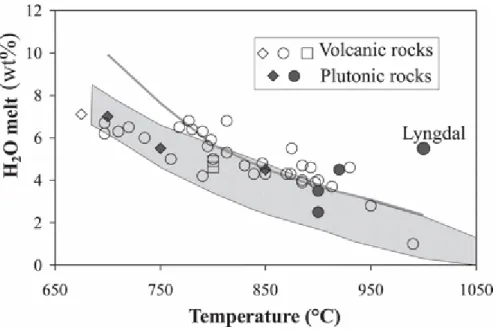
Figure 8 (modified after Scaillet et al., 1998) illustratesthe relationship between temperature and H2Omelt for a varietyof granitic magma compositions (metaluminous, peraluminous,
peralkaline) emplaced in different tectonic settings. The observednegative correlation between T and H2Omelt can be explainedby the strong buffering effect of dehydration partial
meltingreactions in the crust (see Clemens & Watkins, 2001), i.e.aH2O is fixed by the melting
temperature of a given protolith.Clemens & Watkins (2001) concluded that the absence of hot and wet magmas implies fluid-absent or evolution to fluid-absentconditions during partial melting in the continental crust.Specifically, anatectic melts of andesitic–dacitic composition produced via dehydration melting of basalt sources (or theirmetamorphosed equivalents such as amphibolites) require meltfractions higher than 40 wt % (e.g. Rapp & Watson, 1995).At such high melt fractions, the melt H2O content is unlikelyto exceed 3 wt %. In contrast, our
results show that the Lyngdalgranodiorite crystallized from a hydrous and hot magma that clearly plots off the main trend (Fig. 8). Therefore, assumingthat the emplacement conditions of the Lyngdal granodioriteare well constrained, two hypotheses can explain this off-trend position: (1) the magma formed by fluid-present melting; (2)the magma is the differentiation product of a more mafic composition,the high H2O content resulting from the incompatible
characterof this component in the mafic magma. Fluid-present meltingof lower crustal (i.e. andesitic to basaltic) lithologies isunlikely to yield Al2O3- and CaO-poor anatectic melts, as
manyexperimental studies have shown (e.g. Beard & Lofgren, 1991),because excess H2O
promotes extensive melting of plagioclasein the protolith, giving rise to tonalitic magmas. Also, itseems difficult to have fluid-present conditions during thewhole interval of crustal fusion (see Clemens & Vielzeuf,1987), in particular when a high degree of partial melting andhigh magma volumes are required to produce partial melts ofandesitic–dacitic
composition, as is the case for theLyngdal granodiorite and other HBG plutons in southern Norway.The second hypothesis is thus preferred and examined below.
Fractionation from a mafic magma
The origin of the coeval charnockitic magma belonging to theAMC suite of the Rogaland Intrusive Complex is well constrainedand is compared here with possible interpretations on the originof the HBG suite. Charnockites of the Bjerkreim–Sokndalmassif are mainly explained as the differentiation productsof a jotunitic (hypersthene monzodiorite) parental magma; however,Vander Auwera et al. (1998) did not exclude the possibilityof deriving some quartz mangerites by partial melting of thelower crust. These rocks display a continuous liquid line ofdescent variably affected by crustal assimilation (Wilmart etal.,
1989; Duchesne & Wilmart, 1997; Bolle et al., 2003).Experimental studies and mineral compositional data (VanderAuwera & Longhi, 1994; Duchesne & Wilmart, 1997) indicate that these magmas crystallized at an fO2 between FMQ and FMQ– 1 and under relatively dry
conditions (aH2O increasedto 0·3 in the most differentiated charnockites). Thefeasibility of a
jotunitic parent magma for the Lyngdal granodioriteis examined below.
Based on REE modelling, Duchesne & Demaiffe (1978) proposedthat the Lyngdal granodiorite could represent a residual meltfrom the crystallization of a jotunitic parent magma. The differencein fO2 (between FMQ or FMQ – 1 for the jotunite and NNOor NNO +
1 for the Lyngdal granodiorite) could be explainedby crustal assimilation. Such a
fO2 betweenvarious granitoids in the Laramie complex (Anderson et al.,2003). Anderson et al. observed that the Red Mountain Pluton,which exhibits the most extreme ferroan
geochemistry, i.e. veryhigh FeOt/(FeOt + MgO) ratios, but also very high K2O and REE–
HFSE(high field strength element) contents, is also the most reducedand least contaminated magma type of the Laramie complex. Itsdifferentiation trend on a T–fO2 diagram is shown in
Fig. 9.The less extreme ferroan character of other granitoids fromthe same magmatic suite (e.g. the Sherman batholith), in particulartheir higher fO2 (Fig. 9) was attributed by those
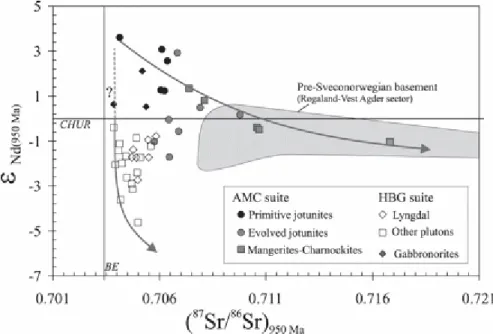
workers tocrustal assimilation. Anderson et al. (2003) concluded thatthe ferroan plutons of the Laramie complex are differentiatesor partial melts of underplated tholeiitic magmas [the ‘tholeiiticconnection’ of Frost & Frost (1997)], variably contaminatedby felsic crust, and they suggested that this model could explainthe variability of ferroan granitoids worldwide. In southernNorway, the situation appears different. As previously noted,the AMC suite is produced by the crystallization of primitivejotunites variably contaminated by the gneissic basement ofthe Rogaland–Vest Agder sectors (Bolle et al., 2003).As observed in Fig. 10, crustal contamination appears to beimportant for the petrogenesis of the charnockites, but theynevertheless preserve the dry and reduced character of theirjotunitic parent magma (Duchesne & Wilmart, 1997; VanderAuwera et al., 1998). In contrast, the HBG suite exhibits alarger variation in 143Nd/144Nd calculated at 950 Ma, expressedin Nd values in Fig. 10 (–0·4
to –4·63)for a small variation of initial 87Sr/86Sr ratios (0·7038–0·7058),implying a different crustal contaminant if we admit that theHBG suite is also derived from a jotunitic parent magma. A differentcrustal contaminant could explain the higher fO2 and the highH2O
contents of the HBG suite. However, this model does notexplain the similar isotopic compositions of the Lyngdal granodioriteand some of the evolved jotunites, which partly overlap (around Nd = –1 and 87Sr/86Sr = 0·7057; Fig. 10). If bothmagmatic suites were
derived from the same parent magma, thisoverlap suggests that they were contaminated by a similar componentconsisting of a mixture of the two extreme crustal end-members.This is in contradiction to their strong differences in fO2and H2O contents. Moreover, if the HBG suite
results from mixingbetween a jotunitic magma (and its derivates) and an H2O-rich
contaminant, we would expect a large variation in H2O contentamong the plutons forming the
HBG suite, producing differentfacies: opx- and biotite-rich to amphibole-rich assemblages. Our phase diagrams do indeed show that variations in H2O contentproduce differences in the
nature and amount of the ferromagnesianminerals. However, all the HBG plutons have the same mineralassemblage and mineral compositions. These observations stronglysuggest that the AMC and HBG suites have different parent magmas,even if an origin from similar magmas contaminated by differentcrustal components cannot be completely ruled out. The Lyngdal granodiorite and the Tranevåg massif (andthe HBG suite in general) define similar, but distinct majorelement compositional trends compared with the AMC suite (VanderAuwera et al., 2001; Fig. 1). Vander Auwera et al. (2003) studiedsmall mafic– intermediate massifs (Handeland and Åseralintrusions) associated with the hornblende– biotite granitoidsof the HBG suite, and also considered small contemporaneousgabbronorite massifs (Demaiffe et al., 1990) cropping out nearthe Lyngdal granodiorite. They suggested the possible existenceof a liquid line of descent from gabbronorites to the quartz
monzodiorites–granodiorites in the lower crust. The gabbronoriteshave geochemical similarities to the jotunites but could bemore oxidized and hydrous (Vander Auwera et al., 2003) and couldthus represent potential parent magmas to the HBG suite. Testingthis hypothesis is beyond the scope of the present study; however,the important point to stress here is that this model is verysimilar to that proposed for the Mesoproterozoic (1600–1300 Ma) ferroan granitoids of Laurentia and Baltica by Anderson& Morrison (2005). Those workers proposed that the oxidizedor reduced nature of the granitoids in this magmatic
provinceis due to the composition of the lower crust, i.e. that thefO2 of a magma is a probe
for the fO2 of its source (Carmichael,1991).
Comparison with volcanic rocks
Frost & Frost (1997) have emphasized the compositional similaritiesbetween reduced ferroan granites and some recently erupted rhyolitessuch as those from Yellowstone. In the following discussion,we show that some extrusive rocks do indeed compare well withferroan granitoids similar to those investigated here or totheir expected derivatives.
High-silica rhyolites can be derived by partial melting of,or by differentiation from, more mafic magmas. The latter modelis well illustrated by our crystallization experiments, which produce high-silica melts. Table 10 shows the compositionalconvergence of the glasses produced by the Fish Canyon Tuff(FCT) and Lyngdal experiments (4 kbar, T < 850°C) as well as their resemblance to natural high-silica rhyolites suchas the Bishop Tuff. As previously noted, these experimentalmelts are in equilibrium with different mineral assemblagesfor similar intensive parameters. This reflects their crystallizationon different cotectic curves converging towards the haplograniteminimum and underlines the importance of bulk-rock compositionon the mineral assemblage in equilibrium with the rhyoliticmelt. Pre-eruptive conditions for the pyroxene-bearing faciesof the Bishop Tuff (quartz, sanidine, plagioclase, biotite,ilmenite, magnetite, apatite, zircon, and augite plus orthopyroxene: Hildreth, 1979) have been estimated at: T between 800 and 850°C,H2Omelt between 3·5 and
5·5 wt %, fO2 betweenNNO + 0·3 and NNO + 0·6, and pressure at 2·7± 0·6 kbar (mineral and
fluid inclusion data:Frost & Lindsley, 1992; Anderson et al., 2000). Our lowestT and H2Omelt
experiments approach these conditions (Fig. 4)and the mineral assemblage and composition of the Bishop Tuffare relatively well reproduced by our experiments at the lowesttemperature and H2O contents (Tables 4–10), which areprobably not very far from quartz and K-feldspar
saturation.Observing that the silica content of extra-caldera volcanicrocks decreases with time from 75 to 64 wt % SiO2, Bailey etal. (1976) suggested that the high-silica rhyolites
could befractionated products from an intermediate parent magma. Basedon the previous discussion, a magma similar to the Lyngdal granodiorite,although probably with a lower initial H2Omelt, could representsuch a parental magma to the Bishop Tuff. Thus, as for their
reduced counterparts, the comparison of the silicic derivativesobtained in the present study with volcanic rocks shows thatsome moderately oxidized high-silica rhyolites can be derived by crystallization of intermediate, metaluminous, ferroan magmas.
Finally, as shown in Table 1, it is worth noting that the compositionof the Lyngdal granodiorite is similar to that of the abundantquartz latites from the Etendeka and Paraná provincesof Namibia and Brazil (Fig. 1), which were erupted at c. 132Ma and contain phenocrysts of plagioclase, pyroxenes (pigeonite± augite, pigeonite ± hypersthene) and titanomagnetite(Ewart et al., 1998, 2004). These voluminous silicic volcanicsuccessions have been interpreted as the extrusive equivalentsof igneous ferroan charnockites (Kilpatrick & Ellis, 1992),formed via melting of a previously dehydrated crustal granulitesource. They are associated with flood basalts erupted duringthe early Cretaceous rifting of the Africa–South Americasupercontinent, which led to the opening of the South AtlanticOcean. Thus their tectonic context is extensional. The phasediagram for 98N06 shows that the Etendeka mineral assemblagecan be produced at high temperatures ( 1000°C), in agreementwith estimated crystallization temperatures of 1000–1100°C,deduced from pyroxene equilibria in the quartz latites (Ewartet al., 1998). The presence of pigeonite also confirms thatthe anhydrous phenocryst assemblage reflects the low H2O contentof the Etendeka–Paraná quartz latite