January 1987 LIDS-P-1644
Distributed Computation for
Linear Programming Problems Satisfying Certain Diagonal Dominance Condition*
by
Paul Tseng** Abstract
An iterative ascent method for a class of linear programming problems whose constraints satisfy certain diagonal dominance condition is proposed. This method partitions the original linear program into subprograms where each subprogram corresponds uniquely
to a subset of the decision variables of the problem. At each iteration, one of the subprograms is solved by adjusting its corresponding variables, while the other variables are held
constant. The algorithmic mapping underlying this method is shown to be monotone and contractive. Using the contractive property, the method is shown to converge even when implemented in an
asynchronous, distributed manner, and that its rate of convergence can be estimated from the synchronization parameter.
*This research was conducted first at the I.I.T. Laboratory for Information and Decision Systems with partial support provided by the National Science Foundation under Grant NSF-ECS-8217668 and later at the U.B.C. Faculty of Commerce and Business Administration with support provided by NSERC of Canada under Grant NSERC-U0505. **The author is presently with the Faculty of Commerce and Business Administration, University of British Columbia, Vancouver, Canada.
1. Introduction
The infinite horizon, discounted dynamic programming problem with finite state and control spaces can be shown (see Bertsekas
[3]; Denardo (6]) to be equivalent to a very large linear programming problem wihose constraints satisfy some diagonal dominance condition. However, the number of constraints in this
linear program grows as a product of the size of the state space and the size of the control space. This number is typically very
large, thus rendering conventional linear programming methods impractical for solving this problem. In this paper, a method for solving a more general case of the above linear programming problem is proposed. The advantages of this method are that (i) it
exploits the diagonal dominance structure of the problem, and (ii) its computation can be distributed over many processors in
parallel. In this way, even very large problems can be solved in a reasonably short time. bore specifically, this method partitions the original linear program into subprograms where each subprogram is associated with a processor. At each iteration, one of the subprograms is solved by adjusting its corresponding variable(s), while the other variables are held fixed. The algorithmic mapping underlying this method is shown to be contractive and, using the
contractive property, we show convergence even if the method is implemented in an asynchronous, distributed manner and furthermore we obtain rate of convergence estimate as a function of the
synchronization parameter.
2. Problem, Definition
Consider linear program of the following special form Maximize aTx
(A) subject to Clx < d1
2
where a and dk ,k=i,...,K, are given vectors in RI ; Ck ,k=l ....
are given mcm real matrices. We make the following assumptions regardin P':
Assumption A: a is nonnegative.
Assumption B: Each Ck (k=i,...,K) is a
Ame
diagonally dominant matrix whose diagonal entries are positive and whose off-diagonal entries are nonpositive.Ye denote the (i,j)th entry of Ck by Cijk, the ith entry of dk by
dik, the jth entry of a and x by aj and xj respectively. Ye also denote the index set {1,2,...,m} by NI. For any vector x we will use IxL, to denote the sup norm of x , i.e.
Ixl
= maxj I xjl and for two vectors x and y of equal dimension we will use x < y to mean xj < yj for all j. Note that for a given P the point (AA,...,. ) isfeasible for P for all A sufficiently negative.
We may interpret P physically as a production problem
involving a production centers, each of which is responsible for producing an item, some fractional amount of which is used by the
other production centers as resource to produce their own items, and the efficiency of resource usage as well as external resouce supply are both random variables. More precisely, let the amount of the jth item produced be denoted by xj which carries with it a nonnegative utility of ajxj. There are K possible scenarios that may be realized. Under the kth scenario, the amount of the ith
item that can be produced is limited by the amount of external materials available, given by dik/Ciik, plus the sum of a fraction,
given by Cik/Ciik, of the jth item produced summed over all jti.
We wish to plan a production level (xl,x2,...,x,) that maximizes the
total utility alxi+... +axxm such that none of the production
constraints is violated regardless of which scenario is realized in the future.
3
P is a special case of linear programming problems and can be solved using any linear programming method, such as the simplex method. However, if the size of P is very large, and noting that t
is not necessarily sparse in structure, the time required to solve P would likely be large even for very efficient linear programming methods. As an example, if =1i00 and K=100, then Phas 100
decision variables and 10,000 inequality constraints. A special case of P, the infinte horizon, discounted dynamic programming problem with finite state and control spaces, typically has n,K r
100 for real applications.
It is therefore important to design methods for solving P that can take advantage of its special structure. Such approach has been successful for other special cases of linear programs such as network flow problems and Leontief systems. In fact, the
constraint matrix for Pand its transpose are both Leontief (a matrix E is Leontief if E has exactly one positive entry per column
and there exists a x i 0 such that Ex > 0). It is known that if E is Leontief, then there exists a x*, called the least element, such that x* solves the following problem
'faximize aex
subject to EIx g d
for all a > 0 ard d such that the above problem is bounded (see [7]). In our work we only require that a be nonnegative but the existence of a least element still holds and is crucial for the method proposed here to work.
The infinite horizon, discounted dynamic programming problem with finite state and control spaces is described below. This problem frequently arises in the areas of inventory control, investment planning, and Markovian decision theory. It is
traditionally solved by the successive approximation method or the policy iteration method (see [31 or [6]). However neither method has a theoretical rate of convergence as good as that of the method proposed here.
4
The infinite horizon, discounted dynamic programming problem with finite state and control spaces is equivalent (see for example
[3]) to the following special type of linear program
Maximize i: xj
j-l
subject to xi s g(i,u) + .i Pij(u)xj , uEU(i), i=i .... , j=1
where moE(O.1) is called the discount factor, {1,2,....m} denotes the state space, U(i) denotes the set of possible controls when in state i (size of U(i) is finite), pij(u) denotes the probability that the next state is j given that the current state is i aend the control u is applied, and g(i,u) is the average reward per stage when in state i and control u is applied.
We can make the identification with Prore explicit by rewriting the above program as
MaEximize 7 x;
j=1
subject to (i-o-Pii(u))xi - E oxpij(u)Xj s g(i,u), VueU(i),
j= i1 ...
Then given that cte(0,1), and augmentin the constraint set with duplicate constraints if necessary, we can easily verify that the above problem is a special case of P
3. The Sequential Relaxation Method
Consider an arbitrary nonempty subset of M, denoted S, and for each xeRm define the following maximization subproblem associated wit.h S and x
5
Maximize ZjeS ajtj
subject to 2jeS Cijk Ij
<
dik -IjS Cijk xj,
k= ....Kwhere *j jeS, are the decision variables. Note that J?(x) is just the original problem
P
For any nonempty S and x the problemPs(x) is clearly feasible since the vector (lA, ... ) of dimension
1St is a feasible solution. However using the following lema we can show that FS(x) in fact has an optimal solution.
Lemma I Suppose A is a n by n diagonally dominant matrix with positive diagonal entries and nonpositive off-diagonal entries. Then the following holds:
(a) A-1 exists and is a nonnegative.
(b) If B is a nonnegative matrix of n rows such that [A -B] has all row suns greater than zero then A-1B is nonnegative and has all row sums less than one.
Proof
We prove (a) first. That A is invertible follows from the Gershgorin Circle Theorem (see for example [10]). To prove (a) we write A as A = D-B where D is the diagonal matrix whose diagonal entries are the diagonal entries of A. Then
A-1 = (I-D-IB)-1D1 - . (1)
D-1B has zero diagonal entries, nonnegative off-diagonal entries. and row sums each less than 1. Then by Gershgorin Circle Theorem D-lB has spectral radius less than i and from (1) it follows that
6
A71 = (I+(D-IB)+(D-IB)2+ ... )D-1
Since D-1 and D-1B are both nonnegative it follows that A-1 is nonnegative.
We now prove (bj. We are given that Ae - Be' > 0 where e
ard e' denote vectors of appropriate dimensions whose entries are all 1's. lMultiplying both sides by A-1 and using (a) we obtain that
e - A-1Be' > 0 . from which (b) follows. Q.E.D.
To show that Ps(x) has an optimal solution we note that its constraints written in vector notation has the form
-t
i
, k=i,....,where ~ is the vector with components tj ,jeS, and each VL by
Assumption B is a ISIXISI diagonally dominant matrix whose diagonal entries are positive and whose off-diagonal entries are
nonpositive. Then Lemma i (a) implies that all feasible solutions t of
FS(x)
must satisfy {!
(t)-Il , k=i,...,K which together withAssumption A imply that Ps(x) has an optimal solution.
The following lemma shows that the optimal solution set of PS(x) has certain special properties:
Lemma 2 For each nonempty subset S of M and each xERm the following holds
(a) There exists an (unique) optimal solution ~* of PFS() such that i* >_ , jeS, for all other optimal solutions
t
ofPs(x) (*
will be called the largest optimal solution of Ps(x)).7
indices {ki})i S such that
:eS Cijki ' j* = diki - .jS Cijk Xj , for all iES
where ~j* denotes the jth coordinate of *.
Proof
We first prove part (a). Let E denote the set of optimal solutions of PS(x). If - is a singleton then (a) follows
trivially. Otherwise let t and t' denote any two distinct elements of 2. It is straightforward to verify that '" given by
j= max { tj , t'j } . jS
is also feasible for Ps(x). Since all the aj's are nonnegative, " has an objective value that is greater than or equal to the
objective value of either ~ or t'. Since 2 is easily seen to be
bounded from above part (a) follows.
Ye now prove part (b). Suppose that (b) does not hold. Then
for some ieS S
Cij < dik - j S Cij j , .. K
in which case ~ given by
~j = j* , jS{i}
i
= max { di3'k jj5
C
Cj x -j - j S'{i Cij 3is feasible for Ps(x), has an objective value greater than or equal to that of . and is strictly greater than ~* in the ith entry.
This contradicts the definition of i*. Q.E.D.
For each nonempty subset S of 11 and each xeRO we define the mapping TS(x):RP-+RSI3 by
Ts(x) = largest optimal solution of PS(x).
That TS(x) is well defined follows frog Lemma 2 (a). Now consider an arbitrary partitioning of the index set h into a collection C of disjoint subsets. Define the mapping TC:R'-)Rm by
TC(x) = ( ... TS(x) .)SC.
The sequential version of the proposed method can be described by an initial estimate x4 and an infinite sequence of collections
{°,1.... }. The solution sequence {xt} thus generated is given by
xt = Tt-z (Tt-2 (...(TD(x°))...)) , t=l, 2...
We will show in the next section that this method converges, in the sense that as t-A-, xt approaches an optimal solution of P for any starting point x° and any sequence {°,Cx,...}. In the special case where C =({{),{2),...{m}} Tc is the algorithmic zapping associated
with the single coordinate relaxation (Gauss-Seidel) method for solving P By considering other possible C the proposed method may be viewed as a generalized relaxation method that allows several coordinates to be relaxed simultaneously.
9
4. Convergence analysis
To prove convergence of the sequential relaxation method we will first show that for any collection i the mapping Tc is
contractive and thus Te possesses an unique fixed point. We will next show that this fixed point is a solution of P and is
independent of the choice of C. In addition we obtain rate of convergence estimate as a function of the size of the subsets in C.
For each nonempty subset S of 11 and each mapping a:S-{I,2,...,K) we define the following matrices
A(S',) = [ cij ] k=(i),ieS, jS
B(S,)
= [
-Cik
] k=(i).ieS.jOS
We note that A(S,a) is diagonally dominant with positive diagonal entries and nonpositive off-diagonal entries. Furthermore by the definition of TS and Lemma 2 we can express TS(x) as
TS(x) = d(S,a) + A(S,a)-IB(S,a}x)MS
where d(S,a) denotes (.. diO(i)-..)ieS , xlns denotes ( ..xj- -)jI\S and
a is some mapping from S to {1,2,....K). Ye have the following
lemma :
Lemma 3 For any arbitrary subset S of
N
and two arbitrary vectors x and y in RR, we have, for some a:S-{i,2,...,K) and a' :S-4(1,2,...,K}, that10
A(S,o)-lB(S,,)(w -z) < Ts(x)- Ts(Y) < A(S, ' )-1B(S, a' )(w-z)
Twhere v-xM~ S and z=yM\S' Proof
Let t= Ts(x) and i = Ts(Y). By Lemma 2 (b) we have
'jeS
Cijki
j=
dik - I'jS Cijii j , V ieS (2)for soxe set of scalars (ki}iES , and similarly
7'jeS cijki' 'j = diki' - jS Cij4' Yj , V iCS (3)
for some set of scalars (ki' }iES Since ~ is feasible for PS(x) and -f is feasible for Ps(y) it follows that
IjeS
Ciji' j < disi' - IjoS Cijki xj , v iXS (41'jeS Cijki j < diki - jS Cijk yj IV iS . (5)
By defining c(i)=ki and a' (i)=ki' for all i=S, we can rewrite (2), (3) as
A(S,a), = d + B(S,a)v (6)
A(S,a' ) = d' + B(S,a')z (7)
and (4), (5) as
A(S,a)4 < d + B(S,o)z, (9)
where d=( ...diki.. )iS d=(... diki' )i S · Equations (6),(9)
together with Lemma I (a) imply that
~-y > A(S,a)-1B(S,a)(w-z)
while (7).(8) together with Lemma i (a) imply that
-V -<
A(s,a' )-~B(So' )(v-z)
Q.E.D.Let e denote the vector whose entries are all 1's and ui (ielM)
the vector whose ith coordinate is I and the other coordinates are 0's (the dimension of e and ui will be clear from the context). For
each nonempty subset S of M we define
=s
-
max
max
{
(ui)fA(S,a)-
1B(S,a)e
all o iESIt immediately follows from Lemma 3 that
ITS(x)-TS(y)l. s pSIx-yI. , for all x and y. (10)
From Lemma 1 (b) it is easily seen that 0 5 PS < I so that T
S is in fact a contraction mapping. Let
(J
= maxiEtP{i}
= maxf -(-jziCijk )/CiikI
k=1i,2 .... ie }. Ve also define12
aS = min min (ui)?A(S,})-lB(S,cr)e
all a ieS and correspondingly
M = Ain.fieM 0M{i}
Leuma I (b) implies that 0 < x, cS, 3PS,
P
< 1. However we can show the following stronger resultProposition 4 For any two disjoint nonempty subsets S and T of IM we have
S
3uT
< max{S, PT } (1) and mS uT m in{(.S, }(12)
ProofConsider an arbitrary a . e can write A(SuT,a) and B(SuT,a) as
A(Su T,a) -
r
A -B 1 , B(S uT,a) = r El
(13)L
-C
D
J
F
J
where A = A(S,a) , D = A(T,a), and B, C, E, and F are nonnegative matrices of appropriate dimensions such that B(S,a) = [B E] and B(T,a) = [C F]. We will show that
A(SuT,)- 1B(SuJT.a)e" < r A-1( Be' + Ee" )1 (14)
13
where e . e', and e" are vectors whose entries are all 1's, with dimensions of IjS, JTJ,and m-JSl-rrl respectively. Since the choice of a was arbitrary and the inequality in (14) holds coordinrate-wise (11) and (12) will follow almost immediately. To prove (14) we first express A(SuT,a)-l in the following form [cf. (13)]
A(5uT,o)-
l
=r
(A-BD-AC)
-1(A-BD-LC)-I
1BD
-1.
(15) l D-X(A-BD-C) -1 D-tII+C(A-BD-C)-1BD-1IJ
It is straightforward to verify that (15) is valid. Direct multiplication using (15) yields
A(SuT,a)-
r
E le =r
(A-BD-1C)-1(Ee" + BD-1Fe")L
FJ
D-LC(A-BDXC)-IC Ee"+ D-I[I+C(A-BD-IC)'-BD-t]Fe" ] We will now show that(A-BD-IC)-(Ee"+ BD-1Fe1 " ) < A-l(Be' +Ee") . (16) To prove (16) we consider the difference
(Ee"+ BD-1Fe") - (A-BD-1C)A-1(Be' +Ee") - BD-1Fe" - Be' + BD-XCA 1L(Be'+Ee")
< BD-'Fe" - Be' + BD-Ce 3 = -B(e'-D-l(Fe"+Ce))
< 0 . (17)
The last inequality follows from the fact that D-l(Feu+Ce) is a nonnegative vector whose entries are strictly less than one [cf. Lemma I (b)j and B is a nonnegative matrix.
By Lema 1I (b), both A-1B and D-IC are nonnegative and have their row sums less than one so that I-(A-IB)(D-IC) is diagonally dominant with positive diagonal entries and nonpositive
14
of f-diagonal entries. Since (A-BD-C)-I = A-I[I-(A-KB)(ID-C) -} it follows from Lemma I (a) that (A-BD-tC)- is nonnegative and
therefore [cf. (17)]
(A-BD-1C)-1 [ (Ee"+ BD-'Fe") - (A-BD-1C)A-1
(Be'+Ee")] < 0
This proves (16).
To complete the proof of (14) we express A(SuT,)'-l in a form analogous to (15) [cf. (13)]
A(SuT,ar)-l = A-[ I+B(D-CA-IB)-1CA-LI A7-B(D-CN-B)-1 . (18)
L (D-CA-B)-yC-'
(D-CA
-B)-l
1J
Direct multiplication using (18) yields
A(SuT, )-ir E e"
=
r
A-l[
I+C(D-CA-B)-ICA- ] Ee + KA-1B(D-CA
1B)-1Fe . ]LF
J
L
(D-CA-B)- 1(CA-1Ee + Fen)J
By an argument analogous to that used in the proof of (16) we obtain that
(D-CA-B)-I(CA-IEe"+ Fe") < D-l(Ce+Fe" )
which together with (16) proves (14).
To prove (ii) and (12) we note that (14) implies
[(ui)T 0 JA(SuTa,)-lB(SuT,a)e" < (ui)TA(S,a)-IB(S,a) [e' 1 [ 0 (uJ)l]A(SuT,a)-B(suT ,a)eu <_ (uJ)TA(T,a)-lB(T,a) [e
1
15
all iES , jET and all a we obtain (11) Similarly taklng the siniuma on both sides over all icS . jeT ad all a we obtain (12)
Q.E.D.
Corollary 4 For any nonempty strict subset S of M we have
O < a s
S
c .The result of Proposition 4 can be sharpened by using Corollary 4
Proposition 5 For any two disjoint nonempty subset S and T of MI we have
PS u=T c x({PSpT} - c-(ST)(l- )/(i+f2) (19)
and
,5 u T < xain({os,mT} - o(S,T)(1-P)/(i+32) (20) where we define the nonnegative scalar
%(S.T) = rin
{ A(S,)-
1-Ciji)] iES,
jeT
A(T,'y)-l [ -Cij*i)I ieT, jeS }
Proof
Consider an arbitrary a Ye can write A(S uT, a) and B(SuT,a) as (cf. (13)]
A(Su T.a) =
r
A -B 1 B(S vT.a) =r
E16
where A = A(S,a) , D = A(T,u), and B, C, E, and F are nonnegative matrices of appropriate dimensions such that B(S,a) = [B E] and B(T,a) = [C Fl. Ve will show that
r
i-'(Be'+ Ee") 1
t(S,T)(I-p)r
e 1
A(SuT,c)- B(SuT,a)e" c I
I -
I
I (21)
L D-<(Ce + Fe') l+J2
L
e'J
where e , e', and e" are all vectors whose entries are i's, with dimensions of ISl, Frl,and a-ISlf-TI respectively. Since the choice ofa was arbitrary and the inequality in (21) holds coordinate-vise (i9) and (20) then follows. To prove (21) we first express A(SuT,ao)-B(SuT,)e" in the form given by (13) and (15)
A(SuT,a)-l rE le" =
r
(A-BD-1C)-l(Ee"+BD-iFe H")LF
j
LD-1C(A-BD-IC)--Ee"+ D-I[I+C(A-BD-1'C)IBD-]jFe" j Then (21) will be partially proven if we can show(A-BD-C)-I(Ee"+ BD-1 1Fe") - A-l(Be'+Ee") < -cx(S,T)(i-)/(l+ 2)e. (22) To prove (22) we first bound the difference
(Ee"+ BD-IFe") - (A-BD-C)A-1(Be' +Ee")
= BD-1Fe" - Be' + BD-1CA-1(Be'+Ee")
< BD-1Fe" - Be' + BD-ICe = -B(e'-D-l(Fe"+Ce))
< -Be' (i-p) . (23)
where the last inequality follows from Corollary 4. Now consider (A-BTD-C)1- = A- I-(A-1B)(D-IC)J]- . By Lemsa I (b) and Corollary 4 both A-1B and D-IC are nonnegative matrices whose row sums are all
17
nonnegative matrix whose row sums are all less than or equal to J2 and therefore the eigenvalues of I-(A1-B)(D-lC) are (by Gershgorin Circle Theorem) in the interval
[l-
i2,I+2]. Furthermore by Lemma1
(a) both A-1 and [I-(A-1B)(D-1C)J]- are nonnegative matrices sothat (23) implies that the left side quantity of (22) is
c - A-'I-(A1B)(D-C) jlBe' (i-p)
< - A-1Be' (1-p)/(1+P2) < - e c(S,T)(1 -p)/(i+p 2 )
where the last inequality follows from the definition of oa(S,T). This proves (22).
To complete the proof of (21) we express A(SuT,a)-iB(SuT,o)e" in the alternate form given by (13) and (18)
A(SuT,a)- i r E le" = r A-I I+C(D-CA-1B)-lCA-]lEe"+ A-'B(D-CA-1B)-IFe
LF
L
(D[CA1B)1(CA7IEeN + Fe") J By an argument analogous to that used in the proof of (22) we obtain that(D-CA-IB)-I(CA7IEe"+ Fe") - D-l(Ce+Fe") s -m(S,T)(1-P)/(l+P2)e'
which together with (22) prove (21). Q.E.D.
The coefficient m(S,T) in some sense estimates the amount of interaction between those variables with index in S and those
variables with index in T as imposed by the problem constraints (if c(S,T) > 0 then an interaction surely exists). Unfortunately
¢(S,T) is difficult to compute in general. Using Proposition 5 we can show that, for any collection C, TI is a contraction mapping
Proposition 6 There exists a set of scalars {f3C)all C ,each
between 0 and 1, such that
Tc(x) -TC(y}). c
PC
I1x-yD. ,for all x and y, (24)where {C) satisfies
Nu, (a= ) (25)
Furthermore if C and C' are two partitions such that each element of C is strictly contained in an element of C', then
, < r C - y(C,C')(I-/(I+~2) (26:)
where we define
y(C,C') = rin
({
(S,T) Se , TeC and SUTEc' } ProofThe proof is by construction (of the set of scalars {~}) since kr given by
vk = max I s
I
SCby Proposition 5 and the definition of y(C,C') satisfies (24),(25), and (26). Q.E.D.
The contractiveness of TE implies that TE has an unique fixed point (see for example [81;[101). The following proposition shows that this fixed point belongs to the set of optimal solutions of P
19
Proposition 7 For any collection C of disjoint subsets of M whose union is M, x* is a fixed point of TC (i.e. x* = TC(x*)) if and only if x* is the largest optimal solution of F
Proof
Suppose that x* = TC(x*), then from the definition of TC and
Lemma 2 we have
'jES cijk Xj < di -'joS Ci xj* , k=i....,K, ViS, VSEC
and
jeS Ciji Xj = diki - Ijo S Ciji Xj* . VieS, VS
for some set of indices {ki}. Clearly x* is feasible for P To show that x* is an optimal solution we assume that the constraints of P have been ordered such that P has the form
M1axiaize aOx
(P') subject to Cx < c
Dx < d
where C = [ Cijk ]iM.jj and C = [ dik ]i
LI
e The dual problem of P' islinimize cfu + dv
(D') subject to Cu + Dbv = a
Let u* = (CT)-la, v* = 0. Since C is diagonally dominant with
positive diagonal entries and nonpositive off-diagonal entries, by Lemma i (a) (and the nonnegativity of a) u* is nonnegative.
20
Therefore (u*, v*) is feasible for D'. Furthermore, since Cx*=c, we have
(U*)?(Cx *-) = 0 (v*)T(Dx*-d) = 0
and thus the complementary slackness condition is satisfied. It follows from classical duality theory that x* is an optimal
solution of P'. To show that x* is the largest optimal solution of
P' we note that any optimal solution x' of f' necessarily satisfies Cx' < c, or equivalently [cf. Lemma i (a)] x' < C-1c . Since x* = C-Ic then x* must be the largest optimal solution of f'. Q.E.D.
In what follows we will use x* to denote the largest optimal solution of P. Combining Proposition 6 with 7 we obtain our main convergence result:
proposition 8 For any arbitrary sequence {C,C... and starting point x° we have
li' t4. Xt = i* d Xt - XX* , -X*1
where xt is given by
xt = Tt-(T(Tt-2(...(Teo(x°))... ) , t=12, ...
and = m max t0,1,.. . (27)
The diagonal dominance of the constraint matrices Ck's is necessary for the mapping TC to be contractive. One can easily construct examples for which the diagonal dominance assumption is violated and for which the mapping TC is not contractive. Note that the classical Gauss-Seidel method (see [10]) for solving a system of linear equalities Ex=b is very similar in nature to the special case of the proposed method with C ={1i},{2}),... m}} for all t. The Gauss-Seidel method also requires the diagonal
dominance assumption on the matrix E to ensure convergence. Furthermore, at each iteration, it adjusts one of the coordinate
21
variables, say xi, to satisfy the ith equality constraint (while the other xj's , j*i, are held fixed), at the expense of violating other equality constraints. The relaxation method proposed here does much the same, except that each equality constraint is replaced by a set of inequality constraints and that several coordinates may be relaxed simultaneously. Drawing upon this analogy we see that the concept of relaxing several coordinates simultaneously and the associated convergence theory [cf.
Proposition 61 are equally applicable to solving a system of linear equalities.
Equations (25) and (26) suggests that if groups of coordinates are relaxed simultaneously then the rate of convergence of the proposed method, as estimated by PC for some partition C, can only
improve. This improvement is likely to be strict if the
coordinates in each group are in some sense strongly coupled (i.e.
y(C',C) > 0 where C' denotes the partition {{1}, {2},.... {m} }).
The mapping TC apart from being contractive bas the additional property of being monotone (i.e. if y < x then Ti(y) < TO(x)). This is not hard to see using equations (6), (9) and the fact that A(S,u)-l and B(S,o) are both nonnegative matrices for all S and a.
The monotonicity property is often useful for proving convergence of algorithms (see for example [31,[41) although in our case the contractiveness of TC is alone sufficient for establishing all the convergence results needed.
In the special case where the cost vector a has positive
entries it is easily verified that the set of optimal solutions of Pis a singleton. As a final remark, all our results still hold if the linear cost aex is replaced by
L) aj(xj)
where each aj :R-*R is a subdifferentiable function with nonnegative slopes.
22
5. Asslchronous distributed implementation
In this section, we consider the asynchronous, distributed implementation of the sequential relaxation method described in Section 3 and show that the rate of convergence for this
implementation can be estimated as a function of the synchronization parameter.
Distributed implementation is of interest because the rapid increase in the speed and the computing power of processors has made distributing the computational load over many processors in parallel very attractive. In the conventional scenario for
distributed implementation, the computational load is divided among several processors during each iteration; and, at the end of each iteration, the processors are assumed to exchange all necessary information regarding the outcome of the current iteration. Such an implementation where a round of information exchange, involving all processors, occurs at the end of each iteration is called synchronous. However, for many applications in the areas of power systems, manufacturing, and data communication, synchronization is impractical. Furthermore, in such a synchronous environment, the
faster processors must always wait for the slower ones.
Asynchronous, distributed implementation permits the processors to compute and exchange (local) information essentially independent of
each other. A minimum amount of coordination among the processors is required, thus alleviating the need for initialization and synchronization protocols.
A study of asynchronous, distributed implementation is given in [1i. An example of asynchronous, distributed implementation on a "real" system is the ARPANET (see for example ([9) data
communication network, where nodes and arcs on the network can fail withoug warning. However, convergence analysis in such a chaotic setting is typically difficult and restricted to simple problems. The recent work of Bertsekas [4] on distributed computation of fixed points and of Tsitsiklis [11i] show that convergence is
23
of computing the fixed point of a contractive (with respect to sup norm) mapping.
The model for asynchronous, distributed implementation considered here is similar to that considered in [4]. In [4], convergence is shown under the assumption that the time between successive computations at each processor and the communication time between each pair of processors are finite. here we further assume that this time is bounded by some constant. Using this
boundedness assumption, we estimate the rate of convergence of the distributed relaxation method as a function of the bounding
constant. This rate of convergence result is similar to that given by Baudet [2] and it holds for the fixed point computation of any contractive (with respect to the sup norm) mapping. The argument used here however is still interesting in that it is a simpler and more intuitive than that given in [2].
Description of the implementation
For simplicity we will assume that the same collection C is used throughout the method (i.e. C = C,Cl,...) and denote the
subsets of nodes belonging to C by Si, S2, ..., SR. Now we
consider finding the fixed point of TC by distributing the computation over R processors, where the communication and the computation done by the processors are not coordinated.
Let processor r, denoted by Pr, be responsible for updating the value of the coordinates in Sr. In other words, Pr takes the current value of x it possess, applies the mapping TSr to x, and
then sends the coordinates of TSr(X) to the other processors. Each Pr upon receiving a value, say that of coordinate j, from some Pq
(jeSq), q*r, replaces its value of xj by the received value. We assume that Pr does not apply Tr unless a new value is received
24
application of T, by some Pr as a computation.
Let the communication time between any pair of processors be upper bounded by L1, where L1 is in units of "consecutive
computations". In other words, at most L1 consecutive computations can pass before a value sent by Pr to Pq is received by Pq, for all
r, q such that rwq. We also assume that each Pr always uses the most recently received values in its computations (note that due to
communication delay Pr may not receive values from Pq by the order in which they were sent).
Let L2 denote the upper bound on the number of consecutive computations that can pass before each Pr has made at least a computation.
The assumption that both Li and L2 are finite is reasonable for any useful system; for otherwise the system may either wait arbitrarily long time to hear from a processor, or leave some processor out of the computation altogether. Let L = Lj + L2. Then we have that every processor always computes using values all of which were computed within the last L computations.
Convergence of the relaxation method under distributed _~plementation
The following proposition is the main result in this section. Proposition 9 The iterates generated by the asynchronous, distributed version of the relaxation method converge to the fixed point of TC at a. geometric rate, with rate of convergence bounded
25 Proof
The idea of the proof is quite simple, although the notation may become a little unwieldy. Define
It (t=i,2 ....) = Index of the processor performing the t-th computation.
Qt (t=1,2 .... ) = SIt
xjt (je;t=i,2 .... ) = Pr's value of the jth coordinate immediately following the t-th computation, where j belongs to Sr.
mjt (jQtt=it,2....) = The number such that, when processor It performs the t-th computation (thus generating xjt,jeQt), the xj (j*ot)
value used is generated by the ojt-th computation. In other words,
(xj t... )jE Qt = Tot(...xi..) and
t- L
;
Cijt < t.
VjOt
Using Proposition 6 we obtain (recall that x*= TC(x*)) that
t t
Xjt- Xj*
C
3 axjnQt Xaj t- Xj* I , ¥ jQ t- (28)Since (using the definition of fjt and Qt ) t
26
and t = ot t=1,2,...
,
for all j and kbelonging to the same element of C,
we can apply (28) recursively to the righthand side of (28) to obtain I Xj* I i- maxl j I x - xj* jo Qt gjt <
(1e)
2u
axI
xn - xn* '(fe)'x
I xn
°-Xn* I
ncMwhere Y is some positive integer, and xn° denotes Pr s initial
estimate of xn* for all nfSr. Then using the fact that
t - cjt s L V j Qt
t t
Oajt -t L V kQ v j Qt
t 0jt ajt
- S L V 1 Q I v k Q V j0 Ot
we obtain (upon summing the above set of inequalities)
t < Y L.
27 and therefore
I xj - xj*1 < (PCl )t max jM I xjO - xj* .¢ js Qt
Q.E.D.
The scalar L is a measure of the level of synchronization in the system : the worse the synchronization, the larger the L. An example of near-perfect synchronization is when the processors compute in a cyclical order (round robin) under zero communication
delay. For the special case where C ={{1},{2},..., m}} and the
order of computation being 1,2,...m, we can verify that
ajt = t-(i-j) if i > j
t-(r+i-j) if i < j
We
then see that t - j.t < a-i for all j, t=O,1i.... andtherefore L = m-1. Proposition 9 can be extended to the case where the It's are not all equal by replacing k with p where p. is given by (27). Note that the proof of Proposition 9 relies only on the
contractivity of Tc and therefore Proposition 9 holds for any contractive (with respective to the sup norm) mapping. For some recent results on distributed computation of fixed points see [4].
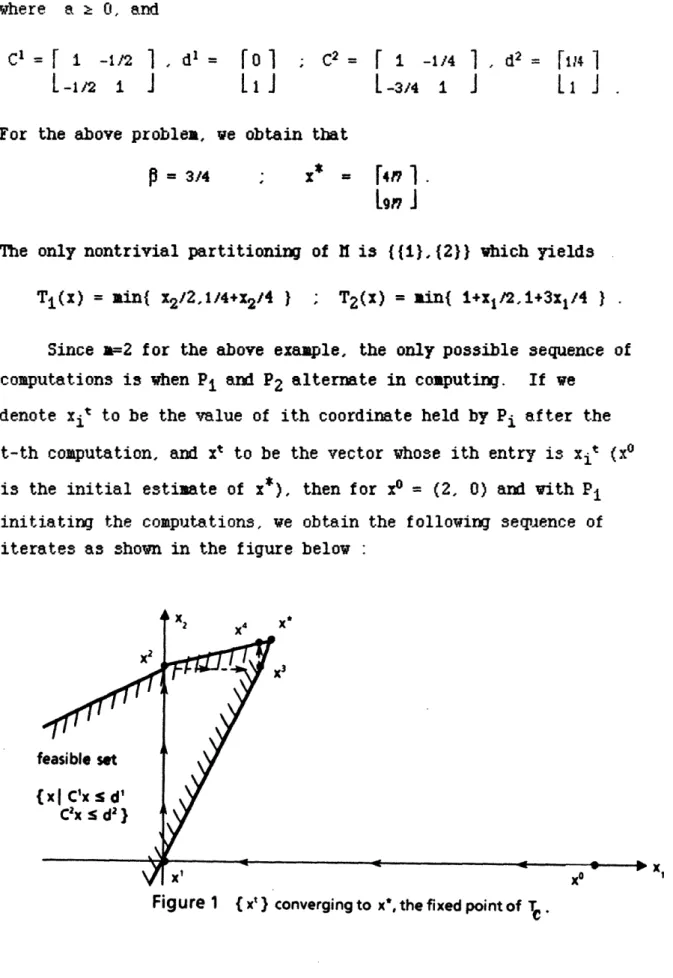
A Numerical Example
We illustrate the relaxation method with a very simple example. Ye consider solving the following problem using the relaxation method
1Maximize aTx
Subject to Clx s dl C2x
&
d228
where a > 0, and
C= 1 -1/2
1
d =r1
C2 = 1 -1/4 1,
d2 = f141
L-112 1 J
[J
L-3/4 1J
L1
J
For the above problem, we obtain that
p-3/4 ; X*=
r4n
.
L[n J
The only nontrivial partitioning of It is {(i,{2})) which yields
Tl(x) = ain{ x2/2,1/4+ 21/4
)
; T2(x) = rin( i+xl/2,1+3x1/4 } Since z=2 for the above example, the only possible sequence of computations is when P1 and P2 alternate in computing. If wedenote xit to be the value of ith coordinate held by Pi after the t-th computation, and xt to be the vector whose ith entry is xit (x° is the initial estimate of x*), then for x° = (2. 0) and with P
1 initiating the computations, we obtain the following seTqence of iterates as shown in the figure below
Ai X2 X4
T X,
X* 2X X3 feasible set(xl
C'x s d ' C2x S d2}F
/ X' X029 6. Conclusion
The method proposed in this paper is simple both in concept and in implementation. Yet despite this simplicity it possesses very strong convergence properties. Such strong properties are due
in great part to the special structure of the problems themselves. It is possible that other classes of problems exist for which
results similar to those obtained here hold and, in particular, it would be of practical as well as theoretical interest to generalize
the rate of convergence result on the asynchronous, distributed implementation of the proposed method. This interest stems from the growing role which distributed computation plays in the area of optimization.
Acknowledgement: I wish to thank Professor Dimitri Bertsekas for his support and guidance in this work.