Author(s) - Auteur(s) :
Publication date - Date de publication :
Permanent link - Permalien :
Rights / License - Licence de droit d’auteur :
Delayed cytokinesis generates multinuclearity and potential advantages in the amoeba
Acanthamoeba castellanii Neff strain
Quinet, Théo; Samba-Louaka, Ascel; Héchard, Yann; Van Doninck, Karine; Van der Henst,
Charles
Published in:
Scientific Reports
DOI:
10.1038/s41598-020-68694-9
Publication date:
2020
Document Version
Publisher's PDF, also known as Version of record
Link to publication
Citation for pulished version (HARVARD):
Quinet, T, Samba-Louaka, A, Héchard, Y, Van Doninck, K & Van der Henst, C 2020, 'Delayed cytokinesis
generates multinuclearity and potential advantages in the amoeba Acanthamoeba castellanii Neff strain',
Scientific Reports, vol. 10, no. 1, 12109, pp. 12109. https://doi.org/10.1038/s41598-020-68694-9
General rights
Copyright and moral rights for the publications made accessible in the public portal are retained by the authors and/or other copyright owners and it is a condition of accessing publications that users recognise and abide by the legal requirements associated with these rights. • Users may download and print one copy of any publication from the public portal for the purpose of private study or research. • You may not further distribute the material or use it for any profit-making activity or commercial gain
• You may freely distribute the URL identifying the publication in the public portal ? Take down policy
If you believe that this document breaches copyright please contact us providing details, and we will remove access to the work immediately and investigate your claim.
1
Scientific RepoRtS | (2020) 10:12109 | https://doi.org/10.1038/s41598-020-68694-9
www.nature.com/scientificreports
Delayed cytokinesis generates
multinuclearity and potential
advantages in the amoeba
Acanthamoeba castellanii Neff
strain
théo Quinet
1, Ascel Samba‑Louaka
2, Yann Héchard
2, Karine Van Doninck
1&
charles Van der Henst
1,3,4,5*Multinuclearity is a widespread phenomenon across the living world, yet how it is achieved, and the potential related advantages, are not systematically understood. in this study, we investigate multinuclearity in amoebae. We observe that non‑adherent amoebae are giant multinucleate cells compared to adherent ones. the cells solve their multinuclearity by a stretchy cytokinesis process with cytosolic bridge formation when adherence resumes. After initial adhesion to a new substrate, the progeny of the multinucleate cells is more numerous than the sibling cells generated from uninucleate amoebae. Hence, multinucleate amoebae show an advantage for population growth when the number of cells is quantified over time. Multiple nuclei per cell are observed in different amoeba species, and the lack of adhesion induces multinuclearity in diverse protists such as Acanthamoeba castellanii,
Vermamoeba vermiformis, Naegleria gruberi and Hartmannella rhysodes. in this study, we observe
that agitation induces a cytokinesis delay, which promotes multinuclearity. Hence, we propose the hypothesis that multinuclearity represents a physiological adaptation under non‑adherent conditions that can lead to biologically relevant advantages.
The canonical view of eukaryotic cells is usually illustrated by an uninucleate organization. However, in the liv-ing world, cells harbourliv-ing multiple nuclei are common. This multinuclearity can have different origins, beliv-ing either generated (i) by fusion events between uninucleate cells or by (ii) uninucleate cells that replicate their DNA content without cytokinesis. Animals, fungi, plants and protozoans possess such cells harbouring multiple nuclei, some of them being associated to a functional advantage.
Within the Amoebozoa, multinuclearity is found in many species, and can be an integral part of their life cycle. The infection cycle of the pathogenic amoeba Entamoeba histolytica involves tetranucleated cells1. In
addition, within the giant amoeba Pelomyxa carolinensis, nuclei are “very abundant”2, containing from two to
thousands of nuclei per cell3. Multinuclearity was also reported in two other amoebae: Naegleria gruberi4 and
Hartmannella rhysodes5.
While multinuclearity appears common among Amoebozoa, there is a lack of evidence concerning its con-sequences and/or potentially associated function(s). Species within Amoebozoa therefore represent interesting model systems to study multinucleate cells. Hence, in this study, we investigate the generation of multinuclearity in an amoeba strain, the associated consequences and propose potential advantages. We use as cellular model the amoeba Acanthamoeba castellanii6 because its multinuclearity can be easily induced through agitation7. Moreover,
open
1Laboratory of Evolutionary Genetics and Ecology, URBE, University of Namur, Namur, Belgium. 2Laboratoire
Ecologie et Biologie des Interactions, Equipe Microbiologie de L’Eau, Université de Poitiers, UMR CNRS 7267, 86073 Poitiers, France. 3Research Unit in the Biology of Microorganisms (URBM), NARILIS, University of
Namur (UNamur), Namur, Belgium. 4Microbial Resistance and Drug Discovery, Center for Structural Biology
(CSB), Flanders Institute for Biotechnology (VIB), Vrije Universiteit Brussel (VUB), Pleinlaan 2, Building E-3, 1050 Brussels, Belgium. 5Structural Biology Brussels, Vrije Universiteit Brussel (VUB), Brussels, Belgium. *email:
A. castellanii is ubiquitous, being frequently found in aquatic environments such as sea water, swimming pools, cooling towers, tap waters or contact lens products6. A. castellanii is described as an opportunistic pathogen for
human, inducing keratitis8, a corneal infection, when using contaminated contact lenses9. Despite the facts that
A. castellanii represents a broadly used cellular infection model and a relevant human pathogen, improving the knowledge of its biology remains essential.
Acanthamoeba castellanii is characterized by a biphasic life cycle. Adherent trophozoites are motile, active in the uptake of size-compatible food particles, and are generally described as dividing by mitosis10. Upon harsh
conditions such as starvation, desiccation, osmotic pressure variation or the presence of toxic compounds, the trophozoite differentiates into a cyst form11. This encystation process is mainly characterized by pseudopodia
retraction, cellular detachment, dehydration of the cell body and the synthesis of a thick wall composed mainly of cellulose, protecting the amoeba from its environment12. To our knowledge, and in contrary of E. histolytica,
no cysts of A. castellanii are described as tetranucleated11. However, previous studies showed that there was an
increase in the proportion of multinucleate amoebae when A. castellanii cultures are under agitation7.
Knowing that several Amoebozoan species do contain multiple nuclei per single cell, we investigated the direct consequences of multinuclearity on population growth in A. castellanii by enumerating the number of cells over time. We hypothesized that it could represent a mechanism providing a specific advantage to the spe-cies during colonization.
Results
Absence of adhesion delays cytokinesis.
Multinuclearity has been previously shown to be induced in A. castellanii by agitation7. In our study, amoebae in suspension (non-adherent) put under agitation are called“agitated non-adherent” cells (Fig. 1). The control of uninucleate cells are amoebae put under “non-agitated adherent” conditions. In order to confirm that the absence of adhesion per se, rather than the agitation of the medium itself, is the main factor inducing multinuclearity in our tested conditions, a second control used “agi-tated adherent” cells, for which amoebae are allowed to adhere on a substrate prior to agitation (Fig. 1).
Common morphologies of uninucleate A. castellanii amoebae were observed at the start of the experiment (“T0”) (Fig. 2a). After 24 h without agitation (Fig. 2a upper panel), A. castellanii divided and were therefore more numerous per field of view with similar cellular organization and morphology compared to the T0 (quantifica-tion is given in Fig. 2b). However, the ultrastructure and the morphology of non-adherent amoebae after 24 h under agitation were different (Fig. 2A middle panel). Non-adherent A. castellanii were giant and multinucleate (67.0% ± 1.9% of multinuclearity) when compared to standing adherent uninucleate amoebae for which no multi-nucleate cells are observed (number of amoebae counted = 1511) (Fig. 2b). While uninucleate amoebae measured on average 556.9 µm2 (± 68.9 µm2), multinucleate cells were larger (2,582.2 µm2 ± 581.1 µm2). The absolute size of
the contractile vacuole was also larger (173.4 µm2 ± 75.1 µm2) than the one present in the uninucleate amoebae
(25.0 µm2 ± 6.18 µm2). However, normalized to the size of the amoebae, contractile vacuoles had a comparable
average size (22.3 µm2 ± 1.2 µm2 for uninucleate and 14.9 µm2 ± 3.71 µm2 for multinucleate amoebae) suggesting
that giant amoebae were not dramatically impaired in their osmo-regulation capacity13. In the control conditions
where amoebae were agitated but still adherent (Fig. 2a lower panel), the morphology of the amoebae were in the majority comparable to the non-agitated adherent conditions. However, for these agitated adherent A. castel-lanii amoebae, the quantification of uni-and multinucleate cells indicates that a minority of the population was multinucleated (Fig. 2b). The agitation could have detached some amoebae from their solid substrate.
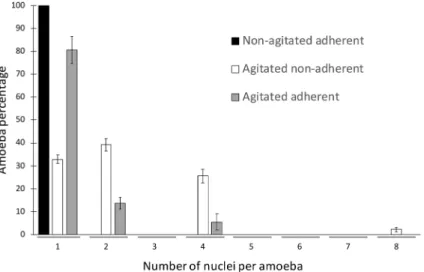
We characterized the multinucleate cells in more depth by quantifying the precise number of nuclei per amoebae using direct counting. Interestingly, the distribution of the number of nuclei per cell was not random (Fig. 3). Bi- and tetra-nucleate amoebae were the most prevalent multinucleate types. Nuclei numbers equal to 3, 5, 6 and 7 were not detected in the tested conditions. The highest number of nuclei per A. castellanii observed
Figure 1. Experimental workflow to induce multinuclearity. The three conditions start from the same amoeba
inoculum. (a) Non-agitated Adherent conditions. Amoebae are incubated without agitation throughout the experiment. (b) Agitated Non-adherent conditions. Amoebae are first incubated with agitation for 24 h and then without agitation for 24 h. (c) Agitated Adherent conditions. Amoeba cells are allowed to adhere for 3 h prior to be incubated with agitation for 24 h and then without agitation for 24 h.
3
Scientific RepoRtS | (2020) 10:12109 | https://doi.org/10.1038/s41598-020-68694-9
www.nature.com/scientificreports/
was eight. Under agitated and adherent conditions, the few multinucleate amoebae were bi-and tetranucleated as well (Fig. 3).
To test if this generation of multinuclearity is specific to A. castellanii or if it represents a common mechanism shared by several Amoebozoa species, we also tested if the absence of cellular adhesion generated multinuclear-ity in the amoeba Vermamoeba vermiformis, which belongs to a different genus than A. castellanii. As A. castel-lanii, V. vermiformis has a biphasic life cycle, with trophozoites and cysts differentiated forms. It is commonly isolated worldwide from natural environments, such as freshwater surfaces but also from engineered systems such a tap water, swimming pools and hospital settings14. As shown in Fig. S1, agitated V. vermiformis amoebae
under non-adherent conditions were also multinucleate. Quantification of the multinucleate cells after 24 h of
Figure 2. Lack of adhesion generates giant and multinucleate amoebae. (a) Adherent amoebae are cultivated
without agitation for 24 h (upper panels); non-adherent amoebae are cultivated with agitation for 24 h (middle panels) and adherent amoebae are agitated for 24 h (lower panels). White arrows show the nuclei and black arrow depict the contractile vacuoles. Scale bar: 50 µm. (b) Quantification of the uninucleate (grey) and multinucleate (white) amoebae. The data are generated from three biological independent experiments. Error bars ± SEM.
agitation showed that 86.7% (± 5.7%) are multinucleate amoebae, while they represented a minor fraction of the population of adherent cells (5.6% ± 1.0%).
A stretchy cytokinesis resolves multinuclearity.
During mitosis, an uninucleate A. castellanii amoeba rounds up, the nucleus replicates, becoming transiently non-visible under light microscopy, the cell divides at the middle, generating two uninucleate siblings of the same size, which separate from each other without cytosolic bridge (Fig. 4a). The situation is different for multinucleate A. castellanii cells. Once cellularadher-Figure 3. Frequency distribution of amoebae according to the number of nuclei. Non-agitated adherent
(black), agitated non-adherent (white) and agitated adherent cells (grey). Amoebae were incubated in the related conditions for 24 h prior to direct observation under a microscope and subsequent quantification. Error bars ± SEM. Data are generated from three biological independent experiments, each done with technical duplicates.
Figure 4. Time-lapse microscopy. Live amoebae previously non-agitated (a) or agitated (b) for 24 h were
monitored for 28 min under light microscope using cytokinesis compatible conditions (without agitation). A set of 9 snapshots are shown for the two conditions. Black arrows show classical mitosis (a) while white arrows depict a “stretchy cytokinesis” for multinucleate amoebae (b). Scale bar: 50 µm.
5
Scientific RepoRtS | (2020) 10:12109 | https://doi.org/10.1038/s41598-020-68694-9
www.nature.com/scientificreports/
ence resumes (without agitation), multinucleate amoebae were able to quickly resolve their uninuclearity by a stretchy-like cytokinesis (Fig. 4b). In this specific case of cytokinesis characterizing multinucleate cells, the nuclei did not replicate and stayed visible throughout the division process, the amoebae did not round up and cytosolic bridges were formed (Figs. 4b and S2). Uninucleate sibling cells were budding from the mother cell, resolving the multinuclearity. Starting from a binucleate amoeba, each daughter cell contained one single nucleus, and they were not anucleate. The two nuclei localized at the opposite direction of the amoeba and the whole cell was teared apart, generating two linked cell bodies going in opposite direction, leading to the formation of a cytosolic bridge. Tensions appeared to accumulate in the bridge until it broke down, leading to the formation of two uninucleate daughter cells. Taken together with previous observations15, this suggests that a non-random
separation process, associated with a regulatory mechanism and involving locomotion machinery is taking place in Acanthamoeba spp.
Single cell quantification highlights a proliferation advantage.
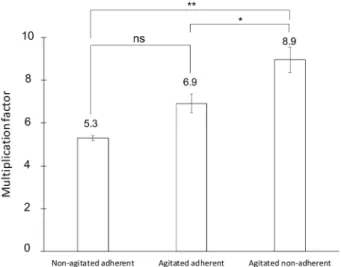
Next, we checked if multinucleate A. castellanii amoebae could have a population growth advantage compared to uninucleate cells by enumerating the number of single celled amoebae over time. We first measured the proliferation rate of the amoeba popula-tion starting with uni- or multinucleate cells (Fig. 1) in rich axenic conditions. The calculated multiplication factor represents the quantification of the sibling cells that originate from uni-or multinucleate amoebae when put back under cytokinesis permissive conditions (with adherence). It was calculated by dividing the number of amoebae at T48h by the number of cells initially present at T24h within the same well (Figs. 1, 5). While the uninucleate amoebae multiplied on average 5.30 (± 0.12 SEM) times in 24 h, the population of multinucleate amoebae showed an 8.95-fold (± 0.58 SEM) increase. Amoebae in control conditions (agitated but adherent), for which a lower number of multinucleate cells were present (Figs. 2, 3), gave an intermediate factor, with 6.92-fold (± 0.44 SEM) increase. Detached multinucleate amoebae, through a direct effect of the agitation conditions, could have participated in this moderate proliferation advantage. Taken together, these data show that under the tested conditions and using single cell enumeration over time, agitation-induced multinucleate amoebae gave rise to more progeny cells than non-agitated cells once adherence resumed.Amoebae are unicellular eukaryotic predators, feeding on bacteria, fungi and yeast cells, for instance9. We
showed an increased population growth of multinucleate amoebae under rich and axenic laboratory culture con-ditions (Fig. 5). We next tested a potential proliferation advantage under more biologically relevant conditions by inoculating uni- or multinucleate amoebae on bacterial lawns. Relying on their phagocytic activity, A. castellanii amoebae can efficiently feed and proliferate on a layer of susceptible bacteria, generating the so called “grazing” zones that are cleared of bacteria16. The higher the diameter, the more efficient an initial single amoeba cell was
able to feed on bacterial preys and proliferate actively, therefore increasing the population size. Measurements and subsequent quantification of the diameter of the grazing areas are given in Fig. 6. The grazing areas started from multinucleate amoebae displayed a higher diameter compared to uninucleate cell origin (Fig. 6). According to our previous observations under axenic conditions, these observations show that multinucleate amoebae were more prone to colonize a growth-permissive substrate under non-axenic conditions as well.
Figure 5. Growth advantage at the population level under axenic conditions. A. castellanii cells were allowed
to adhere and replicate for 24 h without agitation. The multiplication factors represent the number of amoebae at 48 h divided by the number of amoebae at 24 h (see also Fig. 1 for workflow). Data are generated from three biological independent experiments, which were run using technical duplicates. Error bars ± SEM. (*) p < 0.05; (**) p < 0.01 and (ns) p > 0.05.
Discussion
We showed that agitating conditions promoted multinuclearity in A. castellanii and V. vermiformis by generating a cytokinesis delay. Interestingly, multinuclearity induced by agitation has been shown for other aquatic protists as well, such as Naegleria gruberi4 and Hartmannella rhysodes5. Tetranucleated cysts are part of the infection
cycle of E. histolytica1. Based on the data presented in our study, we can suggest that this specific multinucleate
stage in E. histolytica could provide a growth advantage during infection that allows this pathogenic amoeba to efficiently produce numerous descendants when colonizing a new host. This hypothesis remains to be tested. In this light, the involvement of multinucleate cells in A. castellanii pathogenicity deserves to be investigated, and direct single-cell level analyses on human samples, instead of classical amoeba isolation protocols17, could
render these observations possible.
The strain used in our study is the Acanthamoeba castellanii (Douglas) ATCC30010 (strain Designations: Neff, Depositor RJ Neff, biosafety level 1). This A. castellanii isolate has kept its cell cycle related ability to encyst, giving rise to non-adherent mature cysts under starvation conditions18,19. In addition, this isolate retains its capacity to
efficiently feed on bacterial preys. Taken together, these observations show that the validated amoebal isolate used in our study is not axenically adapted, at least to the extents regarding its cell cycle and phagocytosis processes.
At least two different, yet non-exclusive mechanisms can generate multinuclearity (Fig. S3). Firstly, uninucle-ate amoebae could fuse together leading to the formation of a multinucleuninucle-ate cell, therefore forming a syncytium. This hypothesis is interesting knowing that A. castellanii are asexual organisms replicating through mitosis15,
while possessing meiotic genes20–22. Reuniting multiple nuclei, originating from different cells, in a single amoeba
could promote genetic material exchange and create diversity, essential for evolution. In this light, the amoeba Cochliopodium spp. was previously reported to undergo cellular followed by nuclear fusions23. In case of
cel-lular fusions of uni- and multinucleate amoebae occurring randomly in A. castellanii, we would expect another distribution of the number of nuclei per amoeba including even and odd numbers, which is not what we report in our study (Figs. 3 and S3). A potential mechanism that regulates particular A. castellanii cell types to fuse together, such as the mating types designated MATa and MATα in yeast24, cannot be excluded at this stage.
Also, if binucleated cells are more prone to fuse with binucleated cells, this would generate tetranucleated cells. Using live cell imaging and time lapse microscopy, we never observed such fusion events. However, at this stage, we cannot exclude that the frequency of cellular fusion is too low to be detected in our conditions or that the tested conditions in our laboratory did not promote fusion. A second hypothesis proposes that multinuclearity originates from endoreplication, consisting of synchronous nuclei replication without cytokinesis, successively generating from an uninucleate cell (1n) polyploid cells such as 2n, 4n, 8n, … (Fig. S3). The fact that under non-adherent conditions bi- and tetra- nucleated amoebae represent the vast majority of the population (and to a
Figure 6. A. castellanii grazing on bacterial lawns. (a) Frequency distribution of grazing diameters of
uninucleate and multinucleate A. castellanii amoebae. (b) Representative images of grazing zones obtained from solid medium coated with E. coli bacteria as food source, inoculated either with uninucleate (upper panel) or multinucleate amoebae (lower panel). Scale bar: 1 cm. Data were obtained from three biological independent experiments.
7
Scientific RepoRtS | (2020) 10:12109 | https://doi.org/10.1038/s41598-020-68694-9
www.nature.com/scientificreports/
minor extent 8 nuclei) provides support for this second hypothesis (Figs. 2, 3). In our study, no case of uneven nuclei per amoeba were observed (except for single nucleated amoebae). The endoreplication hypothesis is sup-ported by the fact that amoebae must be adherent to their substrate to divide, because the locomotion system is important to tear apart the daughter cells5. Agitation would impair such adhesion, and multinuclearity would be
a consequence of amoebae trying to divide but ultimately failing at the cytokinesis stage, resulting in 2n number
of nuclei. This endoreplication hypothesis does not exclude the fusion hypothesis and both phenomena could occur concomitantly at different rates, depending on the tested conditions.
Producing a higher number of clonal progenies for the multinucleate cells (Fig. 5) and a better substratum colonization (Fig. 6) is equivalent to a greater individual reproductive success, which is one of the aspects of a fitness advantage25,26. Upon cellular attachment to a new solid surface-to-be-colonized and based on cytokinesis
events only (without the need to replicate its genome at that moment), multinucleate amoebae can generate sib-ling cells faster than uninucleate amoebae, all else being equal (Figs. 3, 5, 7). The observed generation advantage takes place specifically upon the process of new substrate colonization. Indeed, multinucleate amoebae had to replicate their DNA content before, as for uninucleate ones, and if we take this into account, it might be possible that no fitness advantage could be highlighted. Nevertheless, when focusing on the colonization timing, when two amoeba cells arrive together (uni-versus multinucleate) and compete for resources, multinucleate cells do have a colonization advantage as they do not need to replicate their DNA content, resulting in a faster division accompanied by an increased population growth (Fig. 7). In addition, the observation that multinucleates are giant cells might help amoebae to sediment and adhere to their new substrate faster than uninucleate ones. This observed advantage relies on the quantification of the number of single celled amoebae and might differ at the level of biomass or total nuclei number.
Concerning the non-adherent conditions, as A. castellanii amoebae are frequently found in aquatic envi-ronments, it is possible that in their natural niche, A. castellanii cells regularly detach from a biotic or abiotic surface. For example, an early step during encystation is cell detachment. Before this differentiation process being irreversible9,11, detached amoebae could have the time to be transported in the water column to colonize
a new environment. In addition, any flux perturbations, water currents or waves might detach amoebae from their substrate and suspend them in water, in a non-adherent state. This process might help amoebae to colonize new environmental niches that are difficult to reach using an adherent state. This cellular detachment is seen in our control conditions when adherent amoebae are agitated, which leads to a small percentage of detached multinucleate amoebae even if the majority of the population remain adherent and uninucleate (Fig. 3). Detached amoebae would therefore get disseminated by water currents, replicating their DNA content without cytokinesis, preparing themselves to efficiently colonize a new habitat. To test this hypothesis, such colonizers could be col-lected directly from natural environmental water columns. However, the current isolation methods do not allow any direct and high-throughput single cell based-observations of collected amoebae, together with their precise identification, as they are rather based on isolation of amoebae through enrichment on bacterial lawns17. As
Figure 7. Model of multinuclearity associated to a potential environmental fitness. Schematic representation
of a model starting from two single-celled amoebae with different origins competing for the same resources present in a new favourable niche. One is a multinucleate amoeba with four nuclei (left side) and the other one is an adherent uninucleate cell, all else being equal. Both amoebae arrive and adhere concomitantly on a surface to-be-colonized. After successive cytokinesis events only, without the need of DNA replication that occurred before, the multinucleate amoeba gives rise to four sibling cells. However, the uninucleate amoeba has to replicate its genetic content prior to divide through a mitotic process, generating two progeny cells only. As the progeny cells will enter mitosis and proliferate, the population that originates from a multinucleate mother cell will be constantly more numerous.
observed upon quantification of the number of individual cells over time. We propose that multinuclearity should not be considered as an artefact in amoebae, but rather as a physiological adaptation to environmental condi-tions, potentially generating better colonizer cells upon absence of adhesion. A direct consequence in amoebae resulting in an advantage that can contribute to a faster colonisation during niche competition.
Materials and methods
Stains and media.
The amoebal strain Acanthamoeba castellanii (Douglas) ATCC30010 was cultivated in peptone yeast glucose medium (PYG) (ATCC medium 712) in T75 cell culture flasks (ThermoFisher, MA, US) with 10 ml of PYG at 25 °C (± 1 °C). To avoid any axenic adaptation at best, the amoebal cultures were regularly allowed to encyst prior to dilution in rich medium for the next cellular amplification. Also, the amoebal culture was use for 30 passages at the maximum, then discarded and a new amoebal culture from a frozen stock solution was launched. Vermamoeba vermiformis ATCC50237 were grown in PYNFH medium (bacto-peptone 1%, yeast extract 1%, yeast nucleic acid (Ribonucleic Acid, Type VI from Torula Yeast, Sigma) 0.1%, folic acid 33 μmol L−1,hemin 1.5 μmol L−1, Na2HPO4 3.6 mmol L−1, KH2PO4 26 mmol L−1, foetal bovine serum heat-inactivated 10%,
pH = 6.5) at 30 °C. Escherichia coli strain S17-1λpir, used as a food source for amoeba grazing experiments, were grown in LB (Invitrogen, CA, US) for 16 h at 37 °C under agitation (175 rpm). When amoeba cultures reached saturation, meaning 100% confluence that corresponds to a calculated number of 2 * 106 cells/ml (using a KOVA
chamber), amoebae were scraped, gently homogenized and 1 ml was transferred to a new T75 flask with 9 ml PYG for 24 h. This corresponds to the “T0” of all experiments (Fig. 1). This step ensures the synchronisation of the population in the trophozoite form, with the same physiological state and growing phase, and that the same number of A. castellanii cells is engaged prior to the experiment.
For the “non-agitated adherent” control conditions, A. castellanii cells were inoculated in a 6 wells plate with 2 ml of PYG and incubated at 25 ± 1 °C without agitation. For the “agitated non-adherent” conditions, A. castella-nii amoebae were inoculated in 6 wells plate with 2 ml of PYG and incubated at 25 ± 1 °C for 24 h under agitation (250 rpm). For the quantification of the number of nuclei per amoebae, agitated A. castellanii were allowed to adhere for one hour prior to direct visualization using light microscope. Observations consist of taking at least 8 random micrographs per well, throughout the entire well, to avoid any edge effects. For the “agitated adherent” conditions, A. castellanii were scrapped from the initial stock culture and put in a 6 wells plate with 2 ml of PYG without agitation for 3 h. This step allows the adherence of the amoeba cells. After that, the plate was put under agitation (250 rpm) for 24 h at 25 ± 1 °C.
Regarding V. vermiformis, the “non-agitated adherent” control cells were inoculated in a 6-well plate with 2 ml of PYNFH and incubated at 30 °C without agitation. For the “agitated non-adherent” conditions, V. vermiformis were inoculated in 6-well plates and incubated at 30 °C for 24 and 48 h under agitation (250 rpm). For the quan-tification of the number of nuclei per amoeba, cells were scraped and centrifuged at 1,000 g for 10 min. Cells were suspended and fixed using a Page’s Amoeba Saline solution (4 mM MgSO4, 0.4 M CaCl2, 0.1% sodium citrate dehydrate, 2.5 mM NaH2PO3, 2.5 mM K2HPO3, pH 6.5) containing 2% of paraformaldehyde for 10 min. After a new centrifugation, cells were suspended in glycerol/PBS solution (CitiFluor™ AF1) containing 0.5 µg/mL µM of DAPI (Sigma-Aldrich). Nuclei were observed under inverted epifluorescence microscope (Olympus IX73).
Scanning electron microscopy (SeM).
Amoebae observed under SEM were incubated under agitation in 50 ml tubes (Merck, Darmstadt, Germany) with 4,7 ml of PYG and 300 µl of scrapped amoebae from a pre-culture at stationary phase (which corresponds to a calculated concentration of 2 * 106 amoebae/ml). Amoebaewere put in a temperature-controlled agitator (350 rpm) at 25 °C (± 2 °C) for 24 h. Agitated amoebae were then put at rest (without agitation) prior to be scrapped, put on cover slips and dehydrated through successive ethanol baths of increasing concentrations as follows: samples were incubated in 30%, 50%, 70%, 85% and 100 ethanol two times each for 5 min and 10 min, except for the last step, which was 3 times 10 min incubation. Then, ethanol was replaced with hexamethyldisilazane (two times 15 min) that evaporated overnight under a chemical hood. Samples are covered with 25 nm of Gold using a Quorum Q150T/ES sputter coater and then analysed under a JEOL 6,010 LV SEM at 15 kV.
Amoeba grazing.
Grazing assays were done on solid medium using 25 ml of LB agar diluted 5 times (Merck, Darmstadt, Germany) per petri dish. Stationary growing phase E. coli were diluted with liquid LB to reach an OD of 0.5 (at 600 nm). A calculated number of 200 A. castellanii cells were mixed together with the9
Scientific RepoRtS | (2020) 10:12109 | https://doi.org/10.1038/s41598-020-68694-9
www.nature.com/scientificreports/
bacteria in a final volume of 200 µl. The 200 µl mix of bacteria and amoebae was then plated using a plastic rake on LB agar plates and put under the hood to dry for about 15 min. Finally, the plates were incubated at 25 °C for 6 days. Grazing diameters were measured using imageJ software28.
Statistical analyses.
Data used for the enumeration of uni-versus multinucleate cells were generated from three independent biological replicates. At each time point, at least 8 micrographs were randomly taken. Amoe-bae were counted using imageJ software28. The number “n” of amoebae counted for the counting of uni- andmultinucleate cells was: n(non-agitated and adherent) = 1511, n(agitated adherent) = 181, n(agitated non adherent) = 365. When the
num-ber of nuclei per amoeba was unclear (i.e. out of the focal plan or not entirely visible in the field of view), they were not counted. We estimated that the fraction of blurry or incomplete amoebae represented maximum 15% of the total number of the counted amoebae. The population growth and the number of nuclei were analysed using ANOVA and Scheffé’s methods. Data used in Figure S1 were obtained from three independent biologi-cal replicates. For each condition, at least 100 cells were randomly counted. All histograms are an average of three biologically independent experiments and error bars represent the standard error of the mean (SEM). Concerning the grazing area generated from uni-versus multinucleate amoebae, an unpaired t test, two-tailed, with Welch’s correction has been executed with GraphPad Prism Software (San Diego, CA, USA) to compare the grazing distribution that is highly significant (p value < 0.0001).
Received: 10 March 2020; Accepted: 26 June 2020
References
1. Ross, A. G., Olds, G. R., Cripps, A. W., Farrar, J. J. & McManus, D. P. Enteropathogens and chronic illness in returning travelers.
N. Engl. J. Med. 368, 1817–1825. https ://doi.org/10.1056/NEJMr a1207 777 (2013). 2. Wilson, H. V. Notes on a species of Pelomyxa. Am. Nat. XXXIV (1900).
3. Daniels, E. W. & Pappas, G. D. Reproduction of nuclei in Pelomyxa palustris. Cell Biol. Int. 18, 805–812. https ://doi.org/10.1006/ cbir.1994.1113 (1994).
4. Weik, R. R. & John, D. T. Cell size, macromolecular composition, and O2 consumption during agitated cultivation of Naegleria
gruberi. J Protozool 24, 196–200. https ://doi.org/10.1111/j.1550-7408.1977.tb053 06.x (1977).
5. Band, R. N. & Machemer, C. Environmental induction of multinucleate Hartmannella rhysodes. Exp. Cell Res. 31, 31–38 (1963). 6. Siddiqui, R. & Khan, N. A. Biology and pathogenesis of Acanthamoeba. Parasit Vectors 5, 6. https ://doi.org/10.1186/1756-3305-5-6
(2012).
7. James, T. E. & Byers, T. J. The induction of multinuclearity in agitated and in aging cultures of Acanthamoeba sp Neff. J. Cell Physiol.
70, 53–62. https ://doi.org/10.1002/jcp.10407 00108 (1967).
8. Khan, N. A., Anwar, A. & Siddiqui, R. Acanthamoeba keratitis: current status and urgent research priorities. Curr. Med. Chem. 26, 5711–5726. https ://doi.org/10.2174/09298 67325 66618 05101 25633 (2019).
9. Khan, N. A. Acanthamoeba: biology and increasing importance in human health. FEMS Microbiol. Rev. 30, 564–595. https ://doi. org/10.1111/j.1574-6976.2006.00023 .x (2006).
10. Bowers, B. & Korn, E. D. The fine structure of Acanthamoeba castellanii. I. The trophozoite. J. Cell Biol. 39, 95–111. https ://doi. org/10.1083/jcb.39.1.95 (1968).
11. Bowers, B. & Korn, E. D. The fine structure of Acanthamoeba castellanii (Neff strain). II. Encystment. J. Cell Biol 41, 786–805. https ://doi.org/10.1083/jcb.41.3.786 (1969).
12. Magistrado-Coxen, P. et al. The most abundant cyst wall proteins of Acanthamoeba castellanii are lectins that bind cellulose and localize to distinct structures in developing and mature cyst walls. PLoS Negl. Trop. Dis. 13, e0007352. https ://doi.org/10.1371/ journ al.pntd.00073 52 (2019).
13. Du, F. et al. Regulation of contractile vacuole formation and activity in Dictyostelium. EMBO J. 27, 2064–2076. https ://doi. org/10.1038/emboj .2008.131 (2008).
14. Delafont, V., Rodier, M. H., Maisonneuve, E. & Cateau, E. Vermamoeba vermiformis: a free-living amoeba of interest. Microbiol.
Ecol. 76, 991–1001. https ://doi.org/10.1007/s0024 8-018-1199-8 (2018).
15. Band, R. N., Mohrlok, S. & Rubin, R. W. Separate induction of amitotic and mitotic division in Acanthamoeba rhysodes. Nature
227, 379–381. https ://doi.org/10.1038/22737 9b0 (1970).
16. Pukatzki, S. et al. Identification of a conserved bacterial protein secretion system in Vibrio cholerae using the Dictyostelium host model system. Proc. Natl. Acad. Sci. USA 103, 1528–1533. https ://doi.org/10.1073/pnas.05103 22103 (2006).
17. Greub, G. & Raoult, D. Microorganisms resistant to free-living amoebae. Clin. Microbiol. Rev. 17, 413–433. https ://doi.org/10.1128/ cmr.17.2.413-433.2004 (2004).
18. Van der Henst, C., Scrignari, T., Maclachlan, C. & Blokesch, M. An intracellular replication niche for Vibrio cholerae in the amoeba
Acanthamoeba castellanii. ISME J. 10, 897–910. https ://doi.org/10.1038/ismej .2015.165 (2016).
19. Van der Henst, C. et al. Molecular insights into Vibrio cholerae’s intra-amoebal host-pathogen interactions. Nat. Commun. 9, 3460. https ://doi.org/10.1038/s4146 7-018-05976 -x (2018).
20. Lahr, D. J., Parfrey, L. W., Mitchell, E. A., Katz, L. A. & Lara, E. The chastity of amoebae: re-evaluating evidence for sex in amoeboid organisms. Proc. Biol. Sci. 278, 2081–2090. https ://doi.org/10.1098/rspb.2011.0289 (2011).
21. Clarke, M. et al. Genome of Acanthamoeba castellanii highlights extensive lateral gene transfer and early evolution of tyrosine kinase signaling. Genome Biol. 14, R11. https ://doi.org/10.1186/gb-2013-14-2-r11 (2013).
22. Khan, N. A. & Siddiqui, R. Is there evidence of sexual reproduction (meiosis) in Acanthamoeba?. Pathog. Glob. Health 109, 193–195. https ://doi.org/10.1179/20477 73215 Y.00000 00009 (2015).
23. Tekle, Y. I., Anderson, O. R. & Lecky, A. F. Evidence of parasexual activity in “asexual amoebae” Cochliopodium spp. (Amoebozoa): extensive cellular and nuclear fusion. Protist 165, 676–687. https ://doi.org/10.1016/j.proti s.2014.07.008 (2014).
24. Lee, C. S. & Haber, J. E. Mating-type gene switching in Saccharomyces cerevisiae. Microbiol. Spectr. https ://doi.org/10.1128/micro biols pec.MDNA3 -0013-2014 (2015).
25. Hamilton, W. D. The genetical evolution of social behaviour. I. J. Theor. Biol. 7, 1–16. https ://doi.org/10.1016/0022-5193(64)90038 -4 (1964).
26. Hamilton, W. D. The genetical evolution of social behaviour. II. J. Theor. Biol. 7, 17–52. https ://doi.org/10.1016/0022-5193(64)90039 -6 (1964).
competing interests
The authors declare no competing interests.
Additional information
Supplementary information is available for this paper at https ://doi.org/10.1038/s4159 8-020-68694 -9.
Correspondence and requests for materials should be addressed to C.V.d. Reprints and permissions information is available at www.nature.com/reprints.
Publisher’s note Springer Nature remains neutral with regard to jurisdictional claims in published maps and
institutional affiliations.
Open Access This article is licensed under a Creative Commons Attribution 4.0 International
License, which permits use, sharing, adaptation, distribution and reproduction in any medium or format, as long as you give appropriate credit to the original author(s) and the source, provide a link to the Creative Commons license, and indicate if changes were made. The images or other third party material in this article are included in the article’s Creative Commons license, unless indicated otherwise in a credit line to the material. If material is not included in the article’s Creative Commons license and your intended use is not permitted by statutory regulation or exceeds the permitted use, you will need to obtain permission directly from the copyright holder. To view a copy of this license, visit http://creat iveco mmons .org/licen ses/by/4.0/.