Université de Paris
École doctorale Sciences Mathématiques de Paris-Centre (ED 386) Laboratoire ALMAnaCH
Standard-based Lexical Models for
Automatically Structured Dictionaries
Par Mohamed KHEMAKHEM
Thèse de Doctorat en Informatique - Traitement Automatique des Langues
Dirigée par Laurent ROMARY Présentée et soutenue publiquement le 01/10/2020 Devant un jury composé de:
Benoît CRABBÉ, Professeur, Université de Paris - UFRL, Président de Jury Rute COSTA, Professeur, CLUNL - UNL Lisbonne, Rapporteur
Patrice BELLOT, Professeur, LIS - Polytech' Marseille, Rapporteur Karlheinz MÖRTH, Directeur, ACDH - ÖAW Vienne, Examinateur
Toma Tasovac, Directeur, DARIAH Berlin et BCDH Belgrade, Examinateur Patrice LOPEZ, Fondateur et gérant, Science-Miner, Examinateur
Declaration of Authorship
I, Mohamed KHEMAKHEM, declare that this thesis titled, “Standard-based Lexical Models for Automatically Structured Dictionaries” and the work pre-sented in it are my own. I confirm that:
• This work was done wholly or mainly while in candidature for a re-search degree at this University.
• Where any part of this thesis has previously been submitted for a de-gree or any other qualification at this University or any other institu-tion, this has been clearly stated.
• Where I have consulted the published work of others, this is always clearly attributed.
• Where I have quoted from the work of others, the source is always given. With the exception of such quotations, this thesis is entirely my own work.
• I have acknowledged all main sources of help.
• Where the thesis is based on work done by myself jointly with others, I have made clear exactly what was done by others and what I have contributed myself.
Signed: Date:
“Dictionary: The universe in alphabetical order.”
“Un dictionnaire, c’est tout l’univers par ordre alphabétique”
“Ein Wörterbuch ist das gesamte Universum in alphabetischer Reihenfolge”
UNIVERSITÉ PARIS DIDEROT - UNIVERSITÉ DE PARIS
Abstract
ED 386 - École Doctorale Sciences Mathématiques de Paris-Centre Department of Computer Science
Doctor of Philosophy
Standard-based Lexical Models for Automatically Structured Dictionaries by Mohamed KHEMAKHEM
Abstract
Dictionaries could be considered as the most comprehensive reservoir of hu-man knowledge, which carry not only the lexical description of words in one or more languages, but also the commun awareness of a certain community about every known piece of knowledge in a time frame. Print dictionaries are the principle resources which enable the documentation and transfer of such knowledge. They already exist in abundant numbers, while new ones are continuously compiled, even with the recent strong move to digital re-sources.
However, a majority of these dictionaries, even when available digitally, is still not fully structured due to the absence of scalable methods and tech-niques that can cover the variety of corresponding material. Moreover, the relatively few existing structured resources present limited exchange and query alternatives, given the discrepancy of their data models and formats.
In this thesis we address the task of parsing lexical information in print dictionaries through the design of computer models that enable their auto-matic structuring. Solving this task goes hand in hand with finding a stan-dardised output for these models to guarantee a maximum interoperability among resources and usability for downstream tasks.
First, we present different classifications of the dictionaric resources to de-limit the category of print dictionaries we aim to process. Second, we intro-duce the parsing task by providing an overview of the processing challenges and a study of the state of the art. Then, we present a novel approach based on a top-down parsing of the lexical information. We also outline the archi-tecture of the resulting system, called GROBID-Dictionaries, and the method-ology we followed to close the gap between the conception of the system and its applicability to real-world scenarios.
After that, we draw the landscape of the leading standards for structured lexical resources. In addition, we provide an analysis of two ongoing initia-tives, TEI-Lex-0 and LMF, that aim at the unification of modelling the lexical information in print and electronic dictionaries. Based on that, we present a serialisation format that is inline with the schemes of the two standardisation initiatives and fits the approach implemented in our parsing system.
After presenting the parsing and standardised serialisation facets of our lexical models, we provide an empirical study of their performance and be-haviour. The investigation is based on a specific machine learning setup and series of experiments carried out with a selected pool of varied dictionaries. We try in this study to present different ways for feature engineering and exhibit the strength and the limits of the best resulting models. We also ded-icate two series of experiments for exploring the scalability of our models with regard to the processed documents and the employed machine learning technique.
Finally, we sum up this thesis by presenting the major conclusions and opening new perspectives for extending our investigations in a number of research directions for parsing entry-based documents.
Résumé
Les dictionnaires peuvent être considérés comme le réservoir le plus com-préhensible de connaissances humaines, qui contiennent non seulement la description lexicale des mots dans une ou plusieurs langues, mais aussi la conscience commune d’une certaine communauté sur chaque élément de connaissance connu dans une période de temps donnée. Les dictionnaires imprimés sont les principales ressources qui permettent la documentation et le transfert de ces connaissances. Ils existent déjà en grand nombre, et de nouveaux dictionnaires sont continuellement compilés.
Cependant, la majorité de ces dictionnaires dans leur version numérique n’est toujours pas structurée en raison de l’absence de méthodes et de tech-niques évolutives pouvant couvrir le nombre du matériel croissant et sa var-iété. En outre, les ressources structurées existantes, relativement peu nom-breuses, présentent des alternatives d’échange et de recherche limitées, en raison d’un sérieux manque de synchronisation entre leurs schémas de struc-ture.
Dans cette thèse, nous abordons la tâche d’analyse des informations lex-icales dans les dictionnaires imprimés en construisant des modèles qui per-mettent leur structuration automatique. La résolution de cette tâche va de pair avec la recherche d’une sortie standardisée de ces modèles afin de garan-tir une interopérabilité maximale entre les ressources et une facilité d’utilisation pour les tâches en aval.
Nous commençons par présenter différentes classifications des ressources dictionnaires pour délimiter les catégories des dictionnaires imprimés sur lesquelles ce travail se focalise. Ensuite, nous définissions la tâche d’analyse en fournissant un aperçu des défis de traitement et une étude de l’état de l’art. Nous présentons par la suite une nouvelle approche basée sur une analyse en cascade de l’information lexicale. Nous décrivons également l’architecture du système résultant, appelé GROBID-Dictionaries, et la méthodologie que nous avons suivie pour rapprocher la conception du système de son applica-bilité aux scénarios du monde réel.
Ensuite, nous prestons des normes clés pour les ressources lexicales struc-turées. En outre, nous fournissons une analyse de deux initiatives en cours, TEI-Lex-0 et LMF, qui visent à unifier la modélisation de l’information lex-icale dans les dictionnaires imprimés et électroniques. Sur cette base, nous présentons un format de sérialisation conforme aux schémas des deux initia-tives de normalisation et qui est assorti à l’approche développée dans notre système d’analyse lexicale.
Après avoir présenté les facettes d’analyse et de sérialisation normalisées de nos modèles lexicaux, nous fournissons une étude empirique de leurs per-formances et de leurs comportements. L’étude est basée sur une configura-tion spécifique d’apprentissage automatique et sur une série d’expériences menées avec un ensemble sélectionné de dictionnaires variés. Dans cette étude, nous essayons de présenter différentes manières d’ingénierie des car-actéristiques et de montrer les points forts et les limites des meilleurs modèles
résultants. Nous consacrons également deux séries d’expériences pour ex-plorer l’extensibilité de nos modèles en ce qui concerne les documents traités et la technique d’apprentissage automatique employée.
Enfin, nous clôturons cette thèse en présentant les principales conclusions et en ouvrant de nouvelles perspectives pour l’extension de nos investiga-tions dans un certain nombre de direcinvestiga-tions de recherche pour l’analyse des documents structurés en un ensemble d’entrées.
Acknowledgements
This thesis has been supported by the European PARTHENOS project, as a part of the Work Package 4 under grant No. 654119, and by the BasNum project under the ANR grant No. ANR-18-CE38-0003.
This work would not have seen the light without the support of people who believed in my personal and scientific capacities. It goes without saying that I had a great chance to have Prof. Dr. Laurent Romary as a PhD advisor. Besides his exceptional supervision and support, I learnt a lot from working with him in different exciting projects. I can’t thank him enough for the trust he put in me. I would like to thank Prof. Dr. Rute Costa and Prof. Dr. Patrice Bellot for the time they dedicated to evaluate my thesis.
I’m very thankful to my family and especially to my sister, Aïda, who taught me how to code my first algorithms and believed in me when many others did not. No words could describe my gratitude to her and to my brother in law, Hssan, for their unconditional support.
I also would like to thank Dr. Patrice Lopez for developing and maintain-ing the GROBID infrastructure and his precious guidance and technical sup-port. I thank all my colleagues at Inria-ALMAnaCH team and Centre Marc Bloch for being part of an outstanding research environment. My thanks go of course to Dr. Richard Eckart de Castilho, who shaped my programming skills during my internship at UKP Lab. I also can’t forget the participants of the GROBID-Dictionaries Workshop series, in particular Simon Gabay, who provided me with valuable early feedback and helped me in extending the scope of this work.
Special thanks go to Richard James for the review of my English.
Last but not least, I’m grateful to all my friends and cousins Cristina, Meryem, Amal, Karim, Ahmed, Oussama and Meher who were there dur-ing the hard times.
Contents
Declaration of Authorship iii
Abstract vii
Acknowledgements xi
1 Introduction 1
1.1 Overview. . . 1
1.2 Task Definition & Research Questions . . . 2
1.3 Thesis Organisation . . . 3 2 Dictionaric Resources 7 2.1 Introduction . . . 7 2.2 Macro-Logical Structure . . . 7 2.2.1 Onomasiological Dictionaries . . . 7 2.2.2 Semasiological Dictionaries . . . 7 2.3 Format . . . 8 2.3.1 Born-digital Dictionaries . . . 9 2.3.2 Digitised Dictionaries . . . 9
2.3.3 Machine Readable Dictionaries . . . 9
2.3.4 Computerised Dictionaries, Lexical Databases and NLP Lexica . . . 9 2.4 Time . . . 10 2.4.1 Modern Dictionaries . . . 10 2.4.2 Legacy Dictionaries. . . 10 2.5 Content . . . 10 2.5.1 Multilinguality Dimension . . . 12 a. Monolingual . . . 12 b. Bilingual . . . 12 c. Multilingual . . . 12 2.5.2 Lexicographic Dimension . . . 12 a. Lexical . . . 12 b. Encyclopaedic . . . 12
c. Etymological & Diachronic . . . 13
2.6 Chapter Summary. . . 13
3 Parsing Lexical Information in Print Dictionaries 15 3.1 Introduction . . . 15
3.2 Challenges . . . 15
3.2.2 Logical Structure vs Physical Structure . . . 18
Logical Structure . . . 18
Physical Structure . . . 20
3.3 State of the art . . . 20
3.3.1 Rule-based. . . 20
3.3.2 Probabilistic Models . . . 22
Text Sequence Labelling . . . 23
Graphical Models for Sequence Labelling . . . 23
Evaluation metrics . . . 26
Previous Work . . . 27
3.3.3 Probabilistic Models for Parsing Bibliographic Data . . 31
3.4 Chapter Summary. . . 33
4 Lexical Models for Parsing Print Dictionaries 35 4.1 Introduction . . . 35
4.2 Cascading Parsing . . . 35
4.2.1 Approach . . . 36
4.2.2 Bibliographic Information and Lexical Information: Pars-ing Similarities and Differences . . . 36
4.2.3 GROBID . . . 39
4.3 GROBID-Dictionaries . . . 40
4.3.1 Cascading Lexical Models . . . 40
4.3.2 Feature Engineering . . . 45
4.3.3 Model Activation & Call . . . 47
4.4 Lexicographic Knowledge Acquisition . . . 50
4.4.1 Easing Setup. . . 50
Initial Configuration: IT Expert Use . . . 50
Enhanced Usability & Unified Execution Environment: DH Use . . . 51
4.4.2 Lightening Annotation . . . 52
Creating Training Data . . . 53
Training Data Annotation . . . 53
Train, Test and Evaluate . . . 54
4.4.3 Training Domain Experts and Collecting Feedback . . 55
Hands-on Sessions with End-Users . . . 55
Participants with Diverse Backgrounds . . . 56
Various tested Material . . . 56
Outcome & Gathered insights . . . 56
4.5 Chapter Summary. . . 57
5 Standards for Structured Lexical Resources 59 5.1 Introduction . . . 59
5.2 TEI . . . 59
5.2.1 Background . . . 59
5.2.2 Modelling Perspectives . . . 60
Encoding Level . . . 60
Encoding Workflow & Choices . . . 61
5.2.4 Discussion . . . 63
5.3 LMF (2008) . . . 63
5.3.1 Background . . . 64
5.3.2 Meta-model . . . 64
5.3.3 Serialisation . . . 65
5.3.4 LMF-based Lexical Resources . . . 65
5.3.5 Discussion . . . 67 5.4 OntoLex-Lemon . . . 68 5.4.1 Background . . . 68 5.4.2 Modelling . . . 68 5.4.3 Serialisation . . . 71 5.4.4 OntoLex-Lemon-based Resources . . . 71 5.4.5 Discussion . . . 73 5.5 Chapter Summary. . . 73
6 Novel Standardised Schemes for Encoding Dictionaries 75 6.1 Introduction . . . 75
6.2 TEI-Lex-0 . . . 75
6.2.1 Context. . . 76
6.2.2 Modelling challenges. . . 77
Recursive entries . . . 77
Revising the entry model . . . 78
Written and Spoken Forms . . . 79
Miscellaneous . . . 82
6.2.3 Serialisation Model . . . 82
Entry Class Diagram . . . 82
Discussion . . . 84 6.3 LMF Reloaded . . . 84 6.3.1 Context. . . 84 6.3.2 Modelling Challenges . . . 85 Restructuring . . . 85 Simplification . . . 86 Enrichment . . . 86
6.3.3 TEI Serialisation Model: ISO 24613-4 . . . 89
6.3.4 Discussion . . . 93
6.4 GROBID-Dictionaries Output Scheme . . . 93
6.4.1 Modelling Challenges . . . 94
Cascading Modelling. . . 94
Satisfying different encodings for the same structures . 97 6.4.2 Serialisation Models . . . 98
Internal Serialisation . . . 98
Final Serialisation & Discussion. . . 101
7 GROBID-Dictionaries in Action 105
7.1 Introduction . . . 105
7.2 Machine Learning Experiment Setup . . . 106
7.2.1 Experimental goals . . . 106
7.2.2 Interfering Factors . . . 106
Sample Selection and Annotation. . . 107
OCR Impact . . . 109
7.2.3 Dictionary Samples & Annotation . . . 111
Dictionnaire de la Langue Française (DLF) . . . 112
Easier English Basic Dictionary (EEBD) . . . 112
Mixtec-Spanish Dictionary (MxSp) . . . 115
Fang-French (FangFr) & French-Fang (FrFang) Dictio-nary . . . 116
7.3 Experiment Series 1: Training with One Dictionary . . . 117
7.3.1 Feature Engineering Experiments . . . 119
Experiments . . . 119
Discussion . . . 127
7.3.2 Learning Curve Experiments . . . 127
Experiments . . . 127
Discussion . . . 132
7.4 Experiment Series 2: Training with Multiple Dictionaries . . . 132
7.4.1 Feature engineering Experiments . . . 133
Experiments . . . 133
Discussion . . . 141
7.4.2 Learning Curve . . . 141
Experiments . . . 141
Discussion . . . 141
7.5 Experiment Series 3: Testing with Unseen Dictionaries. . . 144
Experiments . . . 145
Discussion . . . 145
7.6 Scaling up . . . 149
7.6.1 Experiment Series 4: Beyond dictionaries . . . 149
Legacy Manuscript Auction Catalogs . . . 149
Address Directories . . . 155
7.6.2 Experiment Series 5: Deep Learning . . . 156
Introduction . . . 156
Experiments . . . 157
7.7 Chapter Summary. . . 160
8 Summary & Perspectives 161 8.1 Summary . . . 161
8.2 Perspectives . . . 163
A Descriptive Vectors and Feature Templates 167 A.1 Descriptive Vectors . . . 167
A.1.1 Descriptive Vectors for Dictionary Segmentation Model (a.k.a. GROBID’s First Model) . . . 167
A.1.2 Descriptive Vectors for Dictionary Body Segmentation Model Onward . . . 168 A.2 Feature Templates . . . 169
A.2.1 Unigram Templates of Dictionary Segmentation Model (a.k.a. GROBID’s First Model) . . . 169 A.2.2 Unigram Templates from Dictionary Body
Segmenta-tion Model Onward . . . 172 A.2.3 Bigram Templates of Dictionary Segmentation Model
(a.k.a. GROBID’s First Model) . . . 174 A.2.4 Bigram Templates from Dictionary Body Segmentation
Model Onward . . . 177 A.2.5 Engineered Templates from Dictionary Body
Segmen-tation Model Onward . . . 179
B Models Call for the "Parse Full Dictionary" Level in GROBID-Dictionaries’
List of Figures
2.1 Onomasiological Approach . . . 8
2.2 Semasilogical Approach . . . 8
2.3 Excerpt from Basnage Dictionary (Furetière,1701) of the entry ABORDER . . . 11
2.4 Classification of Dictionaric Resources . . . 14
3.1 Metadata text introduced by a PDF engine in the text of dictio-nary pages (Publishing,2009) . . . 16
3.2 Digitised entry in Basnage dictionary (Furetière,1701) . . . 17
3.3 Left: Entry ACT in (Publishing,2009). Right: Entries ABUSE (Pub-lishing,2009) . . . 19
3.4 Excerpts from different dictionaries with different logical struc-ture . . . 21
3.5 Text Sequence Labelling . . . 23
3.6 Example of bilingual dictionaries processed by (Ma et al.,2003) and (Karagol-Ayan, Doermann, and Dorr,2003) . . . 28
3.7 Illustration of the Hyper-Level zones in a scientific paper recog-nised by Header Segmentation Model in GROBID . . . 32
4.1 First and second segmentation levels of a dictionary page (Larousse, 1972) . . . 37
4.2 Example of the segmentation performed by the Lexical Entry model (Larousse,1972) . . . 37
4.3 Left: Excerpt from Bibliographic References Section in (Khe-makhem, Herold, and Romary,2018). Right: Excerpt of Lexical Entries in (Publishing,2009) . . . 38
4.4 Excerpt from GROBID’s architecture1 . . . 39
4.5 Sequence labelling a dictionary article (Larousse, 1972) using the "Lexical Entry" segmentation model . . . 41
4.6 GROBID-Dictionaries’s Cascading Architecture. . . 42
4.7 Implemented MATTER Workflow . . . 49
4.8 Cascading Model Selection in GROBID-Dictionaries . . . 49
4.9 A GROBID-Dictionaries image in a Docker container . . . 52
4.10 Training data annotation in oXygen author mode for the first model: page headers vs. page body. . . 54
5.1 Entry CABBAGE in (Mueller, 1878) and examples of its two Levels of TEI encoding . . . 61
5.3 Dependencies between the LMF (2008) core and extension pack-ages (Soria, Monachini, and Vossen,2009) . . . 65 5.4 LMF (2008) Object Diagram for Modelling the MWE "DEAD
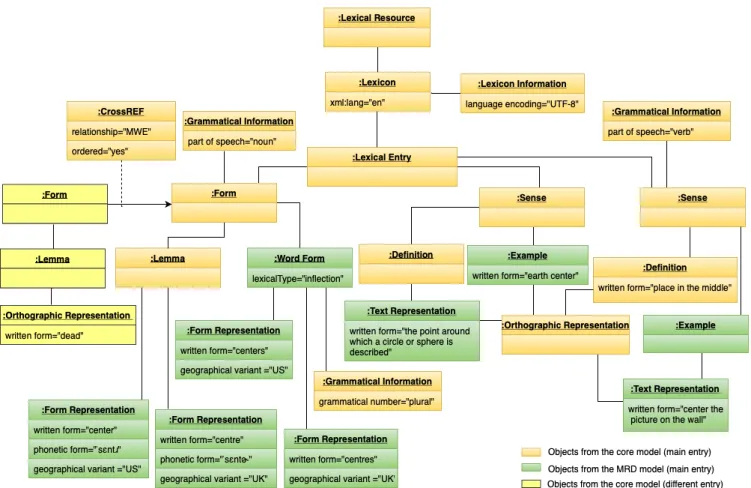
CENTER". . . 66 5.5 OntoLex-Lemon Core Model (McCrae et al.,2017) . . . 69 5.6 First Instance of OntoLex-Lemon Model for the MWE "DEAD
CENTRE". . . 70 5.7 Another Example of Instantiating OntoLex-Lemon Model for
the MWE "DEAD CENTRE" . . . 70 5.8 Turtle Serialisation of the MWE "DEAD CENTRE" and its
Com-ponents . . . 72 6.1 Left: Dictionary Article in an Arabic Dictionary (Almonjid,
2014). Right: Corresponding Minimal TEI-Lex-0 Encoding . . 78 6.2 Minimal Encoding of Homographs as Entries in TEI-Lex-0
(Dic-tionary Articles from (Publishing,2009)) . . . 79 6.3 Minimal Encoding of Homographs as Senses in TEI-Lex-0
(Dic-tionary Articles from (Publishing,2009)) . . . 80 6.4 Left: POS Encoding Using <gram> Element. Right: POS
En-coding Using <pos> Element . . . 80 6.5 Left: Extract from Mixtec-Spanish Dictionary (Alvarado,1593)
Containing Inflected Forms. Right: Corresponding Encoding in TEI-Lex-0 . . . 81 6.6 TEI-Lex-0 Serialisation for <entry> Model . . . 83 6.7 Example of Modelling the MWE "DEAD CENTRE" and its
Com-ponents using the New LMF Core and MRD Models. . . 87 6.8 Instance of the New Etymology Extension for the Entry
"DIC-TIONARY" in (Ernest,1966) . . . 88 6.9 LMF Serialisation for <entry> Model . . . 89 6.10 Example of LMF Modelling of Homographs with two Form
Objects . . . 91 6.11 Example of the new LMF Serialisation for the MWE "DEAD
CENTER" and its Components . . . 92 6.12 Etymological Constructs in (Mueller,1878) . . . 95 6.13 Minimal TEI Encoding as an Output of the Etym/Quote Model 95 6.14 Minimal TEI Encoding as an Output of the Etym Model . . . . 96 6.15 Internal Serialisation of GROBID-Dictionaries’s Models . . . . 99 6.16 Final Serialisation of the <entry> Model in GROBID-Dictionaries102 7.1 Excerpt from a Mixtec-Spanish Dictionary (Alvarado,1593). . 110 7.2 Excerpt from the Dictionnaire de la Langue Française
Dictio-nary (Littré,1873) . . . 113 7.3 Excerpt from the Easier English Basic Dictionary (Publishing,
2009) . . . 114 7.4 Excerpt from the Fang-French & French-Fang Dictionary
(Gal-ley,1964) (FangFr) . . . 117 7.5 Excerpt from the Fang-French & French-Fang Dictionary
7.6 Mono-sample Evaluation of the Dictionary Segmentation Model Using two Classes of Templates . . . 120 7.7 Mono-sample Evaluation of the Dictionary Body
Segmenta-tion Model Using three Classes of Templates . . . 122 7.8 Mono-sample Evaluation of the Lexical Entry Model Using
three Classes of Templates . . . 123 7.9 Mono-sample Evaluation of the Form Model Using three Classes
of Templates . . . 124 7.10 Mono-sample Evaluation of the GramGrp Model Using three
Classes of Templates . . . 125 7.11 Mono-sample Evaluation of the Sense Model Using three Classes
of Templates . . . 126 7.12 Mono-sample Evaluation of the Sub-Sense Model Using three
Classes of Templates . . . 128 7.13 Learning Curve of the Different Models Given the Number of
Training Pages from DLF . . . 129 7.14 Learning Curve of the Different Models Given the Number of
Training Pages from EEBD . . . 130 7.15 Learning Curve of the Different Models Given the Number of
Training Pages from MxSp . . . 130 7.16 Learning Curve of the Different Models Given the Number of
Training Pages from FangFr . . . 131 7.17 Learning Curve of the Different Models Given the Number of
Training Pages from FrFang . . . 131 7.18 Multi-sample Evaluation of the Dictionary Segmentation Model
Using two Classes of Templates . . . 133 7.19 Multi-sample Evaluation of the Dictionary Body Segmentation
Model Using three Classes of Templates . . . 135 7.20 Multi-sample Evaluation of the Lexical Entry Model Using three
Classes of Templates . . . 136 7.21 Multi-sample Evaluation of the Form Model Using three Classes
of Templates . . . 137 7.22 Multi-sample Evaluation of the GramGrp Model Using three
Classes of Templates . . . 138 7.23 Multi-sample Evaluation of the Sense Model Using three Classes
of Templates . . . 139 7.24 Multi-sample Evaluation of the Sub-Sense Model Using three
Classes of Templates . . . 140 7.25 Learning Curve of the Different Models Given the Number of
Training Pages from 2 BL . . . 142 7.26 Learning Curve of the Different Models Given the Number of
Training Pages from 3 BL . . . 142 7.27 Learning Curve of the Different Models Given the Number of
Training Pages from DB . . . 143 7.28 Learning Curve of the Different Models Given the Number of
7.29 Learning Curve of the Different Models Given the Number of Training Pages from All . . . 144 7.30 Evaluation of the Dictionary Segmentation Model Using the
Best Templates and Testing with Unseen Sample . . . 145 7.31 Evaluation of the Dictionary Body Segmentation Model Using
the Best Templates and Testing with Unseen Sample . . . 146 7.32 Evaluation of the Lexical Entry Model Using the Best
Tem-plates and Testing with Unseen Sample . . . 146 7.33 Evaluation of the Form Model Using the Best Templates and
Testing with Unseen Sample . . . 147 7.34 Evaluation of the GramGrp Model Using the Best Templates
and Testing with Unseen Sample . . . 147 7.35 Evaluation of the Sense Model Using the Best Templates and
Testing with Unseen Sample . . . 148 7.36 Evaluation of the Sub-Sense Model Using the Best Templates
and Testing with Unseen Sample . . . 148 7.37 Resemblance between MSCs and Encyclopedic Dictionaries . 150 7.38 Encoding of an MSC . . . 151 7.39 Evaluation of the Dictionary Segmentation Model Trained and
Tested with MSCs and Dictionaries . . . 152 7.40 Evaluation of the Dictionary Body Segmentation Model Trained
and Tested with MSCs and Dictionaries . . . 153 7.41 Evaluation of the Lexical Entry Model Trained and Tested with
MSCs and Dictionaries . . . 153 7.42 Evaluation of the Form Model Trained and Tested with MSCs
and Dictionaries . . . 154 7.43 Evaluation of the Sense Model Trained and Tested with MSCs
and Dictionaries . . . 154 7.44 Evaluation of the Lexical Entry Model Trained and Tested with
EEBD Using Deep Learning and Wapiti Labelers . . . 158 7.45 Evaluation of the Form Model Trained and Tested with EEBD
Using Deep Learning and Wapiti Labelers . . . 158 7.46 Evaluation of the GramGrp Model Trained and Tested with
EEBD Using Deep Learning and Wapiti Labelers . . . 159 7.47 Evaluation of the Sense Model Trained and Tested with EEBD
Using Deep Learning and Wapiti Labelers . . . 159 7.48 Evaluation of the Sub-Sense Model Trained and Tested with
EEBD Using Deep Learning and Wapiti Labelers . . . 160 8.1 Excerpt from the Bibliography Collection (Wiegand,2014) used
for Experimenting the Combination of GROBID and GROBID-Dictionaries Models . . . 165 B.1 Selecting Morphological and Grammatical Models . . . 183 B.2 Selecting Semantic Models . . . 184 B.3 Selecting Etymological Models . . . 184 B.4 Selecting Lexical Entry Model for Parsing Related Entries . . . 184 B.5 Selecting Cross-Reference Models . . . 185
B.6 Selecting Lexical Entry Model for Parsing Sub-Entries . . . 185 B.7 State after of Full Parsing Selection . . . 186
List of Tables
4.1 Some of the Dictionaries experimented with in some sessions of the workshop series . . . 57 6.1 Main labels of the etymology extension . . . 94 7.1 Page Sampling Statistics (Bowers, Khemakhem, and Romary,
2019) . . . 108 7.2 Field Level Evaluation of the Dictionary Segmentation Model 109 7.3 Field Level Evaluation of the Dictionary Body Segmentation
Model. . . 109 7.4 Field Level Evaluation of the Lexical Entry Model . . . 111 7.5 Summary of the First Series of Experiments . . . 127 7.6 Summary of the Second Series of Experiments . . . 141 7.7 Proposed TEI Encoding of Entries in Address Directories
In loving memory of my father, Rchid
KHEMAKHEM
Chapter 1
Introduction
1.1
Overview
Computational lexicography is a field which has emerged from the combination of lexicography - the field dealing with the design and compilation of lexica for human use - with computational methods. This "adventurous" combina-tion, as called by Hanks,2013, that started in the late 60’s freed western lex-icographers from the content dictated alphabetical order compilation to the logical order proceeding. The impact of further computerising lexicography has been significant and led to the establishment of a large field which, ac-cording to Gibbon,2000, covers tasks such as text mining for corpus-based lexi-con lexi-construction, the lexi-construction of lexica for Natural Language Processing (NLP) applications, automatic acquisition of syntactic or semantic information from texts, re-use of Machine-Readable Dictionaries (MRDs) for new lexica, and computer production of lexica for human use.
The creation of lexica for NLP use has been focused in the last two decades on corpus based approaches at the expense of endeavours dealing with the reuse of MRDs which represent in general the digitised version of print dic-tionaries. This imbalanced situation has actually been the consequence of in-creased accessibility of large corpora coupled with a rapidly growing number of advanced dedicated processing tools. To favorise lexical acquisition from corpora over exploiting MRDs, Lemnitzer and Kunze, 2005 further argued that such resources are too old, internally and mutually inconsistent, narrow in scope, missing important information like frequency and distribution in-formation and finally biased towards infrequent phenomena such as obsolete senses and usages.
In the previous decade, such a claim used to be relatively valid for well-resourced languages (e.g., English, French, German, Dutch..) and was strongly questionable for under-resourced languages where print dictionaries always represented the backbone for creating NLP lexica. In fact, print dictionar-ies encapsulate semi-structured lexical information vital for either rapidly harvesting material for building lexica in less resourced languages or for enriching well established resources with information about the diachrony of words. But after the retro-digitisation movement following the break-throughs in Optical Character Recognition (OCR) techniques, legacy dictio-naries have returned in the recent years to the spotlight. Currently an abun-dant number of digitised dictionaries are constantly uploaded to publicly
accessible repositories1 2. In addition, the copyright clearance of such doc-uments, as result of ageing or freely born intellectual properties, has opened up the possibility of their re-use. In parallel, established concepts in cor-pus linguistics, such as comparable corpora (Kenning,2010), have raised the question of applying the same approaches for lexical acquisition from the large newly available corpora of dictionaries.
These facts, along with relatively primitive approaches to automatically structuring such resources, have unwittingly created a huge gap where most of the dedicated methods are ad-hoc and, consequently, unable to cover the important stream of dictionary material for NLP downstream applications.
1.2
Task Definition & Research Questions
In this thesis, we aim to reduce the aforementioned gap by studying the na-ture of digital print dictionaries and finding a suitable approach for structur-ing such resources on a large scale.
The task we are trying to solve comprises two major steps: the first deals with automatically parsing lexical information encapsulated in the text of a digital dictionary. The identification of such constructs greatly depends on a second milestone which studies the design of a scheme that supports dif-ferent organisations of lexical information in the target classes of dictionar-ies. Therefore, we are considering the exploration of dedicated standards for modelling lexica as they provide a suitable framework for scaling up the creation of interoperable lexica (Calzolari, 2008). Switching back and forth between the two sub-tasks is necessary as the complexity of the lexical infor-mation needs to be supported by the parsing technique and the parser(s)’s grammar.
For the first sub-task, most existing approaches have been focused on rule-based methods (Mykowiecka, Rychlik, and Waszczuk,2012; Fahmy and Fayed, 2014; Maxwell and Bills, 2017; Ranaivo-Malançon et al., 2017; Ste-ingrímsson, 2018) with few attempts to make use of machine learning tech-niques (Karagol-Ayan, Doermann, and Dorr, 2003; Crist, 2011; Bago and Ljubeši´c,2015). The dictionaries tested in these approaches have a relatively flat structure and the main task addressed has been tagging the tokens of dictionary articles. None of the state of the art methods has proposed an end-to-end architecture for structuring print dictionaries that have different and deep structures such as nested entries or senses. The only exception to this is the work of Karagol-Ayan, Doermann, and Dorr,2003 who have built a framework for digitising, parsing and generating lexica focused on salient structures in bilingual dictionaries.
In the above mentioned related works, few addressed (Maxwell and Bills, 2017) or mentioned (Mykowiecka, Rychlik, and Waszczuk,2012) the need to generate standardised lexica using Text Encoding Initiative (TEI) (Budin, Ma-jewski, and Mörth,2012) or Lexical Markup Framework (LMF) (Francopoulo
1https://archive.org/search.php?query=dictionaries 2https://galica.bnf.fr/conseils/content/dictionnaire
et al.,2006). Other lexicographic projects (Eckle-Kohler and Gurevych,2012; Czaykowska-Higgins, Holmes, and Kell, 2014) have been more focused on the standardisation of existing NLP resources and shared the use of TEI and LMF, which are considered to be key frameworks within the lexicographic community. The need to find a unified scheme and guidelines that com-bine the best of the two standards has been clearly formalised (Czaykowska-Higgins, Holmes, and Kell,2014; Romary,2015) with some practical sugges-tions, as the division in their use within the lexicographic community repre-sents an obstacle to the large scale interoperability dream. It is important to point out that the task of categorising lexical structures and their modelling using possible alternatives offered by a standard already represents a highly debatable subject among lexicographers.
These challenges raise the following research questions, which we tackle in this thesis:
• RQ1 - Sample-agnostic Models for Print Dictionary Parsing: The first question concerns the study of different existing print dictionaries by analysing their physical and logical facets and the consequent process-ing complexity. Then we want to explore buildprocess-ing generic lexical models to parse different categories of dictionaries. We call a model a parser that enables the analysis and the structuring of text blocks in a dictio-nary according to a defined scheme.
• RQ2 - Unified Scheme for Structured Dictionaries: The second inves-tigation will be carried out on the leading standards for modelling lex-ica, namely TEI and LMF. The goal is to find a compromising scheme that meets both the lexicographic requirements and parsing constraints identified in the first question.
• RQ3 - Scaling-up Lexical Models: In the last question we will empir-ically address the leverage of the constructed lexical models by study-ing the improvement of their performance on the same dictionary and other dictionaries. The possibility of finding more generic models cov-ering documents with similar content is by no means excluded from our investigation.
Approaching all these research questions at once represents in itself a core research question in Digital Humanities (DH): to what extent could a collab-oration be possible between the computational and the humanist?
1.3
Thesis Organisation
This research work is structured in eight chapters. In the current section, we present an overview of the organisation of the thesis:
Chapter
2
- Dictionaric Resources
Having established the context, in this chapter we will present a classification of existing digital print dictionaries. The goal of such a step is to gradually
delimit, based on different aspects of such material, the category of dictio-naric resources that fall within the scope of our research.
Chapter
3
- Parsing Lexical Structures in Print Dictionaries
In the third chapter we present the challenges related to the parsing of lexi-cal information in the already defined target dictionaric resources. Then we will draw the state of the art by reporting related studies and explain how they approached the aforementioned difficulties. We will also discuss the most advanced techniques to position our work within the computational landscape.
Chapter
4
- Lexical Models for Automatically Structuring Print
Dictionaries
The fourth chapter is dedicated to the presentation of our approach and the architecture of the lexical models. We show how we were inspired by the analogy between the parsing of bibliographic data and our task and we will demonstrate how we succeeded in adapting an existing machine learning infrastructure to the requirements of our context. Details about the pro-cess of building these models for the new infrastructure called GROBID-Dictionaries, the challenges, and the consequent conceptual and technical solutions will be provided.
Chapter
5
- Standards for Structured Lexical Resources
In this chapter we give an overview of the most widely used standards within the lexicographic community. We set out to explain the shortcomings of these frameworks with respect to the requirements of automatic processing tasks, mainly the parsing application presented in Chapter 4.
Chapter
6
- Novel Standardised Schemes for Encoding
Dictio-naries
The pitfalls identified in Chapter 5 will be tackled in this chapter, where we present standardisation initiatives in line with our unification goals. We will present our involvement in shaping TEI-Lex-0 and the new LMF frame-works and how such interaction has been translated into the definition of the scheme of our lexical models.
Chapter
7
- GROBID-Dictionaries in Action
In this chapter more experiments, carried out with GROBID-Dictionaries and different dictionaries in different setups, will be described and evaluated. The goal here is to provide an extensive overview of the performance of our machine learning models when they are exposed to different dictionaric ma-terial. The limits of the architecture and the possibilities to scale up parsing
dictionaries based on the collected data and more advanced techniques will be discussed. Experiments performed on non-dictionaric resources will also be presented to show the genericity of our approach and resulting models.
Chapter
8
- Summary and Perspectives
The last chapter will be dedicated to the conclusions drawn from the results of the experiments presented and community feedback. We will also present our vision for building on our work with respect to the requirements of the task undertaken and the advances in machine learning techniques.
Chapter 2
Dictionaric Resources
2.1
Introduction
Dictionaries or lexica (the plural of lexicon) have different representations and content, and therefore can be categorised according to different aspects. This thesis is focused on a parsing task applied to a specific category of dictio-naric resources. To define this task, we firstly aim in this chapter to present the most common classifications of dictionaries and establish the nature of the material we are dealing with. The following categories are based on sev-eral dimensions that touch on the macro-logical structure, format, age and content of a digital dictionary.
2.2
Macro-Logical Structure
By macro-logical structure in this context, we denote the representation of relationships among words, meanings and concepts in a dictionary. Semasi-ology and OnomasiSemasi-ology are directly opposite approaches for studying and presenting such relationships.
2.2.1
Onomasiological Dictionaries
An onomasiological - from the Greek ónoma (name) and logos (study) - ap-proach focuses on categorising words expressing a certain concept based on a possible synonymy of the words. It tries to answer the question "How is a concept expressed?". Figure2.1 illustrates the word synonymy mechanism addressed in an onomasiological system.
Such an approach is commonly applied for building terminologies, but is also followed by lexicographers for compiling thesauri (Roget,1911; Lamy and Towell,1998) and synonymy dictionaries (Urdang,1986) .
Onomasiological resources are beyond the scope of the dictionaries stud-ied in this thesis.
2.2.2
Semasiological Dictionaries
Semasiology - from the Greek semasia (meaning) - deals with polysemy, the coexistence of possible meanings of a particular word. The question to be
FIGURE2.1: Onomasiological Approach
answered in such an approach is "What does a word mean?". Figure2.2 il-lustrates the polysemy mechanism studied in a semasiological system.
FIGURE2.2: Semasilogical Approach
Classic dictionaries (Hornby et al., 1974; Hindley et al., 2000), used by language learners, are the most common form of dictionaries compiled fol-lowing the semasiological approach.
In the context of this thesis, it is semasiological dictionaries that we are interested in.
2.3
Format
The format of a dictionary is determinant for the techniques to be used for the NLP task that we are addressing. We are interested in dictionaries in digital formats having specific features. In this section, we present a classification of possible formats of dictionaries and we specify the ones that fall within the present context.
2.3.1
Born-digital Dictionaries
This category denotes dictionaries that have been originally compiled us-ing computers and generated as a file that could be displayed usus-ing a web browser, a text editor or any other dedicated software (e.g., Microsoft Word, PDF viewer, etc). Their text content is usually represented as a sequence of text searchable by a machine and its quality greatly depends on the tool used to generate the file.
2.3.2
Digitised Dictionaries
This class gathers dictionaries in digital format resulting from the application of an Optical Character Recognition (OCR) system on scans or images of a print dictionary. Such resources are called also "retro-digitised" or "OCR’d" dictionaries.
The automatically recognised text, also known as OCRs, can be exported by the OCR tool as a separate text document or on the original scan as text layer, visible upon selection. The quality of the text and its layout informa-tion in such dicinforma-tionaries varies widely, depending on the characteristics of the original scans, the OCR tool and the conditions in which the digitisation process has been carried out.
Both digital born and digitised dictionaries represent a typical format for resources to be structured using methods developed in the context of this work.
2.3.3
Machine Readable Dictionaries
Certain born digital dictionaries are generated from MRDs (Atkins, 1991; Muller and Beddow, 2002; Dendien and Pierrel, 2003) which are resources that consist of text files controlled by pieces of code guiding the typesetting process. Such a format is commonly used by publishers to produce print and digital versions of dictionaries.
For the structuring task we are addressing, we do not consider processing this kind of resources.
2.3.4
Computerised Dictionaries, Lexical Databases and NLP
Lexica
Computerised dictionaries are structured resources reflecting the logical struc-ture of lexical entries such as part of speech, definitions, examples, etc. The explicit structure can be easily transformed into resources, suitable for com-putational tasks, called "Lexical Databases" or "NLP Lexica".
In the context of the present thesis, such a class of resources represents the target format.
2.4
Time
Time is reflected in dictionaries through certain lexicographic designs and practices which could lead to different dictionaries for very similar content. We distinguish two broad categories of resources: modern and legacy. It is hard to draw a clear line between the two of them as the classification is relatively subjective. But we will try to describe both categories based on our experience with different materials we have been dealing with.
2.4.1
Modern Dictionaries
These are the dictionaries that we use nowadays where, from the layout per-spective, there are clear boundaries among the lexical entries and their main lexical information. Typographic information is omnipresent and in most cases consistently used as they have been generated and controlled automat-ically. The lexical information in such resources is usually expressed in mod-ern language with fewer prolix descriptions.
2.4.2
Legacy Dictionaries
The age of existing legacy dictionaries ranges from a few decades (Larousse, 1948; Hornby et al.,1974) to few centuries (Furetière,1701; Littré,1873). Prose lexical descriptions, poetic examples and old language constructs and formu-lations are very common in the content of such resources. Besides the com-plex semasiological system in representing relatively similar lexical struc-tures such as entries, sub-entries, related entries and senses, inconsistency in the use of the very system can be noticed in different parts of the same dictionary. This fact is totally natural as such resources took years, in some cases decades, to be compiled and often by more than one lexicographer. Typographic information is usually poor, which is not helpful for a human reader to infer the lexicographic system followed by the creator of the dic-tionary. Figure2.3 shows a case of a less informative typography in a legacy dictionary along with a complex logical structure of entries, senses and re-lated entries that could be interpreted differently.
Most digital legacy dictionaries were originally retro-digitised from print dictionaries that were produced before the use of computers was introduced. In addition to the logical complexity briefly explained above, issues related to the OCR process, which will be explained in Section3.2, make the recognition of the text in such documents very challenging for any advanced OCR system and consequently result in a noisy text in the digitised version.
Modern and legacy dictionaries are both in the center of focus of this the-sis.
2.5
Content
We see the content of a dictionary as having two dimensions: multilinguality and of lexicographic information.
FIGURE2.3: Excerpt from Basnage Dictionary (Furetière,1701) of the entry ABORDER
2.5.1
Multilinguality Dimension
The number of languages to be used in a semasiological system has a direct impact on the constructs in the content of a dictionary.
a. Monolingual
Monolingual dictionaries represent the basic form of dictionaries where words in a certain language are explained and described in the same language. Ref-erencing words in other languages remains however possible, especially for expressing relationships between words and their origins, a study called ety-mology or diachrony.
b. Bilingual
Translation equivalents, along with explanations of varying length, consti-tute the core of bilingual dictionaries. Such resources are often used by learn-ers of new languages to find translations of words in a newly learnt language or the other way around. In such dictionaries, it is very common to find two parts: one part for language A to language B and the second part for language B to language A. Compared to monolingual dictionaries, bilingual ones have shorter entries as the goal in this case is not to give an exhaustive lexical description.
c. Multilingual
Multilingual dictionaries are the least common form of dictionaries as mul-tilingualism is relatively less frequent among people. The lexical descrip-tion in such a category is even more compact than in bilingual dicdescrip-tionaries as an alignment between translation equivalents in three or more languages should be preserved for readability and pedagogical purposes.
2.5.2
Lexicographic Dimension
The last dimension in our classification of dictionaric resources represents the category of the lexicographic content.
a. Lexical
Lexical dictionaries are known as the default dictionaries for most dictionary users. This kind of document has the goal of representing the meaning and other lexical aspects related to lexemes, or words of a language. Named entities, such as person or city names, are not in the scope of such dictionaries, but are included in the following category.
b. Encyclopaedic
As mentioned earlier, named entities fall in the scope of encyclopaedic con-tent in dictionaries. Such a concon-tent can be found in separate documents called
encyclopaedic dictionaries or encyclopaedias (Hindley,1971; Larousse, 1982) as it can usually constitute a separate part in a dictionary. However, in many cases, the encyclopaedic content is mixed with the lexical content in one dic-tionary and the alphabetical order is the only sorting system that applies. c. Etymological & Diachronic
As signalled earlier, etymology and diachrony are disciplines for studying the origin of words, which implies investigating relationships between words not only in the same language but also in different ones. Such a description could be condensed within the description of an entry in a lexical dictionary but may be separated and exhaustively described in dedicated documents called etymological dictionaries (Ernout et al.,1951; Ernest,1966).
2.6
Chapter Summary
In this chapter we presented a classification of dictionaries that goes from macro structures and format to the class of content that a dictionary can en-compass. In Figure2.4we summarise the consequent classification of digital dictionaries we are dealing with in the following chapters.
The rectangles in green represent the class of dictionary material we might have as input to structure, whereas the one in orange is the target category we want to reach.
Chapter 3
Parsing Lexical Information in
Print Dictionaries
3.1
Introduction
According to the Oxford English Dictionary1, parse as a verb has two mean-ings. The first is defined as "resolve (a sentence) into its component parts and describe their syntactic roles" while the second is a sub-sense of the former, related to the computing domain, and has the meaning of "analyse (a string or text) into logical syntactic components". Both senses apply in the context of the parsing task we are aiming at. The second has a broader computa-tional meaning and in the case of dictionaries could be parsing the text of a page to recognise structures such as headers, footers, lexical entries or their components.
Dictionaries falling in the target categories defined in the previous chapter represent several challenges for their parsing. Previous studies have tried to overcome these obstacles partially or entirely to reach different levels of text analysis. In the current chapter we showcase the challenges for parsing print dictionaries and present the state of the art.
3.2
Challenges
Parsing print dictionaries comes up against several obstacles that need to be studied in order to have a better understanding of the computational chal-lenges involved. We try to decode these aspects by focusing on two axes.
3.2.1
Born-digital vs Digitised Documents
Print dictionaries in digital format have been produced using computers by means of either Dictionary Writing Systems (DWSs) for the case of born-digital dictionaries or digitisation softwares obviously for digitised ones.
Abel, 2012gives a general overview of the different DWS uses and new trends in compiling dictionaries, following the era of pen and paper. In-house systems, implemented in academic projects such as DEB (Horák and Ram-bousek,2007) and Jibiki (Mangeot-Nagata,2006), and off-the-shelf tools, used
extensively by publishers as well as in academia, for instance TshwaneLex (Joffe and De Schryver,2004), DPS (McNamara,2003), or ABBYY Lingvo (Kuzmina and Rylova, 2010), along with other commercial tools and ad-hoc editors have helped lexicographer to compile, retype or convert dictionaries.
The diversity of the technologies used remained, however, uncontrolled which resulted in pre-print versions that can represent serious challenges for automatic processing. For instance, but not limited to, a large number of dic-tionaries are exported and available as PDF files. PDF stands for Portable Document Format (PDF) which is the de facto and de jure exchange format that still causes computational headaches and remains an active research topic especially for extracting text and its typography from the original doc-uments (Tiedemann,2014; Thaiprayoon and Haruechaiyasak,2016).
(a) The original dictionary
(b) Metadata added to the raw text of the dictionary FIGURE3.1: Metadata text introduced by a PDF engine in the
text of dictionary pages (Publishing,2009)
Figure 3.1 shows an example of anomalies that can be introduced by a PDF engine. In this case, metadata information has been found in almost all the pages of the dictionary but it is only seen in the raw text when extracted from the PDF file.
Processing digitised dictionaries is, in its turn, facing more complexity, not only because of the different compilation workflows and OCR systems, but also given the state of the raw documents. Unclear scans resulting from
damaged pages or low resolutions, obsolete fonts, old scripts and old orthog-raphy among many other issues, challenge the most advanced digitisation techniques.
(a) The scan in PDF format
(b) OCR output by Transkribus (Kahle et al.,2017) FIGURE 3.2: Digitised entry in Basnage dictionary (Furetière,
1701)
An OCR software sometimes puts spaces in the middle of words, and it can incorrectly recognise an individual letter in a word, such as misrepresent-ing the letter "I" for the letter "i." or the sequence "rn" for the letter "m". Cor-rectly and consistently identifying typography used to markup microstruc-ture in dictionaries also remains questionable for state of the art OCR sys-tems, such as OCRpus (Breuel,2008), Transkribus (Kahle et al., 2017), Cala-mari(Wick, Reul, and Puppe,2018), or ABBYY Finereader2. In Figure3.2we can clearly notice many text recognition errors in the OCR output for a legacy dictionary (Furetière, 1701). We see here an illustration of the impact of the scan quality and the old orthography on the digitisation outcome.
Several studies in the literature have investigated the impact of noisy data on basic downstream NLP tasks such as sentence boundary detection, tokeni-sation, and POS tagging (Lopresti,2009) as well as more advanced computa-tional applications like topic modelling (Mutuvi et al.,2018).
This digitisation issue represents a serious obstacle for any parser aiming at decoding the logical system behind the typography conventions imple-mented in a dictionary, as we explain in the following section.
3.2.2
Logical Structure vs Physical Structure
Dictionaries as a whole and their lexical entries are highly structured objects embedding recurrent components. The organisation of a print dictionary can be analysed from two related perspectives: logical and physical structures Logical Structure
The logical structure of a dictionary represents the functional constructs and their mutual connections, enabling the representation of the lexical informa-tion designed by the creator of the lexicon.
Semasiological dictionaries for alphabet-based languages share a general logical organisation. Such a dictionary is usually segmented into chapters where each chapter contains a list of dictionary articles, also called lexical en-tries, starting with the same letter and ordered alphabetically. In bilingual dictionaries, it is common to have chapters organised by pairs of languages.
Lexical entries are considered the elementary constructs of semasiologi-cal dictionaries and therefore it is important to define their key components to understand their logical representation and the links between them. Each entry contains a range of predetermined possible constructs that may differ, depending on the entry type and the purpose of the dictionary. It is beyond the scope of this thesis to give an exhaustive list of the possible lexical ele-ments in lexical entries in all kinds of dictionaries. But to give some indica-tion of the complexity of logical structures in lexical entries it is useful to sum up these constructs in the following items:
• headword: called also lemma. This is considered to be the key element in a dictionary article which is the subject of the lexical or encyclopaedic description and represents a written or spoken form. It usually occu-pies the first position in the lexical entry and marked with bold charac-ters.
• variant form: a variant form of a headword. For instance, "color" is the American variant form of a headword "colour" in a British dictionary • inflected form: a form resulting from the application of a regular or
irreg-ular inflection paradigm (i.e. pattern) to an original word. For example, "colored" is the inflected form of "color" representing its past participle. • part of speech (POS): grammatical category of a word that may be a verb,
noun, adjective, preposition, etc
• morphological information: any kind of information related to the mor-phology of a word form such as orthography, variant and inflected forms, etc. It describes the headword as well as its related forms. • grammatical information: carries the grammatical description of a form
• sense: represents one possible meaning of the headword and is expressed through definitions, examples, usage domain, etc. A sense could carry a multi level nesting of sub-senses and may replace the function a lexi-cal entry in some dictionaric designs (see Figure3.3)
• etymology: provides information about the origins of the headword and its senses. Etymology may figure as a brief description in several possi-ble spots within the dictionary article, or it can occupy the whole focus of the lexical entry’s description in the case of etymological dictionaries. • translation equivalent: maps a headword to its equivalent in another lan-guage and can be accompanied by definitions or examples. Such a de-scription is the core representation in bilingual dictionaries.
• related entry: also called compound or Multi Word Expression (MWE). It represents the use of the headword or one of its senses in more complex constructs such as idioms, collocations, etc.
• cross references: are links to other lexical entries having a semantic rela-tion such as synonymy or antonymy and are usually triggered by the use of "see X" or "cf. X" or their equivalents in other languages.
FIGURE3.3: Left: Entry ACT in (Publishing,2009). Right:
En-tries ABUSE (Publishing,2009)
In Figure3.3the red, green, purple and pink fields represent respectively the headword, pronunciation, POS and related entry. The article act is a ho-mograph which has been represented in this dictionary as a lexical entry hav-ing one sense as noun and another one as a verb (the blue fields). Each sense has sub-senses and the second has an embedded related entry. This repre-sentation may also be interpreted as a noun entry having a sub-entry as a verb. In both cases, the sense representation differs from the logical pattern followed to model another homograph in the same dictionary, abuse, which
could also be a noun and a verb. The logical structure of morphological and grammatical information remains the same, however.
The highlighted inconsistency in modelling entries is one of a number of phenomena that can be observed in modern dictionaries and is more fre-quent in legacy materials. The logical structure, or the syntax, of lexical entries translated in the presence of certain information or their order may totally change in a different dictionary. The difference depends on the multi-lingualty, lexicographic and time dimensions introduced in Chapter2.
Figure3.4illustrates a high degree of diversity in the structures of entries from different dictionaries. Such internal and external variations represent a true challenge for having a unified parser that covers all these varieties. Physical Structure
The logical structure of entries is translated in print dictionaries through a series of navigational components and markers such as font, font size and symbols (e.g. squares, bullets, diamonds). A fixed and predictable typo-graphical system is essential to allow dictionary users to quickly and easily find the information they are looking for. The same applies to a parser which will decode the syntax of lexical entries based on their markup system.
Such a structure remains relatively preserved in the case of the same born-digital dictionary. But given the highly probable deformation of both the text and its typography in digitised documents, explained in Section 3.2.1, the physical structure would be greatly impacted. Consequently, features reflecting the typography of the lexical components would be weak, and in many cases, biasing for a parser aiming at predicting the labels to be assigned to the tokens of lexical constructs.
For both, digitised and born-digital dictionaries, the physical structure depends on the purpose of the lexicographic document as well as the choices of the lexicographer who will have a certain background, practices and ty-pography preferences. Therefore, the combination of all these factors yields a wide range of physical representations of the lexical information (see Fig-ure3.4) which challenges their uniform parsing.
3.3
State of the art
The problem of parsing the structure of print documents, including dictio-naries, has been addressed in the literature by different approaches. In this section, we provide on overview of the commonly used techniques. We put the focus on the most advanced methods which have made use of machine learning to solve the parsing task as well as similar tasks.
3.3.1
Rule-based
Rule-based techniques are very common in computational fields. They have been popular since the early use of computers as, for instance, they had been used for building early expert systems (Buchanan and Duda,1983). Such a
(A) Lexical, Monolin-gual (Pub-lishing, 2009) (B) Etymological (Ernest, 1966) (C) Bilingual (Galley,
1964) (D) Ency-clopaedic (Berth-elot,1886)
FIGURE3.4: Excerpts from different dictionaries with different
logical structure
method relies on deterministic rules defined by observing patterns in a data sample. The rules are basically conditional instructions:
if condition→do action
The set of defined rules constitutes a grammar that gives a formal descrip-tion of certain patterns within the observed sample. A parser relies on such
a grammar to perform the analysis of text structures.
Many ad-hoc rule-based approaches are still being used today to parse dictionaries using tailored grammars. In fact, one way (Khemakhem et al., 2009; Fayed et al., 2014) is to rely mainly on textual markers in the lexical description to infer the function of the parsed structures. Such an approach is commonly used when typography information do not exist and the text of the digitised or retyped dictionary is the only available material to analyse, as is the case for several MRDs.
Other studies (Mykowiecka, Rychlik, and Waszczuk, 2012; Maxwell and Bills, 2017; Steingrímsson, 2018) make use of the typography information, collected from the OCR output, combined with the textual markers to build the parsing grammar. Old but efficient platforms for a flexible writing gram-mar for new parsers are still in use, such as for example the LexParse tool (Hauser and Storrer,1993; Lemnitzer and Kunze,2005).
On the one hand, such an approach has several attractive sides, especially for small projects. First, the rules could be quickly implemented, or just writ-ten in the case of existing platforms like LexParse, and results could be ob-tained within a few days or weeks. Second, the system can be considered as a simulator of the decision process of an expert, but on a larger scale. This fact makes the interpretation of the results straightforward by humans and consequently the rules easy to fine-tune. It also represents a major upside for independent lexicographers who have limited little IT skills, as it frees them from the intervention of IT staff in their own workflow. Finally, since no ad-vanced IT knowledge is needed to develop such a technique, such a choice can drastically reduce the costs for limited budget projects.
On the other hand, the above-mentioned studies have shown that such an approach can be useful to parse dictionaries with a flat structure, bilingual dictionaries for instance, or the shallow constructs in relatively more com-plex dictionaries. It remains, however, limited for parsing deep and exten-sive lexical descriptions where the lexicographic information becomes more complex along with possible inconsistencies in the representation of the log-ical and physlog-ical structures. For instance, the dictionary article FRANCE in La grande encyclopédie (Berthelot, 1886) has 91 pages, AIR has 52 pages and FRANCO-ALLEMANDE (GUERRE) 31 pages. Any rules defined by humans are too subjective to cover all the patterns hidden in the body of such large lexical entries. The scalability question is not limited to large or legacy sam-ples. The adaptation of the extracted rules to new samples may be costly and in many cases impossible as the dimensions of the new dictionary can vary widely.
3.3.2
Probabilistic Models
The need for scalable methods to parse print dictionaries has become clearly apparent. The use of machines can go beyond simply looking for patterns defined by a human expert. Probabilistic models have shown in the literature a great potential to leverage the capacities of machine learning techniques when human observation is limited or impossible.
In this section we introduce a family of probabilistic models gathering certain techniques suitable for our target parsing task.
Text Sequence Labelling
The parsing task we are addressing may be seen as the task of assigning a label from a set of possible tags to each token in a sequence of text. Let us as-sume we want to label this excerpt of an entry "act /akt/ noun 1. something which is done". A probabilistic model has the aim of predicting the prob-ability of assigning a label to each token based on a learnt distribution from previously seen data. A label starting with "I-" marks the beginning of a new field in the sequence, whereas other labels (i.e "<def>") mean we are in the middle or end of a field. In this example: <lemma> marks a lemma, <pron> pronunciation, <pos> part of speech of the headword, <num> numbering tokens and <def> definition of a sense.
<I−lemma> act
<I−pron>
/akt/ <nounI−pos><I−num1 ><num. >
<I−de f> something <de f> which <de f> is <de f> done
FIGURE3.5: Text Sequence Labelling
Such a text sequence labelling task is common in the NLP field, where POS Tagging and Named Entity Recognition (NER) are among the most popular tasks that have been addressed in the literature by applying a family of prob-abilistic models called graphical models.
Graphical Models for Sequence Labelling
The key assumption in graphical modeling is that a distribution over many variables can often be represented as a product of local functions that each depends on a smaller subset of variables. This factorisation shows a close connection to certain conditional independence relationships among these variables. The graphical appellation comes from the fact that both types of information can be represented by a graph.
These models describe the probability distribution P based on X and Y, where X and Y are random variables respectively ranging over observation sequences and their corresponding label sequences. The probability distri-bution P is calculated differently from one graphical model to another and the difference lies in how the independence among variables is modelled.
In this section, we present the conceptual difference between two types of graphical models which have been the most widely used in the literature for sequence labelling: Hidden Markov Models (HMMs) and Conditional Random Fields (CRF)s.
Hidden Markov Models (HMMs) An HMM is a generative model for de-scribing a probability p(y1:N, x1:N) over observation x1:N and label y1:N