RESEARCH OUTPUTS / RÉSULTATS DE RECHERCHE
Author(s) - Auteur(s) :
Publication date - Date de publication :
Permanent link - Permalien :
Rights / License - Licence de droit d’auteur :
Bibliothèque Universitaire Moretus Plantin
Institutional Repository - Research Portal
Dépôt Institutionnel - Portail de la Recherche
researchportal.unamur.be
University of Namur
Responsibility aspects in service engineering for e-Government
Feltus, Christophe; KHADRAOUI, Abdelaziz; YURCHYSHYNA, Anastasiya; Leonard, Michel;
Dubois, Eric
Published in:
Proceedings of the Interoperability for Enterprise Systems and Applications conference (I-ESA'12) Workshop Service Science and the Next Wave in Enterprise Interoperability, Valencia, Spain.
DOI:
10.1002/9781118561942.ch3
Publication date:
2012
Document Version
Early version, also known as pre-print
Link to publication
Citation for pulished version (HARVARD):
Feltus, C, KHADRAOUI, A, YURCHYSHYNA, A, Leonard, M & Dubois, E 2012, Responsibility aspects in service engineering for e-Government. in Proceedings of the Interoperability for Enterprise Systems and Applications
conference (I-ESA'12) Workshop Service Science and the Next Wave in Enterprise Interoperability, Valencia, Spain.. https://doi.org/10.1002/9781118561942.ch3
General rights
Copyright and moral rights for the publications made accessible in the public portal are retained by the authors and/or other copyright owners and it is a condition of accessing publications that users recognise and abide by the legal requirements associated with these rights. • Users may download and print one copy of any publication from the public portal for the purpose of private study or research. • You may not further distribute the material or use it for any profit-making activity or commercial gain
• You may freely distribute the URL identifying the publication in the public portal ? Take down policy
If you believe that this document breaches copyright please contact us providing details, and we will remove access to the work immediately and investigate your claim.
engineering for e-Government
Christophe Feltus* — Abdelaziz Khadraoui** — Anastasiya
Yurchyshyna** — Michel Léonard** — Eric Dubois*
* Public Research Center Henri Tudor, Luxembourg-Kirchberg, Luxembourg ** Institute of Services Science, Centre Universitaire d'Informatique, University of Geneva, Switzerland
Email : [email protected]
ABSTRACT: This position paper presents the challenges related to the specification and compliance of services in e-Government domain. We introduce an approach for the specification of services which includes the responsibility dimension. This approach is composed of four layers (ontological, informational, organizational and technical). The responsibility dimension allows aligning all these layers and enhances the management of services interoperability.
KEYWORDS: compliance, service, responsibility, e-Government, interoperability.
1. Introduction
The stake of the service engineering for e-Government is not to implement an application, a web service or a combination of web services: it is to build an information system for e-Government, which is much more complex. Service-orientation is currently considered as a promising paradigm to deal with the complexity of information systems. This new discipline offers new challenges and has become an issue of great concern that addresses the specification, the compliance and the management of interoperability of services across public institutions or governmental organizations. In this context, the challenge of our research activities is to develop methodologies for the design of sustainable services for e-Government and consequently to enhance the quality of services to offer to the stakeholders concerned by delivered services.
Several challenges and constraints must be considered when we specify services for e-Government. Those challenges and constraints are:
• The obligation of compliance with legal framework which determines the entire functioning of an organization is a crucial issue. The content of this legal framework must be analyzed and considered in order to achieve
2 Service Science and the next wave in Enterprise Interoperability
traceability between the source of business rules and services to be specified. The compliance analysis permits to measure the impact of the evolution of legal framework on services.
• The service interoperability aspects must be analyzed.
• The responsibility dimension of the stakeholders involved in services must be clarified and measured.
The aim of this paper is to present our approach, in order to specify services and service compliance considering the responsibility dimension of the stakeholders involved in those services.
This paper is structured as follows. We sketch the proposed approach for the specification of services integrating the responsibility dimension (§ 2). We then present the ontological layer of this approach (§2.1), the organizational layer (§2.2), the informational layer (§2.3), the technical layer (§2.4) and the responsibility dimension (§2.5). Conclusion and directions for future work are given in (§3).
2. The proposed approach integrating the
responsibility dimension
We define a service “as the result of a process of acquiring knowledge in the context
of the information system engineering. It can correspond to an action or series of actions to characterize the relationships between the stakeholders” [1].
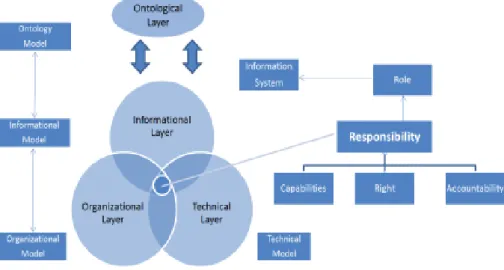
We consider that a service should be defined, as highlighted in figure 1, by the junction of the ontological domain that allows the description of the kernel of the informational (I) domain and that contributes to the elaboration of a part of the organizational (O) domain and the technical (T) domain. All these domains are concerned by the responsibility dimension. It facilitates the alignment between these domains.
In order to illustrate the different layers that we address in the proposed approach, we consider the following case: At the national layer, the state possesses a national repository in order to provide data related to the inhabitants of the country. That repository includes confidential and public information that is available to most of the nation’s public institutions according to the privacy policy. In order to facilitate the access to the information, a national commission has been charged to define the appropriate service.
2.1. Ontological layer
We use the legal framework which describes the conditions to manage the access to confidential and public information of the inhabitants of the country. The fundamental concepts and business rules extracted from the appropriate laws are used to build the ontological aspects [3].
The ontology model of the service which allows the access to the data related to inhabitants allows establishing and clarifying the links between laws and this service. It contains the stable common information to be used in order to specify this service. More precisely, the ontological layer permits to specify the business rules, the ontological roles and the fundamental concepts dedicated to specify this service.
2.2. Organizational layer
A service which concerns the access to the data related to inhabitants can be defined as one or several organizational context(s). For its execution this service can involve one or more roles and stakeholders.
A Role represents a set of necessary responsibilities, expressed organizational contexts, to perform the execution of the activities of the development process or to watch the execution of activities performed by the other roles [1]. The organizational layer also permits to describe the roles, the business activities and business processes related to the access of data related to the inhabitants.
2.3. Informational layer
The kernel of the informational level of a service is elaborated directly from the basis of the ontology model. The service architect has to make choices and decide for each concept and each link between concepts if it is mapped into a class, a transaction or an attribute, and so on. The organizational layer is used to consolidate
4 Service Science and the next wave in Enterprise Interoperability
and enrich the informational elements. The informational layer permits to describe the information needed for the service.
In [3], the content of the informational layer is described with three types of aspects, static, dynamic and integrity constraints constitute, as follows:
• Static aspects specify the data structure of the service;
• Dynamic aspects expresses the behavior of different elements of the service;
• Integrity constraints aspects specifying the constraints governing the behavior of the elements of the service. Integrity constraints of a service generally represent the business rules of an organization. An integrity constraint is a logical condition defined over classes, which could be formally described and verified by transactions or methods.
2.4. Technical layer
The technical layer of a service aims at representing the component of the information system that supports the realization of the service. In our approach, we consider the technical layer as all the components from logic and technique that compose the infrastructure, from the business application to the network component, servers, computers, and so forth.
In order to have service compliance, it is important that a service shared between two companies, or that a service access in one company by another, can be used on both IT infrastructure. This means, for instance, that at the security layer, the access or the restriction to the service must be identically specified by each enterprise.
2.5. Responsibility dimension
The review of the literature [6], [7], [9] and [10] in the field of management has permitted to highlight the concept of responsibilities assigned to a stakeholder representing the obligations of that last regarding the performance of business activities on the first hand and it defines the required rights and capabilities he therefore needs on the second hand. In our previous work [3][8], we have elaborated a responsibility meta-model, which we have used in different contexts in order to align the stakeholders’ responsibilities defined at the business layer down to the representation of that responsibility at the application layer. Using that meta-model has allowed, for instance, improving the assignment of access rights on the information data, to the stakeholders, according to the responsibilities they had at the business layer.
In the domain of service engineering, for the service compliance, considering that responsibility dimension provides a promising added-value since it facilitates the alignment between the different layers : the organizational layer (a responsibility is
assigned to a role that performs business activities), the informational layer (the responsibilities required information), and the technical layer (the responsibility has an existence at the technical layer e.g.: through the form of a class and is logically associated to a data object and to the employees’ ID).
According to our case, we analyze that one employee from each municipality administration is responsible for issuing family composition certificates to the inhabitant of the municipality. That activity composed the certificate issuing process (at the organization dimension) and needs access to the family composition information (at the information dimension). This is translated by a read access right to the inhabitants ID xxx public data provided to the official ID yyy (at the technical layer).
The responsibility aspects also permit to facilitate the management of services interoperability (e.g.: When two services share common information). The specification of responsibility dimension allows clarifying who is responsible for what data? who can access the data? For this task, it is necessary to have interoperability between some sets of concepts from each domains of each service.
Figure 2 : The responsibility dimension and the management of services
interoperability
3. Conclusion
The service oriented paradigm has been raising new crucial issues and challenges. Among these issues, the guarantee of service compliance and management of the services interoperability remains challenging.
The approach proposed in this paper allows considering that responsibility aspect of a service providing a promising added-value since it facilitates the alignment
6 Service Science and the next wave in Enterprise Interoperability
between the different layers of a service. It also enhances the management of services interoperability. The approach, proposed in this paper, needs formalization in order to specify the product part and the process part. Our future works focuses on the development of a case study, in the frame of the management of operational risk in the financial sector according to well established professional frameworks such as Basel II and III and Sarbanes-Oxley Act. At the present work, we are analyzing the opportunity to validate the approach in this context of managing risks in the financial domain.
References
[1] A. Khadraoui, W. Opprecht, M. Léonard; C. Aïdonidis, “Service Specification Upon Multiple Existing Information Systems”, 2011 Fifth International Conference on Research Challenges in Information Science RCIS 2011, May 19-21, Gosier, Guadeloupe.
[2] C. Feltus, M. Petit, E. Dubois, “ReMoLa: Responsibility Model Language to Align Access Rights with Business Process Requirements”, 2011 Fifth International Conference on Research Challenges in Information Science RCIS 2011, May 19-21, Gosier, Guadeloupe. [3] A. Khadraoui, W. Opprecht, C. Aïdonidis, M. Léonard, “Laws-Based Ontology for e-Government Services Construction Case Study: The Specification of Services in Relationship with the Venture Creation in Switzerland”, PoEM 2008: 197-209.
[4] C. Feltus, A. Rifaut, An Ontology for Requirements Analysis of Managers’ Policies in Financial Institutions, Interoperability for Enterprise & Software Applications (I-ESA2007), 28-30/3/2007, Madeira, Portugal.
[5] C. Feltus, M. Petit, E. Dubois, Strengthening Employee’s Responsibility to Enhance Governance of IT - COBIT RACI Chart Case Study, The 1st ACM Workshop on Information Security Governance (ACM WISG 2009) held in conjunction with the 16th ACM Conference on Computer and Communications Security (ACM CCS 2009), 13/11/2009, Chicago, Illinois, USA
[6] J. A. Fox, “The uncertain relationship between transparency and accountability” (August 1, 2007). Center for Global, International and Regional Studies. Reprint Series. Paper CGIRS-Reprint-2007-2. http://repositories.cdlib.org/cgirs/reprint/CGIRS-CGIRS-Reprint-2007-2.
[7] J. Dobson, and D. Martin, “Enterprise Modeling Based on Responsibility, Trust in Technology: A Socio-Technical Perspective”, Clarke, K., Hardstone, G., Rouncefield, M. and Sommerville, I., eds., Springer, 2006.
[8] C. Feltus, M. Petit, “Building a Responsibility Model Including Accountability, Capability and Commitment” Fourth International Conference on Availability, Reliability and Security (ARES), 2009, Fukuoka, Japan .
[9] I. Sommerville, R. Lock, T. Storer, J. Dobson, “Deriving Information Requirements from Responsibility Models”, Proc. of the 21st International Conference, CAiSE 2009, Amsterdam, The Netherlands, June 8-12, 2009. ISBN 978-3-642-02143-5.
[10] L. Cholvy, F. Cuppens, C. Saurel, “Towards a logical formalization of responsibility”, Proc. of the Sixth International Conference on Artificial Intelligence and Law, pages 233-242, 1997.