RESEARCH OUTPUTS / RÉSULTATS DE RECHERCHE
Author(s) - Auteur(s) :
Publication date - Date de publication :
Permanent link - Permalien :
Rights / License - Licence de droit d’auteur :
Bibliothèque Universitaire Moretus Plantin
Institutional Repository - Research Portal
Dépôt Institutionnel - Portail de la Recherche
researchportal.unamur.be
University of Namur
Expression of time in French Belgian Sign Language (LSFB)
Sinte, Aurélie
Published in:
Sign Language Research, Uses and Practices
Publication date:
2013
Document Version
Early version, also known as pre-print
Link to publication
Citation for pulished version (HARVARD):
Sinte, A 2013, Expression of time in French Belgian Sign Language (LSFB). in Sign Language Research, Uses
and Practices: Crossing views on theoretical and applied sign language linguistics. vol. 1, Sign Language and
Deaf Communities, De Gruyter - Mouton and Ishara Press.
General rights
Copyright and moral rights for the publications made accessible in the public portal are retained by the authors and/or other copyright owners and it is a condition of accessing publications that users recognise and abide by the legal requirements associated with these rights. • Users may download and print one copy of any publication from the public portal for the purpose of private study or research. • You may not further distribute the material or use it for any profit-making activity or commercial gain
• You may freely distribute the URL identifying the publication in the public portal ? Take down policy
If you believe that this document breaches copyright please contact us providing details, and we will remove access to the work immediately and investigate your claim.
Expression of time in French Belgian Sign
Language (LSFB)
Aurélie Sinte
1. Introduction
From 1970 onwards, researchers started to study how temporal informa tion can be expressed in sign language discourse. Friedman (1975) initi-ated the studies by assuming that American Sign Language (ASL), unlike many spoken languages, does not hâve a verbal flectional System in order to express tense. Alternatively, temporal information is encoded by relating lexical items or grammatical éléments to spatial time Unes. According to Friedman (1975), this time line is situated horizontally next to the signer and is divided into three areas: the body and the area right in front of the signer represent the présent, the zone behind him désignâtes the past, and the future is located in the space in front of him. Along this line, the signer's body is considered to be unmarked. By default, the body represents the time of utter-ance. Références are made by index finger pointing or by articulating lexical signs on the line, i.e., the more extended the arm movement the more distant the temporal référence. Friedman's description of this line was the first step
of a large number of studies exploring time expression in sign languages
(SL).
This paper présents some results of a PhD research project dedicated to
the expression of temporal information in French Belgian Sign Language
(LSFB). The paper consists of two main parts. The first part provides a global synthesis of studies conducted about time in various sign languages including what has been observed in LSFB (Section 2). The second one focuses on spécifie analyses of LSFB on the basis of a corpus of conver-sational and narrative data. The main research question pertains to the way temporal référence can be encoded in discourse. Is it lexically marked and is
that always the case? If not, how is temporal référence organised? From my
own research addressing thèse questions, it appeared that eyegaze behaviour (directed at the interlocutor or directed at the hands) varies and the regularity of thèse variations gives relevant éléments in order to describe temporal
206 Amélie Sinte
Expression oftinte in French Belgian Sign Language (LSFB) 207
référence marking in LSFB. The rôle of gaze is subsequently illustrated by means of two différent structures found in the corpus (Section 3). An addi-tional short section (Section 4) maintains that, unlike what we find in the literature, the unmarked time is not necessarily the présent time in the LSFB data.
2. Expressing time in sign languages: Previous studies
When studytng temporal référence, a large part of the sign linguistics litera ture is dedicated to the time Unes as metaphorical représentations of time, so that they seem to be an unavoidable starting point in any description of temporal marking. Those Unes are well known and Section 2.1. présents a summaiy of their usage in various Sign Languages (LSFB included). However, other éléments are also used and mentioned: lexical items (Section 2.2.), some spécifie markers (Section 2.3.), pointing and weak hand holds (Section 2.4.) and non-manual features (Section 2.5.). For each élément, I
will briefly outline the situation in LSFB on the basis ofthe collected corpus.
2.1. Time Unes
The use of the "back-to-front-timeline" to refer to past, présent and fiiture was first described for ASL but has also been found in many other Sign Languages, including: British Sign Language (BSL) (Brennan 1983; Woll and Sutton-Spence 1998), Danish Sign Language (DSL) (Engberg-Pedersen
1993), Sign LangUge of the Netherlands (NGT) (Schermer and Koolhof
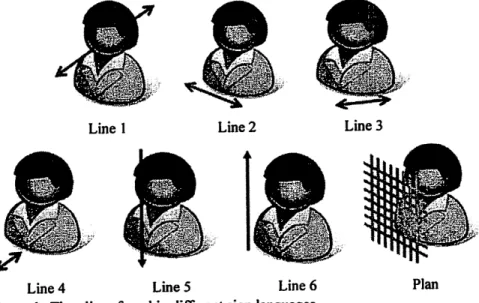
1990), Flemish Sign Language (VGT) (Van Herreweghe, 1995; Vermeer-bergen 1997), Fn;nch Sign Language (LSF) (Maeder and Loncke 1996), Italian Sign Langjage (LIS) (Pizzuto et al. 1995), Québec Sign Language (LSQ) (Lacerte 2001), Spanish Sign Language (LSE) (Soneira and Pereiro 2004) and Austra ian Sign Language (AUSLAN) (Johnston and Schembri 2007). In those va *ious descriptions, the line receives différent names: line A (BSL), deictic linu (DSL) or basic line (LSE), etc. This back-to-front-time line is usually the one mentioned first, but other Unes are described as well asshowninFigurî 1.
Line 1 Line 2 Line 3
Line 4 Line 5 Line 6 Plan
Figure L Time Unes found in différent sign languages
On line 1 (cf. Figure 1), as we said above concerning ASL, the past is
situ-ated behind the signer's body, the présent is right in front of him and on the
body itself, and the future is located in the area in front of the signer. The
movement of the signs articulated on this line détermines how far removed
the référence is. Ifthe movement is distant from the body, the time référence
is remote, either in the past or in the future. This line is linked to the western
conception of time (among others, Woll and Sutton-Spence 1999; Maeder
and Loncke 1996) in which the past features as something we leave behind
us and we cannot go back to while the future is a path we are walking on.
This représentation is not spécifie to Deaf culture; it is widespread in spoken
languages as well, as can be illustrated by the metaphor the "future is ahead"
(Taub 2001: 115). The iconic characteristics of sign languages hâve been
widely demonstrated and explained, but this metaphor is not spécifie to those
languages. Spoken languages also hâve various expressions using space in
a metaphorical way to express temporal références, as in "the deadline is
approaching, we are getting close to Christmas, timeflows by I canfeel a
headache coming' (Evans 2005: 61, 66). Although it is less common, some
cultures (for instance Chinese and other oriental cultures (Lacerte 2001))
represent the future behind the body because we cannot see what is coming
while we know the events that occurred in the past and we can hâve seen
them. So in those cultures the past is situated in front, Le., visible and known.
Line 2 is used in order to situate a séquence of events. The point of référ
208 AurélieSinte
less précise date) which must be explicitly given in tbe discourse. Other events are situated relative to this point The Iine is oriented from left to right (comparable to the written form of western languages) and is parallel to the signer's body. Références located on the left side are anterior to those located on the right side.
Line 3 is situated on a diagonal axis embodied by the non dominant arm from the elbow to the fingers. The use of this line varies from one SL
to another: situating events related to a référence point mentioned in the
discourse (DSL, Engberg-Pedersen 1993), expressing calendar units (BSL (Woll and Sutton-Spence 1999) and LSQ (Lacerte 2001)) or articulating signs like before or later (in LSFB for instance).
Line 4 constitutes a blending of the three first Unes, which is why it is called a "mixed line", a name that was first coined in DSL (Engberg-Pedersen 1993). It is perpendicular to the signer, right in front of him, in the middle of his chest. Periods or séquences situated on this line are always perceived from an anterior perspective. Events are seen coming in a very near future. Using this line, the speaker introduces a spécifie point of view regarding the
events.
Not many studies mention the existence of line 5 (exceptions are NGT and LSQ). It is called the 64top-down line" as it is a vertical line in front of the signer9s face. Days of the week are located hère when information is
organisée in the form of a week's schedule. Monday is then signed at the top
of the line and Sunday at the bottom.
The sixth line is a time line on which the growth of an individual from child to adult is expressed. In contrast to S, it is oriented from bottom to top. Signers frequently use this line when they talk about the major events, like studies and so on, in the life of an individual.
Finally, calendar units (comparable to line 5) can be organised on a plan rather than a line making use of two dimensions in front of the signer. This plan can be used z s a schedule ofa week or as a schedule of a year. In the first case, the first dim snsion (from top to bottom) allows the signer to give infor mation about eve îts occurring at différent moments in a day (morning at the top and evening it the bottom). The second dimension (from left to right) represents every iay of a week (from Monday to Sunday) so that there is one column for e* ch day. In the second case (also mentioned as a diagram in Sallandre 2007:1IS0), every vertical column represents a month. The begin-ning of the mont} is located at the top and the end at the bottom.
Not ail the lii es described above hâve been described for ail the sign languages mentiened. For BSL, for example, lines 1, 2, 3 and 6 hâve been described(Brennui, 1983; Woll and Sutton-Spence 1998). Lines 1 (deictic),
Expression oftime in French Belgian Sign Language (LSFB) 209 2 (sequential), 3 (anaphoric), 4 (mixed line) and the plan (calendar plan) hâve
been used in DSL (Engberg-Pedersen 1993). NGT uses lines 1, 2, 4, 6 and the plan (Schermer and Koolhof 1990). Lines 1 and 2 are respectively named basic and secondaiy lines in ESL (Soneira and Pereiro 2004). Researchers on LIS (Pizzuto et al. 1994) mention line 1 as an axis determined by the fact that the past is situated behind the body and the future in front of it. In LSQ
(Lacerte 1993) uses of lines 1, 2, 4, 5 and 6 hâve been observed. Johnston and Schembri (2007) confirm lines 1, 2 and 3 in AUSLAN but they do not
recognize the existence of line 6. Johnston (1989) even contests the descrip tion of this structure as a time line. According to him, this axis is only used with lexical items associated with the growth of individuals and has no link with a time line. He makes the argument that ifthe axis is used upside-down,
it signifies that somebody is becoming smaller and is never a référence to the past.
In LSFB, I found uses of lines 1,2, 3,4,6 and the plan.
Figure 2. two weeks future (line 1)
210 Aurêlie Sinte
Figure 4. before,1 (line 3)
FigureS, S00N(line4)
6. time passing / grow (line 6)
7. two periods of time (Tuesday from 8:30 AM to 10:30 AM and from 16:00 to 18:00) (are) free (plan)
Expression oftime in French Belgian Sign Language (LSFB) 211 2.2. Lexical items
In this paper, lexical time markers are understood as signs articulated by
the hands which convey temporal information. Numerous studies on various Sign Languages mention the usage of this kind of signs (LSQ, ASL, BSL,
LSE, NGT...). In LSFB, this includes signs such as 1) yesterday, tomorrow,
after, before and 2) calendar units such as year, month, day, etc.
Figure 8. yesterday Figure P. year
Figure 10. thursday
Many of those signs are articulated in space on the basis of the "time is
ahead" metaphor (see above). Variations expressing proximity or distance
of the références are marked by bodily movements and other non-manual
features (such as facial expression) (Baker and Cokely 1980).
Some lexical items bring up another orientation of time. This is, for
instance, the case of the sign before, in LSFB (as illustrated in Figure 4).
The past is situated on the left ofthe signer's body and the future on the right. The signs yesterday and before, are respectively associated with Unes 1
and 3.
In sign languages such as NGT, LSE, LSQ and LSFB, most calendar unit signs can receive two différent modulations: a movement can be added to the
212 AurélieSinte
handshape. The two modifications can be combined. Consider the sign year
(LSFB) in the example below:
Figure II. oneyear
Figure 12. four-years-ago
2.3. Spécifie markers
i
Baker and Cokelyj( 1980) hâve noted in ASL the existence ofcertain "spécifie"
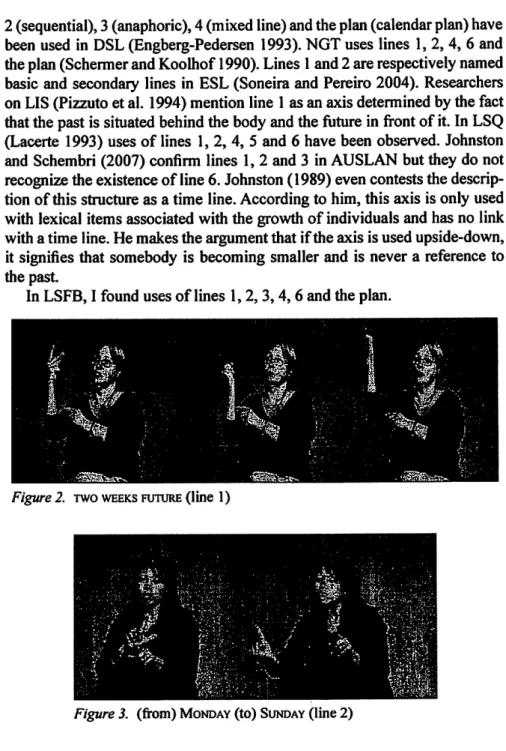
markers, viz. wili, finish and not-yet. In LSFB, such signs are also used as in Figures 13,14 uid 15.
Figure 13. not-yet
Expression oftime in French Belgian Sign Language (LSFB) 213
Figure 14. finish2
Figure 15. will
2.4. Pointing
Friedman (1975) is the first author to mention that index pointing can be
used for temporal référence. The past and future are marked by pointing at
the areas situated respectively behind and in front of the signer. According
to her, this kind of pointing is placed on the time line (see line 1 in Figure
1). She claims that pointing can be combined with lexical items but in thèse
cases, the pointing sign is considered as redundant.
In LSFB, pointing is also very common in temporal marking. When it
is associated with hand holds, it is used to maintain temporal références in
discourse. This will be discussed further down. To illustrate, hère is one
screenshot of the séquence developed in Figure 27.
214 AurélieSînte 2.5. Hand holds
Baker and Cokely ( 1980) hâve found referential uses ofthe weak hand. Signs
such as before, after, next and from-now-on are produced with both hands
but each hand has a différent fonction. One of the hands (in most cases, it
is the non-dominant hand of the signer) becomes the référence point and
is maintained in a point of space depicting a temporal référence while the
other hand îndicates a separate moment relative to the time marked by the
first hand hold. The same structure has been observed in LSFB. It will be
expounded on further down (Section 3.2.2.) and linked to eyegaze behaviour.
Expression oftime in French Belgian Sign Language (LSFB) 215
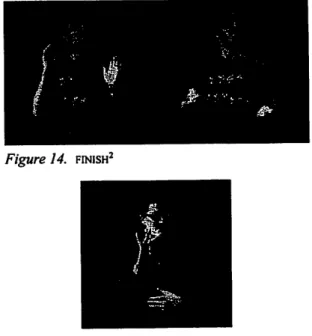
I Figure 17. recently
2.6. Non-manuals
In addition to information conveyed by the hands, temporal marking is
also indicated by non-manual éléments, Le., facial expression and body
movements.Baker and Cokely (1980) describe the rôle played by facial expression
and shoulder movements in the expression of what they call non-manual
adverbs in ASL. The authors say that the behaviour of the cheeks (puffed or
hollowed), of the eyebrows (frowning or raised), of the eyes (wide open or
nearly closed), ofthe lips and the mouth (pursed or open) and so on,
partici-pate in the construction of temporal références. For instance, puffed cheeks
signal that the temporal référence is quite distant from the présent, whereas
a temporal référence very close to présent is indicated by raising the cheek
andside ofthe mouth (Baker and Cokely 1980: 177-179). They note that
this global facial expression is pretty much tied in with shoulder movements.
The shoulder ofthe signer moves forwards and/or upwards for références to
the future while movements backwards refer to the past. The amplitude of
the movements and the intensity ofthe facial expression together mark the
time référence. The more intensive the movement, the closer the time référ
ence is to the présent both with a movement forwards and backwards. But it
seems difficult (if lot impossible) to describe exhaustively ail the variations
of facial expresskns and link them one by one to temporal significations.
Non-manual behaviour in LSFB does not differ from the description
ofnon-manuals in others SLs.
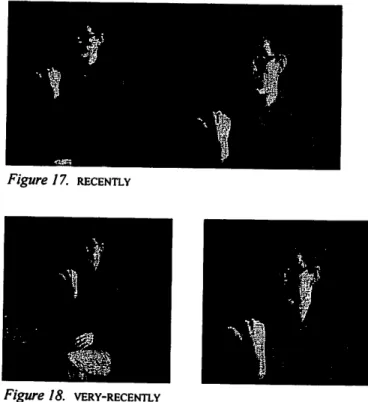
Figure 18. very-recently
In thèse figures, manuals are completely similar but the meaning ofthe signs
differs. Figure 17 shows an unmarked form ofthe sign récent. The face and
body are in neutral position. It signifies a temporal référence undetermined
in the récent past, not specifically close or distant from the présent Figure
18 illustrâtes the rôle of non-manuals. The facial expression is emphasized
(eyebrows raised and lips stretched) and the shoulder moves forwards. In this
case, the sign is understood as very-recently. The référence is considered as
very close to the présent.
2.7. Remarks on the basis of LSFB observations
Besides the description ofthe features developed above (time lines, lexical
signs, spécifie markers, pointing, hand holds, facial expression and body
movements) which are overall quite similar for LSFB, in the literature, we
find additional comments about time expression. Two of thèse comments
will be discussed hère because with respect to LSFB some modification
216 Amélie Sinte
Lacerte 1993; Soneira and Pereiro 2004) that the preferred way to organise différent références to time is the chronological order ofevents. The séquence of events in discourse tends to reflect their real succession. It supposes that the signer knows exactly, in advance, what he is going to say so that he is able to avoid any flashback or anticipation. This adhérence to chronology seems to be common. It has been observed in DSL, VGT, LSQ and LSE, as well as in LSFB. AH the narratives in the data3 (which make a total of 21 séquences signed by 8 différent signers and a total of 70 minutes recording) are recounted in chronological order. But the conversational data (the majority ofthe corpus) also shows examples of events told in an order which is not chronological. One of the tasks proposed to the signers is to explain four events organised in a schedule on a slide. Three of the four participants do not use chronological order to situate the events. Since they can see ail events on one slide, it was expected that they would follow the chronology but for three of them, this is not the case. The example fully presented below (Section 3.2.2, first example. Figure 27) illustrâtes that non-chronological order.
Secondly, it is generally considered (Friedman 1975; Cogen 1977; Baker and Cokely 1980; Schermer and Koolhof 1990; Soneira and Pereiro 2004) that, when there is no explicit marking of time, the time by default is the présent. This leaves us with at least two questions: firstly, what do we call "no explicit marking of time" and secondly, in the absence of any mark, is the point of référence always anchored in the présent? Indeed, in narratives, why do we consider the discourse to be in the présent? In the cartoons of the corpus, there is no clue as to when they happen and the signer has no reason to specify the time. But there is no argument to say that no mark implies that the story is told in the présent. Analyses of spoken languages in which the use of a verb necessarily implies temporal marking may hâve influenced the description in sign languages. In French for instance, story-telling can be
done in the présent tense as what is called a "narrative présent" which is used
as an undetermined time and is typical of stories. But this stoiy time might be différent and taues can also be told using the imperfect tense. So, in LSFB, when there is no sign, no item, no facial or corporal expression which gives information abouti time, the discourse is considered as unmarked. Criteria to distinguish between présent tense and unmarked time hâve to be discovered and described. A ftrst approach will be proposed in Section 4.
Expression oftime in French Belgian Sign Language (LSFB) 217
3. Analysisof LSFB data
Beside the inventory ofthe éléments involved in temporal marking, it seems relevant to focus on how those éléments combine to organise temporal référ ences in différent types of discourse (viz. monologic narratives vs. conversa
tions in this research). Within the LSFB data, I noted that two features (Le., eyegaze and hands) are related to each other in such a way that, together,
they anchor the temporal landmark.
3.1. The data
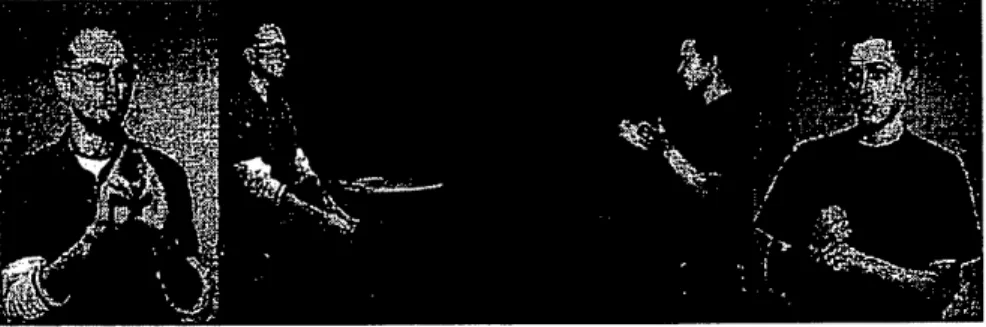
The corpus used in the présent study is composed of various data. A first set ofvideos was recorded in June 2010. In that set, there are two distinct parts. The first part4 is composed of four signers interviewed by a deaf informant
on personal topics (j°b, studies, etc.) and filmed with three caméras (one
facing each speaker and a wide view ofboth). The second part deals with the same four signers who are looking at a powerpoint présentation consisting of pictures, videos and schemata related to temporal information (schedule, short cartoons, etc.). They are asked to sign what they see5.
Figure 19. First part of the videos with a deaf interviewer.
218 AurélieSinte Expression oftime in French Belgian Sign Language (LSFB) 219
A second set of videos was recorded in November 2011. Fourteen signers participated in this data collection setting. They talked in pairs, responding to two séries of 21 questions (about various subjects such as history, culture, current affairs, personal activities and hobbies...) submitted in LSFB (signed by a native signer) on a screen next to one of the signers (they changed position after the first séries of questions). Thanks to this setting (absence of the hearing researcher, no powerpoint présentation on a screen, questions signed by a native signer and the variety of the topics) those data are much more spontaneous than the data ofthe second part of 2010 and the dialogues between the two informants are less formai.
Figure 2L Arrangement of November 2011 recording.
In addition to those two principal sets, colleagues from the University of Namur hâve been kind enough to allow me access to their previous videos recordings (only one caméra facing the signer) which consist of four version of the same cartoon ("Illusion") signed by four différent people6 and six interviews (for six différent signers) about their personal and professional
lives7.
3.2. Analyses
A first sample of the data (called sample 1) has been analysed consisting of 4 hours and 25 minutes of videos including conversations and narratives, involving 7 signers (aged from 27 to 60), taken from both corpora (4 signers from the 2010 corpus and 3 signers from the 2011 corpus). The question that led the research focused on how temporal références are expressed and organised in discourse. Temporal information such as dates, periods and events are expressed in various ways. The goal is to bring to the foreground how they are encoded and how they are linked to one another. During the analysis it became clear that a combination of the behaviour of the eyegaze and the hands reveals éléments relevant to a description of temporal référ ences. The focus is on the rôle of eyegaze and this rôle is observed through two distinct structures noted in the corpus. The first one, which has not yet been described in the literature, is a comparative structure of two moments in time in which the répétition of an élément produces a bracketing effect. The second one is the pointing sign hold. This structure is better known but has not yet been thoroughly studied with respect to temporal information and has not been studied at ail in LSFB. The two structures hâve been chosen because of their récurrence in the data.
3.2. L Comparison oftwo moments in time
In various séquences, comparisons between two moments or periods of time hâve been noted as illustrated in Figure 24. Eleven occurrences of this construction (signed by four différent signers) hâve been found in sample 1.
Figure 22, Cartoon 'Illusion Figure 23. Interview.
BEFORE, NOW BEFORE2
Figure24. Comparison between two periods (LSFB2010 BS cl.00.18.31.730 cl.00.18.55.428)
220 AurélieSinte Expression oftinte in French Belgian Sign Language (LSFB) 221
Hère are the glosses and the translation of the whole séquence (which is too
long to be illustrated with screenshots):
BEGINNING BEFOREX INTERNET NOT YET BEFORE! 1994 UNTIL 2000 PERIOD MORE
GROUP PROFESSIONAL DOWNLOAD NO BUY PART YOU WANT ME COPY GrVE BUT YOU BUY WHAT YOU GIVE ME EXCH^NGE TRY EXCHANGE COMMUNICATION THINK SAME
BUY NO FREE EXCHANGE NOW MORE AND MORE INTERNET DOWNLOAD EXCHANGE NO
DOWNLOAD ALL SIGNING FEWER AND FEWER MEET SOMETIMES SIGNING A BIT THAT'S
ALL BEFORE, MORE YOU HAVE WHAT EXCHANGE SIGNING MORE
4At the beginning, before the Internet, that is to say before a period situated
between 1994 and 2000, it used to be groups of professionals. We didn't download (the software) but we bought some. You want me to give you a copy? Ok, but what did you buy? You give me yours and I give you mine. There was exchange and communication. We thought the same. We didn't want to buy but exchanged for free. Now, we download more and more. We
can download everything so there is no more exchange. So the signing (about
software) is increasingly rare. You meet someone sometimes and you sign a bit but not a lot. Before, we signed more thanks to the exchanges.'
In the example shown hère, the signer compares how people shared infor
mation about computer programs before and after the spread of the Internet that is to say (according to the signer) before and after 2000. To explain the
différences, the signer begins by giving dates. His explanation is divided into three parts. First, he starts with dates associated with the sign before, (i.e., the period between 1994 and 2000; cf. also endnote 1) which is the second
sign ofthe séquence indicating that the comments he makes are related to the
period before the advent of the Internet. Then, the sign now is quickly
real-ised and followed by information about actual practices regarding computer programs. The lexical sign is brief but is salient enough to mark the distinc
tion between the itwo moments. And finally, the speaker goes back to the previous period \n order to repeat how the situation was before 2000. This third part is introduced by the sign beforEj. Each of the three parts contains a
lexical time mark >r. In this case: before,, now and before2.
The use of this type of structure "embraciates" information. The
brack-eting consists of i répétition of an élément A (or a séquence of éléments) which flank anoth sr séquence of éléments B (for a related topic, see Meurant 2010). For tempo al constructions, it is the first time that this kind of répéti
tion (A-B-A) is c escribed. The particularity in the présent example is that
the repeated elem snt has two distinct forms: before, and before2. Both signs are used to talk a>out the period before 1994-2000 but they hâve différent
implications in teins of référence point and enunciation. The sign before,
is produced using both hands. The weak hand holds and anchors the référ
ence point which is given directly after this sign (1994 until 2000 period) while the dominant hand moves backwards on the arm to indicate the next information is relative to the period that précèdes the point of référence, namely before 2000. The sign BEFORE, cannot be used alone, i.e., without an explicit lexicalised point of référence, otherwise it is impossible to grasp which moment or period the signer is talking about It is part of a constituent composed by at least before, and a lexical sign. But the explicit élément is sometimes given before and sometimes following before,. Hitherto, a préf érence for a spécifie order or syntactic différences between the two possibili-ties has not been found. The sign before^ is articulated only by the dominant hand. It is characterised by a backwards movement over the shoulden Unlike before,, BEFOREa can be used alone, without any lexical item.
Furthermore, the eyegaze behaviour provides an insight into the two signs before. In the first case, the manual articulation of before, is associ ated with a gaze eut off from the addressee and resting on the hands (see pictures above), and more precisely on the point associated with the référ ence (1994-2000) indicated by the contact point of the two hands. In this séquence constructed with before,, the eyegaze strengthens the référence (given explicitly by the dates) anchored in the signing space by the hands.
Then, after having explained what happened before 1994-2000, the signer describes the current situation. The sign now introduces comments about a period between 2000 (transition moment) and now. This period is linked with a kind of gênerai présent and so associated with the time of speaking. And in this case, it co-occurs with an eyegaze oriented towards the addressee during the articulation ofnow.
Finally, the signer uses before2 in the third part of the structure with the eyegaze on the addressee, contrary to the first séquence (with before,). Also, there is no manual sign connected to beforEj. At that moment, the référence point (which has just been defined) is the gênerai présent équivalent to the time of speaking. The speaker repeats briefly how the situation was before the transition moment i.e. before a period commencing in 2000 and which continues now in the présent. The répétition (A-B-A) therefore occurs at a semantic level: the signer mentions what the situation was like before 1994— 2000 twice, but he introduces the two occurrences by means oftwo différent signs with the same semantic meaning.
A second, very similar example has been found in the videos of another
222 Amélie Sinte Expression oftime in French Betgian Sign Language (LSFB) 223
FASHION CHANGE
'Fashion has changed.'
BEFOR£2 TELEVISION A BIG FORM
'Before, the télévision was large.'
NOW TELEVISION FLAT (SCREEN)
'Now, the télévision has a flat screen.'
BEFORE2 CHANGE
'Before, it was différent.'
Figure25. CompaHson between two periods (LSFB2010 LMU cl.00.16.55.279 -cl.00.17.06.908)
The signer compares télévision set designs at two moments in time.
She explains that before, the télévisions were big and bulky but now the screens are smaller and thin. The répétition of "before" produces a
brack-eting effect. In this case, contrary to the previous example, she uses the same
sign beforEj twice. This sign is not linked to any date or any lexical item. There is no précise information about the time the signer refers to. As said for the previous example (Figure 24), the signs BEFORE2 does not need to be correlated with an explicit référence point. Hère, the signer simply refers to a contrast between the présent and the past. She uses the same signs before2 but in this example, the passive hand participâtes in the anchoring of the référence and there is a slight différence between the two occurrences. The
first time, the passive hand is an index handshape which can be regarded as a
spreading of the lexical sign télévision which précèdes before^ The second time, the same spreading phenomenon occurs. This time, the handshape of the passive hand is similar to the handshape used to represent the flat screen
of modem télévisions.
With respect to eyegaze, the same observation can be made on the basis of this second example. The sign before2 does not require a gaze on the
hands because it is not linked to any lexical item articulated by the hands in signing space and the référence point is the time of the dialogue so the gaze is oriented to the addressee.
Analyses of this kind of séquences by means of the observation of eyegaze and hands combined give a new approach to the study of temporal expressions and time lines. In the examples discussed above, temporal référ ence signs are articulated on lines 1 and 3. before, is linked to Une 3 while BEFORE2 and now are articulated on line 1. The rôle of eye gaze in temporal marking is focused on as it provides an anchoring of the référence point. When oriented to the interlocutor, it signifies that the temporal landmark is the time of speaking (even if, as in the first example, the présent has to be understood as a large period i.e. from 2000 to now). Line 1 is called a deictic line (Engberg-Pedersen 1993) and indeed the deictic fonction of the signs articulated on this line is endorsed by the eye gaze. Line 3 does not require this kind of eyegaze, on the contrary, temporal signs on this line are articu lated together with an interruption of the gaze on the addresse. Signs of line
1, combined with a gaze on the addressee activate a landmark determined by the time ofthe utterance while signs articulated on line 3 supported by a gaze
(even briefly) eut off from the addressee and oriented on the hand(s) activate a landmark determined explicitly in the discourse and which can be any time, past, présent or future. Clearly, eyegaze behaviour is significant
224 AurélieSinte
3.2.2. Temporal landmarks as pointing sign holds: a buoy
The data show another structure involved in temporal marking, Le. the
pointing sign holds. This type of pointing has been described as a "buoy"
by Vogt-Svendsen and Bergman (2007). The définition of buoys is based on
Liddell:
"Signers frequently produce signs with the weak hand that are held in a sta-tionary configuration as the strong hand continues producing signs. Semanti-cally they help guide the discourse by serving as conceptual landmarks as the
discourse continues. Since they maintain a physical présence that helps guide
the discourse as it proceeds I am calling them buoys. Some buoys appear only briefly whereas others raay be maintained during a significant stretch of signing." (Liddeil 2003:223)
Liddell présents four différent types ofbuoys: list buoys, thème buoys, frag
ment buoys and pointer buoys (for more about this topic, see Liddell 2003 p. 223-260). Vogt-Svendsen and Bergman (2007) add yet another type of buoy, i.e., the point buoy, and maintain that "buoys typically represent discourse entities and, as such, can be pointed at, and hâve verbs and pronouns directed towards them. The POINTER buoy (an extended index finger), however, is spécial in that itpoints towards an entity, rather than represents it." (Svendsen
and Bergman 2007: 217)
Articulated by the weak hand, it can be realised with two différent hand-shape: a flat hand or an extended index finger. In the temporal context, the point buoy indicates a landmark and the signs that follow are situated in relation to it.
The same type of pointing signs has been identified in the LSFB data. Once again, it is the corrélation between eyegaze and hands which guide the analysis and the description ofthis pointer buoy in LSFB.
In the next example, the signer explains the schedule presented in
Figure 26.
Expression oftime in French Belgian Sign Language (LSFB) 225
Monday 1 8 15 Holidays 22 29 Tuesday 2 9 16 Holidays 23 30 Friend's birthday Wednesday 3 10 17 Holidays 24 31 Thursday 4 2pm: dentist 11 18 Holidays 25 Friday 5 12 19 Holidays 26 Saturday 6 13 lOam: hairdresser 20 Holidays 27 Sunday 7 14 21 Holidays 28
Figure 26. Mardi schedule.
The only instruction given to the signer is "explain what you see". We do
not know whether Mardi is in the présent, the past or the future. The signer
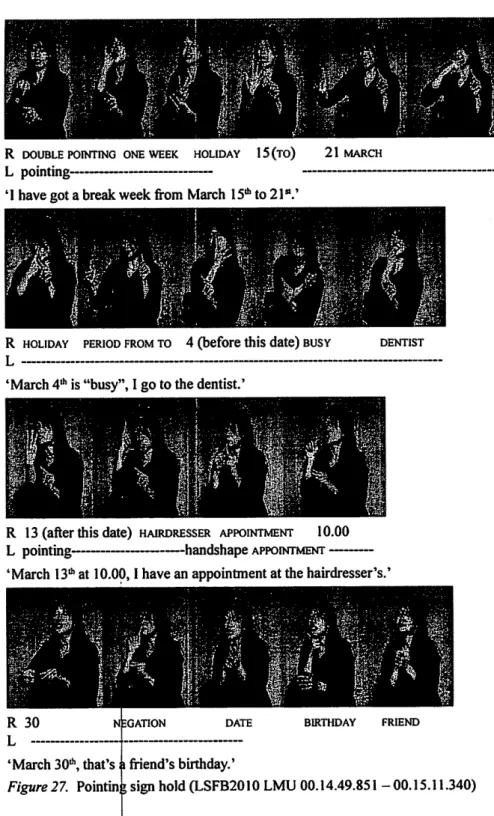
can choose the point of référence. One signer begins her explanation with the week off in the middle and she situâtes the other events in relation to that week. She décides to imagine a context and she adds a comment before starting the explanation. "You want an appointment in Mardi? Wait..." and then she develops the schedule. Therefore, the point of référence she gives is the break week. She establishes that landmark with two pointing signs produced simultaneously by both hands pointing at the same locus and she maintains one ofthem with the passive hand. The buoy is held during almost the whole description. She interrupts the hold one time because of the artic ulation of the sign holidays8 which is most often signed with both hands and she stops at the end of the description, for the Iast event (Mardi 30*: birthday) when she signs date, which also requires both hands.
226 Amélie Sinîe
R DOUBLE POINTING ONE WEEK HOL1DAY 15(to) 21 MARCH
L pointing
'I hâve got a break week from March 15* to 21V
R holiday periodfromto 4 (before this date) busy
L
DENTIST
'March 4th is "busy'\ 1 go to the dentist.'
R 13 (after this date) hairdresser appointment 10.00
L pointing handshape appointment
'March 13* at 10.00,1 hâve an appointment at the hairdresserV
Si 'March 30*, that': Figure 27. Pointin BIRTHDAY FRIEND friend's birthday.* 5signhold(LSFB2010 LMU 00.14.49.851 -00.15.11.340)
Expression oftinte in French Belgian Sign Language (LSFB) 227 Every times the signer gives a new date, she stops looking at the addressee and looks at her dominant hand and therefore at the area associated with the date mentioned. In the meantime, she maintains her passive hand as a pointing sign. This hold refers to the first date (the break week between March 15* and 21*) which is the référence point for the whole séquence. This pointing does not refer to a short and précise moment. It is not only a day but a whole week. As in the example above, the référence time is a period (more or less long as the case may be: a couple of years or a week) and not a given point in time.
The first appointment the signer describes is on March 4* and to situate
it, she moves her right hand with handshape "4" backwards and to the left of the pointing hand. The dominant hand signs the new temporal information while the other hand maintains the référence point. As such she mirrors the représentation of the éléments on the screen. The same process occurs for the second appointment but in this case, the dominant hand articulâtes the sign "13" and moves forwards to the right of the pointing hand and is held there to indicate the situation of 13 in relation to 4 and the holiday which is still the référence point maintained on her weak hand. However, the hand shape ofthe weak hand changes while producing the sign appointment to two
extended fingers (index and middle finger). The third date (March 30*) is
also signed by the right hand but the left hand no longer engages in pointing, but there is a manual spreading (see Sâfâr and Crasborn, this volume) of the sign appointment (which at the same time might be related to a pointing sign because ofthe similar handshape and because the signer maintains the hand shape while her right hand articulâtes the date march
30™)-With respect to time lines, this séquence can be regarded as a mixture of two aspects. On the one hand, the beginning of the séquence can be situated on time Une 2. From the first sign double pointing to dentist (corresponding to the first eleven pictures), éléments seem to be articulated on this séquence Une (Engberg-Pedersen 1993). On the other hand, when she signs 13 (after this date) hairdresser, she maintains the buoy, which is still referring to the holidays (from 15* to 21*), but following the chronological order of line 2, March 13* is not situated on the right of the landmark. It is anterior to the référence point and not posterior to it, so it should be situated on the left, but this is not what we observe in the video. This can be explained by the fact that the signer is influenced by the calendar she sees on the screen (see Figure
26). On the picture, 13* is on the right side of4*. This position détermines the movement oriented to the right. The previous date she mentions is 4* and it is
relative to this date that she situâtes 13*, adhering to the "plan" timeline. The last date (30*) she gives is again located on line 2. The signer articulâtes the
228 AurélieSinte
sign 30 forwards and downwards, in an area situated on the right (Figure 15, first picture ofthe last row). So, this séquence shows mixed uses of line 2 and the plan and not only of the plan as one might hâve expected for the whole description of the schedule. We also see that, again contrary to expectations, she does not follow the chronological order despite the fact that she sees ail the éléments on the screen. There is no apparent reason for mixing the dates but she does. She chooses a référence point (the holidays) and she situâtes the other events before and after regarding to this référence point.
However, the point ofréférence is given by the combination ofthe eyegaze and the hands. In this séquence, it corresponds to a moment defined explic-itly in the discourse and not to the time ofspeaking. During the pointing sign, the eyegaze is directed from the interlocutor onto the passive hand. Interrup tions of the gaze on the addressee occur every time a new date is introduced when pointing anchors the référence point.
A second example illustrâtes the same process. The Mardi schedule is submitted to another signer. She explains the same events but in a différent order. However, a pointer buoy occurs hère as well.
Expression oftime in French Belgian Sign Language (LSFB) 229
R/L TUESDAY POINTING MUST 'Next Tuesday, 1 hâve to go to the dentist at 14.00/
GO
R
pointing-L point
TWO WEEKS FUTURE
'Because two weeks later,
HOLIDAYS
41 go on holidays.'
Figure28. Pointing sign hold(LSFB2010 DM cl. 00.19.39.710-00.19.45.102)
A pointing sign occurs at the beginning ofthe example, directly after tuesday. In LSFB, it is a way to signify the proximity ofthe date, i.e. the next Tuesday.
230 AurélieSinte Expression oftime in French Belgian Sign Language (LSFB) 231 There is no hold at this moment. Then the signer gives détails about the
event linked to the date (i.e., the appointaient with the dentist). Next, another event happens two weeks later. She cornes back to the first date represented by the index handshape with both hands pointing at the same locus (third row, first picture) and maintains that locus with the pointer buoy while the
active hand gives new temporal information: first, the passive hand is fixed
while the active hand moves forward in order to situate the two dates rela tive to one another and then the pointing is still held while the active hand
continues to articulate three signs that express new temporal information
(two weeks future). When she signs the pointer buoy, her gaze is oriented on the hands because this new référence requires the support ofthe eyegaze. The eye contact with the addressee is interrupted and the référence point is not the time of speaking.
4. Unmarked time versus présent time
Through the analysed data, it appears that the ambiguity between "présent tense" and "unmarked time" is due to the fact that both occur in a context in which there is no explicit temporal marking (explicit marking would be any manual items such as lexical signs or pointing and other manual hand-shapes which can also be used for pointing). But the absence of explicit marking does not necessarily imply the présent time by default. When there is no morphological or syntactic élément that warrants a temporal interpréta tion, the référence time is either undefined or it has to be understood from the context and/or from the semantics of non-temporal lexical signs. Such analysis can be suggested for ail the narratives described in Section 2.7 (70 minutes of 21 séquences, 8 signers). AU those cartoons (see endnote 3) are signed by ail the informants without any explicit marking and the time
of the story is not defined. That is why they are considered as temporally
unmarked séquences (but they do follow the chronological order of events). Moreover, in the :onversational data from the analysed sample, there are a number of sequen :es in which time is also unmarked. A part ofthe conversa tion between two
01.39.13.599 toO and good or bad a bad one (01.43.:
informants (in th corpus of November 2011 SD and SdH
.46.34.290 that is more than 6 minutes) concerns holidays memories about travelling. In this séquence, one of the
signers talks about a good memory (01.40.26.154 - 01.43.35.750) and about |
9.624 - 01.44.30.300). During those 4 minutes, the signer produces no explbit temporal marking: no lexical item, no pointing, nothing i that could be ana ysed as temporal anchoring. But in those cases, it seems
impossible to consider the référence point as the présent time. There is no misunderstanding between the interlocutors. They are talking about memo ries so they obviously talk about the past. The context and the sign memory which appears in the question of the first signer seem to give sufficient infor mation about the temporal référence point. This is an example of unmarked time which cannot be associated with the présent time.
5. Conclusions
In this paper, issues with respect to temporal expression hâve been focused on. First, at the level of discourse, the rôle of eyegaze has been underlined through two différent structures involved in the marking of temporal infor mation. On the one hand, the semantic répétition of a period (or moment) which implies an embraciating construction in three parts (A-B-A). On the other hand, there are buoys functioning as anchors by comparison to which new temporal points are situated.
The analyses confirm that the description of the time lines System does not provide ail the éléments involved in temporal marking. In fact, the anchoring of a référence point also dépends on where the gaze is oriented to when the hand(s) articulate(s) temporal signs or maintain(s) pointer buoys. When the point of référence is the time of utterance, the eye gaze is oriented to the addressee while the hands articulate the temporal sign (e.g., now in the first extract) But the présent can be a longer period including the current moment of discourse (e.g., in the same example, "now" refers to the period between 2000 and now). On the contrary, when the référence is linked to a point defined in the discourse and which is not concomitant with the time of speaking, the eyegaze is briefly eut off from the addressee and oriented towards the hands (as in beforeI in 3.2.1.), or towards the hand which is signing the new temporal information (as in march 4™ in 3.2.2.).
Parallel to those statements and analyses, some points still need to be thoroughly investigated: among other things, the notion of adverb, the défini tion of aspect and the relationship between temporal and aspectual marking. This is the direction I expect my doctoral research to take next.
Acknowledgments
I would like to thank Prof. Jean Giot, Dr. Laurence Meurant and Dr. Myriam Vermeerbergen who guide and support me in my doctoral research with
232 AurélieSinte Expression oftime in French Belgian Sign Language (LSFB) 233 constructîve and usefiil advice. A spécial thanks go to the deaf informants
and to my colleagues for sharing data and ideas. And I would also like to
thank Jean Robertson and Mieke Van Herreweghe for the English correction
ofthispaper.
Notes
1. I use the gloss beforeI (in contrast with before2) because in LSFB, différent
signs are glossed by the same French word "avant". (Meurent and Sinte, 2013) 2. This maiker (finish) has already been studied by Meurant (2008) and analyzed
as a morphological component ofthe verb.
3. There are 4 différent versions ofthe cartoon "Illusion" (the cartoon lasts 11.30
min), 4 ofthe cartoon "For the birds" (03.23 min), 4 of "Knick Knack" (02.00
min), 4 of "The pink lollipop attack" (04.41 min) and 5 short cartoons of "Wall-e" (02.30 min).
4. The data collection System of this corpus is based on the Creagest Project
(2007-2012). See Balvet et al, 2010.
5. This part of the recorded data présents a major problem. The power point présentation influences the orientation of the signers* eyegazes. They need to
look at it before and during signing. A part of those videos are therefore not
usable. Besides, the fect that the interviewer is a hearing researcher influences
the answers of the signers who are tempted to adapt their signing in fonction
Tf
of their non-native interlocutor, whether they do so consciously or not. For at least both reasons, new data has been collected in a more appropriate manner resulting in the November 2011 corpus.6. i.e., video recorded in the context ofthe research group on LSFB for bilingual teachers in 2004.
7. i.e., the corpus composed for the dictionary of LSFB project funded by "Le
prix Clinique de Bel Oeil".
8. There is a second instance of holiday (first picture, second row) in which the
passive hand is not involved.
Références
Antinoro-Pizzuto, Elena, Emanuala Cameracanna, Serena Corazza, and Virginia
Volterra
1995 Terms for spatio-temporal relations in Italian Sign Language. In Iconicity in Language, Raffaele Simone (éd.), 237-256. (Current Issues in linguistic theory 110.) Amsterdam/Philadelphia: John
Benjamin Publishing Company.
Baker-Shenk, Charlotte, and Dennis Cokely
1980 American Sign Language: A Teacher's Resource Text on Grammar and Culture, Silver Spring, MD: T.J. Publishers.
Balvet, Antonio, Cyril Courtin, Dominique Boutet, Christian Cuxac, Ivani Fusellier-Souza, Brigitte Garcia, Marie-Thérèse L'Huillier, and Marie-Anne
Sallandre
2010 The creagest project: a digitized and annotated corpus for French sign language (LSF) and natural gestural languages. In Proceedings ofthe Seventh International Conférence on Language Resources and Evaluation (LREC'10), Nicoletta Calzolari, Khalid Choukri, Bente Maegaard, Joseph Mariani, Jan Odijk, Stelios Piperidis, Mike Rosner, and Daniel Tapias (eds.), 469-475. Paris: European Language Resources Association (ELRA).
Brennan, Mary
1983 Marking time in British sign language. In Language in Sign, Jim Kyle, and Bencie Woll (eds.), 10-31. London: Croom Helm. Cogen, Cathy
1977 On three aspects oftime expression in ASL. In On the Other Hand,
New Perspectives on American Sign Language, Lynn Friedman (éd.), 197-214. (Language, thought, and culture) NY/London: Académie Press.
Engberg-Pedersen, Elisabeth
1993 Space in DanishSign Language: TheSemantics andMorphosyntax ofthe Use of Space in a Visual Language. Hamburg:
Signum-Press. Evans, Vyvyan
2005 The Structure of Time. Language, Meaning and Temporal Cognition. (Human Cognitive Processing 12.) Amsterdam/ Philadelphie John Benjamins Publishing Company.
Friedman, Lynn A.
1975 Space, time, and person référence in American Sign Language.
234 Aurélie Sinte
Johnston, Trevor, and Adam Schembri
2007
Australian Sign Language. An Introduction of Sign Language
Linguistics. Cambridge: Cambridge University Press.
Klima, Edward, and Ursula Bellugi
1980
m> Signs ofLanguage. Cambridge/London: Harvard Universiry
Lacerte, Lise
1993
L'expression du temps en LSQ. In Etudes sur la Langue des
Signes Québécoise. Colette Dubuisson, and Marie Nadeau (eds )
137-152. Montréal: Presses du l'Université de Montréal
Liddell, Scott K.
2003
Oramman Gesture and Meaning in American Sign Language
Cambridge: Cambridge University Press.
Maeder, Christine, and Filip Loncke
1996
Spatial, temporal and temporo-logical notions in French sign
language: comparative study of deaf and hearing subjects SiTn
Language Studies 90: 38-51. '
Meurant, Laurence
2008a
Expression oftime in French Belgian Sign Language (LSFB) 235
Le Regard en Langue des Signes, Anaphore en Langues des
Signes Française de Belgique (LSFB): Morphologie, Syntaxe
Enonciation. Rennes: Presses Universitaires de Rennes.
Rôle shift, anaphora and discourse polyphony in sign language of
f?o ^ oClgiUm (LSFB)- taSigns °fthe Tme> JoseP Q« (éd.),
319-351. Hamburg: Signum Press.
Simultanéité et linéarité : leur grammaticalisation en LSFB In
Système etChronologie, Catherine Douay (éd.), 255-273. (Rivages
Linguistiques) Rennes : Presses Universitaires de Rennes.
Meurant, Laurence, and Aurélie Sinte
2013
Towards a corpus of French Belgian sign language (LSFB)
SS^iT md Language Liesbeth Degand>
2008b 2010 Sallandre, Marie-Anne 2007 Langua± Lorraine Issues ir Benjamins
Simultaieity in LSF discourse. In Simultaneity in Signed
tes. Form and Function, Myriam Vermeerbergen,
Leesson, and Onno Crasborn (eds.), 103-125. (Current
Linguistics Theory 281.) Amsterdam/Philadelphia: John
îs Publishing Company.
Schermer, Trude, and Corline Koolhof
1990
The reality of time lines: Aspects of tense in Sign Language of
the Netherlands (SLN). In Current Trends in European Sign
Language Research, Siegmund Prillwitz, and Thomas Vollhaber
(eds.), 295-305. (International Studies on Sign Language and the
Communication ofthe Deaf9.) Hamburg: Signum-Press.
Quelle temporalité en langue des signes française de Belgique
(LSFB). In Système et Chronologie, Catherine Douay (éd.),
275-294. (Rivages Linguistiques) Rennes : Presses Universitaires de
Rennes.
Français - Langue des signes française de Belgique (LSFB):
Quelques éléments d'analyse contrastive des temps verbaux
Cahiers de l'AFLS 16:129-152. Soneira, Ana, and Carmen Pereiro
2004
The expression oftime in LSE. Sign Language andLinguistics
7-63-82.
Stokoe, William C, and E. Lynn Jacobowitz
1988
Signs oftense in ASL verbs. Sign Language Studies 60:331-340.
Sutton-Spence, Rachel, and Bencie Woll
Sinte, Aurélie 2010a 2010b 1998 Taub, Sarah F. 2001
The Linguistics of British Sign Language. An Introduction.
Cambridge: Cambridge University Press.
Language from the Body. Iconicity and Metaphor in American
Sign language. Cambridge: Cambridge University Press.
Van Herreweghe, Mieke
1995
De Vlaams-Belgische Gebarentaal: Een eerste verkenning. Gent:
Academia Press.
Vermeerbergen, Myriam
1997
Grammaticale Aspecten van de Vlaams-Belgische Gebarentaal.
Gentbrugge: Cultuur voor Doven.
2006
Past and current trends in sign language research. Language and
Communication 26: 168-192.
Vogt-Svendsen, Marit, and Brita Bergman
2007
Point buoys. The weak hand as a point of référence for time and
space. In Simultaneity in Signed Languages. Form and Function.